




Abstract
In resource extraction regions, nation-states tend to be depicted as the legal authority sanctioning profitable mining operations in close collaboration with corporate actors in their domestic territories. Especially in post-colonial contexts, corporate sovereignty is the term deployed by anthropologists to depict the acts of power by legally sanctioned corporate actors within a space of negotiation authorised by the state. A problem arises with this framing of sovereignty in contexts where the international norms of liberal democracy and development are violated due to constraints on the domestic authority of the state. In this scenario, the international order imposes itself to restore the authority of the state by governmentalising the security, territory, and market access of the state. Through ethnographic and field survey research in south Kivu of eastern Congo, I argue that the restoration and extension of state authority is a grant given to the state on condition of the responsible exercise of norms and practices of international markets. The tin, tantalum and tungsten (3T) mineral supply chain in south Kivu are an example of such a grant extended by international market actors and their related resource policy regimes to strengthen the state by franchising its apparatuses through practical mechanisms and discourse aimed at implementing traceability of so-called conflict minerals. Here, sovereignty is a position that is made by international market rule delivered through infrastructure in the form of 3T-mineral supply chains that franchise the state with the aim of optimising its fiscal reach and penetration among upstream mineral producers in south Kivu.
Keywords
Introduction
Sovereignty is made by infrastructural lines. (Bratton, 2015: 36)
Par ailleurs, la présente réaffirme le principe démocratique selon lequel tout pouvoir émane du peuple en tant que souverain primaire. (Constitution de la RD Congo, 2011: 81)
It is the month of December 2019, and the rains have been faithfully showering us on a daily basis. We are 80 km east of the sprawling city of Bukavu in a small town in the territory of Walungu in south Kivu province in the eastern Democratic Republic of Congo (forthwith: Congo). My colleague on this trip is Freddy, an experienced field surveyor from the International Peace Information Service, an organisation based in Antwerp, Belgium and Bukavu with decades of expertise conducting research on artisanal mines across eastern Congo. Mud, green rolling hills, mist and roads of compacted earth remind us that we are in a modest and relatively rural centre with around 20,000 residents. While both of us are fluent in Swahili, only Freddy has field experience in south Kivu, however, since 2009, I have conducted fieldwork research on artisanal mining communities in Haut Katanga province in southern Congo (Makori 2017, 2019). That said, this trip to south Kivu province was familiar but also different in a number of ways. For one, our trip to this particular rural mineral trading centre in Walungu territory was just 14 days long, but it was also the culmination of a 2-year field and mobile phone survey research project investigating the impact of mineral sourcing initiatives that claim to be conducted due diligence to pro-actively or reactively ensure that tin ore extraction activities respect human rights and do not contribute to the conflict in eastern Congo (IPIS/ULULA, 2019; PRG et al., 2020).
In this rural mineral trading centre, Freddy and I organised a total of 28 interviews and three focus group discussions with 13 artisanal miners, one group of seven women processing minerals, five mineral traders, and six local officials working in the artisanal mining sector. Our ethnographic insights from engagements with research interlocutors were aimed at adding more nuance to the 2-year collaborative quantitative study on due diligence programming. One notable finding from this collaborative work entailing mobile phone surveys, textual analysis and quantitative field data collection of 104 matched-mine sites in both south Kivu and Maniema provinces was that, of the total 1054 households in the study, those in areas where due diligence program (DDP) activities were active experienced a dramatic presence of official government regulators. To be precise, these largely rural households reported ‘60% more tax collection and service provision by government regulators’ than in households in areas lacking due diligence initiatives. Despite this, these same households in DDP areas ‘did not report feeling more secure than households in areas without DDP’ (PRG et al., 2020: 3). A salient implication of this finding is that the presence of official government agents of the state in areas where DDPs exist in south Kivu does not necessarily translate into improved perceptions of human security for households near mining sites (italics my own). An urgent question on my mind while in the field was: does implementation of due diligence sourcing activities in the tin, tantalum and tungsten (3T) mineral supply chain by state mining agents somehow limit the scope of their work to fiscal activities of tax collection?
Not long after arriving in Walungu territory, I spoke with Ndambuki, 1 a fairly successful young man working as a mineral trader (négociant) and businessman in the small town. Ndambuki had been a mineral trader since the age of 17 and he had grown to be knowledgeable and successful at the business of extracting, purchasing and selling mineral ores. I had tried to speak to him about his activities as a mineral trader but he was always preoccupied with phone calls, ongoing construction of his bed and breakfast accommodation, or visitors. Two days before leaving the small town, I met him again as he was loading his vehicle with tin ores to take to Bukavu. I had previously explained my interest in how minerals are sourced from mines in the interior and taken to urban markets and on that day he was actively engaged in exactly the tasks I was investigating. Unable to ignore me any longer, he invited me to sit down and talk. In a matter-of-fact sort of way, Ndambuki offered me a frank assessment as a businessman as to why no one in the small town was getting ahead in life. According to him, the problem was that the town was a key nodal point in a regional mineral supply chain system enforced by the state provincial authorities to track and trace tin mineral ores from rural mines to urban export markets.
A demand for traceability and responsible mineral supply chain systems in eastern Congo was externally motivated following international concern dating back to at least 2001 that the mineral trade in eastern Congo was fuelling conflict even in the aftermath of the Second Congo War in 2003 (Seay, 2012: 8–10; UN Group of Experts, 2001). A surge in international pressure over so-called conflict minerals and a post-war humanitarian crisis in eastern Congo led to a pervasive view that artisanal mining was unscrupulously aiding rebel groups to finance conflict, even though the reality was a lot more messy (Autessere, 2012; Geenen, 2012; Seay, 2012; Vogel and Raeymaekers, 2016: 5–6). It did not help that at the time the Congolese state was in disarray and unable to rein in rebels or protect innocent civilians in the east. Heavy criticism from European and North American advocacy organisations and coordinated international action from the UN Security Council sought to balance the social protection of civilians making a living from artisanal mining with local and global market demand for Congo's 3T minerals and gold (Cuvelier et al., 2014: 3). Meanwhile, the complex aftermath of the 2008 Financial crisis impressed upon the US government of President Barack Obama to launch perhaps the first legal attack on so-called conflict minerals when, in July 2010, the President signed into law the Dodd-Frank Wall Street Reform and Consumer Protection Act. In sections 1502 of the law, publicly traded companies registered with the Securities and Exchange Commission were required to report whether they source the 3T-minerals (coltan/tantalum, cassiterite (tin), wolframite (tungsten)) and gold from the Congo or its neighbouring countries (Seay, 2012: 10–11). Dodd Frank-1502 imposed a demand for responsible sourcing and it dove-tailed with mineral policy from the Organisation for Economic Development and Cooperation (OECD) ‘Guidance for Responsible Supply Chains of Minerals, from Conflict-Affected and High-Risk Areas’ (2016, henceforth OECD Guidance). The latter set out minimum standards on how businesses sourcing from conflict areas should conduct due diligence, that is, proactive and reactive measures to identify, prevent and mitigate risks of adverse impacts due to their, or their suppliers, activities or sourcing decisions (OECD, 2016:13; emphasis my own).
OECD Guidance and Dodd-Frank 1502 became the global standard for measuring due diligence in mining and the de facto ethical guidelines for doing business in conflict regions. 2 The application of the OECD Guidance beyond Europe has turned it into what Peck and Theodore (2015) call ‘fast policy’, as social practices and infrastructures were developed to enable both the mobility and the proliferation of – in this case – conflict mineral policy lessons from the global north to the central Africa region. Since it is rare, if ever, that policies travel intact and unchanged, Peck and Theodore (2015: xxv) remind us that they require translation so as to be rendered operational (Peck and Theodore, 2015: xxv). The effects of this translation of the Dodd-Drank Act, the OECD Guidance and also the regional ICGLR Regional Certification Manual into mineral traceability initiatives in the Kivus and Katanga provinces is well documented and has drawn a lot of academic criticism for inadequately addressing concerns over human security while often adversely affecting local livelihoods, including those of women (Bashwira et al., 2014; Cuvelier et al., 2014; Geenen, 2012, 2016; Global Witness, 2022; Iguma, 2017: 119–140). Critics argue the imposition of traceability and its attendant reforms sought to enact surveillance as well as the ‘ritualized separation’ and purification of minerals from their conflict-embedded contexts (Smith, 2022: 268). It has also been shown that traceability manifests as a ‘civilising mission’ that is ‘prioritising profit at the expense of [local] development’ (Vogel, 2022: 8–11; Vogel & Raeymaekers, 2016: 6). Diemel and Hilhorst (2018: 466) have assessed the framing of the policy documents enabling traceability (Dodd Frank Act −1502, OECD Guidance and the ICGLR Manual) and they find these tools share ‘ambiguous formulations’ of priorities ranging from ‘peacebuilding’, ‘reducing human suffering,’ all the way to ensuring sourcing is not contributing to conflict financing and promoting due diligence. What this literature makes explicit is not just a divergence between mineral policy intentions and practices, but also the sheer mutation of social forms, economic agendas, and political authorities invested in policing artisanal and small-scale mining in eastern Congo.
Through talking to tin ore traders like Ndambuki and his colleagues it became clear traceable tin ore supply chains were first promoted in Walungu as the desirable approach to organising the conveyance of 3T minerals from rural to urban markets. It was claimed they would lead to better working conditions for miners and increased safety for the mining public and its traders. Starting from around 2014 in Walungu territory, traceability took on more onerous characteristics with the introduction of mandatory registration cards for miners and traders, a small delegation of state mining agents, new buildings for state mining agents, and an array of licit and illicit taxes. Traceability created a very specific socio-spatial form that appeared to seize upon the operations and topographical movements of mineral traders through bureaucratic procedures. It forced them to be registered, audited, and to pay fees and taxes that, as ‘brokers’ in the supply chain (Vogel and Musamba, 2017), they inevitably would transfer further upstream to artisanal miners and raw mineral cleaners. Perhaps, as Brian Larkin (2018:185) points out, it is because infrastructures are woven into the relations of states with their citizens that their form can be viewed as a translation of modes of rule into concrete structures (emphasis my own). For him the forms of infrastructure ushered into existence by the state are more than just material; they are also representational structures that ‘implicate the very definition of a community, its possible futures, and its relation to the state’ (Larkin, 2018: 189).
Taking state infrastructure as a mode of rule in Congo, one is faced with a paradox. Even though a state-implemented 3T-mineral supply chain has obtained translation on the ground and implicated Ndambuki's community and its vicinity with purported aims to monitor and secure the flow of minerals in south Kivu region through state mining agents, evidence increasingly shows that tin traceability does little to protect the people from the predations of state and non-state armed groups (Global Witness, 2022: 3; Hoffman et al., 2016; Smith, 2022: 267–297; Vogel, 2022: 173–197). Not only does this evidence interrogate the social intent of traceability operations in the tin mineral supply chain in south Kivu province of eastern Congo but it also compels recognition that assertions of authority by either state or non-state actors in this region cannot be assumed to correspond with organised and predictable institutional regulation. Nor can the application of regulation necessarily be presumed to result in increased order, security, or predictability (see Goldstein, 2016: 7–8). I contend that in such a dynamic space, grasping sovereign power demands attending not to who but to what is considered its rightful possessor, especially considering the goods such power is thought to supply to those deemed its beneficiaries.
Certainly in eastern Congo, physical security is the ultimate good supplied by sovereign power. As a region of endemic conflict, rural areas of eastern Congo remain dynamic and thus continue to be discussed as being replete with nested forms of sovereignty (Raeymaekers, 2020). Rebel groups and state actors compete for both territory and public authority for different – and sometimes converging – ends (Hoffman and Verweijen, 2019; Schouten, 2022). Anthropologists and political theorists have been quick to describe the implications of the evacuation, mediation, or sub-contracting of sovereign functions in such places through a register of terms pointing to the existence of: ‘governance without government’ (Raeymaekers et al., 2008); ‘practical norms’ instead of official rules (De Sardan, 2015); the ‘privatization of the state’ (Hibou, 2004: 21–23; Mbembe, 2001; Watts, 2004); and the emergence of negotiated order as a modality of ‘real governance’ (Hagmann and Péclard, 2010). An important claim in this literature is that sovereignty as a monopoly on decision, and power as regulatory capacity exercised over local institutions by a variety of social actors are connected in so far as both are rationalities of control, but they often do not reside in the same authority. What anthropologists have been far less adept at contemplating is the travelling nature of such local principles of governance beyond their immediate milieus to higher social scales and strata. For instance, what happens when sedimented, locally negotiated orders in peripheral sites encounter external rationalities like those of international law, or the ‘fast policy’ directives issued from the core markets and legislatures in the global north?
This article explores how an international market order has established corporate sovereignty over the Congolese state through the extension of 3T mineral supply chains into the remote hillsides of south Kivu province in eastern Congo (Smith, 2022: 274; Vogel, 2022: 193). However, it extends scholarship on mineral supply chains by outlining the genealogy of this form of corporate sovereignty in relation to the international market order. Doing so is in response to calls by Yarimar Bonilla (2017: 331) to ‘unsettle’ sovereignty by deploying it not as ‘a neutral descriptor for forms of governance’ but as an idea ‘thoroughly shaped by the institutional, epistemic and ontological orders of empire’. The argument is that sovereignty is not the outcome of the decisionism that issues from a divine ratification of right to rule by a singular political authority, nor am I discussing it as the constitutive power of the people. Rather, I explain why sovereignty is a position that is made by the international market rule of infrastructural forms such as tin mineral supply chains. What this also means is that sovereignty manifests as a form in the sense proposed by D’Arcy Thompson (1917 in Bratton, 2015: 382), where form is a ‘diagram of forces’ and not an external characteristic or intrinsic quality of a political actor. I position sovereignty as a diagram of forces emerging from international law and mineral policy through their translation into a program designed to track and trace 3T mineral ores from mine to market. This program, titled the International Tin Supply Chain Initiative (ITSCI), is wholly owned and managed by the global tin lobby group, the International Tin Association (ITA), a lobby group for the global tin industry and private limited company based in London, England since 1932. But, its traceability work is almost entirely implemented by state agents of the Congolese government. 3 What this public–private alliance enables is the franchising of the state by a global tin metal market, whose aims are to target and optimise the fiscal reach and authority through the formal extension of a tin supply chain system into remote areas of south Kivu. When viewed as an infrastructure granted by an international market order to restore state power and render it interoperable with global markets, the ceaseless failures and unintended consequences of ITSCI supply chain expansion do little to diminish the compulsion to extend market mechanisms in line with the interests of the Congolese state and its foreign allies. Since its inception in 2010 as a pilot project in south Kivu, ITSCI has grown in size and scale to cover most of eastern Congo, Rwanda and Burundi.
As scholars have argued (Bair and Werner, 2011; Meagher, 2019; Suwandi, 2019; Tsing, 2009), supply chains do more than just connect demand and supply sites, they are also a spatial fix capable of redrawing and making political claims about how territory, revenue collection, labour and markets ought to operate inside a state so as to be legible and interoperable with the international market order. Of specific interest for us is here is the ITSCI in eastern Congo, a system for tracing tin ores from source to market. Through a look at ITSCI, I wish to demonstrate three interrelated aspects of the tin mineral supply chains in south Kivu. The first is that tin mineral supply chains in south Kivu must be read as part of a wider historical array of imperial strategies imposed to wrestle control of minerals away from the Congolese state. My second point is that with acquiescence to the establishment of ITSCI in Congo, the state was reduced to a franchise member of the ITA. Franchising is the standardisation of governmentality, meaning, as Tsing (2009:155) reminds us, a homogenisation of economic concepts, rules and procedures. As a business format, it is most often motivated by geographical distance providing a cost or physical barrier to the remote monitoring of business performance or behaviours (Birkeland, 2002:4). It is thus of important note that London-based ITSCI deploys Congolese state agents to undertake the remote task of implementing traceability. As such, the state is not an arbiter of a permissive space between corporate actors and local territory as Diphoorn and Wiegink (2022) suggest, rather, here it emerges as the subservient beneficiary of global mineral policy and corporate strategy. In the last sections of this article, I review how ITSCI instrumentalises the Congolese state by designing a program enabling the state to extend its domestic authority and fiscal reach into remote mining areas in exchange for collecting steep taxes and annual fees from local tin processors, of ‘cheap’ minerals. Scholars rightly note that it does so while retaining monopsonist control of the legal supply and demand ends of the upstream 3T trade (Radley and Vogel, 2015: 408; Vogel, 2018, 2022). However, some point out that this monopoly control of mineral supply chains has a fragmenting effect on regional authority in mining areas of eastern Congo (Vogel, 2018, 2022). What this article makes clear is that corporate sovereignty is not dependent on territorial control for its target is the state itself, whose agencies and apparatus are governmentalised in line with international market order. As such, the numerous failures, unintended effects, and lapses of the ITSCI system act like periodic delays of a ceaseless effort to advance state power into new domains as the only legitimate purveyor and mode of rule recognised by international markets. The effect of this recognition is a loading of the franchise costs for Congolese membership to the global tin supply chain on upstream mine labourers, traders and processors compromising their collective freedom.
Sovereignty and state restoration in the postcolony
One would be remiss to forget that the first modern state in the Congo was the Congo Free State, a commercial organisation that was the personal property of the Belgian King, Leopold II. The Congo Free State was a political project fashioned for plunder, extraction and enrichment of the Belgian crown through genocidal violence, mutilations, mass displacement, and lest we forget, the erasure of other forms of sovereignty that preceded its establishment (Niang, 2018). This violent inscription of the entire Congo River basin into the command and control of the Belgian King as property and state was both a structuring of space and a periodising of time. It gave rise to the colonial state as a project for expression of freedom of the Belgian sovereign to command. Joan Cocks (2014) reminds us it is this tendency to command rather than be commanded that associates sovereign power with freedom as an impossibility. She draws on Arendt's ([1961] 2006: 162–163) idea of freedom as the capacity of anyone to initiate something new in the world through action that interrupts processes that are otherwise automatic, biological or politically prefigured. For Arendt, freedom is directly proportional to the ability of an increasing number of individuals to start something new that can be responded to by others and it shrinks when a smaller and smaller number of people control the means to dictate the responses of others (Cocks, 2014: 41; see also Kabamba, 2015). And because total control over others is an impossibility, sovereign freedom must defeat and deny in others the benefits of free action but, in doing so, it locks itself to a dissatisfying and unrealisable project often resorting to violence to dispel the illusionary character of its power (Cocks, 2014: 41–42). It is in this sense that sovereignty, especially in the political form of the post-colonial nation-state, is against any notion of collective freedom (see Mbembe, 2001).
Sovereign power can also be shown to stand against the idea of the commons if we consider how it seizes, distributes and inscribes forms of order into areas it designates as ‘free space’. In his attempt to explain the rise of international law among European states, the Nazi German political philosopher, Carl Schmitt ([1974] 2006: 70), premised his understanding of sovereignty as arising from creation of nomos as ‘the measure by which the land in a particular order is divided and situated’ but also as ‘the form of political, social and religious order determined by this process (italics not my own)’. In his spatial thinking, it was through treaties and legal agreements that European states distinguished ‘civilized’ lands where rule of law was respected and held sway, from the no-man's land, where plunder and attacks were permitted even towards those with whom one had binding agreements (Jameson, 2005: 201). According to Susan Buck-Morss (2008: 156), Schmitt's nomos speaks to that constitutive act of spatial ordering that through violence (as meted out in the colonies) that turns part of the earth's territory into a container of a very specific order. For certain it was through conquest in the form of land-appropriation followed by division and thereafter settlement that nomic order is established (Jurkevic, 2015: 352). However, as a principle denoting the origins of an orientation to space and an ordering internal to such space, nomos speaks to the performance of sovereign power over land, one that in some cases is documented post-facto by the Constitution or law of the state as a fait accompli (Buck-Morss, 2008:152). It is for this reason that critics of sovereignty view the idea as a colonial technology that uses violence and law to lay claim to appropriated land, but also to dispossess, divide and conquer the resources and territories of native groups (Bonilla, 2017: 332). What is important for our purposes is a consideration of nomos as both the categorical break with sufficiency in force and the new political order that results from it as principles for measuring and determining such order.
When viewed as a structuring force, the concept of nomos positions sovereignty historically as an ordering principle that exists not just within domestic spaces enclosed within states but also beyond them (see Jameson, 2005). As a political category, it is what makes it possible to speak of an international system of states with principles that order in what form and with what functions is a nation to enter as a legitimate state actor into the international space. In the post-Cold War context, the international community places an explicit demand on the existence of a single form of nation-state: the liberal democratic state. David Scott (2012: 197) argues that with US hegemony, the moral and legal framework determining the ‘personality’ of sovereign states is no longer premised upon the right to self-determination as was the case in the era of decolonisation in the 1950s, instead, the character of sovereign statehood is nowadays based on a normative view of the internal political character of a regime. According to Scott (2012), the almost unilateral acceptance of the post-1948 UN declaration of Human Rights and the imposition of ‘good governance’ as a condition for membership to the international community have radically diluted the decolonisation impetus of Third World sovereignty, converting it into a civilisational mission to meet liberal democratic principles. 4
Since 1990, ‘good governance’ has remained a ‘bridging’ concept for international doctrines dealing with ‘development’ and ‘human rights’ and the idea is articulated most forcefully in the conditionalities of International Finance Institutions like the World Bank and the International Monetary Fund to widen the scope of scrutiny and regulation of Third World life 5 through international law (Anghie, 2005: 248–249 in Scott, 2012: 220). As critics have pointed out, the discourse of ‘good governance’ as promoted by global powers, lending bodies, and development agencies masquerades as a technocratic process that uses ‘best practices’, ‘partnerships’, ‘capacity building’ and various ‘diagnostic survey instruments’ to depoliticise what is, in essence, the ‘hijacking’ and total ‘reform of the state’ (De Alcántara, 1998 in Walters, 2004:34; Mkandawire, 2001: 306–310; Sassen, 1996: 14–22). Ostensibly, such neoliberal strategies of government manifest in different regions with formal spatial, juridical and technocratic characteristics that are ultimately aimed at enhancing competition and regulation in and through market mechanisms (Ong, 2006; Peck et al., 2012; Wacquant, 2012). It is for this reason Nandita Sharma (2020: 20) argues that in the aftermath of World War II, we have entered into a ‘Postcolonial World Order’ where the prevailing mode of rule manifests as twofold: in the governmentality of the international system of nation-states, and a comparably international organisation of capitalist social relations. This governmental duopoly of state and market is especially evident in post-structural adjustment Africa in the form of a broad international shift from the depiction of state sovereignty as arbitrary and violent command 6 to a concern over the ‘competence’ and capabilities of post-colonial statehood framed around – what I view – as two main, but interrelated registers: the fiscal capacity and management of the economy, and, secondly, adherence and appropriate application of international laws and binding agreements. Fiscal means and management broadly refer to the capacity to enforce and collect taxes as well as redistribute economic resources as a measure of domestic sovereignty in terms of the organisation and exercise of public authority within a state, while adherence to international laws and agreements in fact speaks to the international legal sovereignty of a state as it extends from the international order and liberal theory of state 7 (Krasner, 1999: 18–20).
What a focus on the fiscal means and management of the economy and adherence to international law bring attention to are the pre-conditions necessary to give capital the freedom to move through the post-colonial state. As Nandita Sharma (2020: 20) points out, support for nation-states is one such precondition that issues from the governmentality of the international system of states and the equally international system of capitalist relations that prescribe unevenness in the distribution of wealth, power, and even peace as outcomes of capital movement. In states like the Congo where domestic sovereignty is perceived to be weak, the governmentality of the international system is less focused on processes of rolling back the state than in restoring state authority through the market. To justify restoration of a weak state, the international system pervasively presents the view that the strengthening of state institutions offers a solution to complete state failure and is necessary for democratisation and development. In line with this reasoning, Bartelson (2014: 79) mentions that global mechanisms may governmentalise the sovereignty of a state on the basis that interference in the domestic affairs of states is necessary to strengthen their sovereignty and secure international order. When framed from the architecture of the international system, sovereignty is not a right of states, but rather a grant given by the international community to a state based on the normative responsibility of governments to populations in line with democratic principles of governance and development (Bartelson, 2014; Scott, 2012).
We see this most visibly in the aftermath of the Congo Wars (1997–2003) where close to four million civilians lost their lives. Since these wars, there has been a dramatic engagement of the international community with the Congo. Since 1999, the UN Stabilisation Mission in the D.R Congo (MONUSCO) has maintained its presence offering some evidence of how the international community wilfully intervenes, including with force if necessary, to secure peace, security and ensure law and order. Starting in 2013, the United Nations Security Council has maintained – among other operational units – a specialised ‘intervention brigade’ charged with the responsibility of ‘neutralizing armed groups and the objective of contributing to reducing the threat posed by armed groups to state authority and civilian security in eastern DRC…’ (UN Missions, 2023). MONUSCO and its interventional brigade remain on Congolese territory in spite of annual threats and wishes of the Congolese state or its citizens. 8 For our purposes, what this perpetual residency of the UN also signals is how an emphasis on sovereignty as monarchic decisionism (Agamben, 1998) or, alternatively, as the constitutive power of people as a collective (Bishara, 2017; Kabamba, 2015; Solana, 2019) both inadequately appreciate the extent to which governmental techniques ushered by the international order increasingly account for why the state still assumes external legitimacy and authority despite significant internal institutional fragmentation and adversaries, 9 especially in eastern Congo (Raeymaekers et al., 2008). But a question still remains, how can we account for this paradoxical condition where state sovereignty is internally ‘dying’ but externally never quite ‘dead’ at a time of almost limitless expansion of capital?
On the mineral supply chains as corporate rule
Eschewing both force as a mode of command or a divine right to rule, Michel Foucault ([1979] 2008) considered governmentality as a form of sovereignty, and not just as an alternative to it, because it entailed control through a range of quotidian practices of rule that demanded as much self-monitoring as external surveillance in their quest to improve life (Chalfin, 2010: 42). Joshua Barkan (2013: 7–8) extends this Foucaldian reading of biopolitics when he reminds us that sovereignty is also a topological relation that emerges out of a multitude of attempts ‘to govern life by establishing and transgressing the boundaries of law’. His reading of sovereignty is focused on understanding the corporation as a politico-legal concept whose genealogy demonstrates the entanglement between the state and the corporation in so far as both model each other even as they originate and are bound to the figure of the demos, as a corporate political body. Similarly to the state, the corporation issues from and yet employs the machinery of government, discipline and sovereignty in its operations that are often declared to be done in the name of public welfare (Barkan, 2013: 6–9). This doubling of corporate power has been palpable in various historical periods for example during European mercantilism when imperial charter companies were granted sovereign rights to establish colonies abroad where they could define the borders and limits of law, but also to define its exceptions, that is, the spaces and cases where such laws do not apply. Of note here are the powerful colonial charter mining companies such as Union Minière du Haut Katanga, Compagnie de Chemins de Fer du Congo Supérieure aux Grand Lac Africaine and the Comité Nationale du Kivu, created by King Leopold II and the Belgian colonial administration to exploit the mineral wealth of the Congo (Hillman, 1997: 151–152). In fact, the economic historian of tin, John Hillman (1997), makes clear that the Congo was the only case where the modern tin industry developed solely through chartered companies.
A second, and possibly more relevant mode of extending sovereign power, concerned corporate bodies that were not states but whom the Crown recognised as autonomous groups through a charter allowing said groups to police society for the fiscal health of the state (Barkan, 2013: 20, italics not my own). For Barkan (2013: 7–9) this was the ‘corporation as police’ and it expressed sovereignty in prescribing ‘over the border between inside and outside of constituted political spheres’. In the contemporary moment, Diphoorn and Wiegink (2022: 427–428) assert that particularly in resource-extractive states, corporate sovereignty is internal and even central to state order because a profit-making motive provides legitimate grounds for a state to create space, negotiating and even sanctioning corporate actors and their actions. Underpinning their claim is a supposition of the state as sovereign over the monopoly on violence, its institutions, and national borders. Our inquiry of the Congo positions sovereignty differently by locating it in relations between the nation-state and its ‘outsides’, that is, an international order with the capacity to restore state authority even as it imposes international market rule of mineral supply chains as a nomic order. In this process, the state, in the form of its agents, is franchised by being delegated to the task of an implementing agent that receives training and monitoring from a corporate actor for the express purpose of enabling corporate control of mineral supply.
Imperial control through tin
Emergence of the Congolese tin industry can be traced back to the colonial era of the 1920s when mineral exploitation was the sole preserve of chartered companies created by the colonial administration. Geomines and Symetain controlled a majority of production in Belgian Congo and both companies were either directly or indirectly financed through funds coming from the Societe Generale du Belgique and Banque de Bruxelles, two powerful financial groups responsible for a majority of the mining-related development in Belgian Congo (O’Malley, 2015:146). In this era, the state did not have a Department of Mining or even one of Geology as attempts to create them had been resisted by the companies (Hillman, 1997:151). The corporate power of chartered tin-mining companies was formidable for they held a monopoly on mining rights in their respective domains and they enjoyed substantial technical and financial support from European investors. With the onset of World War II, bilateral agreements between the Belgian government in exile and the United States were signed effectively turning the Congo into a major supplier of tin for US and Canadian firms (O’Malley, 2015: 149). This was realised through the implementation of wartime legislation that allowed for mass mobilisation of Congolese labour to crucial industries leading to forced migration of thousands of workers from diamond mines in Kasai provinces and gold mines in Ituri to the tin mines in eastern Congo between 1938 and 1949 (O’Malley, 2015: 119–150). However, a fall in tin prices through 1940–1950 exposed the Belgian colonial government to efforts by the international tin cartel, then named as the International Tin Committee (ITC), to stabilise tin price ranges through international agreements establishing production quotas among tin producers and demand stock piles (see role of ITC in Hillman, 2010: 319–335). By 1945, the Congo was Africa's largest producer of tin as production peaked at more than 17,049 tonnes, but this level would precipitously fall in the coming three decades such that the country was producing 3300 tonnes by 1979 as a combination of factors including post-independence civil unrest, low tin market prices, nationalisation of the entire mining sector, and foreign investor apathy led to steep decline of the industrial tin sector (O’Malley, 2015: 158).
In 1982, with the copper and tin industrial mining sectors in decline, President Mobutu liberalised exploitation of precious metals leading to a rapid expansion of artisanal gold mineral production in the eastern Congo provinces of Ituri, south and north Kivu (Geenen, 2016: 25). Peasants, the unemployed, and landless youth left their villages in large numbers to try their luck in mines in Walikale territory of North Kivu, Mwenga and Kamituga in South Kivu. Smuggling of gold, cassiterite, coffee, tea, cattle and agricultural produce were rife following liberalisation, as migrant commerce sought markets in Bujumbura in Burundi, western Uganda, Kigoma and Dar es Salaam in Tanzania (Vlassenroot and Huggins, 2005: 143). By the time President Joseph Kabila was liberalising the entire mining sector in 2002 under the tutelage of the World Bank, informal land tenure arrangements had altered the landscape of mineral governance in the east of the country. 10 The central government had lost almost all control of territory in eastern Congo with the onset of the Congo Wars from around 1997–2003 leading to an estimated 3.9 million people losing their lives – a majority dying due to treatable and preventable diseases like malaria, malnutrition, pneumonia and diarrhoea (International Rescue Committee, 2007). Various non-state armed groups were known to share temporary control over access to artisanal mines with elite customary authorities, communities of miners, and even private mining companies in areas like Kamituga, Luhwindja, and Mukungwe in south Kivu (Geenen, 2016: 26–57). International outcry was swift in decrying the conflict mineral financing of armed groups, and it would help trigger the passage of the US Dodd Frank-1502 and 1504 Acts along with international calls for due diligence monitoring from the OECD. Unfortunately, these international measures by the US Congress and the OECD against conflict minerals would make explicit the sovereign powers of the President Joseph Kabila to supervise the mining industry through legal decrees 11 as afforded by the 2002 Mining Act.
In response to international calls for action over conflict minerals, a punitive 6-month Presidential mining ban was enforced in eastern Congo from September 2010 to March 2011 (Geenen, 2012: 326). The de jure ban led to closure of mineral trading houses crushing legal mineral trade, but it also led to the forced migration and militarisation of mines as the Congolese army (Forces Armées de la RDC) and militia moved into many sites (Geenen, 2012; Vogel and Raeymaekers, 2016: 10). As if proving its sovereign ban as a failure, two ministerial decrees (0057 and 0058) passed in February 2012 outlined corrective measures aiming to strengthen existing regional and international efforts 12 for artisanal mining reform by requiring all supply chain actors enact traceability, due diligence, certification and export validation of minerals to complement the Mining Code (Levin and Cook, 2015: 44).
It is in this period of state incapacity over the militarisation of artisanal mines that ITSCI was developed as a tin industry-led pilot project with funding from the Dutch Ministry of Foreign Affairs and private capital. 13 Originally designed to enhance traceability through a closed-pipe supply chain in south Kivu and Katanga provinces in 2010 (Iwundu et al., 2017; PACT, 2015: 5), ITSCI has grown to become the main 3T-minerals traceability system in eastern Congo. At the time of this study in 2019, ITSCI was present in at least 412 (42%) of all the 974 known mine sites where 3T ores are extracted across the Congo (IPIS Dashboard, 2023). Of these 412 known ITSCI mine sites, about 78 of them (18%) were in south Kivu province alone. While this number may appear low, it is still significant for it accounts for approximately 30% of the known total number of 3T mines in that province as surveyed from 2009 to 2019 (IPIS Dashboard, 2023). To achieve this level of penetration in a region replete state and non-state armed groups causing extensive humanitarian conflict is no small feat and, in many ways, reflects the shared interests in the franchise relationship between ITSCI and the Congolese state.
State capture, or rule through franchising
If the era of state nationalisation of the tin industry pushed out global market control of tin, the current post-conflict era has reversed that trend in spite of a regression from industrial to artisanal modes of tin ore production in Congo. ITSCI growth in the past decade has thrived through close alliance with states and the leveraging of these partnerships with civil society and private actors to achieve economies of scale in the 3T supply chain. The program has become transnational in character and operates in the central African states of DR Congo, Rwanda, and Burundi with state agents as implementing actors (Postma and Geenen, 2021). Of central note in all these countries is how adherence to international law and policy conventions have translated into a much-lauded mantra of tin ore (3Ts) traceability and responsible mining. At least in the case of Congo, it is in the name of implementing traceability that ITSCI trains Congolese state agents to tag mineral bags and record data on mineral production at mineral trading and processing sites, subsequently forwarding these data to ITSCI offices in London (Levin and Cook, 2015: 85). Even as the state has stipulated an array of measures to appear fiscally responsible and legitimate in its extension of market procedures and standards into artisanal mining areas (see Ministère des Mines et Ministère des Finances, 2014), the work of its agents, whose roles are formally diverse, still principally remains tax collection (Buraye et al., 2020; Iguma et al., 2021: 10; Vogel, 2018: 77–78). To be sure, it is vital for the state to demonstrate progress in both the adherence to international law and in fiscal collection of taxes for, in my estimation, these are the twin forces that confer upon international market actors measured confidence that state authority is systematically being restored, in spite of the innumerable lapses and failures in implementing traceability. In what follows, I offer a partial sketch of how the implementation of traceability by state agents produces an infrastructure with explicit sovereign imperatives that strategically reorder state agencies. 14 My interest here is not aimed at comprehensively covering the sheer diversity actors, arrangements, and shortcomings in the implementation of traceability in south Kivu (for this, see Global Witness, 2022; Iguma et al., 2021; Vogel, 2022: 131–179), rather I offer description of what the very form of traceability communicates, what it seeks to conjoin and stabilise, that is, how it infrastructures sovereignty as a position formed from linear pathways sustained by the interests of international markets and the Congolese state.
Traceability in south Kivu begins with the validation of mine sites. According to a state decree on 1 May 2012, joint teams of Congolese government officials, civil society groups and international organisations (GBGR, PACT, MONUSCO) are convened and they travel to a mine site to establish the absence of armed groups, children and serious human rights abuses in the mine. Having confirmed that, validated mines are then ranked on a traffic light system: red for unsafe and un-validated mines, yellow/amber for mines in the process of validation and green for mines that are safe and free of child labour. Validation re-classifies mine space, instilling – in the case of green-labelled mines – the nomos of traceability, that is, ‘the first measure of all subsequent measures’ (Buck-Morss, 2008: 168). Minerals from a validated mine are then tagged at source and they enter the supply chain to be delivered to a mineral trading centre for secondary verification and taxation before being conveyed to a processing centre (entités de traitement) in the city of Bukavu or Goma. Several caveats are worth mentioning on mine site validation. The validation system created by provincial authorities is highly dependent on constant surveillance by civil society actors, state agents and a smooth flow of information about security. However, the reality in rural Congo is that information and access to it is not easy to obtain. Electricity and mobile phone networks do not cover vast parts of rural areas and, because the presence of non-state armed groups is almost constant in many parts of the South Kivu region, the security situation is very dynamic from one day to the next (see also Kivu Security Tracker, 2023; Vogel, 2018: 99–101).
Compounding matters further, the state apparatus charged with maintaining peace in remote areas is woefully under-resourced. Their absence in mine sites as well as complaints over their low and intermittent salaries signalled to us that the mining police and state mining authorities may not have the resources necessary to ferry them on short notice to areas of active conflict, making remote mines easy prey to non-state armed groups. A mining division official in a village in the territory of Walungu in south Kivu was blunt in his assessment when he pointed out that just 25 km from his mineral trading centre, there were mines under the direct control of the FDLR,
15
and Raia Mutomboki, an autochthonous citizen-led rebel group, and rogue elements of the Congolese army (FARDC). These factors render any ‘green’ validation of mine sites in the region a highly tentative affair (see also Global Witness, 2022; Vogel, 2018). Nevertheless, he was still optimistic when explaining that ITSCI was introduced in his village in 2014 to centralise mineral supply chains and rein in activities that were seen to be disregarding mining laws. He argued, …before traceability everyone was buying and selling minerals any way they wanted. There was no price control and no supply chain pipeline. It was complete disorder. It brought misery to miners because instead of being paid USD 5 per kilogram they received USD 3. The state also lost a lot of tax [revenue] … as minerals were transported at night.
The program was pitched to the local community in Walungu territory as a solution that would rein in price fluctuation, illicit and illegal flows of minerals, enhance order in the mineral trade and also reduce harassment by state agents and other armed actors. Posters such as the one above (Figure 1) were used to sensitise people of the physical differences of bags with traceability tags (‘clean’) and those without (‘unclean’). The question posed in Swahili in the middle of the poster asks: ‘which of the two bags is authorized to pass?’ As if to further reinforce the might and officialdom underpinning traceability, on the top banner is a list of all the state agencies active in the mineral trade, and below are the Non Governmental Organisations (PACT and Search for Common Ground), both of whom were involved in its implementation. 16
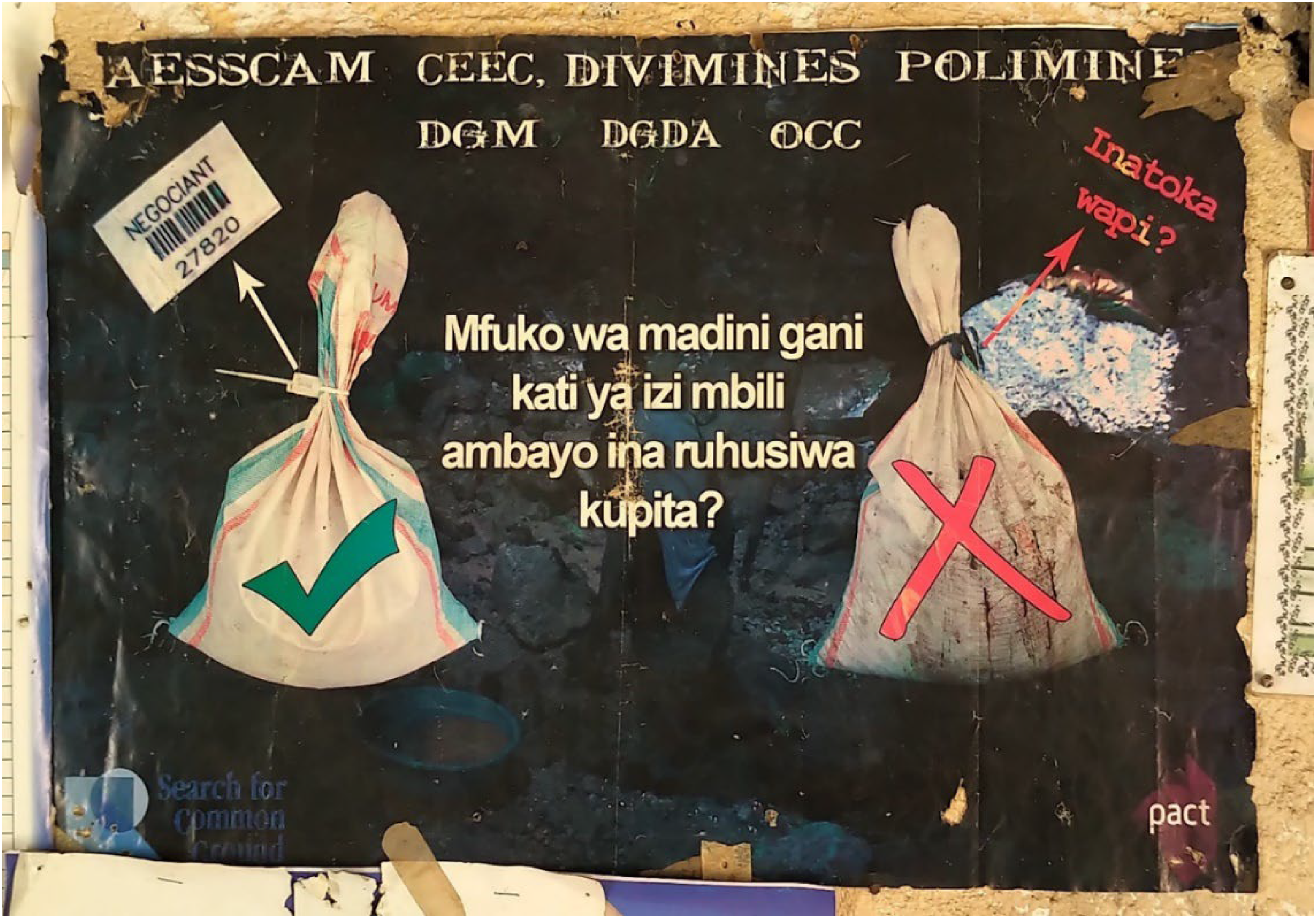
Poster depicting traceability in Walungu territory (by the author, 2019).
Once a négociant, or mineral trader, buys minerals from miners they become his/her responsibility, meaning, it is up to them to ensure that they can be traced back to the mine from where he purchased them. Otherwise, s/he may be charged with fraud. Thus, in theory, traceability as a process attempts to choreograph the movement of minerals starting from the rural mine to the urban centre by seizing upon the actions of the négociant and imposing strict limits on their mineral transactions. The first demand is the need for a license to operate as a négociant. Secondly, the mineral trader must have the minerals he or she purchases bagged and tagged with a bar-coded mine identification tag bearing information on the validated mine site that is the origin of the minerals.
After officials of the mining technical service tag the bags, the bags may leave the mine. The négociant may then deliver them to his ‘maison’ for cleaning and processing but thereafter must present those same bags to the point de vente or mineral trading centre (Figure 2), for the minerals to be re-weighed, taxed and re-tagged with a ‘trading tag’, or, ‘tague de negoce’ (Figure 3). A number of these mineral trading centres in Walungu, such as the one in the picture, were built with finance from the World Bank, reflecting the multinational support for traceability and the restoration of state regulation.

Mineral trading centre, village in Walungu territory (by the author, 2019).
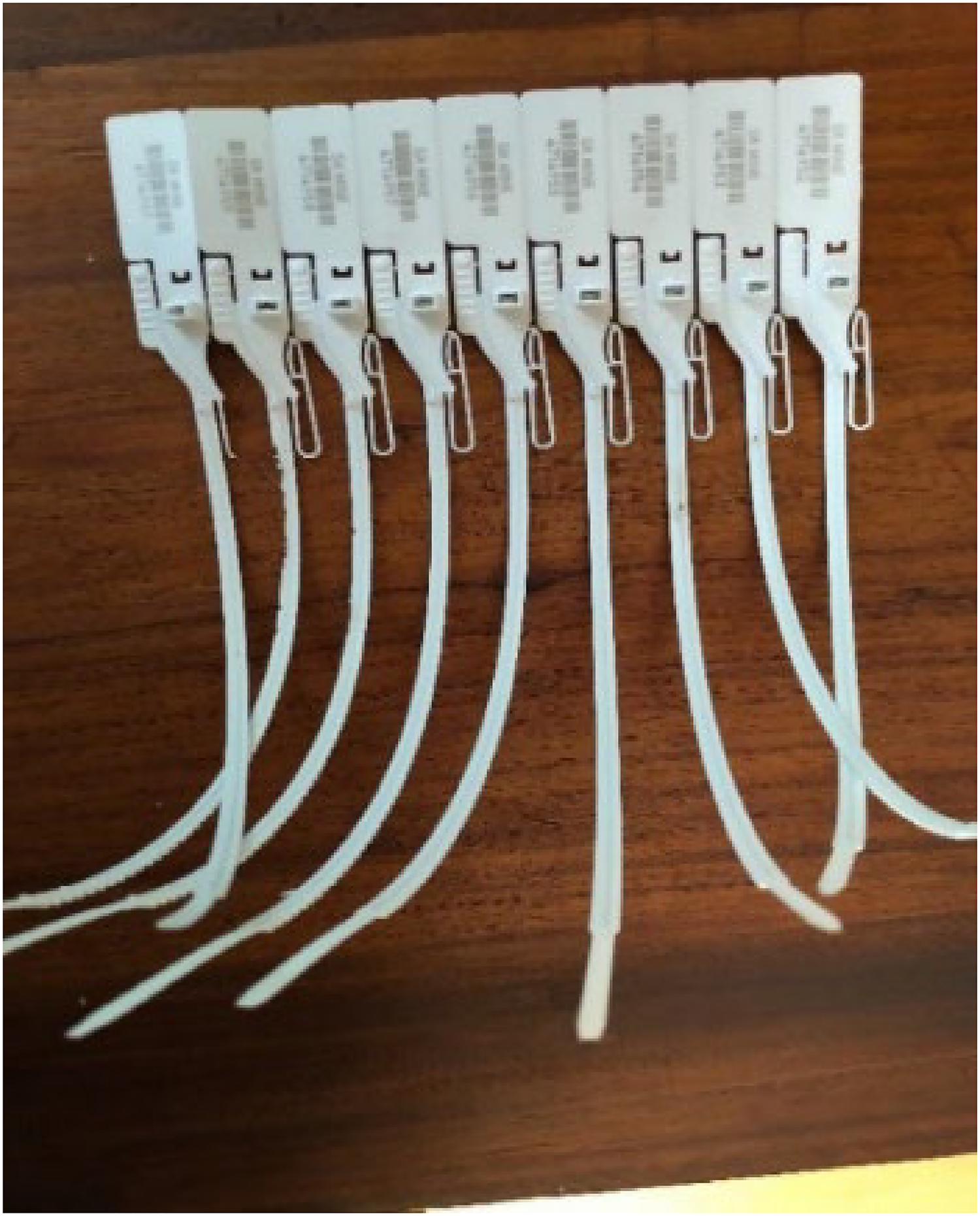
Mine tags at mineral trading post in walungu territory (by the author, 2019).
After receiving a trading tag the mineral trader can proceed onward to the final point of sale at the mineral processing centre in the city (Bukavu). However, before minerals depart the trading centre, a trader is compelled to declare to the authorities in advance the mineral trading counter in the city where he will sell the minerals. After doing so he/she is issued with a bon d’achat, or sale voucher, from the Center for Expertise on Evaluation and Certification (CEEC) of precious and semi-precious minerals that must be presented to state authorities at the mineral processing centre (entités de traitement) in the city. Especially if a négociant is lacking any proper documentation validating their mineral purchase, like the point of sale voucher or authorisation to transport minerals, they are likely to encounter bureaucratic problems with the authorities and can even have their merchandise seized and auctioned. 17 Documents along this chain from registration cards, mine tags, various taxes, vouchers, and receipts are designed to capture information for traceability of the identity of traders, the types and volumes of 3T mineral ore in their possession, the timing and route of the flow of said minerals up to urban processing centres.
In principle, the technical measures imposed by ITSCI on the logistical space through which minerals flow, from mine to urban export markets, only partly inhibit smuggling and the contamination of ‘clean’ minerals with those from militarised mines. Recent reports from Congo offer extensive detail showing how the ITSCI supply chain often fails to hinder the laundering of minerals from unvalidated mines (Global Witness, 2022; Iguma, 2017; UN Group of Experts, 2014, 2020; Vogel, 2022 in Postma and Geenen, 2021: 5–6). While no single miner or mineral trader we encountered ever admitted to laundering minerals from unvalidated mines, it was an open secret in both mines and mineral trading centres that it was hard, if at all possible, to ignore the demands to sell or buy minerals from individuals linked to non-state armed groups because the repercussions can be devastating. The problem according to one of our key interlocutor and guide working as an artisanal miner was that the rebels in Walungu territory were the Raia Mutomboki comprised of so-called ‘ordinary people’ invested in defending their homes and communities from external actors or threats, including from the national army (FARDC) and Force Democratique pour la Liberation du Rwanda (FDLR), a militia group with origins from the Rwandan genocide. Many Raia members were known, and walked freely in the village where we were based and both customary authorities and négociants whom we interviewed admitted that, the Raia Mutomboki rebels in that village were in fact ‘watoto wa kijiji’, ‘children of the village’ (see also Global Witness, 2022; Stearns, 2013; Vogel, 2018: 100–10). To deny them access to mineral markets would disenfranchise, or alternatively encourage them to engage in other, potentially unlawful activities.
So, in as much as ITSCI tried, it just could not fully re-signify minerals from the multiple conflicts embedding them into to their environments (see also Smith, 2022: 282–292). Most state agents and even civil society actors working hard to implementing ITSCI know the entangled nature of artisanal mining relationships but circumventing ITSCI is difficult because only tagged 3T minerals from ITSCI have legitimacy in local and international markets. Herein lies the subterfuge as Smith (2022: 289–292) argues, for traceability fetishises 3T minerals as if they are clean precisely because international standards, foreign concepts and impersonal procedures have alienated them in their movement towards urban markets. According to him, traceability imposes itself as de facto law reframing the representatives of ITSCI and its NGO partners into ‘sovereign agents’ (Smith, 2022: 274). For Vogel (2022: 191–193), ITSCI is even more insidious for it creates spatial unevenness in mining governance. He argues that in areas with traceability, it ‘performs sovereign power’ by intervening and even transforming the practical roles of state mining agents, while in other similar sites, the system permits ‘illicit activities’ by both non-state actors as well as armed groups ‘so long as they don’t affect its business’. While Vogel (2022) gestures to a formulation of sovereignty as that which decides the state of exception (Agamben, 1998), his implication is that the sovereign power of ITSCI preys upon state authority in a way that fragments it, enabling for the emergence of spaces of abandonment within the mineral supply chain that are under the control of rebel and other non-state actors. What such a spatial reading overlooks, following Bartelsman (2014: 81), is that territorial control is no longer a defining or sufficient marker of sovereignty, especially in sites where domestic authority of the state is weak for in these areas the sovereign prerogative seeks to optimise life through the proper arrangement of both resources and people. Secondly, when viewed historically, continuous failure to give the appropriate form to governance arrangements within marginalised sites can often be the point because, as Harney and Morten (2021: 65) assert, it is such failure that fuels a continuous compulsion to improve, to connect, to rationalise, standardise and logistically integrate those who are recalcitrant to state power and market orders. It therefore becomes necessary to explain that which is optimised by traceability in ITSCI operation for doing so may help explain how its nomic order endures despite perpetually deferring human security and development. A partial answer is given by the expansion of the reach of state agencies and their enforcement of taxation within the 3T mineral supply chain in south Kivu.
On the fiscality of tracing tin
In conversations with the small mineral trading town in Walungu territory we resided, one recurrent theme in their discussions was the problem of state-enforced taxation. All five of our négociant interlocutors decried the sheer number and legitimacy of some of the taxes they pay, but they all still dutifully paid them. This tax compliance can be confusing, especially in relation to provincial revenues in south Kivu. In a study by Buraye et al. (2020: 334) on the links between taxation and the 3T mineral supply chain in south Kivu, the authors show that in the year 2015 revenues from mining apparently amounted to only 0.5% of the total provincial budget. 18 Low official tax collection appears to differ from the expanded dynamics of tax enforcement for starting in 2015, the national government decentralised some of its fiscal authority creating more provincial governments whose number increased from 11 to 26. Englebert and Mungongo (2016: 17) argue this decentralisation process significantly increased the fiscal burden of Congolese people in all provinces for it has led to an increase in the number of state agents with legal (or seemingly legal) authority able to extract revenue in taxes, even though such taxes may end up being diverted away from public accounts. Due diligence programming (DDP) evaluations in south Kivu and Maniema also reveal that households in DDP areas reported 58% higher tax collection but also double the service provision by state mining services at mines and near their villages than households living in areas where DDP was absent (PRG et al., 2020: 29).
Implementation of ITSCI appears to aid and even exaggerate tax collection for it is in relation to the enforcement of taxes by a myriad of state agents that data on mineral volumes, flows and finances are collected along the 3T supply chain. Principally, collection happens at mining trading centres and at processing centres. Where taxes on 3T mineral ores are imposed tends to attract a greater concentration of state mining agents than other sites along the supply chain. In our fieldsite, the list and cost of documents needed by a négociant to prove he is following 3T traceability in our study site in Walungu territory in 2019 were as follows:
Request for a négociant card (Mining Division): USD 60 Négociants card (Mining Division): USD 300 Identification profile of négociants (SAEMAPE, Mining Tech. Service): USD 15 Identification profile of Transporter of Artisanally mined Minerals (Mining Division): USD 100 An estimated annual cost of identification documents to work as a négociants totalled USD 475. Additionally, each mineral consignment invited a range of taxes and fees at mineral trading centres, including: Mining Technical Service (SAEMAPE) Declaration tax: USD 0.3/kg Local Village ‘Chancellery’ tax: USD 0.05/kg Exit permit for mineral substances (SAEMAPE): USD 10 Mineral transport certificate (Mining Division): USD 10 Artisanal mining production report form (Mining Division): USD 10 Artisanal mining statistical fee (Mining Division): USD 5 Sale Voucher (CEEC): USD 20
At the time of this research in 2019, Papa Willy, the president of négociants in his village, was selling a tonne of cassiterite for USD 5500. For the first tonne mined from a new mine shaft, he revealed he was left with a very low margin of about USD 90
19
– an amount far less than what a trader pays the government for mineral taxes (USD 475) and identity documents (USD 385), both of which amount to USD 860. The low profit margin leaves little room for any shifts in the global market price of cassiterite or miscellaneous expenses arising from: transportation, the confiscation of merchandise, the financing of new mine site exploration, or any personal expenses.
20
With the costs above, it is also easy to imagine how a trader was likely to increase his profit margin by paying a miner a lot less than USD 4/kg for raw cassiterite ore, putting further pressure on those even more vulnerable along the mineral supply chain. Facing a fiscal squeeze on one side and maybe debts on another, a trader had to adopt tactics to either reduce taxes or increase mineral quality and volumes through any available means, legal or otherwise. It was for this reason Papa Willy concluded saying, ‘Right now, there is no profit in artisanal mining [for traders] … ITRI [ITSCI] is killing us’.
All five of the main négociants that we spoke to in mineral trading centre emphasise two related things about traceability: the first was the low buying price of tin at processing centres in Bukavu and, the second was the market restrictions imposed by traceability. The latter was an effect of being forced to declare in their sale voucher, in-advance of departing from a mineral trading centre, the exact processing centre where they will sell their 3T ore. As it were, once declared the CEEC does not make it easy for a trader to the change the processing centre on their declaration form if he/she disagrees with the valuation and purchase price offered by the processing centre. It can cost a lot of time and hundreds of dollars to change the processing centre on the sale voucher, an action Papa Willy understood as anti-competitive price-fixing behaviour enabled by the state on behalf – and to the benefit – of urban processing centres.
Since the ITSCI program is the only legal means to convey minerals from mines to urban markets, it has centralised the flow but also led to an optimisation of real and fictitious mineral taxes in the name of traceability (see also Buraye et al., 2020; Global Witness, 2022; Vogel and Musamba, 2017). For the year ending 2021, the program collected 97% of its income, a whopping USD 7.2 million, from levies and fees of upstream mineral producers – a majority being from the Congo (ITSCI, 2021). Beneficiaries of traceability appear to be ITSCI itself and the state agents who, as implementers of the program, have increased in both type and number thus expanding the reach of state authorities in 3T production and commercialisation while rendering limited service to the mining public (Buraye et al., 2020). Processing centres on the other hand use their purchase price to ultimately determine how much négociants and their associated miners take home as income. Meaning, a depressed price at the processing centre inevitably causes ripple effects undercutting upstream ore producers all the way up the mineral supply chain, an aspect in dire need of further research. Taxation in this system is the controlling agent determining the sustainability of incomes along the chain but it is also the metric that measures improvements in restoration of state power.
Conclusion
What really is ITSCI mineral traceability in south Kivu province of Congo? It is a nomic order produced by the annexation of space and settled upon by an array of infrastructures and bureaucratic arts that have over time become de facto law. Traceability is designed to give an address to 3T mineral ores, however, in doing so it remodels space into mineral supply lines and instils within these lines market logics that place an array of actors from miners, state agents, civil society actors, local authorities, mineral traders and processors into dynamic tension and competition with one another. It is due to these mineral supply lines and the fiscal logics they invite that political spheres are constituted, defining the borders of what is inside and outside the norms of the global mineral market.
Crucially, the capacity to define the boundaries of what enters the international tin mineral market from Congo occurs in spite of the Congolese state. In our case, what Diphoorn and Wiegink (2022) describe as a ‘permissive space’ allowing corporate actors to operate is not in fact permissive or authored by the Congolese state. Far from it, for the international system of states is an economy of coercion consisting of defined rules of engagement, international laws and doctrines as well as global mineral policy that frame a priori both the ‘personality’ of states within a liberal democratic state system and the conditions each state must conform to so as to enter global markets (Scott, 2012). For states like the Congo where domestic sovereignty is perceived to be weak, the ‘sovereign gift’, as Barkan (2013) denoted it, is modelled more as a grant offering conditional (infrastructural) support to help restore and extend state authority (into areas where such authority was either limited or completely absent) in exchange for control of 3T mineral flows and information. With legal and policy backing from core economic centres and the financial support from the global tin lobby, the Dutch government, multinational companies and private capital, ITSCI is a sovereign grant to the Congolese state. Sovereignty, here, is thus a position that is made by international market rule bestowing infrastructure in the form of a mineral supply chain system. What such a grant also makes very clear is the painful cost of international market rule on what matters the most: the collective freedom of the Congolese people.
Footnotes
Acknowledgements
Ultimately this research was only possible due to the friendship and conviviality of our Congolese interlocutors and participants in south Kivu. Fieldwork in Walungu territory would not have been possible without the guidance of Freddy Baleke, Zachary Bulakali, Erik Gobbers and other staff at IPIS Research in Bukavu and Antwerp. I also wish to extend thanks to Antoine Heuty, Vera Belazelkoska, staff at Ulula Canada and Darin Christensen and J. Sebastian Leiva-Molano at Project for Resources and Governance at UCLA for supporting research and analysis on the evaluation of Due Diligence Programming in eastern Congo. Early versions of this article were presented at the February 2021, GTD Brownbag at the Faculty of Arts and Sciences at Maastricht University, the Comparing Copperbelts Conference in Oxford on 18–19 June 2021 and again at Department of Anthropology Colloquium in Leuven on 20 April 2022. I thank Miles Larmer and Filip de Boeck for inviting me to present my work in those forums and my colleagues for lively questions and commentary on this work. Vivian Solana, Columba Gonzalez and Secil Dagtas, Gloria Perez and Jeroen Cuvelier also deserve appreciation for timely edits on earlier versions of the article. Alice Bieberstein, Erdem Evren, the journal editor, Julia Eckert, and reviewers have all helped refine arguments laid out in this article. All errors and omissions remain my own.
Declaration of conflicting interests
The author declared no potential conflicts of interest with respect to the research, authorship, and/or publication of this article.
Funding
The author disclosed receipt of the following financial support for the research, authorship, and/or publication of this article: Field research for this project was supported by funding from Ulula Canada and IPIS research in Belgium as part of an independent study assessing the impact of due diligence programmes in eastern DR Congo. I also wish to thank the University of Toronto Scarborough for granting me the Inclusive Excellence Postdoctoral Fellowship and the Faculty of Arts and Social Science at Maastricht University for offering me Additional Research Time so as to make progress on the manuscript of this publication.
