



Abstract
Inferences from ethnography in sociocultural anthropological arguments frequently rely on an unexamined model of the human mind and behaviour. Across a range of theoretical approaches, human thought and behaviour are implicitly understood as coherently following a single underlying cultural logic, described in terms such as ‘ontology’, habitus, political strategy. We term this implicit model Homo anthropologicus, by analogy with Homo economicus. Both simplify human behaviour and can thus lead to errors in its interpretation. We examine examples of Homo anthropologicus in anthropological approaches to ontology, caste, state evasion, and habitus. We propose that such accounts are erroneous in light of the multiple cognitive systems involved in human thought and behaviour, discussed with close reference to dual process theory. Unlike Homo anthropologicus, Homo sapiens’ behaviour is frequently inconsistent. Whilst anthropologists have long acknowledged this is the case, in practice, as we demonstrate through our examples, inconsistency is frequently seen as a problem to be explained away rather than as a feature of behaviour to be accounted for in its own right. We therefore conclude by calling for a greater degree of methodological reflexivity when making inferences from ethnography.
Introduction
This article addresses unexamined assumptions about human behaviour and cognition often made in sociocultural anthropological analysis. It has three aims: (1) to identify some characteristics of human behaviour as assumed in ethnographic methods and interpretation, (2) to identify where these characteristics are implausible or underspecified, and (3) to make some preliminary recommendations for how these issues can be mitigated in the creation of anthropological theory. We aim to point out what we see as significant theoretical and methodological flaws in social anthropology stemming from its implicit model of human cognition and behaviour, which we call Homo anthropologicus, by analogy with the similarly flawed model of Homo economicus. We examine this via four examples of anthropological argument. In each case, the arguments examined rely on a conception of human thought and action as driven by a single, coherent cultural logic, whether that takes the form of ‘ontology’, an attitude towards hierarchy, resistance to state governance or habitus. First, we examine the classic interpretive conundrum posed by Evans-Pritchard's observation that the Nuer say that ‘twins are birds’, and how such questions have been taken up in terms of ‘ontology’. Second, we turn to the anthropological explanation of ‘replication’, a phenomenon in South Asia whereby some Dalits treat other Dalits in ways which they explicitly state to be reprehensible. Our third example considers the question of state evasion, and the attribution of associated social structures and institutions to a logic of political choice. We then consider Bourdieu's habitus as an existing attempt to deal with the problem of conscious and unconscious action which nonetheless reproduces the same problems. Finally, we consider some possible ways to address the theoretical problems arising from Homo anthropologicus via a greater degree of reflexivity regarding inference from ethnography.
The problem
As a field concerned with understanding social behaviour and its cultural context and variability, sociocultural anthropology (aside from explicitly cognitive approaches such as Astuti, 2001, 2007, 2017; Astuti et al., 2004; Boyer, 1994, 1998, 2010, 2018; D’Andrade, 1995; Hale, 2015; Regnier, 2020; Sperber, 1985, 1996; Strauss and Quinn, 1997) engages in remarkably little systematic consideration of the kind of animal humans actually are and the implications this might have for its own theoretical approaches. At the same time, however, anthropologists are highly, and justifiably, concerned with methodological reflexivity, and frequently eager to point out issues in the underlying assumptions or explicit behavioural models of other disciplines. Anthropological critiques of economics, for example, have frequently pointed to the assumptions made in that discipline that humans are rational, self-interested actors (see Hann and Hart, 2011; Stafford, 2020 for overviews). However, analogous assumptions underlie much work in anthropology, from the development of theoretical concepts down to the interpretation of specific ethnographic examples. That is, just as economists have frequently studied Homo economicus rather than Homo sapiens, so also do anthropologists often fall into the trap of studying Homo anthropologicus. For sociocultural anthropology to successfully mobilise ethnographic insights in the creation of empirically valid, theoretically sophisticated approaches to human sociality which can meaningfully inform the wider social scientific and psychological understanding of human beings, the discipline must develop a greater reflexive awareness of its underlying behavioural assumptions and their role in inferential theorising. This can begin by characterising the species we call Homo anthropologicus, in order to better understand how and where interpretive errors are made. By way of comparison, we first briefly consider Homo economicus and the kind of problems to which it gives rise.
Homo economicus
According to rational choice theory, human behaviour is guided by self-interest and rational consideration of an action's possible outcomes and associated probabilities. The theory defines three optimality criteria for rational action (Elster, 2015: 235ff). First, an action must be optimal given an agent's beliefs. That is, it must be the action which will best satisfy the agent's desires, given the agent's beliefs about available options and their consequences. Second, the agent's beliefs must be optimally supported by the evidence available to them. Third, the evidence itself must result from an optimal investment in information gathering. The perfectly rational, self-interested individual who follows these principles is the infamous, fictitious Homo economicus. As economic anthropologists correctly point out (Hann and Hart, 2011: 172–174), its natural habitat is not the real world but rather the matrices of game theory.
Rational choice theory is not usually presented as an empirical description of the mechanisms of human cognition. In fact, in his discussion of ‘positive economics’, Friedman (1953: 19–23) explicitly argues against the notion that humans deliberately and consciously engage in the arithmetic of utility maximisation. Instead, he suggests, humans simply happen to behave as if this were the case. Nevertheless, because rational choice theory is a model of human behaviour, it is reasonable to ask what kind of psychological being humans would have to be in order to behave as it predicts – that is, what kind of animal is Homo economicus? The answer is an ‘individualistic’ rather than ‘social’ being, whose behaviour is driven by a central, unconscious processing mechanism that operates according to strict, intangible rules of rationality and is functionally geared towards utility maximisation. It possesses beliefs about the world which are acquired through an underspecified process, of which we know only that it obeys further maximisation and efficiency principles (the third optimality criterion mentioned above). It is noteworthy that Homo economicus is capable of collective action, and that this collective action may be inflected by ‘cultural’ beliefs – for example, the preferences which Homo economicus attempts to fulfil through maximisation may vary from one community to another. Importantly, however, the process by which Homo economicus reaches a decision, given a set of preferences, is not culturally derived. The mind of Homo economicus is thus essentially ‘flat’: information is acquired and processed according to a single principle; a set of inputs and preferences reliably produces the same behavioural outputs, and the whole process is predictable and readily modelled.
What kind of animal is Homo anthropologicus?
In contrast with Homo economicus, Homo anthropologicus can be characterised as a ‘cultural’ or ‘social’ being whose behaviour is driven by a centralised processing mechanism (which may or may not be the mind, depending on theoretical stance). It possesses values and beliefs about the world which are more or less entirely derived from ‘culture’ or ‘the social’, via a process which is essentially mysterious and not subject to systematic inquiry (i.e., the mechanism of socialisation or enculturation is underspecified). These values and beliefs give rise to motivations and intentions, and behaviour is the result of acting these out. Notably, not all these beliefs, values, and motivations are explicit or consciously held. They are often acquired unknowingly by the agent, created by forces which govern the realm of ‘culture’ (or ‘the social’, etc) – these include ‘structure’, ‘power relations’, and so on. Beliefs, both implicit and explicit, are shared by members of a given community of Homo anthropologicus in the form of a perception- and action-guiding mechanism described as ‘ideology’, ‘habitus’, ‘cosmology’, ‘cultural model’, ‘ontology’, ‘paramount value’ or similar. For simplicity, we refer to all such mechanisms as ‘cultural logics’. Whilst implicit beliefs and certain actions, and the practices arising from them, are not necessarily considered by anthropologists to be subject to conscious reflection, the means by which they are processed and lead to behavioural outcomes are nonetheless held to be essentially similar to conscious reasoning; that is, Homo anthropologicus’ perceptions are guided and processed according to an internalised ‘cultural logic’, which produces intentions, which lead to actions. Homo anthropologicus is, in this sense, a disciplinarily specific incarnation of the folk-psychological notion according to which, as Pascal Boyer notes, ‘thinking takes place in a central processor, where different thoughts, essentially similar to the ones we experience consciously, are evaluated and combined with emotions and give rise to intentions and plans for action’ (Boyer, 2018: 25).
As with Homo economicus, this account of human behaviour sees the mind as essentially ‘flat’. What this means is that all mental states and processes are assumed to occur in essentially the same way: acquisition of information via perception (itself guided by the cultural logic), processing of that information according to the cultural logic, and intentions and actions guided by the cultural logic. To elaborate on the previous paragraph, the problem with this model is not an assumption that all mental life is conscious or deliberative. Anthropologists readily recognise that some mental processes are not transparently accessible. Concepts such as the habitus, affect, etc. are used to describe this kind of non- or less-than-fully conscious mental activity. The ‘flatness’ of Homo anthropologicus’ mind, therefore, does not lie in a failure to recognise that there is more to cognition than conscious deliberation. It lies, instead, in the assumption that all mental processes, including those which are not fully conscious, function according to a single, all-encompassing cultural logic. This, as the upcoming sections will argue, is simply not the case. Many non-conscious mental processes operate differently, and in fact, conscious processes are also not governed by a single operating principle, at least in a straightforward way. It is vital that anthropologists come to terms with this because currently, as the examples in the second part of this article show, our reliance on a mistaken model of human cognition and behaviour regularly leads us to formulate implausible, overly coherent explanations and interpretations of ethnographic observations. As it stands, sociocultural anthropology lacks an adequate means of accounting for the complexities of human behaviour because it uses a flawed model of the mind.
Although our aim here is primarily to identify and describe Homo anthropologicus, it is worth reflecting briefly on how this model became so prevalent in anthropology. As Boyer hints towards in the quotation reproduced above, the origins of the model are, partly, in folk psychology. It is common for humans to retroactively tell causal stories connecting their own or other people's behaviour to inner mental life. Such stories contribute to creating a coherent sense of oneself and others as unified mental agents and, in the absence of further reflection, may easily be mistaken for valid causal accounts rather than simply post-hoc reconstructions. Homo anthropologicus emerges when this type of narrative is applied widely to a community of others, and when a single or small number of mental causes are thought to explain a large set of observable behaviours. Yet the deceptively attractive character of unified mental agency may not alone suffice to explain why Homo anthropologicus is so pervasive in anthropology. Ideally, we should also attend to the selective, environmental pressures which make Homo anthropologicus particularly successful. The production of social anthropology happens in an institutional setting which rewards narratives showing how many, perhaps initially seemingly disparate ethnographic observations ‘make sense’ in light of a single ‘discovered’ cultural logic. In fact, the demand for such narratives is strong enough that many of us will presumably recognise the following experience: in the process of writing, one may occasionally or even regularly recall events experienced during fieldwork which provide evidence against the coherent narrative one is building, only to discard such elements as somehow ‘unrepresentative’ or ‘not significant’. The institutional demand for coherent narratives is a topic which certainly warrants further investigation, as it has important methodological and practical consequences. In this article, however, we will limit ourselves to examining Homo anthropologicus for what it is, leaving aside the question of its origins.
At this stage, some readers might suspect that we are committing the very mistake we are calling attention to: by identifying a tacit, prevalent cognitive and behavioural model in sociocultural anthropology, are we not ourselves describing a ‘single cultural logic’ – that of anthropologists? This is not the case. We are not suggesting that Homo anthropologicus is itself the inherent ‘cultural logic’ by which anthropologists operate in general; rather, Homo anthropologicus is something which emerges in the highly context-specific process of anthropological writing and theorisation. We do not claim to have identified a principle which somehow permeates the life of anthropologists and explains how they think and behave outside of conference rooms. Any attempt to read our argument as an all- or highly-encompassing description would be an instance of the problematic, cavalier epistemological attitude we are calling attention to in the first place. Our claim is simply that, in the restricted and rather uncommon activity that is producing professional anthropology, anthropologists tend to reach implausible, overly-encompassing explanations for other people's behaviour that exaggerate its coherence, because they operate with a mistaken model of human cognition and behaviour. In short, Homo anthropologicus emerges from the highly rationalised system of explanations which anthropologists co-produce in a specific setting; it is not the ‘singular cultural logic’ of anthropologists themselves.
There are a number of epistemological assumptions which underlie our argument, without which it would be impossible to talk about a ‘false’ or ‘problematic’ model of the mind in the first place. Perhaps the most important is an opposition to extreme versions of relativism and constructivism. Though there is clearly tremendous variation across human societies in behaviour, social norms, beliefs, etc. there is also a lot that humans have in common, at the cognitive level, simply by virtue of being members of the same species. 1 We take it for granted, then, that there are psychological regularities shared by virtually all members of the species, and that these are as worthy of investigation as psychological differences. Another epistemological stance we take is that we can, to a degree, compare models of human cognition and decide which are more accurate. Different theories – including theories of the mind – generate different predictions, such predictions can sometimes be evaluated against empirical evidence, and in so doing one can favour some theories over others. Our adherence to dual process theory, in the upcoming section, derives from research that proceeds in this mode, but as we explain later, we see this as one of the currently better-evidenced theories of the mind, not as a be-all, end-all account of human cognition.
Comparing Homo anthropologicus and Homo economicus
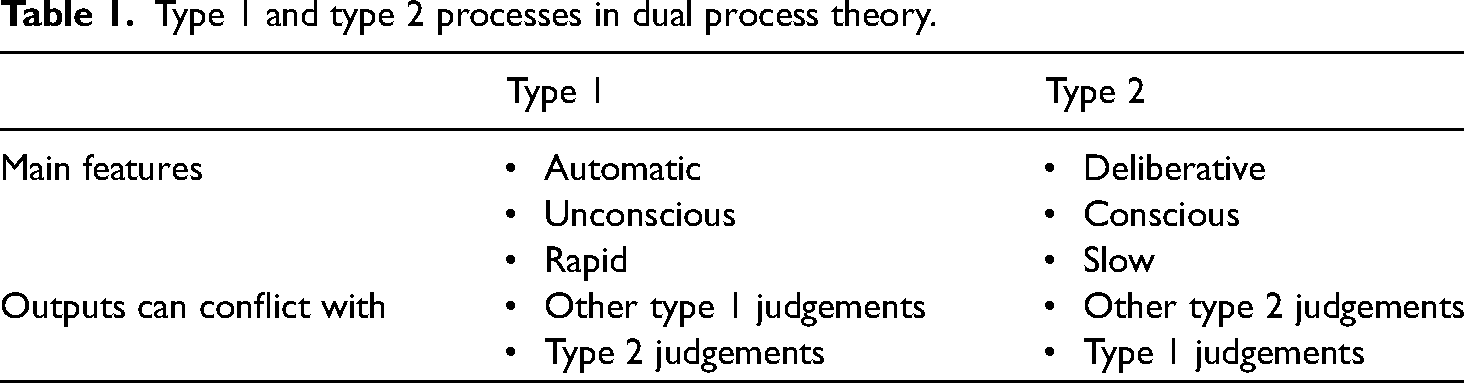
We can compare Homo anthropologicus and Homo economicus as shown in Table 2. We have also added a third column, which is informed by dual process theory. This describes two broad categories of mental processing, type 1 and type 2, which themselves encompass a range of distinct cognitive mechanisms. As shown in Table 1, Type 1 processing, or intuition, encompasses a range of cognitive mechanisms which are automatic, low effort and fast, with a high processing capacity; in contrast, type 2 processing or reflection is deliberative, high effort, slow and of limited capacity (Evans, 2009: 33, see 2003, 2011 for reviews of evidence and theory). Notably, intuition or type 1 processing retrieves information from memory based on learned associations and leads to judgements through a process that is not consciously accessible. Reflection or type 2 processing, on the other hand, is ‘consciously controlled and effortful … involv[ing] search, retrieval, and use of task-relevant information’ (Smith and Collins, 2009: 201).
Homo economicus, Homo anthropologicus and Homo sapiens comparison.
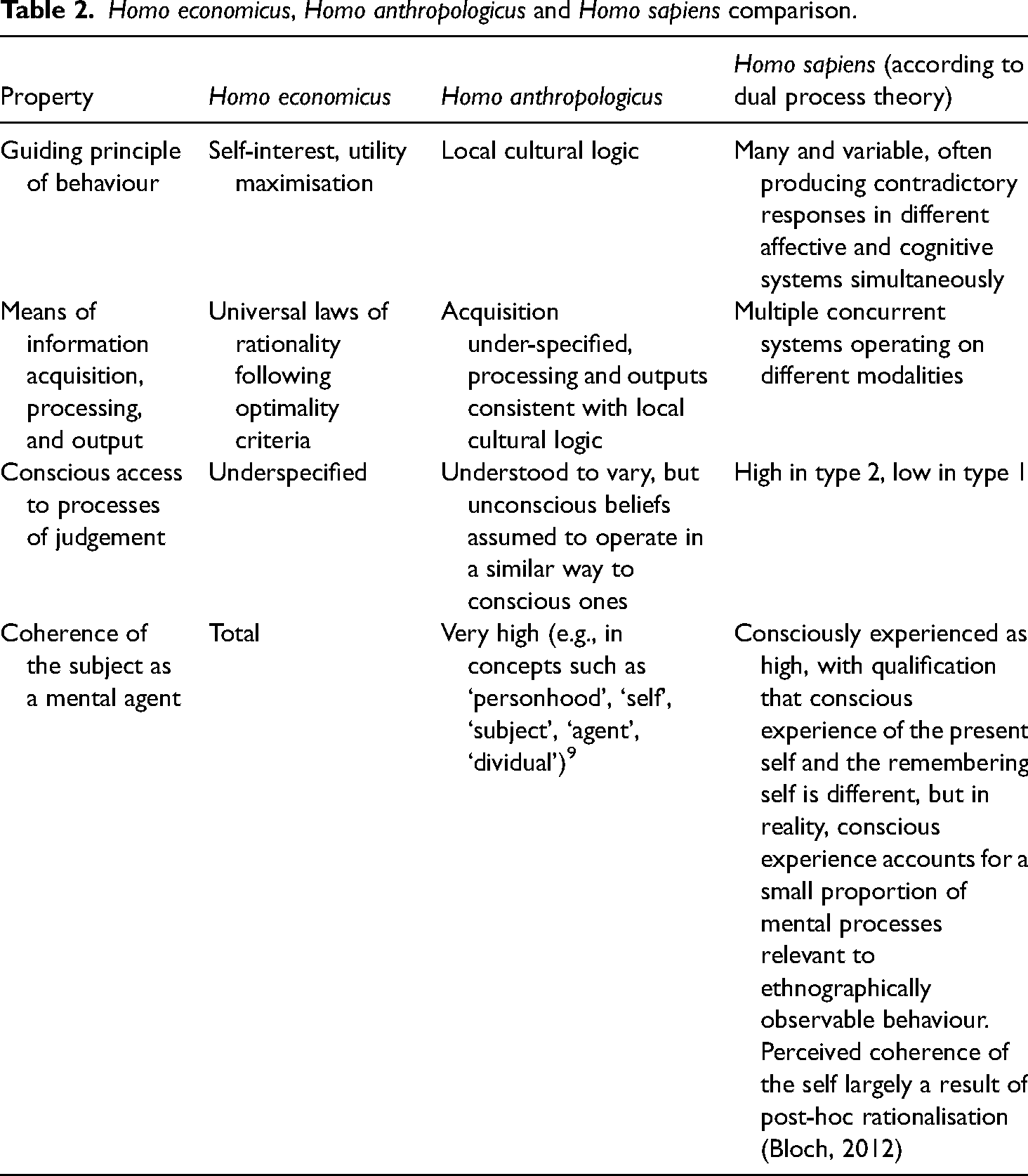
As a caveat, we should note that we do not view dual process theory as a definitive description of human cognition, despite our somewhat provocative title for the third column in Table 2. Some of the evidence which was initially offered for dual process theory, in particular the ‘priming studies’ used by Kahneman in chapter 4 of Thinking, Fast and Slow (2012), has come under scrutiny as part of the wider replication crisis taking place in the psychological sciences. Nevertheless, we think dual process theory robustly establishes that human cognition does not always follow the rules of reflective, deliberate thinking, and, as a result, that humans are much less prone to coherence than we might otherwise expect. Our critique of Homo Anthropologicus relies primarily on this conclusion.
Type 1 and type 2 processes can and do occur at the same time, and can conflict with one another. For example, I might know that a spider is harmless (type 2, conscious representation of knowledge of spiders), but find myself unable to go near it (type 1 emotional response). I might try to explain, via type 2 means, why I am scared of spiders, but I don’t actually know how I reach the type 1 judgement that I should avoid them, nor does my type 2 judgement that they are harmless suffice to eliminate my fear (see second row of Table 1).
Type 1 and type 2 processes in dual process theory.
Importantly, different type 1 processes can also conflict with one another. For example, hunger and disgust might conflict with each other, as when Nepali Hindus, forced by conditions of food scarcity to consume beef during wartime, would initially experience revulsion or fall ill as they did so (Zharkevich, 2017: 791–792). 2 Similarly, type 2 processing will produce different and contradictory, rather than coherent, judgements over time, depending on context. For example, I might consider taxation desirable when I receive life-saving medical care from the state, but be less enthusiastic when I study the deductions on my paycheque; meanwhile, when deciding on a party to vote for, my views on taxation involve consideration of both benefits and disadvantages, and perhaps subordinate these to unrelated considerations. Moreover, type 1 and type 2 processes absolutely do not correspond to ‘universal’ and ‘culturally specific’, respectively. Type 1 processes can be acquired (e.g., the culturally varying, embodied dispositions and behaviours which Mauss ([1935] 1973) described as ‘techniques of the body’, or disgust for beef), and some type 2 processes and concepts are cross-culturally recurrent (e.g., various explicit moral values; Boyer, 2018: 380).
It would be equally misguided to construe type 2 processes as particularly ‘Western’, or for that matter to think that the prevalence of either type depends on cultural setting. There is a history in anthropology of creating dichotomies in ‘worldviews’, ‘values’, ‘modes of engagement’, etc. Different societies or cultures are then, typically, assigned to one or the other. Often, the West is opposed to the rest of the world, or at least some non-Western society. A typical example would be the Dumontian distinction between ‘individualistic’ and ‘holistic’ worldviews. It would be a mistake to read this kind of dichotomy into the dual process literature. Type 1 and type 2 processes are universally present in humans, and there is no reason to believe some societies emphasise one over the other. In the same vein, it is not the case that type 1 processes are more or less ‘individualistic’ than type 2 processes.
As mentioned earlier, although they do not typically use the terminology of dual process theory, anthropologists do recognise that not all mental processes are conscious, verbal and deliberative. They also typically recognise some level of context-dependency in human behaviour. The problem, therefore, is not that they are oblivious to type 1 mental processes. Rather, the problem is the assumption, implicit in much of their work, that type 1 processes are similar to explicit deliberation based on beliefs and values and that, consequently, disparate expressions of type 2 judgements and other ethnographic observations can be pieced together to arrive at a single, coherent cultural logic driving all thought and behaviour. It is noteworthy that the success of behavioural economics in countering the assumptions of Homo economicus is due largely to its drawing on dual process theory (see Kahneman, 2012), and we suggest that a similar move could help counter flawed assumptions of Homo anthropologicus.
Some examples of Homo anthropologicus in the wild
In the following sections we examine Homo anthroplogicus as it emerges in four different arguments, concerned, respectively, with ontology, caste ideology, strategies of political resistance and habitus. We admit to selecting examples that illustrate our argument, and it is true that Homo anthropologicus is not present in all anthropological writings to the same degree. More person-centric forms of ethnography, for example, in which more effort is put into describing individual inconsistencies, may be less prone to the problem. The same may be true of some work in the ethnopsychological tradition. A classic example would be Levy’s Tahitians (1975), celebrated for ‘its critical and self-critical questioning of descriptive generalizations, and its meticulous attention to the justification of inferences concerning connections between observable behavior and subjective experience’ (Levine, 2005). While we acknowledge the existence of exceptions, by drawing from a wide pool of anthropological writing, we nonetheless hope to illustrate how pervasive the issue is.
Example 1: ontology
Homo anthropologicus is extremely evident in much of the literature associated with the ‘ontological turn’, whether that be systematic approaches to ‘ontologies’ as the bases of thought and social practice (Descola, 2013; Scott, 2007) or those concerned with reframing anthropology as an ‘ontological’ practice (Holbraad, 2012; Holbraad and Pedersen, 2017; Viveiros de Castro, 2013). The former explicitly identify ‘ontology’ as a set of principles according to which all perception and thought is ordered and, consequently, according to which people behave and societies are structured – that is, they frame ontology as precisely the kind of concept we identify here as a ‘cultural logic’. For Descola, for instance, all social systems are ultimately explicable in terms of one of four ontologies, or ‘modes of identification’, based on whether individuals perceive other beings as physically and mentally similar or different to themselves. Depending on this initial perception, their relations with others will take on a particular character, as will their forms of social organisation. As Matthews (2022: 37–63) discusses in detail in relation to the work of both Philippe Descola and Michael Scott, this position is made explicit and the arguments, while we would disagree with them, are systematic.
Here, therefore, it is worth focusing on examples in which Homo anthropologicus is equally manifest, but not made explicit. The following is likewise discussed by Matthews (2022: 142–146), but is worth reprising as it demonstrates the way in which Homo anthropologicus is invoked in a range of accounts adopting very different theoretical perspectives. As has been extensively remarked on by several generations of anthropologists, the Nuer stated to Edward Evans-Pritchard that ‘twins are birds’, a notion which the latter considered strange and in need of explanation. However, despite many attempts to explain it anthropologists have not always been satisfied with the accounts given; T.M.S Evens (2012) adopts an approach to it which draws heavily on the ideas of the ontological turn.
While Evans-Pritchard concluded that ‘twins are birds’ referred to the analogous relationship both had with the idea of ‘spirit’ or ‘god’, Evens disagrees. He refers to a 1970 critique by James Littlejohn, who argued that ‘twins are birds’ only seems absurd to an anthropologist because anthropologists know about species and, particularly, that they tend to be reproductively exclusive. The Nuer, in Littlejohn's view, did not know this, as demonstrated by other things they said, such as reports of a woman giving birth to a hippo – and also, because reproductive exclusivity of species is related to evolution, it would be incompatible with the Nuer belief that the world had only existed for 10–12 generations. Immediately here we can see an analytical need to seek out coherence between different ideas given voice by the Nuer in different contexts – to the exclusion of practical considerations such as how the Nuer pursued an effective livelihood as breeders and herders of cattle, with the knowledge of species and reproduction that would entail.
Evens agrees with Littlejohn but goes further – to truly understand ‘twins are birds’, we must imagine what reality would have to be like for the statement to not seem absurd. This is representative of the positions taken by others closely associated with the notion of reconceptualising anthropology as an ontological project, notably that of Martin Holbraad and Morten Pedersen (2017), and Eduardo Viveiros de Castro (2004). For Evens, Evans-Pritchard's problem was that he was a ‘modern’, perceiving the world through an ‘entitative ontology’ in which ‘a thing is what it is’ (2012: 6) – this perspective starts from individual things or ‘basic particulars’ (a twin or bird) rather than from the ‘whole’ (spirit or god in this case). This means he saw the ‘whole’ of reality as the sum total of all the basic particulars, defined against what does not exist, and predicated on a dualistic ontological separation of the real and the ideal. For Evens, the Nuer must have taken the opposite ontological stance, starting from an unbounded whole not dualistically opposed to anything else. Everything in the whole is defined in relation to everything else, and therefore real and ideal are not ontologically separated.
Evens’ position relies on a very literal reading of the Nuer statement; consideration is not given to variation in meaning and usage in different contexts or registers, and in particular that many if not most statements people make are not intended as statements about, or which instantiate, the nature of reality in the first place. 3 The literalism here is especially notable given that Evens’ aim, and likewise that stated by Viveiros de Castro (2013), is to take such statements seriously as concepts – to deal with them in a way which makes them not seem absurd. 4 The problems for Evens's argument are that he needs ‘twins are birds’ to seem absurd in the first place, that it seems absurd primarily insofar as it is taken as a propositional statement rather than in any other way, and that rendering it not absurd therefore requires producing a metaphysical account in which it becomes a non-absurd propositional statement. No justification is provided for the statement requiring comprehensive metaphysical backing in the first place.
The key issue, also present to a lesser degree in Evans-Pritchard's account, is that apparent incoherence or contradiction as documented by ethnography is a problem in need of a solution. This comprises inconsistencies between different utterances, between utterances and reality, and between different domains of knowledge. Resolving the problem of apparently absurd statements, as Littlejohn and Evens demonstrate, itself requires absurd claims. This problem stems from an assumption that all mental processes, as indicated by utterances and other observable behaviour, occur in essentially the same way as a particular instance of conscious reasoning, which is sensitive to incoherence. This would suggest that beliefs, utterances, etc. are all consistent with one another, because – as Evens explicitly states – they rest on an underlying ontology which is culturally specific. This rests on a ‘flat’ model of the mind, which in this view becomes essential a mechanism for the understanding and generation of culturally specific propositional truth claims.
Example 2: ‘replication’ of caste
A similar desire to make sense of observed incoherence, behavioural rather than propositional this time, can be found in anthropological discussions of caste in South Asia and the phenomenon known as ‘replication’. Here too, incoherence is seen as a problem in need of solving, and its resolution comes with the discovery of a single cultural logic that, if posited to cause the observed behaviour, makes the incoherence disappear.
The replication in question is one whereby Dalits, stigmatised for their purported ‘impure’ and ‘low’ character, reproduce among themselves forms of social organisation and patterns of discrimination to which they explicitly object. This is possible because Dalits are not a homogenous category. For example, in Nepal, where Deschenaux has conducted extensive fieldwork, they are divided into several distinct castes (jati) – the Bishwakarma, Pariyar, Mijar, etc. Just as non-Dalits display discriminatory behaviours towards Dalits as a whole, some Dalits display the same behaviours towards other Dalits. For instance, just as all non-Dalits avoid marrying Dalits, the Bishwakarma avoid marrying the Mijar and Pariyar. Just as non-Dalits avoid food cooked by all Dalits, the Bishwakarma refuse to eat food prepared by a Pariyar, etc. In addition, some Dalits explicitly describe an internal hierarchy, ranking their different castes relative to each other, and some Bishwakarma recount origins myths according to which they have Brahminical roots. 5 All this happens, importantly, despite the fact that virtually everybody involved, whether Bishwakama, Pariyar or Mijar, explicitly objects to purity practices and caste-based hierarchies in general.
Anthropology has treated replication as a theoretical puzzle in need of solving. The fundamental question it has tried to answer is why Dalits would, incoherently, re-create among themselves a system to which they object and which, at a macroscopic level, fundamentally disadvantages them. We now briefly review three answers which have been offered and show what we find problematic in them.
Replication as consensus
Marston Michael Moffatt, in a monograph-length analysis of replication, took the phenomenon as an indication that Dalits are ‘in consensus with a system that defines them as fundamentally low’ (Moffatt, cited in Deliège, 1992: 157). On this view, Dalits simply share the same ‘cultural forms’ as those at the ‘top’ of the caste hierarchy: Untouchables [Dalits] do not necessarily possess distinctively different social and cultural forms as a result of their position in the system. Untouchables possess and act upon a thickly textured culture whose fundamental definitions and values are identical to those of more global Indian village culture. The ‘view from the bottom’ is based on the same principles and evaluations as the ‘view from the middle’ or the ‘view from the top.’ The cultural system of Indian Untouchables does not distinctively question or revalue the dominant social order. Rather, it continuously recreates among Untouchables a microcosm of the larger system. (Moffatt, 1979: 3)
Replication as a rejection of low status
Steven Parish is not as rigidly committed to consistency. He notes that ‘[c]learly, what people say and what they do is not always the same; what they do, often, is participate in caste relations they verbally reject’ (1996: 79). He recognises that Dalits’ attitudes shift depending on whether they are looking ‘upwards’ or ‘downwards’: [When looking upwards,] low caste actors may seek to neutralize stigmatizing implications of hierarchy by adopting an egalitarian perspective. But when they feel threatened by groups that are still ‘lower’ groups [i.e., when looking downwards], they may reject equality and solidarity and affirm hierarchy. (Parish, 1996: 205) By replicating hierarchy, and adopting high caste values and practices, untouchables avoid the full psychological consequence of being the lowest. The stigma of being the lowest member, the terminal degraded object in the system, is passed on. This sustains hierarchy, but modifies one's existential place in the system. (Parish, 1996: 207)
Parish's analysis is more sophisticated than Moffatt's, but it still relies on a psychological model that is overly consistent, conscious and culturally driven. Most importantly, it still tries to make sense of Dalit's behaviour and assertions in light of a single ‘cultural logic’ of caste which is underdetermined by the evidence on offer. This is a crucial point – the cultural logic itself is not ethnographically observable; what is observed is a series of utterances and behaviours, which could be explained according to various distinct and mutually incompatible causal accounts. Whilst one of these is the existence of an underlying cultural logic, this is neither the most parsimonious nor the one most consistent with what is known about human cognition.
It is essential to note that the problem is not in the amount of ethnographic evidence on offer. The claim that Dalits want to find someone lower than themselves is actually well supported by Parish's ethnography, which includes extensive quotations and observations. We believe that his interlocutors may even agree with much of his analysis. However, we think that this explanation for replication should be understood as a post-hoc rationalisation of behaviour – that is, an explanation for a series of behaviours, which may have been prompted by any number of conscious and unconscious perceptual cues, in terms of the actions of a coherent, narrative self. Parish's mistake, then, is to interpret it as a causally adequate explanation instead of a culturally consistent narrative.
Replication as dissent
Similar remarks could be made of Karanth's account, which explains replication as a form of dissent against the hegemonic social order of caste through claims to an ‘independent cultural identity’: …the seeming replication of institutions within a caste does not mean that the caste and its members subscribe to the low status accorded to them in the village. On the contrary, replication can also be seen as a challenge to the dominant social order and as an effort on the part of the Untouchable castes to pursue that from which they are excluded. (Karanth, 2004: 155)
Ultimately, this interpretation of replication, while diametrically opposed to Moffatt's, follows the same overall structure. A behaviour which may initially seem incoherent – recreating the religious forms associated with a system that puts one at a disadvantage – is made coherent by revealing the cultural logic (dissent, in this case) which causes it.
What we have, in sum, is three authors trying to come to terms with the same phenomenon, at least two of whom, Moffatt and Parish, are engaging directly with Louis Dumont's own, extremely coherentist model of the South Asian ‘person’, Homo hierarchicus (Dumont, 1980). Each offers a distinct explanation, and in content, these explanations span an extremely wide gamut, from consensus to dissent. In structure, they are all identical. What goes completely unquestioned, and what we know to be an implausible description of human cognition, is the idea that there is a single cultural logic that causes the observed behaviour in the first place, and that this can be discovered through ethnographic investigation and clever inferential thinking.
Example 3: state evasion
We turn now to our third example, James Scott's The Art of Not Being Governed (2009). 6
Scott's primary goal is to debunk a common, social evolutionist narrative about people who have historically lived outside of the control of states. Such people, Scott argues, have typically been portrayed as yet-to-be-civilised, as remnants of an earlier and more primitive time, and importantly, as having never experienced state governance and its purported advantages. This narrative, he explains, has been perpetuated by states themselves, as part of a broader, self-legitimising civilisational discourse, and was perpetuated by an earlier generation of anthropologists and social theorists such as Tyler and Morgan. The originality of Scott's monograph resides in the alternative account which he develops, which turns the social evolutionist view on its head. He starts by noting that states are a relatively recent phenomenon in human history. He then reminds us that, for much of the historical period in which states were forming and expanding, they were not as all-encompassing as today. They lacked the technology and infrastructure that would allow them to bring much of the world's population into their fold. The account departs from social evolutionism in its description of the people who fell outside of the purview of states while the latter were still expanding. Far from just happening to reside in areas that were hard to govern, many of these people, according to Scott, lived there as a matter of deliberate political choice. They did this because they wanted to escape the extractive policies of states.
Scott analyses historical evidence to show that multiple waves of people did in fact escape states by migrating to more remote areas. He argues that this process happened in a diversity of geographic and historical contexts, but builds his case through a focused analysis of Zomia, a geographic area encompassing most of the South-East Asian highlands. 7 On this front, we find Scott's narrative compelling. It is the next step that we take issue with, in which he argues that these same people engineered virtually every aspect of their cultural and social institutions to avoid state control by making multiple ‘strategic’ and ‘political choices’ to ensure that they would remain ungoverned.
It starts with location. Scott suggests that nonstate people strategically determined which areas would be hard to govern, rather than simply moving to spaces where the state had not yet gained control. Then comes mode of subsistence. Nonstate people opted for what Scott calls ‘escape agriculture’, i.e., ‘forms of cultivation designed to thwart state appropriation’ (Scott, 2009: 23, emphasis added). In practice, this meant avoiding sedentary fields and choosing instead nomadism or shifting cultivation. These techniques allowed them to remain mobile and made it harder for any state to keep track of their production and tax them. ‘Escape crops’ were also chosen strategically. Nonstate people favoured roots, tubers, maize and cassava not for environmental reasons, but instead because they knew that these crops are hard for states to appropriate (Scott, 2009: 195ff. and 201ff.). The argument then extends to social structure, which ‘…like agricultural technique, is not a given; it is substantially, especially over time, a choice’ (Scott, 2009: 207, emphasis added). By and large, nonstate peoples have, according to Scott, elected to live in ‘smaller and more dispersed social units’ Scott (2009: 208) because these are more appropriation-resistant. Similarly, they have adopted more malleable ethnic identities and maintained high plasticity in their social systems because they understood that ‘this polymorphism is admirably suited to the purpose of evading incorporation in state structures’ (Scott, 2009: 219). Hierarchical forms of social organisation have tended not to take root among them, and they have adopted more egalitarian systems because egalitarianism is ‘a state repelling strategy’ (Scott, 2009: 213).
The final element which Scott discusses is literacy. On this, he asks [W]hat if many peoples, on a long view, are not preliterate, but, to use Leo Alting von Geusau's term, postliterate? What if, as a consequence of flight, of changes in social structure and subsistence routines, they left texts and writing behind? And what if, to raise the most radical possibility, there was an active or strategic dimension to this abandonment of the world of texts and literacy? (Scott, 2009: 220, last emphasis added)
The impression that the book conveys, overall, is one according to which nonstate people actively engineered most aspects of their culture and social organisation with a deliberate view to resisting capture by the state. The intentional, strategic nature of this engineering is made time and again, and emphasised in particular in the opening pages: Their subsistence routines, their social organization, their physical dispersal, and many elements of their culture, far from being the archaic traits of a people left behind, are purposefully crafted both to thwart incorporation into nearby states and to minimize the likelihood that statelike concentrations of power will arise among them. State evasion and state prevention permeate their practices and, often, their ideology as well. They are, in other words, a ‘state effect.’ They are ‘barbarians by design’. (Scott, 2009: 8, emphasis added)
Scott's argument is, however, exactly what one would defend if operating with Homo anthropologicus as a model of human behaviour. The monograph identifies a single overarching cultural logic – state evasion – that purportedly explains the behaviour, social structure and culture of a large, disparate group of people. In this case, unlike in the two previous examples, the cultural logic is explicitly political. In other regards, the issue is similar: a simplistic, unifying, culturally derived principle is identified and assumed to cause coherent behaviour across many different domains of human activity. As with the replication example, it is simple to see how one might come to such a conclusion: observing social institutions that are remarkably well suited to resisting state encroachment, it may be tempting to conclude that these institutions were all produced with the intention of resisting in the first place. The Homo anthropologicus model is prone to this kind of teleological fallacy. There is, however, a far more plausible explanation. Scott explicitly mentions it himself, in the conclusion of his book: If one were a social Darwinian, one might well see the mobility of hill peoples, their spare dispersed communities, their noninherited rankings, their oral culture, their large portfolio of subsistence and identity strategies, and perhaps even their prophetic inclinations as brilliantly suited to a tumultuous environment. They are better adapted to survival as nonsubjects in a political environment of states than to making states themselves. (Scott, 2009: 334–335)
Example 4: habitus
It may be objected that in our emphasis on the importance of intuitive and unconscious cognitive processes we are simply, via slightly different means, approaching a concept close to Bourdieu's habitus. It is indeed the case that habitus represents an improvement on the models Bourdieu was critiquing, notably purely mechanistic accounts of behaviour and slippage into seeing all behaviour as consciously guided. However, habitus is in fact a trait of Homo anthropologicus rather than Homo sapiens; ultimately, despite acknowledging the importance of unconscious learning mechanisms and emphasising that much human action is not oriented towards explicit goals, in his account of habitus Bourdieu nonetheless presents it as a mechanism guiding all behaviour according to a coherent, if mentally internalised, cultural logic (Bourdieu, 1977).
In Bourdieu's conception, this coherent cultural logic, manifested via similar habitus shared by different individuals in the same cultural context (as products of the same ‘structure’), is necessary for effective social interaction (Bourdieu, 1977: 72–73). If Bourdieu's ‘structure’ is understood in a broad sense (likely broader than he intended) to encompass the entire environment, then the general notion that behaviour is a product of environmental influence and life history in itself is entirely compatible with our account. However, properly speaking this includes environmental influences which are not themselves ‘social’ in the sense that Bourdieu speaks of structure, and which are the product of an interaction between the wider environment and inherited characteristics according to general developmental processes. Bourdieu understands habitus as a system which integrates past and present experiences and ‘functions at every moment as a matrix of perceptions, appreciations, and actions’ (Bourdieu, 1977: 83, emphasis original)–that is, it assumes a unified, coherent character according to which information is processed and behaviour regulated, something akin to a cultural logic but one which is unconscious, and for which sufficient evidence does not exist. Note that even though the description implies that various ‘perceptions, appreciations, and actions’ are involved, they are nonetheless understood to cohere with one another.
The assumed coherence of habitus as a cultural logic is readily apparent in Bourdieu's description of the Kabyle house (Bourdieu, 1977: 90–93). Following a description of it, he writes: All the actions performed in a space constructed in this way are immediately qualified symbolically and function as so many structural exercises through which is built up practical mastery of the fundamental schemes, which organize magical practices and representations: going in and coming out, filling and emptying, opening and shutting, going leftwards and going rightwards, going westwards and going eastwards, etc. Through the magic of a world of objects which is the product of the application of the same schemes to the most diverse domains, a world in which each thing speaks metaphorically of all the others, each practice comes to be invested with an objective meaning, a meaning with which practices – and particularly rites – have to reckon at all times, whether to evoke or revoke it. The construction of the world of objects is clearly not the sovereign operation of consciousness which the neo-Kantian tradition conceives of; the mental structures which construct the world of objects are constructed in the practice of a world of objects constructed according to the same structures. The mind born of the world of objects does not rise as a subjectivity confronting an objectivity: the objective universe is made up of objects which are the product of objectifying operations structured according to the very structures which the mind applies to it. The mind is a metaphor of the world of objects which is itself but an endless circle of mutually reflecting metaphors. (Bourdieu, 1977: 91)
Conclusion: inferential reflexivity
The above examples highlight how a variety of anthropological analyses approach ethnographic materials. In each case, a coherent cultural logic is sought and, once identified, posited to cause the behaviour which was observed. The validity of this causal attribution, in each case, goes unexamined, and requires making claims which are not adequately supported by the evidence available, whether that be for a guiding ontological account, replication of caste relations, conscious strategies of state evasion or habitus. These claims are rendered particularly unlikely when we account for the often incoherent and contradictory processes of human cognition described by dual process theory. None of this would be problematic if humans were Homo anthropologicus, but we know this not to be the case. As it stands, such accounts offer little more insight into human thought, experience and behaviour than does Homo economicus.
How, then, might we improve anthropological analysis? Anthropology is a discipline which rightly prides itself on reflexivity; however, the prevalence of Homo anthropologicus in anthropological analysis indicates that this reflexivity needs to be extended to our basic assumptions about human thought and behaviour and the inferences we make from ethnographic data. Such reflexivity is present in the explicitly cognitive approaches cited earlier in this article as well as in attempts to create a field of neuro-anthropology (Reyna, 2002). But otherwise, it seems largely absent.
The admirable feat of ethnography is that it allows us to circumvent the issue of post-hoc rationalisation by research participants, present in other kinds of qualitative research that rely primarily on self-report. As Bloch comments, …Malinowski argued that the culture of those studied could only be grasped ‘in the context of situation’ within which it was produced. This meant that the anthropologist had to be there when things happened and had therefore to understand the local language in order to grasp knowledge as it was used within practice and within the flow of action and social relations. The ethnographer thus had to participate in the lives of those he studied for very long periods. This was necessary because post hoc recounting was always misleading. (Bloch, 2012: 153)
We need to embrace the incoherence we regularly observe as a key feature of human behaviour, 9 rather than seeing it as a problem in need of a solution; inconsistencies should be explained rather than explained away. We can identify the causes of such behaviours, but not if we are wedded to a search for a coherent narrative which makes the incoherence disappear. Inconsistency is precisely what we should expect given the nature of human cognition – which involves distinct processes at different levels of conscious awareness, subject to different degrees of reflection. The solution is a greater degree of inferential reflexivity – that is, a continual awareness of the nature of inconsistency, on the one hand, and of our propensity to slip into a search for coherent cultural logics on the other. That way, we can produce ethnographic accounts of Homo sapiens rather than Homo anthropologicus.
Footnotes
Acknowledgements
The authors have contributed equally to this article. An early version of this article was presented at the conference of the European Network for Psychological Anthropology in 2020. The authors thank the panel members and audience for their insightful comments. The authors also thank the members of the London School of Economics ‘Doctors without books’ writing group for their valuable feedback on an earlier draft. Finally, the authors would like to thank two anonymous reviewers and the editors of Anthropological Theory for their helpful comments and suggestions.
Data availability statement
No new data were generated or analysed during this study.
Declaration of conflicting interests
The authors declared no potential conflicts of interest with respect to the research, authorship, and/or publication of this article.
Funding
The authors disclosed receipt of the following financial support for the research, authorship, and/or publication of this article: Ivan Deschenaux’s work on this article was supported by the Economic and Social Research Council (ES/V009664/1).
