



Abstract
Anthropological concern with embodiment began in part with consideration of Merleau-Ponty's theory of perception, and this essay continues in that vein by considering his theory of nature. Embodiment from this standpoint is our general existential condition and an indeterminate methodological field for a cultural phenomenology attuned to the immediacy of lived experience. Without claiming to define nature or human nature, the essay offers an outline of embodiment as a framework for integrating corporeality, animality, and materiality. These three domains have generated lively bodies of literature that do not always speak to one another, and that invite phenomenological critique in a world where the existential and ethical position of humanity is increasingly in question and precarious.
Introduction
In this essay I will elaborate on the cultural phenomenology 1 of embodiment as an anthropological project, following the lead provided by Maurice Merleau-Ponty (2003) in his influential seminars on nature at the Collège de France during the 1950s. The aim is to gain a purchase on the longstanding anthropological concern with understanding embodiment and lived experience in a world where the existential and ethical position of humanity is increasingly in question and precarious. “Embodiment” denotes the existential condition that grounds our being-in-the-world, and is identifiable as an indeterminate methodological field (i.e., a domain of interpretation) defined by perceptual experience and mode of presence and engagement in the world (Csordas, 2002, 2011). Understanding embodiment as a methodological “field” means not only that it is a topical or disciplinary field like anthropology, but that how we inhabit the world as bodily beings generates a field in a sense analogous to a magnetic or gravitational field. We must thus investigate the conceptual and experiential limits of this field, anticipating these limits to be indeterminate -- not boundaries but thresholds.
My title frames this undertaking with a phrase drawn from Merleau-Ponty's consideration of nature, which needs to be replaced in its context. Taken on its own, the phrase “something other than its own mass” might imply that the body transcends the border between its own materiality and mind, sensibility, or consciousness. Instead, Merleau-Ponty is reintroducing the non-Cartesian notion of a “corporal schema” from his earlier studies of perception: To take up this notion again, to make the body appear as a subject of movement and a subject of perception—if that is not verbal, it means: the body as touching-touched, seeing-seen, the place of a kind of reflection and, thereby, the capacity to relate itself to something other than its own mass, to close its circuit on the visible, on a sensible exterior. (2003: 209)
The three terms in my subtitle—corporeality, animality, and materiality—reflect the overall structure of Merleau-Ponty's seminars, which were concerned with physical nature, animal nature, and human nature. The three key terms are, grammatically speaking, abstract nouns of quality, the relationship among which is such that our human bodies are also animal bodies and material bodies. Furthermore, whereas corporeality in this sense lies fully within the field of human embodiment, embodiment as a broader methodological field partakes of an autonomous animality and materiality. They are two methodological fields that at an indeterminate point “shade off” from the corporeality that lies at the center of human embodiment. Thus humans are animal beings yet relate to animals as other, and are material beings yet relate to matter as other. Insofar as animality comes into play in defining the limit of embodiment as a methodological field, the threshold is between human and non-human within the domain of animate beings. Insofar as materiality comes into play, the threshold is between animate and inanimate within the domain of matter. Without claiming to define nature or human nature, in this analysis I am guided by Merleau-Ponty's dictum that “Nature outside of us must be unveiled to us by the nature that we are” (2003: 206) and by his borrowing of Husserl's notion of the Ineinander [in one another] as “the inherence of the self in the world and of the world in the self” (2003: 306).
From this starting point, we can describe the relationship among corporeality, animality, and materiality as elements of what existential phenomenology identifies as the Lebenswelt or lifeworld. The lifeworld has three distinguishable aspects or domains corresponding to the personal (Eigenwelt or world of ego and self), interpersonal (Mitwelt or world with others), and environmental (Umwelt or world around us including social and natural environment). The relationship among the three domains of embodiment is different in each of the three domains of the lifeworld, and it is helpful to call on a diagram to visualize this relationship (Figure 1). From the standpoint of the Eigenwelt on the left side of the diagram, the core of our being is the materiality of our body as a physical entity. This materiality is nested in animality in the sense of the physiological and metabolic activity of life. Animality is in turn nested in corporeality understood as the ensemble of intentionality, perception, and agency that make up embodiment at the point of contact between one's body and the world. From the standpoint of the Umwelt on the right side of the diagram, this concentric arrangement of the fields is, as it were, folded inside out. Here corporeality, again understood as embodiment at the intersection of body and world, is at the core of our being, encompassed by the animality humans share with other species. These species form a wider sphere in which our existence as living beings participates. Both corporeality and animality are in turn encompassed within the broadest sphere, that of materiality including space, environment, objects, and substance. Finally, from the standpoint of the Mitwelt at the center of the diagram, a triangular relation among the fields seems more apropos than a concentric one, with the fields coexisting rather than encompassing one another. That is, there is a sense of Mitsein or being-with other humans, animals, and even objects. Corporeality is here best understood in terms of our relation to others as other selves with respect to intercorporeality and intersubjectivity—we are bodies and we exist in relation to others’ bodies. Animality is our engagement in activities related to socially organized and regulated natural functions related to food, sex, and habitation. Materiality in the Mitwelt refers to the concrete sensory aspects of proximity, contact, place, and presence.
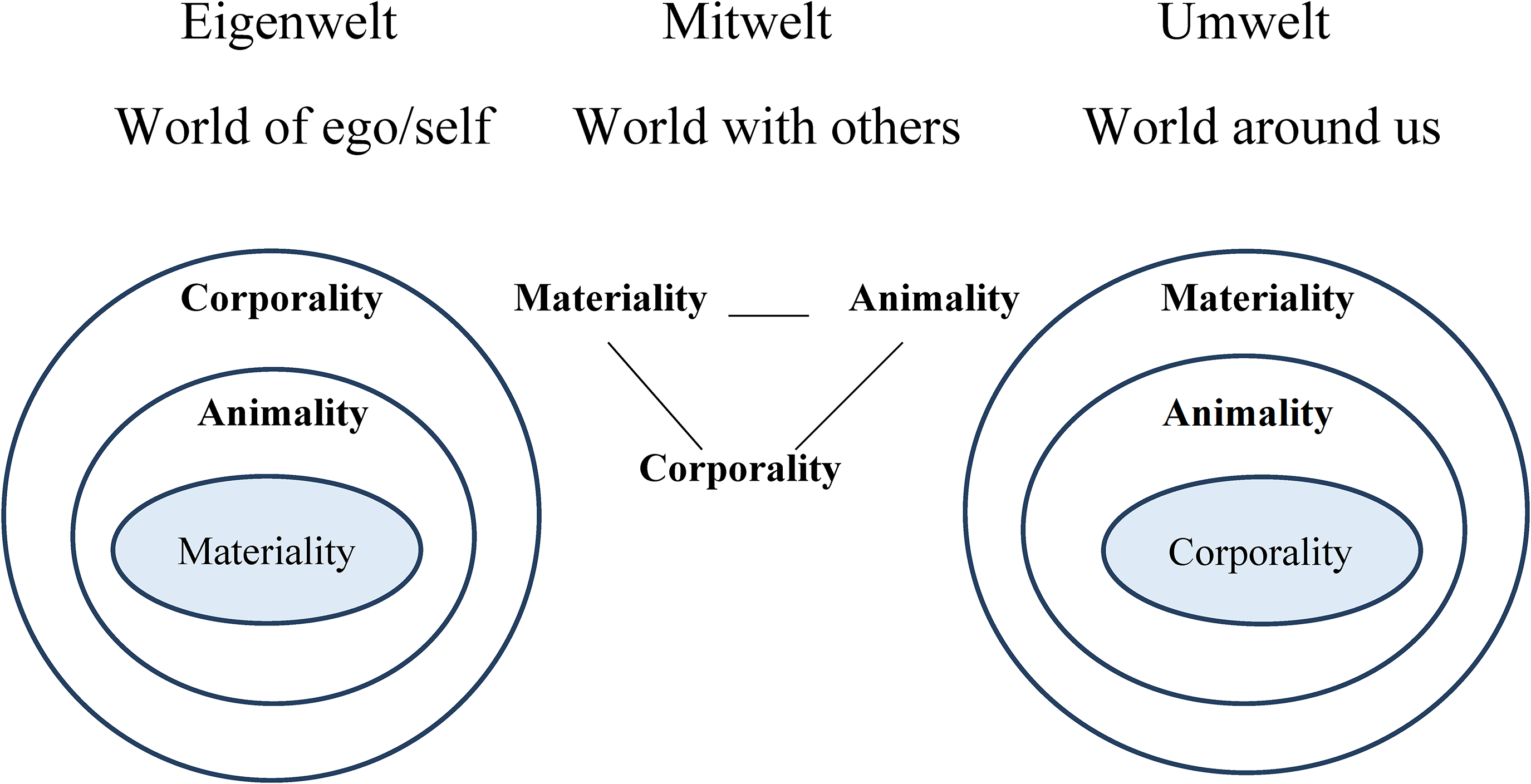
Embodiment in the lifeworld.
My elaboration of embodiment as existential condition and methodological field partakes of an expanding dialogue between philosophy and anthropology (Kumar and Clammer, 2014; Bubandt and Wentzer, 2023; Das et al., 2014) at a time when there is increasingly a sense of urgency with respect to how human existence relates to and should relate to corporeality as bodily integrity, animality as non-human life and materiality as environment. In this context, there are at least two reasons to follow Merleau-Ponty's lead in elaborating embodiment as a methodological field. First, his studies of perception have already proved fruitful in the development of embodiment in ethnography, and it is reasonable to examine how his reflections on nature could do the same. Second, his critique of boundaries among the categories of physical, animal, and human is relevant because these categories separate rich and lively literatures on embodiment, animality, and materiality. Merleau-Ponty's work can contribute to bringing these loosely connected literatures into closer relationship. In the three sections that follow, I will bring Merleau-Ponty's analyses to bear on elaborating embodiment as corporeality, animality, and materiality.
The core of corporeality
Research on the body and embodiment transcends academic disciplines, and scholars in anthropology, philosophy, sociology, psychology, cognitive science (embodied cognition), literary studies and rhetoric, religious studies, and history have addressed it from a variety of directions. From the standpoint of anthropology, an implicit concern with the body began in the early twentieth-century ethnography (Hertz, Mauss, Leenhardt, Radin, Lowie) and became explicitly problematized by Mary Douglas with Purity and Danger (1966) and Natural Symbols (1973). From there we developed an anthropology of the body that treats the body either as (1) a symbolic source domain and a symbolic reflection of social categories in Douglas’ terms, or (2) the object of discipline, biopolitics, and biopower in Foucault's terms; the study of nonverbal communication focusing on kinesics, proxemics, and gesture where analysis is often based on a linguistic analogy that identifies various types of “languages” of the body; an anthropology of the senses in which the senses are parts of human physiology that provide access to a culturally formed behavioral environment, while the sensorium is differentially integrated across cultures; and a cultural phenomenology of embodiment that examines the body as being-in-the-world, at once the wellspring of existence, the source of movement, and the site of experience.
Among these approaches, my intent in talking about corporeality is to deflect interpretation away from “the body” as thing, object, or biological entity toward bodily existence per se. The term corporeality is valuable but not essential—among anthropologists Turner (2011) preferred bodiliness, and Povinelli (2006) found it useful to distinguish between corporeality and carnality. Corporeality in this sense is so fundamental that we can take it for granted to the point of its “disappearance” in the course of our everyday lives, even as it comes into heightened awareness in illness or injury, athletic activity or training, dance or musical performance, love-making, or learning any among what Mauss called techniques of the body (Leder, 1990). For Merleau-Ponty, The body is our general medium for having a world. Sometimes it is restricted to the actions necessary for the conservation of life, and accordingly it posits around us a biological world; at other times, elaborating upon these primary actions and moving from their literal to a figurative meaning, it manifests through them a core of new significance: this is true of motor habits such as dancing. Sometimes, finally, the meaning aimed at cannot be achieved by the body's natural means; it must then build itself an instrument, and it projects thereby around itself a cultural world. (1962/2002: 169)
I will outline three characteristics of corporeality: immediacy, indeterminacy, and alterity. Merleau-Ponty's choice to begin with perception as the key to embodied existence makes it necessary to acknowledge the immediacy of being present in the world, and invites recognition that experience in the Lebenswelt is simultaneously immediate and mediated. This is the immediacy of perception in the Eigenwelt, of copresence in the Mitwelt, and of immersion in the Umwelt. It is the mediation of culture in our construal of the kind of body we have/are, how and with whom we interact, and how we attend to and understand our surroundings. The dialectic of immediacy and mediation in the lifeworld is an element of what I call raw existence in contrast to what Agamben identified as the bare life of a “simple living body” (1998: 3) subjected to biopolitics. If one were to argue that there is no immediate experience because all experience is mediated by language, signs, or symbols, the response would have to be that there is also an immediate apprehension of language, signs, and symbols which is intimately connected to their meaning. The “chicken and egg” relation between immediacy and mediacy (mediation) reappears in the relation between meaning and existence, representation and being-in-the-world, textuality and embodiment, and methodologically in the relation between semiotics and phenomenology. In the domain of language, Merleau-Ponty observes that meaning is not “attached” to words and speech is not the “sign” of thought, but words bring meaning into existence (in speech or in text)—“The spoken word is a gesture, and its meaning, a world” (1962: 214). In the domain of a physics defined by a distinct performative ontology and encompassing both human and non-human bodies, Barad makes the parallel observation that “Matter and meaning are not separate elements. They are inextricably fused together, and no event, no matter how energetic, can tear them asunder” (Barad, 2007: 3).
Corporeality is also characterized by indeterminacy, both due to the inherent experiential/perceptual oscillation between mediacy and immediacy, and because of the constant flux of perspectives across time and space in the lifeworld. Corporeality is variable and malleable as people shift perspectives/positions/orientations posturally or geographically and from moment to moment or across the life cycle, cross-culturally or transhistorically, and insofar as bodily states can be ambiguous or can transform from one to another. The condition of bodies in the world is inherently indeterminate because the horizon of perceptual experience and presence/engagement in the world is constantly shifting, a portable threshold in time and space. Objectifications of existence from different cultural perspectives can result not only in different world views but in different ontologies, as in Viveiros de Castro’s (1998, 2004) work on Amazonian animism and cosmology where people attribute human-like perspectives to animals of other species with other kinds of bodies. From the standpoint of physics, Barad (2007: 153–61) takes up the issue of indeterminacy between the scientist as observing subject and the observed object in relation to the broader issue of indeterminacy in the boundary between body and world, notably juxtaposing examples from Nils Bohr and Merleau-Ponty.
Finally, alterity is a characteristic of the fundamental subject–object structure of corporeality in our very self-awareness as bodily beings. This is evident in Merleau-Ponty's observation of reversibility in touched/touching, such that when I touch my own hand my consciousness can oscillate between feeling myself as the subject doing the touching of my hand as an object, and the subject of being touched by my hand as if it were the hand of another. Our simultaneous existence as subject and object is captured in phenomenological language when we say that our body exists both in itself and for itself (an sich und für sich, en soi et pour soi). This means that alterity is an elementary structure of corporeality, an insight that Descartes had but allowed to escape from the immediacy of lived experience and which subsequently became frozen into an ontological and methodological commitment to mind–body dualism. It is also implicitly why Merleau-Ponty did not always refer to “the body” using the definite article but very often referred to “my body” or “our bodies” using the personal pronoun, thereby emphasizing the body as subject rather than object. The fact that one's own body can become objectified is evident in phenomena such as body dysmorphic syndrome, pornography, or out-of-body experiences which are not literally so but always precisely a bodily experience of being “as if” outside one's body. This inherent alterity constitutes an existential gap (écart) such that one is never completely at one with oneself yet never completely outruns oneself. This gap is the phenomenological kernel that can be elaborated into a religious sense of “otherness” (Csordas, 2004) and that allows intersubjectivity/intercorporeality in recognizing other persons as not merely animate beings but as “other myselves.”
Immediacy, indeterminacy, and alterity guarantee that raw existence remains raw, and that human embodiment is endowed with what Merleau-Ponty called a genius for ambiguity. As for what I am calling components of corporeality, there are at least 10, including bodily form, sensory experience, movement/motility, orientation, (in)capacity/(dis)ability, sex/gender/sexuality, metabolism/physiology, presence/copresence, emotion/affect, emotion/affect, temporality (Csordas, 2011). These components are intimately intertwined, as much as we may lose sight of this when we undertake research on any one of them. They are bound together in what Merleau-Ponty called our bodily synthesis, and each presupposes the others as we inhabit the lifeworld. In this context, I will take only the component of sex/gender/sexuality as an example. It will be helpful again to present a diagram (Figure 2) depicting variable aspects of sexual difference as a series of continua. Read the diagram as if it was structured like an abacus with a bead that could move along the continuum defined by each dimension, so that each person could have a different configuration of “settings” somewhere along the continuum between male and female. These settings would summarize sex/gender/sexuality as a component of corporeality in each person's lived experience, and each setting could in theory shift position over the course of a lifetime. Moreover, there could be standardized “settings” within various dimensions that transcend individual differences. Thus multiple sexes or genders could be recognized as positions of the “bead” or marker along the continuum, much as Fausto-Sterling's proposal to identify five sexes (1993, 2000) includes forms anatomically intermediate between male and female, and Kang's (2014) ethnographic identification of five genders in Thailand includes particular nodes of culturally elaborated performativity. Across the continua of sex/gender/sexuality levels of indeterminacy are not in fact the same—chromosomal structure is relatively more fixed and determinate than is the unconscious. Likewise, self-awareness is available differentially along different continua—one may be intensely aware of one's gender identity while having no immediate access to one's genetics or unconscious.
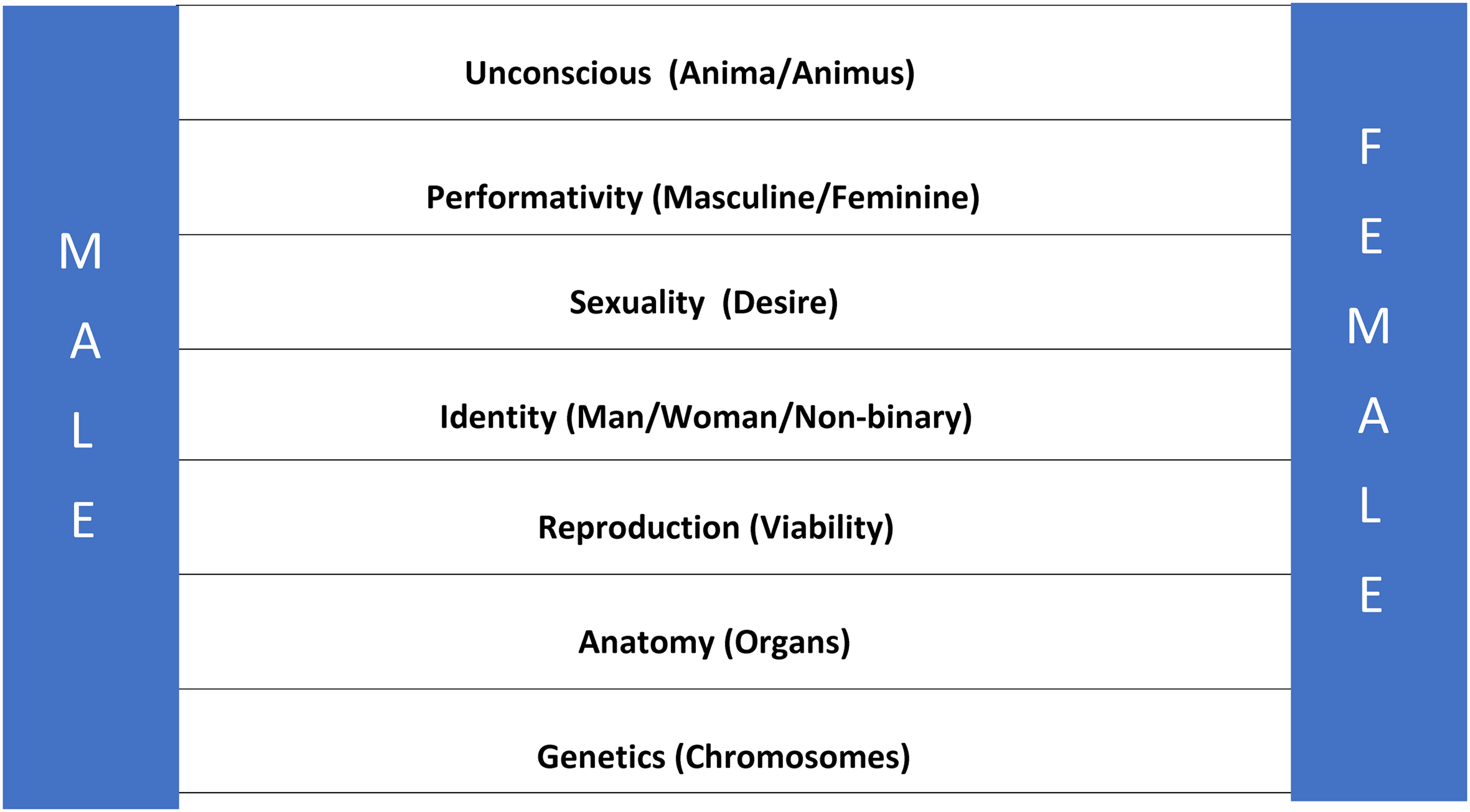
Continua of sexual difference.
Again, components of corporeality are bound together in a bodily synthesis; with respect to relations between sex/gender/sexuality and the other components of corporeality, I will mention only temporality and emotion/affect. Insofar as it is a component of corporeality, temporality is not a feature of linear chronology or sequence so much as experience of duration, pace, tempo, and rhythm including diurnal, menstrual, and seasonal cycles as well as the progression of aging, mortality, death, reincarnation—not a measurable length of time but a lived flow of temporality. Duration is part of bodily existence extending to endurance of waiting as with migrants stuck at the border (Odgers-Ortiz and Campos-Delgado, 2014) or waiting for their day in court (Haas, 2022), or in the fidgety and agitated feeling that “it's time to go” when one person in a conversation feels that conversation has lasted too long. In Butler's treatment of the sex/gender complex, performativity is not only rhetorical as in theatrical or ritual performance, and not only constitutive as in the Austinian performative act, but temporal. The construction of sex is “a temporal process which operates through the reiteration of norms; sex is both produced and destabilized in the course if this iteration (1993: 10) … Hence, it is important to underscore the effect of sedimentation that the temporality of construction implies” (1993: 245). The reiteration of sex/gender norms takes place at different temporal/corporeal scales (personal, historical, cosmological).
Culturally formulated and situationally specified, emotion/affect as a component of corporeality includes feeling and sentiment, recognition of states and changes, intensities and fluctuations of agitation, arousal, excitation, and passion. Affect and emotion have an aesthetic as well as interactive dimension. Their expression, anticipation, and evocation are highly variable, and as much or more than other components of corporeality are subject to assessment along the continuum of normal-pathological. From the standpoint of perception, Merleau-Ponty approached the domain of sex/gender/sexuality through the door of emotion/affect, addressing the issue of desire: Sexuality is neither transcended in human life nor shown up at its centre by unconscious representations. It is at all times present there like an atmosphere… (1962: 195). There is an interfusion between sexuality and existence, which means that existence permeates sexuality and vice versa, so that it is impossible to determine, in a given decision or action, the proportion of sexual to other motivations, impossible to label a decision or act “sexual” or “non-sexual”. (1962: 196)
2
In closing the discussion of sex/gender/sexuality as a component of corporeality, note that while the diagram suggests an indeterminate number of possibilities and variations across the dimensions of sexual difference, conceptualization remains structured by the polar continua between male and female. Polemics about whether sex is inherently binary either draw on several of the dimensions or privilege one or two (Fausto-Sterling, 2018; Fuentes, 2022). The question remains whether the difference is always between binary poles, or whether there is another sex beyond male or female, outside the continuum they define in a way that could be diagrammed as a triangle or polyhedron—is an intersex person somewhere in the middle of several continua or outside the continua altogether? In any case, the only real binary in sexual difference is that between gametes; even in species such as those fish who have more than one breeding form of males and females, they are still identifiable as either sperm or egg providers (Roughgarden, 2009). This invocation of other species offers us the occasion of moving from corporeality to animality, the next topic in our discussion of embodiment as existential condition and methodological field. 3
Embracing animality
Contemporary anthropological concern with animality has been with us as least as long as La Barre's (1957) work on The Human Animal, in which he observed that what distinguishes the human species is neoteny, our immaturity at birth that necessitates a world of adaptations and vulnerabilities. 4 Any comprehensive understanding of animality must address our actual relations with animals, the differences/similarities between us and animals, and the threshold between our corporeality and animality as an issue of embodiment. This includes biological anthropologists’ understanding of animal traditions, communication, and tool use. It most certainly includes efforts to define what an animal is, the issue of animal rights, and multispecies ethnography. Efforts to counter anthropocentrism in how we conceive our positionality as humans come with positing the Anthropocene as a passing stage in planetary evolution, giving rise to the idea of a posthuman state of being in order to put us in a more humble place while enhancing our sense of accountability in relation to the environment. For some the most immediate place to start is with our relationship to pets, as in Derrida's (2008) reflection in which animality becomes an existential problem discernible in the gaze of his house cat, Haraway's (2003) examination of what copresence and companionship mean in relationship to her dog. The intercorporeality of person and pet is one starting point for a consideration of animality that extends all the way to the question of what counts as animate life in the first place.
In Merleau-Ponty's seminars on nature, the idea of logos is central, for there is a logos of the sensible world just as there is a logos of language strictly speaking (2003: 227), and the logos of the sensible world is animality (2003: 166). This way of thinking problematizes taken-for-granted boundaries between animals and humans, between humans and the world we inhabit, and between body and mind. Most consequential is that animality plays a pivotal role between humanity and the inanimate. Merleau-Ponty approaches the problem of what counts as life by outlining the minimal criteria of animality, and of what counts as human by examining the threshold between us and animals. He asserts that neither the relation between physicochemistry and animal life nor the relation between human life and animality is constituted by a boundary but each is constituted as an Ineinander. Critical of the behaviorism and cybernetics prominent at the time, he suggested that in understanding an organism in terms of totality, it appears as an emergent phenomenon defined not only by structure but by posture, not only by physicochemical process but by organization and form. Thus “there is no difference between the organization of the body and behavior” (2003: 146), “behavior is literally a second body which is added to the first body” (2003: 147), and “the body is a system of motor powers that crisscross in order to produce a behavior” (2003: 148).
The critical concept at the threshold of inanimate and animal is that of the Umwelt, a notion we have encountered above and which Merleau-Ponty took up from von Uexküll's studies of animal behavior. It “marks the difference between the world such as it exists in itself, and the world of a living being (2003: 167)…. The Umwelt is the world implied by the movement of the animal, and that regulates the animal's movements by its own structure” (2003: 175). The Umwelt at the most rudimentary level does not presuppose consciousness or subjectivity, only movement and behavior; the “lowest” animals receive nothing from the world and take into account nothing about the world (2003: 169). It is activity itself and not the central nervous system that determines the unity of the organism in this simple Umwelt, because the nervous system has no priority and is just one among other organs (2003: 170). Behavior, and hence an Umwelt, exists only when alternatives exist for the organism: …identical exterior conditions bring along different possibilities of behavior. The crab uses the same object (the sea anemone) to different ends: sometimes for camouflaging its shell and protecting itself thus against fish, sometimes for feeding itself, sometimes, if we take away its shell, for replacing it. In other words, there is a beginning of culture. The architecture of symbols that the animal brings from its side thus defines within Nature a species of preculture. The Umwelt is less and less oriented toward a goal and more and more toward the interpretation of symbols. But there is not a break between the planned animal, the animal that plans, and the animal without plan. (2003: 176)
On the other side of its threshold with the inanimate, where animality shades into humanity, a key to the Ineinander that unites them can be found in the instinctual behavior of animals. Instinctual behavior is already part of an Umwelt, and therefore cannot be said to be the result of simple triggering mechanisms. Instinctual behavior does have a style, though, and does resolve an endogenous tension, in that sense constituting activity that is “for pleasure” (2003: 193). At the same time, it cannot be properly said to be directed towards a goal—it is not intentional but necessary for the animal, and predictable given a certain configuration of conditions. More important, precisely because it is objectless (objektlos), instinctual behavior bears the potential to transcend itself. Having no object frees the imaging function of an instinctual act and renders it susceptible to being taken up as a symbol in the course of evolution. Moreover, “There is an oneiric, sacred, and absolute character of instinct” (2003: 193) that implicitly links up with or carries over into the religious dimension of human experience. Animal mating ceremonies are arbitrary in form just as are signs in human language, and “Just as we can say of every culture that it is both absurd and the cradle of meaning, so too does every structure rest on a gratuitous value, on a useless complication” (2003: 188). Noting how one of two female pigeons raised together in a cage will adopt male conduct, he notes that “This type of error is possible because there is not a spirit of the species, but a dialogue. In brief, we can speak in a valid way of an animal culture” (2003: 198).
Arriving at the logos of language in the fully human sense, there is a retention of connection to the preobjective Umwelt and the mute logos of the sensible world: Logos in the sense of language, the proffered language, says everything except itself; it is reticent, like the silent Logos of perception. It speaks in us rather than we do speak it. It snatches us up like the sensible world. The invisible, mind, is not another positivity; it is the inverse, or the other side of the visible. We must retrieve this brute and savage mind beneath all the cultural material that is given (2003: 212)…. The quasi-natural life of language [langage] … is like a second nature: it precedes itself; its origin is mythic…. It fuses in the human body not as a positive causality of the mind, but between the words like a savage mind, before sedimenting in the positive objects of culture…. There is a logos of the sensible world and a savage mind that animates language. (2003: 227)
In sum, on the side of animality closer to where it fades into anonymous and inanimate processes, Merleau-Ponty understands the organization that emerges in lower organisms as a kind of “republic of reflexes” (2003: 172). On the side where animality passes into humanity, what emerges is a “promiscuity of powers” (2003: 279). There is a democratic and pluralist connotation to these images, as well as an emphasis on continuity at the threshold between them. Merleau-Ponty cites Teilhard de Chardin to the effect that “Man came silently into the world” (2003: 267), meaning that there was no drama or rupture in the emergence of humanity from animality. We remain, now in the phrase of Valery, the “animal of words” (2003: 166). Critically, For us there is no descent, into a body otherwise prepared, of a reflection of which the body would be only the instrument. There is a rigorous simultaneity (not in any sense a causality) between the body and this reflection… This reflection is the coming-to-self of Being, Selbstung, through a sensing, and the realization of an intersubjectivity which is first intercorporeity and becomes culture only by relying on sensible—corporal—communication (the body as organ to be seen/of being seen). Thereby this is not a hierarchical but a lateral relation, or Ineinander. (2003: 272–73)
The lateral development of animality into humanity proffers an opportunity to conceptualize and visualize (Figure 3) how animality constitutes a condition of embodiment. This diagram should not be read from top to bottom as in a hierarchical form, but as if it were laid flat on a table with humanity in the center of the triangle—not for the sake of anthropocentrism but because it is at the center of attention in understanding our body as “something other than its own mass.” In this representation, the link between humans and animals is a lateral and natural one, insofar as we are animals and we (co)exist with or in relation to animals. The link between humans and deities constitutes a threshold of embodiment as a denial or transcendence of animality, and the link between humans and monsters constitutes a threshold as an exaggeration or alienation of animality. The visualization depicts a form in which human embodiment mediates its own animality by positing deities and monsters as cultural entities. This does not preclude the possibility of conceiving hybrid relations among animal, deity, and monster represented by the outer triangle, such that we can imagine divine monster and horrible deity, monstrous animal, or animal deity.
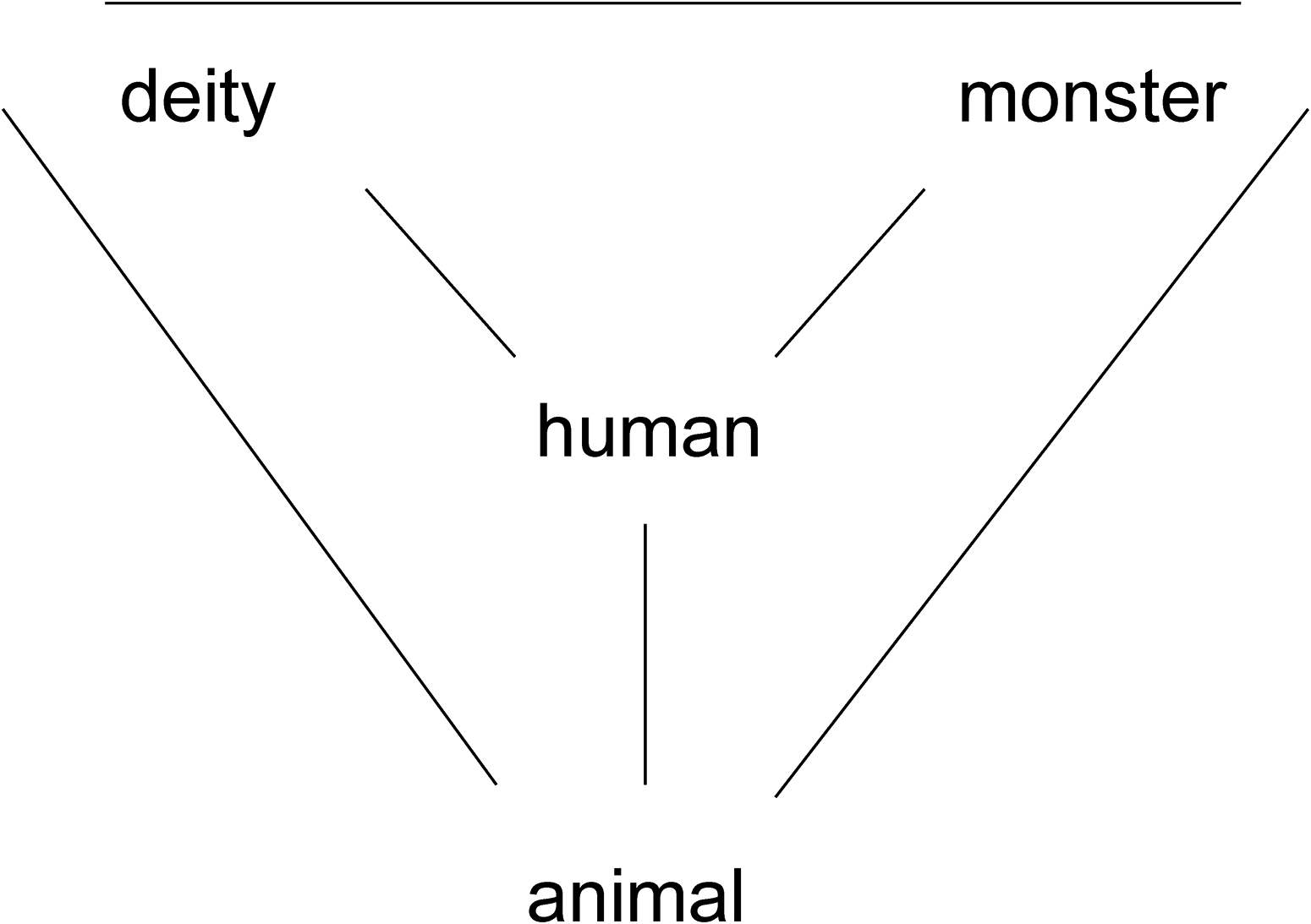
Animality as a condition of embodiment.
If animality is refracted by the human to generate deity and monster, the actual encounter between animals and humans as embodied beings depends on the subjectivity they possess or that people invest in them. The salience of immediacy, indeterminacy, and alterity as characteristics of human corporeality is relatively less if the issue is one of conservation and environmentalism, somewhat greater with respect to ecological interdependence and animal rights, and greatest in relation to intersubjectivity and identity with animals. In other words, the latter are where the animal–human Ineinander is closest to lived experience. The condition of possibility for intersubjectivity is empathy between animal and human and the condition of possibility for identity is transformation between animal and human. I will briefly discuss both.
Empathy is at issue in the volume edited by Ingold (1994), in which the contributors address what an animal is in a way that lays the groundwork for multispecies ethnography (Fuentes and Kohn, 2012; Kirksey and Helmreich, 2010; Ogden et al., 2013). This includes not only “the existence of animals for us” (Ingold, 1994: 12) but also empathetic awareness and self-awareness across the species boundary from both sides (Coy, 1994). From the side of phenomenology, a volume by Painter and Lotz (2007) addresses “what it means to be with non-human animals and to exist for non-human animals” (2007: 4). Painter in particular draws on on the trans-species implications of Husserl's thought and Stein's theory of empathy (Einfühlung) to show that the precondition for empathy is the perception of a physical, animated body” (2007: 106). Empathy in this view is engagement with the psychic life expressed through the animal's lived body while preserving the foreignness of the animal as other, and can expand the ground for an ethics of care (Gilligan, 1982) that recognizes the moral intersubjectivity and moral kinships of humans and animals. This is the case whether or not the animal's psychic life remains pre-reflective and the animal is an empathic patient rather than empathic agent.
Like Painter, Schnegg and Breyer (2022) draw on Stein's idea of Einfühlung as they take up the intersubjectivity between humans and three ontological entities—elephants, trickster spirits (khâidaos), and winds—that exist in what Hallowell would call the behavioral environment of the pastoralist ‡Nūkhoen people of Namibia. While all three entities “are experienced as having subjectivity, the bodily similarity with humans decreases from elephants to tricksters to winds, … [and] empathic processes differ with varying degrees of embodiment” (2022) and different sensory capacities among the types of being. Unlike elephants and spirits, the winds, although they are beings that can experience emotions and can leave an impression as they touch humans, have no perspective that can be grasped empathically because they are without bodies that ground the capacity for expression. This account has the advantage of engaging the animal–human Ineinander that is more or less accessible to lived experience with mammals, but suggests a continuum of decreasing accessibility as bodies/subjectivities diverge across species. At the same time it engages the distinct continuum of foreign subjectivities extending from animals to spiritual beings to natural forces (such as winds) that are decreasingly accessible as their bodies/subjectivities approach the material world which is either inanimate or imaginatively invested with its own affective capacities. 6
We have already seen the reversibility/transformation of human and animal identities in the savage thought and concrete logic recognized by Merleau-Ponty and Lévi-Strauss. Wagner specifically addressed animality as a basic reality and objective quality that constitutes the sense that “makes thought, experience, understanding, and even effectiveness itself efficient” (2001: 129). At the heart of animality is “the way animals and people exist as specific transforms of one another” (2001: 130), such that “Animality has a reality to its human story, and a human story has a reality to its animality” (2001: 131). In observing the animality of animals in relation to humanity, Wagner implicitly engages Merleau-Ponty's wild thought and Lévi-Strauss's concrete logic in terms of structural opposition and inversion, such that one can consider not only anthropomorphism of animals but also a kind of “animamorphism” of humans from the animal standpoint. Observing how people in Australia and New Guinea engage with bats in their environment leads him to a discussion of echolocation, which is for him a methodological trope with metaphorical, spiritual, and ontological overtones. Thus, “whereas bats locate themselves, navigate, and find their food by bouncing sound off echo-limits, effectively transforming their negotiable world into an imaginary crepuscular cave, human beings locate their subject, its negative spaces or contingencies, by resonating against the limits of language” (2001: 136–37). Reflecting on the relation of language and sound, he suggests that if humans used the sonority of talk like bats, “a genuine semiotics might be possible, centering the human echolocation on communication about its own limits” (2001: 137).
Here Wagner is close to Merleau-Ponty's (1968) understanding of “sonorous being” in the bodily relation between voice and language. Yet while for Wagner “Animality is the autonomy of sense, not its characterization, pigeonholing, or symbolization” (2001: 139), echolocation remains a methodological trope. To get a feel for how echolocation can be an element of experiential immediacy in the field of embodiment, we must recognize it as a feature of the perceptual threshold between, or more precisely the ineinander linking, human animality and animal animality. Consider the circumstance of Ben Underwood, a young boy who lost his eyes to cancer and developed his own form of echolocation by making a sharp clicking sound with his tongue. He was able effectively to navigate his everyday world by attending to the sounds that bounced back from things, and could even ride a bicycle around his neighborhood (Engber, 2006; McCaffrey, 2009). The relevant components of corporeality in his case were sensory experience, movement, capacity, and orientation in a way that we can say is contiguous with animal bodiliness, but without attributing to us the same capacities or mode of being of animals. While this case made a big media impression in the early 2000s, research on echolocation by blind people goes as far back as the 1960s and emerged directly from research on sonar among dolphins (Kellogg, 1962; Rice et al., 1965; Rice, 1967). Human echolocation is neither anomalous nor “animal-like;” it makes sense both neurologically and phenomenologically, and it is also the case that sighted people can echolocate, especially if specifically trained to do so (Downey, 2011; Schwitzgebel and Gordon, 2000). This is an essentially different engagement with animality than Wagner wondering what “a human eye with a wolf's mind behind it” (2001: 139) might see, or Thomas Nagel's (1974) wondering “What is it Like to Be a Bat?” Rather than focusing on inversion or transformation between animal and human modes of being, from the standpoint of embodiment the focus shifts to their contiguity and interpenetration. We will carry this thread to the following section about the Ineinander of humanity and materiality.
Fleshing out materiality
Materiality has been a concern for anthropology at least since Appadurai's Social Life of Things (1988) and Miller's Material Culture and Mass Consumption (1987), both of which examine objects and commodities in motion. It appears in archaeology in debates about materiality and material culture, and how to engage the materiality of bones and artifacts. In the anthropology of religion, it appears in a sensibility for ritual objects and their use, and for the engagement of sensory experience. Examination of the built environment as human space and the natural environment as subject to material pollution and climate change are informed by a sensibility to materiality. Actor-network theory, semiotic materialism/material semiotics, and neo-materialism ascribe agency to the inanimate and to human-made objects. We humans are aware of the materiality of our own bodies and our engagement with the material world more explicitly than ever—we are matter and we relate to matter.
Matter is inanimate and anonymous, though not necessarily inert, substance. Material is matter that has a meaning for us because we do something with it, as in material goods, building material, material for clothing. Materiality, however, is an abstract noun of quality designating as aspect of the natural world for us and not in itself. In other words, the “materialness” of matter can be of interest to us only as sentient humans, and we have no other than a human way of relating to matter. In a discussion aimed at material culture for an audience largely of archaeologists, Ingold sets materials and materiality conceptually against one another, favoring materials in order to “bring the flesh and blood of human bodies into corporeal contact with materials of other kinds” (2007: 3). He argues that “I can touch [a] rock, … and can thereby gain a feel for what rock is like as a material. But I cannot touch the materiality of the rock” (2007: 7). In my view the reason one cannot touch the materiality is that the corporeal act of touching the rock generates its materiality and “feeling what the rock is like” is its materiality. Encountering materiality as a quality from the standpoint of embodiment avoids eclipsing experience: there is no such thing as materiality in-itself only materiality for-us.
Merleau-Ponty grounds materiality as a human phenomenon in relation to embodiment as a methodological field. His concept of “flesh” is the linchpin to this undertaking, starting with the elementary question of how we comprehend “what there is” in the world, and how we relate to the materiality of our own bodies and to that of things/objects in the world. The relationship between the sensible and the sentient is like the relationship between the obverse and reverse of a leaf, or like tracing the top half of a circle from left to right and the bottom half from right to left—completely reversible, as are the relations between touching and the touched, seeing and the visible, speech and the signified. Our bodies are themselves simultaneously sensible and sentient, and as sensible they are continuous with “the whole of the sensible” (2003: 138), the flesh of our bodies continuous with the flesh of the world. This poses a critical question: Where are we to put the limit between the body and the world, since the world is flesh? Where in the body are we to put the seer, since evidently there is in the body only “shadows stuffed with organs,” that is, more of the visible?… A participation in and kinship with the visible, the vision neither envelops nor is enveloped by it definitively. The superficial pellicle of the visible is only for my vision and for my body. But the depth beneath this surface contains my body and hence contains my vision. My body as a visible thing is contained within the full spectacle. But my seeing body subtends this visible body, and all the visible with it. There is reciprocal insertion and intertwining of one in the other…. (2003:138) The flesh is not matter, is not mind, is not substance. To designate it, we should need the old term “element,” in the sense it was used to speak of water, air, earth, and fire, that is, in the sense of a general thing, midway between the spatio-temporal individual and the idea, a sort of incarnate principle that brings a style of being wherever there is a fragment of being (2003: 90). The flesh is in this sense an “element” of Being. (2003: 139) That means that my body is made of the same flesh as the world (it is a perceived), and moreover that flesh of my body is shared by the world, the world reflects it, encroaches on it and it encroaches on the world (the felt [senti] at the same time the culmination of subjectivity and the culmination of materiality), they are in a relation of transgression or overlapping. (1968: 248)
For our purposes, the critical phrase lies in the parenthetical comment in which we can interpret the simultaneous culmination of subjectivity and materiality as also a convergence of subjectivity and materiality. The passage is filled with the nuances of reflection, intertwining, encroachment, transgression, and overlapping. The notions of reversibility and limit are not erased as in Bataille's (1989) image of water in water that describes the collapse of immanence and transcendence in animality. Instead, they have their condition in flesh as a medium, an element or elementary structure of existence. To adopt the figure of flesh as the Ineinander of subjectivity and materiality, body and world, and further to describe it as an “element” of being is also to evoke the intertwining of metaphorical and literal meanings, with ontological implications.
Flesh in this sense is not matter (2003: 148), but it is synonymous with materiality, or what Merleau-Ponty calls “heavy signification” (2003: 205). The Flesh of the world is not sentient (2003: 250) and so does not imply animism or hylozoism, but refers to the world's pregnancy of possibilities given in their depth. “Depth is the means the things have to remain distinct, to remain things, while not being what I look at at present … It is hence because of depth that the things have a flesh: that is, oppose to my inspection obstacles, a resistance which is precisely their reality, their ‘openness,’ their totum simul. The look does not overcome depth, it goes round it” (1968: 219). The possibilities present in the depth of things are invisible in the sense of something that is beyond the horizon, and “when Husserl spoke of the horizon of the things—of their exterior horizon, which everybody knows, and of their ‘interior horizon,' that darkness stuffed with visibility of which their surface is but the limit—it is necessary to take the term seriously" (1968: 148–49). The outer horizon is the literal earthly horizon that can be metaphorically reframed as the disclosure of the world in which we advance or recede in everyday life. The inner horizon, inherently figurative, has two senses: that of the anonymous organic processes to which one can penetrate through imagination and anatomical/physiological knowledge; and the significance that is always there to be extracted, discerned, interpreted, or intuited as one gets further and further “into” the object or situation.
In this context, Merleau-Ponty gives us the term “in-visible,” punning on the negation given by the prefix “in-” and the interiority given by the word “in.” He invites “the exploration of an invisible and the disclosure of a universe of ideas,” which unlike the ideas of science “cannot be detached from the sensible appearances and be erected into a second positivity” (1968: 149). Moreover, the reversibility between the flesh of our bodies and the flesh of the world creates the condition of possibility for us not only to see ourselves as others see us, but also to have a sense of being seen by the outside “such that, as many painters have said, I feel myself looked at by the things … so that the seer and the visible reciprocate one another and we no longer know which sees and which is seen” (2003: 139). Likewise, speech and what is spoken of are reversible such that a “landscape is overrun with words as with an invasion” and reciprocally language “is the very voice of the things, the waves, and the forests” (2003: 155). Again, our participation in the element of flesh is the condition for a sense of perceived life, that is, “what makes an appearance animate itself and become ‘creeping’ etc.” (2003: 178). Recognizing the vibrancy of this inherent reversibility of flesh as an element of Being allows us to tap into raw existence at the level of what Merleau-Ponty refers to as wild meaning (2003: 155) and wild being (2003: 178). This is literally a pensée sauvage, the concrete logic embedded in “an expression of experience by experience” (2003: 155). 7
In the preceding paragraphs, I have explored the threshold/Ineinander between the body and the material world. In this respect, parallel to the way we represented animality as a condition of embodiment, we can do the same with materiality (Figure 4). Again, the diagram should not be read from top to bottom but as if it were laid flat on a table—the link between human and matter is a lateral and natural one insofar as we are matter and we exist in relation to matter. The link between human and machine constitutes a threshold of embodiment as a displacement and externalization of human functioning into a material entity, maintain a necessary “interface” and means of “handling.” This displacement is minimal when the machine is the simplest of tools and verges on replacement when one imagines the most complex forms of artificial intelligence. The link between humans and cyborgs is constituted as an incorporation and integration of engineered material in order to enhance or restore human function. The top leg of the outer triangle linking machine and cyborg represents a hybrid in the form of an autonomous humanoid robot, the leg linking matter and machine would perhaps be a non-functioning statue of a machine, and the leg betwween matter and cyborg would highlight its dual biological and mechanical materiality.
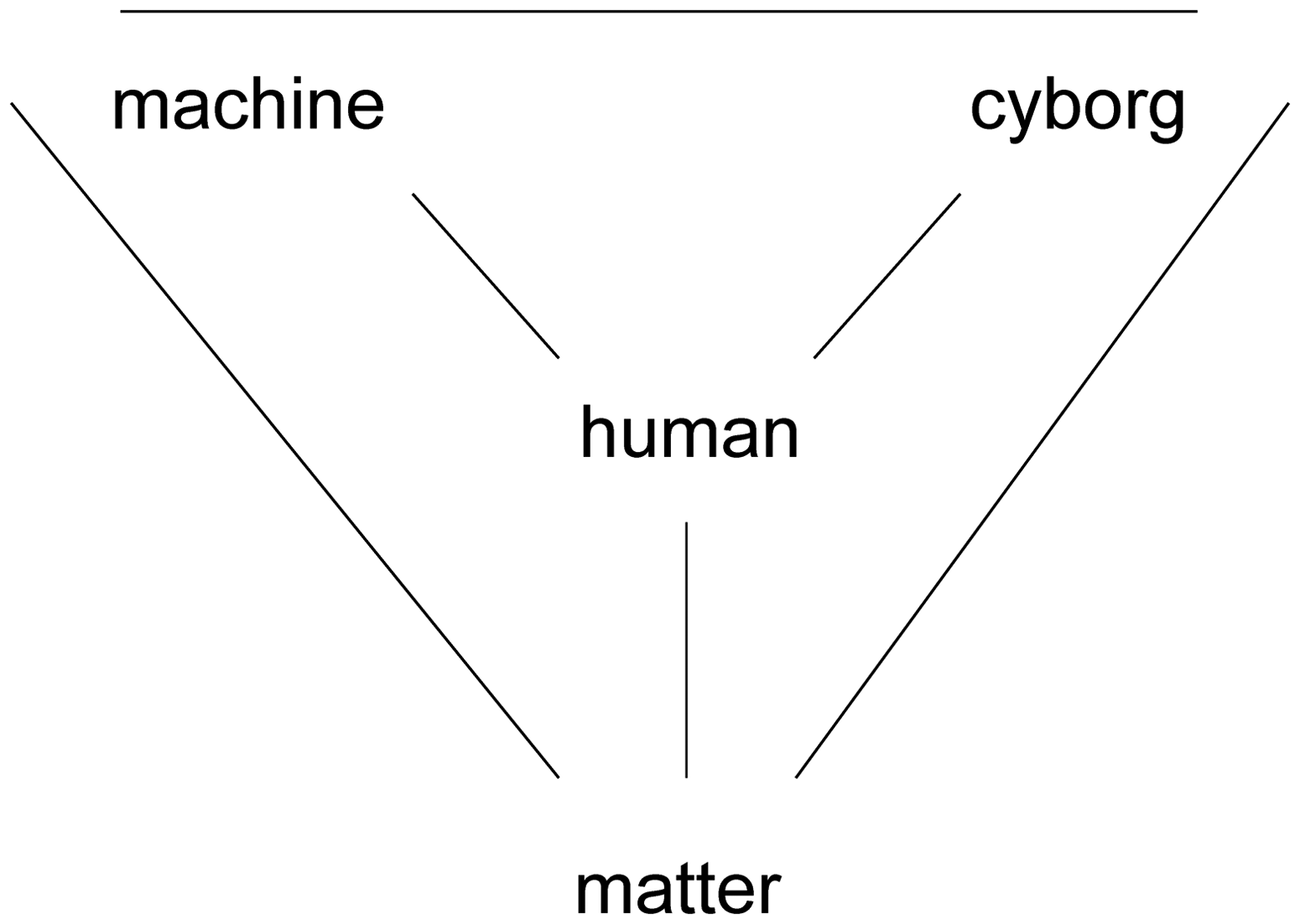
Materiality as a condition of embodiment.
A valuable counterpoint to the notion of flesh is political scientist Bennett's “vital materialism” (2010). From the standpoint of embodiment, the greatest strength of this work is simultaneously its greatest weakness. The strength is that in service of an ecologically responsible politics she aims “to encourage more intelligent and sustainable engagements with vibrant matter and lively things” (2010: viii). Her intent is to counteract “human exceptionalism” in our relationship with the material world by recognizing the agency of matter and things, such that agency is distributed across assemblages of people and things and our relationship with those things can be reconceived as horizontal rather than hierarchical. The weakness is that in undertaking this task she suggests that we “[p]ostpone for a while the topics of subjectivity or the nature of human interiority, or the question of what really distinguishes the human from the animal, plant, or thing,” based in part on the questionable claim that they “presuppose anthropocentrism and will insinuate a hierarchy of subjects over objects, and obstruct freethinking about what agency really entails” (2010: 120). However, Bennett's postponement of human subjectivity does not reinstate it in the end and therefore sacrifices it altogether, along with the intentionality and sentience that subtend it. Subjectivity and intentionality do not disappear by decentering the human (2010: 9), they only become more complex.
Bennett's argument begins with reducing an object to its thingness, which she says opens a space between nature and subjectivity, between the in-itself and the for-us. She intends to fill this space with a vital materialism, while in contrast from the standpoint of embodiment the space between nature and subjectivity collapses into the element of flesh. The instigating image for Bennett is of encountering a random collection of items on a storm drain outside a bagel shop: a glove, a mat of oak pollen, a dead rat, a bottle cap, and a stick of wood. The image evokes what is in effect a spontaneous epoché in which she recognizes but underestimates the element of contingency in making possible the reduction to thingness, while in contrast from the standpoint of embodiment, this contingency is a function of flesh and not of the agentic assemblage or the self-organizing property of matter (2010: 7). Relevant here is Merleau-Ponty's image of the “intentional threads” that link us to the objects given in the performance of a task (1962: 106), in this context as the threads animating the marionette of materiality. “The flesh of the world is not self-sensing (se sentir) as is my flesh—It is sensible and not sentient—I call it flesh, nonetheless … in order to say that it is a pregnancy of possibles, Weltmöglichkeit” (1968: 250). Bennett's contingent cluster of debris on the sewer grate has a Weltmöglichkeit that evokes wonder about why here, why now, why me. The act of observation invests one's self in the stuff, as self becomes one of the objects in the assemblage. Instead, Bennett adopts a kind of hylozoism and makes a leap to seeing the world as animate without recognizing how we animate the world in the bond of reversibility.
In seeing things as actors and humans as vital materialities (2010: 21), Bennett is intertwining metaphorical and literal meanings like Merleau-Ponty did in elevating flesh to the ontological status of an element. However, Bennett argues that “…it is not enough to say that we are ‘embodied.’ We are an array of bodies, many different kinds of them in a nested set of microbiomes” (2010: 112–13). This does not so much replace a hierarchical with a horizontal appreciation of human life as it multiplies bodies without amplifying embodiment into flesh and sentience. There is no agency without intentionality, at least in the sense of what Husserl called the operant intentionality that is an inherent tending toward the world, and no subject without subjectivity in the sense given by raw existence. 8 Moreover, postponing subjectivity and intentionality creates Pandora-like problems for Bennett and she acknowledges struggling to control the discourse and choose the right verbs to describe the agency of objects (2010: 119). What can it really mean to say that electricity “chooses” (2010: 25) its path through the power grid and must “do its part” (2010: 30) based on what we ask of it? In what sense is food qua food (and not as a living chicken or stalk of celery) “vying” (2010: 39) conatively to persist in the world and occupy the role of a “player” (2010: 51) in worldly affairs?
Bennett's problem with depending on a literalism of agentive verbs in attributing agency to objects also appears in Latour's elaboration of actor-network theory, where he argues that “…any thing that does modify a state of affairs by making a difference is an actor—or, if it has no figuration yet, an actant” (2005: 71). As with Bennett, his claim renders human-made objects into subjects: After all, there is hardly any doubt that kettles “boil” water, knives “cut” meat, baskets “hold” provisions, hammers “hit” nails on the head, rails “keep” kids from falling, locks “close” rooms against uninvited visitors, soap “takes” the dirt away, schedules “list” class sessions, prize (sic) tags “help” people calculating, and so on. Are those verbs not designating actions? How could the introduction of those humble, mundane, and ubiquitous activities bring any news to any social scientist?… And yet they do. (2005: 71)
Contrast this to a linguistic order characterized not by taking the metaphorical agency of objects literally, but by taking the actual materiality of objects literally. Rather than emphasizing verbs that appear to transfer human agency to objects, Navajo verbs alter their form depending on the form of objects and how we handle them: Navajo classifies all objects into one, two, or three of eleven categories in the handling of them (picking up, carrying, setting down, giving), and in [distinct forms of] handling them as in throwing, and in describing at-rest positions…. The various verb stems take into consideration number, consistency of the item, the shape of the object and, if in a container, whether in a sack or open or closed container. (Goosen, 1995: 133–134)
Finally, considering materiality within the methodological field of embodiment has direct contributions to ethnographic interpretation. Holbraad and Pedersen (2017), for example, give two examples of encounters with materiality. The first is the spiritual power (aché) of powders used in ritual by Afro-Cuban Ifa diviners (2017: 220–27). The diviners trace patterns in the powder spread on a board, and these patterns are the divinities. The material properties (e.g., perviousness) of the powder itself imbue it with conceptual affordances that allow an understanding of its power. What Holbraad and Pedersen mention but pass over too quickly from the standpoint of embodiment is that the powders are also consecrated and so by a material act are invested with power/meaning that concretely links their power to that of the diviner. The second example is talismans (ongod) of shamanic spirits in northern Mongolia. Preeminent among these is the gown worn by shamans “whose exterior cotton knots, strings, and flaps point antenna-like in all directions” and invite “maximum engagement with and intervention from the surroundings” as if their shamanic bodies were turned inside out as the ongod spirits enter them in a séance. The authors are concerned with the gown as a map of cosmological and community thought/knowledge, but what stands out from the standpoint of embodiment is that the presentation of the inside-out body also establishes a powerful intercorporeality among ritual participants. Their cognitivist concern with thought suggests that material properties allow artifacts to “emit concepts” imbued with power and beauty. However, one could also say that in the consecration of powder and the intersubjectivity of the shaman's gown, power is generated by the Ineinander of corporeality's immediacy, indeterminacy, and alterity with those material properties and their heterogeneous design. To put a semantic point on it, I would replace Holbraad and Pederson's preferred phrase “imbued with” by the phrase “invested with.” Without being necessarily any less ontological in implication, this is a move from thought to experience, and from anonymous to embodied materiality.
In sum, the material world is not animate but animated by us, and this is why we are not in the domain of animism or hylozoism but in the domain of the Ineinander of humans and matter. A boulder lying on the ground has no “heavy signification” until we invest something in it and make something of it. Then it becomes geological data to examine, an obstacle to get around, a beautiful form to admire, a high point from which to look out (or on which to play), a landmark to find one's way, a shrine at which to worship, a chunk of stone to use as building material, a being with which we can interact. This is the animated and invested materiality of the boulder as an aspect of the flesh of the world. Merleau-Ponty's concept suggests that there is something palpable in this, the touched and the touching in our relationship with the materiality of the world as well as the materiality of our bodies.
Conclusion
Critical examination of embodiment as existential condition and methodological field from the standpoint of cultural phenomenology is grounded in the intent to counter a detached, rationalist, authoritarian, patriarchal cogito with a corporeal existence characterized by immediacy, indeterminacy, and alterity. Humans are bodies always in relation to other bodies, animals always in relation to other animals, matter always in relation to other matter. Thus we never transcend animality and materiality as they are recursively transduced within our experience. Our animality remains in the form of the beast within and the deity beyond; our materiality persists in our capacity to create technology in the form of machines and to incorporate technology in our transformation into cyborgs. 9 The critique of boundaries among corporeality, animality, and materiality productively destabilizes these categories and anticipates contemporary concerns of the Anthropocene, allowing us to extend the cultural phenomenology of embodiment to the Ineinander between human and non-human and our participation in the flesh of the world. These concepts constitute an enduring contribution of Merleau-Ponty's seminars on nature for anthropology in suggesting an existential continuity if not an ontological unity across the Lebenswelt of diverse cultures, species, and objects. They invite an extension of cultural phenomenology's agenda beyond description to critique, insofar as the relation between life and mind is neither vitalistic nor Cartesian. Merleau-Ponty opposes any implication that mind or soul “descends into” the body or becomes attached to it (2003: 150), insisting that mind and body are inseparably related not as separate kinds of things but as sides of a leaf, the visible side and the invisible.
A cluster of concepts that arises for Merleau-Ponty in relation to the critique of Cartesian thought is that of Nature, Man, and God, each corresponding to a mode of thinking: naturalism, humanism, and theism. Already in the 1950s, he insisted that “These words have lost all meaning in our culture, and they ceaselessly pass into one another” (2003: 135). How much more this is the case now when naturalism is faced by the Anthropocene, humanism by posthumanism, and theism by ecospirituality on one hand and theocracy on the other. Merleau-Ponty might ask whether the question is about posthumanism as the decentering of humankind within the Umwelt or about posthumanism as the conclusion that humankind is bad for the planet, and whether anthropology beyond the human actually implies leaving humanity behind. The displacement or decentering of humanity and human exceptionalism can be liberatory. It would be ironic, however, if just as we begin to accept responsibility for having brought about an Anthropocene era, we abnegate human sensibility and abdicate human responsibility for the planet and for ourselves, or conclude that humans becoming extinct would be best for the planet.
My final point is to highlight Merleau-Ponty's observation that the dominant problem for phenomenological critique linking corporeality, animality, and materiality is the ontological problem, by which he means the relation between subject and object (2003: 134) with respect to perception, and by extension the relation between being and becoming with respect to existence. Explicit consideration of Merleau-Ponty's ontology (Barbaras 2004) vis-à-vis ontological issues in anthropology (Holbraad and Pedersen, 2017; Kohn, 2015 ; Povinelli, 2016) would require a separate study. It would have to consider how different cultures address ontological issues in a renewed discussion of relativism and universalism recognizing the mutable characteristics and components of corporeality that ultimately remain identifiable as human embodied existence. Such consideration would begin with being-in-the world and consider its relation on the one hand with embodiment as a being-of-the-world constituted dynamically along with and as a part of the world rather than as specifically situated or positioned (Barad, 2007: 160, 377), and on the other hand with embodiment as a being-toward the world constituted as a sentient tropism or operative intentionality that produces the unity of the world and of our life (Csordas, 2011: 139–40). However the ontological problem is elaborated, to the extent that interpretation and critique are grounded in embodied existence, or at least do not lose sight of embodiment, we anthropologists can confront it in the concrete immediacy of lived experience.
Footnotes
Acknowledgments
I am grateful to the doctoral students in various iterations of my seminar “The Human Body in Discourse and Experience,” and for the opportunity to have presented versions of this work at Harvard, Johns Hopkins, Cornell, Cambridge, Durham, Macquarie, Campinas (UNICAMP), Hamburg, the Musée du Quai Branly, and as keynote lectures for the Western Humanities Alliance at UC Santa Barbara and for the 1er Encuentro Latino Americano de Investigadores Sobre Cuerpos y Corporalidades en Las Culturas at the National University of Rosario, Argentina.
Declaration of conflicting interests
The author declared no potential conflicts of interest with respect to the research, authorship, and/or publication of this article.
Funding
The author received no financial support for the research, authorship, and/or publication of this article.
