




Abstract
Much of the debate in archaeological theory throughout the last decades has revolved around challenging problematic humanist principles that have shaped our discipline, particularly the idea that humans are masters over nature. Postprocessualists sought, among other things, to emancipate the human condition from this essentialist claim in part by exposing the historical and cultural situatedness of this humanist principle – an epistemological endeavour. In comparison, posthumanists have animated the material world (albeit in different ways) to decentre human beings in relation to long-forsaken nonhumans – an ontological agenda. While posthumanists accuse postprocessualists of practicing anthropocentrism and the latter accuse the former of occupying an ahumanist and anti-epistemological position, there are powerful commonalities in their critique of late humanist doctrines. The aim of this paper is to introduce a theory that exposes the illusory humanist claim of human control over nature and to recognise other forces with momentum besides human will, while at the same time giving prominence to questions about human knowledge and practice. Therefore, a connection is formed between postprocessualism and posthumanism and, as an ironic result, a theory of breakage is formulated. When we consider human participation with breakage, defined as those continuous and uncontrollable phenomena involving the unbinding of object form, we come to terms with a different form of anthropological understanding termed ‘the social knowledge of breakage’. This constitutes an embodied form of knowledge, which is acquired and expressed practically from a young age about how objects break and how one must respond to these situations. This knowledge is exposed in both mundane and ceremonial practices, in linguistic and non-linguistic forms, shaping social practices in uncertain ways, and can be analysed according to three different strands. In this way, we become aware of the creative ways in which broken materials inadvertently affect our practices.
Keywords
Introduction
The last 40 years of theoretical development in archaeology has in some way or another exposed the (negative) effects of the strand of humanism that is most influential today, particularly its depiction of humans as beings that are in control of or masters over nature. While this endeavour has been historically associated to the postprocessualist movement, which was inspired in antihumanist scholars, recently it has been more loudly conducted by posthumanist archaeologists. In contrast to the epistemological focus of postprocessualists, posthumanist archaeologies instead seek to remove humans from their ‘ontological centre or hierarchical apex’ (Bennett, 2010: 11) in order to acknowledge all those ‘nonhuman others’, such as that material things, plants, animals, celestial bodies, among many others, that are claimed to have always been defined in contraposition to humans (and thus, by what they lack). These arguments have been most notably voiced by new materialists (Fowler and Harris, 2015; Jones, 2012) and symmetrical archaeologists (Olsen, 2010; Olsen and Witmore, 2015; Olsen et al., 2012; Pétursdóttir and Olsen, 2017; Witmore, 2014). While these approaches differ in their treatment and understanding of agency in the (natural) world, a commonality between these frameworks is the aim of decentering humans by shifting focus towards matter or ‘things’. In this pursuit for an ontological equality, however, it would seem as if questions about human perception, knowledge, gender, social inequalities, postcolonialism, among other important topics, are unwarrantedly ignored, which has led to much frustration, confusion and debate (Barrett, 2016; Crellin, 2020b: 119; Fowles, 2010: 23; Hodder, 2014: 229; Lucas, 2015: 191; Thomas, 2015: 1294; Van Dyke, 2015: 18). Yet, the critique of anthropocentrism need not be equated with an ahumanist position (Crellin and Harris, 2021: 473), but a critique of a particular model of humanity, which is the product of the specific history of Western thought (and one might add how this history is being written in contemporary times).
In light of these concerns, a (anthropological and archaeological) theory of breakage is presented in this paper as an opportunity to address the question of humans and knowledge in the current posthuman climate, and, in the unfolding of its principles, uncover a different form of human understanding. My proposition is structured around two arguments: (i) that there is a valuable continuity among antihumanists and posthumanists in their critiques of the figure of the ‘controlling’ human portrayed in humanist doctrine (which I term as the ‘humanist human’), and (ii) that by focusing on breakage as uncontrollable phenomena where humans become involved with numerous material relations we enable the understanding of an often-concealed form of knowledge, which I term the social knowledge of breakage. With consideration to these arguments, the paper is developed according to two sections. The first section situates the theory of breakage within a larger debate in archaeological theory about the ‘human’. In this section, I briefly revise some aspects of the critique of the humanist model of humanity professed by scholars labelled as ‘antihumanists’ and connect it with ongoing concerns from the current posthumanist movement. It is from considering these critiques that a theory of breakage, inspired by Tim Ingold's action-perception theory and Pierre Bourdieu's theory of practice, is formulated in the second section of the paper. Therefore, my proposal starts by briefly revising some onto-epistemological concerns with the ‘humanist human’ (from now on HH) in archaeology in order to arrive at a different episteme. This episteme will not only expose a different version of humans, which bypasses the HH, it will also highlights the creative ways in which the materials we are most exposed to as archaeologists, i.e., broken objects, can shape our lives.
Placing the theory of breakage: The critique(s) of the ‘humanist human’ (HH)
The critique of humanism, or at least the variant of humanism that became most influential and durable in the late history of Western thought, can be probably traced to well-known theoretical approaches like critical theory, poststructuralism, postcolonialism and postmodernism, which have been retrospectively described as a general ‘antihumanist’ movement (see Ferrando, 2019; Hollinger, 2020). Upon the risk of oversimplification, a commonality of this movement is its volition towards exposing the problems of an inherited model of human nature built as part of the Enlightenment project, most noticeably its subjugation of the ‘other’. While there is a vast array of characteristics critiqued of the ‘HH’, and its existential dependence on the inhuman (i.e., something not entirely human but always working around what is believed to be the human; sensu Lyotard, 1991), a central component of this figure is its fixation with control. Max Horkheimer and Theodor W. Adorno expose how the HH was reduced to its rationality, yet this idea of reason was also reductionist: the ability to adapt means to ends, to apprehend the world (technically) towards subjective purposes (Horkheimer, 2012: vii; Horkheimer and Adorno, [1944] 2002: 21–22). Jean Baudrillard shows how the HH permeates Karl Marx's concepts of use-value and labour, by exposing an underlying a principle of production, where the human capacity to produce useful objects is projected as ‘the very movement of human existence’ (Baudrillard, 1975: 48). Michel Foucault also showed the notion of control (over human bodies and populations) fostered during the Enlightenment was, among other things, the discursive condition of possibility for the design of various 18th century institutions, such as clinics, penitentiaries and mental asylums (Foucault, [1961] 1965, [1963] 1975, [1975] 1995). These of course are only some of the numerous critiques of the HH as a bounded, ‘rational’ (albeit a specific type of rationality), and technically controlling master over nature. Concordantly, most of these scholars illustrated how human subjects are never really ‘in control’, and are rather shaped by systems of signs, institutions, practices or other historically constituted processes.
The place of this critique of human mastery in archaeological theory is already well-known, and voiced by scholars associated to postprocessualism (e.g., Hodder, 1982, 1991; Joyce, 1996; Meskell, 1999; Shanks and Tilley, 1987, 1992; Tilley, 1994). These approaches are more notoriously known for expressing their angst against the functionalism and positivism of the processualist movement, which was stated as embodying the Enlightenment project (Thomas, 2000: 17). They argued against (human) culture functioning as an extrasomatic adaptive mechanism that guaranteed subsistence (Binford, 1962: 218; Renfrew, 1972: 486), meaning human groups were described according to their ‘“technologistical” control over nature’ (Hodder, 1984: 30). Thus, humans were portrayed as functioning according to ‘rational’ principles of maximisation and optimisation (e.g., of resources, time, space, etc.; Shanks and Tilley, 1987: 36). Instead, they sought to expose humans as culturally and historically constituted. Inspired by the linguistic turn, most postprocessualists focused on the idea that all human (or rather social) action was meaningful (Hodder, 2000: 87). There was also a strong emphasis on the interpretation of material culture, which could be read as a text (albeit ‘text’ was not always understood in the same ways; Buchli, 2000: 365), showing how the meanings and values of objects were continually modified and interpreted beyond the author's intention (e.g., Miller, 1987). Against the metanarrative of functionalism and Cartesian dualisms, focus was put on the social reproduction of discourses, narratives and meanings, as well as a deep concern with who enounces them and from which position (Shanks and Tilley, 1987; Thomas, 2004). In short, postprocessualism battled the fallacy of the universalised rational-functional human.
The last three decades in social sciences and humanities has also seen the surge of the posthumanism, which is another umbrella term (like antihumanism and postprocessualism) that includes approaches like new materialism, object-oriented philosophy, actor-network theory, multi-species anthropology/archaeology, among others. One crucial commonality is their critique of anthropocentrism (Ferrando, 2019: 22). Anthropocentrism is the essentialist contention that humans are exceptionally gifted beings with the unique power to harness the world, and is accompanied by the hierarchisation over anything considered nonhuman, e.g., animals, ‘inanimate’ objects, celestial and mythical beings, other human modes of becoming (as more explicitly seen in social evolutionary variants), among others. This is why Ingold refers to anthropocentrism more as anthropocircumferentialism (2000: 218), because rather being at the centre, humans are withdrawn from the very environment in which they actually dwell and become humans. The removal of the human from the physical world is what feeds the illusion of control of the former over the latter (Ingold, 2000: 216). In archaeology, posthumanist efforts have been mostly oriented towards doing justice to matter or ‘defending’ things. This agenda has been mostly advocated by symmetrical archaeologists (Olsen, 2010; Olsen and Witmore, 2015; Olsen et al., 2012), new materialists (Cipolla, 2021; Crellin, 2020a; Crellin and Harris, 2021; Harris, 2020) and agential realists (Fowler and Harris, 2015; Marshall and Alberti, 2014). Much like postprocessualism, these approaches also expose the limitations of humanism and Cartesian dualisms (Crellin and Harris, 2021: 469), and except for (the current strand of) symmetrical archaeology, they also have a professed revulsion against essentialist models of the human and material world. Therefore, it is difficult to deny that posthumanism can be seen as expanding, rather than radically replacing, antihumanist critique.
Despite these similarities, much of what posthumanists term ‘anthropocentrism’ has also targeted antihumanist approaches. The latter are considered to have given too much weight to the interpretative subject, who ‘remains key to all meaningful experience’ (Hollinger, 2020: 17). The role of language, it is stated, is overemphasised in the construction of reality, where words occupy an ontological primacy over things (Barad, 2003: 802). In this sense, it is claimed that antihumanists reproduce an idea of humans that are ‘in control’ by their symbolic apprehension of the world, which implies the world is reduced to questions of meaning for humans. In other words, humans are still portrayed to be in control in that they seem to be the product of their own (mostly unconscious) ‘making’ and are rarely affected by nonhumans, which remain passive. Similarly, new materialist and symmetrical archaeologists have claimed that postprocessualism also succumbs to the philosophy of mastery over nature. In their view, this movement prioritised the human agent, according to principles of consciousness and intentionality, while downplaying things to mere referents of human meaning (Webmoor, 2007: 568; Webmoor and Witmore, 2008: 58). Human experience of things remains an object of thought. Olsen goes so far as to describe this so-called textual turn as tyrannical, as no experience of materials can be seen to exist beyond the text (Olsen, 2006: 95). Despite their common intent of extending ontological privileges to all nonhumans, these ontologies work very differently among the different branches of posthumanism in archaeology. Deluzian-inspired new materialists, as well as agential realists, portray a relational ontology (Harris and Cipolla, 2017: 139; Marshall and Alberti, 2014: 22), while symmetrical archaeologists occupy an essentialist position (Pétursdóttir and Olsen, 2017).
Upon risk of oversimplification, in archaeology what we see is that while ‘antihumanists’ (expressed by the postprocessual movement and beyond it as well) battle the subjugation of the human condition to an essentialist imperative and expose the reifications produced from humanist dogmas through different methods – an epistemological endeavour – most posthumanists animate the material world (albeit in different ways) to decentre human beings in relation to long-forsaken ‘things’ or other nonhumans – an ontological agenda. Furthermore, postprocessualists highlight the fallacy of the idea of rational-technical control over nature (fostered by functionalism), while posthumanist archaeologies enhance this critique of human control to the symbolic apprehension of nature. Given these differences, there has been much understandable backlash against these ‘new’ theories in archaeology, and the reader would be pleased to know I do not intend on exposing every single one of them (though many are well founded critiques worth reading). Two are of main concern for the purposes of the paper, these are: the place of the human in posthumanism, and the lack of concern for epistemology.
Given that the idea of decentering humans is inevitably an attempt to break free from a specific model or figure of humanity professed during the Enlightenment, the question that commonly arises is: what are humans like in a posthuman world? Authors like Jane Bennett quite explicitly leave this question to one side: ‘to present human and nonhuman actants on a less vertical plane than is common is to bracket the question of the human and to elide the rich and diverse literature on subjectivity and its genesis, its conditions of possibility, and its boundaries’ (2010: ix; my emphasis). Other authors simply leave this question unattended (Olsen et al., 2012), and only some engage with matters of ‘other’ non-Western human realities (Alberti, 2016; Cipolla, 2021; Marshall and Alberti, 2014). For many archaeologists this question is crucial (Barrett, 2016; Brück, 2019; Fowles, 2010: 23; Hodder, 2014: 229; Liaño and Fernández-Götz, 2021; Lucas, 2015: 191; Ribeiro, 2016; Thomas, 2015: 191; Van Dyke, 2015: 18), as it remains difficult to envision an archaeology, let alone an anthropology without any idea about humans. For some, this ‘dehumanisation’ holds ethical consequences, particularly in legal frameworks, e.g., in a gunshot murder can the shooter and the gun be considered equally responsible (Dyke, 2021: 489)? Thus, much concern revolves around the lack of engagement with social inequalities, power relations, ethics, among other more traditional subjects of study (also discussed in Fernández-Götz et al. 2021).
A second source of critiques that should be mentioned focuses on posthumanists’ overemphasis on ontologies at the detriment of epistemologies (Lucas, 2015). In fact, some state that there is an ‘anti-epistemological sentiment’ permeating this posthumanist movement (Moro Abada and Lewis-Sing, 2021: 210). This has consequences in many postcolonial settings, as recognising different realities does not necessarily position the colonised in a better place, as they are still not recognised as ‘agents of knowledge’ (sensu Spivak and Young, 1991). Epistemic violence continues to operate, as different epistemologies are seldom understood (Moro Abada and Lewis-Sing, 2021: 217). Furthermore, it is also argued that dissolving the marriage of ontology-epistemology, i.e., what is reality and how can we know it, leaves any ‘validation’ of self-formulated ontologies unchecked, and as a consequence there are just as many ontologies as there are new materialists (Ribeiro, 2019: 29). Thus, according to these critiques, ontology becomes subjective and dogmatic (Ribeiro, 2019), and projects become one-dimensional, where ‘they offer a purely descriptive account about how values and knowledge are distributed’ (Lucas, 2015: 191; emphasis in original). 1
Although the question of ‘validity’ of self-formulated ontologies remains largely unaddressed, it should be acknowledged at this point, however, that there are posthumanists that have responded to at least some epistemological concerns. In line with posthumanist principles, collaborative indigenous archaeologies have attempted to decenter ‘Euro-colonial sensibilities’ (Cipolla et al., 2021: 16) and seek to promote a non-dualistic understanding of knowledge production in partnership with indigenous communities (Cipolla, 2021). Similarly, drawing much from the legacy of previous feminist movements and the work of Rosi Braidotti (2019), posthumanist feminists (Cobb and Crellin, 2022; Crellin, 2020a), for instance, stress they do not disregard the question about human knowledge altogether, but are more interested in showing ‘nonhumans as knowledge collaborators’ (Braidotti, 2019: 75), in this way exposing types of knowledge that are not based on a representationalist model of reality. Outside of archaeology, however, the question about the mechanisms through which human knowledge is shaped by the material world has been more explicitly addressed by anthropologist Tim Ingold. From a posthumanist perspective, Ingold (2011) has demonstrated for some time now how bodily knowledge and skill is shaped by its movement through the material world and its affordances, which is partly the reason why his formulations are central for the theory of breakage outlined in the next section. Thus, while at times the differences between anti- and posthumanists seem incommensurable, there is much to be gained from maintaining a continuity between their critiques of humanism, rather than following the good old formula of ‘throwing the baby with the bathwater’. It is not hard to recognise that humanism reifies humans, portraying a single version of humanity, and in so doing reifies nonhumans as well. Yet, in order to maintain some continuation to this critique there are two important points that must be taken into account.
On the one hand, without the consideration that humanism involves the historical marginalisation of other forms of human becoming, focusing solely on emancipating ‘things’ (as professed by some posthumanists; e.g., Olsen and Witmore, 2015; Olsen et al., 2012) forfeits our ability to confront the negative impact of this philosophy, and even less to overcome it. In other words, by leaving the question of the human unattended, we risk inadvertently adopting the very idea of humans that we are trying to overcome (see the critique of symmetrical archaeology in Ribeiro, 2019: 31). In other words, we can end up overdetermining (sensu Althusser, 1969) the philosophy of human mastery over nature. Of course, this may well be a radical position even among posthumanists, as posthumanism is not necessarily an ahumanist position (Crellin and Harris, 2021: 473). Nonetheless, the point to be made is that there are risks involved in turning a complete blind eye to questions about humans and knowledge, and that we must really ponder who (or what) is left once the HH is finally gone.
On the other hand, without acknowledging other forces beyond humans, we may well cripple our understanding of other forms of human becoming, which have been deemed as inhuman by the dominant strand of humanism. For instance, in many societies, reality is animated in different ways (e.g., Sillar, 2009; Viveiros de Castro, 1998). There are many other entities apart from humans that dwell in the environment and are vital for the development of social practices and for understanding how a particular historically constituted practical logic is reproduced or transformed. For example, reindeer can be important decision-makers in their own migratory movement, group status and access to pastures (Ingold, 1974: 523), and these decisions affect Sámi hunting strategies. Reindeer that are found by the Sámi people are often those who were outwitted or have made mistakes (Ingold, 1974: 532). Animal movement is beyond human control, it has its own volition, yet it forms part of how hunting unfolds, of how human groups will decide to move according to their own dispositions. In more praxeological terms, without consideration of these other forces that help shape contingent phenomena emerging in social practices, structural or schematic interpretations about social groups risk becoming dogmatic. Within practice people have space to manoeuvre, actions are not merely executed as intended, and ‘one can also do it excessively, intentionally carelessly or badly, ironically, innovatively or differently’ (Robb, 2010: 501). It is important these other forces have a more explicit place, so that we can have better understanding of the practical decisions of past human groups. These are, in a sense, what give practices their fluidity.
In short, the critique(s) fostered by anti- and posthumanists work to tear down the ‘HH’, which has centralised specific modern Western modes of becoming over others. I argue that a theory of breakage can help further these critiques and offer archaeology another route to understand past human knowledge and practice. If we can acknowledge that the sense of entitlement proclaimed by this human figure is anchored in an idea of control, either through the technical or symbolic apprehension of ‘nature’, then what could be explored with a theory of breakage are those uncontrollable phenomena where humans happen to participate. By focusing our gaze on phenomena that permeates but also transcends humans, such as breakage, we are provided with a different version of humans. In this way, the ‘uncontrollable’ becomes the path towards a different form of understanding; one that breaks the illusion of mastery professed by humanists and recognises other forces with momentum besides human will, while still retaining questions about social knowledge and practice. This endeavour is undertaken in the next section.
An outline of a theory of breakage
The famous description of the unusable by Martin Heidegger (1962: 95–107) provides some idea from where to start our formulations about uncontrollable phenomena. In Being and Time (1962), the author distinguishes between two modes of being for the entities (i.e., things) that surround Dasein, those are: ‘ready-to-hand’ and ‘present-at-hand’. When Dasein is immersed in a task, the things in use for that task become invisible; they are ready-to-hand. For example, in hammering a nail, the hammer is used without any explicit theorisation of it; it becomes an implicit thing as the task is performed. However, a lot can go wrong. When this happens, things become present-at-hand, and it is here when assertions can be made about the thing. Heidegger distinguishes three scenarios in which there is a transition between ready-to-hand and present-at-hand. In a first scenario, an object cannot be used to fulfil its function because of its damage or its unfitness for the task. In this process, it becomes conspicuous. A second situation is when a tool is absent from the subject's grasp. In this situation, the present absence of the object changes the experience of those articles that are ready-to-hand (i.e., the ones not missing), which become obtrusive. But the missing object becomes purely present-at-hand. Lastly, for Heidegger, there is a third situation where ready-to-hand articles are perceived as a hindrance to perform a specific task. The most valuable contribution from these theorisations is that they allow pondering on objects beyond their intended purpose, granting ‘an invitation to a different form of understanding’ (Wolfendale, 2014: 319; see also Thomas, 2020: 150). Thus, the study of how objects break may well be a legitimate starting point for archaeological projects.
There is, however, a problematic assumption that severely undermines a form of knowledge that I term below as the social knowledge of breakage. Namely, Heidegger's views are ethnocentric in that conspicuousness, obtrusiveness and obstinacy are assumed to be the universal ‘natural’ human perception of the un-ready-to-hand. Thus, contrary to the current ontological drive and the anti-epistemological sentiment surrounding the latest theories developed in archaeology, the theory of breakage, as articulated here, works towards an epistemological agenda: how knowledge is created and enacted, produced and reproduced from the uncertainties in practice. The proposed theory of breakage draws from Bourdieu's (1977, 1990, 2000) theory of practice and Ingold's (2000, 2007, 2011) action-perception theory. The following section is structured around three questions, and each is answered in a subsection; these questions are: (i) what exactly can we term as breakage? (ii) how is knowledge created from these phenomena and how does it shape social practices? (iii) how can we approach the study of breakage? Together, these three points will expose a distinctive episteme that enables much of what we do in practice, and outline the creative ways in which the materials we mostly encounter as archaeologists, i.e. broken materials, articulate social life.
Some initial formulations on breakage
Excepting John Chapman's (2000) reflections on object fragmentation and various studies focusing on how breakage works as an intended action (e.g., Blanco-González, 2014, 2015; Brück, 2006; Chapman, 2000, 2008; Chapman and Gaydarska, 2007; Gordillo and Vindrola-Padrós, 2017; Hamilakis, 1998), breakage remains an undertheorized topic in archaeology. Thus, despite the fact that most of what we deal with are broken objects, a clarification of what exactly we mean by breakage (point i) is warranted. Four core statements are put forth towards this endeavour (Figure 1) and are detailed in order throughout this subsection, starting with the simplest and broadest: breakage consists of phenomena involving the unbinding of object form. These formulations ultimately culminate with a fifth statement that unveils the core concept of the paper, i.e., the social knowledge of breakage, which is detailed in the next subsection.
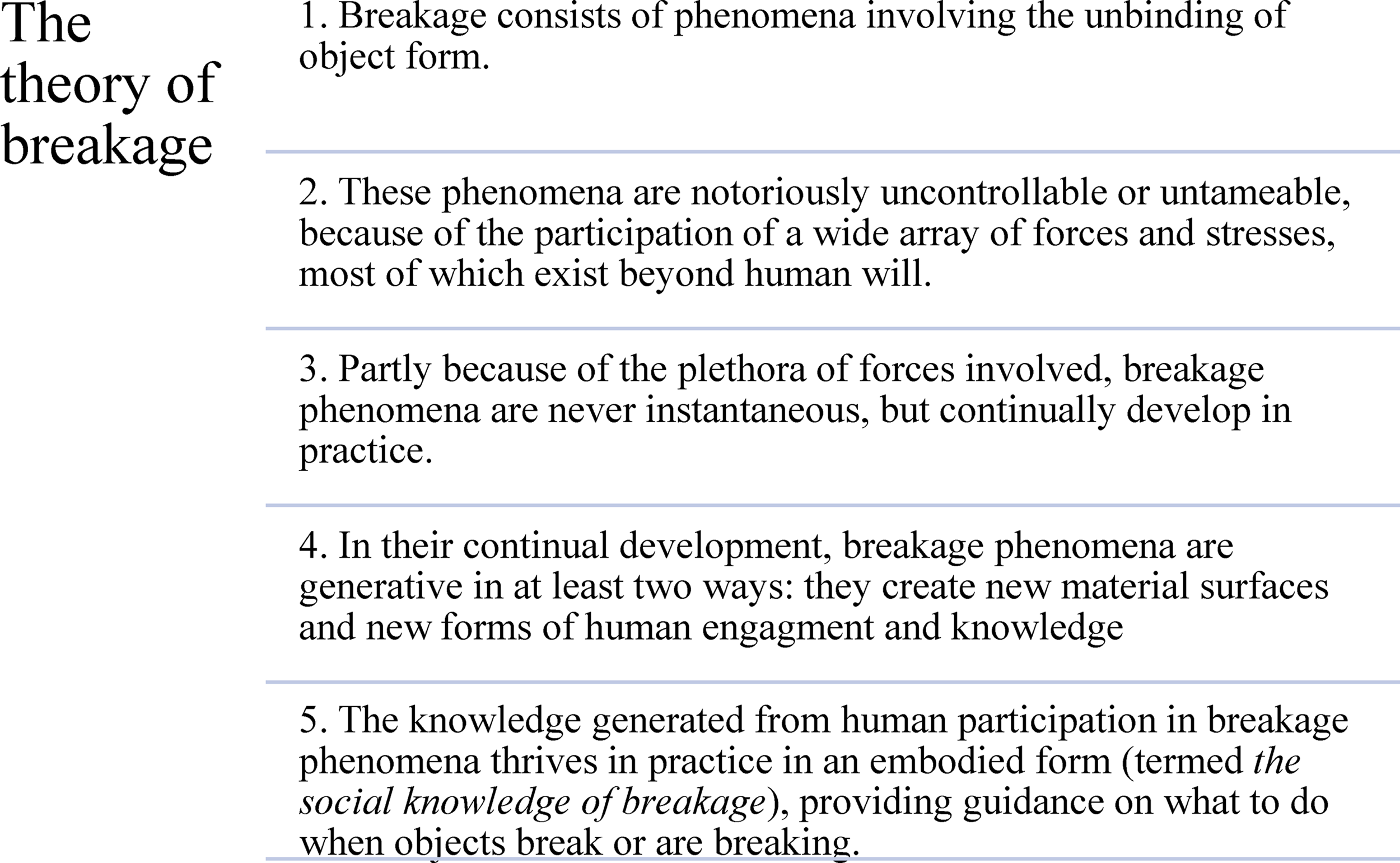
The core statements that build up the theory of breakage (as detailed throughout the next two subsections), and how they relate to each other. Highlighted in italics is the key theoretical construct of this paper.
We started by stating that breakage constitutes phenomena, i.e., material configurations involving multiple forces produced in practice (see Barad, 2007: 140), involving the release or unbinding of an object's form (Colloredo-Mansfeld, 2003) or, more specifically, the liberation of what is perceived and enacted as the form of an object (statement 1 in Figure 1). As such, it is an invitation to transience, an exposition of a world of becoming. In this world, the way humans and nonhumans perceive their surroundings involves ‘moving around in it, attending to it, and discovering […] what it has to offer’ (Ingold, 2018: 39). Perceiving and acting are one and the same (Ingold, 2018: 39). Thus, whatever is articulated as an object, which can be any material (regardless if it has been modified by humans or not), 2 is not a pre-construed product of the mind, but a bounded entity emerging from an active relational world, from practice (Barad, 2007: 135). Breakage, thus, enhances the tension between what Chris Fowler and Oliver Harris call the episodes of being and the dynamics of becoming (Fowler and Harris, 2015: 135), between the pragmatic reproduction of bounded entities and the contingent realisation of their impermanence. In other words, while object form is a practical necessity, without which ordinary life would be untenable, breakage is a contingent affair that gives practice movement by exposing object form as something ephemeral. As Ian Hodder recently stated, ‘humans want to rely on things and imagine them stable, but things have their own lifespans and processes that undermine and disrupt human lives’ (Hodder, 2014: 26). It is important to note that this ‘disruption’ can at times also be desired, but this point is given more prominence in the next subsection. Furthermore, while breakage phenomena very much exist beyond humans, as any taphonomist would not hesitate to acknowledge, it is ultimately the question of human knowledge, which is the focus of this paper. In this sense, the theory is anthropological, but not anthropocentric. It recognises the power of nonhuman forces in shaping social practices, but the concern is mainly about bringing to light other forms of humanity and ways of constructing knowledge.
Given the concept of phenomena conveys the inclusion of other forces beyond human volition, there is already an implicit agreement that in any phenomena there will be something which is uncontrollable or beyond our grasp. Yet, breakage phenomena are particularly untameable or uncontrollable, because a wide array of forces and stresses, most of which exist beyond human will, are always involved (statement 2 in Figure 1). When firing pottery in a bonfire, for example, breakage can obviously occur from heating the pot, which leads to numerous thermal stresses (e.g., thermal gradients produced from non-uniform exposure of the pot to the fire, the differential thermal expansion of the pot's clay matrix and the temper, the release of vapor and CO2, among others), but also from the pressure from other pots that are stacked, wind gusts that lead to erratic fires, etc. The list can be truly endless. Statement 2 then poses an immediate challenge for frameworks seeking to champion a model of human supremacy, because breakage phenomena develop in even the most seemingly controlled situations. The most experienced knapper can have doubts of the outcome of a rehearsed blow at a beautifully prepared platform on a core. Similarly, engineers wanting to test the strength of ceramic materials by applying an increasing load may never know at what point their specimens will effectively break. More importantly, in many different social groups around the world
One of the most notable aspects of breakage phenomena is that they are never instantaneous, but continuously develop in practice (statement 3 in Figure 1). From the moment an object's form emerges, breakage also develops. In other words, breakage phenomena are always constantly unfolding and, as such, cannot be restricted to a singular event or ‘stage in an object's life (Figure 2). On the one hand, breakage develops as a sequence of material phase transitions (DeLanda, 2002, 2006). These transitions consist of multiple causal interactions and their effects (DeLanda, 2002: 19) that gradually develop until an abrupt change occurs. Objects evolve or grow by gradually breaking, wearing out or decaying, regardless of whether human agents are involved or fully aware of this when they engage with objects, and this continues until a critical point is reached (i.e., the material actually fractures; Figure 2). This is a well-known aspect in failure analysis, where it is stated that ‘[…] a material's failure is never an instantaneous event but is always one which has a beginning, a more or less complicated history of development, and an end’ (Fréchette, 1990: 5). Brittle materials, i.e., those that tend to break rather than deform (Roesler et al., 2007: 71), are certainly better at exemplifying this point. 4 The history of use of a pot may mark the vital difference between it fracturing completely when dropped accidentally or of it maintaining its form, as for instance cracks initiate and propagate during the object's lifetime. This makes reference to materials, like most traditional pottery, which tend to release stress through crack propagation without necessarily reaching a critical point of rupture (e.g., Kilikoglou et al., 1998). Hence, we might say that breakage is always latent and threatening to occur. On the other hand, there is also continuity in our perception of these material phase transitions. It is important to notice, as Ingold reminds us (Ingold, 2011: 57), while tools carry with them a history of use, it is ultimately the body that actually remembers. Thus, breakage remains continuous as a sort of ‘latent concern’ for object form or stability, as well as in the adaptation of the human agent's movements to counteract, allow, promote, channel, ignore or prepare for these phenomena. The latent concern and counteraction occur throughout the development of material phase transitions, although it is often the critical point of rupture which can be the most telling. In other words, considering breakage as continuous phenomena forces us to consider that actions also have a duration in human temporal experience with objects (Robb, 2020: 128). For instance, given many traditional ways of manufacturing pottery result in pots exhibiting cracks as a way for the material to release stresses, if a potter finds that cracks have developed in the base of a vessel during drying, precautions might be taken. The potter might want to reduce temperature shock during firing stages to prevent the crack from propagating. If the vessel then survives the fire, the potter might still be cautious when using the vessel around the house. Therefore, the concern over the crack, as well as the crack itself, has a much longer temporal duration that extends breakage beyond the single ‘stage of production’. Thus, rather than successional (as in discretely bounded stages), we could say that breakage is processional (sensu Ingold, 2011: 53), i.e., every movement continually develops from the one before and a preparation for the next.
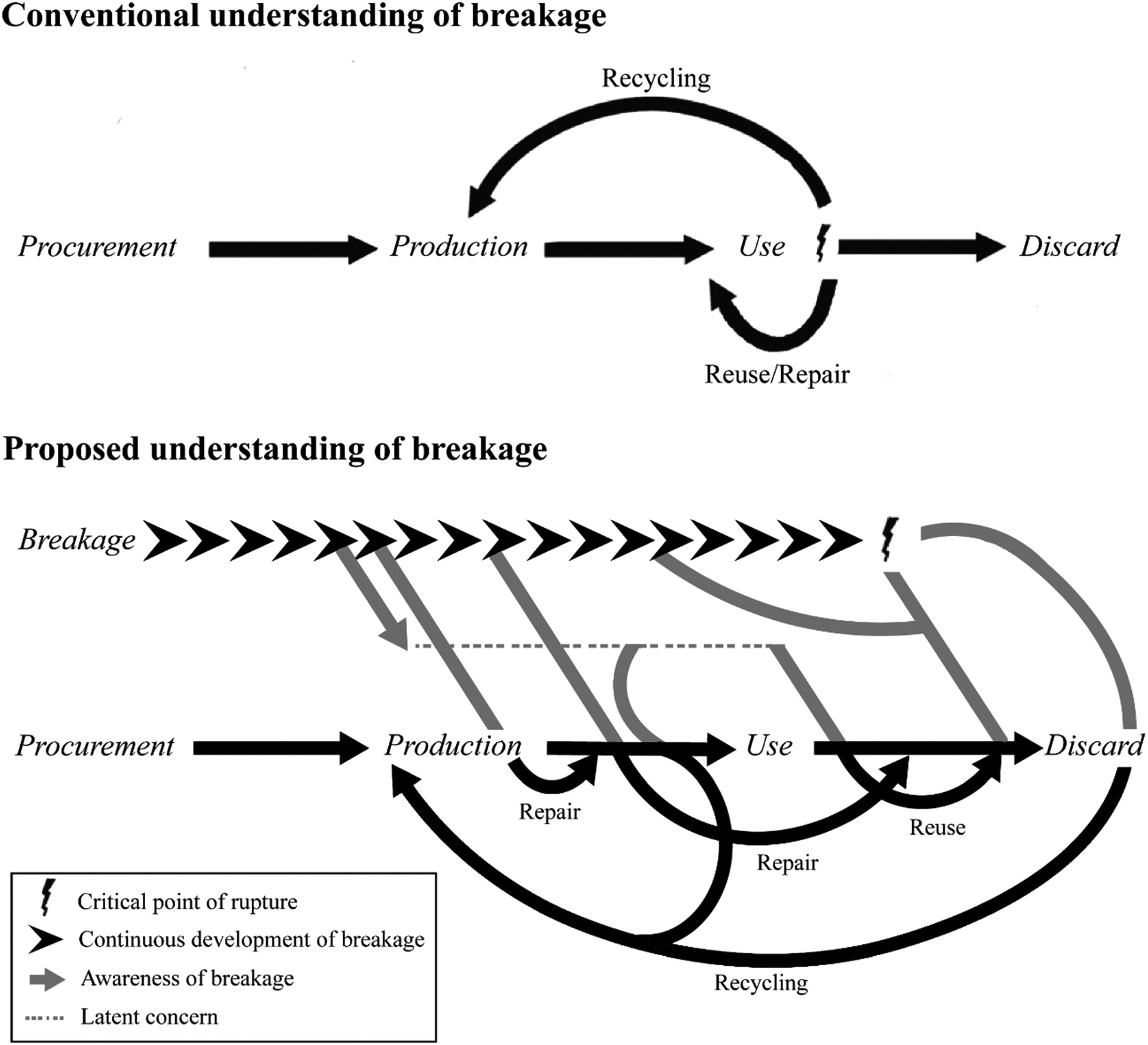
How we conventionally understand breakage in our study of archaeological objects, and how I understand it as a continuous process. Both models are detailed according to traditional classification of actions (i.e. recycling, repair, and reuse), and therefore does not include the wealth of human responses discussed throughout the paper.
Models attempting to study objects according to stages of production, acquisition, use and discard have been quite proficient in restricting the phenomena of breakage to a discrete phenomenon or event. For them, breakage is merely something leading to discard (Schiffer, 1987: 48). Curiously, these models are actually dependent on phenomena such as breakage to justify the transformation of objects in use to objects of recycling, repair, reuse or discard (Figure 2). Furthermore, despite the best intentions, stages of object life appear to be inevitably rigid, as there is no input from contingencies, i.e., circumstances that cannot be predicted. Without this input, there is an inevitable reproduction of the humanist ideal of plan divorced from execution (Ingold, 2000: 295). Therefore, in contrast to these models, we must envision breakage as something actually occurring all the time (see Drazin, 2019).
This ‘continuous nature’ is also associated with a last important aspect: breakage phenomena are generative. When an object breaks or is breaking, it links to other (knowledgeable) actions, as well as generates new surfaces (statement 4 in Figure 1). While breakage might be unintended in the majority of times (although Chapman would disagree on this point; Chapman, 2022), certain responses emerge, nonetheless. In this way, practical intent can be triggered from this unintended action. A clear example may be the case of the repair of a completely fractured object. In this scenario, repair emerges as a ‘new’ practice with its own volition. Through time, these responses develop into what is termed below as the social knowledge of breakage. Material surfaces are also generated in this exchange, and these are enmeshed in relations of growth and movement (Ingold, 2011: 71). For example, in the case of pots, changes in the bonds between grains, voids and clay matrix in the ceramic, as well as the substances in containers and stresses generated from their handling in different ways (through different movements and gestures), are all constitutive of surfaces. In this way, breakage is generative of human knowledge, but also of surfaces that can continue to evolve beyond humans.
Of course, both the embodied knowledge and surfaces generated during breakage develop very differently according to various arrangements of materials and meanings (see also Drazin, 2019: 310; Sennett, 2008: 226–227). It is well recognised that objects are charged with culturally specific meanings that can be reclassified when moving in different ‘spheres of exchange’. For instance, a cherished work of art, like a Picasso, can have a specific monetary value (say $690,000) in one sphere but can be considered priceless in another (Kopytoff, 1986: 82). Similarly, a pot broken intentionally the night before a couple's wedding to bring luck, as part of the German Polterabend tradition (see also Table 1), holds different value and meaning than if broken as a demonstration of anger during a domestic dispute. We can also say that there can be entirely different outcomes when the same type of pot breaks accidentally during its manufacture or use, particularly in societies where fields of production and consumption are kept decidedly separate. For instance, it is well known that industrial activity in capitalist societies since at least the 1960s (Packard, 1960) has been characterised by the manufacture of appliances with materials that do not withstand the test of time. In this case, this planned obsolescence by producers leads to much frustration for consumers (Roberts et al., 2017). Material surfaces are also created differently when breakage occurred through different stresses, such as impact, bend, or tensile stresses. Even different forms of impact lead to different outcomes, as shown in the comparison between vessels dropped and those struck with sharp implements (Vindrola-Padrós, 2015). This is shown in ethnoarchaeological research where pot rims chipped away by accidentally striking them with metal lids during cooking is contextually different from those worn-out when cleaning (Skibo, 1992: 128). Certainly, surfaces produced also change and affect social practices in different ways. Smashing a pot with excessive force leads to shattering and very small fragments, whereas lower energy processes can lead to larger fragments (Vindrola-Padrós, 2021). The latter may influence the user to collect a few pieces for further use, as is seen in various Early Neolithic settlements in Europe
Selection of contemporary European proverbs that exemplify how the social knowledge of breakage is exposed in linguistic expressions.
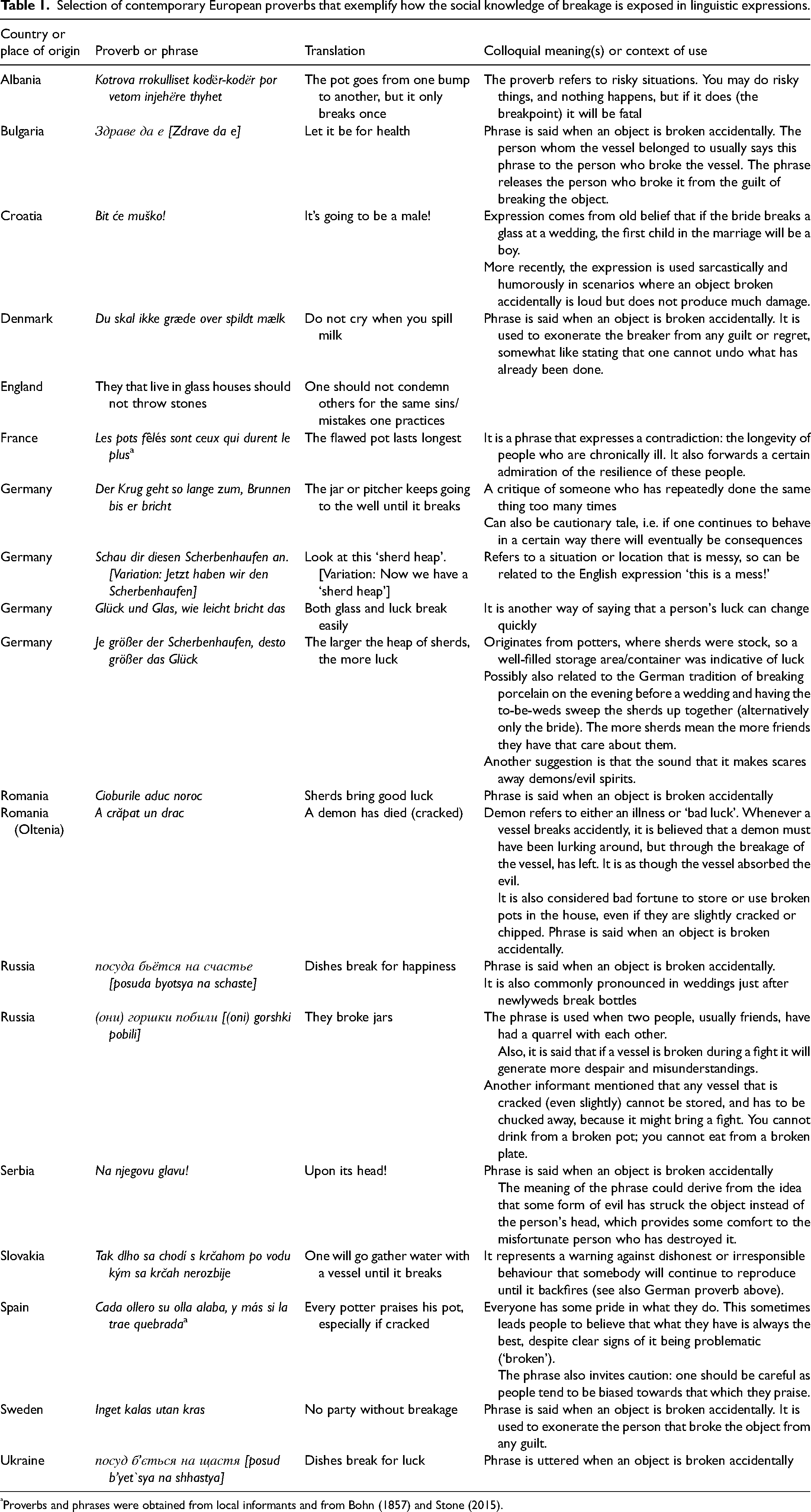
Proverbs and phrases were obtained from local informants and from Bohn (1857) and Stone (2015).
Based on what we have formulated so far, as a synthesis we can state that breakage consists of those continually developing and uncontrollable phenomena involving the liberation of object form, which not only result in the generation of new material surfaces but also new forms of human engagement and knowledge. The aim of this paper is to expose the very last element of this definition, i.e., the knowledge produced through breakage. This peculiar type of knowledge has been long forsaken as legitimate knowledge and it is finally given predominance in the next subsection.
The social knowledge of breakage
Someone has placed a glass at the edge of the table during dinner. This situation triggers the most perfectly ordinary example of what we can denominate as the social knowledge of breakage. For many this immediately triggers a sense of uneasiness, others might try to turn a blind eye. While this particular scene is not encountered every single time we have a meal, when it does happen it changes things. We immediately uncover a repertoire of actions. We might restrict our movements so as to not to tip the glass, ask someone to remove it from that position or maybe just watch and pray it does not fall. It also raises the question of how often one avoids putting one's glass at the edge of the table. More importantly, has the avoidance of this particular scenario already inadvertently framed the way we eat every day? This example showcases the core purpose of this subsection, which is to provide further insight into how knowledge develops from breakage phenomena and in this way shapes social practices. Therefore, in regards to point (ii), in the next pages I will outline the following: what I mean by the term ‘social knowledge of breakage’; how this type of knowledge develops from human relations with the material world (through the use of concepts of skill, dexterity and practical mimesis); and how this knowledge is meaningfully expressed in different human groups through physical actions and linguistic expressions in both ceremonial (protocolar) and ordinary practices (Figure 3). The result of these theorisations is the exposition of a form of knowledge that is ubiquitous, albeit developed in many different ways, and that is fundamental for social reproduction.
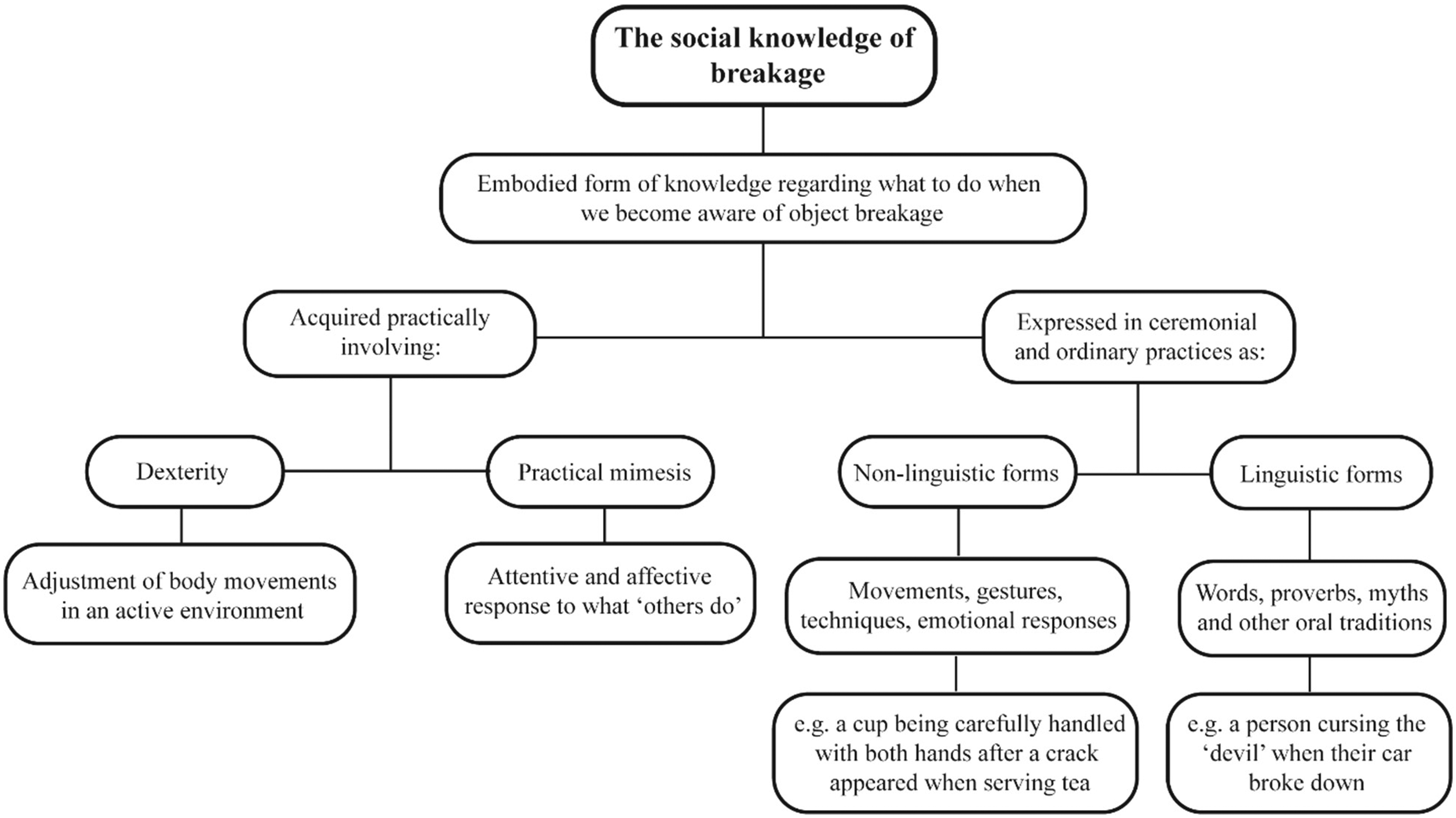
Definition of the social knowledge of breakage and how it operates in practice.
Contrary to what can be professed from the Enlightenment's ‘technological project’, i.e., the pursuit for utility in the world, the social knowledge of breakage is not commonly planned a priori but something that takes shape in practice, when the cards are on the table so to speak. It consists of an embodied or incorporated form of knowledge, mostly acquired and expressed practically (Bourdieu, 1990: 74; Connerton, 1989: 102), that provides guidance on what to do when we become aware of object breakage (statement 5 in Figure 1). The ‘social’ accredited in its label refers to the historical legacy of human relations with the material world. Throughout this history, agents become endowed with the power to decipher perceived signs, such as cracks or fractures, and act accordingly to what they consider ‘correct’ (Bourdieu, 1977: 10–11), while reproducing it in this same performance. Practice is never excluded from the material world; it exists and thrives in it, ‘recognising its malleability and resistances’ (Barrett, 2001: 152). While breakage cannot be fully controlled nor predicted, the knowledge of breakage remains an informative part of social practices. One does not plan on learning how an object will break while making or using it, but one still does, and it can be crucial for the continuation of the practices where the object performs. As Robb states, ‘both intentional and unintentional action are part of the larger process of social reproduction’ (Robb, 2010: 498). For example, cooks not only learn how to carefully process food, but also learn when utensils at hand are damaged or unfit, and know how to react to this (Sutton, 2006: 105). This is expressed in the following excerpt on bone-handled forks: ‘Cleaning one requires the same attention as when washing a well-seasoned iron pan. Bone-handle forks should never be put in the dishwasher. Instead, rinse them quickly in hot sudsy water, and dry immediately. […] My grandmother's fork is just barely surviving. Having lifted and turned soft-shell crabs and having pierced a lifetime of steamed cauliflower, it has been rendered frail by its journeys from hot stove to soapy water. The slivers of bone have pulled away from the slender steel base. She now uses a pink rubber band to hold it together. Mine are comparatively polished – intact, untarnished and ready to age along with me’ (Hesser, 2003: 18).
Given practical knowledge is all about the development of skill, Ingold's (2000) formulations from action-perception theory give us some insights into how people might incorporate knowledge and create new meanings from their engagement with breakage. For the author, practitioners are participant observers of what their environment affords, and while certain relational forces are presented in their active engagement with this environment (Ingold, 2000: 5), such as the attrition produced by sand as pots are being cleaned near a river, it is the attentiveness of the practitioner that will determine if this affordance is acknowledged. Skill is, thus, relational. It is about the body's inextricable link to an environment of relations (Ingold, 2000: 353), such that thinking, feeling, and doing become synchronous. Starting from these formulations, I consider there are two processes that are central in the acquisition of the social knowledge of breakage: dexterity, the sensorimotor adjustments of the body in an active environment, and practical mimesis, the affective and attentive response to what others do.
The concept of dexterity was originally developed by Nikolai Bernstein. Dexterity consists of live sensory corrections in the practitioner's movements adjusting to changes in the task at hand (Ingold, 2000: 353), such as the handling and use of objects or tools. Given the primacy of action over movement, dexterity involves the adjustment of movements as a ‘motor solution’ to certain conditions. Thus, dexterity is shaped along with the ‘surrounding conditions’, i.e., the context and environment in which the task is being performed, and not by the movements on their own (Bernstein, 1996: 23), which means dexterity extends even beyond the body (Ingold, 2011: 18). For instance, skilled blacksmiths striking anvils with hammers results in the tip of their hammer consistently hitting the same spot on the anvil, but the trajectories of their arms will vary (Latash, 1996: 286). In other words, with every stroke the same gesture will be conducted, but with small variations in movement. Repetition of movements are important to solve a motor problem, as conditions external to the body are never quite the same, and consequently motor skills develop from the many deviations and variations arising during specific tasks (Bernstein, 1996: 176; Reed and Bril, 1996: 436). Towards the final process of learning a skill, the stabilisation of movement from destructive influences, such as an object failing or breaking in a task, is crucial. The knowledge of these destructive influences is what will ultimately consolidate a skill, as Bernstein mentions: ‘[…] the essence of this process of actual confrontation with various complications is the development of resourcefulness, the ability to avoid confusion in unpredictable situations and to find immediately solutions’ (1996: 201). When forming pots on the wheel, skilled potters continually move their fingers according to where they feel the pot needs to be thinned in order for it to maintain its form. For these reasons, dexterity is crucial to understand one of the ways in which the emerging breakage of an object influences bodily knowledge and leaves room for the fact that even the most skilled of practitioners can mishandle and break objects under certain conditions.
While dexterity gives us an understanding of the adjustment of body movements to a changing environment, it does not fully capture the full complexity of social practices. For this we also need to comprehend the idea of practical mimesis (to borrow a term by Bourdieu, 1990: 73). Practical mimesis consists of emotional and affective identification to other people's actions, involving meaningfully charged body movements, gestures and postures, as well as other resources with mnemonic functions like words, music, rhythms, among others (Bourdieu, 1990: 73, 74, 92, note 4). Through this process, the apprentice moves and simultaneously attends to what others do (Ingold, 2000: 353). In this sense, we can say that the social knowledge of breakage emerges from the immersion of practitioners in a ‘shared environment’ (Ingold, 1993: 222–223), i.e., an affective and attentive engagement with what others are doing, and probably for this reason it constitutes knowledge that is normally left out of written protocols, recipes, manuals or textbooks.
Taking these formulations into account, we can state that the social knowledge of breakage is certainly primordial. As part of practical mimesis, after the first six months of age infants learn to manipulate objects (Lockman and McHale, 1989). Through behaviours like looking, touching, pulling, striking and dropping, infants will learn about what objects can afford. Moreover, at this age infants will vary their behaviour according to the qualities of the object. For instance, in a study by Gibson and Walker (1984), infants were observed more frequently pressing flexible objects, while striking was more commonly practiced on rigid objects. It is not hard to imagine that through some of these manipulative behaviours, objects commonly break or are dismantled. It is only after the age of two that toddlers begin to infer certain objects may be used for specific tasks, i.e., they begin to use tools (this is purely in the traditional sense of the word) such as using a spoon to bring food to their mouths (Connolly and Dalgleish, 1993; McCarty et al., 2001). The exploration of these affordances occurs well before the little humans use tools, let alone create them. More importantly, this exploratory knowledge is not simply forgotten once toddlers begin to use tools, but from an action-perception theory it can be seen as a continuation from learning affordances by directly manipulating objects by hand to learning affordances from a new relation between hand-object and another object or surface, i.e., hand-object-object/surface (Lockman, 2000: 142). Caregivers are of course always crucial in channelling these behaviours (Bruner, 1982) by ‘joint visual attention’ with the toddler (Gibson and Pick, 2000: 66). For example, toddlers are particularly gifted at exploring parents’ reactions to their behaviours, particularly when it comes to (mis)handling fragile objects. So engrained becomes this knowledge of breakage through some of these learning mechanisms, that it quickly becomes an ‘instinctual movement’.
Having stated how the social knowledge of breakage becomes incorporated, we can detail some of the different ways in which this knowledge is practically and meaningfully expressed. Expressions of this knowledge in ordinary practices are available in some of the archaeological literature (although the reader is advised to also have a look at most of the examples already provided above). Perhaps more predominantly known is John Chapman's interpretation of deliberate acts of fragmentation in Balkan prehistory. The author starts with the consideration that in certain societies breakage can be a powerful social bonding strategy utilized in groups where persons are considered not as indivisible wholes but as divisible ones, and pottery, which is a particularly brittle and divisible material, affords these types of operations (2000: 42–43). According to Chapman (2000: 48), just like gift economies recorded ethnographically (Mauss, 1966; Strathern, 1988; Weiner, 1992), in places like the Balkans during the Neolithic and Chalcolithic, fragments of broken objects were considered extensions of persons, and became inalienable objects. In this sense, discarded material can be ‘analogous to the buried bone remains of dead ancestors’ (Chapman, 2000: 49). Thus, connections created through genealogies (such as heirlooms) or in exchange networks (like Kula necklaces and bracelets in Polynesia or spondylus shells in the European Neolithic) were reinforced or reproduced by conducting practices involving acts of deliberate breakage and the deposition of broken objects in specific areas of settlements. Acts of deliberate breakage of pottery as well as bodies (Chapman and Gaydarska, 2010) anchored social relations to specific places (Chapman, 2000). More recently Chapman has extended this argument, suggesting that during the Neolithic even in extraction of clays for pottery making displayed an enchainment process, where ceramic vessels retain some connection with places where raw materials were sourced (Chapman, 2022). In comparison, in his interpretation of Neolithic pits at Măgura (Romania) Doug Bailey (2018) envisions the act of cutting the ground not as an act of enchainment but as a violation of the ground's sanctity. In this way, when digging or ‘breaking the surface’ of the ground, a crucial activity during the Neolithic, populations crossed an important boundary. Given the differential expression in ordinary life, we should be cautious as to not universalise deliberate breakage and instead understand its historical conditions of formation, as once again that would severely restrict the social knowledge of breakage in every human group to a particularity. Despite their commonalities, this is one important distinction between the theory of breakage and fragmentation theory. 5
In other examples, the social knowledge of breakage is triggered in practices of a more ceremonial nature. Let us consider an old anthropological example. The Sara from Chad constitute a society where death is constantly represented on day-to-day operations, in contrast with most post-18th century Western urban societies where death is confined to extraordinary episodes and tends to be excluded from more public ceremonies (see Ariès, 1975, 1981). Through most of Robert Jaulin's Le Mort Sara (1967), we observe a detailed description of Sara funeral practices. In these practices, after the deafening screams and moans from family members have ceased, the deceased is placed in a pit and water is poured over his/her body. Later on, the same wares that contained the water are broken and distributed over the body of the deceased as if covering it with earth, like in some Western funerals. The destruction of vessels constitutes a participative activity conducted by grieving Sara clan members, where the brittleness of ceramic materials is considered particularly important. While pottery breakage may involve enchainment in this scenario, it displays a very different type of exchange network, where there is also some attempt to break connections with the dead in the process of mourning. Furthermore, the example clearly shows how the social knowledge of breakage can also become part of something far more protocolar and ceremonial.
Lastly, while my attention has been so far strongly focused on the non-linguistic element of this knowledge, which archaeology strongly encourages, as a last point in this subsection I will expose how linguistic expressions and oral traditions are another important way of reproducing this knowledge. These expressions in turn give us the opportunity of exposing how the knowledge of breakage influences discursive acts. From a praxeological perspective proverbs, songs and poems are all strategically used in practice by agents according to specific interests (Bourdieu, 1991). There is a sort of practical competence that enables the pertinent use of linguistic expressions in specific situations according to the requisites of the fields of practice (Bourdieu, 1991: 37). For instance, many of the proverbs presented in Table 1 are strategically used in practice to exonerate the breaker, generally a house guest, from guilt of accidentally breaking objects from the host's house. Table 1 also illustrates just how widespread the knowledge of breakage (in the form of proverbs) can be in present-day Europe. In most cases these proverbs are only uttered in specific situations, emerging after the breakage phenomenon occurred, others are simply uttered as analogies in very different contexts of meaning and action.
We can state then that breakage elicits a linguistically rich response in ordinary social life. In a large linguistic study (Majid et al., 2007, 2008), speakers of 28 languages from 13 different language families were asked to watch videos of different cutting and breaking events, such as breaking a stick or a plate, and to describe the events using words from their own language. Results showed there was significant variation in the ways speakers of these 28 languages designate different cutting and breaking phenomena. Particularly noticeable are Tzeltal speakers, which use up to 54 different verbs to distinguish different cutting and breaking actions (Brown, 2007: 320–321). These are based on a series of factors, including the textural properties of objects, spatial properties of the action (e.g., arrangement of body movements in relation to object), the outcome of the breaking action, among others (Brown, 2007: 321). In contrast, Yéli Dnye speakers in Rossel Island only use one word for breaking and two for cutting (Levinson, 2007: 208). Furthermore, the distinction of these verbs is not dependent on the action being performed but on how the material breaks. In this sense, fibrous materials are thought to be ‘coherent’ as they would break along the orientation of fibres, but materials like pottery, which break in any direction, would be considered incoherent (Levinson, 2007: 210). In short, as Bailey (2018: 191) argues, in our contemporary world there is a demonstrable diversity of ways in which people from different linguistic backgrounds understand and designate breakage phenomena, and there should not be much stopping us from assuming this also existed in the past.
The same can be said of the use of myths. Anthropologists like Claude Lévi-Strauss were certainly pioneers in showing academics how myths encapsulate legitimate knowledge of the world, against the positivist claims of myths as fantastical, supernatural or speculative narrations (e.g., Comte, 1988). In societies where mythos and logos have never been divorced (Vernant, 1996, 2006), part of the power of myths and taboos relies on providing an explicative framework of the world. Myths explain ‘the present and the past as well as the future’ (Lévi-Strauss, [1958] 1993: 209). Taking these formulations pragmatically (rather than as part of a model of structural linguistics), we can state that they are a powerful medium for practical endeavours and strategies. This is also the case for the knowledge of breakage. Let us consider, for example, what Lévi-Strauss states on decorated Pomo baskets in Northwest America: ‘The basket spirits, they [i.e., the Pomo] claimed, live within the decorative coils; it is their village. And within the latter there must be a ‘door’, that is, an intentionally created defect, that, often scarcely visible, breaks the continuity of the design and allows the basket spirits, when they die, to escape and ascend to their sky home. One woman who failed to make a ‘door’ on her basket, was condemned to death by the imprisoned spirit’ (Lévi-Strauss, 1997: 170).
What we have explored so far is a form of knowledge that is rarely considered by analysts but is of substantial importance for social practices, as it creates a framework for breakage phenomena. In other words, it gives breakage a place where it can be understood despite the fact it cannot be controlled. This knowledge is inadvertently widespread, at times latent and at others more concretely present. As a form of knowledge that begins taking shape even before tools are used, it permeates many practical domains of human life. It enables social reproduction by shaping practices from the most mundane and ordinary to the most protocolar and ceremonial, but also transgresses into linguistic realms. Uncovering this knowledge invites the recognition that ‘people construct culture as they go along and as they respond to life's contingencies’ (Bruner, 1993: 326). Towards this end, the next subsection turns to a more analytical endeavour and shows how this form of knowledge can be studied according to different strands.
Three strands of the social knowledge of breakage
Addressing point (iii), the social knowledge of breakage can be studied according to three interrelated strands, which can be summed up as follows: what to do when objects are perceived as breaking (involving an anticipation), how do objects specifically break (which informs how to break objects), and what is to be done with the newly created surfaces (i.e., the broken pieces). These strands are artificially separated, but in practice can potentially overlap in many ways and cannot be divorced from their context of meaning and action. Furthermore, these strands are processional (as explained above), following material phase transitions of object breakage. The reader must also be advised that from this point onwards most of the theorisations provided are thought for brittle materials because they are materials that particularly foster the (re)production of the knowledge of breakage.
The first strand is probably the hardest to study archaeologically. It concerns the anticipation of breakage. This involves the reactions or attitudes coming from the perception of the signs of breaking. The socialised signs of breakage are protentions 6 or anticipations developed in practice. The anticipated (breakage), as part of the agents’ perception and in relation to which they position themselves to respond, is present in the practice itself, even if the pot is not actually broken. It is not that breakage ‘may happen or not happen, but something which is already there’ (Bourdieu, 2000: 208). This perception of risk, or ‘workmanship of risk’ as Ingold (2011: 59) would state, is the power of this first strand of the social knowledge of breakage, as it disposes agents towards further action. Among communities in Pumpuri (Bolivia), for example, when chicha brewing pots develop even a minor crack, they are rendered unusable and their participation for this task is generally avoided (Sillar, 2000: 108). As Bill Sillar mentions, due to the great value and effort invested in acquiring the maize to produce chicha, and we might also potentially add the knowledge of how catastrophic a crack can be in these particular types of pots, using a cracked vessel for brewing is risky (Sillar, 2000: 108). Put briefly, there is a sense of what to do when breakage features (e.g., cracks, fractures, chips), considered to be conducive to a broken pot, start to appear.
In this respect, repair is a particularly attractive activity when dealing with brittle objects that are prone to stable cracking, like many low-fired tempered pots (Kilikoglou et al., 1998; Müller et al., 2010, 2015). The interesting thing about repair in these types of materials is not only the ‘subtle acts of care’ (Jackson, 2011: 222) that reconcile the subject's moral relation to the object, but that it is indicative of how people strategically interpret the breaking object according to their embodied history. By considering repair as a response from an uncontrollable process (such as breakage), we can envision repair as a know-how particularly dependent on the state of that which is considered in need of mending (Vindrola-Padrós and Vilde, 2022). Repair strategies are also of great value for archaeological research, as it is a plausible way of informing us on this first strand.
As objects participate increasingly in practices, so does our sense of their breakage, which presents us with a second strand of this form of knowledge. There is a latent knowledge of breakage always, so to speak, on the back of our minds during practice. This is the knowledge of how objects can break in different scenarios. Unsuspectingly, we encounter this constantly: if I leave a glass at the edge of a table it may be knocked over and fall; if I pour boiling water in a glass, it will crack or burst; if I play football next to my mother's decorative pots, I will most likely knock them down. This knowledge becomes highly visible to experienced teachers when they encounter inexperienced hands holding objects. For example, potters know the gestures that should be avoided by their apprentices when pots curve improperly on the wheel, and how to remedy this. In short, I have not met a potter that is oblivious to the problems that can arise at each stage of fabrication, and what is the best course of action to address this (e.g., Fraser, 1986).
Sometimes this strand is reflected by cautionary measures even when there are no signs of the pot physically breaking. An example is the much-dreaded firing process during pottery manufacture. Because of the complex combination of processes, such as production of CO2, water evaporation, thermal stresses due to the generation of temperature gradients across the material, thermal shock produced by strong intermittent winds, among others, breakage can occur in any number of ways. When Edward E. Evans-Pritchard worked with the Azande, he noticed experienced potters would take caution in preparation for vessel firing: ‘on the night before digging out his clay [the potter] abstains from sexual intercourse. So, he should have nothing to fear. Yet pots sometimes break, even when they are the handiwork of expert potters, and this can only be accounted for by witchcraft. ‘It is broken-there is witchcraft’, says the potter simply’ (1937: 67). Similarly, potters near Skopska Crna Gora in Macedonia, create a figurine called the master or landlord of pans and place it on the first finished clay pan to protect other pans from bewitchment (Filipović, 1951: 169). These examples address different notions of causality, but at the same time reference mechanisms in place for contending with breakage. Both cannot be divorced, and thus are essential components of the social knowledge of breakage. Furthermore, despite the fact that the complete fracturing of a pot does not occur daily, although ethnoarchaeological surveys indicate it is a common occurrence (Shott, 1996; Shott and Sillitoe, 2001, 2004; Shott and Williams, 2006), this does not entail that there is not a daily expression of an embodied knowledge of object breakage.
This second strand also brings great consequences to how breakage emerges as an intended part of certain practices. Through the intended breakage of specific objects, different meanings are portrayed depending on the historical-material conditions in which one is socialised. The breakdown of Malangan wooden sculptures in the mortuary practices in the New Ireland region of New Guinea, for instance, are paramount for the consolidation and reproduction of the socio-political system as well as intergenerational and kinship bonds (Küchler, 1988). During the ‘killing’ of sculptures in mortuary rites, guests gather and provide a prestation to the sculpture. In this process, images associated to these sculptures are burnt into memory and a connection is established between hosts and guests. It can be, in Chapman's terms, a true act of enchainment. Furthermore, those who share this memory can also partake in land claims regardless of birth or marriage (Küchler, 1988: 632). Different to the Malangan example, knowledge of how objects break can also be manifested in practices explicitly intended to create an imbalance in power relations. Incan conquest strategies often included the deliberate destruction of targeted ‘public’ areas in newly annexed provincial regions (DeMarrais, 2013: 362; Nielsen and Walker, 1999: 166). By contrast, the intentional destruction and abandonment of the domestic and ceremonial site La Rinconada in northwest Argentina shows that knowledge of breakage was paired with an intent of liberation, which allowed its inhabitants to leave (Gordillo and Vindrola-Padrós, 2017). It is also true that objects are sometimes designed to break at specific times. California Yurok hunters, for example, create spears with obsidian tips that can break in the wounds of their target (Ellis, 1997: 52). In short, there is quite a diverse range of possibilities for analysing this second strand of the social knowledge of breakage.
No matter how strong ceramics are, how skilled the person repairing the pot is or if an object did or did not break at the intended time, brittle materials will eventually break. This is where the third strand of the social knowledge of breakage operates, and it is probably the most studied in archaeology. It relates to the after-effects of breakage and fragmentation, namely the sense of what to do with the fragments of broken objects. The reuse of ceramic vessels in Tzeltal communities in México is a remarkable example. Broken pots perform as collection devices, planters, feeding dishes, storage vessels, objects for pottery manufacture and receptacles for burying afterbirth, among many others (Deal and Hagstrum, 1995: 115–118). Yet, broken objects are not always ‘put to use’ after they are broken, neither are they discarded, but they are most often left where they were formed. Such is the case of vessels being dropped on the way of collecting water from wells (Deal, 1985: 264). These examples illustrate that attitudes towards broken pots depend very much on how vessels break, including the pots’ breakage context, and the actual way in which fragments are formed.
Areas of deposition have a strong connection to how broken objects are perceived and categorised (Hodder, 1987; Moore, 1986). For the Maya at Chunchucmil, broken pottery was deemed dirty, and so it was easily removed from domestic spaces. However, fragments are not placed randomly, but to the west of habitation structures, which is considered the ‘direction of decay’ (Hutson and Stanton, 2007: 141). In contrast, for the Dogon (Mali) certain types of rubbish like bìnugu (a mixture of manure, straw and ‘dirty’ liquids; Douny, 2007: 317) are viewed through a positive lens, so the accumulation of these materials in domestic spaces is welcomed. It is a sign of prosperity. Other materials like broken pottery and plastic bottles are dumped outside, where they remain potential resources for reuse. In this way, domestic waste is always in transformation (Douny, 2007: 313).
Accumulations of broken materials are also related to practical strategies of human agents. In places like the Balkan Peninsula during the Neolithic, fragments of broken pottery were considered extensions of persons, and their accumulation was a strategy to augment the status of the owner (Chapman and Gaydarska, 2007: 197). The gathering of broken objects can also be related to the memorialisation of ancestors, events, buildings and places (Cameron, 2002; Cruz, 2006; Gordillo, 2007; Mills, 2008: 106–107; Thomas, 1999: 70–71), and have an ‘active role in shaping social processes’ (Pollard, 2008: 45). For instance, at Goemu village (Torres Strait, Australia) broken objects accumulated in middens are associated with houses and function as reminders of everyday activities, e.g., what was consumed and discarded (McNiven and Wright, 2008: 145), but can also work to circumscribe domestic areas. In this sense, broken materials do not only necessarily act as a hinderance (contra Binford, 1978: 339; Schiffer, 1972: 161–162) nor are they devoid of social life (Chapman, 2022). In short, the third strand of the social knowledge of breakage refers to the specific repertoire of what can and cannot be done with fragments.
Much like the multi-stage approach to the study of object biographies, chaîne opératoire or flux models, the strands of the social knowledge of breakage act as an analytical method. Unlike the abovementioned models, these three strands are designed to understand contingencies in practice without imposing a teleological model like production → use → discard (Pauketat, 2001: 80), such that human participation in a material world are appreciated in their constant state of becoming. From the tension created in practice between the human perception of form and its dissolution arises a different epistemology. This epistemology cannot be fully described as ‘trial and error’, nor by the old formula of ‘plan and execution’, but by what we can call contingency (situatedness and ‘chance’) and (re)action. This refers to knowledge stemming from the attentive and responsive movements to the uncertainties in social practices. It is in this contingency where practical ‘intent’ is in part informed from untameable breakage phenomena.
Some final remarks: The importance of a theory of breakage
A colleague once told me that in his excavation experience there was nothing that connected him more to the past, nothing felt more ‘human’ than uncovering a wedge that was used for supporting a double-wall from collapsing. This anecdote has always left me thinking: where are these phenomena in our archaeological inquiries? It is hoped that the theorisations articulated here have provided a place for them.
This points towards a first major contribution of this theory: it makes us aware of the creative ways in which broken materials inadvertently affect our daily lives. It is not hard to argue that what we encounter most as archaeologists are fragments (see for instance Chapman and Gaydarska, 2007), and it is highly likely that this was the same for people in the past One might even say from an entropy point of view, particularly considering brittle materials, broken objects were likely encountered far more than whole ones. Understanding how breakage unfolds and shapes our lives, thus, seems fundamental to any archaeological research of the past. The division of this form of knowledge into three strands was introduced as a way of conducting said research. Of course, the strands suggested are intertwined in various ways, and the examples given are not intended to exhaust all possibilities but act as mere cases for exploring this often-concealed form of knowledge.
A second major contribution is that the theory of breakage presents a different mode of anthropological understanding, particularly in regard to human involvement with material phenomena. The historical legacy of archaeology has been anchored on the importance of tool making and use, whether it be human evolution, social identities or the categorisation of ‘cultures’ through time. What the theory of breakage exposes is that there can be no tool production nor use without an understanding of how materials fall apart. Lurking in these shadows is an episteme that has always been there, so to speak, enabling the continuation of what we do in practice, what I have termed the social knowledge of breakage. By studying breakage, we understand how knowledge can be (re)produced from uncertainties that arise in practice, which are what ultimately grant social practices their fluidity. These are what make the crucial difference between memorising a score and having to play it by heart, between following a recipe and playing around with some of the ingredients.
The last major contribution of the proposed theory is that by envisioning breakage as uncontrollable and continuous phenomena that both impacts human lives and transcends them, there is a crossover between anti- and posthumanist agendas. On the one hand, human participation is but one of a multitude of forces that influence the separation of object form, some of which we cannot fully comprehend in practice. Moreover, it is the fact that there is such an overwhelming number of causal mechanisms involved in object breakage which makes it so uncontrollable. On the other hand, more in line with an antihumanist agenda, the theory of breakage invites us to battle the reification of humans as thinkers or toolmakers, which are thought to shape the world as they will it. In such an emancipatory process, we find other versions of humans, as well as other epistemes, that are not anchored in an idea of superiority over other beings. In this way, despite the ongoing anti-epistemological sentiment in contemporary archaeological theory, uncovering other forms of knowledge remains a valid endeavour. In short, the social knowledge of breakage recognises that ‘to invent and to make is human. To break, to curse, to despair, repair and mend, perhaps all the more so’ (Laviolette, 2019: 322). This does not mean that to attend to uncontrollable phenomena is a uniquely human quality, but this should not deprive us of learning about humans (however encountered) or even to open experience to difference in the world.
A few last clarifications should be made. Firstly, the theory of breakage is but a first movement of an unfinished project for approaching archaeological investigations. Secondly, the formulations given are not intended for creating another ‘grand theory’ about the world or reality, as I would state alongside other authors that there is no universal theoretical panacea in archaeology (Gardner, 2021: 506; Ribeiro, 2021: 538). On the contrary, it is the focus on the uniqueness of breakage, its variation, which makes the theory powerful for reconsidering some basic conceptualisations of human engagement in a world of material relations and to help us become aware of other contingencies in practice. Thirdly, the theory is centred around specific phenomena, i.e., breakage, and not on ‘things’. This is a logical consequence of following the idea of a world of becoming.
Footnotes
Acknowledgements
I wish to thank Ana Paula Motta, Ulrike Sommer, Martin Porr, Cecilia Vindrola-Padrós, Joakim Goldhahn, John Robb, Daniela Hofmann, Penny Bickle and John Chapman for their very enriching discussions and feedback on the topic. I am also grateful to all the people who very kindly took the time to either share or confirm the meaning of some of the proverbs presented in  . Lastly, I am also very grateful to the reviewers and editors for their constructive feedback on the manuscript.
Declaration of conflicting interests
The author(s) declared no potential conflicts of interest with respect to the research, authorship, and/or publication of this article.
Funding
The author(s) disclosed receipt of the following financial support for the research, authorship, and/or publication of this article: This work was supported by ERC Synergy Grant 951631 titled “XSCAPE: Material Minds: Exploring the Interactions between Predictive Brains, Cultural Artifacts, and Embodied Visual Search”, as well as the University College London Overseas Research Scholarship.