




Abstract
This article follows a groundbreaking climate justice lawsuit between a Peruvian farmer and major energy company in a German court, a strategic political intervention addressing the inequities of global warming. The claim posits that the two are neighbors, meaning the company should take responsibility for contributing to climate change impacts in the Andes. Using this legal conception as a starting point to engage with academic discussions about sociality and moral responsibility, I establish neighborliness as an analytical framework for examining the moral stakes of social relations. Addressing the methodological and theoretical challenges of studying a phenomenon that draws connections across the planet, this approach allows for an ethnographically grounded understanding of global warming. Climate change expands the scope of social relations and raises the question of how we should live together on our planet. A focus on neighborliness foregrounds the normative claims through which people make sense of globalizing phenomena.
Keywords
Introduction
“A case like this would not exist in the industrialized world,” 1 explained appellate court Judge Rolf Meyer. He heads a panel of three judges at the Upper State Court in Hamm, Germany, that is hearing a historic legal case: a Peruvian farmer named Saúl Luciano Lliuya sued the German energy company RWE over its contribution to climate change impacts in the Andes. RWE has no operations in Peru but has produced a substantial amount of emissions through operating coal-fired power plants in Germany and various other countries for over a century. On the other side of the world, Saúl Luciano Lliuya comes from a Quechua-speaking family in the Cordillera Blanca region of the Peruvian Andes. He lives in a community of small-scale farmers that worry about increasingly dramatic changes they witness in the mountain environment. Saúl works as a mountain climbing guide, bringing him into contact with glaciers that are rapidly shrinking. In the long run, many are concerned about water scarcity caused by melting glaciers. In the short term, there could be too much water: glacial retreat has caused mountain lakes to grow to unstable levels, raising the risk of flooding for downstream communities. Saúl owns a house that lies below Lake Palcacocha, which scientists have described as particularly dangerous. In the German courtroom, Saúl seeks to hold RWE liable for its contribution to flood risk in Peru and make the company contribute around US$20,000 to a government project to stabilize the lake.
“In a place like Germany,” Judge Meyer stated, “this problem would be solved immediately by building a dam or implementing other necessary measures.” He glanced around the courtroom, a large, bright hall with ceiling-high windows facing a park. To his left sat Saúl with his two lawyers who were delighted that the case appeared to be achieving unexpected success (see Figure 1). Saúl followed the proceedings in Spanish via a court-appointed interpreter. Long discussions of legal technicalities had left him confused, yet he was happy that the judges were taking the case seriously. Across from them sat RWE's legal team—five middle-aged men in dark suits, visibly annoyed by the judge's statements. Looking on was an audience of about 75 people, primarily climate activists and journalists. It was November 2017, two years after Saúl filed the lawsuit against RWE with support from the non-governmental organization (NGO) Germanwatch.
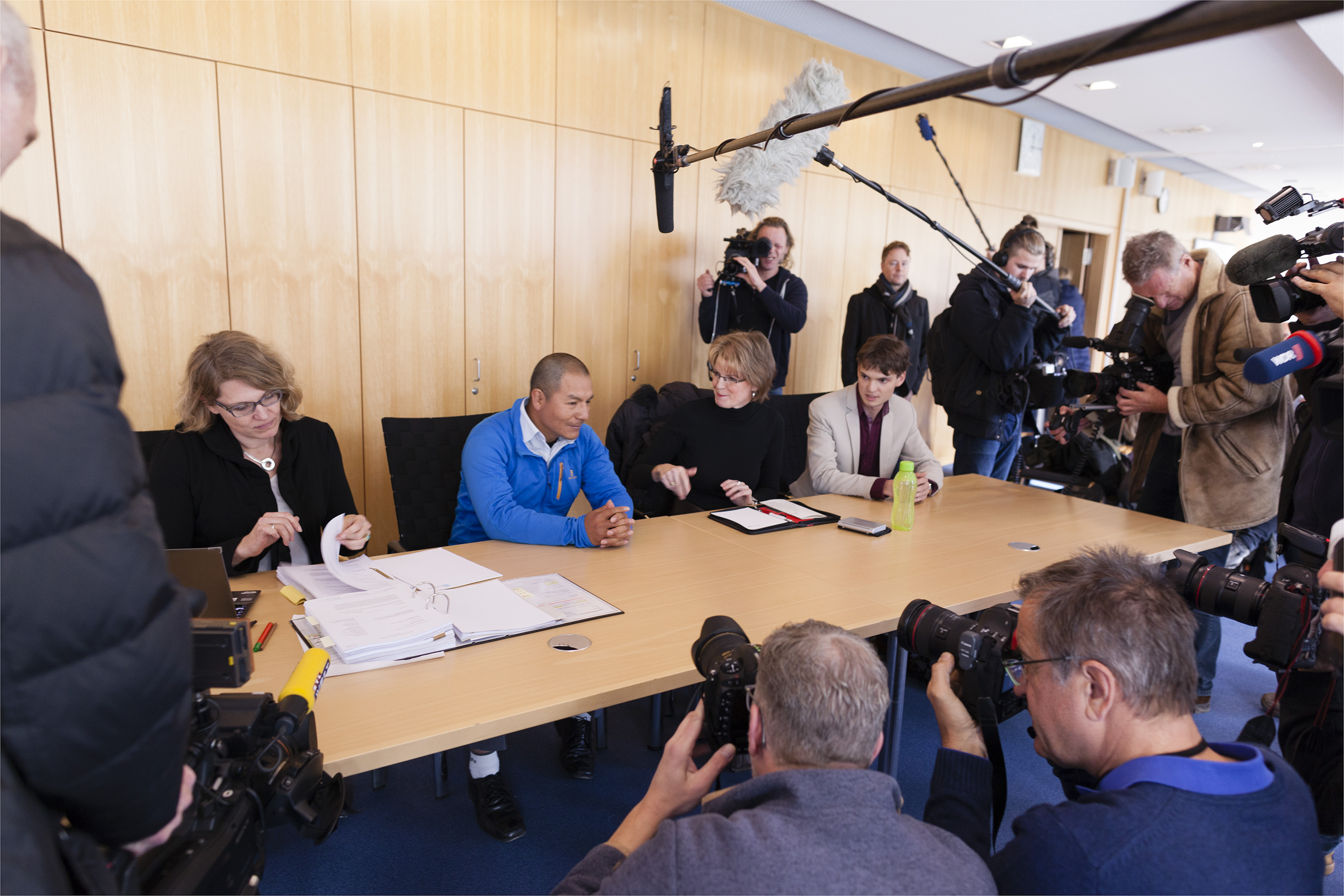
Saúl Luciano Lliuya alongside his lawyer Roda Verheyen (left) at the Upper State Court in Hamm, November 2017 (photograph by Alexander Luna, used with permission).
Earlier during the hearing, Judge Meyer elaborated the court's opinion that the case was legally admissible, meaning the court could rule in Saúl's favor if it saw sufficient evidence linking RWE's operations to glacial flood risk in Peru. RWE's lawyers had quickly rebuffed the judge's suggestion for an out-of-court settlement, arguing that this was a matter of precedent. For the climate activists at Germanwatch that had gathered donations to organize the lawsuit, this was a legal test case: could German law be used to hold major corporations liable for their contribution to climate change? Similar cases in other jurisdictions had failed, 2 but climate science was evolving rapidly, improving the evidentiary basis for proving a causal link between emitters and impacts. This case addressed what many see as a significant inequity of climate change: while the majority of emissions has been produced in wealthy countries of the Global North, many of the worst impacts are felt in the Global South where governments have fewer resources to confront them. Bringing this moral dimension to the forefront, Judge Meyer continued with his remarks: “But in the places in the world where money is scarce, can we leave these people on their own even when we are causing the problem over here? Is that just?”
The lawsuit between Saúl and RWE draws on legal norms that people usually invoke to seek relief from neighbors for damage or potential harm to their property. This can involve a nuisance relating to environmental pollution if claimants can prove their neighbor's responsibility. In their arguments, Saúl's lawyers expand the legal conception of neighborliness to encompass relations across the planet: as climate change connects RWE and Saúl, it makes them neighbors. The legal approach defines as neighbors those who are able to act on one another. Neighborliness emerges out of concrete claims that construct ethically charged relations between legally defined entities such as humans and corporations.
Placing this legal conception in conversation with anthropological and philosophical discussions about morality and sociality, I define neighborliness as a type of relationality that revolves around mutual moral responsibility. Neighborliness is a familiar form of engagement in local communities around the world. In ethnographic practice, the precise nature of these moral relations can be a matter of dispute, giving rise to discussions about what responsibilities should arise from a particular relationship. I use neighborliness as an analytical framework to develop an ethnographically grounded understanding of climate change that foregrounds the moral relations at stake. The focus on neighborly relations reconfigures climate change in terms of legally and morally charged engagements between those who emit greenhouse gases in one part of the world and those who face the detrimental consequences of global warming thousands of miles away. This involves the study of concrete social engagements manifested in ethical claims about who should take responsibility for devastating environmental transformations. Characterizing climate change in terms of neighborly relations makes it methodologically and theoretically amenable: while we might struggle to capture a global process, we can follow specific relational claims. The lawsuit provides an empirical opportunity to study how people invoke ethically charged social relations to make sense of and act on climate change. If anthropology is the study of social relations, a neighborly approach to climate change provides an ethnographic opportunity to investigate the relational engagements at stake in contemporary climate concerns.
In this article, I trace how the lawsuit emerged as activists and environmental lawyers around the world have increasingly promoted legal mechanisms to address climate change. My involvement in Saúl's lawsuit began when I worked for the NGO Germanwatch and helped coordinate the claim in its initial stages. Subsequently, I conducted ethnographic research following the claim between the Peruvian Andes, German courts, and UN climate summits. Reviewing the claim's legal argumentation, I demonstrate how the lawsuit configures Saúl and RWE as neighbors on a warming planet. I compare this legal concept to Saúl's own experience of neighborly relations in his Andean village. In both cases, the idiom of neighborliness foregrounds potentially conflictual moral dynamics. Taking conceptual inspiration from a climate change lawsuit that raises fundamental questions about how people should live in the contemporary world, I propose a that a focus on neighborly relations can help anthropologists unravel the moral stakes of climate change and other globalizing phenomena from an ethnographic perspective.
Neighborly relations: Moral responsibility in times of climate change
Climate change raises significant theoretical and methodological challenges for anthropology. How can a discipline grounded in ethnographic specificity approach a phenomenon that is transforming the entire planet? Building on anthropological discussions about climate, morality, and law, I establish neighborliness as an analytical framework for studying social claims about mutual responsibility. Examining climate change from this perspective highlights how it expands the scope of moral relations across the planet.
While an older generation of anthropologists studied how climate and weather shape cultural life, social life is now shaping the climate (Howe, 2015). Recent years have seen a significant growth in anthropological literature on climate change, with researchers studying this predicament from numerous ethnographic standpoints. In a recent review, O’Reilly et al. (2020) place existing anthropological research on climate change into three broad categories. First, anthropologists have traced the production and circulation of climate change knowledge, focusing in particular on scientific conceptualizations. This can provide a critical view on how climate change debates are shaped by politics, power dynamics, and cultural values (Barnes et al., 2013). Second, ethnographic research can show how people engage with climate change impacts. Collaborating with natural scientists, anthropologists have contributed sociocultural aspects to climate change research (Crate, 2011). Finally, anthropologists have examined social and political efforts to mitigate the climate crisis, with a significant focus on energy consumption and transitions (High and Smith, 2019). What many of these studies have in common is that they involve a territorially situated study of climate change knowledges, impacts, and mitigation strategies. Grounded in a tradition of long-term ethnographic fieldwork, anthropology is particularly apt for studying how people engage with climate change in different places around the world. Some researchers have begun to theorize from an anthropological standpoint how climate change connects people, the planet, and its atmosphere. Knox (2015) suggests that we approach climate change via its material processes to study the energy relations it invokes. As such, we can trace the material and social relations through which climate change emerges and becomes contested. Following the suggestion from O’Reilly et al. (2020: 23) that anthropology can help us “reimagine the future of human-atmosphere relations,” I propose a framework for studying climate change ethnographically by tracing how its material relations give rise to new moral relationships.
What makes relations moral? Morality and ethics refer to normative concerns about how people should act. 3 While philosophical discussions have often revolved around defining ethical principles, an ethnographic perspective can trace how normative concerns emerge through people's lived experience and how they navigate moral tensions (Fassin, 2012). Moving between scales of analysis, anthropological study can relate ethnographic experiences of moral issues to broader analytical and social concerns (Fassin, 2011). In particular, it can follow moral disagreements as they play out in ethnographic practice (Shweder and Menon, 2014). Anthropological discussions about morality and ethics have shown how they shape everyday social life, uncovering moral structures in distinct localities and conceptual fields such as humanitarianism, religion, and medicine (Mattingly and Throop, 2018). Such research can trace how climate change arises as a moral concern in public debates and activist practice (Von Storch et al., 2021). The focus in this article is on moral relations as they play out in a lawsuit that cuts across local and global scales by defining Saúl and RWE as neighbors.
Ethical norms about how social actors should engage with one another are often embedded in legal institutions. From an anthropological perspective, the law has been characterized as a type of system that enforces codified rules and moral standards, shapes categories of identity and may serve as a framework for political action (Goodale, 2017: 4). While law has often been used as a tool of oppression, subaltern groups can mobilize legal tools to challenge the status quo (Eckert et al., 2012). Ethnographic study of legal process traces how legal theory and concepts are negotiated in practice. Exploring the analytical implications of legal debates, such research can inform broader understandings in social theory about the issues at stake (Bens and Vetters, 2018). In this article, I bring legal arguments from the case of Luciano Lliuya v. RWE into conversation with anthropological discussions about how climate change reframes social relations across the planet. I propose a focus on neighborliness as a methodological and theoretical framework to approach these dynamics. What does it mean to be a good neighbor in times of global warming?
Countless studies in anthropology and related disciplines have examined engagements between neighbors at a local level (e.g., Henig, 2012; Zabiliūtė, 2020) or between adjacent ethnic and national populations (e.g., Åtland, 2010; Gribetz, 2014). Other academics have used the term “neighbor” in a metaphorical sense to posit the centrality of ethical relations between people around the world. Some have drawn on a Christian ethics of neighborliness to promote a more charitable engagement between people in a globalized world (Walker, 2008). Others have invoked the idea of “Global Neighbors” to promote ethical consumerism addressing global inequality (Haugestad, 2004). In all these discussions, the “global neighbor” idiom has a clear analytical value: it posits the centrality of moral relations. However, I define the term “neighborly relations” in more concrete ethnographic terms as the morally charged engagements between social actors who are able to affect one another.
Neighborliness is a conceptual framework for studying the moral stakes of social relations. I contrast this to kinship which involves a much tighter set of relations. Picking up on longstanding debates in anthropology, Sahlins (2013) defines kinship as the “mutuality of being”: it involves a social interdependence at an existential level. Based on a review of numerous ethnographic studies from around the world, Sahlins argues that kinspeople make one another who they are as they participate in each other's lives. Neighborliness is broader in scope: it involves those who are not close enough to be kin, but neither are strangers. In philosophical discussions about the ethics of coexistence, “the neighbor” has been theorized as a figure toward whom one has potential moral obligations (Thiranagama, 2019). Rather than mutuality of being, neighbors are held together through mutual responsibility. This can be regulated through law and local custom, and the bounds of responsibility are often disputed. Neighborly relations can involve numerous types of social actors including humans, corporations, and sentient earth beings inhabiting the landscape (De La Cadena, 2015). Neighborly relations are not necessarily harmonious; they can be antagonistic and conflictual. If a person asserts that someone else is a neighbor, this entails a call for the other to accept the ensuing moral responsibility.
In times of increasing global interconnection, neighborliness potentially encompasses relations across large distances. Nevertheless, neighbors only become neighbors through concrete claims about moral responsibility. Climate change is giving rise to a growing number of such claims. Climate science narrates with increasing specificity the social practices contributing to global warming and the subsequent impacts around the world. This provides crucial evidence for climate justice lawsuits. Legal practitioners have applied the familiar framework of neighborliness to translate these scientific links into moral relations between those actors who made the largest contribution and those who suffer the consequences. This framework resonates with anthropological discussions about social relations in times of climate change. Approaching climate change in terms of neighborly relations makes it ethnographically amenable. Anthropological research can follow discussions about causal linkages and moral responsibility in scientific, legal, and political contexts. This approach builds on the work of others who have grappled with studying global phenomena ethnographically. We can study the fragments of global relations, tracing the frictions that arise when people engage with universalizing claims (Tsing, 2005). Drawing on Marcus (1998), Krauss (2009) and Crate (2011) call for a multi-sited research approach to climate change which can trace how people come to understand global environmental change as a universal process, and how they localize it in particular places. A focus on neighborliness highlights the moral dynamics at stake in cross-planetary social relations that have emerged in times of global warming. This framework is especially pertinent for studying climate change, which is a fundamentally moral issue: it expands the scope of neighborly relations and raises the question of how we should live together on our planet. As I discuss in the conclusion, a focus on neighborliness may also be helpful for studying other forms of global interrelation.
Constructing a legal claim
The lawsuit against RWE emerged as a collaborative effort. A group of German activists sought to enact legal and political change; Saúl Luciano Lliuya's most significant motivation was to support the mountains that he witnesses losing their glacial covers year after year. Saúl and his interlocutors entered a pragmatic alliance and embraced a shared cause. As the lawsuit gained public attention in Germany and beyond, its collaborative nature faded into the background. Media profiles often focused on Saúl as a lone man struggling for justice (Jarvis, 2019; Nugent, 2018). Saúl fit into a useful narrative mold: a historically subjugated subject from the Global South—seen by many as Indigenous, though he never referred to himself in those terms—taking on a powerful multinational corporation. This story lent the lawsuit emotive strength. As the lawsuit drags on in 2022, it has come to define much of Saúl's life. Several documentary film projects about him are currently in production.
Before the claim began, the NGO Germanwatch had spent two decades participating in UN climate summits pushing for sustainable solutions to a global crisis. 4 As politicians made little progress, activists sought new avenues of action, drawing on analysis from legal scholars about potential litigation strategies (e.g., Kysar, 2011; Rogers, 2013). On other social and environmental issues, legal claims had moved forward debates when politicians and industry failed to take action. It took dozens of lawsuits against tobacco companies over several decades until the industry acknowledged its responsibility for smoking-related health risks. In a similar vein, climate litigation could push for action against global warming (Ganguly et al., 2018). Since the early 2000s, activists and lawyers had discussed the possibility of making legal claims against major emitters. When I joined Germanwatch in 2014, I found ongoing conversations about possible strategies under German law. There were discussions about claiming protective measures from a large emitter in German courts. Groups from countries such as Nepal had asked Germanwatch to assist in assessing possible legal pathways, but a concrete claim was yet to emerge.
Leading up to the 2014 UN Climate Summit in Peru, Germanwatch employees took interest in the Peruvian Andes where studies have highlighted widespread climate change impacts including glacial retreat, flood risk and long-term threats to water security (Hegglin and Huggel, 2008; Vilímek et al., 2014). However, the people at Germanwatch were unfamiliar with the region and did not speak Spanish. As I had lived in Peru and had academic and personal ties to the country, I joined the team to seek out people in the Andes who shared the NGO's concerns about climate change. I reached out to an old friend, a Peruvian agricultural engineer who worked with small-scale farmers in animal husbandry projects. Traveling around the Andean city of Huaraz, he struck up a discussion with Saúl's father Julio after a village assembly. Julio, in his late seventies, held a position of authority in the village and was concerned about what the ongoing environmental shifts might mean for his community's future livelihood. After an introduction via my friend, we arranged to visit Julio with a team from Germanwatch after the UN Summit in Lima.
In our first discussions, my colleagues asked Julio and Saúl about their experience of climate change. I acted as an interpreter while father and son elaborated on their concerns that glaciers were disappearing and that their future was uncertain. If the glaciers disappeared, where would they find water for use in the household and irrigating their fields? We pointed to scientific studies that suggested a risk of flooding for Huaraz from Lake Palcacocha (Emmer and Vilımek, 2013; Portocarrero Rodríguez, 2014). Julio and his wife Juliana had bought land in the Huaraz district of Nueva Florida in the 1980s. Saúl spent part of his childhood living in a small adobe hut in Nueva Florida where he had easier access to school. According to the studies, Nueva Florida could be swept away almost entirely if there were a flood.
Over their respective lifetimes, Julio and Saúl have witnessed dramatic changes in their mountain environment. In 1941, when Julio was one year old, an outburst flood from Lake Palcacocha devastated the city of Huaraz and killed thousands. Living on higher ground in an upstream village, Julio and his family evaded death. Throughout Julio's life, particularly since he worked as a mountain climbing guide in the 1970s, glaciers in the surrounding Cordillera Blanca have retreated dramatically. Stepping in his father's footsteps, Saúl became a mountain guide in the early 2000s (see Figure 2). Both father and son share a deep concern for glacial retreat. They see glaciers as vital sources of water that enable agricultural livelihoods, and as living beings that are suffering in uncertain times. Their dilemma was that they did not see themselves as responsible for this predicament. Large industry and wealthy countries caused global warming and glacial melting. Yet Julio and Saúl lacked any means of taking action—until a mutual friend brought a small delegation of German climate activists into their village.
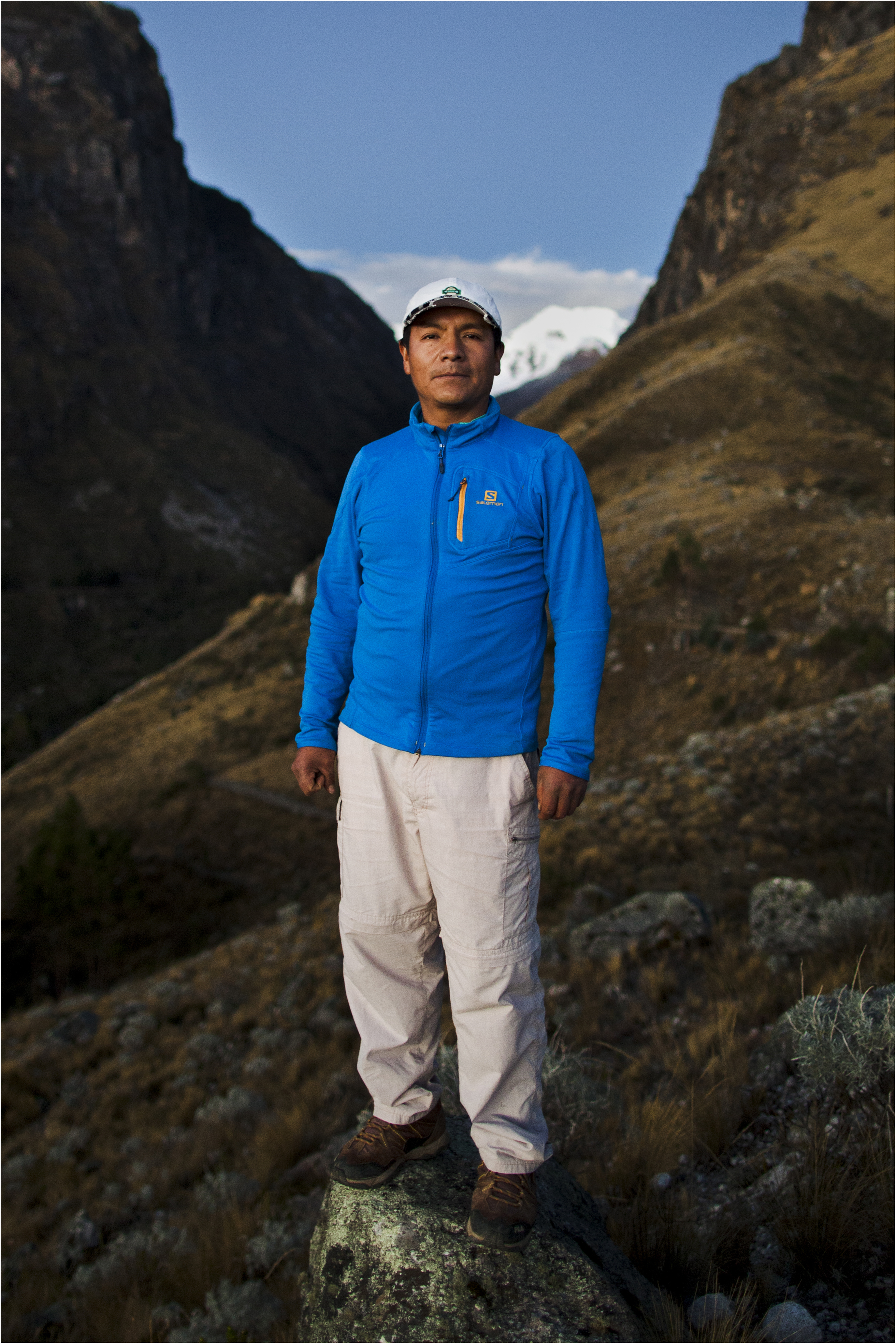
Saúl Luciano Lliuya in the Andes (photograph by Alexander Luna, used with permission).
Initially, Julio expressed his willingness to file a lawsuit against a major polluter. However, over lunch in Saúl's house he told us that he had recently divided his property among his seven children. After we explained that only someone who legally owned the property could make a claim, Saúl did not hesitate before speaking up: “I’ll do it.” At 34, Saúl was the youngest of his siblings and the only son. Julio looked at him fondly as we agreed to arrange a call with the lawyer in Germany.
Saúl first met Dr. Roda Verheyen, the leading lawyer on the case, in a series of Skype calls following our visit to Peru in which they discussed the possibility of taking legal action. They considered various options, including lawsuits in Peruvian, German, and international courts. As Saúl's preferred option was to directly address a major polluter, the discussions came to revolve around a civil law claim against RWE. The decision to focus on RWE was pragmatic as the case emerged out of a Peruvian-German collaboration and RWE is Germany's largest emitter, but those involved aim to set a precedent for holding other major corporate emitters responsible. The lawyer explained that the chances for legal victory were very low, but that if they won, Saúl would be on the front page of every newspaper in the world. Saúl agreed to join an international network of activists in a precedent-setting claim for climate justice. This commitment marked a radical change of course for a shy and unassuming man who had lived his life in the global periphery. It took him to German courts and UN summits where he captured the passions of a burgeoning transnational climate justice movement. Saúl had been nervous about speaking at village assemblies but went on to address thousands of people at major climate marches. He would give countless interviews to the world press. His lawsuit reached greater success than Saúl had ever imagined.
Referring to its collaborative nature, Saúl often refers to the lawsuit as “our claim.” “Who are ‘we’?” I once asked him after he used that formulation in a press interview.
“I say ‘we’ because it's not just me in this claim,” He explained. “I have friends who are helping me with this claim, so they are also part of this claim.” Saúl and the people at Germanwatch have distinct reasons for being involved in the lawsuit and both get something from each other. For Germanwatch, working with Saúl gives them the opportunity to pursue a legal test case to hold major emitters responsible, thereby pressuring politics and business. Saúl seeks to prevent further damage to the mountains he calls home. Working in the context of a global activist effort, they are brought together by the aim to limit global warming and mobilize support to deal with its worst impacts. Germanwatch and the lawyers have played a crucial role in developing the legal strategy. Saúl is not a legal expert; he does not follow the intricacies of German law and scientific evidence under discussion at court. That he gladly leaves to the legal team. Law is merely a means to an end for him: climate change is a lived experience, and his sense of justice tells him that major polluters like RWE should pay. Saúl plays an integral role in communicating the case publicly, shaping how different audiences perceive the claim.
I accompanied him throughout this process as an interpreter, confidant, fellow activist, and ethnographer. To this day, I act as an advisor to the legal team and participate in court proceedings. Some have argued that academic research and activism are qualitatively different efforts: while anthropology draws legitimacy from scholarship to create knowledge, advocacy relies on moral legitimacy to apply knowledge (Hastrup et al., 1990). Nevertheless, the two can inform each other (Kirsch, 2002; Merry, 2005). My involvement in the lawsuit has raised productive analytical tensions that I deconstruct in this article.
Looking back on his fateful decision to participate in the lawsuit in a conversation several years later, Saúl explained that he felt a responsibility to act over glacial retreat. “It's something that had to be done.” Referring to his own feelings, Saúl usually spoke in the second person: “If you have the opportunity to do it, you should. Were there risks? Of course. But you just felt like you had to do it.”
“We live at the bottom of a sea of air”: Making neighborly relations in the courtroom
The legal claim that Saúl submitted to the court in November 2015 is a 39-page German document. The first half draws on scientific literature to argue that RWE contributed to glacial flood risk affecting Saúl's property. The latter half of the lawsuit involves a highly technical legal discussion that justifies the claim in terms of German law. When Saúl read a Spanish translation, he had trouble following the claim's scientific and legal language.
Saúl's lawyer Roda Verheyen wrote the document in cooperation with Germanwatch employees, including myself. With support from legal colleagues, Roda developed and formulated the lawsuit's legal argumentation. At Germanwatch, we read countless scientific papers on climatic processes, glaciology, and glacial lake outburst floods. As the only Spanish-speaker on the team, I collected Peruvian government reports and media articles about the situation at Lake Palcacocha. After compiling this information according to legal requirements, we helped Roda write the legal text that she and Saúl later filed at the courthouse. Along with the 39-page lawsuit, they submitted a much larger stack of attachments that included scientific studies, Peruvian government documents, and the deed to Saúl's property.
In legal terms, Saúl's lawyers argue that the German energy producer RWE has caused a nuisance to Saúl's property in Huaraz. The plaintiff and defendant are configured as neighbors. Climate litigation cases can lead judges to reconsider fundamental legal categories (Kysar, 2011). Faced with the challenge of climate change, this lawsuit urges German courts to expand their understanding of legal liability and neighborly relations.
According to the lawsuit, 5 RWE's emissions from coal-fired power plants contributed to the concentration of CO2 and other greenhouse gases in the world's atmosphere. These gases insulate the planet by retaining a larger portion of solar energy, thereby producing the greenhouse effect and global warming. This has led to glacial retreat around the world (IPCC, 2014). In Peru, the lawsuit says, Andean glaciers have melted at a particularly fast rate. As a result, glacial lakes such as Palcacocha have grown in volume, increasing the risk of flooding. Several floods have occurred at Palcacocha and other Cordillera Blanca lakes in recent decades (Emmer et al., 2014).
Lake Palcacocha has grown dramatically in recent years, from around 0.5 million m3 in 1974 to over 17 million m3 in 2009 (Portocarrero Rodríguez, 2014). In the city of Huaraz, Saúl's house sits in the path of a potential outburst flood. He spends most of his time in his village, around 30 minutes’ drive from Huaraz, outside of the danger zone. Saúl and his family live in the Huaraz house when they have commitments in the city. During the university semester, Saúl's son stays in the house to attend classes.
Citing flood models from Texas University scientists, Saúl's lawyers stated that a flood from Palcacocha threatened to destroy his house. 6 Saúl's lawyers argued that RWE and other greenhouse gas emitters are partially responsible for this flood risk. To remove the risk to Saúl's property and the city of Huaraz, the Regional Government planned to build a new dam and drainage system at Palcacocha. Authorities valued this project at around US$4 million. The lawsuit did not seek this entire sum from RWE, but only a partial payment in accordance with its alleged contribution to greenhouse gas emissions. According to the Carbon Majors Report which quantified historical emissions and linked them to individual companies (Heede, 2014), RWE is responsible for 0.47% of industrial emissions between 1751 and 2010. Following this, the lawsuit demands that the company pay 0.47% of US$ 4 million to the Regional Government toward the Palcacocha safety project. That amounts to US$ 18,800. 7
In the contemporary order of global capitalism, transnational corporations often have the potential to produce impacts and harm far away from their country of origin or headquarters. Researchers studying efforts to hold corporations responsible for pollution and health concerns have argued that legal institutions based within national jurisdictions may inadequately apprehend how harm is produced through complex processes of extraction, production, trade, and consumption, failing to account for the power relations inherent to these dynamics (Eckert and Knöpfel, 2020). In addition, courts face a significant challenge when they apply old legal doctrines—that were formulated before contemporary concerns with climate change—to the complex and multi-scalar problem of global warming (Osofsky, 2007: 248). Saúl's lawyers addressed these challenges by reinterpreting an old legal norm to draw the causal link between RWE's emissions in Europe and climate change impacts in Peru. The lawsuit asserts a neighborly relation between Saúl and RWE in accordance with Section 1004 of the German Civil Code:
Claim for removal and injunction
If the ownership is interfered with by means other than removal or retention of possession, the owner may require the disturber to remove the interference. 8
German lawmakers first passed this law in 1900 as a general nuisance provision. Lawyers have typically used it to resolve neighborhood conflicts. 9 If one (legally constituted) person causes harm or risk of harm to another person's property, the latter person can sue the former, citing Section 1004, and demand that they remove the interference. 10 This legal norm is a key provision under German law for regulating relations among neighbors.
Roda Verheyen, Saúl's lawyer, drew on a simple analogy to explain the legal approach: Imagine if your neighbor has a wall that divides their property with yours. The wall is old, and the bricks are loose, so you’re afraid it could fall onto your property and damage your house. If that happened, you could sue your neighbor for damages. But you would rather not wait. You don't want to live with the uncertainty – when will the wall fall over? So, you sue your neighbor over the hazard, citing Section 1004. You force them to remove the problem. In this case, make them fix the wall. In Saúl's case, remove the flood hazard.
In legal terms, she argues that Saúl and RWE are neighbors. This builds on other cases that have addressed local environmental harms such as noise and smell pollution via Section 1004. 11 In subsequent legal arguments, the lawyers cited historical German jurisprudence 12 that defined neighborly relations in broad terms: accordingly, the neighborhood is as large as potentially harmful effects can reach. 13 Following this legal logic, any greenhouse gas emitter is a potential neighbor to someone who faces climate change impacts. The “neighborhood” encompasses the entire planet. Through invoking a neighborly relation, Section 1004 could be applied at a German court for claims relating to harm caused anywhere in the world as long as the defendant is legally situated in Germany.
RWE's lawyers disagreed with this understanding of Section 1004. In their first response to the lawsuit, they argued that “German civil law provides no basis for liability in cases of potential interference by ‘all against all’ due to global climate change.” 14 According to their interpretation of the law, Section 1004 is not applicable to climate change cases—and even if it were, they questioned the causal link between RWE's emissions and specific climate change impacts in Peru. 15 They disagreed with the articulation of a neighborly relation between Saúl and RWE.
German lawmakers drafted Section 1004 in the late nineteenth century, many years before greenhouse gases and climate change became a major public issue. Nevertheless, environmental concerns may have been on their minds in the context of early industrial pollution. Roda drew on an old legal text explaining the motives for the Civil Law Statute which asserted that neighbors are not only those who can see or hear each other.
At the court hearing in November 2017, Judge Meyer of the Upper State Court in Hamm went into great detail summarizing Saúl's legal claims. Then he quoted the official commentary accompanying the law that Saúl's lawyers had cited in legal submissions: Some types of effects cannot be kept within specific boundaries. We live at the bottom of a sea of air. This circumstance necessarily means that human action extends into the distance. […] If the permission or prohibition of such an immission
16
is to be determined, one must not only consider the relationship of neighbor to neighbor; rather, the scope of the owner's right can be made to bear on all people. […] Someone who causes or spreads imponderabilia must know that these go their own way. Their propagation across the border can be attributed to them as a consequence of their action (Mugdan, 1899: 146)
17
“Prophetic phrases,” Judge Meyer said. At a lower court in Essen, judges had dismissed Roda's argumentation, ruling that Section 1004 could not be applied to enact a neighborly relation in the context of climate change. At the appeals court in Hamm, the judges expressed their disagreement with the previous ruling; much to the surprise, it appeared, of RWE's lawyers. On the plaintiff's side, Roda became ever more excited. Saúl understood little of the legal discussion despite support from a court-appointed interpreter but began to comprehend that the hearing was going well when Roda gave him looks of joy and squeezed his hand. She and her colleagues had found success in applying an old law to climate change, drawing on a long-forgotten legal interpretation.
By their nature, legal structures are meant to be universally applicable within a particular jurisdiction. This allows for strategic legal creativity: The claim against RWE stretches Section 1004 across a planetary scale. With surprising foresight, nineteenth century German lawmakers recognized that we are all connected by a “sea of air.” Pollutant imponderabilia can produce impacts across borders. While lawyers had previously applied Section 1004 to cases of local interference and pollution, the lawsuit draws on its drafters’ original motivations and applies it to global climate change. Building on Section 1004, the claim reconfigures climate change as an engagement between neighbors. Anthropologists face similar challenges as legal practitioners in terms of how to analytically grasp the issue of global warming. As in the legal sphere, a focus on neighborly relations provides a theoretical framework that uncovers the moral stakes of climate change. I apply this approach to an Andean context in the following section, contrasting the legal understanding of neighborliness to Saúl's contested engagements with his neighbors.
Neighborhood tensions in the Andes
Saúl's claim caused reverberations around the world; many seemed to see him as a hero of climate justice. Among some of Saúl's neighbors in his Andean village, the claim raised suspicion. In 2014, he was a farmer and mountain guide who lived in the village with his wife and two children. He and his family tended to the fields and cared for their animals. Starting in March 2015 when Roda sent an initial claim to RWE, his name periodically appeared in the Peruvian and international press following important legal events.
At the lawsuit's outset, the directors of Germanwatch made a legal commitment to cover all costs associated with Saúl's lawsuit. 18 The NGO raised funds from other organizations and private donors to cover legal costs, travel expenses, and organize a public relations strategy for the lawsuit. Saúl incurred few direct expenses. Germanwatch ensured that the court and lawyers received their fees. They booked his flights for him.
After Saúl's first visit to Germany in 2015 to submit the lawsuit, he and his family began renovations on their house in the flood hazard zone. The old adobe hut that his parents had built years ago would hardly withstand a deadly flood wave. Working with the extended family, they built a two-story brick house in its place. Saúl used money he had earned as a mountain guide, but his neighbors speculated that he must have gained a significant financial advantage through his lawsuit and visit to Germany. Few confronted him directly, he later told me, but rumors abounded about his supposed newfound fortune. Some even said he was selling Lake Palcacocha to the Germans.
Saúl did not explain to many people what he was doing. He lacked the charisma and oratory skills that allow others to hold dramatic speeches and draw people onto their side. He did not like addressing tense village assemblies. His neighbors found out about the claim primarily through gossip. Some younger people read about it on Facebook. When I began conducting ethnographic research in the area where Saúl lives in 2017, I found that while many people I spoke to did not understand why Saúl had made the claim, they had the feeling that he was doing something wrong. When I first moved in with a local family in a village neighboring Saúl's, we sat around a table in their adobe house eating potato soup on a cold evening. Chatting with one of my hosts, I mentioned that I knew Saúl. “Saúl is a crook,” he exclaimed. “The people say that Saúl is making money from Lake Palcacocha.” I explained the reasoning behind the claim to my host, but I still wonder to what extent he saw me with suspicion at that point. To many, it simply seemed outlandish that Saúl would go to Germany over a lake in the Peruvian highlands.
The irony was not lost on Saúl: while he sought to establish a neighborly relation with RWE in Germany, the case caused friction between him and his neighbors in Peru. If neighborliness arises out of claims about mutual responsibility, as I argue above, then it should come as no surprise that neighborly relations are not always friendly and can involve significant antagonism. In any social setting, the scope of neighborliness relates closely to people's moral understandings of how they should engage with one another.
In the Andes, anthropologists have documented the significance of reciprocity for social relations (Allen, 1988). For example, local regulations in Saúl's village and neighboring communities require people to participate in communal labor such as road and canal maintenance. While this custom is slowly declining as more people move to the city, communal works remain significant in the region as a symbolic practice that strengthens communities (Osorio Bautista, 2013). Reciprocity can also extend to relations between people and the landscape, which many engage as sentient. Across the Andes, people perform tribute payments to earth beings such as mountains to plea for more productive harvests (De La Cadena, 2015). At Lake Palcacocha, which threatens to flood the city of Huaraz, I witnessed locals providing tribute to the nearby mountains to prevent an avalanche and subsequent disaster. Mountains are neighbors of a different sort, traditionally seen as powerful beings requiring respectful moral engagement. Anthropologists have argued that climate change questions cosmological understandings about the power of mountain beings (Bolin, 2009). Many feel that the mountains are suffering due to glacial retreat and my interlocutors expressed uncertainty about what would become of mountain beings once they lost their white cover.
While reciprocity is a common theme in Andean notions of neighborliness, community relations can be contentious in practice. During my fieldwork, I found that village assemblies were frequently tense affairs as people argued over how to divide access to community canals and how much they should pay for shared infrastructure services. Open arguments were not unusual. When conflicts arose between neighbors, they often concerned matters of disputed mutual responsibility; a family might be accused of taking too much water out of the local irrigation canal.
These tensions are exacerbated in times of increasing environmental transformation. In the southern Peruvian Andes, Stensrud (2016) found that farmers threatened by water scarcity related to global warming invoked the notion of reciprocity in their political demands for support from government agencies. My Andean interlocutors frequently discussed their concerns about melting glaciers, changing rain patterns, and water scarcity. Only some people referred to this as climate change (cambio climático), a term they picked up from friends, the media, or tourists (cf. Gabriel, 2013). Research on climate change adaptation in the Peru points to significant challenges in communicating scientific conceptions to rural Andeans (Paerregaard, 2020). Climate change has no equivalent in Quechua 19 and many struggle to make sense of the situation. Locals see glaciers as an important source of water and are concerned about water scarcity as glaciers disappear. Recent research on climate change perceptions in the region has found that people provide varying causal explanations such as local littering, mining contamination and even religious immorality (Rasmussen, 2015). Several studies found that villagers have picked up on NGO and governmental discourses about environmental pollution and argue that people's incorrect behavior in their mountain range caused glacial retreat. They frame climate change as a local issue concerning relations between humans and the sentient Andean environment (Jurt et al., 2015; Paerregaard, 2013). In one locality, villagers argued that their own contaminating activities were to blame (Paerregaard, 2018). I encountered similar discussions in my research, with opinions differing about what caused the environment to change so drastically. Some people, especially among the younger generation, spoke in terms of global warming.
It did not help Saúl's case with his neighbors that the lawsuit concerned the short-term risk of flooding rather than long-term water scarcity. Many in the area questioned authorities’ assertions about the flood hazard at Lake Palcacocha, arguing that this was a pretext to steal public funds through infrastructure projects. I encountered a pervading mistrust of state authorities among villagers in the rural areas around Huaraz. Most people simply assumed that government officials were corrupt and were skeptical of anything they said. The government did not engage villagers as a reciprocal actor, frequently disappointing people's expectations for support in terms of infrastructure and economic opportunities.
While the lawsuit against RWE is concerned with establishing causality and responsibility retroactively, many villagers I spoke to rather look to the future and wonder how they might continue to make a life for themselves. The legal claim addresses international discussions about climate justice but offers little concrete support to those who worry about the viability of agriculture for the next generation. For those who understand climate change as an issue of local environmental engagement, meaning glacial retreat is caused by humans’ disrespectful behavior towards sentient mountains, Saúl's actions may appear completely misguided. From this perspective, RWE is not a relevant moral actor. In local Quechua parlance, people usually use the term “neighbor” only for those living in their immediate vicinity. 20 Meanwhile, German jurisprudence does not recognize Andean mountain beings as legal persons. 21 Saúl found it difficult to reconcile his argument about global climate justice with some of his immediate neighbors’ understandings of what it means to be a good neighbor and which actions are viable to address glacial retreat. As his behavior did not fit within the moral order of neighborly relations, some came to perceive him as morally dubious.
It comes as little surprise that Saúl faced rumors alleging that he was doing something wrong. Saúl speculated that many were simply envious of his newfound fame and attention. Envy, particularly between men, is not uncommon in an Andean context marked by machismo. Based on a study of rural life in the Bolivian Andes, Van Vleet (2003) finds that gossip is a tool through which people make sense of relationships and social events. Gossiping is a theorizing practice that allows for the evaluation of people's behavior in relation to shared understandings about how community members should act. In this context, argues Van Vleet, envy arises when someone is seen to gain an advantage without keeping to the moral obligations of reciprocity and sociality. As such, the critique of Saúl arose from the perception that he had violated the moral order of Andean neighborly relations. He is not the first activist to face such trouble in his own community, as others have documented (Conklin and Graham, 1995). These tensions may be declining; when I visited Huaraz in May 2022, many were more familiar with the lawsuit and there seemed to be greater support for Saúl in his community. An analytical focus on neighborliness, in the Andes as in the context of global climate politics, uncovers the moral stakes of social relations: who are the relevant social actors and how should they treat each other?
Conclusion: The power of neighborliness
On 30th June 2017, the Upper State Court in Hamm made a historic preliminary ruling in favor of Saúl. Reflecting their oral comments in the hearing earlier that month, the judges found that the lawsuit was admissible—it had a solid legal foundation. They saw the possibility for a precedent under German law if evidence could be found to prove a causal link between RWE's emissions and glacial lake flood risk to Saúl's house in Peru (Frank, 2017). The decision was widely covered in German and international media, prompting discussions about whether major emitters should take financial responsibility for climate change impacts (Nugent, 2018; Spiegel, 2017). While the case is still ongoing as of 2022 following pandemic-related delays, new evidence has emerged linking glacial retreat and flood risk in the Peruvian Andes to anthropogenic climate change (Stuart-Smith et al., 2021) while climate litigation has gained significant momentum around the world. In two recent verdicts, a Dutch court ruled that Shell must reduce its greenhouse gas emissions 22 and the German constitutional court found that the government should take stronger action to protect future generations from harmful climate change impacts. 23 The latter case, also led by Saúl's lawyer Roda Verheyen, forced the government to enact new legislation in the immediate aftermath. 24 While the RWE claim as achieved unprecedented success, similar cases have since emerged in the United States and Switzerland. 25 Time will tell how these efforts proceed in the courts and to what extent they affect public debates about climate change. Meanwhile, major energy companies have already made significant climate commitments—at least on paper 26 —with RWE planning to phase out coal and become carbon neutral by 2040 (Schunck and Bücker, 2020).
While some have argued that law can be de-politicizing in the sense that it moves controversial issues into the realm of legal decision-making, ethnographic research shows that legal mobilization can be “a means of doing politics” when it strives toward social and institutional change (Eckert and Knöpfel, 2020: 5). The lawsuit against RWE offers novel analytical and political potentialities for approaching climate change. With its focus on neighborly relations, it provides an opportunity for capturing how people configure climate change in terms of morally charged social relations spanning the planet. In the context of climate justice activism, climate change becomes graspable as specific relationships between emitters, such as RWE, and those who face potential harm, like Saúl. Tracing the social practices that enact these connections, I offer an ethnographic snapshot of climate change conceptualized in terms of morally charged neighborly relations. Saúl faced misunderstanding and suspicion in his own village upon returning home from Germany; from his perspective, RWE became another contentious neighbor.
Neighborliness is a familiar moral framework that calls forth ideas about mutual responsibility. Disputes can arise about the bounds of reciprocal obligation, especially when potential neighbors confront each other in the context of asymmetrical power relations. In a discussion about neighborhood relations between members of different castes in rural India, Thiranagama (2019) argues that demands for neighborliness can be both ethical and political in nature. When Dalit people—members of the formerly untouchable caste—called for others to treat them as true neighbors with the corresponding dignity and respect, they invoked a political argument about the reorganization of caste relations. From an analytical standpoint, a focus on neighborly relations brings to the fore moral disputes over how social actors should treat one another. Such disputes, in turn, may be mixed up with broader political concerns about how society should be organized.
Studying climate change in terms of neighborly relations addresses some of the theoretical and methodological challenges that arise when analyzing a world-encompassing process from a social research perspective. It traces the moral relations that emerge from scientific conceptualizations of climatic processes and which people invoke to make sense of how global warming connects major polluters and those who face dramatic environmental transformations. A focus on neighborliness points to the uneven power relations at stake in social, political, and legal discussions about climate change. Saúl and RWE formally engage each other as equals in the legal context—as legal persons with institutionally defined rights and responsibilities—yet the company undoubtedly has more resources at its disposal than Saúl and his activist backers. Appeals to neighborliness highlight power imbalances while calling for a reorganization of social relations based on the recognition of mutual responsibility. As Saúl's experience in his village shows, neighborly tensions can revolve around whose voices count and how resources should be divided. If neighbors are those who can potentially cause harm to each other, we might say that all people, corporations, and state institutions in the world are potential neighbors. Nevertheless, neighbors only become neighbors through moral claims that assert a concrete relation between clearly defined beings or entities. My approach is to follow these claims as they emerge.
Climate change is a “causal and moral narrative” that connects people and socio-environmental changes around the world. The notion of human responsibility potentially brings all people into the discussion (Hulme, 2010: 268). An analytical focus on neighborly relations highlights the social connections and moral dynamics arising from contemporary concerns about climate change. Neighborly relations can involve people and corporations, as in the RWE case. We could also apply this approach to ethnographically analyze citizens’ claims against government institutions to take more ambitious action against global warming. Going forward, we might examine what other potential actors are involved in the moral dynamics of climate change. Like many Andeans, Saúl engages the mountains with their melting glaciers as sentient beings. One significant reason that brought him to the court is a feeling of responsibility to protect the mountains. A focus on neighborliness is an anthropological approach for examining the moral dynamics of globalizing phenomena. It may also be helpful for studying other issues such as migration, pandemics, and supply chains. This approach draws attention to moral claims and underlying ideas about relational responsibility. This is not only useful for studying legal claims, but can be applied to political processes, activism, or any other relevant social context. A neighborly approach provides a novel ethnographic framework to examine moral relations among people, corporations, governments, and sentient landscapes connected through globalizing forces.
Footnotes
Acknowledgments
I would like to thank Saúl Luciano Lliuya, Roda Verheyen and my other ethnographic interlocutors for sharing their insights on climate change, law and justice. I shared early drafts of this article in seminars at the Universities of Cambridge, Frankfurt and Lisbon and would like to thank the participants for their valuable comments. Finally, I am grateful to Lisa Vanhala, Angelica Johansson, Monserrat Madariaga, Friederike Hartz, Guilherme Fians, Elena Borisova, Matthew Keracher, Sandhya Narayanan and Wilhelm Frank for their generous feedback on this paper.
Declaration of conflicting interests
The author(s) declared no potential conflicts of interest with respect to the research, authorship, and/or publication of this article.
Funding
The author(s) disclosed receipt of the following financial support for the research, authorship, and/or publication of this article: This work was funded by the Economic and Social Research Council of the United Kingdom (Grant reference: ES/W00674X/1).
