




Abstract
Essentialist assumptions about human beings persist in scientific practice, despite their erroneous logic. This article examines essentialism related to research on, and handling of, academic collections of human remains. Historically human remains, and skulls in particular, have served to produce various forms of scientific racialization and racism, confining people to fixed notions of identities and legitimizing violent systems of exploitation and oppression. Contemporary handling of these human remains aims to account for the problematic and violent past, examining the provenance of particular human remains, often leading to their restitution. Despite the different political and ideological motivations of contemporary practice, it too often relies on essentialist categorization and inaccurate or erroneous assumptions. This text exposes the problematic logic of social essentialism and challenges its prevalence in scientific practice.
Introduction
The history of racism, colonialism and imperialism is inextricably connected with the history of science, in particular with essentialist notions of human beings and social groups. Scholars and thinkers pluralized the population of the world into a multiplicity of categories, attributing specific characteristics to each group of people. Such essentialist notions of otherness often served to justify unequal treatment, exploitation, oppression and genocide. Pernicious essentialist social categorization can be traced far back into history. In antiquity the notion of ‘barbarians’ denoted those who were considered inferior in the Hellenic world (see Hall, 2002: 172–188; McCoskey, 2012). Early colonial discussions, such as the sixteenth-century Valladolid debate about the natural and moral character of ‘Indians’ in the Americas, had an influence on how local populations were treated, and also led to a systematic ethnological study of these communities (see Pagden, 1986). Beginning with the European Enlightenment, scholars began to classify and taxonomize the human biological diversity, bestowing their categories with the air of naturalistic truth that scientific methods seemed to afford (Daston and Galison, 2010). From today's perspective we understand that these racial taxonomies rested on the arbitrary selection of biological characteristics which were conflated with specific social identities, socio-geographic belonging, culture or character traits. Although the invalidity and dangers of such racial theories have long been exposed, essentialist notions of fixed identities still prevail, including in some contemporary scientific research. Drawing on a number of past and present examples of the handling of academic collections of human remains, this article draws attention to the tenacity of essentialist assumptions in scientific practice, despite the erroneous logic which informs them.
In this article we focus on social essentialism, a way of thinking that attributes causal essences to individuals and groups of people. 1 This form of essentialism is both erroneous and dangerous. In this context, essentialism is a way of thinking that attributes necessary characteristics to a person or a group of people, characteristics which are supposed to define who those people are and without which they would no longer be themselves. Considering such characteristics as necessary, as causally constituting a person's essence, contrasts with perceiving them as accidental, constructed in the course of history, context-dependent, fluid, and changeable. An example of such essentialism could be the attribution of necessary characteristics to define a group of people, such as the simplistic assumption that speaking Polish or drinking vodka are necessary characteristics of Polishness. Jacorzynski (2020) argued that there are in fact no characteristics which all Poles share, showing how essentialist thinking in relation to social groups is inadequate, and that the category of Polishness is a historical construct, itself subject to changes in time. Essentialism similarly lies at the foundation of the perception of slave descendants in Madagascar as unclean (Regnier, 2021) or of Santomeans as underdeveloped (Soekoe, 2020), examples of essentialist characteristics linked to one's supposed ancestry or geographic origin that serve to diminish grouping of people or people politically defined as of different ancestry within a given nation-state. It is important to emphasize the dangers of essentialism, as it constitutes the legitimation of categories of racial difference and hierarchy and provides central assumption of past and present racist, nationalist and other xenophobic ideologies. Essentialism is a set of assumptions validating discrimination, oppression, dehumanization and genocide (see Smith, 2021). Essentialism can also attribute positive characteristics as necessary, for example asserting that women are caring and empathetic (an example used by Phillips, 2010) and that such a predisposition is determined through belonging to the category, conditioned through biological sex rather than through socio-historically and individually shaped characteristics of womanhood.
In all these cases essentialism constitutes a false assumption that people can be adequately assigned to social identities or other categories, and that members of a given category share a characteristic, or a set of them, which defines who they are across context and time. 2 There is no set of persistent characteristics that constitutes an essence of a person or a social group across context – for example, some individuals who identify as woman are not always caring, and some who identify as Poles may not speak Polish, whereas there are non-Poles who do. Moreover, being Polish or a woman will not necessarily be a salient category in all situations. Despite common assumptions about the persistence of identities, believed to reveal something meaningful about a person or a group across context, it is rather the case that identities are relevant contextually (see Kurzwelly, 2019).
Alongside its dangers, and despite its erroneous logic, essentialism also fulfils a number of existential and societal functions. It reinforces a coherent sense of self, a sense of a continuous and persistent personal identity (Kurzwelly, 2019). It enables a feeling of belonging to a group, and provides moral and behavioural prescriptions (Kurzwelly et al., 2020a). Essentialism enables meaning making and social positioning (Rapport, 2020), as well as different forms of group formation, exclusion, and political mobilization (Niechciał, 2020; Spiegel, 2020). Essentialism as a cognitive bias develops early in life when children learn to construct reifying categories through which to perceive the world (Gelman, 2005). All this is part of a general human tendency to classify and categorize (Ellen, 2008). Ultimately, however, essentialist thinking fails to recognize how personal and social identities are constituted through imagination, also failing to account for our inherent human contradictoriness and flux (Kurzwelly, 2019; Kurzwelly et al., 2020b).
In this text we compare several forms of essentialism employed in relation to academic collections of human remains. Human remains, especially skulls, began to be widely ‘collected’ 3 since the late European Enlightenment, an epoch that strove to systematize the world, establishing new strategies of scientific legitimacy. In this context, skulls acquired a unique significance as scientific ‘objects’. The head was understood as the location of the mind from which mental abilities were derived. Next to skin colour, the skull became one of the most important markers of essentialist human classifications. To illustrate these practices, we discuss three historical examples of scholars, all of whom ‘collected’ human remains and contributed to the establishment of ‘race science’: Johann Friedrich Blumenbach (1752–1840), Samuel George Morton (1799–1851) and Eugen Fischer (1874–1967). 4 We examine in detail Blumenbach, the creator of the first empirically grounded racial taxonomy of human types. Unlike Morton and Fischer, Blumenbach was explicitly motivated by abolitionist and anti-racist ideas. His case is an important illustration of the dangerous potential inherent in essentialism, regardless of a scholar's intentions. We appraise the methodological and scientific error Blumenbach made when constructing his taxonomy, namely conflating biological characteristics with social categories and geographic belonging. In some methods of biological anthropology and other scientific practices, including provenance research and restitution, this error persists until today.
In the contemporary moment we are witnessing an increased acknowledgement of, and attempt to account for, the exploitation and oppression committed in the colonial past. Research into the provenance of human remains aims to account for the injustice and violence employed in the collection of human remains and the racial theories they served, to seek restitution, and to contribute to political discourses of reconciliation and empowerment of the ‘communities of origin’. Despite the fact that this research is driven by motivations fundamentally different from those that led to the original assemblage of human remains, a number of scholarly methods and terminologies this research employs perpetuate similar essentialist thinking. This is perhaps most evident in biological anthropology's ancestry estimation methods which not only have a questionable validity and reliability but conflate phenotype or genotype with social identity and socio-political belonging. This essentialist logic turns the intangible socially constructed identity into a tangible characteristic. In such framing, social identities seem similarly fixed as the rigid tissue to which they are attributed, as if they were calcified within the very materiality of the bone.
Contemporary scholarly essentialist notions of calcified identities are often used to legitimize and perpetuate essentialist discourses of identity applied by governmental and institutional representatives and activists, where human remains and restitutions form part of a broader identity politics. The article concludes with a reflection on how these subjects-objects – human remains being variably attributed the status of scientific object in some contexts and that of historical and spiritual subject in others – are entangled in complex identity politics, which in turn leads to broader questions about the ethics and politics of essentialist thinking and discourses beyond scientific practice. Such politics of restitutions of human remains relies on ‘strategic essentialism’, which is aimed at addressing colonial historical injustices and their continuous legacies, and can thus be seen as desirable by some. The purpose of this article is not to engage in a polemic assessment of the political strategy, but only to point out the problematic underlying essentialist assumptions.
Historical racial essentialism
Between the late eighteenth and the mid-twentieth century, anatomists and anthropologists developed ordering systems that classified humans into ‘races’ and systematized an ever-expanding world into clear structures. The discipline of comparative anatomy emerged through and developed in line with European colonial expansion and contributed to the constitution of modern scientific racism. One basis for this science lay in the comparison of human remains, mostly skulls, ‘collected’ by European academics. Simultaneously, the dispossession, oppression, exploitation and enslavement of the colonized required legitimization and scientific arguments, along with religious and economic ones, served that purpose. There were certainly natural scientists who opposed slavery and aimed to prove the equality of all humans. Yet a closer look at the arguments they proffered shows how racial, Eurocentric and essentialist images were nevertheless produced or cemented in the process. The effort to subordinate people to a colonial, imperialist order of knowledge led to the ruthless plundering of graves that accompanied craniological research and generation of racial taxonomies and hierarchies.
It was predominantly colonized people, criminals and the poor, whose bodies were subject to ‘collecting’. 5 European colonial expansion intensified the desire to distinguish, delineate and hierarchize different groups of people. This section presents different uses and meanings of human remains for scientists from the late eighteenth to the twentieth century. Through selected examples we show how collections of human remains were used at different times to create and legitimize essentialist conceptions of human beings, attributing specific characteristics to groups of people.
We begin with Johann Friedrich Blumenbach (1752–1840). He was one of the first natural scientists to create a racial classification based on empirical ‘data’. He drew upon the racial classification of Carl von Linné (1707–1778), who ordered humans into four categories, mainly based on skin colour. Unlike Linné, Blumenbach used skulls to support his theory. 6 Blumenbach's main concern lay in the debate about human origins: polygenesis assumed that different groups of humans have different origins, thus effectively constituting different species, while monogenesis determined a common origin of all people. Motivated by an abolitionist anti-slavery conviction, Blumenbach wanted to use his anatomical research to prove the unity of human beings. 7 Despite these humanist intentions, he ‘collected’ human remains from often morally questionable and violent contexts. Based on his examinations, Blumenbach classified people into five different ‘races’: American, Caucasian, Ethiopian, Malay and Mongolian. His typology was based on assumptions that ran contrary to his own rejection of rigid boundaries between humans. Importantly, his typology laid part of the foundation for scientific thinking about ‘race’. To this day researchers continue to debate whether Blumenbach should be celebrated as a humanist or decried as propagator of racial stereotypes (Painter, 2010; Rupke and Lauer, 2019).
Blumenbach developed his typology based on a number of small-scale comparisons of selected characteristics, such as the shape of the face, forehead, nose or zygomatic (cheek) bones. As a craniometric basis, he introduced the ‘norma verticalis’ – a view of the skull from above and behind. With this, Blumenbach identified three main types of humans and then, by adding two intermediate forms, extended his scheme into a five-type classification. For each of his ideal types he chose a representative skull. As explanation for the differences between these human phenotypes, he listed climate, diet, and general way of life (Blumenbach, 1795).
From today's perspective, these five racial types have no relationship to the genetic variations and commonalities of homo sapiens and are not a valid taxonomy; contemporary consensus denies biological races amongst humans. Blumenbach's mistake was to base his typology on a small number of characteristics which corresponded with the racial thinking of his time. In other words, his taxonomy rested on confirmation bias. Accounting for a broad spectrum of biological human difference shows that a racial taxonomy of humans is impossible. 8 The number of genetic loci that are reported to statistically correlate with social identity is so minute that they cannot be used as basis for classifying people into biological ‘races’ or ‘natural types’. As Witherspoon et al. (2007: 358) reported: ‘The fact that, given enough genetic data, individuals can be correctly assigned to their populations of origin is compatible with the observation that most human genetic variation is found within populations, not between them. It is also compatible with our finding that, even when the most distinct populations are considered, and hundreds of loci are used, individuals are frequently more similar to members of other populations than to members of their own population’. In other words, when comparing a large number of loci, or other markers of human difference, the correlation with social identities or arbitrarily selected ‘populations’ cannot constitute a basis for a taxonomy of ‘natural types’ or ‘races’. 9 Note that in this case the use of the term ‘population’ can be problematic, risking similar problems with essentialist assumptions if defined in a way that conflates or blurs biological and socio-political categories. 10
A further error of Blumenbach's classification can be found in the allocation of human types to different geographical origins. This rests on a conflation of biological diversity of select phenotypic characteristics with socio-historical factors. Thus, naming a category ‘Ethiopian’ (instead of using socio-politically neutral name, such as a letter of the Greek alphabet) associates a skull shape with a political and geographic region, thus linking biology with population distribution and socio-cultural dynamics. In this manner the notion of biological difference is fused with an essentialist ascription of socio-political belonging, ancestry, geographic origin and social identity.
Blumenbach relied on his personal aesthetic judgements and biblical assumptions for his taxonomy. In the illustration of his five types (see Figure 1), Blumenbach positioned the ‘Caucasian’ skull in the middle, from which the types to the left and the right had ‘degenerated’. By ‘degeneration’ he meant how much they deviated from the shape of the first humans, who he supposed to have been very similar to the Caucasian type. The reason for this assumption was the general association of the place where Noah's Ark had landed on Mount Ararat, in the Caucasus, which was thus taken as the place of origin of the Caucasian race (Junker, 2019; Painter, 2010). Blumenbach himself mentioned a mountain in the Caucasus but did so in connection with the beauty of the inhabitants of this region and not explicitly with reference to the story of Noah. For Blumenbach, aesthetics served as a legitimate criterion for evaluating descent and ‘race’, arguing that God would have created the most beautiful people. 11 In this manner beauty became another essentialist ascription in his scholarship – an aesthetic characteristic which implicitly denoted ‘Caucasian’ people as closer to God's original creation. These were the only value judgements he made about ‘races’; otherwise his aim was to prove equal intellectual abilities of all humans. Yet, others have used his typology to make further essentialist connections between biological ‘race’ and non-biological traits, often with pernicious agendas.
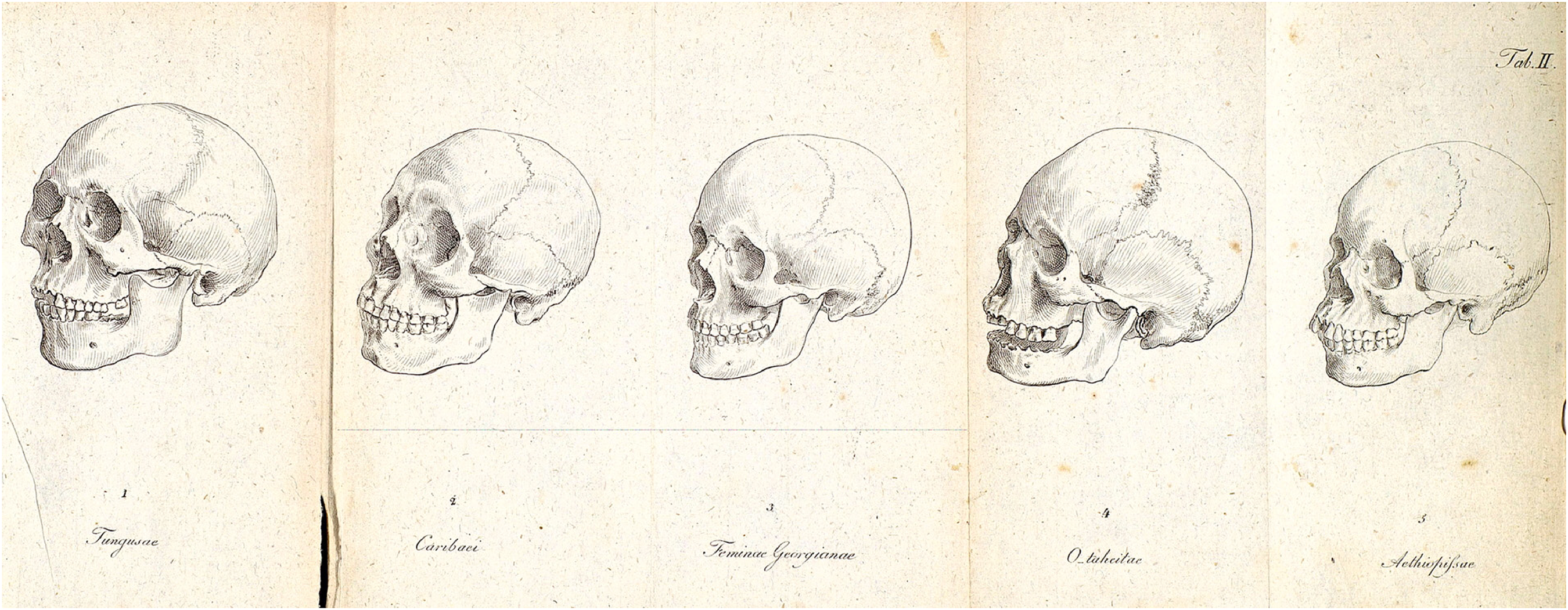
Blumenbach's taxonomy illustrated. 21 (Source: Blumenbach's De Generis Humanis Varietate of 1795, Tab. II, Blumenbach-Online / SUB Göttingen).
The interest in examining and comparing skulls to classify people into distinct ‘races’ increased significantly in the nineteenth century. One of the prominent examples of a clear deprecatory essentialism was Samuel George Morton (1799–1851), a supporter of the polygenetic theory. Morton was a leading exponent of the so-called American School of Anthropology and amassed the world's largest collection of human skulls of his time. He was interested not in developing a new classificatory system but in using Blumenbach's classification to engage in empirical skull comparisons to solve the question of the origin and hierarchy of humankind. He described racial difference in terms of cranial volume which he took as determinative of intelligence and general mental ability (see Gould, 1981). Morton argued that the Caucasian ‘race’ had the largest brain volume, followed by the Mongolian, the Malay, the American, and finally the Ethiopian (Morton, 1839). He attributed particularly pejorative characteristics to the American and Ethiopian ‘races’. Writing on the former, for example, his aim was to describe the strikingly characteristic traits of these people to sustain the position that all the American nations, excepting the Eskimaux, are of one race, and that this race is peculiar, and distinct from all others. (Morton, 1844: 4)
Morton's arguments rest on essentialist claims and conflate biological differences with non-biological characteristics: the ‘races’ into which he divided people are conflated with ‘cultures’ – for example, he described the ‘backwardness’ of the maritime technology of the American ‘race’. His hierarchizations are a clear case of racist essentialism.
Morton based his research on a considerable number of empirical ‘objects’ and a wide-ranging quantitative analysis. By elevating supposed biological differences to differences between species, his arguments provided seemingly scientific foundations for slavery and colonialism (Mitchell, 2018). Although Morton did not explicitly address slavery, his studies coincided with the rise of abolitionism. Some of his closest confidants from the American School of Anthropology, for example Joshua C. Nott, spoke out publicly in favour of slavery and diminished Black people's mental and intellectual abilities, justified by skull comparisons (Nott, 1847, Nott and Gliddon, 1854). This biological determinism portrayed society, cultural differences and inequality as the result of biology. Through the nineteenth century, numbers and measurements, especially the skull index, increasingly became seen as warrants of objectivity and craniology assumed greater importance. 12 Especially for the scientific ‘race theorists’ of the nineteenth century, skulls formed the medium for theorizing human beings and their differences, often in essentialist ways and with disastrous consequences. Nevertheless, this should not obscure the fact that there were also counter-movements. Friedrich Tiedemann (1781–1861) is an example where the measurement of brain volume did not go hand in hand with hierarchization. Rather, Tiedemann employed quantitative skull measurements to develop a biological argument for human equality and against slavery (Tiedemann, 1837).
Our third example is from biological anthropology during the rise of National Socialism in Germany, thus illustrating the continuation of a strong biological essentialism attached to human remains. Eugen Fischer (1874–1967) was one of the most famous racial hygienists of the twentieth century. Unlike Blumenbach and Morton, he focused his research on a combination of racial difference, genetics and eugenics. He steered the craniological focus of anthropology towards a biological science of heredity (Lösch, 1997; Proctor, 1988) in an aim to prove the persistence of racial characteristics over generations. As the most important characteristics Fischer identified the overall shape of skull and nose, the colour of the eyes, and brain size as the marker of mental ability (Baur et al., 1927).
In colonial German South West Africa, Fischer investigated the so-called Rehoboth Bastards (today referred to as Basters) in terms of the Mendelian theory of heredity. By proving the heritability of racial characteristics from both parents, he aimed to advance his theory that the intermarriage of settlers (German or Dutch) with Africans would lead to cultural decay (Fischer, 1913). He claimed his study documented a difference between the mixed Basters ‘race’ and the original ‘black Hottentot race’ and attributed higher intellectual abilities to the former. Fischer's results were part of the general body of scientific racism that later legitimized discriminatory apartheid policies which regulated the separateness between ‘races’ and a complex system of exploitation and oppression based on ‘race’ (Lösch, 1997; Švihranová, 2017). Later, as director of the Kaiser Wilhelm Institute for Anthropology, Human Heredity, and Eugenics in Berlin, Germany, Fischer had an impact on National Socialist politics. The Institute and German anthropological science in general contributed significantly towards providing a scientific basis for Nazi racial policies (Proctor, 1988; Weiss, 2010). Thus, biological essentialism was one of the most harmful forms of scientific racism, providing a scientific basis for horrifying crimes: racial segregation and apartheid; Arian racial purity, anti-Semitism, and the holocaust. In a 1946 letter to Science, Franz Weidenreich described Fischer as one of the leading Nazi anthropologists who are morally responsible for the prosecution and extinction of the peoples and races the Nazis considered “inferior”. … If anyone, he is the man who should be put on the list of war criminals.
Despite their entirely different motivations, Blumenbach, Morton and Fischer all grounded their approaches in essentialist assumptions – they used biological features to divide people into arbitrary racial groups and attributed these with non-biological characteristics, such as geographic origin or socio-cultural belonging, physical beauty or intellectual ability. Yet, while such theories are widely considered as invalid today and ‘race science’ as a discredited field of inquiry, essentialist and reifying notions of identities and social categories persist in different forms, including in the research and handling of collections of human remains.
The present-day handling of collections of human remains is partially motivated by a desire to account for colonial history, scientific racism and the predatory ‘collecting’ practices of human remains during imperialism. All three historical figures discussed above obtained human remains from around the world. Blumenbach acquired skulls from the late 1770s onwards, drawing on an extensive network of former students, colleagues and influential figures who provided him with skulls from colonial contexts, war sites, cemeteries or autopsies. Alexander Anderson, director of the Royal Botanical Gardens on Saint Vincent in the West Indies and commissioned by Joseph Banks, president of the Royal Society in London, to collect skulls for Blumenbach, commented in 1789 on this task: [I]t is a very difficult thing to get the Crania of the yellow Carribes or aborigines[.] [T]he greater part of them have been extirpated by the black Carribes[.] [A]t present there are only 2 Families of them & these are in the most remote Part of the Island[.] [T]heir burial places are not easily Found & an attempt to disturb them is looked upon as the greatest of Crimes. (Dougherty, 2010: 236).
Yet such difficulties and sensitivities did not limit the collecting activities on behalf of Blumenbach. Morton's ‘suppliers’ – here too colleagues, and political agents stationed abroad – reported similar problems with obtaining skulls from burial sites. Such ‘collecting’ practices were usually based on predatory encroachments on other people's beliefs and cultural practice (see Fabian, 2010; Mann, 2003). Fischer, in turn, conducted his studies on both skulls and living human beings in colonial contexts. From 1900, he was in charge of the anatomical collection in Freiburg assembled by Alexander Ecker (1816–1887). When the institute and its collections were partially destroyed in a bomb attack, Fischer asked for donations in a colonial newspaper: Numerous gentlemen, who have come to know and love our beautiful colonies from their own experience of them, own horns, skulls, partly from their own hunts, partly acquired by chance, among the latter occasionally also human skulls (which would be especially appreciated for the anthropological collection which, after all, has also suffered greatly). (Fischer, 1921: 9)
These ‘collecting’ practices imposed a view on human remains as objects, as specimens to be studied, stripped of individuality and life history, to serve the purpose of essentialist ‘race’ theories. Although the three historical figures presented above are not representative of physical or biological anthropology as a whole, they represent several historically significant essentialist ascriptions. The discipline and theoretical models have changed significantly in time. Central to the development of anthropology was evolutionary theory, which shifted our understanding from static representations to a more dynamic and processual view. We gained an understanding of evolutionary mechanisms – natural selection, mutation, genetic drift, gene flow – and the complex ways in which they interact. The DNA revolution further expanded our understanding of evolutionary change and variation, opposing the previous compartmentalizations of human diversity into ‘races’. Of course, evolutionary and processual theories did not inhibit racist interpretations in diverse forms, including the use of Darwin to justify racial hierarchies and segregation. These present a continuous challenge for the discipline.
Overall, anthropology moved away from the static, essentializing and explicitly racial theories, and the consensus opposes ‘biological races’ and hierarchies. Discussing disciplinary history lies outside of the scope of this article. (For an overview of the history and changes in the discipline, see for example Ellison 2018 and other articles in the special journal issue of the American Journal of Physical Anthropology. For a comprehensive introduction to the history of ‘race’ theories and their criticism see Bethencourt, 2013; Bonilla-Silva, 2017; Gärtner and Wilckens, 2022; Golash-Boza, 2018; Heng, 2018; Kendi, 2016). Our goal is rather to point out that while the ‘race science’ of Blumenbach, Morton or Fischer has been largely delegated to pages of history, essentialist assumptions, in different forms, have a continuity in the handling of human remains in academic collections, including the very collections with which these three figures were associated.
Contemporary essentialism in provenance research and restitutions
Despite a scholarly consensus against biological ‘races’ of homo sapiens, the fundamental underlying logic of social essentialism, including its reification of identities and conflation of biological and socio-political categories, persists in the handling of, and scholarly practice related to, collections of human remains. Collections of human remains have largely been out of public sight and were cared for by a limited number of academics or custodians. 13 Only recently have such collections come into the spotlight in the context of intensifying calls for the revision of colonial history and debates about decoloniality. 14 In the context of such a critical engagement with the past, many institutions have undertaken provenance research to generate information about the history and origin of the human remains they hold, often seeking a path towards restitution to the so-called ‘societies of origin’. 15 Provenance research relies on both historical and biological anthropological research methods that allow for the ascription of contemporary social identities – ethnicity, race or nationality – to human remains. ‘Restitutions’ (or ‘repatriations’) are then made on the basis of such an ascription of reified identities. While some of these methods make it possible to uncover the histories of individual people and their fate, they often simultaneously perpetuate essentialist thinking by, again, conflating select characteristics of an individual's phenotype, genotype or place of dwelling with an identity, thus enabling essentialist political interpretations of scientific findings.
The methods used in provenance research combine a potential for individualization of given remains, with a risk of perpetuating essentialism, and it is important to identify the latter. In such projects, historians are looking for source materials that might provide information about the living person behind the human remains in question, along with the context of the ‘acquisition’ of the remains and their potential historical and geographic provenance. Biological anthropologists examine the remains according to a number of variables that can help generate information, such as the potential cause of death, traces of disease, information about diet, biological sex or determining the so-called ‘ancestry’. Often the purpose of historical geographical ascription, or bio-anthropological ‘ancestry’ estimation, is to endow the given human remains with a contemporary social identity which then forms the basis for their potential restitution to representatives of that identity group. Yet this process constitutes a circular practice of reductive classification (see Figure 2). The human remains were originally ‘collected’ in order to classify them into an essentialist category. In the process, their individuality was mostly disregarded and erased from the record. Provenance research now investigates these formerly de-personalized remains with the objective, on the one hand, to re-individualize them, which often is possible to a very limited extent, for example by providing information about illness, estimates of age or cause of death. On the other hand, along scarce biographical details, generalized essentialist identitarian ascriptions are made on the basis of phenotypical or genetic characteristics or of historical records suggesting where the person might have lived. This categorization, in our view, does not constitute an individualization of the remains, as it does not provide reliable information about the individual person. With some notable exceptions 16 , the existing information is insufficient to determine how the given person would have self-identified. Social identity is not an outcome of biology or place of dwelling; it is, rather, a social imaginary construct that can change across time and context. Self-identification can also vary from how a group perceives the individual; and, importantly, it can differ from the identity a ‘collector’ ascribed to the person's mortal remains. Identity ascription can at best be an informed guess but is inevitably reductive and essentialist – seeing as it relies on a limited set of variables which are stereotypically attributed as necessary characteristics of a given group. Despite the humanizing potential that lies in the practice of individualizing human remains and uncovering personal histories, the contemporary scientific approach is ultimately trapped in the enactment of the reductive essentialism of identity ascription. This is brought to light by both methodological and epistemic shortcomings in the research assumptions and by the ultimate political interpretations that provenance research enables. We first discuss how certain methodological practices and terminology feed essentialist thinking and then consider how they are used politically.
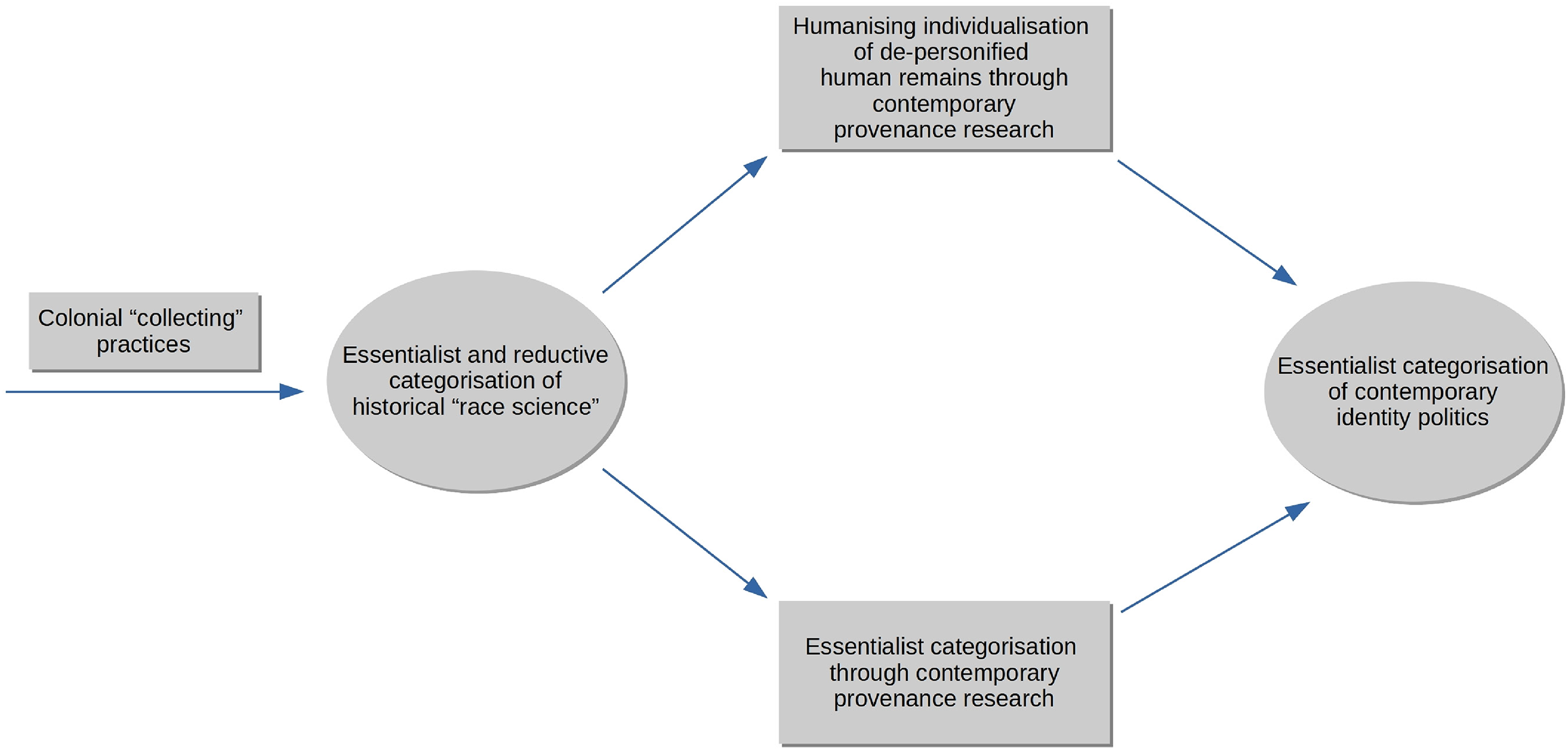
A simplified graphical representation of the circular practice of essentialist categorization related to human remains. A degree of individualization, of providing details about a person's life, is usually part of provenance research. However, with some notable exceptions, political narratives surrounding restitutions usually ultimately disregard individual biographies or use them in essentialist fashion (Graph by J. Kurzwelly).
The present-day practice of ancestry estimation in biological anthropology is a good example of how essentialist thinking is assumed and reproduced within provenance research projects. Ancestry estimation is conducted through a number of methods, such as using characteristics of skeletal or dental morphology, DNA or stable isotope analysis. 17 All of the methods assume a correlation between certain biological characteristics and socially constructed identities. They thus all face two similar problems: the reliability of the correlation they establish is difficult to assess, and the terminology they resort to is misleading and inaccurate.
For example, a DNA sample extracted from human remains can be compared against a reference database to estimate similarity with other individuals and their reported identities. This statistical correlation between genetic diversity and identities, if it indeed exists, is best explained by relative history, geographic isolation and distance, and shared cultural practices, and not by biological factors. (Thinking otherwise would be mistaking correlation with causation. Alike in the example of ice-cream consumption statistically correlating with cases of drowning, two variables which are not causes of each other, but of differences in socio-cultural practice between winter and summer.) However, the way in which such correlations are named and communicated can easily lead to an essentialist biological reification and a false belief in causality, a belief that social identities are an outcome of biological diversity. More specifically, such methods can lead to the misconception that someone's biological characteristics constitute proof of the person's identity rather than being a statistical guess.
An essentialist interpretation is already implied in the very name of ‘ancestry estimation’. Synonyms of ‘ancestry’ are ‘lineage’, ‘bloodline’, or ‘pedigree’ – none of which the methods employed for ancestry estimation reveal. Rather, what an ‘ancestry’ estimation – based, for example, on skull measurements, drawing on software like CranID or AncesTREES with the Howells dataset – does is to compare a sample against a small reference database which is not representative of the composition of the given identity group nor reflects changes within that group across time – thus erroneously assuming the presence of sedentarism and endogamy and a continuity of heritable traits. 18 This raises doubts about the method's validity. Furthermore, inaccurate and misleading terminology allows the inference to be made that the correlation reveals a person's actual social identity, whereas it only estimates a statistical similarity of skull morphology with an unrepresentative reference dataset. Dunn et al. (2020) recognize that ancestry estimations calculate the correlation between biological characteristics and socially constructed categories; however, they do not question the accuracy of the term ‘ancestry’ and do not expose the problems with perpetuating essentialism implied in continuous use of such methods. Skinner (2020) clearly described and critiqued the inferences about ‘race’ and ethnicity from genetic markers of phenotype or ‘ancestry’ in forensic police DNA databases.
Ancestry estimation methods assume a correlation between biological characteristics and social identities, operating on questionable modelling assumptions and input data. The assumed correlation is between tangible, quantifiable biological variables (phenotype or genotype) with intangible, difficult-to-quantify social phenomena (social identities). The input data, the datasets, pose several different conceptual and practical problems. One problem is the above-mentioned difficulty of reliably establishing the social identity of a deceased individual, especially when little historical records are available. When attempting to represent living persons in a dataset, there is a danger of sampling bias, where only people of certain phenotype, citizenship of place of residency might be sampled as representative of a given social identity. (See Winther (2014) for a discussion of the challenges of mathematical modelling, including the dangers of biased assumptions that inherently influence the reliability of empirical samples upon which any classification relies.) This relates to the conceptual hurdle of choosing the basis on which a given identity group should be represented. Because social identities are abstract categories, any attempt to quantify them leads to an erroneous reification. For example, who should be sampled as representative of the social category ‘German’: people who live in the territory, or who are citizens, or who self-identify as such? Should German minorities in Brazil or Russia be included, or Germans with migratory background, or people with mixed identities? How does one estimate the rate of change in the composition of a given social identity group and the time-brackets in which such estimations can be seen as reliable – should people before the unification of the German state be considered as Germans? ‘German’ or other similar social identities such as ‘Namibian’, ‘Nama’, ‘Black’ or ‘White’ cannot be reliably quantified, as these are imagined social constructs with no biological or otherwise material foundation. All these issues suggest that there are good grounds for at least a cautious treatment, if not a complete dismissal, of both the nature of the correlation of ancestry estimation methods, as well as the input data used for such a correlation.
Recognizing the ‘race’-reifying character of ancestry estimation, some forensic anthropologists called for abandoning some of the methods employed (DiGangi and Bethard, 2021). Others have argued that there are practical reasons for drawing on the emic use of racial or other identitarian terminology, such as racial descriptions employed in police databases of missing persons (Cunha and Ubelaker, 2020). In which contexts the use of such ancestry estimation methods might be legitimate is an important issue for ethical and political discussions. There might, indeed, be some limited contexts in which the use of pragmatic identifiers can be justified. Msimang (2021) argued that in specific biomedical settings a pragmatic use of racial identities can, for example, help in the search for adequate donors for organ transplantations. However, he also argued that these should be exceptional cases and that accurate relevant variables should be used instead of social identities. 19 If, despite all these shortcomings, one still decides to perform ancestry estimations, a first step to mitigate against undesired interpretations would be to rename the method to capture more accurately what it actually estimates, and to ensure that the way reports are worded does not enable reified and essentialist interpretations (one could envision warnings similar to those on tobacco packaging).
Ancestry estimations and other methods of provenance research often reinforce essentialist and reified notions of identities not least because they are used for such goals. Essentialism is not entirely unintended by the researchers. Where provenance research is designed to enable restitution, the interpretations and political uses of the information generated by the research can be largely foreseen. As the examples below show, provenance research and restitution are an arena for identity politics that seek to raise awareness of colonial violence, oppression and exploitation through symbolic and spiritual acts in which ethnic or national identities are reaffirmed. This identitarian affirmation could be seen as a form of ‘identity politics’ and ‘strategic essentialism’, which uses the language of reconciliation or social justice. The assessment of such politics is difficult and will necessarily depend on one's political convictions. (See Kurzwelly (2023) for a polemic discussion on how provenance research and restitutions address different kinds of historical and contemporary injustices, and their potential to arrive at, or fall short of, social justice.) Such an identity politics, of course, can be seen as desirable and as serving contemporary needs – we do not aim to frame it as necessarily negative; we do wish to point out the essentialist assumptions involved.
For example, provenance research undertaken on human remains at the Charité Universitätsmedizin Berlin hospital in Germany has led to the restitution of a number of human remains to Namibia in 2011 and 2014 (see Förster, 2013, 2020). These remains have been ascribed a Namibian nationality and corresponding Namibian ethnicities. Various ethnic Herero and Nama non-governmental organizations (NGOs) claimed these mortal remains as their ethnic ancestors. For many years they were engaged in attempts to obtain reparations for the genocide committed by the German Empire's troops against the Ovaherero and Nama in 1904–1905. For them, the restitution, and the political acts and ceremonies accompanying it, was an opportunity to present these human remains as victims of the genocide and as evidence for it. They wanted to negotiate directly with the German authorities and demanded that monetary reparations be paid specifically to Herero and Nama as the historical victims of the genocide. The Namibian government, in turn, identified these human remains as national heroes returning to their fatherland and thus fostering sentiments of a shared national identity. The German government, which under pressure has recently acknowledged the genocide committed to paying a large aid package to Namibia in lieu of reparations, wished to negotiate only with the Namibian government. All this caused a tense political situation in which identitarian affiliations, national and ethnic, formed the basis for historical guilt, responsibility, and continuous harm and disadvantage.
As German counterparts claim to acknowledge ‘their’ colonial past, Namibian politicians celebrate the return of ‘their’ national heroes, and Herero and Nama organizations welcome ‘their’ ancestors back, the situation is entangled by the issue of monetary reparations. A historical continuity of ethnic and national identities is assumed in relation to the human remains: the trope of imagined communities is invoked to understand identities as persisting across time – an imagined longue durée of identity categories. Provenance research enables, and is drawn on for, such political essentialism and identitarian groupism. One might go as far as to say that the restitution of human remains is to a large extent about identity politics, which in turn often relies on essentialist, calcified notions of identities.
Human remains are not only read in political terms in the context of restitution. They are also seen as spiritual ancestors (which may or may not intertwine with the political agendas). Such an ascription of spiritual properties to, or assumption about the spiritual beliefs of the deceased person is often also based on identitarian and essentialist ascriptions. For example, the Te Papa Museum in New Zealand, in charge of coordinating repatriations to the country, organizes ceremonial welcomes for returning ancestors in the hope of offering their spirits a final resting place (Museum of New Zealand Te Papa Tongarewa. n.d.). This practice necessarily assumes that the human remains are either Māori or Moriori spirits, so that a connection to these groups’ spiritual beliefs and practices is possible. Although the repatriations potentially carry less (explicit) political weight than the Namibian ones, the welcoming rituals similarly reflect the problem of assumptions of calcified identities, partially enabled through provenance research. 20
Because restitutions of human remains are largely political acts, the assessment of its effects varies. Some argue that it can lead to accountability for historical violence and the empowerment of minorities. For example, Le Gall (2019) has argued that the restitution of human remains greatly contributed to the recognition of the Herero and Nama genocide and lead to broader debates about transnational remembrance, postcolonial justice, and human rights. For Le Gall, remembrance denotes an array of material and immaterial processes striving to reunite what has been broken, fractured, damaged, or separated by decades of physical and epistemic violence: bones, teeth, bodies, on the one hand; on the other, to reunite families, repair subject-positions, reinstate dignity and positions of authority on historical narratives, and recall claims for self-determination. (Le Gall, 2019: 5)
He stipulates that such a reflection on the past allows the prioritization and re-politicization of the voices of those who have been historically oppressed and objectified, allowing for the living to mourn and to obtain a sense of acknowledgement, atonement, cooperation, reconciliation and potential reparation.
If, however, one were to reject the logic and validity of identity politics, then provenance research and restitution could be judged less favourably. Hauser-Schäublin (2021) asked if such provenance research and restitution – often dominated by academic and political elites in both the sending and the receiving countries – do not in fact distract from the continuing exploitation and everyday struggles of the poor in the formerly colonized states? Therefore, might provenance research and restitution not ultimately serve the capitalist system and its beneficiaries? More generally, not just in relation to restitution, Fraser (2008) famously claimed that identity politics and identitarian affirmations are consistent with a liberal politics of surface redistribution within the existing socio-political structure, as opposed to a strategy of identitarian deconstruction which has a better chance of deep restructuring that is needed to achieve social justice.
Regardless of which political position is taken, we believe that essentialist notions of identities are erroneous and should not be legitimized through scholarly practice. Politics, even when driven by humanistic motivations – as those of Blumenbach or of contemporary researchers and activists – should not legitimize the fallacy of essentialism, and should not legitimize erroneous scientific practice. Scientists should assess vigilantly what politics their research enables. Our goal here is not to dismiss provenance research per se, but to draw attention to the problems raised by a reliance on and reproduction of essentialist notions of identities. Are there ways for provenance research to individualize human remains without falling into the poorly justified, reductive and essentialist ascription of social identity? Politically, could there be a way to use provenance research for its potential to raise awareness of, and expose, the forms of exploitation and oppression that stem from colonialism and continue in diverse forms until today, without reproducing reifying and essentialist identity categories? If used primarily as a political tool, could provenance research lead to sustained forms of addressing historically shaped economic inequalities and continuous forms of identitarian oppression? Such practical, ethical and political questions should be posed when designing and engaging in provenance research and restitution of human remains.
Footnotes
Acknowledgements
We wish to thank all those who offered their generous feedback on previous versions of this text and conference presentations, in particular to: Regina Bendix, Birgit Großkopf, Steven Robins, Andrew Spiegel and Holger Stoecker. We express our gratitude to the two anonymous reviewers and the journal editor and assistants, for their detailed and constructive feedback.
Declaration of conflicting interests
The author(s) declared no potential conflicts of interest with respect to the research, authorship and/or publication of this article.
Funding
The authors disclosed receipt of the following financial support for the research, authorship and/or publication of this article: While writing this article, Jonatan Kurzwelly has received a postdoctoral fellowship in a provenance research project, funded by the Volkswagen Foundation, that investigates two collections of human remains at the University of Goettingen (including the so-called Blumenbach Skull Collection). Malin S. Wilckens has received a doctoral scholarship for her research on Blumenbach and Morton, from the German Academic Scholarship Foundation.
