




Abstract
What smell does border death leave to the inhabitants of borderlands? Is the encounter with the dead bodies of the migrants who perished in the Mediterranean Sea telling in how we articulate discussions around (necro)politics at the external borders of Europe? Based on one-year of fieldwork on the island of Lampedusa (Southern Italy), Door to Europe, and frontier for irregular border crossing, I argue that border death has consequences for both the migrants and the inhabitants of borderlands. The paper will trace such consequences through the testimony of Vincenzo, the old cemetery gatekeeper of Lampedusa, the witness and bearer of knowledge around the nameless bodies buried in Lampedusa's cemetery since 1996. This approach will help considering the extent to which the encounter with migrants’ dead bodies – bare life in death – allows ethnographers to speak of the inherently violent system that scholars referred to as necropolitics or thanatopolitics, and the otherwise irreducible force of life, which manifests itself beyond any possible attempt to reduce it or silence it.
I enter the cemetery of Lampedusa, turn right, and walk along a corridor in the open sky of the warm morning of April. Two squares of land delimited by a cream marble stone catch my attention. Wooden crosses are scattered across the earthed fields, with some sandy stones covering small areas (Figure 1). The crosses indicate something that is illegible. While most other tombs are made of marble and display photographs, names, surnames, dates of birth and death, as well as loving words in the memory of the dead, on the two squares of land there is no indication of the people who are buried underground. Only crosses lie bare on the ground, some vertically, others slightly oblique.
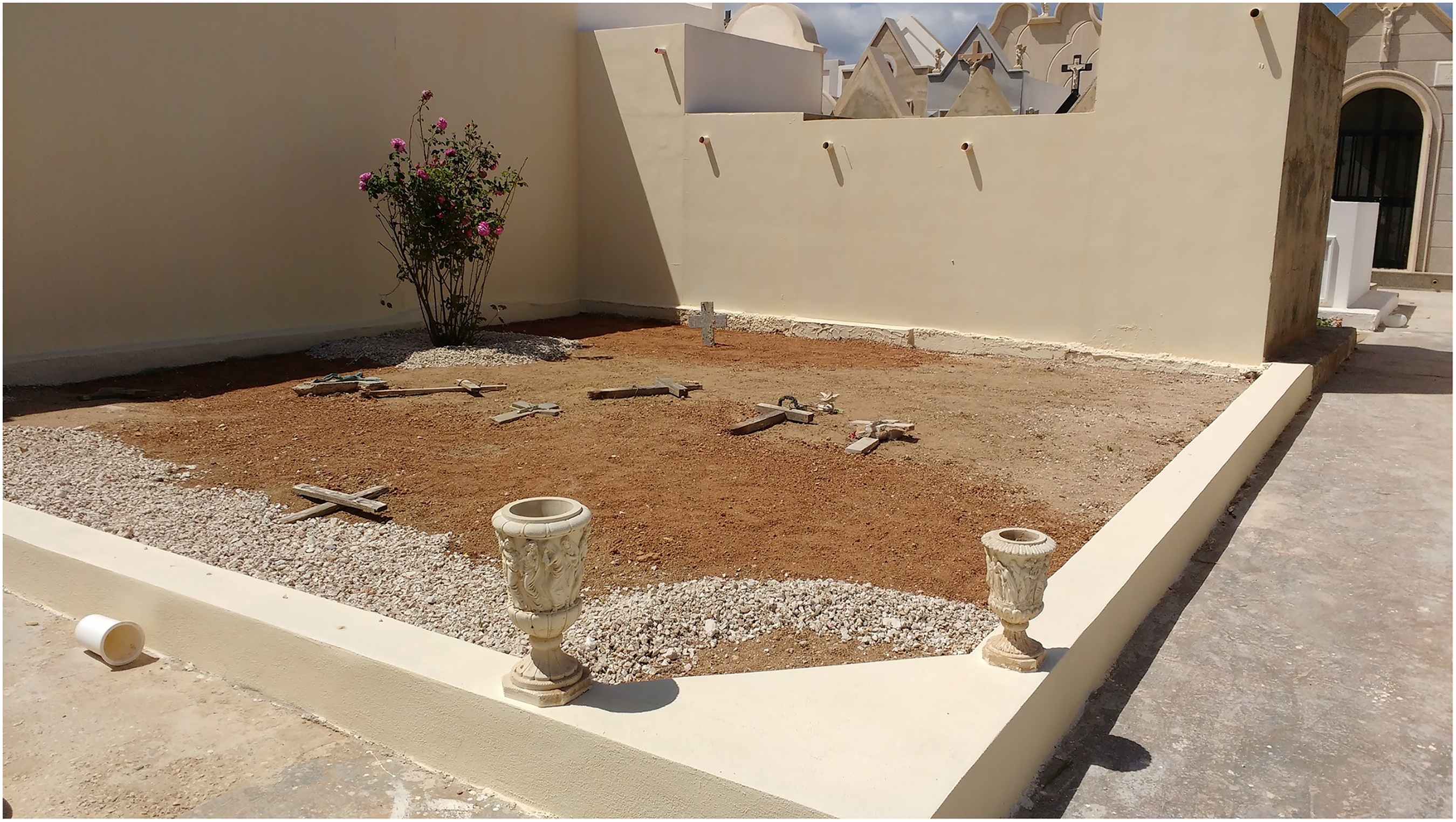
Left square graveyard Lampedusa in 2016.
In January 2017, the six square meter pieces of land look different. Green plants bush over the once deserted land, and no crosses can be seen anymore. A marble stone stands at the corner of the left square, and with poetic words, announces institutional care. ‘Quale mondo giaccia al di là di questo mare non so, ma ogni mare ha un’altra riva, e arriverò’ (I don't know the world beyond the sea, but each sea has another shore, and I will get there). The words of poet Cesare Pavese are dedicated to the persistence of those who did not make it to Europe and perished at sea (Figure 2). However, the words one can now observe inscribed on the marble stone, stand above the crosses, covered in high grass.
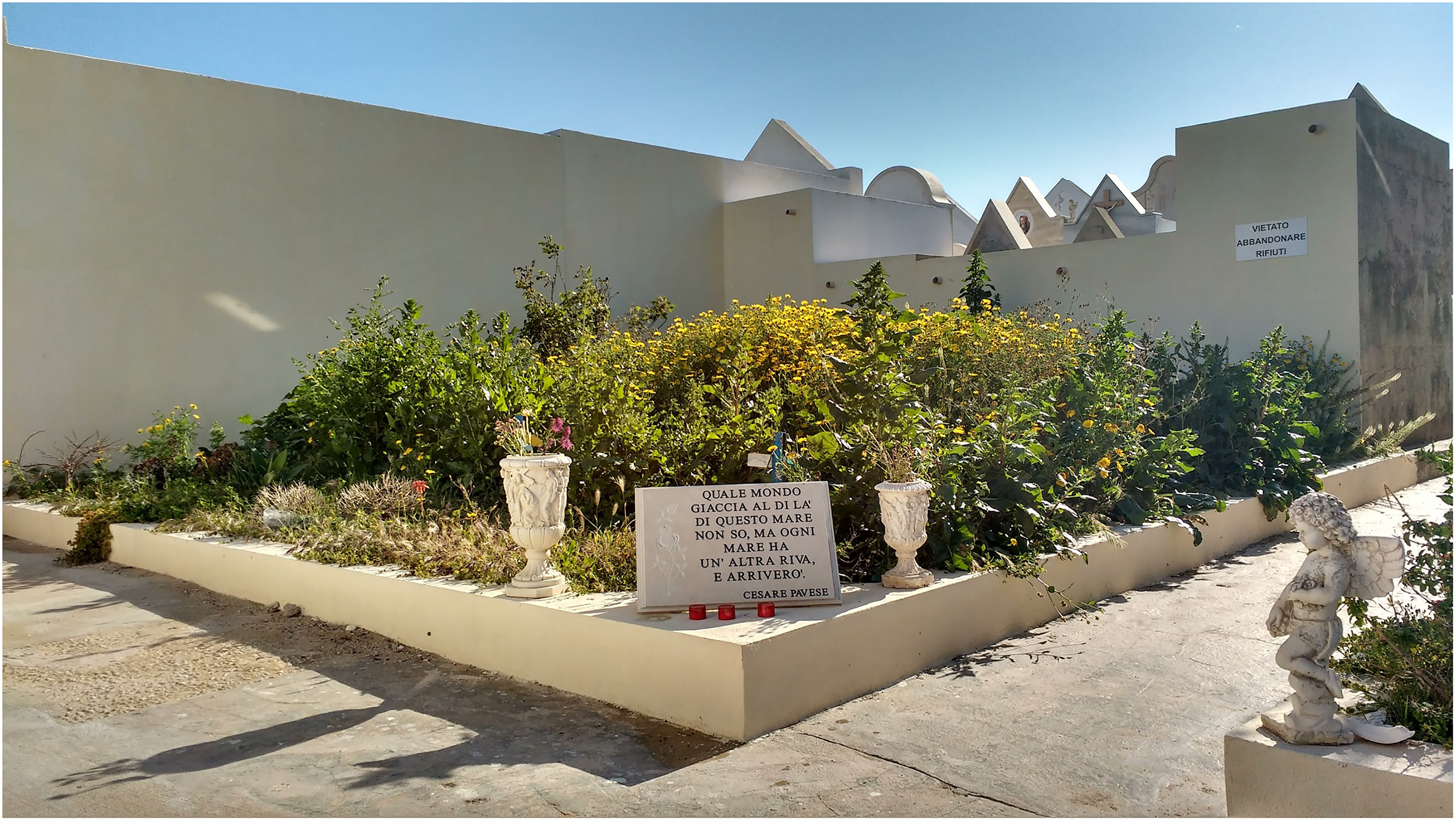
Left square graveyard Lampedusa in 2017.
On the right square, a piece of a wooden vessel taken from a migrant boat has been installed by local craftsman Salvatore Tuccio. The installation demonstrates the materiality of border death (Cuttitta and Last, 2020; Mazzara, 2017), the tangibility of structural injustice (Mbembe, 2019), and the proximity between the most sacral space of the Lampedusans – the cemetery – and migrant dead bodies, at the borderlands of Europe. If one gets closer to the piece of a wooden boat, there is a quite nice smell. The vivid green colour of some of the plants standing above the crosses, reminds me of mint. ‘Mint’ tells me Vincenzo, the old cemetery gatekeeper. ‘I put mint inside my nose, so that I could cope with the stink’. The smell of the bodies in decomposition retrieved at sea was hardly bearable, he explains, but the natural strong smell of mint was the only remedy he had at the time. It was 1996, he explains, and the first dead bodies of migrants who crossed the Mediterranean to lose their lives, had been retrieved at sea and buried on the island.
Many years later, the plants and flowers that surround the squares dedicated to dozens of dead migrants buried since 1990s, generate a quite natural atmosphere, to some extent harmonious and peaceful. The smell of death is far from reach. The stink, as Vincenzo would call it, has been buried, together with those who perished at sea, and whose life has been slowly turned into a symbolic representation, a memorial act, a sacrifice to be honoured for the ritual of border death (Khosravi, 2010). Nevertheless, there are signs of that smell in those who are still alive, and bear witness of what the encounter with dead bodies leaves; how it marks the life of the living (De León, 2015). This paper will trace those signs through the testimony of the old cemetery gatekeeper Vincenzo, the witness and bearer of a unique and experientially informed knowledge around the nameless bodies buried in Lampedusa's cemetery since 1996. This approach will help considering the extent to which the encounter with bare life in death allows us to speak of the inherently violent system that scholars referred to as necropolitics (Mbembe, 2019), or thanatopolitics (Agamben, 2011), and the otherwise irreducible force of life, which manifests itself beyond any possible attempt to reduce it or categorize it. The recognition of the bareness of migrants’ dead bodies ultimately allows for the acknowledgment of our sameness beyond political categories (Rapport, 2015), which I here argue begins with the visceral experience of encountering the migrants’ dead bodies.
A growing number of scholars have engaged with the issue of bare life in relation to the migrants who are ongoingly left to die, or to live in hardly bearable conditions, and whose life is further neglected by the institutional lack of care for the dead bodies and their loved ones (Cattaneo, 2018; De Genova, 2017; De León, 2015; Vaughan-Williams, 2015). Beyond the ritualized and institutionalized practices of mourning the dead described in recent anthropological works, and how these illuminate our understanding around questions of belonging, otherness, hospitality, and state neglect, the aspect that surprisingly remains marginal to the conversation is what border death leaves to the living (De León, 2015; Kobelinsky, 2019; Zagaria, 2020). This is to ask not only the important question of how migrant remains occupy a ‘material’ space – how they are treated and conceptualized (Grotti and Brightman, 2021), but also how the encounter with border deaths leaves traces beyond their life; how it lives through and across the lives of the borderland inhabitants and first witnesses of migrants’ deaths (De León, 2015; Kobelinsky, 2019; Navaro-Yashin, 2009; Perl, 2016). What perfume does border death leave? Is the encounter with dead bodies telling in how we articulate discussions around the (necro)politics of life at the external borders of Europe? Furthermore, can the experience of facing such deaths illuminate what Rapport (2015:258) names as the possibility of ‘Anyone’; the fact that ‘the individual human being is able to recognize a commensurateness in fellow human beings at the same time as these are immersed in other life-worlds’?
Departing from traditional work on the anthropology of death and dying, in this paper, I am not interrogating the experience of the death of a beloved one (Das, 2020), a kin person (Segal, 2018), an enemy (Rosaldo, 2014) or a sacrificial victim (Taussig, 1987). Sacrifice is to some extent part of the questions I will be reflecting on, as the dead migrants who perish while they navigate the politically hard and physically fluid borders that border regimes produce and use to their interests, become sacrificial victims to the border ritual (Andersson, 2014; Biehl, 2013; Corso, 2019; De León, 2015; Khosravi, 2010). For many of them, the Mediterranean Sea is only the further deadly wall (a water-wall) to be faced ‘illegally’ (De Genova, 2017; Stierl, 2019). The final destination of those who died during the Mediterranean Sea crossing in Europe, but not Lampedusa. Lampedusa is the frontier constructed by national and European border regimes to manage the ‘waves’ of irregular migrants (Cuttitta, 2013). A tiny island of about five thousand inhabitants, north of Libya and East of Tunisia, Lampedusa turned into one of the deadliest frontiers of Europe; a speck of emerged land that has become known in the world as the ‘door to Europe,’ theatre of hospitality and tragic shipwrecks (Albahari, 2015).
When the first encounters with the dead bodies of migrants began in 1990s, the island of Lampedusa was not yet a frontier. ‘Straneri’ (Sicilian dialect for ‘foreigners’), were starting to appreciate the beauty of a very little-known paradise in the Mediterranean, and the island became a favoured resort for an elite of people, especially from Italy. In those years, migrant landings were already happening, although in very limited numbers and spontaneously. When migrants came on board tiny boats, in eight, twelve, fifteen at times, locals used to take care of them spontaneously. Doctor Pola, a doctor who began working in Lampedusa in 1990s, told me how locals would soon alert the doctors at the poliambulatorio (health clinic). At that time there was no Centro di Primo Soccorso ed Accoglienza (CPSA) (First Aid Welcoming Centre) or regulations for the management of illegally landed migrants, so the people who were often cold, tired, wet, and in distress after the journey, were taken care of thanks to individuals’ gestures of hospitality. Many men and women offered food, blankets, dry clothes, and a house to rest in until the Prefettura (Prefecture) di Agrigento was alerted, and the newcomers could be transferred to mainland Italy. With the alive, also the dead began to land on the island. The story I will narrate concerns the latter. The migrants I will refer to, landed in Lampedusa when they were no longer alive, retrieved by the fishing boats who found their corpses caught in their fishing nets. They were found accidentally. Many of those who die in the Mediterranean are never found (Cattaneo, 2018). The main character of this story, the cemetery gate-keeper Vincenzo, met many migrants as dead bodies, already drawn into a guiltless sea (Heller and Pezzani, 2017).
The condition of being left to die which has become intrinsic to the border crossing experiences of irregular migrants (Albahari, 2015), giving the name to a tragic series of criminal omissions in the 2011 ‘left to die boat’ case, mirrors the theoretical paradigm of the bare life proposed by Giorgio Agamben (Agamben, 2003; Albahari, 2015; Heller and Pezzani, 2017; Vaughan-Williams, 2015). Bare life is the form of life which has been produced by the law to maintain power. Bareness is a condition of nakedness which does not substantially qualify the form of life it refers to, but rather, it fictionally determines its being, thus legitimately putting it into death (De Genova, 2012; Stierl, 2019). But can bareness be traced by the encounter with death? What does constitute a bare life; a life that has been left adrift, in abandonment, and whose state of abandonment defines its very condition of being? (Agamben, 2003, 2015; Biehl, 2013; Vaughan-Williams, 2015).
I will take Agamben's project on bare life in conversation with a humanistic and existential approach to the question of being human in anthropology to attempt to move beyond binary oppositions and reductionist views when addressing the tangible presence of sovereign power as opposed to the vital force of life (Jackson, 2013). Writing allows us to ‘describe and ‘to denounce, deplore, and combat’ not only the secrecy and mystified aspects of reality (Derrida, 1995:35). If the possibility to know is to be found in the certainty of ‘not knowing’, and anthropology may be considered as the realm where such paradoxical threshold can be explored and discussed openly, I wish to expose the ethnographic text to vertigo which such a possibility may entail, with the hope to find a fertile terrain for life to proliferate. Despite power's attempts and effective success in producing bare lives, migrants’ dead bodies have a living voice which resonates not only via the raising forms of cooperation of humanitarian actors (Stierl, 2019) but also through the relationships that borderland inhabitants form with the dead whom they encounter. The tangibility of the encounter with the migrants’ dead bodies and the pervasive memories and vivid sensations that borderland inhabitants live with thereafter, reinforce and transgress the notion of bareness articulated by Agamben (1995, 2015), showing both the power of criminal border regimes, and the agency of those whom, despite being subjected to death, live through the words, practices, and memories of the living witnesses of their criminal killing. If we will be able to trace some meaningful characteristics of bareness through the encounter with migrants’ dead bodies, it will be possible to imagine and understand bareness as not only the condition of a particularly politically (un)qualified life but as a state that the body of the dead is exposed to beyond life: bare life will thus appear to us as bare death.
Contextualizing bare life
In his life-long philosophical project, Italian philosopher Agamben (1995, 2015) argues that the archetypal element of separation and articulation – an exclusively inclusive mechanism – that can be traced back to the philosophical writings of Aristotle and the Ancient Greek thought around questions of politics and life, determines what we presently know as politics. For Agamben, the primary and necessary space which must undergo such a scission to then be included in the political machine is life. He thus explains, based on Aristotle's thought, that life, which for the Ancient Greeks was conceptually divided into zoè (natural or biological life) and bios (politically qualified life) is the primary object and the very hidden core of western politics. For Agamben (2015), power can be such only through a philosophic-ontological exercise of separation between bare life and politically qualified life. By constituting a fictitious exclusivity of a certain form of life that can be separated from the politically qualified one while being necessary for its being, nevertheless, power configures itself. Power is as the result biopower, and politics is biopolitics, because it governs life, and in order to take hold of life, it must separate a particular form of it, a form of living, which appears as originally different from the other.
Biopolitics, however, is as much about life, as it is about death. Necropolitics is in fact a fundamental aspect of sovereign power; the production, management, and proliferation of border death determine the threshold between zoè and bios; an indeterminate zone of abandonment which hunts life and determines death (Biehl, 2013). Without the determination of bare lives, hardly bearable and deprived of most basic rights (Hage, 2019), forced into isolation (Ravenda, 2012), detention (Gatta, 2012), led to suicide, raped without any form of protection, left to live in abandonment (Corso, 2019) or to die without dignity (Heller and Pezzani, 2017), we could not imagine wearing the clothes we wear. In Italian, the word clothes has a singular form. ‘Cloth’ is ‘abito’, from Latin ‘habitus’. The ‘abito’, which is not only the habit, but the very total sum of what gives us the opportunity to express ourselves in potentia, to actualize what we could become in the many directions we have been offered. In other words, the clothes we wear are sewed through the unsewing of many others. The recognition of such a mechanism is however not enough to deactivate it (Agamben, 2015).
Agamben (2015: 272) writes that we must ‘attempt to think humanity and politics as what results from the disconnection of these elements and investigate not the metaphysical mystery of conjunction but the practical and political one of their disjunction’. If we conclude that power rests on the exclusive inclusion of the bare life from the politically qualified life – via the production of ‘thanatopolitical borders’ (Vaughan-Williams, 2015), we still need to comprehend how it will be possible for anthropology to display, reveal, or simply tell such a story. How to write, responsibly one may add, without however incurring in the issue of reductionism – depicting life as if it were essentially bare, thus qualifying it as inherently separate – or into the exaltation of the ‘other’ dismissing the relationships between that individual life and all others as uniquely different and potentially same? If life and death are at the core of political power, their articulation will be the object of investigation in this paper.
From this perspective, I ask whether there could be a way to make use of the force of ethnography to display the so immanent and unspoken void which Agamben so powerfully detected in his philosophical work and anthropology seeks to unleash despite its many fears, uncertainties, and emotional difficulties involved with the attempt of doing so (Gay Y Blasco, 2017; Vitebsky, 2017). By presenting the experience of the encounter between two human beings, despite the latter being dead, and although the former has never met that person before, is it possible to put on text something which will give us the sensation or appearance of that void? By being attentive to the sensations, words, emotions and small gestures of a man whose life is situated for geographical and abstract discourses at the borderland, it will be possible to open up a new horizon of possibilities for anthropological thinking. In this attempt, ethnography may show how responsible it can be for our understanding of the effects that contemporary politics has on life, and how life continues beyond bareness. If such a horizon will appear, even if for just a moment, we will have achieved something important, and embark into a journey which Agamben defines as the representation of the void of power and the deactivation of constitutive power – thus giving back a less violent and more experientially based power to anthropology and to ethnographic writing (Beatty, 2019; Rosaldo, 2014).
The cemetery gate-keeper
Vincenzo is a man in his 70s, with a nice smile, tanned skin, and small green eyes. It was a sunny morning of April 2016 when I first met him. Don Mimmo, the then priest of Lampedusa, gave me a lift to the cemetery, where Vincenzo had been waiting for me, after his usual early morning walk from the church to the cemetery. ‘Thank you, Don Mimmo. I will call you later’ I said, waving. ‘Vincenzo, I watch you, he is a good boy’ said Don Mimmo, leaving us alone, and winking at his friend. Vincenzo introduced me to the cemetery before we entered the gate. ‘Let's go,’ he said, moving on, beyond the threshold which established our entrance to the realm of the dead. ‘I will show you the migrants.’ We moved a few steps in. He stopped. ‘Here’. He pointed to an open space in front of us. I could only notice tombed walls at a distance and the cemented pavement. ‘When I brought some of the first migrants here, there was thirteen of them, and I put them all in a row, in this way.’ He showed the imaginary row with his hand going from one side of the pavement to the other. ‘They were all here … I looked at them, you know, so young. You know, they were laying in this way … I was moved, and I cried. They risked their life. They came for a better future, running always from war … And I began crying.’ I asked if they were young. ‘I estimate, twenty-five, thirty [years old]. They [the bodies] were still fresh, four to five days since when they died. I could see their faces, yes. One was called Alì Mustafà.’ He said his name with some sense of pride and care at the same time. ‘We put him into a refrigerator for five days, you know, relatives could come to look after him. But nothing. So, at the end, after five days, I buried him.’ I knew that Vincenzo cared much about the young man. He said that he could still remember his features. The moustache, the long face. Yes, as if he was still there.
The thirteen dead bodies were among the first who entered the cemetery of Lampedusa in 1996. In the 1990s, Lampedusa was not yet the deadliest frontier for irregular migrants’ crossing (Albahari, 2015). In 1998, with the Turco-Napolitano law, Italy sees the raise of the first temporary detention centres for irregular migrants. Lampedusa becomes a significant border space and the detention centre established where there is now the airport, is first managed by volunteers from the Red Cross, and later, with the introduction of the Bossi-Fini law in 2002, which gives power to the state to administrate irregular entries, volunteers are replaced by paid workers hired by private cooperatives selected by the state. The island will soon hire experts in border management, security, and rescue, budling an asset of specialized individuals coming from all over the world. As militarization grows rapidly, with a presence of about one thousand military personnel from the armed forces (Carabinieri, Finanza, Coast Guard, Air Force, the Navy, and Frontex) Lampedusa is recognized across the world as one crucial frontier for irregular migration in the Mediterranean (Cuttitta, 2013).
The making of a frontier does not coincide to the avoidance of death, but it rather generates ongoing death. From the late 1990s to the second decade of the 2000s, the number of migrants who died at sea grew dramatically. Writer and journalist Gabriele Del Grande, one of the few who attempted to document and keep track of the dead migrants in the Mediterranean, established the blog Fortress Europe, and estimated the death of at least 1,674 people between January and August 2011 (Zagaria, 2015). In 2015, the year before I began my fieldwork, the total estimated number of migrants who died at sea was 4,273 (Fortress Europe, 2016). Numbers can have the function of forming an impression of the density of the phenomenon we are discussing, but the estimates of migrants’ death in the Mediterranean are tricky, and different databases offer different numbers, which are never entirely true. Despite the dramatic increase of death at sea, the frontierization of Lampedusa, especially after 1998, determined an important shift in border death management. From rescue to push back and transferral operations to detention centres, hospitals, or cemeteries, everything takes place under the hyper technological and securitized eye of the border regime (Heller and Pezzani, 2017).
Back in 1996, things looked rather different. Within a non-existent system of state response to the then quite extraordinary shipwrecks of migrants off the shores of Lampedusa, Vincenzo was called to intervene, and he did so, but not light-heartedly. ‘What I really feel angry about,’ he said, ‘is that I suffered a lot here, and I was the first, with my son, alone, putting them [the son and the wife] at risk to get sick. Do you know what it means to go on board of a fishing boat to collect a dead [person]? The head came out, as did the legs … And you know, how many fish they had inside? Yes, little white fish everywhere. They [the dead bodies] were left at the harbour for five days. They were among the first who died here. It was 1996. The dead [migrants] already started. When policemen came, no, when Carabinieri 1 came, they thought I had to do the job [collecting bodies.] But this is not my job … They did nothing. So, I went. I said to myself, let's see. And when I saw those dead people, tell me something, yes, it is true that I could leave them to be, but what did Jesus say?’ He confusedly said something like ‘What you do to my brother, you did it to me. I said, let's try.’
After rushing to take the graves to the carpenter, and driving the hearse, at night, asking for help, and supported by one carabiniere whom he still prays for, he himself buried in the cemetery of Lampedusa, Vincenzo cleaned up the bodies, and welded the coffins. He then explained that one body had been left in the morgue. ‘I waited for the tomb.’ He said. ‘A day, two days. So, we [with his family] went to the Carabinieri. They said it was not their business. Also, the Finanza 2 [police force] said it was not their responsibility. So did the comune (municipality). At the end I received the telephone number of the Prefetto (Prefect) [of Agrigento]. He could not believe it. It was indecent. Full of flies.’ The accident was resolved when firemen came with biohazard suites and together with Vincenzo, they cleaned up the morgue, and were able to bury the body of the young man. Vincenzo was not only preoccupied with his own wellbeing. After so many years from those days, and his retirement in 2007, he was still deeply concerned with the poor ways in which things were managed at the cemetery, especially in the case of migrant bodies, and the lack of information about them in the graveyard space dedicated to most of them.
‘These were unknown, because … they [authorities] could not possibly recognize them.’ The bodies of the dead migrants had been deteriorated by the long exposition to the sea water, Vincenzo explained to me. ‘I brought eighty-two of them here, because there was no space for the others. I brought the remaining ones to the ship with my track, and they were transferred to Agrigento [in Sicily.] They were buried in Agrigento and other cemeteries in Sicily.’ Then he carried on. ‘Here’, he said. ‘There was a woman … a beautiful young woman. She was almost alive, one could say. I buried her. There,' he pointed somewhere else amongst the wooden crosses scattered on the ground, ‘there was another person, with a child. He was not black. He was African. I asked him: “why are you crying? Are you moved by this [by seeing the graveyard]?” He said: “No, [I am crying] because I came here to take her. She is the number 6.” “And who are you?” I asked. He started crying and he left.’
Dead migrants buried at the cemetery of Lampedusa were mostly identified by numbers. As Vincenzo added, ‘If he [the man whom he saw with a child many years ago] would come again, there will be no number anymore. There is nothing left. I made these crosses by myself. Vincenzo carried on, pointing to other crosses on the ground. ‘Here another one. Here, you see, there is no cross [to indicate that there is a dead person buried underground.] Beneath the wall there is one more. There are so many. Only here. Vincenzo pointed to a portion of one rectangle of ground (See Figure 1) ‘There should be fourteen [bodies.] There two more. No name, no year’.
The migrants who reached Lampedusa as dead bodies in 1996 and in the coming years, were young men and women who travelled across the Mediterranean Sea, fell under a shipwreck, and were retrieved by fishermen or the authorities to be brought to the island and buried at the graveyard. The procedures through which these bodies were retrieved, left on the harbour for days, treated as cadavers to be removed by only one man being the cemetery gate-keeper and then buried in a mass grave style, is telling if we are to understand the ways in which migrants’ lives are treated as ‘bare lives’ (Agamben, 1995). Most of the time, only body parts are retrieved by the coast guard or the local fishermen, both in Lampedusa, Tunisia, and Libya, and depending on the political decisions which cause migrants’ flows to move in time, trajectory, and intensity, the local community is exposed to the remains of the bodies washed ashore, or the belongings of the migrants (Zagaria, 2020). Faced with ongoing waves of shoes, milk bottles, sacred texts, trousers, and deteriorated documents, local communities who live in the borderlands of Europe do their best to respond to the tragedies they witness; some by acts of indifference and xenophobia, others with gestures of care and love (Corso, 2019; Perl, 2016). If nameless objects and remains of body parts only constitute a percentage of what is left to drawn at sea to be never retrieved, what happens to the bodies that are recuperated and brought on land?
The bodies of the migrants buried in Lampedusa's cemetery, like hundreds of others scattered across Sicilian and southern European cemeteries (Grotti and Brightman, 2021), were denied a dignified burial. The institutional neglect towards the dead migrants exercised by European governments, constitutes a dilemma for the family members and friends who struggle to obtain information about their beloved ones with whom they have lost contact, as well as for borderland inhabitants who are left alone to deal with the management of the dead bodies (Kobelinsky, 2019). 3 The question of identifying the bodies of dead migrants haunted the lives of other undertakers like Vincenzo, individuals from civil society, activists, and volunteers in Lampedusa, but also in Agrigento, Siculiana and Favara (Zagaria, 2015), only to mention a few key sites identified for migrants’ burials across Sicily. The identity of these bodies can be traced by attempting to reach out the families, requesting information from the police, making letters of complaint to the municipality and the local administration. The great difficulties experienced by these individuals in different contexts, political situations, and particular circumstances, often speak of a pervasive state of abandonment exercised by the institutions and the state (Corso, 2019).
State neglect concerns both the burial of the dead bodies retrieved at sea and the large and partial number of people who die at sea. As I describe in more detail in my work on the spectacularization of memorialization (Corso, 2019), families of the victims who died at sea during the 3 October 2013 shipwreck came to Lampedusa to ask for the bodies of their loved ones to be repatriated, while many others, never knew for certain what happened to their beloved who left and never returned. A Syrian couple who survived the 11 October 2013 shipwreck, participated to the memorial ceremony for the dead migrants that took place in Lampedusa on 3 October 2016, explaining publicly that after 3 years, they still did not know for certain what happened to their missing child, who was separated from them during the rescue operations that took place in international waters, with the co-responsibility of the Maltese and the Italian authorities. Such cases are common and pervade the literature on border death in the Mediterranean (Denaro, 2016; Heller and Pezzani, 2017; Kobelinsky, 2019; Zagaria, 2020). Grievability is a difficult path which requires multiple actors and joined attempts to creatively overcome the structural inequalities of ‘a politics of erasing deaths’ (Kobelinsky, 2019: 10), and it is always devastating for the families of the dead or missing migrants. Death, we learn from scholars who extensively worked on the subject, is already the paradoxical encounter with presence in absence; the manifestation of the impossibility to communicate, or the tangibility of what is not anymore, while physically being there. However, in the specific context of forced migration to Europe, the presence of absence is simultaneously the ‘absence of absence’. Perl (2016:198) uses this concept to grasp the fact that as the ‘dead remain missing; uncertainties and fears survive and may agonise the living.’ The presence of the dead bodies described by Vincenzo, with their unique features and details he still remembers vividly, comes with the devastating absence of information about who these bodies were in life, and what lies behind and before their politically determined bare death. Their presence is symptomatic of the absence of support from the institutions, the state, and ultimately, the absence of the many other bodies who never reached the surface, to remain forgotten in the Mediterranean Sea. As we navigate the experience of encountering death through Vincenzo's personal story, two elements emerge significantly. First, bare life transcends life and remains in death. Second, bare death does not only concern the (non)existence of the bodies who were bare in life; it further emotionally affects the lives of those whom politics reinsures as being politically qualified lives, thus protected and safeguarded: the inhabitants of borderlands. The presence of the dead bodies signals of the absence which is constitutive of their condition of bareness both in life and in death. But how does absence materialize through presence? What is left of the dead at sea, and how does their death further affect the life and memories of the inhabitants of the borderland?
Unbearable life
‘A stink, but a stink…’ Vincenzo used to repeat as he remembered the very first encounter that he had with the five migrants’ dead bodies who were first retrieved off the shores of Lampedusa. ‘And you know what I did? My wife can tell you. I did not eat anymore, not for a while. Because it [the stink] remained. So, I had some mint I had planted. I took some of it. I crushed it. I bought the face masks, and I put some of it inside. And I helped myself. So, when I started to weld, from close, it [the smell] mingles. But you always smell it. It does not go away.’
Bare life leaves traces (Navaro-Yashin, 2009). These ‘traces’ become present – as they acquire significance rather than being left in abandonment or treated as ‘garbage’ (Mazzara, 2017) – when distance is replaced by proximity. In this shift of perspective (from distance to proximity) the ‘attention one pays to corporality’ (Rapport, 2015), to the ‘body and face’ of the other (Levinas, 1989), and to the ways in which encountering the other affects one's sense of being-in-the-world, is crucial. The acknowledgment of the life of the dead migrants is experientially constituted through a visceral response that concerns sight and smell, and it affects the life of the borderland inhabitants long after their first encounter with border death.
Bare life moves across the boundaries between life and death, and it anchors itself to the lives of those who are open to explore the ‘human organ of perception’ which any individual human being can become aware of (Rapport, 2015:257). By ‘attending to this organ and its perceptions,’ which ‘can give onto an awareness of universal humanity,’ one however faces the difficulties of transcending ‘the-taken-for-granted or encultured’ (Rapport, 2015: 257). If some of these difficulties are not new to the anthropologist, whose fieldwork experience is often about ethical dilemmas and ‘existential aporiai’ (Jackson, 2013), the kind of experience recalled by Vincenzo is one of contingency; an encounter he has not sought or asked for, and an opening towards the question of what constitutes life, which is not the outcome of intellectual curiosity, but of the direct experience with the sensorial space of bare death. The literature on border death and migrants’ post-mortem, speaks of a wide web of individuals and organizations who were affected by the neglected deaths of people on the move to Europe, arguing that a ‘lifeless body’ can create ‘a new pattern of mobility involving both the living and the dead, forcing them into a form of coordination’ (Kobelinsky, 2019: 1). Before being ‘a material object’ and a ‘symbolic vehicle of political content,’ a migrant's dead body appears to the first people who retrieve it as a corpse in decomposition, whose presence is difficult to face.
The stink Vincenzo talked about when he remembered the dead bodies of the migrants retrieved at sea was difficult to handle. Without a system of support and the technical equipment which a few years later would be provided to rescue agents and experts on land (gloves, masks, biohazard suites), the police agents who had to take care of the removal of the dead bodies from fishermen's vessels, and transfer them to the cemetery, were not prepared for it, and stepped back. Vincenzo felt the need to intervene, helped by a few others. But even in that case, the stink was terrible, and the mint he used could only partially alleviate it.
The stink described by Vincenzo represents, in its most visceral and sensorial forms, the way in which the encounter with migrants’ dead bodies can become unbearable. If the politics of bare life aim to maintain a bearable life (not to kill, but to let live or die in hardly bearable conditions), the encounter with such a hardly bearable life in death, provokes an unbearable sense of repulsion (Hage, 2019). Here the ‘unbearable’ is firstly about the experiential outcome of encountering migrants’ dead bodies, touching them, cleaning them, and inhaling the smell caused by their decomposition at sea.
Stink cannot be simply explained as the rotten cadaver towards whom we tend to express feelings of horror, vomit, disgust, and repulsion (Kristeva, 1984). If there is a psychologically spontaneous reaction to certain experiences in most people – a sense of safeguarding our life by an exercise of shielding ourselves from death – it is also true that each experience of death leaves something different (Derrida, 1995). Such difference in apprehending death and dealing with the dead body often depends on the previous knowledge of the dead person in life, and/or the information one can gather about the life of that person. One may imagine that with the absence of all this information, the smell of death can only produce a sense of repulsion and prevent one from recognizing personhood in the dead body. Vincenzo's story persuades me to think that the encounter with the dead body of migrants can overcome the absence of the knowledge of the individual person in life. He often told me that he did not feel repulsion for cadavers in general. When Vincenzo told me about his first experiences as a cemetery gatekeeper, he never stressed the stink of the bodies he buried. The kind of disgust that he described as he recounted his first encounter with the dead migrants, did not originate in the encounter with death. It rather stems from the encounter with a particular kind of death, a bare death, resulting from how people are left to die during the sea crossing to Europe. Such bareness is made physically present in the bodies that remained in the water for hours or days to be brought to Lampedusa and buried at the cemetery. The encounter with these bodies produced in Vincenzo a condition of estrangement, taking away his appetite, and forcing him to find remedies (the mint) to overcome an otherwise unbearable situation.
There is one important point to be made as we consider the relationship between the smell of death, the absence of knowledge about the migrants’ lives, and the strong memories of Vincenzo. The fact that the smell of the former living person is still present in the memories of those who had not known them in life, suggests that the stink which produces a repulsion at first establishes the conditions where one begins to recognize life in the face of death. The absence of the actual knowledge about the person in life does not exclude the recognition of their personhood, their life, even if one has only met them in death. Moreover, it is precisely because of the possibility to encounter the smell of the dead bodies in decomposition, thus the possibility to witness the outcomes of bare death, that Vincenzo became aware of the corporality of these deaths. The stink Vincenzo refers to thus stands as a metaphor that captures the physical relationship between borderland inhabitants and dead bodies, and it is an expression of the paradoxical failure of the political act of exclusion that lies behind the production of bare death. Bare death emerges in the experience of Vincenzo as the ultimate form of political neglect towards life, which in the encounter with the other, requires some form of response – a recognition of the life that has been violently taken away from the person who is formally dead, but whose body still lives, calling for some form of care and acknowledgment.
If knowledge is inevitably about a mystery – the encounter with the other for Levinas, the recognition of the force of the ego for Stirner (2005) – anthropologists have learnt to appreciate the complexities through which we come to know. Knowledge transcends the textual; it is in fact pretextual, as it concerns ‘flesh and mind’, ‘body and face’ through, beyond and prior to textual language itself (Rapport, 2015:257). Some knowledge may furthermore be visceral, concern the stomach, and affect the appetite, as well as our sense of being in the world (Jackson, 2013). Knowledge can be repulsive, and force one to run away, shield oneself, and find protection in the already known, the familiar (Jackson, 2011). The encounter with the ‘Other’ may make one tremble (Derrida, 1995). Such trembling, one may argue, is a possibility for movement, a condition of crisis, and a moment of response (Motta 2021).
Only by being attentive to the visceral and hardly bearable stuff that such responsibility (the ability to respond to bare death) requires, we could hope to bring forward the hidden or unspeakable core element that politics keeps hidden at its core (Agamben, 2015). The interplay of closeness and distance that emerges in Vincenzo's story, signals an important aspect of our discussion. If we may find ourselves shielded from the tangibility of death, as Das (2020) puts it, what does such difficulty tell us about life itself? One could then imagine what it may take to think of bare death as an attribute that both declares the reality of bare life, and yet further reveals the limitations of such politically generated category.
Searching for a meeting point
‘When many [Lampedusans] come and say, “yes, I am here, but everything ends”. No, it does not end. The body dies, but the soul goes to heaven.’ Whilst one may argue that the cosmos of Vincenzo was influenced by Christianity, these instances are significant if we are to address questions around humanness, sameness, and life as a whole. One could otherwise say, questions of a cosmopolitan kind. Religion may be otherwise apprehended as a space or a language to hold on, a contextual sphere which could determine one's ability to respond (responsibility) to limit-situations. The anxiety of facing an immanently presumed ending is both an existentially shared preoccupation across time and space, but also a growing preoccupation for a number of anthropologists whom, faced with a sentiment of uncertainty, crisis and hopelessness when confronted with realities of mass violence and social inequality, seem to project their most inner fears into narratives around what they feel as lacking – the empty space, abandonment, neglect, and ultimately death (Biehl, 2013; Das, 2020;). These arguably human experiences of loss or death may be exasperated or dramatized when one lives in a context of a crisis – economic, political, epidemiological, mental, bodily. In these occasions, some fall into cyclic narratives of desolation, others welcome reality as it comes, although there is never really an ultimate way of coming to terms with the aporiai of life (Jackson, 2011). In the illuminating work of Lucht (2011) on a Guan community of fishermen who migrated to Europe and temporarily lived in Catelvolturno (Naples), Guan families of dead migrants at sea or across the desert demonstrate an existentially grounded preoccupation with the loss of their loved ones. ‘Unnatural death’ must be met by rituals, practices, and a difficult path towards a clearing, which requires time, and may lead to further suffering across the local community (Lucht, 2011: 226). For Guan families, it is not that the ‘bare conditions’ of migrants who lose their lives are not acknowledged or recognized. Despite the full awareness of what could happen to the migrants who leave their homes to seek a better life in Europe, death is never simply met as a matter of fact, or a merely normative question (Lucht, 2011: 227–228). For those who experience loss, and deal with the violence of necropolitics, death is a tragic outcome which leaves permanent scars. Strategies to deal with death are true not only for the relatives of the dead migrants, who are often unable to see the dead body of their beloved, but also for the local communities at the borderland who feel the need to respond to the death of people whom they have never met prior to their death. If the force of politics rests on its power to leave the living to the proximity of death, and to further leave the dead bodies of some people in a condition of extreme marginalization and neglect, the ways in which individuals and communities use care to respond to the presence/absence of migrants’ dead bodies, has a political value (Kobelinsky, 2019). In her study at the Spanish border of Algeciras, Perl (2016: 206) points out the significance of the words used by the cemetery undertaker Martìn Zamora, who used ‘persona’ (person) and ‘muerto’ (dead) only when he referred to the deceased, and ‘bodies’ or ‘corpses’ when he ‘explicitly refers to his business or to forensic examinations’. Vincenzo mostly used the terms ‘persona’ (person) and ‘morto’ (dead) during his stories. The terminology detected by Perl reflects the level of attachment that the undertaker (which is true also for Vincenzo) demonstrated as he spoke about the dead bodies of the migrants he buried and helped repatriating; acts of care and acknowledgment of the personhood of the dead which overcame the business he honestly declared to take profit from as he worked as an undertaker (Perl, 2016).
Vincenzo produced dozens of wooden crosses which he put on the two rectangles of square land where most of the unnamed migrants were buried. The crosses were obviously Christian objects. Some people on the island, he said, complained that he should have used more care; many of the migrants he buried may have been Muslim. If they were, putting a Christian cross was disrespectful. They may have not appreciated his gesture.
Was Vincenzo's act inconsiderate, diminishing the dead migrants’ dignity, superficial, or was it the sign of a tendency to see in the other, the reflection of the I, and to try to breach that gap between death and life, bareness and right for citizenship and protection?
Responsibility and care for the other carry the baggage of guilt, as the individual is a priori always guilty with respect to the finitude of our being; ‘guilt is inherent in responsibility … one is never responsible enough’. (Derrida, 1995:51). From a theoretical and logical perspective, responsibility requires contradiction and impossibility; its possibility is grounded in the impossibility of coming to ultimate terms to its very accomplishment (Heidegger, 1975). The limits of human finitude may not allow us to think of a pure, complete, or guiltless responsibility, but life nevertheless teaches us that a tendency towards a response of the other rests in the caring – loving – force of the self in the encounter with the other (Levinas, 1989). This ‘other’ is both other than the I (another human being) and other than the alive self (death) (Derrida, 1995). Confronted with the astonishing absence of institutional presence (the Italian state, and the rest of the world) for quite a long time 4 , Vincenzo walked daily from the church to the graveyard to pray for the dead souls of the bodies he encountered. His copious sweat when I first met him in the morning, following his visits to the cemetery, suggests that his commitment to the dead souls was a serious affair. The hot sun of summer, reaching temperatures of over 40 degrees, did not stop Vincenzo.
When he spoke about this routine as a necessity he had felt for many years, Vincenzo declared to me that according to him, the souls ‘are all the same’. He made it clear that each time he went to the cemetery, he prayed for both the migrants and the Lampedusans. He prayed for the dead, he clarified, because for him death knew no distinction.
Resembling cosmopolitan theories (Jackson, 2011; Josephides, 2014; Rapport, 2015), Vincenzo's take on humanity and the equality of human beings after death finds interesting grounds in his own visual experience of encountering the dead at sea. ‘Didn't you know?’ He said, as he stared at me. ‘When they [migrants] are dead, they are all white. After a few days in the water, they all become pale white, all the same.’ Paleness is what characterizes all bodies who have been at sea long enough to lose the pigmentation which characterizes the many shades of our skin colour, from very dark to very light. It is not the whiteness that concerns us here. It is not the colour white, and the significance of whiteness. It is rather the adjective ‘pale’ that accompanies the colour white, and the fact that such paleness speaks; it signals us something which matters. The paleness of dead bodies recovered by Vincenzo signalled visually what he had tried to explain verbally; in death, we are all the same. At the same time, the pale colour of the deceased migrants Vincenzo refers to, is evidence of them being the same and simultaneously different from others. The sea may act indistinctly on anyone's dead body, rendering it the same in its paleness, but the death of the migrants who perished at sea remains a bare death. Vincenzo's experience demonstrates that personhood goes beyond the knowledge of a person in life; personhood emerges in death at its rawest form. If we consider the dead body both as a material object and as a symbolic vehicle of political content, the humanness of the dead body is prior to any kind of political qualification (Douglas 1996; Engelke 2019).
The lack of acknowledgment suffered by irregular migrants both in life and in death produces tangible ‘otherness’ in the form of the ‘bare life’. At the same time, the encounter with the dead bodies of the migrants can display their ‘sameness’ despite and because of the recognition of their ‘bareness’. The possibility to dismantle the violence that is inherent to a widespread form of politics in the contemporary world, and the processes through which barriers are produced, borders reinforced, wars nurtured, hatred fomented, xenophobic attitudes accepted, and the death of innocent people 5 on the move allowed, rests on our ability to recognize the incommensurability of life; the simple fact that the thought that someone who is different in the capacity to exist freely, seek a better future, and be grieved by family and loved ones as he/she wishes to, proves the violent nature of necropolitics, but is not enough to erase the acknowledgment of the other's sameness in being human, despite and beyond any kind of kin, social, cultural, political, or affective relationship established before in life.
The attempt to resist reductionism is one of posing in reflection (Crapanzano, 1992). The act of ethnographic writing is the display of such posing experience, when thought exhibits itself as what is, thus becoming, even if for only a moment, bare (Corso, Forthcoming). At that moment, bare writing can only expose the injustice and absolute irresponsibility of the sovereign power. As it exhibits the inherent injustice and exclusive inclusion which rests at the very core of politics, it also lets us in the life stories of those who have lived through and across such forces. This does not legitimize us to think that life can be ultimately reduced to the language and mechanisms of violence, sovereignty, and politics as we learn and experience it. It rather allows us to narrate a story where the irresponsibility of power is made bare, exposed, and empowered by its fictional mechanisms, even if for a moment. As a result, life shows its fullness, leaving emptiness on the ground, and raising to the realm of the souls, where what is treated as other in life and death, is simultaneously same to everyone.
Re-ordering
Being confronted with graveyards which present the materiality of bare life in death, raises fundamental doubts about pre-conceived imaginaries of how humanness is anthropologically conceived and the processes of inequality through which it is differently imagined, treated, and constituted (Corso, Forthcoming; Grotti and Brightman, 2021; Zagaria, 2020). If the graveyard, as the realm of the dead par excellence, reveals the tangibility of bareness, which is stripped of its clothing by the responsible inaction, absence, and neglect of the Italian state, the EU, and multiple other actors, it also signals the impossibility to know about the personal stories of many migrants, and the unknown number of missing people who perished and keep losing their lives in the Mediterranean Sea, and long before taking that last trip to Europe. In the specific case of this paper, the very experience of Vincenzo suggests that the inequalities to which migrants are subjected in death do not intrinsically concern inherently different human beings (Agamben, 2003). In fact, migrants’ bareness appears as the unjustified violence of a sovereign state which fails to act according to the basic principle illustrated by Vincenzo: that if different in life, we are all the same in death. Although power is effectively exercised to separate one life from another, one must be able to resist falling into the temptation of believing that life can effectively be separated in bare and politically qualified, or rather, that that very separation tells us something meaningful about life itself, and the potentialities it holds for recognizing our sameness while acknowledging the fundamental otherness which separates some from others both in life and in death (Lucht, 2011).
The ethnographic material that I illustrated in this paper suggests that life as a whole emerges through the experience of the encounter between politically qualified life and bear death and pervades the world of the living, calling for a response (Rapport, 2015). Paying attention to such encounters and the kind of relationships they establish with the borderland inhabitants who are living witnesses of migrants’ border deaths, enables us to display the otherwise invisible violence that border regimes keep generating, both by acts of neglect for the dead who are retrieved, and for all the ones who have never been found. If the migrants I refer to through Vincenzo's story are mostly nameless or faceless, this is not because I omit personhood in death, or fail to see agency in the body of the dead migrants, but instead, this is the outcome of the bare conditions to which these people have been exposed. Agency, however, can be found in the corporal and visceral relationship that Vincenzo established with their bodies and the details he observed, smelled, and kept in his memories. All the rest is long gone, buried with their bodies.
If many scholars of migration and borders have rightly argued that the politics of migration serve to effectively determine spaces of exclusion, injustice and death while pretending to distribute help and protection, ethnography suggests that all these efforts catastrophically produce plural forms of death and hardly viable lives, but they are never able to fully contain life-force and predict or direct how life and/or death permeate the space of the living (Andersson, 2014; De León, 2015; Lucht, 2011).
The responsibility we may have at this point is then one of revealing the (in)ability to respond of (necro)politics and to some extent of thought itself (Mbembe, 2019). Labels are necessary to qualify and display the responsibilities of irresponsible actors and the deeply rooted mechanisms of exclusive-inclusion which regulate politics and language as we know it today, allowing certain groups of marginalized people to be left in abandonment (Biehl, 2013; Stierl, 2019), and others to be offered diverse perspectives towards their imagined futures (Cabot, 2014). Even if we live in a particularly challenging time when endings seem to describe a future of uncertainty and emptiness captures our imagination of what life is and is going to look like in the future, politics seems to regulate viability even more forcefully and explicitly than we may think (Mbembe, 2019). Before being murdered, Pasolini (1976) declared that he could not see the same kind of love and spontaneity in the young generation of his time in the early 1960s, and feared that progress would soon come to produce an always more stereotyped, sad and ultimately ‘dead’ version of life. In his visionary criticism of capitalism, Pasolini (1976) describes vividly how society attempts to capture life in the very same cages imagined by Hage (2019) when he considers contemporary politics as a form of power which administrates our viability. Yet, when we encounter one another in ‘borderland situations’, life reveals itself as the mystery of communion, which is made possible precisely because of the corporal disjunction that necropolitics tragically produces. Ongoing processes aimed at erasing the life of the vulnerable, illegalized and marginalized others, produce an unbearable smell, and until the stink of the migrants’ dead bodies will remain unbearable even if only for one witness of these crimes, the smell of death will leave the perfume of life.
Footnotes
Acknowledgments
The author would like to thank Vincenzo Lombardo, the old cemetery gatekeeper of Lampedusa Island, and all the people I met during my one-year’s fieldwork research in Lampedusa, from locals to temporarily detained migrants and migrant workers. This paper could not exist without their presence and every single encounter through which my perspective around border death and life in Lampedusa has been re-shaped in time. A special acknowledgment goes to Professor Ruben Andersson, for the intellectual stimuli and support during the writing process. I would like to thank Professor Michael D. Jackson, Professor Mookherjee, Dr Marco Motta and Dr. Ben Kasstan, for contributing to think through the field-material towards the main argument of this paper. I also thank the ESRC for their generous Postdoctoral Fellowship in 2020–2021 which allowed me to engage with the very stimulating community of researchers at the Oxford Department of International Development and at the University of Oxford more broadly, and to formulate this work.
Declaration of conflicting interests
The authors declared no potential conflicts of interest with respect to the research, authorship, and/or publication of this article.
Funding
The authors disclosed receipt of the following financial support for the research, authorship, and/or publication of this article: This work was supported by the Economic and Social Research Council.
