




Abstract
Has development critique run out of steam? While a certain impasse can be noted between post-development theorists and development ethnographers, this article suggests to re-start the steam engine of development critique by attending to the “irony of development”, i.e. ironic predicaments that explain the sustenance of the development industry despite its persistent failures to live up to its aspirations. How one reads this “irony of successful failure” amounts to a question of how to practise critique, what position the critic takes and what ironic stances the critic intones. While post-development operates an external critique, development ethnographers practise an internal one. I propose to transform the latter into an immanent critique, which identifies “moral excess” as the constitutive function of the ironic predicaments inside the global development apparatus.
Introduction
Irony, writes Clifford Geertz (1968: 147), “reduces grand attitudes and large hopes to self-mockery.” Irony is here qualified as the quality of an object, or more precisely, as the characteristic of a social condition or predicament (Clifford, 2001: 257). Such ironic predicaments are artfully expressed in Ross Coggins’ timeless poem The Development Set. 2 This poem articulates an alarming sense of disenchantment within the work of “big-D” development (Hart, 2001), i.e. the conglomorate of intentional, planned interventions to alleviate poverty, which Jock Stirrat has termed the “development industry” (Stirrat, 2008: 406) and Raymond Apthorpe framed as “Aidland” (Apthorpe, 2011; Harrison, 2013). Coggins paints the symptoms of crisis, the cynicism and the self-doubt in the sector in the genre of sarcasm, ridicule, satire, and irony. Coggins’ poem lampoons the gap between the lofty claims and the real contradictions, indeed the falsehoods, which occur down on the ground of everyday practice where development projects are rolled out or development policy is written and discussed. His poetry scarcely conceals the “… resigned sense of doubt about the purpose of it all or the cynicism about one’s own deeds” (Rauch, 1993: 250). 3 The ironic quality makes social predicaments ripe for critique; in this case the predicament of “Aidland’s complacent, also complicit, ‘we tried, they failed’ practice” (Apthorpe, 2011: 216).
In The Anti-Politics Machine (Ferguson, 1990), still one of the most widely cited work in critical development studies (Gould and Ranta, 2018), James Ferguson captures this problematic by suggesting that failure of big-D development does not lead to a disavowal, but sustains a survival impulse of the global development apparatus. Failure thereby “produces and sustains cultural fantasies and regimes of expectations” (Appadurai and Alexander, 2020: 1). For James W. Fernandez, Ferguson identifies here an ironic predicament: “[This] institution seems a persistent failure which yet in its way, succeeds. It is the irony of ‘the successful failure’ one might say” (Fernandez, 2001: 91). And Fernandez explains in greater detail how this irony of successful failure unfolds: “For although development has so frequently failed in the third world to fulfil the ‘quality of life’ goals of greater local productivity and distributive justice, less poverty and hunger, it has successed in reproducing, if not bringing into being, an ‘infestation’, as Ferguson calls it, of ever more controlling, often enough repressive and self-serving, bureaucratic structures. It is this counterintentionality, this contradictoriness of structural reproduction, that is so ripe for irony.” (Fernandez, 2001: 91)
Indeed, big-D development continues to shape the world, even though its organisational form might have changed over time (Gardner and Lewis, 2015: 3; Crewe and Axelby, 2013). Development is a hegemonic aspiration that builds on its own failures, though. In this paper, I propose that rehearsing the question of a “failing hegemony” that nevertheless keeps on going – the “irony of successful failure” – is a useful entry-point to push the critique of development beyond Ferguson’s work and the post-development critique more broadly. Indeed, while the post-development critique is still widely acclaimed and critically debated, most prominently perhaps in a recent special issue in the journal Third World Quarterly (Ziai, 2017), and two recent edited books (e.g. Klein and Morreo, 2019, Kothari et al., 2019), and has shaped the teaching syllabi in development studies (Asher and Wainwright, 2019; Ziai, 2017; Harcourt, 2017), many observers talk about an impasse: after hefty debates in the late 1990s and early 2000s, controversies around post-development theory have mutated into a “slow-burning discussion” (Arsel and Dasgupta, 2015: 645), although Aram Ziai warns of “premature burials” (Ziai, 2015).
So, why igniting a “slow-burning discussion”? My sense is that many of the issues at stake in the post-development critique are still “haunting ghosts” (Ziai, 2015) that have remained unresolved in development theory. The post-development critique of development – with Ferguson’s The Anti-Politics Machine as one of its most seminal contributions – is necessary, but not sufficient. It has opened our eyes to the Eurocentrism in the idea of development and progress and exposed the paternalism and “self-righteousness of development policymaking” (Macamo, 2014). But the post-development critique has been less well equipped to explain the survival of the development industry despite its persistent failures to deliver on its promises. To this end, I propose a conscious distinction to be made between the notion of “machine” and that of “apparatus”. In Ferguson’s writings the concept of “machine” implies a certain unavoidability of hegemonic structures of discourse, while the concept of “apparatus” refers to the institutionalised structures whose modus operandi may appear coherent at first glance but are characterised in everyday practice by fragmentation and contradictions, i.e. by ironic predicaments. The notion of apparatus has some kafkaesque reminiscence: protagonists struggle inside an apparatus; they might even ask questions to the gatekeepers or superiors, but at the end of the day, they continue with their work, against all odds. This is, argue development ethnographers, “Aidland’s thick skin” (Apthorpe, 2011: 216).
The different metaphors of hegemonic machine and kafkaesk apparatus underwrites, unconsciously perhaps, the debate between post-developmentalists and development ethnographers. These two metaphors reflect different forms of critique and different positions from which the critic operates: The post-development critic operates a “cold critique” (Kapoor, 2017: 2666) of external criticism, and rejects both norms and practice of the development industry. Development ethnographers, instead, practice internal criticism: They do not necessarily discard the norms of the development industry, but expose the disjuncture between norm and practice. In the first case, failure is the judgement of the critic; in the second case, failure is the judgement that is negotiated by those working inside the development apparatus, and the critic exposes these struggles and the practical norms that drive these judgements. The development ethnographer therefore rather looks into “regimes of failure” (Appadurai and Alexander, 2020: 2) of the development industry. i.e. its internal negotiations of judgements and expectations.
In this paper, I suggest that this ethnographic critique can be further developed into an immanent critique (Jaeggi, 2014). Immanent critique is astutely sensitive to the ironic predicaments of a regime of failure and the norms constituting this arrangement, rather than simply lamenting a disjuncture between norm and practice. Immanent critique identifies moral excess as constitutive function of the inner workings of Aidland. The development industry has, indeed, internalised a great deal of the criticism levelled against it: “The critical academic scrutiny of development … has … not disrupted or destabilized its target at all, but has served to improve, nourish, sustain, enhance, and reproduce it” (Venugopal, 2022: 11). The moral impetus of the development idea remains unbroken: It is this enduring moral excess, which, despite all failures, serves to “sustain the enterprise” (Venugopal, 2018: 245): It makes the work of the expert into a Sisyphian task. As an expert told anthropologist Tania Li, when confronted with her criticism: “You may be right, but we still have to do something” (Li, 2007: 2). Immanent critique excavates the postcolonial melancholia of this sense of “we cannot not do something”.
Post-development’s hermeneutics of suspicion
Let us first look at two key works of post-development: Arturo Escobar’s Encountering Development (1995) and James Ferguson’s Anti-Politics Machine (1990). A core concern of these writings is, in my reading of them, the argument that the global development apparatus is reproduced through a hegemonic discourse in which those countries assigned to the category of “underdeveloped” are prescribed a certain set of treatments that are planned and administered by experts from “developed” nations and societies. Escobar rejects the notion that “development” should necessarily be an attempt to imitate the West’s business model. He is open to alternatives to this development. Ferguson, too, points out that state-led development is not “the only game in town” (Ferguson, 1990: 286). However, the empirical core of both works offers a critical analysis of the failure of development organisations and of concrete rural development programmes (Escobar looks at Latin America, Ferguson at Lesotho), and it is on this part of their contributions that my analysis focuses.
James Ferguson argues that the “development machine” will follow its own logic whatever the moral (or cynical) intentions of the individuals within it may be: “the planners’conceptions are not the blueprint for the machine; they are parts of the machine,” writes Ferguson in The Anti-Politics Machine (1990, 276; emphasis in original). And Fernandez identifies in this set-up an “irony of structural reproduction” (Fernandez, 2001: 91f.): He finds that although the global development machine largely fails to achieve the goals it has set itself, especially with regard to overcoming poverty and hunger, at another level it appears to be very successful. This success lies, says Ferguson, in a parasitic spread of controlling, repressive and self-serving bureaucrats – not only in the development apparatus but also in the so-called recipient countries: Failure at the level of achieving development goals is, in this view, nevertheless a success at a structural level because it secures the institutional interests of the development apparatus, enhances collaboration with local elites, advances the territorial penetration by post-colonial states into their periphery, and facilitates the global expansion of capitalism.
For Ferguson this has far-reaching consequences: development “assistance” masquerades as “apolitical” but is, he concludes, in no way politically innocent in view of its complicity with the postcolonial elites and global capitalism. Academics working in or for this machine are, his argument runs, necessarily getting their hands dirty. Even if they are motivated by the best of intentions and strive to improve the way the machine operates, they are, in this view, complicit since they help to keep the machine running with all its inscribed irony of successful failure. A quite similar argument is advanced by Arturo Escobar in Encountering Development (1995), who sees in the very idea of “development” and its implementation by the global development apparatus a hegemonic project of the West.
The fundamental critique presented by post-development rests on an underlying belief that the critics can see more because they know more than the objects and subjects of their analysis (Yarrow and Venkatesan, 2012: 5). Applying the metaphor of the machine, Ferguson mobilises a theoretical register that we find in Foucault’s writings on the “microphysics of power”, to which Ferguson also makes explicit reference. 4 The machine works behind the backs and beyond the discernment and understanding of the actors working within it. Only the critical theorist is exempt from this cognitive deficit. The insight of the critics thus results from a supposedly superior position, standing above the insight of the relevant subjects and above the latter’s own discursive logic. The danger being that this position of the critic mimics a “view from nowhere” (Nagel, 1986).
In this way, Escobar and Ferguson risk to ensnare themselves in a “hermeneutics of suspicion” (Quarles Van Ufford et al., 2003: 13). The hermeneutics of suspicion is intent on making visible the hidden and the repressed that “direct the subjects without them knowing about it” (Bude, 1994: 118). This immediately reminds us of Ferguson’s “machine” or Escobar’s “discourse”. Their critical impetus is driven by mistrust: they attack the hidden in order to penetrate the actual. For Ferguson, this “actual” lies in the logic of the machine; for Escobar, the discursive structures of hegemony have so far gone unrecognised by everyone else and, being concealed from them, must be brought into the light by the critics. The hermeneutics of suspicion plays into an aesthetic desire for theory, which knows in advance and treats empirical findings primarily as confirmation. With their theory, the critics have opened up a shield that protects them from the ambivalent world – the ironic predicaments - that they might otherwise discover inside the development apparatus.
At the same time, this theoretical aestheticism celebrates political resistance against the machine as the heroic “other” of the global development apparatus – a disposition particularly pronounced in the case of Escobar. This heroic “other” is located by the critical theorist in various social movements, activist organisations and other spaces of resistance: “Development is not policy to be implemented, but domination to be resisted” (Mosse, 2004: 643). We might also say that the critical hermeneutics of post-development is condemned to condemn the global development apparatus. The hermeneutics of suspicion threatens to collapse into a “hermeneutics of cynicism” 5 that can only ever see the development machine as a hopeless, morally bankrupt endeavour (Mosse, 2004: 642; Yarrow, 2011: 6).
If irony “interrupts the reign of a formal causality that would otherwise be machinelike”, as Kevin Newmark (2012: 11) suggests, the question arises: Is Ferguson’s critique of the “anti-politics machine” and its inherent irony of structural reproduction itself ironic? Fernandez (2001: 92) identifies in Ferguson’s analysis of the development machine a “Foucauldian” irony of the “counterproductivity and subversiveness of human intentionality in the world”, which paints the picture of an “inevitable subversive relation of power to knowledge”. Ferguson calls his critique a “cold-blooded operation” (Ferguson, 1990: xvi), which he describes as a vivisection at a living organism – in his case: the organism of the development machine. Ferguson’s metaphor of critique by implication paints the critic as a vivisectionist operating outside of the organism; but the vivisectionist does not cure the illness, nor does she read the ironic predicaments inside the organism.
The problem with “cold critique” (Kapoor, 2017: 2666) is that it gets stuck in a “fundamental critique” (Ziai, 2012: 133) that rejects development as discourse and practice altogether: “To put it forcefully, the point here is not to improve [development] but to abolish it” (Ziai, 2012: 133). The global development machine, its ideology and its practices, is dangerous – dangerous because, despite its manifest failure to achieve self-defined objectives, the global development machine is seen as operating very successfully. The bureaucracies of the development machine have become increasingly bloated, according to Ferguson (1990), and serve to perpetuate the West’s global hegemony, argues Arturo Escobar (1995). Big-D development is seen as a “malign myth” (Esteva, 1991: 76). For Fernandez (2001: 92), this fundamental critique couched in Foucauldian irony bears “complicituous implications” and the possibility of irrelevance: It risks to “itself be incapacitated to offer any tactial advice … on how to deal with the pervasive poverty, hunger, sickness in the world.”
Development ethnography
Development ethnographers have objected to this fundamental critique. In only recognizing a hegemonic project of domination, the hermeneutics of suspicion ignore the arduous details of the everyday operation of the development apparatus, its struggles and incoherences. Ferguson and Escobar empirically overrate the “machine” as a formation of hegemonic knowledge, when it is in fact both fragmented and fragile – and not even completely controlled by anyone (Weisser, 2014). In other words, the “irony of structural reproduction” does not just fall from the sky: “hegemony” must always be actively made and remade. Yet Ferguson fails to notice there are various spanners in the works that hamper the running of the “machine”. True, the apparatus of development assistance pursues certain hegemonic ambitions. But “development” does not simply arise out of a coherent bundle of practices, a globally coherent unity of idea and rule – out of a “machine” or a “discourse”. Rather, it emerges from a great diversity of forms of relationships, ideologies, practices and struggles (Yarrow, 2011: 6).
Development ethnographers have criticized that the post-developmentalists’ analysis of discourse gives too little attention to the question of how much work is needed for composing “development” through the concrete practices of intervention. The post-developmentalist (implicitly) assumes that the discourse and its inner logic “perform this work automatically” (Koddenbrock, 2015a: 169) – like a machine. When translated into the concrete everyday practices of the development apparatus, the grand ideas and concepts (development, progress) can turn out to be far more contradictory and fragile: post-development writings largely ignore the political conflicts, the simulated obedience, the cunningness, the compromises and contingencies that actually occur in the handling and execution of this hegemony (Li, 1999: 295; Randeria, 2007). Running such programmes demands a spirit of compromise and negotiation and involves detours (Mosse, 2004: 645, Bierschenk, 2014; Bierschenk and Elwert, 1993). Any claim to success is shaky since it always consists of “the possibility of exposure and disgrace …” (Li, 1999: 299).
While development ethnographers do not deny the post-structuralist critique of “successful failure” per se, they insist that the post-development critique simply claimed that rather than showed how failure and success are produced inside the development apparatus. Yes, Escobar, Ferguson and the like have revealed how the objects of development interventions are devalued, how the recipients are addressed as victims rather than subjects with rights. Yet this critique fails to explain the functioning, upholding and ongoing reality of development assistance and cooperation as an intervention practice, i.e. its persistence in practice (Koddenbrock, 2015a: 169). In a Latourian impulse, development ethnographers opened Pandora’s box to explain how failure has been made “productive” to “cultivate development” (Mosse, 2005) and how “success” is produced to ensure the persistence of the development industry.
This fragility of success needs to be studied with “a greater focus on the internal dynamics of development’s ‘regimes of truths’” (Power, 2019: 302). To address the empirical question of how discursive formations impact everyday practices we therefore need empirical access to the actual work of interventions performed in the name of “development”; in other words: the opening of Pandora’s Box. Only then can we make a functionalist critique of the global development apparatus that “is able to explain the functioning and sustaining of intervention” (Koddenbrock, 2015a: 169). The question requiring empirical examination is, therefore, not whether the global development machine works but how “development” is repeatedly being made and remade, negotiated and pieced together – in concrete social practices through which the development project is performed (Mosse, 2004). Such an ethnographic gaze, inspired by the work of Bruno Latour (Donovan, 2014), facilitates a functionalistic critique (Koddenbrock, 2015a: 169) capable of explaining the reproduction of intervention practices.
The theoretical referencing of Latour’s concepts of “translation” and “composition” has enabled ethnographic studies of the development apparatus to tease out the contradictions, or rather “disjunctures” (Lewis and Mosse, 2006), between models, discourses and practices. Examples of this approach would include Richard Rottenburg’s partly fictional “parable” of “far-fetched facts” (Rottenburg, 2009) or David Mosse’s searching description of how a development programme in India was “cultivated” (Mosse, 2005), how it was constructed and reconstructed in ever new networks of experts and the justificatory environments they inhabit. 6 Thanks to the ethnographic exploration of ever new sites of production and construction of “development”, of work performed in the development apparatus and in “Aidland” (Mosse, 2011, 2013), we are now aware of the great and varied efforts required to make a coherent picture of “development” appear. And yet it is precisely this mere appearance, this bogus coherence, that authors such as Escobar identify as “hegemonic discourse” and, in so doing, overlook the internal contradictions and disjunctures and fail to uncover the immense work that goes into the production of a particular discourse or policy.
To this end, many development ethnographers have worked inside the apparatus, producing an “anthropology in and of development” (Crewe and Axelby, 2013: 40). But Latour has not been the only theoretical inspiration. Alongside and preceding “Latourian” development ethnography has been the work of anthropologists, such as Thomas Bierschenk and Jean-Pierre Olivier de Sardan, or rural sociologists, such as Norman Long. These anthropologists have been inspired by an actor-oriented interactionist approach, taking inspiration from Max Weber’s verstehende Soziologie, Erving Goffman’s ethnomethodology and Robert K. Merton’s concept of middle-range theory. Their scholarship goes back to the 1980s and thus precedes the post-development critique, to which they responded critically however, after it became topical in the 1990s. Jean-Pierre Olivier de Sardan, for example, contrasted the deconstructivist approach of post-development to an “entangled social logics” approach (Olivier de Sardan, 2005: 11ff.).
Already back in the 1980s Norman Long identified “social interfaces” between interveners, experts, planners and a variety of local practices and “logics” that contradicted expert logics, while they absorbed them to make them work in the service of these local practices (Long, 1990). A group of German and French anthropologists (Bierschenk and Elwert, 1988; Bierschenk and Elwert, 1993), many of whom had worked as practitioners in development, framed development projects as “arenas of negotiation” (Bierschenk, 1988), identified “strategic actors” within this arena, and contrasted “peasant logics” to “development project logics” (Olivier de Sardan, 1988). They also coined the term “development broker” as a key figure in mediating different logics that come together in the project arena (Bierschenk et al., 2000), while more recent work emphasizes the blurred boundaries and entanglements between the development apparatus and state bureaucracies (Bierschenk, 2008). Building on Merton’s notion of ambivalence, this group of ethnographers highlights “gaps, discrepancies and contradictions” (Olivier de Sardan, 2016: 111ff.) and the “revenge of the context” (Olivier de Sardan, 2021) in the implementation process of development interventions, not dissimilar to the Latourian ethnographers (even though their conceptions of agency differ).
Not surprisingly, similar to the Latourians, these interactionist anthropologists took issue with “the hasty generalizations of the ‘deconstructivist’ anthropology of development à la Escobar (1995), which reduces development to a western plot solely on the basis of purposively selected discourses” (Olivier de Sardan, 2016: 118). Bierschenk (2008: 9), for example, takes note that Ferguson and Escobar generalize from a single and very particular case that represents a type of program that has seen its days long ago (“high modernist” rural development). Moreover, Bierschenk (2008: 10) insists that the discourse analysis overlooks the “repressive tolerance” of the development apparatus to accommodate critics and critique in their policy discourse, though with limited effects on intervention practices. Olivier de Sardan (2005: 5f.) remarks that the discourse school produced “a caricature”, a “diabolical image” even, of the developmentalist configuration that overlooks the incoherences, uncertainties and contradictions in intervention practices, nor do they register shifts in strategy and policy in their analysis.
Post-developmentalists seem to have been unmoved by the ethnographers’ challenge, however: In his preface to the second edition of Encountering Development (2012) Arturo Escobar addresses the criticisms made by the ethnographers – and dismisses them. Although he concedes that the ethnographic approach does contribute to “de-essentialising” the concept of “development”, he is clearly unwilling to adopt this critical approach himself: his project, Escobar explains, is quite different, namely that of analysing the “overall discursive fact”, rather than examining how, on the ground, this fact is actually contested and hybridised (Escobar, 2012: xix). And Escobar adds that even the more strongly hybridised narratives of local practices should still be understood as instruments of rule. Moreover, he claims that the ethnographers have given up the possibility of thinking about radical alternatives to the existing hegemonic discourse. Escobar seems to argue that the ethnographers have turned their back on the possibility of a comprehensive critique of society as a critique of capitalism (Koddenbrock, 2015b: 252f.).
What is at stake in this controversy are two different conceptions of “theory”, or more precisely of the relation between “theory” and “empirics”: For post-developmentalists, theory knows in advance that development is a malign hegemony that can only be resisted by a critically minded academic, and the task of the critic is to unmask its discursive regimes. For ethnographers, this idea of grand theory leads to “risk-free generalizations” (Olivier de Sardan, 2005: 5). Instead, ethnography derives theoretical insights from the immersion into the empirical world. The ethnographer thereby acknowledges the practical knowledge of those who operate in the field of development, and the theories and moral norms that these actors develop to make sense of the predicaments they face in practice. The analyst then, in a second step, theorizes those “categories of practice” (Brubaker and Cooper, 2000: 4), and describes how these categories and normative premises are justified, disputed and critiqued in the social worlds of these actors. This second approach resembles Luc Boltanski’s pragmatist sociology of critique, which aims primarily to “establish a grammar of the arguments invoked and logics mobilized in disputes” (Fassin, 2017: 22) in order to “cast a normative glance at the world without it being guided … by a sustantive moral philosophy” (of the analyst) (Boltanski, 2011: 30), i.e. without a critical meta-theory.
Forms of critique
While there seems to be an impasse between post-developmentalists and development ethnographers with little terrain being conceded to the other side, I am suggesting here that a closer scrutiny of the irony of development, i.e. the ironic predicaments of “successful failure” within the development apparatus could move the debate forward: “In ironic predicaments, things never lead quite where we want them to”, writes James Clifford (2001: 257), and this certainly applies to the functioning of the development apparatus. Reality is falling short of expectations (Boltanski, 2011), and this makes it ripe for critique as much as for irony. As irony arises in practice, it “excites the moral imagination by its identification of a gap, contradiction, inconsistency, or incongruity” (Fernandez and Huber, 2001: 263). In fact, the development idea involves a hegemony that is fragile. The development enterprise is better understood as a kafkaesque appararus than a well-oiled machine. The narrative of failure ironically sustains the enterprise by “keeping the wheel of tragedy, intervention and disappointment spinning” (Venugopal, 2018: 245). To expose this ironic predicament of failure as constitutive of the development industry requires a particular form of critique: immanent critique. Neither discourse analysis nor Latourian ethnography necessarily arrive at this form of critique.
While the post-development critic and the development ethnographer converge on the fundamental proposition, that failure of big-D development ironically sustains a survival impulse of the global development apparatus, the position from which they define what “failure” means differs, however. Here, Michael Walzer distinction of external versus internal criticism is useful. Walzer takes Plato’s allegory of the cave to explain that the external critics “find their peers only outside the cave, in the blaze of Truth” whereas internal critics “find [them] … in the shadow of contingent and uncertain truths” (Walzer, [1989] 2002: xx). How the critic relates to the cave-dwellers – from outside or inside the cave – makes a difference, suggests Walzer. If we take the cave to be an allegory for the global development apparatus, the post-developmentalist operates outside the cave, the ethnographer inside. Taking Walzer’s metaphor, we could postulate that Escobar, Ferguson and the post-development critique operate an “external” criticism, whereas development ethnographers practise an “internal” form of critique (see Table 1).
External, internal and immanent critique.
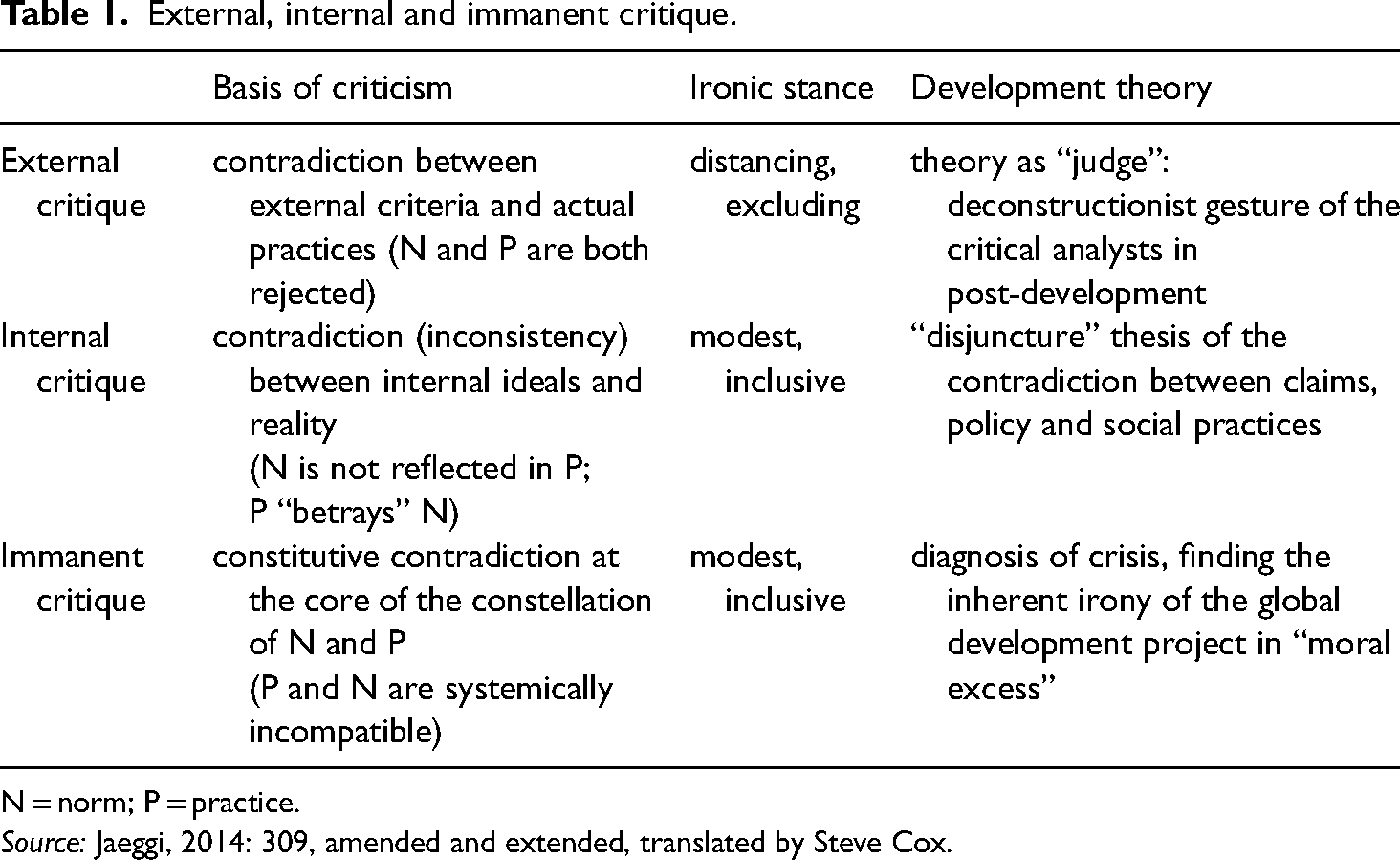
N = norm; P = practice.
Source: Jaeggi, 2014: 309, amended and extended, translated by Steve Cox.
The post-development critique may be called an external critique because the critic operates outside the cave in the sense that he or she relies on external standards when defining failure. Ferguson’s criticism, for instance, concerns the logic of structural reproduction, but he applies evaluative criteria what failure means from outside to his object of study. The critical analyst argues from an “Archimedean point”. Thomas Nagel has described this perspective as the “view from nowhere” (Nagel, 1986). The external critic does not share the norms represented by the experts inside the “development machine” but maintains a clear distance from those norms. The critic rejects both norm (N) and practice (P) of the development apparatus. Criticism here is primarily aimed at negating or redirecting. This is why the post-development critic propagates uncompromising negation of the development idea itself and all the associated institutional formations and practices.
The ethnographic position, on the other hand, proceeds on the basis of an internal critique inasmuch as the yardstick of criticism is not taken from outside the object of study being criticised, but from within itself (Jaeggi, 2014: 261). This becomes clear when the term “disjunctures” (Lewis and Mosse, 2006) is employed, in other words when the analysis refers to contradictions between the norms and moral claims formulated in development policy documents and project plans, on the one hand, and the everyday practices shaped by the contingencies of power, networks and events, on the other. The “disjuncture” that this form of internal critique seeks to demonstrate lies in a discrepancy between norm N and practice P, i.e. N is not realised in P (Jaeggi, 2014: 266). According to Boltanski, this form of criticism “exposes the discrepancy between the social world as it is and as it should be in order to satisfy people’s moral expectations” (Boltanski, 2011: 30). Internal criticism uncovers this contradiction, this inconsistency, but does not necessarily call into question N as such. In terms of policy, the ethnographic analyst may therefore aspire to achieve an alignment between N and P (see Table 1).
These normative premises of an internal critique are not always made explicit in the ethnographic literature, especially in the works influenced by Latour, which aims at the level of a sort of description of the “inside” of aidland (Harrison, 2013). Flagging up agency, relationality and hybridity is considered key for an explanation of the fragility and instability of the development apparatus. This analytic work of Latourians exposes internal incentives, restraints, subjectivities and disjunctures within the system, but often avoids the question of normativity. Again, in simplified terms, we could say that while the post-development critique focuses on the claim “that” successful failure is, indeed, taking place, Latourians explain “how” successful failure is achieved and sustained despite all its inconsistencies and contradictions without necessarily proposing a judgement on N itself. In this logic, Latourian ethnography and Boltanski’s notion of a pragmatist critique coincide.
We do not need to end in this dichotomy between external versus internal critique, however, but turn it dialectically: Didier Fassin suggests a form of ethnographic critique that he develops in critical appreciation of Boltanski’s work and that operates from a “liminal” position (Fassin, 2011: 49f.), where the critic stands at the threshold of the cave, “alternately stepping inside and outside” (Fassin, 2017: 21). For Fassin, the key point is that “as critical ethnographers, we know what we owe to the critical sense of our interlocutors and informants”. And yet, as theorists, we develop “our own intellectual autonomy” (Fassin, 2017: 21). In other words, the ethnographer that Fassin has in mind, “incessantly moves in and out of the cave” (Fassin, 2017: 23). This dialectics of the treshold has epistemological and ethical implications, as David Mosse rapports from his own experience as critical ethnographer (Mosse, 2006).
Fassin’s critic who operates at the threshold is in a good position to formulate an immanent critique. Indeed, while Fassin does not use the term immanent critique himself, his idea of the threshold is inspired by Axel Honneth’s notion of the critic operating from an “internal abroad” (“inneres Ausland”) (Honneth, 2009: 185; Honneth, 2007: 225f.): Despite all distance, only a remaining bond or tie (“Bindung”) with the social constellation that the critic denounces motivates her observational diligence, verve and energy to identify the constitutive function of the contradictions at heart in that constellation. Honneth is here, following Theodor W. Adorno (1970), endebted to the Frankfurt School’s tradition of an immanent critique. Combining Fassin and Honneth, it is arguable that immanent critique is best practised as a “liminal critique” where an “internal foreigner” can raise questions “that reveal an aporia” (Fassin, 2011: 49f.). The internal foreigner is “at once participant and critic” (Hyndman, 2000: xvii).
In fact, I believe that many development ethnographers practise this sort of immanent critique, which allows more than an internal critique. Immanent critique allows to move from “how” to “the ‘why’ of international development” (Apthorpe, 2011: 199). Questions such as: Why, in such a morally loaded field as development assistance are the contradictions between ethically high-minded objectives and the ambivalent realities of everyday practice so persistent? Why do so many experts, and indeed activists, not give up in the face of these contradictions and despite their knowledge of the “development” project? These why-questions indicate the ironic predicaments of “moral excess”. Why-questions can be asked without any (implicit) moralising, and yet do ask about moral motivations or “practical norms” (Olivier de Sardan, 2015) of those who operate in the cave.
My insistence on the question of “why” is aimed at a form of immanent critique: an immanent critique argues that “the contradictions it identifies are constitutive for the existence of the respective practices” (Jaeggi, 2014: 291, my emphasis). It diagnoses the underlying propensity to crisis of a social arrangement, not just its inconsistencies. Immanent critique does not limit itself to flagging up a contradiction between N and P; rather, it is interested in the constitutive function of the contradictions, i.e. in the systemic, immanent reasons for non-conformity between N and P (see Table 1). Thus, immanent criticism is ultimately concerned with transforming N and P, i.e. resolving its constitutive predicaments, while not assuming to “know better than the practitioners themselves what they should be doing” (Jaeggi, 2015: 75). Immanent critique thus resonates with Jonathan Lear’s idea of irony as “pretense-transcending activity” (Lear, 2011: 11ff.), which is: a space for reflection. 7
One way to formulate such an immanent critique of development is to identify “moral excess” as the constitutive function of the contradictions between N and P inside the global development apparatus. This moral excess is also, what, arguably, sets the development apparatus apart from other large bureaucracies or organisations and colours the ironic predicament of the development industry. The “moral excess” of the incentives, restraints and subjectivities of the individuals working in the apparatus are summarised concisely by Tania Li (2007) with her concept of the “will to improve”: Li identifies here the obstinacy of a will that is not discouraged by disappointment and setbacks, even after critical evaluations, not put off from designing, planning and implementing new projects again and again. Li, in her book, quotes from a conversation with a development expert about Li’s criticism of large-scale resettlement schemes in Indonesia cofinanced by the World Bank. The expert did not doubt the basic veracity of her negative assessment but simply replied with a note of resignation: “You may be right, but we still have to do something, we can’t just give up” (Li, 2007: 1–2). The failure of a project does not lead to its termination. Rather, ever more plans and schemes are then designed to banish from memory the setbacks of the previous programmes.
It is in this way that the development apparatus draws its moral impetus for survival from its own failures. However, this moral impetus is not necessarily triumphalist, but gestures towards resignation and melancholia. I suggest here that the increasing disillusionment among experts in the global development apparatus is haunted by a “postcolonial melancholia” - the dawning awareness of “losing a phantasy of omnipotence” (Gilroy, 2005: 99). The melancholic, suggested Sigmund Freud in “Trauer und Melancholie [Mourning and Melancholia]” (Freud, 1917), is unable to “properly” grieve the loss of an object. Melancholia ends up as “resignative utopia” and as “disappointment with reality” (Lepenies, 1969: 7). And yet (albeit in later writings), Freud depicts melancholia as “a constitutive psychic mechanism of subjectivity itself” (Eng, 2000: 1277): The cynics inside the apparatus are then the “borderline melancholics who can keep their symptoms of depression under control and can remain more or less able to work” (Sloterdijk, 1983: 36). Cynicism is the expert’s “enlightened false consciousness” (Sloterdijk, 1983: 37), which acts against its better judgement, as practical imperatives and survival instincts keep the cynic fit for work (Rauch 1993).
It is precisely this enlightened cynicism inside the apparatus that Coggins poem The Development Set nails with humour. The poem addresses the enlightened/seen-it-all/cynical practitioners who hide behind a “facade of professional competence” (Rauch, 1993: 250), but in the evening, over a beer, they can vent their frustrations, talking openly about the pointlessness and dishonesty of their actions – only to get up the next morning and return to the daily business of the development apparatus. The enlightened cynics “see through ideological pretensions and consciously verbalise critique … And yet (and this is the point) the same people take actions upon the world as if they did not know, as if they were deluded by ideology, as if ideology were reality” (Navaro-Yashin, 2002: 159f.). Innocence is irretrievably lost (Ticktin, 2017). The enlightened cynics know that they are part of an apparatus and still carry on regardless with their work. After all: “We have to do something!” the expert told Tania Li (2007: 2). An immanent critique of development addressed this constitutive predicament in the work of the development industry.
What is to be done? Irony, melancholy, cynicism
I started this paper with the premise that ironic predicaments invite evaluative judgement and critique. Indeed, the irony of development – the irony of “successful failure” – has invited different forms of critique – external, internal and immanent. As a form of external criticism, the post-development critique exposes the myths surrounding the origins of the development idea, its fantasies of omnipotence, its modernist register of progress as a “civilising mission”, which drives forward the “irony of structural reproduction”. It enables the critic to denounce the work of the development apparatus as “malignant” (Esteva, 1991: 76) and to diagnose the experts’ behavior inside as “addicted” and “pathological” (Esteva and Escobar, 2017: 2567). What the external critic thereby looses out of sight are the internal struggles inside the apparatus, so argued development ethnographers, who opened Pandora’s Box. In other words, the ethnographers cautioned that the post-development critique overrates the coherence of development’s hegemony, which they, the ethnographers, think is fragile and rather incoherent.
The post-developmentalist and the development ethnographer differ in how they position themselves towards their object of study: the experts inside the apparatus. The ethnographer might be more inclined to “a sense of fundamental kinship with the enemy” (Burke, 1941: 435), whereas the post-developmental critic refrains from making friends with those complicit with a “malign” development machine. While the latter’s position invites rigorous moral judgement, the ethnographer is rather interested in the ambivalences and contradictions of a social practice, even the “folly and villainy” (Burke, 1941: 435), that may be integral motives for wisdom and virtue, while not seeking to pass moral judgment on this practice. Ironic anthropology thus understood, writes Michael Carrithers, entails a commitment to find “a ‘fair and faithful’ perspective of perspectives among all the parties” (Carrithers, 2011: 71). For Kenneth Burke, irony and modesty therefore belong together: “True irony, … irony that really does justify the attribute of ‘humility’, is not ‘superior’ to the enemy” (Burke, 1941: 434). Such an ironic stance demands “imaginative identification” and “thick description of the private and idiosyncratic” (Rorty, 1989: 93f.), and thereby draws on a productive tension between criticism, on the one hand, and inclusion, or moral obligation, on the other (Fernandez, 2001; Steinmüller, 2011: 34).
The post-developmentalist, in turn, operates a cold critique that postulates its theory a priori. To confirm this form of theory, the post-developmentalists must trust that the critique of the development apparatus will not have any effects on the workings of the “machine” and the experts inside it (Eriksson Baaz, 2005): The critic’s hermeneutics of suspicion merely consolidates the quandaries of the experts’ enlightened cynicism – both critics and practitioners “remain more or less able to work” (Sloterdijk, 1983: 37) in mutual symbiosis: An “extractive intellectual industry” (Carr, 2011: 2798) cannibalizes the development industry. This position “has something to do with an unachievable desire to unsettle development without unsettling [the critical theorist]” (Carr, 2011: 2798). The post-developmental critic thus ends up as a professional pessimist (Lund, 2010: 22).
For the development ethnographer, critique is “a difficult exercise”, insists Fassin (2013: 46), because of the difficulty to withstand the “moral intangibility” of development’s impetus that “we have to do something”, or more precisely, “we cannot not do something”. Indeed, even many of those who think that the post-development critique is fundamentally correct have taken issue with Escobar’s or Ferguson’s demand to abandon the development enterprise altogether: Post-development critique, it is argued, thereby “amounts to little more than the facile negation of the object it criticizes” (Wainwright, 2008: 9), and “ends up resorting to inflated claims” (Kapoor, 2017: 2672): narratives of alternatives to development tend to romanticize the local, social movements and anti-modernity, while discarding the continuous desire for development among the poor: “We cannot not desire development” concludes Wainwright (2008: 10, emphasis in original).
The impossibility to let loose this desire signifies the “excess in the concept of development that is central to its functioning” (de Vries, 2007: 30), and foregrounds an aporia, i.e. a dysfunction intrinsic to the functioning of a social predicament (Fassin, 2011: 49f.; Wainwright, 2008: 10). An aporia, writes Jacques Derrida (1993: 16f.), signals an impossibility as a barred path – the impossibility “not to do something”. This aporia is constitutive of the development apparatus that draws the moral excess from its own failures. This aporia escapes the gaze of post-development: Its “Foucauldian irony” (Fernandez) resorts in an a priori cynicism of the critic about the very planners, managers and experts who seem to be caught up in their own cynicism and operate the machine against their own better judgment and convictions. The post-development critique thereby becomes entangled in the aporia of development, and the aporetic condition endures.
Immanent critique seeks to escape the critic’s a priori cynicism and its refusal to “unsettle the critic” and instead deploys a modest form of criticism. Inscribed in this form of critique is an epistemological tactic of procrastination. The art of procrastination brings to work “an idiosyncratic precision, an idiosyncrasy … against the irreversibility of judgments, against the finality of solutions, against the certainty of consequences …” (Vogl, 2008: 109). Procrastination holds back from passing overhasty moral judgments and practises “a form, a way of indicating that must not be allowed to consolidate into the substantive expression of a judgment” (Düttmann, 2004: 73). In so doing, immanent critique deploys a modest irony that turns the post-colonial melancholia of “we cannot not do something” into a “fruitful melancholia” (Traverso, 2016: 20).
Footnotes
Acknowledgements
This piece has had a long digestion period. In this process, numerous persons have provided feedback or ideas: Eberhard Bauer, Christian Berndt, Christin Bernhold, Barbara Bleisch, Sarah Byrne, Ottavia Cima, Muriel Côte, Steve Creech, Martin Doevenspeck, Dedo Geinitz, Christoph Görg, Olivier Graefe, Pia Hollenbach, Tania Li, Christian Lund, Elisio Macamo, David Mosse, Detlef Müller-Mahn, Theo Rauch, Peter Schaber, Conrad Schetter, Julia Verne, Christoph Vogel. The detailed comments by Raymond Apthorpe, Pascal Goeke, Kai Koddenbrock, Eberhard Rothfuss, Christine Schenk, Timothy Raeymaekers, Florian Weisser as well as by two reviewers have been particularly helpful. I thank Steve Cox who translated selected passages of this paper from a German manuscript into English.
Declaration of conflicting interests
The author(s) declared no potential conflicts of interest with respect to the research, authorship, and/or publication of this article.
Funding
The author(s) received no financial support for the research, authorship, and/or publication of this article.
