



Abstract
The Damara pastoralists (ǂnūkhoen) in Namibia distinguish a diverse range of rains. Some rains kill livestock, others care for insects and still others wash away the footprints of the deceased, allowing the person to exist in the spirit realm. While anthropologists have documented cultural classifications like the Namibian rains for decades, we still lack a convincing theory to explain how they come to exist. To address this, I develop a phenomenological perspective and theorise how experience contributes to what rain becomes. I argue with Husserl that the present in which we experience the rain is not a discrete moment, but a unity across a succession of ‘nows’. In the process, perceptions, images, memories and expectations about past and future events blend. In other words, a web of meaningful relationships connects the rain we experience ‘now’ with multiple past and future entities, including people, plants, spirits and animals. I refer to this as network formation. Combining the analyses of the people's pastoral being-in-the-world and their historical–political context, including post-colonialism, allows an explanation as to why some of those combinations are singled out and become distinct ontological entities. I refer to this as node selection. Combining the two processes – network formation and node selection – allows for an explanation as to why precipitation becomes discernible and meaningful as eleven different Namibian rains.
Dark clouds announced the rain. We were sitting in front of the hut, a little way uphill where we could see far across the flat, arid landscape and deep into the sky. The thunder and lightning gave us a clue as to where the rain was falling. ‘Our friends in the Rockies are lucky to receive the first rain of the year’, I said to Charles, who was sitting on an old gasoline drum next to me. 1 ‘No, Michael, this is still behind Khorixas’. As was often the case, my estimate was significantly off. I wondered whether I would ever learn to align my views of the landscape and the sky to locate weather phenomena appropriately. Charles knew this and did not comment. ‘ǀgurukupu ǀnanub is bad’, he continued. Charles spoke Khoekhoegowab and lived in Fransfontein, the pastoral community in northwestern Namibia where I have conducted fieldwork for more than 15 years. 2 Like most people here, he considered himself a Damara (ǂnūkhoen). He kept goats, cattle and sheep on the vast, open pastures surrounding the community. ‘ǀgurukupu ǀnanub kills our animals’, he added. As we talked, some of his animals were returning, with weak steps, from the pastures.
I did not understand why he was so concerned. I asked myself how the rain (ǀnanus), which brings water and life to the arid environment, could be bad. I knew of its all-encompassing importance to local people, who refer to it as ‘everything’ (ǀNanus ge a hoaxū). Did not Charles complain every time we went to the field that his goats could hardly find any leaves to eat? His animals had become so weak, I feared they might stumble on the stony ground. ‘For sure, we need the water’, he continued. ‘But not this rain’. ‘Isn't water all the same?’ I insisted. ‘No, ǀgurukupu ǀnanub is bad. It only falls in some very select places. Like now, somewhere behind Khorixas’. He continued,
They do not get how far this is. They start running and running, sometimes for days. When they get there, the sun has dried the soil and they find nothing to drink or to eat. They just waste their energy. And then, when it rains somewhere else the following day, they start running again. While they are searching for green pastures, they lose their appetite for the old grass that is still there. In the end, you have to search for your animals in the open pastures and if you find them, some will be dead. At the end of the rainy season the animals are so weak that ǀgurukupu ǀnanub kills them.
This was why the ǀgurukupu ǀnanub was bad (ǀǀgaisase). Before I could continue with my questions, Charles ended our conversation. 3
On another occasion, Charles and I saw the clouds forming again. I wanted to show him I remembered our conversation so I said that it could not be ǀgurukupu ǀnanub this time because the rainy season had started long ago. He confirmed this: ‘You know, Oupa [grandfather] Carl passed away and they are burying him today. This is ǀhôaǀnanub, the rain that comes after the funeral of a well-known person to wash away the footsteps of the deceased. Only then can he enter the sky peacefully’. Whereas I would have called both rain events Wolkenbruch (cloudburst) based on their intensity, Charles had two different names for them. But why does the rain appear differently in the two situations, and why differently for him and for me?
Cultural classifications like this are not a new concern in anthropology, and questions like ‘How many words for X do the Y have?’ have occupied the discipline since Franz Boas published a list of words for ice and snow in 1894 (Boas, 1894). The cognitive theories that are often used to analyse cultural classifications like these assume that things (e.g. snow, rain etc.) exists in the world ‘out there’ and that we get to know them through the properties they have (Bennardo and Munck, 2014; D’Andrade, 1995). While good at documenting diversity, cognitive approaches have issues in explaining why people distinguish exactly those entities (e.g. kinds of snow, ice etc.) and why they have those particular meanings (e.g. in Boas’ analysis, thin ice at the ice edge in winter [ik̄u’liaq]; thin ice formed by the first frost [s̄ı’koaq] etc.) (Krupnik and Müller-Wille, 2010: 396).
To address how the categories themselves come to exist, several authors point to phenomenological theories. What these theories have in common is that they underline the importance of experiences. With experience, they refer to an erleben, a ‘living through’ in Dilthey's sense, and the subjective, situational, embedded and embodied knowing this entails. The basic argument is that categories form as abstractions of what we experience.
But how do we experience? It is well established that in relation to the environment, experience is first made through every day practical activities and these activities (e.g. walking, hunting, plowing etc.) contribute to what we know – about the landscape, the wind, the rain and many other things (Ingold, 2000; Ingold and Kurttila, 2000; Schnegg, 2019). In this article, I add a second component that I argue contributes equally to how things are made through experiences: time. The importance of time is evident from the opening vignettes. While we talked, Charles connected the rain to another rain that failed to come. Moreover, he connected the rain to the effects it had on the livestock – the livestock that heard thunder, smelled moisture and searched for water and food in desperation. Therefore, both time and practical activities contribute to what a particular rain is.
But how can we integrate and combine these two elements (time and practical activities) into a valid theory of environmental knowing? Swedberg suggests that ‘before theory comes theorizing’ (Swedberg, 2016: 2). Considering theorising as a process, I mobilise Husserl's theory of time and Heidegger's notion of being-in-the-world as entry points for exploring why people distinguish eleven Namibian rains. Through this analysis, I identify explanations that become building blocks for a more finished phenomenological theory of environmental knowing. The concluding remarks reflect both this progress and the steps still ahead. To prepare this ethnographic analysis and my theorising, however, I first explain the main propositions of the representational theory of knowing that dominated anthropology, and particularly cognitive anthropology, for quite some time.
How things appear, phenomenologically
The founding father of representational theories, René Descartes, stated famously that the thinking mind and the external world are two separate spheres, and the mind collects information from the world to process it (Descartes, 1998). The mind is like a container into which we pour water (i.e. data) through a funnel (i.e. our senses) and has little influence on what exists (e.g. the different kinds of rain). This one-way conceptualisation, which still prevails in the works of John Locke and David Hume, began to change with Immanuel Kant, who distinguished between the mind, the phenomenon, and the thing-in-itself (Ding an sich).
The rain exists with all its properties (shape, quality, intensity etc.) as a thing-in-itself, and these properties contribute to what we perceive as a phenomenon. At the same time, our mind also takes an active role in ‘co-constituting’ the phenomenon. How then, does the mind contribute? Kant argues that this emerges in combination of a priori perceptions (Anschauungen) of time and space, as well as concepts (Begriffe) and universal categories of pure reason (Kategorien der reinen Vernunft) including ‘causality’, ‘existence’ and ‘substance/property’ that transform the thing-in-itself into the phenomenon we experience (Mohr and Willaschek, 1998). While acknowledging the active role of the mind much more adequately, one of the problems with Kant's universalising approach is that it has issues explaining why Charles sees ǀgurukupu ǀnanub and I see a Wolkenbruch while we are watching the rain (Reyna, 2002: 118).
This is where early phenomenological theories step in. While they correspond with Kant that phenomena are shaped by the mind, they diverge in two ways. First, they deny the idea of a thing-in-itself and argue that such a mind-independent reality does not exist. Our sensual experience is not, as the founding father of phenomenology Edmund Husserl says, ‘trübendes Medium, welches statt der Dinge an sich bloße Erscheinungen derselben gibt’ (‘an opaque medium, which instead of the things themselves gives mere appearances of them’) (Husserl, 1976: 172). Instead, what is sensually given is all there is. With this, phenomenological theories reject the proposition that there are several ‘real’ rains that have properties that allow us to recognise them and call them by different names. They argue rather that while the world is real, we do not know how sensually given things and reality correspond. All we can tell is that things often appear the same – but can appear differently – to Charles, to me, and to others from situation to situation.
To explain the differences in appearances of things, phenomenologists’ main focus is the way we experience them. That is the mind-world relationality. For doing so, they have developed sophisticated understandings of how things appear (this is their second major theoretical contribution). Whereas the approaches differ between Husserl (intentionality, adumbration), Heidegger (Dasein, being-in-the-world), Merleau-Ponty (embodiment), Stein (empathy), Waldenfels (responsivity) and other phenomenologists, they share the idea that these modes of experiencing a phenomenon shape what it becomes (Desjarlais and Throop, 2011; Duranti, 2009; Jackson, 1996; Ram and Houston, 2015; Throop, 2003).
In this article, I mainly draw on Husserl's phenomenology, which has been used very productively in anthropology before (Duranti, 2009, 2010; Throop, 2015, 2018). According to his view, experience has two salient features. First, in any particular situation, a phenomenon only appears from a specific perspective. Husserl uses the example of a table to explain this. We can never see (read, experience) the table as a whole thing; as we are sitting on the sofa with the table in front of us, its opposite side, its underside and part of its base are hidden from our view. Husserl refers to this hiddenness as Abschattung (adumbration) (Husserl, 1966a: 3). How, then, does it become a table in our mind, even though we only see a small fraction of it? This is where the second important feature comes in. Husserl argues that the single perspective we have in this situation points to the other perspectives of the table. In his words, we ‘co-intend’ (mitgemeint) images from having experienced (or even imagined) similar objects or the same object in the past The limited image we receive prompts us to recall those other perspectives, and we utilise them to complete the partial sensory impression we have. Therefore, the table appears as what it is: a whole (Husserl, 1966a).
The process of Abschattung – the unconscious co-intending of other aspects of a phenomenon – also extends to our experience in time. In this case, it does not refer to the other sides of the table but to things that happened before and after the phenomenon occurred.
Husserl's theory of time – ‘now’ as a unity of succession
To get a feel for how this works, imagine driving on a highway and recognising a car approaching in the other lane. Husserl's main argument is that we do not experience this time sequence as a stringing together of many short impressions but as a unity across a succession of ‘nows’. Put differently, there is no gap between those ‘nows’ because the impressions blend together. Even in the moment you recognise the car, you already anticipate it as something approaching. Then, as it passes by, you continue ‘seeing’ the car or have an idea of how it disappears. In short, its presence is not just the single moment in which you consciously recognise it. Rather, it co-intends perceptions of a before and an after that you link it to. This intersection constructs what you experience as ‘now’. Husserl also calls this Abschattung, the co-intending we talked about above (Husserl, 1966b).
Husserl provides many diagrams to exemplify his theory, and several are along the lines of Figure 1 (Dodd, 2005). The horizontal line presents a succession of ‘nows’ from C to G. As we move along this line, we come across and experience objects in time, marked, for example, as points D, E and F. However, once we have experienced an object at a given moment, let us say at C, this experience does not disappear but remains present as something that has left an impression. Husserl calls this process retention. It is indicated through the objects sinking in Figure 1 from C to C′ to C″ and so forth. As we experience the next event, D, we still have some of C present – not as C but as C′.
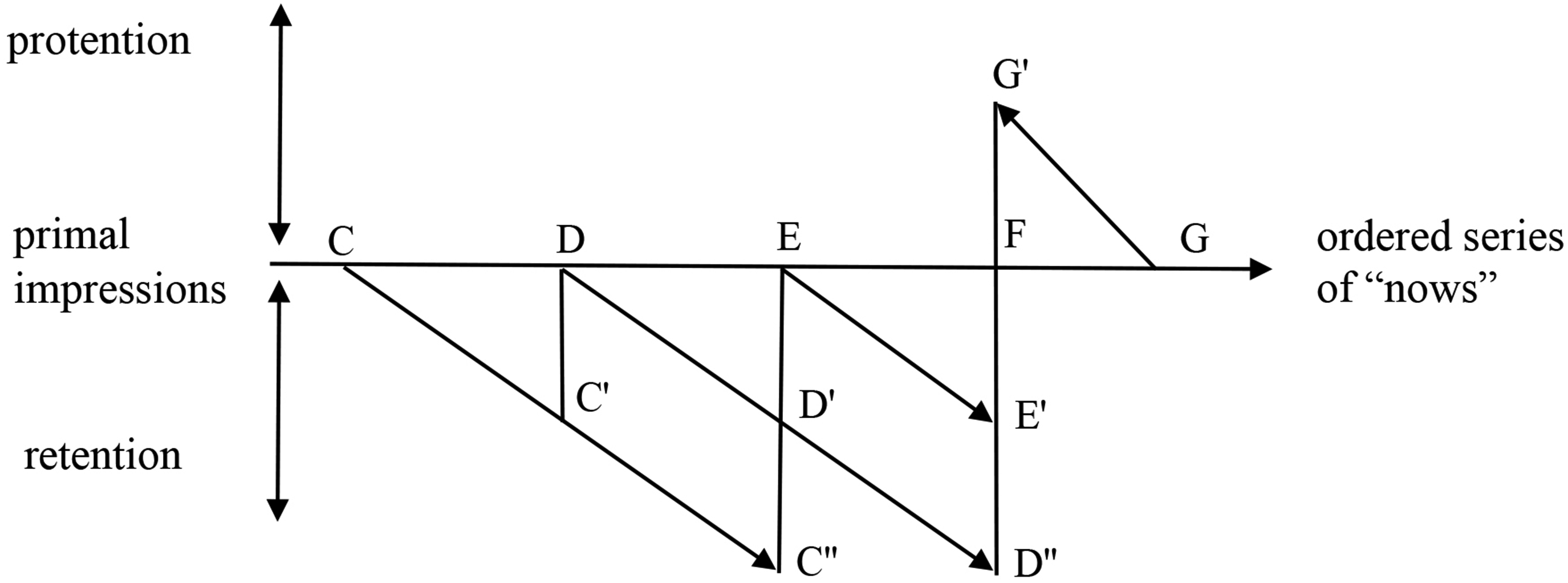
Retention and protention in a series of ‘nows’, C to G, adopted from Husserl (adopted from, Husserl, 2002).
To return to the car scenario, while the next car is approaching, the first car is still somewhat present in the back of our mind, like the tail of a comet that has yet to disappear completely. The same process applies looking forward. Here, we anticipate how things will be, and this expectation influences how we experience the moment, even when the anticipated events have not yet occurred. Husserl calls this protention. The process is indicated in the image by the lines above the main horizontal line.
Let us now combine the two processes, considering point F. Here the experience of something (F) also includes E′ and D″ from the past, as well as the anticipated object in the future, G, which is experienced at F as G′. In the end, experiencing an object in the present links the current situation with moments that have passed and moments yet to appear (Dreyfus, 1982; Husserl, 1966b). These moments are co-intended, like the hidden sides of the table, to make the phenomenon appear in a particular way.
Whereas Husserl developed this theory for the analysis of relatively short periods of time, including the perception of tones and melodies, I translate his general idea about Abschattung to longer durations to explore how Damara people in Northwest Namibia experience the rain and how they relate other entities to it. As with the table in the example above, any experience of the rain in the ‘now’ co-intends past and future experiences, albeit not in their original impression but in and adumbrated form, contributing to what the rain becomes.
While Throop (2003) foregrounded the link between experience and time in Husserl's phenomenology some time ago in his illuminating essay on experience, it remains largely unexplored ethnographically. Close to it, Bryant and Knight (2019) developed a sophisticated phenomenological (albeit Heideggerian) outline of an anthropology of the future that shows how our ways of relating to the future shape what we experience now (Bryant and Knight, 2019; Throop, 2003). Similarly, I aim to show how time makes things, but I largely stick to Husserl, who links experiences to both past and future events more generally, allowing us to understand how time makes rain discernible and meaningful as ontological entities.
Time in anthropology
In philosophy, Husserl's analysis is called an A-series perspective, which refers to the subject's positioning in a flow of time passing from the future through that individual's experiential present into their past. This subjective perspective is also the most prominent way anthropologists have analysed time (Gell, 1992; Munn, 1992). While this is an important perspective for me as well, I also use time in a second sense where it denotes the ordering of events, as in notions of date, generations, or evolution. In philosophy, this is called a B-series. The B-series perspective implies a third-person position from which we can look at time to say, for example, that my birth was in 1971, and before yours (McTaggart, 1908; Mellor, 1981).
Thinking of a river flowing from the top of the mountain to the lake can help clarify this difference. Imagine my friend and I are fishing along the river while we see a piece of wood floating downstream. In the A-series perspective, the object changes position in relation to me. I can describe it as being in front of (before) me, level with me (same time), or behind (after) me. While I say, for example, that the piece has just passed, the statement is true for me as a subject, but not necessarily for my friend who stands some meters downstream. In contrast, the B-series perspective describes the floating of the wood (i.e. time) with a statement that expresses its relation to other entities, for example, by saying it is floating between me and my friend. The truth value of this statement is independent of who says this (the subjects). It contains an (objectifying) third-person perspective from someone, say, standing on the riverbank.
Several anthropologists have attempted to bridge the two perspectives on time in ethnographic enquiry. In his extraordinary book, Gell combines the analytical philosophy of time with a Durkheimian view to show how (‘real’) time is socially constructed and shapes our perception of reality (Gell, 1992). 4 Adding to this, Hodges offers Bergson's concept of la durée to overcome the theoretical problems of structure and subjectivity that the A- and B-series divide implies (Hodges, 2008). Furthermore, Bear thoughtfully combines Gell's epistemology of time with a Marxist perspective to address the tension between the time-reckoning of capitalism and the concrete experience of time (Bear, 2014). Whereas these analyses provide sophisticated understandings of how subjective and objective perspectives on time interact, they do not thematise explicitly how an object's positioning in time contributes to what it is.
Many social scientists prefer to speak of temporality/temporalities or temporalising to view time as a process continuously being negotiated by cultural models, artefacts and practices, including clocks, wage labour, calendars, calculations and other technologies (D’Angelo and Pijpers, 2018; Munn, 1992; Stewart, 2016). Temporality, in these views, can have two meanings (Ringel, 2016: 394): for one, it encompasses a group's understanding of time. In this sense, academics or Damara pastoralists have a certain attitude towards time, a temporality (e.g. lineal, cyclical, modern etc.). For another, the objects we interact with as members of these groups (e.g. scientific publications as academics or livestock as pastoralists) also have a temporality that relates to our general understanding of time. As Ringel (2016: 395) has shown, both approaches face the danger of homogenising and attributing one group or object one temporality.
To avoid this, my theorising uses subjective experience as an entry point. I describe how an object (the rain) is experienced in a situation and how this experience in time establishes connections to other entities (A-series). Accordingly, the experience builds nodes in the network that connects the rain to other entities (e.g. animals, vegetation, souls etc.). I refer to this process as network formation. When calling the rain by a name – e.g. ǀhôaǀnanub – those temporal relations become inscribed in an objectified way: the rain that falls after someone has died to wash his footprints away and allowing them to exit in spirit (in the sense of the B-series). This selection happens against the backdrop of a particular way of being-in-the-world and the socio-political context in that people live. I refer to this process as node selection. In my approach, then, the A- and the B-series perspective constitute a duality – two sides of the same coin. I express this duality through the notion of lived-entities.
Defining time as the duality of those two perspectives, as lived-entities, allows me to show first, what types of rain the ǂnūkhoen distinguish; second, how those rains encapsulate time; and, third, how those types of rain become distinct entities. However, before continuing to answer these questions, some words on the ethnographic context are in order.
Being-in-Fransfontein
Fransfontein, the community in northwestern Namibia where I have worked for many years, consists of roughly 250 households situated 450 km northwest of the Namibian capital, Windhoek. As in most of the Kunene region, the communal pastures surrounding Fransfontein are dotted with small settlements where inhabitants live pastoral lives (Pauli, 2019; Schnegg et al., 2013). Before colonialism, most ǂNūkhoen were hunters and gatherers. Another salient transformation that came with colonialisation is the creeping occupation of farmland by settlers of European decent. This has restructured access to land and water sources significantly. The colonial subjugation in the late 19th century and the forced sedentarisation and taxation by the colonial state also pushed Damara people towards seminomadic pastoral livelihoods. Forced to live on pockets of land that were much too small, their vulnerability significantly increased (Schnegg et al., 2013).
Households combine different economic strategies to assure their livelihoods such as pastoralism, wage labour and state welfare. These activities link people in Fransfontein to the communal settlements in the surrounding hinterlands. On these settlements, no more than ten households typically live within a few kilometres of a drilled borehole that provides water to livestock and people. Many farms are so remote that they lack technological infrastructure like cell phone networks, running water and electricity. Elderly people live mostly in the hinterlands, while the younger generations stay either in Fransfontein, where the primary school is, or in one of the urban centres, especially the capital Windhoek and the port town Walvis Bay (Pauli, 2019; Schnegg et al., 2013).
Even though the people's lives are structured by wage labour and technologies like cars, pay-per-view television and smartphones, the rural base remains important for most people for several reasons. Economically, the opportunities to invest money in Namibia are few. Livestock herding is still a very effective means to grow profit from earnings made through wages or trade. Social status is shaped significantly by how much livestock one owns, so investments in livestock are investments in one's reputation and identity. Many social feasts, including weddings and funerals, require livestock for food or rituals, and livestock gifts on these occasions are a means to invest in social relationships. Moreover, the ownership and sale of land is restricted by law. Therefore investing in livestock is often the only way to establish a relationship with the land and to express a sense of belonging to the place (Pauli, 2019; Schnegg et al., 2013). For these reasons, pastoralism is still a salient cultural model and practice in people's lives, even though very few live on livestock alone.
Namibia is the driest country in Sub-Saharan Africa, and the Kunene region receives only 200–300 ml of rain annually. The rain falls very selectively, both in space and time. Precipitation is extremely unlikely in the winter months, but even between May and August, during the rainy season, most areas receive rain on relatively few days (Schnegg and Bollig, 2016).
I first came to Kunene in 2003 when my wife and colleague Julia Pauli and I were looking for a place to do a community ethnography (Pauli, 2011, 2019). We lived in Fransfontein for more than a year and have returned many times since. At this point, I speak the people's language, Khoekhoegowab, quite well. In addition to acquiring language skills, I bought some sheep, goats and cattle that I care for when I am there in order to learn pastoralism myself. The data I present here was collected mostly after 2015. Around that time, I started learning how people make sense of the weather, and most importantly, the rain (Schnegg, 2019). After 5 years and more than 30 tape-recorded qualitative interviews, I have a detailed understanding of what people know about the weather, which I explore next.
How different rains encapsulate time
My analysis focuses on the ways in which rain encapsulates time. However, in northwestern Namibia the rain is an all-encompassing phenomenon, and others have offered sophisticated analyses of its additional meanings. These include how the lack of rain is a consequence of social and political change (Sullivan, 2002), rain's personified agency (Hannis and Sullivan, 2018; Schnegg, 2019) and rain's symbolic, medical and ritual role in rock art and people's lives (Low, 2008; Sullivan and Low, 2014). Moreover, I have shown in my previous work how two gendered and animated winds are responsible for the arrival of the rains and how and why the rains have failed to come in recent years with climate change (Schnegg, 2019, 2021). While these ethnographies offer insightful analyses, none of them discuss the different types of rain in detail.
Within the annual cycle of Damara people's livelihoods, rain events connect to other entities of the natural world in particular ways to form distinct rains. How these relationships unfold will become clear when I describe the types of ǀnanus (rain) people distinguish around Fransfontein. They are:
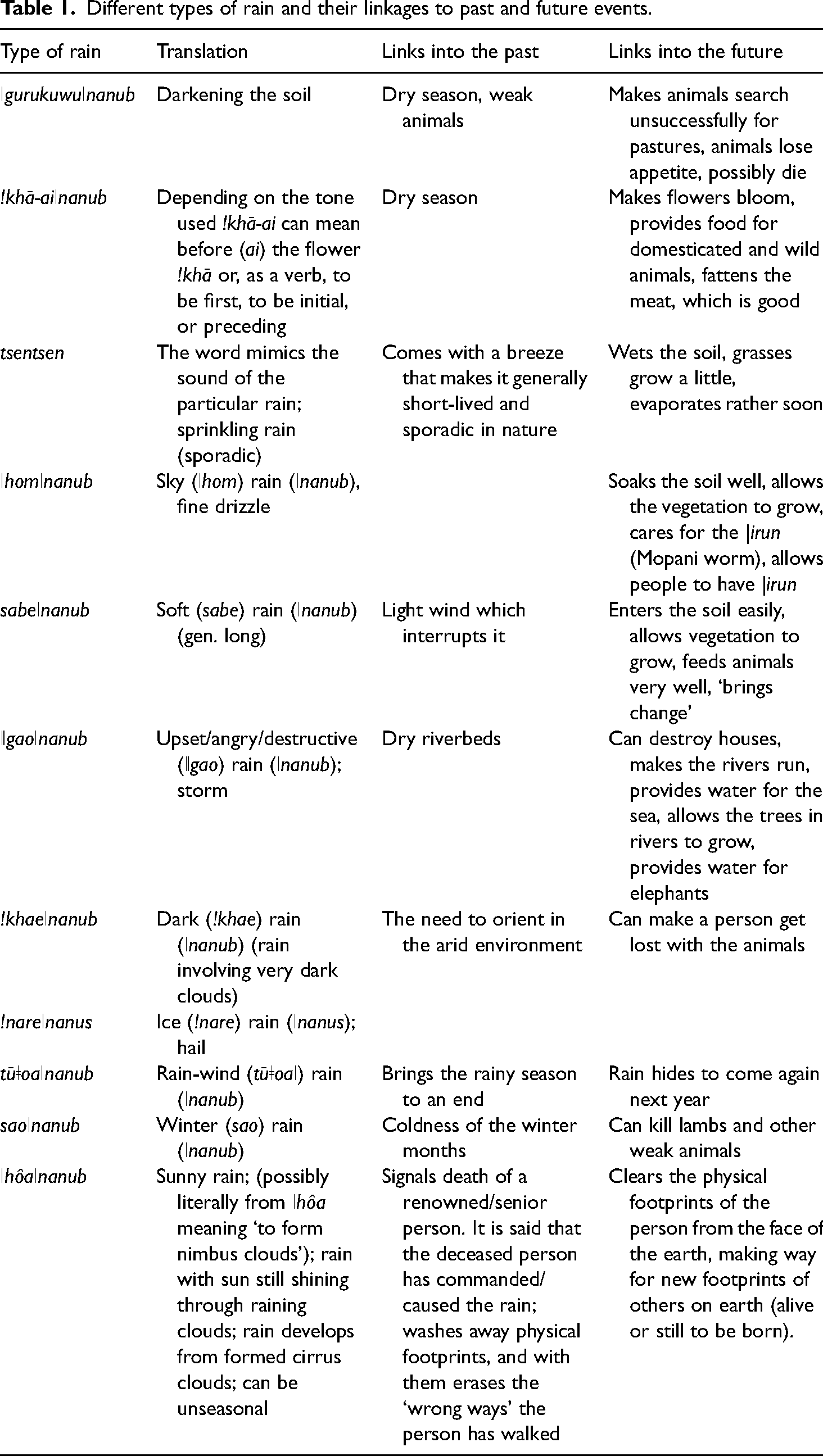
ǀGurukupu ǀnanub. In the article's opening, I described this ‘first rain’. ǀGurukupu ǀnanub is patchy and falls only in selected places. When this happens, in September or October, the landscape is still very dry, and animals are in desperate need of fodder. Aridity has been increasing for months when the first clouds form in the sky – and it continues to increase. As soon as the animals hear the rain (and the thunder) or smell the wetness of the land, they search for green grass, walking long distances through the open pastures. No fences hold them back. While looking for fresh grass, they lose their appetites for the scarce dry grass that remains. As a consequence, the animals, now thin and exhausted at the end of the dry season, become even weaker, and some of them die. The word ǀguru in ǀgurukupu ǀnanub refers to the animals’ skin getting rough and their hair standing up as an indication of this weakness. People fearfully anticipate these difficulties when they see the rain forming in the distance, as when Charles said, ‘ǀGurukupu ǀnanub is bad’. ǀGurukupu ǀnanub thus unfolds in connection with past events that persist in memory, the characteristics of which recur consistently. These characteristics are the landscape's aridity at the end of the dry season, and events that are imminent – especially the movement of the animals and the sun drying up the moisture too fast. Only at this intersection do these variables combine to form ǀgurukupu ǀnanub. Next comes the rain that fully ends the dry season: !khā-aib nanub. Not long after the incident I described, we sat in front of my hut. The trees that covered the area were still dry and had very few leaves. When the clouds formed toward the east, I asked my neighbour, Dave, if he thought it would rain today. ‘Yes, we might experience some !khā-aib nanub’, he replied. He explained that !khā-aib, the first part, means ‘before the flowers’. The rain is called !khā-aib nanub because it makes the flowers bloom. In Fransfontein, flowers are anticipated not so much for their beauty, but for the nutritious food they provide animals. For example, the flowers of a shrub called ǁhaub (Rhigozum trichotomum) are the favourite foodstuffs of many antelopes (especially kudus), and when they bloom, wildlife come close to the community. In Fransfontein, hunting is illegal and only a few people have rifles to shoot over long distances. However, when the wildlife comes close, it can be chased easily with dogs and killed with spears. Because of that, !khā-aib nanub not only anticipates flourishing food for animals, but also nourishment, well-being and joy for people. Taken together, !khā-aib nanub unfolds in the centre of a network that links the rain to the dryness of the past, to flowers that will flourish and to the anticipation of the food it will bring for both animals and people. Another day, Tina and I were driving to a nearby town when the sky darkened and the clouds closed in. As I often did in comparable situations, I tried to show the knowledge I had gained. ‘I am sure that it will rain today’, I said. ‘What do you think?’ Looking through the car window, Tina replied, ‘Well, I am not so sure. Maybe, but only tsentsen’. People describe tsentsen as a light rain that pours down softly for a relatively short amount of time, any time of year. The name tsentsen is an onomatopoeic reference to the sound this rain makes when it hits the ground or corrugated iron roofs. Tsentsen is a beautifully calming sound, tsen, tsen, tsen and the rain typically comes with a weak breeze. People say that because the wind is not very strong, it cannot bring new clouds and the rain will stop relatively soon. When I asked Tina whether tsentsen was good, she replied, ‘Look at the landscape [!garob]; it is much too dry. Tsentsen can help the animals a bit, but it will not bring change’. Like Tina, many people in Fransfontein describe tsentsen as a good rain for the grazing animals, including cattle, horses and sheep. This is because it moisturises the ground and partly enters it. However, because the amount of precipitation is low, tsentsen evaporates quickly. Therefore, when experiencing tsentsen many people comment that the rain is useful, but that it ‘will not bring change’, anticipating that the landscape will not look significantly different after it has rained. In sum, experiencing tsentsen links the rain to phenomena that occur at the same time, such as the slow breeze, to explain its short duration. This brief duration will, however, have an effect on future developments. The lack of change is anticipated, which turns the light drizzle into tsentsen. ǀHom ǀnanub (literally, sky rain) is a much longer-lasting rain that can be experienced throughout the year. The sky is dark while ǀhom ǀnanub falls. People in Fransfontein say that it seems ǀhom ǀnanub will only stop when the dark clouds have cleared, giving way to the sun. ǀHom ǀnanub is soft and favourable for the growth of ground vegetation. People receive/undergo ǀhom ǀnanub often in the beginning of the year, when the Mopani worms (Gonimbrasia belina) are still small. Last year, we were driving to a community about an hour away to conduct an interview when I saw tents along the roadside. At first, I thought they had a problem with their car and we should help them. But Roman, who was with me, said, ‘No, they are collecting |irun, Mopani worms; remember, we had them last year. People are saying there are many this year, and now I know where they are. Tomorrow I will go, too, to collect some with my wife. You can make a lot of money with them. One maize-meal bag [10 kg] sells for 1000 Namibian dollars or more’. Mopani worms are rich in protein and a sought-after delicacy in Namibia and other parts of sub-Saharan Africa. When I asked why there were so many |irun this year, he explained that it had to do with the rains. When they are small, Mopani worms live on Mopani tree branches, and heavy rain showers wash them to the ground, where they die. But this year, when the worms were small, ǀhom ǀnanub came instead of heavy rains, so the worms thrived in the trees. So while ǀhom ǀnanub has few explicit associations with past events, it anticipates the well-being of the Mopani worms, and eventually, people's well-being. People say that ‘because the rain cares’, it becomes ǀhom ǀnanub. Sabe ǀnanub (literally, soft rain) occurs throughout the summer months, too. Unlike tsentsen, it comes with a stronger wind, which makes this type of rain begin and end suddenly. Sabe ǀnanub is considered one of the best rains for grazing animals, including cattle, horses and sheep because it soaks into the ground slowly and the soil stays wet for longer. When the sun comes out, typically the next day, the heat combined with the wet ground makes the grasses sprout. After sabe ǀnanub, people in Fransfontein often say, ‘You will see the change in a couple of days’, indicating how fast the sand-coloured savannah turns green. And they are right; it is a fascinating transformation to observe. Sabe ǀnanub thus links the current precipitation to the prolonged growth of grasses and the effects this has on livestock and humans. Without a doubt, sabe ǀnanub becomes what it is through its anticipated effects. But not all rain is good, as the opening episode revealed. ǁGao ǀnanub (literally, the upset/angry rain) is a heavy rain driven by a very strong wind – strong enough to knock down trees and to blow away zinc roofing plates. Most houses in Fransfontein are built from wood and covered by such corrugated metal sheets. Typically, those sheets or plates are connected to the wooden walls with wires. If the wind blows very strongly, the wires can tear out of the sheets and the shelter is destroyed. Therefore, ǁgao ǀnanub is dangerous and impacts people's livelihoods immediately. ǁGao ǀnanub is typically so strong that the ground does not absorb the water. The water instead gathers and flows into the ephemeral rivers that characterise Namibia, then out to the sea. Some of this water is blocked by natural dams, where it collects in drinking reservoirs for animals. Where wildlife comes to drink, it can be hunted easily. Therefore, ǁgao ǀnanub has a positive side, too. While ǁgao ǀnanub is bad for ground vegetation, it helps the large ana trees (Faidherbia albida) in the riverbeds grow because the water level in the ephemeral rivers rises. This also allows elephants to successfully dig for water to drink. The water that comes with ǁgao ǀnanub eventually enters the ocean to become part of the next rain, as people in Fransfontein claim (Schnegg, 2019). In sum, ǁgao ǀnanub links the rain to a network of favourable and unfavourable effects. In the centre of this network it becomes what it is. Two years ago, I wanted to learn how to take animals to the grazing ground, just as pastoralists do. I asked my neighbour, Pete, if I could accompany him for a week. He would first take the responsibility of advising me, and later we would switch roles. One of the strongest impressions I got from this experience was how much cognitive work it takes to keep 100 sheep and goats in the bushy landscape under control when they are all searching for scarce food. In the middle of the day, impressive clouds formed while we walked. ‘What can we expect from them?’ I asked Pete. ‘This might be !khae ǀnanub’, he replied. I knew !khae meant dark, and it made perfect sense. When I asked what made this rain so special, he explained that people fear being surprised by it. As the name implies, !khae ǀnanub darkens the sky in the middle of the day. This is especially frightening when you are in the field, many hours from home. ‘As you know, we grew up in this area and we find our way at any time of day or night. But we need some means of orientation, like a star in the sky or the mountains before Kranspos. If you can't see anything while you’re busy following the animals, you can easily get lost Then what will you do if the lightning comes?’ As this indicates, !khae ǀnanub connects the present rain to what might happen in the situation that follows. !nare ǀnanus, a type of hail, is very rare. The classification focuses on the physical properties of the rain (literally ice rain/frozen rain/hail rain). Resting on our walk to Tasaraxaibes, we sat a bit uphill, overlooking the sky and the landscape, when clouds formed in the east I asked Frans, my assistant and friend, about the clouds and their patterns. He replied, ‘This might already be tūǂoab ǀnanub. It's late in the season and the rain might go back’. I knew tūǂoab meant ‘rain wind’ so I asked, ‘Isn't all rain brought by a rain wind?’ ‘Yes, but now it's time for the rain wind to disappear behind the ǃgûdi trees (Vachellia reficiens), where it will stay for the winter months’. At this point, it began to make sense to me. Tūǂoab ǀnanub is part of a larger narrative about the weather. The people in Fransfontein make the interaction of two loving and caring winds responsible for the arrival of the rain (Schnegg, 2019). Only if the two agree will there be rain. In the dry season, rains are the exception. During this time, tūǂoab ǀnanub stays behind dark ǃgûdi trees before it comes out again in September or October. Those trees stand in the far northeast of the country where the climate is much more humid. My interlocutors attribute much spiritual power to the people who live there. When it is time for the rain to hide, the grasses have already grown. In the larger area, many grasses are annual and have weak stems. If the rain comes with a strong wind (tūǂoab ǀnanub), they are likely to bend and break. Because the wind can easily blow them away, tūǂoab ǀnanub is partly bad. Within this network the rain becomes tūǂoab ǀnanub. Saoǀnanub is the earliest rain associated with the winter months, a time when the animals give birth and the offspring are extremely vulnerable. The wet and the cold the rain brings can kill the animals. With this, one risks losing what could be future wealth. Therefore, saoǀnanub is feared as a rain with destructive possibilities. It potentially negates all the care one has given to the animals to allow them to lamb. Saoǀnanub becomes something bad because people anticipate its consequences and link it to potential death. ǀHôaǀnanub is the second rain that comes at unexpected times. Last year, I attended the funeral of one of the most eminent men in Fransfontein, Pete. He had fought for Namibia's independence alongside the first president and became an important figure in regional politics after the war. The day of the funeral was enormously hot, around 100°, and only a few people walked from the church to the graveyard for the burial. Those who could, jumped onto the pickups of the many townspeople who had come for the day. When my friend Hubert and I returned home after the coffin had been placed in the ground and covered with sand, the sky began to close. But in some spots, bright early-afternoon sunlight was still shining through. Before long, however, the rain poured heavily, and I recognised how happy Hubert had become. I wondered why, and thought about what the rain would mean for the animals. He said, ‘Don't you realize, it's ǀhôaǀnanub. It came’. Until then, it was ‘just’ a tremendous cloudburst to me. He explained, ‘ǀhôaǀnanub only comes when an important person has died. It will wash away all of Pete's footprints on earth. And all the “wrong ways” he took. You know, he was not the kind of person they described in church. This was not Pete. Pete had many women, and he could be very arrogant’. In Fransfontein, footprints are the most important sign of human and non-human interactions with the world. People read spoor much the same way a driver looks at traffic and traffic signs. They reveal which living being has been there and what it did, often days after it happened. Footprints are the most important signs while hunting, but also in everyday interactions such as trying to find out where someone has gone when you do not find them at home. Washing away the footprints allows the person to exist in spirit, without any ‘baggage’ from their time on earth. ǀHôaǀnanub also makes space for new people and their footprints or paths. Moreover, ǀhôaǀnanub indicates that the deceased had the power to bring the rain, underlining his or her importance on earth. Again, we see how ǀhôaǀnanub unfolds in the centre of a network of past and future events that constitute what it is. As summarised in Table 1, people relate the rain to manifold other entities of the world. The particular intersections constitute what the rain is. But how exactly does this happen?
Different types of rain and their linkages to past and future events.
How time constitutes rains
Cultural classifications of snow, ice, colours and other domains are an established research field in cognitive anthropology (Bennardo, 2019; Bennardo and Munck, 2014; D’Andrade, 1995). While cognitive analyses have shown convincingly that people know different things about the environment, the question of how these differences come about is much less settled. In my reading, this also has to do with the theoretical framing cognitive anthropology often applies. Guided by representationalism, cognitive approaches theorise culture as shared scripts, models and symbols that are stored in our minds. But how do they get there?
In this article, I have explored a phenomenological approach that foregrounds experiences to answer this question. In so doing, my intention is not to show that people distinguish exactly eleven types of rain. It might well be that some people collapse some types into a single category while others distinguish more types or categories. In contrast, I intend to demonstrate according to which processes those entities become meaningful, discernible and real through their being-in-time. Therefore, my third question is: how do those types of rain become distinct entities and how can this process be explained using phenomenology?
In brief, the answer is through the situation in which it rains. When Husserl says that knowing is not a representation of something that is real but the presentation of something that appears, this also includes the social situation in which this process of appearing takes place. While I am sitting in Fransfontein, I am part of a network of relationships between me and people, me and things, and among the things themselves. The ‘nodes’ in this network include aridity, land scarcity, colonialism, particular conditions of the vegetation, Charles, his goats, their behaviours, the flowers that are about to bloom, and the Mopani trees. When I see rain, much of what it can become is already there as part of the situation. As my discussion of the eleven rains has shown, the ‘nodes’ in this network are not restricted to the present. With Husserl, the Abschattung connects the present experience of the rain with instances of expected and remembered events through retention and protention. Taken together, the rain's being-in-time constitutes a network of past, present and future entities in which a particular experience of the rain is embedded and can then become meaningful. This is why I refer to this process as network formation.
According to Husserl and most other phenomenologists, many of these connections are unconsciously drawn as part of routine experiences (Husserl, 1966b: 484; Throop, 2003). In the opening scene I described, Charles and I experienced the weather in a way similar to how we did most of the time when we looked after the animals. The weather happened and flew by – it was just there and we were within it. However, when the thunder struck, we were torn out of the flow of experience and turned our consciousness toward the experience itself (reflektiven Zuwendung), as Husserl says (Husserl, 1966b: 484). We ask ourselves, ‘What was this?’ This was when Charles said, ‘ǀgurukupu ǀnanub is bad’. In this moment, which Heidegger would later call a breakdown (Störung), the routine was disturbed and we were taken out of the flow of experience (Dreyfus, 1991: 71; Heidegger, 2006: 72). The familiar became unfamiliar. The nodes in the network were frozen, and the entity they formed (e.g. the particular rain) appeared like an object, an image, in front of our mind. In this moment, we reflected and used the classifications we had to make sense of it as ǀgurukupu ǀnanub. But still, how were these particular nodes linked to form these rains?
To understand this process, we need to consider how people around Fransfontein experience the rain in time, 20–50 times a year. All those experiences include sensing and thinking about the rain before it occurs (anticipating it), while it is happening, and after it has stopped (after the event). This is the A-series perspective. At the same time, people recognise and name at least eleven particular types of rain as distinct entities. The names of those rains contain references to other past and future events. Independent of the particular experience and the subject position ǀhôaǀnanub, for example, is a rain that exists after someone has died, that washes the footprints away, and that will thus allow the deceased to leave the earth peacefully. In making these references, ǀhôaǀnanub encapsulates a B-series perspective, independent of who speaks about it and when. Therefore, linking the two perspectives on time, the A-series of subjective experience and the B-series as one possible aggregate, allows answering how different types of rain emerge as phenomena. But why these connections and not others? To understand this, we need to consider, for one, how the rain is encountered in people's being-in-the-world, including their practical activities and the larger socio-political context in which it rains. This is the process I refer to as node selection.
According to many phenomenologists, entities (such as the kinds of rain) emerge through our ways of being-in-the-world and through using things practically (Heidegger, 2000). Heidegger explains this with the distinction between Seiendes (‘entity’) and Sein (‘being’). Seiendes can be described as an entity that is ‘out there’ or, as some would say, real. As we have seen, for phenomenologist these entities do not exist as Kantian things-in-themselves but only as theoretical constructs, as the essence (Wesen) of the different ways they appear. In contrast to this, Sein (being) describes the particular way an entity appears. But how, then, is Seiendes transformed into Sein? This is where our being-in-the-world and practical activities comes in.
Heidegger illustrates this transformation through the hammer as an example: a hammer, a thing composed of wood and steel, is lying in front of me. Why is it a hammer to me? According to the representational view (e.g. Descartes, Kant), we recognise the hammer through its properties such as size, colour or shape and we co-constitute it through our mind. Heidegger does not deny that this way of knowing the world exists; he refers to it as Vorhandenheit (present-at-hand). Through this kind of mind-based cognition, the world unfolds as an object present in front of us, the subject. However, according to Heidegger, Vorhandenheit is only one way of relating to the world. While we can recognise properties and might be able to name the thing as a hammer, we still do not really know what the hammer is. The meaning of the hammer only unfolds once we start hammering. Heidegger refers to this way of being in the world as Zuhandenheit, or readiness-at-hand. Through the practice of hammering, the separation between the perceived object and the perceiving subject is overcome and the I–hammer emerges as a new entity (Schnegg, 2019).
In short, our everyday practices of using things with a specific future-oriented purpose or project constitute the nature of things (equipment, Zeug, in Heidegger's language). Without the practice of hammering to get nails into the wall, we have no hammers! Without bicycling to get from here to there, we have no bicycle! Without skiing to descend the hill, we have no skis! And without pastoralism, there would be no ǀgurukupu ǀnanub. Without doing, the hammer, the bicycle, the ski and the ǀgurukupu ǀnanub do not exist, or are something else (Heidegger, 2006; Ingold, 2000: 69).
In Fransfontein, the pastoral livelihood, their being-in-the-world as pastoralists, as Heidegger says, circumscribes the practice that translates the entities (Seiendes) – here, rain – into something that exist for us (Sein) – a particular rain that is recognised and named. Being-in-the-world as a pastoralist implies caring for one's animals, being concerned. This includes knowing what animals eat, how they behave, how they see, how they smell, what their predators do, how they find their way in search of food, and much more. These practices of caring and the knowledge it implies form a horizon of understanding against which the distinct rains emerge.
However, their being-in-the-world as pastoralists also takes place within a particular historical, political and economic context. The rain also gets its saliency for the Damara people because the colonial powers seized most of the land and relocated indigenous people to areas much too small for subsistence farming (Schnegg et al., 2013). Because people were stripped of their land and access to permanent water sources, their dependence on the rain increased significantly. These political developments established the lifeworld that gives rise to aspects of the phenomena. They enable or enforce particular experiences that foreground nodes that could become meaningful in the rains-as-networks I describe.
If the Damara people had sufficient land, for example, the animals would not be exhausted at the end of the dry season to the point where they run after the smell of the first rains, ǀgurukupu ǀnanub. Accordingly, on the abundant commercial farms around Fransfontein that are still owned by the descendants of the colonial elites, ǀgurukupu ǀnanub does not exist. On those farms, there is enough pasture and fences to allow the livestock to be managed throughout the year. Goats and sheep will neither run away nor die.
In addition to the political and economic context, religion and interethnic relationships also contribute nodes to the web of meaning that constitute the different rains. The German colonisers not only destroyed people's livelihoods, they missionised the indigenous populations, too. ǀHôaǀnanub closely connects to this. It combines the Christian understanding that souls leave the earth after death with the indigenous view that the persistence of footprints and other signs on the ground enforces bad luck. In a similar manner, stretching to interethnic relationships, tūǂoab ǀnanub describes the rain that comes before the winds go away and hide among the ǃgûdi trees far in the northeast The landscape in the northeast is more humid and its inhabitants are well known (and feared) for their supernatural powers. Linking the dry season to a place that stands for affluence and angst at the same time is also a comment on interethnic relationships. Without all this, these particular rains would not exist.
Taken together, the analysis demonstrates how a combination of two arguments, the experience of a network of relations through time (leading to the network formation), and a focus on the pastoral, economic and political being-in-the-world (resulting in the node selection), allows us to understand how particular rains become recognised, discernible and meaningful. The people's experience of rain in time constitutes a specific type of rain as a network of relationships that includes adumbrated references to past and future events. Within this network, nodes become meaningful to people depending on a particular historical–political context, their skills of access, and the way they use them and other entities in the world. The intersection forms what the particular rain is.
Concluding remarks
When analysing culturally specific phenomena like the eleven Namibian rains, anthropologists have often assumed there is one world and many ways of representing it – expressed in different taxonomies (Vigh and Sausdal 2014). Recent ontological debates have shifted the focus to examining the nature of what exists (Holbraad and Pedersen, 2017; Omura et al., 2018; Pedersen, 2020). Accordingly, the difference can become so pronounced that it is more appropriate to speak of different ‘things’ instead of distinct representations of the same ‘things’. This is the case when, for example, some people recognise ‘the wind’ as a gendered and humanised being (tūǂoab) and others recognise it as a resource that provides wind energy. Or, more famously, when some Christians (e.g. Catholics) say sacrificed ‘bread’ is the body of Christ while other Christians describe it as a symbol.
Despite different assumptions in the cognitive and ontological literature, in my reading both approaches share one problem: they do not yet include a convincing theory of how those differences come about – regardless of whether they are differences between representations or things. This means explaining why I recognise a Wolkenbruch (cloudburst) when experiencing a particular rain and I describe it through its intensity and duration while my interlocutors see, for example, a ǀgurukupu ǀnanub, a ǀhôaǀnanub or none of these. With the theorising I present in this article and in my previous work, my overall aim is to contribute to a phenomenological theory of environmental knowing that can explain this.
This theorising begins with experience, and, so far, I identify four components of a more finished theory. First, as I and others have shown, the way we encounter the world in practical activities circumscribes what we know (Blaser, 2013; Omura et al., 2018). In the case I explore, this allows us to explain why Damara people and Namibian scientists have largely different understandings of the weather and climate change (Schnegg, 2019, 2021). While some see the weather as the result of loving and caring winds, others view CO2 molecules and the Intertropical Convergence Zone as the ultimate cause of what they observe. The different explanations become intelligible by considering the distinct ways in which both groups enact the weather: from a particular place through pastoral activities (for Damara pastoralists) or from any-place or no-place through scientific instruments (for Namibian scientists).
The theorising in this article explores a second component in a theory of environmental knowing: time. My exploration starts with the observation that many rains are described with references to past and present events, for example, when the name of a rain includes the word ‘ǀguru’, as in ǀgurukupu ǀnanub, which refers to the animals’ skin getting rough and anticipating the weakening of their bodies. Inspired by this, the aim of this analysis has been to show how time, in addition to practical activities, contributes to what the entity becomes.
To unravel this I mobilise Husserl's theory of time, which allows me to examine how we experience an entity as part of a flow of events, as ‘living through’ (erleben) the entity (the A-series perspective). In this flow, many things co-occur with rains. Retention and protention are Husserl's tools for understanding how these past and future events still resonate or are already anticipated when we experience an event – in this case, different rains. My theoretical intervention is to show that those ‘co-intended’ events form a network of relationships that constitute the experience of an entity in the present (network formation). Of those relationships, some are selected as meaningful and are thus inscribed into a lived-concept or -entity, as in ǀgurukupu ǀnanub (this is the B-series perspective).
In the third component of a more complete theory of environmental knowing, I have shown that this selection happens against the background of people's pastoral livelihoods and the social and political contexts in which they dwell (node selection). For example, without the experiential spheres of land scarcity, colonialism, the practice of pastoralism, the importance of gathering, Christianity, and much more, these particular eleven rains would not exist Each rain forms a network of relationships that links to these spheres and stabilises them, and is then confirmed, named and talked about. These relationships become encapsulated in lived-entities like ǁgao ǀnanub, ǀgurukupu ǀnanub or tūǂoab ǀnanub.
With this, my theorising has identified important explanatory components for showing how things in the environment become what they are. Exactly when and how do those experiences result in different categories or entities, and eventually eleven Namibian rains? I build on basic phenomenological insights again to explain this in the fourth component of the theory: that the experience of the weather and the rain, like all other experiences, happens mostly without being noticed. We are in a groove, inside the weather. It is just there, and we are unaware of it. Only when we are torn out of the flow of being-inside-the-experience – becoming alert, surprised wondering what is happening – do we refer to the network it forms by name. Experiencing becomes an experience (Erlebnis). According to this understanding, it is in these moments, which recur, that categories or entities are brought up, are socially negotiated, and are finally taken into the cultural repertoire. While I have pointed to some of these processes, it remains a salient challenge for a theory of environmental knowing to include enculturation processes to show how trajectories of knowing are opened during childhood and adolescence (Duranti, 2009).
I, for example, learned something new when Charles and I were observing the rain and he saw ǀgurukupu ǀnanub while I did not. When the thunder struck, we were both torn out of the experience of the rain we were observing. We had to make sense of the weather. For him, the weather was ǀgurukupu ǀnanub, a lived-entity that encapsulated past and future objects and events in the environment. While I did not see it at the time, the active reflection and the communication turned our ‘living through’ into an active experience (Erlebnis). This will probably lead me to see the rain differently next time. Perhaps next time I will be the one to say, ‘Let's put the animals into the kraal, otherwise we won't see them again’.
Footnotes
Acknowledgements
Without the continual support of many people in Kunene, Namibia, this research would not have been possible. Julia Pauli shaped my thinking about knowing since the beginning of my career, and I am extremely grateful for the advice she has given me. Edward Lowe, Coral O’Brian, Inga Sievert, Robert Pijpers and the anonymous reviewers have offered very constructive comments. Steve Reyna has encouraged me to make my theoretical claims more explicit and I am very thankful for that. Moreover, I am indebted to Sylvanus Job, who opens to me the door to his language, Khoekhoegowab, and to the world it encapsulates. The results presented here were funded by the Deutsche Forschungsgemeinschaft (DFG) as part of the projects ‘Knowing the Weather in Namibia’ (423280253) and ‘CLICCS – Climate, Climatic Change, and Society’ (390683824).
Declaration of conflicting interests
The author declared no potential conflicts of interest with respect to the research, authorship and/or publication of this article.
Funding
The author disclosed receipt of the following financial support for the research, authorship, and/or publication of this article: This work was supported by the Deutsche Forschungsgemeinschaft (grant no. 390683824, 423280253).
