



Abstract
This article examines how trust, legitimacy, and credibility are constructed in criminal justice practice through the work of lived experience professionals – individuals whose authority derives from embodied histories of punishment as well as professional practice. Drawing on 16 interviews with lived experience professionals and mentees across prison, probation, and community settings, the study uses Reflexive Thematic Analysis within a multi-theoretical framework combining Foucauldian analyses of disciplinary power with scholarship on legitimacy, desistance, and embodied practice. Four themes are identified: the persistence of a structural ‘them and us’ divide; the emergence of liminal legitimacy within disciplinary boundaries; the development of a desistance habitus through embodied skills, cultural fluency, and moral authority; and the contested label of peer, which simultaneously enables authenticity while reproducing stigma and constraint. The findings show that lived experience professionals occupy a necessary yet precarious position within penal systems, generating relational legitimacy within the architectures of surveillance and control. Lived experience practice therefore emerges as both rehabilitative and penal in character, operating from within rather than outside the logics of contemporary punishment. The analysis reframes lived experience work as stratified legitimacy work, showing that authority is negotiated through symbolic, relational, and organisational mechanisms rather than assumed through shared biography alone.
Keywords
Introduction
Extensive research has examined the use of peer mentors and professionals with lived experience of crime and punishment across international criminal justice contexts (Buck, 2020; Elisha, 2023; Matthews, 2021; Moak et al., 2023; Nixon, 2020). Studies identify relational benefits alongside practice outcomes such as improved engagement with supervision, services, and rehabilitative interventions, and continuity of support, although evidence on reducing reoffending remains limited and context-dependent (Brierley et al., 2025; Lenkens et al., 2024). Despite this growing literature, the mechanisms through which trust, credibility, and legitimacy are constructed within lived experience mentoring relationships remain under-theorised.
Although individuals in contact with criminal justice systems often respond positively to professionals who share similar experiences (Buck, 2020; Nixon, 2020), the relational and disciplinary processes through which credibility is produced – and the conditions under which it is recognised or withheld – are under explored.
This article addresses this gap by focusing on lived experience professionals – individuals with direct experience of punishment (e.g. custody, probation, or criminal justice supervision) who subsequently work in supportive, advocacy, or rehabilitative roles within penal and penal-adjacent organisations. Much of this work occurs within what Tomczak and Buck (2019) term the penal voluntary sector (PVS), a domain embedded within the wider ecology of criminal justice governance. Such roles should not be understood as external to punishment. As Cohen (1985) argues, reform and participatory interventions are incorporated within dispersed forms of penal power, while analyses of late-modern penality similarly locate voluntary and third-sector activity within responsibilised governance (Garland, 2001). Within this penal context, the article develops the concept of liminal legitimacy to explain how relational authority is negotiated within disciplinary systems, emerging from the in-between position lived experience professionals occupy between institutional authority and experiential credibility.
Literature
Over the past two decades, criminological scholarship has increasingly recognised the epistemic and practical value of lived experience in shaping research, policy, and intervention (Antojado, 2023; Brierley, 2023; Ross, 2024). This shift extends into criminal justice in the United Kingdom (UK), where individuals described as peer mentors have been incorporated into policy and service delivery (Buck, 2021; HM Prison and Probation Service, 2025). Yet how such roles are defined and legitimised remains contested (Brierley et al., 2025; Wong and Horan, 2021). In the UK, peer mentoring commonly refers to individuals with criminal justice experience who support service users in voluntary or professional roles (Buck, 2020), whereas in the United States the wounded healer terminology predominates (LeBel, 2007; Maruna, 2001). Other descriptors – such as Elisha's (2023) convict therapy – capture similar practices but carry pejorative connotations (Antojado et al., 2024; Cox, 2020). Competing labels highlight enduring ambiguity about what peer mentoring is, how it can be used effectively, and who should deliver it (Fletcher and Batty, 2012; Wong and Horan, 2021).
Historical scholarship has long suggested that former offenders can support current offenders to change. Cressey's (1955) retroflexive reformation, Riessman's (1965) helper therapy principle, Brown's (1991) professional-ex, and later wounded healer accounts (LeBel, 2007; Maruna, 2001) show how experiences of alienation and punishment can be reconfigured into rehabilitative resources (O'Sullivan et al., 2020).
A systematic review by Brierley et al. (2025) synthesised contemporary evidence, identifying both promise (e.g. enhanced social capital, reduced isolation, pro-social participation) and persistent challenges, including professional recognition, vicarious trauma, uneven effectiveness, and insecure employment. U.K. policy has embraced peer mentoring as part of efforts to reduce ‘stubbornly high’ reoffending rates (HMPPS, 2021: 7), with political advocates presenting peer mentors as credible brokers between offenders and staff (Grayling, 2012; Inside Time, 2020). Yet celebratory rhetoric sits uneasily alongside uncertainty about how lived experience roles are defined, recruited, supported, and legitimised across statutory and voluntary sectors (Brierley et al., 2025; Buck et al., 2022).
Empirical research reflects this tension. Peer mentoring in custody is associated with reductions in self-harm (Griffiths and Bailey, 2015), improved prisoner–staff relations and meaning-making (Jang et al., 2020), and positive masculinities (Nixon, 2023). In community contexts, it has been linked to social capital and desistance pathways (O'Sullivan et al., 2020; Sells et al., 2020). A lived experience autoethnography argued that such benefits derive from embodied street and carceral knowledge that generates symbolic capital (Brierley and Best, 2025). However, vulnerabilities have also been identified, including exposure to abuse within male-dominated organisational cultures (Bäcklin, 2022), underpayment and insecure contracts (Elisha, 2022; Woods, 2020), and difficulties having new professional identities recognised (Buck, 2018; Nixon, 2020).
Legitimacy, credibility, and trust have long shaped how authority is perceived in penal contexts. Procedural accounts emphasise fairness (Tyler, 1990), while Bottoms and Tankebe (2012) conceptualise legitimacy as dialogic and negotiated. Liebling (2004, 2011b) shows how legitimacy is embedded in moral performance and emotional quality, aligning with Crewe's (2011a) work on soft power. Similar dynamics are observed in community supervision (McNeill, 2006; McNeill and Robinson, 2012).
These debates speak directly to the position of lived experience professionals. Their authority is relational and contingent on authenticity, cultural fluency, recognition and status across both academic and penal fields (Dennehy and Brierley, forthcoming). Yet legitimacy remains fragile, shaped by organisational scepticism, institutional boundaries, and the visibility of criminalised identities (Nixon, 2023; Schreeche-Powell, 2025). Resident accounts in four U.K. prisons illustrate status hierarchies within lived/living experience (Albertson, 2025), highlighting that legitimacy is embedded in power relations and disciplinary structures.
Synthesising this literature, lived experience professionals appear promising yet precarious as rehabilitative actors and under-examined for their role in penal governance. Their value derives not only from empathy or shared history but from their distinctive positioning as individuals who transition from people under supervision to paid professionals within penal ecologies (Tomczak and Buck, 2019). This study examines how within that penal context, trust, legitimacy, and credibility are negotiated by such professionals across prison, probation, and community settings using a Foucauldian framework to theorise lived experience work as a disciplinary phenomenon.
This study therefore addresses the following research question: What patterns of meaning characterise how credibility, legitimacy, and trust are constructed in mentoring relationships involving lived experience professionals across prison, probation, and community settings?
To examine this question, the article develops two analytical lenses: liminal legitimacy and the desistance habitus. Liminal legitimacy refers to the form of relational authority generated by occupying an in-between position within penal systems: close enough to the system to be institutionally legible, yet close enough to service users to be credible. Desistance habitus refers to embodied, dispositional, and symbolic competences that enable lived experience professionals to navigate institutional demands while maintaining street and relational authenticity (Brierley and Best, 2025). While liminal legitimacy describes the structural position lived experience professionals occupy, the desistance habitus captures the embodied capacities through which that position is navigated in practice. The two concepts operate as analytical lenses rather than thematic labels, offering a framework for understanding how legitimacy is negotiated from within – rather than outside – the architectures of punishment.
Conceptual framework: Legitimacy, discipline, and embodied practice
Foucault's (1977) analysis of discipline and surveillance provides a central lens for understanding how legitimacy emerges within systems of punishment. Power is not held by individuals but circulates through everyday practices, organisational routines, and relational encounters. Prisons, probation, youth justice and adjacent rehabilitative services operate through techniques of monitoring, categorisation, and normalisation that shape conduct and produce subjects attuned to institutional expectations. Contemporary criminology extends this lens to late-modern penal governance, showing how both prisons and community supervision rely on diffuse mechanisms of observation, discretion, and moral regulation (Bosworth et al., 2017; Crewe, 2011b; McNeill, 2018). Across this work, legitimacy is not simply enacted through formal authority but continuously negotiated through calibrations of visibility, autonomy, and relational conduct.
Legitimacy, credibility, and trust, cannot be understood solely through institutional power. Procedural justice approaches emphasise fairness, respect, and moral performance (Liebling, 2004, 2011a; Tyler, 1990), while Bottoms and Tankebe's (2012) dialogic model conceptualises legitimacy as co-produced through ongoing negotiation between powerholders and those subject to power. These dialogic accounts illuminate how legitimacy in lived experience practice is negotiated rather than granted, emerging at the boundaries between disciplinary authority and those subject to it. Their legitimacy is assessed simultaneously by service users, colleagues, and organisations, requiring them to embody and at times contest institutional expectations.
Legitimacy also operates at the micro-relational level. Goffman's (1990 [1959]) distinctions between frontstage and backstage interaction help explain how emotional performance and authenticity are negotiated in practice. Practitioners move between formally regulated public performances and more informal spaces where trust is built, stories are shared, and boundaries are softened. For lived experience professionals, these backstage settings are often where cultural knowledge and shared histories are leveraged to humanise encounters, while frontstage settings require careful management of what aspects of the past can be made visible.
These competencies are not merely enacted but embodied. Bourdieu's (1986) theorisation of capital and habitus helps explain how lived experience professionals draw on cultural, symbolic, and moral resources accumulated through carceral and community experience. These resources are stratified rather than uniformly held, producing hierarchies of credibility within lived experience practice. Drawing on this perspective, the article conceptualises a desistance habitus as the embodied dispositions through which such resources are mobilised across institutional and community worlds (Brierley and Best, 2025). This aligns with scholarship on narrative labour and identity reconstruction in desistance (Maruna, 2001; Nugent and Schinkel, 2016). Street and prison-based competencies – such as reading risk, symbolic status, and decoding local norms – are re-purposed alongside professional communication and organisational navigation.
Collectively, these perspectives provide the analytical lens for the study. Foucault foregrounds the disciplinary conditions under which legitimacy is enabled or constrained; dialogic and procedural accounts emphasise its relational production; Goffman illuminates the micro-interactional performance of trust; and Bourdieu, alongside desistance theory, explains how embodied histories and symbolic resources shape credibility. This integrated framework situates lived experience professionals in a liminal position within disciplinary systems, enabling liminal legitimacy and the desistance habitus to be used as analytical lenses through which lived experience practice is understood as penal legitimacy work enacted from within disciplinary logics.
Methods
Sixteen semi-structured interviews were conducted with individuals who had been peer mentees, mentors, or both across prison, probation/youth justice, and community settings. Participants classified as lived experience professionals were those with direct experience of punishment who had transitioned into supportive or rehabilitative roles.
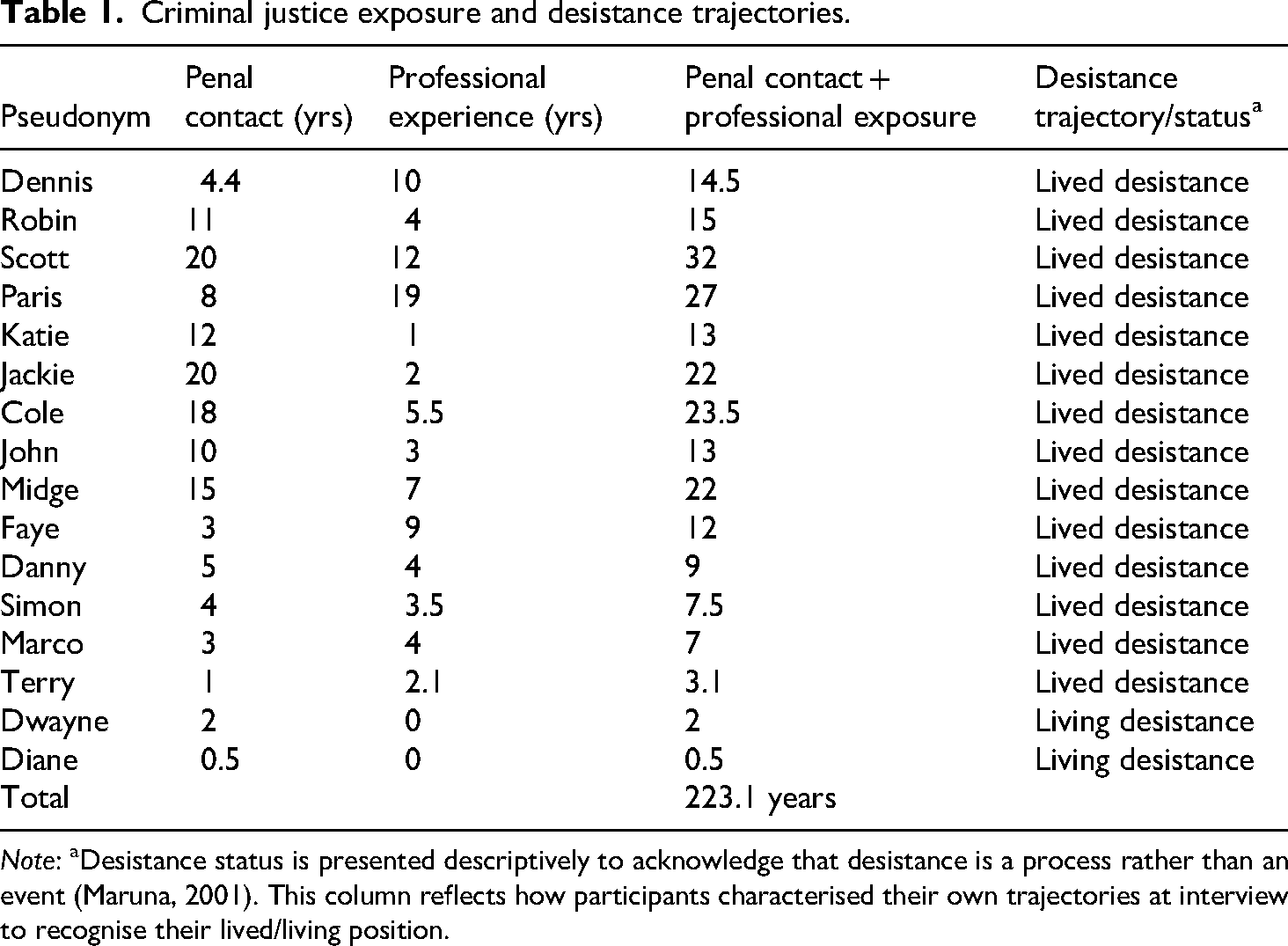
Across the sample, participants reported over 200 years of criminal justice contact, spanning time in custody, on probation, and in professional lived experience roles (Table 1).
Criminal justice exposure and desistance trajectories.
Note: aDesistance status is presented descriptively to acknowledge that desistance is a process rather than an event (Maruna, 2001). This column reflects how participants characterised their own trajectories at interview to recognise their lived/living position.
Table 1 outlines penal contact, professional experience, and desistance trajectories, situating lived experience work at the intersection of desistance, organisational role, and penal governance. Participants occupied statutory, voluntary, and hybrid positions across the U.K. penal field, with varying proximity to formal authority. While some worked directly within prison, probation, or youth justice settings, others operated through voluntary-sector organisations embedded within supervision, recall, and Multi-Disciplinary Team processes. This distribution reflects the ecology of lived experience work, which spans but does not sit outside penal governance. A full breakdown of organisational positioning and statutory proximity is provided in Appendix A. Including mentees ensures that legitimacy is examined not only from the standpoint of those who claim authority, but also from those positioned to grant or withhold it.
The sample comprised 11 lived experience professionals working (or having recently worked) in PVS or statutory roles; three individuals who had experience as both peer mentee and professional; and two who had recent experience as mentees only. Participants occupied a range of positions, including peer mentor, lived experience professional, youth justice worker, peer support worker, and specialist liaison roles in prison. A minority had previously held statutory posts within youth justice, probation, or approved premises settings.
Participants’ proximity to formal penal authority therefore varied. A small number had previously worked within statutory organisations where enforcement responsibilities – such as breach processes, risk assessment, or recall involvement – formed part of the team's remit, although none held sole recall authority. The remainder worked in probation-adjacent roles within reform, voluntary-sector, or commissioned services delivering interventions, contributing to risk-management discussions, and supporting individuals under supervision without holding statutory powers themselves.
Several participants had transitioned from statutory roles into penal voluntary, academic, or rehabilitation-sector positions at the time of interview, while continuing to draw on lived experience as a central component of their professional practice.
Across this spectrum, participants navigated organisational, surveillance, and behavioural expectations of the criminal justice system while also being recognised by service users as culturally and experientially proximate. This dual positioning – inside the disciplinary system yet not fully of it – forms the conceptual basis of liminal legitimacy explored in the analysis. Demographic data were collected but not reported due to the small sample and identifiability risks.
Although only a minority of participants worked directly within statutory organisations, all (excluding mentees) operated within the broader disciplinary system of criminal justice, including one participant – a peer mentor while serving a prison sentence and involved in developing various peer mentoring schemes in the community post release – working in reform while overseeing structured prison-based groups. Commissioned and voluntary sector lived experience roles remain embedded within institutional cultures shaped by surveillance, assessment, data reporting, safeguarding and risk governance, even without enforcement authority. Participants described being positioned within multi-agency supervision, subject to managerial oversight, and required to engage in practices that reproduced elements of disciplinary power. This supports the interpretation that all professional roles in the sample operated within – albeit to varying degrees – penal disciplinary environments.
Procedure
Recruitment targeted individuals with lived experience as mentees, mentors, or both, reflecting the aim of examining legitimacy from multiple positions. Participants were recruited through community and voluntary-sector organisations delivering peer mentoring linked to prison and probation. Sixteen individuals were interviewed. Approximately half (n = 8) were known to the researcher in a professional capacity, which is addressed in the limitations section.
One-to-one interviews (one online and the rest in-person) lasted 30–75 min, were audio-recorded, transcribed verbatim, and anonymised using pseudonyms. All participants provided written informed consent.
Analytic approach
At the design stage, both Interpretative Phenomenological Analysis (IPA) and Reflexive Thematic Analysis (RTA) were considered. RTA was selected because it aligns with the study's epistemology and with the researcher's proximity to the phenomenon: whereas IPA emphasises ‘bracketing’, RTA treats researcher subjectivity as an analytic resource (Braun and Clarke, 2019, 2022).
Analysis followed Braun and Clarke's (2006, 2019, 2022) six phases – familiarisation, coding, generating, reviewing, defining themes, and writing up. The process was iterative, inductive, and reflexive; codes and themes were developed through sustained engagement with the data rather than through inter-coder reliability procedures, consistent with RTA's rejection of reliability metrics.
Epistemological positioning
The study was informed by a contextualist epistemology, recognising experience as shaped by social, cultural, and structural conditions rather than as a direct reflection of internal states (Braun and Clarke, 2013; Willig, 2013). This aligns with a constructionist orientation in which meaning is produced through interaction between participant accounts, researcher interpretation, and wider discourses (Braun and Clarke, 2019) and coheres with the Foucauldian framework underpinning the analysis.
Researcher reflexivity
The researcher's positionality – as someone with personal experience of imprisonment who later worked professionally within statutory criminal justice – shaped all stages of the research. It influenced data collection through rapport and trust-building, interpretation through familiarity with institutional cultures, and analytic decisions through sensitivity to language, nuance, and tacit practice. Reflexive engagement was continuous, supported by analytic memos, supervisory dialogue, and iterative reading of transcripts. Positionality was treated as integral to knowledge production, consistent with constructionist qualitative paradigms.
Ethical considerations
NRC approval was not required because participants were not prisoners or individuals under HMPPS jurisdiction at the time of interview, and interviews were not conducted in custodial settings. Recruitment occurred via community-based organisations and probation-linked voluntary-sector services. Ethical approval for this research was granted by the Leeds Trinity University Research Ethics Committee (Ref: 2024-FSSE-PGR-0040). Participation was voluntary, with no impact on access to services. Confidentiality was maintained through pseudonyms and removal of identifying details, with participants either selecting pseudonyms from a list or being assigned one by the researcher. A protocol was in place to manage distress (e.g. pausing interviews, offering breaks, signposting to support), though no interviews required termination. Participants were not financially compensated.
Limitations
A key limitation of this study is the absence of a control group of criminal justice staff without lived experience of punishment. Future research could usefully examine how legitimacy and credibility are negotiated comparatively between practitioners with and without lived experience. While the focus of the research was to understand the perspectives of lived experience professionals themselves and their mentees, this design means the analysis cannot make claims about how their legitimacy, credibility, or relational practices may differ from those of practitioners without lived experience. The aim, therefore, is not to compare but to illuminate the distinctive ways legitimacy is negotiated within lived experience roles. This limitation is acknowledged in the interpretation of findings. The author being close to both the subject at hand and several participants may be viewed as an epistemic privilege or indeed as a limitation of the analysis.
Findings
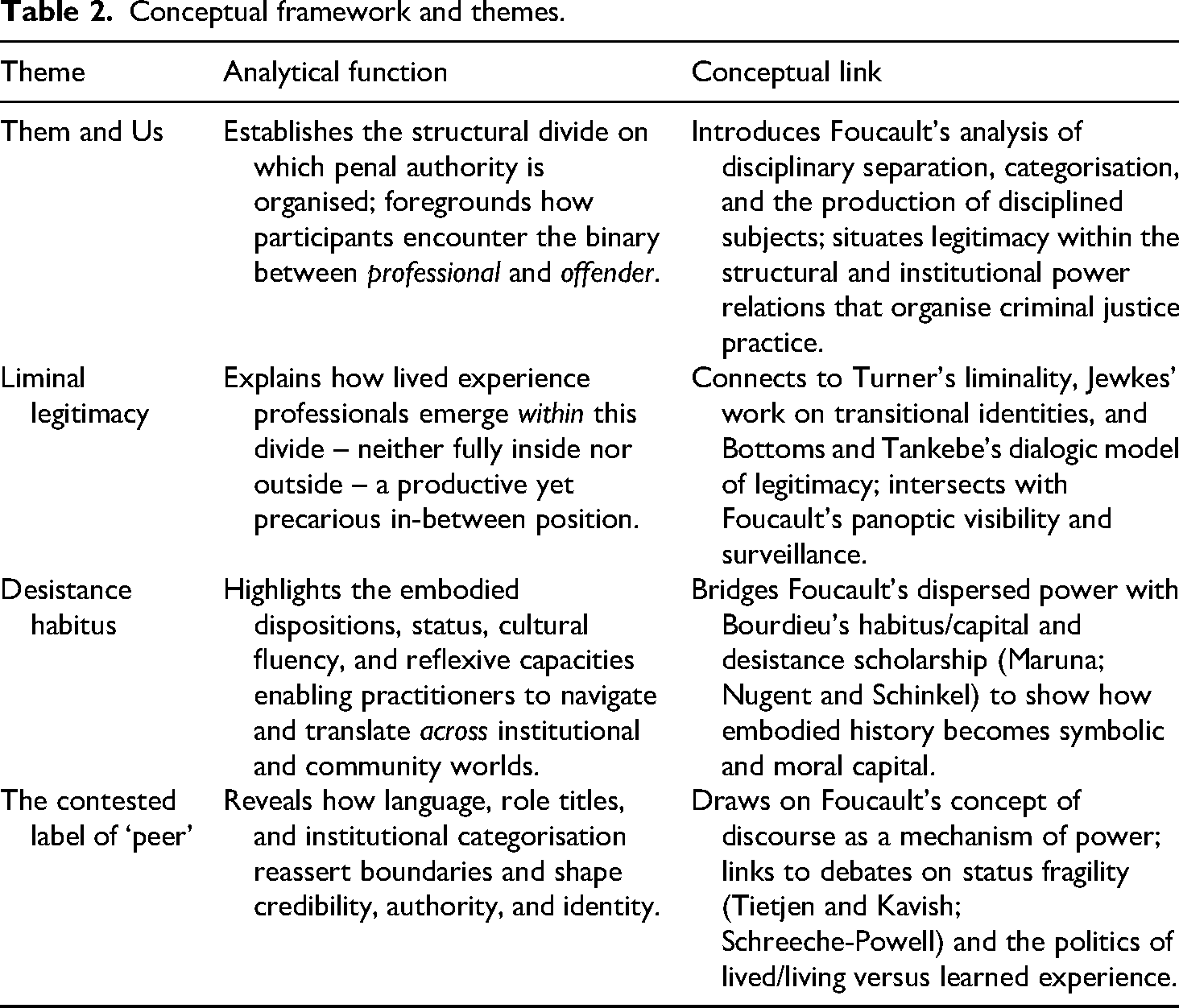
Following the principles of RTA (Braun and Clarke, 2006, 2019, 2022), analysis was an iterative and interpretive process that moved between the data, reflexive engagement, and theoretical framing. Through this process, four interconnected themes were developed, each capturing a distinct yet overlapping dimension of how legitimacy, trust, and credibility are experienced and constructed by lived experience professionals across prison, probation, and community rehabilitation contexts. These themes trace a progression from the structural divisions that shape relationships in criminal justice to the personal and symbolic negotiations of identity, status (prior to desistance) and professionalism. Across all themes, the analysis highlights the dual nature of lived experience practice: the same conditions that enable trust and legitimacy also generate constraints including emotional strain, organisational ambivalence, and uneven recognition. Table 2 provides an overview of the four themes, their analytical focus, and their conceptual contribution.
Conceptual framework and themes.
The following sections explore each theme in detail.
Finding 1: Them and us
Across participants’ accounts, a perceived divide emerged between formal criminal justice professionals without lived experience of punishment and those who had themselves experienced the system – a separation experienced as cultural, moral, and relational rather than simply occupational. Dwayne captured this succinctly:
My man is dressed like me. So, I believe unconsciously, I probably separated him - even though I still understood that he's not my mate, he's not one of the lads that I’ve been hanging with or anything like that. But I know he's not like them - even though he's working with them. (Mentee)
This sense of difference – of who belongs and who does not – was central to accounts of trust and legitimacy across the data. As Danny (lived experience professional) put it, ‘Everyone I met just wasn’t like me … None of them had been through the system … that was miles away from anything I’d ever thought about’. Professional distance was often felt as a barrier rather than a marker of competence.
In contrast, lived experience professionals were recognised as ‘one of us’: authentic, relatable, and credible. Jackie (lived experience professional) explained how this shaped her identity within the role: ‘They’ll say, “You’re all right, you’re one of us.” … It made me feel conflicted, like am I one of them or one of the professionals?’ This in-between positioning highlights the ongoing negotiation of identity at the heart of lived experience practice. Marco (peer mentee/lived experience professional) captured this divide by explaining that those with lived experience sometimes refer to themselves as the ‘lived experience lot’, while calling professionals without lived experience ‘the clinical lot’.
Several participants also described tensions within professional hierarchies. Terry (peer mentee/lived experience professional) recalled feeling ‘discredited based on [his] lived experience’, noting how administrative and academic skills were often privileged over relational expertise. Cole (lived experience professional) described joining probation during the Transforming Rehabilitation reforms:
There was real resentment from established staff - they saw us as a threat. We were the new “solution” being parachuted in. I remember driving home crying because of the hostility and the impostor syndrome.
Now working in a senior leadership role within a lived experience organisation in the PVS, Cole's reflections highlight how such tensions can persist even for those who remain embedded within penal practice. Such accounts illustrate how systems organised around professional authority can reproduce the hierarchies they seek to challenge. As Paris (lived experience professional), with experience of peer mentoring in prisons both as a prisoner and practitioner, warned, ‘When helping becomes professionalised, it becomes about fixing and compliance - and I’m not about that’. While such claims reflect participants’ attempts to distance themselves from institutional logics, their roles nonetheless remain embedded within organisational structures that require engagement with these same disciplinary practices.
A Foucauldian lens helps interpret this persistent divide. The separation between them and us reflects disciplinary structures that position professionals as agents of surveillance and those with lived experience as its punishable subjects (Foucault, 1977). Lived experience professionals complicate this binary by inhabiting both spaces simultaneously: recognised by the institution yet still connected to those under its gaze. Their legitimate authority stems from this ambiguity and from an insider understanding.
Lived experience professionals therefore provide more than support; they operate as a relational bridge across entrenched institutional boundaries – a liminal zone participants described as a ‘sweet spot’. The next theme, liminal legitimacy, examines how this ambiguous space functions as both a source of power and vulnerability within systems of surveillance control.
Finding 2: Liminal legitimacy
Participants repeatedly described the ambiguous position lived experience professionals occupy within criminal justice practice – neither fully professional nor fully client. As Dwayne (peer mentee) explained, ‘You know this person has been through what I’ve gone through … they’re talking the way you’re talking … they’re dressed the way you’re dressed. And I feel like that's very distinctive’. Across these accounts, authenticity appeared as a visible marker of legitimacy: lived experience professionals were trusted because they looked, sounded, and felt familiar within the penal field. Diane (peer mentee) described how embodied cues shaped her ability to trust lived experience professionals:
It's easy for someone who hasn’t experienced it to say, “Oh no, I understand.” But when someone who has been through it validates your feelings, it's different. People don’t realise how much body language counts - your face, your eyebrows, how you’re standing. You might say, “I understand,” but if your eyebrows are already squeezing together, you don’t understand.
Simon (lived experience professional) described this trust as enabling deeper communication – a relationship ‘that shouldn’t be standardised’. Terry (peer mentee/lived experience professional) likewise noted that those with lived experience ‘are a lot easier to talk to … you just have more trust for someone that's not just a professional’. Formal authority was often distrusted, while relational authority – grounded in shared experience and cultural proximity – fostered legitimacy and credibility.
Several participants described credibility as being performed through style, language, and cultural fluency that created what they referred to as ‘sweet spots’ or relational ‘bubbles’ that lived experience professionals could step into. Marco reflected:
I wear what I wear every day … I speak the way I speak … I’m not 100% professional; I’m not 100% service user. I sit somewhere in that sort of ‘sweet spot’. (Peer mentee/lived experience professional)
Danny (lived experience professional) similarly described operating in his own bubble, blurring identity and professional expectations:
Yeah, it's like I operate in my own bubble. My colleagues like working with me because they know I connect with the young people … I have professional boundaries, but I’m still me. Young people relate because they can spot authenticity a mile off.
Robin (lived experience professional) emphasised how this authenticity enables navigation between institutional and service user perspectives:
Most lads have a kind of sixth sense for authenticity … If it feels false, barriers go up. Probation staff can be quite cynical … I can navigate it because I see both sides.
These accounts position lived experience professionals as inhabiting a liminal space (Nixon, 2023) – a position frequently described in the literature as precarious yet experienced by participants in this study as a ‘sweet spot’ between two bounded worlds. Drawing on Turner (1969, 1983), Jewkes (2005), and Johns (2018), liminality is traditionally understood as a transitional state defined by uncertainty and suspended belonging. Here, participants framed liminality as a mechanism for relational trust: their in-between status was not only marginal but productive, enabling access to both the language of the penal system and the trust of those subject to it.
Katy (lived experience professional) articulated this role clearly: ‘They see you [formal professionals] as the enemy … but they will come and speak to someone like me, and then I can go speak to their probation officer’. Lived experience professionals thus act as interpreters within a system – which from their perspective – otherwise speaks the language of surveillance and control. Yet this mediation does not place them outside these disciplinary logics; rather, they remain embedded within the same governmental structures they help translate and soften in practice.
A Foucauldian lens helps explain how this legitimacy emerges. The system relies on fixed categories of authority and subject (Foucault, 1977) yet lived experience professionals – by straddling these categories – expose the contingency of these distinctions. They are simultaneously under institutional scrutiny and able to subvert it, making visible the relational limits of formal penal authority.
Midge (lived experience professional) captured this role concisely: ‘Systems lack understanding of “us.” That's why we’re so good at this work - because we understand “us”’. Lived experience professionals therefore translate across disciplinary boundaries, making rules and expectations intelligible both to service users and to penal agencies.
Paris (lived experience professional) articulated this duality as ‘straddling two worlds – the intelligentsia and the streets’. This straddling is both empowering and precarious, a dynamic also highlighted in Nixon's (2023) observation that lived experience professionals often occupy a structurally unstable liminal position. As Cole noted, ‘Having those insights and being able to share them … is a real attribute that I don’t think we get a financial return on’. Legitimacy is thus gained relationally rather than bureaucratically; yet the same conditions that make lived experience work effective also render it undervalued, emotionally demanding, and organisationally fragile.
This liminal position also carried risks. Participants described organisational scepticism, tokenistic inclusion, and the emotional strain of being accountable to both service users and agencies. Liminal legitimacy was therefore double-edged: it created space for relational trust while exposing lived experience professionals to precarity, scrutiny, and heightened expectations. Therefore, lived experience professionals needed the ability to navigate this liminal space while performing to professional expectations and remaining authentic to their mentees.
Finding 3: Desistance habitus
While liminal legitimacy captures the relational position lived experience professionals occupy, desistance habitus reflects the embodied skills and dispositions that enable them to move within and across that space. Participants consistently described the importance of adaptability, tacit skills, status prior to desistance and cultural recognition – qualities extending far beyond shared experience. Participants described navigating multiple institutional and subcultural worlds that required different forms of recognition and communication. As John (lived experience professional) outlined, ‘It feels like two worlds – ours and theirs … There's knowing something through training and knowing something through feeling’.
Accounts such as this illustrate the dual orientation required in lived experience practice: the ability to move between institutional rationalities and the embodied knowledge associated with criminalised experience. Participants’ accounts also suggested that lived experience itself was not interchangeable. Rather, it operated unevenly across contexts, shaped by biography, reputation, and forms of symbolic capital that precede and inform desistance trajectories.
This distinction illustrates the dual consciousness participants described: navigating between institutional rationalities and embodied stratified understanding. These hybrid competencies form what Brierley and Best (2025) conceptualise as a desistance habitus: a set of embodied dispositions, reflexivities, cultural fluencies, and historically derived status that combines the credibility forged through street or carceral experience with the communicative and procedural skills of professional practice.
Midge (lived experience professional) emphasised that such knowledge is not abstract but enacted through subtle, embodied acts of communication that draw on interactional and relational competencies developed through lived experience:
Body posture, tone, movement - all skill. We don’t shout about that first interaction and how we talk. It's all “go to college, do a course.” Those matter - better pay and all that - but the first point is how you interact. That's the relational skill.
His perspective complements Diane's earlier insight from the receiving end of practice, highlighting tacit relational intelligence as an embodied expertise developed through lived experience and reflexive practice rather than formal training. As Danny (lived experience professional) explained:
I’ve had professionals in my life since I was about four. I’ve grown up around systems - care, prison, justice - so I’ve learned how to navigate different spaces. Every young person I work with does the same, in their own way. But some professionals can only operate one way - risk-averse, by-the-book.
Such distinctions can also function as forms of professional identity work, allowing participants to differentiate their relational approach from the institutional practices within which they nonetheless operate. This capacity to move across institutional and social fields is central to the desistance habitus. As Jackie (lived experience professional) put it, ‘Lived experience isn’t enough … The lived experience opens the door, but it's the skills that let me walk through it with them’. Jackie's account illustrates the distinction between liminal legitimacy and the desistance habitus: lived experience may grant initial credibility within penal contexts, but the capacity to translate across institutional and social worlds depends on embodied skills, cultural fluency, and reflexive practice.
Others described this as a repertoire or ‘toolbox’ of embodied practices. Cole (lived experience professional) framed it as ‘a valuable tool … but it's just one tool … You’ve got to have the whole package - engaging, charismatic, empathetic’. Denis (lived experience professional) linked this to specific relational abilities that go beyond lived experience: ‘the ability to build relationships, improvise, see what the person is likely to go through … and provide hope’.
Faye (lived experience professional) offered a similar reflection grounded in community familiarity, street capital (Sandberg and Pedersen, 2011), and local credibility:
I was born and bred in [City], so I was well known. I dealt drugs for 20 years in [City] … when people were walking through the doors and seeing me rather than a worker, that gave them motivation and groups were filling up.
Her account shows how legitimacy can derive from situated visibility, where street and criminal capital are converted into symbolic, moral, and social capital within professional practice. Former reputational markers become resources for trust and engagement. Yet for many participants, this habitus is reconfigured through desistance, but the previous status remains and generates authenticity and credibility. Paris (lived experience professional) expressed this clearly:
I didn’t do a short sentence either - I did four years for drugs. For a woman, that's long. That carries respect … and it gives me credibility as a peer mentor on the wing as either a prisoner or a professional.
Her account – as with Faye's – illustrates how certain forms of experiential capital (sentence length, offence type, and street reputation) operate as both symbolic capital (Bourdieu, 1986) and status capital (Dennehy and Brierley, forthcoming) across social worlds.
Scott (lived experience professional) develops this idea, describing how his experience becomes a practical and relational tool:
I see myself as a practitioner with a special sort of role: I can put a particular bait on the hook and know I’m going to get a bite. Someone without my experience - drug use, the streets, all that - wouldn’t know how to do that … I can use my history to get someone's attention, bring them into a conversation, and then work with them … It's a skill set, and we have an obligation to share it.
He later reflected on the risks of this dual positioning as a constraint:
There are clear benefits - but also challenges. One risk is being too close to an individual; that can cause problems … That familiarity is useful - we can switch back and forth to reach someone - but it also brings the risk of over-identifying or blurring boundaries.
These reflections illustrate the double-edged nature of liminal legitimacy and the role of the desistance habitus in navigating it. The capacity to move fluidly between the system and the street allows practitioners to strategically mobilise their history as a form of professional practice knowledge. Yet it also demands continual reflexivity to prevent slippage between identification and influence.
At the same time, the data reveal subtle hierarchies within lived experience practice, where forms of realness or street credibility command differing levels of respect and legitimacy. Lived experience therefore operates not as a flat identity category but as a stratified field of symbolic capital shaped by offence history, sentence length, local reputation, and forms of carceral or street status recognised within criminal subcultures. These distinctions shape who is perceived as credible by whom and under what conditions. Legitimacy was therefore not produced through shared experience alone but through the alignment of symbolic capital between practitioner and mentee. As Marco observed, ‘If I didn’t respect you on the landing, I’m not respecting you with a lanyard on’. His account illustrates how credibility accumulated within carceral or street contexts does not automatically translate into professional authority but remains mediated by hierarchies internal to criminal subcultures.
These forms of pre-desistance reputation and status were not celebrated as desirable in themselves but were recognised as consequential for relational credibility within specific penal contexts. Across these accounts, legitimacy appeared to rest not on the fact of ‘having lived experience’ but on the symbolic value attached to that experience within criminal subcultures. As John explained, ‘I can work with users, but I’m not a dealer, I am an addict … that's a different world’. The desistance habitus thus captures not only embodied skill and professional competence but the stratified forms of capital through which credibility is recognised, negotiated, and selectively granted.
This interpretation reflects Bourdieu's (1977) theorisation of capital and field; whereby symbolic capital accumulated within street and prison contexts can be converted into relational credibility within lived experience practice. Desistance enables the reworking of these resources into forms of cultural and moral capital, yet their legitimacy remains uneven and field-dependent, such that some forms of experiential capital transfer effectively while others lose value across institutional settings.
In Foucauldian terms, this habitus can be read as a strategic re-working of disciplinary effects rather than a departure from them. Whereas the justice system produces what Foucault (1977: 136) termed ‘docile bodies’ – subjects regulated through surveillance and control – the desistance habitus enables these embodied traces to be reconfigured as resources for authority, rapport, and practice knowledge. Participants described an ability to code switch between social worlds: to inhabit the norms of professionalism while retaining the authenticity, cultural fluency, and moral credibility associated with their biography and status (Dennehy and Brierley, forthcoming).
The data also demonstrate that these same capacities involve significant constraints. Several participants described being disproportionately relied upon by organisations precisely because of their lived experience. Cole reflected that lived experience was often treated as a universal solution within probation: ‘If a client was difficult, they’d say, “Give them to Cole - he's got lived experience.” It was seen as a fix-all’. He went on to describe how practitioners were encouraged to deploy their personal histories as tools to manage behaviour, a practice that could generate respect but also ‘antagonise situations’, exposing them to emotional and relational risk when organisations overlooked the importance of matching and the stratified nature of credibility. Others described similar pressures – being drawn into crises, informal mediation, or emotionally charged work because of their credibility with mentees. These examples show how the desistance habitus, while enabling powerful forms of connection, can also become a site of organisational exploitation, emotional strain, and uneven expectations.
These tensions point to a broader pattern: even as lived experience professionals soften institutional boundaries, those boundaries are continually reasserted through organisational practices and professional classifications.
Finding 4: The contested label of ‘peer’
In U.K. criminal justice practice, peer mentoring is often used to describe support delivered by people with lived experience of punishment (Buck, 2020, 2021). As outlined in the introduction and literature, peer mentor remains the most common title used across U.K. criminal justice practice and scholarship. In principle, the label is intended to recognise shared experience as a source of credibility. However, participants in this study consistently contested this label, describing the term as producing tensions around identity, professionalism, and legitimacy.
Only a small number expressed ambivalence, viewing the label as administratively useful rather than personally meaningful. Faye, now a senior lived experience professional, reflected: ‘It doesn’t matter what they’re called … we changed it from “mentor” to “peer navigator”’. Paris similarly questioned the definitional stability of the term: ‘What is peer support? … People call me for help with anything’. These views contrasted with a more pervasive discomfort.
Most participants rejected the label as stigmatising or reductive. Marco described feeling ‘almost ashamed’ of being called a peer support worker, removing the term from his email signature when contacting probation ‘to be taken seriously’. Robin observed that while peer mentor made sense ‘on the wing with lads who were literally my peers’, the term no longer fit ‘three years later … with a degree and loads of experience’. Jackie felt the title blurred professional boundaries – ‘It sounds like you’re saying we’re friends’ – while Scott worried that it would have marked him out as inferior: ‘If I’d been labelled a “peer mentor,” it would have set me apart from colleagues’.
These objections reflect what Foucault (1977) identifies as the disciplinary function of disclosure. Modern systems of punishment require individuals to repeatedly narrate and display aspects of their past in order to be rendered knowable, classifiable, and governable. The peer label operates as such a mechanism: it compels the visibility of a criminalised identity that participants were actively trying to transcend. In making lived experience hyper-legible within organisational structures, the label embeds practitioners more firmly within the disciplinary gaze, fixing them to a past from which desistance work otherwise seeks to depart.
Goffman's (1990 [1959]) insights further illuminate why the label threatened legitimacy. Participants engaged in careful impression management to construct and perform credible professional identities in penal practice. Being designated a peer forced an unwanted frontstage identity into interactions with colleagues and service users, undermining their ability to present a reconstituted, professional self. The label therefore interfered with the relational and symbolic labour through which legitimacy is built in penal practice.
From a Bourdieusian perspective, several participants described the peer label as a barrier to the accumulation of symbolic and professional capital. Cole captured the tension at the heart of desistance: ‘An important component of the desistance journey is identity change. Yet here we are, compelled … anchored to our lived experience past’. For others, the term functioned as a structural ceiling. Terry reflected: ‘You’re still a professional, but the label you’ve got means your opportunities are probably less’. His account reveals how the label not only shapes self-presentation but also constrains professional mobility, reinforcing hierarchies that position lived experience workers as less professionally legitimate than their penal colleagues despite often doing similar work.
Collectively, these accounts show that the peer label does not travel evenly across criminal justice settings. While it may facilitate connection in custodial environments – where shared experience is synchronous – it undermines professional legitimacy in community and statutory contexts, where distance from past identities becomes central to professional credibility. These tensions echo broader scholarship on status fragility (Schreeche-Powell, 2025; Tietjen, 2025; Tietjen and Kavish, 2020), which demonstrates how the credibility of criminalised individuals remain vulnerable to situational cues, institutional classification, and professional hierarchies. The peer label amplifies this vulnerability by positioning lived experience professionals as permanently adjacent to, but not fully within, the domain of legitimate penal expertise. Recent debates on the politics of lived, living, and learned experience further show how such labels regulate recognition and distribute symbolic capital unevenly (e.g. Albertson, 2025; Buck, 2020). Participants’ discomfort with the term peer reflects these dynamics of naming, revealing how classificatory practices can both confer and constrain legitimacy. The label therefore both affirms authenticity and constrains legitimacy by reproducing stigma and limiting opportunities for progression.
In recognition of this tension, and out of respect for participants’ perspectives, this article adopts the term lived experience professionals rather than peer mentors. This term is therefore adopted pragmatically rather than normatively. While it avoids some of the stigma associated with the peer label, it nevertheless continues to tether professional identity to past criminalisation, raising broader questions about how such practitioners might be recognised through titles commensurate with their specialist role within penal systems. This conceptual shift reflects the broader argument of the paper: that legitimacy in criminal justice and penal work is a dynamic, negotiated process shaped by the interplay of disciplinary power, identity work, and embodied histories – and can arguably safely transfer across international contexts.
Discussion
Across all four themes, liminality emerges as the central analytic pattern linking identity, legitimacy, status, trust, and professional practice. The findings show how trust, legitimacy, and credibility are constructed by lived experience professionals across prison, probation, and community rehabilitation contexts. Participants described working within systems organised around a rigid separation between professionals and those subject to punishment, while themselves occupying a liminal space between these categories. Their effectiveness derived not simply from empathy or shared history, but from this structural position – recognised by service users as ‘one of us’ while simultaneously operating within, though not fully belonging to, the disciplinary apparatus.
Goffman's (1990 [1959]) frontstage–backstage distinction, later applied to emotional zones in prisons by Crewe et al. (2013) and nuanced by Dennehy (2023), helps illuminate these dynamics. Dennehy shows how prison officers can craft relational backstage moments within otherwise rigid penal environments. In this study, lived experience professionals similarly described opening relational spaces where trust, disclosure, and moral engagement became possible. Their presence alone did not create legitimacy; rather, legitimacy operated as the entry condition granting access to these spaces, while their professional and relational skills – together with stratified street or carceral status – enabled them to ‘walk through’ the social space alongside mentees.
From a Foucauldian perspective, these interactions are not outside power but produced through disciplinary arrangements. Criminal justice and adjacent systems operate through surveillance, categorisation, and the production of what Foucault (1977) termed docile bodies – subjects shaped through observation, regulation, and control. These disciplinary arrangements sustain the ‘them and us’ distinctions that many participants described, positioning professionals as agents of authority and those under supervision as its subjects. Yet precisely because these systems organise individuals into such fixed roles, they also create the conditions for liminal figures who blur the boundary between authority and subject. This study shows how lived experience professionals occupy – and strategically work within – this in-between zone, enabling forms of relational legitimacy that conventional professional roles may struggle to access in structurally identical ways (Brierley et al., 2025; Elisha, 2023; Kavanagh and Borrill, 2013).
This reading aligns with Tankebe's (2013) conception of legitimacy as dialogic: co-produced through relational encounters rather than conferred by institutional status. Lived experience professionals exemplify this model. Their authority derives not from rank but from liminal legitimacy, alongside their desistance habitus – embodied dispositions, cultural fluency, status, and moral credibility that resonate with those under supervision (Dennehy and Brierley, forthcoming). These concepts are not offered as general theories, but as analytical tools developed inductively to illuminate how lived experience professionals navigate disciplinary environments. This aligns with Liebling's (2004, 2011b) account of legitimacy as grounded in moral performance and emotional quality rather than technical authority. Consistent with Crewe's (2011a) account of soft power, lived experience professionals exercised relational influence through credible status, alongside fairness, consistency, and ethical presence rather than coercion or formal authority.
These relational resources were shaped – and sometimes constrained – by organisational structures. Participants described how being positioned between professional colleagues and service users opened relational possibilities, yet also generated vulnerability, heightened expectations, emotional labour, limited progression opportunities, and organisational scepticism. These constraints illuminate the negotiated and fragile nature of liminal legitimacy: it is continually earned, always conditional, and dependent on an institutional willingness to recognise lived experience as a source of penal expertise rather than stigma.
The tensions become especially visible in the contested label of peer. As Foucault (1977) argues, disclosure is a modality of power: institutions require individuals to become visible through classificatory practices that stabilise identity. The peer label functions in this way. While intended to signal authenticity, it compelled participants to inhabit a criminalised identity they were attempting to move beyond, thereby constraining their claims to professional legitimacy. Goffman's (1986) work on stigma helps explain why many viewed the label as damaging: it imposed an unwanted frontstage identity that undermined their efforts to present themselves as credible professionals. From a Bourdieusian standpoint, the label acted as a cap on symbolic and professional capital, restricting advancement and anchoring practitioners to their past.
Emerging evidence strengthens this interpretation. Drawing on resident accounts in four U.K. prisons, Albertson (2025: 12) shows that only those with synchronous (living) experience are regarded as peers in custody; former prisoners working in professional contexts and receiving ‘payment’ roles are not. This aligns closely with the discomfort expressed by participants here and clarifies why the term lived experience professionals more accurately reflects their legitimacy across settings. Buck's (2020) principles – identity, social pedagogy, fraternity, and politicisation – help explain why the peer label resonates in custodial environments, where authenticity is immediate and shared experience is synchronous. These mechanisms travel less effectively into community or statutory penal contexts, where professional distance, institutional legitimacy, and organisational hierarchies become more salient.
Moreover, these insights reaffirm that the effectiveness of lived experience professionals cannot be attributed solely to empathy or biography. Their legitimacy emerges through the interplay of structure, power, and embodied practice – produced within, rather than solely outside, disciplinary systems. This aligns with Foucault's (1977) understanding of power as productive: generating possibilities for resistance, reconfiguration, and relational transformation. The desistance habitus may therefore be understood as a strategic reworking of disciplinary effects – an embodied capacity to repurpose the internalised traces of surveillance, stigma, and categorisation into forms of professional authority, trust, and credibility. The framework also foregrounds a key feature of lived experience work previously underexplored: status, street credibility, and symbolic capital prior to desistance shape authenticity in practice.
By synthesising these theoretical and empirical contributions, this study positions lived experience professionals as essential mediators within systems defined by punishment, risk, and control. They humanise institutional encounters, soften disciplinary boundaries, and create relational possibilities that traditional professional roles – while certainly capable of building rapport – cannot access in structurally equivalent ways. In doing so, they reveal that trust, credibility and legitimacy in criminal justice practice emerge not just outside state power but also within its contradictions, through the liminal spaces where authority and experience meet.
The findings demonstrate that legitimacy in lived experience work in criminal justice is shaped by stratification, organisational context, differential recognition of symbolic street and carceral capital and status (see Dennehy and Brierley, forthcoming). Rather than operating as a flat category, lived experience functions relationally and hierarchically across penal settings, revealing how authority emerges through matching, status, and institutional positioning.
Conclusion
The analysis in this article reframes lived experience work as stratified legitimacy work, showing that authority emerges through structural positioning and relational negotiation rather than shared biography alone. The perceived effectiveness of lived experience professionals in criminal justice lies not simply in empathy, criminalisation, or shared history, but in the structural and relational position they occupy within systems of punishment. Working inside disciplinary environments, they negotiate legitimacy between institutional expectations and service-user recognition, generating trust and credibility through relational rather than formally granted authority.
Lived experience practice therefore operates as a site of stratified legitimacy. Authority is not uniformly conferred by lived experience itself, but differentially recognised according to biography, status, symbolic capital, and organisational context. Through the analytical lenses of liminal legitimacy and the desistance habitus, the study shows how legitimacy is produced, negotiated, and constrained within penal settings, reframing lived experience work as both rehabilitative and penal in character. This challenges assumptions that lived experience constitutes a flat or interchangeable resource, demonstrating instead that it operates through differentiated forms of recognition shaped by disciplinary power. By showing that lived experience legitimacy is stratified and contingent rather than inherently transformative, the study explains why lived experience roles simultaneously attract policy enthusiasm and produce uneven outcomes in practice (Brierley et al., 2025).
These findings carry implications for policy and practice, particularly for commissioning models that privilege professional distance while overlooking the relational mechanisms through which legitimacy is generated. Participants’ accounts highlighted organisational tensions including role precarity, emotional labour, and the uneven recognition of lived experience expertise within penal institutions. Future research could examine how organisational settings, professional pathways, and field-specific hierarchies shape the production – and erosion – of liminal legitimacy over time, including the implications for practitioner burnout, professional mobility, and the long-term sustainability of lived experience roles as they become increasingly formalised within penal ecologies (HM Prison and Probation Service, 2025).
Supplemental Material
sj-docx-1-pun-10.1177_14624745261436432 - Supplemental material for ‘I sit somewhere in that sort of sweet spot’: Liminal legitimacy in criminal justice practice
Supplemental material, sj-docx-1-pun-10.1177_14624745261436432 for ‘I sit somewhere in that sort of sweet spot’: Liminal legitimacy in criminal justice practice by Andrew (Andi) Brierley in Punishment & Society
Footnotes
Acknowledgments
This research was undertaken as part of the doctoral studies of Andi Brierley at Leeds Trinity University/University of Leeds. The author extends sincere thanks to current supervisors, Dr Shaun McDaid and Dr Russell Woodfield, for their sustained academic support and guidance. The author also wishes to acknowledge the valuable contributions of scholars outside the supervisory team whose insights enriched the development of this work. Special thanks are offered to Dr Gillian Buck and Max Dennehy for their thoughtful input in shaping the theoretical ideas and articulation of this article. The author further gratefully acknowledges former supervisors, Prof. David Best and Prof. Danielle McDermott, for their early contributions to the project and to the author's academic development.

Ethical considerations
Ethical approval for this research was granted by the Leeds Trinity University Research Ethics Committee (Ref: 2024-FSSE-PGR-0040). All procedures performed in this study involving human participants were in accordance with the ethical standards of the institutional and national research committees and with the 1964 Helsinki Declaration and its later amendments.
Consent to participate
All participants provided informed written consent to take part in the study. Consent forms were completed and securely stored in accordance with the approved ethical protocol and data protection regulations.
Consent for publication
All participants were informed that anonymised quotations may be used in publications arising from the study and provided consent for this. No identifying details are included in the article.
Funding
This research received no specific grant from any funding agency in the public, commercial, or not-for-profit sectors. The study was undertaken as part of a self-funded doctoral project at Leeds Trinity University.
Declaration of conflicting interests
The author declared no potential conflicts of interest with respect to the research, authorship, and/or publication of this article.
Data availability
The qualitative interview data supporting the findings of this study are not publicly available due to ethical and confidentiality restrictions. Anonymised excerpts may be shared upon reasonable request to the corresponding author, subject to ethical approval.
Supplemental material
Supplemental material for this article is available online.