




Abstract
The relationship between economic conditions and imprisonment has long been debated in the political economy of punishment, with scholars, inspired by Rusche and Kirchheimer (1939), examining whether economic downturns increase incarceration rates. However, empirical findings remain inconclusive. This article reviews 47 longitudinal studies (1950s–2020s) testing this relationship, focusing on the data analysis techniques employed and their implications for results. The findings reveal a prevalence of techniques poorly suited for time-series data, such as correlation and regression analyses, which are more likely to yield significant results (82%) compared to time-series-specific techniques like cointegration analysis (68%). Through a case study of France (1960–2019), the article demonstrates how different analytical approaches applied to the same data yield opposite conclusions about the economy-imprisonment relationship. The article connects these methodological issues to theoretical developments in the field, showing how contemporary scholarship emphasizes complex, mediated relationships that require appropriate analytical techniques to test effectively. It identifies a critical gap between theoretical sophistication and methodological practice, arguing that the complex, mediated relationships proposed in contemporary political economy of punishment theories demand time-series-specific methods capable of detecting such nuanced dynamics.
Keywords
Introduction
The relationship between economic conditions and imprisonment has long been debated in the political economy of punishment, with scholars examining whether economic downturns increase incarceration rates, whether labor market conditions shape penal policies, and how economic forces interact with political and institutional contexts to influence punishment practices (Brandariz-García and González-Sanchez, 2018). This ongoing scholarly conversation, inspired by Rusche and Kirchheimer's (1939) seminal work Punishment and Social Structure, has produced a substantial body of empirical research but inconsistent findings.
These empirical inconsistencies raise concerns about both theoretical formulations and methodological approaches. This article addresses such concerns by systematically examining the data analysis techniques employed in longitudinal studies of the economic conditions-imprisonment relationship and their implications for research findings. We aim to answer three interrelated questions: (1) What data analysis techniques do scholars use when addressing the link between economic conditions and imprisonment across time? (2) Are there differences in research results based on the adopted analysis technique? And (3) How do methodological choices interact with theoretical developments in shaping our understanding of the political economy of punishment?
Answering these three questions has implications not only for methodological practice but also for theoretical development and policy formulation in criminology. Methodologically, identifying appropriate analytical techniques can enhance the validity and reliability of research on the economy-imprisonment relationship. Theoretically, understanding how different methods shape research conclusions can help refine existing theories of punishment by providing more rigorous tests of their propositions and identifying the specific mechanisms through which economic conditions influence penal practices. In that perspective, while recent theoretical developments have moved beyond economic determinism to consider how economic forces operate through mediating mechanisms within diverse institutional contexts (De Giorgi, 2006; Garland, 2001; Lacey, 2008; Wacquant, 2009), the methodological approaches used to test these increasingly sophisticated theories have received insufficient critical attention. This gap necessitates the identification of methodological approaches capable of capturing the nuanced relationships proposed in contemporary theory. Finally, from a policy perspective, more methodologically sound research can inform evidence-based approaches to addressing the social and economic drivers of incarceration, potentially leading to more effective and contextually appropriate interventions.
Consequently, this article makes three contributions to the literature. First, it provides a systematic review of 47 longitudinal studies (1950s–2020s) examining the economic conditions-imprisonment relationship, focusing on the data analysis techniques employed. Second, it demonstrates through an original case study how different analytical approaches applied to the same data can yield opposite conclusions about this relationship. Third, it identifies a critical gap between theoretical sophistication and methodological practice in the field and proposes appropriate time-series-specific methods capable of helping to fill that gap.
This article begins with Rusche and Kirchheimer's foundational framework before exploring theoretical developments that move beyond economic determinism to consider mediating mechanisms and contextual factors. It then explains why conventional statistical methods often produce spurious results with time-series data, describes the review methodology, and presents findings on analysis techniques used across studies. Next, a case study of France (1960–2019) demonstrates how different analytical approaches applied to the same data yield opposite conclusions. The discussion examines the implications of these methodological issues for research on the political economy of punishment, explores how methodological refinements can enhance theoretical understanding, and offers recommendations for future research. The article concludes by addressing the research questions and synthesizing the key contributions of this methodological critique.
Theoretical and empirical background: Rusche and Kirchheimer's foundational framework
The central hypothesis developed by Rusche and Kirchheimer (1939) is that social structure and labor market conditions significantly influence the functioning of the criminal justice system and the use of sanctions, particularly imprisonment. 1 Their perspective emphasizes the relative abundance or scarcity of the labor force as a crucial determinant of punitive severity. When the labor force is abundant relative to demand, sentences tend to be harsher. Conversely, when the labor force is scarce, wages rise, living standards improve, and both crime and punitive severity typically decrease (Rusche and Kirchheimer, 1939). Building upon this framework, Melossi (2003, 2007, 2011) argues that periods of economic prosperity foster more reformist penal approaches, while economic stagnation encourages harsher punishment and higher incarceration rates.
Empirical research on the economic conditions-imprisonment link has proliferated since the 1980s, but with mixed results. Some studies support the idea that economic downturns lead to increased punitiveness and prison populations (e.g., Cantekin and Elgin, 2019; Lappi-Seppälä, 2008; Vanneste, 2021). Others, however, find that economic crises do not necessarily result in increased imprisonment (see Brandariz-García and González-Sanchez, 2018 for a summary).
The wide margin of interpretation left by Rusche and Kirchheimer (1939) has led to a multitude of studies attempting to corroborate or refute their hypotheses using various data analysis techniques (Tiago, 2023). Researchers have adopted both cross-sectional (e.g., Arvanites and Asher, 1995; Jones et al., 2017; Lappi-Seppälä, 2008, 2011; Pease, 1991) and longitudinal designs (e.g., Cappell and Sykes, 1991; Downes and Hansen, 2006; Jackson, 2014; Joo and Yoon, 2008; Kim, 2017; Laffargue and Godefroy, 1989; Malone and King, 2020; Sutton, 2004) to assess the economy-punishment relationship at specific points in time and over extended periods. While longitudinal designs are less common than cross-sectional ones in criminology and social sciences more broadly (Ray, 2020), there is a growing number of recent studies that focus on long-term imprisonment trends (Tiago, 2023). This may be due to the increased availability of big data, including digitized historical series. Our study focuses specifically on these longitudinal approaches, as they are particularly suited for testing the dynamic and historical propositions of Rusche and Kirchheimer's hypothesis, which posits changing relationships between economic conditions and punishment over time rather than static associations at single points in time.
Theoretical developments in the political economy of punishment: Beyond Rusche and Kirchheimer
Analyzing time-series data poses distinct challenges compared to cross-sectional designs, but before examining these methodological challenges, it is essential to understand how theoretical frameworks for interpreting the economy-punishment relationship have evolved since Rusche and Kirchheimer's initial contribution in 1939. While their work established the importance of examining how labor market conditions influence penal practices, contemporary scholarship has moved beyond economic determinism to focus on the mediating mechanisms and contextual factors that condition this relationship.
Garland (1990, 2001) positions punishment within broader social, cultural and political contexts, rejecting purely economic explanations. He introduces the concept of a “culture of control” to explain how economic insecurity under neoliberalism combines with cultural anxieties about crime to produce punitive policies. Building on these insights, Wacquant (2009, 2013) characterizes the expansion of the penal state as a form of “prisonfare” that manages marginalized populations as welfare systems are dismantled. His hypothesis is that economic deregulation, welfare retrenchment, and punitive policies form an integrated strategy of governing social insecurity. De Giorgi's (2006, 2007) work further enlarges understanding by examining punishment within the transition from Fordism to post-Fordism. He posits that the structural characteristics of post-Fordist economies—flexibility, deregulation, and labor precarity—have reshaped punitive practices, with penal systems increasingly targeting populations rendered surplus by economic restructuring.
Beyond these broader theoretical perspectives, institutional arrangements seem to significantly mediate the economy-imprisonment relationship. Lacey (2008) expanded the “varieties of capitalism” framework to explain cross-national variations in imprisonment rates. 2 Lacey argues that different institutional arrangements filter economic pressures in distinct ways: Liberal market economies (like the United States) are more likely to respond to economic insecurity with increased incarceration than coordinated market economies (like Nordic countries) with stronger welfare systems and labor protections. Similarly, Cavadino and Dignan (2006) illustrate how varying welfare regimes condition penal responses to economic pressures. Their comparative typology suggests that neoliberal societies exhibit higher imprisonment rates not simply because of economic conditions but because of how these conditions interact with welfare institutions, political systems, and cultural values. This institutional perspective is further supported by Beckett and Western (2001), who illustrate how welfare regimes shape responses to economic downturns. Where social safety nets are robust, economic downturns tend to have less pronounced impacts on imprisonment compared to states with minimal welfare protections.
The translation of economic conditions into penal policies seems also critically shaped by political dynamics. Simon (2007) and Gottschalk (2015) suggest that political actors strategically deploy punitive policies in response to economic insecurity. This political mediation helps explain seemingly contradictory findings in the empirical literature, as the relationship between economic indicators and imprisonment depends on political framing, policy choices, and institutional contexts. Cultural factors further complicate this relationship, as shown by Pratt's (2007) examination of penal populism, which mobilizes cultural anxieties about crime and morality, often independent of actual crime rates or straightforward economic metrics. These cultural narratives serve as powerful mediators, reframing economic anxieties into discourses of social discipline or security threats.
While these contemporary theoretical developments in the political economy of punishment have moved beyond economic determinism to emphasize institutional, cultural, and political mediators, empirical research has largely lagged behind. Most studies continue to rely on direct measures of economic conditions—such as unemployment or gross domestic product (GDP)—without systematically testing how these effects are conditioned by welfare regimes, labor market flexibilization, or cultural narratives of control. Recent contributions have highlighted this gap between theory and measurement. For instance, Sozzo (2017) and Garland (2018) emphasize the lack of empirical strategies to test cultural or institutional mediators, while studies like Cavadino and Dignan (2006), Beckett and Western (2001), and Lacey et al. (2018) offer partial insights through comparative typologies, rather than direct empirical tests of mediating mechanisms. As a result, there remains a significant gap between theoretical propositions and empirical validation, particularly regarding the intermediate mechanisms outlined by the authors mentioned in this section.
The importance of matching methods to data: Technical foundations of time-series analysis
Since the 1980s, correlation and regression have become increasingly common in research on the economic conditions-imprisonment relationship (e.g., Biles, 1982; Boritch and Hagan, 1987; Laffargue and Godefroy, 1989, 1990). However, these techniques were originally developed for cross-sectional data analysis and have significant limitations when applied to time-series data (Armstrong, 2019; Bachman et al., 2021; Shin, 2017). This section explains why conventional statistical methods often produce misleading results with longitudinal data and why time-series-specific techniques are essential for reliable analysis.
The challenge of non-stationarity
At the heart of the methodological challenge is the issue of non-stationarity. A stationary time series is one whose statistical properties—such as mean, variance, and autocorrelation—remain constant over time (Box et al., 2015). However, most economic and social time series are non-stationary, exhibiting trends, cycles, or random walks that cause their statistical properties to change over time (Shin, 2017).
Non-stationarity creates several problems for conventional statistical methods. First, standard regression and correlation techniques assume that observations are independent and identically distributed (i.i.d.), which non-stationary time series violate by definition. When these assumptions are violated, the statistical tests underlying these methods become invalid (Hamilton, 1994). Second, when two non-stationary series are regressed against each other, test statistics (such as t-statistics) are severely inflated, leading to the rejection of the null hypothesis of no relationship even when no meaningful relationship exists (Granger and Newbold, 1974). This phenomenon of “spurious correlation” was documented by Granger and Newbold's (1974), who showed that two completely unrelated random walk series frequently show “significant” relationships when analyzed with conventional methods. For example, both GDP and prison populations in several Western European countries exhibited upward trends from the 1980s to the 2000s. Correlation analysis would detect these parallel trajectories and indicate a strong positive correlation. However, this apparent relationship might be entirely spurious, merely reflecting independent growth patterns rather than any genuine causal or structural relationship between economic growth and imprisonment. Third, non-stationary series typically exhibit strong autocorrelation, where current values depend on past values. Conventional methods fail to account for this temporal dependence, treating each observation as independent when they are not (Wooldridge, 2019).
Conventional approaches and their limitations
Before the 1980s, researchers often avoided or ignored the problem of non-stationarity, perhaps due to lack of awareness or suitable alternatives. Since then, however, new methods have been developed to address these issues (Shin, 2017). One common solution is to transform non-stationary series into stationary ones through differencing—analyzing changes in variables rather than their levels—and then applying conventional regression techniques (Lin and Brannigan, 2003). This is the approach used in autoregressive integrated moving average (ARIMA) models, which are popular in social science applications of time-series analysis (Adebiyi et al., 2014; Dugan, 2010). While differencing can transform non-stationary series into stationary ones, it has significant limitations. First, it discards information about long-term relationships between variables, focusing only on short-term changes (Hendry, 1995). Second, it amplifies measurement error and introduces additional noise into the analysis, potentially obscuring genuine relationships (Banerjee et al., 1993). Third, if variables are cointegrated (i.e., if they share a long-run equilibrium relationship), differencing results in model misspecification by ignoring the error correction mechanism that drives their joint evolution (Engle and Granger, 1987).
Similarly, ARIMA models have their own limitations. They require data collected over long, uninterrupted periods and may not adequately handle extreme values or structural breaks in the series (Siami-Namini et al., 2018). Moreover, ARIMA models assume linear relationships and may miss important non-linear dynamics (Siami-Namini et al., 2018; Zhu and Chevallier, 2017).
Cointegration and error correction models as appropriate techniques for time-series analysis
Techniques specifically designed for non-stationary time-series data offer more robust alternatives. Cointegration analysis (CA), developed by Engle and Granger (1987), provides a framework for analyzing relationships between non-stationary variables without the pitfalls of spurious correlation. 3 The key insight of cointegration theory is that while individual time series may be non-stationary, certain linear combinations of these series may be stationary. In this context, when two or more non-stationary variables are cointegrated, it indicates a genuine long-run equilibrium relationship. Deviations from this equilibrium relationship are temporary, with forces pulling the variables back toward their long-run balance. This error correction mechanism provides evidence of a structural relationship beyond mere co-movement (Johansen, 1995).
Error correction models (ECMs) build on cointegration by modeling both long-run equilibrium relationships and short-run dynamics, allowing researchers to distinguish between temporary fluctuations and fundamental relationships (Enders, 2015). According to Lin and Brannigan (2003), CA and ECMs have been the most important innovations in time-series analysis in recent decades, becoming standard tools in economics. However, their use remains limited in criminology and other social sciences (Tiago, 2023).
As we will show in our case study and elaborate in the discussion section, these technical issues have profound implications for research on the economy-imprisonment relationship. The methodological choices researchers make can fundamentally shape their findings and theoretical interpretations. Applying inappropriate methods for time-series analysis can lead to misspecified models, biased estimates, and flawed conclusions about the relationship between economic conditions and imprisonment.
Having established the technical foundations of time-series analysis and the importance of appropriate methodological approaches, we now turn to our review of the literature on the economic conditions-imprisonment relationship, examining which analytical techniques have been used and how these methodological choices may have influenced research findings.
Methodology
The focus of this research is on the methods, and more precisely the data analysis techniques, used by researchers to study the relationship between economic conditions and imprisonment over time. Thus, attention is directed toward scientific articles addressing, directly or indirectly, this issue, and published during roughly seven decades (1950–2021). Using different combinations of the keywords longitudinal, time-series, trends, economy, economic, prison, imprisonment, and detention, we were able to identify over 4000 scientific articles on Google Scholar.
To be included in the present review, a study must (1) measure the relationship between the economic environment and imprisonment (independently of the indicators used to assess these two phenomena), either as a direct or an indirect aim of the research, (2) during a period of at least seven years, (3) using country or regional-level data, and (4) be published in a scientific journal. The references included in the studies published since 2010 were also analyzed to identify more potential articles meeting these criteria. In the end, we have a sample of 47 papers meeting all four inclusion criteria.
For each paper, we recorded the aim of the research, the principal statistical data analysis techniques for hypothesis testing, the geographical and temporal coverage of the research, the year of publication, and the main results of the research. Studies were then classified according to (1) the analysis technique used for hypothesis testing, (2) the decade of publication, and (3) the key result reported by the authors. Concerning this last classification criterion, a publication was classified as reporting either (a) results corroborating the existence of a statistically significant relationship between economic conditions and imprisonment, (b) results refuting the existence of such a relationship, or (c) inconsistent results, with the statistical significance of the relationship varying according to the variables used to operationalize the economic environment or imprisonment. The 47 articles retained for this review are presented and summarized in Table 1.
Systematic review of 47 longitudinal studies examining the economic conditions-imprisonment relationship (1950s–2020s): Summary of authors, geographic coverage, time periods, analysis techniques, and key findings.

Note on Directional Indicators: In the Key Findings column, (+) indicates a positive correlation and (-) indicates a negative correlation between economic indicators and imprisonment. Interpretation varies by indicator: For unemployment and inflation, (+) supports the Rusche-Kirchheimer hypothesis (economic hardship → increased imprisonment). For GDP, wages, and purchasing power, (-) supports the hypothesis (economic prosperity → decreased imprisonment). Mixed findings are indicated by (+/-) or noted as varying by variable. 2SLS: two-stage least squares; ARDL: autoregressive distributed lag; ARIMA: autoregressive integrated moving average; ECM: error correction models; FE: fixed effects; GLS: generalized least squares; ME: mixed effects; MLE: maximum likelihood estimation; OLS: ordinary least squares; RE: random effects; SEM: structural equation modeling.
Findings
Figure 1 presents a flowchart categorizing the 47 reviewed articles according to two key dimensions: (1) Whether they employed time-series-specific analysis techniques and (2) their conclusions regarding the statistical significance of the relationship between economic conditions and imprisonment. Only a minority of all publications, 40.4% (19 articles), reported using at least one time-series-specific analysis technique for hypothesis testing, while 59.6% (28 articles) did not. Overall, the vast majority of papers, 76.6% (36 articles), concluded that there is a statistically significant relationship between economic conditions and imprisonment. A minority of 14.9% (7 articles) concluded that such a relationship is not statistically significant, and 8.5% (4 articles) presented mitigated results, with the significance of the relationship varying according to the specific variables considered. However, most of the 36 publications that found a statistically significant relationship between economic conditions and imprisonment based their conclusions on results from other than time-series-specific analysis techniques (23 articles = 63.9%), with only 13 (36.1%) of them having reported the use of at least one of these techniques for hypothesis testing. More significantly, 82.1% (23 out of 28) of the studies that used non-time-series-specific techniques found such statistically significant relations. In contrast, when looking solely at the 19 studies employing time-series-specific techniques, the likelihood of finding a statistically significant relationship decreases to 68.4% (13 out of 19); while those that did not find such a relationship or concluded that the result depended on the variable studied are divided equally at 15.8% (3 out of 19 each).
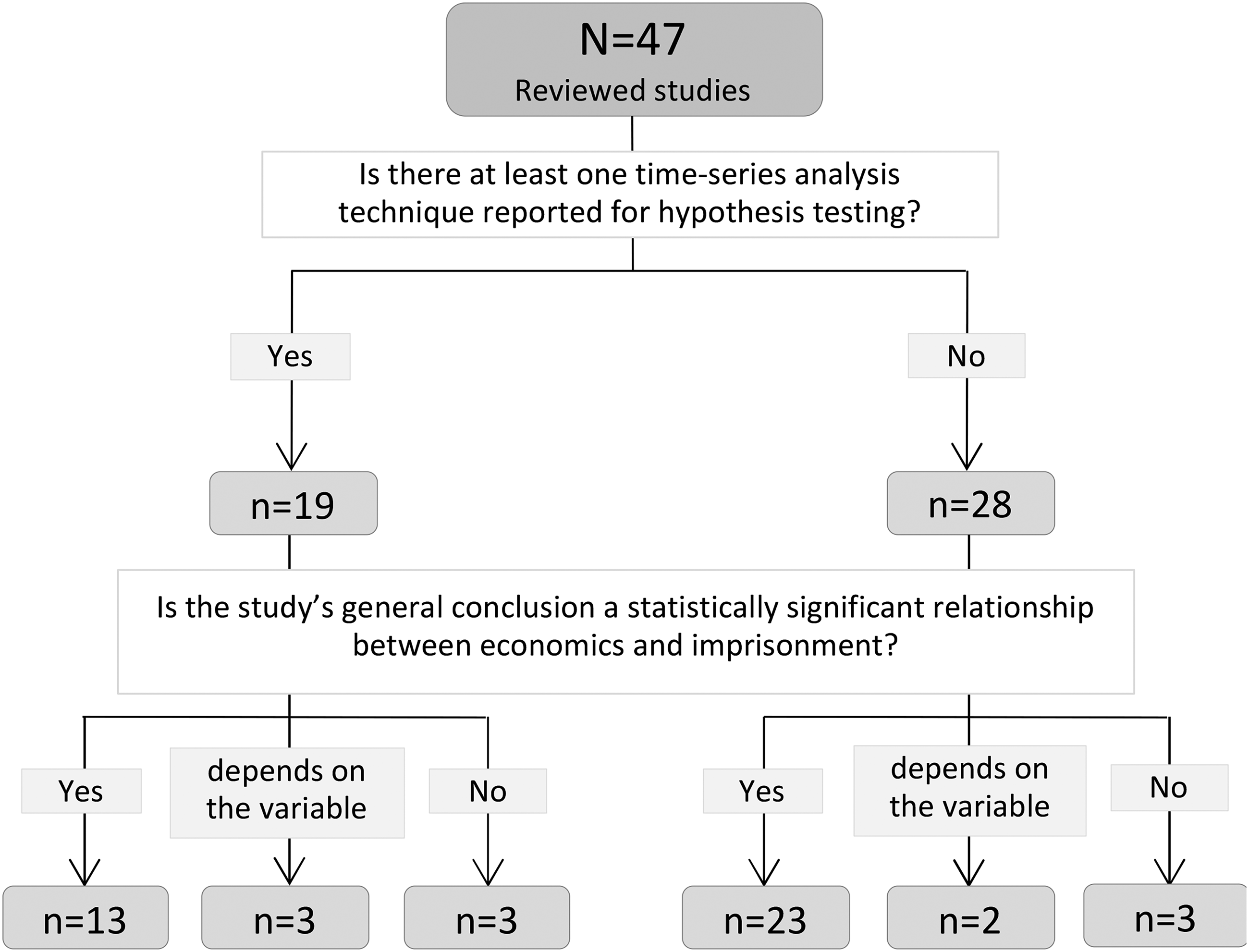
Study-level analysis. Distribution of 47 studies by research conclusion and methodological approach: Time-series-specific vs non-time-series methods in economy-imprisonment research.
The 47 reviewed articles apply 22 different data analysis techniques that are presented in Table 2. As a majority of 25 articles (53.2%) use a combination of two or more data analysis techniques, the total number of statistical analyses reviewed adds up to 88.
Distribution of analytical techniques in longitudinal studies of economic conditions and imprisonment, 1950s–2020s.
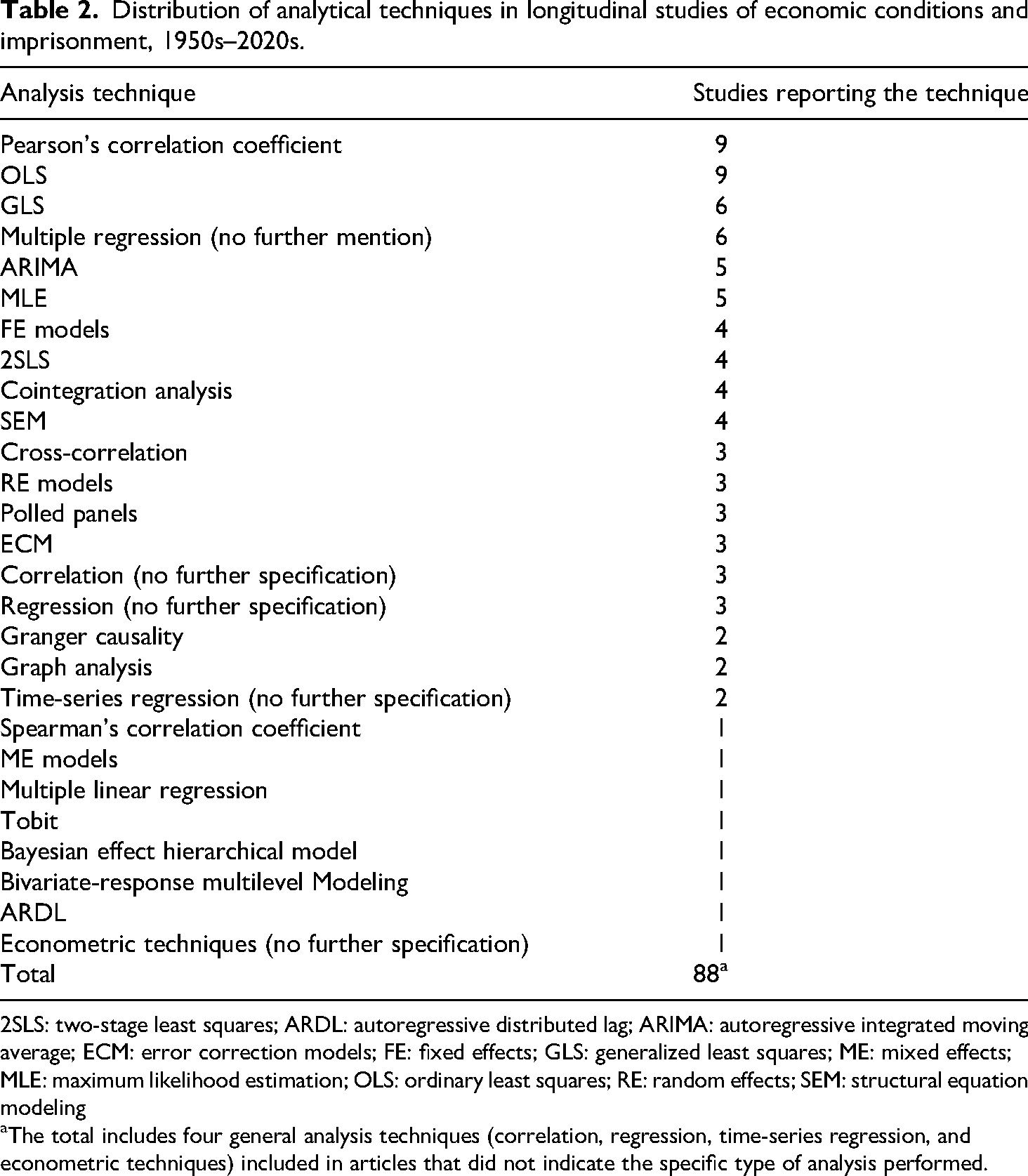
2SLS: two-stage least squares; ARDL: autoregressive distributed lag; ARIMA: autoregressive integrated moving average; ECM: error correction models; FE: fixed effects; GLS: generalized least squares; ME: mixed effects; MLE: maximum likelihood estimation; OLS: ordinary least squares; RE: random effects; SEM: structural equation modeling
The total includes four general analysis techniques (correlation, regression, time-series regression, and econometric techniques) included in articles that did not indicate the specific type of analysis performed.
Pearson's correlation coefficient and ordinary least squares (OLS) are the most frequently reported techniques for analyzing the relationship between economic conditions and imprisonment over time—each appearing in nine different studies—followed by generalized least squares (GLS), reported in six studies, and ARIMA and maximum likelihood estimation (MLE), each used in five studies. Altogether, these five techniques represent 39% of all reported analysis techniques across studies, with only one (ARIMA) being a time-series-specific technique. Notably, five articles published in the 1980s and 1990s mention general analysis techniques such as correlation, regression, and econometric techniques without specifying the precise methods employed; for instance, whether correlation analyses used Pearson or Spearman coefficients. This lack of methodological detail highlights the evolution in academic publishing standards, where contemporary scientific publications require explicit identification of statistical techniques. Additionally, this ambiguity may reflect the limited range of analytical approaches familiar to researchers in the early development of quantitative criminology. A plausible inference is that generic references to “correlation” typically indicated the Pearson coefficient until advances in statistical software expanded access to diverse analytical methods and heightened awareness of methodological alternatives among researchers in criminology.
In that perspective, up to the 1970s, data analysis was often manual and time-consuming, which limited the scope and complexity of research that could be feasibly conducted. The proliferation of computers on university campuses in the 1980s significantly enhanced data analysis capabilities. This advancement led to a surge in empirical research based on quantitative analysis across various fields, including criminology. The 1980s are in fact the decade with the highest number of longitudinal studies concerning the relationship between economic conditions and imprisonment (14 articles), followed by the 2010s (12 articles) and the 2000s (9 articles). Table 3 presents the distribution of articles by decade of publication, focusing specifically on studies that both reported using time-series analysis and clearly specified the particular analytical techniques employed. This more restrictive analysis excludes two articles that mentioned time-series regression techniques without identifying the specific analytical methods utilized. Consequently, Table 3 includes 19 studies that meet these more stringent methodological reporting criteria. 4
Evolution of time-series-specific analytical techniques in economy-imprisonment research by decade, 1950s–2020s.
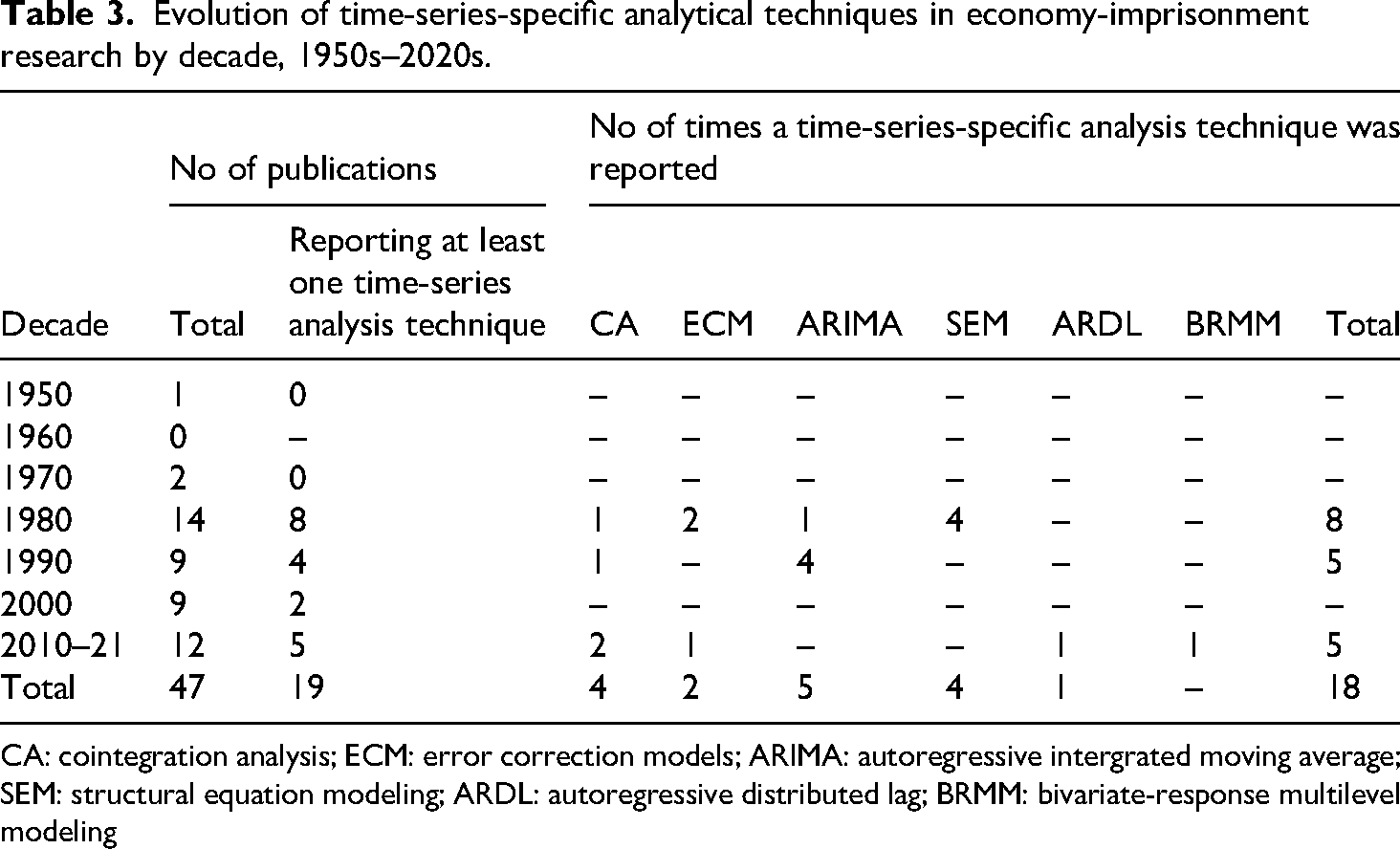
CA: cointegration analysis; ECM: error correction models; ARIMA: autoregressive intergrated moving average; SEM: structural equation modeling; ARDL: autoregressive distributed lag; BRMM: bivariate-response multilevel modeling
Among the 19 studies employing at least one time-series-specific data analysis technique, eight were published in the 1980s, four in the 1990s, and only five between 2010 and 2021. This relative decline in time-series-specific approaches during the twenty-first century likely reflects multiple factors. For example, while statistical software has become more accessible, truly appropriate time-series methods like CA remain technically complex and demanding, potentially deterring criminologists without extensive quantitative training. Many researchers may opt for more familiar but less appropriate methods rather than investing in mastering these sophisticated techniques. At the same time, the democratization of user-friendly statistical packages enables researchers to perform seemingly advanced analyses independently, potentially reducing interdisciplinary collaboration with time-series specialists from fields such as econometrics or statistics. This methodological isolation may lead to inappropriate application of techniques without full understanding of their underlying assumptions and limitations. Simultaneously, the big data revolution has enabled econometricians and statisticians to analyze criminological datasets without necessarily consulting domain experts familiar with the specific limitations and contextual nuances of criminal justice data. These paradoxical trends—criminologists avoiding complex methods or using advanced statistical techniques without proper statistical consultation, and statisticians analyzing criminological data without criminological consultation—may contribute to the methodological issues identified in our review. Table 3 identifies six different time-series-specific techniques reported in the reviewed publications: CA, ECMs, ARIMA, structural equation modeling (SEM), autoregressive distributed lag (ARDL), and bivariate response multilevel modeling (BRMM).
Finally, Figure 2 summarizes the 88 statistical analyses reviewed in this article. The majority of these analyses −68 out of 88 (77.3%)—are from studies concluding that there is a statistically significant relationship between economic conditions and imprisonment. Meanwhile, 14 analyses (15.9%) are from studies that find no significant relationship, and 6 (6.8%) from studies reporting mixed results, meaning the significance varies depending on the variable used to measure economic conditions and/or imprisonment. The flowchart also reveals that only 22.7% (20 analyses) employ a specific time-series technique, while 77.3% (68 analyses) do not. Of the 20 time-series-specific analyses, 14 (70%) are from studies concluding a significant relationship between the two phenomena, 4 (20%) are from studies concluding the opposite, and 2 (10%) from studies reporting mixed results. Finally, among the 68 non-time-series-specific analyses, 54 (79.4%) are from studies concluding that there is a statistically significant relationship between economic conditions and imprisonment, 10 (14.7%) from studies concluding the opposite, and 4 (5.9%) from studies reporting mixed results.
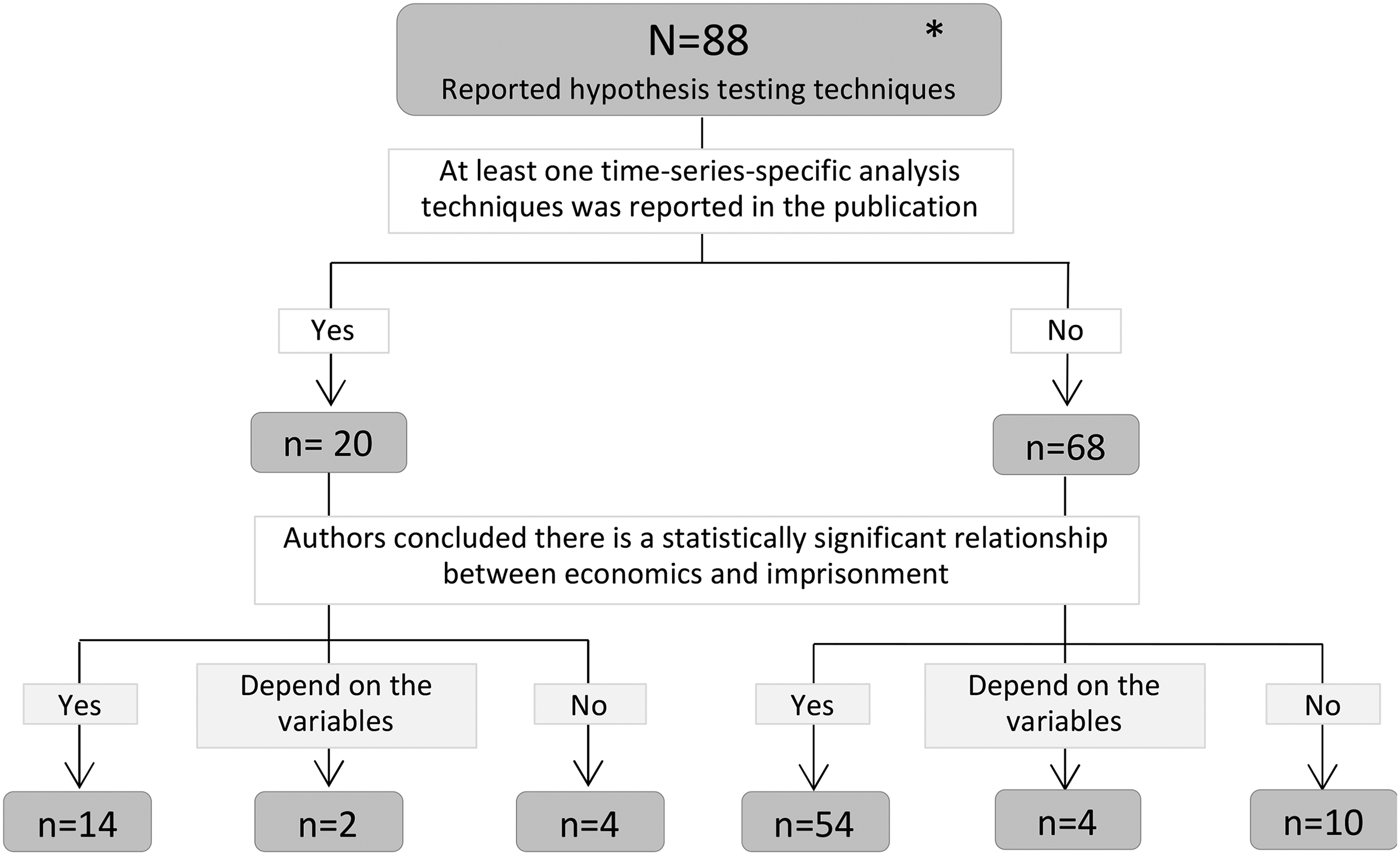
Technique-level analysis. Distribution of 88 statistical analyses by research conclusion and methodological approach: Breakdown of individual analytical techniques in economy-imprisonment research. *The total includes four general analysis techniques (correlation, regression, time-series regression, and econometric techniques) included in articles that did not indicate the specific type of analysis performed.
Case study: Economic conditions and imprisonment in France from 1960 to 2019
Our review has revealed significant methodological issues in the empirical literature on economic conditions and imprisonment, particularly the prevalence of techniques poorly suited for time-series data. The implications of these methodological concerns will be explored more fully in the discussion section, where we will connect them to broader theoretical considerations in the political economy of punishment literature. Before that, however, and to further illustrate how analytical choices can influence research conclusions, we present a case study examining economic indicators and imprisonment rates in France from 1960 to 2019. By applying multiple analytical approaches to the same dataset, this case study provides a concrete demonstration of how different methodological choices can lead to opposite interpretations of the same underlying data.
Data and methods
Our analysis examines the relationship between the prison population rate and five economic indicators, each selected for its theoretical relevance to the political economy of punishment:
Industrial production index: This indicator captures economic output and labor demand, directly reflecting Rusche and Kirchheimer's (1939) original focus on labor market conditions. Industrial production has been used in several studies (e.g., Laffargue and Godefroy, 1990; Myers, 1991) as a proxy for economic cycles and labor demand. Inflation rate: Inflation has been theorized to affect imprisonment through multiple pathways, including its impact on economic anxiety, social instability, and distributional conflicts (Lessan, 1991; Schissel, 1992). High inflation can create economic pressure on both individuals and state institutions, potentially influencing criminal justice policies and practices. Purchasing power index: This measure reflects the real economic well-being of the population and captures economic strain more directly than aggregate measures like GDP. Theoretical perspectives suggest that declining purchasing power may increase social marginality and influence the perceived need for social control (Wacquant, 2009). Unemployment rate: Unemployment has been central to tests of the Rusche-Kirchheimer hypothesis, with numerous studies examining its relationship to imprisonment (Box and Hale, 1985; Michalowski and Carlson, 1999). It directly measures labor surplus and the potential for economic marginalization. Gross domestic product: As a comprehensive measure of economic output, GDP captures overall economic conditions and has been frequently used in comparative studies of punishment (Lacey, 2008; Sutton, 2004). GDP growth may influence imprisonment through multiple pathways, including state fiscal capacity, social welfare spending, and broader socioeconomic conditions.
These indicators represent a range of economic dimensions potentially relevant to imprisonment, allowing us to examine whether methodological choices yield consistent or divergent results across different aspects of economic conditions.
We analyzed the relationship between the prison population rate per 100,000 inhabitants in France (obtained from the French Ministry of Justice archives and Council of Europe SPACE statistics 5 ) and the five economic indicators described above (all obtained from INSEE, the French National Institute of Statistics and Economic Studies). All variables were transformed into indices (1960 = 100) to facilitate comparison of trends over time.
To ensure methodological rigor, we first tested each time series for stationarity using both the Augmented Dickey–Fuller (ADF) and Phillips-Perron tests. All variables were found to be integrated of order 1, I(1), meaning they became stationary after first differencing. We then applied four distinct analytical approaches:
CA using the Johansen procedure to test for the existence of long-run equilibrium relationships between variables. Variable dynamics analysis through vector ECMs (VECM) to examine long-run and short-run dynamics when cointegration was present. Toda-Yamamoto causality tests, which extend Granger causality to be robust for non-stationary time series. Correlation analysis using both Pearson's correlation coefficient (r) and Spearman's rank correlation coefficient (rho) to measure the static association between variables.
This methodological pluralism allowed us to directly compare results from time-series-specific techniques (approaches 1–3) with conventional correlation analysis (approach 4) that our review found to be commonly but inappropriately applied in the literature.
Results
Descriptive trends
Figure 3 displays the trends in the prison population rate and the five economic indicators in France from 1960 to 2019, all indexed to 1960 = 100 for comparability.
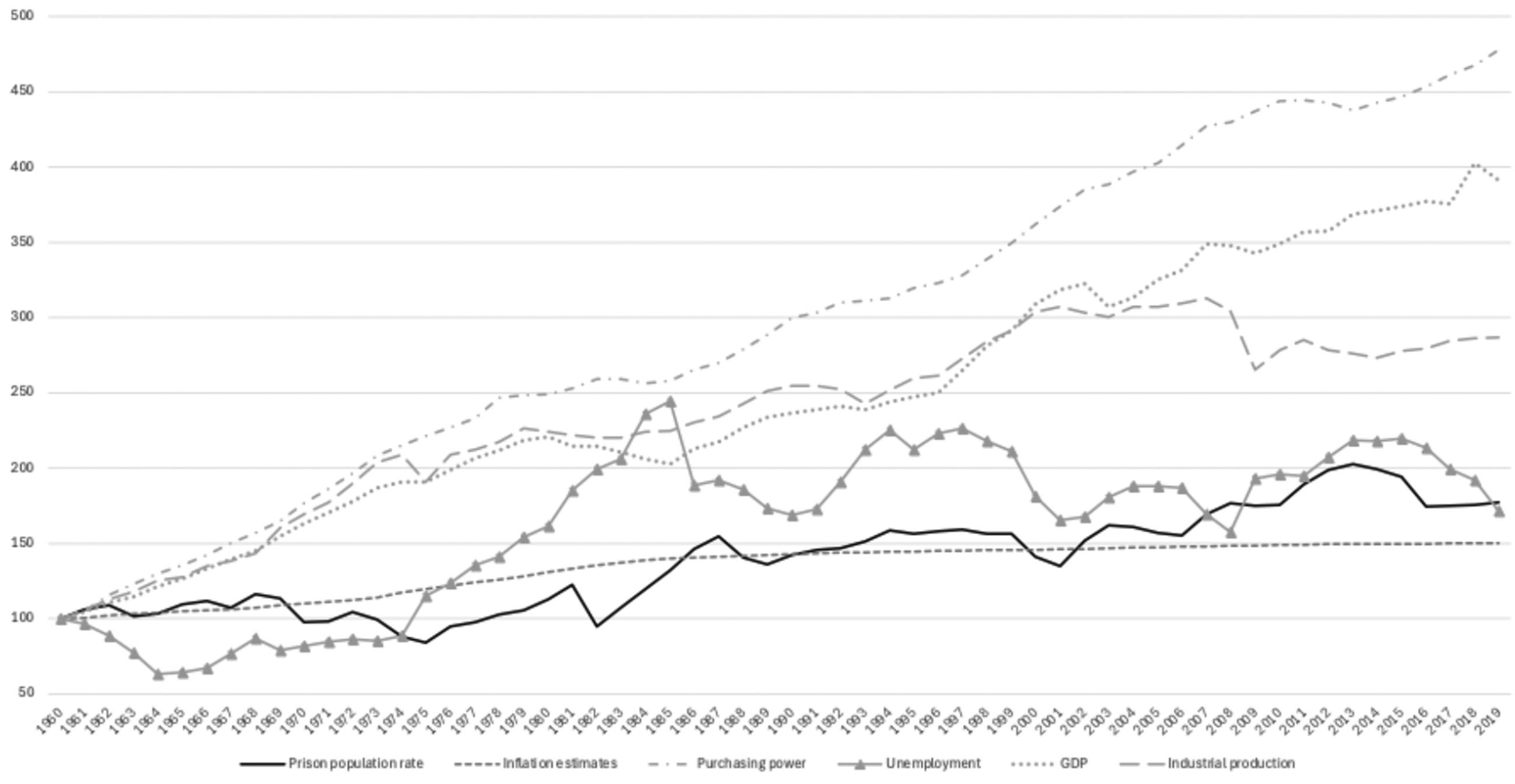
Trends in prison population rate (per 100,000 inhabitants) and five economic indicators, France 1960–2019 (1960 = 100).
Several observations emerge from examining these trends. First, the prison population rate shows considerable fluctuation over the 60-year period, with notable increases in the early 1980s and 2000s, and a period of decline in the early 1990s and after the 2008 financial crisis. This pattern does not follow a simple linear trend, suggesting that the relationship between economic conditions and imprisonment may be complex and historically contingent.
Second, most economic indicators show pronounced upward trends across the period, particularly GDP and purchasing power, which have increased substantially since 1960. This overall growth pattern creates conditions where spurious correlations can easily emerge when using conventional statistical methods that do not account for non-stationarity.
Third, despite the general upward trends in economic indicators, there are noticeable fluctuations that correspond to major economic events, including the oil crises of the 1970s, the recession of the early 1990s, and the global financial crisis of 2008. These fluctuations provide potential points for examining whether prison population rates respond to short-term economic changes.
Fourth, inflation shows a distinctly different pattern from the other economic indicators, peaking in the late 1970s and early 1980s before declining to much lower levels in recent decades. This divergent pattern offers an interesting test case for whether different analytical approaches yield consistent results across economic indicators with varying temporal patterns.
These observations from Figure 3 highlight why careful consideration of analytical techniques is crucial when studying time-series data. The apparent visual correlations between some economic indicators and imprisonment rates could easily lead researchers using conventional correlation or regression techniques to conclude that strong relationships exist, without adequately addressing the possibility that these associations are merely artifacts of shared non-stationary properties.
Statistical analysis results
Table 4 presents a summary of results across all analytical approaches.
Comparison of analytical techniques: Results from multiple methods testing the economy-imprisonment relationship in France, 1960–2019.
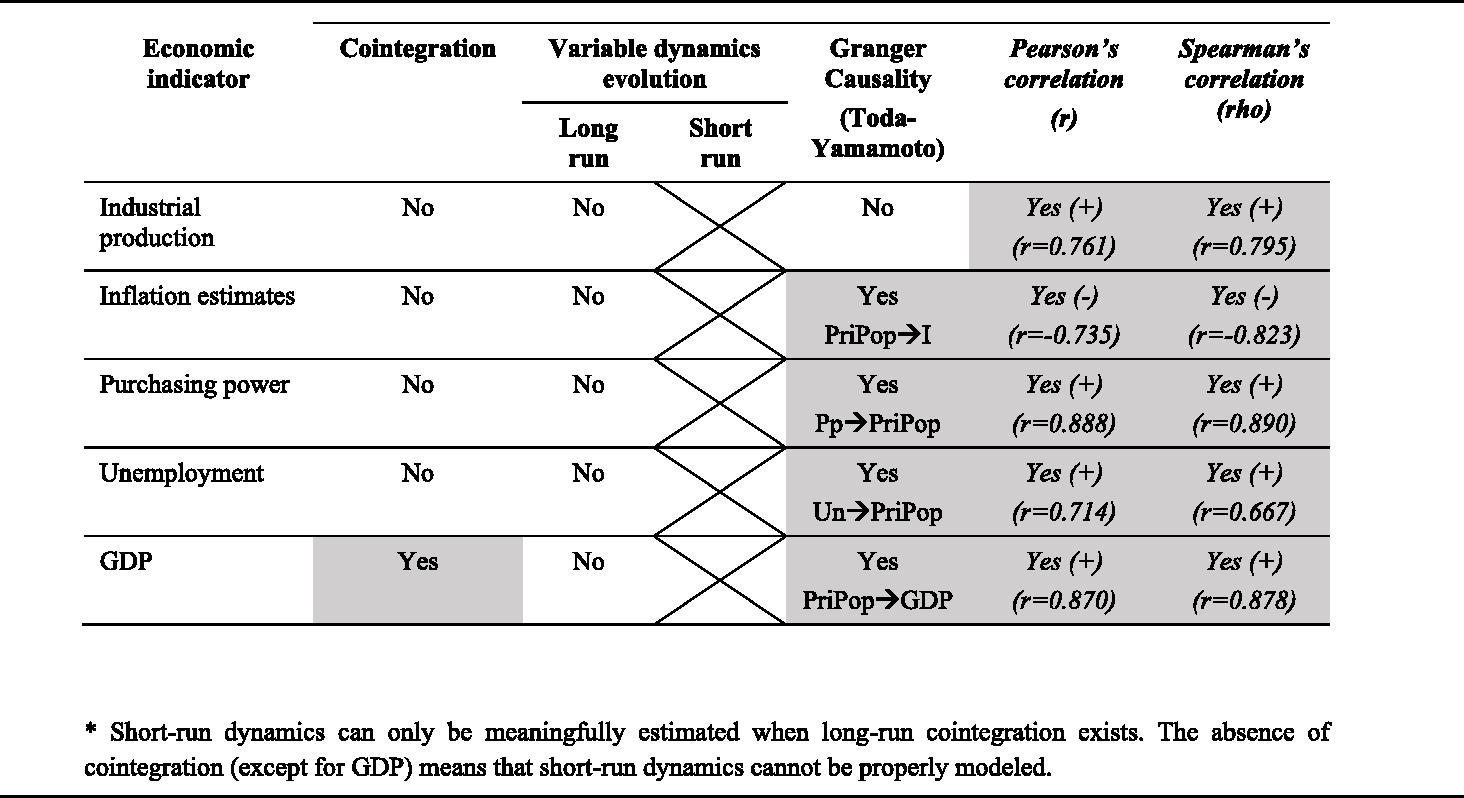
The results reveal striking divergences across analytical approaches. When analyzed using correlation coefficients—both Pearson's and Spearman's—all five economic indicators show strong, statistically significant associations with the prison population rate. These correlations appear substantial, with absolute values ranging from 0.667 to 0.890, suggesting a robust relationship between economic conditions and imprisonment.
However, when these same relationships are examined using CA—a technique specifically designed for time-series data—only GDP demonstrates a long-run equilibrium relationship with the prison population rate. Even in this case, despite the presence of cointegration, the variable dynamics analysis reveals no significant long-run or short-run effects between GDP and imprisonment rates. This indicates that while the two variables may move together over time (sharing a common trend), changes in GDP do not systematically drive or respond to changes in imprisonment in either the short or long term in a statistically significant manner.
For the remaining economic indicators—industrial production, inflation, purchasing power, and unemployment—no cointegration was detected, indicating an absence of stable long-term relationships with the prison population rate. This finding fundamentally contradicts what the strong correlation coefficients suggest.
The Toda-Yamamoto causality tests add nuance to this picture by identifying potential short-run interactions. These tests suggest that fluctuations in inflation, purchasing power, and unemployment may precede variations in incarceration rates in the short run, despite the absence of long-run relationships. Surprinsingly, for GDP, the causality appears to run from the prison population to GDP rather than vice versa. This unexpected finding initially appears counterintuitive given traditional assumptions in the literature. However, this reversed causality could reflect several plausible mechanisms. First, increasing incarceration rates typically entail significant state expenditures on criminal justice infrastructure, staffing, and operational costs, directly influencing GDP through public spending (Hooks et al., 2004). 6 Second, expanded imprisonment can signal broader shifts in governance strategies or policy environments, indirectly shaping economic priorities and resource allocations (Gottschalk, 2015; Wacquant, 2009). Lastly, incarceration trends may serve as leading indicators of underlying socioeconomic changes, reflecting institutional responses to economic insecurity or labor-market restructuring that only later manifest in GDP fluctuations. Rather than weakening our understanding, this finding underscores the complexity and potential bidirectionality of relationships between penal policies and economic conditions, reinforcing the need for analytical techniques capable of capturing these nuanced dynamics.
Discussion of case study findings
This case study empirically demonstrates several points highlighted in our literature review. First, it confirms that conventional correlation analysis can yield misleading results when applied to time-series data. The strong correlations between the prison population rate and all economic indicators suggest robust relationships that more appropriate time-series techniques largely fail to substantiate. Second, our findings illustrate how the choice of analytical technique directly influences research conclusions. A study relying solely on correlation analysis would likely conclude that all five economic indicators significantly relate to imprisonment rates in France. In contrast, a study employing CA would reach a much more nuanced conclusion: only GDP demonstrates a long-run relationship with imprisonment, and even this relationship lacks significant dynamic effects. Third, the case study results align with the broader pattern identified in our literature review: studies using time-series-specific techniques are less likely to find significant relationships between economic conditions and imprisonment than those using non-time-series-specific methods. This pattern suggests that many of the significant findings reported in the literature may be artifacts of methodological choices rather than reflections of substantive relationships. Finally, our analysis demonstrates the value of methodological pluralism in studying the economy-imprisonment relationship. The Toda-Yamamoto causality tests, for instance, reveal potential short-run interactions not captured by CA, suggesting that different methodological approaches may uncover different aspects of a complex relationship.
These findings underscore the importance of matching analytical techniques to the properties of the data being analyzed. The apparent contradictions between correlation and cointegration results are not merely technical curiosities but have concrete implications for our understanding of how economic conditions relate to imprisonment practices. In line with the theoretical developments discussed earlier, these methodological insights not only reveal analytical shortcomings but substantively corroborate contemporary theoretical propositions that the relationship between economic conditions and imprisonment is more complex, conditional, and context-dependent than many empirical studies assume. The methodological divergence in our results provides empirical validation for theoretical frameworks that emphasize mediating mechanisms and institutional contexts rather than direct, universal economic effects.
Discussion
Our review and case study reveal significant methodological issues in the empirical literature examining the relationship between economic conditions and imprisonment. The dominance of analytical techniques poorly suited for time-series data helps explain the field's inconsistent findings and may have produced numerous spurious results. 7 These findings support Kleck et al.'s (2006) observations regarding the prevalence of bivariate analysis and regression models in criminological research.
The divergence in findings based on methodological approach is particularly striking. Studies employing appropriate time-series methods consistently report fewer significant relationships than those using conventional techniques, a pattern vividly demonstrated in our France case study where identical data yielded opposite conclusions depending on analytical approach. 8 This suggests that methodological choices, rather than substantive differences, may drive many contradictory findings in the literature.
Despite methodological advances in related fields, criminological research on the economy-imprisonment relationship remains methodologically isolated. The underutilization of techniques like CA—standard in economics for decades—reflects disciplinary barriers and training gaps that perpetuate inappropriate methodological practices. 9 This underutilization likely stems from multiple factors. While statistical software has become more accessible, truly appropriate time-series methods remain technically complex, potentially deterring criminologists without extensive quantitative training. Simultaneously, user-friendly statistical packages may reduce interdisciplinary collaboration with time-series specialists, while the advent of big data has enabled statisticians and econometricians to analyze criminological datasets without necessarily consulting domain experts. This methodological isolation from both directions—criminologists working without statistical consultation and statisticians working without criminological consultation—may contribute to the prevalence of inappropriate methods.
Methodological and theoretical implications
The prevalence of inappropriate methods has produced a literature where spurious findings, misinterpreted trends, and overlooked dynamics may be more common than genuine insights into the economy-imprisonment relationship. The Toda-Yamamoto causality test results in our case study, revealing directional relationships that vary by economic indicator, illustrate the complex dynamics that conventional methods fail to capture.
The mismatch between theoretical sophistication and methodological practice is particularly problematic given that contemporary frameworks emphasize mediated relationships operating through institutional arrangements (Lacey, 2008), political dynamics (Simon, 2007), and cultural factors (Garland, 2001). Without proper time-series modeling that can distinguish between direct, indirect, and spurious relationships, researchers cannot adequately test these sophisticated theoretical propositions.
Time-series-specific methods offer capabilities aligned with these theoretical demands, yet remain neglected. This methodological-theoretical misalignment helps explain persistent empirical inconsistencies and prevents adequate testing of key theoretical propositions about institutional mediation and historical contingency. 10
While our analysis focuses on analytical techniques, we acknowledge that divergent findings in the literature also reflect variations in research design. The inclusion of control variables—particularly crime rates—the selection of countries, and the broader socio-economic and political context all contribute to heterogeneous findings. As Lappi-Seppälä (2019) notes, the relationship between economic growth and incarceration may vary depending on baseline economic resources. 11 These design choices interact with methodological decisions to shape research conclusions.
Recommendations for future research
Advancing the theoretical debate requires matching methodological approaches to theoretical propositions. Future research could prioritize: (1) Employing panel cointegration techniques for comparative studies that can account for both temporal dynamics and cross-national institutional differences, (2) explicitly modeling mediating variables from political and institutional contexts alongside economic indicators, and (3) testing for structural breaks corresponding to theorized historical transformations in the political economy of punishment.
While our review provides valuable methodological insights, it has limitations. We focus on longitudinal studies without discussing the validity of specific variables used to operationalize economic conditions and imprisonment, which also influence results. Additionally, our sample is limited to published journal articles. Future reviews could examine a broader range of studies and consider how imprisonment and economic conditions are measured across the literature.
Conclusion
This article has examined the methodological approaches used in longitudinal studies of the relationship between economic conditions and imprisonment, guided by three interrelated research questions about analytical techniques, their influence on findings, and their interaction with theoretical developments.
Our systematic review of 47 studies revealed that researchers predominantly employ methods poorly suited for time-series data. While sophisticated techniques have emerged over time, appropriate time-series-specific methods remain significantly underutilized in the field. This methodological pattern has profound implications for the validity of research findings.
We found substantial differences in research outcomes based on analytical techniques employed. Studies using conventional methods were markedly more likely to report statistically significant relationships than those employing time-series-specific techniques. Our France case study provided empirical demonstration of this phenomenon: correlation analysis suggested strong relationships between all economic indicators and imprisonment, while appropriate time-series techniques revealed far more limited connections. These findings demonstrate that methodological choices fundamentally shape research conclusions in this field.
Perhaps most critically, we identified a significant misalignment between increasingly sophisticated theoretical frameworks and the methodological approaches used to test them. Contemporary theories emphasize complex, mediated relationships operating through institutional, political, and cultural filters. Yet empirical studies often rely on methods that assume direct, linear relationships, preventing adequate testing of nuanced theoretical propositions.
The methodological limitations identified in this review help explain the inconsistent empirical findings that have long characterized research on the economic conditions-imprisonment relationship. When inappropriate methods are applied to time-series data, they produce results that may reflect shared trends rather than meaningful relationships. This suggests that substantial portions of the empirical literature may report artifacts of methodological choices rather than substantive connections.
Advancing understanding in this field requires integrating appropriate methodological approaches with theoretical insights about mediating mechanisms and contextual factors. Time-series-specific methods—particularly CA and ECMs—can capture the complex, conditional relationships that contemporary theory suggests characterize the political economy of punishment. By aligning methods with theoretical complexity, researchers can develop a more robust understanding of how economic forces shape punishment practices across different contexts and historical periods, ultimately informing more effective evidence-based policies.
Our call for methodological rigor is thus simultaneously a call for theoretical refinement. 12 Only by matching methods to the complexity of the phenomena under study can researchers develop a comprehensive understanding of the political economy of punishment—one that accounts for the mediated, contextual, and historically contingent nature of the relationship between economic conditions and imprisonment that contemporary scholarship increasingly recognizes.
Footnotes
Acknowledgements
The authors are non-native English speakers and acknowledge the use of ChatGPT and Claude as tools for text editing and refinement during manuscript preparation. While ChatGPT and Claude contributed to enhancing the language and sentence structure, all ideas, analyses, and perspectives presented in this article are the original work of the authors. The authors gratefully acknowledge the support of the University of Lausanne in facilitating the open-access publication of this research.

Contribution of the authors
This research is an indirect result of the PhD dissertation of Mélanie M. Tiago, supervised by Marcelo F. Aebi at the University of Lausanne (Tiago, 2023). For this article, Tiago conducted the literature review and statistical analyses, and prepared the first draft; Aebi revised the manuscript and prepared the second draft; both authors reviewed and approved the final version.
Funding
The authors received no financial support for the research, authorship, and/or publication of this article.
Declaration of conflicting interests
The authors declared no potential conflicts of interest with respect to the research, authorship, and/or publication of this article.
Data availability statement
The article is based on a review of published scientific articles.