



Abstract
Punishment and society scholars studying the dramatic increase in “carceral capacity” during the rise of US mass incarceration have tended to focus narrowly on prison construction. Drawing from research on digital punishment and the shadow carceral state, I shift attention instead to the expansion of carceral capacity through the creation of a new method of social control—digital incarceration—designed to annex and re-purpose infrastructure ostensibly built for telecommunications. The paper examines the little-known history of the birth of the digital prison in the 1990s, including organized market formation initiatives at Sandia National Laboratories in New Mexico, design work at the telecommunications giant American Telephone and Telegraph, and marketing and implementation at Pro Tech, a small startup in Florida. I show that the infrastructural development of digital incarceration was planned in the first instance by private sector technologists and entrepreneurs working outside formal policy processes. Drawing on this history, the paper spotlights the dynamics of penal entrepreneurialism as a force of carceral state expansion in a digital age.
Keywords
A range of punishment and society scholars have studied the rise of US mass incarceration as a dramatic increase in “carceral capacity” (i.e. Eason et al., 2024; Schoenfeld, 2018). Carceral capacity has typically been defined broadly as the total resources devoted to state punishment across criminal justice institutions (including police, the courts, and parole/probation), but in practice, researchers have tended to focus more narrowly on prison construction. For example, Schoenfeld (2018) introduced the term in a study of carceral expansion in Florida that focused largely on the state's “capacity to imprison” (21). And more recently, Eason et al. (2024) “operationalized” the concept nationally by “measuring prison building over time and place,” charting a “massive public works project” that cost conservatively $30bn and increased the number of prisons in the USA from 500 to nearly 1700 (970). What both studies illustrate is a tendency to imagine the infrastructural basis of carceral state capacity as a sprawling network of standalone fortified institutions.
This paper examines digital incarceration as an alternative vehicle of carceral state expansion, and in the process, responds to calls for shifting research on mass incarceration to the convergence of “mass supervision” (McNeill, 2018; Phelps, 2017; Robinson, 2016) with technologies of “e-carceration” outside prison (Arnett, 2019; Kilgore, 2022). My approach draws in particular on Beckett and Murakawa's (2012) work on the expansion of the “shadow carceral state” into institutional spaces that were previously separate from the criminal justice system, like the addition of criminalizing processes to the administration of immigration and debt collection—a dynamic they describe as “institutional annexation.” These ideas were developed to stimulate the “mapping” of less visible penal developments outside criminal law and justice institutions that nonetheless “increase the capacity of the state to punish” (Beckett and Murakawa, 2012)—work that continues more than a decade later (see Kirk-Werner et al., 2024; Murakawa and Beckett, 2024).
I extend on this tradition by mapping how digital incarceration was designed to annex and re-purpose infrastructure ostensibly built for telecommunications. There were makeshift experiments with electronic monitoring as early as the 1960s, when two postgraduate students cobbled together a small local surveillance system from discarded missile tracking equipment (Schwitzgebel et al., 1964), and by the 1980s, there were a dozen companies developing specialized equipment for the first systems of house arrest implemented in the USA (Renzema and Skelton, 1991). But in this paper, I examine the emergence of “digital incarceration” in the 1990s, a distinct form of electronic monitoring characterized especially by three practices: (1) satellite positioning to translate the locations of tracked people into spatial coordinates that can be stored and processed, (2) cellular communications to circulate this and other data across geographic distances, and (3) algorithmic data processing to continually compare the relative coordinates of tracked people and their virtual walls across entire criminalized populations. Each of these practices rely on co-opting the infrastructure of telecommunications—orbiting satellites, cell tower networks, and data storage servers—a foundational design feature of the digital prison that I call “infrastructural annexation.”
Punishment and society scholars are only beginning to come to terms with how the digital revolution has transformed carceral state development (Brayne, 2020; Jefferson, 2020; Lageson, 2020; Roberts, 2019). In this article, I argue that one crucial change has been the emergence of digital incarceration as an alternative vehicle of carceral expansion not reliant on prison construction. This is especially important to consider at a time when the prison building boom has gone bust (Harris et al., 2024), and since 2000, around 188 prisons have closed (16% of all facilities) and nearly 130,000 prison beds have been removed from the national network. Harris et al. (2024) argue that “the prison bust has made a substantial, though rarely acknowledged, impact upon the carceral state”—and marks a “substantial decline in US carceral capacity” (360–361). But the picture changes when the frame of analysis is broadened to include digital incarceration: the number of people on electronic monitoring, for example, almost doubled in the 4 years between 2019 and 2023 alone—from around 282,000 to 518,000 (Bäckman, 2024). In this larger context, what might seem like a decline in carceral capacity looks more like a shift from one type of capacity to another.
There is burgeoning field of specialized research into the rapid expansion of electronic monitoring in US criminal justice (Arnett, 2019; Boe, 2020; Kilgore, 2024; Kilgore and Sanders, 2018; Kirk, 2021, 2022; Weisburd, 2022). This work shows that while electronic monitoring is often promoted as an alternative to prison, the technology is also itself an instrument of incarceration—creating “electronic prisons” (Weisburd et al., 2021) and imposing “e-carceration” outside physical walls (Kilgore, 2022). What is generally missing from this literature is a fine-grained analysis of the infrastructure that makes incarceration without walls possible. While there has been a focus on the increase of global positioning system (GPS) satellite tracking in electronic monitoring (i.e. Nellis, 2014), which has now almost entirely replaced early methods of house arrest in the USA, this has obscured the equally important role of cellular technology and the wireless networks of digital telecommunications more broadly. Infrastructure is almost by definition invisible and taken-for-granted (Star, 1999), even more so wireless networks that are often viewed as virtual rather than physical (Dourish and Bell, 2007: 424–427). But the infrastructure of digital incarceration is doubly invisible because it was built for telecommunications and appears on the surface disconnected from the carceral state.
This paper opens a window on the usually opaque infrastructural basis of digital incarceration through a detailed, ground-up account of how it was designed to work in the founding moments I call the “birth of the digital prison.” Returning to this initial period of planning and design provides an opportunity to examine how annexation became the basic strategy for large-scale infrastructural development. And as I show, the key actors were not policymakers weighing the various options, but private sector technologists and entrepreneurs creating a novel method of social control for sale. Examining this history therefore doubles as a chance to consider the role of penal entrepreneurialism as a force of carceral state expansion in a digital age.
Penal entrepreneurialism and the birth of the digital prison
Feeley (2016) argues that the history of electronic monitoring provides a paradigm case of private sector entrepreneurs driving penal change (see also Feeley, 2002, 2018). But he shows that the underlying dynamics are much older: his sweeping historical research traces parallels in the role of “penal entrepreneurs” in establishing transportation in the eighteenth century, the modern prison in the nineteenth century, and electronic monitoring in the twentieth century. In each case, he suggests, private contractors actively created demand for and then supplied new forms of social control. Feeley argues that these dynamics have been especially important in the USA, a relatively weak state where the criminal justice system has no standalone research and development unit or central agency charged with developing new and improved ways of doing things (like European ministries of justice). In this context, entrepreneurs have filled the gap and become perhaps the single most important source of innovation in carceral state development. Feeley (2002) argues that many—maybe most—new forms of punishment have their origins in the business ventures of private contractors.
Feeley's work provides an important vocabulary for examining the role of penal entrepreneurs in the birth of the digital prison. Yet my paper is revisionist and points to important omissions in his historical account of electronic monitoring. For example, Feeley (2014) rightly identifies Florida as a central hub of development, but describes the key private contractor as the multinational giant Minnesota Mining and Manufacturing (3M), suggesting that the company provided most electronic monitoring technology in the state beginning in 1987 (19). In fact, 3M—a company more well-known for selling stationary products like Scotch tape and Post-it Notes—first entered the industry more than two decades later in 2010 (Etter, 2017). This entry began with a $200m acquisition of Israel-based company Attenti, which only 3 years earlier (then named Dmatek), had purchased Florida-based Pro Tech. 3M played a key role exporting digital incarceration around the USA and globally, but did so based on a purchase of already existing technology. As I show, the more important innovation took place at Pro Tech in the 1990s, and the company was not a multinational giant but a speculative startup co-founded by Robert Martinez, a former mayor of Tampa and Governor of Florida come penal entrepreneur.
Feeley shows parallels in private sector innovation across vastly different eras separated by hundreds of years. My timeframe is far more modest: I spotlight three historical episodes in the development of digital incarceration that all took place within around a decade. In section one, I examine organized market formation initiatives at Sandia National Laboratories in New Mexico; in section two, I outline design work at the telecommunications conglomerate American Telephone and Telegraph (AT&T); and in sections three and four, I explore how digital incarceration was marketed and implemented at Pro Tech in Florida. All three episodes are not only missing from Feeley's account, but either missing from or mentioned only briefly in most specialized histories of electronic monitoring (i.e. Burrell and Gable, 2008; Kilgore, 2022: 34–49; Lily and Nellis, 2013). This paper therefore extends on the existing historical record, and in the process, examines the more general role of private actors and commercial interests in the development of the digitized carceral state.
Corda and Lageson (2020) argue that in digital punishment, penal entrepreneurialism “version 2.0” follows an “opportunistic mode of action” in which private actors operate outside any formal delegation of state authority—like the data vendors who mine and commodify digital criminal records scraped independently from a variety of sources (15). But they suggest that electronic monitoring follows an earlier “version 1.0,” a “contractual model” in which “the government decides to adopt a newly available technology but authorizes private players to deploy it to carry out a government function…” (Corda and Lageson, 2020: 14). In this paper, I complicate the distinction and show how relatively autonomous private actors have been a key force of penal innovation in electronic monitoring too (more like version 2.0). Penal entrepreneurs spent years designing digital incarceration before securing contracts, and by the time formal public–private partnerships were established, a plan for infrastructural development had already been set in motion outside any overt policy process. These private actors also helped drive the government decision to adopt the technology in the first place, through market-making activities and other forms of lobbying and promotion.
Drawing on this history, I argue that the digitization of the carceral state has involved large corporate actors operating on a different order of magnitude than any of the private entities involved in founding the first prisons or the earlier systems of penal transportation (see also Jefferson, 2020: 3–4). This is an opportunity to rethink Feeley's (2002) original formulation of penal entrepreneurialism, in which the key actors were individual capitalists developing specific methods of social control. In the nineteenth century, for example, Jeremy Bentham spent a “small fortune” and “countless hours” perfecting his Panopticon prison design, trying to acquire a suitable building site, and courting influential friends to support his efforts; in return, he “expected to get rich with this venture” (Feeley, 2002: 331–332). Bentham was unsuccessful in this “obsessive quest” to obtain a contract to run the prison. But as Feeley shows, his individual entrepreneurial energy was nonetheless an important force in the birth of the prison, helping to convince policymakers and a skeptical public of the value of a novel institution.
In the birth of the digital prison, by contrast, I trace the early design to the technologist Joseph Hoshen at the laboratories of AT&T, then the world's largest phone company, with annual revenues in 1994 of around $75bn. AT&T held a state-sanctioned monopoly over the US phone network for much of the twentieth century, and used a portion of the monopoly profits to fund a network of research centers, named “Bell Labs” after Alexander Graham Bell, the company co-founder and inventor of the landline telephone. Historians have shown that Bell Labs researchers formulated the basic theory of information coding and transmission underpinning the digital age (Ceruzzi, 2018), and developed both the first communications satellites and the first cellular phone systems (Gertner, 2012). But in this paper, I focus instead on the little-known role of AT&T in fostering a new model of digital incarceration nestled within this larger telecommunications infrastructure, and in the process, draw attention to the role of large corporate actors in driving digital penal change.
By centering AT&T in the historical narrative, I also locate the emergence of digital incarceration at the epicenter of the “dot com boom” and a much broader digital revolution in computing and telecommunications (see Srnicek, 2016: 14–16). The resources funneled into information and communication technology during this period remains unprecedented: in 1980 the level of annual investment in computers and peripheral equipment was $50bn; by 1990 it had more than tripled to $155bn; and by 2000, it reached a still unsurpassed peak of $413bn. Millions of miles of fiber optic and submarine cables were installed, there were major advances in software and network design, and large investments in databases and servers were made. The US military completed the GPS and began releasing it for non-military human tracking (Bernard, 2019: 27–60). A national network of cellular towers was constructed (Wikle, 2002). And as this massive expansion of telecommunications infrastructure laid the groundwork for the digital economy to come—the digital prison was born.
In this paper, I spotlight specific people who worked to bring the digital prison into being, examining their patents and diagrams, published writing and marketing imagery. In the next two sections, the focus is paid technologists employed within large corporations with no obvious connection to the carceral state at all. This begins not at AT&T but at the Sandia Corporation, a company ostensibly engaged in the management of a large nuclear weapons research complex in New Mexico, and a little-known technologist named Debra Spencer. The account begins in 1993. Electronic monitoring had been operating in US criminal justice for less than a decade, and the initial methods of house arrest were localized and wedded to the landline telephone. And now Sandia, a giant corporate actor located at the heart of the US nuclear establishment, became involved in overhauling this technology and ushering in a new form of digital incarceration. This is an understudied chapter in the history of not only electronic monitoring but the digitization of the carceral state more broadly.
Market formation at Sandia National Laboratories
In August of 1993, Debra Spencer and other “tech transfer” managers from Sandia National Laboratories met with officials from Boulder Incorporated (BI), the Colorado company that was the largest in the US market for early house arrest technology—and remains the largest electronic monitoring company in the world. At the time, BI relied on short range equipment that was wedded to the landline telephone, using a small box attached to the phone to track a person's presence in or absence from the surrounding area (usually over a few hundred yards). This simple mechanism turned the house into a site of “house arrest”—but the tracked person dropped from coverage anytime they left the property. A discussion document circulated at the meeting suggested this fundamental weakness of telephone-based house arrest was “inherent to the technology,” and “the next generation of electronic monitoring equipment should center on creating a system with tracking capabilities” (Sandia National Laboratories, 1993: 1). For Debra Spencer and Sandia, the goal was steering BI and other private actors toward building this more expansive surveillance network.
Spencer was a different kind of penal entrepreneur than the people featured in Feeley's (2002) historical research, not an autonomous business person developing a specific method of social control, but a paid technologist trained in creating commercial markets from existing military technology. And her employer, Sandia, had no clear relationship with the carceral state; it was part of a sprawling nuclear arms complex in New Mexico that included weapons design and testing at Sandia, Los Alamos, and the White Sands Missile Range, and the largest single arsenal of nuclear weapons in the USA at Kirtland Air Force Base (Gómez 2022; Masco, 2020). In 1993, the company had 7500 employees and a budget of $1.35bn. But in the wake of the Cold War and collapse of the Soviet Union, Sandia was facing budget cuts and potential redundancies. In this context, the business model increasingly hinged on subsidizing other companies to create domestic products from the underlying military technology—then sharing in the revenues. Sandia called this commercialization process “tech transfer.”
In this context, Debra Spencer worked on a wide variety of emerging methods of social control. In a published review of Sandia's “criminal justice projects,” for example, she described the development of a video simulator for planning the layout of CCTV cameras at prison perimeters, and a backpack-mounted gun for controlling prisoners using an immobilizing sticky foam that Sandia originally produced to protect nuclear facilities (Spencer, 1995: 5). These were entrepreneurial initiatives geared from the beginning toward creating for-profit products cheap and reliable enough to be purchased by carceral state customers. As Spencer described (7): The nation's technologies developed to protect nuclear and other high value assets have enormous potential to improve all our lives when applied to crime and personal safety. The difficult parts of doing this are simplifying the transfer of this technology to private industry and eventually to criminal justice practitioners, doing it efficiently and accurately enough to create cost-effective applications that work, and providing a way to make the cost for the new systems affordable by state and local agencies.
The Sandia contract with Spectrum was a market formation initiative intended to cultivate both commercial production and customer demand. On the one hand, Spectrum was funded to develop a system concept, in the hope this might encourage initial production, whether it was adopted by the company itself or used as a guide by other private actors looking to enter the emerging industry. At the same time, Spectrum met with policymakers and officials to identify potential customers and promote demand. Within 6 months of signing the CRADA, for example, Spectrum reported meetings with a range of corrections officials in California, Texas, and Florida—the three largest departments in the country. The company even claimed its outreach directly fostered demand in Florida: describing “a number of discussions” with Richard Nimer from the Florida Department of Corrections, and suggesting he was “interested in replacing his old EM equipment with the next generation technology,” and had allocated $500,000 toward “implementing a pilot program” (2). As I show in sections three and four, the Florida contract was ultimately signed with the company Pro Tech, not Spectrum, but Nimer's apparent interest nonetheless suggests a potential role of Sandia market-making in helping to create this initial customer base for new technology.
The Spectrum system concept proposed building specialist tracking infrastructure from scratch, installing networks of “receiver stations” at high points around cities, each containing antenna, GPS receivers and modems, and computers with associated software. Spectrum called it “MetroTrack” because these stations would be “located strategically throughout the metro area”—installed on tall buildings, for example—and a tracking device moving around inside could then be located by triangulating signals from them. Around the same time, the weapons manufacturer Northrop Grumman installed a similar prototype in downtown Pittsburgh that was comprised of four purpose-built “mini-base stations.” The base stations were arranged in a square to create a single 800 m × 800 m cell that could, like the MetroTrack system, locate a tracking device moving around inside. Northrop proposed this single cell could be gradually built out into a citywide grid that would be the basis for a “comprehensive, community-wide electronic monitoring system” (Murphy et al., 1996). If implemented at scale, both these models would have more closely resembled conventional prison construction, relying on the physical expansion of carceral infrastructure visible on the ground.
Debra Spencer's contribution as a penal entrepreneur was in the general cultivation of a market rather than the creation of a particular product or concrete plan for how the system would work—and the Spectrum proposal to build specialist tracking infrastructure from scratch was never fully developed or sold to the carceral state. But she did also feed into larger debates over the technical details of design. In November of 1996, for example, Spencer and two collaborators reviewed a range of options in a paper on “wide-area continuous offender monitoring” presented at a Sandia co-sponsored conference in Boston on “Command, Control, Communications, and Intelligence Systems for Law Enforcement” (Hoshen et al., 1997). Drawing on the planning work of Spectrum and Northrop Grumman, the group claimed that “the first systems will certainly be built as self-contained local systems” (174). At the same time, they also predictedthe ultimate course of development in arguing that “we may need to eventually extend the system to cover the entire nation,” and suggesting this growth was “becoming possible because of ever extending wireless networks,” in which “offender monitoring would become just another database service in these huge networks” (174).
Importantly, one of Spencer's collaborators on this paper was Joseph Hoshen from AT&T Bell Labs. 1 Because by then, Hoshen and AT&T had already patented this kind of wireless network design for digital incarceration—a clear alternative to MetroTrack—and articulated a basic template for how the system could operate. I examine this model in the next section.
Cell towers as carceral infrastructure
Joseph Hoshen was an unusual penal entrepreneur, without any particular business acumen or even experience with criminal justice. His contribution to developing a new for-profit method of social control drew instead on his background as a systems engineer working on the mathematics of telecommunications. Hoshen was employed at a Bell Labs complex in Naperville, Illinois, that specialized in researching the switching infrastructure underpinning phone networks. He developed algorithms to speed-up changes to AT&T's “5ESS” switching system, for example, cutting the “queue times” of software updates from 40 to 3 days and publishing the results in The Journal of Software (Hoshen, 1998), as well equations for triangulating GPS satellite signals into location estimates using ancient Greek geometry (Hoshen, 1996). In the 1990s, Hoshen also began writing and publishing on the technical design of electronic monitoring (i.e. Hoshen et al., 1995). And this work was commercialized by AT&T in a patent for a “locator device” filed in May of 1994—with Hoshen named as the inventor—that provided an initial map of a yet to be created system of digital incarceration nestled within the emerging infrastructure of cellular communications.
Working at Bell Labs, Hoshen had a front row seat to the broad shift from the landline to the mobile phone unfolding at the time. An AT&T subsidiary—Ameritech Mobile Communications—launched the first commercial cell service in the country in Chicago in 1983 (Channick, 2023). The tech boom then stimulated a period of massive investment in cellular infrastructure: between 1985 and 1995, the number of cell phone towers in the USA increased from around 1000 to 25,000, and by 2001, had reached more than 125,000. The national construction of cell tower networks most obviously laid the groundwork for the mass adoption of the mobile phone. But with these shifts still in their infancy, Hoshen also recognized the carceral potential of cellular infrastructure.
The central diagram in the AT&T patent was based on the geometry of cell tower construction, showing hexagons arranged in a honey-comb pattern (see Figure 1). The companies that built this infrastructure arranged towers in hexagons to maximize the coverage provided by each site, without overlapping with others, while minimizing blackspots—each area is known as a “cell,” hence the language of “cellphones” and “cellular technology.” But Hoshen re-imagined this infrastructure as an all-encompassing carceral network. The “house arrest prisoner” would be located through a device clamped to their ankle, but police and potential victims would also carry locator devices, and all three groups would be linked to the back-end database system by a series of interconnected “cell sites.” The tracking device itself was depicted as like a cellphone: it would communicate using radio-waves to send information wirelessly to the nearest cell tower, and like most early mobile phones, was shown topped with an external antenna protruding from the outer shell (see Figure 2). He even suggested the equipment might have a “communications interface” for making and receiving voice calls.
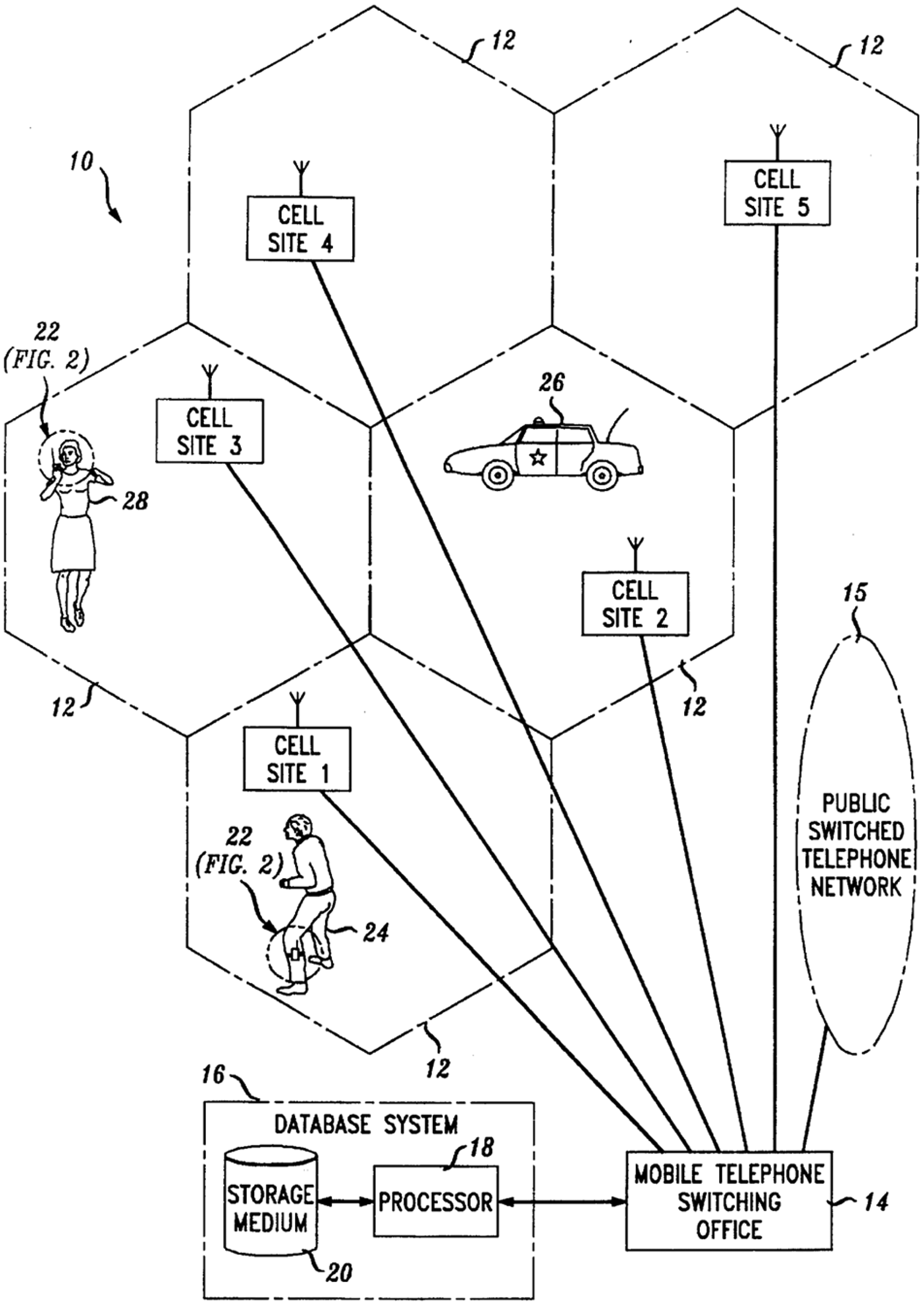
AT&T patent image of cellular carceral network. AT&T: American Telephone and Telegraph.
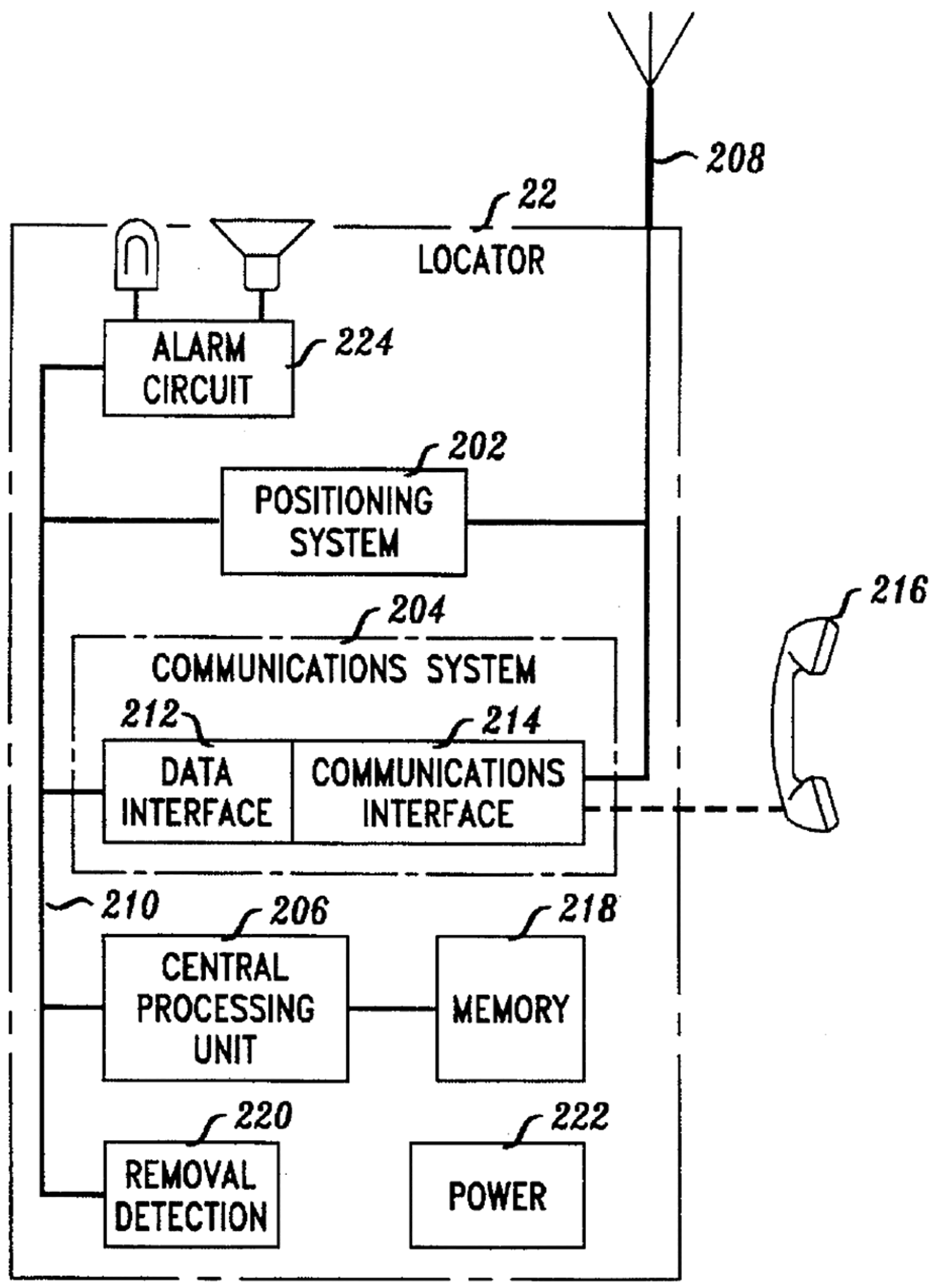
AT&T patent diagram of locator device. AT&T: American Telephone and Telegraph.
AT&T imagined the ankle monitor would use satellite communications to determine the location of the house arrest prisoner: the patent proposed building a “global positioning system card” into every locator device, that would then calculate “latitude, longitude, and altitude coordinates by triangulating a plurality of satellite signals” (Hoshen, 1995: 6). This was the methodology of a GPS poised to transform telecommunications, but which at the time was a little-known technology still under construction within the US military (Bernard, 2019; Ceruzzi, 2012). GPS launches began in the 1970s, and each satellite in orbit was continuously sending back its position to earth at the speed of light, where a receiving device on the ground needed clear line-of-sight signals from at least three to calculate a position (using variation in the timing and distance of signals and how they intersect). The complete constellation of 24 satellites was not even fully operational until 1995 (Air Force Space Command, 1995), but by then, AT&T had already patented a novel system of digital confinement built on this emerging infrastructure.
The AT&T patent articulated the space of digital incarceration not as a closed institution, like a prison, or a single property, like traditional house arrest, but as an abstract “polygon”—a flat plane that has at least three sides, no curved lines, is always closed, and has a particular set of mathematical properties drawn from geometry. These polygons would be created and mapped onto a physical location by entering spatial coordinates in a central database. The database would continually compare the location of the house arrest prisoner relative to the boundaries of the primary carceral polygon they had been assigned, a “determination of inclusion” checking they were “within particular bounds” (generally, inside their own residence). But the polygons of digital incarceration could span “multiple locations depending upon the time of day,” so that the tracked person could be expected to move between different spaces—for example, from home to work and back. And this basic mechanism could also be used to establish “areas of exclusion” from which the tracked person was forbidden, similarly defined by perimeter coordinates and active times in a database, that would “determine whether the subject has stayed out of a particular area.”
This formulation turned confinement into a data-processing task: the patent included flow charts representing the operations of a central database, with the key “decision diamond” comparing the coordinates of a tracked person with their assigned perimeters at a given point in time. The charts showed a database working through the entire list of house arrest prisoners one-after-the-other, checking whether or not “the location coordinates of the subject” were “within a polygon” defined by their database record, before starting again at the beginning. The patent suggested the text Computation and Geometry by Franco Preparata as a guide to building this data-processing architecture.
For AT&T, the patent established a legal claim to property rights over the commercial development of the locator device. But the main contribution of Joseph Hoshen as a penal entrepreneur was mapping in advance how this equipment could anchor a larger system of confinement outside prison walls. All three pillars of contemporary digital incarceration were present in his 1994 design: satellite positioning, cellular communications, and the algorithmic data processing of relative locations. At that historical juncture, Hoshen's technical breakthrough was seeing how these still relatively marginal technologies could be re-fashioned for the purposes of carceral control.
AT&T awarded Pro Tech, a small startup in Florida, an exclusive license to commercialize the technology—a history covered in the next two sections. The business advantage of doing so was outsourcing the cost of development while also fostering the formation of a new industry dependent on the company's cellular infrastructure. AT&T was leading a boom in cell tower construction, and the owners of this infrastructure generate revenue by charging fees for access—in this sense, it does not matter if the device accessing the network is a mobile phone or a locator device for electronic monitoring. For AT&T, then, digital incarceration was another way of commercializing cellular infrastructure that the company was already building for everyday communications. But Pro Tech was a more conventional site of penal entrepreneurship: a company founded specifically to sell a new method of social control. The enterprise was headed by Robert Martinez, and much of the innovation was in the marketing.
Doing business in the carceral telecommunications nexus
As the Governor of Florida between 1987 and 1991, Robert Martinez emerged as a national figure in the get-tough movement, driving prison expansion through staunch legal resistance (Schoenfeld, 2010, 2018: 109–115). Civil rights litigation challenged draconian conditions in Florida and forced policymakers to cap prison numbers and find ways to release prisoners at key overcrowding thresholds. So Martinez led a strategy of redefining these limits as a mandate for prison building. He wielded the threat of forced releases to persuade legislators to spend on prisons by, for example, sending them lists of people from their districts who would be released if they chose not to build (raising the specter of media backlash). And in his 4 years as Governor, the legislature approved funding for more than 27,000 additional prison beds—or the equivalent of 27 new institutions (and six times the resources allocated in the 5 years before). Martinez championed a model of infrastructural development that prioritized “quick construction” prototype prisons assembled on cheap land in remote areas using the labor of existing staff and prisoners. One senior corrections official described his general attitude this way: “we are going to build them wherever we can and wherever it is cheapest” (see Schoenfeld, 2018: 111).
Two years after leaving office, Martinez co-founded Pro Tech to develop and sell satellite-based electronic monitoring to policymakers confronting court-mandated prison releases—a business venture that would create an alternative source of carceral capacity. Examining this little-known later chapter in Martinez's career, when he transitioned from elected official to penal entrepreneur, is another opportunity to consider the role of private actors in electronic monitoring and digital penal change more broadly. His influence was more important than simply responding to the demand of state agencies that had already decided to adopt new technology and then authorized a private company to deploy it (Corda and Lageson, 2020: 14). Martinez co-founded Pro Tech as a speculative venture outside any formal contract, delegation of state authority, or award of taxpayer resources. Rather than catering to pre-established market demand, Pro Tech created a product in advance and helped produce the necessary customers to trial the technology in practice.
Martinez was well-placed to sense an emerging demand among policymakers. In 1993, Florida was one of 40 states across the USA under court order to reduce overcrowding and/or eliminate unconstitutional prison conditions (see Schoenfeld, 2010). And even in California, where policymakers undertook the “biggest prison building project in the history of the world” (Gilmore, 2007: 26), the prison system had entered a sustained period of “chronic hyper-overcrowding” (Simon, 2012: 110). The early methods of house arrest were increasingly discredited as overly localized and limited in their coverage. Martinez sensed a market niche selling a more expansive digital alternative to carceral state customers confronting legal and financial constraints on traditional prison capacity.
An early profile in the magazine Corrections Professional suggested that Pro Tech had an “eight-member team of aerospace engineers” who began working on the technology in 1993 (Jones, 1996: 6), and by 1996, the company was running “live demonstrations” with corrections officials and practitioners around the country. The Pro Tech website listed 13 of these demonstrations that year, including visits with the State Department of Corrections in Florida, California, Washington, and Pennsylvania, attendance at both the summer and winter training institutes of the American Probation and Parole Association, and a TV appearance on CBS This Morning. This flurry of product development and marketing activity preceded the company entering any formal public–private partnership.
The design that Pro Tech developed during these early years, outlined in a patent filed in August of 1996, was an iteration of the original AT&T model of building tracking equipment to be nestled within the infrastructure of the mobile phone (Layson, 1998). Joseph Hoshen had proposed creating a “locator device,” and in Florida, Pro Tech patented a “portable locator or tracking apparatus.” This shift in language, from “device” to “apparatus,” signaled that Pro Tech was unable to build a single piece of tracking equipment small enough to attach to the body. Instead, they proposed a “two-piece” system, with a tracker strapped to the ankle monitoring the main, larger device that was carried separately (an alarm signaled if these were too far apart). The antenna, computer processor, and other key electronic components were almost all contained in the carried device—which was bulky (7 × 4.5 × 2.75 inches) and weighed almost 5 pounds—rather than the paired ankle monitor. But the Pro Tech design was nonetheless an iteration of the earlier AT&T template, built on mobile communications equipment designed for data transfer over cellular networks.
As it had been at AT&T, a key focus of the Pro Tech patent was addressing the data-processing challenge of continually comparing the relative locations of tracked people and their assigned virtual walls on a large scale—so that escapes could be identified in real time. But the Pro Tech approach shifted the bulk of data processing from a central database (as imagined by Hoshen) to a “distributed network” of portable equipment. Now the (carried) locator device was imagined as a small computer that could operate as a “processing node on an overall network” (1). These devices would download the coordinates of assigned boundaries and “place scheduling rules and location constraint processing intelligence with a subject”—rather than the large-scale, concentrated database architecture that AT&T had imagined would process the location constraints of every tracked person simultaneously. Pro Tech claimed this was a faster and more efficient approach to monitoring boundary violations, providing “real-time event processing not achievable through a centralized approach” (1).
Building on the AT&T model, the Pro Tech patent re-imagined the infrastructure of digital telecommunications as an extension of the carceral state: orbiting satellites arranged along the top, a cell tower placed at the center, and a central database accessed through an interface on a desktop computer (see Figure 3). Both “victims” (left) and “offenders” (right) were represented as carrying tracking devices in their hands, while the latter were also strapped with ankle monitors. But the key actors in the diagram were officials from carceral state agencies. The figures reading faxed printouts of information, for example, were described as representing the “supervising agency, such as parole and probation” (Layson, 1998: 3). The central role of “law enforcement” was visualized with the inclusion of a patrolling police vehicle. The diagram was most obviously a technical description of how new tracking equipment was designed to work; but more abstractly, it imagined a broader process of expanding carceral state power through the infrastructure of digital telecommunications.
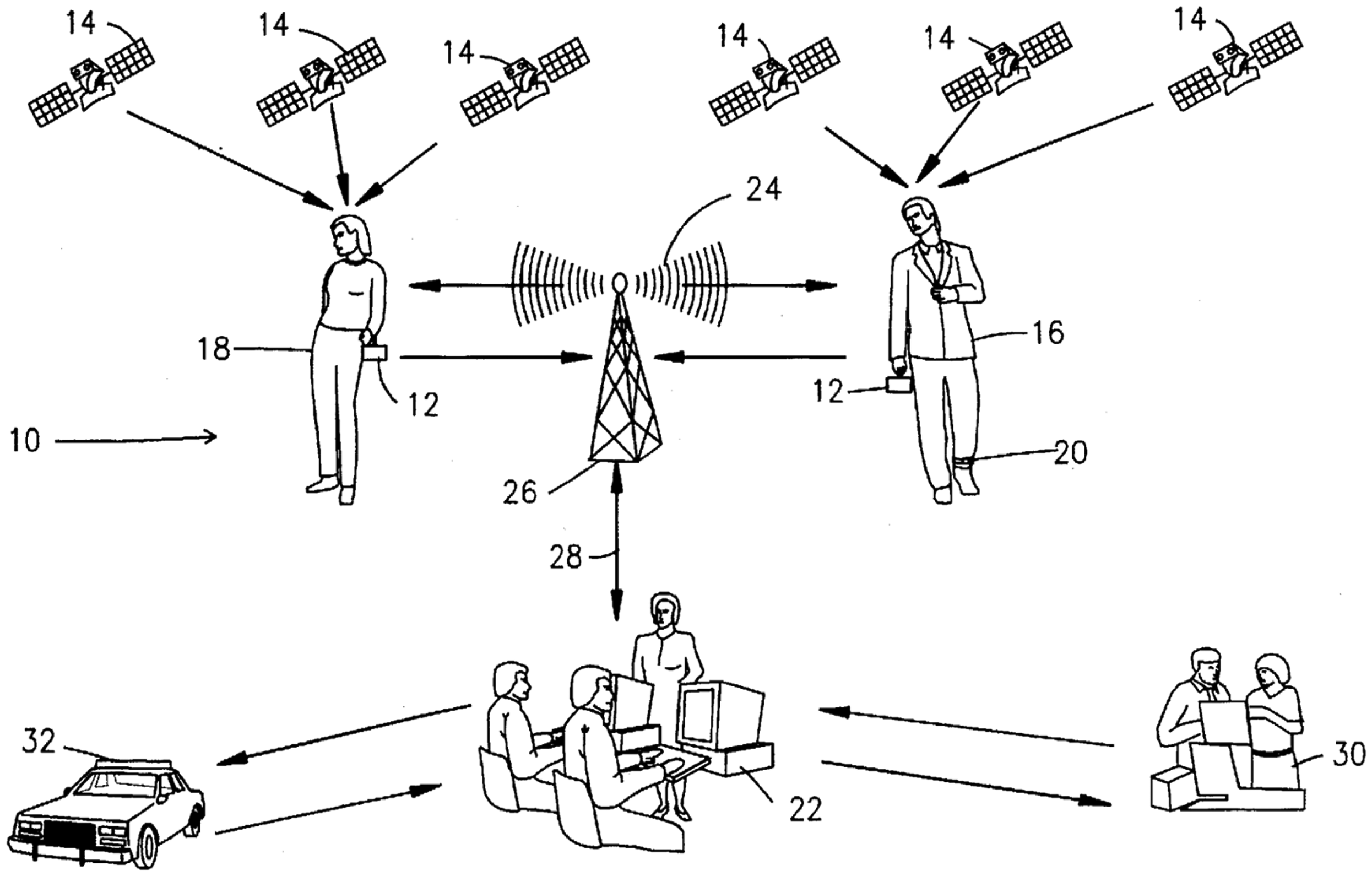
Pro Tech patent image of distributed carceral network built on cell tower infrastructure.
Crucially, this proposed transformation of the carceral state was crafted not by policymakers but by private sector technologists and entrepreneurs. The entire process of planning and design covered in the paper so far—spread across Sandia, AT&T, and Pro Tech—was a commercial exercise located outside the usual channels of penal policymaking. This was a key period in the digitization of the carceral state, initiating a plan for the large-scale infrastructural development of a new kind of incarceration that could operate outside prison walls. But the process was opaque and subterranean (i.e. Beckett and Murakawa, 2012: 223), taking place within untransparent corporate entities rather than state agencies with clear mechanisms of public consultation, debate, and oversight.
The penal entrepreneur who most visibly launched this plan publicly was Robert Martinez. His contribution was in sales rather than design, drawing on his political credentials as a former Mayor of Tampa, Governor of Florida, and prominent national figure in the US prison construction boom. Martinez leveraged his reputation for get-tough policymaking inside the carceral state as credibility in his new role selling an experimental method of social control from outside. For example, the magazine Corrections Professional assured its readers—a key potential customer base for Martinez and Pro Tech—that he was “no stranger to corrections,” having “expanded Florida's prison system by about 30,000 beds during his governorship,” and suggested that now his technology could be used for “monitoring groups of inmates such as those on chain gangs” (Jones, 1996: 3). As Martinez developed the public relations strategy, he even hired his son, Alan, as the Pro Tech “marketing chief” (Trigaux, 1997). The sales imagery developed by this father-son team obscured as much as it revealed about the underlying dynamics of infrastructural annexation.
The orbiting warden
Robert Martinez named the Pro Tech product the “Satellite Monitoring and Remote Tracking” system—or “SMART” for short—and the company logo showed a bald eagle gripping a police badge printed with a satellite circling earth among the twinkling stars (see Figure 4). Less formally, he called it the “orbiting warden,” and peppered descriptions of the technology with the phrase “space age.” And when Pro Tech signed a crucial first contract with the Florida Department of Corrections, the Tampa Bay Times announced the deal with a headline adopting the company slogan: “Orbiting Warden’ Watches Offenders” (Trigaux, 1997). The article was filled with hyperbole: Pro Tech's GPS technology was described as “the same system used by the US military to guide smart bombs in the Middle East,” when the company relied on the much less accurate non-military version available at the time, and predicted there would be more than 6 million people on electronic monitoring by 2001 (at the time there were only around 60,000). Most of all, the coverage showed the success of Pro Tech marketing in capturing public imagination, declaring that “the satellite-based system represents a quantum leap from traditional electronic monitoring”—despite it never having been used before.

Pro Tech logo displayed on the company website, 1996 (www.ptm.com).
At Sandia National Laboratories, the basic view had been that GPS satellite tracking was too inaccurate for electronic monitoring, and unsuited to locating people moving around and often inside buildings that block weak signals traveling long distances (i.e. Hoshen et al., 1997: 174). In one strategy meeting, for example, a Sandia technologist “declared that GPS was ‘exactly the wrong technology’ to use” (Drake, 2008: 15). And when Joseph Hoshen tested the early Pro Tech equipment used in Florida, he found that satellite communications could be broken entirely by simply wrapping the locator device in household tinfoil, with “two layers of aluminum foil” enough to shield it from receiving any signals at all (Hoshen and Drake, 2000). These technical weaknesses were the reason that Sandia-backed startup Spectrum Industries proposed building original tracking infrastructure—as discussed in section one—installing “MetroTrack” communication grids operating at a city level.
Robert Martinez's skill as an entrepreneur was masking the technical shortfalls of satellite tracking with a vision of space-age innovation and all-encompassing carceral control. And beyond the marketing value and public appeal, the approach was also simply pragmatic and adapted to the constraints that he and his co-founders faced as speculative investors in an unproven product. The company was a bare-boned operation typical of the dot com boom and bust of the 1990s, and there was never the capital for building specialist tracking infrastructure. Instead, Pro Tech hitched its fortune to satellite communications infrastructure that was freely available from the US military. As the company (1997) described in a “system briefing,” satellite signals were “free to commercial users” and “available world-wide, 24 hours a day,” and the cost of receivers and other GPS products was “falling due to increasing commercial use.” Pro Tech was a small startup with less than 20 staff and an uncertain future, but successfully sold its technology as having potentially planetary coverage. Spectrum Industries, on the other hand, folded before ever releasing a viable product.
The founding of the digital prison can be traced to the initial contract between Pro Tech and the Florida Department of Corrections, which provided a 5-year platform to “experiment with the new technology” (Florida Senate Committee on Criminal Justice, 1999). This was the key period of integration when the private sector design of digital incarceration was folded into carceral state development. The Pro Tech business model most obviously involved building locator devices and other tracking equipment, then leasing this hardware to state agencies at an agreed per-person rate, along with an associated software interface for processing alerts and otherwise interacting with the resulting data. But what the company sold more importantly was a vehicle of carceral state expansion without prison construction. While policymakers intent on prison building were pulled into politically contentious capital spending that produced large fortified institutions (usually) owned by state agencies, Pro Tech offered a lighter and more flexible alternative: lease batches of tracking equipment and operate a more dispersed carceral network outside. This approach located Pro Tech as an intermediary between the carceral state and the privatized telecommunications sector supplying the more opaque, underlying infrastructure—extracting revenue in the form of leasing fees on equipment.
In building this system of digital incarceration, Pro Tech was the public face of private sector involvement, but also less visibly spearheaded the partnerships with the telecommunications sector that enabled the associated process of carceral state annexation of everyday cellular infrastructure. In 1998, for example, the company announced it was “joining forces” with Ameritech—one of the seven regional “baby Bells” that was split from AT&T in a 1984 anti-trust settlement—to “assist with the development of future products incorporating wireless data transfer” (Pro Tech, 1998). Under this deal, Ameritech would operate as a “value-added reseller” of Pro Tech equipment—adding its own features or services and on-selling to carceral state customers as an integrated product. The two companies ran a joint demonstration with the American Probation and Parole Association in 1998, and in press reports, Ameritech was described as marketing or selling the Pro Tech equipment around the country (i.e. Richtel, 1999; Rose, 1999).
Around the same time, Pro Tech also announced a partnership with Sierra Wireless to bulk purchase the “cellular modules” that were built into its tracking devices (Cole, 1998). Sierra Wireless was not obviously a supplier of carceral technology: the company was a wholesale manufacturer of electronic components for adding wireless communications functionality to usually more mundane devices, like payment terminals and automated meter readers. But in partnering with Pro Tech, Sierra Wireless also became an important agent of penal entrepreneurialism, helping to establish a new method of social control as a viable commercial enterprise. In particular, the SB220 modules built into Pro Tech tracking devices mobilized Cellular Digital Packet Data (CDPD), a new technology that enabled low-cost data transfer across cell tower networks originally designed for voice calling. The devices would “transmit a short burst of encrypted data every minute over a wireless network,” and CDPD immediately offered the potential for “millions of monitors to cost-effectively transfer information across the same cellular channel without clogging it” (Arquilevich, 2000: 44).
In 2002, the New York Times ran a profile of Pro Tech that described GPS-based electronic monitoring as a “glimpse of a future in which imprisonment may be more a function of technology than of bricks and bars” (Lee, 2002). Satellite tracking remained tiny in scale: there were only around 1200 people in the USA on GPS monitoring, spread across 27 states, with 150,000 still subject to traditional methods of telephone-based house arrest. But the article suggested that the “potential population for satellite tracking” encompassed the almost 5 million people on probation or parole—around one of every 60 people in the country—and quoted the editor of the Journal of Offender Monitoring as saying that “we want to create a jail without walls in the community, a virtual jail.” This was more than futuristic imagining: Pro Tech now provided a working model of the virtual jail. The article even printed a screenshot of the company's software interface showing a birds-eye view map plotting the movement of a tracked person through the streets of Florida.
A complete genealogy of how the Pro Tech model of digital incarceration became a global template would require tracing a complex series of business deals and commercial relationships. Because in the wake of the dot com boom and bust of the 1990s, Pro Tech changed hands several times: for example, it was swallowed by Israel-based electronic monitoring firm Dmatek in 2007, but continued to operate in the USA under the same name until 2010, when both Dmatek (by then named Attenti) and Pro Tech were purchased as a package by 3M. At 3M, the technology of digital incarceration from a small startup in Florida was bundled into a global expansion drive at a multinational giant (see Etter, 2017). At the time, the company had a market value of $115bn, operations and sales in 200 countries, and a long history using these networks to win government contracts internationally. 3M established a standalone “Track and Trace” division, and soon claimed to be monitoring 200,000 people a year across 40 countries.
The spread of digital incarceration was enabled by the underlying model of infrastructural development founded at Pro Tech: entering each new market involved partnering with the telecommunications sector, rather than building expensive new infrastructure, and leveraging the latent carceral capacity of broader wireless networks. These linkages make the history of digital incarceration in Florida crucial to understanding carceral state development not only inside the USA but globally.
Carceral capacity beyond the prison
Recent punishment and society scholarship reveals a surprising reversal of the boom in prison construction that defined US penal policy at the end of the twentieth century: the number of prisons has now been gradually declining for two decades (i.e. Harris et al., 2024). Some scholars have even suggested we may be moving into an era distinct from that of mass incarceration—entering what has been called “late mass incarceration” (i.e. Beckett et al., 2018; Campbell et al., 2020; Seeds, 2017). But developing a more complete understanding of this historical juncture requires rethinking the infrastructural basis of carceral state capacity. Because the digital transformation of the carceral state has enabled new forms of racialized control and confinement beyond prison walls, like electronic monitoring, with “carceral power silently spreading through infrastructures of cellular towers, datacenters, fiber-optic cables, smart sensors, and video cameras” (Jefferson, 2020: 52). And even as digital incarceration has dramatically expanded in scale, this process has been relatively opaque because it operates through infrastructural annexation rather than the more visible construction of purpose-built institutions.
This paper shows how the infrastructural development of digital incarceration was planned in the first instance by penal entrepreneurs working outside formal policy processes, with the strategy of annexation emerging from private actors confronting market forces and commercial imperatives, rather than policymakers and elected officials evaluating the merits of various proposals. The new method of social control was sold as an alternative to prison. But as Feeley (2002) has shown across a centuries-old historical arc, when private entrepreneurs offer “alternatives” to existing punishments, the typical result has not been substitution but rather expansion of the state capacity for social control. From transportation in the eighteenth century to the modern prison in the nineteenth century, and now electronic monitoring in a digital age, these entrepreneurial innovations have consistently functioned as add-ons rather than replacements. These dynamics are especially important to confront in the reform moment of late mass incarceration. While prison closures might superficially suggest a contraction of the carceral state, the founding and ongoing expansion of digital incarceration through infrastructural annexation points to a more complex process of penal change and adaptation.
Footnotes

Funding
The author disclosed receipt of the following financial support for the research, authorship, and/or publication of this article: This research was funded with a Marsden grant from the Royal Society Te Apārangi Marsden Fund (grant number: E4642).
Declaration of conflicting interests
The author declared no potential conflicts of interest with respect to the research, authorship, and/or publication of this article.