




Abstract
The entrenched nature of punitive ideologies within societal structures demands a radical reconceptualization of justice and accountability. Sustained inquiry into modes of accountability that seek to exist outside the bounds of the broadly punitive thus presents a radical and necessary project. This article explores transformative justice (TJ) as a community-centered form of accountability that challenges punitive ideologies. Using ethnographic interviews with US-based TJ facilitators, I explore how these practices seek to address harm in a way that centers accountability, rather than punishment. I present a framework of eight spectrums that distinguish TJ processes from punishment. While punitive approaches seek to assign blame and isolate harmful actors from their communities, TJ relies on the core principle that all people are deserving of safety, dignity, and belonging, regardless of any harm they have caused. This article contributes to penal theory by arguing for a framework that views punishment and transformative consequences along a continuum, offering a critical perspective on the possibilities for justice beyond punitive mechanisms.
Introduction
Punishment is embedded within the fabric of social life, etched into conceptions of justice, accountability, reparation, and healing. As “alternatives” to incarceration expand, the question of how to define punishment and identify its core elements becomes more pressing. These alternatives are often grounded in the same logics of isolation and shame that form the basis of traditional penality (Schenwar and Law, 2020). As punishment becomes more entrenched in institutions and social practices, punitive responses to harm are normalized as the default, leaving little room for accountability outside of punishment.
For decades, communities targeted by the penal state have attempted to define and practice accountability differently. In the wake of the state's failure to meaningfully address interpersonal violence, transformative justice (TJ) has emerged from collective desires to develop new ways of conceptualizing and achieving accountability that transform the conditions that have allowed harm to proliferate in the first place (Kim, 2018). 1 Grounded in values of self-determination and consent, TJ relies on communal relationships to address and respond to harm in ways that center the needs of those who have experienced harm, while honoring the humanity of those who have caused harm (Communities Against Rape and Abuse, 2006).
At its core, TJ seeks to build networks of community care and accountability rooted in supporting the needs and transformation of all parties involved. Unlike restorative justice, which is primarily concerned with interpersonal relationships, TJ is an explicitly penal abolitionist praxis that aims to shift the conditions that have allowed for harms to occur in the first place and dismantle institutions of structural violence (Generation FIVE, 2007; Mingus, 2019). Penal abolition aims to both dismantle the prison-industrial complex and cultivate community-based practices of care and accountability that render carceral systems obsolete. As Ruth Wilson Gilmore (2019) articulates, “abolition is about presence, not absence. It's about building life-affirming institutions.”
While critical scholarship recognizes abolition as a dual project of both deconstruction and construction, there has traditionally been more emphasis on dismantling carceral institutions while the project of building systems of care is often treated as an afterthought. Increasingly, however, scholars are explicitly highlighting TJ as a framework guiding abolitionist responses to harm (see Barrie, 2020; Brown, 2019; Brown and Schept, 2017; Kim, 2018). Yet, there remains a noticeable gap in coherent frameworks that can help practitioners and scholars differentiate TJ from punitive systems. Existing research highlights individual aspects of TJ without consolidating these into a unified model that captures the nuanced ways TJ diverges from punishment. This paper addresses this gap by introducing a structured framework of eight spectrums that clarifies TJ's core principles and offers a practical tool for understanding the continuum along which TJ practices can evolve.
This research explores the principles and practices of TJ by addressing the question: How can TJ processes be systematically differentiated from punitive approaches, and what does this differentiation offer to both theorists and practitioners working toward non-punitive forms of accountability? I argue that TJ practitioners are building and theorizing forms of community-based accountability that rely on interdependence and collective care, rather than retribution. I present eight axes along which facilitators distinguish punishment from transformative consequences. I argue that a framework that conceptualizes transformative consequences and punishment along a continuum is necessary to examine the tensions that arise in community-based accountability processes. Rather than generating binaries of absolute conditions or minimalist requirements, I sketch out a conception of aspirational accountability towards which community-based strategies can, and often do, strive. I contend that uncoupling collectivized forms of accountability from punitive logics is ongoing and aspirational work that directly resists the overwhelming influence of carceral institutions on visions of safety and justice. A transformative vision of accountability seeks to support those who have caused and experienced harm and balances the needs of all those involved.
The argument is organized as follows. First, I define TJ, summarizing existing writing from both academic and non-academic sources. Next, I outline my research methods, including semi-structured interviews with TJ facilitators. The core of the paper presents eight spectrums distinguishing punishment from transformative consequences, based on empirical data. Finally, I discuss the practical implications of these spectrums for both theory and practice, highlighting how TJ offers a non-punitive framework for accountability.
Situating transformative justice
It is critical that we develop responses to gender violence that do not depend on a sexist, racist, classist, and homophobic criminal justice system. It is also important that we develop strategies that challenge the criminal justice system and that also provide safety for survivors of sexual and domestic violence. — INCITE! Women of Color Against Violence and Critical Resistance, 2001
Punitive, restorative, and transformative justice.
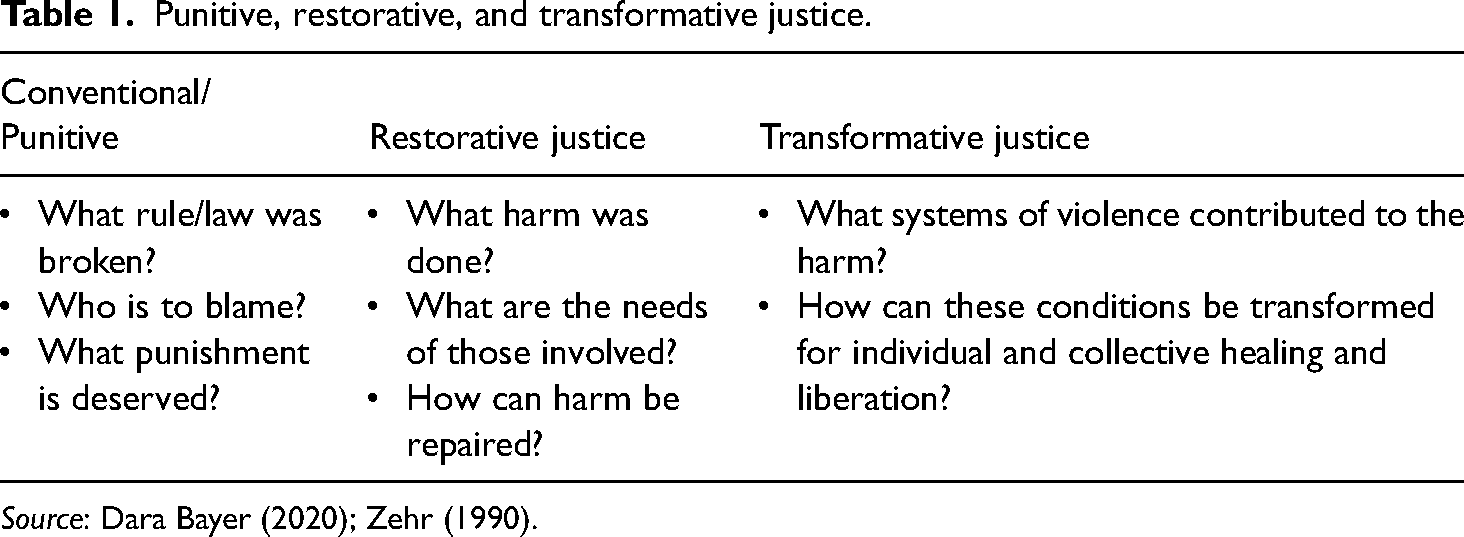
Source: Dara Bayer (2020); Zehr (1990).
TJ emerged out of abolition feminist social and political movements in the US against both state and interpersonal violence, and more specifically from indigenous, Black, queer and trans, low-income, undocumented, disabled, and sex worker communities that have long had to address harm outside of the carceral state (Davis et al., 2022; Mingus, 2019). As the intellectual grounding for TJ praxis, abolition feminist theory proliferated in the US in the 1990s and early 2000s from the scholarship and activism of black feminists and other women of color feminists, many of whom converged at the INCITE Color of Violence Conference at the University of California, Santa Cruz in 2000 (Rojas et al., 2011). The broad coalition of activists and scholars that convened at the INCITE conference revealed the wide array of intellectual lineages that inform TJ theory and praxis, including Black feminism (Taylor, 2017; Zellars and Smolash, 2016), decolonial feminism (Monture, 2011; Smith, 2016), and critical criminology (Braithwaite, 2003; Cunneen, 2007; Mathiesen, 1974).
In articulating the goals of TJ accountability processes, Rojas et al. (2011: 5) describe approaches that “challenge us to seriously address violence and intimate harms without reproducing the technologies of individualization, pathology, penality, protection under the authority of heteropatriarchy and white supremacy, and criminalization.” Community accountability processes can take many forms, but they often involve three components: (a) a support pod 2 for survivors that helps them determine what they need from the process and meet those needs; (b) an accountability pod to support the person who caused harm 3 in taking responsibility for the harm they’ve caused and change their behavior to prevent further harm, and (c) a team of community members that works to transform the conditions that have allowed for harm to happen. Processes can be initiated by anyone involved in the instance of harm, including but not limited to: the survivor, the person who caused harm, or any community member close to the instance or pattern of harm. Facilitators invite relevant parties to participate in the process based on the harm and people impacted, Figure 1.
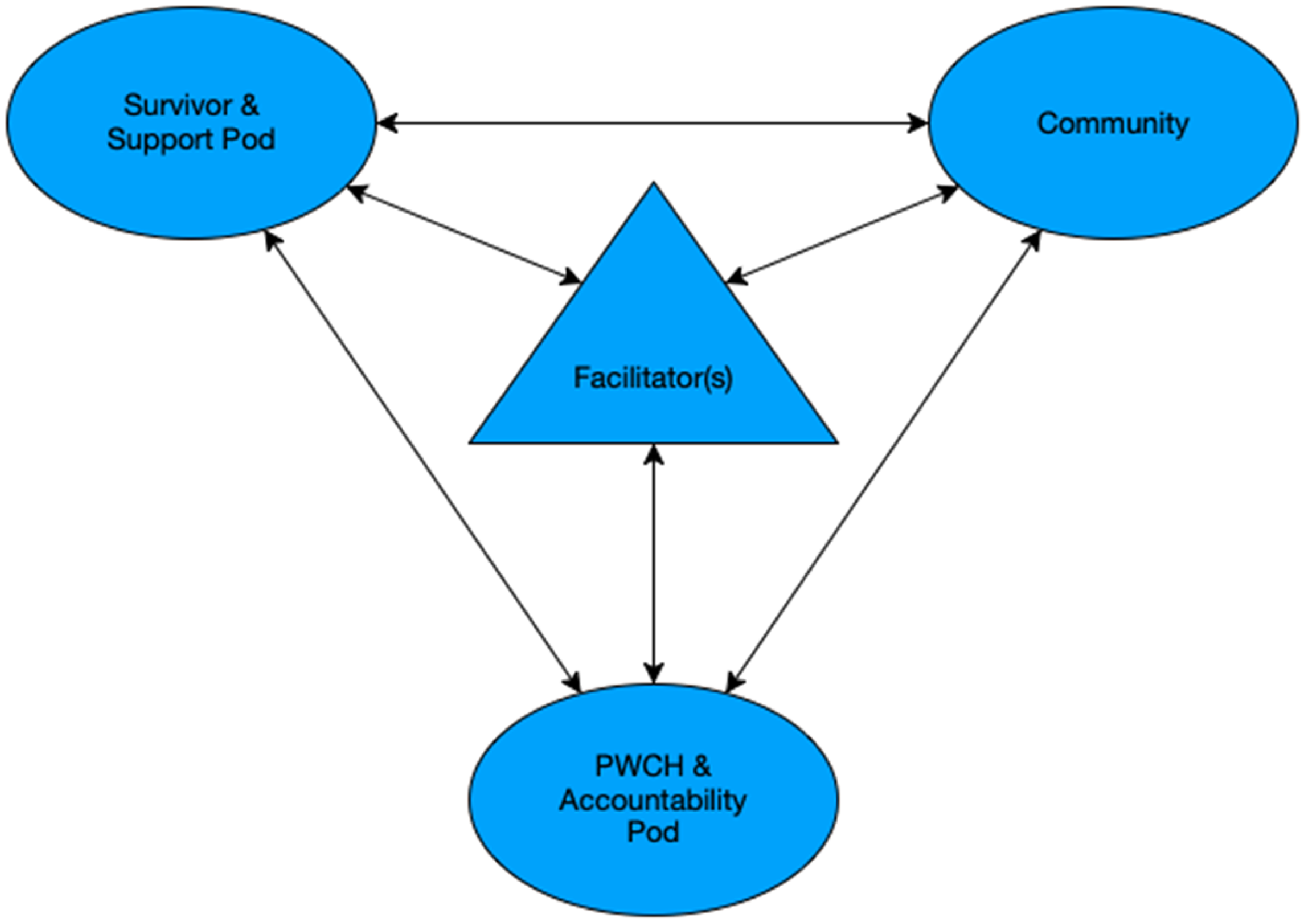
Core components of community accountability processes.
The survivor support pod is made up of people the survivor chooses to help them safety plan and determine what they need from their community and the person who caused harm to be able to heal and move forward. The accountability pod is comprised of people close to the person who caused harm who support them in “understand[ing] their actions and the impact they had on the survivor(s) and others involved, apologize, makes amends, repair damage caused by their actions and—most importantly—work to change their behavior so that the harm doesn’t happen again” (Mingus, 2019). The accountability pod often engages in long-term education work to help a person who caused harm unlearn harmful societal norms and behaviors, including readings and discussion about consent, power, racism, ablism, and heterosexism. These processes can take anywhere from months to years of regular pod meetings depending on the specific goals of a process. Finally, the broader community work to address the root causes of harm in cultural or institutional practices varies based on the community context and goals of the process. One example of this work might be a community organization responding to sexual harm in their social spaces by incorporating sexual consent education in their orientation trainings.
Though TJ as an explicit and written framework is a relatively new development, TJ practices have been part of the survival and liberatory tactics of criminalized communities for decades (Dixon, 2020: 8). Mingus (2019) writes that TJ was created “by and for” people in criminalized communities who “have been practicing TJ in big and small ways for generations— trying to create safety and reduce harm within the dangerous conditions they were and are forced to live in.” Though these practices were not labeled as “transformative justice” until recently, they have shaped the menu of tools that now comprise community accountability processes.
Methods
I conducted dozens of in-depth, semi-structured interviews and focus groups with TJ facilitators across the US (n = 35). To protect participants' anonymity, I assigned pseudonyms to each interviewee represented in direct quotes throughout this paper. Though TJ emerged from the particular racial-colonial history and carceral conditions of the US, activists around the world have begun to invoke TJ theory and praxis in the transnational work of building life-affirming practices of mutual accountability and care (Lakshmi Piepzna-Samarasinha and Dixon, 2020). 4 Having studied and practiced TJ for several years, I recruited participants from a pool of practitioners I have previously met and some with whom I have worked. I used one-and-a-half-to-two-hour semi-structured interviews and 3-hour focus groups to examine how TJ facilitators define accountability and conceive the distinction between punishment and the consequences, obligations, or outcomes that may emerge from a TJ process. Semi-structured interviews follow a pre-determined list of questions with space for follow-up questions that shift each interview to attend to the interests and guidance of the interviewee. Wibeck et al. (2007: 249) assert that focus groups allow researchers to study how people engage in “collective sense-making; i.e. how views are constructed, expressed, defended and (sometimes) modified in the context of discussion and debate with others.” Beyond simply providing the opportunity for data collection about practitioners’ individual understandings and practices of TJ, these spaces also cultivated deliberation and opportunities for cross-perspectival reasoning for everyone present.
I use grounded normative theory to inform my methodological approach to this research. Grounded normative theorists use empirical methods to recursively collect and incorporate data that strengthens and expands the comprehensiveness of their normative theorizing (Ackerly et al., 2021). A grounded approach is rooted in a commitment to remaining accountable to those participating in empirical research (Ackerly et al., 2021). Grounded normative theory emerged from growing calls for political theorists to engage with the “real world” (Ackerly et al., 2021: 17).
More specifically, I adopt an “ethnographic sensibility” to inform my empirical approach to normative theorizing (Prinz, 2019). Such approaches require paying close attention to the way that individuals understand their moral and ethical obligations (Longo and Zacka, 2019; Prinz, 2019). This methodology seeks to disrupt hierarchies of epistemic power that situate academics as inherently knowledgeable and able to objectively perceive and discern the lived reality of others. Instead, an ethnographic sensibility centers the wisdom and knowledge of community-based practitioners informed by years of study and practice.
This interdisciplinary approach to research is particularly informed by decolonial thinkers whose research at the margins and borders of disciplines has subverted the historical and ongoing epistemic violence of the Western academy. In their writing on decolonizing criminology, Blagg and Anthony advocate a paradigm shift in criminological inquiry towards a “post-disciplinary epistemology…that tests the boundaries of the discipline,” (Blagg and Anthony, 2019: 11) while Hook (2012: 21) argues that “it is the very partitioning of disciplines…that ensures that the more pernicious elements of colonial racism tend to evade analytical capture.”
My conversations with TJ facilitators unearthed several key themes and factors that shape how transformative consequences are developed and carried out. I adopt a participatory approach and use interviews, focus groups, and informal texts as an opportunity to theorize with TJ facilitators rather than about them. I take the position that those facilitating TJ processes are intimately aware of the ways their practice strives to diverge from penal approaches. Rather than treating my participants as objects of analysis, I engage with their insights as I would with penal theory developed in an academic setting.
I transcribed each interview and focus group and adopted a grounded theory approach to code and consolidate themes that emerged (Corbin and Strauss, 2015). To enhance validity and reduce confirmation bias, I triangulated data from additional sources, including podcast transcripts, blog posts, toolkits, webinars, and zines by other TJ facilitators. Using NVivo software, I developed thematic codes informed by my research questions and refined them as new data emerged and my understanding of TJ practitioners’ core challenges deepened (Charmaz, 2006). This retroductive approach, blending inductive and deductive methods, generated new perspectives by iteratively moving between established explanations and case-specific, observed (Giese and Schnapp, 2021). From the themes that emerged across interviews and other data sources, I offer a set of eight spectrums to describe how facilitators distinguish punishment from transformative consequences.
Distinguishing accountability from punishment
I present eight spectrums that illustrate the core principles distinguishing punishment from transformative consequences. Instead of defining a strict boundary between punitive and non-punitive accountability through minimalist or maximalist criteria, I explore these continuums to challenge the binary thinking of penal systems. Drawing on Christie's (1986) critique of the dichotomized nature of penal law, which categorizes actions and individuals as either good or bad, I advocate for embracing continuous variables that facilitate more nuanced and effective accountability processes. This approach addresses the complexities and tensions inherent in building community justice practices outside of the penal realm.
Together, these eight continuums are critical for facilitators in distinguishing transformative consequences from punishments. The (a) intentions, (b) processes, and (c) outcomes of transformative accountability processes emerge from a worldview fundamentally different from that of penal systems. While punitive approaches categorize individuals along binaries of good vs. bad and right vs. wrong, TJ recognizes all people as deserving of safety, dignity, and belonging, Figure 2.
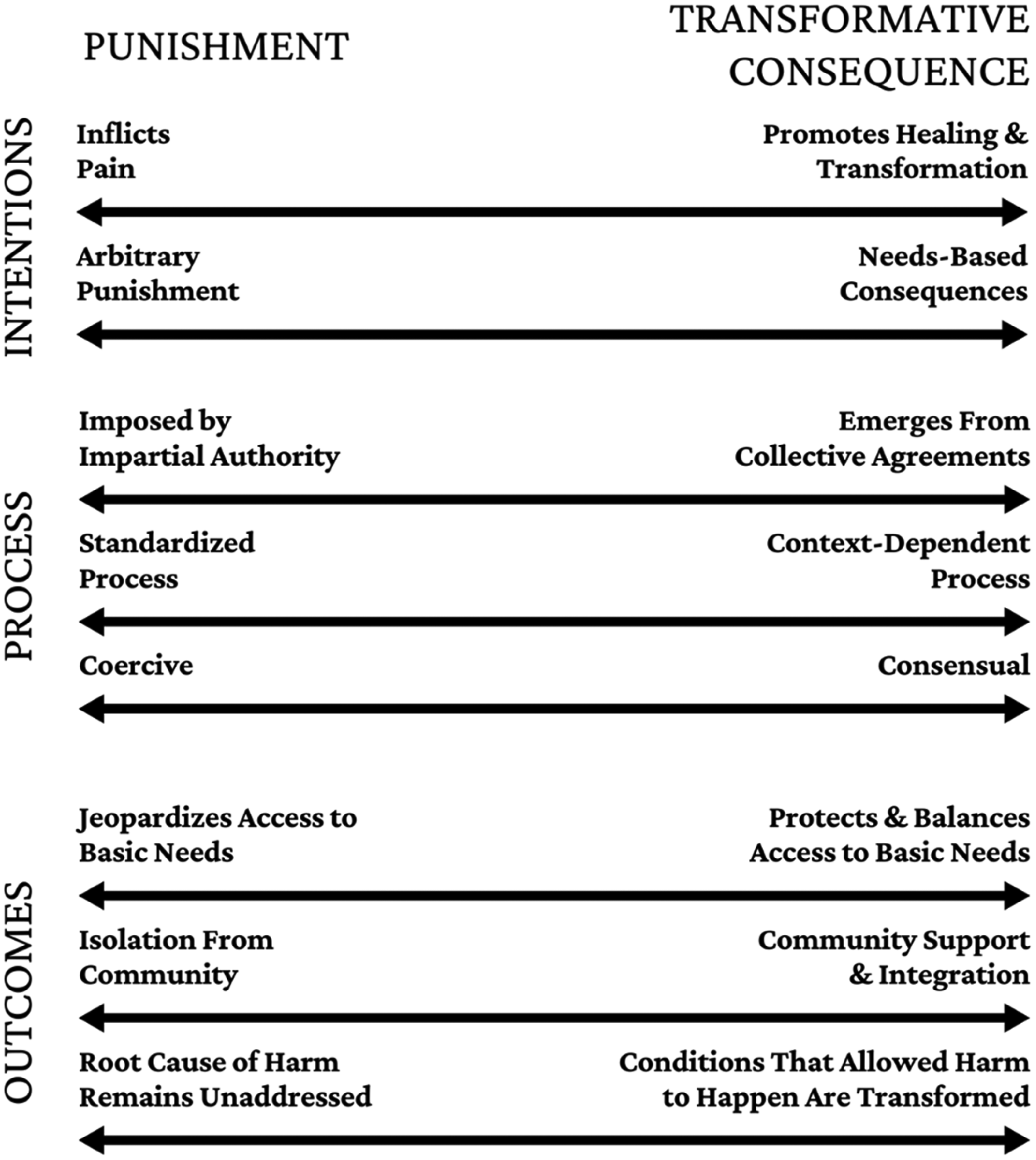
Spectrums.
Rejecting binary thinking is crucial to understanding the extensive range of possible outcomes along each continuum of punishment and transformative accountability. These spectrums, which range from punitive to transformative, are not metrics but representations of possibilities within community accountability, shaped by context. My research shows that while many processes aim for the transformative end, they often fall somewhere in between. Practicing TJ in a punitive society requires a nuanced framework that holds the complexities of abolitionist praxis while aligning with TJ principles. As Sharon Welch (2016: 33) notes, “the very longing for categories that are unambiguous is itself part of the logic of domination, the illusion that imperfection and error are solely negative and not part of the ingredients of creativity.” These spectrums are offered not as measures of success or failure, but as guides for TJ theorists and practitioners working to prefigure abolitionist futures within our current punitive society.
Intention to inflict pain vs. intention to promote healing and transformation
Penal theorists often identify the intention to inflict pain as one of the core features of punishment. Christie (1982: 674) described punishment as “an intended evil” and “the inflicting of pain, intended as pain” (1982: 1). Similarly, Golash (2005: 1) described punishment as the “deliberate infliction of pain.” TJ facilitators echoed this tenet—Indra (pseudonym, 2021) articulated, “you're actually causing more harm by way of punishment.”
In contrast, TJ prioritizes “harm reduction,” aiming to lessen suffering while promoting self-determination and autonomy for those most impacted by oppressive systems (Kaba and Hassan, 2019: 7). 5 Noa (pseudonym) defined harm reduction as “balancing self-determination and autonomy with preventing and lessening the harm and violence that's happening.” Quin claimed, “the biggest value that guides my TJ work is harm reduction, and not like harm reduction as in nobody will be harmed by this process, but harm reduction more so that we are entering with the intention to reduce harm as much as possible, while in a way that can also further people's healing.”
Several participants mentioned harm reduction by name, but all interviewees stressed, “the idea of doing no further harm” (Indra). Some practitioners explicitly claimed that no amount of harm could emerge from a TJ process—Indra expressed, “any consequence that may cause further harm is not an actual consequence. It's a form of punishment.” Jose claimed, “punishment is another way to enact violence,” while TJ is about responding to harm “without reproducing harm or violence.”
While many facilitators consider minimizing further harm as a moral imperative, others take a consequentialist approach, highlighting the cyclical nature of violence encapsulated by the common axiom, “hurt people hurt people” (Adrian). Ari stressed, “we’re not looking for their suffering,” while describing the many ways that increasing suffering may result in more harm down the line. Adrian added, “people who have experienced healing are going to be less likely to commit harm in the future.” Jordan described this principle, noting, “you have to get off the wheel of harm.”
Noa described the goals of TJ as illuminating “the circumstances that are going to best lead towards transformation, accountability and healing.” She added that ideally, a consequence allows someone “to learn and be supported in growing and transforming.” This core element of TJ is grounded in “the belief that people can transform and grow” (Kai). Noa emphasized, “we all have the capacity to heal, and we want to support and create the conditions for people to heal.” Transformative consequences aim to promote healing and growth while punishments seek to inflict pain.
Arbitrary punishments 6 vs. needs-based consequences
TJ facilitators criticized the arbitrary nature of punishments in the criminal legal system, where sanctions often lack direct relevance to the harm caused and fail to address the survivors’ needs. Christie (1977) argued that legal systems “steal” conflicts, reducing “the victim to a nonentity and the offender to a thing.” In contrast, TJ outcomes are tailored to meet the specific needs of all parties. This approach views the obligation to repair harm as a direct consequence of the offending action, thus making the consequences inherently reparative rather than punitive.
Noa emphasized that punishment is “arbitrary,” and “doesn't necessarily correlate” to the harm caused. Indra illustrated this by critiquing community service orders, which lack a “direct tie” to accountability or healing: “somebody breaks into a car, and then another person is like, ‘well, I want you to pick up trash on the side of the freeway’…that doesn't get your car back; it doesn't do anything.”
All interviewees noted that consequences emerge directly from the needs of those who have experienced harm. Ari noted, “there are ways to be more specific, meeting exact needs and repairing previous harms that are relevant and helpful and healing.” Noa expressed, “consequences ideally come from the needs of the person who's been harmed…the needs create obligations, and so what are those obligations that need to be addressed?” Indra similarly noted, “an effect of having caused harm is the obligation to repair it. And that obligation to repair it is essentially a consequence.”
Facilitators shared examples where consequences were rooted in the harmed party's needs. Adrian, for instance, described in which an abusive partner had to “remove themselves” from shared spaces during the process: “it was more about foregrounding the safety and well-being of the person who had been harmed, than about causing more suffering for the person who had caused harm.”
Often the consequences that emerge from a process are oriented to meet the needs of the person who caused harm as well. Adrian described a process that centered this tenet, “can they be hooked up with medical insurance, so they could get therapy or be in supportive groups if they take a leave?”
As a political praxis, transformative accountability is based on a conception that structural violence and interpersonal violence are inextricably linked and cannot be addressed separately. Addressing abusive relationships in undocumented communities, for example, requires examining the conditions of precarity, fear, and isolation that establish the structural conditions of said violence.
Imposed by authority vs. emerging from collective agreements
While adversarial legal processes are overseen by authority figures, transformative consequences arise from “bottom-up” deliberative processes that prioritize community consensus. Noa noted that TJ accountability is “not a top-down, singular decision…it has been determined in community.” Sage added, “what makes TJ different is that combination of collective and community-based—meaning we're not a service…We're really doing this as part of the community.” Several interviewees echoed this sentiment, reinforcing that TJ is at its core, “about being grounded in community” and “grounded in relationships” (Ari).
For Adrian, relationships are central to TJ: “to have a community accountability process in the first place, there's got to be some groundedness in relationships.” Indra described decision-making within accountability processes as based on a principle of interconnectedness, asserting, “there aren't any outsiders, there are no observers, there's nobody falling outside of a web of interconnectedness.” This approach rejects the Western notion of neutrality common in judicial systems, instead centering community-based decision-making.
Facilitators described their role as coordinating community consensus, rather than imposing sanctions. Unlike the “authority figures” described by Hart (1959) and Duff (1989), TJ facilitators are embedded within the communities they serve. Indra described this distinction: A facilitator is not an outside neutral party or a mediator…So for folks who are facilitating these processes, they're not neutral, that's not possible. They're not there on behalf of or on the side of one person or another, but they are holding the humanity and dignity of all participants in equal measure.
Responding to a scenario about a community conflict surrounding someone smoking marijuana in a public park with children, Adrian explained, “the first thing is asking myself, am I actually in a position to address this? You know, does the person smoking weed know me? Do they trust me? Because if not, I don't really have any traction.” Robin described the relationships between everyone in the process are one of the most critical features of successful TJ processes: “ideally, you're doing this work in your community, with people that you have relationships with, people that you know and therefore can trust that they're doing this for the right reasons. And they're not just checking the boxes so that they can move on with their lives.” Facilitators do not claim to be neutral or impartial outside observers, and instead, are very much embedded in the communities impacted by the harm.
Many facilitators also saw community accountability processes as a community-building endeavor in and of itself. Sage described the community that emerges from accountability processes, depicting “the collective that we're actually creating by this group process.” Emory added, “accountability can be transformative because it allows everyone involved to take an active role in healing and repairing the harm done.” These approaches to community-based accountability look nothing like the adversarial legal systems that largely sideline community engagement and rely on external decision-makers.
Standardized vs. context-dependent
Unlike standardized punishments, TJ consequences are context-dependent and tailored to the specific circumstances of each case. Though the flexibility of sentencing guidelines varies across jurisdictions, the circumstances and background of an “offender” are only factored into sanctions as an addendum (e.g. mitigating factor) rather than as a central consideration (Roberts, 2011). Kai explained that “community accountability is really built on this understanding that context does not excuse behavior, but it does explain it. And more than anything, people's context is also going to be the key to them not repeating that behavior.” Noa emphasized that responses vary “depending on the particular community and situation…there is no one size fits all formula.” She added that facilitators “need to look at the whole situation. Look at the relationships, the power dynamics… I think that's why it's so important to be embedded in community to understand where people are and where they're coming from.” Just as consequences emerge from the direct needs of those who have experienced harm, they are also informed by the community dynamics and broader societal context in which the harm took place.
Rather than isolating instances of harm from their societal context, transformative accountability seeks to unearth and transform the material conditions that have led to an instance or pattern of harm. Sage noted, “we're cognizant of the harms of systems, and we're transforming those.”
For instance, Adrian described a process where the person who caused harm was undocumented and without health insurance. A significant part of the accountability process involved securing access to health insurance and affordable therapy. Adrian explained, “TJ, as a set of practices and frameworks, can lead us to structural change…like this person needs health care; they need viable economic support; they need emotional support. Okay…how are we going to create those things?” Kai added, “I don’t believe in TJ as something that stands alone by itself because it's so contextually specific—what each person and community needs to heal is likely going to be pretty different.” The flexibility of these processes makes them responsive to many forms of violence and complicating factors.
However, this malleability can also lead to confusion and disagreement among facilitators around the parameters of TJ, and perhaps more importantly, what does not qualify as TJ. Skyler noted, “the CJS is really rules bound and what I find is that TJ is so much more relationally-oriented and context-specific, which means that there's not a fixed set of abstract universal laws. I think that can create confusion.” Identifying the principles that are central to TJ is thus a critical task for building coherence around a praxis that is at once many things, while also ostensibly decidedly non-punitive.
Coercive vs consensual
Transformative accountability emphasizes inviting the person who caused harm to engage voluntarily, rather than coercing them. Sage noted that TJ ideally involves the person who has caused harm “starting to think themselves of what they need to do for repair,” while Noa emphasized working “with somebody as opposed to doing to them.” Instead of imposing sanctions onto a participant, transformative accountability relies on collective decision-making that includes the person who caused harm.
Noa articulated a common creed among TJ facilitators: “no one can hold you accountable” but yourself, emphasizing a culture where “accountability actually comes from the inside out.” Jordan emphasized, “everything has to be an invitation, and if it's not, you end up replicating the system.” Amari added, “People have to choose to take accountability. The best I can do is give them soft places to land so they're willing to do it.”
However, achieving fully consensual processes is complex, as existing relationships and social pressures can influence the engagement of those who have caused harm. For example, facilitators described leveraging their relationship with the person or recruiting friends to convince them to participate. Whether this type of informal social pressure to participate in a process should even be described as coercion remains debated among TJ facilitators. Noa used the term “influence” to describe the pressure to engage in an accountability process: “we exist in social relationships and that's part of what we do. So, how can we kind of be intentional about engaging influence?”
While each facilitator stressed that they strive to reduce coercion and maximize the autonomy of everyone involved, they all had different perspectives about how much influence or coercion would be too much in any given process. Quin noted, “consent is the best thing about TJ, and it's also the thing that cuts it short.” When asked about coercion in accountability processes, Ari asserted, “there is a space for encouragement and that is obviously a very grey line.” Alex added, “very rarely do I feel like people have full agency because if you don't go with the process, something else worse is waiting for you. The goal is more and more agency.” While some processes involve participants that are eager to engage in dialogue and reflective work, others are more challenging, and facilitators struggle to balance the safety needs of survivors with the autonomy of those who have caused harm.
Jeopardizes access to basic human needs vs. protects and balances access to basic human needs
A core debate in defining punishment is whether outcomes are central to its classification. While penal theorists agree that the intention to cause pain and suffering is a core part of punishment, there remains significant disagreement about the relevance of the impact of sanctions. While Walgrave (2001: 22) claimed the experience of the punished was “irrelevant,” and argued that “the key to punishment lies in the head of the punisher, not the punished,” Daly (2000: 39) considered the impact of a sanction on those punished as essential, defining punishment as “anything that is unpleasant, a burden, or an imposition of some sort on an offender.” For TJ facilitators, the outcomes of accountability processes are a central consideration.
Penal theorists see the deprivation of basic rights as a key feature of punishment. Golash (2005: 166) claimed that non-punitive consequences “do not deprive the offender of anything to which he has a right.” TJ facilitators echoed this distinction, emphasizing that community accountability processes are centered around upholding the basic needs of everyone involved. Kai noted that punishment “usually takes away something that is fundamental to what you need to survive—consequences do not.”
To define fundamental needs, facilitators drew on frameworks including generative somatics (Haines, 2019), which outlines essential needs for safety, belonging, and dignity, as well as Maslow's (1970) hierarchy of needs, which encompasses physiological needs like food, water, shelter, followed by needs for security, belongingness, esteem, and self-actualization.
Both the needs of survivors and those who have caused harm are vital in shaping the scope and limits of transformative consequences. Rooted in the core belief that “everyone is deserving” (Noa), honoring the needs of those who have caused harm is crucial to determining feasible or desirable consequences. Kai emphasized that people who cause harm have needs that “deserve to be honored and respected.” Adrian added, “just because someone's[…]caused harm, doesn't mean they don't have needs, doesn't mean their well-being is discounted.” Malu asked, “what does the person who caused harm need to be able to be accountable? Because asking someone to move away and like lose their job and lose their housing and lose their community doesn't seem to promote accountability.” The needs of those who have caused harm are considered central to the work of promoting meaningful accountability and behavior change.
Though meeting everyone's basic needs is a central goal for all facilitators, they disagree about how to balance conflicting needs. For example, Adrian described “creative strategies to mitigate the negative impact” of survivors’ safety needs—which sometimes includes separation from the person who caused harm—on those who caused harm. The following section explores this tension further.
Results in isolation from community vs. results in community support and reintegration
Penal theorists describe punishments as “exclusionary,” often resulting in shaming and isolation (Duff, 2001; Golash, 2005). TJ facilitators echoed this, characterizing punishment as inducing “humiliation” (Kiran), “isolation” (Zuri) “ostracization” (Indra), and “ex-communication” (Sage). In contrast, transformative consequences aim to strengthen and expand relationships of support and mutual accountability. Adrian emphasized that “support and accountability go hand-in-hand, in order for accountability for harm to happen, there needs to be support.” This emphasis on community support and long-term goals of reintegration shape how facilitators understand appropriate outcomes of a TJ process.
Central to the TJ ethic and worldview is the principle of “non-disposability” (Kiran), a “belief in transformation,” and faith in people's “capacity to grow” (Kai). These principles sustain a commitment to ensuring that those involved in accountability practices are always supported by a network or “pod” of people (Mingus, 2019). However, realizing these values in practice can be challenging. Facilitators often struggle to balance supporting those who caused harm with the safety needs of survivors, who frequently request separation from the people who harmed them. Noa cautioned against segregating people from their communities: “isolating or preventing them from accessing any kind of care would be a punishment.” Indra emphasized, “we shouldn't make our jobs easier by just ostracizing one person and putting all of our energy on the other, because it's really a short-term solution to what ultimately will be a long-term problem.” She added, “I think that you can separate people from each other without excommunicating either of them, meaning that your community works out amongst itself, who's going to be in community with these folks and who's going to be in community with us.” Remy echoed this sentiment, asking, “how do we also support that person in creating belonging in other spaces so that they are not experiencing isolation, but they still have more community?” Adrian emphasized exploring “other options for the safety and well-being of the people who've been harmed” to ensure that any separation from community is “the least restrictive option.” He highlighted the importance of supportive community for preventing future harm, emphasizing that “one of the number one protective factors for people who have experienced trauma is that they feel supported in navigating the impact of the trauma.”
Some facilitators acknowledged that temporary separation may be necessary to stop immediate harm and allow for healing. Devan claimed, “there are times that somebody needs to go away, and it doesn’t mean prison. We'd love to put people in different homes where they can actually work on themselves if they're actively in a state of harming.” Quin echoed this sentiment, “if you're healing, part of that process is being able to not be around the triggers and the cues that have allowed and enacted that. You need to be able to build the skills that you need to regulate and move in an appropriate way without those stressors.”
Facilitators agreed that any exclusion should be temporary and a last resort. Kai contrasted the permanence of legal punishments with TJ, stressing that “nothing should be forever.” Amari echoed this: “you don't get to throw people away without an opportunity and a way back.” Interviewees consistently emphasized the importance of continuous social support and clear timelines for reintegration into community spaces for anyone undergoing an accountability process.
Facilitators’ responses to hypothetical scenarios showed differing views on acceptable forms of temporary exclusion within a TJ process, such as asking someone to leave a university, especially considering the individual's reliance on university resources for their basic needs.
Facilitators also discussed the impact of community isolation on inducing shame. While shame is understood to be a common or “natural” (Ari) reaction to understanding the harm one has caused others, it can also obstruct meaningful accountability and behavior change. Ari cautioned, “shame has all these negative effects that inhibit you from taking accountability for yourself. And so we don't want any consequence that would be further shaming them.” Many facilitators described their efforts to reduce shame and foster community support.
Root cause of harm remains unaddressed vs. conditions for harm are transformed
TJ processes aim to address not only individual acts of violence but also the systemic injustices and material inequities that enable harm. By mobilizing collective action against structural violence, TJ represents a fundamental shift from traditional responses, striving to dismantle cycles of violence at their root.
Central to TJ is a commitment to abolishing the carceral state and building life-affirming networks of care and accountability in its place. Esteban Lance Kelly (2011: 49) of Philly Stands Up emphasizes that TJ “acknowledges the broader systems of oppression (e.g. racism, male supremacy, capitalism, and the prison-industrial complex) that instigate sexual assault.” Mingus (2019) challenges practitioners to consider, “what would it take to not only respond to rape, but to end rape? To not only respond to domestic violence, but to end domestic violence?” TJ practices are committed to addressing the political and social conditions of state violence and organized abandonment (Gilmore, 2022) that embed and expand oppression.
Facilitators stressed that addressing interpersonal violence requires tackling foundational inequities that create unmet needs such as “exposure to violence, isolation and shame” (Quin). Sam emphasized TJ's collective healing imperative, stating, “community accountability works best if it's an attempt by community to heal itself.” Tyler added, “If you don't have an aspect of your practice that is making it so that the situation doesn't happen again, or if you are avoiding the factors that caused the situation, then I don't think you can call it transformative justice.” Connie Burk (2000: 36) of the Northwest Network underscores TJ's structural analysis, emphasizing that facilitators examine, “the culture,” “the society,” and “other institutions” that perpetuate violence and control.
TJ processes combine immediate interventions with long-term systemic change, aiming not only to treat symptoms of violence but to eradicate its root causes, thereby fostering safer and more equitable communities.
Conclusion
Practicing TJ in a predominantly punitive society makes accountability messy and complex, as facilitators and communities struggle to balance people's needs for safety, dignity, and community. Despite efforts to ensure consensual processes, facilitators note that sometimes the participants’ needs for safety and community create tensions, making consequences feel more coercive or isolating than intended.
Ari noted that punishment can inadvertently emerge within TJ processes: “we're always striving to make that proportion as small as possible, but it will be an impact sometimes, despite our best efforts.” Though facilitators expressed different limits on how far towards the punitive end of a spectrum they would allow a process to go, they shared a core commitment to honoring the humanity of everyone involved.
This research contributes to ongoing debates on defining punishment and exploring alternative forms of accountability. It bridges the disconnect between abolitionist scholarship and grassroots abolitionist organizers. The dominance of the penal state requires that I directly engage with punishment as a theoretical concept and lived reality for criminalized communities around the world. At the same time, this research seeks to resist normalizing punishment as the default response to harm.
This research has practical implications for TJ practitioners addressing violence in ways that do not reproduce the cycles of harm and shame central to punishment. Even seasoned facilitators struggled to identify constitutive factors that distinguished TJ from punishment. The findings are being disseminated to facilitators in a workbook, Beyond Punishment, which presents these spectrums as a framework to navigate complex ethical dilemmas and provides reflective questions and examples to help facilitators prevent TJ processes from replicating oppressive, punitive dynamics.
As Foucault (1975) and others have shown, penal practices morph over time, shaped by the politics of each era. Current political interest in decarceration and neoliberal crime control strategies raise critical questions about the definition of punishment. Renewed interest in cost-effective “diversion” programs and “alternatives” to incarceration threaten to expand the reach of the penal state and entrench practices of surveillance and isolation beyond the formal penal realm (Schenwar and Law, 2020). Reformist efforts to make technologies of punishment more palatable and pervasive require scrutiny and analysis (Kilgore, 2018). Identifying the core elements that characterize penal practices is thus an urgent political and epistemic task.
Envisioning a world beyond punishment requires rigorous inquiry into what Hartman calls wayward and insurgent “experiments in living otherwise” (2019: 33). Future research should continue to explore the myriad forms of collective justice and accountability that operate outside adversarial systems. TJ offers critical insights into fundamental questions facing leftist social movements, from resourcing abolitionist projects, the relationship between abolition and the state, and the complexities of collective decision-making. Taken seriously, TJ provides a vision of collective governance and an approach to understanding power and community that reaches far beyond its current applications.
Footnotes
Acknowledgements
Many thanks to all of the practitioners who engaged in those discussions and shared their experiences facilitating TJ processes.
Declaration of conflicting interests
The author declared no potential conflicts of interest with respect to the research, authorship, and/or publication of this article.
Funding
The author disclosed receipt of the following financial support for the research, authorship, and/or publication of this article: This work was supported by the Rhodes Scholarship.
