



Abstract
Parole decisions have a dramatic impact on individuals’ lives as well as public safety. Studies seeking to discern which factors predict parole decisions highlighted the role played by correctional reports submitted to parole boards by rehabilitation authorities; however, very few offered any in-depth insight into them. Moreover, research also failed to explore the interplay of reasoning employed by parole boards and rehabilitation authorities, which seem to represent different orientations and interests—risk reduction vs. the chances of rehabilitation. Using a quantitative content analysis of documents composed by parole boards and the rehabilitation authority in Israel, we have extracted risk or chance factors from 306 cases. Logistic regression models demonstrated that, while rehabilitation authority recommendations may be predicted solely by factors that focus on rehabilitation, as can be expected, parole board decisions seem to give similar weight to both rehabilitation and risk factors. The study's findings shed light on the dynamic of these two organizations and could enhance public trust in the early release process.
Introduction
The decision to release prisoners conditionally before their sentence is fully served is one of the most important decisions in criminal justice (Houser et al., 2019; Lindsey and Miller, 2011). The dramatic impact of parole on prisoners’ lives, and the safety of society at large, has stimulated research that aimed to discern which factors predict parole decisions; however, findings were inconsistent (Vîlcică, 2018). While the relationship between several parole factors and parole release decisions remains equivocal, studies have successfully demonstrated the major role played by correctional authorities’ reports (Bowman and Ely, 2017; Proctor, 1999).
Unfortunately, such studies rarely offer an in-depth examination of the components of correctional authority reports submitted to parole boards, and usually only consider their often-binary final recommendation of granting or denying early release (e.g., Bowman and Ely, 2017). Moreover, prior studies have referred to the correctional report as one of many factors in the parole board's discussion, not as an independent decision-maker (Bowman and Ely, 2017; Proctor, 1999). In recent years, parole scholars have increasingly recognized the importance of examining multiple decision points and assessing the relationship between them as a key to developing a fuller picture of the parole landscape (Young and Pearlman, 2022). Hence, a comparative analysis of the factors associated with the parole boards’ decisions vis-à-vis those that relate to the correctional authorities’ recommendations would shed light on the dynamic of these two authorities playing a crucial role in the parole decision-making and reentry process. The exposure of the dynamics of these “behind the scenes” authorities’ discourses aims to expose the professional relations between them, and increase the parole process’ transparency as well as public trust while encouraging consistency, coherence, and effectiveness of the release and reentry decision-making process.
The present study aims to address these gaps with data from 306 cases found in the Israel parole boards’ protocols and the Israel Prisoner Rehabilitation Authority's (PRA) reports submitted to parole boards. Through a quantitative content analysis of these two types of decision-makers, we can gain a comparative perspective on the relations, similarities, and differences between these decision-makers’ philosophies while shedding light on the professional forces employed in the unseen world of parole.
Parole boards and their decision-making
Parole is rooted in the nineteenth-century “medical model” that acknowledges the potential for offenders’ rehabilitation (Petersilia, 2003; Simon, 1993). The rehabilitative meaning of parole was often contrasted with its role in public safety (Petersilia, 2003; Raynor and Robinson, 2009; Simon, 1993). The rehabilitative framework usually associates parole with a welfarist or clinical logic and its beneficial effect on the lives of prisoners, while the risk framework usually associates parole with the protection of future victims and the logic of actuarial risk management (Raynor and Robinson, 2009). However, both concepts can be viewed in tandem, with the risk to public safety being determined, inter alia, by an assessment of the extent to which the prisoner had been rehabilitated in prison (Maurutto and Hannah-Moffat, 2006; Ruhland, 2020). Parole also serves other purposes, whether officially or less so, such as reducing prison overcrowding, or managing institutional safety and discipline (Morgan and Smith, 2008; Petersilia, 2003).
In the late 1970s, most U.S. parole boards began to be criticized for being arbitrary, biased, and often highly routine (Proctor, 1999; Ruhland et al., 2017; Young and Pearlman, 2022). These objections led to significant changes in the nature of parole decision-making; parole guidelines (Rhine et al., 2017; Simon, 1993) and formal decision-making instruments or risk assessment tools (Rhine et al., 2017) were adopted. Nevertheless, many U.S. parole boards still exercise “enormous” discretionary power (Rhine et al., 2017: 282). In the United Kingdom, parole considerations “are not exhaustive and members can take account of any other relevant element” (The Parole Board, 2019: 4). Discretionary parole is common in other European systems (Padfield et al., 2010), as well as in Canada (Hannah-Moffat and Yule, 2011) and Australia (Mooney and Daffern, 2014). While research on parole success dates back almost a century, the decision-making work involved in parole is largely hidden and has received limited scholarly attention thus far compared to the “front-end” sentencing process (Dagan, 2023; Mooney and Daffern, 2014). One reason may be the public's intolerance of parole release since it contradicts its call for a “truth in sentencing” retributive policy (Fitzgerald et al., 2020). The reluctant public attitude toward parole is amplified by the confidential nature of parole boards, the records of which are seldom available for public viewing, and, in some instances, are even classified as “state secrets” (Schwartzapfel, 2015). Even less explored is the role of the authorities that submit their opinions and recommendations to the parole board (Bowman and Ely, 2017; Mooney and Daffern, 2014). An empirical investigation “behind the scenes” of the paroling and the recommending authorities’ decision-making would mitigate public suspicion toward it, as well as enhance public trust and legitimacy. In the following section, we will review the various factors and sources of information employed by parole boards when deciding for or against parole.
Factors considered by parole boards
Parole decisions are complicated because they primarily aim to grant release only to those individuals who will not continue to pose a risk to the community, hence requiring board members to foresee the future (Houser et al., 2019; Rhine et al., 2017). In discretionary release systems, the parole board is required to review and consider an extensive array of information sources when arriving at its decision. At this stage, both static (e.g., prior criminal history and seriousness of the crime) and dynamic factors (e.g., drug use and employment prospects) may be considered and balanced (Hannah-Moffat and Yule, 2011; Petersilia, 2003).
Studies have shown significant relationships between prisoners’ personal characteristics and release decisions. Young age, higher education, being married and higher socioeconomic status were associated with positive release decisions (Houser et al., 2019; Morgan and Smith, 2005) in contrast to mental illness (Caplan, 2007; Houser et al., 2019) and belonging to a minority ethnicity (Huebner and Bynum, 2006; Young and Pearlman, 2022) that were found to have a negative effect on them.
Longer time served in prison, highly serious offenses, and criminal history were found by some studies to be associated with negative release decisions (Caplan, 2012; Caplan and Kinnevy, 2010; Carroll and Burke, 1990; Kinnevy and Caplan, 2008; Turpin-Petrosino, 1999). Crime victim impact statements were also associated with parole denial (Caplan, 2007, 2012). However, other studies have shown that the seriousness of offense or length of the sentence were not the best predictors of parole decisions (Houser et al., 2019; Mooney and Daffern, 2014; Vîlcică, 2018).
Prisoners’ institutional behavior and parole readiness were found by some studies to be significantly associated with parole decisions (Caplan, 2007; Huebner and Bynum, 2006), so disciplinary incidents (Bonham et al., 1986; Caplan, 2007; Hood and Shute, 2000; Mooney and Daffern, 2014) and noncompliance with institutional programming were revealed as robust predictors of denying parole (Vîlcică, 2018). In their study on Canadian women convicted of violent crimes, Hannah-Moffat and Yule (2011) suggested that parole release decisions were associated with program completion and demonstrable changes in behavior while in prison, as well as expressions of remorse. However, other studies have found that institutional behavior only counted when it was adverse, whereas prison treatment and good institutional behavior were not sufficient reasons for granting parole (Morgan and Smith, 2005; West-Smith et al., 2000). These findings made Roberts (2009: 397) wonder: “Were parole boards losing sight of the issue of rehabilitation?.”
Many studies have shown that recommendations provided by reentry staff in the community or correctional officers in prison were associated with the parole decision, but these recommendations rarely received in-depth attention as a separate and detailed form of decision-making. Based on their analysis of data collected in Alabama, Morgan and Smith (2005) concluded that the recommendations of upper-level prison personnel were the most important and best predictors of parole decisions. Similarly, parole plan, as well as employment and housing plans formulated by correctional officers, were found to be highly significant for parole board decisions (Bonham et al., 1986; Bowman and Ely, 2017). In a U.K. sample, Dyke et al. (2020) revealed that release decisions were strongly predicted by the recommendations made by correctional officers and reentry staff while being mediated by the parole boards’ confidence in those professionals’ expertise.
As for the recommendations provided by community rehabilitation officials, studies have found a high correlation between positive reentry staff parole recommendations and release decisions (Morgan and Smith, 2005; Proctor, 1999). Moreover, in the Pennsylvania state system data, Vîlcica (2018) found that reentry staff recommendations had more than tripled the likelihood of release, while Mooney and Daffern (2014) found in their Australian sample that it increased it nearly nine-fold. A study on the Pennsylvanian rural county jail found that reentry staff recommendations explained 41% of the variance in parole release decisions (Bowman and Ely, 2017).
In summary, quantitative studies on the impact of various factors—such as personal characteristics, criminal history, institutional conduct, prison rehabilitation, and postrelease plans—on parole release decisions have generally shown consistent findings, whereas some factors have been found to be less consistent, often due to differences in parole systems and prisoner populations studied.
As for the findings of qualitative studies, these suggest that the weight attached to each parole factor varies between parole board members according to their own personal and professional experiences (Ruhland et al., 2018). With regard to rehabilitation, parole board members felt it was important for offenders to receive a second chance (Ruhland, 2020). They also attached lesser importance to positive behavior in prison for men incarcerated for sex crimes, stressing the dissimilarity of prison and civil society, but emphasizing the importance of their social stability (Greene and Dalke, 2021). With regard to risk, qualitative studies suggest that parole board members view public safety as the lens through which they filter their decisions, and their commitment to rehabilitation was often mentioned in relation to public safety. Whether or not prisoners were considered a risk was often defined by parole board members in discretionary and even obscure ways that, at times, were difficult to measure (Ruhland, 2020; Ruhland et al., 2018). In addition, parole board members were found to value institutional reports in the bottom half of the parole factors’ hierarchy (Ruhland et al., 2017). One U.S.-based study found that parole board members in Pennsylvania have even expressed their interest in correctional officers’ input, asking to give them greater discretion within the process (e.g., when determining release conditions), as they are better equipped to set the right priorities for the prisoner (Ruhland et al. 2018).
The role of rehabilitation authorities in parole boards
As reviewed so far, one of the major factors found to affect parole board decision-making is the rehabilitation and correctional officials’ recommendations. However, very little research has been conducted to date to ascertain the full implications of rehabilitation officials’ recommendations in this process (Mooney and Daffern, 2014). The studies that do explore the role of these reports in parole decision-making rarely offer any in-depth examination of the rehabilitation authority's decision-making process (e.g., Proctor, 1999). Instead, they usually only consider the rehabilitation reports’ binary recommending or objecting to early release (Bowman and Ely, 2017).
Moreover, merely considering the rehabilitation authority's recommendation as another input in the parole board's discussion, as past studies have done, ignores its role as a unique source of information in the parole and reentry process. Overlooking the independence of this input in the parole boards’ decisions paints parole boards as no more than a one-authority “show,” while ignoring the possible dynamic and interplay between the two authorities’ inputs. One might think that they represent different penological philosophies: parole boards focusing on public safety and therefore mainly considering risk factors; and rehabilitation authorities primarily expressing interest in prisoner rehabilitation and reentry prospects. However, studies show a strong correlation between the two authorities’ decisions (Mooney and Daffern, 2014; Proctor, 1999)—so much so that Proctor (1999) has openly wondered whether parole board decisions could be seen as an automatic derivative of the correctional staff's recommendation.
An analysis of each authority's decision-making process in and of itself would, therefore, expose whether each of these two central parole “players” operate in their own field, as per their anticipated traditional penological approaches, or are perhaps affected by their shared interface, thereby using each other's reasoning, conceptions, and language.
The current study aims to unveil what goes on “behind the scenes” of the process leading to the parole board decision. To that end, we will compare the reasoning used by parole boards and rehabilitation authorities in their decisions and recommendations for or against early release. Instead of relying on information included in case files and administrative databases (e.g., Morgan and Smith, 2005; Vîlcică, 2018), we will focus on the contents that directly led to the written decision, thereby enabling us to argue causality. Overall, this study will provide a better understanding of the penological and professional dynamic in this process, as well as the possible interplay between the two authorities that ostensibly have different philosophies and guidelines, while amplifying the transparency of these discussions, and enhancing public trust in parole boards.
Methods
The research context: The Israeli parole board framework
The Israeli parole board is a quasi-judicial body, originating from the English parole model. The Israeli parole system is a middle ground between U.S. and European systems (Dagan, 2023). Like several U.S. discretionary parole systems, the Israeli parole board relies on its broad discretion rather than numeric guidelines (Rhine et al., 2017). However, more similarly to European parole systems, the Israeli system operates under a determinate sentencing regime, and the role of punitive considerations is limited by law only to severe cases (Padfield et al., 2010). Parole boards in Israel are comprised of two correctional experts (e.g., criminologists, psychologists, or psychiatrists), headed by a retired judge, and form part of the judiciary branch (Dagan, 2023). The main parole possibility is at the two-third point of the original sentence for prisoners serving more than a one-year sentence (Shoham et al., 2013). The Israeli law guides parole boards to primarily consider risk factors, as it is required to assess whether the prisoner's early release “will not risk public safety” (Parole Act, 2001, s. 3). While the law also instructs parole boards to consider prisoners’ rehabilitation prospects and behavior while in prison (Parole Act, 2001, s. 9), case law confirms that “risk is the primary and most important of parole considerations” (Garcia v. Parole Board, 2003, para 8). 1 Other regulations are for prisoners serving life sentences that are subject to different parole tracks by special parole boards (Parole Act, 2001, ss. 5, 10(b)). The parole board conducts an oral hearing before issuing its decision in the presence of the Attorney General's counsel, prisoner's counsel (if there is one), prisoner, and, in some cases, the victims or their families. Upon deciding on parole, the board specifies the reasons for its determination in a short-written decision that is subject to administrative review (Dagan, 2023).
The Israeli parole board's discretion regarding release and supervision conditions is wide (Garcia v. Parole Board, 2003, para 3). The law specifies a nonexhaustive list of ten factors that the parole board may consider when weighing prisoners’ risk level or rehabilitation prospects. Examples of such factors are the seriousness of the offense, criminal history, prison behavior, drug use and drug rehabilitation, as well as the PRA recommendation for or against release. Whenever PRA reports support early release, they are required to address postrelease employment, treatment, and a supervision plan. The law does not specify the weight that should be given to each of these factors (Dagan, 2023), nor does it determine the weight or relations between the PRA report and other parole factors. However, the Israeli Supreme Court has maintained that “there is no doubt a very eminent place amongst the parole board's considerations is reserved for that PRA's recommendation” (Abu-Hamed v. State of Israel, 2013, para 10).
The research context: The Israeli Prisoner Rehabilitation Authority framework
The PRA is a formal government agency tasked by law with rehabilitating ex-prisoners in Israel. 2 It is responsible for policymaking and service development for ex-prisoners, as well as for building and implementing supervised rehabilitation programs during ex-prisoners’ parole periods (Prisoner Rehabilitation Authority Act, 1983, s. 3). PRA officials submit a report to the parole board for every prisoner who requests their early release to be discussed. The report is comprised of a summary of the prisoner's risk factors and chances of rehabilitation, 3 as well as a binary recommendation for or against early release. It is written by a prison counselor (a social worker by profession) who meets the prisoner at the correctional facility and uses both prison and community reports to complete their own (Prisoner Rehabilitation Authority, 2023). 4
Although the PRA report does not rely on risk assessment scores and is presented as a narrative, the PRA guidelines provide detailed criteria for positive and negative parole recommendations (Prisoner Rehabilitation Authority, 2020, unpublished). These guidelines are rehabilitation-oriented, and may be divided into three groups: (a) institutional rehabilitation and behavior, where positive factors are prison work and vocational program persistence, good prison behavior, and providing drug-free samples in prison; (b) crime-attitude and treatment motivation, where positive factors are prisoner's understanding of the causes of crime and showing insights with regard to the need for treatment; (c) postrelease factors, where positive factors are community support (e.g., family support), and postrelease employment (e.g., future employment letter).
Database
We used the Israeli judiciary's official database (Net HaMishpat), consisting of parole board decisions and PRA rehabilitation reports. Having examined the cases that were discussed 5 during the first quarter of 2015, 6 and screening out those that were not informative enough and failed to contain specified reasons for the decision/recommendation, the sample used consisted of approximately 1000 cases. Of them, we randomly selected 306 cases of male prisoners, according to the capacity of Israel's three administrative districts (North, Center, and South). Female prisoners were not included in this sample since they comprise a very small part of the prison population (less than 2%). The randomness of the sample was designed to represent the background and criminal characteristics of the prisoner population (e.g., age, marital status, offense type and seriousness, and length of sentence), the different compositions of parole boards, and the variety of PRA prison counselors writing the rehabilitation reports.
Cases
Table 1 presents the background and incarceration characteristics of the study cases.
Study cases’ background and incarceration characteristics (N = 306).
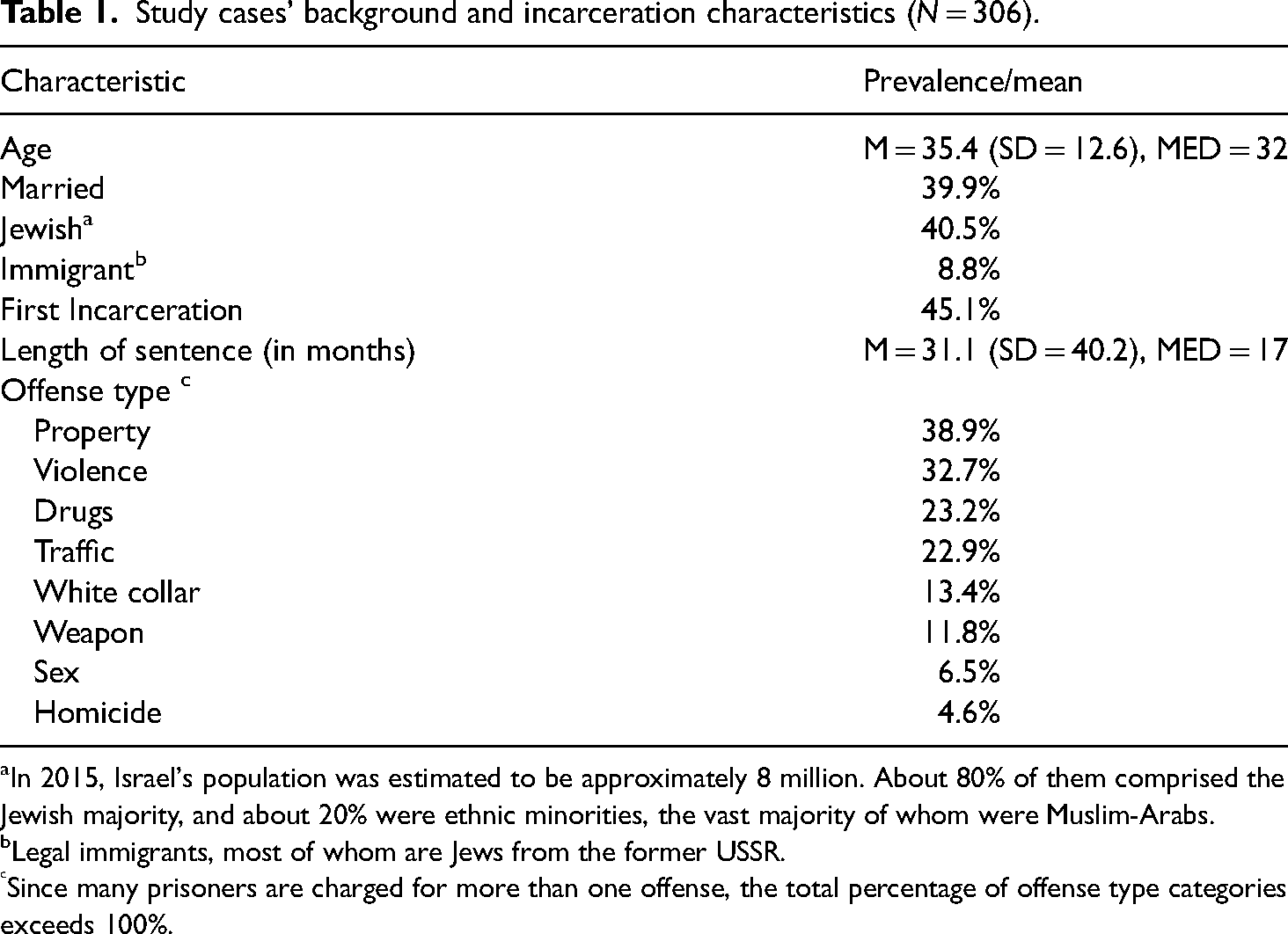
In 2015, Israel's population was estimated to be approximately 8 million. About 80% of them comprised the Jewish majority, and about 20% were ethnic minorities, the vast majority of whom were Muslim-Arabs.
Legal immigrants, most of whom are Jews from the former USSR.
Since many prisoners are charged for more than one offense, the total percentage of offense type categories exceeds 100%.
Chi-square and t-test analyses of the characteristics listed in Table 1 revealed that almost none were associated with the decision to grant or recommend early release. The only exceptions were age and first incarceration. The average age of prisoners the parole board decided to release was 32.9, and 37.6 when the decision was to deny release (t = 3.28, p < .01). The average age of prisoners the PRA recommended to release was 32.5, and 40.3 when the decision was to deny release (t = 5.43, p < .001). The parole board decided to release 61.6% of the prisoners for whom this incarceration was their first, and 33.9% of those for whom it was not (χ2 = 23.3, p < .001). The PRA recommended the early release of 76.8% of the prisoners for whom this incarceration was their first, and 51.2% of those for whom it was not (χ2 = 21.3, p < .001).
In order to identify the factors that impact the early release decision or recommendation, we explored the reasoning found in the parole board decisions and PRA rehabilitation reports. The following section will describe the method used to extract the factors from these documents. Since parole cases are usually short, written in legalized and formal rhetoric, and mainly review the parole factors, we did not find the data richness and depth were suitable for qualitative content analysis (Elo et al., 2014). Instead, we employed a quantitative-inductive content analysis method (Krippendorff, 2018).
Independent variables
In the present study, we conducted a content analysis of the categories appearing in the texts of parole board decisions and PRA reports, that is, the independent variables. Content was extracted in the following several stages:
Dependent variables
An analysis of the predicted variable, that is, the early release decision by the parole board or recommendation by PRA, reveals that the former decided to grant early release in 46.4% of the cases in our sample, and the latter recommended to do so in 62.7% of them. In 122 of the cases (39.9%) both PRA and the parole board agreed to grant early release. In 94 of them (30.7%) the two authorities agreed to deny early release. In 70 of the cases (22.9%) the PRA recommended early release while the parole board denied it, and in 20 of them (6.5%) the PRA recommended denying early release but the parole board decided to grant it. In total, the PRA and parole board agreed in 70.6% of the cases analyzed (r = .45).
Analytic strategy
In the present study, where resources for predictive variables were not formal data-collecting tools but bureaucratic-professional raw material, stepwise regression emerged as the best statistical method for obtaining the optimal model predicting an early release decision/recommendation. 7 As part of this approach, the variables that optimally predict the outcome variable will be indicated while optimizing the desire to increase predictability and striving to reduce variance (a bias-variance tradeoff). This method automatically selects the model and is not theory- or context-based.
Results
Descriptive statistics
Table 2 displays the prevalence of categories and factors appearing in parole board decisions and PRA reports.
Prevalence of categories and factors appearing in parole board decisions and PRA reports (N = 306).
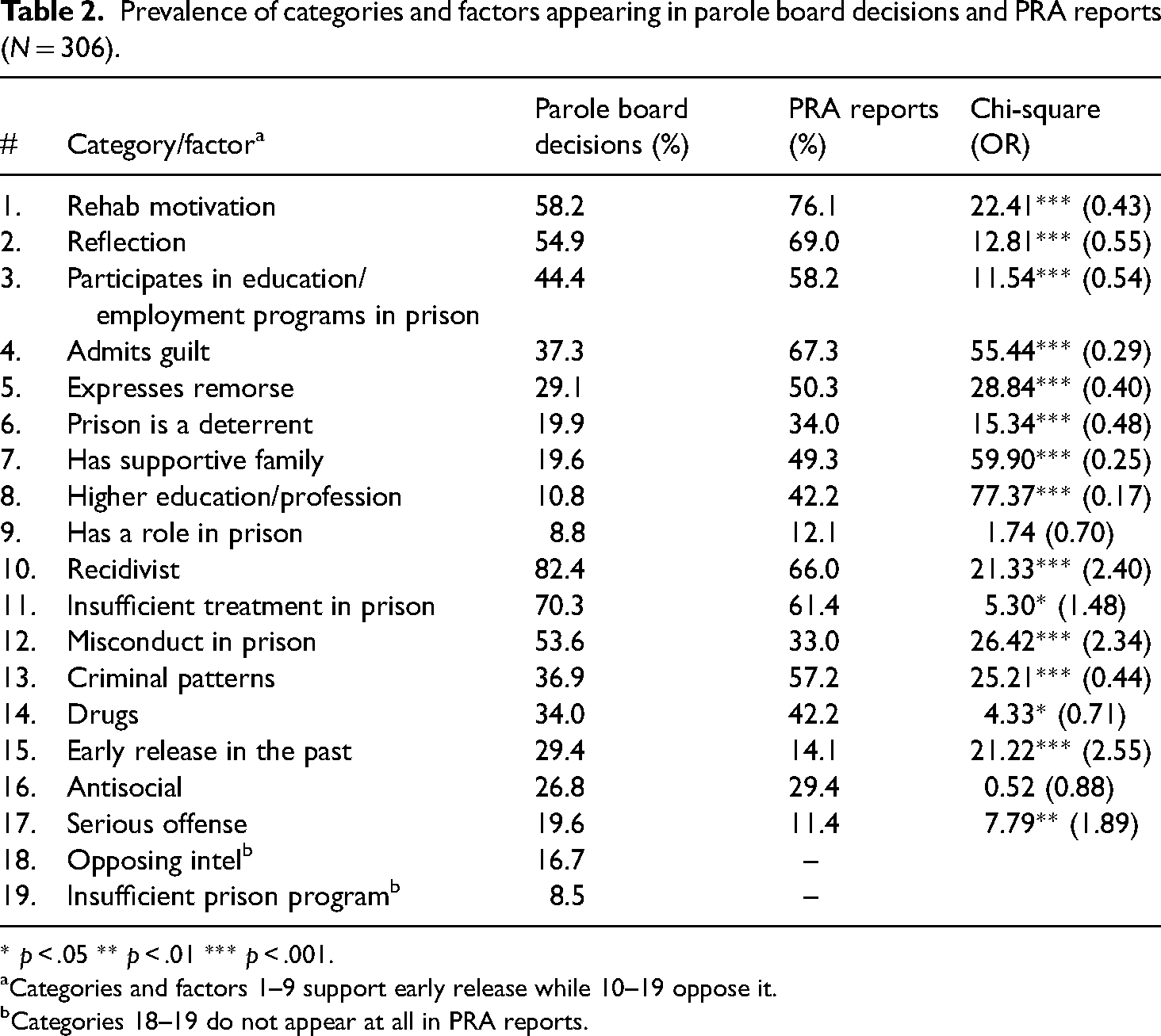
* p < .05 ** p < .01 *** p < .001.
Categories and factors 1–9 support early release while 10–19 oppose it.
Categories 18–19 do not appear at all in PRA reports.
Significant differences were found in 15 of the 17 comparable factors (“Insufficient prison program” and “Opposing intel” do not appear in PRA reports). When categories and factors are divided into those that support early release (nos. 1–9 in Table 2, e.g., “Rehab motivation”) and those that oppose it (nos. 9–16 in Table 2, e.g., “Recidivist”), the prevalence of all categories and factors supporting early release, except one category (“Has a role in prison,” in which no significant difference was found) was significantly higher in the PRA reports than in the parole board decisions. The prevalence of categories and factors opposing early release was higher in the parole board decisions than in the PRA reports in five of the eight categories/factors, and lower in two categories/factors; whereas in one category no significant difference was found.
Logistic regression models
The factors and categories appearing in parole board decisions and PRA reports, as well as the background and incarceration characteristics of the study cases were introduced into two forward-stepwise selection models appearing in Table 3.
Logistic regression models (with forward stepwise selection) a to predict decision/recommendation for early release.
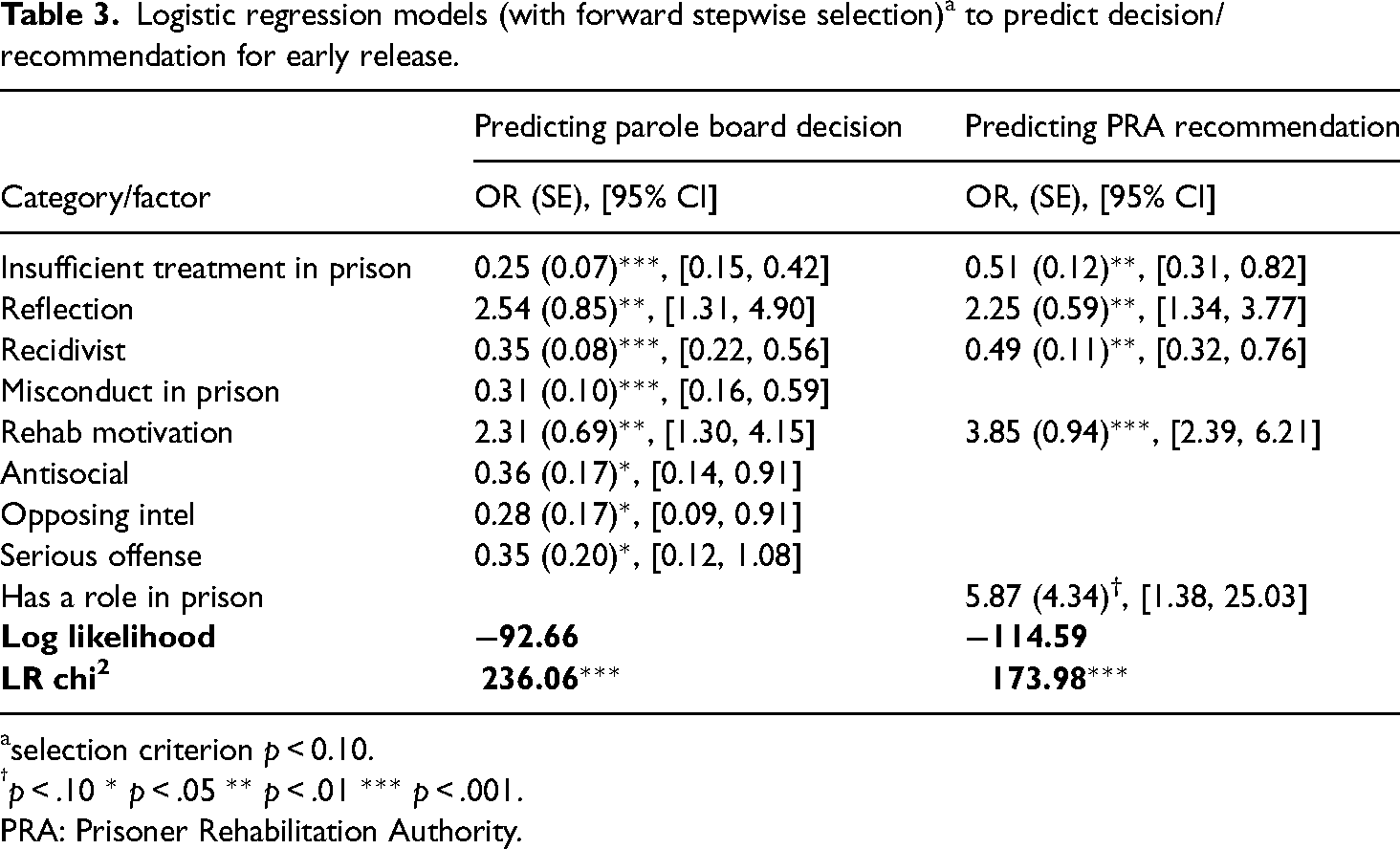
selection criterion p < 0.10.
p < .10 * p < .05 ** p < .01 *** p < .001.
PRA: Prisoner Rehabilitation Authority.
Eight variables appear in the parole board decision final model, and five variables in the PRA recommendation model. To assess the predictive power of the model we used PRE (proportional reduction in errors) as proposed by Menard (2003). This measure yielded a 75.35% reduction of error for the parole board decision model and 59.65% for the PRA recommendation model.
The predictive variables appearing in both models were: “Insufficient treatment in prison”, “Reflection”, “Rehab motivation”, and “Recidivist”. The variables “Misconduct in prison”, “Antisocial”, “Opposing intel”, and “Serious offense” appeared in the parole board decision model only, and the variable “Role in prison” only appeared in the PRA recommendation model. None of the background and incarceration characteristics (including prisoner's age and first time in prison that well distinguish between for or against early release, see Table 1) were included in the final models.
In the parole board decision model, there were both factors associated with risk (e.g., “Misconduct in prison” and “Antisocial”) and those associated with rehabilitation (e.g., “Rehab motivation” and “Reflection”), while in the PRA recommendation model, there were factors associated with rehabilitation only, except one (“Recidivist”). Thus, it seems that, while PRA recommendations rely almost solely on rehabilitation considerations, parole board decisions rely on rehabilitation and risk considerations alike.
Discussion
The current study aims to overcome the gap in knowledge on the role played by the rehabilitation authority in the parole board's decision-making process, and the interplay between these two authorities’ decision-making. By doing so, this study sheds light on parole decision-making from multiple perspectives, contributing to a fuller understanding of the complex crafting of parole (Young and Pearlman, 2022).
We explored whether the parole board and rehabilitation authorities adhere to their anticipated traditional risk and rehabilitation discourses respectively, or perhaps practice more versatile reasoning. When analyzing the records of these two authorities, a complicated picture emerged. While the PRA report relies heavily on rehabilitation reasoning, the parole board uses risk and rehabilitation reasoning alike. It seems that Israeli parole boards embrace the rehabilitation discourse and weave it into their decisions. Findings indicate that the primary decision-maker—the parole board—integrates and internalizes the rehabilitation logic and rhetoric of the recommending authority, albeit its primary role as gatekeeper of risky released prisoners.
This finding is integrated with qualitative studies suggesting that, for parole board members, “through that rehabilitation comes public safety” (Ruhland et al., 2018: 4). Seemingly, parole board members capture risk as fused and intertwined with rehabilitation (Maurutto and Hannah-Moffat, 2006; Simon, 1993) while endorsing their professional and institutional self-perception as the “public safety defenders” (Fitzgerald et al., 2022; Greene and Dalke, 2021; Ruhland, 2020; Ruhland et al., 2018).
The dynamic between these two authorities, when the decisive authority uses the logic and rhetoric of the recommending authority, can be viewed as a form of “professional isomorphism” between the two, where, possibly, the parole board adopts the dominant discourse of the rehabilitation authority, as the formal rehabilitation experts by law, in order to increase its own stability, efficiency, and legitimacy toward the public (DeMichele, 2014). Such a process seems to be especially needed in the context of parole that often suffers from adverse public opinion and insufficient legitimacy (Fitzgerald et al., 2022).
However, unlike some U.S.-based findings, Israeli parole boards’ discretion was not found to follow the rehabilitation recommendation automatically (Proctor, 1999), nor does the latter act simply as a “surrogate parole board” (Bowman and Ely, 2017: 558). Instead, in our sample, agreement was achieved in 70% of cases. The relative independence of the two decision-makers—acting under separate legal guidance and different rehabilitative orientations, while being comprised of different professionals—may explain that. However, similarities in these two players’ reasoning, especially when parole boards use rehabilitative language, may attest to the openness of the latter to specialists’ recommendations, without giving up the final word. A similar pattern was found when the correspondence between sentencing recommendations and sentencing outcomes was examined in other systems (e.g., Deane, 2000; Van Wingerden et al., 2014).
Naturally, most disagreements among parole boards and the PRA arise when the rehabilitation authority supports early release and the parole boards object to it since the latter attribute greater weight to static (e.g., criminal history or offense seriousness) and prison factors (e.g., prison misconduct) compared to the PRA. It is instructive that, although the Supreme Court stressed the risk aspect (Garcia v. Parole Board, 2003), the rehabilitative discourse is highly present in parole board reasoning. In the Israeli case, the composition of parole boards—comprised not only of a judge but of members from diverse professional disciplines with varying experience (psychology, criminology, etc.) too—may explain this wide view. Moreover, we believe that the fact that most parole chairpersons are retired judges may contribute to their wider and less constrained view, that goes beyond risk and reflects the traditional discretionary nature of the judicial work in penal issues (Ruhland, 2020).
Expression of remorse was not found to predict parole decisions or PRA's recommendations in our study, although it was found to predict parole release in others (e.g., Hannah-Moffat and Yule, 2011; Ruhland et al., 2018; Vîlcică, 2018), and even described by parole board members as part of the moral logic of parole (Young and Chimowitz, 2022). Possible explanations are that remorse is not mentioned explicitly in the Israeli parole law as a factor for release. Furthermore, perhaps the authorities prefer to avoid the assessment of the prisoners’ “soul” considering that the offenses in our sample, on average, were less severe compared to the above studies (e.g., no prisoners serving life sentences; few convicted for sex crimes) (Young and Chimowitz, 2022). Finally, there may be some similarities between “expression of remorse” as a factor found in other studies, and “reflection,” a factor found in our study to be a powerful predictor of parole decisions and recommendations. Indeed, they were found to be quite correlated both in the parole board (r = .41) and PRA factors matrix (r = .53).
Parole boards’ psychosocial reasoning is illustrated by the “Antisocial” factor included in the model predicting early release decisions. This factor, comprised of items such as “Difficulty with authority figures” and “Impulsive,” is well rooted in the psychological practice of offenders (e.g., Black et al., 2010), and is also viewed as a predictor of recidivism. Similarly, according to Andrews et al. (2006), there are eight central risk factors (or criminogenic needs) for recidivism. Of the eight, four are considered especially influential for reoffending: antisocial history, antisocial personality, criminal thinking, and antisocial peers. It would therefore seem that parole boards have adopted the reasoning and terminology that enable them to encompass the complex rehabilitation-risk discourse on early release. Yet the “Antisocial” factor did not appear in the PRA recommendation model, as might be expected from the professional organization in charge of the psycho-social discipline. It seems that the reduced impact of the “Antisocial” factor may be explained by the PRA's tendency, as a rehabilitative body, to prefer dynamic, future-oriented factors due to its desire to render rehabilitation suitable for as wide a population as possible.
In the present study, sociodemographic variables were not included in the predictive models for either parole board decisions or PRA recommendations. While studies conducted in the United States reveal that the chances of being released early are smaller among African-American prisoners (e.g., Huebner and Bynum, 2006), the present study found no differences in the rate of early release decisions granted to Jews, who form the majority of the Israeli population, and members of non-Jewish minorities (the vast majority of whom are Muslim-Arabs), attesting to procedure fairness in Israel. However, discrimination during the criminal proceeding is complex, and inconsistent findings in this area are explained by research methodologies as well as the type of criminal proceeding examined (Baumer, 2013; Mitchell, 2005; Young and Pearlman, 2022). In Israel, too, some findings attest to discrimination in certain criminal justice proceedings (e.g., Gazal-Ayal and Sulitzeanu-Kenan, 2010, who found ethnic discrimination during extended remand proceedings). This is especially true in judicial procedures where detailed information on the subject is limited (e.g., in extended remand as opposed to parole discussion), increasing the likelihood of stereotyping emerging.
This study used a quantitative-inductive content analysis of documents pertaining to some 300 cases. Once the themes and categories were extracted, their relations with the parole board decision and PRA recommendation were examined. This is not a common attempt in the field of legal content analysis, 8 where content analysis is often conducted while employing a qualitative approach and using a relatively small number of cases, probably due to difficulties accessing the material, and the high cost of such analyses (Lowenstein, 2016). The use of a quantitative approach with a relatively large number of observations might enable inferential statistical analysis. Moreover, the studies conducted to date on parole boards have examined the relations between variables that emerged from documents and data provided to the parole boards, and the decision to grant early release. In such examinations, it is difficult to determine causality, because it is impossible to know the extent to which the parole board had taken them into account, or had even been aware of them. Therefore, the only conclusion that may be reached can be correlational. The present study examines the factors mentioned in the documents written by the parole board and PRA officers themselves, and can therefore be seen as an expression of the parole boards’ mindset, serving as the logical basis for their decisions, and offering the possibility of cautiously proposed causality.
The present study has theoretical and policy implications. When discussing and analyzing parole policy, we should consider the possible intersections and gaps between the various parole philosophies held by the different decision-makers both in prison and in the community. Moreover, parole policy-making (e.g., parole law) should be aware of the actual orientation of each decision-maker within the overall parole framework, and encourage representativeness of the various ideological approaches, as well as some synchronization between them.
Our findings should be read while bearing in mind the following limitations. First, while the content analysis of the parole board decisions and PRA recommendations conducted during the present study employed prudent procedures to strengthen the reliability and validity of the themes and categories extracted from the texts, this process was nevertheless manual and subject to the possibility of subjective review. Furthermore, the present study employed a data model analysis approach that required strong assumptions about linearity, monotonicity, or parameters of distributions, rendering their predictive ability more limited compared to algorithmic models (Breiman, 2001). Here, too, automated tools may be helpful. A pilot study used natural language processing and machine learning to analyze legal texts and predict the decisions of the European Court of Human Rights as to whether there has been a violation of an article of the Convention on Human Rights. The models used predicted the court's decisions with 79% accuracy on average, indicating that the formal facts of a case are the most important predictive factor supporting the theory of legal realism (Aletras et al., 2016). Even greater accuracy was obtained using a similar technique when predicting the rulings of the Supreme Court in France (Sulea et al., 2017). However, while the use of such advanced tools makes prediction more precise, the advantage of using traditional statistical models lies in their ability to suggest themes and categories with theoretical and practical implications for the research field associated with the content analysis (Shmueli, 2010).
Second, this study was conducted using Israeli data, and the relevance of its insights to other systems and national cultures requires further examination. We believe that the Israeli parole boards share a similar approach and reasoning with many other Western discretionary parole systems (Padfield et al., 2010), rendering the outcomes of this study highly relevant to them as well. At the same time, the rehabilitative approach of the Israeli correctional system has deep roots in Jewish tradition, and offenders are perceived as individuals who can change their way of life (Gideon et al., 2015). Therefore, the rehabilitative emphasis of Israeli parole boards is perhaps a unique phenomenon.
One cannot overstate the importance of unveiling the backstage of parole boards and rehabilitation authorities, as their ability to shorten sentences significantly following a short discussion (an average of about 6 min per case in Danziger et al.'s (2011) study on Israeli data) grants them dramatic social power. Similarly, the findings of the present study indicate the existence of a set of considerations that balances risk and chance assessment, and, in this respect, an encouraging picture emerges. It would be even more instructive to examine the correlation between these entities’ decisions and the recidivism rate found among prisoners released early. Are PRA reports and parole board decisions able to predict prisoners' successful rehabilitation, and are there any particular factors that can predict it more accurately than others? A more profound understanding of recidivism-related factors could serve as the basis for developing a tool to support decision-making in parole boards and recommending rehabilitation authority discussions (e.g., Berk, 2017).
Finally, the current study encourages further qualitative studies that may validate the current study's quantitative findings. Such studies could reveal the extent to which these two players’ activities when crafting parole reflect different in-depth perceptions regarding their professional identity, functions, and perceived responsibilities within the rehabilitation and risk pendulum.
Conclusion
Prisoners’ release is a significant event, not only for them and their families, but for society too, as it is expected to welcome back those who have breached its fundamental codes and, while having paid their dues, are still often perceived as posing a high risk to it. This event is more dramatic still when prisoners are released early, before completing their full sentences. The present study has shown that the two entities playing central roles in this process—the parole board and rehabilitation authority—hold a discourse on chance and risk, relying on prisoners’ criminal histories and their future prospects. While the rehabilitation authority plays its role as expected of it, shedding light on chance and future prospects, parole boards’ discourse is more complex, with chances and prospects being indeed dominant, but risk factors also addressed. Such a complex discourse probably results from the law, but may also be considerably impacted by the professional diversity among parole board members, and the rehabilitative language used in PRA recommendations. Overall, it seems that this empirical investigation of the “behind the scenes” may mitigate the public's suspicion toward the early release option, and enhance public trust.
By way of concluding this paper, we can rephrase Roberts’ (2009) question into a more optimistic statement: “Parole boards are in [instead of losing] sight of the issue of rehabilitation” (p. 397). In the Israeli case, at least, they truly are.
Supplemental Material
sj-docx-1-pun-10.1177_14624745231213859 - Supplemental material for Rehabilitation vs. risk: What predicts parole board decisions and rehabilitation authority recommendations?
Supplemental material, sj-docx-1-pun-10.1177_14624745231213859 for Rehabilitation vs. risk: What predicts parole board decisions and rehabilitation authority recommendations? by Dror Walk and Netanel Dagan in Punishment & Society
Footnotes
Declaration of conflicting interests
The authors declared no potential conflicts of interest with respect to the research, authorship, and/or publication of this article.
Funding
The authors received no financial support for the research, authorship, and/or publication of this article.

Supplemental material
Supplemental material for this article is available online.
Notes
References
Supplementary Material
Please find the following supplemental material available below.
For Open Access articles published under a Creative Commons License, all supplemental material carries the same license as the article it is associated with.
For non-Open Access articles published, all supplemental material carries a non-exclusive license, and permission requests for re-use of supplemental material or any part of supplemental material shall be sent directly to the copyright owner as specified in the copyright notice associated with the article.
