




Abstract
Criminal justice institutions are held to account in a number of ways yet there is limited knowledge as to how these systems of regulation function. One primary method for regulating systems of punishment is through the use of independent inspectorates, yet very little empirical research has explored how inspectorates engage with the organisations they inspect nor how inspection is received by inspected organisations. Procedural justice theory has been used to understand compliance with laws. It can also shed light on compliance with systems of accountability, although there is a dearth of research in this area. Thus, our understanding of how regulation works in situ is limited. This article uses procedural justice theory to analyse data that were collected in England and Wales to explore how His Majesty's Inspectorate of Probation garners legitimacy from those it inspects. The article suggests that the Inspectorate is seen to be trustworthy and impartial, treats people with respect and provides them with a voice although there is variance between groups. The article contributes to (1) our understanding of how regulation works in the field of probation and (2) procedural justice theory by exposing the mechanisms that underpin compliance with regulatory regimes in institutional settings.
Introduction
Community sanctions are partly legitimated through being positioned as ‘alternatives’ to custody, reserved for people who have caused insufficient harm nor pose sufficient risk to the public to warrant detention. Although re-offending rates amongst people who have served short custodial sentences are higher than amongst those who had served a community sanction (Hamilton, 2021) garnering sufficient legitimacy for probation services has proven difficult over the years. As a result, successive governments in England and Wales have resorted to the language of ‘toughening up’ probation instead of focusing on its rehabilitative efforts (Robinson and Ugwudike, 2012). However one chooses to justify and legitimise community sanctions, there needs to be evidence that probation services are delivering what they are tasked to do. As such, Ministry of Justice analysts and independent researchers undertake analysis and evaluations of effectiveness, although historically community sanctions have remained invisible and poorly researched when compared to other criminal justice institutions (Robinson, 2016). Criminal justice agencies are also scrutinised by bodies such as the Ministry of Justice which carries out such tasks through internal monitoring, quality assurance and independent inspection. These methods of accountability are poorly understood, with the National Audit Office (2015) identifying a lack of knowledge on the impact of inspection across the criminal justice system.
This article explores the regulation of criminal justice institutions by analysing data collected in research on the impact of inspection on probation through the lens of procedural justice (Tyler, 1990). The article examines stakeholders’ experiences of inspection to explore His Majesty Inspectorate of Probation's (HMI Probation) perceived trustworthiness, impartiality, respectfulness and the extent to which inspected people have a voice in the process. This analysis sheds light on how inspectorates generate legitimacy to ensure recommendations are implemented. In doing so the article makes a contribution to procedural justice theory by exposing the mechanisms which underpin the nature of compliance with regulatory regimes in institutional settings.
Regulating criminal justice
Regulation exists to ‘steer the flow of events’ (Grabosky, 2010: 73) and can relate to both criminal justice as an activity (in that punishment seeks to change behaviour) and – for the purposes of this article – criminal justice practice as a regulated activity. Since the final decade of the twentieth century audit and inspection activities have increased partly due to a declining lack of societal trust in organisations (Power, 1997). Whilst audit may have laudable aims (improving practice and service delivery) it can also bring unintended side effects. For example, Power (1994) notes that audit can ‘provide comfort to stakeholders who are remote from day to day practices’ but also bring an end to dialogue around how to improve. Moreover, Power (1994: 39) argues that whilst audit is ‘directed at evoking good feelings about organisational practices it may also become a new form of image management’ instead of substantive analysis. Whilst inspectorates exist to ‘drive system change’ (HMI Probation, n.d.) there is little evidence on how – or indeed whether – they achieve this (Badachha et al., 2022). Although potentially effective in improving effectiveness inspection and audit risks introducing accountability overload (Halachmi, 2014) and organisational pathologies that reduce efficiency, effectiveness, responsiveness and innovations. Indeed, it has been found that inspection in probation can result in a burden on practitioners and organisations by taking up time and detracting attention away from peoples’ day-to-day responsibilities (Phillips, 2021a). As such, the process of audit and inspection is in need of deeper analysis.
In England and Wales, the Government has adopted a tripartite model of ‘public regulation’ (Ogus, 2010) to regulate prisons, comprising monitoring, inspection, and complaints handling (Behan and Kirkham, 2016). In probation, the Ministry of Justice has adopted a similar ‘three lines of defence’ model which consists of inspection, internal quality assurance and contract management (HMI Probation, Ministry of Justice and HMPPS, 2018). This ‘redundancy model’ of accountability ensures that ‘effective regulation does not stand or fall on the performance of a single actor’ (Seddon, 2010: 263) and means that a multitude of actors are responsible for regulating criminal justice (Tomczak, 2021). Whilst this article deals with inspection it should be remembered that this is not the only way in which probation is regulated.
Accountability can be ‘past-oriented’, undertaken to find out what happened as well as future-oriented through the use of recommendations for change (Seddon, 2010). Within this broader model of accountability, inspection tends towards more forward-looking approaches though playing a ‘preventive’ role (Owers, 2010: 242) by focusing on the competence of professional staff, compliance with professional standards and outcomes for service users. In order to achieve this, inspection requires the involvement of three groups of actors: directors, detectors and effectors (Boyne et al., 2002). Directors set the standards for the work they inspect; detectors generate evidence about whether these standards are being met and effectors implement and change organisational policies and behaviours.
HMI probation was created in 1936 and was initially responsible for overseeing the selection, training and competence of individual probation officers. During the 1980s, the focus of the Inspectorate's work was considered in the ‘Grimsey Report’ which recommended that work should be primarily directed towards efficiency and effectiveness. Since the early 2000s, its remit has grown to encompass the inspection of adult probation and youth offending services. HMI probation also undertakes, commissions and disseminates research around effective practice and can be asked by the Secretary of State to undertake inquiries and reviews of serious further offences (SFOs) or in response to specific concerns. In 2020, it took on a new quality assurance role around SFO reviews which are carried out by the probation service. Over the last 90 years, the Inspectorate's remit and influence have grown (reflecting Power's 1994, 1997 notion of the ‘audit explosion’) and is responsible for both developing effective practice and accountability. Effectiveness here is not necessarily about those broader aims of sentencing such as retribution, public protection or rehabilitation (although Badachha et al., 2022 argue that inspection can create the conditions for a more rehabilitated form of probation practice). Nor is it necessarily about how well probation providers meet their contractual obligations or key performance indicators as set out by the Ministry of Justice. Rather, providers are assessed against the Inspectorate's own set of standards which it creates independently of government.
In England and Wales, probation is delivered by the Probation Service which is part of His Majesty's Prison and Probation Service. HMI Probation inspects all adult probation services against its own set of regional- and PDU (probation delivery unit)-level standards. One set of standards focus on leadership, staffing, services and information and facilities at the regional and PDU levels. PDUs are also assessed against an additional set of standards related to court work, direct work with people on probation, outcomes for people on probation, and statutory victim work (HMI Probation, 2021b). In each region, the Inspectorate gathers evidence during a specified period of fieldwork (HMI Probation, 2023b). Regions and PDUs are given 8 weeks’ notice of fieldwork commencing. During this preparation period, a plan for the inspection is drawn up and inspected services are asked to provide evidence relevant to the inspection in advance of fieldwork. Fieldwork itself involves interviews with leaders and partner agencies and case interviews with probation practitioners. These are framed as learning opportunities in which practitioners should ‘feel able to be open and honest about their work’ (HMI Probation, 2023b: 26). At the end of the inspection, a final rating is published in PDU-level reports alongside a regional review letter which consolidates overall findings, key observations, and areas for improvement at a regional level.
Legitimacy, procedural justice and the process of inspection
Transforming rehabilitation (TR) had significant implications for the legitimacy of probation in relation to both ‘the self-image of the service and its workforce, and the perceptions of external audiences and stakeholders’ (Robinson, 2021: 152). Although criminologists have tended to focus on the legitimacy of criminal justice institutions from the perspective of the general public or people who are subjected the powers that criminal justice practitioners wield, Robinson et al. (2017) point to ‘five key stakeholder groups: the general public; offenders and victims; ministers and civil servants; sentencers; and probation employees and their representatives’. This article largely deals with the process of legitimation of inspection for probation employees and their representatives but it is important to note that the ‘self-legitimacy felt by probation practitioners’ is likely to have significant implications for the overall legitimacy of the service in the eyes of other stakeholder groups (Deering and Feilzer, 2017). Indeed, Robinson (2021) suggests a number of strategies for re-legitimation when it comes to external stakeholders, many of which will rely – to some degree on – on the outcomes of inspections, because they can be used to ‘to foster the belief among constituents that the organisation's activities and ends are congruent with the expectations, values, and norms of constituents’ (Ashforth and Gibbs, 1990 cited in Robinson, 2021: 153).
However, this can only take place if inspection itself is seen and experienced as a legitimate endeavour by those who are subject to it. In order to effectively persuade providers about what they should do, inspectorates need to be able to garner legitimacy from those they inspect and task with implementing recommendations. Legitimacy relates to subordinated actors’ recognition of the authority of officials who hold power over them (Tankebe and Liebling, 2013). Legitimacy theory suggests that officials will be perceived as legitimate if such power is legally obtained, exercised in accordance with shared values of procedural and distributive fairness and effectiveness, and where consent is given by the subordinated (Beetham, 2013). Procedural justice describes the quality of officials’ decision-making and treatment of others, whilst distributive fairness describes the fairness of officials’ outputs or allocation of resources (Tankebe, 2013). As inspectorates are created and funded by the state (whilst also being independent from it) they wield significant power over others on behalf of the state. For them to meet their core function they must therefore cultivate and maintain legitimate practices to garner ‘cooperation, deference and compliance’ from those they inspect (Bradford and Quinton, 2014: 1024). The legitimacy of independent oversight bodies such as inspectorates thus derives ‘from the procedures they use to reach their decisions’ (Rosanvallon and Goldhammer, 2011: 92) through winning the ‘hearts and minds’ of the executive and inspected service (Owers, 2010).
Tyler's (1990) work on procedural justice theory suggests that people are more likely to comply with laws if they see the institutions that create and enforce them as legitimate. People are more likely to obey the law and comply with people in positions of authority if the institutions which creates and enforces them are perceived to (1) be trustworthy, (2) be impartial, (3) respectful and (4) provide people with the opportunity to have a voice (Tyler, 1990). If people do not trust those in authority, then they are less likely to be seen as effective and fair. Importantly, trustworthiness is established when an authority has a ‘strong commitment to the community’ and subordinated groups need to feel ‘understood’ (Bickers et al., 2019: 479). This relationship shapes the ways in which people feel treated and leads to greater legitimacy – and thus compliance – if they are part of the in-group (Jost and Major, 2001; Tyler and Blader, 2003). For probation, this concept may have added pertinence considering the generally low levels of understanding around what probation practitioners do.
Those in positions of power must also be seen to be impartial. As noted by Bickers et al. (2019), people will view a police officer's decision as fair and impartial, and therefore more likely to comply, if they feel that the officer was objective and neutral about the facts collected (Tyler, 2010b) even when a decision goes against them. A fair process therefore enhances legitimacy (Tyler, 1990, 2001). This is critical in the context of inspection and regulation as the ramifications of a poor inspection can be wide-ranging. For example, scathing inspections of some Community Rehabilitation Companies (CRC) led to their demise whilst in other fields, there have been concerns about the impact of inspection on staff morale (Education Committee, 2023) as well as tragic events such as suicide of a school headteacher following a negative inspection (BBC News, 2023).
Respect relates to the extent to which people in authority are respected by those in subordinated positions and thus rests on their ‘status within the group’ (Tyler and Blader, 2003: 354). There is overlap here with the concept of trustworthiness: if inspectors are seen to sit outside the profession they are inspecting, they may find it more difficult to generate trust and thus treat people with respect. When subjects discuss injustice, they most commonly refer to the lack of respect that they feel they are given by others (Mikula, Petri, and Tonzer, 1990 cited in Bickers et al., 2019). Respect can also relate to the way in which those in positions of authority respect ‘the limits of rightful power’ (Trinkner et al., 2018: 283). People are interested in how power is exercised over them as well as what power is exercised. If those in power are seen to be overstepping the mark, they risk being seen as disrespectful to those in subordinated groups.
Finally, voice refers to giving people the opportunity to take part in the decision-making process by presenting arguments, and having their views considered by those in power (Bickers et al., 2019). The process of inspection in probation provides opportunities for people to talk to inspectors, especially through case interviews. Procedural justice theory would suggest that talking along is not enough: ‘voice’ requires a person to feel heard (Mitchell and Von Zoller, 2016 cited in Bickers et al., 2019) and so interaction needs to be meaningful to the subordinated person.
Procedural justice theory has been used to understand how people comply with a range of laws and institutions (Black and Heap, 2022; Murphy et al., 2014; Nagin and Telep, 2017) and how correctional institutions can garner legitimacy from those that are being punished (Blasko and Taxman, 2018; Digard, 2010; Fitzalan-Howard et al., 2023; Jackson et al., 2010; Ryan and Bergin, 2022). Moreover, it has been applied to a range of contexts outside the immediacy of compliance with law and criminal justice institutions such as prison accountability mechanisms (Behan and Kirkham, 2016) and business regulation (Makkai and Braithwaite, 1996). However, very few studies have explicitly and empirically explored the ways in which practitioners comply with regulatory regimes and experience inspection. Addressing this knowledge gap has implications supporting accountability organisations to enhance their capacity to effectuate change (Behan and Kirkham, 2016) and informs wider debates about how criminal justice institutions are regulated.
Study context
This research was undertaken in 2019–2020, towards the end of a period of structural change in probation in England and Wales whereby the Government partially privatised probation through a process known as TR in 2014 (Ministry of Justice, 2013). TR resulted in privately run CRCs supervising low- and medium-risk people and a newly formed publicly run National Probation Service (NPS) supervising high-risk people. Ostensibly an exercise in focusing probation delivery on reducing re-offending through a contracting process that was partly based on payment by results, TR was not popular amongst many of those closely involved with probation. The probation union Napo successfully balloted for strike action and academics and other interested parties argued against the reforms which they felt would put the public at risk (Phillips, 2014). It soon became clear that CRC staff were struggling to assess and overcome barriers to compliance, explore the reasons behind peoples’ behaviour and do work with people to modify their behaviour (HMI Probation, 2015). In subsequent reports, CRCs averaged a score of 14 whilst NPS divisions averaged 20 (Webster, 2020) and CRC staff reported feeling like ‘second-class’ practitioners (Robinson et al., 2015). CRCs were accused of crossing ‘immutable lines’ by under-counting riskier cases because of commercial pressures and completing sentence plans to meet performance targets, without actually meeting clients (HMI Probation, 2019a). This experiment in privatisation was soon branded a failure and the Government re-nationalised the CRCs in June 2021 (Annison, 2019) a process that was likely sped up by then Chief Inspector Dame Glenys Stacey's comments that the TR model was ‘irredeemably flawed’ (HMI Probation, 2019b).
Although unification was welcomed by many, the process has not been wholly smooth. Practitioners have described it as a ‘necessary but painful journey’ (Millings et al., 2023) and probation is still very much dependent on ‘bureaucratic and dependent upon market(-like) mechanisms’ which have ‘further eroded professionalism in probation’ (Tidmarsh, 2023). Unification (as a legacy of privatisation) has left the Service facing serious challenges in terms of recruitment, staffing, training and retention (HMI Probation, 2021a, 2023a). Added to this, a number of high-profile SFOs have cast doubt on the ability of the Service to effectively supervise people in the community (Long, 2023) and, at the time of writing in August 2023, all except for one PDU has been rated by HMI Probation as Requires Improvement or Inadequate (HMI Probation, 2023c).
Methods
The data presented in this article were generated through a qualitative study that explored the impact of inspection on probation policy, practice and practitioners (Phillips, 2021b). The research – which was funded by a British Academy/Leverhulme small research grant – was carried out with the support of the Inspectorate which facilitated access but was independent of them. The study received ethical approval from the ethics committee at Sheffield Hallam University and the HMPPS National Research Committee. Data collection combined observational methods and interviews across four inspections in the NPS and CRCs. Thus, time was spent talking to inspectors and sitting in on case interviews and meetings. These observations were designed to improve the researcher's understanding of the inspection process; identify the impact of inspection ‘on the ground’ and in real time; and see how inspectors work with and interview staff to collect data that informs inspection findings. Although focused on probation, the research has relevance to inspection in other institutions and these methods could be deployed in different contexts accordingly.
Observations were combined with interviews (n = 77) with a range of actors (see Table 1 for a breakdown of the interview sample) which focused on the aims of inspection, experiences of inspection and perceptions of the Inspectorate. After each inspection had finished, an email was sent to people who had taken part in a case interview asking for volunteers to take part in a research interview. Senior leaders, managers and external stakeholders were also invited to take part. Probation staff were interviewed twice: once immediately after they had been inspected and then again after the inspection findings were published (although due to the COVID-19 pandemic, some of these follow-up interviews did not take place because of restrictions on undertaking research during this time). This sampling approach means that the sample may be skewed towards those who have more time to partake and who have something particularly positive or negative to say about the process. Interviews lasted – on average – 1 hour and were recorded and professionally transcribed. Leaders within the Inspectorate were interviewed separately while Inspectors and Assistant Inspectors took part in focus groups that took place during a learning week held at HMI Probation's offices.
Breakdown of interview participants.
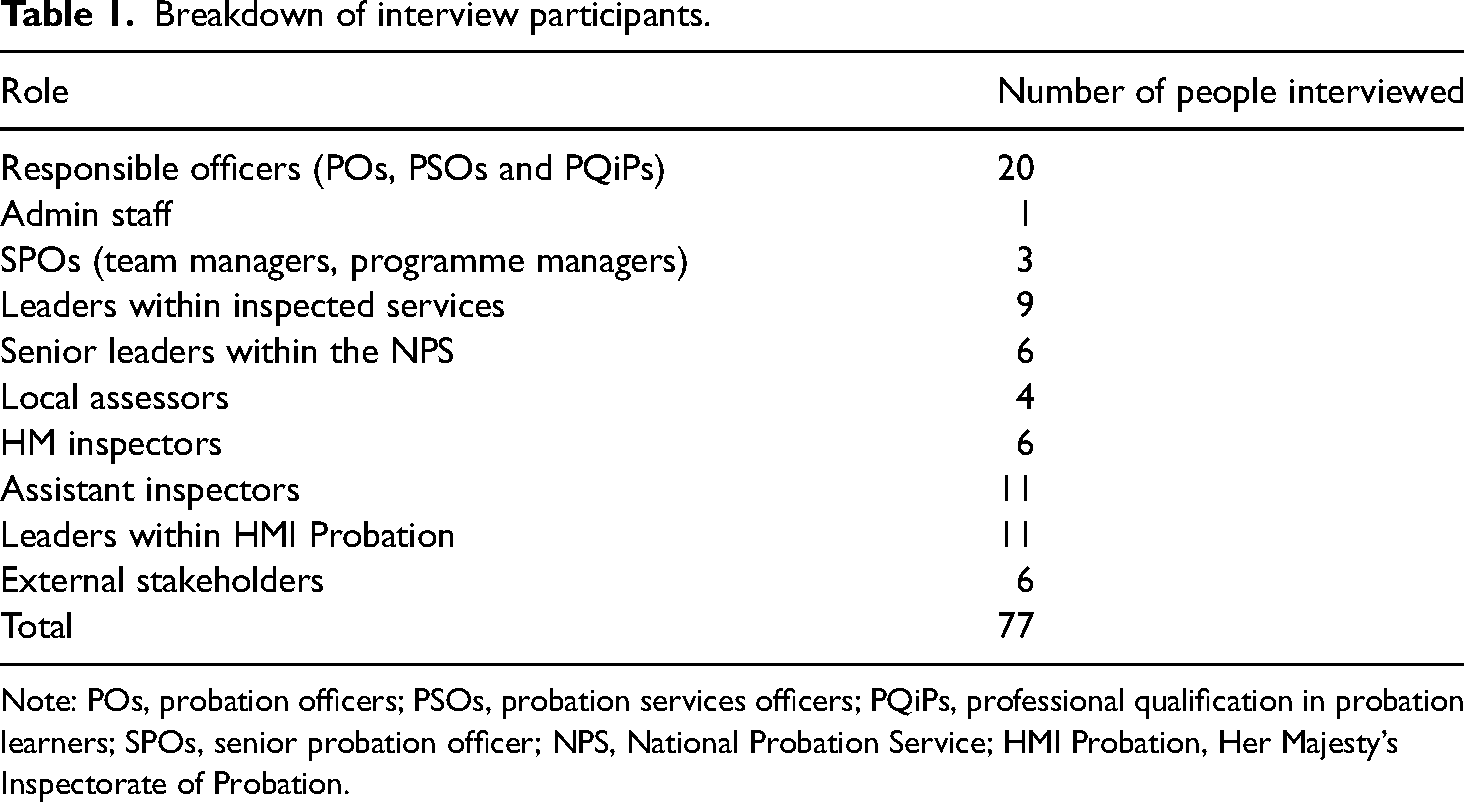
Note: POs, probation officers; PSOs, probation services officers; PQiPs, professional qualification in probation learners; SPOs, senior probation officer; NPS, National Probation Service; HMI Probation, Her Majesty’s Inspectorate of Probation.
Analysis was undertaken using Braun and Clarke's (2006, 2021) reflexive thematic analysis. Following a process of data familiarisation, the data were coded using sensitising concepts that had been derived from existing literature on procedural justice with a view to understanding what enables the Inspectorate to legitimate itself in the eyes of those it inspects.
Findings
Trustworthiness
Where systems of accountability are seen as fair, more trust in those systems of accountability will transpire (Tyler, 2010b). If people trust the activities carried out by regulatory bodies and consider the findings that come from inspections to be accurate, they are more likely to respond to them positively. A lack of trust risks inhibiting the extent to which people will act on them. Many participants felt that the inspectorate's methodology was effective in terms of understanding how well a case was supervised and they largely trusted the findings. This was particularly prevalent amongst leaders and managers within the NPS who felt that the Inspectorate's methodological approach generated a depth and breadth of evidence that provided an accurate picture of the quality of practice at the time of inspection.
However, some practitioners were concerned about providers ‘gaming the system’ through extensive preparatory work done in the run-up to an inspection. Framed in terms of ‘resistance’ this type of preparatory work can result in ‘a distorted, yet successful school [being] presented to inspectors, who wrote their report accordingly’ (Perryman et al., 2018: 161). Inspectors can see evidence of this preparatory work (entries on nDelius – probation's case management system – are time stamped) and so, whilst they recognised that work was checked prior to an inspection, they were confident that they could see beneath this veneer: they do a run through to make sure that everything’s in place and they haven’t missed anything … it has no impact on what we find … We know when the inspection was announced, and we know when they’ve started to ramp up the activity because we can see all that. That’s not hidden from us. (HMIP14)
1
Now, I know with my cases they weren’t the truth because they’d been made to look as good as they possibly could be for the inspectorate. (CRC2 04, PO) Researcher: What do you think about that, the level of preparation that goes in? Participant: Honestly? I think it defeats the object to be quite honest. You’re putting all this – you’re changing everything to fit the inspection when an inspection I think should be of how it is, because how are you going to learn if you’re making these errors if actually you put all the preparation in so everything’s tip top by the time the inspectors see it? (NPS 18, Local Assessor)
POs and PSOs were more likely to be concerned about the way in which preparatory work may result in a ‘false picture’ being painted of the work. Managers and leaders were much more likely to concur with the view put forward by HMIP14, above: I don’t see it as a false picture because I think, ultimately, if you are reviewing an OASys because it hasn’t been done, because it needs to be done, having audited it, that's not giving the inspectorate a false picture, because they will see, as and when from that OASys that review has been undertaken. (NPS1 06, SPO) I don’t think it matters as much as people think it matters. That's the first thing. So, the theory would go that if we had loads then we’d redo every case file or we’d repaint every wall in a prison and everything will be brilliant. (NPS National 01, SL)
The extent to which Inspectorates’ findings were perceived as trustworthy varied across different groups of staff. Some practitioners felt unable to fully accept the accuracy of the inspectorate's findings because they were not, in their eyes, an accurate reflection of practice. For example, participants said that cases were made to look like they were being supervised more effectively than they were by carrying out additional reviews and safeguarding checks purely for the inspection rather than because they were needed. This poses a threat to trust in the Inspectorate and its findings from practitioners, suggesting a need for consideration of how this lack of trust shapes compliance with inspections and recommendations stemming from inspection. That said, the audience for inspection findings and reports is primarily leaders (e.g., many front-line practitioners had neither the time nor inclination to read inspection reports) and NPS leaders was more inclined to trust the outcome of inspections. Considering the NPS was receiving much more favourable inspection results than CRCs at the time of the research, it may be that this tendency occurred because – for them – the process of inspection was more about ‘image management’ (Power, 1994) than improving practice. It may also be that the Inspectorate undertakes inspections in ways which seem fairer to effectors, instead of those they are inspecting. However, this lack of trust risks a legitimacy deficit when it comes to implementing the findings because practitioners see the actions coming from inspections as untrustworthy.
Inspectorates can create higher levels of trust in findings by ensuring that those people who serve to benefit from systems of accountability engage in the process (Behan and Kirkham, 2016). Thus, practitioners should benefit from inspections. However, participant practitioners found it difficult to identify examples of how things changed in the immediate aftermath of an inspection. When asked specifically about post-inspection changes, front-line practitioners detailed training that had been implemented and complained about the fact that workloads and other issues get in the way of improving practice. Indeed, inspectors suggested that the reports which are produced after inspections fail to engage practitioners: I think the reports are a strange beast anyway aren’t they. (Agreement) I think they’re very, very dry. I think [Name] alluded to it. We pick up some really rich data but also rich experiences, cultures and so on and none of that’s really reflected in the report. I can’t imagine anyone other than the strategic managers and us reading reports. (Inspectors Focus Group)
Impartiality
Impartiality underpins inspectorates’ abilities to challenge both providers and the government in relation to service delivery. If a regulatory body is not perceived as impartial then the people who serve to benefit – people under probation supervision and probation staff – may disengage from the process: ‘whether perceived or real, this perception can undermine these bodies if prisoners disengage as a result, potentially leading to reports providing a skewed perspective on penal institutions’ (Behan and Kirkham, 2016: 442). Representatives of HMI Probation were adamant that they act independently and impartially: People that inspect probation respect probation and they respect the people that work in probation. They have a great deal of empathy when they see people overloaded with work and so on, but their job is to be independent, neutral in every sense, whilst also being polite and all the rest of it … independence is the very right hand to everything that we do really. (HMIP 01, SL) I would really argue that the insider thing just isn’t true … if that was true, I would never get any difficult reports that make me uncomfortable and make me squirm with ministers and make me squirm in the press. Unfortunately, that isn’t my reality and there are plenty of what they come out with that makes me feel both of those things. (NPS National 01, SL) I think there is, from what I’ve seen, a culture of professional integrity and independence within the inspectorate … when I look at the reports they produce … I don’t feel concerned that there is a lack of political independence there…. (NPS National 10, SL)
Front-line practitioners viewed the Inspectorate – generally – as relatively independent but some raised concerns around inspectors being former probation staff. There was a perception that former probation staff could result in an inevitable desire to be lenient in the course of the inspection because they believe in the fundamental value of probation: I just think as a probation officer you’d always be trying to look for the good things because you used to be a probation officer and you know the stress that people are under, you know the trials and tribulations that you have as a probation officer. I don’t know whether you’d be looking for, not excuses, I don’t mean that, like justifications of why things have gone wrong. I don’t think for ex-probation officers it can be completely independent. (NPS1 02, PO) The inspector that I had, she’d previously been a senior probation officer and I kind of didn’t feel, I think because of her knowledge and because the fact she was a previous probation officer I didn’t kind of feel it was totally independent. No. … it doesn’t particularly feel like it’s an independent, like somebody from outside has come in and looked. (NPS1 04, PO)
Whether or not a background in probation influences an inspector's assessment is immaterial here. In procedural justice terms, perceptions are important and if practitioners do not perceive inspectors to be impartial then the legitimacy which the Inspectorate garners from those it inspects is at risk. Relational models of procedural justice suggest in-group members are more likely to engender compliance even though there may be evidence of bias yet there seems to be a sense that former probation officers risk being too biased towards probation – this represents an area for further research.
Most participants agreed that the Inspectorate's standards were appropriate. It is possible to see legitimacy being created here through a dialogic process (Bottoms and Tankebe, 2012). Specifically, participants emphasised the fact that inspectors know the landscape and understand probation and – significantly – participants appreciated the fact that the standards against which probation is inspected was developed with practitioners and underpinned by evidence: I think that people respect what comes out of that as an opportunity to look at how we can develop practice and … it's rare that I can remember a conversation with practitioners about ‘these standards are way beyond what we should be doing’ … generally practitioners do understand where it's come from, where the development of those standards has come from and … the impact on their practice and thinking back to lots of stuff that we’ve done internally we have used the standards as a guide for what we’re doing well and that's about assessing cases or reviewing cases or work that we’re doing in terms of manging orders and what have you. (EXT5, SL HMPPS)
When it came to staff in CRCs – even amongst practitioners who were generally positive about inspection findings and their experiences of inspection – the independence and impartiality of the inspectorate was called into question: We would like to think so [that HMI Probation is independent] wouldn’t we, but unfortunately in today’s world where everything goes out to tender and we privatise this and privatise that, it’s no great surprise that they are a private organisation working for the Ministry of Justice, so you would like to think that they are impartial to what’s going on, but the thing is … if you buy a loaf of bread, you want a loaf of bread so therefore the Ministry of Justice, they want the Inspectorate to actually find out certain things to roll forward with, so if the inspector comes back with something completely different and don’t come back with what they’ve paid for, the inspectorate haven’t done their job have they? (CRC1 05, PO) As regards the actual inspection itself, it’s the subtle ways things are framed and the way questions are framed that I objected to and the closed questions, the leading questions. You can just tell when someone’s trying to pick on all the aspects that – You want to talk about the good work you’re doing, and they want to talk about something you might not have done. (CRC1 01, SL) I probably haven’t stressed enough how much I thought that they did come with an agenda (CRC2 01, SL)
In CRCs, there was a perception that HMI Probation was using inspection to justify the abolition of CRCs and the creation of a new fully public model of probation which – at the time of the research – was being considered by Government: Researcher: So HMIP are essentially justifying the next process in TR by saying the offender supervision side of CRCs is not working so that’s why it has to go in to the NPS, but CRCs are good at doing the programmes and the unpaid work? Participant: Yeah, confirmation bias. If you see an example of confirmation bias, this is it. Go in, ask closed questions, (CRC1 01, SL) I felt this was – it’s hard to determine whether they were looking at quality of cases or if they were actually trying to deconstruct the whole basis on which CRCs were founded (CRC1 02, SL)
People are influenced by what they think an authority is trying to achieve: when ‘people feel that those authorities are acting out of a sincere desire to do what is right, then they view the authorities as acting more fairly’ (Tyler, 2010a: 130). Whilst CRCs no longer exist there are ramifications from these findings as many former CRC staff and leaders in the Probation Service may hold these views. The Inspectorate needs to ensure that it does not look to be working to reinforce the decision to reunify the service. Secondly, the findings raise questions for other inspectorates who are tasked with inspecting privatised services in relation to how they create and maintain a perception of impartiality amongst those they inspect. This is not to say that the Inspectorate suffers from a problem of bias. Rather, in some areas the perception that it is working to further its own ends, than necessarily improve the quality of practice can easily arise.
Respect and dignity
Tyler (2010a: 130) argues that treatment with respect and dignity ‘is one of the most important issues that people are concerned with when dealing with authorities’. Participants from the Inspectorate firmly believed that the people they inspect are treated with respect and recognised the importance that this has in relation to increasing the chances of recommendations being implemented: Because I think we’ve got professional respect and credibility so [they] generally agree with our recommendations. I think it’s a sign of a good inspectorate if we go and highlight and quantify maybe some of the issues that they already know. (HMIP 05 SL) A really positive experience to be honest. I didn’t know exactly what to expect but the inspector, she was lovely, she put me at ease, straightaway she just gave me a bit of background knowledge to what they were doing and about her and what she’d done previously. Yeah. I felt that it was just a pleasant experience to be honest. … I think the way that she kind of presented her views or whatever was done in a really constructive manner … she gave me that feedback in a way that wasn’t putting me down in any way. I felt that I gained some knowledge from it, but it didn’t make me feel that I’m incompetent or anything like that. (NPS1, 11)
Feeling respected by inspectors, then, stemmed from feeling that the inspector created a positive atmosphere within the confines of the case interview and substantiated their assessments with evidence and provided feedback in a professional manner. Practitioners also commented positively when they discussed receiving constructive feedback on how they could improve their practice. This gave practitioners a sense of being supported rather than simply scrutinised by the inspector. Indeed, participants who said they had not felt respected explained that this was because of the way in which inspection findings had been fed back to them.
However, leaders – especially those in CRCs – were less positive here. Several leaders across both NPS and CRCs complained about the amount of time that inspection took with some suggesting that it was not proportionate: Don’t ever underestimate how much works goes on from a CRC and I dare say NPS. Behind the scenes in preparation and working with the inspector. It must cost thousands, hundreds of thousands in man hours. (CRC1 03, SL)
Voice
Allowing people a voice provides people with opportunities to influence the decisions that are made about them (Tyler, 2010a). The main mechanism for providing opportunities for enabling practitioners to have a voice in case interviews and meetings between inspectors managers and leaders. Practitioners were generally positive about case interviews and found that the process was validating and provided a rare opportunity to reflect on the management of a case (Phillips, 2021a): I guess them coming in and giving, like you say, that validation, it gives you a little boost really because it can be quite demoralising this job at times. (NPS1 12) … he was on two orders, he was massively chaotic, drug user, literally overdosed on the steps of probation. Things are going to be missing and I’m not going to have managed that absolutely perfectly. He was on … supervision and I couldn’t recall him back to custody and all of those things in the mix. I think the inspector was actually really good in terms of he just let me explain that one. He didn’t really give me any feedback on it, he just said what do you think about how you managed it? I said not very well but because of this, this and this. Yeah, so I think I did have the opportunity to say all the things I needed to say about it, I guess. (NPS1 02)
This participant felt the case interview had allowed them to have a voice in the process and they were – as a result – positive about the inspection and the Inspectorate.
In a small number of cases, inspectors assess the quality of practice through a ‘file read’ which relies wholly on the notes available in the case management system. This method for inspection provides practitioners with very little voice and was seen to be inferior: I was disappointed that that message was delivered to my staff member in my absence, based on a file read out of context because I do think that that has a significant impact. It certainly did on that staff member, and it does on me as well moving forward in relation to the advice I might give to my staff members. (NPS1 06)
Whilst case interviews were seen to provide people being inspected with a voice in the process, it is important to reflect on what can happen if a case interview is not perceived to have gone well: Interviewee: I think that's just the way that the interview went and the fact that I suppose I felt like I was being sort of quizzed and questioned on the processes and policies rather than what actually happens with my offenders Researcher: So, it didn’t get to the heart of the work that you’d been doing with him, basically? Interviewee: I don’t feel like it did. No. And that's why I say I walked out of there kind of feeling like I was failing, and I’d not done my job properly or was not doing my job properly. (IOM02)
This participant felt like they had not been given the opportunity to have a voice, feeling that the interview had focused too much on policy and process than on engagement and quality of work. Examples such as this were rare and, overall, practitioners felt that they had a voice in the process. Moreover, it was clear that the case interview played an important role in the generation of legitimacy amongst practitioners in particular.
Conclusion
This article has examined the ways in which HMI Probation holds probation providers to account and seeks to improve probation practice through its inspection activity. The article has argued that the Inspectorate needs a high degree of legitimacy from those it inspects in order to influence probation leaders and staff to implement and act on inspection findings and recommendations. Analysis of data generated through observations of inspection and interviews with stakeholders suggests that HMI Probation garners legitimacy by providing those being inspected with a sense that the inspectorate is trustworthy, impartial, respectful and giving people a voice in the process but that this differs across different groups of staff and that some aspects of inspection and organisations’ responses to inspection serve to undermine its legitimacy. For practitioners, using standards which align with their own understandings of quality probation practice as well as providing meaningful opportunities to have a voice in the process influenced the Inspectorate's legitimacy. For leaders and external stakeholders, HMI Probation's perceived independence, robust methods and willingness to highlight poor practice when necessary were important.
CRC staff and leaders were less positive about the inspection process and saw it as politically motivated and partial, and were more likely to be cynical of the Inspectorate's methods. On the whole, these people perceived the inspectorate as being less legitimate, primarily due to a perceived lack of independence and impartiality. If legacy CRC staff do not see inspectors as legitimate, then their responses to inspection findings are likely to be less positive. There is also concern about the way in which providers are seen by practitioners to be gaming the system, further reducing the trust that practitioners have in inspection findings. Poor results across the newly formed probation service in recent months means that an understanding of the legitimacy of the process amongst practitioners is imperative considering the impact that low levels of legitimacy may have on engagement with the process of inspection and the extent to which staff and providers implement recommendations emanating from inspections. Returning to the argument that probation practitioners’ and leaders’ self-legitimacy may impact the overall legitimacy of the Service adds weight to the need for a detailed understanding of the influence of inspection on the Probation Service post-unification. This analysis also raises questions about why the Probation Service is performing so poorly and what probation practitioners think about this. It is likely that the turmoil created by TR and subsequent unification has caused this drop in standards (especially when compared to pre-TR when probation trusts were assessed as performing well) but there may be the belief amongst some that it has been constructed by changing standards and inspection methodologies for political reasons. Further research in this area will shed light on how HMI Probation is operating within the new probation landscape and – importantly – contribute to wider debates about how to make improvements to policy and practice and re-legitimate the service.
Inspectorates are critical players in the penal field and wield extensive power to influence policy, practice and the wider legitimacy of the Service. Analysis of how they operate is important to our understanding of how criminal justice institutions deal with people convicted of a crime. This analysis raises several implications for future research and analyses of regulation in criminal justice settings. All major criminal justice institutions in England and Wales are inspected by inspectorates yet little is known about how these processes play out, how different inspectorates operate across institutions and how inspection is received by people working in inspected services. Findings from single-site research such as that presented here as well as comparative research across institutions have significant implications for understanding the ways in which criminal justice institutions are held to account.
Footnotes
Acknowledgements
The author would like to thank Andrew Fowler and Alex Black and two anonymous reviewers for their comments on earlier versions of this article.
Declaration of conflicting interests
The author declared no potential conflicts of interest with respect to the research, authorship, and/or publication of this article.
Funding
The author disclosed receipt of the following financial support for the research, authorship, and/or publication of this article: This work was supported by the British Academy, Leverhulme Trust and Department for Business, Energy and Industrial Strategy [SRG1819\190123].
