




Abstract
This article investigates who counts as dangerous for immigration control purposes and how states spot and monitor purportedly dangerous people for immigration enforcement measures. By examining Canadian immigration detention law and practice during the early months of the COVID-19 pandemic, the study finds that nearly all danger-based immigration detentions targeted long-term Canadian residents who had typically lost permanent legal status following a criminal conviction. The article argues that a core function of immigration enforcement processes is the removal of supposedly undesirable persons from society and that danger-based detentions are used primarily for post-admission migration control. Furthermore, the study reveals that the surveillance and policing of dangerous individuals largely relies on external police agencies, with immigration officials rarely initiating or managing their own investigations. The findings from this research contribute to the growing body of literature on the overlap between criminal law and immigration law and shows that—in the context of danger-based immigration detention—immigration authorities do not initiate their own investigations, but depend almost exclusively on the work of criminal police forces.
Keywords
Introduction
States are increasingly turning to immigration enforcement law and policy to manage crime and purported public safety risks (Stumpf, 2006; García Hernández, 2013; Turnbull & Hasselberg, 2017). As overlap between criminal law and immigration law grows, two research questions move to the fore: (1) who counts as dangerous for immigration control purposes and (2) how do states spot and monitor purportedly dangerous people for immigration enforcement measures?
To answer these questions, this study seizes on a Canadian research opportunity. In the early months of the COVID-19 pandemic, there was a marked shift in Canadian immigration detention law and practice when a record number of detainees were released from detention, dropping the total number of immigration detainees in the country precipitously (Arbel & Joeck, 2021; Wallace, 2022). We can appreciate the magnitude of this change by considering the number of detention hearings that occurred immediately before, and immediately after, the pandemic. In Canada, all immigration detainees get at least one hearing before a decision maker and more if they are detained for a lengthy period of time. In 2019, 3663 people had at least one immigration detention hearing but in 2020, the number dropped to 1674. But not all classes of detainees were released at the same rate (Immigration and Refugee Board, 2023). Detainees can be held for several different reasons, but two grounds dominate: risk to the public and a risk of absconding (fight risk). While the number of people held as a flight risk dropped to roughly 20% of the previously recorded record low, the number of people held as a danger to the public remained comparatively stable at 80% of the previous record low (Canada Border Services Agency, 2023).
The relative inelasticity of danger-based immigration detentions, during a moment of decarcereal pressure, provides rich empirical terrain from which theoretical insights about the changing landscape of immigration detention and “crimmigration” can be mined. Put differently, the decision to detain some classes of people over others in the face of a global pandemic illuminates the core priorities and objectives of the Canadian immigration control apparatus. This study comprehensively reviews the decisions from the summer of 2021 where a person was detained after being found to be a “danger to the public.”
I make two arguments. First, I join Daniel Kanstroom (Kanstroom, 2000; Kanstroom, 2003) and show that a core function of immigration enforcement processes is the removal of supposedly undesirable persons from society. At first glance, this point seems obvious but I demonstrate how danger-based detentions and policing is used to police people long after their admission to Canada, not at the moment of their arrival. In Canada, some non-citizens may stay in the country permanently (e.g. with ‘refugee’ or ‘permanent resident’ status) subject to their compliance with certain rules. People who breach these rules by, for example, committing a serious crime, can be deported. This study shows that most danger-based immigration detainees immigrated as children, some immigrated as refugees, were viewed as psychiatrically disordered, and had many interactions with the criminal justice system. Altogether, this means that this form of detention was used to enforce back-end immigration rules against people who had status, not used to police borders at the front-end of the migration process.
These findings are of particular interest because they parallel observations made by scholars in other jurisdictions. Researchers in the Netherlands (Brouwer, 2020), the United Kingdom (Turnbull & Hasselberg, 2017), Italy (Campesi & Fabini, 2020), and the United States (Kanstroom, 2003; Miller, 2005; Stumpf, 2006) also find that discourses around danger, in the context of immigration detention and deportation, are often deployed against people who have resided within the nation for a long period of time. That similar objectives and procedures manifest across different jurisdictions, despite each jurisdiction's historical and legal idiosyncrasies confirms the international character of the ‘crimmigration’ hypothesis: that – especially beginning in the 1980s – the traditional boundaries between criminal law and immigration law in Western democracies began to collapse (Stumpf, 2006; García Hernández, 2013). In this telling, immigration enforcement measures offered states tools to ‘achieve objectives that are legally impossible or otherwise more difficult to achieve through the ordinary social control tools provided for by criminal law’ (Campesi & Fabini, 2020). This local study aims to enrich our understandings of how larger ‘crimmigration’ dynamics develop and emerge in different spots around the world.
This leads to a second argument about surveillance. During the period under study, the Canadian immigration authorities never initiated nor managed their own investigation into a detainee. Instead, immigration officials received allegations and evidence to substantiate a claim that a person was dangerous from a local police force or a police force from another country. While it is the case that this study shows that danger-based detentions are used to further criminal law objectives that would otherwise be unattainable, it is equally important to note that this power is still qualified by certain criminal law and judicial norms. When criminal law and immigration law overlap, at least here, immigration law is subordinate to the criminal law. Danger-based immigration detentions are not traditional mechanisms of immigration control, rather they appear more as vectors for the punitive dynamics of criminal law.
Immigration detention in Canada: An overview
Canadian immigration detention has responded to at least one of two major themes: managing incoming migration and, second, policing migrants after their admission to Canada (Molinaro, 2018; Dawson, 2014; Cleveland, 2015). As an explicit practice, the power to detain and deport a migrant for failing to comply with immigration law was activated in the summer of 1900, when Canadian officials sought to interdict and deter a migration of Jewish refugees (Wallace, 2023). Like many Western democracies, the institution expanded during the latter half of the twentieth century. Canadian detention law became more robust in 1988 when Parliament passed the Immigration Detention and Deterrence Act after the arrival of 174 Sikhs off of Nova Scotia who, after travelling from West Germany, sought refugee protection (Hurwitz, 1989).
Early twentieth century deportation law authorized the deportation of some migrants post-admission because of criminality or moral concerns (Molinaro, 2018). By the end of the twentieth century, however, criminality grounds for deportation dominated all others (Immigration and Refugee Board, 2023). While the precise definition of criminality serious enough to warrant deportation has changed over the years, Canadian law explains that people can only be deported for in-Canada criminality if they are convicted of a crime by a Canadian criminal court and that crime is serious. The definition of seriousness changes depending on the person's status. For example, a permanent resident is only deportable if they were convicted of an offence for which they could have received a custodial sentence of 10 years or more, or for which they actually received a sentence of 6 months or more. Nonpermanent residents, in contrast can be deported, if they receive a single conviction for a serious offence, regardless of the sentence imposed.
This emphasis on crime control accelerated at the end of the twentieth century. In 1994, after a white police officer was killed by a non-citizen who was the subject of a deportation order, Parliament amended deportation law again. While Canadian immigration law had since the beginning of the twentieth century contained provisions allowing for the deportation of some people convicted of crimes, the new law expanded the state's powers to identify and remove convicts from Canada (Silverman & Kaytaz, 2022). Perhaps more importantly, the public attention prompted Canadian police agencies to step up their efforts to track down and deport criminals with no status or contingent status in Canada (Ruddick, 1996). The trend towards greater immigration enforcement continued and, in 2013, Parliament passed The Faster Removal of Foreign Criminals Act, which made more people with status in Canada subject to mandatory deportation because of criminality (Silverman, 2021).
These twin imperatives – managing refugee migrations and policing people in Canada – manifest now in the Immigration and Refugee Protection Act (IRPA) and its associated regulations. The IRPA explains who can be detained and on what specific bases. A non-citizen can be detained if they are unlikely to appear for their removal from Canada (or unlikely to appear to a hearing where a removal order could issue), they are a danger to the public, or in some rare cases if they are the subject of an immigration investigation to ascertain the person's identity or to determine whether they are inadmissible for a serious reason, such as criminality, security, war criminality, or organized criminality (IRPA, s 58). There are provisions in the IRPA that authorize mandatory detentions, subject still to some limited review, but these have not been invoked in years and will not be considered here.
The Minister of Public Safety and Emergency Preparedness, who has in turn delegated authority to the Canada Border Service Agency (the ‘CBSA’), is responsible for immigration detention and deportation. When an officer of the CBSA arrests a non-citizen, they must immediately notify the Immigration and Refugee Board of the arrest. The Board must convoke a hearing to review the reasons for the arrest. The primary question at the hearing is whether the Minister can prove that a ground of detention exists. Put differently, it is the Minister's obligation to present evidence that shows that a person is a danger or a flight risk. If they fail to prove their case on a balance of probabilities, the Board must order the release of the detainee.
A person may be ordered released, even if a ground for detention is made out. Canadian courts have explained that an otherwise lawful detention must end in three circumstances. First, in an early Canadian immigration detention case, the Federal Court of Canada drew on caselaw from the United Kingdom to explain that immigration detentions were only lawful for so long as they were required for an immigration law purpose. Quoting R v Governor of Durham Prison, ex p Singh (1984), the Canadian Court accepted that because the institution of immigration detentions exists ‘in order to enable the machinery of deportation to be carried out … the power of detention as being impliedly limited to a period which is reasonably necessary for that purpose’. Put differently, an immigration detention is only lawful if it remains related to an immigration control purpose (Sahin v. Canada (Minister of Citizenship and Immigration), 1994).
Second, Canadian law prohibits the state from subjecting any person ‘to any cruel and unusual treatment or punishment’ (Charter of Rights and Freedoms, 1982). If a decision maker concludes that the detention itself would ‘outrage standards of decency’ they may order the detention end (R. v. Boudreault, 2018).
Finally, every detention must be proportionate. Decision makers are required to assess the circumstances of a detention holistically – including the availability of alternatives to detention – to determine whether a person should remain in custody. A common alternative relies on a bondsperson, where a third-party pledges to supervise the person in the community and promises the government to forfeit a pre-specified amount of money if the person breaches any rules. But proportionality concerns more than just the availability of an alternative to detention. In every case, the Board's decision maker is required to consider the reason the person is in detention, the time they have been in detention, the time they are likely to remain in detention, whether the detainee or the government has unreasonably prolonged the length of detention, the best interests of an impacted child, and the availability of any alternative.
In Canada, immigration detention hearings repeat. If the Board finds that there are sufficient grounds to warrant detention, it will order that the person continue to be detained but also schedule another hearing where another decision maker will consider the evidence, the arguments, and any new information. The next decision maker is not bound by the first decision and can come to a different conclusion. After an initial detention order, the next hearing will be scheduled within 7 days. If detention is ordered again, detention reviews will be scheduled every 30 days thereafter, until the person is released from immigration detention. A function of this institutional arrangement is that detentions can become indeterminate because the circumstances when a detention must legally end are fact-specific and nebulous. Put differently, there is no pre-specified maximum length of detention in Canada. This is not to say that detentions are allowed, at least in theory, to become permanent, but that Canadian law will tolerate a detention that does not have a specific end date provided it remains possible that immigration enforcement objective may be achieved (Chaudhary v. Canada (Public Safety and Emergency Preparedness), 2015).
If a detainee or the government disagrees with the decision of the Board, they may bring applications for leave and for judicial review to the Federal Court of Canada. The judicial review process is not an appeal where a judge determines whether the Board reached the correct decision. Instead, it is a deferential process in which the Court asks whether the process used to reach the decision was fair and whether the decision itself was justified, transparent, and intelligible. In some cases – although the mechanism is rarely invoked – detainees may challenge a detention by bring a habeas corpus application before a judge (Silverman, 2019; Anstis, Blum & Will, 2018).
As is the case in other jurisdictions (for an example, see the discussion regarding IS91 in Turnbull & Hasselberg, 2017), detainees in Canada can be transferred to immigration detention from criminal incarceration. The fact that a person will be subject to a deportation process at the end of a criminal sentence necessarily transforms that sentence. As scholars have observed, the imminence of immigration consequence changes the purpose and experience of waiting in detention because, in favour of reintegration, the legal priority shifts to exclusion (Brouwer, 2020; Turnbull & Hasselberg, 2017; Bosworth, 2021).
In some cases, the detainee may not be moved from the prison where they served their criminal sentence when they become immigration detainees. This is because the Canadian immigration authorities contract with criminal custodial facilities run by Canadian provinces to house some detainees (Silverman & Kaytaz, 2022). Canada also runs lower-security immigration holding centres. Detainees are streamed to one of these two types of facilities depending on how their case is scored against an algorithmic tool known as the National Risk Assessment for Detention (Silverman & Kaytaz, 2022).
The experience of being streamed to, or being kept in, a provincial detention facility is significant. Detainees held in provincial facilities are sometimes comingled with persons held for criminal sentence or pending the resolution of their criminal trials, are required to wear orange prison jumpsuits, have limited access to telephones, are often incarcerated in out of the way locations far from major metropolitan centres (where most immigration lawyers work), have little access to programming, and are subject to frequent lockdowns (Silverman & Molnar, 2016).
In 2018, after a series of critical comments made by judges, activists, and reporters regarding immigration detention adjudication, the Board released an internal audit regarding the consistency and quality of its adjudicative processes (Laird, 2018). The audit found that ‘there were notable discrepancies between the expectations articulated by the courts and the practice of the [Board]’. Regarding the danger to the public ground of detention, the auditor found that ‘there was a great deal of discrepancy between the seriousness with which the criminal conduct was regarded in the criminal justice system and the way it was regarded in [Board] decisions’. In some cases, ‘criminal sentences were very light – a few days in some cases; or well under one year – but immigration detention continued on the basis of public danger for two, three, four or more years after completion of the criminal sentence’ (Laird, 2018).
In response, the Board's management promised systemic reforms (Immigration and Refugee Board, 2018). One systemic reform included the publication of a Guideline, a soft law instrument aimed to offer non-binding direction to decision makers. The Guideline does not purport to resolve all controversies in immigration detention. In this regard, its section on danger-based immigration detentions – the subject of this study – is telling. The Guide explains, ‘[n]either [statutory law] nor the case law explicitly defines the phrase “danger to the public”’ (Immigration and Refugee Board, 2021).
The present study
In the absence of doctrinal clarity or previous Canadian scholarly investigation, this project set out to empirically investigate which non-citizens are being held in immigration detention as a danger to the public and for what reasons. In particular, the present study aims to offer answers to the following questions. Given that Canadian immigration detention law can and is deployed both to manage migration into Canada, and police migrants who are already in Canada, to what degree is the danger to the public ground of detention used against one class of migrant over another? Second, what sort of (mis)conduct leads to a finding that an immigration detainee is a danger to the public? Third, to what extent do immigration detainees held as a danger share common attributes?
To answer these questions, I sought access to a narrow class of documents. Canadian access to information law allows researchers to obtain most documents produced at the end of a judicial hearing (Access to Information Act, 1985). To answer my research questions, I made a formal request for the final reasons issued by a decision maker from (i) public cases where (ii) the detainee was found to be a danger to the public at (iii) their first detention review. I only requested cases where a danger finding was made out (as opposed to all cases where it was alleged) because my understanding is that data is collected with respect to conclusions and not allegations. This explains why I only examined cases where a danger allegation was established, as opposed to cases where it was alleged by the adjudicator rejected the government's arguments.
The fact that I requested only public cases is also significant. As discussed above, any non-citizen can potentially be the subject of an immigration enforcement proceeding, including refugee claimants. Canada holds immigration detention reviews regarding people with pending claims for international protection in camera (in the absence of the public). By requesting only public decisions, I understood that I would not obtain any access to decisions concerning someone with a pending claim for protection. At bottom, this decision was a practical one: there are good reasons why refugee claimants ought not be publicly identified and, for the purposes of this study, I decided not to challenge or litigate the issue of the extent of asylum seekers’ privacy rights. Instead, I requested high level statistics about the number of private hearings conducted during the period under study to understand how many cases concerning probable refugee claimants were heard.
This study is limited to cases where the first detention review was conducted in July or August of 2021, during the COVID-19 pandemic. As discussed above, there was a major reduction in the detainee count during the pandemic as Canada sought to release detainees at scale (Bureau, 2020; Arbel & Joeck, 2021; Wallace, 2022), yet the number of people held as a danger to the public remained relatively flat (Immigration and Refugee Board, 2023). The fact of this inelasticity was of interest because, I hypothesize, it offers clues about Canadian immigration enforcement priorities by showing who was of the greatest concern to Canadian authorities at a moment of general decarceral pressure.
I submitted the request in September 2021. In December, the Board provided me 1214 pages of disclosure concerning all cases conducted during the period under study across all of Canada. After receiving the cases, I reviewed each and coded them for the detainee's name, the date of the decision, the adjudicator's name, the name of the detainee's lawyer (if the detainee had a lawyer, which they are not obliged to have), the name of the person's litigation guardian (the person charged with making legal decisions for them if they are incapable of making decisions on their own behalf), the nexus reason the CBSA sought to keep the person in detention (i.e. for deportation), the type of deportation order or deportation proceeding, the year that the person arrived in Canada, whether they arrived as a child, their status in Canada, the fact of any criminal convictions, whether references were made to the person's psychiatric health, the reasons the ID decided that the detainee represented a danger to the public, and the final disposition. I removed any decisions from the dataset that were not responsive to my request criteria. In the end, the dataset contained 49 decisions.
The quality of this data is variable. Board members are required to issue individualized reasons for each decision that they render (Immigration and Refugee Board, 2021). Every one of the decisions under review for this study was issued orally at the end of a hearing and then transcribed. Depending on the circumstances, the detainee, and the decision maker, the decisions can be detailed or comparatively brief. This means that in some cases it was not possible to extract information that this study sought.
Findings
This study's findings come in three parts. First, I canvas demographic information about detainees and the legal reasons justifying their detentions. Second, I show that the definitions of dangerousness used to warrant a danger-based detention were usually linked to lengthy criminal records, perceived psychiatric disorder, and addictions concerns. Third, I show how danger-based detentions were not used to effect traditional border control objectives, but to support punitive efforts against long-term residents in Canada.
People detained as a danger to the public were rarely recent arrivals in Canada
Between July 1 and August 30, 2021, 55 people were found by the Board to be a danger to the public at their first detention review. For reference, in all of 2021 there were 1752 initial detention reviews, for an average of 146 reviews per month (Canada Border Services Agency, 2023). If we assume that the number of detention reviews remained relatively constant over the course of a year, this would mean that cases where a person was found to be a danger accounted for 18% of all reviews. 1
Of these cases, 49 of the cases were heard in public and 6 were heard in private. Usually, a person whose claim is heard in camera has a pending refugee claim. The fact that so few cases held during this time were private is a strong indicator that this ground of detention was not used during the period under study against persons recently arrived in Canada to claim refugee protection. This suggests that a defining feature of a danger to the public detention is that it is used to enable post-entry migration control and that these detentions are usually precursors to deportation. Indeed, there was not a single case in the public dataset where the person was arrested at the border or while making a refugee claim: in every case the immigration authorities were alerted to the person after being contacted by another law enforcement agency.
Importantly, because of the COVID-19 pandemic, the number of people entering Canada was lower relative to other years. From April 2019 to March 2020, for example, 33,083,807 people without permanent status entered Canada; from April 2020 to March 2021, that number dropped to 2,980,459 people (Canada Border Services Agency, 2023). At the same time, the number of refugee claims dropped significantly: in 2019, 64,030 refugee claims were initiated; in 2020, only 23,700 claims were filed (Immigration, Refugees and Citizenship Canada, 2023). As discussed above, the number of danger to the public detentions during the pandemic was, compared to flight risk detentions, comparatively stable. Nonetheless, it is likely that before the pandemic and after pandemic border restrictions loosened, we would expect some increase in the number of people held at the border.
Of the cases in the dataset (n = 49), almost all detainees were men (n = 46). Although adjudicators tended not to explicitly mention a person's race or ethnicity in their reasons, they often discussed their citizenships. Almost all detainees held citizenships from countries in the global south. In other respects, detainees were diverse. In 41 cases the decision maker noted the person's citizenship. A plurality of detainees (15) were from Africa, 8 were from the Caribbean, 5 from Latin America, 4 from southeast Asia, 2 were from the Middle East, and 1 detainee was from Central Asia. Only a small percentage of detainees were from countries in the Global north (Europe: 5; the United States: 1).
In most cases (n = 39), the person had a form of permanent status in Canada (either permanent residence or refugee protection) before losing their status after receiving a serious criminal conviction. Most of these individuals (n = 22) immigrated to Canada as a child with a family member or after being sponsored by a family member. In 11 cases, the child immigrated as a refugee. In 41 cases, the adjudicator identified the year the person arrived in Canada. As Figure 1 shows, 75% of danger to the public detainees had been in Canada at least 6 years by the time of their detention review.
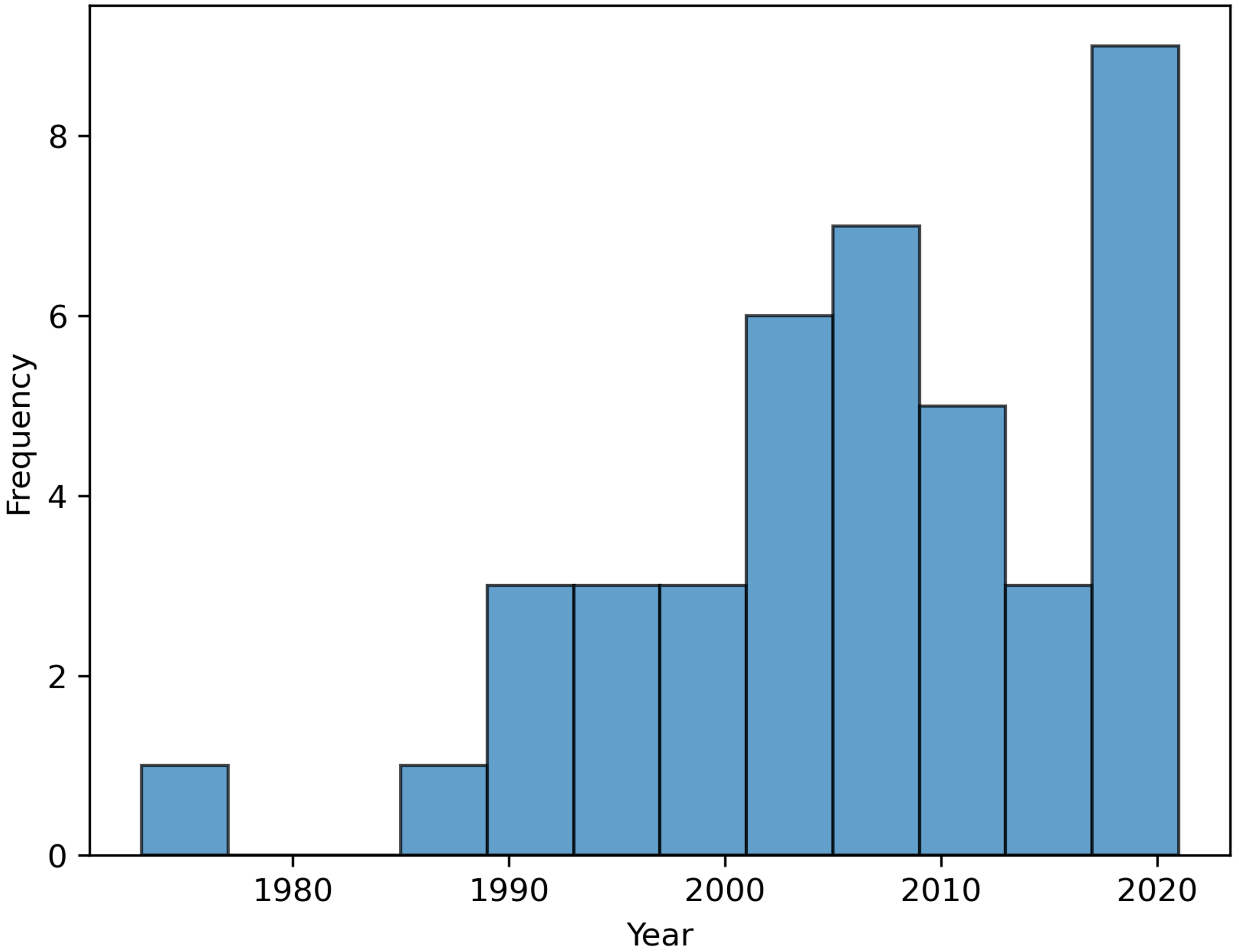
Number of cases per year of arrival, distribution of dataset under study.
The reason that the immigration authorities sought to hold the person was identified in 34 cases. In the majority of those cases Canada sought to hold the person in detention to affect their deportation. In almost every case the person was being deported because they were convicted of at least one serious criminal matter in Canada and had served their criminal sentence. There were two cases where Canada sought to hold a person to ensure their attendance at a hearing where a deportation order might issue. There was one case where immigration officials sought to hold the detainee pending the resolution of a criminal trial.
In four cases, the person was being deported because of their membership in a criminal organization. These organizations appeared to be small and loosely organized affiliations. In one case, for example, the member found that the detainee along with two or three other people constituted ‘a criminal organization engaged in a recruitment of minor children for sexual purposes for financial gain’. In another case, the person was found to be a member of a group that broke into houses to steal personal items.
For detainees held for deportation, two chief reasons were cited explaining why immigration detention was necessary. First, in 14 cases Canada sought to hold the person pending the finalization of removal arrangements. In some cases, immigration authorities were waiting for the detainee's country of nationality to issue a travel document. In other cases, time was required to schedule removal – a fact made especially challenging because of the reduced availability of flights because of the COVID-19 pandemic.
Second, in 15 cases deportation was deferred because the person was making a legal claim that deportation was unlawful. Each of these cases followed the same pattern. There were 17 cases where the detainee appeared to already have refugee status in Canada. Canadian law authorizes the deportation of some refugees but allows refugees to explain why – in their particular circumstances – deportation is inappropriate because it would subject them to an unacceptable level of risk. In other cases, detainees who were not yet recognized as refugees made defensive claims for protections (Lefebvre & Lafontaine, 2021; Liew & Galloway, 2015). Regardless of which process the person was involved in, the effect on their deportation was the same. Until the matters resolved, their deportation was suspended. The fact of the suspension did not, however, render the detention inappropriate because Canadian officials insisted, and Board members accepted, that the person might still be deported and that they could be held in detention pending the resolution of their cases. Often this delay can be significant, extending for months or years (Canada (Public Safety and Emergency Preparedness) v. Suleiman, 2022).
Dangerousness was defined with reference to a person's criminal record, psychiatric history, and addictions history
The sort of criminality that deportees were convicted of varied, but generally revolved around one of four cores: sexual offences (n = 13), personal injury offences (n = 25), drug offences (n = 7), or firearms offences (n = 7). In many cases it was difficult to definitively categorize the criminality that the person was convicted of because most detainees had multiple convictions. That said, detainees generally either were being deported for perpetrating sexual assaults, street-level violence, or participating in the illegal drug trade. Of the three cases concerning women, each was convicted of an offence concerning the exploitation of a child.
Most detainees had lengthy criminal records that spanned many years, and often included convictions for offences when they were youths (i.e. not yet 18 years of age). Except for persons convicted of a single sexual offence, it was common for adjudicators to reason that the persons before them were chronic recidivists. For example, one decision maker concluded that ‘[t]his is not a one-time event, it appears to be part of a repeated pattern of behaviour’. Or, as another adjudicator explained, ‘I have no crystal ball. There is no magic way for me to predict what anyone can do in the future. The best I could do is look at past behaviors and from that come to a logical conclusion as to how people will behave in the future’.
In every case but one, the adjudicator indicated that the person was being found as a danger to the public because of the risk they posed to individuals in Canadian society. There was one case where the adjudicator reasoned that the person was a danger because, in part, of a risk that they posed to themselves: I find that you do represent a danger to the public… [because] you had a weapon with you, you had that knife with you, and that they – that there seemed to be an attempted suicide regarding jumping in front of a metro. The thing is this would have happened in front of young children.
In many cases, the person's psychiatric and addictions history was used to justify the finding that the person was a danger to the public. In one case where a person was held for deportation because of criminality related to sexual offences, the adjudicator partly reasoned that: There are – there is evidence that you suffer from schizophrenia, that could be also causing you to behave in that manner, I am not an expert but that could well be. But – and there is also evidence, I do not have a lot of information about it, that you may suffer from substance abuse. So, for these reasons, I find that you [are described by the] law, and as such, you are someone who poses a current and future danger to the public, given your history and your behaviour.
In another case, where an individual had broken into at least two individuals’ homes, the adjudicator found also reasoned that he was a danger because he was found on the roof of the United States consulate in Toronto. This raises ‘significant concerns about how he managed to get himself up there, what he was doing up there. I think this is very dangerous type of behaviour not to mention that it's likely a danger to him as well’. The decision maker recognized that the behaviour might be linked to a psychiatric disorder and appointed a litigation guardian to make legal decisions on his behalf and additionally reasoned that there was no evidence to show that the detainee ‘has actually addressed these mental health issues in a significant enough way that they're no longer a concern. So if, if indeed this is something that is fostering dangerous behaviour that deeper cause has not yet been addressed’.
Decision makers did occasionally engage with the person's efforts at rehabilitation. For example, one adjudicator explained ‘that [the] rehabilitation work is relevant and very significant in this case and in addressing the danger to the public concerns’. While still finding that the person constituted a danger to the public, they concluded that the person was ‘at the low end’ of the danger spectrum. In general, decision makers had high rehabilitation expectations. One adjudicator explained ‘the fact that [the detainee] has been free of convictions over two years and a half, for me, is not enough to conclude that he has proven himself, that he can remain free of criminality, which would have led me to believe that he had fully rehabilitated’.
Most detainees (n = 43) who were found to be a danger were ordered detained. The six detainees who were ordered released all presented strict supervision (or alternative to detention) plans. As discussed above, a detainee is entitled to seek their release by presenting an alternative to detention that will mitigate the risk they pose. For example, one detainee was released to a supportive living environment that promised to provide substantive healthcare support including ‘ongoing treatment with respect to trauma, counselling, and brain injury’. Each time an adjudicator released a person from detention, they concluded that the alternative ‘virtually eliminated’ any danger posed by the detainee. In many cases, the detainee had previous experience with immigration detention. In a plurality of cases, the decision maker observed that the person had been previously released from immigration detention but had breached the terms and conditions imposed, usually after being arrested for an additional criminal offence.
Danger-based immigration detentions are a down-stream consequence of the criminal justice system
Information about a detainee's alleged dangerousness rarely was collected by immigration enforcement authorities. To the extent that information regarding the risk that the detainee posed emerged from the contact with immigration enforcement, it was obtained when people breached the conditions of their alternative to detention. From a legal perspective, an alternative to detention is a set of rules (e.g. a person must live somewhere, attend a specific treatment programme, abide by a curfew, etc.) and if a person failed to follow those conditions, it is considered a breach of the rules imposed upon them. The evidence of previous breaches was sometimes used by adjudicators to find that a person was ungovernable by conditions or that an alternative to detention was unlikely to mitigate the risk they posed, based on their previous non-compliance. For example, in one case a person was released to a facility where they were supposed to receive treatment for addictions but they departed the facility without authorization. The detainee was later the subject of a drug test and he tested positive for fentanyl. The adjudicator, who subsequently ordered his re-detention, found: So, initially, the detainee would not accept responsibility for his drug use. He suggested that he had accepted a donut and coffee from someone on the street, and that was why he tested positive in discussions with CBSA that followed shortly afterwards.
He still refused to admit that he had taken anything, despite the positive urinalysis, or even to accept responsibility for having departed the facility without permission. Instead, he blamed the [facility] staff for not being fair and treating him differently than others.
Now, to his credit though, in a conversation with [an immigration officer]… [the detainee] subsequently admitted that he had gone for a walk, saw someone he knew who offered him drugs, and took them. He also admitted that he left residence without permission. So, essentially, because of – there is a pattern of some violence.
There is also a pattern of very serious drug use, the offence for which he was convicted in 2017 – robbery, had a very significant sentence. And of course, I am not ignoring the outstanding charges.
Leaving aside this category of evidence – non-compliance with immigration terms and conditions – in all cases the primary source of information used to justify the finding that someone was a danger came from another police agency. In every case, the person was investigated and arrested by another police agency before ultimately, usually after serving sentence, being transferred to immigration custody. There were no cases in the dataset where immigration officials initiated, managed, or ran their own investigation to collect evidence to establish that a person was a danger to the public. The only cases where information was obtained from outside of Canada was when, in two instances, it was shared by police authorities from the United States.
The bottom-line conclusion is that immigration enforcement authorities, at least with respect to danger-based concerns regarding long-term residents in Canada, receive people, information, and cases from other institutions: immigration authorities do not, as a rule, initiate proceedings and investigations against individuals. Viewed holistically, we can see how the configuration of Canadian law produces this reality.
The gateway to an immigration detention is the existence of a related immigration control proceeding, usually a deportation. Canadian law allows for deportations for a range of reasons from non-compliance with immigration law to war criminality, security, organized criminality, and serious criminal conviction. But deportation orders can only issue once certain legal requirements are met and these requirements impose important practical restraints on who can be detained. For example, a person with legal status in Canada can usually only be deported for in-Canada criminality after receiving a conviction. This means that a precondition to a detention is the collection and collation of evidence and information to substantiate a criminal conviction or some other deportation ground.
Danger-based grounds of inadmissibility – such as terrorism, criminality, organized criminality – tend to be resource intensive, at least compared to more common deportation grounds. It takes comparatively little effort to determine whether a person requires a visa to enter Canada as compared to establishing that a person is a member of an organized crime group. In the case of the former, an officer need only conduct a simple database search; in the case of the latter, they must establish that an organized crime group exists, and that the person is a member of it. A recent study on Canadian war criminality and crimes against humanity deportation cases found no cases where the immigration authorities actively investigated a person. Instead, every single case depended on the same piece of evidence to prove that a person committed a major international crime: the person's own self-disclosure, in the context of an application to enter or immigrate to Canada, that they belonged to a group Canada considers problematic (Wallace, 2022).
These factors help explain the character of danger-based detentions in Canada. Because of the quantity and quality of information expected by Canadian judicial bodies, and because some types of deportation orders specifically require criminal convictions, detainees who are described as a danger must necessarily have some contact with a police agency that is prepared to expend the effort and energy to collect and gather information about them. During the period under study, this police agency was never the immigration authorities themselves.
From an immigration perspective, the fact that a person can be described as a danger to the public appears almost as an afterthought. In every case under study here, the danger ground of detention was always the second ground of detention alleged by the government. In every case, the government's first argument was that the person was unlikely to appear for their removal or for a proceeding that could lead to the issuance of a removal order. The fact that a person was also a danger strengthened the case for detention, but it was never a freestanding ground on its own. Immigration authorities appear not as investigators or instigators, but rather the next jailor, charged with implementing and enforcing the consequences of criminal behaviour determined by others.
Conclusion
This study asked who Canada used a discrete immigration detention power against: the power to detain a non-citizen as a danger to the public. It found that this power was used almost exclusively against long-term residents of Canada, many of whom immigrated to Canada as children or refugees. In many cases, it was clear that the persons caught up in the detention processes had significant addictions and psychiatric history. Because of the nature of the person's immigration history, this study shows that danger-based immigration detentions represent a qualitatively different form of punishment for some long-term residents of Canada, most of whom are racialized and immigrated from the Global South.
This study shows that danger-based immigration detentions have less in common with traditional immigration control, and more in common with traditional punishment. Though the purpose of the detention is to enable deportations, this type of immigration detention is used primarily to ensure that some persons experience the maximum force of the criminal law. This type of immigration detention is, following Garland, representative of crime control policies in late modernity. Detainees are constructed as dangerous because of their criminal records, their mental health histories, and their addictions. Instead of drawing on solidaristic ideas of social need, this form of immigration detention aims to eliminate risk by removing ‘danger’ instead of addressing need (Garland, 2001).
This research confirms another local dimension to a global phenomenon. Increasingly states across the industrialized West are turning to immigration law to manage and expel ‘undesirable’ individuals, despite their long-term connections to a particular place. The ‘crimmigration’ thesis holds that one consequence of the overlap between criminal and immigration law is that immigration law is used by the criminal law to achieve otherwise impossible ends. This study shows that Canadian law targets a narrow class of long-term residents, viewed by the criminal law as intractable criminals, for detention and deportation.
Footnotes
Declaration of conflicting interests
The author declared no potential conflicts of interest with respect to the research, authorship, and/or publication of this article.
Funding
The author received no financial support for the research, authorship, and/or publication of this article.
