



Abstract
Scholarship on contemporary US penality has paid little attention to practices opposing the punitive trend. This study explores clemency – official acts moderating punishment and its lasting consequences – as an executive back-end mechanism of leniency. To explore how clemency is discussed at a time of increasingly punitive penal policies, I conducted a qualitative analysis of 36 years’ worth of presidential statements on clemency from Reagan to Obama. This study revealed that three central justifications are used to validate clemency decisions: individuals’ deservingness, community benefits and justice ideals. Discussions of clemency challenge punitiveness by closing the social distance between individuals with criminal histories and law-abiding society and calling for moderation in punishment and penal reform. However, by using a justificatory tone and mirroring penal rationales, clemency statements are limited in inviting progressive change and at times actively drive and reinforce dominant punitive narratives.
Introduction
As scholarship on contemporary US penality has explored at length punishment, prison and parole, we know a great deal about how penal actors discuss punitiveness. By contrast, practices opposing punitive trends have received limited attention (Green, 2013, 2015b; Horowitz and Uggen, 2019). Therefore, we know little about the prerogatives of US administrations in both dispensing and discussing leniency towards individuals with criminal histories. This study aims to address this paucity of research on trends opposing the punitive turn, by exploring federal clemency as a case of leniency granted at the back-end of the criminal justice system.
In the US, clemency – ‘the legal authority of an executive to intervene in the sentencing of a criminal defendant after the justice system has run its course’ – is one avenue through which leniency is offered to individuals with criminal histories (Sarat, 2005: 11). Clemency acts are intended to moderate the harshness of punishment imposed upon an individual, by either reducing a sentence through a commutation, or lessening the collateral consequences of a criminal record after a sentence is served through a pardon. While commutations often result in early release from custody, pardons assist individuals to move on with their lives by countering the stigma of a criminal record. Similarly to parole, clemency reverses the usual way of thinking about punishment by shifting the focus to the end of prison sentences (Guiney, 2018) and by moderating harsh sentences. In so doing, clemency embodies an impulse that at least at first glance, seems to conflict with the main thrusts of punishment aimed at suppression and control.
During the punitive turn, clemency has arguably come to represent much more a form of leniency rather than a routine duty and widely accepted power by US presidents. Scholars agree that the already declining exercise of clemency intensified since the 1980s (Barkow, 2015). At a time when American politicians became particularly adept at stoking public fear of crime and using a ‘tough on crime’ rhetoric to push for increasingly punitive penal policies, clemency decisions sharply dropped (Office of the Pardon Attorney). Controversial cases also raised concerns among the public for their arbitrary nature and for challenging the administration of justice (Crouch, 2016; Dinan, 2003). Despite this, US presidents have continued (albeit at lower rate than earlier in the century) to grant clemency to individuals with criminal histories, once again illustrating the stability of back-end mechanisms in criminal justice. It is in this context of increasing punitiveness that this study explores presidential statements on clemency.
Although early analysis of penal evolution considered clemency, contemporary scholars of American penality have paid little attention to this back-end mechanism. This neglect is likely due to the nature of this power, its infrequency, and secrecy. In the United States, deliberations are at the discretion of the executive branch of state and federal government. Due to its formal autonomy from criminal justice, clemency is often perceived as a mechanism outside of the penal field of little concern to punishment scholars. Furthermore, as an empirically rare event (compared to other early release or relief remedies), clemency is believed to have a narrow impact on the population under supervision. Nonetheless, since the abolition of federal parole in 1987, commutations constitute the only chance to reduce time in custody. Clemency decisions also occur behind closed doors and public justifications of clemency are rarely provided (Sebba, 1977).
As a result of the limited data available, US research on clemency has mostly focused on historical trends, political factors influencing presidential decisions, and the legal and political functions it performs (Ruckman, 2012; Whitford and Ochs, 2006). This study aims to complement this literature by examines the language and narratives used when discussing clemency – an approach that may also illuminate how clemency works as a particular form of punishment. Specifically, I ask: How do US presidents discuss clemency during the punitive era? To answer this research question, I conducted a discourse analysis of all reported statements on clemency by presidential administrations from 1981 to 2017. Although some state governors have comparable power for state offences, I limit my analysis to presidential statements due to the variability in the administration of clemency at the state level both in terms of frequency and process. 1 Furthermore, when granted by the highest authority in the US, clemency acquires a symbolic quality. By reproducing existing discourses and proposing new perspectives, presidential rhetoric creates the discursive conditions delimiting the space for social action (Ryfe, 2007). It has the potential to validate or limit the scope and nature of this power, offer alternative or permanent views of leniency, and in so doing, influence clemency decisions at the state level. Essentially, federal clemency might be a symbolic way for presidents to ‘break’ the control that states have in criminal justice. This is significant as the growth in incarcerated individuals during the mass incarceration era has corresponded to an increase in potential clemency candidates. If regularly and consistently used, clemency could be one avenue to reduce the correctional population.
My analysis finds that presidential administrations spend considerable time justifying the exercise of clemency power by highlighting individuals’ deservingness, community benefits, and justice ideals. By challenging the portrayal of offenders as ‘criminal others’ and providing an opening for administrations to discuss penal reforms, clemency statements challenge the dominant punitive narratives of the time. However, behind this pro-leniency and inclusionary attitude towards people with criminal histories, clemency statements at times actively drive and reinforce dominant punitive narratives. By relying on a justificatory tone, using a narrative of deservingness, and mirroring punitive narratives, presidential administrations recast clemency grants as extraordinary cases of leniency. This rhetoric creates the exceptions when clemency can be granted, and virtually ensures it will not (or cannot) be used to address hyper-incarceration writ large. In the following sections, I first offer a brief history of US federal clemency and then an overview of the literature on clemency.
US federal clemency: A brief history
Historically, clemency power was perceived as part of the regular administration of justice and presidents would frequently and generously grant clemency (Crouch, 2016). The public welcomed decisions and trusted the review process by the Office of the Pardon Attorney (OPA), which evaluates applications and recommends candidates to the president (Ruckman, 1997). However, over the last century, this practice has become rarer and since the 1980s, there has been a drastic decline in the proportion of clemency grants (see Figure 1). Whereas between 1953 and 1977 on average 13% of applications (received and pending) were successful, this percentage dropped to 2.3% over the next three decades. This decline has been driven by a sheer growth in clemency applications (see Table 1) due to the rise in federal prosecutions and the abolition of parole at the federal level. Between 1994 and 2004, the OPA saw a 47% increase in petitions received each year, and a 476% increase between 2004 and 2014 (Barkow, 2015: 818). 2 This led to a rise in processing time (from months to years) and permanent case backlogs (Love, 2010). The bureaucratic structure of the OPA as part of the Department of Justice is also not conducive to grants since by reviewing prosecutorial decisions, clemency creates an internal tension (Barkow, 2015).
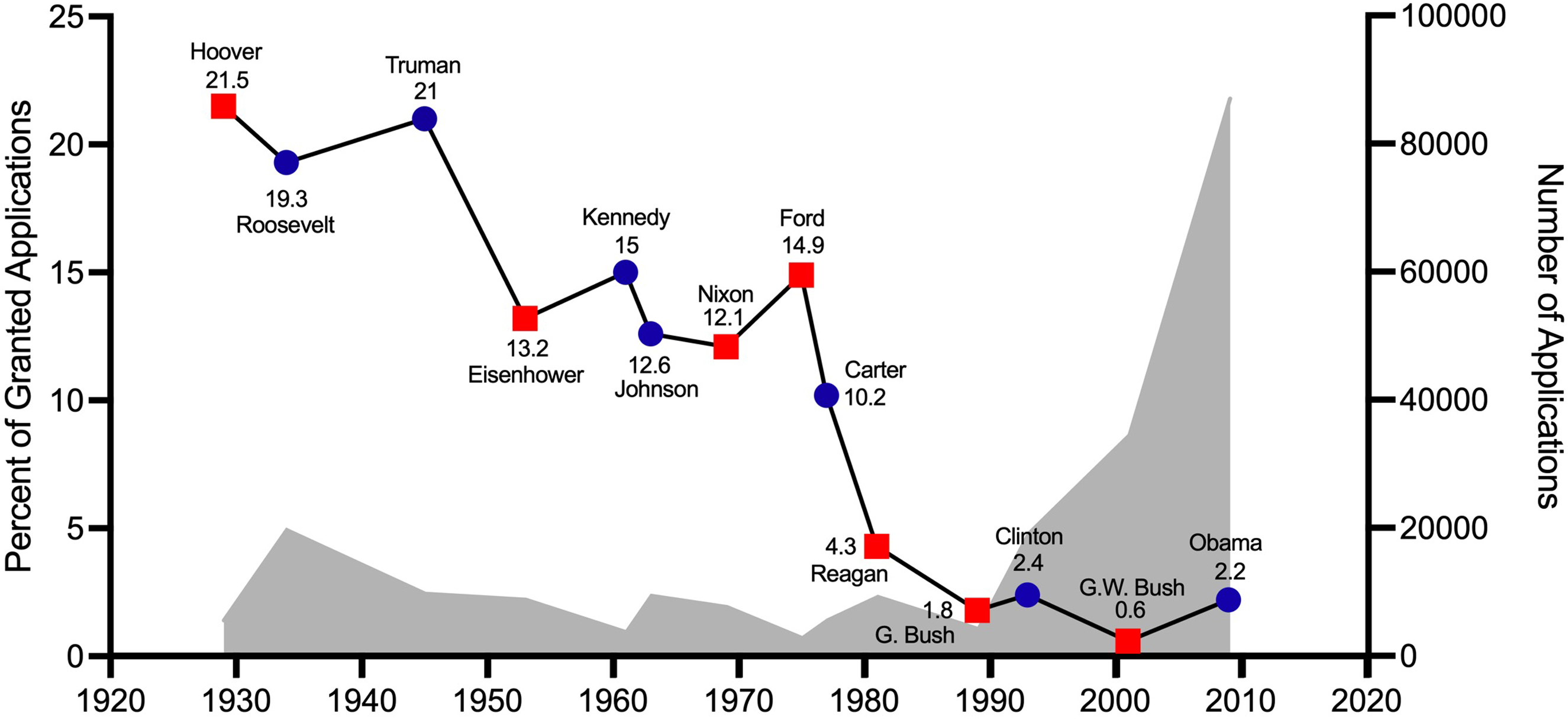
Percentage of granted clemency applications by US president.
Executive clemency statistics (1929–2017).
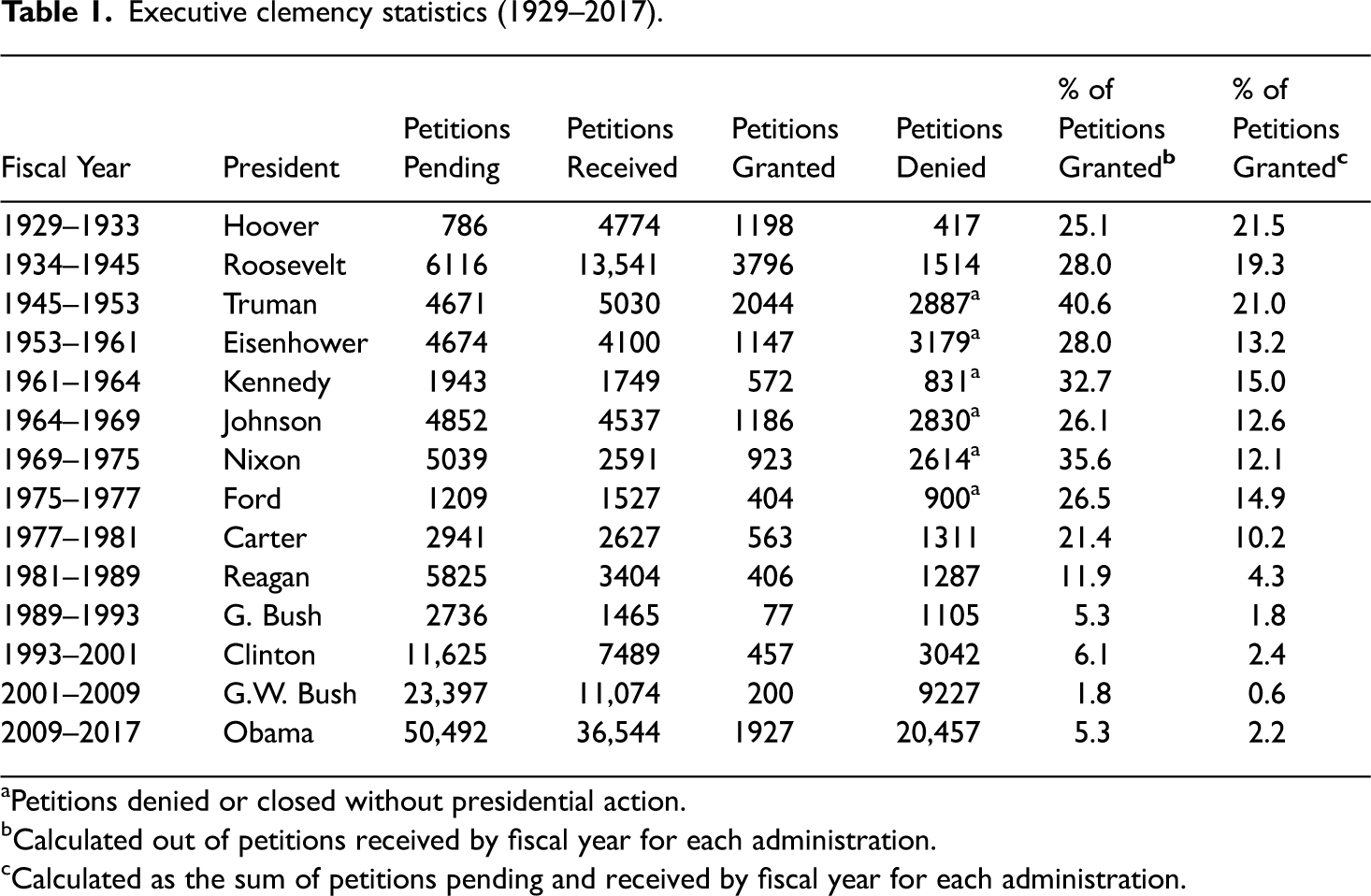
Petitions denied or closed without presidential action.
Calculated out of petitions received by fiscal year for each administration.
Calculated as the sum of petitions pending and received by fiscal year for each administration.
However, scholars have mostly linked lower clemency rates to the punitive era and changes in public perceptions about this power (Love, 2010). As politicians and other penal actors made crime into a politically strategic issue and ‘fear of crime’ became increasingly a governance tactic in the 1970s (Simon, 2007), the exercise of clemency was considered high-risk from a political perspective. It was feared that conceding clemency would compromise the ‘tough on crime’ image of its grantor. Furthermore, the notion that recipients could return to crime spread amongst the public. This sentiment was exacerbated by the Willy Horton's advertisement used during the George Bush campaign to illustrate the consequences of being ‘soft on crime’ on public safety. 3 Another upsetting, but telling illustration of this, occurred when Clinton left the campaign trail to oversee the execution of a person with limited cognitive capacity to reverse the Democrat party's soft on crime image.
Clemency also became subject to criticism due to its alleged incompatibility with constitutional democracy. By attributing sovereign powers to executives who can ‘freely’ decide when and to whom grant leniency, some critics have argued that clemency power is too discretionary and easily abused, thereby undermining the rule of law (Dinan, 2003). This is mostly evident with commutations because changes in sentences are perceived as challenging the ordinary process of justice. The secrecy of the deliberation process, the limited publicization of decisions (Pascoe, 2019), and controversial grants to political supporters also contribute to this lack of public confidence towards clemency.
The literature on executive clemency
While contemporary scholars of penality have put the US punitive turn, mass incarceration, and the growing boundaries of the carceral state under the microscope (Gottschalk, 2014; Seeds, 2017), discourses and practices opposing punitiveness have received limited attention in the US context (Green, 2013, 2015b). A relatively small body of punishment scholarship is concerned with clemency as a mechanism of leniency. According to early analysis of penal evolution, clemency acted as an instrument of power and control in the hands of the sovereign and contributed to the majestic view of the law by the populace (Foucault, 1977; Hay, 1975). Horowitz and Uggen's study of commutations at the US state level is the only recent attempt to explore clemency in light of punishment scholarship (2019). By reconceptualizing commutations as a back-end mechanism for early release, they found that notions of ‘risk’ drive clemency decisions and punitive US states have higher rates of grants. This study follows their invitation to examine clemency – an understudied and underutilized mechanism of mercy – from a penal perspective.
Most research on clemency has been conducted by legal scholars and political scientists. Legal theorists have explored the development, organization and practice of clemency in a comparative perspective in modern common-law democracies (Novak, 2016). This research found that clemency performs three main functions: redemption, utilitarianism, and retributivism (Pascoe, 2019). Clemency as redemption is granted in light of individuals’ character and commendable behaviour. In contrast, the abrogation of punishment for utilitarian reasons, typical of amnesties following civil wars, aims to provide a general benefit to the public. Finally, retributive clemency challenges undeserved or disproportionate sentences to enhance justice. More recent comparative scholarship has examined clemency when sparing individuals from capital punishments (Pascoe, 2019; Pascoe and Novak, 2020).
In the US context, political scientists have taken a different tact by exploring historical trends in presidential grants and assessing the relationship between politics and clemency (see Ruckman, 2012 for a review of this literature). These studies have relied principally on clemency statistics and little attention had been paid to how this power has been articulated by those who exercise it. Sarat's analysis (2005) of Governor Ryan's speech regarding his clemency grant to all Illinois individuals on death row is an exception. Whereas seemingly a ground-breaking gesture, a close examination of Ryan's address revealed he was responsive to the prevailing public sentiments about crime and order. Indeed, one main goal was to establish his ‘tough on crime’ attitude. By using retributivist principles of justice and victims’ right discourses prevalent at the time, his conception of clemency fit comfortably with the larger punitive context in which it occurred (Sarat, 2005). Although limited in scope, this analysis of clemency rhetoric enlightens the exercise of clemency power and exposed the political and symbolical motives resting behind it.
Punishment scholars have also paid attention to penal discourse and its relation to practices on the ground. To better understand society's responses to crime, Garland (2001: 24) argues that ‘discursive statements and rhetoric’ are ‘as important as action and decisions in providing evidence of the character of a field’. In addition, when articulated by political actors, statements become a ‘form of action in themselves’ (Garland, 2001: 25). This is the case with clemency as officials are the ones articulating these assertions. Discourse function as an action because with their rhetoric and language, presidents invite debate on selected topics, while also presenting the angle from which these issues should be addressed (Ryfe, 2007). In other words, by reproducing existing frames and proposing new perspectives, presidential rhetoric creates discursive conditions that by reshaping mentalities, delimit the space for social action, and influence ‘policy environments’ across government levels (Miller, 2008).
Data and methods
My dataset consisted of 36 years’ worth of presidential statements on clemency from 1981 to 2017. I selected Reagan's presidency as a starting point because it corresponds to a shift in perceptions about crime and punishment in the US and the formation of the present American penal state (Garland, 2001; Hagan, 2010). Reagan also inaugurated a new clemency trend: he started the custom of exercising this power in the final year of administration (Love, 2010) and granted only 4% of clemency applications (a drastic decline from an average of 13% over the previous three decades) (Ruckman, 1997). This timid and ‘last-minute’ practice of clemency has endured until the present (Democrat and Republican presidential administrations alike). Trump's administration was excluded as ongoing during data collection. Since this study aims to explore clemency (and leniency) at a time of punitiveness, the lack of this presidency constitutes a limitation, particularly considering Trump's ‘law and order’ rhetoric and pursue of punitive immigration policies. However, data indicates that the US might be nearing a brink of punitiveness as, while still extremely high, its incarceration rate has been declining since 2009 (Minton et al., 2021). Future research should explore Trump's term because, due to its ‘extraordinary’ nature, it might reveal some unique discussions of clemency.
The data was collected through the American Presidency Project (an online searchable database of presidential records compiled by researchers at UC Santa Barbara), and the Public Papers of the Presidents published by the Federal Register. Through a keyword search (‘clemency’, ‘commutation’, and ‘pardon’), I retrieved public speeches, interviews, Q&A sessions, press briefings and news conferences by presidents and their spokespersons. As documents in archives were inaccessible, 4 I also retrieved statements in The New York Times and The Washington Post – two newspapers that due to their status as leaders of US elite journalism have been widely used as reputable sources of data by academics. When discussions of clemency were available, presidential memoires were included. I will use the term ‘presidential administration’ to refer to statements because approximately half were issued by presidents and half by their press secretaries.
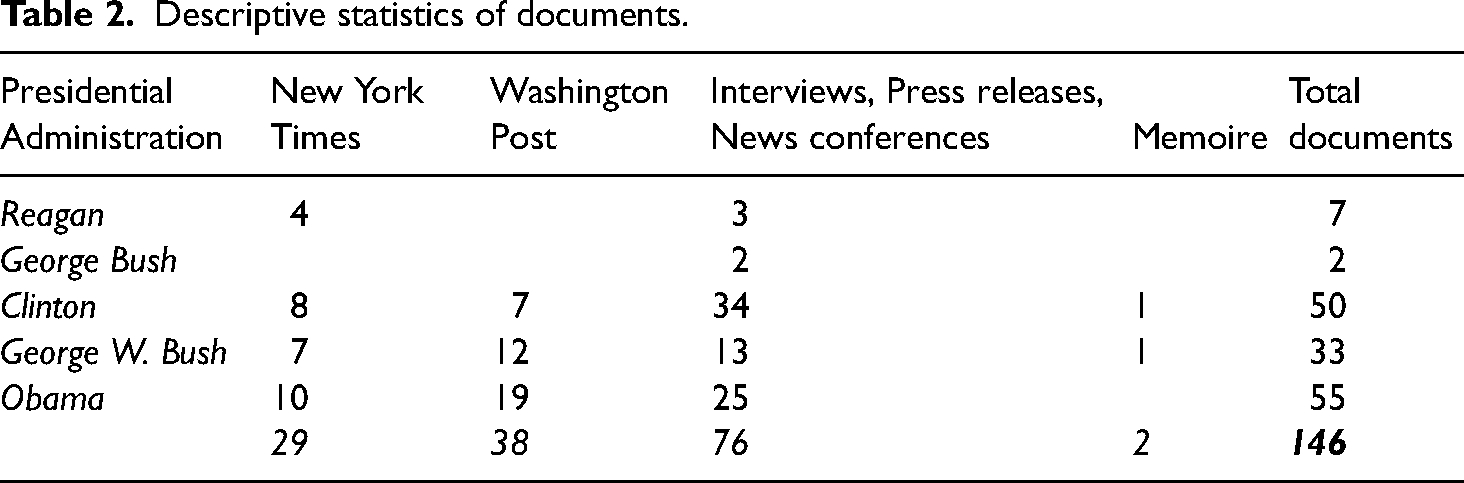
After screening for meaningful discussion of clemency and eliminating duplicate assertions, I obtained 146 documents. Although clemency grants are nowadays treated as official government actions and, therefore, a public announcement is made, most grants are issued without commentary. This limited discussion is to be attributed to the infrequent exercise of this power and the sporadic practice of divulging reasons for granting or denying clemency (Kobil, 2000). For instance, Reagan and George Bush hardly addressed decisions in public or issued written statements on clemency (see Table 2). As George W. Bush affirmed when asked about clemency: ‘I don't have to do any. I can do some. Nor do I have to talk about it’.
Descriptive statistics of documents.
Statements also differ in length and substance. In contrast to brief quotes in newspapers, other documents offer extensive discussions. Some accounts focused on categories of recipients (e.g., non-violent drug offenders), other discussed the nature of clemency power, but the most detailed explanations of clemency accompanied the contentious exercises of this power (Kobil, 2000). For instance, several statements comment on Libby, FALN and Pollard 5 as presidents felt compelled to provide reasons for their decisions and settle public debate.
My analysis treats the documents as a corpus to understand how clemency is discussed at the federal level during the punitive era. The coding procedure was informed by grounded theory analysis and performed with Atlas.TI (Strauss and Corbin, 1998). First, through open coding, I generated categories based on manifest descriptive themes in presidential statements (e.g., ‘recipients characteristics’ and ‘decision making process’). I then engaged in focused coding to sharpen these thematic patterns by noting relationship across the data and grounding my interpretations in clemency literature. From this inductive process, it became clear that administrations spent considerable time justifying their decisions. Hence, I re-read and re-coded the data selectivity through this lens to include variation in the language and discourses used by presidential administrations to justify clemency. During this latter phase, I also explored the presence of any patterns across administrations.
Justifying clemency
The analysis of clemency statements revealed that presidential administrations spend considerable time justifying the exercise of clemency power – as identified by Sarat's examination of the Ryan case (2005). At its heart this is a defensive practice; the goal seems to explain clemency against what is perceived to be public hostility toward leniency and discretion. Administrations respond to concerns about abusing clemency power by reassuring the public that decisions are reached through a rigorous process at the OPA and assume a deferential posture towards judicial decisions. For instance, they state that only after the ordinary process of justice occurred, clemency might be considered. As Reagan said: ‘I think the law has got to take its course’. Likewise, George W. Bush affirmed: ‘I'm pretty much going to stay out of it until […] the case has finally run its final – the course it's going to take’. Presidents also often deny political gains and underline the Constitutional nature of this power.
In addition to this, statements provide three main rationales to validate clemency: individuals’ deservingness, community benefits and justice ideals. As the following analysis will show, these explanations have some overlap with the three overarching functions of clemency identified by legal scholars (redemption, utilitarianism, and retributivism). This examination goes beyond this functional framework by exploring the specific language and discourses used by administrations to justify leniency. The following discussion will dissect each of these justifications by highlighting the double-edged sword of clemency. While on the one hand, clemency statements champion leniency and moderation in punishment. On the other hand, by mostly relying on a justificatory tone and mirroring penal rationales, clemency statements actively drive and reinforce dominant punitive narratives.
Justification 1: Constructing clemency recipients as deserving
All administrations validate clemency decisions by constructing individuals as deserving; they embody desirable attributes, engage in actions that are valued, and fulfill citizenry expectations. In what follows, I examine variations in this value laden language that follows the redemptive model of clemency. Before discussing how administrations cast clemency recipients as productive citizens and reformed and remorseful individuals, which are commonplace in penal narratives, the next section explores a more distinct justificatory narrative of clemency as redemption.
Service to the nation
The few clemency statements retrieved for Reagan's and George Bush's administrations justify clemency in light of recipients’ patriotism and commitment to the nation. For example, Reagan reasoned that having ‘served the Federal Bureau of Investigation and our nation with great distinction’, and since crimes ‘grew out of their good-faith belief that their actions were necessary to preserve the security interests of our country’, clemency was appropriate. Similarly, George Bush granted a pardon to officials involved in the Iran-Contra Affair because: First, the common denominator of their motivation – whether their actions were right or wrong – was patriotism. Second, they did not profit or seek to profit from their conduct. Third, each has a record of long and distinguished service to this country.
While this narrative was infrequently used by other administrations, it seems that Reagan and George Bush issued clemency statements only for state officials with an outstanding civil service.
Respect for the law and productivity
Two attributes deeming individuals deserving of clemency across all presidential administrations are respect for the law and productivity. Recipients are portrayed by Reagan as ‘very fine productive citizen[s]’, by Clinton as ‘living their lives in a straight and effective way’ and leading a ‘'productive and law-abiding post-conviction life’ by Obama. In other cases, statements report recipients’ occupations or depict individuals as ‘working hard and paying taxes’ and as ‘gainfully employed’.
While the emphasis on respecting the law is foreseeable, the relationship between productivity and clemency is more indirect (and thus requires some linguistic and moralistic contortions). Formal labor has long stood as a central characteristic distinguishing the ‘criminal’ from the law-abiding individual (Kaye, 2012). As Simon argued, ‘by obtaining a good job, a prisoner demonstrated a credible claim to being a ‘normal’ person who had misstepped into crime rather than one who was a criminal at heart’ (1993: 46). Essentially, employment is considered a primary indicator for an individual's reform and change in identity. Furthermore, by being productive, individuals become independent from state support and financially contribute to society – a central marker and expectation of neoliberal subjects. Presidential statements echo this reasoning to validate clemency and use the terms ‘law-abiding’ and ‘productive’ as signposts to differentiate deserving recipients from those who are not.
During Clinton's administration, discussions of formal labor as a mark of character's reform are paired with another penal narrative: barriers to reentry. 6 Acknowledging that finding employment with a criminal record is difficult and that most individuals eventually return to society, Clinton states ‘I don't think they ought to be discriminated about in getting jobs or keeping jobs or getting contracts if they have discharged their sentence and they've been out in law-abiding society’. Therefore, clemency becomes a way to ‘free people to live in the present and future’ and counteract the ‘scarlet letter on their forehead’ or ‘a 50-pound weight we want you to wear around your neck for the rest of your life’. By casting individual with a criminal record as real individuals with needs to be addressed, Clinton not only rehumanizes and creates proximity with the incarcerated ‘other’ (Green, 2015a), but also signals an opening for reforms to address past criminal records and the ensuing restrictions on civil rights and professional opportunities. This is an example of how discussions of clemency become an avenue for presidential administrations to wade into criminal justice matters, in this case reentry.
Assertions on clemency as a means to re-establish ‘full citizenship’ maps onto reintegration narratives which use a language of inclusion celebrating rehabilitation and ‘second chances’ to justify interventions (in this case, clemency) (Steen et al., 2012). However, while calling for moderation in punishment by setting an end to its collateral consequences, other statements during the Clinton's presidency use tropes typical of recidivism reduction narratives which frame individuals in much more negative terms. Rather than emphasizing their ‘potential to do good’, by discussing criminogenic factors, risk management, and public safety, the Clinton presidency reiterates the idea that in the future of individuals with criminal histories looms the possibility to do harm (Steen et al., 2012: 31). As a result, discussions of clemency appear to reinforce dominant punitive narratives that draw a distinction between ‘the criminal’ and the ‘law-abiding’ citizen.
In addition to a productive citizen at work, the conscientious citizen at home and the contributing citizen to the community are recurrent markers attributing deservingness to clemency recipients. By describing individuals as being ‘a positive force in [their] community’ as George W. Bush did, or ‘a terrific father, (…) part of a Bible study group and a leader in the community’ as Obama highlighted, people continue to demonstrate their character's reform, but also their civic reintegration. In so doing, clemency becomes a way in which administrations reify the symbolic boundaries of citizenship by denoting what it means to be a ‘good citizen’ and who is worthy of being considered one. While offering redemption to recipients in light of their employment and contributions to the community, clemency narratives also continue to mark the criminal as an undeserving other, that only when respecting societal expectations can be formally and fully re-admitted to society. This logic constructs the ‘criminal’ as an anti-citizen further reproducing the distance between convicted individuals and the rest of society. This is how clemency discussions drive and reinforce dominant punitive narratives that see a clear distinction between those who have committed crimes and those who did not.
Reform, remorse, and second chances
Obama's administration modified this narrative of change. Worthiness is not only dictated by respecting the law (as the term law-abiding suggests) or by a transformation of behaviours (to become productive citizens). Clemency candidates are new, different persons. Showing effort and willingness to change acquires significance as statements emphasize how recipients ‘tried to reform themselves while incarcerated’ and ‘demonstrated the potential to turn their lives around’. Individuals also showed ‘genuine remorse’, engaged in ‘efforts at atonement’, and recognized they ‘have made mistakes, but take responsibility for it’. Hence, the discursive construction of change during Obama's term is increasingly linked to a kind of neoliberal moral transformation that one also finds in discourses from drug addiction to problem gambling to sexual predation or harassment, as remorse and taking responsibility supposedly demote greater responsiveness to reform (Weisman, 2009). This emphasis on a moral transformation in recipients fits with ‘clemency as redemption’. However, it also showcases how penal narratives, and more specifically in this case, the rehabilitative theory of punishment which underlines personal reform and responsibility, permeates the exercise of clemency power and its discursive formation (Bosworth, 2007; Lynch, 2000).
A close analysis of how the executive discursively constructs deserving recipients shows that a variety of attributes are used to differentiate the reformed individual from the criminal and, consequently, who is (or is not) deemed worthy of clemency. While the focus on productivity and lawfulness permeates all presidential administrations, moral reform and atonement is unique to Obama's term. Such variation in attributes across administrations proves, as suggested by Sarat (2005: 33), that ‘each exercise of clemency (..) speaks to the spirit of its age’. I would add (and will illustrate this further in the following sections) that justifications used to validate clemency often reflect the dominant penal rationales of the time. For instance, the Obama's administration often refers to clemency as a ‘second chance’. This expression, which entered the penal field under George W. Bush, marked a shift in criminal justice discourse and practice (Green, 2013, 2015b). Clinton hints to this framing, but never uses this term. Obama echoes his predecessor by stating that ‘America is a nation of second chance’. However, whereas clemency as a ‘second chance’ is an undeniable reality because ‘people are just getting out all the time’ as Clinton and George W. Bush reasoned, for Obama it is a means to give individuals an opportunity that they would not otherwise receive due to the lack of parole at the federal level. This difference reflects contrasting outlook on pardons and commutations.
As in this example, the previous analysis illustrates nuances (and ambivalence) in what appears an uttermost lenient and generous attitude towards individuals with criminal histories. While portraying this group in a positive light and even pressing for penal reforms, statements at times reinforce the othering typical of punitive narratives. In doing so, they ‘feed moral indifference and callousness towards the plight of incarcerated others’ (Green, 2015a) and therefore, run counter to clemency as a leniency mechanism. In other words, by mirroring penal narratives, presidential statements might limit how clemency power can be understood and used, further sustaining punitive approaches, and understanding of the criminal as the ‘other’.
Finally, clemency continues to be casted as a redemption mechanism – a justification that Sarat (2005) argued was replaced by a retributivist theory of clemency, but that still gains traction across presidencies. Within the redemptive model, individuals’ attributes and achievements (rather than a general eligibility) justify clemency. Leniency following a redemptive and deserving narrative requires singularity and a discussion of human effort. Individuals are deserving of clemency because they have changed from ‘offenders’ or ‘former offenders’ to ‘citizens’. Thus, presidential administrations present clemency as a mechanism to address individual circumstances and reaffirm leniency as available only in cases of exceptional worthiness, restraining clemency's role as a policy tool.
Justification 2: Clemency as a collective remedy
Individuals and their loved ones
While the executive often discursively constructs deservingness in light of personal achievements, recipients’ loved ones and their suffering are reasons used to validate decisions. For example, George Bush describes relatives as ‘anguished’ and recipients’ children as having ‘suffered immensely’. Obama emphasizes how the lengthy separation from their incarcerated loved ones is ‘damaging families’ as ‘kids are growing up without parents’. According to this retributivist logic for compassionate family grounds, clemency becomes admissible because the original sentence would result in disproportionate punishment not only to the convicted individuals, but also to their families (Pascoe, 2019). Rather than merely describing individuals as people with a history of crime, emphasis is placed on their relationships with others. Recipients become ‘mothers and fathers, sons and daughters, [… and] grandparents’. As always, the goal appears to convince the public that clemency is warranted (and neither too discretionary nor ‘soft’ on crime); the public is presumed to be more sympathetic to clemency if granted to a father or mother, rather than an ‘offender’ as they close the social distance between ‘us’ (law-abiding individuals) and ‘them’ (people with histories of crime). This rhetorical strategy, therefore, increases the public's emotional proximity with the ‘incarcerated other’ (Green, 2015a). Yet by providing reasons for grants that do not pertain only to the merits of recipients, but explicitly considering family dynamics, clemency acquires a collective scope that is not often associated with this practice the US.
Clemency in the interests of society
For some presidential administrations, the benefits of dispensing clemency do not end with the individual and their family but translates to the community. Clinton occasionally grounds his clemency grants in a discourse of collective prosperity. Giving clemency to those individuals who served their punishment and demonstrated their commitment to be good citizens is in the interest of the community. For instance, he states: Our interest as citizens, after they pay their debt to society, is to see them be successful. I mean, when somebody pays, then when they get out, surely, we don't want them to keep on paying. If they have to keep on paying, that's why you end up with more crime and a less successful, less healthy society.
However, while at the surface inclusionary and sympathetic to this stigmatized population, this narrative encourages the use of clemency for our own benefit rather than the direct benefit of clemency recipients. This discursive move is similar to how recidivism reduction narratives typically describe reentry measures and investments in programs. Initiatives are not cast as a means to improve ex-prisoners’ lives, but are intended to foster the safety and interest of the public (Steen et al., 2012). This underlying logic is further evident in the ‘us versus them’ language used in the statements above which draw a clear line between individuals with criminal histories and the rest of society. The main story driving clemency is that we (the ‘rest of us’ or non-offenders) should be open to clemency because creating further barriers for individuals with a criminal history only makes us less safe (we would ‘end up with more crime’). Therefore, while supporting leniency and providing an opening for clemency's use, this discursive move is not as inclusionary as it seems.
Obama administration also uses this collective narrative, but often links it to considerations of sentencing and incarceration and calls for reforms in these areas. Two rhetorical moves motivate the use of clemency in his discussions. First, he suggests that American society would benefit from the early release of incarcerated individuals through commutations because it would redirect federal government spending. At the 2015 NAACP convention, he detailed these gains: the ‘$80 billion the federal government spends each year on prisons – nearly a third of the Justice Department's budget – could instead fund preschool for every 3 and 4-year-old in the country’. Here, when justifying clemency, the Obama administration draws from a neoliberal cost-saving rationale, or as Aviram (2015) calls it, a ‘humonitarian rhetoric’, common in correctional discourse to promote criminal justice reform.
The second rhetorical move links clemency as a collective remedy to the negative consequences of mass incarceration. When asked about how he plans to exercise clemency in his last few months, Obama depicts this executive act as one of the possible mechanisms that can reduce some of the social repercussions of an overly aggressive policing and criminalizing state. He links his intent to reinvigorate clemency to what he describes as the extraordinary rate of incarceration of nonviolent offenders [which] has created its own set of problems that are devastating. Entire communities have been ravaged where largely men, but some women, are taken out of those communities. Kids are now growing up without parents. It perpetuates a cycle of poverty and disorder in their lives.
Clemency, thus, becomes an opportunity to illustrate, but also partially address, negative issues of punishment in an era of mass incarceration. By highlighting the economic and social damage to those left behind in communities affected by mass incarceration, this statement also implies a moral responsibility to remedy such harm. In so doing, it rehumanizes and builds proximity to the ‘other’ (Green, 2015a).
Justification 3: Justice ideals
As previously noted, clemency is often perceived as endangering the practice of justice. To address this concern, presidents assume a deferential posture towards judicial decisions and portray clemency as a remedy to correct and enhance justice following a retributivist logic. This discursive construction of clemency follows a ‘retributivist theory of punishment’ where justice is better served by granting clemency than punishing (Moore, 1989; Sarat, 2005). When confronted with the Libby case, George W. Bush emphasized his ‘respect’ for ‘the jury's verdict’ but reasoned that a commutation was sensible because of the ‘excessive’ prison term and that his decision still left ‘in place a harsh punishment’. He carefully positioned himself in opposition to court proceedings, while guaranteeing that the recipient still received a politically palatable punishment, and that justice was served. While being lenient, he did not compromise his image of being ‘tough on crime’.
Clinton and Obama also use this proportionality narrative to validate clemency. However, their statement diverts attention from recipients’ suffering resulting from severe sentences to emphasize shared ideals of justice and fairness. According to Clinton, individuals who are ‘serving extremely lengthy sentences’ deserve to be freed because ‘our society believes […] that a punishment should fit the crime’. Obama also underlines how ‘In far too many cases, the punishment simply doesn't fit the crime’. What is unique to these two democrat administrations is demanding a revision of past penalties in light of present sentencing guidelines when using this proportionality narrative. For instance, Clinton expressed his frustration with lengthy sentences for non-violent crimes: people already ‘served sentences that were considerably longer than they would serve under the guidelines which control federal sentencing now’. Similarly, Obama's clemency initiative aimed to intervene when ‘under today's laws – because there have been changes in how we charge nonviolent drug offenses – […] their sentences would be substantially lower’. This frame is politically safe as it is not challenging long sentences as a problem per se, but rather reframing it as an act of better justice. However, Obama stance appears stronger in this respect as not only his deference to the law is less emphasized, but he also openly calls for reforms. While recognizing commutations as ‘politically risky’ because individuals can re-engage in crime once released, he is not afraid to openly criticize the justice system for having severely punished individuals with non-violent drug offences: ‘Today I am commuting the prison terms of eight men and women who were sentenced under an unfair system’.
Together these statements suggest that the discursive performance of clemency under Clinton and Obama casts clemency not as a mere remedy for extraordinary cases where a miscarriage of justice occurred (as it was the case under George W. Bush), but categories of individuals who have been overcharged. US presidents have granted systematic or class pardons across history, but mostly after times of war for utilitarian reasons (Shanor and Miller, 2000), not as a policy tool as these statements illustrate. Obama (2017) was open about his intent to ‘send a clear message’ for reform to occur: By shifting the narrative to the way clemency can be used to correct injustices in the system - and reminding people of the value of second chances - I worked to reinvigorate the clemency power and to set a precedent that will make it easier for future Presidents, governors, and other public officials to use it for good.
Justifying clemency in a punitive era
The empirical research presented here suggests that the three main rationales used by presidential administrations to validate clemency (individuals’ deservingness, community benefits, and justice ideals) overlap with the three overarching functions of clemency identified by legal scholars (redemption, utilitarianism, and retributivism). At a time of punitiveness, rather than reinventing the wheel, presidents have continued to offer established justifications to validate clemency grants. While some evidence indicates that a retributivists conception prevails in the recent practice of clemency (Sarat, 2005), this study found, similarly to Pascoe (2019), that none of the administrations fit with one of the three rationales of clemency. Statements often draw from multiple rationales at the same time and reveal significant variation in how clemency follows such logics. For instance, although all administrations deem recipients deserving in light of their reform, the attributes and actions demonstrating such transformation have changed over time. Similarly, clemency statements follow the dominant penal rationales ranging from public safety, to responsibilization and reentry, to the fiscal costs of the prison and issues of mass incarceration.
While further research expanding the period of analysis to earlier decades and examining clemency at the state level is needed to illuminate the binding of clemency discourse with penal narratives, this rhetoric could reflect a cultural moment when a reconfiguration of penality occurred and crime became increasingly politicized (Garland, 2001; Green, 2015b). Evidence from historical grants of clemency support this view as criminal justice issues were less central prior to 1931 when humanitarian and pragmatic concerns were often reported in clemency decisions (Kobil, 2000; Love, 2000). However, the complexity and ambivalence in clemency discourses identified in this analysis might better reflect ongoing political contestation around criminal justice (Goodman et al., 2015). Clemency decisions and narratives both accord and push against the dominant penal orientation. At a time when clemency is perceived as an easily abused power and as being ‘soft on criminals’, presidents reproduce existing punishment and justice discourses to create an opening for leniency. Clemency as a mechanism of leniency relies on communicative strategies that create proximity between individuals with criminal histories and law-abiding society (see Green 2015a, 2015b for criminal justice developments in US penality following this trend). Statements linking clemency to collective benefits are an example of this attitude and this discursive construction might have some promise as it opens the possibility for an expansion of clemency’ scope.
While inclusionary and benevolent at the surface, the discursive construction of clemency still marks the majority of formerly incarcerated individuals as unworthy ‘criminal others’. By mirroring justifications frequently used by state actors to justify and explain harsh sentences, clemency statements often reify the boundary of American citizenship as excluding those with criminal histories. The ‘us’ versus ‘them’ language used increases social distance between convicted and unconvicted individuals and the narrative of deservingness portrays clemency as a mechanism that is acceptable only in single and exceptional cases.
Even when calling for penal reforms or challenging past sentencing guidelines, administrations advance politically safe cases for leniency. For instance, although recipients have ‘paid their price’, clemency still leaves in place some sanction. Clemency (and penal reform) is admissible when punishment is disproportionate, but only for some categories of offences: the so called ‘non, non, non’ (nonserious, nonviolent and nonsexual) (Gottschalk, 2014). This favorable view of individuals with non-violent criminal histories fits with Horowitz and Uggen's finding at the state level (2019). So while presidents might express some disagreement on penal issues and policies, ‘they agree on the rules and stakes of the game and share general assumptions about what is “in” versus “out” of bounds’ (Page et al., 2019: 824). While working as a leniency mechanism, the discursive construction of clemency mostly supports small-scale tweaks to punitive policies.
Despite the potential that clemency holds as a back-end mechanism for reducing the size of the correctional population, the image of clemency that arises from presidential statements is not sympathetic to this aim. Whereas providing justifications validates the use of this remedy, it simultaneously limits both how this power can be exercised and its scope. The pervasiveness of a justificatory tone and the narrative of deservingness recasts clemency as a mechanism that can only be considered in select cases and circumstances. In other words, this rhetoric creates the exceptions when clemency can be granted, and virtually ensures it will not (or cannot) be used to address hyper-incarceration writ large. Hence, this positioning reproduces clemency as a rarely exercised remedy for the single individual.
Conclusion
This study set out to examine clemency as a case of leniency. However, the analysis of four decades of clemency statements by US presidential administrations revealed ambivalence in how clemency rhetorically works to support leniency and moderation in punishment. By mirroring penal rationales to justify decisions, clemency statements at times appear to reinforce the dominant punitiveness of the US penal field. This observed tension and binding of leniency and punitive narratives exposes the loose coupling of clemency power and criminal justice, despite their formal independence. This study proposes to extend the empirical boundaries of punishment scholarship by considering clemency alongside the new wave of research on punishment, which has been attentive to the expansion of the US penal state and the intersection of politics and penal policies. While further research is necessary to establish whether clemency as a site where penal policy is validated and challenged is a cross-time feature or a recent development, this study raises questions for scholars of punishment on the relationship between the ‘power to punish’ and the ‘power to forgive’ in the contemporary era, and the symbolic role played by clemency (including its rhetorical construction) in penal policy change.
Footnotes
Acknowledgements
I am grateful to the following scholars who read and provided thoughtful comments on earlier drafts of this paper: Anson Au, Ellen Berrey, Olimpia Bidan, Natalia Bittencourt Otto, Andrew Cooper, Lei Chai, Yvonne Daoleuxay, Philip Goodman, Julia Ingenfeld, Josée Johnston, Patrick Leduc, Ron Levi, Laila Omar, Sebastien Parker, Kaitlyn Quinn, Patricia Roach, Andrea Roman Alfaro, Dana Wray, Catherine Yeh, as well as the anonymous reviewers at Punishment and Society.
Declaration of conflicting interests
The author(s) declared no potential conflicts of interest with respect to the research, authorship and/or publication of this article.
Funding
The author(s) received no financial support for the research, authorship and/or publication of this article.
