



Abstract
Studies on the criminal justice process up to the point of conviction show that defendants who belong to racially marginalized groups suffer a greater risk of being wrongfully convicted. However, little attention has been paid to the period after conviction. Applying multilevel analysis to data from the National Registry of Exonerations in the United States, we compare the length of the exoneration process for members of racially marginalized minority groups who are shown to have been wrongfully convicted compared with their counterparts from the white majority group. Our results indicate that exonerees from racially marginalized groups serve more time out of their sentence compared to those who are white. Further analysis shows that these differences exist only with respect to exonerees in Republican-controlled states. These findings suggest that not only are racially marginalized minorities wrongfully convicted at higher rates, as found in previous studies, but also that they suffer longer periods of unjustified punishment.
Introduction
There is evidence that defendants from racial and ethnic minorities are more likely to be wrongfully convicted than defendants from the majority group (Gross et al., 2017; Smith and Hattery, 2011). 1 For instance, it was found that Blacks in the United States are at greater risk of being wrongfully convicted of murder (Gross et al., 2017) and rape (Bjerk and Helland, 2017) compared to white defendants. These disparities, which many studies point to, are commonly blamed on racial discrimination, including racially biased acts of officials toward minorities (Davis, 2013; Rizer, 2003).
Although many studies have addressed the relationship between wrongful convictions and race, most existing research is focused on the pre-conviction stages. The current study explores whether the period from conviction to exoneration relative to the sentence (relative prison time) is longer for minority-group exonerees compared to majority-group exonerees in the United States. Ensuring that criminal proceedings of any sort are completed within a reasonable timeframe is essential, as any prolongation of these proceedings raises concerns both about the fairness of the process generally, and the fair treatment of both defendants and victims, who are left without proper justice. This is particularly true when it comes to people who were wrongfully convicted, and who experience a unique degree of suffering and pain (Campbell and Denov, 2004; Shlosberg et al., 2018). Our first research question, therefore, is whether there is an association between the racial or ethnic identity of people who are exonerated after being wrongfully convicted in the United States and their relative prison time.
Another topic in the field of wrongful convictions is the political character of the U.S. states. U.S. states are often characterized by the political affiliation of their populations, which tend to be majority Democratic or majority Republican (Ishise and Matsuo, 2015). These parties differ in the values they support, such that majority-Democratic states tend to operate under policies that reflect social liberalism and social-democratic economics, while majority-Republican states tend to favor more conservative policies and practices (May and McGarvey, 2017). Importantly, in contrast to the Republican party, the Democratic party tends to adopt a more racially liberal agenda, promoting policies often favored by racially marginalized groups, such as an expansive welfare state and affirmative action (Rodriguez, 2019; Valentino and Sears, 2005).
With respect to the justice system, Republican states, on the whole, show greater support for harsher criminal sanctions and punishments compared to Democratic states (Jacobs and Carmichael, 2004), and they are less likely to initiate reforms aimed at reducing wrongful convictions (Carmichael and Kent, 2017). In addition, racial disparities in various aspects of the criminal justice system have been found to be contingent on a tendency toward conservatism (Cohen and Yang, 2019; Durante, 2021). The question that arises is thus whether the relationship between race and relative prison time might look different in Republican states, which are perceived as more antagonistic toward minorities and more stringent in matters of crime and punishment, compared to Democratic states. Hence, our second research question is whether any disparities found between the majority and minority groups in relative prison time following wrongful convictions will differ between Republican and Democratic states.
The current study uses data from the National Registry of Exonerations (NRE), which collects and analyzes data on exonerations in the United States from 1989 onward. Our final database for this study includes 1757 wrongfully convicted people who were exonerated from 1989 to the end of March 2019. We analyze the data using multilevel modeling, while controlling for demographic, legal, and geographic variables at the individual and state levels.
Wrongful convictions: Prevalence and contributing factors
Simply put, a wrongful conviction occurs when a factually innocent individual is convicted of an offense (Acker and Redlich, 2011). Throughout the years, scholars who have sought to examine the prevalence of wrongful convictions have encountered a built-in difficulty: wrongful convictions only come to light when the convicted person is ultimately exonerated (Gross and O’Brien, 2008). This makes assessing the prevalence of these incidents a highly complicated matter (Gross et al. 2014). However, several studies have tried to do so, using different approaches (Acker and Redlich, 2011).
The first approach to examine the prevalence of wrongful convictions is by using existing data on exonerations. Gross and O’Brien (2008), for instance, used this approach to argue that 2.3% of all prisoners executed in the United States are in fact innocent, a figure which they and colleagues later revised upward to 4.1% (Gross et al., 2014). The second approach is through surveys and interviews with law enforcement actors or prisoners. For example, in a study that used different tools to assess the reliability of prisoners’ survey answers, Loeffler et al. (2019) assessed the prevalence of wrongful convictions in the United States as around 6%.
Alongside such assessments, we may be able to learn from empirical evidence about wrongful conviction incidents around the world. For example, in England, the Criminal Cases Review Commission referred 480 cases for re-examination between 1997 and 2011, of which 70% resulted in either the conviction being overturned or the sentence being changed (Weeden, 2012).
Another central issue in research into wrongful convictions concerns the factors that underlie this phenomenon. Over the years, a list of six canonical factors has emerged: false confession, mistaken eyewitness identification, false or misleading forensic evidence, perjury or false accusations, official misconduct, and inadequate legal defense (Garrett, 2020; Gould and Leo, 2010). In addition to these factors, the literature suggests several legal and demographic variables that correlate with wrongful convictions. For example, wrongful convictions are more likely to arise in cases of murder or sexual assault (Gross and Shaffer, 2012) and cases that involve plea bargaining (Mungan and Klick, 2016); among younger defendants (Gould et al., 2013); and among male defendants (Gross and Shaffer, 2012). One specific variable that is much discussed in the literature is the race or ethnicity of the defendant.
Racially marginalized minorities and wrongful convictions
The link between race or ethnicity and aspects of the justice system is a core issue in criminal justice (Factor et al., 2021). The main claim is that members of racially marginalized groups suffer discrimination in every aspect of the justice system, reflected, for instance, in higher arrest rates or more severe punishments (Spohn, 2017). Numerous studies have supported this claim. For example, it was found that in the United States, individuals from racially marginalized groups are more likely to be arrested and prosecuted, held in pretrial detention, and incarcerated (Kutateladze et al., 2014; Sutton, 2013).
Similar disparities also exist regarding wrongful convictions. For example, in the United States, Blacks make up 13% of the population, but almost half (47%) of those exonerated following a conviction (Gross et al., 2017). Likewise, Harmon and Lofquist (2005) found that Blacks are more likely to be exonerated in capital cases, leading the authors to conclude that Blacks are wrongly convicted at greater rates. Looking at particular types of crimes, an NRE report found that Blacks are 12 and 7 times more likely than white defendants to be falsely convicted for drug and murder offenses, respectively (Gross et al., 2017). In rape cases, the wrongful conviction rate for Blacks was found to be 1.5 times higher than that for whites in one study (Bjerk and Helland, 2017).
These examples suggest that racially marginalized defendants are more likely to be wrongfully convicted compared to white defendants. This, in turn, raises the question of what drives these disparities. The common explanation for such findings is that they reflect acts of bias by law enforcement agents and justice institutions (Davis, 2013; Rizer, 2003). This perspective holds that differences in wrongful conviction rates between minority- and majority-group defendants derive from systemic racism, which manifests in discrimination against racial and ethnic minorities at the individual and macro levels (Bjerk and Helland, 2017; Rizer, 2003).
At the individual level, this discrimination manifests in acts – whether deliberate or subconscious – of agents of the criminal justice system. For example, during the investigation stage, police officers may associate particular racial profiles with certain offenses, which can lead to ethnically or racially marginalized minorities being the immediate suspects (Warren et al., 2006). Police investigators may also use aggressive interrogation tactics against members of minority groups, including verbal and physical violence, which can ultimately lead to false confessions (Taslitz, 2006). Some studies even point to cases of outright racially informed fraud, with, for instance, officers planting evidence to bring about the conviction of minority suspects (Gross et al., 2017). Bias can also be manifested in the work of prosecutors, who sometimes file charges against minorities when there is insufficient evidence and make racist comments intended to influence jurors (Davis, 2013; Gould and Leo, 2010; Harmon and Lofquist, 2005).
At a more macro level, the overrepresentation of minorities in wrongful convictions may derive from structural aspects of the system. For instance, Rizer (2003) argued that the war on drugs, and specifically the harsh penalties for the possession and use of crack, which is more common among Blacks, have led to a greater risk of wrongful conviction based upon race-biased suspicions. Likewise, MacFarlane and Stratton (2016) point to managerialist approaches to criminal justice, which prioritize efficiency over due process, as a factor contributing to wrongful convictions of minorities.
State-level political orientation
There are several ways in which U.S. states may differ in their approach to wrongful convictions. These include pre-conviction legislative arrangements, such as false confession reforms and evidence-preservation instructions (Carmichael and Kent, 2017). They also include rules regarding steps that can be taken after conviction, such as the time limit for seeking post-conviction DNA testing, or whether a motion for remedies can be filed after a plea bargain (Stephens, 2013).
U.S. states are often defined in terms of the political orientation espoused by the majority of their inhabitants, which leads to the state being considered “Republican” or “Democratic” (Ishise and Matsuo, 2015). These political parties differ in the principles and values they espouse. Generally speaking, Republicans support conservative values, such as free-market economics and a more isolationist policy in foreign affairs, whereas Democrats tend to embrace liberalism and social-democratic economics (May and McGarvey, 2017). These differences can be seen clearly in debates over topics such as gun rights or health care (Burbank and Farhang, 2021). Republicans and Democrats also differ on issues regarding race and ethnicity. This manifests mainly in the adoption of racially liberal policies in Democratic states, in contrast to racial conservatism among Republicans (Valentino and Sears, 2005), and may lead to racial disparities in various outcomes (e.g., Rodriguez, 2019).
The core values of Republicans and Democrats are also reflected in crime and justice issues. At the state level, Republican states tend to support more punitive policies (Carmichael and Kent, 2017). In keeping, they tend to have higher rates of imprisonment and greater support for the death penalty (Jacobs and Carmichael, 2004). Republican states are also less supportive of policies that aim to reduce instances of wrongful conviction, such as mandatory interrogation recording or exoneree compensation, especially in states with larger minority populations (Carmichael and Kent, 2017). At the individual level, Republican officials (governors, prosecutors, etc.) have been found to embrace a more “tough on crime” stance (Arora, 2018).
In the context of race and ethnicity, research has shown that political settings are associated with disparities in the criminal justice system. For example, Percival (2010) found that counties that score high in political conservatism incarcerate Blacks and Hispanics at higher rates than whites. In the same vein, it was found Blacks tried in Republican-leaning counties received harsher punishments (Durante, 2021). From an individual perspective, Cohen and Yang (2019) showed that Republican-appointed judges sentenced Blacks to longer sentences.
The consequences of wrongful convictions
Imprisonment is an unpleasant experience. In seminal work, Sykes (1958) coined the phrase “pains of imprisonment” to describe the physical and mental harms to which prisoners are subject, from loss of liberty and autonomy through effects on relationships with close others to deprivation of goods and services (Sykes, 1958). These pains have serious negative psychological and physical effects, including PTSD, depression, and the risk of injury, which may persist long after release (Haney, 2012; Massoglia, 2008). Moreover, the pain that accompanies prison time is not only limited to the prisoners themselves but also affects their family (Aiello and McCorkel, 2018; Ugelvik, 2014).
The harmful consequences of imprisonment also affect the wrongly convicted. Based on psychiatric evaluations of 18 exonerees, Grounds (2004) found that many showed symptoms of PTSD, depression, and dependence on drugs and alcohol, findings that were replicated in a more recent study (Alexander-Bloch et al., 2020). The evaluations conducted by Grounds (2004) also showed that those who were wrongfully convicted had a sense of “lost time,” of having lost precious years while their family and friends progressed in life – an experience that makes it more difficult to integrate back into society. As Westervelt and Cook (2018) note, the various social and psychological harms continue even after the exoneration. These difficulties manifest in underemployment, struggle to maintain relationships, and poor mental health (Westervelt and Cook, 2010). Furthermore, although exonerees have had their innocence proven, they are still stigmatized and often suffer from harassment (Acker and Redlich, 2011; Clow and Leach, 2015; Westervelt and Cook, 2018).
Alongside the similarities between convicted people who did commit a crime and the wrongfully convicted, the harms of prison time of the latter have unique elements (Jackson et al., 2021; Rajah et al., 2021). First, as Jackson et al. (2021) note, innocent inmates carry an extra burden as they try to understand why they were incarcerated, and fight for exoneration. Second, when the wrongfully convicted continue to maintain their innocence while serving their sentences, their failure to admit guilt or show remorse can make them ineligible for incentives such as early release (Campbell and Denov, 2004). Third, prisoners due for release are often prepared through a gradual process, which includes guidance for life after prison. In the case of the wrongfully convicted, exoneration and release are often sudden, leaving no time for guidance and support during their return to society (Jackson et al., 2021). Finally, people who are wrongfully convicted may have been law-abiding citizens. However, their exposure to the negative influence of prison time, and their labeling as offenders even after their exoneration, may lead them to develop a real criminal identity (Shlosberg et al., 2018).
The current study
The literature suggests that officials in the law enforcement and justice systems may, consciously or unconsciously, show bias toward defendants from ethnically or racially marginalized groups both before and during the conviction stage of proceedings (Davis, 2013; Bjerk and Helland, 2017). Thus, it is plausible that this discrimination may also manifest after conviction, and that the prison time of exonerated people from racially marginalized groups will be longer compared to that of whites. Indeed, there is evidence that exonerated minorities spend more time in prison compared to majority-group exonerees, though this question has not been the main interest of the relevant studies, and so the evidence is somewhat lacking (Gross et al., 2017; Olney and Bonn, 2015; Rafail and Mahoney, 2019).
The current research does not consider prison time per se, but rather its relative share out of the sentence imposed (“relative prison time”). This is because it is important to control for how long the convict was supposed to serve, and this relative measure allows us to avoid multicollinearity between the sentence and type-of-crime variables. Note that we also ran an analysis with absolute prison time as the dependent variable (instead of the relative measure) and obtained similar results (see methodological appendix). Following our first research question, we hypothesize: The relative prison time of racially marginalized exonerees will be longer compared to that of white exonerees.
Our second research question, which follows from the first, is whether any differences in relative prison time for minority versus majority-group exonerees will differ between Republican and Democratic states. As described above, Republican states are perceived as less racially liberal (Rodriguez, 2019) and as more stringent in terms of punishment and wrongful conviction reforms (Carmichael and Kent, 2017). Hence, we hypothesize: Disparities between racially marginalized minorities and whites in relative prison time served by exonerees will be greater (to the detriment of minority-group members) in Republican states compared to Democratic states.
Method
Data
The NRE, a public database maintained by several academic institutions, includes all known cases in which convicts in the United States were formally exonerated since 1989. For each case, the registry provides details on the individual, the criminal case for which they were tried, their conviction, and their exoneration. The final database used in the current research included information on 1757 wrongfully convicted people who were exonerated between 1989 and 2019. 2
Variables
The dependent variable, relative prison time, was calculated as the absolute time served in days (time between conviction and exoneration) divided by the sentence imposed, also in days (see Table 1; for information regarding the creation of the sentence variable, see methodological appendix). As the distribution of the variable is positively skewed, we performed a square root transformation to normalize it. Thus, the dependent variable used in the analyses is the square root of relative prison time. Note that we excluded from our dependent variable cases in which innocence was proven only after release from prison. 3
Descriptive statistics for the dependent variable and independent variables at the individual level and state level (n = 1757).
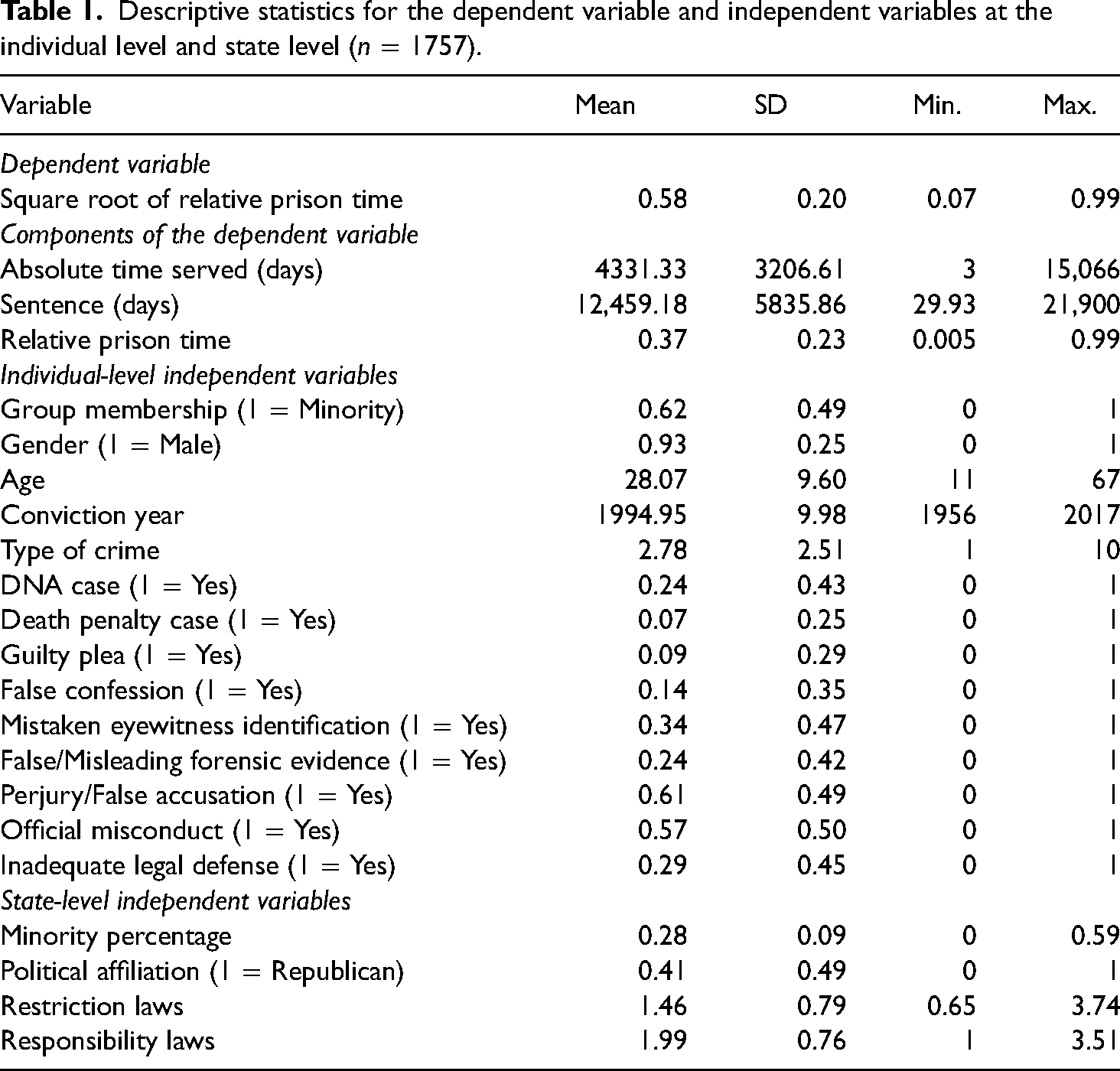
Our main independent variable was group membership, coded as majority (0 = white) or racially marginalized minority (1 = Black/Hispanic/Asian/Native American). The minority groups were collapsed into one category because not every race or ethnicity is represented in each state. Our analysis included 670 exonerees from the majority group and 1087 from the racially marginalized minority groups. 4
We examined several individual-level control variables, including sociodemographic and legal process variables. The sociodemographic variables were gender (0 = female, 1 = male) and age at the time of the crime, which may affect the risk of being wrongfully convicted (Gould et al., 2013). An additional second-order age variable was inserted to capture a curvilinear relationship with the dependent variable.
Eleven legal process control variables were examined. Year of conviction controls for the possibility that due to growing awareness of wrongful convictions (Acker and Redlich, 2011), it might have been easier for individuals convicted more recently to prove their innocence. Type of crime represents the most serious crime the subject was convicted for (10 categories in ascending order of seriousness), and controls for the possibility that the risk of wrongful conviction differs for different crimes (Gross and Shaffer, 2012). Originally, this variable included 27 categories; but for simplicity, we used nine categories which constitute 95.50% of all cases, and collapsed the rest (4.5%) into an “Other” category. DNA case (0 = no, 1 = yes) controls for whether the convict was exonerated due to DNA evidence, which, it has been argued, increases the likelihood of exoneration (Olney and Bonn, 2015). Capital case (0 = no, 1 = yes) captures whether the convict received the death penalty, which has been shown to delay exoneration (Spangenberg and Walsh, 1989), and Guilty plea captures whether the convict pleaded guilty, which may affect the right to appeal or to obtain exculpatory evidence (Garrett, 2020). Finally, the analyses include six binary control variables that represent the so-called canonical wrongful conviction factors mentioned above. These variables differ in their burden of proof, and thus might influence the length of the process. They are coded 1 if the factor played a role in the wrongful conviction and 0 if not.
We also examined five state-level control variables. The first three of these represent general state characteristics. State represents the jurisdiction in which the trial took place and includes the U.S. states and the District of Columbia (more on this below). Minority percentage represents the proportion of the state's population comprised of racially marginalized minority groups, a factor that is related to the harshness of the state's penal system (Carmichael and Kent, 2017). Political affiliation (0 = Democratic, 1 = Republican) represents the political affiliation of the majority of the state's population. This variable was based on the results of the most recent presidential election in the year in which the wrongful convict was exonerated. We recognize that using a static measure to capture the political orientation of states may raise concerns since the political affiliation of a state's voting population could shift over time. Thus, to ensure our results do not depend on this operationalization, we explored several other possible measures, including defining each state by the party which won most elections during the period covered by our data (1989–2019) or using a liberalism/conservatism scale. These operationalizations produced similar results. In addition, we examined changes in state presidential election voting patterns during our research period and found that the results in most states changed little, if at all.
The last two state-level control variables represent state laws dealing with post-conviction DNA testing (Stephens, 2013). These were produced through factor analysis (see methodological appendix), with which we created two variables: restriction laws, which include laws regarding time limits and limits after a plea bargain; and responsibility laws, which include laws regarding responsibility for payment and admitting an attorney. High values in both variables indicate that the state is more restrictive in opportunities to challenge a conviction. Due to curvilinear relationships with the dependent variable, we used a second-order variable for the restrictions variable, and second- and third-order variables for the responsibility variable.
Finally, important assumptions of the multilevel method are that each group has a sufficient number of observations, usually between 10 and 30, and that the number of groups is sufficiently large, usually between 10 and 100 (Clarke and Wheaton, 2007; Łaszkiewicz, 2013). Failure to meet these assumptions has little impact on the fixed effects, which are the main interest of this study, but they do affect the random effects (Clarke and Wheaton, 2007; Łaszkiewicz, 2013). In the current research, some states had fewer observations than the minimum requirement of 10 per group. Therefore, we assimilated these smaller states into bigger ones which are similar in the state-level characteristics examined here (see methodological appendix). Ultimately, the analysis was performed on 33 states or state groupings, each containing at least 10 observations. Note that analysis with all states in their original form (without assimilation) obtained similar results.
Data analysis
We used multilevel analysis because the observations are clustered in states, creating a risk of violating the error independence assumption if ordinary linear regression were used (Kreft and De Leeuw, 1998). We use a random intercept and slope model to allow for different associations between the group membership variable and the square root of relative prison time in each state. Our model is incorporated in the following equation:
Our analysis took place in two steps. First, we examined the effect of the group membership variable on the square root of relative prison time, controlling for the individual- and state-level characteristics. Second, we added to the model a cross-level interaction term for the group membership and political affiliation variables.
Results
We first examine the intraclass correlation coefficient (ICC) using a null model (Kreft and De Leeuw, 1998) – a model including only the dependent variable, but with a different variance for the individual and state levels (Table 2). The results show that there is a small but significant variance between the states (
Multilevel analysis of square root of relative prison time, at two levels (null model).
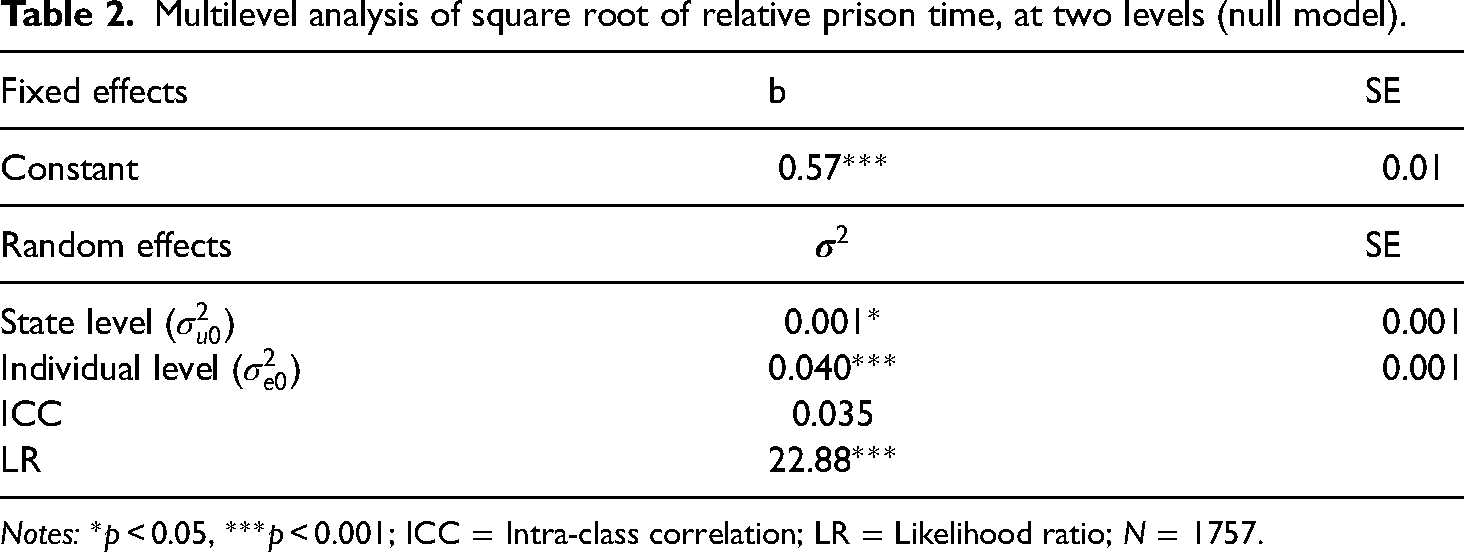
Notes: *p < 0.05, ***p < 0.001; ICC = Intra-class correlation; LR = Likelihood ratio; N = 1757.
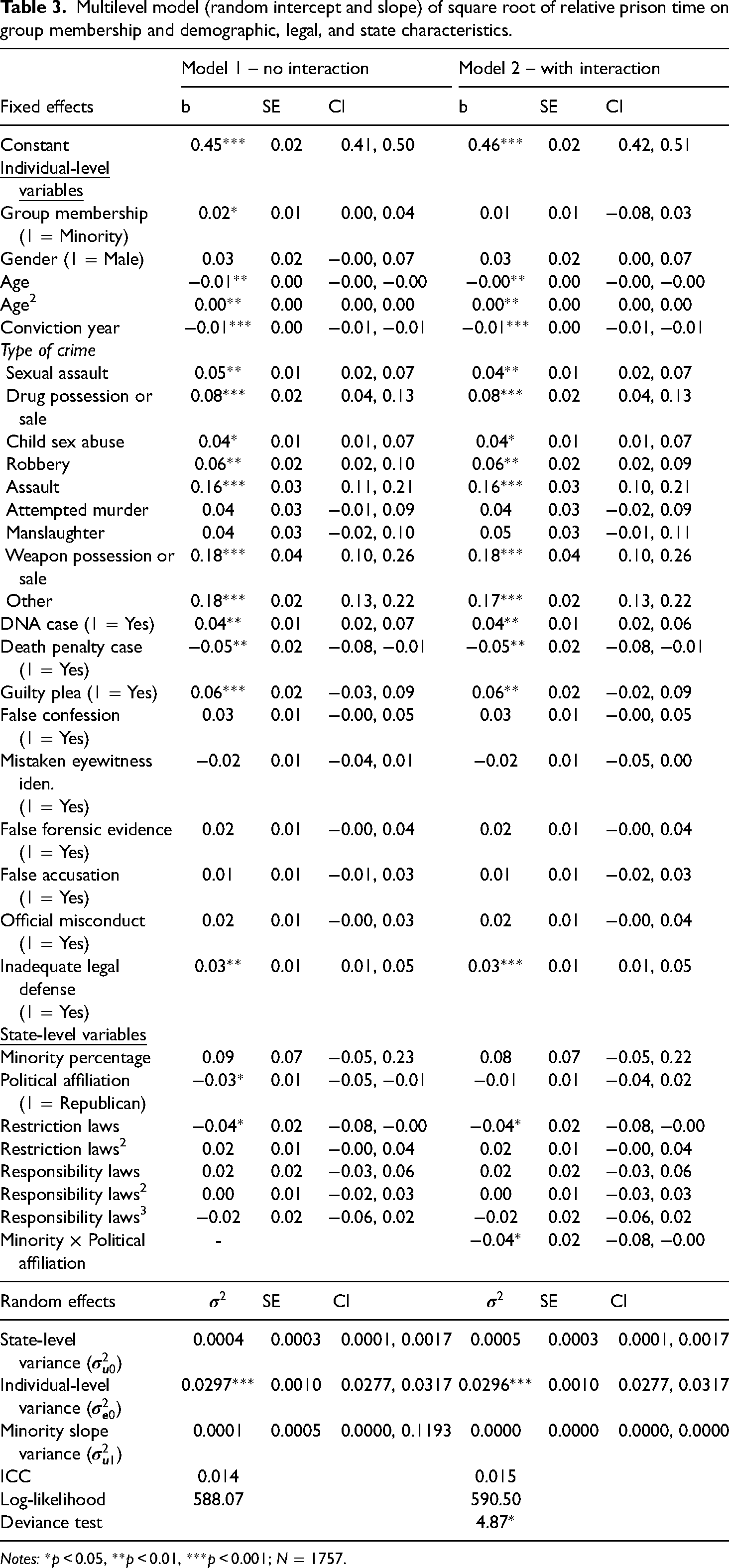
Next, we produced a multilevel model including the square root of relative prison time, the group membership variable, and the demographic, legal, and state-level control variables (Table 3, model 1). 5 In model 1, we see a significant difference for exonerees from racially marginalized minority groups versus the white majority group (b = 0.02, p < 0.05), such that relative to their sentence, racially marginalized exonerees are released after serving more time. Marginal effect displays of the predicted relative prison time show that on average, white people who are wrongfully convicted serve 31.64% of their sentence before exoneration, while those from racially marginalized minority groups serve 34.47% (percent difference of 8.55). These results support our first hypothesis, which suggests that the relative prison time served by racially marginalized people who are exonerated will be longer compared to that of white people.
Multilevel model (random intercept and slope) of square root of relative prison time on group membership and demographic, legal, and state characteristics.
Notes: *p < 0.05, **p < 0.01, ***p < 0.001; N = 1757.
This model also shows that most of the independent variables are significant. Concerning the individual-level control variables, the results indicate that the younger the exoneree, the longer his/her relative prison time (b = −0.01, p < 0.01). A later conviction year (b = −0.01, p < 0.001) and imposition of a death sentence (b = −0.05, p < 0.01) shorten the relative prison time. In contrast, the use of DNA evidence in the exoneration process (b = 0.04, p < 0.01), a guilty plea (b = 0.05, p < 0.001), and an inadequate legal defense (b = 0.03, p < 0.01) all lead to longer relative time. Concerning the type-of-crime dummy variables, in which murder is the reference category, we see that exonerated individuals who were wrongfully convicted of other crime types (besides attempted murder and manslaughter, which are not significant) serve more of their sentence compared to those convicted of murder. Of all the state-level variables, only political affiliation (b = −0.03, p < 0.05) and, surprisingly, restriction laws (b = −0.4, p < 0.05) are significant. Specifically, exonerated people who were wrongfully convicted in Republican states and in states that are more restrictive in laws regarding the exoneration process serve on average less relative time. The ICC of the model shows that the variance between the states constitutes 1.4% of the total variance in the dependent variable – that is, almost all the difference can be attributed to differences between exonerees, and very little to differences between states.
Our second research hypothesis posited that Republican and Democratic states would differ in the association between race/ethnicity and the square root of relative prison time. To test this hypothesis, we added an interaction term between the group membership and political affiliation variables. Comparison of the −2*Log-likelihood of the two models reveals that adding the interaction term significantly improved the model (χ2(1, N = 1757) = 4.87, p < 0.05).
The results of model 2 (Table 3) show that the interaction term is significant (b = −0.04, p < 0.05), meaning that in Republican states, the association between race/ethnicity and the square root of relative prison time differs from that in Democratic states. Further analysis showed that the difference in the square root of relative prison time between the white majority and racially marginalized minority groups is insignificant in Democratic states (χ2(1, N = 1757) = 0.06, p > 0.05), but significant in Republican states (χ2(1, N = 1757) = 10.40, p < 0.01). Marginal effect displays of the predicted relative prison time for the groups (Figure 1) show that in Democratic states, the difference in relative prison time between the majority (34.16%) and minority (35.03%) groups is relatively small – a percent difference of 2.52 (an absolute difference of 0.87%). However, in Republican states, the difference between the majority (28.41%) and minority (33.68%) groups is meaningful – a percent difference of 16.98 (an absolute difference of 5.27%). These results support our second hypothesis.

Predicted relative prison time for minority- and majority-group members in republican and democratic states, from multilevel regression.
Moreover, we can see that there is no significant difference between the two sets of states (χ2(1, N = 1757) = 0.23, p > 0.05) for the minority groups, where the predicted relative prison time is 35.03% in Democratic states and 33.68% in Republican states. However, there is a significant difference (χ2(1, N = 1757) = 5.49, p < 0.05) between the states for the majority group, where the predicted relative prison time is 34.16% in Democratic states compared to 28.41% in Republican states. These findings suggest that the differences between Republican and Democratic states in the association between race/ethnicity and relative time in prison are mainly derived from differences in the treatment afforded to members of the majority group.
Discussion
Many studies support the claim that racially marginalized defendants are at greater risk of being wrongfully convicted (Bjerk and Helland, 2017; Gross et al., 2017). However, little attention has been paid to the stages that follow a wrongful conviction. Given the literature on the racial bias inherent in the criminal justice system, at both the macro and individual levels (MacFarlane and Stratton, 2016; Spohn, 2017; Warren et al., 2006), it is reasonable to assume that discrimination against the racially marginalized will also manifest after conviction. The current study aimed to fill this gap by testing for differences between minority- and majority-group exonerated prisoners in the length of the exoneration process using NRE data covering 1757 exonerations.
Our first hypothesis was that racially marginalized exonerees would serve more relative prison time compared to whites (H1). To examine it, we produced a multilevel model of the square root of relative prison time on group membership, with the additional individual- and state-level control variables. The results support our hypothesis, showing a significant difference between the amount of relative time served by members of the two groups before exoneration, to the detriment of minority-group members (a percent difference of 8.55).
Second, we hypothesized that in Republican states, differences between the minority and majority groups in relative prison time would be greater compared to Democratic states (H2). Indeed, we found that in Democratic states, belonging to a minority versus the majority group makes no difference in terms of relative prison time, whereas in Republican states there is a significant 16.98 percent difference, such that minority-group members who are exonerated following a wrongful conviction serve more time relative to their sentences than those from the majority group. These differences derive from the fact that in Republican states, majority-group exonerees serve less time out of their sentence compared to those in Democratic states, while no differences were found in relative time served by minority-group members in Republican versus Democratic states.
Note that although the significant absolute differences in predicted relative prison time between the minority and majority groups may seem small at first glance (2.83% overall and 5.27% in Republican states), the average sentence in our data is 34.13 years. This means that on average, every 1% difference in relative prison time equates to approximately 125 more days in prison before exoneration.
The present findings serve as preliminary evidence that not only are racially marginalized individuals more at risk of being imprisoned for crimes they did not commit but they also suffer from discrimination even after their conviction and struggle more to prove their innocence. The implications of this are compelling, given that not only are the wrongfully convicted exposed to the mental and physical harms that accompany imprisonment but they also experience unique elements of pain and suffering, as described above (Jackson et al., 2021; Rajah et al., 2021; Shlosberg et al., 2018; Westervelt and Cook, 2018). If every day of unjust imprisonment is painful, a difference of at least a year (on average) between the majority and minority groups is extremely meaningful.
More broadly, the present findings can be framed in the context of cumulative racial disadvantage (Kutateladze et al., 2014). This framework holds that racial discrimination should be considered not only vis-à-vis its effect during specific stages (charging, sentencing, etc.) but also in terms of the cumulative effect of multiple less favorable outcomes (Sutton, 2013). Together with prior work on racial bias in the criminal justice system (e.g., Spohn, 2017), and specifically in the stages prior to wrongful conviction (e.g., MacFarlane and Stratton, 2016), our findings suggest that this cumulative disadvantage does not only stop at the wrongful conviction but also includes the exoneration process.
An important question that arises concerns the reasons for the differences between the groups. A great deal of literature has argued that the overrepresentation of racially marginalized groups in the criminal justice system is due to racial discrimination, manifested in both individual acts of racially biased officials and systemic racism (MacFarlane and Stratton, 2016; Rizer, 2003; Spohn, 2017). Hence, the question is whether the disparities found here also derive from racial bias, or whether other explanations may be offered. Indeed, there are many possible explanations for longer relative prison time for the minority group, including difficulties in financing DNA testing, representation by attorneys who are just not good enough, and more.
However, such explanations seem not to be the primary source for the differences between the groups. First, the differences between Republican and Democratic states are driven by differences in the treatment of wrongfully convicted people from the majority group, not the minority groups. Thus, the possible alternative explanations should be presented from the perspective of whites: greater ability to finance DNA testing and representation by more successful attorneys. But this too seems unlikely, as in that case, we would expect to find differences across all states.
Therefore, we can hypothesize that these differences somehow stem, at least partially, from some features of Republican and Democratic states. As mentioned, racial bias in the criminal justice system has been found to be associated with Republican leanings in both states and individuals (Cohen and Yang, 2019; Durante, 2021). Thus, a logical explanation of our findings is that the differences derive from a more diligent or scrupulous attitude of the justice system in Republican states toward white prisoners who appear to have been punished unjustly, which is manifested at both the state level (e.g., laws or policies) and the individual level (e.g., prosecutors or judges). This identification of political orientation as a possible contributing factor to disparate outcomes is another contribution of our study. Future research is needed to probe this and other explanations further, and to isolate the aspects of the process where they are most potent.
Concerning the control variables, most were found to have a significant effect on relative prison time. These include age, year of conviction, DNA, capital case, guilty plea, inadequate legal defense, and restriction laws, as well as most of the type-of-crime dummy variables. Interestingly, our findings with regard to the capital case and DNA variables are not consistent with the literature. Based on previous work, the exoneration process is expected to be longer in capital cases (Spangenberg and Walsh, 1989), and shorter where DNA evidence is present (Olney and Bonn, 2015). The findings of this study suggest the opposite. Yet they are open to logical explanations. With respect to capital cases, several scholars have noted that wrongful conviction claims for prisoners on death row tend to draw substantial attention from the media – something that is often particularly true when the wrongfully convicted prisoner is Black (Harmon and Lofquist, 2005). This media attention prompts the wheels of justice to grind more quickly, shortening the exoneration process. Another possible explanation is that capital cases – as matters of life and death – may also attract more scrutiny from officials and therefore more resources, and this too may shorten the exoneration process. With respect to DNA, indeed, DNA evidence may make it easier to prove a suspect's innocence; but obtaining such evidence can be extremely difficult and time-consuming (Olney and Bonn, 2015), potentially lengthening the process.
The current study has important practical implications. First, law enforcement agencies, especially in Republican states, should be made aware of the disparities found here, so that efforts can be made to redress previous unfair practices. Second, convicted prisoners who persist in claiming innocence should be supported, for instance by helping them find an attorney or connecting them with the innocence project. This support could also be directed at aspects found in the present study that directly affect the exoneration process. Since obtaining exculpatory DNA evidence is difficult, authorities could allocate financial resources for DNA tests for those who cannot fund it for themselves, for example by establishing a federal fund for defendants and convicted people. Likewise, steps could be taken to prevent instances of inadequate legal defense, for example, by setting limits to the workloads of public defenders and providing training programs. Finally, authorities should set up programs to assist individuals who are exonerated in returning to society, especially members of racially marginalized groups.
The present study is not without limitations. The first limitation concerns the population examined here. A wrongful conviction is only revealed when the convicted individual is exonerated. Therefore, we are never exposed to the entire population (or even a representative sample) of people who were wrongfully convicted, but only to the population of the exonerated, who may differ in their characteristics from wrongfully convicted prisoners who are not exonerated. This is an inherent problem in the field of wrongful convictions (Gross and O’Brien, 2008) that future research should aim to address.
Another limitation concerns the stage of the criminal process examined. Our dependent variable, relative prison time, relates to the period between conviction and exoneration. One can argue that a more accurate period might begin when the wrongful convict begins to actively fight for his innocence – for example, by filing a motion for a new trial or contacting an innocence project. Theoretically, it is possible that the differences we found in relative prison time may imply that wrongfully convicted people from the majority group start to fight for their innocence earlier, compared to those from minority groups. However, even if this is the case, the fact that minorities do not take every possible step to prove their innocence earlier raises sharp questions about how they perceive their status in the eyes of the justice system. Future research could try to shed light on this topic by examining data on the behavior of people who were wrongfully convicted at different stages after the false conviction.
Supplemental Material
sj-docx-1-pun-10.1177_14624745221148318 - Supplemental material for Haven't they suffered enough? Time to exoneration following wrongful conviction of racially marginalized minority- vs. majority-group members
Supplemental material, sj-docx-1-pun-10.1177_14624745221148318 for Haven't they suffered enough? Time to exoneration following wrongful conviction of racially marginalized minority- vs. majority-group members by Eran Itskovich, Roni Factor and Daniel Ohana in Punishment & Society
Footnotes
Acknowledgments
The authors would like to thank the Center for the Study of the United States in Partnership with the Fulbright Program at Tel Aviv University for the support during the work on this article.

Supplemental material
Supplemental material for this article is available online.
Notes
References
Supplementary Material
Please find the following supplemental material available below.
For Open Access articles published under a Creative Commons License, all supplemental material carries the same license as the article it is associated with.
For non-Open Access articles published, all supplemental material carries a non-exclusive license, and permission requests for re-use of supplemental material or any part of supplemental material shall be sent directly to the copyright owner as specified in the copyright notice associated with the article.
