




Abstract
The principle of normalisation has gained more prominence in international prison law, with both the United Nations Standard Minimum Rules (UN SMR) and the European Prison Rules (EPR) promoting normalisation to the guiding principles. In general terms, normalisation refers to shaping life in prison in resemblance to life outside prison. However, it largely remains unclear what this principle entails for prison policy. The general formulation in the UN SMR and EPR leave much discretionary room to national prison authorities. By conducting a (comparative) policy analysis, this article aims to uncover the normative standards derived from the UN SMR and EPR and how the principle translates into national laws and policies of Norway and the Netherlands. The analysis shows that although the main provision is generally formulated, some detailed norms are provided in other provisions on how elements of life in prison should be shaped, including limits and restrictions. In Norway and the Netherlands, normalisation is not explicitly mentioned in law, but is (to a varied extent) incorporated in policy. It is shown that, in practice, normalisation is closely tied to reintegration, which has important implications for the principle itself and the norms that are taken as point of reference.
Historically, prisons have been regarded as places of total confinement. This means that every aspect of life takes place within the parameters of the prison walls; home, work, education, even doctor's appointments and family visits. In these total institutions, their inhabitants must adapt to the regime in order to cope with life in the institution. Life in these ‘total institutions’, as Goffman (1961) stated, could therefore never be normal. Nevertheless, the principle of normalisation has gained traction in international legislation and scholarly debate. The main provision of the United Nations Standard Minimum Rules for the Treatment of Prisoners (UN SMR) and the European Prison Rules (EPR) leave much discretionary room to national prison authorities (Chantraine, 2010; Livingstone, 2000). The principle refers to shaping prison life in resemblance to life outside prison. This, however, raises important questions that warrant further examination, namely what the goal of normalisation is and what norms are considered as points of reference. In trying to answer these questions, the inherent complexity of the principle of normalisation becomes apparent. In this contribution we discuss this complexity with specific attention to the application of the principle of normalisation in the Netherlands and Norway, to highlight how these debates play out in practice.
A comparison between Norway and the Netherlands is particularly interesting because of the apparent similarities between the two countries. Notwithstanding the widespread academic debate, the prison systems in both countries have both been characterised as progressive and exceptional in the past (Liebling et al., 2021; Reiter et al., 2018; Smith and Ugelvik, 2017a; Todd-Kvam, 2019). Moreover, in 2015, Norwegian prisoners were housed in a Dutch prison. The Dutch government stated in one of the parliamentary debates that the Netherlands and Norway have substantively equivalent programmes in prisons (Dutch Ministry of Justice, 2015). Despite the apparent similarities, the research conducted on the incarceration of Norwegian individuals in the Netherlands shows there are far-reaching differences on the executive level, for example in the provision of services (Liebling et al., 2021).
By examining laws and policies of both countries, we will contribute to a better understanding of the translation and application of the complex concept of normalisation. The research question is: ‘How are principles of normalisation as outlined in international guidelines translated into national laws and policy of the Netherlands and Norway and how do countries deal with the inherent complexities within the principle of normalisation?’ As the analysis will show, in international soft law the normalisation principle strictly applies to the conditions in prison. However, in translating the principle into national policy and practice, normalisation becomes more focussed on the individual, at the risk of becoming not just instrumental, but a conditional principle tied to prisoners’ behaviour.
Theoretical debates about normalisation of prison life
The meaning of normalisation is not straightforward. While it has connotations related to behaviour, 1 most definitions of normalisation focus on normalisation of the prison environment and conditions of imprisonment, as opposed to people or behaviour (although, as we will see, this is mostly a theoretical distinction). A review of the relevant literature reveals conceptual dualities in each definition of normalisation; these are schematically displayed in Table 1 and discussed in turn. First, Snacken (2002) distinguishes between two levels of normalisation of prison life: the collective level and the individual level. The collective level of normalisation means that services accessible in free society, such as health care, should be made available in prison and adhere to the same standard of quality as much as possible. Individual normalisation, on the other hand, regards the prisoner as a social being who is part of society, with roles such as father, son, husband and friend (Snacken, 2002). Individual normalisation means that prisoners should be enabled to maintain these other social roles while imprisoned as much as possible. This requires possibilities for visits with family and friends to allow prisoners to retain (part of) their position in society. Individual normalisation also conveys that prisoners are allowed a certain degree of autonomy and space for self-development in prison (Van Zyl Smit and Snacken, 2009). In other words, normalisation assures prisoners’ legal position as part of society, their social position, and their need for self-development as individuals.
Overview of definitions of normalisation in the literature.
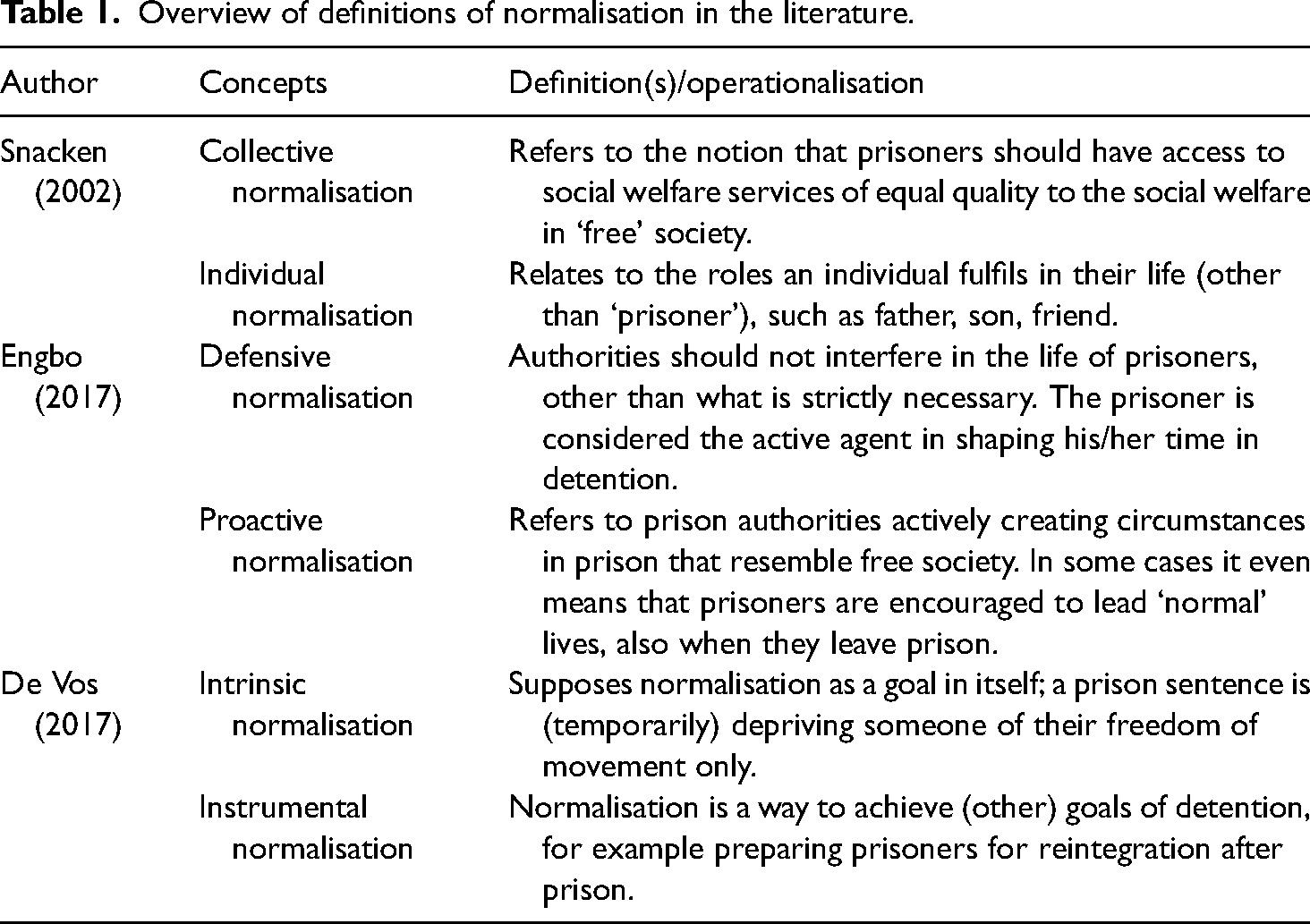
Second, Engbo (2017) distinguishes between defensive and proactive normalisation. This distinction recognises that normalisation means the simultaneous respect to rights on the one hand, and a duty to actively create favourable conditions on the other hand. More specifically, defensive normalisation refers to the notion that imprisonment may not interfere with any other rights than the freedom of movement. Therefore, prison authorities need to abstain from further restrictions or intrusions in the lives of prisoners. Proactive normalisation means that active involvement of the prison authorities is necessary to shape life in prison accordingly. Finally, De Vos (2017, 2021) distinguishes between the intrinsic goal of normalisation and the instrumental goal. Intrinsic normalisation values normalisation from a humane and rights-based point of view, as an extension of the notion that imprisonment should only result in the loss of freedom. Instrumental normalisation sees normalisation as a mechanism to achieve other goals, such as reintegration (Villman, 2021). In other words, in all definitions the concept of normalisation is linked to retaining basic human (equal) rights while in prison as well as to reintegration efforts.
The abovementioned definitions illustrate the inherent complexity of the concept of normalisation. First, the different interpretations of normalisation have varying implications for what norms should be taken as a point of reference. With regard to normalisation as a human rights concept, the norm is grounded in universal human rights and is therefore independent of the country or societal context. However, being able to retain basic human rights in prison also may require prison authorities to facilitate or shape policy and practical conditions (proactive normalisation). Therefore, Engbo (2017) states, taking active steps to shape prison conditions in accordance with life in free society is a ‘concomitant duty’ to reassuring human rights (Smith and Ugelvik, 2017b). Otherwise, normalisation is no more than ‘just […] a principle’ (Smith and Ugelvik, 2017b: 519). Where normalisation holds a duty to facilitate reintegration, the society in which the prisoner will return serves as point of reference in determining the norm.
Second, a tension exists between providing collective services and allowing for individual differences based on specific needs. A ‘normal’ life is not the same for all prisoners, just as it is a subjective notion in our free society. Even when a norm is established, the question rises whether achieving (a standard of) normalisation in prison sufficiently takes into account the problems many prisoners have in comparison to their counterparts outside prison (Van Zyl Smit and Snacken, 2009).
Third, when normalisation of prison life seeks to promote reintegration, it often not only enables but also strongly encourages prisoners to lead ‘normal’ lives in prison and upon release. Here, the normalisation effort is not only targeted at the prison conditions but turns into normalisation of behaviour or of the person (De Vos, 2017). This may be regarded as paternalistic, or a form of governmentality (Foucault, 1982). How countries, in this case Norway and the Netherlands, deal with these inherent complexities is the central focus of this article.
Comparative policy analysis
No systematic legal or policy analysis has yet been conducted on the normalisation of prison life, to complement the abovementioned theoretical contributions. This article fills this gap in two ways: first, relevant international guidelines were analysed in order to describe the current international standpoint on normalisation of prison life. These are the United Nations Standard Minimum Rules for the Treatment of Prisoners (UN SMR, also known as ‘the Mandela Rules’) and the EPR. Although the UN SMR and EPR are not legally binding, they are widely recognised as good principles and practices, and have informed domestic policies and legislation. In addition, relevant case law of the European Court of Human Rights (ECtHR) was studied. Second, relevant laws, policies and case law from the Netherlands and Norway that appeared after the Second World War were analysed to examine the interpretation of the international guidelines in practice. 2 This timeframe was chosen because after the Second World War normalisation was explicitly mentioned as a principle in soft law. For the Netherlands, the Dutch Penitentiary Principle Act (PPA; In Dutch, Penitentiaire Beginselenwet), including its explanatory memorandum, was analysed. Relevant case law was obtained from the official website of The Council for the Administration of Criminal Justice and Protection of Juveniles. 3 In addition, all prominent prison-policy documents were analysed. These were found at the official government website. 4 For Norway, the Code of Corrections (straffegjennomføringsloven; official translation ‘Execution of Sentences Act’) and the Regulations to the Execution of Sentences Act (forskrift til lov om straffegjennomføring) were analysed. Relevant policy documents were obtained from the official government website that publishes Norwegian policy documents. 5 Norwegian jurisprudence was not included due to the language barrier. To overcome the language barrier as much as possible, we translated Norwegian documents that mentioned ‘normalitetsprinsippet’, and consulted a Norwegian expert on prisons while writing this article to make sure no important sources were missed.
All legal and policy documents were coded and then analysed by consulting further literature, and comparing findings across documents. A structured chart was used to uncover the similarities and expose differences and ambiguities. Attention was paid to both explicit and implicit references to the principle of normalisation.
Normative standards of normalisation in international guidelines
In both the UN SMR and the EPR, normalisation is considered a guiding principle for shaping prison life (Council of Europe, 2006a; United Nations, 2015). 6 The UN SMR (2015) states ‘The prison regime should seek to minimise any differences between prison life and life at liberty that tend to lessen the responsibility of the prisoners or the respect due to their dignity as human beings’ (Rule 5.1). The EPR (2006a) is more specific by stating: ‘Life in prison shall approximate as closely as possible the positive aspects of life in the community’ (Rule 5). Beyond the general provisions on normalisation, the UN SMR and the EPR offer detailed guidance on what elements in prison contribute to a normalised environment, but also relevant qualifications. The guidelines are clear in their message that prisoners have equal rights that should be actively provided for.
Normalisation as an equal rights principle
The words of the UN SMR with regard to normalisation resonate the notion that a prison sentence should not inflict on the basic human rights of prisoners. The provisions in both guidelines voice an intrinsic approach to the principle of normalisation, implying that normalisation is a goal in itself when shaping life in prison (De Vos, 2017). The UN SMR state that the responsibility and the respect of prisoners should not be impaired ‘due to their dignity as human beings’ (Rule 60.1). Respecting prisoners as human beings means respecting their basic human rights. This means a prisoner has the same fundamental rights as other citizens and that any restrictions to these rights in practice should not be arbitrary, disproportionate or unreasonable (Council of Europe, 2006b: 7). The ECtHR has recognised the importance of normalisation in relation to protecting prisoners’ human rights. In two notable cases, the ECtHR explicitly referred to the principle of normalisation in their verdicts protecting respectively prisoners’ right to vote and right to family life (Dickson v. UK, 2007; Hirst v. UK, 2005).
The principle of normalisation not only means that prisoners retain their basic human rights while imprisoned, but also requires that aspects of life in prison are organised according to specific (‘normalised’) standards. With respect to work in prison, prisoners should enjoy the same rights as employees in free society. This includes full normal wages, the maximum daily and weekly working hours, safety and health precautions and provisions against injury, including occupational disease (see EPR Rules 26.13, 26.15, 26.17 and UN SMR Rules 96.2, 100.2, 101.1, 101.2, 102.1). The EPR even go as far as to state that normalisation means that ‘prisoners should ideally be paid wages which are related to those in society as a whole’ (Council of Europe, 2006b: 26). The normalisation of work thus concerns the organisational aspects and material conditions of work in prison. Prisoners should also be protected against exploitation (Council of Europe, 2006b: 26). This means for example that work in prison should not comprise highly undesirable work that is involuntarily executed (Van Zyl Smit and Snacken, 2009). Instead, work should be a ‘positive element’ of prison life and should allow prisoners a meaningful way to occupy their day and, ideally, enable them to save money for (re)building their life after release (EPR Rules 26.1, 26.2, 26.3, 26.12). The EPR make explicit that a proactive approach is expected of prison authorities in averting these possible negative aspects and ensuring that positive aspects of free society are implemented in practice (Engbo, 2017).
With regard to health care in prison, the UN SMR and the EPR prescribe that prisoners have the right to health care, which should be of the same standard as the care provided in free society. This equivalence of care is realised by creating material circumstances that reflect those in free society, such as ‘all necessary medical, surgical and psychiatric services’ (EPR Rule 40.5). Furthermore, health care should be ‘non discriminatory’ and ‘free of charge’ (UN SMR Rule 24). Interestingly, promoting free-of-charge health care might mean deviating from how health care is organised in free society. In addition to the organisational and material conditions, the UN SMR and the EPR also stipulate that the relationship between the prisoner and health care professionals should be equal to that in free society. This requires providing health care based on confidentiality, similar to the ‘ethical and professional standards’ for patients in the community (UN SMR Rule 32.1). The case of health care shows Snacken’s (2002) duality of collective and individual normalisation; where collective normalisation concerns the organisational and material aspects, individual normalisation is reflected in the relationship between doctor and patient. In other words, in the case of health care prisoners should be treated as patients the same way they would be in free society.
Another example where the rights-based interpretation of normalisation affects relationships in prison is the right to maintain contact with family. Both the UN SMR and the EPR recognise that imprisonment should not lead to ‘loss of contact with the outside world’ (Council of Europe, 2006b: 21). Organising visits between the prisoner and his or her family is important in respecting a prisoner's right to family life and correspondence (Council of Europe, 2006b: 21). To allow for this contact to be ‘as normal […] as possible’, prison authorities have a positive duty to create beneficial circumstances, for example providing child friendly room for visits with children (EPR Rules 24.4, 24.5). The commentary on the EPR (2006b: 23) specifies visits should be frequent, and advocates for the possibility to have longer intimate family visits. Attention should also be paid to new (digital) forms of communication, for example through email (Council of Europe, 2006b: 21; UN SMR Rule 58.1a). 7 In other words, the conditions in which the contact with family and friends take place should facilitate ‘normalised’ contact between the prisoner and his or her family.
In addition to the general statement where normalisation is a goal in itself, in the provisions on work and contact with the outside world normalisation is linked to the goal of preparation for release. According to the UN SMR and the EPR, a normalised working environment helps prisoners lead a crime free life after prison by preparing them ‘for the conditions of normal occupational life’ (EPR Rule 26.7; UN SMR Rule 99). This reflects an instrumental goal of normalisation as identified by De Vos (2017); the normalisation of prison life serves to benefit other goals of incarceration, in this case reintegration. In order to do so adequately, the UN SMR adds that work should be sufficient and of a useful nature (UN SMR Rule 96.2). In the same way, the UN SMR and the EPR recognise that being able to maintain contact with family and friends – and doing so in a ‘normal manner as possible’ – is of value to the reintegration process of the prisoner after release (Council of Europe, 2006b: 21; EPR Rule 24.4; UN SMR Rule 107). Normalisation is thus not only considered a goal in itself related to promoting prisoners’ equal rights, but is simultaneously an instrument to stimulate reintegration. Both as a goal and instrument, normalisation is aimed at the aspects and conditions of prison life, not at the prisoner as an individual that should be normalised.
Normalisation as relative and selective principle
Regarding equal rights the UN SMR and EPR are fairly specific in detailing what this means and what the ‘norms’ of reference are. When it comes to the shaping of the setting, regime, and activities, the guidelines are less clear. According to the EPR, normalisation does not (only) apply to specific aspects of detention, but should be the basis for shaping the regime as a whole (Council of Europe, 2006b: 24). Looking further through other provisions, the EPR outlines in more detail what aspects of prison life the principle affects. A mixed composition of men and women within the prison staff and the presence of volunteers in prison contribute to a normalised environment (Council of Europe, 2006b: 63–64). With regard to the daily routine, activities should be offered that reflect a ‘normal’ daily routine outside prison (Council of Europe, 2006b: 27). Such activities include work, physical exercise and recreational activities; additionally, the opportunity and facilities to maintain contact with one's family and to cook one's own meal constitute normalising elements of life in prison. Regarding these aspects of a ‘normal’ daily life, the EPR argue that prison authorities have a role in facilitating the possibility for a normal daily routine, but do not dictate that prisoners are obliged to partake in these activities (Council of Europe, 2006b: 26).
In some provisions of the UN SMR and the EPR, explicit restrictions to the principle of normalisation are listed. A qualification that pertains to normalisation in prison is that it concerns only the positive aspects of life in the community (Council of Europe, 2006b: 7). Consequently, the EPR dismisses the idea of ‘less eligibility’ and takes the position that negative aspects of life in society such as hunger and insufficient medical care should not be imported into prison. This could lead to different interpretations on the extent to which inequality in individuals’ circumstances outside prison should be allowed in prison (cf. Engbo, 2017; Feest, 1999; Van Zyl Smith and Snacken, 2009). In other provisions, the UN SMR and EPR implicitly state restrictions to the principle of normalisation. The provision that stands out most in this context is that men and women should be placed in separate institutions as far as possible (EPR Rule 18.8; UN SMR Rule 11). This is contradictory to free society, where a strict separation of men and women does not exist. Furthermore, considering men and women are placed in the same institutions in other contexts, such as mental health institutions and medical facilities, it seems unlikely the separation can be justified based on the maintenance of safety, security and order in prison. Moreover, Denmark and Spain have mixed-gender prisons where men and women are placed in the same institution and mix during work and recreational activities. On the other hand, it can be disputed whether mixed-gender prisons are in line with normalisation, considering that women make up a disproportionately small percentage of the prison population (Mathiassen, 2017). Nevertheless, the example of strictly separating men and women in prison shows that there is selectivity in the aspects of prison life that are subject to normalisation.
Different from rights, living circumstances and activities are much more variable outside prison, even more so from an international perspective. Consequently, what is ‘normal’ is relative, and a normalised prison environment may be quite different from one country to the next. As Daems (2013) points out, this poses challenges for international monitoring bodies, because prison standards are tied up with issues of inequality and justice. Given the relative nature of normalisation, it is valuable to use a comparative perspective to assess how normalisation (differentially) affects national policies and practice.
Two case studies: the norm of normalisation in the Netherlands and Norway
Although both Norway and the Netherlands do not have any provisions in law explicating normalisation, in Norway, the normalitetsprinsippet is a key element in shaping life in prison while in the Netherlands normalisation has not had a prominent place in prison policy. Naturally, this has contributed to differences in policy choices.
Normalisation in Dutch and Norwegian law and policy
Neither Norway nor the Netherlands mentions normalisation explicitly in penal and penitentiary laws. The Norwegian Code of Corrections section 2 states ‘A sentence shall be executed in a manner that takes into account the purpose of the sentence, that serves to prevent the commission of new criminal acts, that is reassuring to society and that, within this framework, ensures satisfactory conditions for the prisoner.’ The law does not specify what those ‘satisfactory conditions’ entail. They are, however, explicitly linked to the goal of reintegration. The Dutch PPA section 4(2) urges for minimal restrictions as one of the main principles stating, ‘Persons who have been convicted to be deprived of their liberty will not be subjected to any other limitations than those inherent to the goals of punishment or necessary to assure the safety and security in prison.’ This does not only apply to the constitutional rights of prisoners, but also on the restrictions exerted on the conditions within prison (Vegter and Muller, 2009). Together with the ‘resocialisation principle’ (resocialisatiebeginsel), the notion of minimal restrictions is the core of the Dutch PPA. Arguably, the two principles of minimal restrictions and re-socialisation together constitute the principle of normalisation (Boone et al., 2016). This is not a far stretch considering that in international guidelines, the principle of normalisation contains elements that secure prisoners’ human rights and also promote reintegration. In this sense, the Dutch law reflects the meaning of normalisation given in the UN SMR and EPR where normalisation requires prisoners to retain their human rights while in prison and simultaneously urges prison authorities to actively shape normalised conditions in prison that facilitate reintegration.
In Norwegian prison policy, normalisation is explicitly and extensively mentioned as a key principle. Even though it is not a legal principle, normalisation was explicitly considered when the law came into being in 1988, stating ‘prisoners should, as far as possible, live a normalised life within the securitised setting (of prison)’ (Norwegian Ministry of Justice and Police, 2000: 32). In a White Paper compiled by the Norwegian Parliament the principle of normalisation is listed as one of five key principles for prison policy (Norwegian Ministry of Justice and Police, 2015). Normalisation is defined in three ways: 1. Apart from the restriction of freedom, prisoners keep the same rights as every other citizen, 2. Normality requires that no more security and safety measures be instated than necessary, and 3. All aspects of life in prison should be shaped as much as possible to the equivalent of life in free society. The ambition of creating a life as normal as possible within the walls of prison is illustrated by the desire to explore the possibilities for further developing ‘village prisons’ to promote normalisation (Norwegian Ministry of Justice and Police, 2018). Examples of these village prisons in Norway are the prison (units) of Bastøy, Leira, Hassel and Osterøy, although the latter two have recently been closed down (Norwegian Ministry of Justice and Police, 2019). In these prisons, prisoners are assisted to master ‘life skills’ and have ‘influence over important decisions in their own lives’ (Norwegian Ministry of Justice and Police, 2018: 52–57). One of the ways to achieve this is that prisoners are trained for jobs where they can be employed after their sentence. Training opportunities in life skills include managing their own finances, food shopping, doing household work and ‘participating in large-scale meetings and conflict mediation’ (Norwegian Ministry of Justice and Police, 2018: 10).
The Norwegian government also recognises that there are certain practical limits or obstacles in realising normalisation, mainly the need for security measures, the prison architecture, and personnel and financial limitations. However, as is stated by the Norwegian government on their website, the limitations that these obstacles pose for the realisation of a normalised prison environment must be accounted for by a reasonable explanation: ‘You need a reason to deny a sentenced offender his rights, not to grant them (Norwegian Ministry of Justice and Police, 2013).’
Contrary to Norway, the principle of normalisation has not had a very prominent place in prison policy in the Netherlands. The principle of normalisation was implicitly included in the post- Second World War prison reforms, instigated by the Commission Fick (De Jonge, 2007). In these policy documents, efforts to normalise life in prison focussed on bringing life in prison and life outside prison closer together (Rapport commissie-Fick, 1947). Years later, in a parliamentary memo, the Ministry of Justice (1964) voices the ambition to have work in prison resemble working conditions outside prison. The aim was to let prisoners adjust to the work routine of work outside, at that time mainly production work in factories. This was achieved by adjusting working hours to those of a regular working week in free society (at that time 42.5 h a week) and by installing modern equipment and machinery (Dutch Ministry of Justice, 1964: 36). In more recent years, normalisation has been incorporated in prison policy documents to some extent, but never with a clear meaning, goal or implications for prison practice. In 2006, the policy document ‘The New Institution’ named normalisation as one of five key principles (Post et al., 2007). Neither in the policy document, nor in the evaluation of the new detention regime it is explicated what the concept of normalisation entails, what aspects of prison life it concerns and how this principle takes shape in practice (Post et al., 2007). In 2012, the Dutch government again voiced the ambition to make work in prison resemble work in free society. In a policy document on the ‘modernisation of work it is explained that implementing more ‘business-like requirements’ in prison work will stimulate its ‘resocialising function’ (Dutch Ministry of Justice, 2012: 2).
This comparison of Norway and the Netherlands shows that explicating normalisation as a central pillar for prison policy, as is done in Norway, has generated a relatively comprehensive description of what the principle entails, incorporating the norms from international declarations. In the Netherlands, in contrast, normalisation is much more implicit, even though it is theoretically congruent with the principles of minimal restriction and resocialisation. Yet, there is little specific guidance on what this means for how specific elements of prison life should be shaped. In the next paragraphs we will show that this discrepancy is also visible in specific policies in Norway and the Netherlands. Furthermore, we will show that in the translation of normalisation into specific (national) policy and practice the concept becomes more and more focussed on the normalisation of the individual and their behaviour. As will become clear, the normalisation of conditions and the normalisation of individuals are not strictly opposites, but rather a sliding scale.
On individualisation and standardisation: equal health care in prison
Both in the Netherlands and in Norway the law determines that all people who have been sentenced to the care of the prison department have the right to health care of equal quality as in free society. Although grounded in the same ideology, the policy differs. In the Netherlands, a general physician, a dentist and a psychologist are part of the prison staff. The Dutch model, referred to as the self-sufficiency model, ensures that all prisoners get the same care, while the prison is responsible for ensuring its quality (Moerings, 2009). Putting the responsibility to provide a certain quality of health care with the Prison Service ensures that no prisoner can receive care that does not meet a sufficient standard. In this sense, the Dutch policy adheres to the part of the normalisation principle that assures only the positive aspects of free society are imported. Medical costs are covered by the (standardised) insurance the Ministry of Justice provides. Consequently, the medical insurance prisoners had before they entered prison is suspended. Prisoners do have the right to consult with a doctor of their own choice at their own expense (article 42.2 PPA). This right only concerns the right to consult, and does not apply to treatment or the prescription of medication.
In Norway, the law states that social services in society are responsible for providing their services – such as medical, educational and library services – and assistance to its citizens while in prison. The Norwegian Correctional Service is only responsible for enabling these services to enter the prison and facilitate their deliveries of services to the prisoners. The municipality where the prison is located is responsible for providing the care (Norwegian Ministry of Justice and Police, 2015). As a consequence, health service providers have to adapt to the conditions of prison and ‘render its services in accordance with the security precautions necessary in a prison’ (section 3–16 of the Norwegian Penitentiary Law). This is known as the import model, which supports the notion that prisoners are still part of society while imprisoned (Ugelvik, 2017). The import model does not assure prisoners can choose their own health care provider (Nesset et al., 2011). Although it is not within the scope of this article to value one system over the other, from the perspective of normalisation it is interesting to see how a similar starting point results in two different translations into policy.
The models differ, and so do the dilemmas that pertain in both translations. In the case of the import model, making regular welfare providers responsible for the allocation of their services in prison also puts a great strain on those providers, which might lead to challenges in the actual provision of health care in practice (Guérin, 2003; Langelid, 2017). Furthermore, the way health care is organised, and more specifically the degree of integration of the service within the prison organisation, differs between prisons, especially between high security prisons and open prisons (Dugdale et al., 2021; Nesset et al., 2011). In the Netherlands, prisoners all have the same standardised medical insurance provided by the Ministry of Justice. As a result, prisoners cannot obtain additional insurance, as is possible in free society. An isolated yet interesting case of the Dutch Council for the Administration of Criminal Justice and Protection of Juveniles showed that this might result in a discrepancy between the health care received in prison and the care that someone might have received in free society. In this case, a prisoner who had paid for a high level of insurance in free society was not reimbursed for the costs of a dental treatment he would have received for free in free society. 8 Although the Council did not rule in favour of the prisoner, the Council did raise the question whether the prisoner should have received the dental treatment (partly) free of charge considering the individual circumstances of his case (such as his previous insurance and the remainder of his sentence).
From the normalisation of conditions to the normalisation of the individual: A sliding scale
As was stated above, Norwegian policy contains a detailed description of the consequences of the principle of normalisation for daily life in prison whereas in the Netherlands normalisation is only mentioned in relation to work in prison. This selectivity in the application of normalisation within Dutch prison policy is also visible in the actual translation of the principle in practice. Both policy documents drafted by the Ministry of Justice in 1964 and 2008 showed that making work in prison resemble work outside prison more closely has predominantly resulted in adjusting the working hours in prison. Currently, the Dutch PPA states that the amount of hours prisoners are obligated to work is determined within the limits of normal working hours in free society (Article 47.2 and Article 47.3). Until a recent change in policy, prisoners had a right and a concomitant duty to work at least 20 h a week. 9 According to the Dutch Council, the minimum of 20 h a week is required considering the importance given to work as a resocialisation activity in prison. Most recently, in a document titled ‘Vision on Imprisonment’, this instrumental approach to normalisation is used to increase the minimum working hours from 20 to 32 h per week (Dutch Ministry of Justice, 2019). The increase is further justified on the basis that it will increase prisoners’ self-sufficiency, and that it will teach them how to be regular employees. However, other aspects of work in prison, such as wages and the type of work conducted by prisoners, are not part of the normalisation effort. In other words, although the Dutch government strives for the normalisation of working conditions, this aim is not realised, as the sole focus is the number of working hours.
The Norwegian government on the other hand is very specific and elaborate on what the principle of normalisation (or normality) means for the day-to-day life of prisoners, but does not confine the normalisation to only the conditions in prison. Instead, the normalisation effort is paired with explicit expectations for prisoners’ behaviour. The Norwegian Ministry of Justice and Police (2015: 23–33) states: The principle of normality has many practical consequences. Inmates should plan their own finances, do their own shopping and cooking, wash their own clothes and keep their cell clean, search for work or school. The prison should be an arena for practicing daily activities and taking responsibility for one's own life. This will increase chances of living a crime-free life.
In other words, in Norway, prisoners’ rights are closely bound to prisoners’ duties. This interpretation of the principle of normalisation in Norwegian policy shows that it is tied to behavioural expectations related to life in prison and outside. Contrary to the UN SMR and the EPR, the dual meaning of normalisation – normalised conditions for their own sake but also to promote reintegration – is not confined to the conditions in prison, but also aimed at shaping prisoners into ‘norm-abiding citizens’, strongly linked to the concept op responsabilisation (De Vos, 2021). Normalisation as responsabilisation – or even disciplining – is strengthened by the tendency to link (access to) a normalised environment or activities to desirable behaviour, such as transition to a prison with a lower security level (De Vos, 2021).
Although not explicitly tied to the principle of normalisation, a similar inclination to link privileges, often reintegration activities, for prisoners to their (perceived or reported) behaviour is increasingly seen within Dutch policy. Already in the 1990's reintegration activities were made more selectively available for prisoners (Boone, 2007; De Jonge, 2007). In the policy of ‘promoveren en degraderen’ (promotion and demotion) effectuated in 2014, a contingency model was introduced that awards privileges, such as extra possibilities for visits with family and friends and more time away from their cell, to prisoners who behave according to a certain ‘desired’ norm (Elbers et al., 2021). These privileges can be taken away when prisoners do not show ‘desirable’ behaviour’, leaving prisoners with a daily programme that assures only the basic activities required by law. 10 In making certain privileges – especially those that may serve reintegration purposes – dependent on norm-abiding behaviour, normalisation becomes a sliding scale towards a paternalistic and disciplining tool used to turn prisoners into desired law-abiding citizens.
Discussion
The purpose of this article was to examine the normative standards and goals of normalisation of prison life, based on an analysis of international guidelines and specific national policies, and to explore how Norway and the Netherlands deal with the inherent complexities of the principle of normalisation. Although the general provisions on normalisation in the UN SMR and the EPR are broadly formulated, both declarations provide a substantially detailed description of the norms that constitute the principle of normalisation. In these declarations, the focus of normalisation lies on the normalisation of conditions in prison. Evidently, normalisation simultaneously promotes equal rights for prisoners, as well as reintegration. This was also reflected in Dutch and Norwegian prison policies. However, in national policies of the Netherlands and Norway, the normalisation effort is not just aimed at conditions in prison, but also concerns behavioural aspects and in some cases even translates into ‘disciplining’ measures. These findings have important theoretical and policy implications, which are discussed below.
First, although the intrinsic value of normalisation is connected to a clear norm – that of human rights – neither the Netherlands’ nor Norway's translation into policy fully tackles the complexity of providing standardisation and individualisation. The intrinsic value of normalisation prescribes that prisoners’ human rights should be safeguarded. This norm, which is grounded in law, should not be dependant on country or government, but is an inherent character of a democratic state with respect for its citizens. However, respecting prisoners’ human rights does not mean there should be one standard for everyone. Instead, having equal rights supposes a degree of autonomy. In the case of health care in prison this translates into the possibility to exert influence over the care that is provided to you. As the two distinct models of providing health care in prison show, the prison environment makes achieving this form of individualisation difficult. It deserves further examination to uncover how this tension between standardisation and individualisation, and by extension the degree of autonomy, is experienced in practice.
Second, while normalisation can be theoretically separated into intrinsic and instrumental components, its practical interpretation and application is mostly done in service of a behavioural norm: reintegration. As a result, the norms are not just living conditions, but also behavioural expectations (i.e. how people should behave when they are released from prison) (Ploeg, 2017). Indeed, activities in prison often have moralising aspects, with an emphasis on responsibilisation (Naessens, 2020). However, such an approach towards normalisation carries a risk that normalised activities and conditions are abandoned if they are not considered efficient or effective (Engbo, 2017; Villman, 2021). These findings raise the question whether normalisation as a principle should be uncoupled from reintegration as a goal to reduce ambiguity of its meaning and separate the concept from disciplining practices.
This suggestion warrants further examination. Both in Norway and the Netherlands, activities or privileges aimed at reintegration (and in Norway explicitly tied to normalisation) are dependent on prisoners’ behaviour. This shows that normalisation, when linked to reintegration, is not only instrumental (De Vos, 2021), but becomes conditional to prisoners behaving according to a desired norm. The difficulty with conditional normalisation is that behavioural norms may exceed legal norms of acceptable behaviour (e.g., when they include expectations about ‘motivation to change’ and ‘hygiene’, see Elbers et al., 2021). More empirical research is needed to explore the manifestation of this complexity within the concept of normalisation in practice. Although normalisation as a conditional norm is visible in both Norwegian and Dutch policy, earlier research suggests that on the executional level the extent to which the ‘conditioning’ of prisoners is embedded in (prison) culture and practice differs (Liebling et al., 2021). How this pertains to the principle of normalisation has yet to be explored. Moreover, studying the principle of normalisation in the broader societal context is crucial in understanding (intended or perceived) forms of normalisation.
Footnotes
Acknowledgements
We are grateful to dr Berit Johnsen for helpful comments on an earlier version of this article.
Declaration of conflicting interests
The author(s) declared the following potential conflicts of interest with respect to the research, authorship, and/or publication of this article: Jill van de Rijt is a PhD Candidate at Leiden University and works as a policy advisor for the Dutch Custodial Institutions Agency. The ideas voiced in this paper are the authors’ and do not reflect the position of the Dutch Custodial Institutions Agency.
Funding
The author(s) received no financial support for the research, authorship, and/or publication of this article.
