




Abstract
This article examines the underlying aims of denationalization of criminal offenders by framing the discussion within citizenship theory. It argues that such citizenship revocation policies exclude individuals who are perceived as non-ideal citizens under a complex vision of citizenship that combines communitarian and liberal undertones, which has significant consequences for detecting those with weak claims to membership. To develop this argument, the article advances in the following way. I first argue that the ‘protective’ function of citizenship, which has so far shielded domestic offenders from expulsion, has been eroding due to increasing reliance on denationalization. I then show, by employing an original study of European policies, that the ‘protective’ function of citizenship is eroding not only in general terms, but that it furthermore targets citizens of a particular profile that is continuously changing. Finally, I argue that recent revocation policies that are premised on security concerns, promote a complex vision of citizenship that combines elements of communitarian and liberal conceptions of belonging and works to exclude citizens of foreign descent who, at the same time, repudiate liberal values. Consequently, the status of the criminal rather than non-citizen, gains prominence in determining those at risk of exclusion from the polity.
Introduction
Protection from expulsion was for a long time a vital prerogative of criminally convicted citizens. The ‘ever-present threat of deportation’ (Walzer, 1984: 58) hovered exclusively over diverse categories of foreigners. In recent times, the mere ‘threat’ has become a ‘default position’ and ‘standard response’ (Kanstroom, 2000; Bosworth, 2011, 2012; Stumpf, 2013) to both immigration offenses – so-called ‘crimes of mobility’ (Aliverti, 2012, 2013) – and ‘regular’ crimes. The citizenship status of domestic criminals in contemporary democracies, however, traditionally provided a bastion of security: although the conviction temporarily limited access to rights and entitlements, it did not permanently break citizenship bonds and would leave the formal status of membership in a political community intact.
This long-standing ‘protective’ function of citizenship has, however, recently been eroding as democracies around the world come to embrace citizenship deprivation prompted by criminal or other harmful conduct (for a recent summary of European policies, see Tripkovic, 2021). By renouncing their citizens, states no longer guarantee ‘absolute protection from expulsion’ (Joppke, 2010: 84). Consequently, divisive properties of citizenship that separate members from non-members begin to collapse, and the non-criminal status emerges as the relevant indicator of ‘belonging’ (of non-criminal citizens and non-criminal residents alike). To develop this original argument, the article traces the prevalence, substance, and purpose of denationalization rules in various European democracies. The study aims to discern the profile of those citizens who, due to their criminal or harmful conduct, no longer qualify for unconditional membership. Given its complexity, the sanction of denationalization could be examined from various perspectives, either within a single jurisdiction or as a topic of comparative analysis. The analysis could explore legal foundations, policies and practices, factors that contribute and shape policy choices, outcomes of the application of legal rules, effects on denationalized individuals and other important issues. Given that the key question that motivates the article is to determine the extent to which revocation laws undermine the protective function of citizenship in Europe, as well as to uncover the motivations that stand behind these policies, the article opted to collect and analyze current and previous citizenship laws to determine the prevalence of particular approaches, examine their basic traits, and trace legal change. Ideally, the analysis of legislation would be complemented by assessing the context, number, and content of individual denationalization decisions. However, comprehensive information required for this type of analysis was, regretfully, mostly unavailable when the research was carried out. Future research could usefully bring the two approaches together to assess how the norms are applied in practice, make substantively more grounded proposals about their purpose, and make sense of the differences in revocation practices that appear between European countries.
After establishing dominant trends in Europe, the article subsequently undertakes a more general assessment of the link between crime and citizenship, arguing that denationalization promotes a vision of citizenship under which the definition of a ‘bad’ citizen hinges on, but also significantly diverges from that of a criminal offender. Ultimately, although citizens of foreign descent are the most common targets of denationalization, the loss of status has equally to do with their deviation from the homogenous ethnic body as well as their apparent reluctance to adhere to liberal values.
The article's central argument develops through three sections. The first explores the meaning of what I term the ‘protective’ function of citizenship and examines how it has so far shielded domestic offenders from expulsion, making their punishment – though oftentimes harsh – still inclusive in many ways. To make this point, the article contrasts such forms of punishment with policies that deter, detain, and deport foreign citizens. The second section begins to question the existence of the ‘protective’ function of citizenship by drawing on an original study of contemporary European citizenship revocation rules. By examining relevant legal provisions, this section establishes dominant trends, demonstrates the extent to which they undermine citizenship, and uncovers the transformation of the definition of ‘bad’ citizen: first a traitor, then an internal enemy and more recently a terrorist. Finally, the last section explores the substance of grounds that constrain access to citizenship: to do so, I contrast two ideal-typical visions of citizenship (communitarianism and liberalism) and assess their bearing on desired citizenship qualities. While denationalization commonly works to exclude citizens who undermine a distinct, community-dependent interpretation of the ‘good life’, they at the same time seek to banish those who fail to subscribe to universal liberal-democratic values which cut across national differences. It is at the intersection of these exclusive tendencies of communitarianism and liberalism where denationalization target is located.
The ‘protective’ function of citizenship
The ‘value’ of citizenship is a recurring theme in political theory. Linda Bosniak portrays citizenship as ‘the most desired of conditions, as the highest fulfillment of democratic and egalitarian aspiration’ (2006: 1). The status of political membership is a benchmark of belonging, an ideal ‘against which achievement can be measured and towards which aspiration can be directed’ (Marshall and Bottomore, 1992: 18).
The most concrete manifestation of the value of citizenship is the unhindered access to national territory that it secures (Joppke, 2010: 16), both as the right of entry and freedom from expulsion. The right not to be deported is ‘one of the few remaining privileges which separates citizens from settled non-citizens’ whereby deportation reaffirms ‘the significance of the unconditional right of residence that citizenship provides’ (Anderson et al., 2011: 548). The practice of deportation is ‘a way in which citizenship may be affirmed and reaffirmed as a normatively meaningful practically valuable status’ (Gibney, 2013b: 220). However, it is not only aliens who are expungable, but also long-term residents who are in other respects barely distinguishable from citizens. For aliens, deportation reaffirms the notion that citizenship is externally exclusive and internally inclusive (Brubaker, 1992) – ‘hard on the outside and soft on the inside’ (Bosniak, 2006: 4). But even for (permanent) residents who are ‘inside’, the lack of citizenship and the consequent threat of deportation reaffirm the mostly invisible internal boundaries that separate them from citizens. The demarcation of ‘belonging’ in this sense does not derive from their attachment or level of integration, but rather depends on being ascribed the formal status of membership.
Bearing the citizenship title, nevertheless, does not always guarantee equal citizenship experiences: this becomes especially apparent when citizens are convicted of crimes. Punishment undermines one's access to rights and entitlements; furthermore, collateral consequences of conviction such as criminal disenfranchisement and prohibition to perform public office, often lead to ‘second-class’ political citizenship. For domestic lawbreakers, criminal law performs similar functions to those which immigration law performs vis-à-vis foreigners: both branches are ‘gatekeepers of membership’ which determine ‘whether an individual should be included in or excluded from our society’ (Stumpf, 2006: 396–397). It is not surprising then that the well-rehearsed exclusionary penal practices have been customized to deal with immigrants through ‘crimmigration’ practices (Miller, 2003; Stumpf, 2006) consequently leading to ‘hyper-criminalization’ of migration (De Giorgi, 2010).
Regardless of their similar ‘gatekeeping’ purposes, important differences obtain regarding the degree and quality of exclusion of criminal offenders depending on their citizenship status. Unlike domestic offenders who remain within polity's boundaries, foreigners are commonly exiled (Aas, 2014). This is the case even in penally ‘mild’ countries, where criminal justice actually tends to be bifurcated: moderate for those who ‘belong’, but harsh and exclusive for ‘outsiders’, like immigrants and minorities (Barker, 2013). While domestic criminals become ‘internally exiled’ (Demleitner, 1999) and – when exposed to long-term or life imprisonment – severely incapacitated, foreigners are ‘excapacitated’ (Aas, 2013). The distinction is hardly semantic: by keeping them within national boundaries, states pledge to observe and control them, and (at least nominally) provide them with an opportunity for rehabilitation, thus paving the way for their future (re)integration. Even in the case of ‘ultimate penalty’ of life imprisonment (van Zyl Smit et al., 2016), convicted offenders enjoy state-guaranteed rights and protections, while their destinies are intimately linked to the state. Similarly, when imprisonment is served in correctional colonies which, in countries such as Russia, amounts to ‘in exile imprisonment’ whereby prisoners come to resemble those who are banished (Piacentini and Pallot, 2013), the state nevertheless maintains close control over them within the polity's physical borders. Therefore, even those who engage in the most serious crimes which might exclude them from the moral community (Hudson, 2006), remain within its geographical borders and future political imagination. Conversely, by way of deportation, ties with foreigners are permanently and irreversibly severed.
Citizenship is therefore a normatively relevant concept for penal law (contra Dubber, 2010): while little difference exists when it comes to substantive criminal law, consequences of criminal conviction are double tracked in that they, on the one side, incapacitate citizens while on the other, they ‘excapacitate’ foreigners. Citizenship is the fundamental barrier to renouncing those with the strongest claim to membership while at the same time it ‘poses intractable problems for those whose citizenship status is absent, in doubt, or irregular’ (Zedner, 2013: 42). This furthermore aligns with views of criminal law as a normatively bounded practice which pertains to citizens of a polity within which it exists – ‘a law that citizens impose on themselves’ (Duff, 2010: 293). Linking penal law with citizenship explains why full members of the polity may be punished in more inclusive terms than foreigners: only they engage in cooperative practices with co-citizens and consequently share the burdens and benefits of living within bounded normative communities (Dagger, 2018). Aliens are, therefore, not entitled to the benefits of ‘punitive inclusion’, which explains why they are ultimately excommunicated.
Leaving aside important normative concerns that arise from this position, the ‘protective’ function of citizenship at least provides a coherent explanation for why foreign citizens are treated differently from our own and why they are denied the ‘privilege’ of punitive inclusion. Citizenship is a sanctuary that secures one's links to a political community and guarantees that citizens may never be relegated to the status of aliens, despite illegal acts that they may commit against their own polities.
Denationalization and expectations of ‘good’ citizenship
The ‘protective’ function of citizenship has in contemporary times therefore mostly impeded alien-like treatment of citizens. While banishment had been widely used across the world since ancient times, gradual changes that occurred by the 19th century made this practice incompatible with developments such as the emergence of the territorial state, importance of national membership, and the rising use of imprisonment (Gibney, 2020a). This subsequently led to a significant reduction in its use which persisted until a strong – though as will be shown pronouncedly dissimilar – denationalization movement emerged in recent decades. Allegedly prompted by the rising fear of global terrorism, in early 21st century democracies began to expand the grounds for the involuntary loss of citizenship, particularly those arising from criminal or other harmful conduct (Lavi, 2011; Bauböck and Pascalev, 2016; Choudhury, 2017; Fargues, 2017; Gibney, 2020b). Denationalization in its modern form, however, appears distinctively different from the most recent practices of banishment: those subjected to transportation from England in the 18th-19th century, for example, did not lose their membership status nor become ‘civilly dead’ (Gibney, 2020a); the state, furthermore, maintained complete control over them, using them as tools of ‘colonial governmentality’ (Anderson, 2016). Today, states seek to permanently sever ties with hitherto citizens and are entirely disinterested in their future.
The following part of the article explores the erosion of the ‘protective’ function of citizenship in recent decades by employing three distinct perspectives. First, citizenship eroded in a general sense because a substantial (and constantly rising) number of countries permit its loss based on specified grounds. Second, the risk of citizenship deprivation is unequally distributed across the population as denationalization pertains only to citizens that have engaged in specific types of criminal or other harmful conduct. Third, a progressive analysis uncovers that the profile of a citizen at risk of denationalization has been changing over time, revealing the transformation in the purpose and aims of such policies, but also showing resilience in being a tool for determining the ‘proper’ performance of citizenship.
General erosion of the ‘protective’ function of citizenship
Involuntary loss of citizenship can ensue for various reasons. The three most common grounds are public security, non-compliance with citizenship duties (serving in the army or assuming public office in the citizen's other country of citizenship), and flawed acquisition (mistake or fraud in the process of naturalization) (Bauböck and Pascalev, 2016). This article mostly focuses on ‘public security’ reasons, although this denomination portrays somewhat inaccurately diverse revocation grounds used by contemporary democracies for it is, as will be shown, both too expansive and too narrow.
My original study examines legal provisions in 37 European democracies: 27 European Union Member States, European Economic Area members (Iceland, Lichtenstein, Norway, Switzerland), European Union candidate countries (Albania, Montenegro, North Macedonia, Serbia, Turkey) and the United Kingdom. The study entailed citizenship deprivation provisions which satisfy two conditions: (1) the loss is involuntary and (2) revocation responds to allegedly harmful conduct. In short, the study sought to uncover instances of unilateral denial of membership when a citizen has acted in ways that are sufficiently harmful to warrant the loss of citizenship. This definition, as will be shown below, covers cases of both criminal and non-criminal conduct.
Combining these criteria removes 15 countries from further analysis since they currently do not provide for such denationalization grounds: Albania, Croatia, Czechia, Hungary, Iceland, Lichtenstein, Lithuania, Luxembourg, North Macedonia, Poland, Portugal, Serbia, Slovakia, Spain, and Sweden. This leaves more than a half of countries in the sample (22) that permit citizenship revocation following a citizen's presumably harmful conduct: Austria, Belgium, Bulgaria, Cyprus, Denmark, Estonia, Finland, France, Greece, Ireland, Italy, Latvia, Malta, Montenegro, the Netherlands, Norway, Romania, Slovenia, Switzerland, Turkey and the United Kingdom. 1 Furthermore, citizenship revocation rules have been subjected to vigorous legislative activity in the last couple of decades, as half of denationalizing countries have either adopted such policies for the first time or made them stricter since the early 2000s (see Appendix). And although revocation numbers remain small (see Bolhuis and Van Wijk, 2020), the reasons for which will be discussed later, legislative efforts in this domain testify to the state's increasingly strong desire to manage and control specific threats through norms of citizenship.
The general erosion of the ‘protective’ function of citizenship in Europe concerns not only the outcomes (loss of citizenship) but also arises from the process itself. I have demonstrated elsewhere (Tripkovic, 2021), that not a single examined revocation country in Europe adheres fully to the fundamental principles of punishment during denationalization process. For example, countries frequently revoke citizenship for non-criminalized conduct, such as ‘lack of loyalty’ or ‘acts against the state’ (see Appendix) thereby holding citizens accountable for acts whose harmfulness is doubtful. Also, the revocation process is often administrative rather than judicial, which undermines fair trial guarantees. It is thus not only the outcome, but also the process of revocation which denies citizenship rights.
Targeted denationalization
While the value of citizenship is clearly diminishing across Europe, citizenship revocation grounds are nevertheless narrowly defined. Aiming to assess the breadth and aims of revocation grounds in Europe, I have analyzed the sample to determine the type and nature of conduct that can trigger such sanction. In terms of the type of conduct, most European countries denationalize for both criminalized and non-criminalized behavior. In fact, only seven of 22 countries (Bulgaria, Denmark, Finland, Italy, Latvia, Norway, Turkey) permit denationalization only upon criminal conviction (mostly for anti-state crimes, crimes against humanity, and terrorism, see Appendix). The remaining 15 cases could be divided into two groups. In the first, citizenship revocation is not grounded in criminal conviction but in another type of apparently harmful citizenship conduct. Eight countries (Austria, Estonia, Germany, Greece, Ireland, Romania, Switzerland, United Kingdom) thus permit revocation broadly for acts harmful to the public and constitutional order, and other acts that demonstrate disloyalty to one's country. In the remaining seven countries (Belgium, Cyprus, France, Malta, Montenegro, Netherlands, Slovenia) both criminalized and non-criminalized conduct is a ground for revocation.
The alarming and perplexing policy of imposing punishment for something other than crime (see Tripkovic 2021), could be interpreted by looking at the nature of revocation grounds. Almost without exception, the primary object of protection of such norms are collective (or more precisely state) interests. Individual rights and interests are safeguarded insofar as they pertain to members of these political communities, and therefore state interests must inevitably translate into their interests as well. Employing this perspective explains why, for example, mass murder can almost never lead to citizenship revocation, but engaging in ‘terrorist propaganda’ often can. The seriousness of crimes and harmfulness of consequences take second place to vague definitions of ‘interests’ or ‘values’ of a given political community. By stipulating the object of protection in a collective and abstract way, the states can easily expand denationalization grounds to include similar non-criminalized conduct. The protected object cuts across the distinction that separates non-criminalized from criminalized conduct and for that reason, for example, terrorist propaganda becomes an equally valid revocation ground as perpetrating a serious terrorist attack.
Targeted use of denationalization is therefore an extreme example of what Günther Jakobs (1985) has called ‘criminal law for the enemy’ (Feindstrafrecht). This diverges from the ‘criminal law for citizens’ (Burgerstrafrecht) by targeting only those offenders who are persistently ‘disloyal’ to the law in ways that go beyond ‘standard’ criminal conduct. Through such conduct they render themselves beyond the boundaries of the legal community which subsequently justifies deviation from standard criminal law principles and procedural guarantees. Although normatively contested, Jakobs’ account provides a robust foundation for grasping the logic of ‘bifurcation’ of penal policy which is lenient for ‘ordinary’ offenders, but tough for ‘really serious’ offenders (Bottoms, 1977). Deviations from standard penal responses are thus based on grounds such as systematic disregard of law (Jakobs, 1985), ‘dangerousness’ (Bottoms, 1977) or non-belonging (Barker, 2013).
Yet, what makes denationalization as currently employed by European countries more disquieting than harsh penal approaches just described is its pervasiveness: it often responds to non-criminalized conduct thus seriously impinging on the principle of legality. Barker (2013) raises related concerns about Swedish laws that criminalize drug possession or immigration violations by arguing that they should not be criminal offenses. While this correctly identifies the importance of the proper scope of criminalization, such acts are nevertheless undoubtedly legal. Citizenship revocation conversely responds to acts that are beyond the scope of criminal law as their ‘perpetrators’ have not encroached any identifiable legal rules (or have not been convicted of any). Consequently, citizenship deprivation – with the harsh repercussions that it has – often ensues for conduct that otherwise does not even warrant ‘conventional’ forms of punishment, such as imprisonment or pecuniary sanctions.
Changing conception of the ‘bad’ citizen
While the preceding legal analysis reveals the scope of current restrictions, a dynamic investigation captures how the notions of unsatisfactory performance of citizenship have transformed over time. Modern citizenship revocation rules, shaped by the changing nature of citizen-state relations but also conditioned by emerging human rights considerations (Gibney, 2020b), appeared in the aftermath of the Second World War. My study of current legislation uncovers that only some European countries have retained their original provisions, while most countries have changed them since. An overview of current European restrictions along with the explanation of the trajectory of changes since the 1950s can be found in the Appendix. The synopsis results from a thorough and comprehensive original analysis of current and past European citizenship laws and gives rise to two important observations that concern, on the one hand, continuous changes to revocation grounds over time but, on the other hand, some persistent trends.
First, a clear pattern of transformation can be observed regarding the specificity of revocation grounds, which have over the years become clearer and more focused. Initially, between 1950s and 1980s, European countries, such as Greece, Ireland, Malta, and Switzerland, embraced vague notions of state ‘interests’, ‘reputation’, and ‘prestige’ to remove those who lacked ‘loyalty’, ‘allegiance’, or ‘fidelity’: none of these countries provided an indication of what these terms meant (exceptions are Malta and Cyprus that additionally linked revocation to imprisonment). Beginning in the early 1990s, other countries began adopting rules which equalized undesirable conduct with crime: in the case of Slovenia, for example, revocation could ensue after repeated criminal conviction, while in Bulgaria, Denmark and Estonia it was directly linked to crimes against the state or its constitutional order. It is in this period that a strong bond was established between crime and denationalization, making the latter a punishment for the former. Finally, in roughly the last decade, new provisions have emerged in at least ten European countries, which have further specified the profile of an undesirable citizen. While some countries – such as Latvia, Montenegro, the Netherlands, Norway, and Turkey – retain denationalization as a potential sanction for groups of offences (like international or crimes against the state), an overwhelming number of countries such as Belgium, Austria, Finland, Germany, Italy, and Norway, began to limit this sanction to crimes that reveal their concern with terrorism and desire to preserve security.
Second, regardless of these modifications, citizenship revocation nevertheless retains the same overall purpose. While the direct aim of such sanctions if to react to undesirable individual conduct of a given citizen, their indirect – but equally important – aim is to allow the states to position themselves to both other states as well as to react to perceived internal threats. In that, revocation grounds almost without exception reflect the desire to protect collective over individual interests. Over time, these ‘collective’ interests have transformed, from ‘loyalty’ over ‘integrity’ to ‘security’, as was just demonstrated. Regardless of these changes, the objective of denationalization nevertheless remains the same, as it goes beyond conventional aims of criminal law towards targeting the ‘unsatisfactory’ performance of citizenship that is perceived as antagonistic towards the state. In the immediate post-war period, inter-state relations were marked by perpetual distrust, and denationalization sought to remove citizens who were the ‘bearers’ of foreign identity. The almost ‘romantic’ ideas of unwavering commitment to only one polity, further strengthened by low mobility and rare dual nationality, informed this approach. In all countries, revocation only pertained to naturalized citizens, thus working to correct the state's ‘error’ in assuming that such citizens could be loyal and giving effect to an already obsolete ideal of hierarchical relations between citizens and the sovereign (Lavi, 2011). From 1980s, as the state became more confident about its position in the international order and more certain of its naturalized citizens’ attachments, competition with other states gave way to maintaining the constitutional order and amplifying citizens’ adherence to values that arise within a given constitutional setting. Most recent denationalization grounds have become even more specific, targeting illiberal tendencies demonstrated by (most often double) citizens, who – due to engaging in terrorism and similar activities – start to be viewed as bearers of identities and ways of life alien to the denationalizing state.
Over decades, European countries have overwhelmingly moved in a similar direction when defining the gravest threats to the substance of citizenship. Today, most countries’ denationalization provisions reveal deep-seated concerns about security of the state, subsequently identifying perpetrators of terrorist and associated acts as those whose citizenship qualities are ambiguous. As was already shown, these concerns have become so entrenched that countries often resort to citizenship deprivation for acts outside the scope of criminal law, aiming to react preemptively to (real or imaginary) threats. In most cases, this is probably a reaction to global terrorism as an arguably distinct danger that arose in the 21st century: denationalizing countries such as Austria, Belgium, France, Germany, Norway, the UK, and others have all experienced serious terrorist attacks and have also witnessed thousands of their citizens going abroad to fight for IS and similar groups (Benmelech and Klor, 2016). Sometimes, however, the threats are local and internal: for example, denationalization provisions adopted by Turkey in 2017, though similar in form to Western European legislation, were conversely motivated by the attempted coup d’état in 2016 (De Chickera, 2017). Regardless of these differences, however, the analysis reveals that modern denationalization serves multiple functions, the most pronounced of which is to define the contours of the appropriate performance of citizenship.
Denationalization and the nature of citizenship
The article has so far described the recent demise of citizenship's ‘protective’ function which has not only undermined the abstract value of membership but has also had a pronounced negative impact on a defined segment of citizenry. The article has also revealed that the protective object of such norms is collective, even if the definition of what harms this collectivity keeps changing. It was finally demonstrated that the recently introduced grounds have been devised to safeguard security and have consequently been mostly used to target the so-called ‘foreign fighters’: citizens of Western European democracies who have engaged in combat abroad or have otherwise associated with terrorist organizations such as the Islamic State (IS). Drawing on theories of citizenship, the last part of the article develops an understanding of the ideal-typical visions of belonging which current policies promote: if membership is indeed conditional, what do current laws signal about the nature of citizenship and the associated values that states seek to uphold? By employing this approach, the article sides with Anderson et al. (2011) who propose that it is precisely the conditions for expulsion (and naturalization) that reveal the ‘normative content’ of citizenship – those ‘shared values’ that make citizenship a meaningful status for its bearers.
In inevitably simplified terms, different ideal-typical conceptions of citizenship assume distinct perspectives on the desirable relationship between a citizen and their polity. The liberal conception prioritizes individuals, their rights, and liberties (Schuck, 2002) and allows citizens to have and pursue their own unencumbered visions of the ‘good life’. The state is neutral in this respect, but at the same time strongly committed to securing equal access to rights and to safeguarding the private sphere (Lister, 2008). Security, freedom, and liberty are key to the achievement of the liberal ideal of citizenship (Macedo, 1990). The communitarian conception, conversely, prioritizes the community and its ‘moral particularity’ (MacIntyre, 1984): it views citizens as constitutive of but also subordinated to polity's aspirations. Communitarian polities restrict choice and demand allegiance to the ‘common good’ as a culturally specific vision of the ‘good life’. Subsequently, accommodating difference is one of the key difficulties that such polities face. 2
Communitarianism: foreigners as ‘suspect citizens’
Although academic debate has so far not been explicitly couched within citizenship theory, existing accounts seem to imply that security-based denationalization norms promote a communitarian version of citizenship. Deprivation of citizenship is viewed as an exclusionary and discriminatory tool that promotes an ethnocentric vision of belonging that undermines pluralism and is detrimental to multicultural aspirations. Such strong devotion to a solitary cultural identity and a single interpretation of the ‘good life’ (Lister, 2008), result in perceiving citizens of foreign descent as ‘suspect citizens’ (Anderson, 2013). Contemporary denationalization, as a matter of both law and policy, seems to align with this outlook as it allegedly reveals resentment and hostility towards citizens of foreign descent (Choudhury, 2017; Fargues, 2017; Lenard, 2018; Boekenstein and de Groot, 2019). Pelabay and Senac, for example, suggest that citizenship deprivation promotes a ‘thick concept of membership… which originates in a critical stance towards the primacy of individual rights’ (2019: 393). Gibney sees current denationalization policies as a discriminatory ‘tracer’ of groups that are considered ‘foreign’ (Gibney, 2020b).
This position finds support in state policies that, both as a matter of construction and enforcement of laws (Gibney, 2020b), seem to corroborate the discriminatory intent of denationalization. On the one hand, the substance of legal provisions makes it probable (or more likely) that they will be applied towards citizens of foreign descent (for details on European policies, see Tripkovic, 2021). This is the case, for instance, with provisions which permit denationalization only in the case of double citizens. Similarly, majority of European states (see Tripkovic 2021) permit revocation only when citizenship was acquired by way of naturalization, thus clearly prioritizing the more ‘genuine’ citizenship ties based on ius sanguinis and ius soli. Zedner argues that this ‘quasi-contractarian’ notion makes the retainment of citizenship conditional on demonstrating loyalty, which apparently does not pertain in the same manner to non-naturalized citizens (2016: 238). On the other hand, information about how laws are applied provides a strong indication of discriminatory outcomes for citizens of foreign descent. In the UK, for example, targets of denationalization are almost exclusively Muslim men (Gibney, 2020b). In Belgium and the Netherlands, most revocations have so far concerned citizens of Moroccan descent while in France they similarly target those of Moroccan and Tunisian origin (Bolhuis and Van Wijk, 2020). The citizenship ‘history’ of a criminal offender can thus significantly impact ensuing penal outcomes, causing significant hardship to those whose belonging is contested due to polity's communitarian aspirations. Denationalization, under this interpretation, would thus seem to serve the same discriminatory purpose as policies of deportation and exclusion of non-citizens (Bosworth, 2017).
Liberalism: terrorists as ‘suspect citizens’
However, if we shift the focus away from outcomes (the disproportionate targeting of citizens of foreign descent) to reasons for denationalization (the substance of citizenship revocation grounds), a different picture begins to emerge. The temporal analysis in the previous part of the article established that the most recent deprivation policies aim to uphold security to respond to a perceived terrorist threat as part of the overarching ‘war on terror’. The protective object of anti-terrorist legislation – which includes citizenship deprivation provisions – is thus the uncompromising struggle to promote values such as security, freedom, dignity, equality, personal integrity, which are pronouncedly liberal in nature. Liberalism is intrinsically linked to security (Owen, 2010): without security, the state cannot guarantee access to rights that allow citizens to pursue their individual aspirations. Terrorism stands in the way of achieving goals that are central to the promotion of the liberal model of the polity – the breadth of denationalization grounds which include not only terrorist acts but non-criminalized forms of conduct, seem to support the notion that citizenship revocation upholds a particular vision of the good life which is threatened by even low-level attempts to undermine the liberal order. Although liberalism does not promote a comprehensive doctrine of the ‘good life’ in the way in which communitarianism does, liberal values, taken in their entirety, still signal strong commitment to a particular way of life which, similarly to communitarian polities, leaves little room for deviation from the desired form.
This approach would also explain why recently adopted revocation rules in European states, as can be seen from the previous part, have an almost identical substance, regardless of distinct national characters of relevant polities. The foundation of rules that determine citizenship in Western democracies is liberal democratic (Joppke, 2010), and for that reason such countries seem to have a common enemy in a citizen uncommitted to such liberal values. The geographic origin of the ‘illiberal citizen’ will differ across countries, but nevertheless, ‘the national particularisms… across European states are but local versions of the universalistic idiom of liberal democracy’ (Joppke, 2010: 137). Analyzing integration tests used in the process of naturalization, Joppke establishes similar coherence in the substance of requirements: ‘one can notice that contemporary definitions of what it means to be American, British, German, or Dutch are at heart replicas of the self-same idiom of liberal democracy: freedom, equality, tolerance’ (Joppke, 2007: 45). And while targets of denationalization are always those who are ‘different’, the underlying reasons seem to have less to do with their ethnic diversity, but rather their assumed deviation from the values that define liberal communities.
At a crossroad: mutually reinforcing exclusive tendencies of communitarianism and liberalism
Regardless of how persuasive both these accounts seem, neither of them, however, provides a completely satisfactory explanation of the reasons for denationalization. On the one hand, the communitarian version cannot explain why only a handful of citizens of foreign descent have so far lost their citizenship: for example, since 2014 there were 19 revocations in Belgium, 8 in France, 16 in Netherlands, and 148 in the UK (Bolhuis and Van Wijk, 2020). Compared to the number of foreign-associated citizens of these countries, the numbers are miniscule, and even in the absence of data for other countries, it seems safe to say that the mere fact of foreign descent cannot fully explain revocation decisions. On the other hand, the liberal interpretation cannot explain why only some citizens with illiberal tendencies are targeted for denationalization – leaving out, most commonly, those who belong to the ethno-national majority. This argument is often made in the historical context: Choudhury (2017) and Joppke (2007) for instance note how terrorist acts conducted some decades ago in places such as Germany, Italy or Northern Ireland never prompted even a discussion of denationalization. Similarly, Zedner argues that although the UK has not been a ‘stranger to terrorism’ in its long history, it is only the recent events that have given rise to citizenship deprivation (2016). Demonstrating illiberal tendencies, therefore, does not on its own explain denationalization decisions, especially if the perpetrators share in the common ethnic background with the majority population.
I thus propose that the vision of citizenship that denationalization promotes combines exclusive tendencies of both communitarianism and liberalism: the object of exclusion is therefore a citizen who is non-ideal in both the communitarian and liberal sense. The graph below explains this perspective (see Figure 1). Both communitarianism and liberalism have exclusive citizenship tendencies. In the case of communitarianism, non-ideal citizens are all those who deviate from the ethnic body and lack profound commitment to a culturally specific understanding of the ‘good life’; for liberalism, non-ideal citizens are those whose behavior upsets fundamental liberal values. Denationalization targets are thus citizens who are non-ideal from both the communitarian and liberal perspective – they are located at the intersection of these exclusionary tendencies.
This can explain why individuals of foreign descent – even if they might forever remain ‘suspect citizens’ – can hold firmly to their citizenship unless they display illiberal tendencies (the indication of which, as the analysis of legislation has shown, is set disturbingly low). If they are successful in demonstrating strong commitment to liberal values, they might even be branded ‘model’ citizens who have, despite their foreign origin, managed to immerse in a predominantly liberal community. This would similarly explain why citizens who demonstrate illiberal tendencies but otherwise share the majority ethnic background (someone like, for instance, Anders Breivik) are rarely candidates for denationalization.
This interpretation seems to capture well the reasons for citizenship revocation, which helps draw out the circle of denationalization candidates located at the overlap of exclusive tendencies of communitarianism and liberalism. Nevertheless, a host of other legal circumstances will determine which of the illiberal foreigners that fall in this circle will lose their citizenship. Such circumstances act as obstacles to denationalization and might help explain why the number of denationalization decisions has so far been low; additionally, the specificity of legal circumstances in different contexts additionally accounts for the difference in the number of revocation across countries. One such legal obstacle is the prohibition of statelessness that derives from supranational legal instruments, such as the 1961 Convention on the Reduction of Statelessness: thus, Zedner correctly acknowledges that the ‘strong constraint against statelessness has restricted citizenship revocation to those who hold dual nationality and this restraint has proven an important limit on its use as a tool of counterterrorism’ (Zedner, 2016: 233). As I have already shown (Tripkovic, 2021), all but two European states (Italy and the UK) prohibit denationalization when it would leave the individual without access to any citizenship, which therefore acts as a barrier to the loss of citizenship of all those who may be deemed non-ideal citizens in an abstract sense. This might also explain why the UK – with almost non-existent prohibition of statelessness guarantees – has substantively higher number of citizenship revocations than other European countries. Another explanation for the UK's higher number of revocation decisions is that the country has in the last few decades routinely and consistently removed foreigners through the expansive use of crimmigration powers (Bosworth et al., 2018). In the UK, for example, the same expression— ‘conducive to the public good’— is used to justify the removal of foreigners and serves as basis for citizenship revocation (Gibney, 2013a).
This interpretation warrants additional words of caution about its limitations. In line with the proposed liberal-communitarian framework as applied to the European context, my conclusions may only be said to pertain to those European countries that have (a) adopted security-based denationalization grounds, (b) could be described as developed democracies, (c) have recently experienced serious terrorist threats or an outflow of their citizens who subsequently became ‘foreign fighters’, and (d) are characterized by substantive immigrant populations. Most of the denationalizing countries fit this description (these would include Austria, Belgium, Finland, Germany, Italy, the Netherlands, Norway, the UK, see the Appendix): denationalization norms of those few countries that only partially fulfill the four stated conditions (such as Montenegro, Romania, or Turkey) might be motivated by other reasons, as the example of Turkey that was discussed above has shown. A more in-depth socio-legal analysis would help shed light on the circumstances that have prompted such countriews to adopt citizenship revocation provisions, but the framework developed in this article seems to offer a good explanation for those countries that satisfy all four conditions.
Conclusion
The article sought to describe the impact of contemporary denationalization rules on the ‘protective’ function of citizenship and to, moreover, establish the scope, substance, and transformation of European approaches to defining ‘good’ citizenship that can be inferred from such rules. The article has subsequently developed an original account of the ideal-typical vision of citizenship which deprivation policies endorse: citizens with weak claims to membership at risk of exclusion are – cumulatively – of foreign descent and allegedly opposed to fundamental liberal values.
Given its equal emphasis on exclusive tendencies of both communitarianism and liberalism, my conclusion somewhat undermines the conventional narrative which associates the rise in denationalization powers with security concerns that have emerged in the context of ‘global’ terrorism (Choudhury, 2017; Fargues, 2017; Gibney, 2020b). The claim that global terrorism is novel and distinctive (Duyvesteyn, 2004; Spencer, 2006; Field, 2009) and may therefore be considered responsible for this change has already been seriously scrutinized. Furthermore, this explanation does not work for many European countries that have adopted revocation norms without previously experiencing serious terrorist acts or threats. But even if the nature of terrorism did not change, some profound transformations that are consistent with my findings have occurred in the last couple of decades which might explain the overwhelming and hasty adoption of denationalization provisions by so many countries. I refer to the appearance of the Islamic State which epitomizes a political organization that entirely deviates from – and aggressively opposes – liberal values and aspirations. Even those countries that were not targeted by terrorism have witnessed their citizens leaving to join IS (Europol, 2020): denationalization might therefore be considered a reaction of the liberal state to illiberal tendencies of its citizens that are evident through their association (even if not formal citizenship) with a profoundly illiberal foreign ‘state’. This does not deny that IS is primarily a terrorist organization, but puts emphasis on its status as a pseudo-state: citizenship deprivation is therefore not only a reaction to citizens’ terrorist inclinations but a more fundamental response of the liberal state to the association of its citizens with what it considers to be a morally corrupt foreign ‘state’. The values of Western democracies are at such odds with those promoted by the IS, that the association of a single person with both entities is unacceptable for the liberal state. Further examination of individual cases of citizenship revocation would be necessary to establish whether this explanation holds ground, but incidental knowledge gathered in the course of this research speaks strongly in its favor.
What are the implications of my findings? What do they indicate about penal power in contemporary European democracies? Two important conclusions emerge from the previous analysis. First, denationalization diverges from other forms of punishment as it is both (a) narrower because it can be imposed for limited criminal offenses and thus lacks ‘general applicability’ (Von Hirsch and Wasik, 1997), but also (b) wider in scope, as it often sanctions conduct beyond the realm of criminal law. Coupled with the finding that the protective object of denationalization are collective interests defined as a combination of exclusive tendencies of communitarianism and liberalism, the analysis strongly suggests that the purpose of citizenship deprivation goes beyond criminal law objectives (establishing responsibility and imposing appropriate punishment) to demarcating the ‘proper’ performance of citizenship. It is important to acknowledge that, based on limited information about numbers of deprivation decisions in countries such as France, the Netherlands, and Belgium, revocation powers are used cautiously, which seems to be at odds with the recent virulent legislative activity. A few speculative answers could be offered to this puzzling situation. It might be that because many such provisions are recent, countries are still indecisive about individual cases in which they might be warranted, meaning that revocation numbers might easily grow in the future, as has been the case in the UK (see data in Bolhuis and Van Wijk, 2020). It also might be that caution emanates from considerations for gravity of consequences and the obvious parallels between citizenship revocation and death penalty – denationalization leaves offenders ‘civilly dead’ (Gibney, 2020a) and given that countries in question otherwise have solid human rights records, the decision to revoke citizenship is not made easily. Finally, as already argued, prohibition of statelessness is an important obstacle to revoking the citizenship of illiberal foreigners – and given that perpetrators of these acts are predominantly young and generationally quite distant from their countries of ancestry, it is possible that they have only one ‘active’ citizenship, which therefore becomes a legal obstacle to denationalization. Thinking in terms of numbers, however, might obscure grasping the real significance of denationalization which lies in its ability to define ‘good’ citizenship and allows the liberal democratic state to take the clearest stand against undesirable citizen qualities. It is through legal definitions that the boundaries of polity are drawn, and this remains so even if there are practical obstacles to a more frequent denationalization. The small number of revocations should therefore not be taken to mean that denationalization is merely ‘symbolic’ – an empty threat intended to convey a country's stance on ‘proper’ performance of citizenship. Liberal countries are actually strongly committed to discarding their unwanted citizens, which can, for example be seen through the explicit defiance of many EU countries to repatriate thousands of their citizens held in Syria and neighboring countries (Mironova, 2021) which leaves them de facto denationalized. For those in their countries, the threat of citizenship revocation also serves the aim of general prevention. The revocation of Shamima Begum's UK citizenship, for example, allowed the Government to send a strong message that even the lowest level of affiliation with an illiberal state could lead to banishment.
Second, the vision of ‘belonging’ promoted by such policies moves away from emphasizing ethnonational bonds, to emphasizing alliance with those who share our ‘liberal’ commitments. ‘Bounded solidarity’ (Bosniak, 2006: 132) is no longer confined to state borders: foreigners exist beyond our borders with whom, due to their liberal tendencies, we may share more than with our illiberally minded co-nationals. Although this does not result in opening the door of European democracies to liberal foreigners, it does permit expulsion of those who have demonstrated a lack of allegiance to fundamental liberal values. Consequently, such expulsion powers make the distinction between citizens and non-citizens less solid, although the breadth of ‘wrong’ behaviors for which access to territory can be denied remains much wider for non-citizens.
The non-criminal denomination, rather than the status of citizenship, thus seemingly gains prominence in defining those with a strong claim to state territory. This is, at least, coherent: if terrorism, as a prime acts against security, leads to expungement of both citizens and non-citizens, this no longer discriminates against foreigners because they are foreigners. When removal from territory is conduct-based and not status-based, the justified grievance that expulsion is based on ‘who the offenders are’ rather than on what they have done’ (Bosworth et al., 2018: 43), becomes less pressing. Though coherent, this approach nevertheless raises grave concerns about the future of the ‘protective’ function of citizenship, and consequently demands a serious consideration of what remains of the substance and meaning of membership in contemporary times.
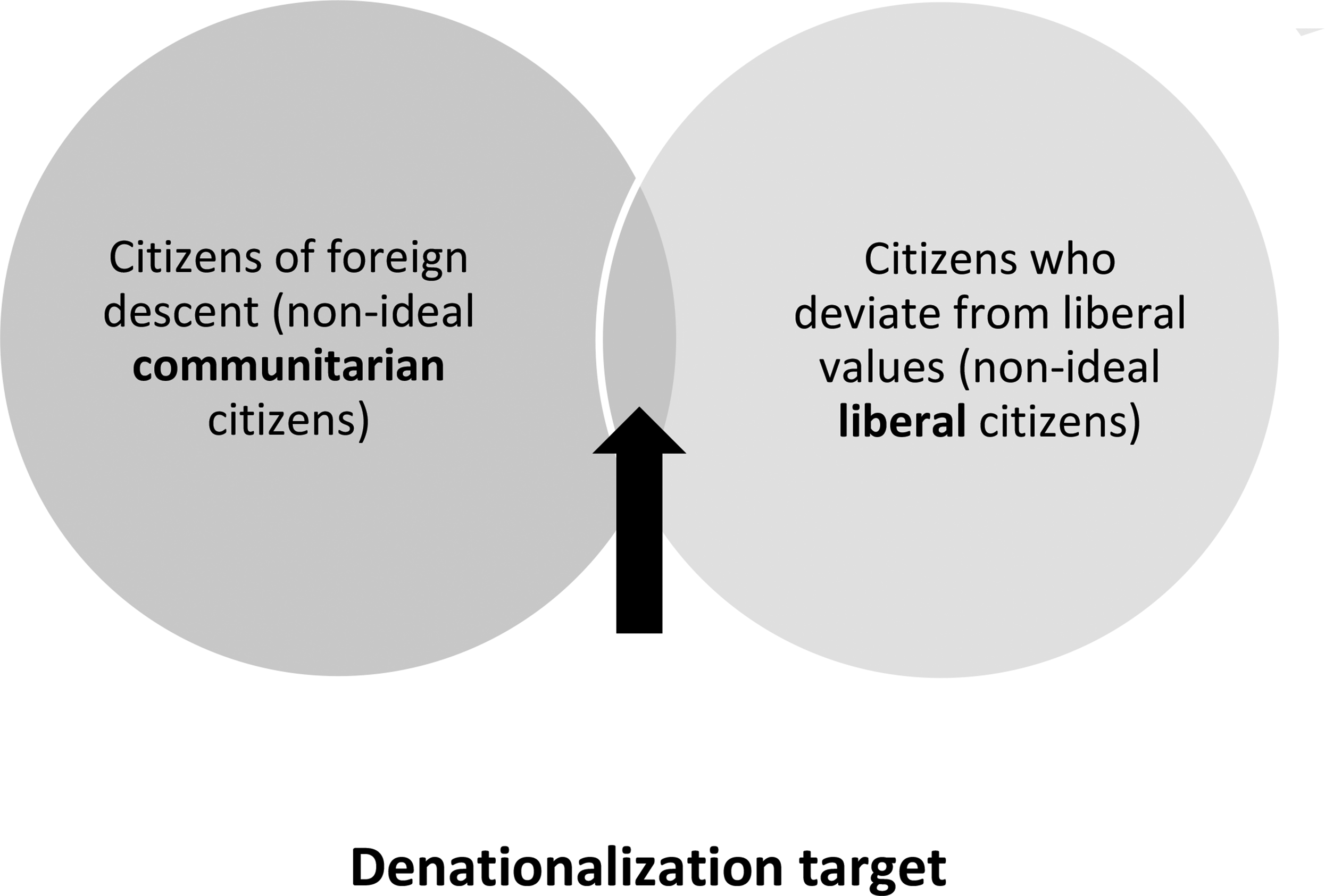
Denationalization target.
Footnotes
Declaration of Conflicting Interests
The author(s) declared no potential conflicts of interest with respect to the research, authorship, and/or publication of this article.
Funding
The author(s) received no financial support for the research, authorship and/or publication of this article.
