



Abstract
The aim of the current research was to examine the contribution of crime type and severity as well as offender, observer, and victim characteristics to prediction of perception of community correction (CC) as an appropriate punishment. We conducted a telephone survey among Israeli citizens. A random and representative sample of 573 respondents, aged 20 to 74, evaluated the seriousness of crime scenarios and the appropriateness of CC for each scenario. In different versions of crime scenarios, we manipulated offence type as well as offender and victim characteristics. The results of a logistic regression indicate that perceived lower crime severity, a crime that is not murder, older offender age, and being a secular observer are related with an increased likelihood of supporting community corrections. The discussion addresses these findings in the context of punitive goals (e.g., revenge, retribution), public perception of offender dangerousness, and social identity theory.
Introduction
Community correction (CC) refers to sanctions in which offenders serve all or a portion of their sentence in the community (Alarid, 2017: 4). It includes such imprisonment alternatives as residential programs (e.g., halfway houses, therapeutic communities), economic sanctions (e.g., restitution, fees and fines), and nonresidential or outpatient solutions (e.g., probation, parole, electronic monitoring; Alarid, 2017; Gelb, 2011; Shahbazov, 2019). CC plays a vital role in the criminal justice system as it represents an alternative to incarceration, promotes offender re-integration into the community, and contributes to recidivism reduction (Lowenkamp et al., 2010; Shoham et al., 2015). Public support is critical for initiation, fundraising, management, and overall success of community-based corrections programs (Gainey and Payne, 2003; Garland et al., 2017). However, research on public opinions regarding CC is still limited (Garland et al., 2017) and there are no studies on CC support in Israel. It is critical to research public attitudes toward CC and factors related to public CC support because public opinions tend to shape criminal justice policies and practices (Cullen et al., 2017; Roberts, 2018). This study investigates Israeli public attitudes toward CC through crime type and severity as well as offender, observer and victim characteristics.
Crime type and severity
Research on public attitudes indicates that people tend to express more negative attitudes toward offenders with a history of violent and sexual offenses compared with those with a history of non-violent crimes, misdemeanors, and no sexual offenses (Hardcastle et al., 2011; Perkins et al., 2009; Rogers et al., 2011). Accordingly, the support for CC sanctions tends to be stronger for non-violent offenders, such as property offenses and drunk drivers (Cullen et al., 2000; Shahbazov, 2019; Thielo et al., 2016). Similarly, the public is more supportive of electronic monitoring in cases of non-violent offenders. The public has little empathy for perpetrators of serious crimes and believes that prison should remain the only option for them (Shahbazov, 2019). Thus, in the case of sexual offences, which are considered highly severe crimes (Herzog, 2017), citizens tend to support incarceration over community-based sanctions (Dum, 2016; Harris and Socia, 2016; Kernsmith et al., 2009). Furthermore, citizens tend to adopt a “not in my backyard” approach and resist placing transitional housing facilities for sex offenders in their neighborhoods (Garland et al., 2017; Stojkovic and Farkas, 2014). Also, the support for electronic monitoring and residence retraction for sex offenders is usually more motivated by the ideas of supervision and public safety than by the idea of offender rehabilitation (Button et al., 2013; Payne et al., 2016). Based on the findings regarding crime type and severity, we hypothesize that: H1: There is a significant difference in perceived severity by support for CC: Cases in which the public supports CC are perceived as less severe than cases in which the public does not support CC. H2: There is a significant difference in support for CC by crime type: In property crimes and victimless crimes, the public supports CC more than in cases of rape, murder, and violence.
Offender characteristics
As for offender characteristics, public attitudes and punitiveness are associated with such factors as offender criminal record, age, addictions, race/ethnicity, gender, etc. Thus, the public supports electronic monitoring more in cases of first-time offenders and minors (e.g., Shahbazov, 2019). Also, citizens tend to support more the use of supervision, treatment, and community work for offenders who are suffering from mental illness and drug addiction (e.g., Gelb, 2011). The research on offender age mostly supports the notion that young offenders receive more lenient treatment (e.g., Gelb, 2011). Yet, there are also studies that indicate the relationship between offender age and punitiveness is curvilinear: punitiveness is relatively low regarding juvenile offenders, increases with receive harsher sentences regarding offenders between 20 and 30, and decreases for offenders older than 30 (Steffensmeier et al., 1995, 2017). As for gender and ethnicity, the research on attitudes toward offenders indicates that people express more positive attitudes toward female offenders (de Vogel and de Spa, 2019) and toward offenders belonging to an ethnic majority (Pager, 2003; Rozmann and Levy, 2019) than toward male and ethnic minority offenders. In addition to these variables, the current research also addressed offender occupational function and legal status. Offender occupational function is one of the most important factors in community reintegration and rehabilitation (Lockwood et al., 2017; Manikandan and Latha, 2017; Varghese et al., 2010), although the research on its effect on attitudes toward offenders and CC support is scant. According to Varghes et al.'s (2010) findings, offender job qualifications mitigated criminal history bias in cases of misdemeanor charges. As for offender legal status, Rozmann and Levy’s (2019) findings showed that attitudes toward offenders are affected by offender citizenship more than their ethnic minority/majority affiliation: the minority group offenders who were not Israeli citizens (Africans) were blamed significantly more than ethnic minority (Arabs) and majority group (Jewish) offenders who were Israeli citizens. Based on the findings on the impact of offender characteristics, we hypothesize that: H3: There are significant differences in public CC support by offender characteristics: The public supports CC more in cases of younger, ethnic-majority, female, employed, with citizenship, first-time offenders than in cases of older, ethnic-minority, male, unemployed, and without-citizenship and with criminal record offenders.
Observer and victim characteristics
Researchers have long recognized that observer (respondent) demographics predict attitudes towards offenders and their punishment (Bohm and Vogel, 2004; Boots et al., 2003; Rossi and Berk, 1997; Rozmann and Levy, 2019). However, there are hardly any studies that examine the relationship between observer demographics and perceptions of CC. Respondent characteristics that are associated with attitudes toward offenders include inter alia gender, race/ethnicity, religion, and education. Some studies found that women are more compassionate and express higher tendency to look for alternative solutions to crime problems than men (Whitehead and Blankenship, 2000). However, the majority of research indicated that, compared to men, women express less favorable attitudes toward offenders (Leverentz, 2011; Mancini et al., 2010; Willis et al., 2013). Regarding the impact of ethnic affiliation, it appears that respondents who are white or belong to an ethnic majority tend to be the more punitive than respondents who are non-white and belong to an ethnic minority (Hirschfield and Piquero, 2010; Leverentz, 2011; Mancini et al., 2010). As for religiosity impact, citizens who rate themselves as more religious tend to be more punitive than their secular counterparts (Yelderman and Miller, 2016, 2017; Yelderman et al., 2019). Also, respondents with an academic-level of education report less punitive views in comparison to those with high school level education (Shahbazov, 2019). Studies analyzing the effect of age yielded mixed results, with some concluding that younger people have more punitive views (Fortete and Cesano, 2009; Unnever and Cullen, 2005), while others reported that younger people support more lenient sanctions than the elderly (Bader et al., 2010; Fortete and Cesano, 2009). Therefore, we hypothesize that: H4: There is a significant association between CC support and observer characteristics: The observers who support CC tend to be male, more mature, belong to ethnic minority, secular, and more educated. Female, young, ethnic majority, religious and less educated observers are less supportive of CC. H4: There is a significant association between CC support and victim characteristics: The observers support CC in case of female, ethnic minority, foreign and young victims more frequently than in cases of male, ethnic majority, local and mature/older victims.
Current research
The current research aims to identify factors predicting public perception of CC as an appropriate punishment. This study is significant in several ways. First, the research on attitudes toward CC is limited, especially in Israel, and the current study intends to fill this gap. Secondly, we employ a factorial survey approach that combines controlled, randomized quasi-experimental designs with a representative sampling of a conventional survey (Herzog, 2003, 2017). This approach allows uncovering social and individual structures of human judgments about crimes and offenders. Due to the complexity of the research design in factorial surveys, the participants are usually not fully attentive to the manipulation of different elements of the vignettes. Therefore, their judgments tend to be less affected by social desirability bias (Wallander, 2009). Thirdly, the studies on public attitudes toward CC tend to focus on violent crimes, mostly on sexual offences (e.g., Button et al., 2013; Payne et al., 2016). In contrast, the current research addresses several types of offences and includes non-violent crimes (e.g., property crimes, bribery) in addition to different types of violent crimes (violence, murder, rape). Furthermore, the existing research on CC support usually explores a contribution of a specific factor such as observer knowledge on CC alternatives (e.g., Shahbazov, 2019), observer characteristics (e.g., Button et al., 2013; Payne et al., 2016; Thielo et al., 2016) or offender characteristics (Gelb, 2011). Such an approach lack sensitivity to the complexity of public opinions. As Levy and Ben-David (2008) suggested, crimes should be considered from a triadic point of view, which includes the offender, the observer and the victim. Therefore, we adopted an ecological framework (McLaren and Hawe, 2005) that addresses the triad and assumes that behaviors and attitudes are affected by the interaction between individual (respondent related variables) and contextual (situational) factors (Espelage and Swearer, 2010; Levy and Reuven, 2018; McLaren and Hawe, 2005). In this context, observer demographic characteristics and perceptions of crime severity represent individual factors, while the crime type and offender and victim characteristics represent contextual factors. We assume that the inclusion of multiple aspects within our model allows identifying the factors that contributes the most to CC support prediction. Such information can be helpful to practitioners: Law and policy makers responsible for promotion and implementation of CC alternatives.
Methods
Participants
This study included 573 respondents. Respondent age range was 20–74 [Mean = 43.56, S.D. = 14.16] and range of years of education was 8–20 [Mean = 15.13, S.D. = 2.79]. About half of the respondents were male (52.8%). The majority of the respondents were Jewish (75.5%), 17.6% Arab, and about 6.9% Druze. Approximately 9.6% of respondents defined the financial situation of their household as lower than average, 71.7% defined it as average, and about 18.7% defined it as higher than average. In terms of religiosity, 35.8% of the respondents defined themselves as secular, 33.1% as traditional and 31% as religious. As for political affiliation, the majority (46.2%) reported holding centrist political views, 35.2% rightist political views and 18.7% leftist political views.
Measurements
The research questionnaire included the following parts:
Crime Scenarios. To manipulate type of crime as well as offender and victim characteristics we created crime scenarios. Each scenario included information about the circumstances of the criminal act, details of the offense, and personal characteristics of the offender and the victim. The characteristics of offenders and victims included details about gender (man/woman), ethnic affiliation (Arab/Jew), age (25/50 years old), employment (full time job/unemployed), criminal record (existent/not stated), and status in the country (Israeli/foreign worker).
Crime Type. Based on the offences presented in the scenarios, we created six crime categories: 1) murder (murder of a spouse/murder of a business partner); 2) violence (violence between spouses/violence between businesses partners); 3) rape; 4) wrongful death; 5) property offences (burglary/theft/robbery); and 6) victimless offences (submission of a false report to the IRS/selling drugs/bribery).
Crime Severity. Respondents were asked to evaluate the severity of different criminal offenses presented by means of the aforementioned scenarios. The answers ranged from “1” (not at all severe) to “11” (the most severe).
Community Correction. Respondents were also asked to choose a preferable punishment for each criminal offense represented in the criminal scenarios by choosing one option from life imprisonment, a certain number of years in prison, and community correction. The answers were recoded into 1 = support for community correction; 0 = no support for community correction (support for imprisonment).
Respondent Demographic Characteristics. In the last section of the questionnaire, the respondents were asked about their age, education, gender, ethnicity, financial situation and religiosity.
Procedure
Scenarios Sampling. This study adopts the factorial approach (see Herzog, 2017). Based on this approach, the chosen scenarios represent a random sample of scenarios from the population of all possible scenarios, based on the combination of all values of all research variables (see Steiner et al.; Wallander, 2009). Thus, as a result of the random selection of values from the many factorial variables and the control of respondent personal characteristics (Rossi and Berk, 1997), we found unbiased estimations on the influence of each of the independent variables of the research on respondent judgments (Herzog, 2017).
Data Collection. All respondents were informed that the questionnaires were anonymous, that their content was confidential, and that their answers would serve only for research purposes. Each respondent addressed four scenarios and the interview lasted between 7 and 10 minutes. The language of the questionnaire was kept as simple as possible and efforts were invested to minimize potential biases. The research assistants administered the questionnaires by means of a telephone survey between August and November 2018, in every region of Israel. Preference was given to telephone survey due to its relatively short process of distribution and collection, affordability, and high response rates. Additional advantages of telephone questionnaires relate to low probability of surveyor biases, short and uncomplicated formulation of questions, high standardization of answers, researcher ability to make clarifications, and relatively easy access to large and diverse, and thus representative, samples (including illiterate respondents) of all the country's regions. The most recent Israeli telephone directories at the time of the study (2018), covering all geographical regions, provided the sampling framework. The application of a systematic random sampling method assured identical probability of inclusion of all households and persons listed (no other technique, such as interview schedule, was applied). Given that at least 90% of the Israeli population within the limits of the Green Line has one active telephone line at home or cellular phone (Central Bureau of Statistics, 2019, 2020), and that most telephone and cellular phone numbers appear in Israeli telephone directories, it may be assumed that this sampling frame was appropriate for the purposes of this research. The response rate of this study was 70%. It was calculated on the basis of valid household numbers, excluding businesses, fax connections, etc. To boost response rates, respondents who could not initially be reached were contacted again. A household was replaced after three unsuccessful attempts.
Generally, the sample's sociodemographic characteristics are similar to the official distribution of these variables in the Israeli population in the year when the survey was conducted (see Central Bureau of Statistics, 2019, 2020). Since the sample was representative of the adult Israeli population, it may be assumed that no important groups were under-represented in it. In addition, the questionnaire was pre-tested with a small number of respondents, in order to both obtain an initial test of measure reliability and test any unexpected response patterns (none were found).
Data Analysis. All analyses were carried out using SPSS Version 25. To assess CC support and the association between CC support and crime type, and offender, victim and observer characteristics we used t tests, ANOVA, Pearson correlation and Chi-square analysis. Logistic regression was used to assess the integrative model.
Results
Crime type, crime seriousness and support for CC
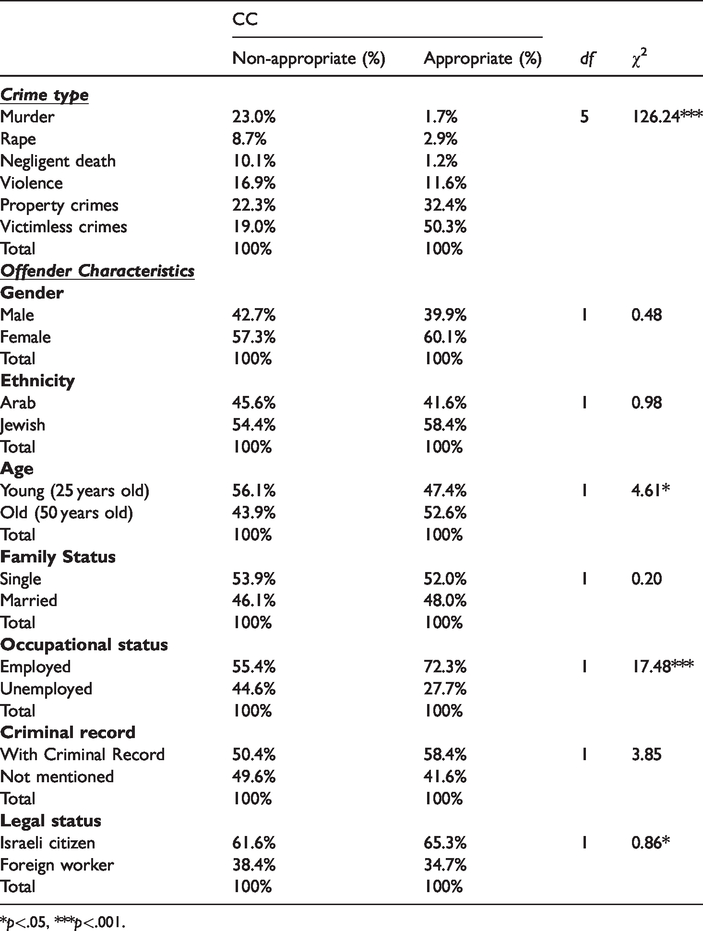
The results of one-way Anova indicate that there is a significant difference in perception of crime severity between different types of offences [F(51,322)= 92.72, ή2=.26, p=.00]. The participants perceived murder scenarios as the most severe crimes [Mean = 9.80, S.E. = .11]. In the second place were rape scenarios [Mean = 9.52, S.E. = .18], in the third place scenarios of negligent death [Mean = 8.85, S.E. = .17], in the fourth place violent offences [Mean = 7.57, S.E. = .13], and in the fifth place property crimes [Mean = 7.41, S.E. = .11], while the scenarios of victimless crimes were perceived as the least severe [Mean = 7.01, S.E. = .11]. A Scheffe test indicated that all but two pairwise comparisons were significant. There was no significant difference in perceived severity between cases of murder and rape, and also there was no significant difference between cases of violence and property crimes. Regarding the support for CC, it appears that respondents chose CC as appropriate punishment only in 13% of cases. Also, chi-square analysis (Table 1) shows that there is a significant association between respondent support for CC and crime type. Half of the scenarios in which participants supported CC addressed victimless crime and close to a third described property crimes. The lowest frequency of support for CC was in cases of rape and murder. A T-test indicated that there was a significant difference in perceived seriousness by support for CC [t (313.61) = 25.22, p < .001]. Crimes for which respondents suggested CC were perceived as significantly less severe [Mean = 5.60, S.D. = 1.30] than crimes in which respondents did not suggest CC [Mean = 8.5, S.D. = 2.02].
Associations between the perception of CC as appropriate punishment and crime type and offender characteristics.
*p<.05, ***p<.001.
Offender characteristics
The results of the chi-square analysis (Table 1) show that there is a significant association between respondent support for CC and offender age, occupational status and legal status. Respondents tended to support CC significantly more frequently in scenarios with older offenders (50 years old) than in scenarios with younger offenders (25 years old). Among those cases in which respondents choose CC, the scenarios with older offenders were far more frequent than the scenarios with younger offenders. Regarding offender occupational status, the respondents considered CC as more appropriate in case of offenders who were employed than in case of unemployed offenders. Thus, among those cases in which respondents considered CC as an appropriate punishment, the scenarios that included employed offenders were the majority (81%). Among the cases in which respondents did not consider CC as an appropriate punishment, the difference in frequency of scenarios with employed and unemployed offenders was only 7.4% (in favor of employed offenders). As for offender legal status, the respondents supported CC more frequently in the case of an Israeli offender than in the case of an offender described as an illegal alien. Within the scenario sample, only 37% of the scenarios described offenders who were illegal aliens, with the rest (63%) describing offenders as Israeli. In the scenarios in which the respondents did not choose CC, the distribution between the scenarios with Israeli and non-Israeli offenders was very close to the general distribution of cases in this research (62% and 38%, accordingly). In scenarios in which respondents considered CC an appropriate punishment, there was an overrepresentation of scenarios with Israeli offenders, since the prevalence of scenarios with Israeli offenders is 10% higher than its frequency in the sample. There was no statistically significant association between support for CC and offender characteristics such as gender, ethnicity, family status and criminal record (Table 1).
Victim and respondent characteristics
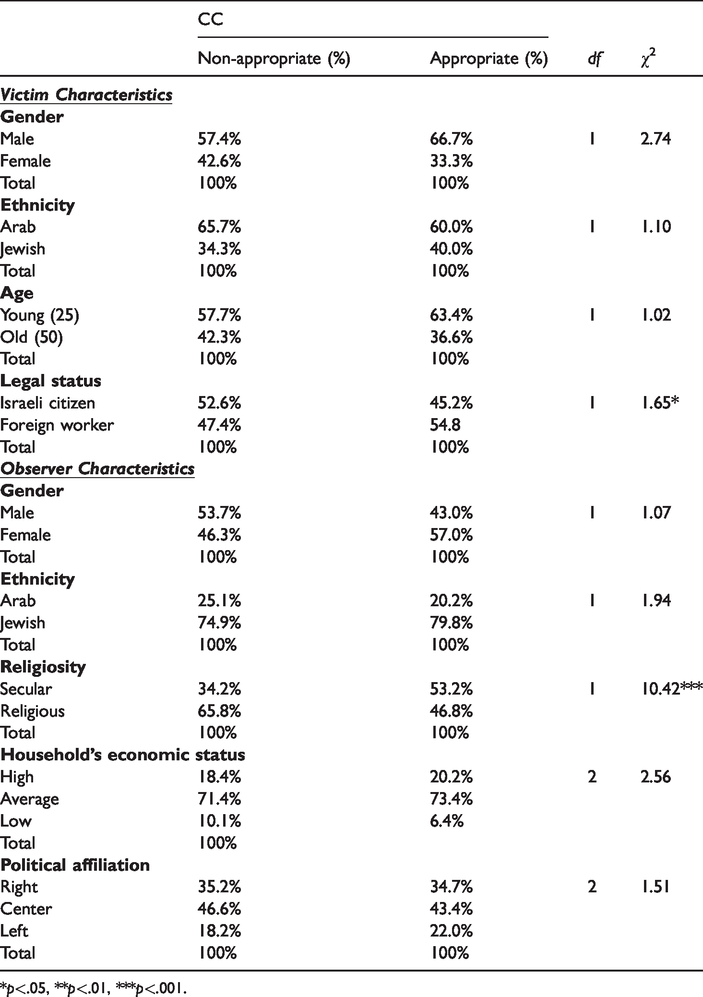
There was no statistically significant association between victim characteristics and support for CC (Table 2). As for observer characteristics, religiosity was the only variable that was significantly associated with the support for CC. Among the respondents who choose CC as an appropriate punishment, the majority were secular, while among the respondents who did not choose CC the majority were religious. The association between CC support and observer gender, ethnicity, economic status and political affiliation was statistically insignificant (Table 2). Also, there were no significant differences in observer age [t(1326) = −1.97, p = .05] and education [t(235.46) = 0.94, p = .35] by CC support.
Association between perception of CC’s appropriateness and victim/observer characteristics.
*p<.05, **p<.01, ***p<.001.
The integrative model
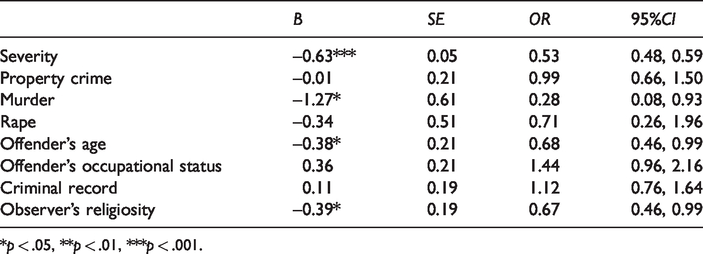
First, we conducted bivariate analyses, which showed, similar to Chi-square analyses, that several characteristics of both the offender and the observer were found significant regarding the appropriateness of community corrections (1-appropriate, 0-inappropriate). These were: perceived severity of the offense (p < .001), property crime (1-yes, 0-no, p = .003), murder (1-yes, 0-no, p < .001), rape (1-yes, 0-no, p = .009), offender’s age (1-young, 0-older, p = .032), offender's occupational status (1-employed, 0-unemployed, p < .001), criminal record (1-yes, 0-no, p = .049), and observer’s religiosity (1-not secular, 0-secular, p = .001). Then, the multivariate model was examined with a logistic regression of the appropriateness of community corrections with the predictors mentioned above (Table 3). The model was found significant (χ2(8) = 289.07, p < .001), with 36% of the variance in CC being explained in it (Nagelkerke’s R2). Results show that perceived lower crime severity, a crime that is not murder, an older offender’s age, and being a secular observer are related with an increased likelihood of supporting community corrections.
Logistic regression for CC’s appropriateness and offender/observer characteristics (N = 1328).
*p < .05, **p < .01, ***p < .001.
Discussion
The primary purpose of this study was to investigate the relationship between the support for community correction, type of crime, and characteristics of all the central actors in a criminal scenario: offenders, victims, and observers (Levy and Ben-David, 2008, 2015). This study's main findings indicate that CC support is associated with individual and contextual factors, including crime type, offender characteristics, and respondent perceptions and characteristics. Generally, the respondents did not consider CC as appropriate punishment in the majority of criminal cases in this study. Considering the negative relationship between vengeance attitudes and attitudes toward rehabilitation as well as the positive relationship between vengeance attitudes and support for retribution and incapacitation sentencing goals (McKee and Feather, 2008), the low rates of CC support suggest that revenge and retribution motivate Israeli public attitudes toward offender punishment. Future studies should explore the relationship between factors associated with Israeli public support for CC and sentencing goals and revenge attitudes.
Contextual factors
One of this study's central findings refers to CC support and crime type. This study's findings correspond with the notion that CC support is lower in violent crimes (e.g., Hardcastle et al., 2011; Rogers et al., 2011). As we hypothesized, the majority of respondents chose CC as an appropriate punishment in victimless and property crimes. Only a few considered CC as appropriate punishment in cases of murder, rape, negligent death, and violence. This pattern is consistent with just-desert logic, which advocates that punishment should fit the crime (Bergeron and Mckelvie, 2004; Tonry, 2018). Also, it is possible that the Israeli public considers criminals who commit murders as more dangerous and at higher risk of reoffending, and, therefore, prefer that these criminals will be sentenced to jail instead of community correction. Further research is needed to understand the meanings informing the Israeli public's focus on crime type.
Another intriguing set of findings points to the associations between offender characteristics and CC support. The data only partially supported our hypothesis and indicated that the respondents supported CC more frequently in scenarios in which the offender was older, employed, and an Israeli citizen. The preference of CC in cases of older offenders does not align with previous findings that the public's attitudes toward young offenders are more positive and rehabilitation-oriented than toward adult offenders (e.g., Gelb, 2011). However, the research on attitudes toward young offenders usually focuses on juvenile/adolescent offenders, while this study compares 25 year old (young adult) and 50 year old offenders. Thus, our findings on CC support and offender age correspond with the curvilinear relationship pattern (Steffensmeier et al., 1995, 2017). These findings may suggest that similar to previous findings on judges' sentencing practices (Steffensmeier et al., 2017), the Israeli public considers older offenders as less dangerous and less risky for correction within the community than young adult offenders (i.e., ages 20–29).
Additional findings on the impact of offender characteristics refer to occupational and legal status. The research on post-incarceration release indicates that offender occupational function and employment are essential to community reintegration, promote rehabilitation (Varghese et al., 2010) and decrease recidivism (Lockwood et al., 2017; Manikandan and Latha, 2017). Similarly, and according to our hypothesis, our findings indicate that the general public acknowledges the significance of employment in community correction. The respondents chose CC as an appropriate punishment more frequently in cases of employed offenders. As for offender legal status, the results support our hypothesis and are similar to Rozmann and Levy’s (2019) findings that Israeli offenders were blamed less than offenders who were not Israeli citizens. The respondents in the current research chose CC more frequently in scenarios with Israeli offenders than in scenarios with foreigner offenders. The social identity theory (Tajfel, 1982) may account for this pattern. According to social identity theory (Tajfel, 1982), ethnic and cultural similarity between an observer and an offender affects verdicts and blame attribution. Thus, respondents may perceive the in-group offender (Israelis in our case) as more favorably than the out-group offender (foreign workers). Also, since in recent years, most foreign workers in Israel are sub-Saharan Africans, the description of an offender as a foreign worker might have triggered general racial bias manifesting as the perception of Black offenders as more culpable, violent and dangerous (Hall et al., 2016). Once again, it seems that the higher frequency of CC selection as appropriate punishment in scenarios with employed and Israeli citizen offenders is related to respondent perceptions regarding which type of offender poses a lower risk to the community.
Intriguingly, offender characteristics such as ethnicity, gender, and criminal record were not associated with the selection of CC as appropriate punishment. These results disagree with our hypothesis and some of the previous research (de Vogel and de Spa, 2019; Hardcastle et al., 2011; Rozmann and Levy, 2019). Furthermore, in contrast to our assumptions and the literature review, none of the victim characteristics (e.g., gender, age, ethnicity, legal status) were associated with CC selection as appropriate punishment. This discrepancy between previous research and this study's results may be related to the fact that the latter focused on the prediction of CC support while the former addressed attitudes toward offenders and support for severe punishments (Hirschfield and Piquero, 2010; Mancini et al., 2010). Another possible factor that may account for these results is the complexity of this study's criminal scenarios. Perhaps within the complex context of crime type and multiple offender and victim characteristics, the respondents considered only those variables that they perceived as the most significant in considering whether CC is an appropriate punishment whereas other variable effects were eclipsed. This assumption is further supported by the logistic regression results, which indicated that within the integrative model even offender employment and legal status contribution to the prediction of CC selection was statistically insignificant. Thus, the only two contextual variables that contributed to the prediction of CC selection were crime type and offender age. Even so, respondent disregard of victim characteristics corresponds with the secondary role victims play in the legal system, in general (Ben-David, 2000), and the Israeli legal system, in particular. Similar to the limited involvement and impact on decisions of victims regarding offender punishment within the legal system, it appears that the respondents did not consider victim characteristics when deciding whether CC is appropriate punishment.
Individual factors
The individual factors within our model refer to the perception of crime severity and observer characteristics. Similar to previous research findings (Dum, 2016; Harris and Socia, 2016; Shahbazov, 2019), and in accordance with our hypothesis, this study suggests that selection of CC as appropriate punishment is significantly associated with perceived crime severity. The crimes in which respondents chose CC were perceived as significantly less severe than the crimes in which CC was not considered as appropriate punishment. One possible explanation for this pattern is the tendency mentioned above to use harsher punishments as revenge for more severe crimes.
As for observer characteristics, our hypothesis was only partially supported: The only variable that contributed to the prediction of CC support was observer religiosity. As previous studies suggested (e.g., Yelderman and Miller, 2016, 2017; Yelderman et al., 2019), our finding indicates that secular respondents were less punitive and chose CC as appropriate punishment more frequently than religious respondents. The contribution of religiosity is even more distinctive in light of the non-significant association between CC support and observer gender, age, education, ethnicity, economic status, and political affiliation. The saliency of religiosity in comparison to other observer characteristics may stem from the relationship between religiosity and values that may account for attitudes toward offenders. For example, there is evidence that religiosity is positively associated with values such as the need to preserve social order and uncertainty avoidance beyond such factors as age, gender, education, and income (Pepper et al., 2010; Schwartz and Huismans, 1995). Considering that in some cases, higher uncertainty avoidance is related to more negative attitudes toward offenders (Levy and Kerschke-Risch, 2020), perhaps the search of religious respondents for certainty and order manifests itself in their tendency to prefer incarceration, which poses a lesser risk to community safety. Future studies should explore the relationship between religiosity, values, and attitudes toward community correction.
Limitation and future studies
Although this research has yielded interesting results regarding public attitudes on CC, some limitations should be noted. First, our sample represents the Israeli general public. Although members of the general public can be anyone, and may even work within the criminal justice system, average respondent attitudes regarding CC may differ from those of judicial practitioners, whose opinions may be affected by their training and experience. Therefore, building on our findings, the next step in this line of research could be to explore how crime type and offender, victim, and bystander characteristics predict CC support among judicial practitioners. Also, future studies should consider additional victim-related variables such as consequences of victimization and geographic proximity between victim and offender. Finally, this study was conducted in and its results, therefore, are more significant for Israel. Although the findings of studies conducted in Israel are consistent with those found in the literature (Herzog, 2017), perceptions of crimes may change based on cultural context (Levy and Adam, 2018). Future studies should examine this study's model within different cultural domains.
Conclusions
This study expands the knowledge on attitudes toward community correction and identifies the salient factors in public support for CC. Our findings suggest that the combination of such factors as crime type, offender age, crime severity, and observer religiosity is useful in predicting Israeli public support for CC. Furthermore, our result patterns imply that the support for CC is related to respondent focus on offender dangerousness and risk. It appears that respondent choice regarding appropriate punishment was guided by their need to feel safe along with a defensive desire to prevent the most dangerous offenders (in their perception) from blending into the community.
From the theoretical point of view, this study's results provide evidence supporting the ecological framework (Levy and Reuven, 2018; McLaren and Hawe, 2005) assumption that attitudes stem from the interaction between contextual and individual variables. Also, by addressing the crime scene as a triad between offender, victim, and bystander (Levy and Ben-David, 2008), this study facilitates the identification of more complex patterns in public decision-making. Thus, according to our findings, in choosing between CC and incarceration, the public tends to overlook victim characteristics. Future studies should employ this framework to explore whether this pattern repeats itself in other aspects of punitiveness and attitudes toward offenders.
On the practical level, these results are relevant not just in the context of general public attitudes toward CC, but also among professionals working within the criminal justice system. Training programs should address practitioner awareness of the possibility that their perceptions on crime severity and characteristics (e.g., religiosity) may affect their selection of appropriate punishment, specifically their support for CC. Finally, this study underlines the limited role of victims in decisions related to offender punishment. Since victims are the direct casualties of criminal offences, we suggest that policymakers should consider expanding and strengthening the victim's role in the criminal justice system.
Supplemental Material
sj-pdf-1-pun-10.1177_1462474521989805 - Supplemental material for Predicting support for community corrections: Crime type and severity, and offender, observer, and victim characteristics
Supplemental material, sj-pdf-1-pun-10.1177_1462474521989805 for Predicting support for community corrections: Crime type and severity, and offender, observer, and victim characteristics by Inna Levy, Keren Cohen-Louck and Sergio Herzog in Punishment & Society
Footnotes

Supplemental material
Supplemental material for this article is available online.
References
Supplementary Material
Please find the following supplemental material available below.
For Open Access articles published under a Creative Commons License, all supplemental material carries the same license as the article it is associated with.
For non-Open Access articles published, all supplemental material carries a non-exclusive license, and permission requests for re-use of supplemental material or any part of supplemental material shall be sent directly to the copyright owner as specified in the copyright notice associated with the article.
