




Abstract
Community Protection Notices (CPNs) are civil preventive orders used in England and Wales to prevent and/or require specific behaviour by an individual or organisation, where existing conduct has a ‘detrimental impact on the quality of life of those in the locality’. Breach of the notice results in a £100 fine under a Fixed Penalty Notice or a possible criminal conviction. To date, CPNs have tackled an array of perceived anti-social behaviours, ranging from rough sleeping to overgrown gardens. Using Ashworth and Zedner’s preventive justice as an analytical framework, our research qualitatively explores recipients’ experiences of this new tool for the first time. The findings highlight how the operationalisation of CPNs extends the coercive power of the state, with a range of negative consequences relating to the concepts of disproportionality, due process and accountability. We also offer three empirically-grounded recommendations for reforming CPN practices.
Introduction
A Community Protection Notice (CPN) is a civil behavioural notice that imposes requirements on an individual aged over 16, or an organisation, to undertake or cease specific actions or behaviours. According to Part 4 of the Anti-Social Behaviour, Crime and Policing Act (2014), any behaviour can be sanctioned by a CPN if ‘the conduct of the individual or body is having a detrimental effect, of a persistent or continuing nature, on the quality of life of those in the locality, and the conduct is unreasonable’ (Section 43 (1)). The main differences between a CPN and previous anti-social behaviour (ASB) powers are that the grounds for a CPN are vaguer and more subjective than the legal ASB definition, with a significantly lower standard of proof and can be issued without having to go to court. The limited information currently available about CPNs highlights an increasing, but widely divergent use. An investigation by Mills and Ford (2018) suggests demographic profiles of recipients are infrequently recorded by local councils and police services, offering little oversight of the discretionary use of this power. We also know from our own research that the Home Office does not monitor the use of any of the powers introduced through the Anti-Social Behaviour, Crime and Policing Act, so there is no accountability or top-down monitoring taking place (Heap and Dickinson, 2018).
To date, no empirical research has been conducted to examine how CPNs are being experienced by recipients or used by practitioners. This paper begins to address this gap in understanding by reporting the first, and to date only, research into the experiences of CPN recipients. The aim was to investigate why, and most importantly how, individuals come to receive a CPN. In particular, we were keen to understand recipients’ perceptions of the behaviours sanctioned and their context, recipients’ knowledge and experience of the issuing process and to assess if, and in what ways, CPNs are being resisted or challenged.
Community Protection Notices
In England and Wales, ASB is legally defined as ‘conduct that has caused, or is likely to cause, harassment, alarm or distress to any person’ (Anti-Social Behaviour, Crime and Policing Act 2014, Section 2 (1a)). The Crime Survey for England and Wales indicates that ASB is a pervasive problem, with 39.6% of citizens experiencing or witnessing ASB and police recording 1.5 million ASB incidents in 2019 (Office for National Statistics, 2020, 2019). Powers to tackle ASB were first introduced by the New Labour government through the Crime and Disorder Act (1998) as a means of addressing perceived inefficiencies with the criminal justice system (Burney, 2005). This was followed by a tranche of legislative measures including the Police Reform Act (2002) and Anti-Social Behaviour Act (2003), which were designed to provide a holistic, community-based approach to nuisance behaviour. In 2014, the Home Office introduced the Anti-Social Behaviour, Crime and Policing Act with a view to enhancing responses to ASB victimisation by ‘streamlining’ existing powers. A key element of the new legislation was the introduction of the CPN, which replaced previous environmental sanctions including Litter Abatement Notices, Litter Clearing Notices, Street Litter Clearing Notices, and Defacement Removal Notices. The rationale for creating the CPN was to facilitate enforcement action against individuals who cause ‘ongoing problems or nuisances which are having a detrimental effect on the community’s quality of life’ (Home Office, 2019: 39). Traditionally, these behaviours were dealt with solely by local councils, but the power to issue CPNs was extended to any authorised person including the police, local council and registered social landlords to acknowledge their roles in tackling ASB.
Procedurally, prior to being issued, the individual/organisation must receive a written Community Protection Warning (CPW), that outlines the nature of the problem, requests the behaviour to stop and details the consequences of inaction. The CPW should specify the timeframe within which the behaviour is expected to change, giving an indication of when a CPN might be issued. How the warning is discharged and the time given to resolve the problem is left to the discretion of each authorising body. Breaching a CPN is a criminal offence punishable by a £100 fixed penalty notice, or a fine of up to £2500 on conviction (£20,000 for organisations). Punishment for a breach can also include paying for remedial work, forfeiture, or seizure of items. The prosecuting authority can impose a remedial or forfeiture order; non-compliance constitutes contempt of court and could result in a custodial sentence of up to five years. Recipients can appeal a CPN within 21 days of issue on a range of grounds. For example: if they assert that the behaviour did not take place, the behaviour was not unreasonable, or that any of the requirements are unreasonable. However, unlike previous ASB sanctions there is no provision in the ASB, Crime and Policing Act (2014) for a CPN to be varied or discharged, although case law indicates that authorising bodies should have a review and adjudication system for this process (Stannard v CPS [2019] EWHC 84 (Admin)). Consequently, if the opportunity to appeal is not taken at the outset, the CPN could stand indefinitely. Furthermore, CPNs do not feature in Schedule 1 of the Legal Aid, Sentencing and Punishment of Offenders Act (2012) and thus the Legal Aid Agency does not grant funding to appeal a CPN. There is no clear legal basis to appeal or challenge a CPW.
The research presented here uses qualitative data to explore participants’ lived experience of the CPW/CPN process. The concept of preventive justice as defined by Ashworth and Zedner (2014) will be used as a theoretical lens through which to explore CPWs/CPNs in relation to concepts of proportionality, due process, and accountability. Through understanding recipients’ experiences, the implications for policy reform will be considered. This feeds into three empirically-grounded recommendations we offer for adjusting front-line practice to enhance the legitimacy of the CPW/CPN process.
Anti-social behaviour and preventive justice
Ashworth and Zedner (2014: 1) conceptualised the term preventive justice to assess ‘the principles and values that should guide and limit the state’s use of preventive techniques that involve coercion’. The tensions raised within ‘preventive justice’ emerges from the state's power to utilise tools intended to protect communities from potential harms, whilst also respecting the autonomy of those individuals who may be subject to such tools. Tipping the balance in favour of prevention over protecting individual rights, this contemporary ‘preventive turn’ raises challenges to the legitimacy and the justification of the justice system (Carvalho, 2017). This issue is even more pertinent for ASB where the behaviours to be limited by preventive measures are themselves subjective and contingent upon the perceptions of others (Millie, 2008).
Ashworth and Zedner establish a taxonomy of criminal offence categories whose rationale are primarily preventive in that they ‘criminalize acts falling short of causing the actual harm' (p.95). These include for example crimes of membership to a proscribed organisation and crimes of abstract endangerment where activities are criminalised if they create an unacceptable risk of harm, even if that harm never occurs, such as speeding. Ashworth and Zedner recognize the state's duty to prevent a level of harm to citizens, but reason that if risks are to be criminalised, rather than regulated, then there should be some restraining principles that ought to apply. They also highlight an additional category in the taxonomy which includes the offences of ‘doing anything that the person has been prohibited from doing by a civil preventive order' (p.102). Here they use the Anti-Social Behaviour Order (ASBO) as an example. Considered as a ‘punitive zeitgeist for the period’ (Brown, 2019: 2), ASBOs were a civil order handed down by the Magistrates’ Court to a person over the age of 10 and could contain an unlimited number of conditions to prevent ASB. Breaching the order was a criminal offence, which could attract a custodial sentence of up to five years. Between 1999 and 2013, 24,427 ASBOs were issued by the courts (Home Office, 2016), a figure already surpassed by CPWs and CPNs in a significantly shorter period of time (Manifesto Club, 2016, 2017, 2019). ASBOs faced considerable academic scrutiny and extensive criticism, with empirical inquiry exploring a range of issues including: breaches of human rights related to the civil standard of proof (Ashworth et al., 1998; Pearson, 2006), disproportionate enforcement action against young people (Squires and Stephen, 2005), and inappropriate conditions (Fletcher, 2005). That said, Matthews et al. (2007) examined the use and impact of ASBOs, finding them effective at providing some respite to victims, with perpetrators reporting a reduction in their offending behaviour.
Ashworth and Zedner (2014) raised a series of objections against the use of the ASBO. Fundamentally they highlighted the breadth of the concepts of harassment, alarm or distress. They also noted high levels of court discretion and scope for the prohibitions imposed to be disproportionate to the behaviour in question. The ASBO is the most similar predecessor to the CPN, which is part of a new generation of preventive orders introduced to tackle ASB by the Anti-Social Behaviour, Crime and Policing Act (2014). The CPN is considered in this article as a form of preventive justice in line with Ashworth and Zedner's taxonomy of civil offences. However, we argue that the conditions that are subject to objection in relation to the ASBO are extended further with the CPN and thus require greater consideration of the necessary restraining principles. Recipients’ experiences of CPNs highlight the tensions that this tool creates, particularly around proportionality of use, due process and the ability to hold this power to account.
The concept of proportionality as a constraint on criminal punishment is well established (Steiker, 2013). Preventive orders, however, are intended to shape future behaviour, rather than account for past conduct (Crawford, 2009). The imposition of a preventive order on an individual is demonstrative of that individual’s ‘failure to reassure’ others that they are safe from future harm (Ramsay, 2012). In this context, preventive proportionality must then ‘focus on the degree of harm sought to be averted and the likelihood that the harm would occur in the absence of prevention’ (Steiker, 2013: 196). The discretionary nature of CPNs allows officers to insert requirements that prohibit the recipient from engaging in behaviour likely to cause any harassment, alarm or distress to the community. Therefore, the order may disproportionately punish behaviour beyond the scope of the initial act. Furthermore, as CPNs can be open-ended in timescale, their design affords the opportunity for excessively lengthy punishment to occur beyond the risk of harm.
Preventive orders have been criticised for their disregard of due process as a result of their ‘two-step’ approach; where a civil order becomes criminalised upon breach. For Crawford (2009: 818) the blurring of civil and criminal processes seen within ASB powers is evidence of ‘evading higher standards of proof and evidentiary burdens associated with the criminal justice process’. Whereas the subjective nature of the powers ‘necessitates rigour and standardisation’ in their application (Donoghue, 2010: 151). Under the civil standard of proof, the legal tests for issuing a CPN set out in the Anti-Social Behaviour, Crime and Policing Act (2014) are: having a detrimental effect on the community’s quality of life, being of a persistent or continuing nature, and being unreasonable. However, as CPNs are not issued by a court they bypass the usual procedural safeguards that a suspect would expect. This out of court process is problematic when considering the perceived legitimacy of CPNs, given the evidence that suggests ‘people’s general commitment to obeying the law is heightened when they experience fair procedures in legal settings’ (Tyler, 2007: 28). The growing literature on procedural justice demonstrates that the way in which interventions are delivered may actually have a greater impact on compliance behaviour than the interventions themselves (Crawford et al., 2017). The range of actors that can exercise their discretion and subjective interpretation of the legal tests when deciding whether to issue a CPN means that there could be a wide variation in the manner in which these coercive powers could be deployed. Consequently, the opportunity for procedures to be seen as unjust increases.
Preventive orders focus on restraining possible conduct in order to avoid future harms to the wider community. This ‘what if’ logic circumvents the principle of the presumption of innocence and instead works on the ‘likelihood’ of future guilt (Crawford, 2009). As Ramsay (2009) has argued, an individual’s ‘failure to reassure’ is ‘a legal burden akin to a presumption of guilt. It reverses the onus of proof in respect not of accusations about the past, but of fears about the future’ (Ramsay, 2009: 120). The first stage in the process of a CPN is a CPW that stipulates which behaviours must or must not continue. If a recipient abides by the stipulations, then no further action takes place. They are comparable to the regulatory tools described by Crawford (2009: 816) whereby individuals are offered a ‘choice’ to ‘comply or else’. A breach of a CPW can lead to a CPN. However, there is no formal process for appealing a CPW and thus no prescribed way for having it removed, regardless of the perception of the recipient around suggested wrongdoing, guilt or innocence. The CPW operates as a ‘cordon sanitaire’ (emphasis in original), a buffer zone placed around an individual to constrain their activities and movements in order to avoid harm to others (Ashworth and Zedner, 2014: 91). Recipients of a full CPN can appeal within 21 days of issue; however as mentioned previously, these appeals are not supported by legal aid and thus reduce equality of access. For Ashworth and Zedner (2014: 86), civil preventive orders such as ASBOs allow courts the authority to create individual prohibitions or ‘a personal criminal law’ which ‘fails - certainly in practice - to afford the defendant sufficient opportunity to contest the restrictions on liberty that the court intends to impose’ (p.87). In the context of the CPN, this delegation of power extends beyond courts to those practitioners issuing orders on the frontline.
The challenges raised above in relation to CPNs highlight the requirement to explore and understand how these tools are being used in practice and the impact that they are having on the recipients. This article offers a novel contribution to the field by documenting the first academic investigation into recipients’ experiences using the qualitative method of in-depth interviews.
Methodology
The qualitative research strategy was employed to assess how recipients experienced the CPW/CPN issuing process and beyond. Data were collected through fifteen semi-structured telephone interviews with CPW/CPN recipients, with conversations lasting approximately one hour. Telephone interviews were favoured because they offered the flexibility to recruit participants from across England in a cost-efficient manner. Research has shown that telephone interviews can encourage the disclosure of information to the interviewer and do not compromise data quality (Novick, 2008). In addition, seven participants provided copies of the CPW/CPN documents they were issued, which provided an insight into the types of requirements set in relation to the nature of the complaint(s). Participants were recruited using two variations of non-probability sampling. First, purposive sampling was used through the research team’s collaboration with Manifesto Club, an organisation that challenges the hyper-regulation of public spaces, who contacted known recipients on our behalf to invite them to participate. Second, convenience sampling was utilised by searching social media for CPW/CPN recipients, as well as contacting national and local newspapers that had published stories about these cases. The similar experiences across the sample were sufficient to generate a range of cross-cutting themes to address the research questions and provide conceptual density (Nelson, 2016). A limitation of this work is that it only details the experiences of a relatively small number of recipients and not those of issuing officers. Nevertheless, the aim of this study is to present the perspectives of those subject to CPWs/CPNs and to highlight some of the concerns arising from their reported experiences, which has been used to inform research into practitioners’ issuing processes that is currently being undertaken by the authors.
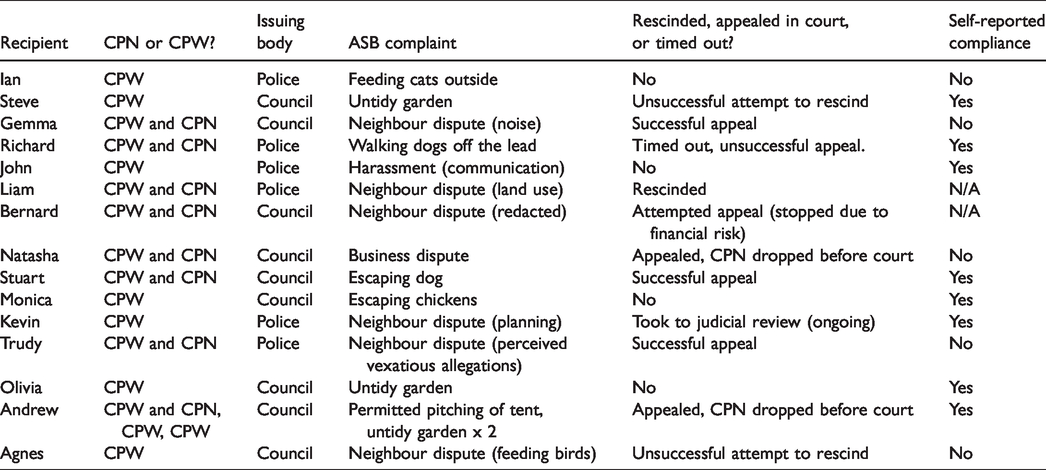
Of the sample, 9 were male and 6 female. The mean average age was 53.6 years, with an age range between 24 and 70 years. All participants were based in England, across a variety of regions; 4 from the East Midlands, 4 from the South East, 3 from the South West, and 1 from London. The sample was predominantly White (14), with the remainder of Mixed ethnicity (1). Two participants did not provide age, ethnicity or location information. In relation to the CPWs/CPNs, 8 participants had received a CPW and 7 a CPW and CPN, of that 7, one person had received a CPW followed by a CPN, then two separate CPWs for different issues. Nine participants were issued their notices by local councils and 6 by the police. A total of 6 CPWS/CPNs were eventually either rescinded or successfully appealed. A summary of the cases, which includes details about the ASB, issuing body and whether the notice was appealed can be found in Table 1.
Details of recipients’ CPW/CPN cases.
The interviews were transcribed and thematically analysed using Braun and Clarke’s (2006) six-phase process which entails: familiarising yourself with the data; generating initial codes; searching for themes; reviewing themes; defining and naming themes; and producing the report. This approach provided a theoretically flexible means of systematically searching ‘across’ the dataset to locate repeated patterns, suitable for an unexplored phenomenon. Ethical approval was granted by the authors’ institution and adheres to the British Society of Criminology Statement of Ethics (2015). Participants’ privacy, anonymity and confidentiality were upheld, and the names presented in this paper are pseudonyms.
Findings
Proportionality: Cases and requirements
Analysis of the original CPW/CPN documents highlights the issue of proportionality. The CPWs and CPNs in our sample had been employed to sanction a wide range of behaviours (see Table 1). This variety demonstrates how Home Office guidance (2019: 38), which states that the purpose of a CPN is to address ‘anti-social behaviour which spoils the community’s quality of life’, has been embraced flexibly by practitioners and moves significantly beyond the environmental measures CPNs were designed to replace. In addition, the requirements stipulated in the CPW/CPN documents analysed for this study were either ‘ongoing' or did not specify an end date for the notice. This open-ended requirement raises the question of duration which, when related to preventive orders, implies the continued dangerousness or riskiness of the individual which cannot be overcome even where immediate changes are made (Steiker, 2013).
Disproportionality could also be seen in the wide range of prohibitions on participants' behaviours. Ashworth and Zedner (2014) highlight that the requirements in preventive orders are likely to not only target the direct behaviour in question, but also occurrences that may lead to this behaviour. They raise two objections to this; firstly it goes beyond the minimum requirements necessary to impose on an individual, and secondly it fails to treat the individual as a responsible agent who can decide for themselves how to behave (p.86). It was evident from the CPW/CPNs analysed that many included requirements that went beyond the type of ASB that resulted in their CPW/CPN being issued. For example, five CPW/CPNs contained a generic condition that requires them to ‘not act in any manner or engage in any activity which causes or is likely to cause annoyance, nuisance, alarm, harassment and/or distress to any person not of your household within [an area]’. Subsequently, a recipient issued with a CPW/CPN for walking dogs off a lead, could be issued with a fixed penalty notice for an entirely unrelated incident; based on the low behavioural threshold of nuisance and annoyance under the civil burden of proof. This type of catch-all requirement is not only disproportionate and incongruent to the initial behaviour; it also reflects how issuing officers have the power to define recipients as a wider risk to the community.
Alongside the disproportionality found within the actual wording of the CPW/CPN was the disproportionality and injustice felt amongst the participants in their accounts of the issuing process. These narratives, of course, represent only the perspectives of the recipients. However, their experiences and perceived legitimacy of the process have direct implications for compliance with the notice requirements and its attempts to mediate respective quality of life issues (Crawford et al., 2017). Negative feelings towards ASB sanctions are not new. Matthews et al. (2007) reported 40% of their sample of ASBO recipients felt their order was unfair, inappropriate or disproportionate. Despite this, some respondents also acknowledged that their behaviour was problematic and improved as a result of the order. In this study, participants generally did not acknowledge their behaviour as problematic as a consequence of the CPN. However, many stated that they complied with the requirements in the first instance, mostly due to a threat of sanctions. This raises important questions around the long-term impact of these tools on behavioural change and on addressing community conflict.
For most participants in this study, their case was also much more complex than the CPW/CPN requirements suggested. To illustrate, in 8 out of 15 cases, the requirements related to specific behaviours such as: noise nuisance or feeding birds. However, through the interview process it became clear that the recipient was in a long-standing neighbour dispute with the complainant and thus they felt they were being individually punished for a wider-ranging dispute, where the other actor(s) involved were perceived as not facing any sanctions. Agnes said: They’re asking me … to stop feeding all birds in the vicinity of my property, the birds are there, the birds land on the roof whether I feed them or not. Carol … she feeds birds. Two houses away from her and another house next to them, I know they feed birds. … It’s an unrealistic and stupid request, so therefore it’s for eternity that I get criminalised and Carol on the other side is fine. (Agnes)
Due process: Procedure and communication
Participants articulated a range of experiences about the CPW/CPN issuing process. Home Office guidance (2019) makes it clear that informal interventions must be fully exhausted before formal sanctions are pursued. However, 12 out of 15 participants stated that they received no informal communication before being issued with their CPW. Whilst this cannot be corroborated, the participants' perspective that they had not received any communication sits against a backdrop of renewed policy emphasis on the incremental approach towards conduct regulation, which was re-imagined by the ASB, Crime and Policing Act (2014). When informal interventions were described, such as attempts at mediation between both parties, participants stated there was no indication given about the potential for formal proceedings and no explanation given about the nature of CPNs, which meant the CPW came as a surprise to the recipients. For example: The neighbour had spoken to my wife on one occasion and the fact that the Police Community Support Officer had spoken to my wife in the front garden one Saturday. You know when we got the warning letter it was like a big shock. (Ian) I think that if they are going to issue something through your letterbox which is along the lines of a warning or a notice and you're not home, so they haven’t spoken to you, I think that maybe they should do it in a way where initially it’s a conversation. So, for example, if they sent the letter through saying there’s this issue, can you speak to this person about it and then you speak to that person and they explain their side and you explain your side and see if an agreement can be reached… (Olivia) When I saw it I thought oh my god, it says unless you take – I mean she issued it 3rd April and she gave until 17th April to sort it all out to make sure that your poultry are confined to your land at all times so that's two weeks to sort it out, not a lot of people can sort it out in two so what if they get out on 18th? Then you're automatically going to be issuing me with a fixed penalty notice. You get 30 days with a parking notice so why should they be able to put two weeks for you to remedy it? That's a ridiculously short timescale. (Monica)
Communication difficulties were raised by 10 out of 15 participants. The biggest problem was contacting the issuing authority to discuss the contents of the CPW/CPN. Participants described phone calls, emails and letters not being replied to for a matter of weeks, if at all, and the feeling of being pushed from person to person without satisfactory resolution. Natasha’s experience epitomises that of the sample: Because I had the CPN the police weren’t interested, so as soon as you’ve been given a CPN you’re tarred with this ‘you’re a pain in the arse’ brush … I mean the police basically told me that if I have any problems I need to speak to the council. They weren’t interested. I was tarred with a brush. Then I phoned the council who have issued me a CPN that are on the other people’s side in the first place. It was really bad. (Natasha)
Accountability: Evidence, appeal and resistance
One significant area of concern amongst participants who had received a CPW/CPN was the low issuing evidence threshold on which they were administered. Many recipients were unaware of the evidence presented against them. This lack of transparency heightened feelings of injustice and disparity within the authorising procedure and opened up scope for challenging the legitimacy of the power: No, they never, ever presented me with any evidence whatsoever. He just says in his original warning letter ‘following an investigation of complaints received, I have now set aside that your conduct is unreasonable’ and you see when I looked up this law on Section 43, basically it gives local authorities the right to issue these warnings and notices without actually having any real evidence where they base all their so-called evidence on hearsay from neighbours… (Agnes)
Participants highlighted a lack of knowledge that complaints were ongoing after the CPW, leaving them in breach of their stated conditions: Then three months later I received a full CPN, basically re-stating what it says within the warning and nothing else…. I couldn't see any reason why, you know. They hadn't notified us of any further complaints, they hadn't notified us of anything, so I basically said, well you know, I don't see why I should be issued with a Community Protection Notice without proper support and proper evidence and without the benefit of a conversation to say this is happening or we've received further complaints. (Stuart) Well, basically this guy’s judgements. The officer made the judgement that my garden was out of control and so it's his own judgement and for me that wasn't good enough because there are some people who would mow their lawn every single day and I'm afraid I'm not one of those people. (Steve) Because the threshold of providing nuisance isn't properly defined and because you're effectively treated guilty until you can prove yourself innocent or in this case because we got the warning letter there's nothing we can do to challenge it. (Ian) … so it kind of felt like you have to comply with it. Do you know what I mean? It’s like something has come through your door, you have to comply with it and you don’t really have an option. (Olivia) I sent some emails to [Force name] Police and to a long list of officers including the chief constable and their head of legal services department and made a couple more phone calls I believe and after about a month I got a hand delivered letter saying that it had been rescinded. I know that's not the prescribed route to take, it's to go to court isn't it and challenge it. (Liam) It's just incredible. The experience of trying to fight this by myself. I mean I've got two Masters degrees… I've had to do as much for this appeal which I've won as I did for one or two of those dissertations. That hard work is exhausting, it's made me ill and it's almost destroyed my life. I don't know if that's enough but I'm left thinking what has my doctor said to me right from the start, I'm left thinking what about all these people who -? This is so unjust, and people can't defend themselves. That's what I think. (Trudy) I just felt it was really sad that I'm too poor to be innocent; do you know what I mean? No one told me in this process when they issued you with a CPN, and it does say you can appeal, it doesn't mention anywhere that if you appeal it's going to cost a lot of money. My lawyer, he didn't actually – He'd never done a CPN because no one really appeals them. They're only for 12 months and you just wait it out and I was like, yeah, but to me it just didn't feel right. It didn't feel right at all. It felt unjust that someone had given me a penalty which I didn't deserve. (Bernard)
Discussion and conclusion
This paper reports on the first qualitative inquiry into Community Protection Notices, shedding light on how this new power is being implemented and consequently experienced as a coercive tool. The findings situate the testimonies of our participants within a preventive justice analytical framework that highlights a range of tensions surrounding the development and execution of CPWs and CPNs as preventive techniques. Our analysis echoes the concerns raised about their closest predecessor the ASBO by Ashworth and Zedner (2014) in relation to disproportionality, due process and accountability. It also demonstrates that CPWs and CPNs have further eroded recipients’ procedural rights and extended the coercive power of the state, thus prioritising the risk of future harms posed to the community.
Our research shows that CPNs appear to be operating at the edges of their flexibility, evidenced by the vast range of behaviours being sanctioned. The greatest procedural difference between an ASBO and a CPN is that the latter is not issued by a court, but by an individual. Consequently, the breadth of issuing agents is much wider than previous powers and it is the power invested in a single officer that determines the extent of the cordon sanitaire. The magnitude of discretionary decisions afforded to frontline personnel results in an individual officer’s actions shaping the issuing process experienced by the recipients, which has the potential to result in wildly different applications of the power. The lack of transparency surrounding the implementation process, accompanied by a dearth of procedural safeguards, diminishes the legitimacy of CPNs in the eyes of recipients; evidenced by a third of our sample not complying with the requirements stated in their order. As a result of the perceived unfairness of the implementation process, our participants expressed dissatisfaction with their notices due to inconsistencies in communication, the lack of clarity about the order itself, and concerns about the consequences for breach. This resulted in a clear distinction between the third of participants that did not comply, and the remainder who felt trapped into compliance; this group expressed their fear of financial hardship if they received a fine, or negative consequences for their career if they received a criminal conviction. The issues and uncertainties we uncovered were experienced in combination resulting in feelings of helplessness and vulnerability due to a lack of evidence with emotions exacerbated by no prospect of appealing the initial CPW.
The challenge faced by issuing officers is to balance the rights of the community to be free from the risk of future harms without disproportionately punishing the recipient based on the degree of ASB they have exhibited. Due to the extent and impacts of ASB victimisation (see Heap, 2020), a power such as the CPN can have beneficial impact in protecting individuals and communities experiencing harm. However, the tool requires reform so that the current design of CPNs and its ability to be misapplied does not undermine its potential value to victims of ASB. The complexity and subjectivity of ASB tools and powers is evident from the number of CPW/CPNs in our sample (6) that were rescinded or successfully appealed in courts. Further work by the authors is currently ongoing to supplement recipients' experiences with practitioners' experiences of issuing CPNs. Our findings raise pertinent questions for frontline practice. A range of adjustments could be made to the issuing process to enhance the legitimacy of CPWs and CPNs and we offer three recommendations:
Thorough casework should be undertaken to consider the possibility of victimisation being experienced by the intended recipient. The complexity of the cases detailed in our research showed that a more nuanced understanding of the situation could have resulted in a more appropriate, and consequently less punitive, early intervention being employed; for example, mediation or restorative justice. The CPN process is designed to be swift but should not be employed simply as a ‘quick fix’. A more effective communication strategy should be created to provide a more transparent issuing process that meets the needs of both parties. For example, the issuing officer should communicate with the potential recipient, preferably verbally and in person, before a CPW is issued. This initial contact should provide details about: the alleged ASB and supporting evidence, the potential for escalation should the behaviour continue, and the consequences of non-compliance with any sanctions. Recipients should also be able to contact the issuing officer to discuss their case and the authorities should ensure there is appropriate infrastructure in place to support this. The timescales allocated to recipients to address the ASB in question should be more flexible to account for the practicalities of making any changes (such as employing someone to conduct remedial work and the associated costs) and be proportionate to the risk of harm.
Further to these three suggestions based on our original empirical research, we also advocate that training practices should be explored due to the extent of discretionary decisions undertaken by frontline officers to ensure the notices are proportionate. Greater research into the training provided to all issuing authorities (police, local councils and registered social landlords) is necessary to understand the issuing thresholds of ASB to safeguard against unsuitable notices being issued. We also propose that comments from the Stannard v CPS [2019] EWHC 84 (Admin) judgement are heeded, which were made following the unsuccessful appeal of a CPN at the High Court on the grounds of it being invalid. Despite the outcome, the court stated that requirements should be no more than necessary to address the behaviour in question. Additionally, there should be no generic requirements that prohibit the recipient from causing any harassment, alarm, distress, nuisance or annoyance. Furthermore, authorising bodies should have a review and adjudication system in place to provide the opportunity for CPWs and CPNs to be discharged. Given that the number of CPWs and CPNs dispensed has already far outnumbered those of ASBOs, work to improve the procedural safeguards and associated communications related to the issuing process should be considered a priority.
Our study demonstrates that recipients of CPWs and CPNs are not responding to the orders in the manner expected by practitioners. Resultantly, further research is required to better understand how CPNs are implemented from the perspectives of both practitioners and victims. Continued scrutiny of this power is necessary to ensure that recipients are not treated unfairly because of ongoing issues with disproportionality, due process and accountability. Ultimately, these sanctions need to be operating effectively in order to reduce the harm caused by ASB.
Footnotes
Acknowledgements
We would like to thank Josie Appleton of the Manifesto Club for her support with this project. Also, thank you to Jamie Grace, Jaime Waters and the reviewers for their helpful feedback on earlier versions of this article.
Funding
The author(s) disclosed receipt of the following financial support for the research, authorship, and/or publication of this article: This work was funded by the Helena Kennedy Centre for International Justice, Sheffield Hallam University.
