



Abstract
The Offender Rehabilitation Act (ORA) 2014 has extended post-release supervision to all individuals serving short sentences in England and Wales – a cohort who previously faced neglect within the criminal justice system. This empirical study uses a case study approach to explore the resettlement experiences of individuals subject to this new legislation, understanding how individuals circulate and re-cycle between a range of services and agencies in the community, further illuminating upon the reality of repeat ‘revolving door’ imprisonment. Drawing upon Cohen's ‘net widening’ analogy, this article posits that collectively the array of services involved in an individual's resettlement form a ‘resettlement net’, which segregates individuals in the community through control and surveillance functions, extending the carceral boundary of the prison firmly into the community. Welfare-orientated organisations become compelled to ‘braid’ welfare responses alongside penal functions in order to operate within the resettlement net. This article also explores some of the difficulties that individuals experience as they navigate the resettlement net, including informal forms of exclusion, and the wear and tear of the net, which undermines the rhetoric of care envisioned by this legislation, and drives individuals deeper into the mesh of carceral control.
Keywords
Introduction
Drawing upon Cohen's ‘net widening’ analogy, this article explores service user perspectives of ‘recycling’ between the revolving door of prison and the community, highlighting individual resettlement journeys in order to illuminate the reality of transitioning to the community. Recent resettlement policy initiatives in England and Wales have led to the expansion of statutory probation supervision for individuals serving short sentences, 1 and in turn, this has witnessed an influx of additional community providers into resettlement services. This article seeks to build upon contemporary ‘net widening’ literature to illustrate how these organisations form a ‘resettlement net’ that entangles individuals further into a carceral network of control. In order to operate within the resettlement net, traditionally welfare-oriented organisations have blended welfare and penal responses, often subverting their traditional values and ideals. For individuals stuck within the resettlement net, the frequent interactions with these agencies are experienced as additional control and interference, rather than additional support. The article then turns to the experience of wear and tear in this expanded net, which can lead to gaps in care envisioned by this legislation. Lastly, this article outlines the difficulties of navigating around the complex bureaucracies of the resettlement net.
Writing on the policy and practice developments of resettlement, Raynor (2007) notes that resettlement is a concept that often lacks clarity. Indeed, notions of what services encompass resettlement and the terminology used to describe it are frequently changing. American literature commonly uses the term ‘re-entry’ to describe the long-term process of leaving prison and returning to society (Travis, 2005). Similarly, resettlement is commonly understood as a process of offender management, that begins pre-release by identifying and working on issues, and then continues ‘through-the-gate’ into the community, in order to help the individual reintegrate – or integrate for the first time – back into society (Raynor, 2007). How resettlement is operationalised and its main policy objectives can often encompass a number of divergent and often contradictory goals. These can include more penal-orientated elements such as risk management, monitoring and crime reduction. It can also include a more welfare-related focus, including social inclusion, reintegration and rehabilitation. This article posits that the expansion of resettlement provisions to the short sentence cohort, uses a rhetoric of additional support that is cloaked in more punitive elements of control, and often encases individuals deeper into the grasp of the criminal justice system.
Cohen's ‘net widening’ analogy
Cohen’s (1985: 41) work on visions of social control sought to provide an understanding of the extension of coverage and intensity of social control in the community. This expansion entails the ‘deviancy control system’ which is used to describe the invisible net of control and surveillance operated by an array of new groups and actors. This control blurs the boundaries between the state and new agencies (Burke et al., 2019) and acts as a ‘carceral continuum’ (Wacquant, 2001), or ‘an extended and widened network of social control beyond prison walls’ (Allspach, 2010: 705), with an escape from its clutches increasingly difficult, once an individual has entered its net.
Cohen's focus draws from the work of Foucault's Discipline and Punish (1977: 298), which outlines how the power of the carceral state is dispersed and transferred into the lives of particular populations in the community, penetrating into everyday life. Foucault outlined the ‘carceral archipelago’ to explain how discipline has been extended outside of the prison, and the power to punish has been decentralized, reproducing its power into the lives of particular populations.
Cohen uses a fishing analogy to describe the deviancy control system as a giant net cast out by an army of fishermen and women, trapping and then processing deviants, to be sorted by a ‘production-line’ of social control colleagues (Cohen, 1985: 42). Often these individuals are then thrown back out into the sea, with a set of tags and labels, to then become swept back up again in the same net, repeating this process multiple times. Cohen was concerned with the shape of this net – this can encompass the size, scope, reach and density, as well as its extension to new sites, trapping an extended array of deviants. The shape of the net also concerns the strength of the mesh or the size of its holes; encompassing the grip and intensity this net had on individuals. The features of the net are also a concern, including how clearly the net can be seen and its visibility or camouflage. Cohen also sought to understand the ripple effect or consequences that the casting of the net had on the ocean; who inadvertently gets caught up in this net and what other parts of the ocean get disturbed.
Further research has utilised Cohen's work to understand net widening in context to the rise of ‘community corrections’. This involves the increasing extension of new forms of social control operating outside of the prison gates – though not always as alternatives to imprisonment (Scull, 1983). Robinson (2016) reminds us of the work of Lowman et al. (1987) who outline concerns of more expansive and penetrating forms of social control, spawning the notion of ‘transcarceration’, demonstrating the blurring of the boundaries and the connections between different sites of social control. For many individuals subject to penal control, their lives will be characterised by ‘institutional mobility, as they are pushed from one section of the help-control complex to another’ (Lowman et al., 1987: 9). Increasingly, welfare-orientated institutions and supervisory practices operating within this sphere have had to adapt and ‘braid’ their responses with punishment-orientated strategies, in order to fit within the expectations of modern penal punishment (Hutchinson, 2006; Robinson et al., 2013).
Net widening in a contemporary context
More contemporary research that utilises the net widening concept has outlined three key themes. The First theme involves research concerned with ‘mass supervision’. This includes Phelps’ (2013) ‘Paradox of probation’, which understands how probation in the U.S. widens the net of penal control and contributes towards higher incarceration rates, acting as both an alternative to, and an expansion of imprisonment, outlining it as a unique form of state control. Phelps describes this as ‘mass probation’ and has also been described as ‘mass supervision’ in the UK (Robinson et al., 2013). McNeill (2018) describes how ‘mass’ in this sense can be used to describe how the penal system processes, and often fails to distinguish and respond to individual needs. Instead, this system often typifies and allocates standardised responses according to classification. Aebi et al. (2015) discuss how community sanctions have contributed towards net widening across Europe, expanding carceral control at both the soft end (probation) and hard end (imprisonment).
The second key theme focuses on carceral mobility and the role that institutions play in this process. Previous studies on homeless populations in America (Comfort et al., 2015; Hopper et al., 1997) outline the ‘institutional circuit’ these transitory populations can experience. Sered and Norton-Hawk’s (2019: 27) study of women in Massachusetts, found that the decentralizing power of the institutional circuit can be hard to define. Services often appear as benign, but serve to trap women as ‘institutional captives’, often unable to exit these circuits. Russell et al.’s (2020) study based in a bail court in Australia develops the concept of ‘carceral churn’ to understand the connective web of carceral systems individuals can cycle through.
Finally, further contemporary studies have identified the increased power that net widening disperses to organisations involved in resettlement. Miller (2014: 307) has established ‘carceral devolution’ as central to the re-entry experience in his American study, to explain the transfer of carceral authority from federal institutions, into local ‘welfare state-criminal justice hybrid’ institutions. Miller and Stuart (2017: 532) outline how individuals released from prison become marked as ‘carceral citizens’ legible for governance through multiple institutions of coercion and care. These institutions are endowed with the power to regulate and shape the lives of these citizens. Halushka’s (2020) study in New York City explores the difficulties of interacting with these institutions, describing the experiences of formerly incarcerated men as they navigate the re-entry process. This involves managing a web of bureaucratic entanglements with multiple criminal justice and welfare agencies. He calls this process ‘the runaround’ and for many men in Halushka's study, navigating this becomes a full-time occupation in itself.
This study aims to build on these contemporary themes by demonstrating how legislation ostensibly introduced as additional support, can become braided and interpolated with additional control. This results in agencies formally proposed to provide care and support – such as mental health, or substance misuse services – become entangled with penal agencies in control and surveillance functions. This will be explored alongside the ‘mass supervision’ concept, which helps us understand how the inability of probation practitioners to provide the time and resources to these individuals, leads to the erosion of the care and support functions envisioned by this new legislation. Firstly, a brief overview of the Offender Rehabilitation Act (ORA) 2014 – and its potential net widening implications – is provided below.
The Offender Rehabilitation Act 2014: A ‘classic case of net widening’ or addressing a gap in support?
In 2014, the Transforming Rehabilitation (TR) reforms (Ministry of Justice (MoJ), 2013) were implemented in England and Wales by the Conservative-led Coalition Government. A central component of TR involved the introduction of a ‘mixed-market’ of private and third sector organisations into probation practice – known as community rehabilitation companies (CRCs) – who would operate under a payment-by-results contract, designed to incentivise innovative and decentralised practice (MoJ, 2013). A central rationale of these reforms were the ‘stubbornly high’ re-offending rates of individuals serving short sentences (MoJ, 2014a: paragraph 1).
Prior to the TR reforms, individuals serving a sentence of less than 12 months were released unconditionally at the half-way point of their sentence, with no post-release involvement from statutory services such as probation. This is despite individuals serving short sentences having the highest reoffending rates within the adult system (NAO, 2010), and frequently encompassing the most complex multi-systemic issues, including housing, substance misuse and mental health (Stewart, 2008).
Reflecting this ‘gap’ (MoJ, 2014b: paragraph 1) in provisions, The ORA 2014 was introduced as a key element of the TR reforms. This Act sets into law, a statutory period of 12-months post-release supervision in the community for individuals serving prison sentences of less than 12 months. This means that individuals released under this legislation will serve a period on licence, followed by a ‘top-up’ period of post sentence supervision. 2 The ORA 2014 was designed to provide dedicated support ‘through-the-gate’ to help individuals transition back to the community and end the cycle of re-offending. This legislation was outwardly promoted as a benevolent safety net of much-needed support for a long-neglected cohort, however, these changes also meant that an additional 45,000 individuals would be cast into the net of probation supervision, mostly to go directly into the caseloads of the newly created CRCs (MoJ, 2014a).
These through-the-gate services would be augmented by a range of third-sector organisations, ostensibly asked to provide specialist resettlement support to individuals upon release from prison (MoJ, 2014a), significantly expanding the reach and scope of probation supervision onto a range of new actors. This has also effectively expanded probation services – and the attendant control it exerts – into third-sector organisations, potentially co-opting them into a ‘shadow penal state’ (Cocoran et al., 2018: 193), resulting in this newly expanded net having a tighter mesh of this support/control nexus.
Although these reforms were cautiously welcomed as an opportunity to provide support for a long-neglected cohort (Burke, 2016), considerable doubts were raised regarding the impact and reach of this reform. These include concerns around increased recalls to prison (Padfield, 2016) and its net-widening capabilities for sentencers (Cracknell, 2018). Tomczak (2015: 152) forewarned of the extension of ‘the spatial and temporal reach of carceral power’ of the ORA 2014 and also understands the expansion of third-sector and voluntary organisations into the supervision and control of the short sentence cohort as part of a ‘carceral net’ which widens and intensifies control and carceral power. Tomczak examines the effectiveness of expanding punishment to an increasing ‘army of technicians’ (Foucault, 1977: 11), whose presence contributes towards the perpetual growth of the penal system, questioning if the ORA 2014 legislation leads to ‘more effective punishment, or merely more punishment’ (Tomczak, 2015: 23). Within this context, Burke et al. (2019: 26) recognise the ORA 2014 as a ‘classic case of net widening’, particularly as it provides the rhetoric of support, but without the required resources to make it a reality. This article posits that the ORA 2014 legislation is interpreted and enacted as an additional control, but ‘cloaks’ this reality in a rhetoric of providing additional care to a previously neglected cohort.
Methods
The findings presented within this article are based on part of a doctoral thesis, which explores how resettlement is enacted and experienced by practitioners and individuals serving short sentences in relation to the ORA 2014. This empirical research uses a case study approach (Creswell, 2013), encompassing a local prison 3 and the corresponding CRC office. Under the TR reforms, England and Wales were divided up into 21 ‘contract package areas’, with CRCs bidding to win contracts to manage all probation and through-the-gate services in that area. In conjunction with the research committee for HM Prisons and Probation Services (HMPPS) – the government department responsible for prisons and probation – access was negotiated to one contract package area. All the prisons in that area that specifically had a local function were written to, and one was granted access. The CRC office closest to the prison was where all community-based participants were gathered.
The qualitative findings are taken from 35 semi-structured interviews, encompassing prison-based practitioners (n = 10) and men in prison (n = 8) and community-based practitioners (n = 9) and men under supervision in the community (n = 8). The views and perspectives of these individuals were captured in order to highlight how the intended reforms of TR and the ORA 2014 operate in practice on the ground. Alongside these wider perspectives, this article also features an in-depth look at a small number of individual cases. Although each individuals’ experience of the resettlement net is unique, these cases are featured in order to illustrate how the transition between prison and the community is experienced, particularly the experiences of coming into contact with the array of resettlement services available in the case study area and the different forms of social control that these organisations exercise.
Interview data was complemented and informed by informal observations of staff daily practice, including interactions with service users and field notes within the prison and CRC office. This helped to further corroborate data gathered through interviews. However, I was unable to directly observe interactions within the many organisations that formed the resettlement net, therefore, I relied on participants’ retrospective accounts. Although these accounts do offer insights into the difficulties of navigating resettlement, I interpreted these accounts as partial, subjective narratives.
All data was gathered between March and September 2018. Participants were purposively sampled to ensure a variety of service user experiences of the criminal justice system and different practitioner roles within the case study area. Respective gatekeepers played an intrinsic role in this process, assisting in mapping out available services in the case study area and helping to formulate inclusion/exclusion criteria for suitable service users. 4 This research has not attempted to explore the issues of women serving short prison sentences. This is primarily for practical reasons, as time and resource constraints meant the author could only access men.
Once suitable service users were established, a further purposive sample took place to ensure that individuals were interviewed with a range of experiences and perceived needs. This included individuals with different established resettlement issues, with and without past experiences of the criminal justice system and previous short sentences, and from a range of ages and ethnicities. Of the 16 service users interviewed, 10 identified as White-British, five as Black-British and one as Asian. Four service users were in their 20s, six in their 30s and six in their 40s. Twelve individuals had served at least one previous short sentence, and for four this was their first prison sentence. Eleven identified substance misuse as the primary cause of their offending, three identified mental health, and a further three as housing. Case studies are primarily based on small samples, so this article does not attempt to generalise findings on a wide scale. Instead, case studies should focus on theoretical generalisations to identify themes and concepts that can be applied to a wider context (Lewis and Ritchie, 2003). In this sense, a central purpose of this article is to deepen the understanding of ‘depth rather than breadth’ of the penal character of supervision (McNeill, 2019: 208).
Before any fieldwork took place, ethical permission was sought and gained internally from the universities’ ethics committee from which the thesis was supervised. Ethical approval was then subsequently gained from the National Research Committee for HMPPS, and then via the individual gatekeepers for the case study prison and CRC. All participants were given information sheets and signed consent forms before all interviews took place. All participants were interviewed once by the author for ∼30 – 60 min. To maintain full anonymity, all participants featured in this article have been given a pseudonym, and any identifiable information – including the location of the case study area – has been removed.
All interviews were recorded and were undertaken and transcribed verbatim by the author. Data was analysed via grounded theory, this utilises a three-stage coding process (Strauss, 1987). Beginning with open coding, interview transcripts and field notes were analysed line-by-line in order to identify major categories, themes and issues. Next, a further axial coding exercise took place, where the author organised these core themes and issues into specific groups and then sought to identify possible linkages between them. Finally, selective coding took place, where all subcategories became systematically linked together to create a core phenomenon. Initially, the service user and practitioner groups were analysed separately, however, once I started to gain a fuller understanding of individual resettlement experiences and the array of involvement and control that different practitioners had, the selective coding process combined both groups and helped to form the concept of the resettlement net.
Revolving door imprisonment and the ‘resettlement net’
This research contends that the route between prison, the community and back again, was not a straightforward process, but often deviated between different forms of social control, which existed in and beyond the direct reach of the criminal justice system. Many individuals released from a short sentence in the case study area circulated and re-cycled in the community between different agencies, and forms of formal and informal support and control. This support could be situated in or outside the remit and control of the criminal justice system, local government, health services, community mental health teams, or other third-sector bodies. Service users frequently moved between or beyond these various organisations, circulating around a variety of agencies while in the community, often for a matter of weeks, months or even years, before eventually returning to custody. This circulation could sometimes entail coming into the remit of formal criminal justice sanctions, or being accommodated by a range of third-sector or local authority organisations. Circulation could even involve extended periods sofa surfing or street homeless, existing outside of formal control mechanisms.
The local prison also played a fundamental role in the re-circulation of individuals subject to a short sentence. The prison acted as the central focal point from which service users flowed in and out of, before moving back into one or more organisations in the community. It was common for service users to move between several organisations during their time in the community. Often they were pushed and corralled between a series of overworked and under-resourced agencies, before eventually re-offending or breaching licence conditions. This could lead to re-imprisonment and then re-circulating into a different set of institutions upon release. These frequent movements between different carceral spaces demonstrated the institutional mobility that many service users experienced in their daily lives. It also demonstrated that the prison was not an end-point in itself, but acted as a temporary stop-off point, before the individual re-circulated back into the community.
This process further illuminates upon the reality of revolving door sentencing, demonstrating that this is not merely a continuum between release and prison. In reality, this was only the experience for very few prisoners. More commonly, release involved movement into an expanded network of resettlement services and housing options, which exerted formal and informal control over the lives of individuals subject to a short sentence. These included (but were not limited to): residential rehabilitation facilities and detox centres for substance misuse, hostels, shelters, temporary housing and mental health institutions. Service users’ recycled through these services, sometimes staying out of the front door of imprisonment for weeks, months or years, before re-imprisonment and the subsequent exiting back into these services in the community.
The movements of Sean provide an example of how this process could work. Sean was released from a short sentence and went immediately to a residential rehabilitation programme for his substance misuse problems. Sean initially progressed well but found the rules of the rehabilitation facility quite stifling and difficult to adapt to. Eventually, after several warnings for minor rule violations, he returned to the rehabilitation facility one afternoon in an intoxicated state and when challenged by staff was verbally abusive. He was subsequently asked to leave.
Sean next underwent a period of sofa surfing in the community, staying with an array of friends and relatives. Eventually, his addiction issues returned. He was involved in a minor shoplifting offence and he was given a fixed recall to custody. Upon release, he was placed into a hostel run by a third sector organisation that specialised in support for people with substance misuse issues. He was required to attend daily group sessions, given a keyworker and then set up with a local mentoring agency for extra support. Again, his substance misuse deteriorated and after several incidents of being abusive to staff and breaking the curfew of the hostel, he was moved onto a temporary hostel for the homeless run by the local authority. At the time of fieldwork, Sean was on the waiting list for more permanent housing. In the space of 9 months, Sean had re-cycled in and out of prison twice and had been variously housed in a drugs rehabilitation centre, sofa-surfed, resided in a hostel and lastly a temporary homeless facility. He had also received support and control from a variety of individuals, these included: a CRC probation officer, substance misuse teams, local authority housing and a mentoring agency (Figure 1).
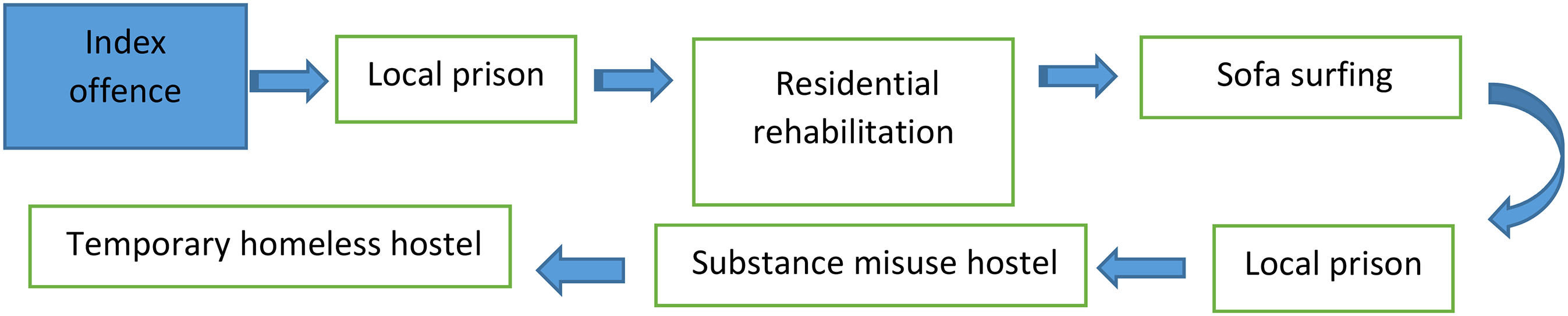
Sean's resettlement journey.
All these services performed control and surveillance functions of different intensities. For example, Sean found difficulties adapting to the rules and structures put in place by the rehabilitation facility he was placed in after his initial release. The rehabilitation facility had a keyworker who would regularly communicate and liaise with Sean's CRC officer. His licence conditions also specified engagement with the rehabilitation facility, demonstrating the braiding of support and control, alongside the subversion of the values of the rehabilitation facility towards surveillance and punishment. For Sean, what should have been experienced as help, was translated as additional interference: It was just stupid, they treated me like a little kid. All these silly rules they give you; when you can leave, when you have to be back, what you can do. I felt like they were constantly trying to trip me up. I might as well have been in prison. It's like you’ve got one foot in jail still; you’re free, but you’re not properly free.
For several service users, services ostensibly designed to provide resettlement support where a potential trap – or a net – restricting freedom and confining individuals within a system of control. In this sense, institutions such as rehabilitation facilities were not exclusively viewed as unadulterated help and assistance existing to mediate and alleviate the difficulties of transitioning from prison to the community, but could also be experienced as services that negatively shaped resettlement in the community, further reinforcing and expanding carceral control.
This demonstrated the blurred boundaries that existed through-the-gate between freedom and confinement, undermining the perspective that these were two contrary experiences with a clearly demarcated line between the two. For many, through-the-gate reintegration could be experienced as a transition from custody to a different form and gradient of control, rather than a move to unrestricted freedom, with several resettlement services playing a central role in regulating released prisoners in the community.
Many of these organisations also played a surveillance function and had a variety of formal or informal relationships with the CRC. In this respect, the CRC played a role as a convenor of different resettlement organisations in the community. This further demonstrates how the rhetoric of help and support of the ORA 2014, disguises the additional control this legislation exerts. A partnership manager outlined one such organisation that existed within the case study area and the role it played in the surveillance of service users. The organisation was called ‘The Hub’ and placed multiple services on a single site. This was ostensibly for the convenience of service users, but it also allowed other functions, according to a CRC partnership manager: CMHT (Community Mental Health Team) is there, housing is there, social services are there. It's literally around the corner and they can see a nurse, they can get advice from DWP (Department for Work and Pensions), they can do courses. A lot of clients can drop in there, and that means we can keep an eye on them and know what they’re doing.
These findings support Robinson’s (2008) discussion of the adaption and transformation of rehabilitation into three late-modern penal narratives: utilitarian, managerial and expressive. Many resettlement services in the case study area had braided their ideals into managerial control and surveillance functions in order to play a functional role within the resettlement net. This entailed the envelopment of resettlement support, alongside forming close relationships with the formal criminal justice agencies, and keeping ‘an eye’ on service users.
Another service user in the community, Gary, demonstrated his experiences of release from a short sentence. Initially, upon release, he was living with his mum, but a breakdown in the family relationship led to a period of street homelessness. He was eventually picked up by a street homeless team and was placed in a temporary homeless hostel. However, during a police stop and search, he was found in possession of class A drugs and returned to custody. On his release, the local CMHT became aware of him and he was housed in specialist supported housing for dual diagnosis clients. While in the hostel he was put on the waiting list for a drug rehabilitation place. However, this fell through and he left the hostel after disagreements with staff and returned to live with his mum. At the time of the fieldwork, he was under the impression that his stay at the family house was conditional on it being a temporary arrangement, and he was looking for more permanent accommodation. The range of services he had cycled through included the prison, the CRC, a street homeless team, a homeless charity, the local authority and the mental health team (Figure 2).

Gary's resettlement journey.
Gary and Sean's experiences provide exemplars that help to conceptualise a different understanding of how through-the-gate was actually experienced, underlining that it was not a binary process between prison and complete freedom, but a series of transitions into different sets of controls, rules and standards to meet. The experiences of these two individuals also underlined that it was difficult to exit this process and that once caught up within this net, it was difficult to relinquish its grasp.
The continual recycling through different services underlined a failure to permanently form a stable base in the community. In this respect, the experience of re-circulation was a form of carceral segregation in the community, a painful experience where individuals were existing and often isolated alongside society but were not fully autonomous members of it. Collectively, the various organisations and services that formed this process acted as a ‘resettlement net’, trapping individuals within its grasp.
This net was cast by an array of actors operating in the community, including CRC probation practitioners, CMHT staff, local authority housing staff, street homeless teams, DWP staff, substance misuse practitioners and volunteer mentors. Many third-sector organisations had been pulled into the orbit of control of offender management, supplementing the functions of probation and blurring the boundaries between care and carceral control. The concept of the resettlement net also demonstrated the power of the carceral state to disperse and penetrate into the lives of individuals serving short sentences, as well as the symbiotic relationship between prison and community ‘alternatives’ (McNeill, 2020).
The ORA 2014 was envisioned as a means to provide an additional safety net to a neglected cohort, however, for many service users, the extension of post-prison supervision further entangled them within the criminal justice system, and made it harder for individuals subject to it to free themselves from these forms of social control. This net was often masked and disguised as support, but the thinning of the mesh and the lengthening of this net gripped individual's tighter, not allowing escape from its cast. Instead, service users were intensively re-processed by the ‘production line’ of the ‘recycling industry’ (Cohen, 1985: 42) of probation practitioners, resettlement agencies and through-the-gate supervisors, often involving multiple short stays in custody, before re-circulation and then thrown back into the resettlement net.
The wear and tear of the resettlement net
Fitzgibbon (2008) writes that when nets get pulled so wide, holes begin to appear and individuals can fall through these gaps. Nets can also become frayed and torn if they are not sufficiently maintained. Findings from this study indicate that there is significant wear and tear to the welfare-oriented elements of the net, and when this occurs, this often leads to individuals falling deeper into the carceral mesh of the resettlement net. One such example of the consequences of wear and tear to the safety net is Imran, a young Asian male who suffered from mental health issues and learning difficulties. Before his first short sentence, Imran was also homeless. Imran had recently been released from prison when he was interviewed, and he noted that there had been a three-week gap between his first custodial sentence and his second. After release from his first sentence, Imran explained the realities of the absence of support promised within the ORA 2014 legislation: I was released homeless and was begging on the streets to get money for food. I was released with no benefits and it can take 5 weeks to get set up after release, so I was left with nothing. I shoplifted again so I could eat, nothing was set up for my first release, no one chased anything up for me.
Imran's experiences demonstrate how wider-scale macro issues such as the benefits system, or housing shortages can undermine the caring rhetoric of the ORA 2014. In particular, it demonstrates how the decisions of one arm of the government on issues such as welfare support and housing, can inhibit and undermine another arm of the government and the expansionist aims of criminal justice policy. Furthermore, the failings of Imran's initial release from custody, resulted in him re-circulating back into prison again, demonstrating the enduring persistence of control that the ORA 2014 legislation provides. This further signifies that any wear and tear in support typically leads to individuals falling further into the net of the penal system. It was in his return to prison, where his needs were finally picked up on by staff and were able to provide the support Imran needed: It's been different this time … through the prison healthcare staff, they picked up on my housing problem and got me to see someone to help me with my housing situation. They helped to get me into a temporary hostel place.
This demonstrates that for those that do fall through the fraying mesh of supportive services, that the prison is often the eventual landing spot. The cast of the ORA 2014 will eventually sweep these individuals back up and re-process them, with the probability that they will be eventually re-circulate into another organisation within the resettlement net. At the time of the interview, Imran was in a temporary hostel place, meaning he was secured tightly in the mesh of the net and was engaging with his probation appointments. However, it is conceivable that further wear and tear will occur; establishing that additional control, rather than additional care, is the underlying pervasive feature of ORA 2014.
To discover how wear and tear of support can occur so readily, it is important to understand the barriers that practitioners’ experience in their ability to provide effective care for individuals within the resettlement net. One prevalent issue that was highlighted concerned the large caseload numbers that practitioners’ held. These had expanded significantly with the introduction of the ORA 2014 and led to difficulties in effectively tracking and monitoring individuals and providing effective services. One such example is a probation officer, who outlined the difficulties he experienced with meeting the demands of his caseload: It is challenging, managing 60+ cases. I used to see everyone for an hour. Because that was the ethos of how you work with them. It can't be 15 minutes, if you give them 15 minutes, they will think nobody's interested and just come in and tell you what you want to hear. If you take an hour, they get to know you, you get to know them, you can get something out of them! But now, it's just not possible.
The above officer explained how the expansion of cases he was responsible for, served to lessen his ability to proactively engage with individuals, providing a less impactful supervisory relationship. Within this reduced framework of support, the officer felt less able to get to know his cases and provide meaningful support. His caseload had become reduced to an indivisible mass, with support limited to short check-in appointments, relegating the space to provide meaningful care and demonstrating the pervasive impacts of ‘mass supervision’.
Navigating and negotiating the resettlement net
For many individuals who were circulating amongst the institutions of the resettlement net, navigation was often experienced as an impenetrable bureaucratic minefield. The experiences of men in the case study area in navigating their resettlement in the community, supported Halushka’s (2020) exploration of the challenges facing formerly incarcerated men, and Henley’s (2018) research into the formal exclusion that former prisoners faced. However, this article develops these themes to outline how informal processes could exacerbate the difficulties in navigating and negotiating the resettlement net.
Successfully navigating and negotiating around this complex system, required a set of resources and tools at one's disposal. One crucial key to unlocking the bureaucratic processes required the possession of valid photo identification. Without it, individuals could not set up benefits or housing support and become effectively locked out from accessing support. If an individual had no ID, acquiring one was a very difficult and timely process. As Gurusami (2019) has previously outlined, ICT skills and digital connectivity are crucial to access a range of services, and were also needed by individuals in the resettlement net in order to apply for benefits and search for employment and housing. However, this could also present as a difficulty, as Carl explained: It's all on computers now and it's difficult for me to get access to them. You used to be able to just go into the office and speak to people face to face, but now it's online, or you wait ages speaking to a call centre.
Not every service user had access or the skills and knowledge to use a computer. Without these abilities, navigating the resettlement net could be a very difficult and challenging process. Access to services was also reliant on accurately filling out endless streams of paperwork. Particularly for securing housing, this was an unavoidable part of the process. This process could be frustrating and repetitive and required reserves of patience and resilience. Several service users felt this process could often trip you up if it was not carefully managed. Ben outlined some of the complexities and difficulties he had endured during his release: The jobcentre sent a letter with one date for my next appointment, they then sent me another letter with a different date. I called them up and they told me to ignore the second letter – that it was sent by mistake. But when I didn't go to that appointment, they sanctioned me anyway. Now I’ve got to try and sort this all out.
For several service users, conflicting appointments and paperwork errors were a commonplace problem and much time was spent trying to avoid falling foul of these issues. These mistakes and miscommunications were often exacerbated by overworked staff, often with poor or inconsistent relationships with other agencies. Informal barriers such as possessing ID, accessing ICT and navigating bureaucratic paperwork systems were all potential roadblocks that could inhibit resettlement and act as a painful source of informal exclusion from successful reintegration. Navigating the multiple agencies involved in a service users’ life could pre-occupy the majority of their time, and could forcefully penetrate into the life of a person released from custody. Gary provided an overview of the interactions he had with formal agencies in a normal week: In any given week I’ll have a keywork session at the hostel, see my worker at the CMHT, go to the GP, I’ll have the jobcentre to deal with and on top of that, I’ve still got to go to probation, nod my head and say the right things. It's hard to keep on top of it all, be at the right place at the right time, keep them all happy and make sure I get what I need out of them.
When service users’ faced various commitments in their resettlement, they could often be seen as an indistinguishable mass to be negotiated through, rather than viewed as multiple sources of support. These multiple appointments were all played out as a series of negotiations that required service users to successfully navigate through in order to progress and remain out of prison. All these services had requirements and rules in order for the individual to maintain their place in the community. This meant that service users had to work hard to juggle these appointments and keep the individuals who exerted control over them onside. Amongst the multiple appointments a service user might have to navigate in any given week, the probation officer existed as just one of the numerous faceless bureaucrats to navigate. In this sense, supervision – traditionally viewed as a primary means of relational support – becomes viewed as an additional tool of control and surveillance in individuals’ lives.
Conclusion: Analysing the ripple effects of the ORA 2014
The ORA 2014 promised to provide a safety net to a long-neglected cohort of service users. Based on interview data with service users experiences of resettlement, the extension of support served to further trap and encase the short sentence population further into a ‘resettlement net’ of social control. This reality re-characterises the ORA 2014 as an additional control, cloaked in the rhetoric of additional help and support. This article explored the lived reality of the revolving door. For service users, it was frequently experienced as a process of re-circulation. Often, service users flowed and re-cycled between different agencies and bodies of support in the community. Service users demonstrated institutional mobility as they transitioned for weeks, months or years between different organisations, before often returning to prison. This process further positioned the local prison as a central point of re-circulation which service users flowed in and out of. This resulted in trapping service users alongside the community, but not allowing them to be autonomous members of it. This was conceptualised as the ‘resettlement net’, providing an understanding of how the movement from prison into the community was often not experienced as a clean break, but as a movement into a different gradient of support and control.
Cohen placed importance on understanding the far-reaching consequences – or ripple effects – of net widening, and so this article concludes by considering how the casting of the ORA 2014 legislation has disturbed the ocean. Although not designed as an exhaustive list, this article has identified three primary ripple effects. Firstly, the extension of mandatory post-release probation supervision to individuals serving a short sentence has led to an exponential rise in recalls to custody (HM Inspectorate of Probation, 2018: 14). This has resulted in the attendant licence conditions and supervisory framework introduced under TR serving as a ‘landmine’ (McNeill, 2018: 44) and acting as an additional catalyst in the re-cycling around the revolving door, further deteriorating chances of successfully reintegrating back into the community.
Secondly, the extension of support provided by ORA 2014, has served to harm the quality of support and supervision that is provided to the individuals subject to these sanctions, eroding the supervisory relationship and discouraging effective engagement. This means that the relational aims of supervision are increasingly braided with control and surveillance functions and viewed within this study as additional interference, rather than additional care. Dominey (2019: 283) refers to this as a ‘thin’ model of supervisory practice, characterised as ‘minimal and administrative approach to supervision’. This further exemplifies the de-personalising qualities of McNeill’s (2018) ‘mass’ supervision.
Lastly, the extended ‘production line’ of numerous third sector organisations that have been pulled into the orbit of the resettlement net, has altered the ethos and culture of smaller charities, in order to align their values towards the private sector (Corcoran et al., 2018), pulling the voluntary sector further towards market competition. Corcoran et al. (2018: 193) term this as ‘mission drift’, where organisations lose their critical voice and re-orient traditional welfare values towards control and surveillance functions. This has been embodied on the ground by practitioners in a more distant and formal relationship with service users, exerting forms of surveillance and control, further segregating them in the community.
Footnotes
Acknowledgements
The author thanks his PhD supervisors, Professor Karen Duke and Dr Julie Trebilcock.
Declaration of conflicting interests
The authors declared no potential conflicts of interest with respect to the research, authorship, and/or publication of this article.
Funding
The authors received no financial support for the research, authorship and/or publication of this article.
