




Abstract
Transportation to remote islands has been a way that authorities have dealt with criminals since well before the birth of the modern state. What happens to those exiles once on the islands has varied greatly in different times and places. This paper explores the Galápagos plantation run from 1878 to 1904 by Manuel J. Cobos. His operation demonstrates that the patriarchal concept of the hacienda continued to play a key role in the disciplining of perceived criminality in Latin America in the late 19th century, outside of the roles of the military, the police, and penal institutions. The Galápagos example shows the overlaps and tensions between capitalist plantations and state penal colonies in their treatment of transported convicts in the 19th century.
Keywords
The Galápagos Archipelago has been part of Ecuador since the independence of that country from Spain. From the 1830s until the 1950s several locations on the islands were used as sites of criminal exile from Ecuador. In this paper we explore the relationship of these locations to plantation agriculture, to vagrancy laws in Ecuador, and to the changing penal system on the mainland. Our focus is on the late 19th century plantation run by Manuel Cobos on San Cristóbal Island, known at the time he lived there as Chatham Island. His operation was typical of the complex landscape of criminal exile in the Galápagos, mixing agriculture and punishment, and mixing state-sponsored colonization with private enterprise. After a brief history of penal transportation to the islands, we focus on Cobos’ operation to explore the role of the hacienda “patron,” as capitalist landowner and patriarchal figure caring for his peons, and as a de facto prison warden.
In 1832 the newly independent Republic of Ecuador declared the Galápagos Archipelago to be part of their national territory, and since that time the islands have acted as a national frontier, a site of criminal exile, and now as a globally recognized ecological park. From 2014 to 2016 the authors were involved in an archaeological project on the Island of San Cristóbal, looking at the material remains of the Hacienda el Progreso, a 19th-century agricultural operation with an infamous history (Stahl et al., 2020). El Progreso was a sugar plantation, the labour for which came at least partly from criminals sent there from the city of Guayaquil.
Islands have been used by societies around the world to abandon, exile, or warehouse those deemed unworthy for a very long time. In the 19th and 20th centuries they have been used to detain migrants, criminals, the mentally ill, and a host of others, using the islands’ ambiguous sovereign status and geographic remoteness to allow the state to do things to people they would not otherwise do. The geography of the frontier could be used to hide, or minimize, societal problems, people, and practices. These were remote places, but the common dynamic of island exile has been an important part of how many states operate (Mountz, 2011).
The variety of ways that remote locations in 19th century South America were used as sites of criminal exile has been of increasing interest to historians of punishment in recent years, with an emphasis on the role of the military, the use of convict labour to create remote infrastructure, and the contrast of these sites to the urban penitentiaries that the new republics were eager to build (De Vito, 2018; Edwards, 2014, 2018). El Progreso, and other Galápagos colonization events, bring up the forgotten role of the transition from hacienda discipline to state discipline that revolutionized the Andean nations over this period – a role that has largely been ignored by historians of punishment in South America. “Southern Criminology” (Brown, 2018) warns us that the history of punishment in different postcolonial regions of the world may have unique trajectories. In the southern United States the transition from the plantation, with a planter whose power was almost absolute, to the modern racialized incarceration of many, has been explored through the history of convict leasing and prison farms, where private agricultural enterprise, and debt peonage, mixed with state support for vagrancy laws and property rights to reinforce post-emancipation racial divides (Forret, 2013; Lichtenstein, 1996; Mancini, 1996).
This is only one example of a global change in the second half of the 19th century. The abolition of slavery, the independence of former colonies, and the modernization of mechanized plantation agriculture, coincided with the use of legal sanctions to ensure labour supply through a wide variety of relationships between police, state legal systems, and patriarchal, usually white-skinned, landowners and agricultural managers in many countries. A key aspect of this relationship became vagrancy laws, often applied in racialized ways, and the ability of state actors to send individuals to agricultural, or other capitalist operations, to serve terms of forced, coerced, or debt-based labour (De Vito and Lichtenstein, 2015; van der Linden and Rodríguez García, 2016). The Galápagos Islands in the 19th century provide a good example of this type of arrangement, where private enterprise and the goals of the state intertwined in ways that ended with coerced labour regimes and violence in a place largely outside of state control.
Colonial Quito
The Galápagos Archipelago was accidentally encountered by a ship carrying the Spanish Bishop Tomás de Berlanga in 1535, when off-course sailing from Panama to Lima, Peru (Berlanga, 1884). From Berlanga’s first report, through to Ecuador’s formal ceremony to claim the islands three hundred years later, they remained an extra-national space, and some of the most remote islands on the planet, used by pirates, sealers, whalers and other ships from many nations to restock provisions and water, and particularly to take on board live tortoises for consumption during long sea voyages in the Pacific (Epler, 2013). The archipelago was not, to our knowledge, used as a site of criminal exile during the Spanish colonial period.
What is now the Ecuadorian mainland, known in the late colonial period as the Audiencia of Quito, was similar to other Spanish South American colonies in the punishment of criminal activity. In the capital city of Quito in the late 18th century this could include banishment from the city, or a sentence of several years’ labour, whether in the Royal Tobacco Factory (which existed in both Guayaquil and Quito, the two largest colonial cities), or, for men, the Navy. Those convicted of serious crimes could be sent for life to the Castillo de Chagres (Fort San Lorenzo) in Panama, or the Castillo Valdivia in southern Chile, in what De Vito (2018) has characterized as the presidio system, in which criminals were turned over to the military to become labourers at remote frontier fortresses and settlements. Whipping and execution were the final recourse for more serious crimes in colonial Quito (Black, 2011; Espinosa Apolo, 2016).
Confinement of criminals in purpose-built jails was generally a temporary measure in the Spanish colonies. In the late 18th century the city of Quito had three jails: the Cabildo (city council), the Audiencia (regional), and the women’s (Recogimiento of Santa Marta). The number of people annually detained in them ranged from about 300 to 500 in total, and these numbers were evenly split between men and women (Black, 2011). These were buildings for securely holding people awaiting trial or awaiting punishment. In the case of women, the system of confinement was run by the Catholic Church (Goetschel, 2016).
In contrast to much of the published literature on crime and punishment in the Spanish colonies, it is important to note that much of the colonial population lived, and much of the punishment of perceived wrongdoing occurred, in rural areas in the Audiencia of Quito. The unique nature of rural criminality, and the power relationships that exist between agricultural labourers and landowners, is an important topic in modern criminology (Donnermeyer and Dekeseredy, 2014). The history of these relationships in Latin America is something that is well understood by historians, but to date has not been integrated into the history of punishment. In colonial Quito highland haciendas were run by large landowners of Spanish descent, with legally sanctioned labour rights to the Indigenous peoples who made up most of the highland population. The hacendado, or patron, and his family were to a great extent the law on their property. Corporal punishment, moral correction, and many abuses intermingled in the complex power relationship between landowning families, their workers, and the church infrastructure that supported these relationships (Lyons, 2006; Thurner, 1993).
The republican transition
In the 1830s, as Ecuador became an independent republic, ideas about crime and punishment began to change. The first Ecuadorian Penal Code was published in 1837 and reflects considerable continuity with colonial norms. Those who were criminal, or simply idle (vago), rowdy, or immoral (vicioso) could find themselves brought in by the police. The range of punishments, or forms of social control, remained diverse, but surrounded a theme of removing offenders from their community, and forcing them into some kind of labour. Drafting into the military, assignment to a labour gang for public works, or being assigned as a labourer on a private plantation were all common (Espinosa Apolo, 2016). Exile, or banishment to the frontier, remained another common fate. In this sense Ecuador as a republic reflects Mark Brown’s (2018) framing of postcolonial criminology as mimetic, recreating colonial structures under republican ideals.
It was in this period that the republic of Ecuador asserted its territorial claim to the Galápagos. General José Villamil, a hero of Ecuadorian Independence who was born in Louisiana and had become a business leader in Guayaquil when it was still part of the Spanish colonies, lobbied the government immediately after independence to incorporate the Galápagos as a province of the new republic. Ecuador then recognized the Galápagos as the “Archipiélago del Ecuador,” and Villamil dispatched Colonel Ignacio Hernández on the schooner Mercedes, to take possession of the archipelago in a ceremony on the newly christened island of Floreana in February of 1832 (Coulter, 1845; Epler, 2013). From that day forward the Galápagos became a frontier for Ecuadorian colonization, but one which, because of its very remote location and difficult living conditions, was not an easy region to convert to human habitation. One solution to such frontier conditions was to export criminals as colonizers.
Villamil had created a private corporation, the Sociedad Colonizadora del Archipiélago de Galápagos, and with a government land grant, his company founded the Asilo de la Paz (Asylum of Peace) colony on Floreana Island. At the same time a decree by the government of Ecuador declared the Island of Floreana an official location “for the deportation of those sentenced to exile” (Idrovo, 2005: 49). Villamil had arranged for Ecuador’s president, Juan José Flores, to commute the death sentences of 80 soldiers who had colluded to revolt against Flores. Instead they were exiled to the Galápagos under Villamil’s supervision and formed the first wave of colonists at Asilo de la Paz. Villamil continued to receive various categories of people deemed worthy of exile by the government, including political dissidents, thieves, murderers, debtors, vagrants and sex trade workers (Bognoly and Espinosa, 1905; Epler, 2013). About 300 people lived at Asilo de la Paz at its peak. The colony produced agricultural products, and extracted oil from tortoises, selling their products to passing ships, particularly the whaling ships that visited frequently in this period.
John Coulter, the surgeon on the English ship Stratford, visited Villamil’s Asilo de la Paz colony in 1833. Coulter described Villamil as constantly nervous, afraid that his charges might stab him in the night. Each inhabitant (often with a wife and children) had their own plot of land, but Villamil kept them in debt peonage through his control of all supplies to the island, and account books for worker indebtedness (Coulter, 1845). The inhabitants lived in “log cabins” in the agricultural fields, while Villamil had a three-room house against a cliff, with a small store for supplies. Significantly, Coulter (1845: 55) also mentioned that behind the house was “a natural cave of about twenty feet long, with an entrance of about eight feet high. To this entrance, a strong door, or, more properly speaking, gate, well secured, was fitted; this was the jail.”
Coulter makes no mention of any formal government facilities or authorities other than Villamil. Charles Darwin visited the colony in 1835 and reported that of the 200 or 300 inhabitants “nearly all [were] people of colour, who have been banished for political crimes” (Darwin, 1845: 375). Villamil represented both the head of government for the islands, and the patron of his own hacienda, run through debt peonage for his own profit. He was often absent on the mainland, and in 1841 the Asilo de la Paz workers revolted against the tyranny of José Williams, who was Villamil’s on-site manager, beating him with sticks and machetes until Williams fled the colony in a company boat (Parks and Rippy, 1940). After several of these violent incidents, Villamil sold off his investment as administrator of the province in 1846, leaving the islands to resume their role as extranational territory (Latorre, 2011).
The Galápagos in the late 19th century
The second half of the 19th century brought huge changes to agricultural labour, and the economy, of Ecuador. Slavery was abolished in Ecuador in 1851; many enslaved Africans worked sugar plantations in both northern Ecuador and the Amazonian foothills. The cacao boom of the 1870s to 1910s encouraged coastal plantation owners to offer cash advances to labourers, drawing large numbers of Indigenous and African-descended workers from all over Ecuador to the Guayas basin. This system, known in Ecuador as concertaje, was threatened by those who refused work, left their haciendas before paying off debts, or were otherwise seen as vagrant, or criminal. Racism, the illiteracy of workers, coercion, and violence, meant that concierto relationships were often without written contract, had no clear time or work limits, and were based more on the threat of debt imprisonment, or violence on the part of the landowner, than on any clear legal limits (Carnes, 2014; Chiriboga, 2013; Foote, 2004).
The city of Guayaquil, as the rapidly growing entrepôt and economic capital of Ecuador, attracted large numbers of the rural poor seeking wage jobs or other opportunities. Work on cacao plantations was seasonal, leaving many without work for much of the year. The population of Guayaquil grew from 26,000 in 1877 to 120,000 by 1925, with concomitant increases in urban poverty and social unrest (Pineo, 1988). With a growing urban population and increasing labour mobility, the Guayaquil authorities’ view of vagrancy, idleness, and poverty changed. The 1847 Guayaquil Police Regulations had stated that anyone without land, or a profession, could be rounded up and jailed, and should be returned to their previous landowner as a concierto. These regulations were reinforced in the Guayaquil Ley de Régimen Municipal (Municipal Regulations) of 1863, which obligated the Policía Rural to regulate servants, apprentices, and day labourers, ensuring they were not vagrant, and ensuring that those deemed vagrants were returned to the property they were attached to. By the 1860s on the Ecuadorian coast the vagrancy laws had become very important, returning debt peons to the plantations they had “escaped” from, and generally reinforcing large landowners’ control over the countryside, in an echo of colonial landowner/labourer relationships of moral authority and power. In 1865 President Gabriel Garcia Moreno created the “Order and Public Security” Police Force at the national level. The Garcia Moreno era (1861–1875) combined Catholic morality with a spirit of modernization, in attacking head on perceived problems with vagrancy, drunkenness, and the sex trade through more extensive use of police forces to apprehend perceived threats to public order (Goetschel, 2016; Sánchez Mosquera, 2007).
The first penitentiary in Ecuador was built in Quito under García Moreno and was completed in 1874. Its panoptic design, with the walls of cells painted black, and a rule of silence for inmates at all times, mixed ideas of reform and terror (Argüello, 1991; Espinosa Apolo, 2016). It was the jewel of the capital city’s carceral landscape, but of course did little for the rapidly growing economic capital in faraway Guayaquil. There, men convicted of crime were generally assigned to public works such as road building, put into concertaje at a local plantation, or sent as labourers to build new roads and other infrastructure in areas of coastal forest being cleared for cacao agriculture. Women, although not sent to field labour, construction, or military labour, could be put into a house of reform, or sent to a private home to become a servant (Chiriboga, 2013; Clark, 1998). Some, both men and women, were exiled to the Galápagos.
The Garcia Moreno government attempted to pull the Galápagos into the state penal system, going so far as to approach Italy in 1866 to negotiate a joint penal colony on the archipelago, but these negotiations came to nothing (Pagnotta, 2015). Instead, the government turned once again to a private enterprise arrangement. In 1869 Ecuador licenced a new company, the Companía Orchillera, to exclusively harvest lichen for dyes throughout the Galápagos. Three men, José Valdizán, Manuel Cobos, and José Monroy took over the colony on Floreana abandoned by Villamil. The lichen business failed, and Valdizán instead independently set up a farming operation on Floreana, with the familiar mix of convict and debt labourers. He was killed by his own workers in 1878, and Valdizán’s colony collapsed (Latorre, 2011; Mann, 1909).
The Hacienda El Progreso
Manuel J. Cobos and José Monroy, Valdizan’s business partners turned rivals, had set up their own agricultural operation on Chatham Island. After Valdizán’s death many of his workers moved to Chatham to join them. From 1878 Cobos lived on Chatham Island full time, and built it into a large sugar, coffee, and fruit plantation run by up to 400 labourers, which he christened the Hacienda el Progreso. One important aspect of his operation was Cobos’ relationship to the Guayaquil police, who began sending him labourers they had detained in Guayaquil. There is no evidence that this was a formal legal process, and Cobos was in no way a penal official in the state system. Instead, it would seem that Cobos was treated in a similar way to large mainland landowners at the time, as a patron who could be trusted to morally instruct and punish his workers as needed, with little legal oversight.
Manuel Cobos had previously run an import/export business from the port of Chanduy on the Ecuadorian coast, with, it is important to point out, no previous experiences as a government official or in any form of legal, or penal, administration. As a young man he had a reputation for running contraband goods between Mexico, Panama, and Ecuador, and occasionally pirating other peoples’ ships (DeKay, 1871). In 1878 Cobos began living at the agricultural operation he was building on Chatham Island, and by 1904 El Progreso was a very modern plantation operation which produced and refined about 500 tons of sugar for the Ecuadorian market annually, and several other products such as coffee and leather for international markets. The plantation occupied most of the southwestern portion of the island, and from a few hectares in 1879, El Progreso had grown to about 3000 ha in 1904 (Latorre, 1991).
The Galápagos remained beyond any real oversight by the Ecuadorian government. In 1885 Ecuador brought in the Ley de Régimen del Archipiélago de Galápagos, which created the title of Jefe Territorial (territorial administrator), as well as creating a position for a chief of police for the islands, and four constables (Bognoly and Espinosa, 1905; Latorre, 2011). The first Jefe Territorial arrived in Galápagos in 1886, and had to live on Cobos’ hacienda, relying on him for transportation, food and lodging. Very soon after government control had begun to be put in place, the authorities were becoming frustrated at the lack of resources and commitment to the legal system on the island. Throughout the late 19th century police chiefs and inspectors assigned to the island complained of the lack of legal infrastructure to charge anyone with a crime, and the lack of sufficient police personnel on the island to enforce the law (Guevara Ruiz, 2015).
El Progreso as plantation
The economic engine of Cobos’ operation became sugar production. The second half of the 19th century saw sugar become a very important export commodity in many parts of the tropical Pacific, and the end of slavery in most of these regions meant that landowners faced challenges in finding labour (Dye, 1998; Knight, 2014; Takaki, 1983). Sugar plantation work was exhausting, dirty and dangerous. The sugar industry in the South Pacific relied on both mechanization, and a turn to contract, or indentured, labour. Hundreds of thousands of the poorest rural labourers from a wide range of countries were contracted, tricked, kidnapped, or otherwise encouraged to move to sugar plantations as production grew (Engerman, 1983; Graves, 1993; Gonzales, 1989, 2014).
Manuel Cobos drew his labour force from the unemployed of Guayaquil, but also from other regions. By 1889 there were 287 people living at his El Progreso operation (Figure 1). These workers were from several mainland regions with different backgrounds. Among them were foreign and undocumented workers from Colombia and Peru. The census of 1889 showed six Colombians, five Peruvians, four Mexicans, one Chinese, and three Norwegian workers (technicians for the sugar mill) living at El Progreso. A number of these people were free labourers, who saw the opportunity of getting land and work on the Islands. An important number of the workers were, however, “convicts” and “indigents” (Bognoly and Espinosa, 1905; Carbo, 1894).
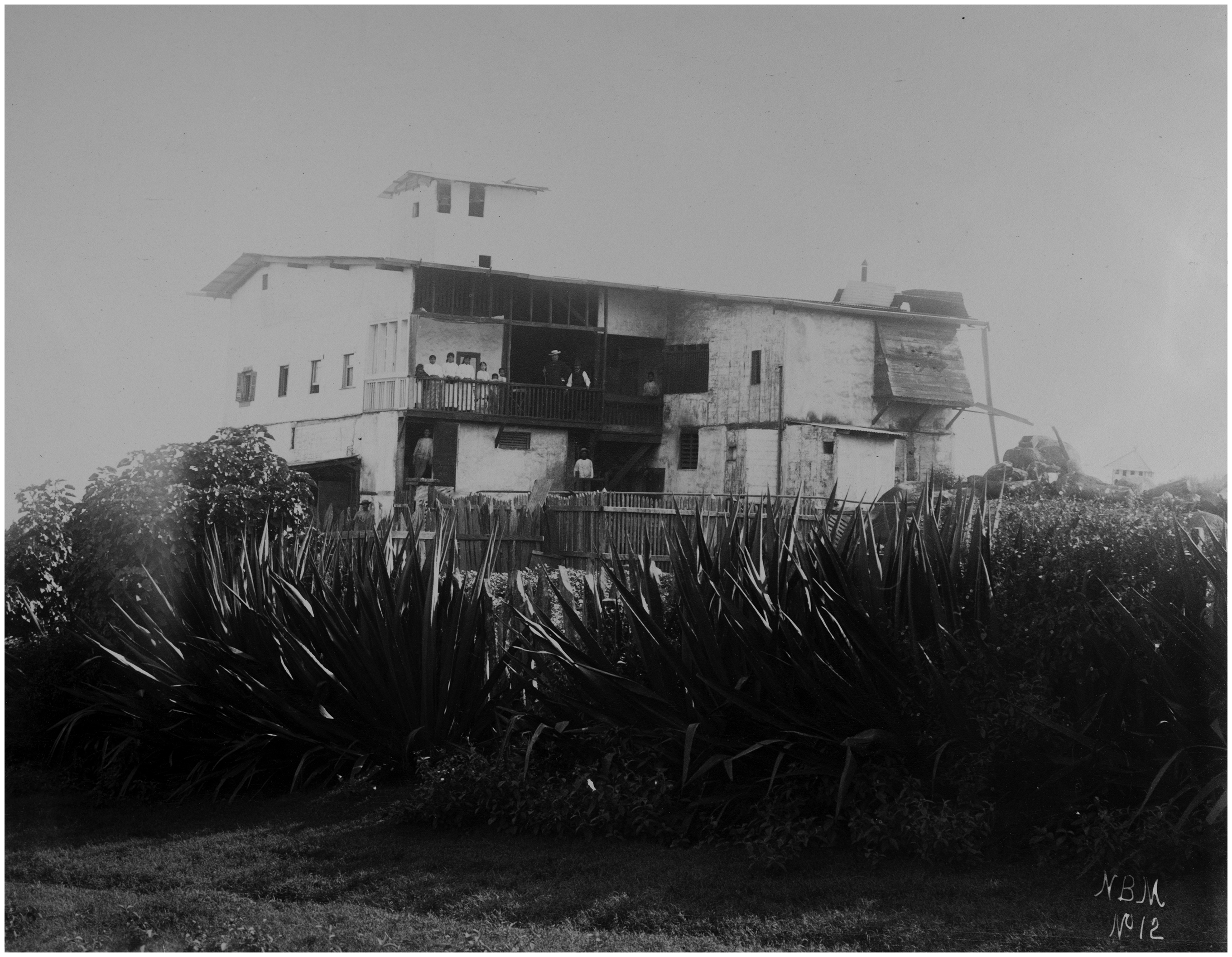
"Señor Cobos' House, Chatham Island, Galápagos" (1888). Manuel J. Cobos is standing on the balcony in the centre of the photograph, in a white hat.
Directly below Cobos’ house, on a terrace to the west, was the ingenio (sugar mill). This complex of wood framed buildings, with walls of cane matting and corrugated tin roofs, housed Cobos’ greatest investment in modernity – sugar milling equipment. A visitor a couple of years after Cobos’ death described the sugar mill: “The machinery is principally of Glasgow manufacture and quite up-to-date, there being a large cane mill, triple effects, vacuum pan, centrifugal separators, and a number of other accessories” (Mann, 1909: 29). By the end of the 19th century Cobos’ operation included a system of movable Decauville railway tracks and railcars imported from France (Stahl et al., 2020). Thus, El Progreso can be seen as a penal colony, but was also clearly an example of a modern industrialized plantation.
When settlers arrived they found a community dominated by Cobos’ house, located on a hill in the centre of the property, with balconies and a central watchtower to allow his gaze to rest on most of the nearby plantation operations without ever leaving his home (Browne, 2015; Epperson, 1990). Contemporary photographs show that workers lived in a village downslope from Cobos’ house, in huts made of wooden or bamboo frames, woven walls, and thatched roofs (Figure 2). The layout seems entirely unlike a prison, with huts in rough rows along “streets”. There would have been little opportunity for overseers, or Cobos, to see what workers were doing inside the huts, and during the workday the labourers would have needed freedom of movement throughout the large agricultural zone. The workers’ housing of El Progreso looked very like the housing on cacao plantations on the Ecuadorian coast in this period, both in architecture and layout (Chiriboga, 2013).
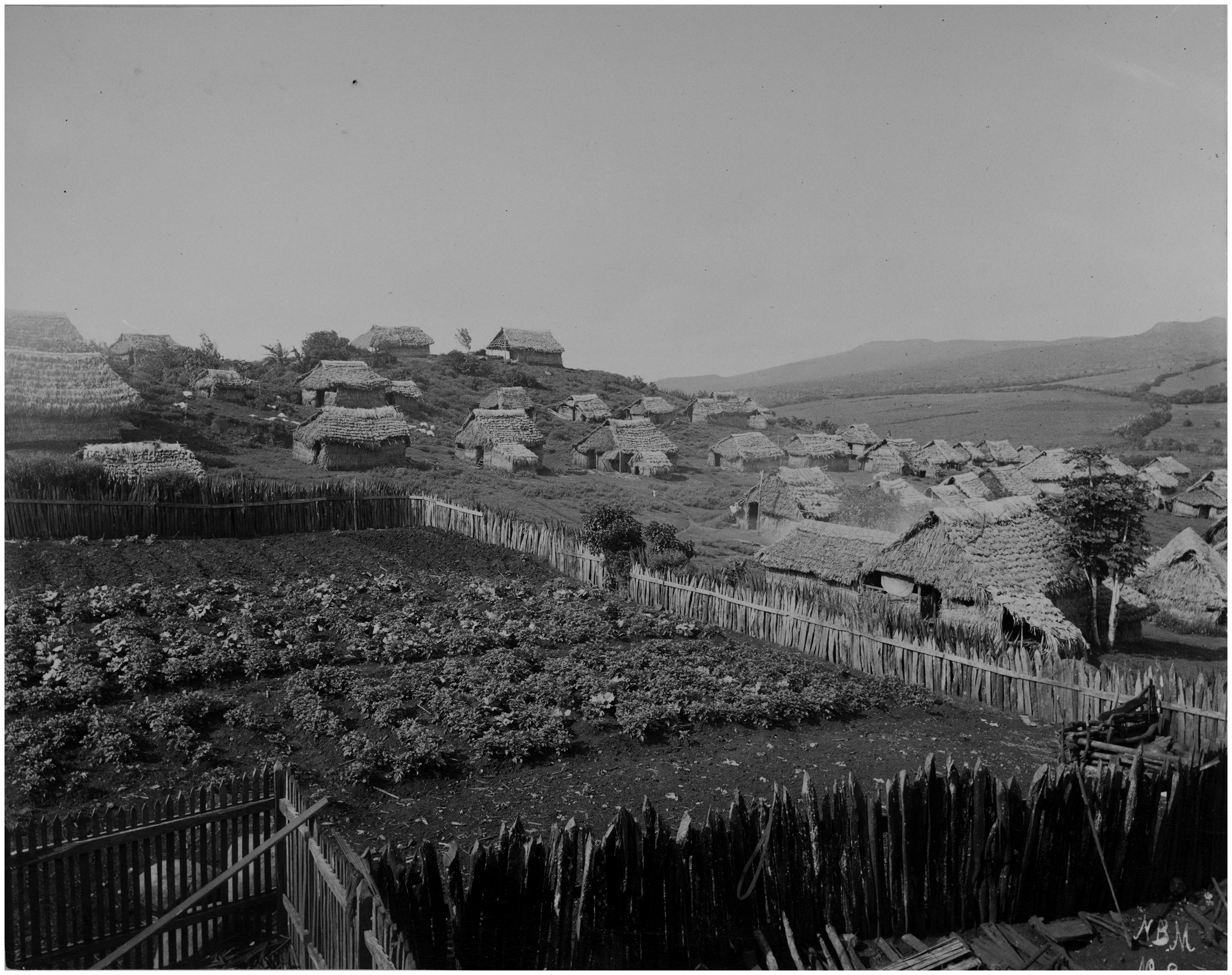
“Plantation Chatham Island.” The worker’s village at El Progreso in 1888, viewed from the balcony of Cobos’ house.
Social control was maintained more directly in ways other than architecture. There was a company store, which was the only place workers could buy food or other goods. Cobos and his trusted senior managers were armed with repeating rifles and pistols, and Cobos was the only source of material goods, transport, or assistance for the workers, with the remoteness of the island serving as an effective barrier to escape (Jamieson, 2019; Stahl et al., 2020).
Zera Luther Tanner, Captain of the US Fisheries Commission research vessel Albatross, described visiting Cobos at Chatham Island in 1887. The beach at Wreck Bay had a lighthouse and storehouse, as well as a dwelling for the lighthouse keeper. Cobos’ son descended on horseback and invited them to ride up the wagon road to the Hacienda El Progreso. They were met there by his father, who took them on a tour of the estate, which had around 200 inhabitants, a lot of sugarcane fields, a cane mill, tropical fruit, and other products. The coffee plantation had been newly installed and was not yet producing coffee. Cobos himself estimated there were 20,000 head of cattle on the island (Tanner, 1887). Tanner did not mention guns, or prisoners, or discipline.
Four years later Tanner made a return visit with the Albatross. He noted that in the four years “a plant of modern sugar machinery had been installed,” and this, as well as the McKinley Bill, meant Cobos stood to make a lot of money from sugar. Tanner stated that “The settlement on Chatham Island was formerly a penal colony, the convicts performing all the labor on the plantation. This was the case at the time of our visit in 1888, but is no longer so, the criminals having been removed and free labor employed, greatly to the advantage of the estate” (Tanner, 1893: 264). Despite Tanner’s statement, it is clear that Cobos continued to receive criminals from Guayaquil throughout the time he ran the plantation on Chatham.
El Progreso as penal colony
Cobos owned two sailing ships, which were the only regular form of transportation between Guayaquil and the Galápagos Archipelago. The sporadic visits of the government steamer meant that everyone, including the territorial governor, was dependant on Cobos for transport on or off the islands (Martínez, 1919). Cobos received workers from the Chief of Police in Guayaquil because they were in some trouble with the law, but this appears in the late 1880s at least to have been an informal, or perhaps illegal, arrangement. When Federico Chaigneau visited Cobos on a voyage of the Chilean naval vessel Chacabuco, in 1887, he described the 140 inhabitants of El Progreso (20 of them women) as “…people mostly relegated from Ecuador, for various offenses, which are used in the farm and who are paid with little wages and food provided by Mr. Cobos.” (Vidal Gormaz, 1890).
The 1887 report of the Jefe Territorial listed only seven of the inhabitants as “confinados,” (in confinement) but this may simply mean recently arrived criminals, as opposed to other workers who had been initially sent to the islands because of perceived criminal activities. As the only civil authority on the island, the Jefe Territorial made several formal complaints about the practice of sending criminals to the island through improper channels, and without any official paperwork (Latorre, 1991).
By 1890 criminal convictions in Guayaquil had reached 8000 men and 1000 women annually. Many were young, single men, picked up for petty theft or vagrancy. The Guayaquil jail was described as overcrowded and filthy; prisoners were not fed, but received 10 cents per day to feed themselves; unless family brought food, they had to beg the guards for scraps. The combination of an overcrowded municipal jail, and overwhelming numbers of convictions, led police chief R.T. Caamaño to advocate in 1890 for 3–5-year exile of “habitual drunks and vagrants” to the Galápagos (Pineo, 1996: 83). At this date, the only location these exiles could have been sent was El Progreso plantation. Cobos had told Tanner during his 1891 visit that criminals were no longer being deported to Galápagos, but the reports of the Jefe Territorial contradict this. Perhaps the police chief was musing about formalising policies that were already in practice. In both 1899 and 1902 the Ecuadorian Congress made decrees expressly forbidding the exile of “criminals, offenders, or women of bad habits” to the Galápagos (Latorre, 1991: 29–30). Between these two dates, in March 1900, newspapers reported Ecuadorian congressional debate on whether to found a “Penitentiary and Agricultural Colony” on Chatham Island (Estrella de Panama, 1900: 1). These reports tend to indicate debate at the national level on the advisability of sending offenders to the Galápagos informally, and the need to create a government facility on the archipelago to receive them.
The creation of a panoptic penitentiary in Quito was followed by the abolition of the death penalty in Ecuador in 1897, and the elimination of corporal punishment for prisoners in 1902 (Espinosa Apolo, 2016). In Guayaquil, which was a growing city and the source of many of Cobos’ colonists, a modern city jail, the Carcel Municipal de Guayaquil, was begun in 1886, but was still under construction in 1896 when partially destroyed in a fire that consumed the city. Work continued until it finally opened in 1907, four years after Cobos’ death. It served as the main prison for Guayaquil until 1950 (Baleato, 1887; Sánchez Mosquera, 2007). The jail that it replaced housed only petty criminals, as serious offenders were sent to the national prison in Quito from the 1870s up to 1907.
The death of Cobos
On February 15, 1904 Cobos was shot and killed by his own workers, along with the Jefe Territorial, Leonardo Reina. Newspaper reports stated that since the founding of El Progreso there had been rumours that Cobos thought of himself as a feudal lord, whipping, torturing and shooting the criminals sent there at his own whim. The workers reported that Cobos had put a Colombian worker in the hacienda jail overnight and threatened to whip him 500 times the next day. In the morning, a majordomo, Elias Puertas, asked Cobos if he would really go through with the punishment, and when Cobos affirmed this, Puertas shot him three times with a revolver. Cobos was injured but dragged himself to get his Mauser rifle, and fired on the crowd of workers assembled below his balcony. He then fell into the crowd, who beat him to death. Others had already shot Reina (El Comercio, Lima, Mar. 51,904: 1). Immediately after Cobos’ murder, the company stores were ransacked, and all the account books and ledgers were burned. A large group of workers then took the company boat and escaped to the mainland, where they were arrested and stood trial.
In a formal declaration the rebel workers recounted a history of Cobos’ tyranny. They claimed that he had had six workers shot, six workers had died after being whipped excessively, and 15 had been exiled to desert islands in the archipelago to await certain death (Bilbao, 1904). There were numerous reports of rape, and coercive sexual relations with female workers by Cobos and his majordomos, but the authorities seemed never to respond (Latorre, 1991). Sheriff Pedro Jaramillo, when first assigned to the colony, had requested more state and police presence to reduce and stop internal social conflict, violence, and the despotism of Cobos. This seemed an endless refrain, as Sheriff Juan Piño again denounced the “monopoly and authoritarianism” in El Progreso in 1904, its last year of operation (Bilbao, 1904). During the 1904 trial the workers repeated the claim that local authorities were completely dependent on Cobos’ authority, and thus Cobos felt free to break both local and national law (Bilbao, 1904).
After Cobos
Cobos’ death in 1904 did not end the transportation of criminals to the islands. A government commission to investigate his death was sent to the archipelago on the naval vessel Cotopaxi, and it was of note to them that they travelled with thirty offenders being deported to Albemarle island (Bilbao, 1904). The 1906 Penal Code restated that deportation to the Galápagos was an important tool for the control of criminality in Ecuador (Salvatore and Aguirre, 1996). Hundreds of criminals are known to have been deported to San Cristóbal and other islands in the 1920s and 1930s, apparently to live as colonists without much supervision, in an atmosphere described as beyond the control of the government of Ecuador (Larco Chacón, 2011).
The Second World War brought American military bases to the islands and curtailed the transport of criminals. With the end of the war, though, Ecuadorian President Velasco Ibarra ordered the conversion of an American radar station on Isabella Island into a new prison colony, El Porvenir (“The Future”). Criminals from public jails were sentenced to forced labour here from 1946 onwards, including the construction of the “Wall of Tears,” a long wall of lava cobbles built simply to keep the prisoners working. In 1959, after a rebellion and many reports of violence and abuse, the prison colonies on Isabela finally closed, in the same year that most of the Galápagos were declared a national park (Idrovo, 2005).
The carceral hacienda
It is of note that in the incident that ended in his death, Cobos had thrown a Colombian worker into the El Progreso jail overnight. Many plantations in the 19th century New World had small jails, or holding cells, for their workers, whether in South Carolina, the Yucatan, Peru or elsewhere (Birch and Buchanan, 2013; Gonzales, 1991; Hollis and Stokes, 2012; Wells and Joseph, 1996).
The Galápagos islands in the late 19th century were both prison islands and a remote agricultural frontier for the expanding Ecuadorian state. The Cobos operation was the manifestation of this combination. The plantation frontier in 19th century Ecuador was tied to areas accessible to national and international markets, whether by road, river, or ocean. Government programs to settle people on such frontiers were much less important than large operations where private citizens created commodity plantations largely beyond government control. Cobos’ El Progreso plantation was different from this. Government control, and his access to markets, were challenged by the 1000 km of water between El Progreso and Guayaquil. Such distance also meant he had dictatorial control over the territory in, and surrounding, his plantation in a way that magnified the usual patriarchal role of the patron or hacendado in Ecuadorian 19th century agriculture.
Conclusion
Landowners, hacendados, and slave owners had been the powerful class in Latin America since before independence from Spain and continued to be into the 20th century. In the late 19th century they saw their personal ability to jail, whip, or execute workers as a key right, maintaining both class and racial order. Police agencies in Ecuador supported this social order, and would often send, or return, escaped workers, as well as orphans, delinquents, the mentally ill, and other undesirable classes to a nearby private landowner to “take care” of the “problem” (Salvatore and Aguirre, 1996: 16). The opposite was also true, however. The workers on Andean haciendas saw the patriarchal role of the hacendado as a role of responsibility to be fair and just, rather than corrupt and abusive. If abuses grew large enough the hacendado risked death at the hands of his own workers (Langer, 1990).
The agricultural penal colony was a variation on this theme. The idea of many Republican-era Liberal regimes in Latin America was that frontier zones could not be colonized because of rural labour shortages. Thus, if the government could give land grants with a source of labour guaranteed, the nation would benefit. Anyone seen as problematic by agents of the state could be rounded up and sent to these zones. The rural work would rehabilitate them, teach them the value of daily routines, and in the end the government would grant them small plots of land as colonos to live out their lives (Palmer, 1996). For criminologists the most well-known example this brings to mind is probably the convict leasing system in the United States (Mancini, 1996), and yet the Galápagos example points out that assigning penal labour to capitalist plantations was, in fact, a global practice. Many of the Latin American republics, for example, saw agricultural penal colonies as a way of bringing wild frontier lands into agricultural production and establishing sovereignty in zones previously without a government presence (Rausch, 2002).
Around the world the panoptic penitentiary, and custodial sentencing, were taken on in the 19th century, as part of a reform ethic that intended to create disciplined subjects appropriate to work in an emerging industrialized economy (Melossi and Pavarini, 1981). There were, however, other ways to handle criminal elements in society; ways that remained popular well into the 20th century in many regions. Cobos’ operation at El Progreso embodied the modern 19th century Latin American export commodity agricultural zone, with the latest in industrial equipment. At the same time, it reflected an enduring Latin American idea of sending criminals to the frontier to become reformed, both through exposure to rural work, and exposure to the firm hand of the patron, the patriarchal private landowner who knew best how to handle the broken, the intransigent, and the racially suspect.
