




Abstract
This article examines for the first time to what extent the lived experience of long-term prisoners matches the normative theory of criminal punishment as moral communication. The findings are based on 27 narrative interviews with men at different stages of a long-term prison sentence. The analysis suggests that Antony Duff’s normative vision of punishment as moral communication may be difficult to realise in practice because of the inevitable pressures on defendants in the courtroom and on prisoners during their incarceration. In the court, the men’s attention was focused on the length of the sentence imposed; they were often overwhelmed by emotion and did not interact with the court as a moral arena. Within prison the men tended to accept their sentence in order to make bearing their incarceration easier. Comparing these men’s lived experiences of punishment with Duff’s normative theory highlights problems with the theory’s potential implementation but also reveals normative problems with current practices of sentencing and sanctioning.
Introduction
This article reports the findings of a research project examining long-term prisoners’ accounts of their sentence. Many authors have pointed out the importance of examining offenders’ views of the criminal justice process. It has been argued that soliciting offenders’ accounts is necessary in order to describe the criminal justice system accurately, examine and possibly change it (Casper, 1972), to promote respect for the system (McGinnis and Carlson, 1981) because disrespect for the system may lead to further crime (Alpert and Hicks, 1977; Sherman, 1993) and to make rehabilitation more likely (Larson and Berg, 1989). Several authors have also highlighted the need to investigate the lived (subjective) experience of punishment in relation to normative theories, in order to understand what it is that the theory is aiming to justify (Kolber, 2009; Rex, 2005). This article examines for the first time to what extent one influential theory, namely Antony Duff’s theory of punishment as moral communication, matches up with conditions in the ‘real world’ of sentencing and sanctioning. Based on 27 narrative interviews with long-term prisoners, it discusses whether punishment can serve as a form of moral communication in the context of court and prison experiences. By comparing a normative theory of what punishment should be with an empirical analysis of what sense the punished make of punishment, this article aims to shed light on both questions and ultimately to contribute to debates about the relationships between purposes and practices of punishment.
The philosophy of punishment and moral communication
There are two main schools of thought in the justification of punishment: consequentialism and retributivism. Consequentialist theories state that punishment is justified if, and to the extent that, it has a positive effect on the world by reducing crime (e.g. through deterrence, reform, rehabilitation or incapacitation). Retributive theories justify punishment with reference to the crime committed. They hold that there is an intrinsic link between wrongdoing and punishment, with the sentence seen as the offender’s ‘just deserts’, and argue that consequentialist justifications fail because they do not explain the necessary link between the original crime and the punishment. However, others have argued that many retributive theories, in turn, fail to make sense of the idea that punishment should bring about at least some future good (Duff, 1996; Rex, 2005), the forward-looking element of punishment.
One influential theory that attempts to explain both the connection to the crime committed and the need for possible positive impact is Antony Duff’s (1996, 1999, 2001, 2003a) carefully elaborated theory of communicative punishment. Duff (2001: 95) argues that when serious wrongs are committed, more is needed than just verbal censure and an apology: ‘To think that [the offender] could just apologise, and then return to her normal life, would be to portray the wrong as a relatively trivial matter that did not seriously damage the victim or their relationship.’
He thereby explains the link between crime and punishment: the wrong committed requires some kind of redress. This redress is delivered through ‘hard treatment’ or punishment, which is intended as a two-way communication. It demonstrates to offenders the extent to which they have done wrong and focuses their attention on their crime and its consequences. At the same time, the hard treatment constitutes a message from the offender. Duff (2003a: 300) writes that it is ‘a material and forceful expression of the apology that [the offender] owes to those whom she wronged – to the direct victim of her crime, if there was one, and to the wider community whose values she flouted’.
The wording here is important: hard treatment is an expression of the apology that is owed, but this does not make it necessary that the offender is actually repentant. When this is not the case, the sentence is still seen as having given adequate weight to what happened. The forward looking element of Duff’s theory, however, depends on the hard treatment being capable of bringing about repentance and behavioural change. Besides having a communicative function hard treatment is also an enforced secular penance (Duff, 2003a), which ideally leads to the offender accepting responsibility and changing their ways (Duff, 1999). However, while this is an aim of the punishment, it is not the justification (this is not a consequentialist theory) and the enforced penance cannot be continued simply on the basis that the offender has not repented.
Duff’s (2003b: 192) account of criminal punishment focuses on community penalties, which he argues are by far the best suited to fulfilling the role of ‘communicative penance’ and should be used much more extensively. Imprisonment should only play a very small role in the kind of criminal justice system he envisages, as punishment for the most serious of crimes. He writes: The message of imprisonment is that the offender has not just damaged or threatened, but has broken, the normative bonds of community. He has made it impossible for us to live with him in the ordinary community of fellow citizenship unless and until he has undergone this penitential punishment. (Duff, 2001: 150, emphasis in original)
The relevance of lived experience
As Rex (2005: 3) has written, the views of those affected by criminal justice decisions cannot disprove normative theories: ‘you cannot prove an “ought”’. Even a finding that no prisoner has ever felt rehabilitated does not show that criminal punishment should not be justified by its rehabilitative function. Besides, Duff (2003a) has unequivocally stated that his account does not justify punishment as it is practised in our current society. Does the lived experience of punishment matter, then, to normative theories in general and Duff’s theory in particular? Various writers have pointed out that, even if theories only justify an ideal system of punishment, they do need to be applicable to the world we live in. For example, Murphy (1994: 58) writes ‘a theory may be formally correct (i.e. coherent or true for some possible world) but materially incorrect (i.e. inapplicable to the actual world in which we live)’. Moreover normative theories have been used to change penal practices. For example, Duff’s emphasis on the moral education of the offender has found an expression in the cognitive behavioural programmes that are now being run for offenders on probation as part of the ‘What Works’ agenda (Robinson, 2008). This type of influence, where aspects of a theory are taken on board or borrowed by policy makers, necessitates examination of whether the practice is actually true to the theory (see also McNeill, 2012) and whether all aspects of the theory that the justification of punishment depends upon are in place. If either of these conditions is not fulfilled, then the practice cannot be justified with reference to the theory. It is clear that Duff (2001: 201) wants current practice to be examined against his theory, when he writes: ‘the task of justifying criminal punishment … is the task of so transforming the content and context of criminal punishment that it can become what it ought to be’.
In examining the lived experiences of punishment against this normative theory, then, this article is intended both to highlight problems with the theory and provide insight into how our system might need to change in order to deliver punishments that can be justified as moral communication.
Perceptions of the purpose of punishment
Few studies have focused specifically on the purpose of prisons in offenders’ eyes. Of the ones that have been conducted, most have found that prison is seen as failing in its aims to rehabilitate and reform (Halsey, 2007; Kolstad, 1996; Patrick and Marsh, 2001). Prisoners feel that, because they are confined with other offenders, they learn about crime, making them more likely to offend (Halsey, 2007; Kolstad, 1996). Deterrence has also been found to be only partially successful. Halsey’s (2007) narrative research with incarcerated young men in Australia, found that while they saw deterrence as an intended effect of their imprisonment, they felt it was not achieved because the environment was not sufficiently aversive, was familiar and provided respite from a more difficult life on the outside. Other research has found that (ex)prisoners do want to avoid further punishment, indicating that they have been deterred by their previous sentence(s) (Burnett, 2004). In relation to the punitive function of sentences, Sexton (2012) found that among long-term prisoners in the USA perceptions of punishment increased when conditions were seen as symbolic (e.g. lack of health care as symbolic of lack of concern for inmate’s well-being) and when the salience of punishment was high.
In studies touching on perceptions of punishment, the criminal justice system as a whole has been found to be positioned as a mighty adversary in the accounts of violent offenders in the USA (Presser, 2008) and remand prisoners in Norway (Ugelvik, 2013), with experience of punitive regimes sometimes increasing feelings of hostility towards the criminal justice system (Franke et al., 2010). The well-developed literature on legitimacy (Beetham, 1991) of prisons in the UK, on the other hand, suggests that some features of the prison environment might make a critical examination of one’s sentence difficult. Carrabine (2004) and Sparks et al. (1996) have pointed out that the reality and imposed routines of imprisonment can make power relations in the prison seem inevitable, which means that these often go unquestioned. Crewe’s (2009) ethnography of HMP Wellingborough suggests that the actual sentence may also remain unexamined by many prisoners, because many are either resigned to a life of imprisonment, take their situation for granted or accept their sentence as fair. In his typology of reactions to imprisonment, it is only the ‘stoics’ and ‘players’ (less than a third of prisoners in the study) who might oppose their sentence on moral grounds. The literature on the legitimacy of imprisonment has also linked staff–prisoner relationships, the provision of material goods and visits, and the way in which power in prison is operationalised to the legitimacy of the regime in prisoners’ eyes (Carrabine, 2004; Sparks et al., 1996). Research on the quality of life in prisons has found that prisoners additionally need to be able to give their experience meaning, and to feel trusted and recognised as human beings to experience the prison as legitimate (Liebling, 2013; Liebling et al., 2011).
Studies examining communicative aspects of sentencing have tended to be observational studies, which did not seek the perspective of offenders. Generally, communication between the judge and the offender has been found to be more common in youth courts (or Children’s Hearings in Scotland) than in adult courts, although even in the former any such communication tends to be formulaic and fails to take the form of a dialogue (Bouhours and Daly, 2007; Daly and Bouhours, 2008; Kupchik, 2004; Rap and Weijers, 2011). Communication is also more common in problem-solving courts (Dzur and Mirchandani, 2008), but the focus is often on the progress made by the offender, meaning that communication is supportive and encouraging, rather than censorious (McIvor, 2009). The findings described here are intended to address this lack of knowledge about how any moral messages contained in sentencing are perceived. However, the focus is not only on the moment of sentencing, but also on the ongoing experience of serving the sentence. More specifically, this article examines the experiences of men serving prison sentences of four years or longer (long-term sentences) in Scotland.
Methodology
Participants’ characteristics
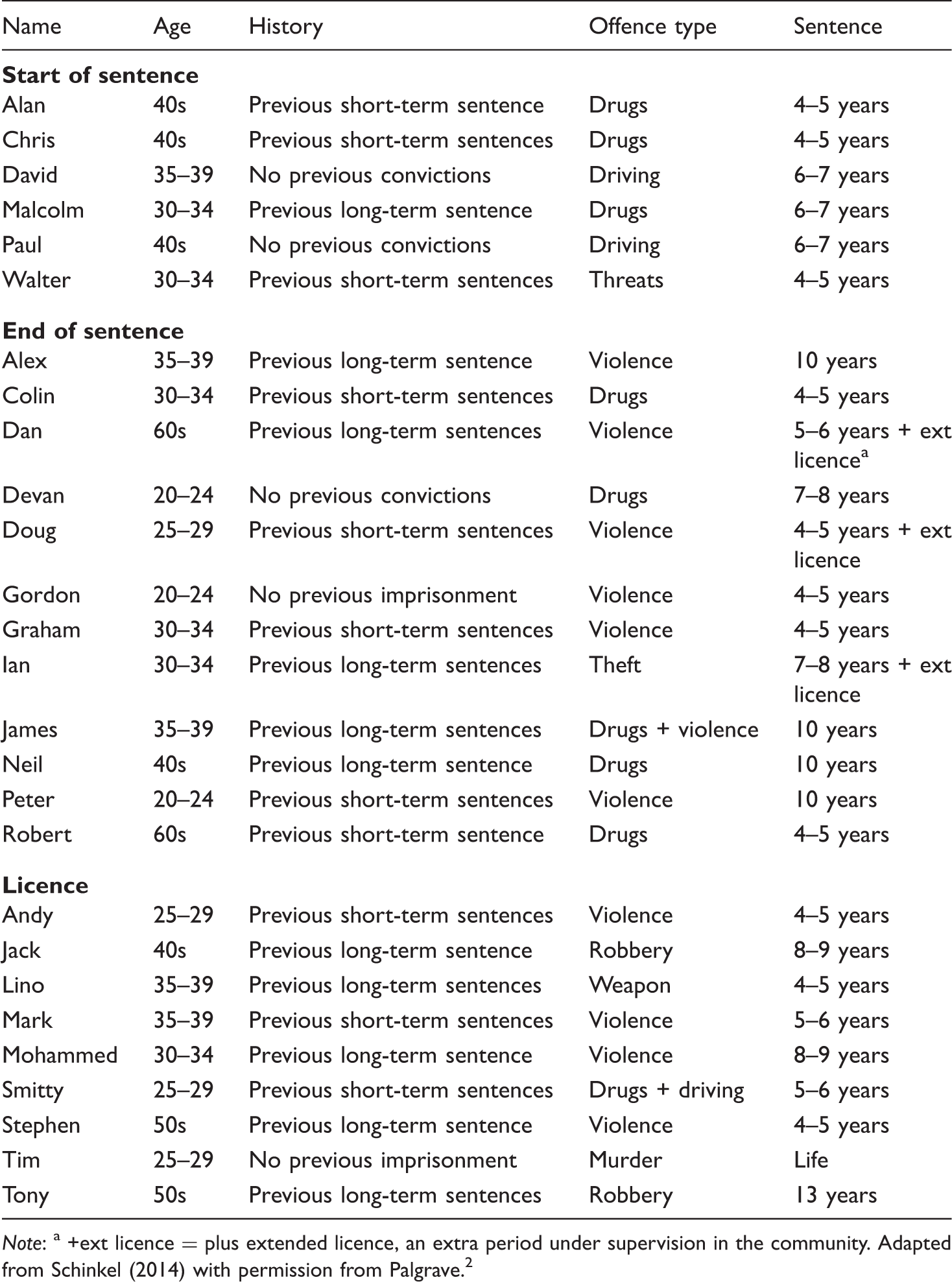
Note: a +ext licence = plus extended licence, an extra period under supervision in the community. Adapted from Schinkel (2014) with permission from Palgrave. 2
Those who were still incarcerated were interviewed in two Scottish prisons, and those on licence in two criminal justice social work offices near Glasgow. Most interviews lasted between one and one-and-a-half hours, with the shortest interview 39 minutes and the longest two hours and 20 minutes. A combined methodology was used for all the interviews. The initial stage of the interviews was narrative, with a focus on the way the men interpreted their sentence and incorporated it in their wider life story. Then, if they had not touched upon questions of legitimacy and purpose, they were asked specifically about these topics through semi-structured questions. This methodology was not meant to uncover ‘what really happened’. It is now well acknowledged that qualitative interviews do not simply transfer information held by the participant on what happened to the researcher (e.g. Holstein and Gubrium, 1997; Riessman, 2008). Instead, interviews are sites of meaning construction, where the active interpretation and selective description by participants of their experiences is influenced by the interview setting, context, audience and issues of what can be remembered and put into words (Polkinghorne, 2007). Issues of memory are especially significant for the men on licence and the men at the end of their sentence. Their descriptions of their experiences of the court case (and, for those on licence, the sentence) may have been less than perfectly accurate, as it is difficult for people to remember their attitudes and beliefs over long periods (Ruspini, 2000). In addition, being interviewed by a researcher, who is ostensibly not herself involved in offending, and the fact that they were interviewed in criminal justice premises, is likely to have put pressure on the interviewees to distance themselves from their past behaviour (see also Presser, 2008). Accordingly, the findings below do not aim to describe actual moral communication that took place in the courtroom or the prison; that is a task for which observational studies are better suited. The men’s recollections of what happened in the courtroom will have been influenced by their subsequent experiences, problems with recall and more active processes of selecting material to fit their view of themselves or their life. But by examining prisoners’ perceptions of moral communication it becomes possible to ascertain the salience of such communication for its recipients and to examine how the pressures of prisoners’ situations, as well as their motivations and (desired) identities impacted on the way they narrated their experiences of moral communication.
Findings
Moral communication was much less salient than most other possible purposes, notably reform, rehabilitation and deterrence, in the interviewees’ accounts. Most of the men did not spontaneously refer to communication at all, and it loomed large as a purpose for only one of the men. In what follows I focus on themes developed across interviews, usually in response to targeted questions about moral communication.
Moral communication in the courtroom
Many of the men remembered the attitude of the judge, if not his or her actual words. More often than one would perhaps expect of long-term prisoners, they felt the judge had shown a (partially) positive attitude towards them. Censure was far from the only content of the communication, nor could the court process often be characterised as a degradation ceremony, in which the whole offender was condemned (see also Daly and Bouhours, 2008; Presser, 2008). In several of the men’s accounts the judge was described as highlighting the positive, rather than censuring conduct: I was expecting him to say like something like ‘this was a brutal, barbaric attack’ or something like that, you know but he never even said anything like that … I can remember him saying ‘it shows here this report that you (.) eehm, (.) it shows extreme remorse’ know what I mean and I can’t remember him saying anything bad about me or anything like that, no. (Doug)
1
Doug and others expected more censure than was delivered. Others even portrayed the judge as being on ‘their side’, describing how the judge’s comments during their court case made it clear that they disapproved of the proceedings. Tim was very young when he was charged with murder and recalled how the judge questioned whether he could have been the sole person responsible for what Tim described as ‘15 to 20 people mobbing and rioting in the street’. Tim portrayed the judge as having been reluctant to imprison him: He said ‘it saddens me tae see two families ruined (2) wi’ this’ and he says ‘I need tae compose myself tae pass this sentence’ so he went away for five minutes and came back after he composed himself and says (3). But he was bound by law that I was found guilty wi’ my peers and he had tae sentence me, so. And that aspect I think that’s how the eight years came into it as well.
Others, like Tim, positioned the judge as being bound by guidelines. Despite the absence of sentencing guidelines in Scotland and the only mandatory sentences being those for murder and third convictions of class A drug offences (Jamieson et al., 2010), several of the men said the judge had no choice in their punishment: M: What do you think the purpose of giving you this prison sentence was for the judge, like why did he give you six years in prison? Paul: Well that’s [clears throat] judging by the crime, that’s the guidelines he’s went with, nothing else (.) guidelines.
This neutralisation of the judge also sheds a different light on the previous paragraphs, which discussed the positive communication and attitude of the judge in some of the accounts. Participants might have selected positive rather than negative aspects of communication, both in what they remembered and what they chose to tell me, because being censured is likely to be painful. The following exchange with Jack shows that, at least sometimes, selective remembering was intentional: M: Did the Judge say anything when he sentenced you? Jack: Not that I can remember no, it’s just like a kinda blank. I kinda just shove that (2) see if you had a wee box in your heid an it was a box that if you fling somethin’ in it never gets opened up again, I have like something like that. I flung it in it and forget/try and just/never, know what I mean, just kid on it never even existed, it never happened and just get on wi it. M: Okay so what kind of things do you put in the box then? Jack: Just like whatever/like ‘aye you’ve got nine year, you’ve been a bloody this and a that to society’ or whatever. Whatever, it just/you know what I mean, he can say whatever else he wants, because I’m no interested. I’m goin’ doon the stair tae get on wi my sentence.
Although Jack was the only one to describe his own defence mechanisms, several others also resisted the judge’s censure. Of those who remembered being censured, most rejected the judge’s moral communication, for different reasons. Some felt that the judge’s reading of the situation in which they had offended was unrealistic. He said ‘taking into consideration the way you’ve been living your life, it’s been on the streets’ and it was/he was like that ‘but you could have walked away from the boy’, even though the boy was shouting and cursing and swearing at a girl I was with, he was like ‘you could have walked away from it, instead of, instead of knocking him out’. (Graham)
Graham disagreed with the judge’s reading of the situation, objecting that it is not possible to walk away when someone is ‘shouting and cursing and swearing’ at a girl. Others rejected the judge’s censure because they felt the judge did not know them sufficiently and only judged them on their record, or because they felt the judge attributed too many harmful consequences to them as an individual (e.g. in relation to drug dealing). It is interesting that censure was resisted even if, as in the example above, the judge condemned the offence committed, but not the whole person, as recommended by Braithwaite (2000) in his theory or reintegrative shaming. Conversely, when the judge engaged in stigmatisation, the condemnation of the offender instead of the offence (Braithwaite, 2000), the men were not always opposed to this, even though it has been predicted this should lead to defiance, especially for poorly bonded individuals (Sherman, 1993). Some of those who did not reject or neutralise the censure directed at them in the courtroom were condemned as people by the judge. James: Where the judge talked to me was in the XTC [ecstacy] one, because he had all the records from the High Courts, all the previous High Courts and he called me an evil man. M: And what did you think of that? James: In a way, aye, you ken what I mean. A lot, a lot of previous, about three or four pages. So in a way, aye.
It is clear, though, that after the initial statement made by the judge, James has had no further input from the criminal justice system in the way he thinks about his crime or punishment. The tentativeness with which he comes to his conclusion strongly suggests that he has never before reflected on the judge’s message despite describing having long stretches of time for reflection in prison, which he saw as having changed him. While censure was evident in the judge’s comments, they seem to have had no further impact on James or his thinking, but instead have been left behind in the courtroom.
Is moral communication in the courtroom possible?
Jack’s earlier quote, where he said the judge ‘can say whatever else he wants because I’m no interested, I’m goin’ doon the stair tae get on wi’ my sentence’ illustrates a problem with moral communication in the courtroom. For those who are expecting and receiving long sentences, there is so much at stake that they are unlikely to hear much beyond how long they have to spend in prison. Devan described vividly the emotional impact hearing his (unexpectedly long) sentence had on him: Judge turns around and looks at me and goes ‘Mr. X, you’re getting (.) seven and a half years’, BOOM. [Laughs.] And I’m that ‘No way’. At that moment in time, I thought he was joking, like. And then, I was frozen, I was still standing up there and he was just talking, talking and talking and saying whatever he was saying. I was just still standing there. I was just like ‘No way, man’.
It is telling that almost all of the men described the moment of sentencing with a sense of real drama. Many struggled with the knowledge they were going to prison for years, even when the sentence was (less than) expected. You’re gutted, but you know it’s going to happen. When you’re out robbing people you know you’re going to jail sooner or later. … But when I got this sentence I was gutted because the wean was only three weeks old at the time. That’s when you realise, you know what I’m talking about? I’m going away for a while, but I don’t think you realise it at the time. (Ian)
Ian’s quote illustrates that there are different ways of ‘knowing’: rationally knowing versus realising viscerally that you will not see your family again; that this is a certainty and no longer just a likelihood. Being shocked, like Devan, or trying to assimilate the emotional reality of an expected sentence, like Ian, means being deaf to anything going on in the courtroom. As Hudson (2002: 631) has noted, what the judge says ‘is almost inevitably lost on the offender as he gives his attention to the sentence’. In order to take on the meaning of a message, in a way that leads to long-term attitude change, the recipient needs to be free of distraction (Petty and Cacioppo, 1986; Petty and Wegener, 1998). This is not true of someone who has just heard they are sentenced to long-term imprisonment.
Furthermore, given the huge personal investment my interviewees had in the outcome of their court case, it is not surprising that they did not submit to the court as a moral arena but tried to manipulate the process in order to minimise their sentence. Lino linked his untruthful ‘not guilty’ plea directly to the length of the sentence he faced: But, there was no way I was daein’ that [pleading guilty], the longest I’d spent in prison was six months I think and that was/that felt like forever so I was like, there was no way I was gonnae put my hands up to this.
The men’s sense that the courtroom did not have any great moral standing was intensified by their view that the lawyers, and even the judges, were playing the same game: Peter: See, if I hadnae pled early, I would have walked fucking the eight year. M: But why is that, usually if you plead early you get less, don’t you? Peter: Aye, you get a third off your sentence, I know, but because they’d heard I’d put in an early plea, they put my sentence up.
This replicates Casper’s (1972) finding that judges and prosecutors, like the police, were seen by defendants as workers who sometimes take shortcuts, rather than neutral or impartial actors and Ugelvik’s (2013) finding that remand prisoners in Norway constructed the criminal justice system as an adversary that does not play by its own rules. Carlen (1976), in an observational study, found that court personnel often colluded with each other and were more concerned with their own standing than with the case. This collusion of professionals was recognised by Devan, who felt this, along with much of what went on in court, made for an unfair system: Because, another thing that is crazy about this system and how things are up here are/I know you and you know me, right, for instance. I represents the defendant, you represents the Crown, the prosecutor. Me and you work in the SAME office, right? We go to the same nightclubs or whatever, we go to the same bars or whatever. I actually speak to you ALL THE TIME. I actually know you, we’re friends, and YOU’RE UP AGAINST ME. Is that not a JOKE AND A HALF, man?
When court actors attempt to manipulate outcomes, bargain with the defendant for a guilty plea or collude in a visible way, this not only reduces the moral standing of the courts in offenders’ eyes, but also problematises the communication of censure through sentencing. Weijers (2004) has noted that moral communication is less likely to take place in an adversarial system than in an inquisitorial system, because in the former most of the proceedings take the form of a contest between prosecutors and defenders. In this research, some of those who had been defendants positioned themselves, too, as active participants in the court contest. But the more courtroom proceedings become (or are interpreted as) an adversarial game, the weaker any moral communication becomes. How the moral element is lost is clearly described by Mohammed: I think at the time during the trial, all I’m interested in is getting away wi’ it. It’s after the trial’s done wi’ and you’re doing the time and you kinda look at it and you think ‘that was a lot more serious than I kinda thought at the time’.
If the sentence is settled upon for reasons of expediency (avoiding the expense of a trial) or through manipulation of the rules and processes by court actors (as well as defendants themselves), then the link between the amount of censure inherent in the sentence and the initial offence is surely lost.
There are three main reasons, then, why moral communication is problematic in a court with the power to impose long-term prison sentences. So much depends on the exact length of the sentence and the emotional impact of being imprisoned is so great that the offender is unlikely to attend to any moral comments made by the judge. Second, the stakes are so high that offenders are highly tempted to manipulate the outcome, thereby rejecting the moral dimension of court proceedings. Finally, analogous manipulation by court actors lessens the moral standing of the court and diminishes the extent to which the sentence can be seen as censure deserved for the initial offence. With the court such a problematic site of moral communication, the next section examines whether the moral dimensions of crime and punishment were more successfully explored within the prison.
Moral communication in prison
Most interviewees commented that the only time their offence, their sentence and questions of morality were discussed within the prison was during cognitive behavioural courses. For example, Dan said ‘the only people who spoke to me about my offence here were the people in the courses’. Some of the men had not been assessed as needing these, and were therefore left without any discussion of moral questions or the meaning of their sentence. Robinson (2008: 438) has argued that some of the cognitive behavioural courses used in criminal justice aspire to Duff’s ‘transparent persuasion’: censure of the offending behaviour is expressed and offenders are encouraged to reflect morally on their offence. However, the fact that attendance of courses is made compulsory for progression within the prison means that real persuasion is problematic (see also Schinkel, 2014). Most of the men reported only attending them to secure their progression within the prison: No, it’s sort of that, up there, it’s just a numbers game. And they sort of try to frighten you with, you don’t do that, you don’t get your parole. People do it and people just go on and sit in a class and just say nothing. And they cannae do nothing because the boy’s just sitting there, y’know. (Graham)
By making courses compulsory for progression, formal compliance (meeting the minimum requirements, i.e. ‘just sitting there’) rather than substantive compliance (actively engaging with what is on offer) (Robinson and McNeill, 2008) is encouraged.
The general absence of an intentional and meaningful dialogue about crime and punishment initiated by prison staff is best illustrated by some of the men’s comments on the experience of being interviewed. For example, Alan said ‘you’ve listened to me but I don’t get asked these questions anywhere else in the jail so nobody really (.)’. This silence around questions of wrongdoing and legitimacy of punishment (which has also been noted in the French context (Herzog-Evans, 2011)), makes it very easy for prisoners not to engage with these questions.
A further limiting factor on moral communication taking place within the prison was the way in which the men adapted to their prison sentence. In order to make bearing their confinement easier, the men adopted a strategy of ‘getting your head down’ – limiting thoughts to events within the prison. As Doug said ‘when you’ve got years tae go and you just don’t think aboot it and it’s just (.) your head’s in here, this is your life in here you know what I mean, in this wee small surrounding’. This strategy included accepting one’s sentence: You have to say ‘this is it, this is me for the next x amount of years, I’m not going out anyway, so (.), you know, just get on with it, try to make the best of it. (Neil) It’s still fair, I’m here, I’m doing it. It doesn’t have to be fair, that’s how I’m dealing with it. (Peter, emphasis added)
As Peter’s quote illustrates, however, this strategy had the effect of further silencing normative questions around their offence and their sentence. Because there was such pressure on the men to accept their sentence in order to make surviving it easier, this acceptance was decoupled from their thoughts on their crime and punishment. Even those who maintained they were innocent nevertheless acquiesced in their sentence by linking it to past or possible future wrongdoing: Maybe a sentence was just waiting to happen. Maybe no/maybe not as much or as long a sentence, but with the crowd I was running about with at the time, pretty much, see, there was maybe a sentence in the making, you know what I mean? (Gordon)
None of my interviewees perceived the communicative meaning of a need for exclusion that Duff ascribes to prison sentences. Why this might be the case can be usefully explored by referring to the men’s views on incapacitation. Incapacitation was only perceived by the men as a purpose of their imprisonment when they saw themselves as dangerous, or when it was explicitly mentioned as a purpose by the court, as illustrated by the following two quotes: I think my sentence at the time did achieve its purpose, they just wanted me off the street at the time, cause AT THE TIME I was very dangerous. (Stephen) That was in the judge’s report, basically if I’m locked away then the public has less chance of getting harmed. And the witnesses or whatever. (Gordon)
Perceptions of other purposes were also generally due to either a perception of need (notably rehabilitation and reform) or information from other sources, usually the judge’s comments or the court report. As none of the court actors or reports framed the sentence as communicating a need for exclusion, none of the men were induced by the court to see their sentence as such. And while some of the men felt they needed to be incapacitated because of what they might otherwise do, none saw themselves as needing to be excluded because they had already broken the bonds of society. It is likely that this is at least in part because this conceptualisation of imprisonment is not part of the public discourse and common understandings of criminal punishment. However, it may also be because the men, like many in relation to incapacitation, had no reason to see themselves as needing to be excluded (see below).
Conclusion
This article has looked in some depth at the way in which long-term prisoners’ accounts of their sentence resonated with portrayals of criminal punishment as moral communication. It has highlighted important aspects in which current practice and Duff’s theory of punishment diverge. First of all, little explicit moral communication was perceived by the men. They described any moral dialogue and censure as patchy at best and there was no consistent moral message attached to long-term imprisonment. My interviewees had had very little guidance in thinking about their crime and their punishment, instead being left to create their own meanings. The findings here furthermore suggest that any censure in the courtroom is unlikely to be taken on board, at least when long-term sentences are imposed. Moral censure from the judge was generally either not perceived (sometimes wilfully so) or opposed. Moreover, with long-term prison sentences looming, the men were not able or willing to pay much attention to moral communication or to engage with the court as a moral arena.
Within the prison, the only consistent communicative input came from structured group-work programmes. The question is whether moral communication should be delivered solely through such programmes. Burnett (2004) has argued for a return to one-to-one counselling for offenders in order to support the desistance process. More one-to-one input would also seem welcome in order to get prisoners to reflect on their sentence and to give it a meaning within their lives. However, the extent to which moral communication could be delivered through long-term sentences was limited by the adaptation strategy adopted by the men. In order to cope, they shrunk their world down to the prison walls and accepted their sentence. The importance of accepting the sentence in this context means that any discussion that leads to a more critical understanding of the sentence would either be resisted or make the sentence harder to bear. In the case of the former, the communication will not have had an impact; in the case of the latter it will exacerbate the pains of imprisonment precisely for those who have reason to oppose it, which cannot be a desired outcome. I do not want to suggest that the adaptation process described here is necessary for all (long-term) prisoners. Different prisons and different conditions within them will support different adaptations. For example, Liebling et al. (2011) have recently described how prisoners in Whitemoor, where surveillance was all-pervasive and staff–prisoner relations poor, tried to forget they were in prison as much as possible, rather than forgetting the outside world. They also were much more likely than my interviewees to oppose their sentence. Similarly, remand prisoners in Norway, who are still involved in an adversarial process with the criminal justice system generally saw the system in negative terms (Ugelvik, 2013). What this shows, though, is that different forms and environments of imprisonment create their own pressures, which are likely to take precedence over the need to reflect on the punishment in relation to the crime committed. This means that such sentences are less than ideally suited for the communicative purpose ascribed to them by Duff (2001). Applying Duff’s theory in the ‘real world’ of sentencing might require us to cap explicitly the length of imprisonment that can be imposed, as this article has shown that longer sentences create emotional reactions and pressures to cope that overshadow any communication inherent in the sanction. Duff’s (2001: 151, emphasis in original) characterisation of three years’ imprisonment as a ‘very harsh punishment’ shows that a limit on the length of sentences is already evident in his work, if not explicit.
Furthermore, for current practice to come closer to realising Duff’s theory, the findings reported here suggest court processes and the content of prison sentences would need to be changed. If the court is to be experienced as a moral arena, its processes need to be re-imagined so that the outcome is more straightforwardly related to the offence. The adversarial nature of the process, plea-bargaining, giving time off for an early guilty plea and other elements would have to be re-considered, and there could be greater involvement of the offender in the determination of the appropriate punishment (Weaver, 2009). Equally, the moral-dialogical aspect of punishment might need to be more carefully attended to in the execution of sentences, perhaps as an alternative to pedagogical forms of rehabilitation. Even in the context of shorter sentences, a facilitated dialogue about the moral connection between crime and punishment could complement the court process in facilitating moral reflection, without making this overly painful for those for whom this connection is less secure.
Most seriously, however, current practice falls short of Duff’s theory in the kinds of offences for which imprisonment is imposed. Duff (2001: 151) has not attempted to define precisely what offences break the bonds of community to the extent that communicating a need for exclusion is appropriate. He writes: Any answer depends on the community’s understanding of what kinds of wrong make community impossible. But that understanding can change, and itself depends not merely on the character of the wrongs involved but on the willingness of other members of the community to live with those who commit them. To suggest that those who have been systematically excluded or unjustly disadvantaged may not be bound by the law … is not to suggest that their criminal actions are justified, permissible or excusable … It is, rather, to suggest that their actions are not wrong qua criminal: that they are not to be judged (justified, excused, or condemned) by the law, in terms of its demands and requirements.
For both these groups of men, then, imprisonment as an expression of their wrongdoing, intended to make them reflect and repent, cannot justify their sentence, according to Duff’s theory. Sentencing will need to be re-examined, and the systematic exclusion of those who (go on to) offend taken more seriously, so that it is only those who have been sufficiently part of the community and committed acts that merit exclusion from this community who are imprisoned.
Footnotes
Funding
This work was supported by the Economic and Social Research Council [ES/G013012/1].
Acknowledgements
I would like to thank Fergus McNeill, Richard Sparks and Bill Whyte for their insights and helpful comments on earlier versions of this article and Antony Duff for sparking my interest in the rights (and wrongs) of punishment. Thanks also to the (ex)prisoners and criminal justice staff without whom the research would have been impossible.