




Abstract
This article examines the meaning of ‘public authorities’ under the Environmental Information Regulations 2004 (EIR) since 2015, when it was decided in Fish Legal that private water companies in England and Wales are public authorities for EIR purposes. Whilst that decision was considered a victory for transparency as it now means that private water companies have a legal obligation to provide access to environmental information, this article argues that the tests established in Fish Legal have introduced a high threshold that relatively few other private bodies have met, despite performing what are arguably public functions. As a result, access to environmental information is effectively limited due to the increasing participation of the private sector in delivering public services. Through an examination of the decisions taken since Fish Legal, this article exposes the limitations of the current functional approach to designation and argues that a renewed approach to environmental transparency is needed to ensure that information and participation rights are not diminished by privatisation.
Keywords
Introduction
Public access to environmental information is fundamental in supporting public participation in environmental governance. 1 Based on the principle that environmental protection is the responsibility of all, access to information enables people to fulfil their duties to protect the environment for present and future generations. 2 Access to information also supports the right to a healthy environment by conferring a procedural mechanism to facilitate public participation in environmental matters. In England, Wales and Northern Ireland, access to environmental information is governed by the Environmental Information Regulations 2004 (EIR). 3 The EIR apply to public authorities, as well as to private bodies that perform functions of public administration 4 or are under the control of a public authority and have responsibilities for functions or public services relating to the environment. 5 This broad, functional approach was designed to ensure that privatisation does not interfere with access to information when public functions are performed by private actors. 6
The boundaries of the functional approach were clarified in 2015, when the Upper Tribunal (Administrative Appeals Chamber) determined in Fish Legal v Information Commissioner that private water companies in England and Wales are subject to the EIR, 7 effectively overturning a previous decision that they were not. 8 The decision was considered a victory for transparency, as it imposed a legal obligation on private water companies to provide environmental information within the framework of the EIR. However, subsequent decisions have demonstrated that the tests established in Fish Legal for determining whether a private body falls within the scope of the EIR have created a high threshold for other private bodies to meet. 9
This article examines the application of the tests established in Fish Legal, arguing that they have led to a narrow interpretation of the meaning of ‘public authority’ under the EIR that effectively limits access to environmental information in an era characterised by privatisation and outsourcing. It further argues that this narrow interpretation is incompatible with the original intention for the EIR to apply broadly to private bodies delivering public services or performing functions of a public nature related to the environment. 10 By examining the normative underpinnings of the EIR alongside the post-Fish Legal decisions concerning the meaning of public authority, this article demonstrates that the narrow interpretation is unduly restrictive and calls for a renewed approach to maximise access to environmental information in the public interest that is less dependent on the institutional characteristics of the service provider.
The rest of the article is divided into five sections. The Right to Environmental Information section examines the legal background to the EIR and the normative justifications for the right to environmental information. Establishing the Tests: Fish Legal and Cross section provides an overview of the Fish Legal judgments, focusing on the development of the ‘special powers’, ‘control’ and ‘entrustment’ tests. Public Authorities after Fish Legal section provides a comprehensive analysis of the Information Commissioner (ICO) decision notices since 2015 that engage the relevant EIR provisions, that is, Regulation 2(2)(c) and Regulation 2(2)(d), along with the appeals where applicable. It argues that the ‘Fish Legal tests’ have led to a restrictive interpretation of the meaning of ‘functions of public administration’ that limits public access to information. Discussion section considers the wider implications of this restrictive approach, and the Conclusion section concludes with a call for a renewed approach to the classification of public functions so that access to information is not eroded by privatisation, in keeping with the stated aims of the Aarhus Convention. 11
The right to environmental information
The contemporary right to environmental information can be traced to the early 1990s with parallel developments at the international 12 and European Union (EU) levels. 13 Principle 10 of the Rio Declaration on Environment and Development 1992 (hereafter ‘Rio Declaration’) states that all individuals ‘shall have appropriate access to information concerning the environment that is held by public authorities’. Its underlying rationale is that environmental protection is the responsibility of everyone, 14 and effective participation necessarily requires information so that we can scrutinise policies, make informed decisions, and hold public and private actors to account, for example, for failures to comply with environmental regulation. Although it is not legally binding, the Rio Declaration has played a significant role in establishing the conceptual link between the right to information and the right to a clean and healthy environment. The Rio Declaration also laid the foundation for the Aarhus Convention on Access to Information, Public Participation in Decision-making and Access to Justice in Environmental Matters (hereafter ‘Aarhus Convention’). 15
The Aarhus Convention was introduced by the United Nations Economic Council for Europe (UNECE) in 1998. It is comprised of three pillars: the right to receive information that is held by public authorities, the right to participate in environmental decision-making, and the right to review and challenge public decisions made without respecting environmental law. 16 Building on Principle 10 of the Rio Declaration, access to information is positioned as a prerequisite to support public participation in environmental matters, based on the assumption within the Convention that ‘there is an implicit moral duty imposed on all individuals to protect and enhance the environment for present and future generations’. 17 In addition to this duty, the Convention declares that a healthy environment is a human right. 18
The Aarhus Convention was signed by the European Community in 1998, and the European Directive 2003/4/EC on public access to environmental information implements the Convention within the European Union. The Directive is incorporated in the United Kingdom by the EIR and the Environmental Information (Scotland) Regulations 2004 (EISR). The EIR and the EISR remain in force as retained EU law following the UK's withdrawal from the EU in 2020. 19
Access to environmental information and private bodies
Significantly, the Aarhus Convention was drafted to apply to public authorities, but not to private bodies. 20 The underlying rationale is that state actors and public authorities hold environmental information on behalf of the public and in the public interest. 21 Public authorities are considered to be custodians of information; therefore, the public should have the right to access information that will enable them to participate in environmental governance. 22 Public participation is thought to improve the quality of decision-making as well as enhance its legitimacy through the inclusion of diverse contributions. 23 On the other hand, private bodies like commercial businesses are accountable to their shareholders and hold information for their own private interests. The Aarhus Convention was never intended to apply to purely private entities. 24
However, the widespread privatisation of public services that has taken place in recent decades means that many of the functions once performed directly by the state are now performed by private actors, including private voluntary organisations and for-profit businesses. Within the UK, these privatisations have included telecommunications, energy, aviation, and the water industry in England and Wales. 25 Privatisation in the UK has involved ‘traditional’ forms of privatisation (i.e. the sale or transfer of public industries and assets to the private sector), as well as outsourcing and the use of public–private partnerships to deliver public services. 26 What each type of privatisation has in common is the rolling back of the state and the embedding of private sector principles in public services. Moreover, these diverse forms of privatisation have complicated the application of public law instruments to private actors. Whilst legal mechanisms have developed to ensure that private actors delivering public functions or services have the same obligations as their public sector counterparts, it is not always clear whether private service providers will fall within their scope, largely due to difficulties on the part of the judiciary in identifying what constitutes a ‘function of a public nature’. 27
To address the challenges posed by privatisation and the fact that many public services are carried out by entities other than ‘traditional’ public authorities, the Aarhus Convention defines ‘public authorities’ broadly to include ‘natural or legal persons performing public administrative functions under national law’, 28 as well as persons ‘having public responsibilities or functions, or providing public services, in relation to the environment’ and under the control of a public authority. 29 This suggests that the intention was for the Aarhus Convention apply widely so that private bodies providing public services related to the environment, such as water or electricity companies, would be required to comply. Indeed, the (non-binding) Implementation Guide that accompanies the Convention has explained that ‘the Convention tries to make it clear that such innovations cannot take public services or activities out of the realm of public information, participation or justice’. 30 In other words, the Aarhus Convention was drafted with knowledge of the potential challenges that can arise from privatisation and therefore designed to ensure that private bodies delivering public services would have the same transparency obligations as public authorities delivering the same services. As Jonas Ebbesson later observed, this broad formulation of ‘public authority’ apparently makes the Convention ‘surprisingly resilient to privatisation’. 31 However, as this article will demonstrate, the EIR are perhaps less resilient than initially thought.
The EIR define ‘public authority’ very similarly to the Aarhus Convention, as follows:
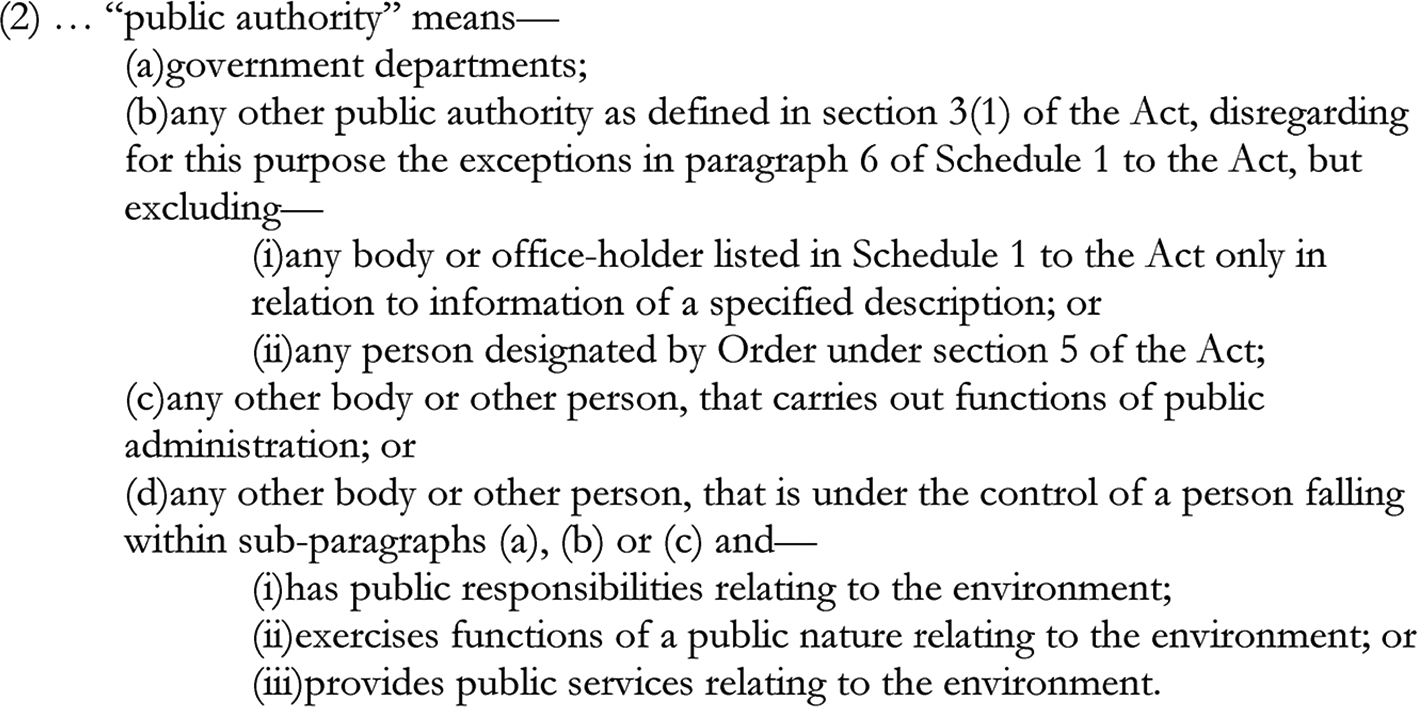
Regulations 2(2)(c) and 2(2)(d) reflect the stated aim within the Implementation Guide to ensure that privatisation does not interfere with public access to environmental information. Indeed, the ICO has recognised that the scope of the EIR is broader than that of the Freedom of Information Act 2000 (FOIA), which applies to designated public authorities. 32 Under FOIA, public authorities are listed in Schedule 1 of the Act, and although there is a mechanism under s 5 to extend FOIA to private bodies that exercise ‘functions of a public nature’, this mechanism has been used on relatively few occasions and after lengthy consultations. 33 By contrast, the functional approach to the EIR was understood to be more flexible, allowing for private bodies with responsibility for public functions to be classified as functional public authorities under either Regulation 2(2)(c) or 2(2)(d) without the need for formal designation.
However, the reality is that the meaning of ‘public authority’ under the EIR has been interpreted narrowly following the Fish Legal judgment, when the Court of Justice of the European Union (CJEU) established the ‘control’ and the ‘special powers’ tests for determining which private bodies fall within the scope of the Regulations. 34 Indeed, the private bodies that are most likely to meet the criteria are those privatised bodies resulting from ‘traditional’ forms of privatisation in the UK, such as the water industry (privatised in England and Wales in 1989) and the energy industry (privatised in 1986). This form of privatisation, however, does not reflect the current landscape of public service delivery, which is characterised by diverse forms of ‘privatisation’, including outsourcing and public-private partnerships. Under these forms of privatised delivery, private entities often wield significant decision-making powers, are in receipt of substantial public funds, and are engaged in matters of public policy, such as social housing, urban regeneration, and environmental protection. As the decisions analysed in Public Authorities after Fish Legal section will demonstrate, tests based on the traditional understanding of privatisation are not adequate in the modern landscape of public services and hybrid functions, and the result is that environmental information in the public interest is at risk of becoming inaccessible to the public.
Establishing the tests: Fish Legal and Cross
Fish Legal concerned the question of whether private water companies in England and Wales are public authorities under the meaning of the EIR. Previously, the Upper Tribunal (UT) had held in Smartsource that the private water companies were not public authorities because they do not have the necessary characteristics. 35 Adopting a factor-based approach, the UT reasoned that the water companies are not responsible for setting health and safety standards, do not receive public funding, and do not have government nominees on their boards of directors. 36 Therefore, they did not perform public functions and could not be subject to the EIR. The Smartsource decision received significant criticism at the time, both for the substantive outcome that restricted transparency within the privatised water industry and for the factors that the UT took into consideration. 37 Arguably, these factors put greater emphasis on the institutional characteristics of the water companies, such as the composition of the board of directors, rather than on the nature of the functions that they perform.
In Fish Legal, however, the UT rejected the factor-based approach when considering whether the private water companies are subject to the EIR. 38 Instead, the UT referred five questions to the CJEU, three of which are relevant here. 39 The first two questions concerned the meaning of ‘public administrative functions’ and the criteria for determining what these are. The third question concerned the meaning of ‘control’ in the context of Regulation 2(2)(d) and whether it differed from ‘regulation’.
In response, the CJEU reasoned that ‘organic’ public authorities are those that ‘form part of the public administration or the executive of the State’, that is, core public authorities that are governed by public law. 40 On the other hand, ‘functional’ public authorities for EIR purposes are those that have been entrusted under the relevant national legal regime with the ‘performance of services of public interest, inter alia, in the environmental field, and which are, for this purpose, vested with special powers beyond those which result from the normal rules applicable in relations between persons governed by private law’. 41 In other words, it is not enough for the authority in question to be entrusted with the performance of services in the public interest; they must also exercise ‘special powers’ in performing these services.
Following the CJEU judgment, the matter was passed back to the UT, who determined that the private water companies exercise ‘special powers’ because they exercise powers beyond those that are normally granted in private law. 42 For example, the water companies have compulsory purchasing powers, the right to issue temporary hosepipe bans, and the right to decide whether to cut off customers’ water supply (subject to strict conditions). Therefore, the UT concluded that the private companies are functional public authorities under Regulation 2(2)(c). Because entities can exercise diverse powers, it is not possible to devise a comprehensive list of ‘special powers’. Instead, the UT explained that the relevant question is: ‘Do the powers give the body an ability that confers on it a practical advantage relative to the rules of private law?’ 43
With regard to the meaning of ‘control’ under Regulation 2(2)(d), the CJEU reasoned that this will only apply when the authority in question does ‘not determine in a genuinely autonomous manner the way in which they provide…services’. 44 Taking this definition into account, the UT concluded that neither the Secretary of State for the Environment nor Ofwat 45 exert a level of control over the water companies that prevents them from operating in a genuinely autonomous manner. 46 Although the water companies are subject to strict regulation, the UT reasoned that the regulatory regime reflects the fact that the water companies are effective monopolies because customers cannot simply switch supplier. Therefore, the regulatory framework exists to ensure competition and protect consumer rights in the absence of a free market. However, the UT concluded that this regulatory framework does not indicate that the water companies are under the ‘control’ of Ofwat as it does not prevent them from carrying out their core operations in an autonomous manner. In making this decision, the UT acknowledged that the threshold for meeting the so-called ‘control’ test is high and very few commercial companies are likely to meet it. 47 Commercial companies tend to operate autonomously, with an independent governance structure, and are subject to company law. 48 It is unlikely that many commercial bodies will be influenced by a public authority to such an extent that they are prevented from operating in a genuinely autonomous manner. Indeed, as Public Authorities after Fish Legal section will demonstrate, the decisions taken since Fish Legal show that none of the entities in question have met this threshold. 49
Cross v Information Commissioner and the Cabinet Office
Fish Legal established the so-called ‘control’ and the ‘special powers’ tests. The Cross decision clarified that there is a third and separate test – the ‘entrustment’ test – to determine whether a private company can be deemed a public authority under the EIR. 50 The case considered the question of whether the Royal Household is a public authority for EIR purposes. The ICO's decision that the Royal Household is not a public authority was appealed to the UT, 51 and the case was stayed pending the outcome of Fish Legal.
In applying the ‘special powers’ test, the UT said that to meet the definition of public authority under article 2(2)(b) of Directive 2003/4/EC, the services of public interest and the special powers ‘must be entrusted to and vested in the relevant entity by the legal regime applicable to that entity’. 52 In other words, it is not enough that a private body is exercising powers not normally available in private law. They must also be entrusted with the power to do so by the applicable legal regime. This means that there needs to be a sufficient link between the functions that have been entrusted to the authority in question and the functions of the state. Without this link, it is unlikely that the environmental information will be disclosed, even if there is strong public interest in disclosure. 53 In Cross, the link was not present, and the UT held that the Royal Household is not a public authority under the meaning of the EIR. 54
To sum up so far, the CJEU in Fish Legal established that there are two tests determine whether a private body under the EIR: the ‘control’ test and the ‘special powers’ test. In Cross, the UT clarified that ‘special powers’ and ‘entrustment’ are two distinct concepts. 55 Both criteria must be present for a private body to meet the definition of public authority under Regulation 2(2)(c). As the next section will demonstrate, this distinction has been key in the narrowing of the scope of the EIR.
Public authorities after Fish Legal
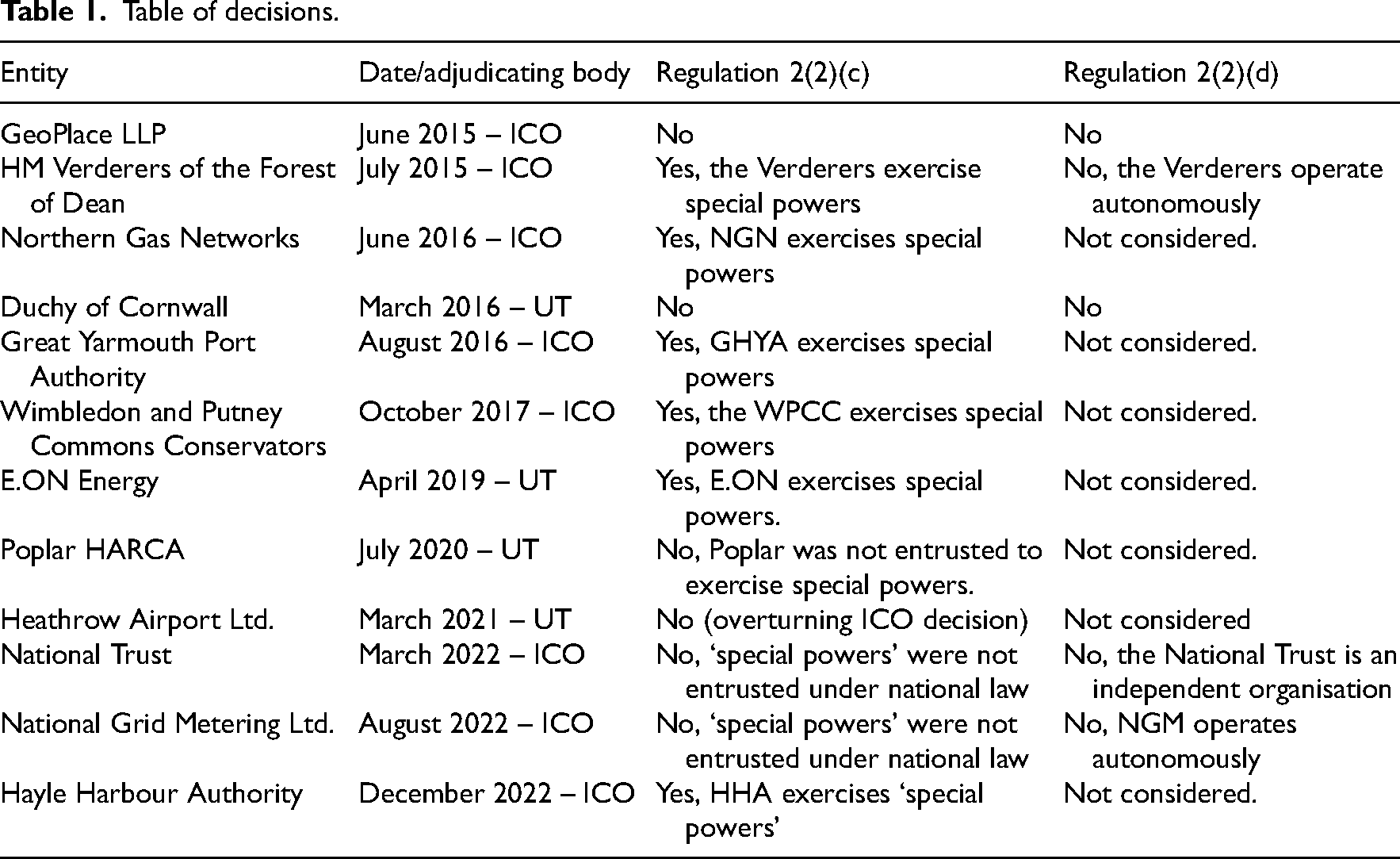
Since Fish Legal and Cross, there have been some ‘mixed messages’ regarding which private bodies fall within the scope of the EIR, in part due to divergent applications of the tests. 56 The aim of this section is to systematically analyse the decisions that have been taken since Fish Legal concerning the meaning of public authority under the EIR. These were identified by searching the ICO's online decision notices database for all decisions involving either Regulation 2(2)(c) or Regulation 2(2)(d), up until 1 July 2024. 57 There are twelve in total.
Table 1 summarises the outcome in each decision. Where a decision has been appealed to either the First-tier Tribunal or Upper Tribunal, the table reflects only the highest-level decision.
Table of decisions.
Geoplace LLP
GeoPlace LLP was established in 2010 as a public sector limited liability partnership (LLP) between the Local Government Association and Ordnance Survey to produce and maintain geospatial information, including the National Land and Property Gazetteer (NLPG) and the National Street Gazetteer (NSG). 58 In response to an information request, GeoPlace explained that the NSG is only accessible to statutory undertakers or contractors carrying out street works, and not to the general public. 59 The requester argued that since GeoPlace is a public sector partnership, it is subject to the EIR and FOIA and therefore should disclose the requested information. 60
The complainant initially contacted the ICO in 2014, who advised that the complaint wait until after the conclusion of the Fish Legal case. 61 When the complainant contacted the ICO again in 2015 to complain about the way the information request had been handled by GeoPlace, the ICO had the opportunity to apply the Fish Legal tests for the first time. The ICO concluded that GeoPlace does not exercise any ‘special powers’ that would bring it within the scope of Regulation 2(2)(c). 62 It is largely responsible for maintaining databases under contract, and it has not been granted any powers beyond those ordinarily exercised in private law. Similarly, the ICO concluded that GeoPlace does not fall within the scope of Regulation 2(2)(d). 63 It is a limited liability partnership jointly owned by Ordnance Survey and the Improvement and Development Agency for Local Government, trading as Local Government Improvement and Development (LGID). Although OS is a public authority under the EIR, the LGID is not. Therefore, it could not be said that GeoPlace is under the ‘control’ of a public authority because it is jointly owned and operated. 64
This decision makes an interesting starting point as it clarifies the boundaries of the EIR, indicating that the mere existence of a partnership between the public and private sector will not be sufficient for the private actor within the partnership to be deemed a ‘public authority’ within the meaning of the EIR. Whilst GeoPlace's business model means that it does obtain data from public authorities, the commercial product that it develops from that data is not subject to disclosure under the EIR. This raises questions about the repurposing of public sector data for commercial purposes, but in the circumstances of the complaint, it is reasonable to conclude that this is not the type of private actor that the EIR was drafted to capture.
HM Verderers of the Forest of Dean
In 2014, the ICO decided that HM Verderers of the Forest of Dean (hereafter ‘the Verderers’) are not a public authority under the EIR, in response to an information request about plans to increase the population of feral boar in the Forest. 65 However, the complaint was resubmitted and considered as a new complaint following the Fish Legal judgment.
Applying the ‘special powers’ test, the ICO decided that the Verderers fall within the scope of Regulation 2(2)(c) because they advise on and have the ability to influence decisions related to planning, regeneration, local mining, and the construction of byelaws to govern the Forest. 66 The Verderers have a long history going back to the thirteenth century and have responsibility for managing land within the Forest of Dean. 67 The role of the modern Verderers is set out in various statutes, including the Dean Forest (Timber) Act 1808 and the Forestry Act 1981. Despite the fact that this modern legislation has curtailed the role of the ancient Verderers and they no longer exert the same level of power as they did in Norman times, they still exercise significant powers beyond those normally enjoyed by private landowners. 68 However, the ICO decided that the Verderers are not public authorities under Regulation 2(2)(d) as they carry out their functions autonomously and therefore are not under the ‘control’ of a public authority. 69 This decision highlights the influence that the Fish Legal tests have had on the ICO's decisions, and, in this case, allowed the ICO to reconsider a previous claim and take a more expansive approach based on the Fish Legal outcome.
Northern Gas Networks Limited
This decision concerned the question of whether Northern Gas Networks Limited (NGN) is a public authority under Regulation 2(2)(c). 70 NGN is one of eight gas distribution companies in the UK and has responsibility for delivering services to 2.7 million residential and commercial customers in the north of England. 71
Because NGN has legal obligations under the Gas Act 1986 to develop and maintain a gas pipeline, the ICO was satisfied that NGN has been entrusted under national law to provide services in the public interest. 72 With reference to the special powers that had been identified in Fish Legal, the ICO concluded that NGN also exercises special powers. These include the powers it has been granted by the 1986 Act to enter onto land for inspections, compulsory purchase powers to develop a pipeline system, and powers to lay pipes in streets. 73 As these powers confer a practical advantage on NGN, the ICO decided that NGN is a public authority within the meaning of Regulation 2(2)(c). 74 The ICO did not go on to consider Regulation 2(2)(d). 75
The Duchy of Cornwall
In Attorney General for the Prince of Wales v the Information Commissioner and Mr Michael Bruton, 76 the Upper Tribunal decided that the Duchy of Cornwall is not a public authority for EIR purposes, thereby overturning a 2011 decision by the FTT that the Duchy is subject to the EIR. 77 The Duchy of Cornwall is a Crown body responsible for the management of approximately 135,000 acres of land, primarily in southwest England. 78 Since the fourteenth century, the title Duke of Cornwall and possession of the Duchy has been inherited by the eldest son of the reigning British monarch. 79 Over time, the Duchy has taken on ostensibly public functions, such as serving as the statutory harbour authority for the Isle of Scilly. 80 Adopting the Smartsource factor-based approach, the FTT had concluded that as a statutory harbour authority, the Duchy carried out functions of public administration and therefore was a public authority under the meaning of Regulations 2(2)(c) and 2(2)(d). 81
However, following the Fish Legal and Cross decisions, the UT determined in an appeal that the Duchy does not exercise ‘special powers’ within the meaning of Regulation 2(2)(c). 82 Ultimately, the UT concluded that the Duchy does not carry out functions of public administration, except in relation to its role as the harbour and lighthouse authority on the Isles of Scilly. 83 In that capacity, it is subject to the EIR. However, in its capacity as a private landowner, the Duchy does not have a general obligation to provide access to environmental information.
Great Yarmouth Port Authority
Great Yarmouth Port Authority (GYPA) is a statutory port authority with responsibility for administering the Port of Great Yarmouth. 84 In deciding that GYPA exercises special powers, the ICO reasoned that it has statutory duties under the Harbours Act 1964 and Great Yarmouth Port Authority Act 1886 to keep the port open, as well as the authority under s 4 of the Great Yarmouth Port Authority Act 1990 to close quayside lands and suspend public rights of way, and the power under the Harbour Docks and Piers Clauses Act 1847 to remove vessels. 85 Reiterating the principle that an organisation need only have one ‘special power’, and designation does not depend on whether those powers are exercised frequently, the ICO concluded that GYPA is a public authority within the meaning of Regulation 2(2)(c) as it has clearly been entrusted under statute to exercise special powers not ordinarily exercised in private law. 86 The ICO did not consider Regulation 2(2)(d).
Wimbledon and Putney Commons Conservators
The ICO followed its reasoning in the Verderers decision to determine in 2017 that Wimbledon and Putney Commons Conservators (WPCC) also exercises ‘special powers’ within the meaning of Regulation 2(2)(c) and is therefore subject to the EIR. 87 The WPCC is responsible for managing Wimbledon and Putney Common, a public park in southwest London. The WPCC was established under the Wimbledon and Putney Commons Act 1871 and is primarily funded through council tax paid by residents of three neighbouring boroughs. 88
Given that WPCC is clearly acting in the public interest under national law, the key question for the ICO was whether it was exercising ‘special powers’. 89 Citing Fish Legal, the ICO noted that the WPCC has the power to make byelaws 90 and to set and enforce a levy to collect funds for its operation. 91 With reference to the Verderers decision, the ICO reasoned that WPCC had similarly been established by statute to manage a particular area of land, and the range of powers it had been granted to carry out those functions meant it falls within the scope of Regulation 2(2)(c). 92 The ICO did not consider whether WPCC falls within the scope of Regulation 2(2)(d).
Poplar HARCA v Information Commissioner
Poplar Housing and Regeneration Community Association Ltd. (hereafter ‘Poplar’) is a social housing association set up in 1998 by the London Borough of Tower Hamlets to transfer its housing stock and to regenerate the local area. 93 Poplar currently owns and manages over 10,000 homes in East London. 94 The case arose from a request for information about Poplar's redevelopment plans, including those for Balfron Tower, the landmark brutalist tower block designed by Ernő Goldfinger in the 1960s as social housing and recently refurbished as luxury flats. 95 Applying the Fish Legal line of reasoning, the ICO concluded in August 2018 that Poplar was a public authority under Regulation 2(2)(c), on the basis that providing social housing is a function of administration that is at least partly related to the environment, and Poplar exercises powers that are not ordinarily available to private landlords, such as the power to apply for injunctions to prevent evictions. 96
On appeal, the First-Tier Tribunal (Information Rights; hereafter ‘FTT’) overturned the ICO's decision. 97 It concluded that although Poplar does indeed exercise ‘special powers’, it had not been entrusted to perform functions of public administration ‘by virtue of a legal basis specifically defined in national legislation’. 98 In other words, it did not satisfy the separate requirement of ‘entrustment’, which the UT in Cross clarified is an additional requirement. Significantly, the FTT acknowledged that the entrustment requirement ‘puts an artificially narrow interpretation on the phrase “under national law”’ and explained that had it not been bound by Fish Legal and Cross, it would have taken a broader approach. 99
The ICO appealed the FTT decision to the UT, which was tasked with determining whether the FTT had erred in its conclusion that Poplar is not a public authority for EIR purposes. 100 The UT rejected the ICO's argument that ‘legislative entrustment’ is not a separate and additional requirement to ‘special powers’, agreeing with the approach taken in Cross that these are two separate requirements that must be met for a private actor to be classed as a public authority for EIR purposes. 101 The UT agreed with the FTT's reasoning that although Poplar carries out similar activities to that of the state in providing social housing, it is not bound by national legislation to do so. Rather, Poplar is a private limited company, first incorporated under the Companies Act 1985 (and latterly the Companies Act 2006). Therefore, the UT concluded that Poplar does not fall within the scope of the EIR because its powers had not been entrusted to it under national law.
The UT decision in Poplar raises three points for discussion here. First, the decision has mischaracterised the nature of the functions Poplar HARCA performs, classifying it as simply a ‘company that supplies housing’. 102 Without disputing the fact that Poplar HARCA is a private limited company, this classification fails to take account of the specific reasons the housing association was created and the broad remit with which it has been authorised. It was ‘voted into existence’ by its own residents as part of the voluntary transfer of housing stock. 103 In addition to managing its housing, Poplar plays a significant role in development and regeneration in a capital city where affordable housing is in short supply. It also provides social welfare services in community development, youth services, and employment. 104 In short, it is a social enterprise that delivers many of the same services commonly delivered by local authorities and other public bodies. Yet, in determining whether Poplar is a public authority for EIR purposes, the UT was bound by the narrow tests of ‘special powers’, ‘entrustment’, and ‘control’. As the analysis throughout this section shows, these tests are still more likely to focus on the institutional characteristics of the organisation performing the function, rather than the nature of the functions themselves. The result is that, although the EIR should apply broadly to capture environmental information related to functions performed in the public interest, they are more likely to apply when the private body takes over a function that has recently been provided directly by the state (e.g. water) or if there is a very close relationship between the private body and the state.
Second, it is notable that the Court of Appeal decided in Donoghue that Poplar is a public authority under the meaning of s 6(3)(b) of the Human Rights Act 1998 (HRA). 105 Taking a factor-based approach to determining whether Poplar was performing ‘functions of a public nature’, the Court decided that Poplar is a public authority largely because of its close relationship with Tower Hamlets. The Court reasoned that although the provision of social housing is not necessarily a ‘function of a public nature’, the fact that Poplar had been created with the purpose of taking over housing stock from Tower Hamlets, indicated that ‘the role of Poplar is so closely assimilated to that of Tower Hamlets that it was performing public and not private functions’. 106 Of course, the HRA and the EIR are separate legal instruments, and there is no suggestion that a private body deemed to be a public authority for one will be classified in the same way for the other. It must also be recognised that the Donoghue decision was criticised at the time for being too focused on the ‘administrative links’ between Poplar and Tower Hamlets, rather than the nature of the functions Poplar performed. 107 Nevertheless, the fact that Poplar is considered a public authority for the purposes of the HRA but not the EIR points toward the complexities in determining what constitutes a ‘function of a public nature’. This can understandably lead to confusion for both the general public and the authorities as to their legal obligations, and it underscores the need for a principled approach to classification that goes beyond the narrow tests established in Fish Legal.
Finally, it is worth noting that registered social landlords (RSLs) in Scotland have been subject to the Environmental Information (Scotland) Regulations 2004 (EISR) since 2014, following a decision by the Scottish Information Commissioner (SIC).
108
Notably, the EISR do not use the phrase ‘functions of public administration’ and instead define ‘public authority’ under Regulation 2(2) as follows:
any body which, any other person who, or the holder of any office which is–
listed in schedule 1 to the Act (but subject to any qualification in that schedule), or designated by order under section 5(1) of the Act; a publicly-owned company as defined by section 6 of the Act; any other Scottish public authority with mixed functions or no reserved functions (within the meaning of the Scotland Act 1998(3)); and any other person who is neither a public body nor the holder of a public office and who is under the control of a person or body falling within paragraphs (a), (b) or (c) of this definition and –
has public responsibilities relating to the environment; exercises functions of a public nature relating to the environment; or provides public services relating to the environment
In the 2014 decision, the SIC determined that Dunbritton Housing Association (DHA) fell within the scope of the EISR because it is under the control of the Scottish Housing Regulator (SHR), the independent regulator tasked with safeguarding the interests of people living in social housing.
109
The SIC reasoned that although DHA is an independent voluntary organisation, it is subject to ‘considerable regulation’ by the SHR, which has the power to oversee and direct DHA's business.
110
Looking at the remit of DHA and Poplar, it is clear that they perform similar functions in managing social housing and developing their local communities. Beyond providing housing, DHA is responsible for supporting ‘physical, social, economic and environmental regeneration’.
111
Yet, Poplar does not have the same transparency requirements as DHA, in part due to interpretation of the Fish Legal tests. Again, this is indicative of the challenges in determining what constitutes a function of a public nature.
E.ON Energy UK Plc
In January 2020, the ICO decided that private electric company E.ON Energy UK is a public authority for EIR purposes. 112 E.ON had previously declined to provide information about the offshore windfarm it had been granted exclusive rights to develop near the Sussex coast. 113 The company argued that it was not a public authority under the EIR, and, in any event, it did not hold the requested information. The ICO disagreed, citing E.ON's authority to forcibly enter properties to inspect meters for safety or to disconnect energy supply as two examples of the ‘special powers’ that it exercises. 114 In coming to this decision, the ICO applied the ‘cross-check’ that had been developed in Fish Legal and Cross. In other words, in addition to applying the three tests, it stepped back to consider whether there was a sufficient connection between E.ON's functions and those that would be performed by an ‘organic’ state entity. The ICO concluded that such a connection exists, noting that should E.ON fail to provide services, the state would have to step in as an operator of last resort. 115 The ICO did not go on to consider Regulation (2)(2)(d).
The decision was significant, as it meant that not only E.ON, but all other similar utility providers are subject to the EIR. 116 In an appeal to the UT, E.ON argued that since it did not hold the information in question, the ICO's decision to assess whether it was a public authority was ‘pointless, disproportionate and academic’. 117 However, the UT concluded that it had been necessary for the ICO to first consider the question of whether E.ON was a public authority for EIR purposes before proceeding to the evidentiary question of whether E.ON held the information. The appeal was dismissed, and E.ON remains subject to the EIR.
Heathrow Airport Ltd
Just days after the E.ON Energy decision, the ICO decided that Heathrow Airport Ltd (HAL) is also a public authority under Regulation 2(2)(c). 118 HAL was incorporated in 1986 following the privatisation of the British Airport Authority (BAA) 119 and is currently responsible for the operation of London's Heathrow Airport, the busiest airport in Europe with over 60 million annual visitors. 120 The land on which the airport was built was purchased in 1929 by a private company for aircraft assembly and flight testing. 121 During the second world war, it was requisitioned by the Air Ministry before ownership of the site was transferred to the Ministry of Civil Aviation in 1946. 122 The BAA was later established under the Airports Authority Act 1965.
In determining whether HAL fell within the meaning of Regulation 2(2)(c), the ICO first had to assess whether HAL had been empowered under national law to perform functions of administration. The ICO reasoned that because HAL derives its functions from statute because the BAA had been established under statute, and there is a ‘direct and continuing link’ between the functions of the BAA and those of HAL. 123 The ICO then went on to identify several ‘special powers’ exercised by HAL, including the power under the 1986 Act to make byelaws, the power to impose financial penalties on aircraft operators for noncompliance with noise regulations, and the power to exercise limited development rights without the need to obtain further planning permission. Thus, the ICO concluded that HAL falls within the meaning of Regulation 2(2)(c) and did not go on to consider Regulation 2(2)(d).
However, on appeal, the UT decided that HAL is not a public authority for EIR purposes because it has not been entrusted under national law to exercise special powers. 124 Although the UT recognised that HAL does exercise powers to make byelaws and to develop land, it also reasoned that such powers are not uncommon, and that developing land is not necessarily a function of public administration. 125 Moreover, the UT reasoned that much of the Airports Act 1986 had been repealed over time, and the statutory powers it granted HAL were limited. 126 In explaining its reasoning, the UT made several direct comparisons between HAL and the water industry. For example, the Water Industry Act 1991 established a strict regulatory framework to which the privatised water companies must adhere, but HAL is not subject to the same level of regulation. 127 The UT was equally unconvinced that HAL exercises a ‘natural monopoly’ in the same way as the private water companies, despite the significance of Heathrow as a transportation hub. 128 Finally, the UT did not accept that because Heathrow airport had been taken into public ownership during the second world war, it necessarily followed that there was a historical basis for classifying it as a state entity. 129 Indeed, despite the fact that Heathrow is a ‘crucial part of the national infrastructure’, it does not mean that it is an organic part of the state. 130
The decision of the UT demonstrates the influence of the Fish Legal reasoning on subsequent cases, with the privatised water industry providing almost a ‘blueprint’ of the types of privatised entities that are likely to be deemed public authorities within the meaning of the EIR. The arguments put forward by counsel for both parties, as well as the Tribunal's reasoning, focus on the extent of regulation, historical responsibility for the airport, and whether the powers exercised by HAL are indeed ‘special powers’. As with all of the decisions analysed here, these considerations serve as proxies for determining what constitutes a public versus a private function. Because the tests that were established in Fish Legal arose in the context of a ‘traditional’ privatisation, the application of those tests to other bodies that did not follow that form of privatisation is less likely to result in a finding that the entity in question is a public authority for EIR purposes.
The National Trust
In March 2022, the ICO decided that the National Trust for Places of Historic Interest or National Beauty (hereafter ‘National Trust’) is not a public authority under the EIR. 131 The National Trust is a charitable and membership organisation responsible for conserving natural and cultural heritage sites throughout England, Wales, and Northern Ireland. 132 The National Trust Act 1907 incorporated the National Trust in statute and conferred on it powers to make byelaws concerning its properties. 133
In making its decision, the ICO quickly determined that as an independent organisation, the National Trust clearly does not meet the threshold to be classified under Regulation 2(2)(d). 134 In considering the more complicated matter of whether the National Trust meets the definition under Regulation 2(2)(c), the ICO first considered whether there is a sufficient connection between the activities the National Trust performs and those that a state or government body would perform. Although the National Trust has never been a state entity, the ICO reasoned that the role it plays in preserving historic buildings and natural sites is a role that can be played by the state, and indeed is in many jurisdictions. In fact, English Heritage is a state entity and performs a similar role in cultural preservation. 135
However, the ICO went on to reason that although the National Trust is bound by statute, it has not been entrusted by statute to perform functions of public administration. 136 Rather, the National Trust was established by itself, not the government. 137 Thus, the ICO found that the National Trust does not meet the definition of a public authority under Regulation 2(2)(c). Despite this conclusion, the ICO went on to consider whether the National Trust exercises ‘special powers’, deciding that it does because it has the power to impose byelaws on its land, which is not something a private landowner is able to do. 138 In coming to this conclusion, the ICO reiterated that the ‘special powers’ test as formulated in Fish Legal is ‘not limited to activities or outcomes, but includes the means by which they may be secured’. 139 But since the National Trust had not been entrusted under national law to exercise these powers, it did not meet the definition under Regulation 2(2)(c).
The decision reiterates the position from Cross that ‘special powers’ and ‘entrustment’ are in fact two separate requirements that must be met to meet the definition under Regulation 2(2)(c). This distinction was materially significant in this case, as the National Trust would have been classified as a public authority if it had satisfied the ‘entrustment’ test. Moreover, it is notable that English Heritage, which performs very similar functions in preserving sites of historic importance and natural beauty, is a public authority under both the FOIA and the EIR. 140 This suggests that the tests developed in Fish Legal and Cross, whilst ostensibly designed to identify functional public authorities under Regulations 2(2)(c) and 2(2)(d), in fact are focusing on the institutional characteristics of the bodies that perform the functions, rather than on the nature of the functions themselves.
English Heritage has responsibility for over 400 historic sites, including Stonehenge. 141 Similarly, the National Trust's portfolio includes over 500 sites, such as Chartwell, the former home of Winston Churchill. Both are charitable organisations funded through private donations, visitor fees, and memberships that grant access to their sites for an annual fee. However, unlike the National Trust, English Heritage was historically part of a government department, the Office of Works (later, the Ministry of Works). 142 After the second world war, as the number of sites within the Ministry's remit began to grow, concerns were raised about the ability of the Ministry to manage such a large and diverse portfolio of historic sites. 143 Therefore, it was decided that the National Trust would take over responsibility for country houses, with the Ministry of Works continuing to care for the older historic monuments. In 1983, responsibility for their management was transferred from the Ministry of Works to the Historic Buildings and Monuments Commission, which was renamed English Heritage.
Because English Heritage has its origins as a government body, it is considered a traditional public authority and therefore subject to both the EIR and FOIA, whereas the National Trust was established as an independent body and thus, as the ICO concluded, is not subject to the EIR. Regardless of whether one thinks that the National Trust should be subject to the EIR, this decision highlights the emphasis that continues to be placed on the institutional characteristics of the body performing the function, rather than the nature of the function itself, and emphasis that has been seen (and criticised) in previous decisions, including Smartsource and Donoghue.
National Grid Metering Limited
In August 2022, the ICO decided that National Grid Metering Limited (NGM) is not a public authority under the EIR. 144 The NGM operates under a service level contract for the National Grid Gas Plc (NGG), which is a public authority under the EIR, to maintain and manage commercial and residential gas meters throughout the UK. To carry out its work, NGM exercises what could be characterised as ‘special powers’, such as the power to enter a property to access a meter without the consent of the owner or occupier. 145 However, the ICO determined that this power was not entrusted under national law to NGM, but rather to NGG. On the rare occasions when NGM staff must force entry into a property, it does so under the instructions of NGG. 146 Therefore, NGM does not meet the definition of public authority under Regulation 2(2)(c).
The ICO went on to conclude that NGM was not under the ‘control’ of NGG and therefore did not meet the threshold under Regulation 2(2)(d) either. 147 Although the fact that NGM can only force entry into a property under the instruction of NGG would suggest that NGG does exercise a degree of control over NGM, the ICO reasoned that this level of control does not extend to NGM's daily activities and therefore does not prevent it from operating in a genuinely autonomous manner. 148 This decision presents an interesting paradox. On the one hand, NGM does not meet the definition under Regulation (2)(2)(c) because it does not independently exercise ‘special powers’ and can only do so under the instructions of NGG. Yet, NGM does not meet the definition under Regulation 2(2)(d) either because it operates autonomously when performing its typical functions. This conclusion again demonstrates that the ‘control’ test sets a very high threshold that almost no private actors will meet.
Hayle Harbour Authority
In December 2022, the ICO decided that Hayle Harbour Authority (HHA) is a public authority for EIR purposes. 149 HHA was established by statute (the Hayle Harbour Act 1989) to operate as a public harbour, although it is important to note that Hayle Harbour had already existed before the Act. The ICO was therefore satisfied that the ‘entrustment test’ had been met and that HHA carries out its functions in the public interest. 150 Additionally, because the 1989 Act had been introduced with the purpose of conferring additional powers on the existing harbour, the ICO was satisfied that it exercised ‘special powers’ that gave the HHA a practical advantage. 151
Given the outcome of the factually similar Great Yarmouth Port Authority decision, this conclusion is not surprising. Nevertheless, it is worth noting that the ICO took the time in this decision to reiterate that the scope of the EIR is intended to be broader than that of FOIA. 152 The ICO also reiterated the distinction between the ‘entrustment’ and ‘special powers’ tests, as well as the need for the special powers to confer a practical advantage relative to private law.
Discussion
The decisions analysed in the previous section raise five points for discussion here. First, the analysis suggests that the ICO took an expansive approach to the ‘special powers’ test in the immediate aftermath of Fish Legal, with the ICO primarily concerned with whether the entity in question exercised any powers not ordinarily available in private law. 153 The requirement for the special powers to be exercised under national law was interpreted broadly, until the application of the Cross reasoning in Poplar HARCA clarified that ‘entrustment’ is not only a separate test, but one that adopts a narrow interpretation of the ‘under national law’ requirement. 154 This requirement would appear to exclude any private entity that has been set up for its own purposes, even if it takes over from the state in providing a public service, such as the provision of social housing. This narrowed approach is not limited to the EIR, but rather stems from an inability to define ‘public functions’ in other contexts, including the scope of the Human Rights Act 1998. 155
Second, the analysis of the twelve post-Fish Legal decisions has proven the UT's hypothesis that very few private actors will satisfy the criteria set by the Regulation 2(2)(d) ‘control’ test. 156 Indeed, none of the entities examined here has met the threshold, and it is difficult to imagine a situation in which a private actor (particularly a commercial company) would meet this threshold. This suggests that the ‘control’ test and its application is not compatible with the intended aims of the Aarhus Convention and the EIR to ensure that privatisation does not interfere with access to information, as it does not reflect how private companies operate, making it highly unlikely that they will be deemed functional public authorities even whilst performing ostensibly ‘public’ functions.
This brings me to my third point for discussion. Now that I have established that the restrictive approach to the classification of ‘public authorities’ is incompatible with the aim of ensuring that the EIR remain ‘resilient’ to privatisation through its broad, functional approach to coverage, it is necessary to revisit the aims of the Aarhus Convention and the role of access to information in facilitating the substantive right to a clean and healthy environment. Whilst the Convention is typically thought of as protecting procedural, rather than substantive environmental rights, there is a strong argument that a substantive right to a healthy environment is implicitly recognised within the Convention, supported by the three procedural rights of public access to information, participation, and justice. 157 Article 1 of the Convention opens by recognising the objective ‘to contribute to the protection of the right of every person of present and future generations to live in an environment adequate to his or her health and well-being’. 158 The final text of the Convention was agreed following a long period of negotiation, suggesting that the allusion to the right to a healthy environment is neither accidental, nor an afterthought. 159
Moreover, the Convention is a dynamic instrument, and thus should be interpreted in the light of social and legal change, such as the growing international recognition of substantive environmental rights. 160 This includes the recent recommendation to incorporate the right to a healthy environment in Scotland's proposed Human Rights Bill. 161 Whilst these proposals are on hold for the 2024–2025 legislative session, it is anticipated that the plans will be revisited in the future, reflecting the increasing emphasis that is being placed on environmental law and environmental rights within the UK to address the climate crisis. The procedural right of access to information supports the substantive right to a healthy environment and should not be eroded by privatisation.
Fourthly, it is necessary to consider the justifications for extending access to information requirements to private actors. Whilst the EIR appear to adopt a ‘rights-based approach’ to transparency 162 in the sense that they are designed to ensure that information rights follow public functions, this article has shown this does not always happen in practice. Instead, the difficulty in determining what constitutes a public function has resulted in a trio of tests that places more emphasis on the institutional characteristics of the entity performing the function, rather than the nature of the function itself. Given the importance of access to information as a means to realise the substantive right to a healthy environment, it is necessary to reconsider the utility of these tests, in particular the need to satisfy both the ‘special powers’ and ‘entrustment’ tests under Regulation 2(2)(c). The decisions of the FTT and the UT in Poplar HARCA are prime examples of the consequences of the narrow approach. An organisation that has responsibilities for urban planning and social welfare services is not subject to the EIR because of the manner in which it was legally constituted. But if we accept that the people living in this community have a right to live in a clean, healthy, and sustainable environment, then it becomes clear why access to information on these activities is necessary.
None of this is to say that access to environmental information will necessarily lead to substantive environmental protections. 163 Access to information is a necessary prerequisite for meaningful and legitimate participation in environmental matters, but it is not sufficient on its own. Yet, in order to ensure that the EIR can implement the Aarhus objectives of improving the quality of environmental decision-making, supporting the legitimacy of environmental democracy, and facilitating the realisation of substantive environmental rights, they must adopt a broader approach to the classification of public authorities.
Finally, it is necessary to consider the role of the Aarhus Convention Compliance Committee (ACCC) and its recent findings that the UK is non-compliant with the Convention. 164 In accordance with Article 15 of the Convention, the Committee was established to review member state compliance and has the power to make non-binding recommendations to parties when it makes a finding of non-compliance. The Committee has found that the UK is non-compliant with respect to the access to justice pillar of the Convention, in part due to the costs involved in bringing environmental claims and the time limits for bringing judicial review claims. At the time of writing, the Ministry of Justice is consulting on possible legal reform in England and Wales to implement the Committee's recommendations. 165 Although these recommendations do not include strengthening the access to information pillar, this article has shown that a less restrictive approach to the interpretation of ‘public authority’ under the EIR is necessary to ensure ongoing compliance with the Convention.
Conclusion
The analysis of the post-Fish Legal decisions has shown that the functional approach to the EIR is not as broad as it appears, with many private actors failing to meet the high thresholds established by the ‘special powers’, ‘control’, and ‘entrustment’ tests. The restrictive interpretation of Regulations 2(2)(c) and 2(2)(d) is at odds with the intended commitment within the Aarhus Convention to ensure that privatisation does not interfere with access to information. The article has demonstrated that whilst private actors that have come to be responsible for public services through ‘traditional’ forms of privatisation (e.g. the water and energy companies) are now subject to the EIR, it is much less likely that private actors in sectors that have not followed the typical path to privatisation will be deemed public authorities within the meaning of the EIR. Moreover, the fact that it took so long for the water and energy companies to be deemed public authorities indicates a degree of uncertainty within the system that has limited information access, even whilst the EIR have taken an apparently broad approach to coverage. Therefore, it is time for a renewed focus on the meaning of public functions to ensure that the right to environmental information can be fully engaged to support the right to a clean, healthy, and sustainable environment.
Declarations
I confirm that I do not have any conflicts of interest, and I have not received any funding in connection with this article.
Footnotes
Declaration of conflicting interests
The author declared no potential conflicts of interest with respect to the research, authorship, and/or publication of this article.
Funding
The author received no financial support for the research, authorship, and/or publication of this article.
