



Abstract
Global biodiversity has been lost at an alarming rate in the past century leading to what is often described as ‘the sixth mass extinction'. Leading causes of this loss are chemical pollution, habitat loss, unsustainable use of resources, invasive species, and climate change. Such environmental change can alter ecosystem functions irreversibly, leading to a direct loss of ecosystem services, such as food provision, climate regulation, and cultural services, which are estimated to have a global value of tens of trillions of dollars. International governing bodies have repeatedly set targets to preserve biodiversity and ecosystem services, especially within the framework of the UN Convention on Biological Diversity (CBD). Despite nation states’ pledges at the Rio Summit in 1992 to conserve biological diversity, progress has been lamentable. One reason for such failure is that action to redress biodiversity loss depends on national governments but it is of relatively low concern on the public agenda. This article reviews the UK and EU legal and policy biodiversity frameworks and exposes some of the complexities surrounding biodiversity loss, including non-compliance, public awareness, and valuation. Following a multidisciplinary roundtable on biodiversity in 2023, we suggest policy recommendations to overcome these issues.
Keywords
Biodiversity loss
Global biodiversity has been lost at an alarming rate in the past century leading to what some have called the sixth mass extinction, entailing biodiversity loss caused by human population growth and activities. 1 The Living Planet Index 2 reports an average 69 per cent decline in global wildlife populations between 1970 and 2018, with insects and freshwater species suffering the highest loss. 3 Leading causes of biodiversity loss are chemical pollution, habitat loss, unsustainable use of resources, invasive species, and climate change. 4 Diverse biological communities are typically more resilient to environmental change; hence loss of biodiversity is expected to reduce the resilience of natural communities. 5 Moreover, a shift in the composition and assemblage of biological communities driven by environmental change (e.g. chemical pollution and climate) can alter ecosystem functions irreversibly, leading to a direct loss of ecosystem services, 6 including food provision, climate regulation, nutrient cycling, and cultural services, 7 which are estimated to have a global value of tens of trillions of dollars. 8
International governing bodies have repeatedly set targets to preserve biodiversity and ecosystem services, especially within the framework of the UN Convention on Biological Diversity (CBD). Although in 1992 at the Rio Summit nation states pledged to conserve biological diversity and ensure the sustainable use of its components, progress has been lamentable. For example, the Aichi Targets for the protection of natural systems, adopted in 2010, expired in 2020 without any of the 20 targets fully achieved and with only six partially met. 9 One reason for such failure is that action to redress biodiversity loss depends on national governments and biodiversity loss has been a relatively low concern on the public agenda, 10 in spite of scientific warnings about the catastrophic loss of species and their habitats. Whereas disquiet about climate change has risen from 18 per cent in 2014 to 52 per cent in 2020, with 85 per cent of the UK population now anxious about climate change, over one-third of the UK public have never heard of the term biodiversity and only 20 per cent are very concerned about biodiversity loss. 11 Figures for the EU are slightly better with 41 per cent of EU citizens said to understand the term biodiversity. 12 Within the EU, a 2020 EEA report identified 81 per cent of habitat assessments as having a poor or bad conservation status, and the EU was not on track to meet its 2020 conservation targets for protected species and habitats. 13 In the United Kingdom, 23 per cent of habitats were ‘unfavourable-declining’ in 2019. 14
This article exposes some of the complexities surrounding biodiversity loss as well as suggesting ways forward to overcome them. The following two sections of the article outline the United Kingdom and EU legal and policy biodiversity frameworks. The final section identifies the main outcomes of a multidisciplinary roundtable on biodiversity (bringing together UK academics, representatives from non-profit organisations, industry, government, and regulatory agencies) 15 by identifying challenges as well as policy recommendations that will assist in addressing biodiversity loss. The participants in this roundtable contributed to the discussion of the topics that underpin the concepts presented in this article.
Legal and policy framework governing biodiversity in the United Kingdom
Of late, the UK government has promoted various policies to address biodiversity loss in furtherance of its international obligations. In December 2022, COP 15 replaced the Aichi Targets with the Global Diversity Framework, 16 with four goals and 23 targets to be achieved by 2030. The United Kingdom already has the infrastructure from Biodiversity 2020, which was put in place to monitor progress on the Aichi Targets and includes regular reporting to the CBD Secretariat and review by the Joint Nature Conservation Committee. Alongside this, from 2018, the United Kingdom has developed its own 25-Year Environment Plan 17 for environmental and biodiversity improvement, with annual progress reports. The Plan is supported by a Nature Recovery Green Paper, 18 of March 2022, which looks to recast the EU-derived law on designation and management of protected sites.
The Environment Act 2021 now requires at least one environmental target to be set for each of air, water, biodiversity, resource efficiency, and waste reduction, with draft statutory instruments now published. 19 The Act also requires the Government to put in place a species abundance target for 2030. Also, 2030 is a commitment, as part of a global pact signed in 2020, to protect 30 per cent of UK land. This will mean that over 4,000 km2 of new land in England will be designated and protected, but as nature conservation is a devolved matter, the Westminster Government will have to work with those of Northern Ireland, Scotland, and Wales to fulfil the target for the United Kingdom as a whole.
Alongside these developments are other recent initiatives with practical steps, which might help to meet the targets described above. For example, the Environment Act 2021 demands the vast majority of planning permissions granted in England contain a planning condition to deliver at least 10 per cent biodiversity net gain. Part 6 of the Act amends the earlier conservation duty on public bodies 20 to include a duty to enhance biodiversity; it has measures to address deforestation and contains powers to amend the law 21 to support domestic biodiversity priorities. Part 7 of the Act makes provision for conservation covenants to conserve natural or heritage qualities on land. These are voluntary private agreements between private landholders and designated public bodies. Finally, note that the Countryside Stewardship scheme 22 makes funds available to farmers, woodland owners, foresters, and land managers in return for environmental improvements. These might include the conservation or restoration of habitats or the reduction of water pollution.
The European Union dimension
In the EU, as well as the UK post-Brexit, there has been a surge of activity related to, but not until recently directly addressing, biodiversity recovery and conservation. Currently, at the EU level, there is a range of diverse legislation addressing various aspects of environmental law that are relevant to the protection of biodiversity. The Birds Directive, one of the oldest pieces of EU environmental legislation, along with the Habitats Directive, focuses largely on land management. The Water Framework Directive, which is aimed at improving water quality within river catchments, does not seem to have led to a reduction in biodiversity loss within most major catchments. The Environmental Liability Directive requires operators working under an environmental permit to take preventive action in the face of an imminent threat of environmental damage and to notify the competent authorities of any imminent threat of, or actual, environmental damage and to remedy any environmental damage that it has caused. Yet this seemingly powerful legislation seems rarely to be drawn upon across the EU both generally and in the context of biodiversity.
The EU has acceded to the CBD, but it has had little influence over regional legal frameworks. Consequently, this range of legislation has not proved effective in addressing biodiversity and the responsibility to address this environmental challenge is unclear, as is the choice of the most appropriate legal framework to ensure effective protection of biodiversity. However, unprecedented biodiversity loss has become a major obstacle to the EU delivering on its environmental targets. As recognised in the European Green Deal, the EU failed to meet most of 2020 environmental objectives, including the Aichi targets under the CBD. 23 Changes in land and sea use, overexploitation, climate change, pollution, and invasive alien species are all identified as the main drivers of biodiversity loss in the EU. 24
To address these problems, the EU has made ambitious commitments in the European Green Deal. Of particular significance is the Biodiversity Strategy for 2030 which distinguishes two main actions to further protect and restore nature, including ‘widening our network of protected areas and development of an ambitious EU Nature Restoration Plan’. 25 With regards to furthering the network of protected areas, the EU also pledges to meet the ambitious legal target of protecting a minimum of 30 per cent of the EU's land area and 30 per cent of the EU's sea area, coupled with the integration of ecological corridors, as part of a true Trans-European Nature Network. 26 Of particular interest within this ambitious commitment is the focus on remaining EU primary and old-growth forests, which form at least a third of the EU's protected areas. The second objective is the development of the EU Nature Restoration Plan which will be the vehicle for the recovery of nature, while reconciling competing objectives of environmental protection, urban development, and economic growth. To that end, the EU has committed to setting EU nature restoration targets that have now been prescribed by the Nature Restoration Law Proposal. 27 Unfortunately, this Proposal has encountered strong opposition from the agri-food industry with significant objections in the European Parliament by the European People's Party, and it is now subject to a conciliation procedure. Finally, the aim is to make more coherent links between agricultural policy and biodiversity protection by aligning the Biodiversity Strategy, Farm to Fork Strategy, and the new Common Agricultural Policy (CAP).
Challenges and solutions
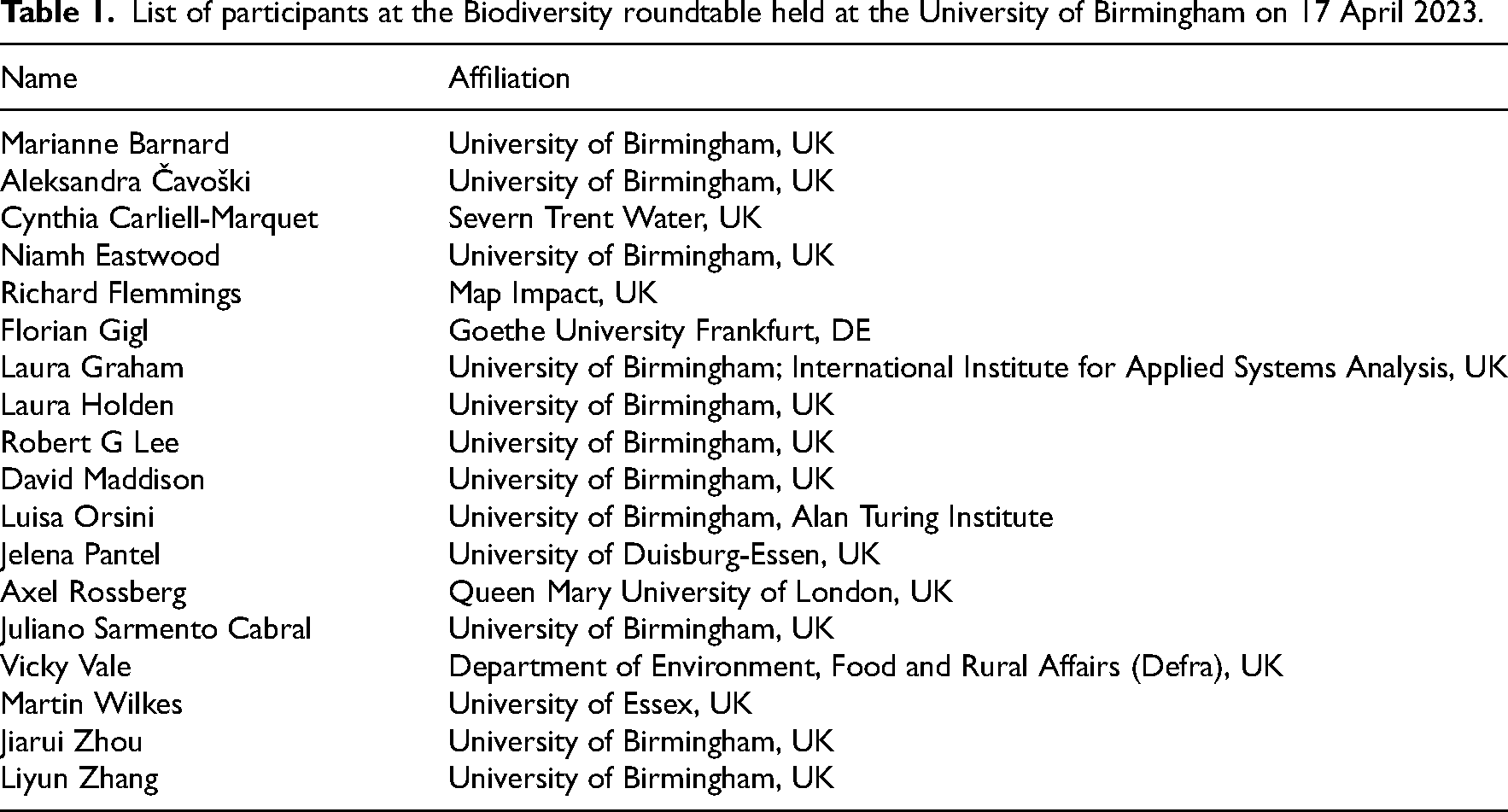
Legal and policy activity both in the United Kingdom and EU is most welcome, but given the historic lack of delivery on conservation objectives, it needs to be informed and accompanied by insights from other disciplines. In particular, life sciences in terms of how to effectively quantify and monitor biodiversity to ensure the delivery of ecosystem services; how to plug knowledge gaps in our understanding of ecology; and how to develop a holistic roadmap to manage future biodiversity challenges. To identify outstanding challenges in biodiversity management and put forward possible solutions, a multi-stakeholders roundtable was held at the University of Birmingham in April 2023, bringing together UK academics, representatives from non-profit organisations, industry, government, and regulatory agencies (Table 1). The discussion revealed several challenges with regards to biodiversity, though three which are discussed below are regarded as key. They include non-compliance with environmental law, lack of public awareness on issues surrounding biodiversity, and valuation of biodiversity loss and its scale.
List of participants at the Biodiversity roundtable held at the University of Birmingham on 17 April 2023.
Non-compliance with biodiversity law
While many biodiversity policies and targets have been set over the years, the compliance entailing implementation and enforcement of such aims is lacking. The two previous sections outlined major policy and legislative activities in the United Kingdom and the EU. A very illustrative example is the United Kingdom, where there have been a series of policy documents since 2018 when the UK Government published the 25-year Environment Plan, which was updated in 2023 with the launch of the Environment Implementation Plan. In addition, as explained earlier, the new Environment Act was passed in 2021 which pledges to maintain biodiversity net gain while enabling growth, along with provisions for waste and resource efficiency, air quality, water, conservation, and nature. Targets identified in the Environment Act are now set out in secondary legislation including the Environmental Targets (Biodiversity) (England) Regulations 2023 and the Environmental Targets (Woodland and Trees Outside Woodland) (England) Regulations 2023. Despite the intensive policy and legislative processes, the state of the environmental quality is deteriorating at an alarming rate. In January 2023, the Office for Environmental Protection (OEP) Chair, Dame Glenys Stacey, highlighted that the ‘progress on delivery of the 25 Year Environment Plan has fallen far short of what is needed to meet Government's ambition to leave the environment in a better state for future generations’. 28 Similarly, in the EU, the environment remains one of the three areas with the highest number of infringement cases, together with justice and consumers, employment, social affairs, and inclusion. 29
This can be explained by the lack of resources across different public authorities responsible for biodiversity, in particular the Environment Agency and Department of Environment, Food and Rural Affairs (DEFRA) as illustrative examples in the United Kingdom. The weak link, attributable in part to this resource shortfall, is enforcement, especially against repeat polluters. River pollution is an example of serious and systematic failures to enforce the regulation, which has prompted an investigation, launched by the OEP in June 2022, ‘into the roles of Ofwat, the Environment Agency and the DEFRA Secretary of State in the regulation of combined sewer overflows (CSOs)’ in England. 30 It is worth noting that the OEP is charged with enforcing against failures to comply with environmental law, but it may focus on the most egregious incidents demonstrating non-compliance, while leaving behind an array of instances of regular non-compliance. The lack of compliance is an issue at the EU level too, and environmental law has always been an area with suboptimal compliance. This can be justified by various factors such as requirements for behavioural, legal, administrative, financial, and other adjustments in member states as a result of the incorporation of EU environmental law coupled with capacity and expertise limitations. 31
This brings us to the wider issue of how this complex challenge can be addressed. Due to complexities in understanding and evaluating biodiversity loss as addressed below, strengthening biodiversity governance may need to be rehauled and include a range of legal, economic, and social mechanisms to ensure compliance. Robust compliance is likely to proceed from a system of everyday monitoring, alongside inspection and reporting processes for the more dramatic instances of failure to comply. In addition, incentivisation provides an alternative to ‘command and control’ enforcement models. 32 Economic incentives could be devised for private companies that demonstrate good biodiversity practices, based on clearly defined biodiversity footprint metrics. This could include tax breaks for companies that invest in biodiversity conservation. Environmental Social Governance (ESG) forces could work powerfully, as wider awareness of biodiversity loss grows. Engaging with the public and raising awareness of the importance of biodiversity (see below) can therefore have a value in generating ESG concerns, which in turn create pressure on the private sector to measure and reduce adverse impacts on biodiversity. Finally, establishing shared responsibility across groups of stakeholders with collaboration across government, NGOs, communities, and companies could help to promote biodiversity conservation.
Lack of public awareness on issues surrounding biodiversity
We often fail to see the interconnectedness between drivers of environmental change (e.g. habitat loss, chemical pollution, direct exploitation of natural resources, invasive species, and climate change) and biodiversity. This is because climate change and biodiversity are both presented to the public and addressed in law in separate compartments. Similarly, there is a lack of awareness of the consequences of biodiversity loss on human well-being and the economy. For example, loss of crop biodiversity is predicted to impact food safety, 33 while the decline in pollinator species has been shown to impact the delivery of ecosystem services. 34 The COVID-19 pandemic slightly changed these perceptions and led to greater awareness about the benefits of nature for wider well-being. However, further efforts in raising awareness are required. This may involve the creation of a variety of educational provisions at multiple levels, including the school curriculum, within higher education, via community workshops, and public awareness campaigns. As we are living in the digital age, the use of social media for public campaigning, especially among young people, is a valuable approach. Furthering local communities’ engagement in biodiversity efforts can also assist in raising awareness. This can be done through capitalising on the role that some of the local associations offer at the local level such as ramblers, and conservation organisations, coupled with more structured support to existing and new conservation initiatives. There is much to be learnt from pioneers who are devising creative ways to preserve biodiversity, for example, Highlands Rewilding Initiative, 35 and the People Plan for Nature, 36 to also help improve awareness.
Finally, policymakers need to ensure that the biodiversity agenda is made more accessible to a wider audience. There is now great familiarity with the 1.5 °C climate target, even though addressing the climate change crisis is considerably more complex than lowering the average earth temperature. Simplifying the narrative to describe biodiversity could certainly improve public understanding. Issues on conservation and assessment of biodiversity are complex and therefore difficult to grasp for people not well-versed in scientific terminology. One approach would be to focus on concrete examples to which people can relate, such as focusing on selected flora and fauna with which wider audiences may be familiar. In terms of a climate comparison, we may feel that images of a polar bear on melting ice are somewhat hackneyed, but they do convey a powerful message. Similar powerful messages can be used to convey the gravity and consequences of biodiversity loss. Successful messages that had positive consequences include the campaign to save bees as key pollinators. Trusts were established that helped increase public awareness of the consequences of pollinator loss, 37 and the number of managed beehives in urban areas has increased for the first time in 2023.
Quantification and valuation of biodiversity loss and its scale
Valuation of biodiversity loss and its footprint is a so-called wicked problem: complex, open-ended, and often intractable. This is because it is reliant on many component elements, including quantitative metrics for biomonitoring and predictive tools to forecast biodiversity loss under different pollution and climate scenarios. 38 Many countries already support a range of survey activities for biodiversity monitoring, such as national atlases, monitoring programs focused on threatened or flagship species, and large-scale sharing of biodiversity data, but with a focus on certain species and regions. 39 While these partial data may satisfy specific jurisdictional needs, they are suboptimal for a global biodiversity strategy because they underrepresent overall biodiversity; fail to identify the causes of biodiversity loss; and do not provide predictions of future biodiversity loss. Firstly, biodiversity monitoring approaches often focus on a representative set of species, and they ignore the causes of biodiversity loss. Secondly, species monitoring requires direct observations, taxonomic expertise, and time. Thirdly, species abundance is often overlooked and only presence/absence is recorded. Finally, protocols facilitating sharing and interoperability, as well as easy-to-use tools, are largely missing. 40
Essential Biodiversity Variables (EBVs) are a step in the right direction to standardise biodiversity monitoring. 41 They offer both spatial and temporal resolution of species distributions and dynamics, and geographic contiguity, which is relevant for decision and policymakers. With this approach, direct observations are complemented by remote sensing and modelling to collect intelligence on remote locations, reduce uncertainties, and improve geographic coverage. However, the approach is limited to direct observations, which requires specialist skills (e.g. taxonomy); it does not account for environmental drivers of biodiversity loss; and does not include predictive tools that can support decision makers to prioritise conservation actions.
More recently, some participants of the roundtable have developed a conceptual framework that establishes the links between biodiversity dynamics and environmental change through time and space, using artificial intelligence. 42 The approach has many advantages over established and emerging methods. The scale of biodiversity loss and the economic impact of ecosystem services loss are often caused by multiple threats over a long period of time (decades to centuries). Traditional ways of monitoring and mitigating biodiversity loss do not account for this complexity and are limited to things we can see and measure. The conceptual framework makes use of environmental DNA – ghost genetic material left behind by plants, animals, and bacteria – to reconstruct biological communities over long time spans. This long-term data is paired with environmental drivers, such as chemical pollutants and climate variables, allowing not only the monitoring of ecosystem-level biodiversity, but also revealing the culprits of biodiversity loss with astonishing accuracy. 43 The long-term continuous data will be used by an AI-based algorithm to learn from past trends and forecast the future of biodiversity and ecosystem functions under different climate and pollution scenarios, with an accuracy never achieved so far.39 Importantly, the framework identifies lists of species/taxonomic groups that deliver ecosystem functions, and environmental drivers (e.g. pesticides), that drive biodiversity loss over time and space. This information is directly relevant to regulators to prioritise the conservation of species that deliver critical ecosystem services and regulate environmental drivers with the greatest impact on biodiversity. The approach embraces complexity to address a wicked problem, while generating simplified metrics that can inform decision-making.
However, also needed is some clear mechanism to translate the outcome of these metrics for a more general audience. What does it mean that 70 per cent of insect biodiversity has been lost in the last 30 years? Why should we worry that freshwater biodiversity is under the greatest threat, with an 83 per cent reduction in the global freshwater living planet index since 1970? It is vital to make the link between loss of biodiversity quantified with the quantitative metrics discussed above, and implications for the human population. As in the case of the pollinators mentioned above, it is important to increase public awareness and understanding of the consequences of biodiversity loss for human socio-economic well-being.
By demonstrating the goods and services made available to the human population from natural ecosystems, such as flood attenuation, water purification, and climate regulation, biodiversity may become valued as a commodity for human well-being. This is not uncontroversial, as there are many who would decry this valuation and commodification approach as inherently anthropocentric, but this does not necessarily undermine its capacity to influence human behaviour, which lies at the root of biodiversity loss. Public awareness combined with mechanisms to enforce compliance will require a joint effort among multiple stakeholders, to define and enforce a shared agenda for biodiversity conservation.
Conclusion
In this review we have focussed largely on UK policy as informed by its legacy from the EU but, as biodiversity loss is a global issue, it is useful to end by reiterating the need for global coordination of efforts. In doing so it should be borne in mind that loss of biodiversity and its services can impact vulnerable countries much more severely than developed economies. The Royal Society suggests that between 1996 and 2008, ∼ 60 per cent of total global biodiversity loss for bird and mammal species occurred in just seven countries: Indonesia, Malaysia, Papua New Guinea, China, India, Australia, and the United States of America (including the Hawaiian Islands). 44 It is worth remembering that while we have discussed measures at a national level, international coordination on issues such as the development and enforcement of metrics to assess biodiversity loss and its causes, remain of crucial significance. Similarly, the setting and monitoring of biodiversity targets globally under the CBD remains crucial, despite poor progress in meeting such targets to date, as does the need for more robust approaches to fulfilling targets at national levels.
At the national level, it is clear there is a need for a compliance culture, to ensure that targets are met. We have seen that much greater public awareness may be a necessary driver to build and reinforce that culture, and we have suggested methods by which awareness might be heightened. Finally, this article reviewed state-of-the-art approaches to quantify biodiversity and drivers of loss, as an aid to understanding and making transparent the threats to local and global well-being posed by biodiversity loss. Efforts to mitigate that loss will require cross-disciplinary approaches that account for trade-offs between ecological and socio-economic values, as well as the development of user-friendly tools that regulators and government agencies can use without specialist skills. 45 We must be prepared to forgo short-term economic gain, which may lead to long-term and irreversible loss. We must also find mechanisms that will factor such equations into policy development and decision-making.
Footnotes
Declaration of conflicting interests
The author(s) declared no potential conflicts of interest with respect to the research, authorship, and/or publication of this article.
Funding
The author(s) disclosed receipt of the following financial support for the research, authorship, and/or publication of this article: This research was supported by colleagues from the environmental genomics group and was funded by the Natural Environment Research Council (NERC) through the highlights grant LOFRESH (NE/N005716/1). Niamh Eastwood is supported by the Midlands Integrative Biosciences Training Partnership (MIBTP; BB/M01116X/1).