




Abstract
EDITORIAL
As we move into autumn it is undoubtedly of some relief that households will not be facing the same energy prices they did last October. However, many are dealing with the cost-of-living crisis and will struggle as temperatures continue to drop. It was that consideration that PM Rishi Sunak heavily relied upon when announcing the Government's overhaul of net-zero policies. No doubt, there is merit in considering the real-world impact of the targets on the public, especially on those who will already be struggling financially. However, valid concerns were raised from various groups: those in industry criticised constantly shifting goalposts; climate change campaigners pointed out the very real costs of delaying actions which would prevent further harm being done to the environment; others criticised the Government's failure to focus on measures that would both assist net-zero goals and those struggling with the cost of heating. This is perhaps yet another example of how problematic tackling climate change is when it comes to consistent, effective and efficient government responses (and one certainly can't limit that just to the UK).
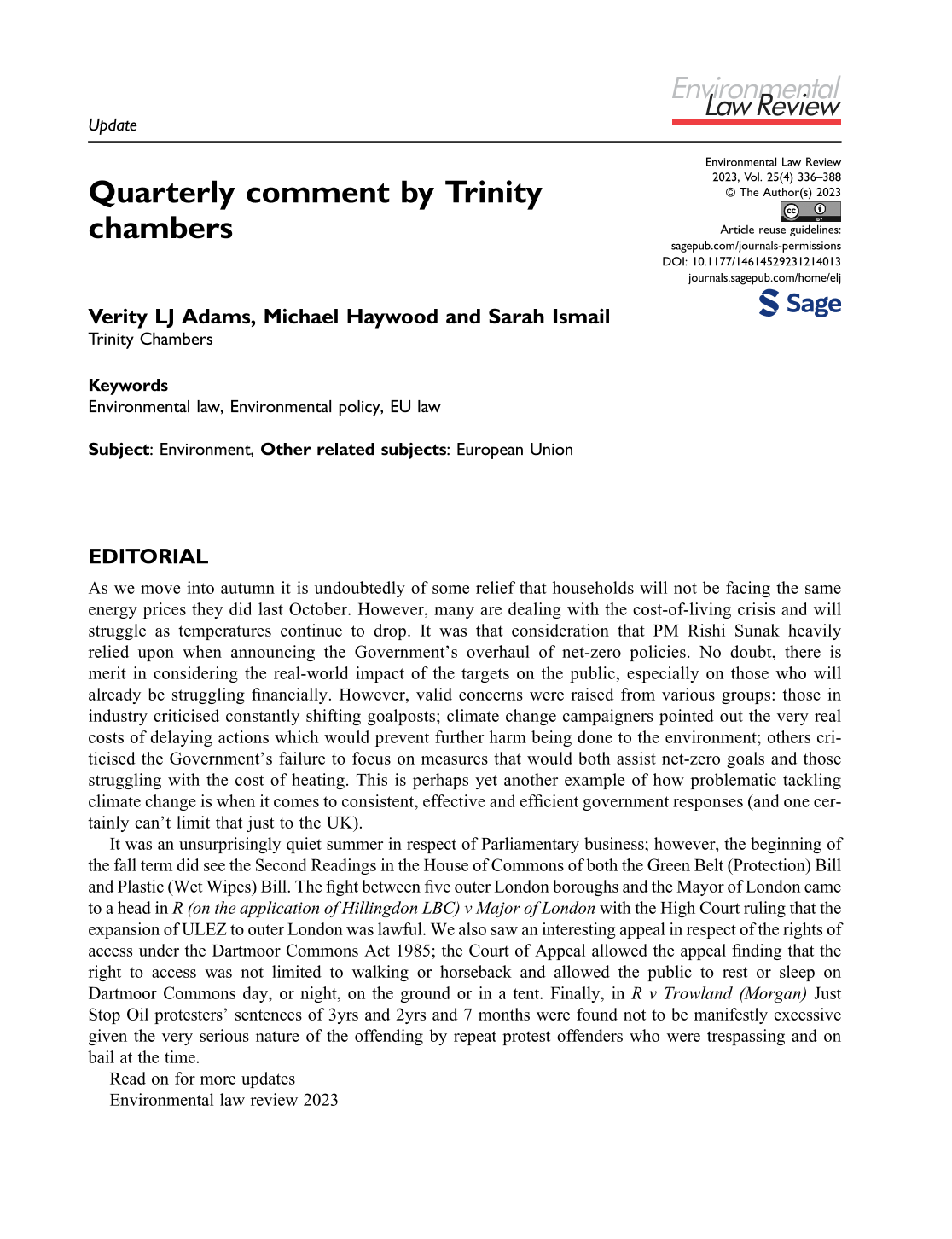
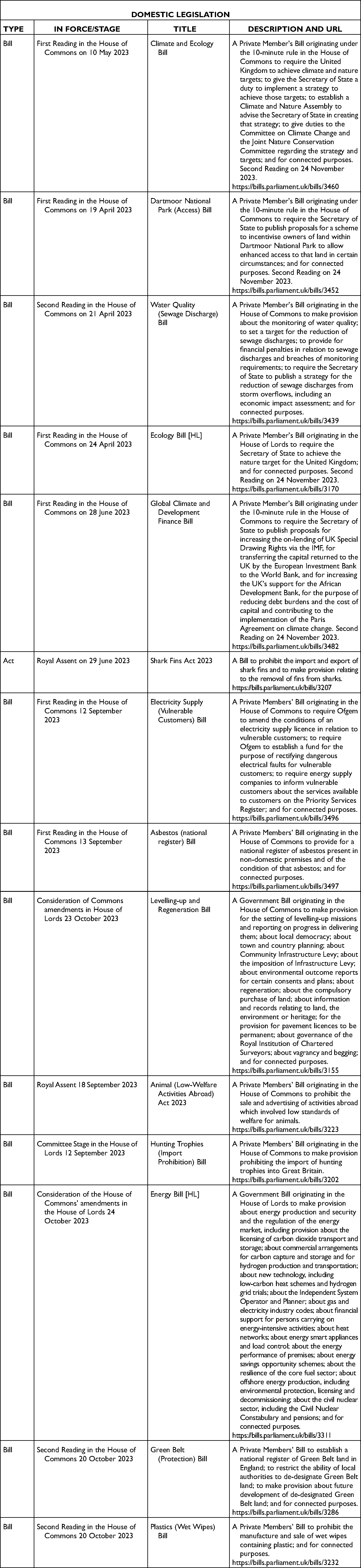
It was an unsurprisingly quiet summer in respect of Parliamentary business; however, the beginning of the fall term did see the Second Readings in the House of Commons of both the Green Belt (Protection) Bill and Plastic (Wet Wipes) Bill. The fight between five outer London boroughs and the Mayor of London came to a head in R (on the application of Hillingdon LBC) v Major of London with the High Court ruling that the expansion of ULEZ to outer London was lawful. We also saw an interesting appeal in respect of the rights of access under the Dartmoor Commons Act 1985; the Court of Appeal allowed the appeal finding that the right to access was not limited to walking or horseback and allowed the public to rest or sleep on Dartmoor Commons day, or night, on the ground or in a tent. Finally, in R v Trowland (Morgan) Just Stop Oil protesters’ sentences of 3yrs and 2yrs and 7 months were found not to be manifestly excessive given the very serious nature of the offending by repeat protest offenders who were trespassing and on bail at the time.
Read on for more updates
Environmental law review 2023
Anna McClean
Verity LJ Adams, Michael Haywood and Sarah Ismail
EU LEGISLATION AND TEXTS
Directive (EU) 2023/958 amending Directive 2003/87/EC as regards aviation's contribution to the Union's economy-wide emission reduction target and the appropriate implementation of a global market-based measure
PE 8 23 INIT
This Directive introduces amendments to the EU ETS legislation in relation to its application to aviation to ensure that it contributes to the emission reduction target in accordance with the European Green Deal and later in the Commission's 2030 Climate Target Plan.
https://data.consilium.europa.eu/doc/document/PE-8-2023-INIT/EN/pdf
Sustainable Fisheries Partnership Agreement between the European Union and the Republic of Madagascar
ST 9007 2023 INIT
This agreement will allow 65 tuna fishing vessels from EU Member States to access Madagascar waters over a period of 4 years in exchange for €700,000 per year and €11 million sectoral support to accompany the sustainable development of the fisheries sector and the blue economy in Madagascar.
https://eur-lex.europa.eu/legal-content/EN/TXT/?uri=CONSIL%3AST_9007_2023_INIT&qid=1690375057506
Regulation of the European Parliament and of the Council establishing a carbon border adjustment mechanism
PE 7 2023 INIT
The Carbon Border Adjustment Mechanism (CBAM) would require importers of certain energy-intensive goods to pay a levy in respect of their imports that corresponds to the price of emissions allowances under the EU Emissions Trading System.
https://eur-lex.europa.eu/legal-content/EN/TXT/PDF/?uri=CONSIL:PE_7_2023_INIT
Regulation of the European Parliament and of the Council on the making available on the Union market and the export from the Union of certain commodities and products associated with deforestation and forest degradation and repealing Regulation (EU) No 995/2010
PE 82 2022 INIT
The Regulation sets out rules governing the entry of traded goods and raw materials originating from tropical forest ecosystems on the EU market and the export of derived products from the Union.
https://eur-lex.europa.eu/legal-content/EN/TXT/?uri=CELEX%3A32023R1115
Directive of the European Parliament and of the Council on energy efficiency and amending Regulation (EU) 2023/955 (recast)
PE 15 2023 INIT
The recast Directive introduces a series of measures to aid in accelerating energy efficient practices as well as requiring EU countries to achieve an average yearly energy savings rate of 1.49% from 2024 to 2030 in critical sectors.
Directive (EU) 2023/959 of the European Parliament and of the Council of 10 May 2023 amending Directive 2003/87/EC establishing a system for greenhouse gas emission allowance trading within the Union and Decision (EU) 2015/1814 concerning the establishment and operation of a market stability reserve for the Union greenhouse gas emission trading system (Text with EEA relevance)
PE/9/2023/REV/1
This Directive reviewed the legislative framework to ensure the latest climate ambition is met. It intended to ensure effective protection for the sectors exposed to significant risk of carbon leakage, addressed the distributional and social effective of the transition, ensured the sectors not included in the EU ETS contribute cost-effectively to emission reductions, reviewed the monitoring reporting and verification system of CO2 emissions from maritime transport and reviewed the Market Stability Reserve.
Regulation of the European Parliament and of the Council concerning batteries and waste batteries, amending Directive 2008/98/EC and Regulation (EU) 2019/1020 and repealing Directive 2006/66/EC
PE 2 2023 REV 1
The Regulation strengthens sustainability rules and applies to all batteries throughout the life cycle of a battery including through to recycling.
https://eur-lex.europa.eu/legal-content/EN/TXT/?uri=CONSIL%3APE_2_2023_REV_1
Commission Decision (EU) 2023/1540 of 25 July 2023 amending and correcting Decision (EU) 2021/1870 establishing EU Ecolabel criteria for cosmetic products and animal care products
Industry stakeholders and members of the EU Ecolabelling Board indicated that some provisions of Decision (EU) 2021/1870 could be interpreted in different ways, which could lead to inconsistencies in the practical implementation of that Decision. To avoid such inconsistent application, and to ensure legal clarity and legal certainty, it was necessary to provide for clearer wording in those provisions.
https://eur-lex.europa.eu/legal-content/EN/TXT/?uri=CELEX%3A32023D1540&qid=1697988700160
Commission Decision (EU) 2023/1575 of 27 July 2023 on the Union-wide quantity of allowances to be issued under the EU Emissions Trading System for 2024 (Text with EEA relevance)
Commission Decision (EU) 2020/1722 set the Union-wide quantity of greenhouse gas allowances referred to in Article 9 of Directive 2003/87/EC for 2021 at 1 571 583 007 allowances, applying the increase of the linear reduction factor to 2.2% starting in 2021. As a result of applying this linear reduction factor, the Union-wide quantity of allowances for 2023 is 1 485 575 977. For 2024, the Union-wide quantity of allowances referred to in Article 9 of Directive 2003/87/EC amounts to 1 386 051 745.
https://eur-lex.europa.eu/legal-content/EN/TXT/?uri=CELEX%3A32023D1575&qid=1697988700160
Commission Decision (EU) 2023/1809 of 14 September 2023 establishing the EU Ecolabel criteria for absorbent hygiene products and for reusable menstrual cups (notified under document C(2023) 6024) (Text with EEA relevance)
This set out the Ecolabel criteria for absorbent hygiene products (non-textile) and reusable menstrual cups (made of silicone or other elastomers). It specified that ‘absorbent hygiene products’ would consist of any article whose function is to absorb and retain human fluids such as urine, faeces, sweat, menstrual fluid or milk and would include both private and professional use products. In respect of ‘reusable menstrual cups’, this would consist of any reusable flexible cups or barriers worn inside the body whose function is to retain and collect menstrual fluid. In order for a product to be awarded the EU Ecolabel under Regulation (EC) No 66/2010 for the product group ‘absorbent hygiene products’, it must fall within the definition of that product group as specified in Article 1 of the Decision and must comply with the respective criteria and related assessment and verification requirements set out in Annex I to the Decision.
https://eur-lex.europa.eu/legal-content/EN/TXT/?uri=CELEX%3A32023D1809&qid=1697988700160
Council Decision (EU) 2023/1974 of 18 September 2023 on the signing, on behalf of the European Union, of the Agreement under the United Nations Convention on the Law of the Sea on the conservation and sustainable use of marine biological diversity of areas beyond national jurisdiction
The signing on behalf of the Union of the Agreement under the United Nations Convention on the Law of the Sea on the conservation and sustainable use of marine biological diversity of areas beyond national jurisdiction (the ‘Agreement’) was authorised, subject to the conclusion of the said Agreement.
https://eur-lex.europa.eu/legal-content/EN/TXT/?uri=CELEX%3A32023D1974&qid=1697988700160
Council Decision (EU) 2023/2170 of 28 September 2023 authorising the European Commission to participate, on behalf of the European Union, in negotiations on a Council of Europe Convention superseding and replacing the 1998 Convention on the Protection of the Environment through Criminal Law (ETS No. 172)
The Commission was authorised to participate, on behalf of the Union, in negotiations as regards matters falling within the Union's competence, as defined by the Treaties, and in respect of which the Union had adopted rules, or the adoption of which was expected in the foreseeable future, on the new Convention on the protection of the environment through criminal law superseding and replacing the 1998 Council of Europe Convention on the Protection of the Environment through Criminal Law (ETS No. 172).
https://eur-lex.europa.eu/legal-content/EN/TXT/?uri=CELEX%3A32023D2170&qid=1697988700160
Council Decision (EU) 2023/2172 of 28 September 2023 on the position to be taken on behalf of the European Union within the Joint Committee established by the Agreement between the European Union and the Swiss Confederation on the linking of their greenhouse gas emissions trading systems, as regards the amendment of Annex I, and the insertion of a clarification in Annex IV, to the Agreement
This decision established that the position to be taken on behalf of the Union within the Joint Committee established by the Agreement between the European Union and the Swiss Confederation on the linking of their greenhouse gas emissions trading systems during its sixth meeting, or earlier by means of the written procedure pursuant to Article 8(4) of the Rules of Procedure of the Joint Committee, would be based on the draft Decision of the Joint Committee attached to the Decision.
https://eur-lex.europa.eu/legal-content/EN/TXT/?uri=CELEX%3A32023D2172&qid=1697988700160
DOMESTIC CASE LAW
Environmental information
Patricia Guthrie v The Information Commissioner [2023] UKFTT 00443 (GRC)
This appellant appealed against the Information Commissioner's decision relating to the appellant's request for information from Brent Council regarding a redevelopment project. The appellant had made a general request for ‘all information relating to the property’ and the plans for developing it. This request had been refused and the Information Commissioner had concluded that the Council had been entitled to refuse to disclose the information. In this instance, the panel held that, unlike the Freedom of Information Act 2000, the Environmental Information Regulations 2004 do not impose a specific limit on the amount which the public authority must do to respond to a request and therefore public authorities may be required to accept a greater burden to provide environmental information under the EIR than other information under the FOIA. However, the information relating to the property and its development went back 40 years and therefore the Commissioner had not erred in accepting that responding to the request would require a disproportionate use of public resources and impose a disproportionate burden on the Council. The tribunal agreed that whilst there is a strong public interest in transparency and accountability on the part of public authorities regarding environmental information, this was outweighed by the even stronger public interest in protecting public authorities from exposure to disproportionate burden of resources and expense in responding to such wide-reaching requests for information.
Judson v The Information Commissioner [2023] UKFTT 384 (GRC)
The appellant filed a Notice of Appeal in respect of the Information Commissioner's decision upholding a public authority's reliance on the exception in reg. 12(4)(a) of the Environmental Information Regulations 2004 (that it did not hold the information requested) to refuse to provide information requested by the appellant. The tribunal held that this was not a case that could be described as ‘not fit for a full hearing’. Confusion had been caused by the public authority's change of stance during its correspondence with the appellant and information had subsequently come to light that the Information Commissioner was unable to consider in conducting the balance of probabilities exercise. It was immaterial whether the Information Commissioner regarded the evidence as failing to change his conclusions – the appropriate course was for the tribunal to consider the matter afresh.
East West Railway Co Ltd v Information Commissioner [2023] UKFTT 821 (GRC)
This case was an appeal against the Information Commissioner's decision that the appellant was not entitled to refuse a request for information under reg. 12(4)(b) Environmental Information Regulations 2004 on the basis that the request was manifestly unreasonable. The court held that a request for information can be manifestly unreasonable purely on the basis of the resource burden placed on the public authority by the request, even if there is a significant public interest in the information requested and there is a reasonable foundation for the request. However, this should be considered in the context of the high standard set by vexatiousness referred to in the Court of Appeal judgement in Dransfield v Information Commissioner [2015] EWCA 454. The court held that a highly material factor in assessing whether a public authority's resources were being squandered or otherwise abused by requests for information is whether the public authority was under a separate duty to publish that information. In this case, a significant part of the requested information was information to which the statutory duty of dissemination under reg. 4(1) applied and the court therefore concluded that the burden placed on the appellant did not justify withholding the requested information.
Casey-Hulme v Information Commissioner [2023] UKFTT 770 (GRC)
The appellant appealed the Information Commissioner's decision that DEFRA was entitled to rely on the manifestly unreasonable exception in reg. 12(4)(b) of the Environmental Information Regulations 2004 in relation to a request to provide all information it had in respect of Walleys Quarry Landfill site. The site had been emitting hydrogen sulphide for some time. The tribunal held that the request was extremely broad and that dealing with the request would involve diverting staff away from substantive work relating to the quarry. In light of this, and the information that was already in the public domain, it found that the request was disproportionate, that the exception in reg. 12(4)(b) was engaged, and that the public interest in maintaining the exception outweighed the public interest in disclosing the information. It also found that art. 2 and art. 8 of the European Convention on Human Rights were irrelevant to the public interest under the Environmental Information Regulations 2004, which is intended to protect public interests and not private rights.
Packham v Information Commissioner [2023] UKFTT 777 (GRC)
This was an appeal against the Information Commissioner's decision that, on the balance of probabilities, Norwich City Council held no relevant information within the scope of the appellant's information request beyond that which had already been provided. The appellant had requested information in relation to the Council's decision to apply for planning permission to extend a tennis programme. The tribunal confirmed that this constituted environmental information and was therefore within the scope of the Environmental Information Regulations 2004. The tribunal found that the Council had taken a very narrow view of what was covered by the request rather than objectively assessing what the request was and had not sought to clarify the scope of the request with the appellant. The tribunal therefore found that the Council had not fulfilled its duty under reg. 9 of the Environmental Information Regulations 2004 to provide reasonable advice and assistance to the appellant in connection with the request. The tribunal also found that, on the balance of probabilities, further information was held by the Council which fell within the scope of the request and the Council was required to reconsider the request for information and issue a fresh response.
Whyton v Information Commissioner [2022] UKFTT 518 (GRC)
This was an appeal against the decision of the Information Commissioner relating to information regarding a stopping up order. The appellant had requested from Sodbury Town Council copies of emails, together with authors and dates sent. The Council had provided anonymised copies of all the correspondence, having withheld names and addresses under s. 40 Freedom of Information Act 2000. The Commissioner had held that the information was environmental and therefore the Environmental Information Regulations applied, and that the data subjects’ rights outweighed the appellant's legitimate interest in disclosure. The tribunal rejected the appellant's argument that disclosure of the identity of the authors was necessary to enable him to address the issues and hold the individuals accountable: the complaints process provides a mechanism for doing so without simply releasing the identities to the world at large. The tribunal also consider the balancing of interests and held that individuals would be deterred from contacting the Council if they thought their names would be published, that this was particularly the case in relation to correspondence about a contentious issue in a small community, and this would affect the quality of decision-making in the Council.
Emissions
ABX Air Inc v Environment Agency [2023] UKFTT 847 (GRC)
This appeal concerned a penalty imposed by the Environment Agency on ABX Air Inc. It is one of the first penalties issued under the UK Emission Trading Scheme established by the Greenhouse Gas Emissions Trading Scheme Order 2020, and the issue before the Tribunal was how to approach the appeal, particularly in light of art. 1 of Protocol 1 of the European Convention on Human Rights (A1P1). On its plain wording, art. 47(2) provides that if an operator fails to surrender sufficient allowances a civil penalty must follow. ABX Air Inc argued that the imposition of the penalty would be contrary to A1P1. The EA agreed that a literal application of art. 47(2) of the Order could, in principle, give rise to a breach of A1P1, but did not accept that it would do so in this case. The tribunal held that the importance for the public interest of enforcing compliance with the scheme to preserve its integrity lies behind the mandatory nature of the penalty and the high level at which it is set, and that to succeed on the basis of A1P1 an operator must establish even weightier private interests and circumstances. In this case, the circumstances put forward by ABX Air Inc related to its own disorganisation and lack of engagement and did not come close to establishing that the penalty was disproportionate within the meaning of A1P1.
Manor Farm Feeds Ltd v Environment Agency [2023] UKFTT 807 (GRC)
The appellant appealed against the 2 fixed penalty notices issued by the Environment Agency in relation to inaccurate reporting of its emissions, which was a breach of its obligations under a climate change agreement with the EA. The appellant's arguments included that: (1) the penalty was unreasonable and disproportionate; (2) issuing a penalty in response to self-reported inadvertent errors risked deterring others from checking and correcting previous reports and discouraging participation in climate change agreements. The court rejected these arguments. It held that it was open to the EA to consider that such penalties were justified to preserve accurate reporting.
Buy IT Direct Ltd v Environment Agency [2023] UKFTT 808 (GRC)
The Environment Agency served the appellant with a penalty notice under reg. 31A Fluorinated Greenhouse Gas Regulations 2015 for failure to hold evidence that the electrical goods it sold would be installed by a correctly qualified engineer. The tribunal held that although the appellant had made efforts to gather information to show compliance with this requirement, at the time of the sale it did not have the evidence it required. The tribunal did, however, reduce the penalty imposed to 90% of the original penalty.
R (on the application of Hillingdon LBC) v Major of London [2023] EWHC 1972 (Admin)
Five councils sought judicial review of the Mayor of London's decision to confirm the Greater London Low Emission Zone Charging (Variation and Transitional Provisions) Order 2022 pursuant to the powers in sch. 23 Greater London Authority Act 1999. The effect of the Order was to expand the London Ultra Low Emission Zone (ULEZ) road charging area to also include an area that was significantly larger than the existing ULEZ area. The councils argued that such an expansion required a new charging scheme and should not have been by way of an amendment to the existing scheme. The court refused the application. It held that the power to vary in sch. 23 did not exist separately from the power to make a scheme and the changes made by the Order did not go beyond what could properly be considered as a variation of the existing scheme. The court also dismissed the councils’ argument that the consultation conducted by Transport for London was unlawful because it failed to provide sufficient or sufficiently clear information about its estimate of the proportion of vehicles likely to comply with the ULEZ requirements in the expansion area.
Planning law
C G Fry and Son Ltd v Secretary of State for Levelling Up, Housing and Communities [2023] EWHC 1622 (Admin)
The claimant sought to quash the Secretary of State's decision to refuse to discharge conditions attached to a reserved matters approval in relation to planning permission for a mixed-use development because there had not been an appropriate assessment under the Conservation of Habitats and Species Regulations 2017. The claimant argued that the requirement for an appropriate assessment only applied to the planning permission stage and not to the discharge of conditions on a reserved matters approval, and that if an appropriate assessment was required the scope of the assessment should reflect the scope of the conditions being considered. The court refused the application. It held that although on a strict reading of art. 63 of the Regulations an appropriate assessment was only required at the planning permission stage, under art. 6(3) Habitats Directive a project should not be agreed until an appropriate assessment had been undertaken. The discharge of the conditions was a necessary step in the implementation of the development and the decision that the conditions could not be discharged without an appropriate assessment was consistent with art. 6(3). The Regulations demanded a purposive interpretation so that the appropriate assessment provisions of reg. 63 applied to a subsequent consent stage, including reserved matters applications and the discharge of conditions. The court also held that reg. 63 required an appropriate assessment of the implications of the part of the project to which the consent related, which in this case was the whole development.
Persimmon Homes (Thames Valley) Ltd v Worthing BC [2023] EWCA Civ 762
The developer appealed against the decision that a planning inspector had erred in allowing its appeal against the local authority's refusal of outline planning permission for mixed-use development. The local authority had refused permission because the site lay outside the built-up area defined in its core strategy and was not allocated for residential development and because of the substantial adverse visual impact on the local area and the National Park. The planning inspector had reversed the local authority's decision on the basis that the site offered an acceptable location for development and the effect on the landscape was limited. The local authority had then successfully applied to quash that decision, with the High Court holding that the inspector had not provided adequate reasons for his conclusions and had misapplied Government policy for development that would affect the setting of a National Park. The court in this case dismissed the appeal against the decision of the High Court. It held that the inspector had provided proper reasons for his decision and his conclusions showed a reasonable and lawful exercise of planning judgement, but the inspector's reasons left substantial doubt that he had lawfully applied the relevant national policy regarding development within the setting of a National Park. His assessment of the likely effects did not demonstrate that he had given ‘great weight’ to the conservation and enhancement of the National Park's landscape and scenic beauty as required under para. 176 of the National Planning Policy Framework.
Duff v Causeway Coast and Glens BC [2023] NICA 22
The appellant appealed against the dismissal of his application for leave to apply for judicial review of the respondent's decision to grant planning permission for an infill dwelling. The appellant had not objected to the planning application but sought to challenge the decision. The appellant's interest was based purely upon environmental protection. The court held that he had standing to bring judicial review proceedings despite not having participated in the planning process. It held that the question of standing required careful consideration and was to be determined by the court. Although a litigant should ordinarily have participated in the planning process, in this case, where the appellant was properly engaged with rural planning policy, the local authority (acknowledging that its decision had been unlawful) had invited him to apply to have the planning permission quashed, and there were no other challengers to the decision, the circumstances were exceptional and the appeal was allowed.
R (on the application of Friends of the West Oxfordshire Cotswold) v West Oxfordshire District Council [2023] EWHC 901 (Admin)
A defendant local authority had granted planning permission for development consisting of a number of residential dwellings on land adjacent to an ancient woodland. The ecological assessment and biodiversity management plan submitted with the application for planning permission included a 5 metre buffer zone between the development and the ancient woodland and planning permission was granted subject to the approval of plans and schemes to protect the ancient woodland. The local authority subsequently approved such plans despite them showing that the 5 metre buffer could not be achieved at three points along the boundary, and the claimant challenged this approval and the discharge of the condition. The court held that the wording of the condition permitted no room for planning officers to subsequently vary the width of the buffer zone on an application to discharge and that, given the express importance of the buffer zone, the decision must be quashed.
R (on the application of Plant) v Lambeth LBC [2023] EWCA Civ 809
The appellant appealed against the local authority's decision to grant planning permission for a redevelopment that involved felling mature trees. The local plan policy required particular account to be taken of existing trees on the site and provided that planning permission would not be granted if it resulted in the loss of trees of significant amenity, historic or ecological/habitat conservation value. The local plan also required that adequate replacement planting be secured where it was ‘imperative’ to remove trees. The appellant submitted that this amounted to an absolute prohibition on felling the trees, and the policy regarding replacement trees provided for replacement planting if the prohibition was breached. The court held that this was not the case and that it should be treated as delineating and defining the circumstances in which trees might be removed. It also held that the variables to be taken into account when interpreting the word ‘imperative’ included: (i) the significance, quality and value of the trees; (ii) whether the proposed development could be implemented without removing the trees; (iii) the benefits sought to be achieved by the scheme; and (iv) whether an alternative scheme could achieve the same/similar benefits without requiring the removal of the trees.
Frack Free Balcombe Residents Association v Secretary of State for Levelling Up, Housing and Communities [2023] EWHC 2548 (Admin)
This case was a statutory appeal under the Town and Country Planning Act 1990 of the defendant's decision to grant planning permission for exploration and appraisal operations to assess site suitability for commercial hydrocarbon production at Lower Stumble, which is within an Area of Outstanding Beauty. The court rejected the appeal. It held: (1) that the Inspector was entitled to take into account the benefits of the production phase of the development as if there was no policy or economic support for hydrocarbon extraction there would be no benefit in exploring and assessing them, but the Inspector did not need to refer to the disbenefits of exploration as they would be fully considered at the production stage and are not relevant to the decision whether the approve the exploration alone; (2) that the policy relating to development in the AONB which required consideration of alternatives constituted a requirement to consider alternatives in relation to the exploration of the Lower Stumble layer, not alternatives for production elsewhere; (3) that limiting the screening to the exploration of the site was lawful: the exploration may or may not lead to a subsequent application for production and is not part of an inevitably larger single project; (4) that the appellant's argument that the failure to have express regard to climate change and greenhouse gas emissions was an error in law was not sustainable as the evidence overwhelmingly indicated that it was not a significant likely effect.
Gordon Duff v Causeway Coast and Glens Borough Council [2023] NICA 56
The applicant was appealing against the decision to dismiss his application for leave to apply for judicial review of the respondent's refusal to take enforcement action in relation to quarrying activities. The court dismissed the appeal. It accepted that the appellant had a genuine concern for the environment but found that he did not have standing. None of the appellant's private rights were affected as he did not live nearby or own property in the vicinity. Neither did he participate in the planning process, and he was not a suitable representative of the public interest as he was a litigant in person and neither an incorporated action group nor an NGO. As such, he lacked the necessary specialist knowledge and had few resources available to source expertise. The court also found that the appellant's mere suspicion regarding the veracity of the site map was not sufficient evidence of fraudulent behaviour to justify granting him standing on the basis that he had a meritorious case of fraudulent conduct.
Protect Dunsfold Ltd v Secretary of State for Levelling Up, Housing and Communities [2023] EWHC 1854 (Admin)
The claimant applied under s. 288 Town and Country Planning Act 1990 to challenge the Secretary of State's decision to grant planning permission for an exploratory oil and gas drilling site in Dunsfold that lies to the south of the Surrey Hills Area of Outstanding Natural Beauty. The claimant submitted that the decision was unlawful on the grounds that the Inspector and Secretary of State had failed to have regard to the requirement in para. 176 National Planning Policy Framework that ‘great weight’ had to be given to conserving and enhancing landscape and scenic beauty in the AONB. It was also argued that the decision was unlawful because the Secretary of State had failed to explain substantial inconsistencies with the decision on the same day to refuse planning permission for an exploratory oil drilling site in Ellesmere Port. The court dismissed the claim. It held that unless there were clear, positive indications to the contrary, the court had to assume that the Inspector had applied the policy in para. 176 NPPF. The argument that the omission of any reference to the ‘great weight’ requirement amounted to a failure to apply the policy was inconsistent with the position in the authorities that the phrase did not need to be used. In this case, the Inspector's reasoning, which had been adopted by the Secretary of State, did not give rise to a substantial doubt as to whether they erred in the law. The court also held that, notwithstanding their similarities, the Ellesmere Port decision was not one which no reasonable decision-maker would have failed to take into account. The sole reason for refusing planning permission for the Ellesmere Port proposal was climate change, whereas this had not been a main issue at the Dunsfold inquiry, the policy context of the extraction of shale gas (Ellesmere Port) and conventional gas (Dunsfold) was different, and the decisions did not relate to the same site or to the same sort of development in the same district. As such, the decisions were not sufficiently similar to trigger the application of the consistency principle.
R (on the application of Dawes) v Secretary of State for the Transport Department [2023] EWHC 2352 (Admin)
The claimant applied for judicial review of the Secretary of State's decision to grant development consent for the development and reopening of Manston Airport in Kent. The Secretary of State's decision was a redetermination following the quashing of the Secretary of State's first decision for failure to adequately reason his disagreement with the examining authority's report. The court held: (1) that the Secretary of State was entitled to rely on expert evidence in which some of the underlying evidence was not disclosed because it was commercially confidential, and it was for the Secretary of State to decide what weight could be attached to evidence in the absence of the underlying material; (2) although not perfect, the consultation was not unfair to the claimant. The test for unfairness required not merely that something had gone wrong, but something had gone clearly and radically wrong, and the instant case fell far short of that test. Although no specific further round of consultation was published after production of a further report, nothing had precluded the claimant from making representations about it; (3) there was nothing to demonstrate that the Secretary of State's conclusion on the issue of the need for the development was irrational. Rule 20 Infrastructure Planning (Examination Procedure) Rules 2010 did not limit his redetermination of the application to the evidence on which he had invited further representations. All the material that had been introduced was still available and needed to be evaluated in the redetermination process; (4) the Secretary of State's decision clearly set out his approach to the 6th carbon budget. He was entitled to rely on the Jet Zero Strategy and the Decarbonising Transport Plan as measures that would accelerate decarbonisation in the aviation sector and ensure carbon budgets were met without directly limiting aviation demand. He was entitled to conclude that in view of these policies, the question of greenhouse gas emissions and climate change could properly be regarded as neutral in the overall planning balance.
Environmental impact assessment
No Gas Caverns Ltd's application for judicial review [2023] NIKB 84
The claimant applied for judicial review of the Department for Agriculture, Environment and Rural Affairs’ decision to authorise development by an energy company of natural gas storage caverns located off the coast of Northern Ireland within the North Channel Special Area of Conservation. The court refused the application and held that: (1) the claimant had failed to identify how the decision was cross-cutting and the argument that DAERA ought to have referred it to the Executive Committee pursuant to s. 20 and s. 28A Northern Ireland Act 1998 therefore failed; (2) although the developer's proposal to set up a community fund as a mitigating measure was not a relevant consideration and should not have featured in the submission, it had not been treated as a material consideration; (3) although better information regarding the risks of the project and the proposed mitigation methods could have been obtained, the decision was made on the basis of the available evidence and expert advice and there had been no breach of reg. 43 of the Conservation (Natural Habitats etc) Regulations (Northern Ireland) 1995; (4) DAERA's failure to consider the decommissioning of the caverns as part of the project was not Wednesbury irrational.
Water
Atkin v Secretary of State for the Environment, Food and Rural Affairs [2023] UKFTT 00788 (GRC)
This case concerned an appeal against the respondent's decision to continue to designate the appellant's land as falling within a nitrate vulnerable zone for the purpose of the Nitrate Pollution Prevention Regulations 2015. The appeal was pursuant to reg. 6 and on the basis that his land drained to water which should not be identified as being polluted. The tribunal held that the appellant had not adduced sufficient evidence to enable it to reject the respondent's modelling and methodology and the respondent's evidence supported the contention that the nitrogen level was significant for the purpose of the Nitrate Directive (91/676/EEC) that was relevant to the proceedings. It therefore dismissed the appeal and confirmed the respondent's designation notice.
Boynton v Secretary of State for the Environment, Food and Rural Affairs [2023] UKFTT 787 (GRC)
This case concerned an appeal against the respondent's decision to continue to designate the appellant's land as falling within a nitrate vulnerable zone for the purpose of the Nitrate Pollution Prevention Regulations 2015. The appeal was pursuant to reg. 6(2) and on the basis that the appellant's land did not drain into water identified as a Nitrate Vulnerable Zone. The tribunal accepted that the appellant's farmland did not contain any waterways or watercourses but the respondent had produced evidence that during heavy rainfall events, rainfall and surface water flow contributed to the River Wye catchment area. The tribunal recognised that the appellant had taken steps to avoid run-off and that there was no suggestion that the appellant was responsible for the ultimate pollution levels but found that the respondent's designation was in accordance with the Regulations. It therefore dismissed the appeal and confirmed the respondent's designation notice.
Smith v Secretary of State for the Environment, Food and Rural Affairs [2023] UKFTT 00789 (GRC)
This case concerned an appeal against the respondent's decision to continue to designate the appellant's land as falling within a nitrate vulnerable zone (NVZ) for the purpose of the Nitrate Pollution Prevention Regulations 2015. The appeal was pursuant to reg. 6(2) and on the basis that his land drained to water which should not be identified as being polluted. The appellant argued that the NVZ was initially incorrectly designated and that monitored levels had improved. He also argued that the exception to prevent its designation applied as the monitoring data was impacted by historic landfill. The tribunal found that the respondent's data demonstrated that the appellant's land did drain to water properly identified as being polluted. It also found that the appellant had not adduced sufficient evidence that there was a clear and localised increase in nitrate concentration resulting from the landfill and the exception therefore did not apply. The tribunal therefore dismissed the appeal and confirmed the respondent's designation notice.
R (on the application of Wildfish Conservation) v Secretary of State for Environment, Food and Rural Affairs [2023] EWHC 2285 (Admin)
The question to be determined by the court was whether the Storm Overflows Discharge Reduction Plan published by the defendant in 2022 pursuant to s. 141A Water Industry Act 1991 was unlawful. The court held that: (1) there had been no breach of reg. 4 Urban Waste Water Treatment (England and Wales) Regulations 1994: storm overflow discharge to a waterway in non-exceptional circumstances was lawful if there was no remedy for it which satisfied the ‘best technical knowledge not entailing excessive costs’ test. The Plan went further than this and included policy targets and statements that were not qualified by any cost benefit test; (2) as the Plan merely set national targets for storm overflows generally, there was no link with any specific European site and it did not fall with the Water Environment (Water Framework Directive) (England and Wales) Regulations 2017; (3) the Plan sought to eliminate ecological harm in respect of a substantial proportion of the most harmful overflows by 2030, which did not undermine or conflict with the achievement of the target in s. 3 Environment Act regarding biodiversity; (4) it had not been demonstrated that there had been an significant impairment of the applicant's ability to enjoy family or private life and art. 8 European Convention of Human Rights had therefore not been engaged let alone violated.
Fanshawe v Secretary of State for the Environment, Food and Rural Affairs [2023] UKFTT 712 (GRC)
This case concerned an appeal against the respondent's decision to continue to designate the appellant's land as falling within a nitrate vulnerable zone (NVZ) for the purpose of the Nitrate Pollution Prevention Regulations 2015. The appeal was pursuant to s. 6(2) of the Regulations on the basis that that the appellant's land did not drain into water identified by the respondent as representing an NVZ. The appeal concerned 4 separate NVZs and the tribunal found that the respondent's data showed relevant levels of nitrate pollution in all 4 of the protected bodies of water and that there was evidence that water from the appellant's land contributed to all 4 of the NVZs after passage through other waterways. The tribunal acknowledged that it had not been suggested that the appellant was responsible for the ultimate pollution levels but found that the designation was in accordance with the Regulations. The tribunal therefore dismissed the appeal and confirmed the respondent's designation notice.
Gould v Environment Agency [2023] UKUT 201 (LC)
This case concerned liability for work done by the Environment Agency over 20 years ago which the claimant argued was causing damage to the water mill he owned. The claimant's claim for compensation under para. 5 of sch. 12 Water Resources Act 1991 for costs incurred in repairing the overflow channel failed and the court found that the claimant could not show a tortious act by the Environment Agency either in connection with the way the 2001 works were carried out or in the diversion and reduction of the accustomed flow of water under the mill.
Energy
Marlborough Sterling Investment Group Limited v Environment Agency [2023] UKFTT 681 (GRC)
The appellant appealed pursuant to reg. 48(1) Energy Savings Opportunity Scheme Regulations 2014 against the respondent's imposition of a civil penalty in respect of the appellant's failure to comply with an enforcement notice which required the appellant to carry out an ESOS assessment. The appellant argued that the notice was based on an error of fact and/or was unreasonable. The tribunal held that there was no error in the respondent's finding that the appellant's breach of the Regulations was a negligent breach. However, it allowed the appeal and modified the penalty from £1,375 to £1,000. It held that there was no reasonable justification for departing from the starting point of £1,000: the non-compliance was not deliberate or intended to deliver any financial benefit and there was no history of non-compliance.
Waste
Abdul Majid and Son Ltd, Petitioner [2023] CSOH 41
This case concerned the Deposit and Return Scheme for Scotland Regulations 2020, under reg. 11 of which the producer of the packaging must pay the person from whom they collect the packaging a ‘reasonable handling fee’. The operator of a small enterprise petitioned for judicial review of the decision of the administrator of the deposit and return scheme determining the reasonable handling fee payable under reg. 11. The court held that as the administrator was a private company set up to administer the scheme, it had no statutory power to set the reasonable handling fee and the petitioner was not contractually bound to accept the fee announced by it. The court also held that the four factors listed in reg. 11(4) to be taken into account in setting the fee were by reference to the specific costs of that return point and not to general costs experienced by retailers in Scotland as a whole.
Markovic v Leicester City Council [2023] UKFTT 516 (GRC)
The appellants appealed against the imposition of a fixed penalty for failure to comply with a notice served under s. 46 Environmental Protection Act 1990 relating to their failure to take their bins off the footpath after collection. Under s. 46, a person who fails to comply with a written warning without reasonable excuse can be required to pay a fixed penalty. The appellants argued that they were not aware that bins could not be left on the street because it was the practice of other properties on the street to do the same. The court held that it would ordinarily attach little weight to this as it is the responsibility of residents to understand their obligations. However, in combination with the appellants’ lack of English language skills, their reasons for not removing their bin amounted to a reasonable excuse.
Hwo Lam v Leicester City Council [2023] UKFTT 678 (GRC)
The appellant appealed against a fixed penalty issued by the respondent under s. 46 Environmental Protection Act 1995 for failure to respond to 3 warning notices concerning the household wheelie bin left on the footpath outside his home and causing a nuisance. The appellant argued that the wheelie bin was not his. On the basis of the papers, photographs and video evidence, the tribunal held that it was satisfied to a high degree of probability that the appellant had left his wheelie bin outside his home. It was not a defence that another bin was left on the footpath at the front of his home and the appellant had failed to report to the Council the bin outside his home as not being his despite having been advised that he needed to do so. The tribunal held that the penalty had been properly issued and dismissed the appeal.
Valentina Ivanova v Leicester City Council [2023] UKFTT 677 (GRC)
The appellant appealed against a fixed penalty issued by the respondent under s. 46 Environmental Protection Act 1995 for leaving her bin on the highway outside the permitted hours. The tribunal dismissed the appeal. It found that the appellant may have misunderstood the situation and made a distinction between the footpath and the highway, but there is no distinction. The tribunal dismissed the appellant's request for a reduction in the fine as she is only working 2 days a week as the appellant had not explained why she was only working 2 days a week and the tribunal was not satisfied that there were compassionate circumstances such that the amount of fine should be reduced.
Durham Co Ltd (t/a Max Recycle) v Durham County Council [2023] CAT 50
The applicant applied under s. 70 Subsidy Control Act 2022 for review of the subsidy decision made by the respondent local authority. The local authority, as waste collection authority, was under a duty to collect household and commercial waste, either by performing that duty itself or outsourcing it to a third party. The local authority collected household and commercial waste itself. The applicant was a provider of waste collection services in the area and contended that the local authority was permitting the household waste collection operation to subsidise its commercial waste collection operation, thereby enabling it to charge business a lesser rate. The applicant asserted that this amounted to a subsidy decision and that, contrary to s. 12 of the Act, the local authority had failed to consider the subsidy control principles before making it. The court refused the application. It held that a subsidy within the meaning of s. 2 of the Act had to involve financial assistance given by a public authority so as to confer an economic advantage on one or more enterprises. In this case, the giver of the subsidy was the same person as the person on whom the subsidy was conferred, and this situation did not give rise to a subsidy within the meaning of the Act.
National parks
Darwell v Dartmoor National Park Authority [2023] EWCA Civ 927
The appellant national park authority appealed against the court's decision that s. 10(1) Dartmoor Commons Act 1985 did not permit the public to pitch tents or wild camp on commons land. The court allowed the appeal. The critical question was whether ‘open-air recreation’ included wild camping. The court held that the right to access ‘for the purpose of open-air recreation’ contained in s. 10(1) was not limited to the kind of open-air recreation undertaken on foot or horseback and allowed the public to rest or sleep on Dartmoor commons, day or night, on the ground or in a tent.
Nuisance
Jalla v Shell International Trading and Shipping Co Ltd [2023] UKSC 16
The appellants appealed against a decision that they were out of time to amend their claim against the respondent for private nuisance arising from an offshore oil spill. The spill had been caused by a ruptured pipeline in an oilfield off the coast of Nigeria. The oil had leaked for six hours and had washed up on the shore on the Nigerian coast, where the appellants owned land, with a devastating effect on their land. The appellants issued a private nuisance claim within the six year limitation period provided for in s. 2 Limitation Act 1980. More than six years later, they sought to amend their pleadings to add a new claim, arguing that for so long as oil from the spill remained on their land and was not cleaned up there was a continuing nuisance. The court dismissed the appeal. It held that the general principle is that a continuing nuisance is one where there is a repeated activity by the defendant or an ongoing state of affairs for which the defendant is responsible that results in the cause of action accruing afresh on a continuing basis. It held that in this case the spilled oil not having been removed from the land did not constitute a continuing nuisance. Holding otherwise would be contrary to principle and would undermine the law on limitation and would impliedly convert the claim of private nuisance into one of failure to restore the land.
Chalmers v Diageo Scotland Ltd [2023] CSOH 43
Homeowners took action against the defender in respect of nuisance caused by the release of ethanol vapour from their nearby warehouse, alleging that the vapour escaped into the surrounding atmosphere and encouraged the growth of a fungus that caused their house and garden to be affected by sooty deposits or staining. The defender sought to have the action dismissed or, alternatively, exclusion of particular parts of it, on the grounds that there was a lack of clarity in relation to what the pursuers were arguing in relation to the fungus and inconsistency in the language used. The court held that it was clear what the pursuer had to prove and therefore there was no lack of clarity as to the case that the defender had to answer. Although there was some inconsistency of language in the pleadings, this did not result in any genuine risk of confusion as to what the pursuers’ case was.
https://www.bailii.org/scot/cases/ScotCS/2023/2023_CSOH_43.html
Transport for London v Persons Unknown [2023] EWHC 1038 (KB)
The claimant sought an injunction against 129 named defendants and certain defined persons unknown, including supporters of Insulate Britain, preventing the blocking of the roads and surrounding areas at 34 identified locations on the basis that the protests constituted trespass, private nuisance and/or public nuisance. The court held that the protestors entering onto the claimant's land and using it for a purpose other than exercising a public right of way constituted trespass, that the protests constituted private nuisance as they caused a substantial and unreasonable interference with the enjoyment and exercise of the rights of way of other road users, and that a public nuisance arose as the protests prevented the public from freely, safely and conveniently passing along the roads. The court found there was a real and imminent risk of further protests that would infringe the claimant's rights and cause grave and irreparable harm for which damages would not be an adequate remedy. The interference with the defendants’ rights under art. 11 and art. 12 European Convention on Human Rights was in pursuit a legitimate aim and was necessary in a democratic society. As such it struck a fair balance between the legitimate aim and requirements of freedom of expression and freedom of assembly and it was just and convenient for a final injunction to be made against the named defendants. With regard to the persons unknown, the seven guidelines for granting interim injunctions against persons unknown had been met.
Transport for London v Lee [2023] EWHC 1201 (KB)
The claimant sought an injunction against named defendants and persons unknown to prevent them from blocking, slowing down, obstructing or otherwise interfering with access to or the flow of traffic on specified roads, lasting for a period of five years with annual reviews. The question before the court was whether it was appropriate to make the proposed injunction against persons unknown in circumstances where a single breach would suffice to put a person in breach at risk of committal proceedings. The court held that there was a real risk of the rights of the claimant and others being breached, with a risk of grave and irreparable harm. The court therefore held that whilst the granting of an injunction would be an interference with the defendants’ rights under art. 11 and art. 12 European Convention on Human Rights, this was in pursuit of a legitimate aim. The court was satisfied that the proposed injunction was proportionate and struck a fair balance between the Convention rights of the defendants and the rights of others.
National Highways Ltd v Persons Unknown [2023] EWHC 1073 (KB)
The claimant sought a continuation of an injunction preventing climate change protestors from blocking, endangering, slowing down, obstructing or otherwise preventing the free flow of traffic on the M25 and certain other roads. The court granted the application. It held that there was a real risk that protests would continue and the injunction was continued for a year with a review in the month before it expired. However, the defendants were given two weeks in which to provide an undertaking not to protest by blocking the roads for two years and defendants who signed an undertaking would be removed from the list of defendants. The court was not prepared to continue the disclosure obligations requiring the police to disclose the identity of those arrested during the protests so that they could be named in proceedings without considering further submissions from the claimant.
Partakis-Stevens v Sihan [2023] EWHC 1051 (TCC)
This case concerned work undertaken by developers to the garden of a property neighbouring the claimant's property. The main action concerned the claimant's allegation that the developers’ work had caused flooding to their garden as a result of surface water run-off that amounted to nuisance and that the developers had been negligent in undertaking the works. The developers had sold the property and the claimant was also claiming that the current owners had continued the nuisance by failing to take steps to remedy the run-off. The current owners defended this claim and brought an additional claim seeking a contribution from the developers, alleging breach of the property sale contract and fraudulent misrepresentation for not having informed them of the dispute with the claimant. The court held that the developers were liable to the claimant in nuisance and negligence and awarded damages. It also held that the current owners were liable in nuisance and granted an injunction requiring them to undertake remedial works. The court held that the developers were liable to the current owners for misrepresentation and awarded damages fully indemnifying them for the losses incurred as a result of the misrepresentation.
R (on the application of Ball) v Hinckley and Bosworth Borough Council [2023] EWHC 1922 (Admin)
The claimant local resident applied for judicial review of the defendant local authority's variation of an abatement notice issued to the interested party under s. 80 Environmental Protection Act 1990 in respect of a statutory nuisance caused by noise. The claimant argued that the effect of the variation increased the impact which noise from the interested party's car and motorcycle racing circuit would have on him and other residents and that the variation was unlawful because the local authority had no power to vary the notice. The court held that the local authority could lawfully exercise the power to vary the notice.
R v Trowland (Morgan) [2023] EWCA Crim 919
The appellants, who had scaled a bridge on the M25, hoisted a ‘Just Stop Oil’ banner across it and suspended themselves in hammocks, had been sentenced to 3 years imprisonment and 2 years and 7 months imprisonment respectively for intentionally or recklessly causing a public nuisance contrary to s. 78 Police, Crime, Sentencing and Courts Act 2022. They appealed against their sentences on the grounds that they were manifestly excessive and a disproportionate interference with their rights of freedom of expression and assembly under art. 10 and art. 11 European Convention on Human Rights and were the longest ever imposed for non-violent protest. The court dismissed the appeal. There was no sentencing guideline specific to the offence and the court held that it was not part of the judicial function to evaluate the merit of the cause in support of which the protest was made. A conscientious motive on the part of the protesters might be a relevant consideration, in particular where the offender was a law-abiding citizen apart from their protest activities and, in such cases, a lesser sanction might be appropriate. However, the more disproportionate or extreme the action taken by the protestor, the less obvious the justification for a more lenient sentence. Whether a sentence of immediate custody was warranted was highly fact-sensitive and the judge had not erred in his approach to the appellants’ previous convictions and any prospect of rehabilitation. The sentences went beyond previous sentences for that type of offending under the old common law but the differences between those cases and the instant case in terms of the scale of disruption and any previous convictions were material. The appellants’ sentences reflected Parliament's will as enacted in s. 78, which introduced a new fault-based public nuisance offence. The court held that the sentences were severe but not manifestly excessive or a disproportionate interference with the appellants’ right under art. 10 and art. 11 ECHR. It was very serious offending by repeat protest offenders who were trespassing and on bail at the time. The protest had resulted in the bridge being closed for 40 hours and therefore, although the protest was non-violent, it had extreme consequences for many members of the public.
Climate change
ClientEarth v Shell Plc [2023] EWHC 1137 (Ch)
The claimant sought permission to bring a derivative claim, alleging that the defendant company's directors had breached their duty regarding the company's climate change risk management strategy, including the duty to promote the success of the company under s. 172 Companies Act 2006 and the duty to exercise reasonable care, skill and diligence under s. 174. Specifically, it alleged that the directors had failed to set an appropriate emissions target, that the strategy for the management of climate risk did not establish a reasonable basis for achieving the net zero target and was not aligned with the Paris Agreement on Climate Change 2015, and that the directors had not prepared a plan to ensure timely compliance with the requirement for a 45% emissions reduction by 2030. The court refused the application. It held that the claimant had not made out a prima facia case that there was no basis on which the directors could reasonably have concluded that the actions they had taken had been in the company's interests. Nor had they made out a prima facia case that the court should grant the relief sought.
Harvey & Brockless Ltd v Environment Agency [2023] UKFTT 849 (GRC)
The appellant appealed against the Buy-Out Fees notified to it by the Environment Agency and payable due to the appellant's failure to meet its climate change targets for a specified period. The appellant's grounds for appeal were that the material impact of the covid pandemic had continued into the specified period and led to them not meeting their targets. They argued that it would be fair to reduce the amount of the Buy-Out Fees in these circumstances. The tribunal dismissed the appeal and confirmed the Environment Agency's decision to impose the Buy-Out Fees. It held that its powers were no wider than those of the Environment Agency and it therefore only had the power to vary a penalty to correct an error. It did not have the power to substitute its own view of the appropriate amount. It found that if it is unreasonable for the Environment Agency not to have in place a scheme to recognise the continuing difficult trading conditions following the pandemic, this was a matter for Parliament and not the tribunal.
ClientEarth v Shell Plc [2023] EWHC 1897 (Ch)
The claimant asked the court to reconsider at an oral hearing the refusal on paper of its application for permission to continue its derivative claim under s. 260(3) Companies Act 2006 in relation to an alleged breach of duty by the defendant's directors regarding the company's climate change risk management strategy. The court refused the application. It held that the test of prima facia case required to take the evidence adduced by the claimant at its ‘reasonable highest’, but this did not mean the court was bound to assume that the facts alleged by the claimant were true. It further held that the test for breach of s. 172 (duty to promote the success of the company) was subjective and required proof of conduct other than in good faith. Whilst an absence of good faith could be inferred from the irrational nature of the conduct in issue, irrationality itself could not stand as a ground of breach on its own. It held that the claimant had failed to show a prima facia case that there was no basis on which the directors could reasonably have concluded that the actions they had taken had been in the best interests of the company. With regard to the claimant's reliance on incidental duties to accord appropriate weight to and adopt strategies to mitigate climate risk, the court found that this had insufficient regard to how the legislature had formulated the general statutory duties in s. 172 (duty to promote the success of the company) and s. 174 (duty to exercise reasonable care, skill and diligence) and sought to cut across these general duties.
EU CASE LAW
European commission v Portuguese republic, case C-220/22, 29 June 2023
The Court (Sixth Chamber) declared that the Portuguese Republic had failed to fulfil its obligations under Article 13(1) of Directive 2008/50/EC of the European Parliament and of the Council of 21 May 2008 on ambient air quality and cleaner air for Europe by systematically and persistently exceeding the annual limit value for nitrogen dioxide from 1 January 2020 to the year 2020 in the zones of Lisboa Norte, Porto Litoral and Entre Douro e Minho. They had further, in respect of all those zones, failed to fulfil its obligations under Article 23(1) of Directive 2008/50 and in particular its obligation to take appropriate measures so that the exceedance period could be kept as short as possible. The Court ordered the Portuguese Republic to pay the costs.
https://eur-lex.europa.eu/legal-content/EN/TXT/?uri=CELEX%3A62022CJ0220&qid=1690454093489
European commission v Ireland, case C-444/21, 29 June 2023
The Court (Second Chamber) declared that Ireland had failed to fulfil its obligations under Article 4(4) of Council Directive 92/43/EEC of 21 May 1992 on the conservation of natural habitats and of wild fauna and flora, as amended by Council Directive 2013/17/EU of 13 May 2013, by failing to designate as special areas of conservation as soon as possible (or within six years at most) 217 of the 423 sites of Community importance included on the list established by Commission Decision 2004/813/EC of 7 December 2004 and further failing to define detailed site specific conservation objectives for 140 of the sites. Further, the Court declared that by failing to adopt the necessary conservation measures which corresponded to the ecological requirements of the natural habitat types referred to in Annex I and the species referred to in Annex II to Directive 92/43, as amended by Directive 2013/17, present on the 423 sites of Community importance referred to in point 1 of the operative part, Ireland had failed to fulfil its obligations under Article 6(1) of Directive 92/43, as amended. The Court dismissed the action as to the remainder and ordered Ireland and Germany to bear their own costs whilst also ordering Ireland to bear the costs incurred by the European Commission.
https://eur-lex.europa.eu/legal-content/EN/TXT/?uri=CELEX%3A62021CJ0444&qid=1690454093489
Judgment of the court (second chamber) of 21 September 2023. European Commission v Federal Republic of Germany
The Second Chamber declared that the Federal Republic of Germany had failed to fulfil its obligations under Article 4(4) of the Council Directive 92/43/EEC (May 1992) on the conversation of natural habitats and wild fauna and flora, as amended by Council Directive 2013/17/EU (May 2013), in three primary ways. First, by failing to designate 88 of the 4,606 sites of Community importance as special areas. The sites were identified as of Community importance in a series of Decisions and Directives from 2003 to 2007. Secondly, by failing to adopt detailed conservation objectives for the 88 sites. Thirdly, by failing to adopt the necessary conservation measures for a group of 737 of the 4,606 sites of Community importance. The remainder of the action was dismissed and the Federal Republic of Germany was to bear its own costs and pay those incurred by the European Commission.
https://eur-lex.europa.eu/legal-content/EN/TXT/?uri=CELEX%3A62022CJ0116&qid=1697987847930
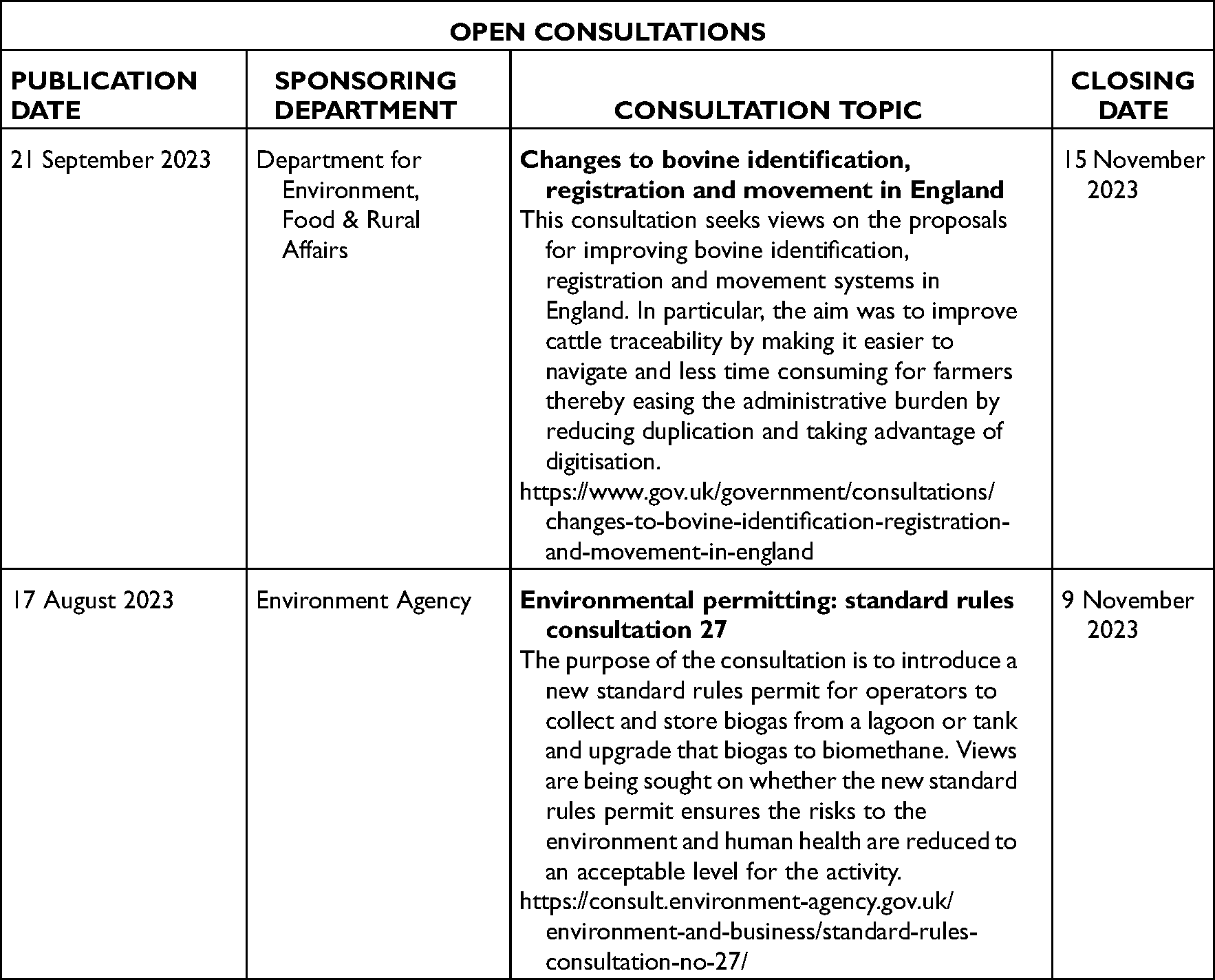
CONSULTATIONS


NEWS AND MISCELLANEOUS
“Plastic pollution: campaigners around the world are using the courts to clean up – but manufacturers are fighting back”, The Conversation, 26 June 2023
Amid growing concerns over plastic pollution and weak governmental response to it, individuals and communities have been seeking action by resorting to courts.
“Rishi Sunak announces U-turn on key green targets”, The Guardian, 20 September 2023
Rishi Sunak has announced a major U-turn on the government's climate commitments with delayed ban on the sale of new petrol and diesel cars as he pushed back net zero goals.
“Water company bosses should face jail time over ‘shocking’ sewage pollution, says Environment Agency”, The Independent, 14 July 2023
Water company bosses should go to jail for allowing raw sewage to be pumped into England's waterways, the outgoing chair of the Environment Agency has said.
https://inews.co.uk/news/water-company-bosses-face-jail-sewage-pollution-1741918
“The Supreme Court just upended environmental law at the worst possible moment”, The Washington Post, 30 June 2023
The Supreme Court just made official what environmentalists have dreaded would come to pass as soon as Donald Trump was elected president: a radically conservative majority, in West Virginia v. Environmental Protection Agency, has seriously threatened environmental law's ability to safeguard public health and welfare.
“Canada court ruling on key environmental law risks deterring investments”, Reuters, 20 October 2023
A Canadian court ruling that voided most of Prime Minister Justin Trudeau's environmental assessment law for resource projects has sparked fresh policy uncertainty and risks deterring investments, company and industry executives said.
“ClientEarth loses High Court fight with Shell over climate strategy”, The Guardian, 24 July 2023
An environmental law charity has lost an attempt to revive a lawsuit against Shell over its climate strategy after the High Court in London refused permission to bring a case against the energy company.
“ULEZ expansion legal, High Court rules”, Sky News, 28 July 2023
Sadiq Khan welcomed the “landmark” ruling but said he would “do everything possible to address any concerns Londoners may have” after the scheme was blamed for Labour's defeat in the Uxbridge by-election.
https://news.sky.com/story/ulez-expansion-legal-high-court-rules-12928472
“Young climate activists land tentative win in Montana constitutional case”, Harvard Law Today, 22 August 2023
On August 14, a state judge in Montana declared unconstitutional state laws that bar state officials from considering potential climate impacts related to fossil fuel-related permitting decisions. The statutes, the judge wrote, violated the state constitution's guarantee of “a clean and healthful environment … for present and future generations”.
“EU passes nature restoration law in knife-edge vote”, The Guardian, 12 July 2023
The EU has narrowly passed a key law to protect nature – a core pillar of the Commission President Ursula von der Leyen's European Green Deal – after months of fiery debate and an opposition campaign scientists criticised as misleading.
https://www.theguardian.com/world/2023/jul/12/eu-passes-nature-restoration-law-vote-meps
“Watchdog finds sewage overflow failures may have broken environmental law”, Sky News, 12 September 2023
The Office for Environmental Protection (OEP) says there may have been "misinterpretations of some key points of law" which have allowed discharges to occur more often than they should.
“ISSB sustainability-related disclosure standards published: A new global baseline?”, Norton Rose Fullbright, 26 June 2023
On 26 June 2023, the International Sustainability Standards Board (ISSB) published its first sustainability-related disclosure standards (the Standards). The publication of the Standards, known as IFRS S1 and IFRS S2, represents a crucial step-forward in the development of a globally consistent and reliable framework for the provision of sustainability information to capital markets, with the ISSB hoping that they will become the global baseline for sustainability-related disclosures.