




Abstract
This article discusses 2 ideas for reforming abstraction of water from the natural environment in order to provide a balance between environmental protection and secure, sustainable access to water also for future generations. This matters in light of an increased risk of water scarcity and drought due to growth and a changing climate. The first of these ideas – a sliding scale of legal protection for abstractions seeks to match the strength of legal protection through the abstraction licence to how much water is abstracted, as well as to how critical to business use, and environmentally beneficial the abstraction is. The second idea – ‘bubble licensing’ – involves capping the amount of water available for abstraction in a catchment and to promote exchanges of water between abstractors, not just through trading, but also through reciprocity exchanges and bartering. This collective action approach is intended to transcend an individual fixed entitlement approach to abstracting water. The article develops its argument through an analysis of literature on water rights, pollution trading, water charges, as well as a reference to ongoing reform debates about abstraction licensing in England.
Keywords
Introduction: Drought and water scarcity in times of a changing climate
Climate change is associated with various environmental impacts. Among these is an increased risk of water scarcity and drought in a number of countries.
1
Somalia experienced during autumn 2022 a severe drought that is leading to famine. During the summer of 2022 drought conditions existed across China, with its southwestern regions particularly badly affected, and also in mainland Europe, that is, France, Spain, parts of Italy and Germany, as well as Hungary, Romania, Slovenia and Croatia. In the UK 11 out of the 14 Environment Agency areas were officially declared to be in drought. Policymakers and regulators in the UK no longer consider droughts and water scarcity simply as a natural disaster. Reform debates are increasingly exploring how governance of water resources and supply can be improved in order to ensure sustainable long-term access to water: If the water sector continues to operate as usual, by 2050 some of our rivers could have up to 80% less water in summer, and it will not be possible to meet the growing demands of people, industry, and agriculture. There will be even greater pressure on the quality of rivers, lakes, estuaries, and wetlands from pollution.
2
It has also been suggested that managing the demand for water alone will not be sufficient to tackle water scarcity. 3 Against this backdrop this article argues, firstly, that the licensing of abstractions from the natural environment can be reformed by providing for a sliding scale rather than uniform legal protection for abstractions. Secondly, economic incentives for conservation and more efficient use of water can be enhanced. Thirdly, the article makes a case for capping the amount of water available for abstraction in a catchment, by determining a ‘bubble’ of available water for licensing, and incentivizing various ways of exchanging water between abstractors, not just through trading, but also reciprocity exchanges and bartering.
The article develops this argument in 4 sections. After this introductory section, the next section shows how current legal rules in the UK promote an individual entitlement approach to defining rights to water. The following third section suggests that such an individual entitlement approach to defining rights to water can be overcome through a sliding scale of legal protection. This differentiates between those abstractions that deserve greater legal protection and those who do not, on both business and environmental grounds. The fourth section sets out what is entailed in ‘bubble’ licensing. The last section concludes.
The individual entitlement approach for accessing water
Before a changing climate coupled with growth increased the risk of water scarcity, legal rules sought to fix secure entitlements to water for individual abstractors for economic production. This is reflected in past abstraction licensing practices. For instance, from 1963 onwards – when abstraction licensing began in England and Wales – abstraction licences were granted without a time limit, and thus without consideration of how long a particular use of water was actually required. Time-limited licences were only introduced through the Water Act 2003. They now constitute about 29 per cent of all licences in England and Wales. 4 Moreover, a significant number of licences granted in the UK permit a much higher amount of water to be abstracted than abstractors actually need. 5 About 12 per cent of licence holders abstract less than half of their allocation, and 17 per cent abstract less than three-fourth of their allocation. 6
The strongest expression of an individual entitlement approach to water is embedded in legal rules that consider rights to access water as a private property right. Such rights can be created either through statute or through an extension of common law riparian rights. In the UK such rights exist where water abstraction is authorized through a ‘licence of right’ 7 or where in the past private acts of Parliament have created property rights in water. ‘Licences of right’ are statutory rights to abstract water that existed before the modern abstraction licensing regime was introduced in England and Wales in 1963 through the Water Resources Act (WRA). The WRA 1963 recognized and did not extinguish these prior abstraction rights. 8 ‘Licences of right’ could also be created under the Water Act 1989. Debates within the U.K. Parliament about the need to provide financial compensation for holders of abstraction licences of rights that are varied or revoked also suggest that such licences give rise to a private property right in water. This is protected by Art. 1 of the First Protocol to the European Convention of Human Rights, as implemented in the UK through the Human Rights Act 1998. 9
Private property rights in water can also arise when a private Act of Parliament expressly grants a power to buy and sell water flowing in a particular river. 10 Where such statutory property rights to water have been created, this may be associated with an obligation for natural or legal persons to pay for water, for example, where those who hold property rights in water vest the water in others who then have to pay for water uses. 11 This can be a step away from the individual entitlement approach to water, since paying for water can promote valuing it, not just for anthropocentric purposes but also for wider ecosystem services, such as maintaining water and land based habitats.
These statutory property rights to water are, however, limited because they do not dispense with the requirement to obtain a licence to abstract water under contemporary Water Acts, that is, the WRA 1991. 12 Such a licence can impose conditions on how a statutorily created private property right to water can be exercised. 13 For instance, when abstractors now apply for the renewal of a time-limited abstraction licence they have to make a case for the continued ‘need’ for the abstraction, show its ‘environmental sustainability’ and demonstrate efficient water use. 14 Also, the English common law is limited in providing private property rights in water. There are no private property rights in water flowing from time to time in water courses, though such rights may exist in relation to water held in reservoirs. 15
The main way in which abstractors access water since 1963 is through an abstraction licence, now granted by the Environment Agency or Natural Resources Wales under s. 24 (A) WRA 1991. Such a licence provides for a legitimate expectation in accordance with administrative law rules that the abstractor receives a specified volume of water for the purposes set out in the licence. There are no explicit provisions in the WRA 1991 that designate the rights of licence holders as property rights, except for s. 59 B which states that if the holder of a licence dies, the licence shall be considered as property that is part of the deceased's estate. 16 Similarly, dicta from Scottish courts suggest that for the purposes of the Insolvency Act 1986 abstraction licences issued by the Scottish Environment Protection Agency are considered as a private property right. 17
While an abstraction licence in England or Wales does not create a private property right in water, it has nevertheless promoted an individual entitlement approach. This has mainly occurred by securing a fixed allocation for an individual abstractor, and by providing rights to financial compensation if the EA or NRW impose a revocation or variation of the licence. Compensation may include the costs of using an alternative source for water abstraction that is needed. 18
Due to an increased risk of water scarcity and to ensure sufficient flow of water in rivers also for avoiding increased concentrations of pollutants during low flow, successive U.K. governments have whittled away at the rights granted under abstraction licences. There are now grounds upon which the regulator can revoke or vary a licence without the abstractor's consent and without paying compensation. First, if so directed by the Secretary of State, the EA can revoke or vary a licence, after the 1st of January 2028, in order to fulfil ‘a relevant environmental objective’ (as specified in secondary legislation implementing the EU Water Framework Directive), or ‘to otherwise protect the water environment from damage’. 19 Second, the EA can vary a licence, if so directed by the Sec. of State, on or after 1 January 2028, in order to reduce the amount of water that can be abstracted. The amount of water actually abstracted in each of the 12 years before the Sec. of State issues the direction, has to have been 75 per cent or less of the actual volume licenced to be abstracted. 20 Third, licences can be revoked or varied if the EA/NRW can show that the specific abstraction is causing serious environmental damage. 21 This power has seldom been used in practice since it is difficult to prove a causal link between an abstraction and the environmental damage. 22 Fourth, the EA/NRW can vary or revoke abstraction licences held by water companies without having to pay compensation. 23 Fifth, the EA/NRW can revoke non-time-limited abstraction licences if they have not been used for 4 years or longer. 24 Sixth, when a time-limited licence is renewed, the renewal can include licence conditions that limit the amount of water that can be abstracted. In practice, the EA/NRW has been reluctant to use these extended legal powers, in particular those related to licence revocation, since it prefers a consensual and negotiated approach in contrast to an adversarial imposition of allocations of water. 25
Further reforms limiting individual entitlements to access water are planned in England. It is anticipated that in 2023 abstraction will be moved into the environmental permitting regime. 26 In that case, new licences will be periodically reviewed, which may lead to a reduction in volumes that can be abstracted, or the imposition of ‘hands-off flow’ conditions which temporarily limit unsustainable abstractions. If such reviews are carried out frequently, they limit individual entitlements to water. 27 For existing abstraction licences, individual entitlements will remain in place, since current licence holders will not lose their rights to compensation
To summarize, the individual entitlement approach to water has several shortcomings. First, it makes it more likely that resolving different claims to water – in particular during drought – engenders a zero-sum approach that creates ‘losers’ and ‘winners’ instead of ensuring continued access to some water for a range of abstractors. Second, the individual entitlement approach is distributionally not fair, since abstractors for whom access to water is not critical for their business or who contribute little through water efficiency measures to water availability, should not benefit from the same legal protection for their abstraction than abstractors for whom access to water is vital for production and who are very efficient in the use of their water. A sliding scale of legal protection for abstraction rights can begin to address this.
A sliding scale of legal protection for water abstractions
Features of a sliding scale
A sliding scale means to match the strength of legal protection to the type of abstraction with reference to 3 criteria. 28 These are firstly, how much water is abstracted, and secondly, how important the abstraction is for a business. This second consideration of the business need for water can be further strengthened through a link to the development control regime. The EA's role as a statutory consultee on some planning applications for land use for businesses could be extended to comment on the impacts of the development on water quantity. 29 The third criterion is to consider the environmental performance of the business, for example, how efficiently water is used, and for example, environmental impacts on soil, in order to encourage innovation and best practice, as depicted in Table 1.
Matching strength of legal protection through the licence to type of abstraction.
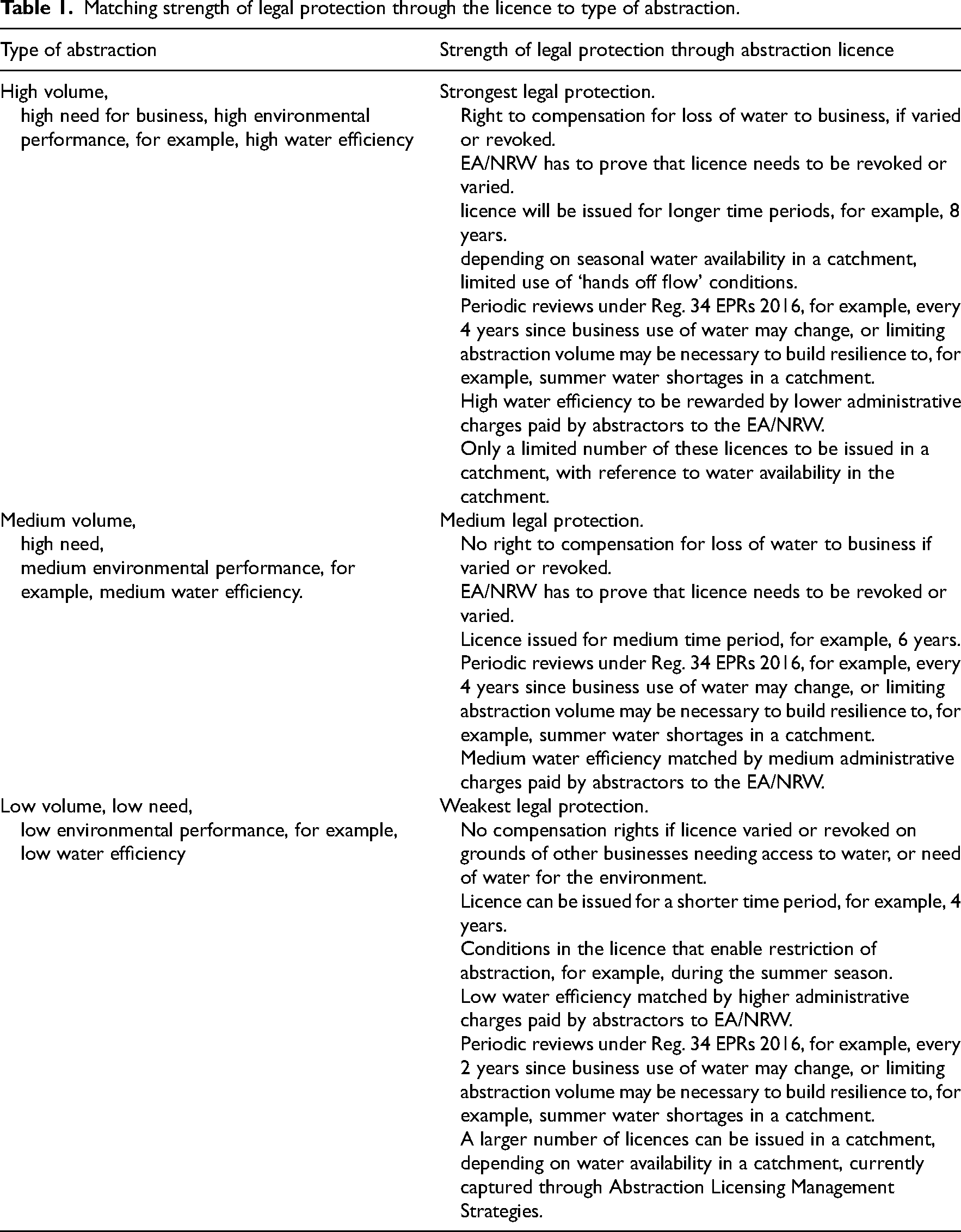
Table 1 depicts 3 types of abstractions. Abstraction type 1, listed at the top of the left-hand column, is ‘high volume, high need for business and high environmental performance’, to be proven by the abstractor. A key criterion for high environmental performance is high water efficiency, which could be defined as below-industry average use of water per unit of product. A ‘high need for water’ means that there are no possibilities to replace water use, for example, through an on-farm reservoir, or that costs for reducing water use are disproportionately high.
Abstraction type 2, is ‘medium volume, high need, medium environmental performance’, with the latter measured through, for example, medium efficiency in water use. Abstraction type 3 is ‘low volume, low need, low environmental performance’, for example, low water efficiency. ‘Low need’ can be defined as limited dependence on the abstraction because of greywater recycling, on-site capture of rainfall, water storage, or changes in production technology.
In practice, there will be further permutations, such as ‘high volume, high need and significant environmental impacts, such as low water use efficiency’ which may attract legal protection that is a tweaked version of the high legal protection set out in Table 1. In this case an abstraction licence could only be issued for a short time period, for example, 3 years, and during summer ‘hands-off flow’ or other environmental management conditions may be imposed. This may incentivize the abstractor to improve efficiency in the use of water or other aspects of its operations that cause environmental impacts. 30
Sustainable development and legal principles informing the sliding scale
Matching the strength of legal protection to the nature of the abstraction chimes with more recent developments in environmental law, such as sustainable development as an overriding objective, as well as various legal principles and duties that are required to inform the exercise of public powers in the UK, for example, by the Secretary of State heading the Department for the Environment, Food and Rural Affairs (DEFRA), as well as the EA and NRW.
Sustainable development seeks to reconcile economic, environmental and social dimensions of development. 31 For water abstraction this means to integrate business needs for water with protection of the environment from over-abstraction, and, for example, promotion of local employment. In the UK this builds on the EA's concern that socio-economic considerations should be taken into account when reviewing abstraction licences. 32 Moreover, DEFRA would like to see greater integration between regional water resource management plans, the development of which is also promoted by the EA, 33 and Local Enterprise Partnerships. 34 The latter brings together local councils, businesses, third-sector organizations, and universities.
In addition, in England, Wales and Scotland sustainable development is also to be promoted through the application of environmental principles. For instance, preventative action should be taken ‘to avert environmental damage’, the precautionary principle and the polluter pays principle. 35 The legal principle of preventative action informs the sliding scale because it provides more powers for the regulator to vary or revoke those licences that cause serious environmental impacts, for example, through their business operations, and have the least water efficiency. The sliding scale is also informed by the precautionary principle, which steers regulators to take action even if full scientific evidence for their proposed course of action is not yet available. When abstracting water this means to leave more water in the catchment for subsequent licensing for those to whom water is critical to their business, and for periods of water scarcity. A sliding scale is also informed by the polluter pays principle, since those who use water most efficiently, and thus take the greatest steps to limit the impact of their abstraction on water quantity, will benefit from the greatest protection, that is, compensation rights if the licence is varied or revoked.
A sliding scale can also be justified with reference to the EA/NRW's duty to have regard to economic considerations in the exercise of their discretionary powers to issue a licence. The EA/NRW are required to consider the likely ‘costs’ when discharging their regulatory functions in order to protect and enhance the environment, 36 which includes costs imposed on the environment. 37 The EA/NRW also have to consider the likely ‘costs and benefits’ of their actions 38 and have to consider the ‘desirability to promote economic growth.’ 39 In addition, the EA has to promote the efficient use of water. 40 A sliding scale of protection addresses costs and benefits. For instance, by limiting compensation rights to abstraction licences that are critical to business use, high volume and highly water efficient, the EA/NRW will have addressed the issue that a secure water supply is of benefit to the abstractor, while a very efficient water use reduces costs to the environment.
Fine-tuning water abstraction charges in aid of flexible licensing
Economic incentives can further help to implement the sliding scale of protection. In particular, water abstraction charges (WACs) can incentivize using less water and using it more efficiently. 41 In the Australian Capital Territory a WAC, imposed since 1999, is calculated on the basis of the scarcity value of water and includes the environmental costs of human water use. 42 A scarcity value can be either assigned by a regulator, for example, on the basis of data about availability of water in a catchment. In England and Wales this is documented in catchment abstraction licensing strategies. Alternatively, water markets can signal the price and scarcity value of water. 43
In Denmark and in the German state of Baden-Württemberg, WACs have led to substantial water savings. Industry in Baden-Württemberg accepted the charge because the costs of investments for improved water efficiency could be offset against the charge. Water suppliers accepted it because some of its proceeds were used for reducing nitrate pollution in water courses, thus lowering suppliers’ treatment costs. 44 WACs can also incentivize particular groups of abstractors to use water more efficiently. For instance, in the Netherlands water suppliers pay a higher tax for groundwater abstractions than farmers. 45
According to proposed reforms of the German Water Charges Act (Abwasserabgabengesetz) the impact of effluent on the environment will be a key criterion for calculating the charge. For example, the proposed reforms will introduce charges for environmentally damaging trace substances, such as medical drugs. The current German Water Charges Act already incentivizes improved water availability by levying a charge for rainfall water that is discharged as effluent. This is intended to promote keeping surfaces permeable so that rainfall can seep into soil deep enough to refill groundwater sources. 46
In England, WACs have been recently revised. The main criterion for the level of the charge is how much administrative costs arise for the EA in issuing the licence, and reviewing it. This does not consider how water efficient each abstraction is, or what the impact of the abstraction is on water pollution. But since the EA has to carry out more work for a licence application in water-scarce areas, for example, by assessing the impact of the abstraction on pollution levels or land-based habitats, 47 conservation of water may be promoted through this charging scheme in a more indirect and limited way. Moreover, water charges are also higher for larger volumes being abstracted, or where applications compete for abstraction of the same water, or where there is significant water loss rather than abstracted water being returned to the environment, as for example, in the case of water used for irrigation or dust suppression. 48
Moreover, ability to pay rather than efficiency in water use seems to inform higher WACs for water supply companies. Hence, WACs could be reformed by setting lower water charges for those for whom it is particularly expensive or technically not feasible to reduce their water use or use water more efficiently. In addition, charges could be set at such a level that it becomes more economical for the abstractor to surrender the abstraction licence, rather than to continue to hold it and to pay the annual charges associated with it, in order to address the problem of historic overallocation of water.
This approach has been successfully used since 1989 in relation to groundwater abstractions in the German City State of Hamburg. For some abstractors, the cost of the administrative fee for continuing to hold the water licence was higher than the value of the water to the abstractor. While this prompted voluntary surrenders of licences, it lead in this case not to water conservation, but it enabled the regulator to allocate these surrendered abstraction rights to new users. 49 Hence, WACs can help to transcend the individual entitlement approach to accessing water by incentivizing water conservation and efficiency. There are limits, however, to how high WACs can be set. Where an abstractor has a property right in the water, disproportionately high charges for the use of this private property right may be prohibited by Art. 1 of Protocol 1 of the ECHR, as implemented through the HRA 1998 in the UK. Very high charges may be a form of expropriation or control of private property that would require compensation. 50 To summarize, the main objective of the sliding scale of legal protection is to move away from the individual entitlement approach to water that fixes allocations of water over long time periods for individual abstractors. This objective can be further promoted by considering all water allocations in a catchment together when licensing through ‘bubble’ licensing and by promoting the exchange of water between abstractors. ‘Bubble’ licensing can thus build on the initial allocations to individual abstractors according to the sliding scale approach.
‘Bubble’ licensing for flexible entitlements
Determining how much water there is in a catchment
Bubble licensing is a distinct approach to granting licences for the abstraction of water from surface- and groundwater bodies. It is different from the ‘first come, first served’ principle that has in the past informed the EA's/NRW's Catchment Abstraction Licensing Strategies. 51
Bubble licensing involves 2 steps. First, for the environmental regulator, for example, together with catchment partnerships to ascertain how much ground- and surface water is actually available in a water body or catchment for abstracting. Such an assessment will be informed by environmental science information about the environmental impacts of abstractions and climate change-adjusted projections of rainfall. This could include a baseline of existing impacts of abstractions and projected impacts in light of reduced, expanded or changed production. Such assessments can consider whether imports of virtual water increase the amount of water available for abstraction in the catchment. Virtual water is water abstracted in a different catchment and used there for the production of goods, such as crops or paper, which are then exported into other catchments. Estimating the amount of virtual water in a catchment renders transparent whether a catchment is a net importer or exporter of water. 52
So far there are only limited moves in the UK to engage in bubble licensing. In some areas, such as East Anglia, a bubble is created, not for covering all water bodies in a catchment, but for smaller parts within it, by aggregating groundwater abstraction licences in a catchment. 53 Within these aggregated licences a new abstraction point can be added to a licence, a new purpose for abstraction can be added to an existing licence, or various licences can be combined. 54
Moreover, the EA has issued in England group abstraction licences which cover, however, areas that are smaller than an entire catchment. These group licences authorize abstractions from a common pool, that is, ‘bubble’ of water. Group abstraction licences can be held by a company, with, for example, individual farmers abstracting portions of the water according to their production needs. In the case of the Lincoln Water Transfer Company a legally binding members’ agreement and protocol 55 sets out member responsibilities and sanctions. 56 Members can return unused portions of their allocation to the common ‘bubble’ for redistribution by the Upper Witham Internal Drainage Board. This flexibility has reduced the total licensed volume under the group abstraction licence. 57
Determining the size of the bubble and incentivizing exchange of water
The second step in bubble licensing involves the environmental regulator, for example, together with catchment partnerships, to determine how much water from the total water available in a water body or catchment, should be available for abstraction. 58 The bubble then represents the cap on the amount of water that is available for abstraction. The size of the bubble can be determined with reference to various criteria. This can be, firstly to have sufficient water to comply with legal limits for water quality and habitat protection under, for example, the Water Environment (Water Framework Directive) (England and Wales) Regulations, 59 as well as the Conservation of Habitats and Species Regulations 2017 (as amended), 60 and the Conservation of Habitats and Species (Amendment) (EU Exit) Regulations 2019. 61 Secondly, by reducing the bubble a greater incentive for abstractors to exchange water or to invest in infrastructure, such as storage, will be created. Exchanges can happen through trading, reciprocity exchanges or bartering.
Bubble licensing and facilitating access to water through trading
Bubble licensing can be associated with trading in, for example, abstraction rights. This means that a market is established in which different abstractors can buy, sell or lease their rights to access water either permanently or for a fixed period of time. This can be facilitated through electronic platforms. 62 Water trading can also extend to virtual water by capturing the amount of water that is embedded in agricultural or industrial products when the actual commodities are traded. Virtual water trading can lower the cost of exchanging water, since no pipe infrastructure or administration of exchanges of legal licences to abstract water are required. As set out in Table 2 academic and grey literature based on empirical research has identified various obstacles to water trading. It has also suggested solutions, which are relevant to abstraction reform debates.
Obstacles to and measures for facilitating water trading.
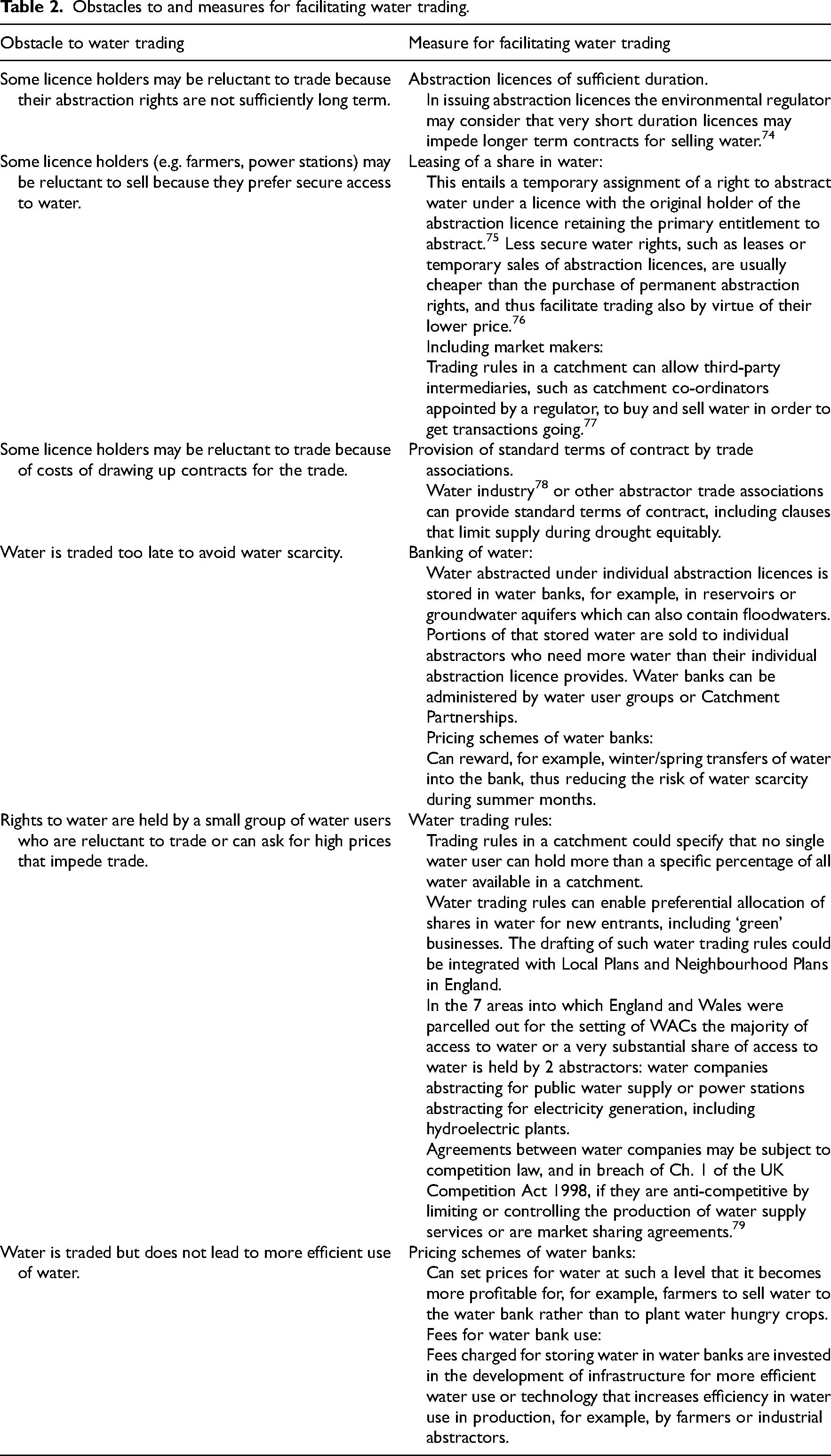
Trades can involve trading in rights in water, trading in the licence itself, or trading in water, such as a share of water. 63 Trading in water rights means that an abstractor sells all or a portion of their right to abstract water, as set out in their abstraction licence. Currently in the UK, trading does not occur directly between holders of water rights, but needs to be approved by the Environment Agency for 2 reasons. First, water rights are not entirely fungible. Various abstractions have different characteristics. Water is abstracted in different locations, for different purposes and has different environmental impacts. For instance, water abstracted for crop irrigation has more peaks over the year, than the more constant abstraction for watering livestock. 64 Second, the EA and NRW retain statutory duties to ensure compliance with water quality standards in accordance with the Water Environment (Water Framework Directive) (England and Wales) Regulations 2017, such as not to cause deterioration of water courses. Trades in the UK therefore involve the EA varying existing abstraction licences or issuing new ones. 65
While the UK government advocates trading as one of the ways in which access to water can become more flexible, 66 the environmental regulator, the EA imposes significant restrictions on this. It prohibits trading, for example, where according to the Catchment Abstraction Management Licensing Strategy the water body is classified as ‘restricted availability for licensing’. 67 Water available for trading may be restricted once actual abstraction has reached a sustainable limit. This may mean that water that already has been allocated for abstraction from such a water body, and thus has met criteria for lawful abstraction, may not be allowed to be traded, even though that water may be of greater value to another abstractor.
Facilitating access to water through reciprocity exchanges and bartering
Academic literature on improving sustainable access to water has focused on how this can be done through trading and how markets for water can be established. 68 But exchanges of water or rights to water so that water is put to its most beneficial and valued use, can also happen without financial payment through a direct reciprocity exchange between a licence holder and a water user. This already occurs occasionally in England when a farmer makes water available to a neighbouring farmer who may need extra water because he/she is planting a more water hungry crop. This exchange of water can happen through leasing the land with the water abstraction right, or through piping the water to the neighbouring farmer. The incentive for a farmer to engage in such an exchange is that the farmer may benefit during the next cropping season from a reverse exchange.
Exchanges of water or water rights directly between 2 abstractors can also occur through bartering. 69 In the case of bartering there is a non-financial ‘payment’, such as the lending of farm machinery or the provision of ecosystem services, as consideration for the permanent or temporary transfer of water or water rights held by one abstractor to another abstractor. In the UK there are already successful examples of bartering that involve the provision of ecosystem services. For instance, farmers have entered into voluntary agreements with water companies to reduce the use of pesticides and fertilizers, or to fence off pastures near water courses, in order to limit concentrations of pollutants in water bodies in a catchment, or to provide flood water storage. This saves the water company treatment costs or reduces its risk of sewer flooding. In return, water companies, transfer some water that has been allocated to them under an abstraction licence to farmers, for example, during times of high seasonal agricultural demand for water. Paying by providing ecosystem services, makes it possible for those abstractors who cannot afford to pay for more water in a market, such as small farms, or other small businesses, to nevertheless access more water. Similarly, where water savings by industrial or farming abstractors or by water users, such as domestic householders, make more water available for abstraction for a water supply utility, the utility could ‘pay’ for this protection of its water resource assets by providing ecosystem services, such as river restoration measures or flood management schemes.
Paying for access to water through the provision of ecosystem services is likely to cost less than the EA/NRW recovering water through imposed licence changes that require compensation payments 70 and then redistributing this water through new or changed allocations under abstraction licences. If exchanges of water involve increased abstraction from surface- or groundwater abstraction points it may be necessary to produce a statement of environmental impacts financed and provided by the abstractor who obtains an increased allocation. 71 Such a statement might be assessed in an expedited procedure by the EA/NRW, and would have to show that the exchange of water does not lead to significant increases in pollution levels in surface- or groundwater sources, 72 or detrimental impacts on nature conservation sites. 73
Conclusion
This article has sought to contribute to debates about abstraction reform by outlining ideas for rendering access to water more flexible, but thereby also more sustainable, including for future generations. The first idea, a sliding scale of legal protection for different types of abstractions, seeks to transcend the existing individual entitlement approach to allocating water. A sliding scale of legal protection implements a relational approach to allocating water, by considering individual abstractors’ access to water in relation to other abstractors’ need for water (how critical is the use of water to the business?) and in relation to water availability for the environment and other human users of water in a catchment (how efficiently is the water used?). Reforms already underway in some jurisdictions, such as England, go some way in limiting the individual entitlement approach to water. This is, however, currently focused on a licence by licence tweaking of existing abstraction rights, also through the removal of compensation rights in further cases. In contrast to this, this article suggests to group types of abstractions in a catchment and – through further reform of the statutory framework – to match the strength of legal protection provided to the type of abstraction undertaken (e.g. critical to business use and highly efficient).
The relational, collective action approach of the sliding scale can be further promoted through ‘bubble licensing’ which places a cap on the total water available for abstraction. By reducing the size of the cap and thus initial allocations, abstractors are incentivized to exchange water. Academic literature and public policy practice have focused in particular on trading in markets as one type of exchange. This article suggests that reciprocity exchanges and bartering are also important forms of exchange. This can facilitate that those for whom it is least costly will make the greatest contributions to water savings.
Footnotes
Declaration of conflicting interests
The author(s) declared no potential conflicts of interest with respect to the research, authorship, and/or publication of this article.
Funding
The author(s) disclosed receipt of the following financial support for the research, authorship, and/or publication of this article. This work was supported by the Natural Environment Research Council (grant number NE/L010364/1 and NE/L010356/1).
