




Abstract
The need to ensure a uniform interpretation and effective application of the large corpus of EU environmental regulation in the jurisdictions of the Member States remains a task of pivotal importance for the Court of Justice of the European Union (CJEU). A quick look at the CURIA database reveals that many judgments are handed down every year to clarify the meaning of EU environmental provisions. It is therefore important to study the proper functioning of the tandem composed of the CJEU and the national courts in this field of EU law. In that sense, this article responds to Bogojević’s call ‘to draw a grander map of judicial dialogues initiated across various Member States’. More specifically, the topic investigated by this article is how the United Kingdom (UK) courts have followed up on responses received from the CJEU to their preliminary reference requests in the field of EU environmental law, from the UK’s accession in 1972 until January 2017. All the cases we have retrieved from the UK show various degrees of willingness to cooperate with the CJEU. This article highlights the existence of three trends: full cooperation, fragmented cooperation and presumed cooperation.
1 Introduction
Officially starting in 1973, 1 European Union (EU) environmental policy and law today constitutes a large regulatory corpus. Hundreds of legally binding acts cover the vast majority of environmental aspects, with soil law and judicial protection in environmental matters probably representing the two fields in which EU environmental law is at its scarcest. 2 The need to ensure a uniform interpretation and effective application of this large regulatory corpus across the jurisdiction of the Member States thus remains a task of pivotal importance for the CJEU.
In essence, CJEU is not a court of appeal empowered to annul or modify national judgments. 3 The effective application of EU environmental law is the task of the Member States, as well as their courts. The CJEU’s function is to serve as the ultimate interpretative authority on questions of EU law, 4 including when it engages in judicial dialogue with the national courts. Judicial dialogue is thus an essential feature of the EU legal system, given this particular character of its jurisdiction, 5 a jurisdiction in which the CJEU and the national courts are, to use the words of Advocate General Jacobs, ‘bridged together exclusively by the preliminary reference’. 6 It is up to the CJEU and the national courts together, as a shared responsibility, 7 to rule on matters of EU law. 8 In the process of ruling on EU law under the preliminary reference procedure, the CJEU has fleshed out most EU legal principles, forming what Mancini considers the ‘Constitution of Europe’. 9 In this regard, Jacobs emphasises that the preliminary reference is an, albeit unsatisfactory, opportunity for individuals to enjoy the rights derived by them under EU law. 10 Alongside the protection of individual rights, the preliminary reference procedure also plays a key role in guaranteeing that EU law is uniformly applied across the Member States. 11 A quick look at the CURIA database and the Service Section of this journal shows that many judgments clarifying the meaning of EU environmental provisions are handed down every year.
It is, therefore, important to study the proper functioning of the tandem composed of the CJEU and the national courts in this field of EU law. Several studies have considered the advantages and shortcomings of the preliminary reference mechanism in this regard, both in general 12 or specifically to environmental matters, 13 and whether questions are asked and answered (the upload phase) correctly. Far less attention has been paid to what occurs after the CJEU has responded to the national judges (the download phase). 14 The research question to be addressed in the download phase thus concerns the manner in which national courts administer the replies received from the CJEU following a preliminary reference in the field of environmental protection. This question has two aspects. First, it concerns the manner in which the referring national court reacts to the CJEU’s answer. Second, it concerns the manner in which other national courts react to the CJEU’s answer in the light of the unwritten stare decisis system confirmed by the ‘acte eclaire’ doctrine declared in Da Costa 15 and CILFIT. 16, 17 This article addresses only the first aspect, leaving the latter for a follow-up study.
So far, only Bogojević has addressed how national courts react to the CJEU’s answers to their referred questions, and then only for the Swedish courts. 18 As further discussed in section 2.3, she mapped the Swedish courts’ behaviour and unfolded four different categories of judicial dialogue: interchanged dialogue, gapped dialogue, interrupted dialogue and silenced dialogue. 19 This mapping exercise was only a starting point. She argues for greater attention to be paid to this particular aspect of judicial dialogue, given that national court behaviours have, so far, not been mapped. Empirical data on this matter are fundamental to place theoretical discussions on judicial dialogue in perspective.
As Bogojević’s findings are only a starting point, this article takes up the call to ‘to draw a grander map of judicial dialogues initiated across various Member States’. 20 Following up on Part I of Bogojević’s map, this article presents Part II. More specifically, the topic investigated by this article is how the United Kingdom (UK) courts follow up on the CJEU’s answers to their preliminary references in the field of EU environmental law, from the UK’s accession in 1972 until January 2017. Mapping the UK courts’ behaviour is important because it is claimed that the Community’s status quo lacks justification in the eyes of the English courts, which, in turn, affects how they go about interpreting statutes. 21 UK law and courts are traditionally considered sceptical of environmental legislation and European integration. This aversion to gold-plating/green-plating means that most EU environmental law is implemented in UK law in almost verbatim fashion both by the courts and in statute. 22 The UK is therefore a good counterpart to complement the findings from Bogojević’s study of Sweden, which is usually considered to be both pro-environment and pro-Europe.
To properly present our empirical findings, it is important first to establish the common denominators of the research. Section 2 accordingly provides an account of what is meant by ‘judicial dialogue’ and its micro dimension ‘judicial cooperation’ (section 2.1), preliminary references in ‘environmental matters’ (section 2.2), the categories under which national courts responses to the CJEU’s answers can be classified (section 2.3), and the role played by the variables influencing judicial dialogue (section 2.4). Section 3 then provides the empirical data, based on the mapping of UK courts’ practice in environmental matters, followed by a synthesis in Section 4. Our main findings are three new categories of interplay. All the cases we retrieved from the UK reveal a willingness to cooperate with the CJEU to various degrees. This section highlights the existence of three trends. First, the national court applies the CJEU’s judgment to the letter (full cooperation); second, the CJEU decides to reformulate the question and the national court applies the CJEU’s answer inasmuch as it considers it relevant to the case (fragmented cooperation); third, the CJEU judgment is not applied, because the losing party withdraws from the proceedings, predicting full compliance (presumed cooperation). These three new categories extend the map started by Bogojević and therefore help develop a better insight into national court behaviour in the download phase of Article 267 TFEU procedures. Section 2 is also useful to steer comparative studies on this matter. Indeed, similar studies focusing on the Netherlands, Germany, France and Italy are in the process of being finalised and will be the subject of separate publications. Together, these empirical studies will flesh out a map of the judicial dialogue download phase in EU environmental matters. Once the actual shape of judicial dialogue in EU environmental matters is described, an in-depth comparative research project can be conducted to unveil the reasons for the empirical findings presented in this paper and the coming ones described.
2 Setting the stage: Judicial dialogue and judicial cooperation in preliminary references in environmental matters
2.1 The micro dimension of judicial dialogue: judicial cooperation
There are various kinds of judicial dialogue. 23 Jacobs highlights the two main features of the internal judicial dialogue in the EU legal system. The first is the ‘constitutional’ judicial dialogue (that is, the jurisdiction of the CJEU to hear complaints lodged by other EU institutions or the Member States). 24 Second, and the object of this contribution, there is a judicial dialogue through the preliminary reference mechanism, or what Jacobs considers ‘[…] the most important feature of the judicial system of the Community […]’. 25 However, we argue that it is only possible to speak of a dialogue between judges at the macro level – the level at which a national judiciary is considered as a whole. At the micro level, when considering the behaviour of individual courts, it is impossible to speak of a dialogue, simply because asking a question and receiving an answer can hardly be considered a dialogue. To summarise the procedure, lower courts have a right to ask a preliminary question, 26 courts of last instance have an obligation in this regard 27 and the CJEU has a duty to answer these questions. The national court referring the question must comply with the CJEU’s answer, 28 but it does not have to report its final judgment to the CJEU. A quick look at the CURIA and Eurlex databases shows that information about the continuation of national proceedings is usually missing. The CJEU’s recommendations underline the desirability of a practice where national referring courts would report back to the CJEU how they have ruled on the matters subject to the preliminary question, in light of the principle of sincere cooperation. 29 Yet, when questioned, the CJEU only confirmed that the preliminary ruling is binding on the referring court without providing any comment on why the majority of national cases could not be located. 30 How the national courts respond to the CJEU’s answers can thus hardly be considered as being directed at the CJEU, and therefore at best amount to a dialogue of the deaf. 31 Proposals have been made to improve the dialogue, ranging from making a better use of Article 101 of the Rules of Procedure to inviting national referring judges to participate in the hearing before the CJEU, but they are not actually applied. 32
In light of the normative background of the preliminary question and answer and the lack of a real discussion between the two main parties to the procedure, we will only speak of cooperative or uncooperative dialogue at macro level. Instead, at micro level we prefer to discuss in terms of sincere cooperation rather than judicial dialogue. Indeed, the principle of sincere cooperation goes hand-in-hand with the objective of the preliminary reference itself. First, because a judicial system which is built upon the division of competences between the national courts and the CJEU calls for a greater cooperation. 33 Second, since it is through the correct application of preliminary references that the national courts are offered the opportunity to demonstrate a cooperative attitude towards the CJEU par excellence. 34 In this regard, it could debatably be argued that the willingness of the national courts to refer questions to the CJEU might also indicate their willingness to give effect to its rulings. 35 Yet rather than being based on mutual understanding, judicial cooperation can be affected by elements of conflict and a struggle for power, as wisely remembered by Paunio. 36 Ascertaining where this comes from would require not only an inquiry into the perception of EU law in the eyes of national courts, 37 but also a sociological inquiry into a Member State’s approach to the EU 38 , which is not the objective of this article.
2.2 Defining the common denominators: ‘environmental matters’
The concept of ‘preliminary references in environmental matters’ is a term in need of refinement. If it is understood in its broadest sense, it would encompass each case under Article 267 TFEU dealing with environmental issues. In turn, the concept of ‘environmental issues’ in its broadest sense would encompass – alongside more traditional environmental matters 39 – nuclear and other energy issues, animal health issues, product standards when linked to environmental concerns, national justifications of EU law, especially in the context of the fundamental freedoms, etc. Such a broad approach, although suitable for understanding the relationship between national courts and the CJEU, would not provide a clear picture of whether the EU environmental law acquis is interpreted and applied uniformly. Moreover, a broad approach to the concept of ‘EU environmental law’ would increase the chances of cases being added or omitted improperly from the analysis. The narrowest approach to the concept of ‘preliminary references in environmental matters’ would be to look at cases under Article 267 TFEU in which an interpretation of acts based on current Article 192 TFEU was required. Such a narrow approach would ensure the highest degree of consistency in the comparative approach. Yet it would exclude from the analysis cases which are usually considered ‘environmental cases’, but which relate to an EU legal act which is not based on Article 192 TFEU for the simple reason that the centre of gravity test favoured the application of a different legal basis. A compromise between the broadest and the narrowest approaches was achieved by searching Curia for preliminary references from the UK concerning environment, energy and provisions governing the institutions. The results where then filtered for judgments which did not concern EU acts as defied in Article 288 TFEU, having as their primary or explicit secondary objective the protection of the environment.
2.3 Categories of judicial cooperation
The cases retrieved by means of the research criteria mentioned in section 2.2 can then be analysed to identify the kind of judicial cooperation taking place. In this regard, all the cases can be categorised into two main groups: cases supporting the existence of a cooperative dialogue, in which national courts can be considered as following the CJEU’s answers and those supporting the existence of an uncooperative dialogue, in which national courts cannot be considered to being following the CJEU’s answers. Uncooperative dialogue arises when the two main positive obligations and three negative obligations binding the national courts according to Verhoeven are not respected. 40 The positive obligations are that the courts should ensure the effective application of EU law and the protection of rights stemming from EU legislation; the negative obligations are that they should abstain from measures which impede the effectiveness of EU law, the proper functioning of the internal market or the process of EU integration.
It is within the category of cases sustaining the existence of an uncooperative dialogue that Bogojević’s categories can be located, albeit renamed in terms of interchanged cooperation, gapped cooperation, interrupted cooperation and silenced cooperation, 41 for the reasons indicated in section 2.1. Interchanged cooperation means that there is an interchange of values. The preliminary reference is absorbed into national law and applied as though it were national case law. 42 For example, in the Gävle Kraftvärme the CJEU’s had clarified what ‘incinerator’ meant under the Waste Incineration Directive. 43 The Swedish Supreme Court tasked a lower court to apply the criteria set out by the CJEU. In so doing, the lower court only referred to the Swedish Supreme Court ruling not to the CJEU’s ruling. 44 The lower national court did not treat the preliminary reference as though the information were provided by the CJEU. 45 Gapped cooperation signifies that there is a lack of judicial dialogue between the CJEU and the national court. There can be instances where a national court questions the validity of the CJEU’s ruling. 46 For example, in the Billerud case the national court, after receiving the CJEU’s ruling, considered whether the CJEU’s interpretation of the ETS Directive complied with the European Convention of Human Rights. 47 This was done without making further reference to the CJEU. There is then interrupted cooperation, which means that national law may have been revised, and/or facts added, rendering the preliminary reference useless while the procedure remains ongoing. 48 For example, in Jan Nilsson, the relevance of the CJEU’s answer to the question of whether stuffed species fell under the CITES Regulation lost importance as the criminal offence for trading in such species was abrogated, leading to the criminal charges against Mr Nilsson being dropped. 49 Finally, Bogojević proposes a category of silenced cooperation, covering cases where the national court does not mention the preliminary ruling and ignores it. 50 For example, in Mickelsson and Roos the national court ultimately cleared Mr Mickelsson and Mr Roos of the criminal charges on grounds different from the ones considered in the CJEU’s ruling, which was not even mentioned. 51 Although these cases do not concern the interpretation of an EU directive aiming primarily or secondarily at environmental protection, and would thus fall outside the scope of the research based on the criteria set out in section 2.2, they still represent cases where a national court has not included the reasoning provided by the CJEU in its national ruling. The CJEU’s ruling is thus ignored.
This article considers whether cases from another jurisdiction than Sweden, the UK, fit within Bogojević’s categories, or whether new categories should be introduced. As elaborated in section 3, every case we retrieved from the UK shows adherence to the CJEU’s rulings to various degrees. Therefore, not all of them fall under the categories indicated by Bogojević. Three new categories of judicial cooperation are introduced here, and are fully explained and accounted for in section 3. First, full cooperation, where the national court applies the CJEU’s judgment to the letter; second, fragmented cooperation, where the CJEU decides to reformulate the question and the national court applies the CJEU’s ruling inasmuch as it can be applied the part of the answer that it considers relevant; and third, presumed cooperation, where the CJEU’s judgment is not applied, because the party which is deemed to have lost before the CJEU withdraws from the proceedings, expecting full the decision to be applied in full by the national judge.
2.4 The role of factors influencing judicial dialogue and judicial cooperation
It goes without saying that as in any important cooperation, good communication in judicial matters is extremely important. This begins in the upload phase, where the national court must pose well-formulated questions and provide additional information if necessary. 52 Intervening parties, especially the Member State from which the questions originate, should help to provide a clear picture of the subject matter of the question, while refraining from changing its focus. 53 From the CJEU’s perspective, it must be borne in mind that answering in abstractions and general principles may, in fact, be the best way to provide national courts with the rules needed for a broad application of the CJEU’s interpretation to the facts at hand; however, the Court in Luxembourg must accept that by so doing, it is not controlling the outcome of concrete cases. 54 Indeed, this approach could lead to the rulings provided by the CJEU being considered too theoretical by national judges to resolve the case in question. 55 Judges might then choose not to apply such rulings. 56
As such, the CJEU is required to be more precise if it wishes to avoid complicating the delivery and reception of a preliminary ruling because, as Prechal maintains, just like communication in other spheres of life, something can always go wrong with judicial communication. 57 To this end, the CJEU tries to help preserve the interpretative uniformity of EU law by delivering guidance cases which present a set of specific circumstances to be taken into account to interpret a certain provision. 58 A step further in controlling the outcome of national cases would be for the CJEU to deliver outcome cases, in which the CJEU would only state that a Member State, for instance, had failed to implement a directive correctly, thus leaving to the national court only the outcome of striking down the decision taken in breach of EU law. 59
The different working languages of the national and EU courts, in this case French and English, as well as differing drafting practices, can also influence judicial dialogue and consequently how national courts follow up CJEU’s rulings. 60
All these variables are important to understanding why a national court behaves in a particular way, but they are irrelevant as far as this study’s mapping exercise is concerned. Indeed, as in Bogojević’s study, the question lying at the heart of this article is how national courts react to a CJEU ruling, not why they react in a particular way. The variables indicated in this section are relevant for follow-up studies explaining the meaning and relevance of the finding presented in this study. Such follow-up studies will also have to take into account the meta-juridical aspects related to judicial cultures and national attitudes towards the EU integration process. The comparative methodology needed to link the national experiences together requires a rigid framework to avoid comparing ‘apples’ and ‘pears’, hence requiring the setting up a broad research project with the help of external funding, such as the H2020-funding programme, to be applied. Accordingly, while we will keep these variables in mind, we do not address the ‘why’ question in this study. We will confine ourselves in sections 3 and 4 to indicating whether, based on the information at our disposal, any or all of the variables mentioned in this section can be observed. This does not detract from the relevance of this study because, as stated in the introduction, it is only possible to organise and conduct a research project on the reasons for our empirical findings once how the judicial dialogue in environmental matters is actually shaped is known.
3 UK judges as European judges in the context of preliminary references in environmental matters
Bogojević’s contributions have demonstrated the existence of four categories of cases in which national courts do not sincerely cooperate with the CJEU. As shown in the following three sections, three new categories, all demonstrating judicial cooperation, should be added to the judicial dialogue map, when we look at the behaviour of UK courts in environmental matters.
UK scepticism of the EU integration process, 61 its minimalistic approach to the implementation of EU obligations 62 and the reluctance of UK courts to ask preliminary references 63 are well documented in academic writing. The readers of this journal do not need two non-UK lawyers to tell them how judicial review is organised in the UK or what the UK judicial culture is. 64 As indicated in the previous section, to do so is also not necessary to answer the research question posed by this contribution. For a recent overview of the general and peculiar features of the judicial administrative review systems in England and Wales from a comparative perspective, we direct the reader to Backes and Eliantonio’s edited book on judicial review of administrative acts. 65 Given the space at our disposal, this section focuses directly on our empirical findings.
A total of 30 preliminary references were made by UK courts in this field between 1972 and mid 2017. 66 The eight preliminary references which form part of this study were requested at various stages in the national proceedings, representing every instance. Five references were requested by the highest court 67 and the rest by lower courts, 68 but none came from Scotland. Though including the national procedure for every case would most likely have helped us form a better understanding of this situation, reports for the remaining 22 cases were impossible to locate. 69 Two of the eight cases located did not result in a corresponding national decision, because the party which lost before the CJEU decided to withdraw from the proceedings (one of those was from Northern Ireland). 70 Information as to the reasons for the lack of a follow-up case was provided by the lawyer representing one of the parties for these two procedures. This might have also been the case for the other 22 cases for which no-national follow-up could be retrieved, 71 but out-of-court settlements or other reasons could also explain the impossibility of locating the remaining follow-up cases.
All the cases we retrieved from the UK show the CJEU’s rulings being followed, to various degrees. This section highlights the existence of three trends. First, the national court applies the CJEU’s judgment to the letter (full cooperation), as discussed in section 3.1; second, the CJEU decides to reformulate the question and the national court applies the resulting decision as far as it can be applied (fragmented cooperation), as discussed in section 3.2; third, the CJEU judgment is not applied because the losing party withdraws from the proceedings, implying full cooperation (presumed cooperation), as discussed in section 3.3.
3.1 First category: Full Cooperation
National courts, in light of the principle of sincere cooperation, must ensure that the judicial dialogue between them and the CJEU runs smoothly by demonstrating cooperative conduct in applying the CJEU’s guidance. As regards the latter aspect, such cooperative conduct was evident in five cases in the UK, 72 with the national judges deciding completely in accordance with the CJEU’s decision, although in one such case this conclusion requires qualification.
Full cooperation was easy to establish in those cases where the Court of Justice delivered an outcome case (that is, where it indicated whether a given interpretation of the EU act in question is right or wrong). This was the case, for example, in R v Secretary of State for the environment (ex parte Society of Birds). 73 The case concerned a decision of the Secretary of State excluding some 22 acres of land near Lappel Bank from consideration as a Special Area of Conservation (SAC), in the grounds of economic interests. Uncertain whether economic considerations could be taken into account when delineating SACs under the Wild Birds Directive, 74 the House of Lords asked the CJEU for its opinion. The House of Lords also asked whether anything would change if the economic considerations constituted matters of superior general interest or reasons of overriding public interest.
The CJEU answered both questions in the negative. 75 It held that the Member States are not authorised to include economic considerations in their decisions delineating SACs. Moreover, it held that even if these considerations are of overriding public interest, they cannot be taken into account at the stage of delineating a SAC, but only at a later stage.
In line with the CJEU’s interpretation, the House of Lords quashed the decisions handed down by the Court of Appeal and the High Court and declared invalid the decision of the Secretary of State regarding the delineation of a special protection area under the Wild Birds Directive, on the grounds that the Secretary of State had taken economic requirements into consideration in reaching the decision in question. The House of Lords also stated that within the context of delineating a special protection area, the Secretary of State was not authorised to take economic requirements into consideration as imperative reasons, as indicated in the Wild Birds Directive. 76 In so doing, a full account was given of the CJEU’s ruling, meaning that this cannot be described as silenced cooperation, as happened in Sweden in the Mickelsson and Roos case. 77
A similar finding can be drawn from another outcome case, that of Diane Barker v Bromley Council. 78 London & Regional Properties Ltd applied to Bromley Council for outline planning permission to develop a leisure complex. Bromley Council concluded in 1998 that an Environmental Impact Assessment (EIA) envisaged under the EIA Directive 79 was not required, and granted outline planning permission subject to some reserved matters for subsequent approval. When a decision was needed for approval of the reserved matters, some Bromley councillors requested an EIA, but under English law it was no longer possible to carry one out at that stage. Final approval was therefore granted in 1999 without an EIA. Ms Barker challenged this decision, but her action was dismissed both in the first instance and on appeal. She then appealed before the House of Lords. The House of Lords had doubts about whether the permission was a ‘development consent’ under the old EIA Directive and also whether the EIA could be carried out at a later stage of the consent, if initially it was believed that it was not required. It therefore asked first, whether the concept of development consent should be interpreted by considering national law exclusively. Second, it asked whether the directive requires an EIA to be carried out if, following the grant of outline planning permission subject to conditions that reserved matters be approved, and without an EIA having been carried out, it emerges when approval of the reserved matters is sought that the project may have a significant effect on the environment by virtue, inter alia, of its nature, size or location.
The CJEU answered that the national court, when deciding if planning permission can be considered a ‘development consent’, cannot exclusively look at national considerations, but should apply national law in a manner consistent with EU law. Second, the CJEU held that when national law provides for a consent procedure of more than one stage in which the latter stage cannot extend beyond the parameters set by the principal decision, the EIA should be performed at the time of the principal decision. However, if the adverse effects cannot be identified at the initial stage, the EIA should be carried out in the context of the implementing decision. 80
In line with the CJEU’s interpretation, and presenting a full account of it, the House of Lords did not consider national law exclusively when interpreting the concept of ‘development consent’. It stated that proceedings granting outline planning permission subject to subsequent approval by the relevant authority should be deemed a ‘consent procedure’ under the EIA Directive. 81 Quashing the Court of Appeal decision, the House of Lords held that by precluding an EIA at a later stage of the consent procedure, the Planning Regulations 1998 had failed to transpose the directive correctly. Moreover, Bromley Council was wrong when it concluded that an EIA was not possible at a later stage in the decision.
Remaining within the realm of the EIA Directive, the fourth case showing full cooperation is Mellor v Secretary of State. 82 The case is about a planning permission granted in an Area of Outstanding Natural Beauty (AONB). Following the applicant’s appeal, the planning permission was quashed on grounds that the council had not adopted an EIA opinion. At a later stage, the Secretary of State decided differently and stated that it was not necessary for him to adduce additional reasons to his decision not to conduct an EIA, based on an at-that-time relevant precedent in English case law. The England and Wales Court of Appeal had its own doubts and decided to ask the CJEU if, under the EIA Directive, Member States are obliged to communicate reasons for refusing to carry out an EIA, and if the motivation already expressed by the Secretary of State formally satisfied any potential duty to provide reasons.
The CJEU held that public authorities are not required to provide reasons for a refusal to adopt an EIA. However, authorities are obliged to provide the relevant reasons for their determination upon the request of an interested party. Furthermore, the CJEU stated that the Secretary of State’s reasoning could be considered sufficient as long as it had taken into account the information provided by the parties, supplemented by other information capable of allowing the parties to appeal that decision, something which was for the national court to assess. 83
By the time the CJEU’s decision reached the England and Wales Court of Appeal, various events had occurred. First, two more screening directions had been provided, rendering the original screening direction of the Secretary of State irrelevant. Second, the planning permission had been withdrawn. The England and Wales Court of Appeal was thus, in theory, not obliged to follow the CJEU’s decision, since the ‘old referring facts’ had been superseded by others. Cooperation between the national court and the CJEU could have followed the pattern described as interrupted cooperation, as observed in Sweden in the context of the Jan Nilsson case. 84 This did not turn out to be the case. The England and Wales Court of Appeal applied the CJEU’s ruling, and accordingly awarded costs. The England and Wales Court of Appeal went into the details of the correspondence between the Mr Mellor and the State. 85 It resisted the attempts of the defending parties to focus only on the part of the CJEU’s ruling stating that there is no obligation to provide reasons in a decision not to conduct an EIA. The England and Wales Court of Appeal was clear that there is an obligation to provide such information if such a request has been made. It also considered that Mr Mellor had made such a request. Accordingly, it concluded that the state had failed to provide information at the time of the request. That such information had ultimately been provided did not change the fact that Mr Mellor had had to commence proceedings to challenge the initial refusal. Accordingly, the state was ordered to pay the costs of the proceedings.
The CJEU also delivered an outcome case regarding one of the two questions posed by the High Court of Justice (England & Wales) in the Thames Water ruling. 86 Thames Water was facing criminal proceedings because it had allegedly deposited untreated sewage water on land. There were discrepancies as to whether the waste deposited actually constituted ‘controlled waste’ under the Old Waste Directive 87 or waste within the meaning of English legislation. The criminal proceedings brought by the Environment Agency would stand if the waste was considered waste under the directive. In its preliminary ruling request the High Court of Justice (England & Wales) asked the CJEU whether ‘water waste’ constituted ‘waste’ within the meaning of the directive. Moreover, the national court wanted to know whether the waste could be excluded from the scope of the directive by virtue of an exception in the latter specifying that it would cover the waste insofar there is no ‘other legislation’.
Following the questions as formulated by the High Court of Justice (England & Wales) almost to the letter, as regards the first question the CJEU answered that ‘water waste’ did not alter the character of waste, and thus as regards the second question, it is indeed within the scope of the directive. In line with the interpretation by the CJEU, the High Court of Justice (England & Wales) accepted that the water waste was indeed waste within the meaning of the directive. 88 In doing so, a full account was provided of the Court of Justice’s reasoning for its conclusions.
Full cooperation can also be observed in cases where the CJEU left more leeway to the national court by means of a guidance case. In the already discussed Thames Water case, as regards the second question, ie whether the waste could be excluded from the scope of the directive by virtue of an exception in the latter providing that the directive covers waste insofar as there is no ‘other legislation’, the CJEU held that for waste to be covered by ‘other legislation’, it had to contain ‘precise provisions organizing the management of waste’ and ‘a level of protection equivalent to that under EU law’. Accordingly, it instructed the national court to ascertain whether the national rules governing waste contended by Thames Water met such criteria.
The High Court of Justice (England & Wales) then looked at the specific pieces of ‘other legislation’ mentioned by one of the parties to the proceedings, and decided in the negative. 89 By so doing it fully took into account the criteria laid down by the CJEU, and held that it was bound to decide only on those and no others. 90 The Court considered the regimes invoked by the defendant were unable to satisfy the CJEU’s test in that they were merely ‘[…] dispersed regimes addressing harmful effects […] and not precise provisions governing the management of waste’. 91
A similar conclusion can be reached regarding Edwards v Environment Agency; 92 yet this conclusion should be qualified. This case concerns the prohibitive nature of proceedings costs in environmental justice. A decision approving the operation of a cement works was challenged by the applicant in court. The applicant was refused legal aid and was ordered to provide a guarantee of £25,000 to take part in the proceedings. The applicant relied on the EIA Directive and the IPPC Directive, 93 which state that the procedure must not be ‘prohibitively expensive’. Under these circumstances, the Supreme Court decided to ask the CJEU, in essence, what ‘prohibitively expensive’ meant, and upon which criteria should this determination be made.
The CJEU maintained that ‘prohibitively expensive’ referred to an amount capable of preventing a person from pursuing a claim for review of a decision. 94 This determination had to be done on the basis of the financial status of the applicant, the environmental interest, whether the applicant had any prospect of success, what the applicant’s interest was, the complexity of the law, the potential frivolous nature of the claim, and the legal aid scheme. 95 These criteria were to be applied to each stage of the proceedings.
The Supreme Court, obeying the CJEU’s interpretation, considered every single factor and applied them to the facts at hand. 96 Lord Carnwath applied the Court of Justice’s response in the part which referred to the need to apply the criteria to determine whether the costs were prohibitive regardless of the stage of the proceedings in which the costs are decided. The Supreme Court then sought guidance from the opinions of the Advocate Generals on this point in other cases. The Supreme Court then went on to apply the criteria set out by the Court of Justice. Even though the national court used only a part of the criteria laid down by the CJEU to determine whether the costs were prohibitive, it did not refrain from considering all the criteria set out before discounting the rest on grounded reasons. The Court found that the matter was not frivolous but that the appellant did have any economic interest in the matter. Furthermore, it also held that the case was not particularly complex. It ultimately made its decision, based on the two remaining factors, namely the prospects of success and the importance of the case for the protection of the environment, finding that the guarantee of £25,000 pounds was not unreasonably high.
It is debatable whether this outcome is positive or negative from the perspective of environmental protection. 97 From a substantive perspective, it can be argued that the Supreme Court should have concluded that a guarantee of £25,000 pounds is too high. Yet it can also be argued that this decision represents a step towards ensuring that people are not denied access to environmental matters solely based on costs, a sensitive issue in the UK. 98 From a substantive perspective, it is therefore difficult to say whether this is a case of compliance or not. What emerges from both the objective and subjective factors laid down by the CJEU is the strong focus on the reasonableness and proportionality of costs, obliging a court to take the particular circumstances of the applicant and the case into account when ruling on the whether the costs are prohibitive. 99 This means that the national rules of procedure must leave the national court a wide margin of discretion to assess the proportionality of the costs. 100 From a procedural perspective, the Supreme Court used such room for manoeuvre and assessed the national rules in light of the CJEU’s guidance. Accordingly, despite the reservations about the substantive aspects of the ruling, we consider this case an example of full judicial cooperation.
3.2 Second category: Fragmented Cooperation
‘Fragmentation’ refers to the national court separating what it considers relevant to resolving the dispute in question from the CJEU’s full response, from what it considers irrelevant. This category differs from Bogojević’s gapped category in that in the latter, the national court would omit certain parts of the issue when requesting a preliminary reference and the CJEU would rule only on the other parts. In the former, the national court does not omit any part of the problem in its question, but instead chooses to only engage with the parts of the preliminary reference response that it deems helpful for delivering its judgment, while ignoring the reasoning of the rest. As elaborated below, this ‘engage and discard’ game played by the national court resulted from miscommunication between the CJEU – which did not explain the link between the originally formulated question and the reformulated question answered – and the national court – which, besides asking an awkward question, failed to attempt to link the CJEU’s ruling to the original question.
The Client Earth case concerns air quality management. 101 The territory of the UK was divided into 43 zones for the purposes of assessing and managing air quality in accordance with Directive 2008/50/EC. 102 One or more of the limit values established by the directive for nitrogen dioxide was exceeded in the course of 2010 in 40 of those zones. A final compliance plan was submitted to the Commission under the directive, which sought time extensions for 24 of the 40 zones. The UK did not make any such application for the remaining 16 zones, and projected compliance with the limit values between 2015 and 2025 in its air quality plans. ClientEarth brought a claim in the High Court, seeking an order requiring the Secretary of State for the Environment to revise the plans to ensure that they would comply by January 2015 at the latest, which was the maximum deadline extension under Article 22 of the Directive. That court dismissed the claim, holding that even if a Member State had not complied with the limit values set out by the directive, it is not required to apply under Article 22 for an extension of the deadline laid down by it. The court added that, in any event, such an order would raise serious political and economic questions and involve political choices which are not within the court’s jurisdiction. The claim reached the Supreme Court, which found it necessary to request a preliminary ruling on several issues. First, it asked whether the Secretary of State was obliged to make an application for the extension of the time limits for achieving compliance values. Second, whether drawing up additional air quality plans, instead of an application for extension of the time limits, could be considered as compliance with the directive. Finally, could a national court issue an order obliging the national authorities to establish an air quality plan where they have not applied for a postponement of a deadline.
The CJEU did not explicitly address whether the Secretary of State was obliged to trigger Article 22. This is understandable given that it is clearly worded as a prerogative and not as a duty. 103 This means that Member States are not obliged to use this provision if they wish to comply with the deadlines under the directive by 2010. However, as the CJEU clarified, if Member States wish to comply by 2015, hence extending the deadlines, then Article 22 must be used. On whether preparing air quality plans instead of seeking the extension of a deadline could be considered as compliance with the directive, the CJEU responded in the negative. It maintained that extending the deadline and drawing up air quality plans belong to two different scopes of application, and as such do not affect one another. 104 Finally, the CJEU held that where a Member State fails to meet its obligations under the directive and does not apply for an extension of the time limits to meet these obligations, the national court is empowered to order the authorities to draw up the required plans. 105
When reformulating the Supreme Court’s first question, the CJEU missed the opportunity to avoid ambiguity as to whether the Secretary of State breached Article 22 of the Directive by not applying for an extension of the deadline before extending it. The question was reformulated from ‘Was he obliged to?’ to ‘Does a postponement of the deadline require an application under Article 22?’ The fact that the deadline had been extended in any event was not considered. This led to both parties claiming success as to the mandatory nature of the obligation under Article 22. It is hard to see how extending a deadline without requesting an extension under Article 22, as occurred in the UK, can be considered as complying with the directive. The CJEU’s judgment could have been used to conclude that Article 22 must be used to obtain an extension, given that the UK had wanted to obtain one. Yet the Supreme Court considered that the CJEU’s reasoning was insufficient to rule on whether the Secretary of State was under an obligation to make an application under Article 22. Accordingly, the Supreme Court decided to refer to the position elaborated by the European Commission in the proceedings, which argued that an extension to a deadline was not mandatory. The Supreme Court was willing to apply the Commission’s reasoning and deem Article 22 non-mandatory, but given that the legal deadlines had already expired at that time, the court deemed this issue irrelevant. 106
It is not clear whether or not this route will lead to collision with the CJEU, since the CJEU was never explicit on the obligation of the Secretary of State, but only on the obligation to apply for an extension to avoid breaching the directive. 107 There does, however, appear to be a tendency to go beyond the CJEU’s ruling and use the Commission to fill in the gaps. This technique was also observed in Edwards, where the Supreme Court used opinions of the Advocate Generals to fill in the perceived lacuna in the CJEU’s reasoning. 108
Nevertheless, the Supreme Court never considered whether the Secretary of State was under any obligation because by the time the proceedings reached it in late 2015, the role of the Secretary of State had become irrelevant, as the obligation to meet the directive’s standards had expired in 2010. Arguably, a link could be drawn between this part of the ClientEarth case and the interrupted cooperation category observed in Sweden in the Jan Nilsson case. 109 However, in contrast to the Swedish Court, the UK judge did not ignore the CJEU’s answer. 110 Moreover, the rest of the CJEU’s judgment remained relevant and it was followed by the Supreme Court. In line with the CJEU’s judgment, the Supreme Court considered the breach of the directive, and issued an order for the Secretary of State to draft an air quality plan, even though it deemed this act as a purely political decision outside of its jurisdiction.
3.3 Third category: Presumed Cooperation
The proper application of a preliminary ruling is regarded as the last step in a fully coordinated judicial cooperation chain. However, as briefly introduced earlier in this article, it can happen that the party losing the case before the CJEU withdraws from the national proceedings. In such cases the judicial cooperation chain breaks, and the national decision ‘disappears’, making it impossible to gauge the national court’s degree of compliance. This type of withdrawal must be distinguished from when, for instance, parties agree a settlement and the national court withdraws the reference request. In this case, the CJEU will not rule on the matter, unless it has already given notice of a date on which its decision will be communicated. 111 For the purposes of this article only the former withdrawal will be considered. In both the cases discussed below, the advocate for one of the parties informed us that the case had been withdrawn because the party which considered itself having come off worst before the CJEU expected the national court to followed its judgment. This suggests that the case was withdrawn because the party predicted full compliance on the part of the national judge. This is why we consider these cases examples of presumed cooperation, rather than uncooperation.
This category does not cover cases which were withdrawn for any other reason than the one indicated here, such as when parties reach an out-of-court settlement. In such other cases, no cooperation, actual or presumed, occurs. Such cases therefore fall outside the scope of this study.
The first presumed cooperation case is Seaport v Department of Environment. 112 This case concerns a request made by Seaport to challenge the validity of the Department of Environment’s Area Plan 2016 in Northern Ireland. The national court had previously found in another case that area plans should no longer fall under the Department of Environment’s competence, based on its interpretation of Directive 2001/42, 113 which requires Member States to designate another authority to carry out this task. However, the matter still needed some clarification and made it to the CJEU. The CJEU responded in the negative, holding that as long as the ‘old’ authority was equipped to fulfil the tasks entrusted to it by the directive, there was no need to establish a fresh national authority for the same task. Upon delivery of the judgment, Seaport withdrew its claim, so it was never further determined by the national court. 114
The second case is Etimine SA. 115 This was a very technical and legally complex outcome case dealing with the classification and packaging of dangerous substances. On 19 December 2008, Etimine brought an action against the Secretary of State for Work and Pensions before the High Court of Justice of England and Wales, Queen’s Bench Division (Administrative Court) for judicial review of any measures taken by the United Kingdom Government to implement the classifications introduced by the Thirtieth ATP Directive 116 and the First ATP Regulation. 117 Etimine contested the validity of the classifications of five entries in Annex 1G to the Thirtieth ATP Directive, which were reproduced in Annexes II and V to the First ATP Regulation, classifying certain borate substances as toxic to reproduction. Etimine SA complained that the European Commission had violated the principle of proportionality and several procedural requirements including the duty to provide reasons, when classifying ‘borate’ substances as dangerous substances. The CJEU found no violation of the principle of proportionality and deemed the Commission’s endeavours legally sound. The national claims here were withdrawn because Etimine lost at the CJEU stage and decided not to continue. 118
4 Synthesis and Comparison
It was noted previously in Bogojević’s contribution that the Swedish courts displayed a more diverse array of judicial cooperation. They ranged from complete non-implementation of the CJEU’s ruling to the non-referral of certain legal issues raised in the national proceedings, followed by ambiguous and legally intricate responses from the CJEU. Conversely, something different emerged in the UK. UK judges tend to follow the CJEU’s rulings as closely as possible. 119 They give full account of the CJEU’s reasoning, therefore refraining from engaging in silenced cooperation.
Arguably, a common characteristic of all the cases in the present study is that the CJEU’s instructions were fairly simple to follow. For instance, in Edwards v Environment Agency, the court merely fleshed out existing guidelines, just as it did in Thames Water. The CJEU set out a number of criteria to be taken into account when determining the meaning of the concept of ‘prohibitively expensive’. The national court was then only required to take those circumstances into account and reach a decision. As pointed out in section 2, these ‘guidance’ cases are generally easy to follow. 120 It was also noted above that ‘outcome’ cases are simple to follow. For example, in Diane Barker v Bromley Council the CJEU’s answer was simple in that it only had to prescribe that the UK had failed to implement the directive in question correctly by enacting a national law precluding an EIA at a later stage. As such, the national court was only left with the task of striking down the national authority’s decision not to grant the EIA.
In general, the cases forming the body of this study did not include examples of abstract and general answers, which as introduced in section 2, offer a wider margin of manoeuvre for the national court, but less certainty that the outcome at a national level will be as the CJEU prescribed. Only in ClientEarth could the national court’s approach to the CJEU’s answer be said to deviate from the letter of the European judges’ dictum. Yet this outcome is influenced by an instance of poor communication between the national court and the CJEU. A closer look at this case reveals that, despite the miscommunication, the Supreme Court was willing to apply the Commission’s reasoning to fill in the perceived gaps left by the CJEU. Ultimately, the national court did not need to apply the Commission’s reasoning since the temporal exception relied upon by the national authority had elapsed in the meantime. In turn, this led to fragmentation of the cooperation, whereby the national court only applied the part of the CJEU’s ruling applicable to the remaining part of the case.
It thus appears that the manifest compliance in the UK circumvents any potential discussion about liability claims under the Kobler doctrine for not properly implementing the preliminary ruling in question. This contrasts with the findings for Sweden of Bogojević’s study, where the national courts did not always demonstrate tendencies towards mutual understanding, and would deviate from the preliminary rulings received. Evidently, as was also pointed out in the introduction to this article, judicial dialogue can consist of elements of conflict and power (as in Sweden) but also mutual understanding (as in the UK). The findings for the UK demonstrate that judicial dialogue there has displayed characteristics of mutual understanding with little or no struggle for power. This mutual understanding and non-existent struggle also appears to contradict Bobek’s assumption that national courts disregard both EU law and EU authority.
Based on these findings, the map of judicial dialogue in the EU as regards environmental matters can be enriched as follows:
The marked difference in the outcomes of the empirical research in Sweden and the UK suggests the national judicial culture has a strong impact on judicial dialogue. In particular, comparing the findings from these two countries raises a question on the relationship between legislative practice as regards green-plating and gold-plating and judicial sincere cooperation. It is indeed interesting to note that a country which is considered at the forefront of environmental protection from a legislative perspective, demonstrates instances of judicial uncooperation. In contrast, a country which rarely goes any further than the minimum prescribed by EU environmental standards performs remarkably well as regards judicial cooperation in environmental matters. There is some strength to the argument that the more national environmental law remains close to EU environmental law, the less room there is for national courts to deviate from CJEU’s rulings. Moreover, it should not be forgotten that to qualify as green-plating and gold-plating, national law must comply with EU law. 122 Therefore, cases of interchanged cooperation, gapped cooperation, interrupted cooperation and silenced cooperation deriving from a lawful discrepancy between national and EU environmental law should never lead to under-implementation or a failure to implement EU environmental standards.
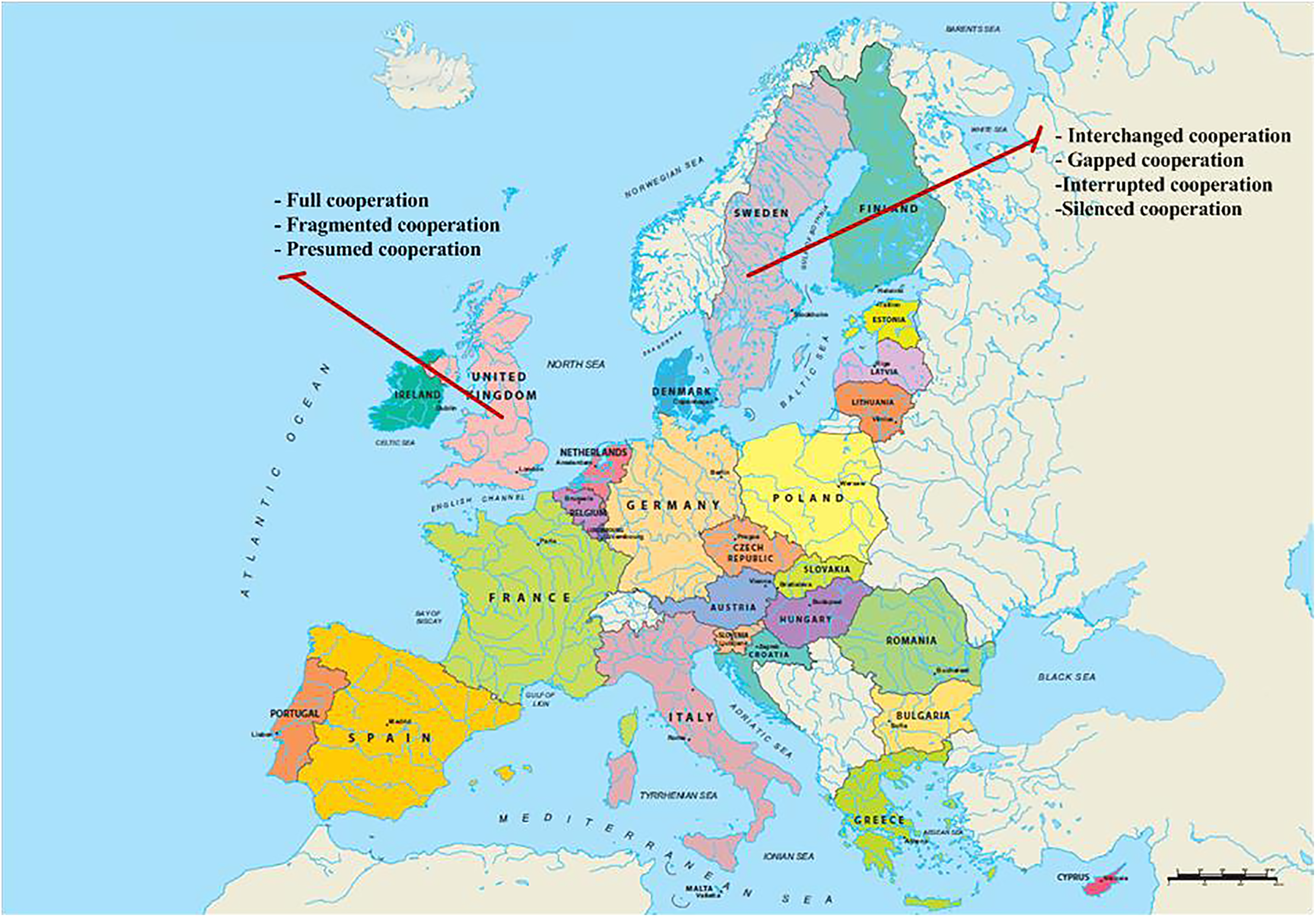
Map of judicial dialogue in environmental matter in the EU (2 MS) – Derived from Council of the European Union; Lovell Johns. 121
5 Conclusions
This study shows that UK courts tend to cooperate fully with the CJEU. Three new categories of judicial cooperation have been highlighted in this regard: full cooperation, fragmented cooperation and presumed cooperation. This finding confirms that mapping judicial dialogue is an ongoing process. Indeed, in this study, none of Bogojević’s categories could be used to describe the UK. New categories could emerge if other jurisdictions are analysed.
This study also suggests that national cultures influence judicial sincere cooperation in environmental matters. More research is necessary to explore judicial dialogue fully, covering more national legal cultures than covered so far. This would also permit us to advance from describing the kinds of judicial cooperation evidenced to an analysis of the reasons behind the national courts’ behaviour. We would therefore argue for the establishment of a comparative research programme to consider follow-up judgments in environmental matters.
It also appears that the majority of the CJEU’s judgments are not followed by a national judgment in the UK, or that such judgments cannot be retrieved. Most cases where a preliminary question is posed simply disappear from EU and national databases once the CJEU provides its response. There is an acute lack of transparency about the reasons for such lacunae. We were only able to establish in a few cases that the national party disadvantaged by the CJEU’s answer withdrew from the case, as it expected the national court to comply with its ruling. Assuming that this was true of all other cases can be misleading. We also noticed that, in one case, information about the national follow-up case was only available on Curia, but not at national level. It is unclear how this can be possible.
There is a need for greater transparency in light of the importance of proper judicial cooperation and judicial dialogue in assuring uniformity in the interpretation and application of EU law. The ongoing judicial practice on preliminary reference follow-up lacks such transparency and invites improvement. We urge for a closer application of the CJEU’s recommendation on this point. Further steps should also be considered. For example, the adoption of a legal obligation in this regard, echoing similar ones in the sphere of national implementation of EU directives, would help create what is not possible today, namely a more systematic database of judicial dialogue and cooperation which is amenable to scrutiny and study.
Footnotes
Declaration of Conflicting Interests
The author(s) declared no potential conflicts of interest with respect to the research, authorship, and/or publication of this article.
Funding
The author(s) received no financial support for the research, authorship, and/or publication of this article.