




Abstract
This study examines how bitch and bastard construct gendered identities in contemporary British English conversation. Using corpus-assisted critical discourse analysis of the Spoken BNC2014, it examines collocational patterns and “
Keywords
Gender and swearing
Patterns of language are often discussed as characteristic of particular social groups, such as social classes (Guy, 1988) and genders (Newman et al., 2008). Research on gender and language has explored how speakers’ linguistic choices both reflect and reproduce gendered identities. This includes differences in thematic focus, lexical choice and structural complexity (Jespersen, 2013), and gender-specific characteristics reflected in language use (Coates, 2015). In such research men’s and women’s language use is often compared. For example, Newman et al. (2008) associates men’s language with references to external events and objects, and women’s with interpersonal and psychological processes. It has also been claimed that women’s language is concerned more with relational maintenance (Rayson et al., 1997) and is often interpreted as avoiding open conflicts through mitigating stance-taking (Eckert and McConnell-Ginet, 2013).
In such a context, it is hardly surprising that swearing has been treated as a locus of variation in male and female speech, though the social context in which gendered swearing has been studied has varied over time. Historically swearing was perceived through a gendered lens. At least from the late seventeenth century (McEnery, 2006), swearing was socially coded as masculine, while women were seen as custodians of morality and propriety, roles that ostensibly precluded the use of coarse language. As a result, we would argue early, intuition based studies of swearing in English assumed that women swore less and used weaker bad language than men (e.g. Lakoff, 1973). With the emergence of large corpora and ethnographic data, such categorical claims have been questioned. McEnery (2006) finds that men and women may use generally the same amount of what McEnery terms “bad language” but overuse different sets of words, respectively. There are also studies showing the two genders’ swearing differences in terms of functions of swearing (e.g. McEnery and Xiao, 2004), tolerance for the use of swearwords (e.g. Jay and Janschewitz, 2008), and variation by the gender of the interlocutor (e.g. Beers Fägersten, 2012). For example, men have been reported to show greater tolerance of profanity (Jay and Janschewitz, 2008). Comparative contrasts have also been identified in written discourse: McEnery and Xiao (2004) claim that texts targeted at female readers generally use
Given that language use both reflects and shapes social identity (De Fina, 2011), swearing provides a valuable lens for examining gendered identity. The use of swearwords not only reaffirms social positioning but also participates in the (re)production of gender stereotypes. Thelwall’s (2008) analysis of MySpace, a youth-oriented social networking site, found that young women in the United Kingdom used strong swearwords at rates similar to young men. In contrast, their counterparts in the United States showed a clear gender gap, a pattern taken to indicate that gendered expectations surrounding swearing may be shifting in online settings in the UK. McDowell and Schaffner (2011) observe that in a reality TV programme about male and female athletes in American football, the women’s use of insults, typically claimed to be masculine linguistic practices, served to challenge the masculinity stereotype linked with sports competitions. Likewise, Lucchetti (2021) demonstrates that women’s use of Russian mat (i.e. obscene language based on sexual taboos) in recent years signals the renegotiation of gender roles, challenging long-standing associations between profanity and masculinity in Russian society.
This article focuses on two apparently gendered swearwords,
Gendered social actor representations
Gender differs from sex in that it is socially constituted rather than biologically assigned (Coates, 2015). It is therefore commonly understood as a situated performance: an identity continually negotiated through interaction. This distinction is crucial in the study of linguistic gender representation, which examines not only “who” produces discourse but also “what” social identities are represented and “how” they are constructed (Sunderland, 2004).
The “how” concerns the linguistic strategies used in discourse, while the “what” includes not only the representation of social actors, which in our case are women and men, but also the underlying ideologies conveyed through language use. These ideologies are constructed by social, cultural and historical contexts, which may not be expressed explicitly but may instead be conveyed through specific linguistic connotations. For instance, Pearce (2008) examines collocational and grammatical constructions of
Yet in these studies of gender representations in everyday language use, only a handful of studies have focused on more hostile contexts of production. For instance, Krendel (2020) explores how gendered lemmas (
However, there has been limited research into how gender identities are represented through the use of ostensibly gendered swearwords. While mentions of
To address these gaps, the present study focuses on
What gendered representations of
How do the sexes of speakers and targets affect these representations?
In line with the BNC2014 metadata, which records speakers as male or female, this study employs sex as a categorical variable. However, in interpreting the results, we treat these patterns as reflections of socially constructed gender norms. This allows us to examine how the language of swearing both represents biological categorisation and negotiates broader gendered expectations in discourse.
Methodology
Data collection
The analysis draws on the Spoken British National Corpus (BNC) 2014 2 (Love et al., 2017), a corpus containing 11.5 million words of orthographically transcribed spontaneous conversations among 672 British English speakers, collected between 2012 and 2016. 3
Within the Spoken BNC2014,
All analyses were conducted via the online corpus tool CQPweb (Hardie, 2012), which provides both technical flexibility and access to sociolinguistic metadata. CQPweb allows searches to be performed using both simple and CQP syntax queries, facilitates filtering by speaker sex and other metadata fields, and displays dialogues in a speaker-focused format. These affordances supported a discourse-oriented analysis of how
Corpus-assisted critical discourse analysis
Both qualitative and quantitative analytical methods have been employed in studies of gender and language. Some researchers adopt qualitative methods to analyse discourse in detail (e.g. Stapleton, 2003), while others use large datasets to identify broader patterns and generalisations (e.g. Newman et al., 2008).
Recent years have seen increasing use of methods from corpus linguistics (CL) in the study of swearing (Love, 2021; Lutzky and Kehoe, 2016). It is important to note that CL is not a purely quantitative approach: it typically combines quantitative and qualitative analyses. Quantitative techniques help to identify the overall aboutness of the data and reveal patterns that may not be immediately visible to researchers (Baker and Egbert, 2016) while qualitative interpretations allows for theoretical refinement and the development of new insights (Baker et al., 2008).
In this respect, critical discourse analysis (CDA) provides a complementary perspective. As a cross-disciplinary approach, CDA examines how socio-power abuse and inequality are reproduced, legitimised, and challenged through language uses (i.e. discourse) (van Dijk, 2015). Given that swearing carries context-sensitive interpersonal and evaluative meanings, the frequency comparison in Section “Data collection” offers only an initial picture. To understand how
Analytical procedures
We designed two complementary analytical perspectives to examine how
The first stage involved a collocation analysis to provide an overall picture of the meanings and associations (Baker, 2023) of
The second stage involved a close analysis of the “
CQP queries used were [lemma=“be”] []{0,3} [word=“bitch” | word=“bitches”] and [lemma=“be”] []{0,3} [word=“bastard” | word=“bastards”], returning 116 cases for
Findings
Collocational comparisons
Collocates of
Collocation categories of bitch and bastard.
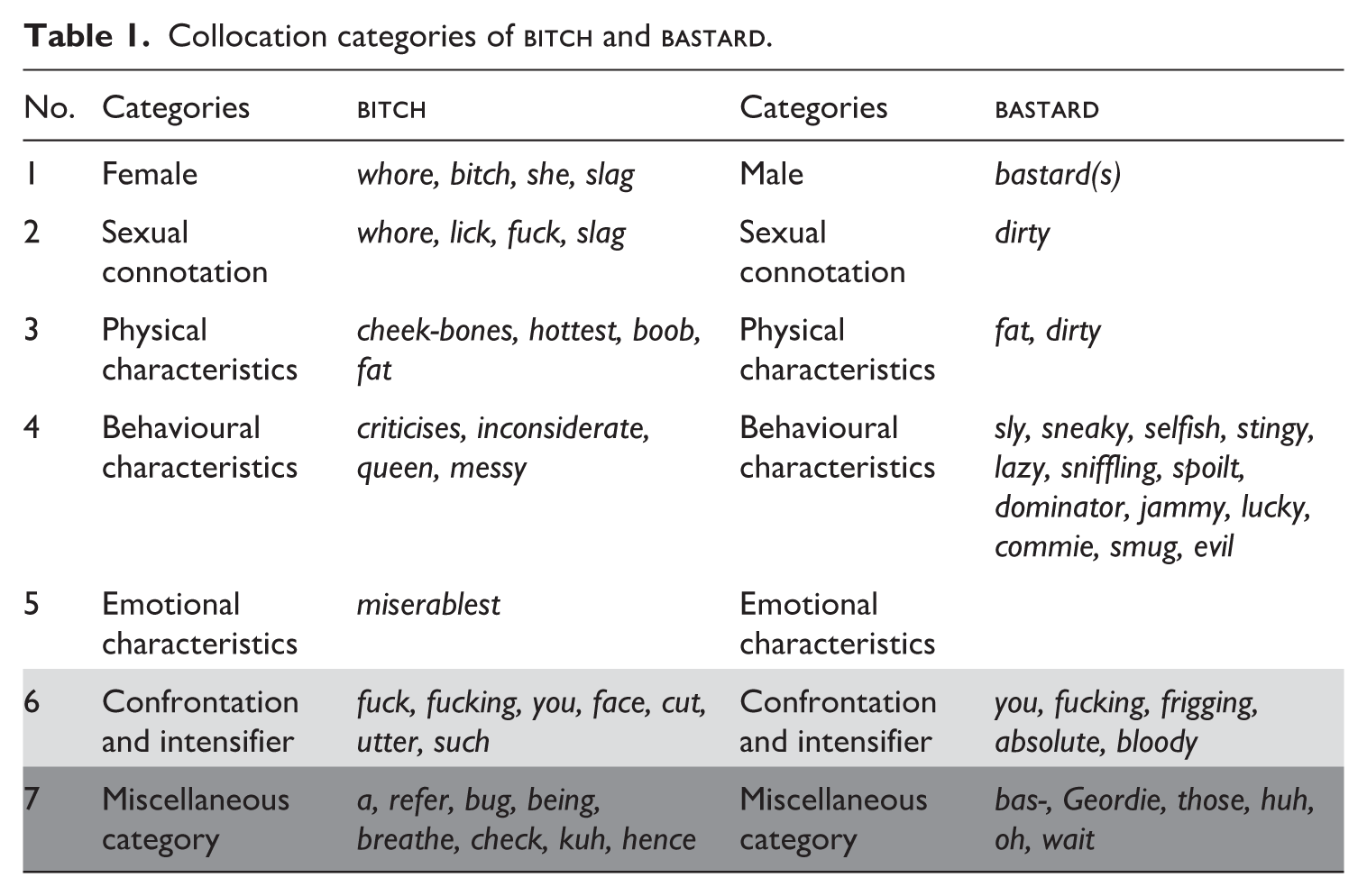
In Table 1, collocates listed in corresponding rows are compared. The first five categories (shaded in white) capture semantic dimensions of representation, while the remaining two (shaded in grey) describe interactional or functional roles such as intensifier and out-of-scope lexical items. As the present study primarily focuses on gendered representations, the discussion below centres on the semantic categories, referring to the non-semantic ones only where they shape gender-related interpretation.
Based on the collocational results and their extended concordances, we interpret the representations of
Gender and sexualisation
This section examines the collocates in “female/male”, “sexual connotation”, and “physical characteristics” categories in Table 1. While distinct, “physical characteristics” are included here as they contribute to the sexualised evaluations of targets.
Collocates in the “female” and “male” categories confirm that
Both
S0246: and everybody says I’m weird like S0249: >>you are though S0246: yeah but –UNCLEARWORD S0249: that’s you rubbing off on him S0246: I don’t rub anything on him S0249: S0357: . . . S0249: she’s never happy even if the conversation ended
For
S0400: oh --UNCLEARWORD
Sexualisation associated with
S0041: but she has S0084: wow S0041: S0084: S0041: yeah S0084: you can’t do anything about your head (.) that’s the thing S0041: yeah (.) oh there’s more (.) S0084: urgh S0041: yeah S0084: S0041: S0084: bitch S0041: S0084: oh yeah (.) yeah
Among the aforementioned bitch collocates, hottest appears to be the only potentially complimentary one. Both of its concordances occur in a discussion between a female speaker (S0246) and a male speaker (S0245) about Blurred Lines by Robin Thicke, a song the male speaker describes as “about the rape” (see Example 4). While hottest might appear evaluative in a positive sense within the lyric concordance, S0246 treats its presence in a workplace as socially unsuitable, particularly in the presence of “loads of old people”.
S0245: oh (.) er erm that Robin Thicke song’s on the playlist at work S0246: what Robin Thicke song? S0245: you know the one S0246: Blurred Lines S0245: yeah S0246: and doesn’t it say you’re S0245: mm S0246: I just realised the other day that it’s not the like censored version S0245: oh is it not? S0246: so it was like really quiet and there was like loads of old people sat there and he just went
For BASTARD, the only “physical characteristics” collocate is fat (Log Ratio = 5.608), yet its concordances suggest that it is rarely used as a literal judgement of body size. It is also poorly dispersed – two thirds of fat’s occurrences appear in one conversation (text ID: SKB5; see Example 5). The expression is prompted by someone sitting on the speaker’s (S0208) “backy”, and “Mr fat bastard” functions as light-hearted, situational teasing rather than an appearance-based judgement or explicit insult.
S0208: yeah where’s your backy? S0202: I don’t know S0215: –ANONnameM’s sat on it S0202: oh S0214: huh S0202: –UNCLEARWORD S0214:
Interestingly, no comparable collocational patterns emerge linking fat with non-derogatory gendered references.
S0046: –UNCLEARWORD by the way (.) you know –ANONnameF you’ve met – ANONnameF (.) the bird in here that you you saw (.) she’s not pregnant S0041: I knew it S0046: I knew it and all [unknown male]: S0046: to be fair (.)
Interpersonal relationship
Collocates in the “behavioural characteristics” and “emotional characteristics” categories reveal the interpersonal dynamics associated with
S0599: she’s called –ANONnameF and I S0598: yeah S0599: like we just S0598: >>yeah (.) mm S0599: >>it was so weird (.) she’s the main she’s
Beyond these shared associations of dominance, the collocational patterns reveal distinct evaluative emphases. While both
For
S0188: yeah two of them were were S0200: what –ANONnameF’s friends? chatty –ANONnameF’s friends? S0187: yeah mate S0188:
S0439: erm (.) slagging her off saying I can’t believe you’ve gone on holiday with somebody who upset me I can’t believe you’re being so disloyal (.) erm you obviously don’t care about me she’s --ANONnameF’s
By contrast,
S0058: . . . did I tell you she’s bought a house? Or her and –ANONnameM have S0120: yeah (.) yeah S0058: yeah (.) next to her parents (.) awkward (.) but I don’t know (.) I’m sure it‘ll be good and it doesn’t (.) mm? S0120: S0058: yeah (.) go and live in Sunderland it doesn’t cost anything
Concordance analysis
This section examines the representations of
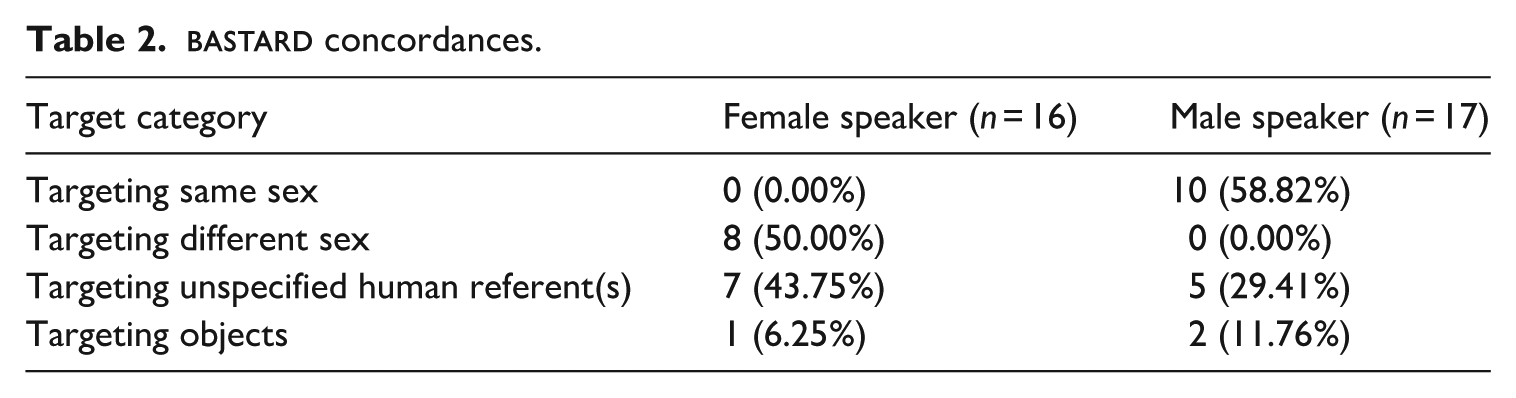
bastard concordances.
bitch concordances.
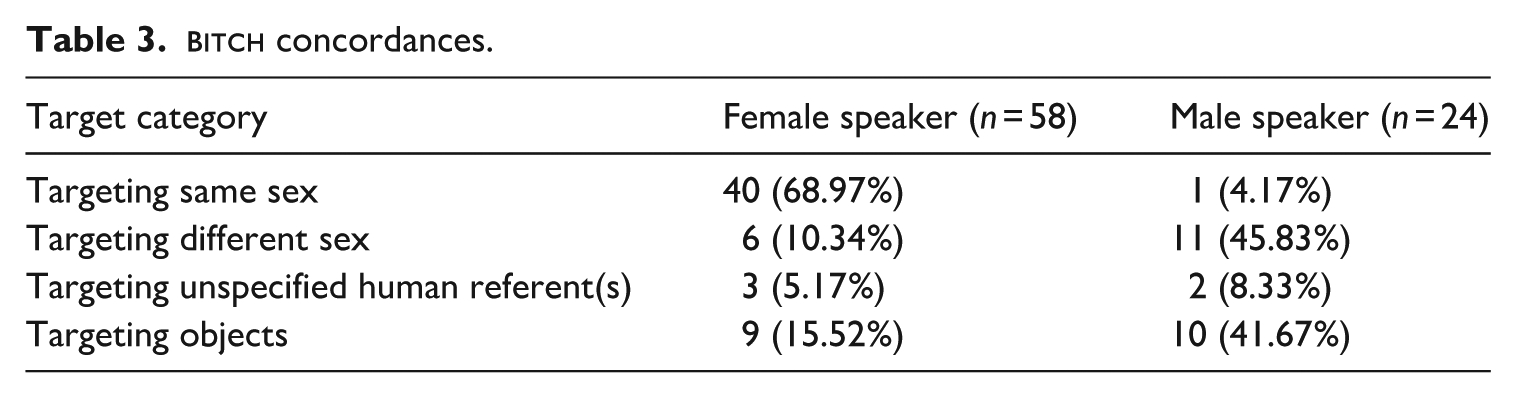
Both female and male speakers use the “
S0453: >>he is he’s S0454: >>yeah I know
The dominant characteristics identified in Section “Interpersonal relationship” are also evident here. In Example 12,
S0570: >>–ANONplace S0571: is he? . . . S0572[??]: >>and he’s like S0570[??]: >>yeah yeah –UNCLEARWORD
Female speakers also use
S0202: fucking taxis I hate them they always do this S0218: (. . .) my car does not like this hill (. . .) why don’t they fucking pull over down there? S0202: they’re just fucking being arseholes fucking taxi
S0440: but he was S0439: >>isn’t he the one that got told off for S0440: yeah . . . S0440: cos it’s not it’s not it’s not just wanking and S0439: >>and he didn’t he get told off for S0440: something like that yeah
The “
When female speakers describe female targets as
S0441: ah there’s a bug go away get out of my spinach S0439: that’s what happens when it’s home grown S0441: I killed it I had to I’m sorry sorry god S0439: you just killed a bug you bitch S0441:
When directed by female speakers at male targets,
S0328: he’s got he’s got a sweet side but S0383: not but he’s like S0328: he’s would he would do S0383: but I feel like he’s very conscious of it like it’s totally constructed S0328: he has moments of remorse but he he’ll fucking
In some cases,
[unknown female]: do you drive? S0202: no but my boyfriend does so S0216: oh right that’s S0202: he’s
Male speakers’ use of
S0245: >>your sister’s a S0249: >>like the ugliest effing person I’ve ever seen in my life S0357: >>plus her sister as well used to wear wigs and that didn’t she? S0249: yeah but she was still horrible
Conversely, two instances of “
S0246[??]: S0246[??]: she’s like fuck yous I is gone away S0400: basically she’s S0245: fuck you all S0246[??]: I’m old I‘ll do what I want
Only one “
S0602: he’s
Discussion and conclusions
The moral policing of masculinity
The consistent representation of
This moral regulation aligns with broader neoliberal discourses that invoke hard work and merit as tools of legitimation (Littler, 2013). Collocates like jammy, lucky, and spoilt reveal resentment towards men seen as having benefited from unearned advantages, echoing neoliberal discourses linking hard work to moral worth. Expressions such as “lucky bastard” (Example 10) question the legitimacy of success, distinguishing between effort-based achievement and undeserved fortune. The discursive representations thereby highlight a neoliberal moral economy that simultaneously celebrates individual success and condemns perceived unearned privilege.
Although this moral policing is consistent across the corpus, subtle differences emerge by speaker sex. Male speakers more often apply
The double-bind of femininity
Representations of
Firstly,
Secondly,
Thirdly, female in-group use sometimes employs humour and mock impoliteness (i.e. surfance-form impoliteness not intended to cause offence; Culpeper, 1996) (Example 15). Here,
Historical resonances
While situated in present day British English discourse in this paper, the patterns observed for
Our findings suggest that these moral grammars extend beyond non-derogatory language (e.g. Baker, 2014; Caldas-Coulthard and Moon, 2010; Pearce, 2008) to inform everyday evaluative discourse, including swearwords. The expectation that men should demonstrate integrity, rational self-control and success in public or professional life is reproduced when
Conclusions
This study investigated how
These findings extend prior corpus-based research on gender representation (Baker, 2014; Caldas-Coulthard and Moon, 2010; Pearce, 2008) by showing that even overtly derogatory language participates in the same ideological processes observed in non-derogatory discourses. Widely and frequently used swearwords thus provide a revealing perspective on the moral and relational structures through which gendered identities are sustained, negotiated, and occasionally challenged in contemporary British society.
Methodologically, this study demonstrates the value of corpus-assisted critical discourse analysis for research on gender and language. Unlike Drummond’s (2020) ethnographically rich but localised study of teenage swearing in a specific institutional setting, the present analysis draws on a large and socially diverse record of spontaneous conversation, the Spoken BNC2014 (Love et al., 2017), enabling patterns of gendered swearwords to be examined beyond a single community of practice. This allows not only for more generalisable observations regarding the gendered use of swearwords in contemporary British society, but also for a more comprehensive analysis of how they discursively construct gender norms in everyday conversation. It traces patterns in gendered, moral, and interpersonal characterisation across collocation and concordance evidence, thereby combining empirical breadth with interpretive depth.
At the same time, several limitations should be acknowledged. Focusing on copular constructions offers analytical depth, but it necessarily excludes the implicit and less frequent syntactic environments. Moreover, the orthographic transcripts of Spoken BNC2014 omit prosodic and other multimodal cues, such as intonation and facial expressions, which may influence how swearwords are understood in interaction. Finally, this study is inherently synchronic, relying exclusively on Spoken BNC2014; tracing the historical shifts of gender representations behind these terms would require a comparative analysis with the Spoken BNC1994. Future research could extend the analysis to additional syntactic environments and incorporate multimodal corpora to capture a wider range of such gendered representations.
Footnotes

Funding
The authors received no financial support for the research, authorship, and/or publication of this article.
Declaration of conflicting interests
The authors declared no potential conflicts of interest with respect to the research, authorship, and/or publication of this article.