



Abstract
From narrative research, we know how the past is reconstructed in narratives. But we also have consolidated forms of communication to talk about the future. These forms are discussed in this article as “projective genres.” First, the concept of communicative genres is presented, and its theoretical background and central concepts are explained. The empirical analysis shows which communicative means the anticipation of the future uses: tasks are distributed, action steps are defined, and responsibilities are assigned. Actors use modals verbs and when-then constructions to accomplish this. After the empirical analysis, the question is discussed of which specific communicative problems this way of speaking about the future solves: on the one hand, projective genres gradually reduce uncertainty; they anticipate and structure a future event. On the other hand, they provide certainty of action. Because projective genres typically appear as a series – the future plan of action is repeatedly addressed and thus kept relevant and current. The analysis is based on empirical data (audio and video recordings from everyday contexts); genre analysis and conversation analysis are used as a method.
Keywords
Introduction
Many forms of communication that we use in everyday life serve to deal with the now (e.g. when we ask someone to close the window). A large part of the communicative budget also has communicative forms that are dedicated to the past, for example, when we talk about a past event. But there are also many options to talk about the future. In many, perhaps most, of our communication, the past, present, and future play a role, and, at the same time, are interwoven into one another. Often, however, one of these aspects is more dominant than the others. In the story of a weekend or vacation that has already taken place, the present and the future play less of a role and the focus is on the reconstruction of past events. During other activities, such as watching TV or eating together, the main focus of communication is on the here and now, even when talking about the past and the future. But oftentimes our communication revolves around what has not yet happened and is yet to come: the future. We think about the future, we act for the future, but above all, we talk about the future. The “ability to orient oneself according to future goals” (Luckmann 1992b: 6; our translation) is an ability specific to humans. It is based in particular on the fact that we are able to articulate these future goals, negotiate with others, design them interactively, and process them communicatively. While entire sub-disciplines have developed around oral reconstructions of the past – linguistic narrative research or oral history studies, for example – with a few exceptions, the same cannot be said for projections into the future. This article aims to close this gap.
The focus of this article is therefore the forms of everyday communication in which the actors orient themselves according to future goals. We have a wealth of communicative forms to talk about our future and future plans of action, and we need these communicative forms to be able to implement plans of action together with others. The whole of these forms can be described as projective genres. Unlike reconstructions that serve to visualize the past, projective genres serve to prefabricate the future. The research project “Planning-in-Action” at Bielefeld University analyzes these types of projective genres. 1 It uses a longitudinal methodological approach to examine which communicative means interactors use to work on their common future and negotiate it communicatively.
This article presents the concept of communicative genres and demonstrates the structure and functions of projective genres. The next section – “On the analysis of projective genres” – sets out the theoretical framework and discusses key terms in genre research. Section “On the form and structure of projective genres” uses an empirical case to show which communicative means are used in projective genres and which practices are used to interactively anticipate the future. Using this as a basis, the ensuing section demonstrates “The function of projective genres”. It shows how projective genres ensure that plans of action are addressed again and again and by which means the interactors ensure the continuity of their plans of action. The article does not present an analysis of a single projective genre, but rather highlights recurring features that prove to be constitutive characteristics of projective genres across various forms of communication.
On the analysis of projective genres: Theoretical framework and empirical access
Communicative genres are to be understood as consolidated forms of communication. Projective genres, in turn, as a subfield of communicative genres, are genres that focus on the future. Projective genres are therefore consolidated forms of speaking about the coming time. The concept of communicative genres stems from the empirical and theoretical work of Thomas Luckmann and Jörg Bergmann (Bergmann, 1993 [1987]; Bergmann and Luckmann 1995; Luckmann, 1986, 1989, 1992a, 1995). 2 In examining the empirical work from ethnography of speaking (Bauman and Sherzer, 1974), conversation analysis (Sacks et al., 1974) and literary studies (especially Bakhtin, 1986 [1952/53]), the question arises as to which major consolidations can be found in everyday communication. Consolidated forms of communication are resources that interactors can use to handle recurring social situations – that is, a consolidated processual structure that is recognizable to the participants themselves. Accordingly, they may recognize (and perform) a joke as a joke or a greeting or an order at a restaurant. The knowledge about these consolidated forms is stored in the social stock of knowledge. Interactors can use these forms to handle recurring social situations (and in some cases, they have to). Luckmann understands communicative genres by way of analogy to social institutions. Institutions offer solutions to “elementary problems of social life” (Luckmann 1992a: 227). Accordingly, communicative genres offer solutions to specific communicative problems (Luckmann, 1986, 1992a). A number of empirical studies have confirmed the viability of this approach: gossip, for example, solves the problem of how to speak poorly of people who are a part of the same social circle and whom one will continue to encounter (Bergmann, 1993 [1987]). In the case of reproaches (Günthner, 1996), it is noticeable that they often appear together in the syntactic format of a question (“why-format,” e.g., “Why is the refrigerator open again?”). This in turn allows the addressees to ignore the reproachful content of the statement and to answer the “question” objectively (“Because I just got something out”). Genres that solve similar communicative problems form “genre families” (Bergmann, 2018). The genre families of reconstruction, moralization, education, and planning can be cited as examples of such families (Luckmann, 2012: 35). Empirical studies are available on three of these genre families, on the genre family of the reconstructive genres (Bergmann, 1993 [1987]; Bergmann and Luckmann, 1995), on the genres of moral communication (Bergmann, 1998; Bergmann and Luckmann, 1999) – and in this text now on the genres of projection.
As a genre family, what the projective genres have in common is that they deal with a common communicative problem, namely processing the future. 3 This coming time may come soon (now, very soon, tonight), in the foreseeable future (tomorrow, the day after tomorrow, this summer) or in the distant future (sometime, in 10 years, some day). Projective genres, according to our hypothesis, encompass a wide range of communicative forms. They can be found in discussions about what to have for dinner, planning a vacation for the upcoming summer, and in thinking about taking a world trip after retirement.
Projective genres are embedded in the current everyday life of the interactors and relate to their future. Our actions in the everyday life-world are shaped by the natural attitude and the pragmatic motive (for this and in the following Schutz, 1962 [1945]; Schutz, 1962 [1951]; Schutz and Luckmann, 1973, 1989). In the natural attitude, we take things for granted and accept the world unquestioningly. Based on this natural attitude, we move through the world of everyday life. The natural attitude also includes the knowledge that time passes and that this very day, the today, will be followed by another day, a tomorrow. What tomorrow will look like is something that human beings can control to a certain extent. Many things are not or are only to a limited extent within the sphere of influence or can be changed by actions of the individual (tomorrow’s weather). However, the “world within my reach” and the “world within restorable reach” (Schutz, 1962 [1945]: 223f.) can be influenced by the individual (what to eat for dinner). The future comes of its own accord, simply because time passes without any intervention of the actors. But how exactly this future will look is something that the actors have influence on within the scope of their life-world possibilities, and they are aware of it. Thus, they take measures that will affect tomorrow, they make plans and preparations. For the actors, planning their future is a social process in which they refer to others and involve others. They plan this future together with others, and communication is central to these joint plans. Accordingly, the interactors continuously communicate about how this common future should look like and what must be done – by themselves and by others – to bring it about. In these communications, the interactors negotiate the future this-worldly reality. The future is made communicative before it arises – in projective genres. The analyses of such projective genres show how actors address their future, how they pursue their own plans and goals and process them in a communicative manner.
This raises the question as to which forms of communication are actually available to the actors for communicatively processing their plans and preparing to realize their operational goals. The following analyses take a look at the specific forms of speaking about the future in projective genres. The data on which this essay is based comes from the research project “Planning-in-Action” (see note 1). This project addresses the question of how people talk about the future in everyday communication and how the actors communicatively articulate and coordinate their intentions for action. These communicative forms are analyzed in the aforementioned project as projective genres. Projective genres are a recurring component of communication as consolidated forms and are firmly anchored in the communicative budget. As a genre family, what the projective genres have in common is that they deal with a common communicative problem, namely processing the future. The analyses aim to identify communicative patterns of processing everyday problems that go hand in hand with talking about the future and planning. This text uses empirical examples based on video recordings of everyday interactions. The following analyses are dedicated to the communicative process of planning and thus the communicative processing of the future with the outlined genre-analytical question. To empirically answer the research question, two fields were accessed for data sampling: a family and a small farm. The videos were created by two field researchers during their stays, which were recurring and of a long duration (whole weeks in Field 1, and whole days in Field 2). The data corpus of the project consists of a total of 141.3 hours of video material, 27.3 hours of audio material, and five WhatsApp threads from Field 1 (family) as well as 60.9 hours of video material and various textual and visual artefacts from Field 2 (small farm). With the longitudinal design of our data corpus, we aimed in particular to track how plans are developed, how they are proceeded in interaction, and, if necessary, implemented by those involved. 4
Genre analysis is, in principle, carried out in the same manner as conversation analysis. This methodology allows genre analysis – in the sense of ethnomethodology and conversation analysis – to focus on the sequential implementation of communicative genres and their interactive realizations. Consequently, the analytical foundations of conversation analysis, as well as its empirical studies, are central to the analysis of communicative genres. This applies in particular to conversation-analytical studies that explicitly deal with the processing of the future, such as Mondada (2018) with a study on “urban planning,” or Nissi’s (2016) analysis of a series of meetings of a city organization, where the customer service was established, Land et al. (2019) on “advanced care planning,” and Killmer et al. (2022) on “joint planning” with a person with aphasia, as well as the ethnomethodological analyses of, for example, Button (1990) or Au-Yeung and Fitzgerald (2022), which explicitly deal with time or with the temporal references that interactors themselves produce. While genre analyses were mainly carried out in the 1980s on the empirical basis of audio recordings, video recordings have become the new standard in the analysis of communicative genres – as in the rest of conversation analysis as well. A number of studies expand classic conversation analysis, which generally manages without the presence of the researcher in the field, to include ethnographic or videographic components (e.g., Knoblauch and Schnettler, 2012). This was also the case in our project, in which the two field researchers stayed in the field for a longer period of time and completed the recordings through their participant observation.
On the form and structure of projective genres
The concept of communicative genres does not simply mean that there are consolidated communicative forms, but also that these forms are anchored in the actors’ stock of knowledge (Luckmann, 1986). They can be retrieved and updated for the situation at hand from this stock of knowledge. These forms are familiar to the speakers and are part of their communicative everyday life. This familiarity is also reflected in the following examples. For the following analysis, a case was selected that illustrates the structures of projective genres well. This example was chosen because it succinctly illustrates the essential characteristics of projective genres. At the same time, this case shows that planning is deeply rooted in everyday practice (for more details, see Ayaß, 2025) and that planning as an activity is organized recursively (for more details, see Hitzler and Kramer, 2024). The selected case consists of three episodes, all of which take place on the same day relatively shortly after each other. In the afternoon, the family sits at the large dining table and discusses many things including the planning of a vacation for the summer of the coming year, the son’s sports activity for tomorrow – he needs to be taken to ice hockey practice and it has not yet been decided who will drive him. And, lastly, they decide what they will do for the rest of the afternoon and what they will eat for dinner. Such aggregations of similar communicative activities are not uncommon: they form clusters of genres as discussed by Bergmann (2018). In this example, the planning of one project (the next vacation) goes directly into the planning of the other project (the sports activities of the son the next day) and finally into the meal planning for that evening. Aggregations of this kind can also be found in other genres and have already been described many times, for example in gossip (Bergmann, 1993 [1987]). These series of similar genres indicate that when interactors have come together in a particular constellation and agreed on a topic of conversation, they maintain this communicative mode for extended periods of time. You find yourself, so to speak, in the interactive mode of planning, joking around, gossiping, and you stay in this mode until the topic runs out or the participants have to part ways.
The following sections use three episodes to show which elements and features are typical for projective genres. The first section focuses on the external structure of the projective genres and the major role played by the constellations of participants, in which future topics will be addressed. The subsequent sections are dedicated to elements of the internal structure. They each discuss phenomena that are typical for the realization of projective genres: the use of when-then constructions and the modal verbs. The extracts are transcribed according to the GAT2 transcription system (see Selting et al., 2011), the names of persons and places as well as other personal characteristics are anonymized. 5
Anticipating the future
Talking about the future essentially consists of the actors anticipating the future communicatively. It sounds simple. On closer inspection, however, we can see that these conversations mainly relate to what needs to be done next – the next dinner, the next summer vacation, the next trip to the supermarket. Today and tomorrow are being planned. This is done in each case quite concretely and as a matter of course. Planning is a thoroughly everyday affair. This is illustrated in our first Episode: Jan and Kerstin sit at the dining room table together with their 13-year-old son Leo. On the right side of the picture, Christmas decorations can be seen on the dining table and there is a laundry rack in the background (Figure 1).
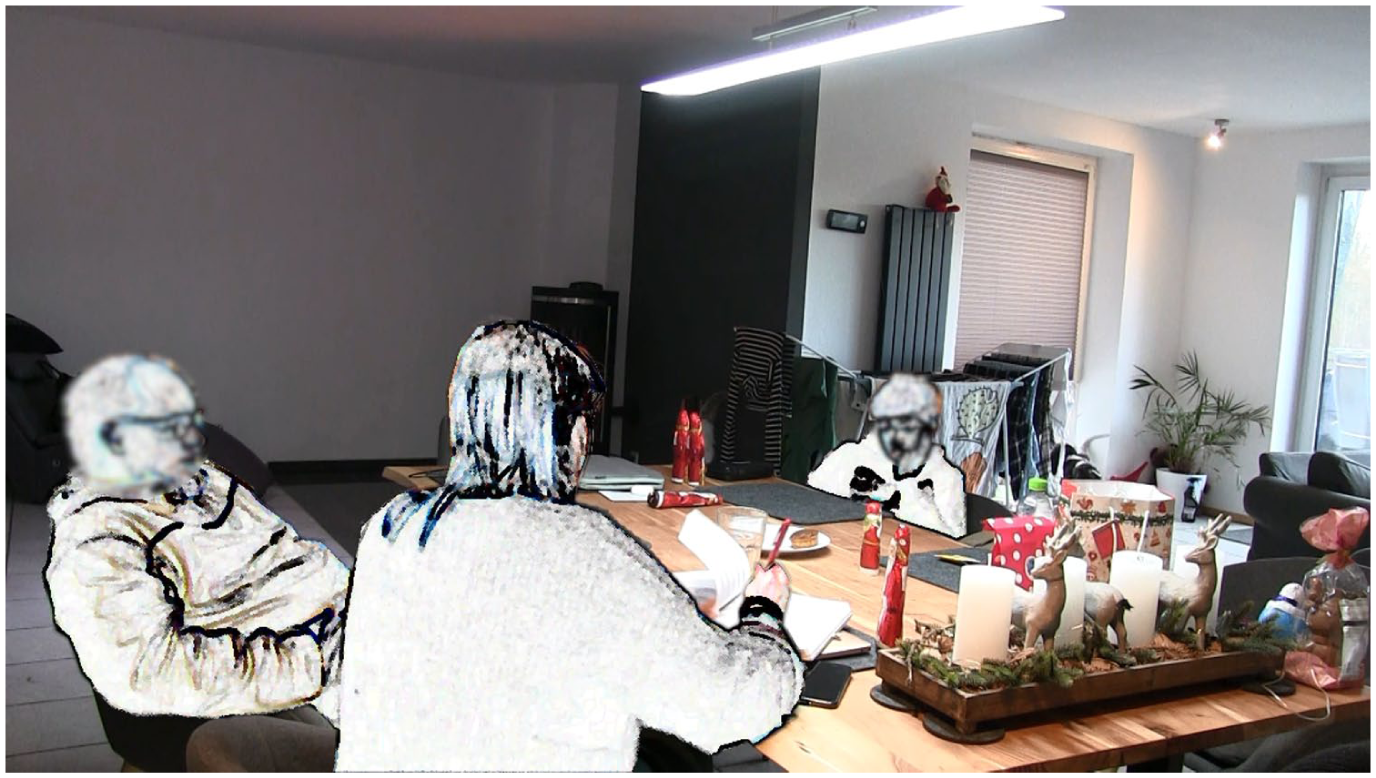
The G family sitting at the dining table. The screenshot is from Episode 2, line 02.
Parents Kerstin and Jan got home from work about an hour ago, and their son Leo was at school. There are a number of things to discuss: their vacation next summer, how Leo will get to hockey practice tomorrow, the rest of the day today, and what to eat for dinner. (The ethnographer walks through the picture several times, and now that the family is seated, he looks for the best position for his second camera.)
In this Episode they first clarify who will do what and what the rest of the afternoon will look like. First of all, Jan asks Kerstin whether she has a specific meeting today: “weißt du das wann du HEUte *
Even this short excerpt shows several typical features of talking about the future:
(1) Firstly, it becomes clear how planning is a matter of course that takes place on a daily basis. It shows that it is an integral part of the family’s interaction and is relevant for the individual family members. These conversations are far from trivial. Especially in the course of everyday life, they play a major role. For people who live together, it is not irrelevant who stays where and when, who feels responsible for what tasks or who needs to be reminded of them. If the actors want to spend their future together, they must first create it communicatively. A common future does not simply happen on its own. The everyday life of planning consists of planning everyday life, and vice versa, planning everyday life is the everyday life of planning. From an ethnomethodological perspective, planning is a deeply reflexive activity (see in particular Ayaß, 2025).
(2) Secondly, it becomes clear how the external structure affects the genres. Together, external structure and internal structure form the two levels of analysis that are constitutive for the analysis of communicative genres (Luckmann, 1986: 203ff.). The external structure includes the social situation, the constellation of participants, social-structural characteristics, and the communicative milieu. With a little exaggeration, one could say that the external structure is the level at which society affects the genres. Both Jan and Kerstin are guided by the fact that Kerstin has a work meeting in the afternoon. Unlike the other plans of action, the time of this meeting is not flexible, so it takes precedence over all other obligations. And one person’s appointment also has consequences for the other, as the decision has also been made as to which of the parents can still go shopping this afternoon: Jan (line 08: “gut. dann fahr ICH ↑einkaufen./good then i’ll go shopping”). 6 We see a clear division of labor and a hierarchy that is reproduced. It is the task of the parents to take care of the shopping (and not the task of the child nor the ethnographer); it is the task of the son to do his homework (in fact, it is also the task of a competent kid his age to avoid doing his homework and studying math for as long as possible). The hierarchy unfolds gradually: the mother’s schedule determines how the father will spend his afternoon (shopping) and this period of time will in turn be the time in which the son will do his homework.
(3) And finally, a planning cascade can be seen: after an initial decision has been made, further decisions can be made, which depend on this initial decision. What is certain is (A), namely Kerstin’s meeting. This was decided in advance by other people who are not present in this situation. On this basis, it is then decided that (B) Jan will go shopping in the afternoon – and not Kerstin. Now the planning cascade is extended: the son is asked if he would like to come with for shopping (he does not want to), and finally even the ethnographer is asked. As this family division of labor for the afternoon (attending a meeting, going shopping) is laid out, it now becomes noticeable that the son has not yet done his homework (line 17). Leo’s statement that he could still do this “later” is immediately understood as a common excuse. And for it, he receives a long (admonishing) look from his father over his glasses. After his somewhat nebulous “mach ich nachher;/i’ll do it later” (line 18), son Leo hurries to more precisely specify what exactly this afterwards consists of: When the father has gone shopping, then the son will do his homework. But he still doesn’t get away with it that easily: his mother immediately takes his task of just doing homework to doing homework “und MATHE lernen./and study for maths” (line 20; at the end of the week, Leo’s class will take a math test). The planning cascade thus covers all those present: Jan even extends it to the temporary family member E (the ethnographer; line 13). As in the Episode above, such cascades can extend to several people (present and absent): first the planning includes one person, then two, then three, then four. And, as we will see below, the cascades extend into the future. The decision for one person, which includes a certain time period X, leads to a further decision, which follows the first and relates to a further time period Y, and so on.
(4) In the planning process, work and tasks are first allocated and assigned. Communicating plans and talking about the future always involves a specific participation framework (Goffman, 1981). Who is planning here? With whom? For whom? Who is included in this planning, and who will be involved at what point in time? Who will carry out the planned action(s)? The above example shows how the son and, above all, the ethnographer are initially treated as bystanders in the first step of planning (lines 01-09) and then brought into the planning process one after the other. Following Lerner (1993), one can speak here of an “association” that deals with the future of the association: strictly speaking, a planning association. In the process, the participants perform various communicative tasks. It is the communicative task of the adult parents to remind and admonish their son to do his homework; it is the task of the child to reluctantly be reminded and admonished and, if necessary, to give excuses. And it is the task of the ethnographer to interfere as little as possible, which is evident in his hesitant and defensive “(2.0) weiß ich noch nich,/i don’t know yet” (line 14/15). According to Stevanovic and Peräkylä (2012), this shows the higher or lower “deontic authority” of the interactors – “the right to announce, propose, and decide.” In projective genres, the different deontic statuses of the participants are reflected in the fact that they do not have the same rights to determine what the future will look like. In projective genres, these different jurisdictions and responsibilities are reflected in the communicative process of planning itself.
What do the interactors do when they talk about the future in this way? The actors coordinate their future activities and the future existence of the community. Through such interactions, the actors anticipate their common future. By doing this together – no matter that the labor has been divided – they create the common future communicatively, even before it occurs.
Dividing the future into phases: When-then constructions
When talking about the future, the interactors mainly spend their time on the immediate things of daily life and what is to come next. “First things first” is a maxim of the natural attitude of everyday life (Schutz, 2011 [1970]: 124f.). The decision as to what can be considered “first” is made by the interactors. This is reflected in a recurring element: the when-then constructions.
Let us return to our case, in which tomorrow is discussed. These things that were still up for discussion can now be considered done. Jan takes stock: “SO dann ham wa DAS auch abgeschlossen;/so it’s decided” (line 01). The family moves on to further planning:
First, Jan concludes the previous topic with a final “SO/so” (line 01). Kerstin confirms with an affirmative “mhm” (line 03). Son Leo, meanwhile, looks at his smartphone, which he is holding in his hand. In contrast to Kerstin, he does not confirm his father’s statement (he looks up only briefly during the pause in line 13). His confirmation of this planning also does not seem to be expected – after all, Jan had also talked about him in the third person (line 06: “er geht zocken und hausaufgaben machen,/he’ll go and play video games and do his homework”), thus treating him at this point not as an approved participant in the interaction, but more as a “bystander” (Goffman, 1981). But Leo is clearly listening attentively. Only a little later, when the vacation planning is discussed and thus the question of whether his friend can come with, does he react immediately. This also shows the not-always-clear participation status of children in their parents’ plans. They are often the ones who are decided upon, and at the same time their cooperation must be assured.
At the same time that Kerstin signals her confirmation, Jan moves on to the next part of the planning. When they are finished planning together, then he will go shopping (line 04-05). These types of when-then constructions are omnipresent in projective genres. Such when-then constructions can take on various functions in German. They are not strictly identical to English conditional if constructions. As Auer (2000) shows, when-then constructions in German assume both temporal and conditional functions. “As a consequence, the semantics of wenn-introduced clauses oscillates between a temporal and conditional reading in the indicative mood.” (Auer, 2000: 175) Whether the specific phrase is to be understood as conditional or temporal is essentially determined by the conversational context of the utterance. When constructions can also take on numerous functions in conversation beyond classic conditionals (see Günthner, 2020, 2021). The when-then structures used in our data are largely temporal constructions: The protasis names an action, and only when this is completed (or at least begun) will the action mentioned in the apodosis be able to take shape. In such conditions, the interactors make it clear that their activities are interrelated and form a clear sequence in time. When (or only when) A has happened, (then) you can move on to B.
Episode 2 shows what task these types of when-then formulations perform in the context of projective genres: When “das alles/all this” (line 04-05) is finished, the group will go their separate ways. The “we” (line 01) becomes three different persons, an “I,” a “you,” and a “he” (line 04, 06, 07). Everyone will pursue their separate activities: Jan himself will go shopping, Leo will play video games and do homework, Kerstin will attend an (online) work meeting. This division of labor has actually already been clarified (see Episode 1) and is now only being summarized by Jan. The present tense in German (“ich fahre,” “er geht,” “du gehst”) is used here with a futuristic function (for more detailed discussion on the function of the present tense for marking the near future, see Ayaß, 2025). It refers to actions in the future, which from now on will have a binding character: they have now been firmly agreed upon. Jan is indeed mistaken about the type of meeting his wife has that day and is corrected by her in line 10. For his statement, however, the specific type of meeting that his wife has to participate in later is not important (line 11: “meinetwegen auch
When-then constructions of this type are a recurring component of the internal structure of projective genres (see also Episode 1, line 19: “we/ wenn du weg bist kann ich das ja machen./when you’re gone i can do it”). According to Luckmann (1986: 203ff.), the internal structure of communicative genres includes the communicative elements that are necessary for the realization of the genre. Genres differ in which internal structural elements are constitutive for them and which are facultative. Thus, gossip can hardly be produced without reproducing direct speech (Bergmann, 1993 [1987]), and reproaches not without the prosody that distinguishes reproachful communication (Günthner, 1996). An internal structural inventory emerges for the projective genres, which is specifically intended to communicatively get a grip on the future and to process it. What specific work do the when-then constructions do in the context of projective genres? When-then constructions are so suitable for projective genres because they can distinguish action steps from each other (when A, then B; but that also means: first A, then B), because with them the future can be divided into phases (there is first an A and then there is a B) and because obligations are determined (we will not be able to do B if we have not previously completed A). In the two sub-sentences, the grammatical structure binds two actions closely together and brings them into a chronological sequence. When-then constructions establish a binding temporality by bringing different states into a temporal sequence and tying them together consecutively.
Such sequences are not only found in conversations about the future, they are also a familiar part of narrative research. Labov and Waletzky (1967), for example, understand the “a-then-b” sequence as a distinguishing feature for stories in general: “(. . .) every narrative must, by definition, use it at least once” (p. 30). Here they clarify the question of “what happened then” and can describe the course of the narrated event in detail, so that the listener is gradually led through the unfolding of the events and can understand what happened, especially when the narrative is dramatic and it is not always understandable how it could have turned out that way. But unlike the “a-then-b” episodes, which serve to reconstruct the past and answer the question of “what happened then,” when-then constructions in projective genres are not components of stories. In projective genres, they anticipate future events and preemptively state what will happen then. In projective genres, when-then constructions serve to make present the future. They structure the sequence of events in the future: The events are broken up into sub-steps and the future development is brought into a linear sequence. For the actors, when-then constructions are therefore a verbal means of gradually reducing uncertainty. On the one hand, they can be used to anticipate and structure an uncertain event. On the other hand, it is significant that constructions with the German “wenn/dann” predominate in our data, and constructions with the German falls [if], which name a less likely event, are used much less often. Within our data on everyday life, it is precisely the near future, the probable and achievable future, that is structured in this way, rather than a hypothetical or unrealistic scenario. The actors in our fields refer to the near future: the meeting, shopping, and homework in the afternoon, followed by dinner together. They talk about “the world within their reach,” as Schutz (1962 [1945]) puts it. The “distant” future plays a much less important role. This seems to be the difference (one of the differences) between everyday planning, as we are investigating it, and planning in institutionalized contexts. There, conditional clauses with “if” seem to play a much greater role, as shown, for example, by the analyses of Land et al. (2019) on medical care planning discussions or the analyses by Nissi (2016) on urban planning in meetings. Hypothetical scenarios are discussed much more frequently than in our everyday planning processes, which aim at specific, implementable actions that usually take place in the near future. 7
So, in our data, the when-then constructions do not establish a hypothetical scenario, but a near future, that also is a common future: others can in turn orient themselves around it, can contradict it, modify it, or simply confirm it (as K says in line 16: “so is das./that’s settled”). Schutz and Luckmann (1989) speak of a “more or less richly branched ‘decision tree’” (p. 52), which a plan of action can adopt. If it is to precede the branches of this decision tree, decisions must be made between several possibilities. When-then constructions are used to close off options that were previously open. When-then constructions are the communicative means par excellence to make the decision tree of the future life one’s own.
Want, can, must: The role of modal verbs
In addition to the when-then constructions, modal verbs form another internal structural element that recurs in projective genres. Modal verbs refer to a future that has yet to be created: no wonder our data is packed with them. (In the examples in Killmer et al., 2022, Stevanovic and Peräkylä, 2012, and Nissi, 2016, which also deal with planning processes, you find plenty modal verbs, too.)
Modal verbs were also used in Episode 1 (wollen [want] and können [can] in lines 11, 13, and 19). Episode 2, which was just discussed, is followed by a short discussion in which the family talks more specifically about their vacation plans. In Episode 3, which follows, the conversation returns to the events of today. In this Episode, there are two modal verbs: wollen [want] in line 04 and müssen [have to] in line 09.
Kerstin is not just announcing what they are going to eat tonight. One immediately hears the difference between an announcement of the sort “tonight, we are having burgers” and the one formulated here “heute abend wollten wir burger mit kartoffelspalten machen (.) is das okay?/tonight we wanted to make burgers with potato wedges is that okay” (lines 04-06). Kerstin explicitly asks for Leo’s approval for this ongoing plan (lines 05/06: “is das okay?/is that okay”). The “we” that had the plan to make burgers with potato wedges has obviously not included Leo so far. Leo is now included in this plan. Even if he does not contribute to the preparation (he is not going shopping, nor will he help with cooking) – the decision is not simply made without him, but rather ensures that he agrees with the decision and will later be satisfied with the meal. The declaration of intent “we wanted” from some parties has now become an understanding that everyone has agreed to. This procedure reduces uncertainties that may arise in the future: if everyone agrees to the food selection in advance, the risk of having unpleasant comments later at the table is low (even if little resistance is to be expected from a 13-year-old for a meal consisting of burgers and potato wedges). If Kerstin obtains the approval of everyone in this way, she also minimizes the consequences of the asymmetries created by deontic authority and minimizes the risk of a conflict later. An analysis by Goodwin (2006), in which a twelve-year-old boy refuses to participate in the planned activity (“I’m not singing today, Daddy”), to which his father is driving him, shows very clearly how much the dissolution of agreements previously made and thus the termination of the originally jointly planned future can lead to conflicts. Plan changes are clearly dispreferred activities.
In this context, the tense of the modal verb in the above excerpt is striking: „wir wollten/we wanted“ (indicative, past tense). (This tense and mood is also found in Episode 1 in the requests in lines 11 and 13: ‚wolltest du?‘). Obviously, dinner had already been discussed earlier, and now that everyone is here, the topic is being revisited. The formulation “wir wollten/we wanted” reconstructs a decision that had already been made and is now being updated. Such revisits are typical for projective genres: plans are always provisional, they develop gradually (on the tentative nature of planning, see Ayaß, 2025). The “wir wollten/we wanted” is, at the internal structural level, the linguistic counterpart to this tentative nature of planning. Redder describes precisely this use of the modal verb “wollen” (i.e., in the form “wollten” in the past tense) as “prospective ex-post orientation” (Redder, 1983: 128; our translation): despite the reference to the past, a prospective orientation is expressed. Between the decision to take action and its realization, (sometimes a lot of) time passes. “We wanted” connects the past and the future in the present situation. This observation confirms Couper-Kuhlen’s (2014: 645) argument that “grammar tells us something about social action.” When “we wanted” appears in this prospective ex-post orientation, we have a stable indication that a projective genre is in progress.
Back to our case. It is no longer necessary to plan who will shop and who will cook. And what will be cooked is now also clear – this has just been decided. However, it is now necessary to plan what needs to be purchased. Jan recognizes the implications that the previous plan has for him: he requests a shopping list from Kerstin. She ‘has to’ write him a list (line 09). The Episode shows how the planning steps and action steps are intertwined: Jan is involved in Kerstin’s cooking later because he has to get the right ingredients while he is shopping; she is involved in his shopping because he is dependent on her shopping list. Kerstin has already anticipated this interaction and has already fulfilled her “duty”: “hab ich./i did” (line 10) and “trotzdem fertig die liste./doesn’t matter the list is done” (line 14). This planning step was so expected and predictable for her that she was able to comply with it before anyone could approach her with the “you have to” request: she can thus avoid the scope of the request (in contrast to her son Leo, who, by the way, cannot say about his homework in Episode 1: “I did” or “my homework’s already done”). In the end, Jan will have bought what was agreed upon and Kerstin will have cooked what was agreed upon (and everyone, including Leo, including the ethnographer, will have eaten it). The success of the plan of action is a joint affair and depends on the cooperation of all. But for this to succeed, this kind of communication about the future is indispensable.
Plans of action are associated with intentions, but they are also fraught with uncertainties, and they often encounter a decent number of obstacles and constraints. Above all, by means of the modal verbs wollen, sollen, können, and müssen, the interactors have the opportunity to quite sensitively articulate the scope of action and its limitations available to themselves and the others: it makes a difference whether I have to go shopping today or whether I should or could go shopping today. Modal verbs have the function of making the validity of a predication more flexible (for German, see Weinrich, 2005: 289–316). This applies in particular if they are used in the restrictive subjunctive (in German: müsste, möchte, könnte, sollte, etc.; in English: should, could, would, etc.). Weinrich describes the validity of the German modal verb wollen [want] as an utterance in which a wish or an intention is expressed. The German modal verb müssen, [must, have to] on the other hand, modifies a predication by determining an obligation. In English, French, etc., modal verbs also express possibilities, obligations, etc., even if the range of variation and the range of expression of the modal verbs differ from one another in the different languages. Modal verbs are so suitable for the projective genres because modal verbs like wollen [want], sollen [should], etc. point to the future and thus carry their own futurity with them, which they lend to the projective genres.
In the projective genres, however, the modal verbs play a central role mainly in the joint anticipation of future events because the modal verbs müssen and wollen (and also other modal verbs) carry with them participation structures, attributions of responsibilities, and expectations (on the allocation of responsibility in family interactions, see in particular Zinken, 2016). They can exert constraints on the addressees or open up the freedom to act. Modal verbs allow the interactors to explore their own scope of action, to obtain the consent and concessions of others, and to assess obstacles in advance. These interactive maneuvers are central to the course of action and its planning. Based on the case used here: For the success of the “burgers for dinner” and the “shopping” plan of action, it is irrelevant to the interactors whether the son comes along for the shopping (and also whether the ethnographer comes along). Accordingly, the modal verb wollen [want] can be used in Episode 1, which is also packaged in a polar decision question, that leaves options open to the addressees:
11
J:
((zu L))
((to L)) are you coming with me or do you want to stay here
12
L:
ich bleib hie:r;
i’ll stay here
13
K:
((zu E)) und
((to E)) and did you want to come
14
(2.0)
15
E:
weiß ich noch nich,
i don’t know yet
For the success of the plan, on the other hand, it is necessary for Jan to go shopping and for Jan to get a shopping list from Kerstin. This interlinking requires a müssen [have to], which leaves the addressee significantly less scope and ascribes to her responsibility for the success of the plan of action:
With the modal verbs, the actors make it clear that the joint plan of action project does not burden all actors equally. Rather, it comes with different expectations. There are expectations of can, should, have to, must, and want, which are distributed differently among the actors involved and which are communicatively articulated in concrete situations. These can be articulated as demands that must be met in some way (“you have to”); however, there are also options that contain scope for action and decision-making options (“are you coming with me or do you want to stay here”). The project contains scope of action and decision-making for the various actors. These options for action and the expectations of the participants associated with them are articulated in the interactions and marked with modal verbs. Whether and how they are met has consequences for the further course of action and thus for the success of the joint plan of action.
Even in the interactive course of the projective genres, the modal verbs are relevant for the progress of the action plan: because the want [wollen] of one can become the must [müssen, have to] of the other. In Episode 3, Jan is affected first:
With the consent of the son, the wanting to make burgers in the evening becomes, in a certain way, a matter decided by all, which now makes the next steps possible, namely to have to shop now, a must, the implementation of which rests on Jan. And again, it becomes clear which interactive consequences modal verbs imply and which interactive maneuvers can be carried out with them: Jan can immediately turn this into a joint effort by requesting a shopping list from his wife.
Modal verbs are relevant for projective genres for several reasons: on the one hand, they allow the actors to articulate, modify, and negotiate obligations for themselves and others. They can strengthen or weaken these expectations and liabilities in their obligatory character by choosing a specific modal verb and its mode. Modal verbs allow the interactors to continuously coordinate with each other so that the joint plan of action also remains a common one. On the other hand, they secure cooperation on a point-by-point basis, as can be seen in the excerpts from Episodes 1 and 3, in which the addressees directly respond, to whose scope of action the modal verb is directed:
Through modal verbs, projective genres can mark different phases of plans of action. There are phases in which the project or parts of the project are at the stage of want (of wanting, of intention, etc.) and other phases in which something specific must be done if the project is to succeed. The more complex a plan of action is, the more stages it will comprise that build on each other. And all the more the interactors will be in different situations of want, must, should, etc. and will need to coordinate with each other. This shows, as was also evident in the case discussed, how the responsibilities of the actors are intertwined and how they respond to an attribution of responsibility.
The function of projective genres
In the previous section, typical characteristics of projective genres were shown by way of example using a case study. When-then constructions and modal verbs are so central to projective genres that they can be described as constitutive features at the level of the internal structure. The case analysis presented above was able to show several things: The planning activities unfold gradually. The plans of action do not happen immediately. Rather, the plans of action take shape step by step. It becomes more and more concrete in and through the planning steps. The specification can only take place based on the previous planning steps. As planning develops from the diffuse to concrete and from the general to detailed, the future that starts out wide open is gradually closed off. The actors clarify their areas of responsibility and mutually confirm them. The plan of action is created through the communicative planning activities as a joint project to which all actors contribute in their own way. The actors gradually restrict the options that an entirely open future would have in store for them. By committing themselves, they set expectations for themselves and for others that they and others will have to meet later (and which can therefore also be disappointed). With this basis, we can now discuss precisely what the function of projective genres – in contrast, for example, to reconstructive genres – is.
Projective genres are, in principle, open to the future. They are focused on a future that is yet to come. Planning is thus always only provisionally completed (for more on the tentative nature of planning, see in particular Ayaß, 2025). On the internal structural level, this is often reflected in hedges. Planning reduces the uncertainty associated with future events. This is carried out primarily through doing it again and again. Planning is a recursive activity. “(. . .) the relationship between a plan and its implementation is recursive, in that a plan is an ongoing accomplishment through time.” (Hitzler and Kramer, 2024: 24) We refer to this continual revisiting as a series of genres. With this term, we are targeting the phenomenon that the further development of plans of action usually extends over a longer period of time, during which the plans are repeatedly addressed and updated in several episodes of interaction. Plans of action change. Accordingly, the plans are addressed again and again, further developed, and adapted to the current conditions. In this revisiting, the future is gradually moved from uncertainty to certainty as the event approaches. The longitudinal section in the data collection used for this research context allowed us to analyze this recursivity, which is typical for projective genres. In this sense, recurring everyday events – dinner, shopping, the upcoming vacation – which take place once a day, once a week, once a year – are recursive. They are produced by actors as events of everyday life. Especially recurring events appear again and again on the agenda of the actors and are dealt with by them with great routine and a self-evident manner (the case discussed in the previous section is one of them). Recursivity, however, plays an additional role in connection with the projective genres. Every single plan of action (be it a simple or a complex plan) must be addressed and discussed again and again. The case given here with the planning of the afternoon and dinner already shows a recursive communicative process (in the interaction history that works toward the event). A more complex case than the one discussed here can be found in Hitzler and Kramer (2024). In their analysis, they follow the development of a larger plan of action (the planning and implementation of a bathroom renovation) over several days. In contrast to the case discussed here, this future event reveals some crisis moments in that the everyday life of the family gets out of hand (someone has to stay at home when the contractor comes; the bathroom has to be cleaned out the evening before and can therefore no longer be used, etc.). But in all our cases, planning goes from the indefinite to the definite, from uncertainty to certainty. Projective genres reduce insecurity and uncertainty. The task of the series of genres is to ensure this on a recurring basis, as a serial revisiting, so to speak. The genre series thus establishes continuity. The task of the genre series is to secure the plans for the action itself and to advance it. For the implementation of the communicative forms, the appearance as a series of genres has consequences in the type of implementation: Projective genres have a past and a planning history, which is invoked when the series of genres is continued. This can be seen in the fact that the actors themselves recall the previous plans and their interaction history when they address the topic again. In the case study above, this was evident, for example, in formulations such as “do you know when you have *
Conclusion
We refer to the forms of speaking about the future presented here as projective genres. In the tradition of genre research according to Luckmann and Bergmann, we assume that communicative genres form solutions to a communicative problem. This problem essentially consists of the fact that actors want to and can shape their future and that they rely on the cooperation of other actors in the shaping of this future. The communications secure this cooperation in advance. The forms of communication, which we refer to as projective genres, are aimed at future plans of action, which, ideally, will sooner or later be realized in the same or a similar way as anticipated by the interactors. Some of these plans of action are never realized – they fail. Other action plans are aborted and postponed – that is, planned for implementation at a later date. Either way – they are all aiming for a feasible future. This analysis focused on how the future is handled in projective genres in everyday, non-institutionalized communications: the private everyday life of a family, the professional everyday life of a small farm. However, it should be clear that highly institutionalized contexts – a municipal authority or an architectural firm, a school or an association – ultimately have to deal with comparable problems, albeit with different motives for action, a different external structure, and possibly a different weighting of internal structural elements. However, this also makes it clear that projective genres have – on all societal levels – an enormous influence on the design of future lives, of one’s own life as well as those of others in my life-world. Projective genres are therefore anticipations of the future life-world and communicative negotiations on how to design them (see Ayaß, 2025). Sooner or later, however, the projects of action are meant to be converted into activities and into real action. That is where the verbal negotiation, which is the subject of the projective genres, ends. Then action is taken, and conversation, too, changes to talk-in-action. The analysis of projective genres thus extends far into sociological action theory, insofar as social action can hardly happen without it.
Projective genres thus correspond par excellence to the definition of Luckmann (1986: 43), according to which genres are included among the communicative processes “that exert an influence on the existence and change of a society” (our translation). They negotiate on a small scale what tomorrow’s society will look like. They are therefore of great importance for the life-world of the actors – for the present, because the projective genres are located in the here and now, and for the future, because they are used to negotiate what their future can and will look like.
Footnotes
Acknowledgements
I am indebted to Eva Nossem (Lingotransfair, Saarbrücken, Germany), for the accurate translation. Many thanks to the reviewers for their helpful and supportive comments.

Funding
The author disclosed receipt of the following financial support for the research, authorship, and/or publication of this article: The research leading to these results received funding from German Research Foundation (Deutsche Forschungsgemeinschaft, DFG; project number: 439555703).
Declaration of conflicting interests
The author declared no potential conflicts of interest with respect to the research, authorship, and/or publication of this article.