




Abstract
A defining characteristic of discourse studies as a field is its grounding in attested data and rejection of introspective data. Researcher intuition or speculation about what discourse is like does not constitute evidence. However, the use of invented examples is not uncommon in the study of argument, a phenomenon that has received little attention. Rather than dismiss them on epistemological grounds, this paper views invented examples as a feature of the written discourse of researchers and investigates the purpose they serve as ‘voiced illustrations’. Based on an analysis of 578 voiced illustrations in 26 published argumentation research articles, the study shows that constructed voices – fictional or hypothetical voices invented by a writer or speaker – are common and explains how they are used to illustrate abstractions. This use of constructed voices in research papers bears intertextual traces of the textbook genre, a form of generic intertextuality.
Keywords
The problem with introspective data for linguists of the early 20C concerned the introspections of their informants. In the effort to document the phonology or grammar of a previously undocumented language, researchers wondered if the introspective judgments of a local informant taking part in an elicitation interview were generalizable. The idea of using themselves as informants and their own intuitions as data would not have made much sense to these linguists in part because they were studying languages previously unknown to them, but also because of a methodological restriction against the practice, even for those researchers who had developed fluency (Labov, 1975: 82–83). Labov points out that during the 1940s and 1950s ‘this restriction against using oneself as informant seems to have gradually eroded’ (Labov, 1975: 83). These were the circumstances that accompanied the arrival of generative linguistics in the 1950s and 1960s. Unlike their predecessors, generative linguists investigated well documented languages and routinely relied on their own introspections in order to invent examples and judge grammaticality. In generative linguistics there has been no restriction against using oneself as informant. In descriptive linguistics – subfields like sociolinguistics, linguistic anthropology, and discourse studies – the restriction remains.
Indeed, one of the defining characteristics of discourse studies as a field is its grounding in attested data and rejection of introspective data. Intuitions or speculations about what discourse is like do not constitute evidence, and neither do invented examples based on them. Attested data is ‘language data which was actually produced by speakers/writers on particular occasions’ (Bednarek, 2018: 540). Introspective data is not attested because it ‘has not been observed or recorded as having been produced by a particular speaker or writer’ but instead involves ‘thinking and reasoning about language use based on one’s own knowledge and experience of language’ (Bednarek, 2018: 539). Though it does not constitute evidence in discourse studies, the use of introspective data and invented examples is not uncommon in the study of argument. This inconsistency has received little attention perhaps because the study of argument is shared by and located on the boundaries of so many different fields and disciplines. 1
One expectation of most empirical research is that researchers should aim to construct theories that fit their data, rather than constructing data that will fit their theories. The use of introspective data and invented examples would seem to run afoul of this expectation. Indeed, the many criticisms of introspective data have primarily focused on the question of their evidential status, an epistemological problem involving their validity as empirical warrants. For instance, Chafe (1994: 17–18) points out how ‘judgments regarding constructed language’ are limited as evidence because they are both ‘private’ and ‘manipulated’. Carter (2004: 2) criticizes researchers who make claims of ‘universal significance’ using ‘invented, decontextualized sentences’, suggesting they harbor a ‘distrust of real data and of extended naturally occurring texts’. In critiques of evidential validity, the privacy and artifice of invented examples are disqualifying. However, these critiques tend to assume that providing evidence is their only purpose. What has been missed in the rush to critique their evidential validity are their other possible uses. Not all examples are data.
Rather than another critique dismissing them on epistemological grounds, this project approaches invented examples as a feature of the written discourse of researchers and investigates the purpose they serve as what I will call ‘voiced illustrations’. Adopting this approach means acknowledging that researchers are writers, and it means treating their published texts as data, written discourse produced by professionals, rather than proceeding as if they were simple conduits for knowledge, or reflectors of the truth, in the manner of a ‘reflectionist’ language ideology (Silverstein, 1979). Based on an analysis of 578 voiced illustrations in 26 published argumentation research articles, the study shows that constructed voices – fictional or hypothetical voices invented by a writer or speaker – are common in the study of argument and explains how they are used to illustrate abstractions, an important goal. It further traces the patterns of constructed voices in the corpus to prior texts from other genres, like the textbook, arguing that they are part of a web of generic intertextual relationships.
The constructed voices examined in this study are the product of writers’ narrative practices and their expository purposes. They help to dress up abstractions in narrative costume in order to illustrate them, bringing them to life for readers. The narrative costume is arbitrary and fungible; its details do not much matter so long as they help make the abstraction more visible and understandable (Gerofsky, 1996, 1999). The artifice is not hidden. Readers are expected to recognize the narrative as a costume and disregard any empirical questions it might raise, focusing instead on its expository purpose. The following excerpt from the corpus is an example of this phenomenon: A doctor recommends that her patient quit both smoking and drinking, giving medical reasons for the recommendation. Patient:
This is a voiced illustration. The dialogue between a doctor and a patient was constructed by a writer to illustrate the fallacy of bargaining. The illustration is voiced because the writer is animating the voice of another, in this case a hypothetical patient. Only the patient’s line is voiced (indicated by underline); the doctor’s part is described but unvoiced. The writer has dressed up an abstraction, the fallacy of bargaining, in narrative costume in order to illustrate it for readers. There is no claim that this represents language data which was actually produced by a particular doctor and patient on a particular occasion.
The exchange between the doctor and patient is ‘constructed dialogue’. Constructed dialogue is a narrative practice by which a speaker or writer dramatizes a story by inventing lines of dialogue, inventing conversational turns, and sometimes even inventing participants, as in a novel or play (Clark and Gerrig, 1990; Kuo, 2001; Mayes, 1990; Tannen, 1986, 1989, 1995). Constructed dialogue represents what could or should have been said, including negative, routine, imaginary, vague, or representative quotations, quotations attributed to a choral or imaginary speaker, or dramatizations of others’ thoughts (Buttny, 1997; Irvine, 1996; Parmentier, 1993; Tannen, 1986, 1995). Despite questions about empirical validity – Gerofsky (1999) calls it ‘fake dialogue’ – constructed dialogue is a strategy by which speakers and writers dramatize a story for an audience by voicing the parts of the characters.
While the artifice of constructed dialogue is not hidden, the differences between participants and standpoints must be depicted with enough detail and verisimilitude to create minimal narrative coherence and help audiences detect narrative boundaries. Voicing is one way that writers and speakers accomplish this. In voicing, the words of a participant other than the writer or speaker are animated (Lauerbach, 2006: 198–199). In the prototypical case, according to Lauerbach, the writer or speaker is not ‘understood to be either the author of the words or to be responsible for them’. (Lauerbach, 2006: 199). The conventional interpretation of voicing, then, depends on role distinctions in Goffman’s production format, distinctions among the ‘animator’ of an utterance, the one who spoke or wrote down the words, the ‘author’, the one who planned the words, and the ‘principal’, the one whose standpoint was expressed and who is responsible for what was said (Goffman, 1981: 144–145). In voicing, the writer or speaker is prototypically understood to be an animator, merely repeating in writing or speech the words and sentiments of another. One of the effects of voicing, then, is to create distance between the perspective and work of the writer or speaker and that of the other being animated.
The constructed dialogue between the doctor and patient involves voicing. The patient’s line represents a voice distinct from the writer’s, with a participant other than the writer or doctor being animated. The standpoint of the patient is not understood necessarily to represent the writer’s standpoint. And despite the fact that the writer probably did actually plan all of the words – the ‘author’ role in Goffman’s terms – the writer is positioned at a distance because the dialogue is voiced as the expression of another. 2 Voicing helps speakers and writers depict boundaries between their own discourse and the discourse of others. It is a creative and strategic process by which writers and speakers animate others’ voices, thereby creating plausible distance from their own sentiments and craft.
Much of the work on constructed dialogue has examined spoken discourse. In her analysis of recordings of casual conversation, Mayes (1990) found that at least half of the direct quotations in her data were constructed dialogue. Kuo (2001) found evidence of constructed dialogue in political campaign speech, a more planned, and public form of spoken discourse. And others have investigated related data involving political campaign commercials (Arnold-Murray, 2021), journalistic interviews (Kraut, 2019), parliamentary debates (Truan, 2021), group discussions (Myers, 1999), and criticism of public figures on social media (Tao, 2021). Less attention has been paid to constructed dialogue in written discourse, though some studies of academic literacy have investigated how researchers synthesize debates.
Constructing dialogue among authors of prior texts in order to position one’s own contribution in relation to others in a debate or a larger literature is an essential part of most professional research writing (Geisler, 1991, 1994; Kaufer and Geisler, 1989, 1990). This kind of constructed dialogue has been termed the ‘artful conversation’ or ‘literate conversation’ (Geisler, 1990; Geisler and Kaufer, 1989). The artifice involved in constructing dialogues among authors of prior texts in order to position one’s own research contribution in a larger debate does not seem to raise significant epistemological questions for most researchers. Authors who have never met, who do not know of one another, who work in different fields or sub-fields, who are dead, who have not directly addressed a common problem, case, or topic, are ‘put in conversation’ by dint of the careful reading and inferencing of a writer who constructs a dialogue among them. Not only is this artifice routinely accepted, it represents an expert writing practice that is central to and required in many research genres. The constructed dialogues of voiced illustrations also involve artifice, but they are used by writers for a different purpose, less to situate their own research contributions and more to illustrate their theories. Though many of these illustrations depict fictional or hypothetical voices based on a writer’s intuition, imagination, or introspection, they should not be dismissed as unnatural imitations of spoken discourse, actual instances of talk from real conversations. Instead, they should be considered artful, literate depictions of talk by expert writers, faithful imitations of the kinds of constructed voices that are used as illustrations in other genres of written discourse.
Data and method
The study investigated the use of voiced illustrations in the study of argument. The data were all of the research articles published in the journal Argumentation: An International Journal on Reasoning in the year 2022 (26 articles), the most recently completed year of publication for the journal at the time of the data collection. Other genres, like book reviews and obituaries, were not included. The journal Argumentation is the flagship journal for the study of argument. The development of argumentation theory is typically traced back to concerns among logicians and analytic philosophers in the second half of the 20C about the limits of formal logic as a tool for analyzing the complexities of ‘real-life’ argumentation, leading to the development of ‘critical thinking’ and ‘informal logic’ courses and research programs in departments of philosophy and cognate academic units (van Eemeren et al., 2014: 373–416). Charles Hamblin’s work on fallacies is often cited as a key text (Hamblin, 1970). In order to transform formal logic into a tool for analyzing the complexities of ‘real-life’ argumentation, researchers have had to investigate its relationship to actual argumentative behavior.
Using NVivo, I identified all of the voiced illustrations in the corpus (578), drawing on a framework for the analysis of paragraph structure. In the schooled literacy of Standard Written English, Topic (T), Restriction (R), and Illustration (I) are three functional slots common in expository paragraphs (Becker, 1965; Johnstone, 2008: 85–88; Waring, 2017: 65–66). The slots are functionally differentiated by their increasing level of specificity. A general topic is stated in the T slot. The R slot narrows down or defines the topic. The I slot illustrates the restricted topic, further specifying it by providing an example. Though TRI is a useful generalization about structure, slots are sometimes deleted, inverted, or repeated. Excerpt 1 illustrates TRI structure using a paragraph from one of the articles in the corpus of this study. In this paragraph, the writers introduce a topic in the T slot, the ‘law of the common term’. They also foreshadow a restriction to follow involving two different argument forms. In the R slot, the writers narrow down the topic by defining one particular argument form where ‘statements share the same subject’, specifying its formal structure, ‘a is X, because a is Y’, and functions, like ‘fulcrum’ and ‘lever’. Then in the I slot, they provide a specific example of this argument form, ‘Unauthorized downloading (a) is not theft (X), because unauthorized downloading (a) does not deprive the original owner of the use of an object (Y)’. This functions as an illustration because it presents an example where the common term, ‘Unauthorized downloading’, is the subject (rather than the predicate) of each statement in the argument.
Example of TRI structure.
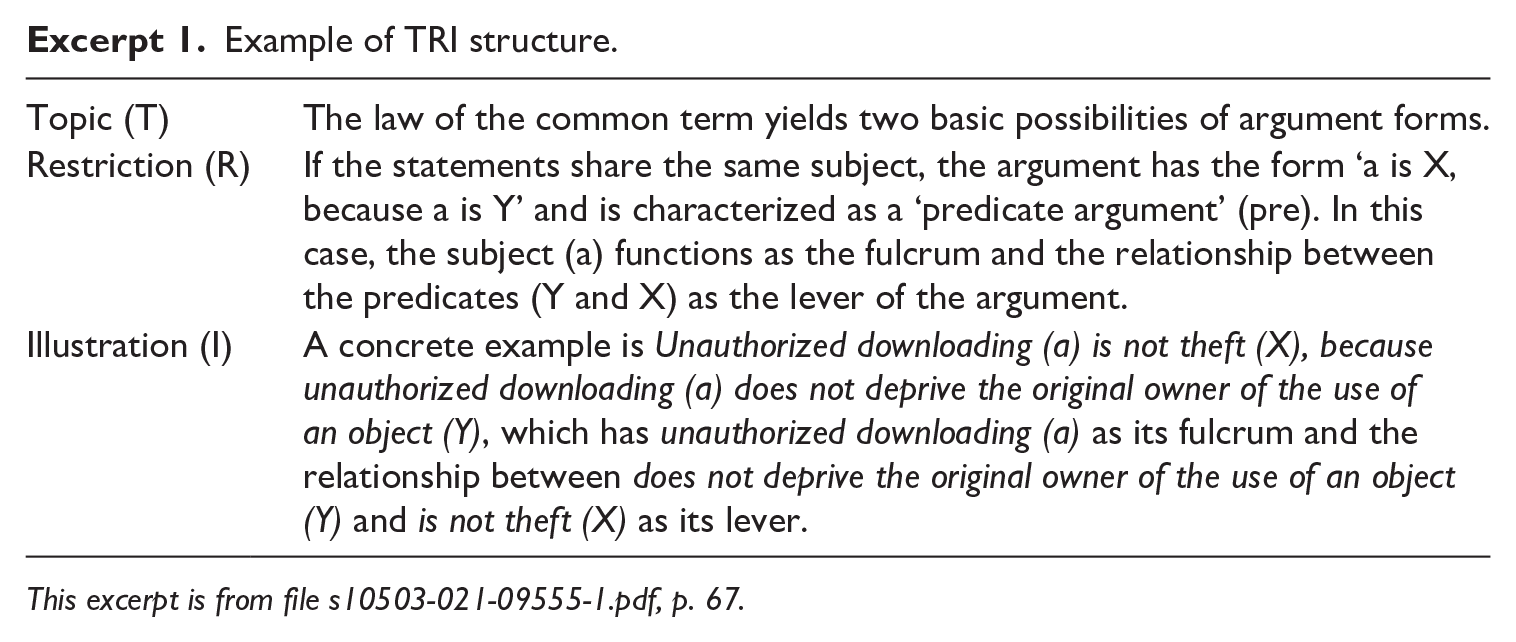
This excerpt is from file s10503-021-09555-1.pdf, p. 67.
Topic, Restriction, and Illustration are structural and functional slots beyond the level of the sentence, with formal markers that help to indicate their parts and boundaries. These markers can be graphic, lexical, or grammatical, can involve a shift in verb form, or the use of transition words (Johnstone, 2008: 88). Graphic text features, like indentation, line spacing, and font style, are common markers for the Illustration slot, as are the use of transition words like ‘consider’, ‘suppose’, or ‘for example’. The Illustration in Excerpt 1 for instance, begins with ‘A concrete example is’ and then uses italic type to graphically depict the shift to the voice of a character, someone arguing in favor of unauthorized downloading. Illustration (I) slots are often marked by indentation and line spacing that set them off graphically from the rest of the paragraph in the style of a ‘block quotation’.
To qualify as ‘voiced’, an illustration had to animate, in Goffman’s sense, the words of a participant other than the writer of the research article (Lauerbach, 2006: 198–199). Each voiced illustration was coded according to whether the line, participant, and turn were reported or constructed, by the writer, or by another, drawing on the distinction first made by Tannen (1986, 1995) between constructed dialogue and reported speech. Tannen pointed out how the term ‘reported speech’ has been systematically misused to refer to any instance of quotation, whether or not it is a repeat of something that was actually uttered (or written) by a speaker (or writer) on a particular prior occasion. She introduced the term ‘constructed dialogue’ as a more accurate way of describing the many so-called speech ‘reports’ that are actually lines invented by a speaker or writer. Mayes (1990) draws the distinction in a way similar to this study. In her analysis of 22 hours of casual conversation, she found that at least half of the 320 direct quotations in the data did not ‘represent actual previous utterances’ but were instead ‘inventions of the speaker’ (Mayes, 1990: 326).
The distinction between reported and constructed lines, participants, and turns, echoes the distinction between attested and introspective data. A ‘reported’ participant was an actually existing person, a ‘reported’ line was a repeat of what was actually written or said, and a ‘reported’ turn was a record of how speaker-change actually occurred (e.g. a transcript). By contrast, a ‘constructed’ participant, line, or turn was one invented by the writer of the article, or by another speaker or writer. ‘Constructed’ participants were imaginary, hypothetical, or choral, ‘constructed’ lines were depictions of what could or should be written or said (or might have been written or said), and ‘constructed’ turns were imaginary or hypothetical depictions of speaker-change.
Results and analysis
Voiced illustrations
The results of the study show that writers used 578 voiced illustrations across the 26 articles in the corpus, for an average of 22.23 voiced illustrations per article. The median was 16. Every article had at least one voiced illustration, with a minimum of 2 and a maximum of 72. This suggests that voiced illustrations were a common feature of articles in the corpus, though across a large range. While all of the articles in the corpus balanced theory with evidence, some placed a stronger emphasis on theory, discussing argument at a high level of abstraction throughout, while others were more focused on particular patterns of argumentative behavior. These differences in emphasis could help explain the range.
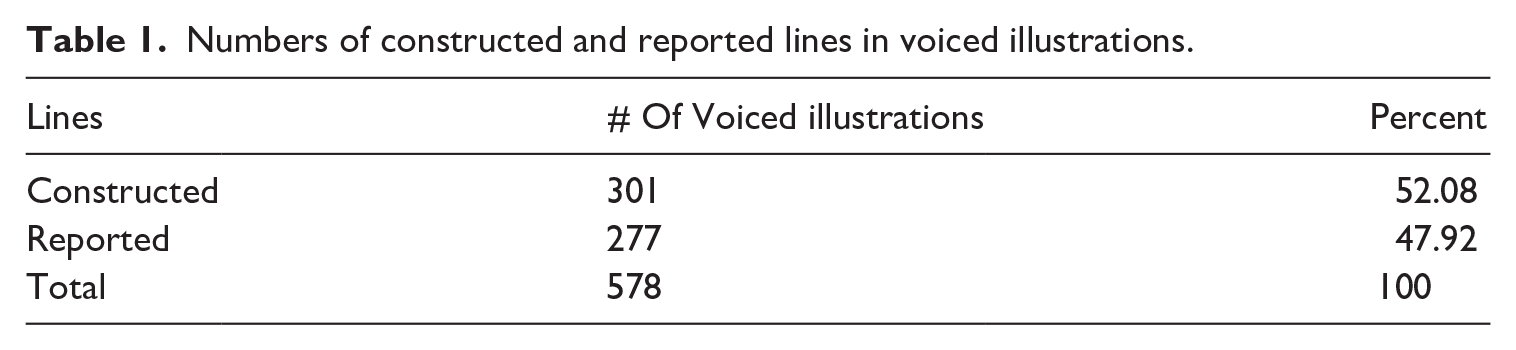
The differences between reported and constructed illustrations are revealing. The results of the study (cf. Table 1) show that roughly half (52.08%) of the voiced illustrations have lines that are constructed. This result is similar to Mayes (1990) who found that at least half of the lines of direct reported speech in her conversational data were constructed rather than reported. However, the data for this study is professional academic writing rather than casual spoken conversation. While the limits of human memory make constructed lines inevitable in casual conversation, these limits would not seem to apply in the same way to written discourse. So, what are constructed lines doing in the research papers in the corpus? The study finds that they are used to illustrate abstractions.
Numbers of constructed and reported lines in voiced illustrations.
The study distinguished the lines of voiced illustrations from their participants and turns. Studying lines, participants, and turns as distinct phenomena allowed for some interesting discoveries. The results of the study (cf. Table 2) show that 41.87% of the voiced illustrations in the corpus have participants that are constructed and 58.13% that are reported.
Numbers of constructed and reported participants in voiced illustrations.
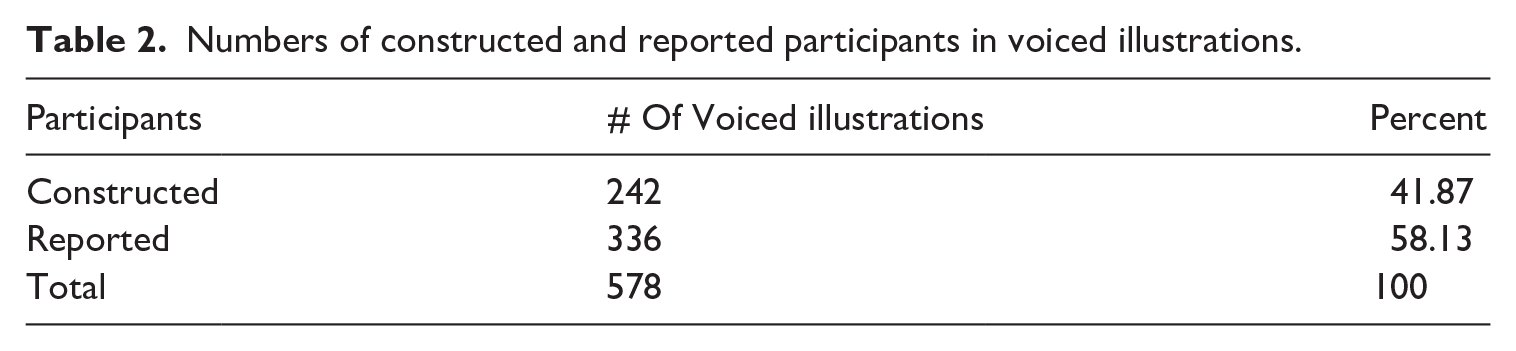
Most, but not all, of the constructed lines also had constructed participants, and most but not all of the reported lines also had reported participants. There were four voiced illustrations with reported lines and constructed participants. There were 63 voiced illustrations with constructed lines and reported participants. Most of the latter were cases where, earlier in the paper, the writer had reported what was actually written or said by an actually existing person (reported line, reported participant), but then rewrote their line so that it would fit a standard analytic framework or invented a line in order to represent their thoughts.
While the results for participants and lines largely overlap, the results for turns form a different pattern. The overwhelming majority of voiced illustrations (83.74%) did not depict any change in speaker (turn zero; cf. Table 3). For example, the voiced illustration in Excerpt 1 that depicts an argument in favor of unauthorized downloading is turn zero because no change of speaker is depicted. Among the few voiced illustrations that did depict a turn, more were constructed (15.05%) than reported (1.21%).
Numbers of constructed, reported, and zero turns in voiced illustrations.
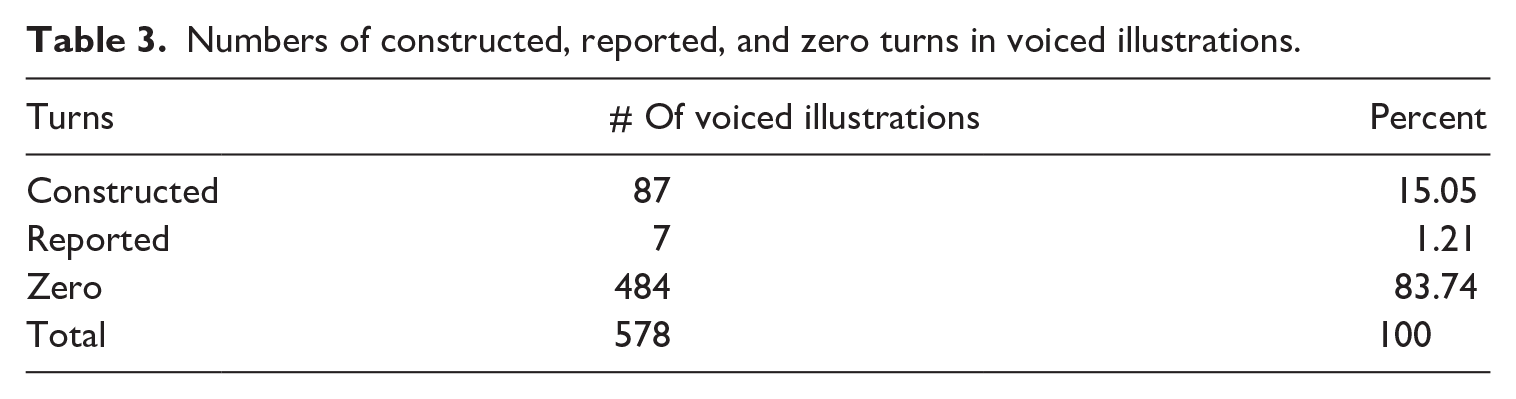
Why did so few voiced illustrations in the corpus depict a turn? Some papers were investigating monological arguments, so their voiced illustrations only needed to depict the voice of a single participant. Other papers investigated dialogical arguments, but the turns in these dialogues were usually not depicted in illustrations. Instead they tended to be presumed or described by the writer somewhere else in the text, like in a topic or restriction slot. The voiced illustrations in these cases, then, depicted the voice of a single participant which was presumed to function or characterized by the writer as functioning as a turn in an argument dialogue.
Reported voices
The voiced illustrations with reported lines repeat utterances and passages from a variety of sources. Most of the reported lines come from transcripts of spoken discourse or published writing. There are lines from parliamentary debates and broadcast news and commentary programs, for instance, along with newspaper articles, scholarly books, and websites. Authors generally follow citation conventions of academic writing in reporting and attributing these lines. In the following excerpt, for example, the author reports lines from the Hansard transcript of a UK Parliamentary debate in order to make a point about ethos:
Excerpt 2.
Within this framework, a sentence uttered by a source-speaker targets ethos of a referent-speaker who can be either supported (Miss Widdecome in Example (1-a)) or attacked (the British Government in Example (1-b)): (1) a. Mr. John Moore: b. Mr. Bruce Grocott:
This excerpt is from file s10503-021-09564-0.pdf, p. 125
The voices represented here (indicated by underline) are those of Members of Parliament whose spoken utterances during a debate were recorded, transcribed, and published on the UK Hansard website, then repeated by the author in their research paper. No turns are depicted. Line b. is not a response to line a. and the lines do not follow one another in the transcript. The lines in this excerpt illustrate a pattern in the data by presenting two attested examples.
Constructed voices
The voiced illustrations with constructed lines depict voices that have been invented by the author or another writer or speaker. They depict what could or should be written or said (or might have been written or said) rather than repeating what was actually written or said, a status often explicitly signaled by authors in their texts. Authors routinely place these constructed lines in the mouths of constructed participants, imaginary, hypothetical, or choral. There are examples constructed by the author or by another writer or speaker, examples drawn from literature, songs, and films. In the following excerpt, for example, the author voices a constructed speaker delivering constructed lines in order to give an example of the role of context in the interpretation of inference claims:
Excerpt 3.
One’s presentation in a given context of an argument in its reason-giving sense may offer clues as to the operative notion of reason in the corresponding inference claim. For example, consider the following argument in standard form.
This excerpt is from file s10503-021-09561-3.pdf p. 238.
The voice in Excerpt 3 (indicated by underline) is that of a hypothetical speaker, whose lines about Beth, a hypothetical character, were invented by the author of the paper. No turns are depicted. In introducing the illustration, the author asks readers to ‘consider the following argument in standard form’, explicitly signaling that the example has been constructed for the purpose of illustrating an abstraction. Other introducers that mark constructedness include modal verbs like ‘could’ and ‘might’, along with ‘imagine’ and ‘suppose’, as in this illustration from another paper in the corpus: ‘Suppose the Speaker says
In other cases, the author constructs the lines being voiced but places these constructed lines in the mouths of a participants that were constructed by another writer or speaker. In the following excerpt, for example, the authors voice a well-known fictional character who delivers constructed lines in order to give an example of a fallacious type of reasoning the authors call ‘bothsiderism’:
Excerpt 4.
Imagine two friends, Xena and Hector, deeply arguing over the existence of gods. Hector is an Olympian, so he holds there are twelve (Zeus, Hera, Athena, Aphrodite, and the rest). Xena is an atheist. Her number of gods is zero. After a long discussion, and exasperated by Xena’s calls for evidence (does the Iliad count?), Hector offers the following compromise:
This excerpt is from file s10503-021-09563-1.pdf, p. 249.
The voice represented in Excerpt 4 (indicated by underline) is attributed to Hector, a character from Homer’s Iliad. His lines were invented by the researchers to illustrate an abstraction, the ‘bothsiderism’ fallacy; they depict Hector reducing faith to a negotiation. The lines and participant are constructed, the former by the researchers and the latter by another. No turns are depicted. The narrative elements are humorous and playful – Gerofsky (1999) calls them ‘recreational’ – marking their constructedness and dispensability.
Then there are cases where both the lines and participants, along with the turns, are constructed by a writer or speaker other than the author. In the following excerpt, for example, the author uses a scene from a feature film as an example of the use of moderate charity by adults in arguments with children:
Excerpt 5.
This example is taken from a Bengali language movie, which involves an argument between a mother and her daughter who appears to be seven to nine years old. The argument takes place after the mother (A) receives a complaint from her daughter’s school administrator that the girl (D) has beaten up her classmate using her newly acquired martial arts skills, causing the boy to suffer a sprained arm (Roy et al., 2019). Here is a rough translation of the exchange.
This excerpt is from file s10503-022-09572-8.pdf, p. 433.
The voices depicted in Excerpt 5 (indicated by underline) are those of two fictional characters from the film Mukherjee Dar Bou, a mother and her daughter. The scene is constructed – the participants, their lines, and their turns – by screenwriters and performed by actors in the film. The dialogue is used by the researcher to illustrate an abstraction, the notion of ‘moderate charity’, depicting the mother inquiring further into the daughter’s reasoning rather than simply dismissing or accepting her argument.
Finally, there are cases of choral participants, where the voice depicted is that of a collective speaker, along with cases where the inner speech of others is being voiced. The following excerpt illustrates both. Here the author voices the inner speech of a constructed speaker in order to show the link between critical engagement and epistemic justice:
Excerpt 6.
We can see this most clearly in the Socratic Method case. The Black students, who are not called-on in class, are unfairly denied the opportunity to practice their argumentative skills (such as replying to and posing new challenges). Their exclusion, while not apparent to Professor C, will be obvious to the students themselves, and might easily lead to them to question their worthiness within the epistemic community. They might think to themselves,
This excerpt is from file s10503-021-09565-z4.pdf, p. 277.
The voices depicted in Excerpt 6 (indicated by underline) are those of ‘the Black students’. This is a choral participant because it depicts a collectivity as if all of its members were speaking ‘in unison like a Greek chorus’ (Tannen, 1995: 204). It is also a case where the thoughts of others are being voiced, with the researcher depicting their inner speech. The lines were invented by the researcher to illustrate an abstraction, ‘unjust deficits of criticism’, depicting the self-doubt students who are not challenged in class.
The generic intertextuality of constructed voices
Generic intertextuality concerns the ways that writers and speakers draw on and appropriate structural conventions from other genres, often to accomplish similar goals (Briggs and Bauman, 1992; Devitt, 1991; Jones, 2015). This borrowing not only influences text structure, but helps to position writers and readers in roles and create relationships between them (Jones, 2015; Yu, 2024). The constructed voices in this study bear a number of intertextual traces of texts from other genres, in particular the textbook.
The study of argument as a research topic grows out of a textbook tradition in the teaching of argument, where the use of constructed voices to illustrate abstractions is routine. This tradition reaches all the way back to Aristotle’s Organon (Andres, 2000; Felipe, 2010; Reif, 1969; Stahl, 1964). Indeed, in his writing on logic and dialectic Aristotle regularly uses constructed voices to illustrate standards of argumentative form and conduct. For centuries, Western textbooks have echoed the pattern across many locales and languages. In English, Whately’s (1832) Elements of Logic, for example, was a pillar of the 19C curriculum, and there have been many heirs in the 20C and 21C. Constructed voices are so closely linked to the teaching of argument that it can be difficult to imagine discussing the topic without them.
In both research articles and textbooks, constructed voices help to illustrate abstractions, dressing them up in narrative costume so readers can better understand them. Readers are expected to recognize the narrative as a costume and disregard empirical problems it might raise, like whether Homer’s character Hector really existed historically, whether he actually believed that there are 12 gods, and whether he actually ever uttered the words ‘After all, I believe there are 12 gods’ to someone named Xena on a particular occasion (cf. Excerpt 4). The reader who fails to treat the narrative elements as arbitrary displays what Scribner calls an ‘empirical bias’, while the reader who looks for the abstraction behind the narrative costume reads with a ‘theoretical approach’ that accords with genre expectations (Cole et al., 1971; Scribner, 1977). When constructed voices are used in this way, their purpose is more expository than evidentiary, and to expect empirical validity from the narrative costume is to misunderstand this purpose.
For the purpose of illustrating abstractions, constructed voices are unparalleled because authors can completely shape and control them. 3 They can guarantee that their illustrations will be ‘well formed’, depicting only the relevant features of the abstraction being illustrated while avoiding all the empirical complexities involved in reporting actual talk or text. In the study of argument, constructed voices help to clean up the ‘clutter’ of ‘ordinary language’ (Blair and Johnson, 1987: 43). In addition, they make it possible for authors to depict ideal cases (whether utopic or dystopic), imaginary ‘conversations’ that could never or have never taken place, illustrating theories that would be difficult, cumbersome, or impossible to illustrate with attested data.
Conclusions
This study has shown that constructed voices are common in the study of argument and has explained how they are used in voiced illustrations and why they might be preferred by researchers. It has pointed out how the use of constructed voices in research papers bears intertextual traces of their use in the textbook genre, with its long tradition in the study of argument.
Constructed voices are not attested data; however, they still serve an important purpose in the study of argument. Researchers use them to illustrate theories rather than to illustrate data, an aim that is more expository than evidentiary. Critics of evidential validity who would dismiss constructed voices as introspective data rightly notice that they are artificial products of introspection. The question is whether or not they are data. While the term ‘introspective data’ is apt in a critique of evidential validity, it tends to foreclose on the other rhetorical purposes constructed voices can serve. This study uses the term ‘voiced illustrations’ to describe a particular pattern of example-giving observed in the data. It does not presume a particular evidentiary purpose or status, leaving open the possibility of meaningful variation. While all voiced illustrations function as illustrations, not all illustrate data. Investigating voiced illustrations helps shift the focus away from irresolvable epistemological debates and wholesale critiques.
Though constructed voices can be critiqued as false semblances of actual discourse, this study demonstrates some of the explanatory benefits of viewing them instead as artful depictions of discourse by expert writers. Adopting this perspective brings into view important observations about researchers’ academic literacy, in particular their use of constructed dialogue as a narrative practice. It highlights how the lines put in the mouths of imaginary speakers are the work of actual writers, and shows how their written discourse can be analyzed as attested data. Researchers are expert writers with many years of professional training who exert self-conscious control of their texts, and others’, leveraging and transforming genre knowledge central to their profession. The constructed voices in argument research articles should not be critiqued as unnatural imitations of actual talk but understood as faithful imitations of the constructed voices used to illustrate theories in other genres that are important to the profession.
Footnotes
Acknowledgements
I am very grateful to Blake Robertson for helping with the initial data collection and analysis for this project. I would also like to thank Martha Cheng for her encouragement and helpful suggestions regarding methodology. All remaining errors are my own.
Declaration of conflicting interests
The author(s) declared no potential conflicts of interest with respect to the research, authorship, and/or publication of this article.
Funding
The author(s) received no financial support for the research, authorship, and/or publication of this article.
Ethical considerations
The data analyzed in the paper is published; it was not collected from human subjects.
Consent to participate
Not applicable
Consent for publication
Not applicable.
