



Abstract
Turkish coffee is not only a popular beverage consumed daily in Türkiye, but also a medium that enhances social connections among women within the same communities of practice. In this study, we examine coffee cup fortune-telling as a discourse type and analyse the sociocultural and linguistic characteristics of this intimate and interactional data among 25 Turkish-speaking women who are close friends. The data consists of 22 informal, naturally-occurring and face-to-face coffee cup reading sessions which correspond to 2 hours 40 minutes of audio recordings. Our analyses reveal that Turkish women use culture-specific semiotic and linguistic resources as tools of reflection and persuasion in this jointly constructed discourse. We also argue that coffee cup readings provide opportunities for establishing solidarity through engaging the speakers in troubles talk.
Keywords
Introduction
Fortune-telling, the prediction of desirable and undesirable future events (Sümbüllü, 2010: 56), has adapted to various sociocultural characteristics of different civilisations. It encompasses practices like interpreting coffee grounds, tarot cards, palmistry and birth chart astrology, facilitated by fortune-tellers, psychics and astrologists. These tools and mediators, as well as the sociocultural function and interactional value of fortune-telling exchanges display variation across cultures. Chinese culture, for instance, features diverse fortune-telling rituals emphasising social interaction and dialogic communication (Chuang, 2011, 2015). In Great Britain, tarot cards were prevalent (Wood, 1998) while Germany and the Netherlands saw consultations with astrologers, mediums and oracles, especially among women (De Blécourt and Usborne, 1999). Despite Christian Orthodox Church opposition, Russia witnessed the popularity of fortune-telling after the Soviet Union’s collapse (Wigzell, 2011). In Africa, Oroma women engage in the ‘Buna’ coffee ceremony in which they code-switch between Oromo, Arabic and English and make frequent use of greetings, prayers, proverbs and formulaic expressions (Yedes et al., 2004). ‘Buna’ plays a role in constructing social identity and unified discourse in Ethiopia (Brinkerhoff, 2011), and Ethiopian immigrant women in London use it as an opportunity to share challenges related to identity construction and sociocultural adaptation (Palmer, 2010a). East African immigrant women hold ‘Kaffa’ coffee meetings for sharing personal troubles, pain and fear (Loewy et al., 2002). Similarly, Icelandic women has been utilising the ancient ritual of fortune telling as a friendship building activity ever since the post-Viking era (Kissman, 1990, p. 137). The healing and transformation power of tasseography (coffee cup reading) is reported to lead to strong emotional attachment and psychological resonance between the seer-seeker dyads in Armenian culture (Avetisian, 2021).
In the Turkish context, old practices of fortune-telling have survived in different forms, specifically through interpretations and readings of fortune, even though fortune-telling is a forbidden act in Islam which is the default religion of the majority. Specific signs and symbols are systematically interpreted as good or bad omens and constitute a discipline called ‘ilmü’l-fal’ (lit. science of fortune-telling) in Turkish folklore. The Ottoman sultans and commanders used these practices before they went hunting or to war. As a result, books called ‘Falname’ (Anthology of Omens) were written and compiled (Gür, 2012).
In modern Türkiye fortune-telling practices continue in different formats and settings, but the most social and informal type of fortune readings happens through the medium of coffee cups after having Turkish coffee. As Ulusoy (2011) highlights, Turkish coffee is an important cultural artefact in social interactions and in maintaining social relationships. The coffee cup readings in Turkish culture serve several social functions, such as satisfying people’s curiosity about the future and their fate; receiving psychological relief and advise; having a good time and socialising; transmitting culture and values; and performing an act of self-realisation in the role of a fortune-teller (Büyükokutan, 2012: 106, 107). Turkish coffee cup reading is a type of socialisation and relaxation, as well as a display of hedonic tendency and traditional habit (Argan et al., 2015). In Atik et al. (2021) study participants’ motivations for seeking fortune-telling were ‘grouped under three main themes. People go to fortune-tellers mainly (1) for fun and socialising (2) with the hope to know about the future (3) as a therapy for their problems’ (p. 148). The researchers suggest that people engage in fortune-telling ‘regardless of their educational or economic background’ and that the fortune teller sometimes assumes the role of a therapist, which contributes to the well-being of the consumers.
The coffee cup narration is both a social practice and an act that connects two individuals, usually women, in a common shared experience (Bağlı and Öğüt, 2009), and it is an indicator of community membership among Turkish women (Mills, 2007). While research studies focussing on this issue reveal the extent to which the practice of coffee cup reading permeates the daily lives of Turkish-speaking women, the linguistic characteristics of this particular discourse remain under-researched.
Turkish coffee cup fortune-telling
Filiz and Eda are sitting across from each other drinking Turkish coffee at the dining table at Filiz’s house. Eda drinks the last sip of her coffee, carefully leaving the thick coffee grounds on the bottom of the small cup. She places the saucer upside down over the cup and swirls them together gently three times before turning them upside down while holding the cup and the saucer firmly together. While doing this, she makes a quiet wish and mumbles ‘Neyse halim çıksın falim’ (may my fortune be revealed). Now the soaked coffee grounds are slowly making their way from the bottom of the cup down into the saucer creating streaks in all directions. When the cup gets cool, Filiz, the reader, lifts the cup gently, watches the last of the liquid drip into the saucer and once the inside of the cup is a bit dry, begins examining the shapes and streaks inside the cup with a serious look. The reading is about to start.
This is how a fortune-telling session through Turkish coffee usually occurs in private, social settings in Türkiye. The depiction of this fortune-telling scene comes directly from the database of the current study which is used to analyse the symbolism and the sociocultural and interactional functions of these narrative exchanges among Turkish women who are close friends having coffee in informal settings. As a common practice, the Turkish coffee cup reading follows five main stages: preparation, initiation, reading the cup, reading the saucer and closure. Figure 1 illustrates the process of Turkish coffee cup reading, where each picture demonstrates a certain stage of the process.

Coffee cup fortune-telling procedure.
Preparation
In the intricate ritual of Turkish coffee cup reading, the initial act of preparation holds great significance. The Turkish coffee is brewed and served in a specific cup (1). After the coffee is consumed (2), the client signals their interest in fortune-telling by initiating the preparatory steps. This symbolic gesture marks the beginning of the first stage. After the final sip, the client delicately positions the saucer atop the cup (3) and ceremoniously swirls them together three times. Uttering ‘neyse halim çıksın falim’ (may my fortunes be revealed), the client expresses her wish to hear about her fortunes. With reverence, the cup and saucer are then inverted (4), allowing the coffee grounds to fall into the saucer, leaving detailed patterns as they settle. The client and the reader wait until the bottom of the cup is cool and ready for reading (5).
Initiation
As the coffee cup reading session enters its second stage, the reader, gently places a finger upon the cup’s base to check its temperature, ensuring it is cool enough to be read. The reader then lifts up the cup, revealing the complex patterns formed by the settling coffee grounds (6). It is at this moment that the reader initiates the session, uttering the phrases ‘hadi gel bakalım’ (come on, let's begin) and ‘neyse halin çıksın falin’ (may your fortunes be revealed). While interaction between reader and client remains limited during these initial stages, their significance lies in their contribution to the ritualistic ambiance of the coffee cup reading experience.
Reading the cup
The following phase revolves around reading the coffee cup to talk about the client’s fortunes. With a discerning eye, the reader analyses the cup’s contents (6), identifying and interpreting the symbols embedded within. For example, the reader says ‘bak şurada bir denizkızı var’ (look there is a mermaid over there). The client decodes the emerging symbols and encodes meaning to each one. Each symbol carries a meaning for the client’s fortune. During this stage, the client uses demonstrative locative pronouns such as ‘şurada’ (over there), ‘burada’ (here) to point out the symbols in the cup. Additionally, the client utilises interactional markers such as ‘hani’ (you know), ‘şey’ (well), ‘biraz’ (a little), ‘öyle bir şey’ (something like that) to present details about the reading. This stage fosters a continuous dialogue between client and reader, facilitating a collaborative process of meaning-making. As the act of fortune-telling unfolds, this phase extends in duration, emphasising its central role in the coffee cup reading ritual.
Reading the saucer
Once the cup reading is finished, the subsequent phase unfolds: reading the saucer. Serving as a complementary stage to the previous one, this phase fosters continued interaction between reader and client to unveil further insights. Although briefer in duration compared to cup reading, it is one of the significant steps of the ritual. Here, the reader aims to instil hope in the client as the fortune-telling session draws to a close. Upon completion of cup reading, the client prompts, ‘hadi gel bir de tabağa bakalım’ (now let’s look at the saucer). The reader places the saucer over the cup (7), allowing the coffee grounds to fall into the cup for reading. While doing this, the reader asks, ‘dilek tuttun mu?’ (did you make a wish?) to the client. Silently, the client forms a wish as the reader flips the saucer, observing the speed of the final coffee drop’s descent (8). Depending on its pace, the reader says, ‘dileğin hızlı/yavaş bir şekilde olacak’ (your wish will come true quickly/slowly). This moment holds great significance for the client, eager to learn the fate of her wishes. Subsequently, the reader examines the remaining coffee grounds on the saucer (9) by utilising similar language patterns observed in the cup reading step.
Closure
As the coffee cup reading session draws to an end, the reader bids final blessings and closes the session. Upon completing the readings of both the cup and saucer, the reader expresses well-wishes to the client. The reader says ‘şimdi git yıka fincanını da dileklerin olsun’ (now go and wash your cup so that your wishes come true) or ‘bu kadar, muradına erersin inşallah’ (that’s it, may you attain your good fortune), and gives blessings for the client’s future endeavours. In response, the client expresses gratitude with ‘ağzına sağlık’ (nicely said), acknowledging the reader’s expertise and embracing the shared experience of meaning-making.
Fortune-telling discourse
While studies on fortune-telling discourse are scarce, Aphek and Tobin’s (1989) detailed work on Hebrew fortune-telling semiotics suggests that fortune-teller language tends to be non-specific, non-precise, multi-purposeful and adaptable to diverse audiences and situations. This language employs elements such as ‘usually’, ‘perhaps’, ‘possibly’, ‘either -or’ to establish a range of possibilities for clients, along with specialised terminology, metaphors, repetitions, mixed registers, hedging, hesitations and silence among the characteristics of fortune-teller/client encounter.
Alagözlü (2007) characterises fortune-telling discourse as a genre in Turkish society as having communicative and sociocultural functions, like shaping women’s social networks. Language in coffee-cup readings frequently features inversions, imperatives, active sentences, future tense, affirmative sentences and discourse particles like ‘şey’ (well), ‘yani’ (I mean), ‘hani’ (you know). Studies examining Turkish coffee cup readings involve virtual fortune-tellers, or more accurately mobile applications of pre-set algorithms (e.g. Gündüz Alptürker, 2021; Soydaş and Yazıcı, 2018). While numerous mobile apps cater to Turkish coffee cup readings, which reflects their popularity in the society, no research has explored naturally occurring dialogues between real interlocutors in informal settings. Our current study aims to address this gap by analysing spontaneous Turkish coffee cup fortune-telling sessions among close female friends, focussing on intimate discourse in private settings.
The study
Coates (1997) suggests that investigating women’s language in all-female interactions helps illustrate the linguistic features of this specific discourse. The interpretation of those linguistic elements should also consider whether the domain is private and public as previous research suggests that women socialise more in private talk compared to men (Gilligan, 1982; Smith, 1985), and private talk fosters the construction and maintenance of social bonds. In private talk, Turkish women engage in various forms of communication, such as coffee-cup readings which encompass elements of oral communicative culture and discursive strategies. In an effort to report these, we investigated conversations that revolved around fortune-telling discourse using Turkish coffee (Figure 2) as the medium and focal point of dialogues. The study aimed to explore the visual tokens used as metaphors to build narratives and establish persuasion in the fortune-telling exchange, as well as the social and interpersonal functions of coffee cup readings between close friends.

Example coffee cup and saucer ready for fortune-telling.
In this study, Turkish women’s discursive practices in the intimate domain of discourse were examined within a Community of Practice framework (Eckert and McConnell-Ginet, 1992) which takes the basic idea that ‘in any culture . . . [there are] linguistic practices that are more ambiguous, often contradictory, differing among women of different classes and ethnic groups and ranging from accommodation to opposition, subversion, rejection or autonomous reconstruction of reigning cultural definitions’ (Gal, 1992: 158). Analysing language use within communities of practice (CofP) gives the researcher a more accurate perspective about what is happening in a conversation and why. Early language and gender studies that followed this approach and investigated smaller and more specifically oriented groups (e.g. Bergvall, 1996; Freed, 1996; Greenwood, 1996; Hall and O’Donovan, 1996) have insightful and more meaningful explanations of how communication is shaped in different contexts and in different research settings without resorting to dichotomous approaches to gender.
More recent research studies focussing on gender and utilising the CofP approach as their research framework come from various disciplines and sociocultural contexts. In healthcare, for example, Chen et al. (2021) examine the interaction between novice and experienced nurses in Singapore to identify how they negotiate identity and group membership, while Terry et al. (2019) study highlights the clinical and professional benefits and empowerment capacity of CofPs as safe spaces for development. A review of the role of CofPs in supporting existing workforce improvement strategies in Indigenous health and education contexts point to enhanced learning and practice (Wynn et al., 2023). In the field of language education, it is common to find studies that use the CofP framework to investigate teacher professional identity development (Mehdizadeh et al., 2023) and learner identity building and negotiation (Pandhiani and Umrani, 2021).
Other CofP studies from different disciplines and contexts have examined discursive practices and intra-gender differences in all-female interactions with victims of violence in Brasil (Ostermann, 2003); female politeness strategies in small talk in managerial business meetings in the UK (Mullany, 2006); street-level sex worker community discourse in the context of forming and maintaining relationships in Arizona, USA (Read, 2013); and the generation, transformation and communication of knowledge in international CofPs (Adler et al., 2024).
The community of practice in the current study is Turkish women’s social gatherings over Turkish coffee, and the coffee cup fortune-telling dialogues that happen after they drink their coffee. The main purpose of these sessions is not necessarily fortune-telling; these events are generally planned for personal information exchange and commentary about personal life narratives among close friends. Fortune-telling becomes part of these coffee talks when one of the interlocutors is known to have the ability, or sixth sense, to read coffee cups and predict what is about to happen in the lives of others.
Turkish women’s linguistic practices have been investigated from multiple perspectives mainly through written or scripted oral discourse in Türkiye. Research that focussed specifically on Turkish women’s language use analysed politeness strategies of female characters in TV series (Agis, 2012); length of requests in female speech as compared to male speech (Önem, 2016); persuasion strategies in folk fiction (Akkaya, 2017); intimate female humour as reflected in a magazine created solely by female caricaturists and writers (Yavuz Görkem, 2018); female political speech in comparison to male political speech of parliamentary candidates (Öztürk-Dağabakan, 2016); and social roles and social status of women reflected through the speech of female characters in Turkish novels (Sevim, 2022). In this vein, this study aims to uncover the linguistic characteristics of the daily language used by Turkish women in informal and social conversations in naturalistic settings with a particular focus on coffee-cup reading sessions. The study specifically aims to answer the following questions: (i) what are the culturally-embedded semiotic resources employed in coffee-cup reading discourse and what are their pragmatic functions? (ii) what are the discursive strategies utilised in the co-construction of coffee-cup discourse and how do these strategies shape this discourse?
Data
The present study examines authentic interactional data compiled unobtrusively within a specific community of practice which consists of (i) Turkish-speaking women (ii) who are close friends, (iii) and engage in coffee-cup readings, (iv) in informal contexts in Ankara, the capital of Türkiye. A total of 2 hours and 40 minutes of data (recording range = 03:05 − 15:55 min, mean = 7:27 min) were compiled spanning over a 6-month period. The database consists of 22 audio recordings of dyadic or multi-party interactions among a total of 25 women whose ages range between 18 to 50 who are all university graduates. Each recording covers a single and complete episode of a spontaneous coffee-cup reading session in which the participants participate as a fortune-teller or a client. It is important to note that among all participants, 6 of them perform both roles across different sessions, as a result these participants contributed more than one recording to the database.
Participants were recruited through purposive sampling; each participant was briefed about the goals and the scope of the study. These sessions were conducted at homes or coffee shops where an informal and intimate atmosphere was assured, the participants chose the setting according to their personal preferences. The sessions were audio-recorded by the participants themselves to ensure that the interaction was not affected by any interference, and no researchers were present during the recordings. The participants took part in the study on a voluntary basis, gave their informed consent for research and completed a short survey of demographic information (age, educational background, relationship with other participants). The participants were assigned pseudonyms, and all personal and sensitive information present in the recordings were anonymised.
The audio-recordings were transcribed using a sub-set of Jeffersonian conventions (Appendix) (Sacks et al., 1978) and the accuracy of the transcriptions was verified by two researchers. Later, close readings of the transcriptions were carried out, two of the researchers carried out the coding as independent coders to identify the metaphors and interactional markers in the data in two rounds of coding. Coding process included both a priori codes from existing literature presented in the previous sections and also included emergent codes. There was 80 percent agreement between the coders and the final reconciliation of coding concerning the disagreements was reached by discussions. The transcription and the data analysis were carried out using the qualitative data analysis software MAXQDA (VERBI Software, 2023). Transcription conventions, codes and metadata are available in the online project repository. 1
Analysis
In this section, the findings of the data analysis will be presented under two sub-sections. In (i) coffee reading as a multimodal site of sociocultural interaction, the semiotic and linguistic resources utilised to establish a shared conceptual space between participants are stated; in (ii) establishing solidarity through troubles talk, discursive strategies used to enhance in-groupness and intimacy among the participants of the community are discussed.
Coffee reading as a multimodal site of sociocultural interaction
The coffee reading as a genre (after Alagözlü, 2007) is embedded with distinct communicative and sociocultural functions in Turkish society. A regular session of coffee reading is a face-to-face and dyadic encounter that involves two parties in interaction: the reader who is the fortune-teller and the client whose fortune is told. Whether it is a fortune-telling session offered by a professional reader 2 or an informal session between friends, the reader is expected to hold the floor more often than the client in the interaction and the client usually remains quiet except for occasionally providing answers, verification and basic information requested by the reader (Aphek and Tobin, 1989; Atik et al., 2021).
After the participants complete the ritual of drinking their coffee and letting it cool down for a while, the reader announces the start of the session by holding the cup and uttering the opening line ‘neyse halin çıksın falin’ (may your fortune be revealed) as an idiomatic expression customary in the ritual. The readers in the dataset also made use of expressions such as ‘bak canım’ (look dear), ‘hadi gel bakalım’ (come on let’s begin) and ‘bakalım’ (let’s have a look) to invite the clients into a joint conceptual space. Thus, in contrast to traditional fortune-telling sessions where the fortune-teller is the ultimate authority in managing speaker turns, these expressions position clients as active participants in the joint construction of the narratives.
One of the most prominent characteristics of this jointly constructed discourse is its multimodality. The discourse constructed around the culture-specific ritual of coffee reading involves various modes and multimodal properties such as images, writing, numbers and speech (Börütecene et al., 2017; Kress and van Leeuwen, 2001), and these resources are utilised for various communicative purposes such as meaning-making, persuasion and negotiation. Each community displays a different repertoire of resources in this process (Kress, 2010). In Turkish cultural context, the multimodality in coffee reading revolves around the images indexed by coffee grains in a cup. Coffee reading ritual is always initiated by an image identified by the reader, based on the dried coffee grains stuck on the bottom and periphery of the coffee cup. 3 These images are visual tokens which act as metaphors with pragmatic purposes in narratives. A total of 220 instances of visual tokens were identified in the dataset and the readers made use of diverse visual tokens (M=8.3, SD=3.84) in their narratives. These tokens were categorised under six thematic groups of concepts: HUMAN, NATURE, ANIMAL, BODY PARTS, OBJECT and SUPERNATURAL as reported in Table 1 below.
Visual tokens in coffee reading dataset.
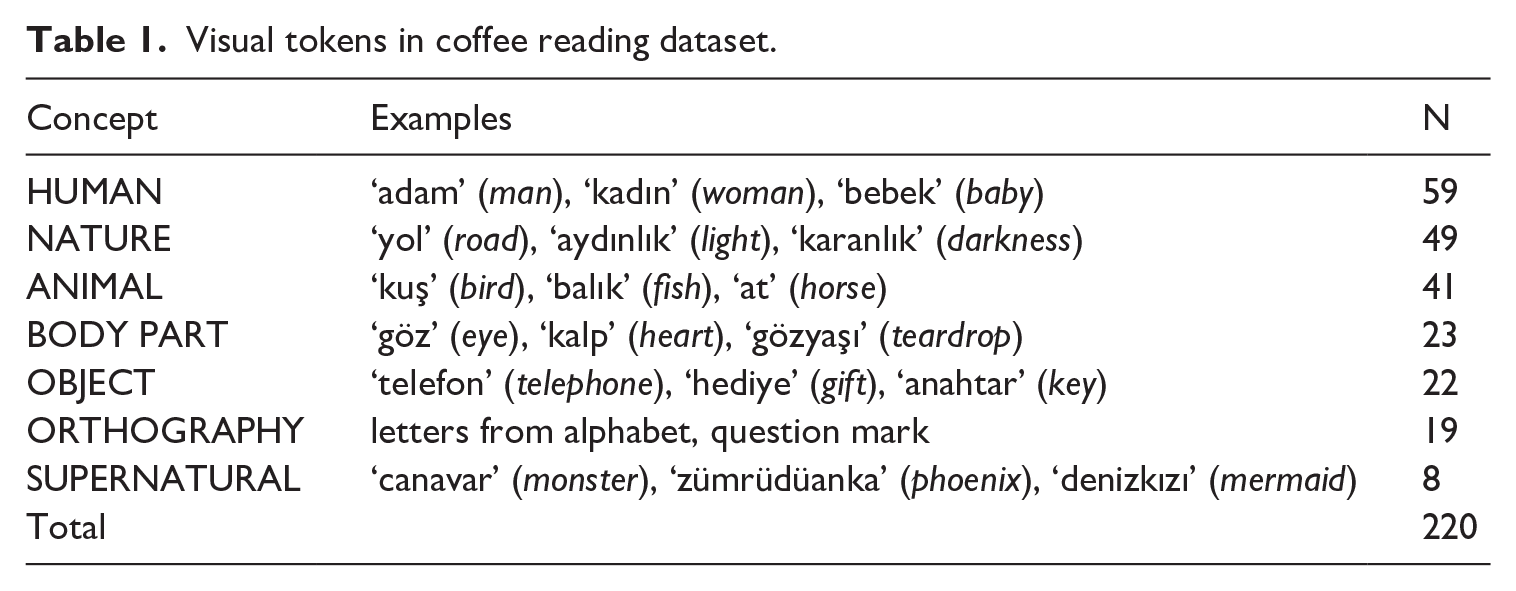
While the highest number of visual tokens belongs to the concept of HUMAN (n=57), the richest concept in terms of the number of unique tokens is ANIMAL including 20 types of visual tokens. Animal symbolism has been prevalent in Turkish cultural practices for centuries (Çoruhlu, 2000; Ögel, 1993; Roux, 2012) and the analysis shows that practice of coffee reading deploys this culturally-embedded semiotic resource to operationalise metaphors as rhetorical devices to persuade the listener (Charteris-Black, 2006; Fairclough, 1995; Reisigl and Wodak, 2009; Wodak, 2009). The most frequently observed metaphor in the category of ANIMAL is ‘kuş’ (bird) (n=12) which has been traditionally denoted as a messenger of news and good fortune in Turkish culture (Bogenbayev and Calmırza, 2014; Ögel, 1993) as exemplified by extract 4 (1) below.
EXTRACT 1 [coffee-f-20180718]
In (1) above, the reader, Filiz, identifies a shape resembling a large bird, interpreting it as a message from the future. In turns 1 and 3, Filiz hints that the message sender is travelling from afar without specifying its content. In turn 4, client Eda relates this interpretation to her life, mentioning an upcoming visit from relatives abroad. While Eda asks about the message content, Filiz refrains from providing details; instead, she emphasises the bird’s presence using the demonstrative locative pronoun ‘şurada’ (over there) to persuade Eda. In a way, the reader compensates for her inability to provide a satisfactory answer by exhibiting visual evidence to legitimise her interpretation. The conversation shifts quickly to another image for interpretation in turn 5.
Overall, the most frequently identified visual tokens are ‘yol’ (road; n = 20), letters from the alphabet (n = 18) and ‘adam’ (man) (n = 17) in the dataset. These tokens also represent and contribute to the most prominent conversational topics in coffee reading discourse. The image of a road usually constructs a narrative about the potential directions, choices, decisions and developments the client is destined to face in the future. The individual letters from the alphabet are used to encourage the client to associate a person who bears a name containing that specific letter with a situation in her present or future life. Finally, the image of a man usually triggers emotion-laden narratives regarding romantic relationships and love interests.
When constructing these types of narratives, readers frequently make use of specific linguistic devices such as the previously exemplified demonstrative locative pronouns ‘şurada’ (over there) in extract (1). Additionally, the readers integrate various interactional markers (after Ruhi, 2013) which contribute to indexing their relational and emotional involvement to the interaction. In coffee reading discourse, these markers encompass approval markers, discourse markers, vague category markers, fillers and downtoners. For instance in extract (2) below, the visual token ‘man’ initiates a conversational topic related to the love life of the client and the reader utilises discourse marker ‘hani’ (you know); fillers ‘eee’ (err), ‘şey’ (well); downtoners ‘biraz’ (a little), ‘birazcık’ (a bit), ‘küçük bir’ (a small); approval marker ‘evet’ (yes) and vague category marker ‘öyle bir şey’ (something like that) in her turns.
In the extract above, a narrative unfolds concerning recent events in the client’s love life. Reader Merve identifies a shape she interprets as a man and uses fillers like ‘eee’ (err) and ‘şey’ (well) to expand the narrative. Given their friendship, Merve speculates that the man may be someone familiar to both and suggests the name ‘Ahmet’. Client Dilara confirms this interpretation in turn 2 and adds details about her relationship with Ahmet, co-constructing the narrative. In turn 3, Merve uses the approval marker ‘evet’ (yes) to align with the developing narrative, employing downtoners like ‘birazcık’ (a bit) and ‘küçük bir’ (a small) to soften the force of her evaluative statements (Overstreet, 2012). In turn 4, Dilara aligns with Merve’s interpretation. Interestingly, Merve strategically asks the rhetorical question ‘gerçekten?’ (really?) in turn 5, inviting Dilara to share more information. The session concludes with Merve referring back to the coffee ground shapes to validate her reading and affirm Dilara’s disclosure using the approval marker ‘evet’ (yes).
The analysis shows that the readers frequently use vague category markers ‘şey’ (thing), ‘hepsi’ (all), ‘bazıları’ (some) which are among the properties of non-precise, non-specific and indirect language which characterises fortune-telling discourse (Aphek and Tobin, 1989; Arıca Akkök, 2019; Yeşilyurt, 2009). This vagueness establishes a range of possible interpretations and possibilities for the clients. An example of such pragmatic vagueness is present in extract (3) turn 5 below where the reader uses vague category markers to let the client shape the narrative.
The coffee reading discourse among Turkish-speaking women is also rich in sociocultural expressions. Above in (3), for instance, client Ahsen thanks the reader using the phrase ‘ağzına sağlık’ (nicely said) (lit. health to your mouth), and the reader, Nil, bestows her blessings for good fortune to her with the idiomatic and culturally-embedded blessing ‘muradına erersin inşallah’ (may you attain your good fortune) in turn 13. Ahsen accepts this blessing with the expression ‘inşallah’ (I hope so) (lit. God willing). These expressions, originally from the religious language domain, are now conventionalised in contemporary spoken Turkish. They reinforce a sense of in-groupness within the community of practice, invoking ideas of prosperity and well-being (Atik et al., 2021; Avetisian, 2021; Palmer, 2010a, 2010b; Ulusoy, 2011; Yedes et al., 2004). In coffee reading discourse, both the reader and the client prioritise positive interpretations of visual cues and predictions that favour the client’s well-being, creating a platform for women to support each other. The next section will examine the discursive construction of solidarity during coffee reading sessions.
Establishing solidarity through troubles talk
After a reader identifies a problem, a trouble, in the client’s life based on visual tokens on the cup, she foresees how the client will attempt to solve this problem. The episodes of troubles talk 5 involve advice giving as a discursive strategy to establish solidarity among the participants. In extract (4) below, reader Burcu interprets that client Canan is at a crossroads in her life concerning her relationships with the people around her. In turn 1, Burcu offers her advice by enacting and voicing what Canan should tell herself to eliminate the people who are toxic for her well-being. In this case, Burcu is giving advice, showing empathy and understanding for Canan’s situation, and highlights her solidarity with her by building a narrative for Canan. Reader Burcu’s enactment of client Canan displays her alignment to the trouble and emotional state, and in turn 2, we see that Canan affirms this alignment using the non-lexical token ‘hı-hı’ (mm-hmm) which marks agreement in spoken Turkish (Aytaç-Demirçivi, 2021; Özcan, 2015). After receiving acknowledgment from the client, the reader concludes the narrative (turn 3) by sharing the promise of a favourable future as an outcome of Canan’s convergent behaviour.
As exemplified above, coffee reading discourse often addresses women's personal and relational issues, particularly in sessions among friends (Clancy, 2015; Pahl and Spencer, 2010; Spencer and Pahl, 2006). Shared knowledge among participants forms the foundation for these intimate discussions. Close acquaintanceship also empowers the reader to comfortably broach personal issues, offer insights as a close friend and provide suggestions. Through strategic use of visual cues, the reader establishes a non-imposing platform for discussing the client's life challenges. Following up in the same extract, the speakers engage in a series of exchanges in which reader Burcu focusses on Canan’s habit of putting others’ needs above her own (turn 4) and Canan confirms this observation (turn 5). In the following turns, we observe that the reader makes use of interactional marker ‘yani’ (I mean) twice in line 6 and ‘aynen’ (exactly) in turns 8 and 10 in order to intensify the argument conveyed previously in turn 4. In this respect, the reader establishes persuasion through the joint construction of this episode of troubles talk.
The primary goal of troubles talk isn't always problem-solving or advice-giving (Jefferson and Lee, 1981) but instead serves to strengthen female solidarity and in-groupness (Boxer, 1993; Debray and Spencer-Oatey, 2022; Goldsmith, 2004; Jefferson, 1988; Kyratzis, 2000; Taniguchi and Kaufman, 2014). This is evident in extract (5) where client Hazal initiates an episode of troubles-sharing and advice-giving by asking reader Gizem ‘içim çok mu dertli?’ (does the cup show that I feel troubled?). In response, Gizem makes pragmatic use of the visual tokens, the darkness and a monster, to initiate sharing and advice-giving.
In (5) above, we observe the joint construction of discourse around a problem raised by the client's disclosure of her feelings. In successive turns (6, 10 and 17), the client assists the reader in interpreting visual tokens, and engaging in collaborative sense-making. This episode of troubles talk revolves around a visual token – a monster representing the client’s thesis supervisor – and the challenge of completing her thesis. Notably, the client identifies the monster’s reference in turn 6 and suggests that a previously identified visual token (thus not present in the extract), the mountain, may symbolise her thesis supervisor in turn 10. Building on the client’s self-revelations, the reader continues to discuss the client’s problem. Unlike the reader in extract (4), the reader in (5) does not provide advice but creates a space for the client to confront the problem and assess her responses. The episode ends without consolation, but the reader shares her assessments (turns 7, 9 and 16) to affirm her emotional alignment with her friend. In turn 18, the reader concludes by advising the client to perform the ritual of washing the coffee cup, symbolising the removal of problems from the client’s life. In turn 19, client Hazal expresses satisfaction with reader Gizem’s ritualistic promise of problem resolution, thanking the reader with a brief, relieving laughter.
Conclusion
The analysis of Turkish women’s intimate discourse during coffee cup fortune-telling interactions reveals the use of cultural expressions and visual tokens, serving multiple social and interactional functions (Alagözlü, 2007; Argan et al., 2015; Atik et al., 2021; Bağlı and Öğüt, 2009; Büyükokutan, 2012; Ulusoy, 2011). These readings exhibit religiously and culturally specific linguistic patterns across different stages, with common symbolic meanings attributed to highlighted visual tokens (Aphek and Tobin, 1989). Multimodality is evident as narratives are co-constructed by assigning meaning to images, numbers and letters in the cups (Kress, 2010; Kress and van Leeuwen, 2001). Power symmetry in the roles of friends in all-female exchanges shifts when readers begin to reveal, comment on and give advice about the personal issues in the lives of the clients. Interactional markers such as approval markers, discourse markers, vague category markers, fillers and downtoners reflect the relationship dynamics and emotional engagement. This mutual engagement within the community of practice (Eckert and McConnell-Ginet, 1992) leads to collaborative narrative construction concerning clients’ lives through shared intimate information and problem-solving revealed in the coffee cups.
Analyses indicate that Turkish women in intimate conversations use common socioculturally meaningful visual symbols and linguistic features to initiate troubles talk (Jefferson and Lee, 1981). Narratives about personal problems are collaboratively constructed using visual tokens as a starting point to establish the issue and its cause; this is followed by collaborative problem-solving agreed upon by both client and reader which is facilitated by agreement markers (Aytaç-Demirçivi, 2021; Özcan, 2015). Sessions typically conclude with traditional linguistic elements assuring clients of the upcoming resolution of challenges, conveying hope for enhancement and improvement in their social, personal and professional lives (Atik et al., 2021; Avetisian, 2021; Kissman, 1990; Ulusoy, 2011).
The community of practice for this study was intimate friends meeting socially to have coffee and read the fortune from the coffee cup. All of the interactions were in face-to-face mode in cosy settings. Alternatively, there are instances where CofPs meet online, rather than in-person, in order to provide a convenient, cost-effective and inclusive environment for the participants; these are called Virtual Communities of Practice (VCoP). Conducting studies on VCoPs is a relatively new and popular trend in literature, practised in diverse professional areas such as health care (Barnett et al., 2014; Jiménez-Zarco et al., 2015; McLoughlin et al., 2017), teacher education (Hajisoteriou et al., 2018; Murtagh and Rushton, 2023) and researcher training (Chen et al., 2023). VCoP studies also investigate the dynamics among a variety of groups, such as members of social fora (Angouri and Tseliga, 2010), US coastal guards (Rodman and Trespalacios, 2018) and disaster management organisations (Gimenez et al., 2017). One common concern reported by these studies, however, is that the anonymity and distance elements of virtual groups creates trust issues for some members, making sharing and participating problematic for them. Researchers who plan on working on interaction patterns within CofPs should bear this in mind while choosing the mode in which to conduct their investigation.
Footnotes
Appendix
Declaration of conflicting interests
The author(s) declared no potential conflicts of interest with respect to the research, authorship, and/or publication of this article.
Funding
The author disclosed receipt of the following financial support for the research, authorship, and/orpublication of this article: This paper examines a selected portion of data belonging to a more extensive research project on women’s talk in Türkiye funded by Middle East Technical University – Scientific Research Project Fund (grant number GAP-503-2018-3053).