



Abstract
In Australia, the term ‘preschool’ generally refers to settings that cater for the education of children in the year before compulsory schooling, hence making it a pivotal site for neoliberal discourses that seek to frame preschoolers as requiring ‘school readiness’. While much research has focused on the implications of neoliberal reforms in the primary through tertiary and childcare sectors, particularly the divisive social consequences of these shifts, insufficient attention has been paid to the ‘neoliberal creep’ – to co-opt Viggiano’s term – into the lives of Australian children and their parents/caregivers. 1 This paper draws on a combination of discursive, affective and semiotic analysis to investigate how neoliberal discourses work through advertising regimes to influence parental choice in the current preschool market. Through the analysis of six Montessori preschool websites, the article highlights how, through the targeted manipulation of visual and linguistic elements, marketing experts create and reinforce idealised constructions of children, which in turn, contribute to the establishment of specific discursive and affective environments. This results in a sort of ‘emotional governance’ which directly influences the relationships between marketisation, discursive subjectivities, and the classed and gendered implications of parental choice in Australia.
Keywords
Introduction
In the last 40 years, governments worldwide have favoured neoliberal policies and practices that privilege market mechanisms. Successive Australian governments have enthusiastically embraced neoliberalism, increasingly shifting the task of education into the private sector, resulting in a sharp rise in the numbers of private education institutions (Watkins, 2007: 320). A neoliberal rationality of individual responsibility and consumer choice positions parents (or rather, as this paper will show, mothers) as free choice-makers, encouraging them to choose private education (Barcan, 1993, 2010; Campbell et al., 2009; Gewirtz et al., 1995; Wilkins, 2012).
Dominant neoliberal discourses stress the importance of early brain development, while highlighting the role of education in preparing ‘the future citizens of tomorrow’ (Tisdall, 2006: 115). This reframes children’s learning as an investment in the labour market of the future (Lister, 2007: 697), rather than as a site where learning occurs naturally, through play, a rationale which operates in stark contrast to the long-established early childhood practice of operating from children’s strengths(Brown, 2015).
In this context, neoliberal policy has fabricated ‘choice’ as a major driver of educational provision, absenting the state from a longstanding democratic obligation based on a commitment to providing quality education for all Australians (Rowe and Windle, 2012). Exercising choice is therefore considered the act of a ‘responsible’ citizen (Gillies, 2005), and being selective in the choice of educational setting is almost mandatory as it signifies ‘good parenting’ (Karlsson et al., 2013). For example, Connell (2013) has argued that with consumerist and competitive ways of thinking becoming dominant in school policy and practice, parents are ‘expected to exercise free choice between different firms’ (p. 103).
Choice, however, is never truly free, autonomous, or individual. As this research suggests, choosing is a complex, multi-layered process, which occurs within the broader political, economic and social structures that surround us. The practice of choice, therefore, takes place within an environment which is influenced by a myriad of factors, including dominant discursive norms, the subjectivities available within such discourses, parents’ emotional experiences, and advertising regimes. Within such a complex environment, preschools, like all educational institutions, must rely heavily on marketing techniques to attract potential ‘customers’. Frequently, this is done through the reproduction of dominant discourses and mentalities, designed to speak directly to parents, and through messages created to tap into mothers’ emotions.
Not all mothers, however, are able to enter this ‘choice market’ on equal terms, with some lacking the knowledge or resources to participate on a par with others, due to their positionality in society and deep-rooted systemic inequalities. This research is interested in exploring how elements such as gender, class, identity and affective experiences intertwine in today’s highly marketised field of preschool choice. In particular, using six Montessori preschools in Adelaide as a case-study, the paper explores how preschool parents are positioned and influenced in their choice-making processes.
Framed within feminist post-structural and social constructionist paradigms, the paper combines the concepts of discourse and affect, and proposes a social-relational analytical approach to the study of preschool choice. 2 This is underpinned by the notion that affect is like a wave, or an intensive force that passes through and within bodies, and moves them to do certain things. Importantly, this social-relational approach relies on the notion that the body is conceived broadly and thus intended not only as the physical entity, but rather as a broad entity, comprising also collective body of people (a collectivity or assemblage), as well as discursive bodies. In sum, the article explores the relations through which parents of South Australian pre-schoolers are facilitated, impeded and/or coerced in their capacities to exercise choice, by bringing together a combination of discursive, affective and semiotic analysis to investigate how neoliberal discourses work through advertising regimes.
Neoliberalism, education and parental choice
The definition of neoliberalism can vary, depending on the research focus. For the context of this paper, neoliberalism is defined as an ‘agenda of economic and social transformation under the sign of the free market’ (Connell, 2013: 100), which proposes that ‘all aspects of human well-being can best be advanced by liberating entrepreneurial freedoms and skills within an institutional framework, characterised by strong property rights, free markets and free trade’ (Harvey, 2005: 2). Neoliberalism connects individual freedom, success and well-being to the accumulation of wealth (Smith et al., 2016), and proposes the increasing participation of private providers in the delivery of public services, such as education, that have historically been the responsibility of the state (Brennan et al., 2012; Connell, 2013). Critiquing this phenomenon, Peters (1999) noted that ‘there is nothing distinctive or special about services like health and education: they are just services and products like any other, to be traded in the marketplace’ (p. 2).
Some scholars refer to this ‘marketisation’ of education as educapitalism (Blackmore, 2014; Smith et al., 2016), a form of governance which has reduced education a ‘sub-sector of the economy’ (McLaren, 2005: 74). In this context, public institutions that were previously responsible for collective well-being, are now reconstituted as private players in the market (Davies and Bansel, 2007: 254), and are actively advertising themselves to attract clients and limited government resources (Watkins, 2007: 320). Parents, in turn, are expected to be ‘entrepreneurial individual[s]’, who are ‘responsible’ for helping their children develop as ‘good’ citizens (Jensen, 2010).
As the education system expands to reflect the neoliberal market ideal, a growing emphasis on the individual (Brett, 2003; Pusey, 2003), and a resultant competitive behaviour between individuals emerges (Reay, 2008). This focus is expressed and experienced most sharply through the concept of school choice (Windle, 2009). Not everyone, however, can access these services equally, and a growing body of literature attests to the fact that only some parents – specifically, middle-class parents — have ‘real’ access to choice. Further, a growing body of literature now attests to the fact that when advertising materials or parenting advice materials speak to the gender-neutral parent, they are in fact referring to mothers, and especially middle-class mothers, who have gradually assumed the subjectivity of entrepreneurial agents in their children’s education (see Campbell, 2005; Campbell and Proctor, 2014; Campbell et al., 2009; Proctor, 2008; Proctor and Aitchinson, 2015; Proctor and Sriprakash, 2013; Proctor and Weaver, 2020; Reay, 2005a, 2005b; Wilkins, 2011).
The current neoliberal education market, therefore, is not only classed, but also strongly gendered, and through the privatisation and marketisation of Early Childhood Education (ECE) in Australia, existing disparities — both social and economic — are being exacerbated through the misguided notion of choice. This is an issue which should be addressed by those emphasising equity and justice, and believing in the transformational power of education, and this paper attempts to do just that.
The marketisation of ECE
In a famous paper, Connell (2013) argued that, following the establishment of a neoliberal policy regime, a ‘cascade of reforms’ followed, which brought every institutional sector in Australia under the sway of market logic (p. 102). This cascade has reached the ECE sector too, and scholars have argued that neoliberalism has resulted in an educational context where equality, freedom and social justice are no longer paramount (Brennan, 2007; Brennan, 2014; Chomsky, 2013; Dalton and Wilson, 2009; Giroux, 2013, 2015; Hunkin, 2016, 2018, 2019; Moss et al., 2016; Newberry and Brennan, 2013; Sims, 2017), and where knowledge and meaning have become standardised and homogenised from a very early age (Sims, 2017).
In particular, it has been argued that the marketisation of ECE can place profit above the child (Smith et al., 2016) and that an over-emphasis on standardisation, accountability and expediency can undermine the child’s right to explore and express (Sims, 2017), thus excluding holistic and balanced approaches to child development (Haslip and Gullo, 2018), and operating ‘in total contrast to the long-established early childhood practice of operating from the child’s strengths and interests’ (Sims, 2017: 4).
Importantly, this reliance on market forces also ignores the realities of the diverse socio-economic circumstances in which families find themselves. This is demonstrated by the abundant literature dealing with the limitations of current neoliberal educational policies that aim to provide universal ‘high-quality’ ECE (Brennan et al., 2012; Dahlberg et al., 2007; Dalton and Wilson, 2009; Doherty, 2009; Hunkin, 2016; Press and Woodward, 2005, 2006; Sumsion and Goodfellow, 2009).
While there is ample evidence of the impact of neoliberalism on childcare, much less research focuses specifically on the effects of marketisation on preschools. There is a gap between research into childcare and investigations into those settings specifically catering for the education of children in the year before formal schooling. To date, while some studies deal specifically with preschool education in Australia ‒ such as Rodd’s (1996) study, which examined practical factors influencing parental choice of preschool in Victoria, and Noble’s (2007) work, consisting of interviews with mothers of children utilising preschool services in Queensland, few have paid attention to socio-economic factors influencing parental choice. However, at the time of writing, there is no evidence that systemic or recent studies have been conducted into how neoliberal mechanisms interact with socio-economic and affective forces to influence parental choice in South Australian preschools.
Theoretical framework: Combining affect and discourse
The paper explores the evolving governance of early childhood education in Australia, and specifically, how neoliberal market imperatives have gives rise to discourses of ‘choice’ and competition. Its significance lies in the fact that, by doing so through an affective lens, it should generate new insights not only into the subjective experiences of mothers, but also into how we are all ‘moved and influenced’ by the ways in which education is operationalised. By looking at how affect is not located just ‘in’ the individual mother, but rather operates as a wave through a collective/assemblage of parents (Ott, 2017; Wetherell, 2012; Zembylas, 2020), the research should highlight how discourses of neoliberalism can favour some mothers, while taking choice away from others, creating dynamics of in/exclusion.
In this sense, it aims to break new ground by offering a language for describing what is being ‘done to’ and ‘by’ us in the name of ‘quality’ education, and as such, it highlights a social justice and inequality issue that demands public attention. Its contribution to knowledge, therefore, rests in its effort to broaden our understandings of choice, by adding affect to what otherwise might be ‘only a discursive analysis’. Through an affective-discursive approach, the research highlights how language, discourse and imagery are powerful tools that engage peoples’ feelings and emotions within a broader classed, raced and gendered social environment.
Drawing on the social-relational approach of affect theorists such as Zembylas (2019a, 2019b, 2019c, 2020) and Wetherell (2012), whose work is indebted to the theorising of Spinoza (1632–1677, see Spinoza, 1992), Deleuze (2003) and Deleuze and Guattari (1987), the paper interprets affect as an intensity (or force) which is both individual – in the sense that affects and emotions are experienced by individual people – but also socially, politically, discursively, materially and historically constituted, and thus irreducible only to individual bodies. As Zembylas (2019a) explains, ‘affect can generally be understood as relational and embodied intensities that circulate as “forces of encounter”’ (p. 2). In this sense, affect encompasses and exceeds more individualised conceptions of emotions (Seigworth and Gregg, 2010). In this paradigm, the study of affect is interpreted as the study of relations, and affect theory is interested in the ways in which affect is mobilised by cultural, political and economic forces and mark the ways in which things become significant and relations are lived (Zembylas, 2019a).
Affect, therefore, does not entail just psychological or mental processes; it constitutes an integral part of the practical activities with which bodies relate to other subjects and objects (Zembylas, 2019a: 6). Importantly, affect ‘slides over the human and non-human, animate and inanimate’ (Wetherell, 2012: 3). Therefore, in this analysis, body is no longer ‘just flesh and blood’, but rather it encompasses ‘the potential, the virtual and the becoming’ (p. 3). The research then interprets parents as constituting a ‘body’; existing and acting not merely as individuals, but rather as a collective, whose choice-making is understood, in part, as the outcomes of certain manipulated and engineered affects and emotions [that] create a particular ‘type of body’, the (classed, raced and gendered) neoliberal subject.
Similarly, as Zembylas (2019a) explains ‘neoliberalism itself, becomes an affective body (or event), as collective affects emerging from neoliberal policies and practices (e.g., fear and anxiety) are inextricable aspects of the sites, networks and flows of neoliberalism in societies’ (emphasis added, p. 2). We could argue, therefore, that – in this light – neoliberal policies and practices have an impact on ‘how the affective textures and activities of everyday life are shaped’ (Wetherell, 2012: 4). Indeed, Wetherell (2012: 10)argues that affect operates through affective practices, namely, the patterned forms of activity that articulate, mobilise and organise affect and discourse as a central part of practice.
The concept of ‘affective-discursive practices’ is thus utilised in this study as a useful tool to analyse a complex and multi-layered event such as parental choice-making. Wetherell (2012) explains that the concept of practices focuses on the emotional and discursive aspects of social relations, and helps to better understand ‘people’s allegiances and investments, as well as their activities of categorising, narrating, othering, differentiating and positioning’ (p. 8). The research thus attempts to shed some light on what parents of preschoolers in South Australia feel about the choices they are arguably coerced to make, by investigating how their affective textures and practices are shaped by marketisation.
Some proponents of the Deleuzian view of affect (Colman, 2010; O’Sullivan, 2006), tend to separate – or even set up – affect in opposition to discourse (see particularly Massumi, 1995; Thrift, 2008). However, the approach to affect adopted here refutes this, as the latter ignores the entanglement of the affective and discursive. Rather, drawing from the work of Wetherell (2012), Zembylas (2019a, 2019c, 2020) and Berg et al. (2019), it is argued here that, simply because affect can be categorised as pre-linguistic, it does not mean it is also non-discursive (Zembylas, 2020), as bodies, emotions and affects ‘depend on, and are informed by socially constructed boundaries and norms’ (McMorrow as cited in Zembylas, 2020: 7).
As Wetherell (2012) argues, the body is always mediated by discourse, if we interpret discourse as meaning-making practices, not just the formal structures of language (p. 54). For critical studies to be useful and relevant, Wetherell claims that we must avoid the division of affect and discourse, and understand instead that affect is inextricably linked with meaning-making and with the semiotic and the discursive (Wetherell, 2012: 16). In this view, therefore, the separation of affective orders from discursive practices – as suggested by some – becomes deleterious and counter-productive (p. 52), as it is actually the discursive that makes affect powerful, makes it radical and provides the means for affect to travel and circulate (Wetherell, 2012: 15; Wetherell et al. 2018). As Butler (2015) says, ‘there is no discourse without the basis of affectivity as “I” am already affected before I can say “I” and I have to be affected to say “I” at all’ (cited in Berg et al., 2019: 48).
Finally, being grounded in a poststructuralist paradigm, the paper views agency as the ‘capacity to recognise the constitution of ourself, and to resist, subvert and change the discourse themselves through which one is constituted’ (adapted from Davies, 1991: 51). According to Wilkins (2011), opening up a space where the reasoning of all parents can be analysed can enlighten how speakers act agentically: ‘refusing, contesting, negotiating and reworking the discursive resources available to them’ (p. 6). Therefore, while recognising the importance of discourses on individuals’ agentic capacity, this study suggests that agency is also mediated by specific affective flows which ‘move’ people to act in specific ways through a sort of ‘emotional governance’ that is being co-opted by neoliberal forces.
In sum, by combining the concepts of discourse and affect, this study illuminates not just how some parents are positioned differentially in the neoliberal market, but also how they exercise the power available to them through every day acts such as choice-making practices. As such, the study explores how these parents are ‘moved to choose’ in two distinct yet interrelated ways: first, through either resisting or reproducing neoliberal discourses that seek to shape them into the consuming individuals the market wants and needs(Zembylas, 2020: 496), and second, through their affective relations and practices. Borrowing from Zembylas (2019a), the paper argues that exploring the affective dimension of everyday acts, like choosing a preschool, is particularly important in a context where neoliberal policies in education are creating what he defines as affective communities, or assemblages (Zembylas, 2019a).
Context of the research: Preschool in South Australia
In South Australia, preschool programs can be delivered in a variety of settings by a diversity of providers and can have various management arrangements. They can be state-owned and operated, as well as privately possessed and run. This increasingly happens in the case of preschools co-located within private Independent and/or Catholic schools or colleges – often called Early Learning Centres (ELC). In addition, they can be delivered in long-day centres (LDCs), which are centre-based childcare services providing all-day or part-time care for children or be delivered from stand-alone or shared premises, including those on school grounds (Productivity Commission, 2015: 76). Given the variety of settings and definitions utilised in the literature, for the purposes of this paper, a preschool program is defined as a ‘play-based, early childhood education program, delivered by a degree-qualified teacher, aimed primarily at children in the year before they commence full time schooling’ (Productivity Commission, 2015: 76). This is irrespective of the type of institution that delivers the program, or whether it is government funded and/or privately provided (Dowling and O’Malley, 2009).
Preschool services in Australia are funded from four key sources: Australian Government funding through the National Partnership Agreement (NPA) on Universal Access to Early Childhood Education, fee subsidies provided by the Australian Government Child Care Benefit (CCB) and Child Care Rebate (CCR) schemes, state and territory government funding and parent fees (Productivity Commission, 2015: 497). Of particular interest for this research is the fact that, while preschools in South Australia have had a predominantly charitable history, the provision of these services is increasingly reliant on market-based mechanisms and for-profit providers (Adamson and Brennan, 2014; Brennan, 2014).
An example of this is the growth of private settings offering a Montessori approach to ECE. Such increase is worth examining as it could be reflective of the intensified marketisation of preschool. Investigating the way in which marketisation is affecting the preschool sector is important for illuminating how younger children are being drawn into the neoliberal maelstrom, and how early childhood is being transformed. In particular, identifying what role discursive identities and affective practices play in such a marketised context can potentially enhance current understanding of the implications of choice policy on issues of social justice.
Website analysis
Selection
In the current market-driven competitive context, some providers have started to brand themselves through educational logos, in order to ‘promote and market a specific notion of distinctiveness to assist in recruitment of clients’ (Maguire et al., 1999: 298). One way of doing this is through websites, as contemporary marketing experts argue that if someone needs to find information, they will most likely turn to the internet to locate it (Barner, 2018; Salerno, 2014), as websites as ‘a digital storefront and showroom’ (Barner, 2018: 1).
Research has shown that websites have become a vital ‘brand communication tool’ (Marginson and Considine, 2002), through which institutional and consumer identities are constructed and represented. They aim to reflect, in some ways, the fantasies and aspirations of their target markets, and as such, targeting is critical, for a sense of audience is essential in preparing a demographic-appropriate website (Maguire et al., 1999). In a sense, websites offer a promise in advance (Maguire et al., 1999), and thus represent a very effective way to tap into people’s emotional spheres. To borrow from advertising jargon, webpage designers are very aware of what commands and dictates visual/perceptual attention; therefore, they follow specific rules in order to maximise impact (Maguire et al., 1999).
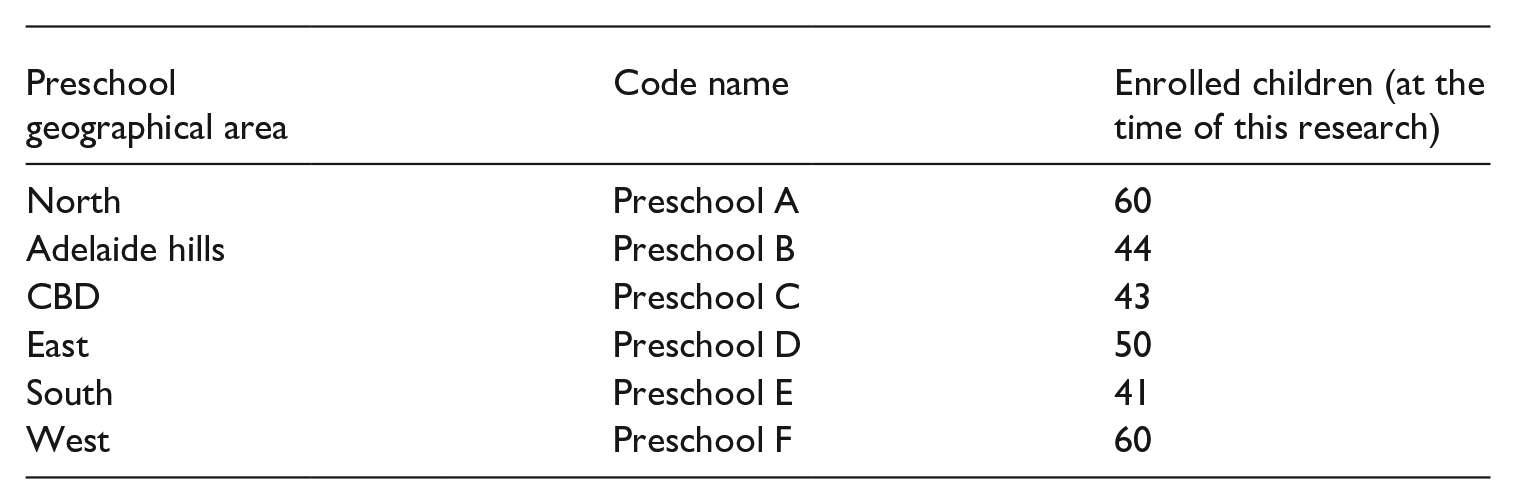
To limit the scope of the study, the selection of websites was determined by four criteria. These were: the number of students (between 40 and 60); the independence of site (i.e., stand-alone preschools or preschools that operated independently within a larger education complex were chosen, as opposed to those co-located in long-day centres); different ownership (i.e., each preschool had to be registered to a different provider); and lastly, different location (choosing six sites from different geographical areas). Following local statistical maps, Adelaide was divided into areas labelled as: north, east, south, west, hills and CBD and one site from each was selected. It was thought that these criteria would maximise the socio-economic and geographical breadth and depth of information. Last, to maintain anonymity, a simple A-F identification system was adopted to refer to the six preschools and their websites. The preschool will thus be labelled as follows:
Analytical methods
The research combined discursive and affective frameworks; however, the examination of the websites was also enriched by the seminal work by Kress and VanLeeuven (2006) on semiotic techniques. Accordingly, special attention was paid not only to the language and vocabulary used, but also to the visual elements present, their locations and the different functions they had within the webpage. Of particular interest was the way in which the ‘targeted manipulation’ (Kress and VanLeeuven, 2006) of all these elements contributed to create the conditions for precise discursive identities to be reinforced, and for specific affective flows to circulate among parents, in a way that strongly contributed to their decision-making mechanisms and choices.
Therefore, a choice was made to study the frequency and usage of certain words and statements, within a chosen groups of tabs. Based on both the recurrence of specific words and the context in which they appeared, the language was categorised in relation to broader, emerging themes. Consideration was given not only to what was written and how often, but also to how this was framed (whether explicitly or not). Importantly, the linguistic analysis was enriched by a feminist poststructuralist lens, in that particular attention was paid to elements such as the use of pronouns in the texts, as well as way in which boys and girls are positioned and constructed not only through textual but also through visual clues. Similarly, the way in which allusions to social and economic class featured indirectly through the manipulation of images played an important role in the investigation.
Specific consideration was also paid to element such as logo and photographs, as scholars have noted play a very important part in activating specific emotive responses and connections in the target public (Drew, 2013; Wardman et al., 2010; Wilkins, 2012). This happens, for example, by intentionally engaging customers of a specific type (adults or children, of different cultures, race and gender) through concepts such as valence and gaze (a specific, direct look to the target). Importantly, the semiotic portion of the analysis focused not only on the images, but also on how and where both the text and the photos were positioned, since a webpage’s set up and design follow a specific order (from top left to bottom right), which is never casual. Rather, the page is divided into specific sections, all of which have different and definite functions (Kress and VanLeeuven, 2006).
For example, in the case of this analysis, it was noted that elements such as the logos, institutional colours and accreditation markers designed to indicate notions of quality, leadership in the market, or excellence tend to be on the left-hand side. Kress and VanLeeuven (2006) explain that is due to the idea that all the elements wanting to portray familiarity, legitimacy or even authority tend to be positioned on the left side of the page. In contrast, components designed to introduce new knowledge and innovation, or those intended to establish difference and change are often found of the right side (Kress and VanLeeuven, 2006). The bottom of the page is often filled with elements designed to recall or evoke a specific identity – whether social or cultural, whereas elements whose aim is to call to mind fantasises, aspirations or ideals are often located on the top half of the page.
All these signifiers are designed and positioned within the webpage specifically to influence the target consumers to identify with, or dream of, a specific feature of the product or service for sale (Kress and VanLeeuven, 2006). In this analysis, for example, the Montessori’s ideals and ethos were often found at the top of the page, along with words suggesting certain values that parents should aspire to. Similarly, modality – which is the truth value of a statement and is often determined by the use of colour, while the saliency of specific elements (such as the logo) or particular words or aspects of the Montessori method is reinforced though the use of specific types of font, the size, colour and its position within the page. For example, often, the lower end (middle) of the market providers had brighter, more colourful and busier pictures, and often displayed large photos of their facilities. In contrast, the higher end providers tended to use more neutral palettes, focusing more on children faces and human subjects rather than on their wares and spaces (Maguire et al., 1999). The analysis revealed three main discursive themes, all strongly linked to neoliberal ideals and values. They are described below.
Results
Firstly, and importantly for this research, what became evident quickly was how every theme contributed to reinforcing explicit and idealised constructions of the child, which, arguably result in the establishment of specific affective environments, impacting on how parents interpret themselves, their responsibilities and their actions.
Theme 1: The neoliberal child as an independent and autonomous boy
Linguistically, the child was nearly always referred to as a he across all websites, and while there was the occasional photograph of girls or children of other races, the absence of any specific words relating to the female gender or diversity of race and class was important. Language that referred to specific capabilities deemed as valuable and desirable within neoliberal discourses was common across all six websites, particularly within the preschools’ philosophies and aims. At the same time, the analysis highlighted the absence of other values, arguably more humanistic or socially focussed, which perhaps do not align as much with neoliberal discourses. For example, most preschools promised to produce students, possessing vital qualities such as individuality, responsibility, freedom (of choice), concentration, self-discipline and confidence, all vital for good work ethic, a sense of achievement and future success, and markers of masculinity when compared with equally desirable characteristics denoted by words such as empathy, kindness, compassion, collaboration and so on. Quotes such as ‘we promise to develop the child’s initiative, independent choice, concentration and power of deliberation’, or were the most common across all the websites.
Interestingly, the websites also highlight the importance of instilling moral values in future leaders. However, these seem to take a lower degree of importance, featuring much less frequently and in a seemingly subordinate manner. Words such as honesty, tolerance, patience and kindness do not appear at all, albeit being arguably very desirable characteristics in a child, and language relating to team work, collaboration or cooperation only appear once or twice, and were co-located with the words skills, behaviours and qualities (Preschools C, E and F). In sum, the websites consistently focus on self-reliance and entrepreneurial skills as ideals to be equated with future success and happiness. This absence of social and/or human qualities is as important in the analysis as it legitimises the focus on individualism and autonomy, so fundamental in neoliberal discourses. As Wilson and Carlsen (2016) note, ‘an absence can also be a statement’ (p. 33).
This gendered version of children was evident also in the images, where the child was often implicitly presented as a white, middle-class, socially advantaged male. Whiteness and masculinity were interpreted and understood as ‘normal’ across the websites, and the absence of other images or words directly related to any type of diversity could arguably be, in itself, a technique to communicate what customer the preschools were aiming to attract. Like in the text, in most of the photos across the website, the neoliberal child is nearly always a boy, and when girls are present in the shots, they tend to either be working with a teacher, or in group. Further, they are often depicted engaging in tasks that are more commonly connected or associated with domestic chores (such as gardening, laundry or kitchen tasks). Affectively speaking, this reinforces the notion that some societal or moral expectations tend to stick more to certain bodies – female bodies – than others.
In sum, in line with dominant neoliberal discourses, the impression constructed through the websites examined is that future success for preschoolers can be guaranteed by choosing Montessori education (Gottschall and Saltmarsh, 2016), as the skills and personal qualities taught through this method/brand are promoted as essential commodities that ‘parent-customers’ can acquire on behalf of their children (Gottschall et al., 2010; Wardman et al., 2010). While it is oversimplistic to argue that advertising materials are the only influence on parental choice, this analysis provides proof that they certainly contribute towards the establishments of specific emotive environments promising parents to deliver specific attributes deemed important by dominant neoliberal discourses. Dominant discursive norms, therefore, allow for the creation of emotional assemblages, within which advertising works by moving some parents to invest in – and choose – specific brands of preschool education.
Theme 2: The boy as a worker and the girl as a domestic carer
The second theme that emerged is linked to the fact that the concept of play was completely absent across all the websites examined. Not only did the notion of play-based pedagogy not appear at all in the websites analysed; the only two times that the word play was mentioned, was in contexts which opposed it critically to the idea of children’s work. For example, on the website of Preschool B, we can find the statement ‘such experience is not just play; it is important work he must do to grow’ (emphasis added), and as can be seen in the following phrase on website A ‘the children work with the materials, they do not play with the toys!’ (Preschool A), which juxtaposes the concepts of ‘work and materials’ to those of ‘play and toys’, clearly favouring the former.
Once again, this dichotomy is evident also in visual terms. When portrayed inside, the children are always using the specific Montessori materials, either aimed at promoting either academic learning (in which case, the photographs feature mostly boys) or at learning life-skills/domestic chores such as cleaning, cooking, or doing laundry (portrayed predominantly through girls using little domestic utensils). This is reflective of the focus on work rather than play in current neoliberal education, where children are prepared to be future efficient workers. Similarly, when the (predominantly) boys are ‘working outside’, they are either building with masculine tools or working in little sheds. This is a stark contrast to the use of toys such as, for example, dolls, balls, tricycles, building blocks or cars, which they might commonly use in child care centres.
Images of focused children juxtaposed with captions that reiterate success are present across all the websites. The children are all depicted as so heavily engaged in highly academic activities (like mathematics, sciences, geography, logical and abstract thinking) and displaying a strong sense of both self-control and self-gratification, which persuasively convinces viewers that by choosing a Montessori preschool their children will achieve happiness and satisfaction. Visually, this is echoed in the close-up of the children looking either very happy and smiling, or highly concentrated and displaying an intense air of satisfaction.
This is interesting, seeing that, while it is true that, in Italian, Dr. Montessori referred to the children’s learning as work (il lavoro), she did not intend work as ‘an effort done in order to achieve a result’ or ‘as duties performed regularly for wages or salary’ (Perica, 2018). Rather, she used the term to refer to a child’s ‘useful activity’ (attivita’ utile), ‘a freely chosen activity or task within a learning environment, particularly one requiring sustained effort or continuous repeated operations’ (Lupi, 2016; Ruggieri, 2017). Dr. Montessori was highly respectful of children’s play, which is why she preferred to use the word ‘work’ when referring to it. Her decision stemmed from her desire to show the respect owed to a child’s effort and motivation during his/her process of growth and development (Montessori, 1991; Montessori, 2013).
In contrast, it could be argued that, by being juxtaposed to the notion of play, the term work has been (mis)used in the websites analysed, as if to convey to potential customers a feeling of superiority in an attempt to gain a marketing advantage. This could align with what some scholars have defined ‘a creeping schoolification of ECE’ (Stover, 2013), whereby the notion of learning-through-play is being replaced by concepts such as education, work and development, which are closely linked to values underpinning neoliberal theories of school readiness. Some scholars have argued that this shift in language (and practice) is putting children in a constant binary with adults (Gould and Matapo, 2016: 56) and arguably contesting some dominant discourses and social practices in ECE. It is perhaps worth questioning, then, whether the usage of the term work in the websites analysed in this study is a genuine attempt to stay true to Montessori’s language (tainted, perhaps, by a case of (mis)translation), or whether it is part of a larger neoliberal discourse, aimed at constructing particular versions of students and recruiting ‘good parents’ who might feel compelled to ensure that their children are school-ready from a very young age. This leads to the last theme, namely the schoolification of early childhood which is discussed below.
Theme 3: The schoolification of ECE: Issues with the purpose of ECE
The perceived importance of school readiness was the third dominant discursive theme highlighted by this analysis. This is particularly interesting because within the ECE literature, one of the common criticisms of neoliberalism is that, the fundamental values of this economic theory, sit in stark contrast to those ECE values centred on the nurturing and caring aspects of early childhood (Gould and Matapo, 2016: 52). In particular, it is argued that neoliberal changes have negatively reshaped the political landscape of early childhood politics (May, 2009: 276), leading to the undesirable adoption of school-like practices and values in early childhood institutions (Bradbury, 2018).
A concern in the literature is that such focus on schoolification and on preparing children for school has happened at the expense of play (Haggerty and Alcock, 2016). It is argued that re-positionings of children as economically productive resources has resulted in pressures to assist them to ‘become school-ready from birth, despite the fact that school attendance is five to six years away’ (Nichols et al., 2009). These pressures are part of the affective flows which feature in some of the websites, which exploit parents’ fears of ‘leaving their children at a disadvantage’, stating that ‘school-readiness has received a lot of focus among parents recently, and with good reason – as we know that children who start school behind, tend to stay behind’ (Preschool D). Statements like these are designed to tap into parents’ anxieties, and contribute to affect moving bodies to make certain choices. For example, Preschool E promises to ‘help children become school-ready through strong emphases on emerging literacy and numeracy skills and support the children in their acquisition of the skills they will need in their formal education’.
Terms such as ‘curriculum’, ‘subjects’, ‘spelling’, ‘grammar’ and ‘abstract reasoning’ were present in most websites, as were the notions of literacy and numeracy, which were prevalent, not only through text but also in images. Five out of the six websites contained statements about supporting children in their development of literacy and numeracy skills and preparing children in these ‘core areas’ necessary for their transition to formal school. Similarly, Preschool A offers ‘a curriculum with a strong emphasis on emerging literacy and numeracy skills as part of the school transitioning program’ (Preschool A), and Preschool E assured a ‘strong emphasis on emerging literacy and numeracy skills, in order to support the children in their acquisition of the skills they will need in their formal education’.
Similarly, schoolification was visually perceptible, both through pictures of very neat, prosperous-looking classroom environments, furnished with child-sized tables and chairs, and featuring various learning materials, and through the fact, in four out of six websites, the children wear a uniform (entailing a T-shirt and some shorts, which, again, could denote a gendered preference). Arguably, these elements are preparing the children for a future in private schooling.
School readiness is also ‘exploited’ in affective terms, with messages designed to tap into parents’ fears and insecurities that their children will not be cared for as well as at home. While the shots of school-like environments evoke images of typically academic environments, it is also apparent that most preschools also want to portray their setting as a ‘home’, rather than ‘only a preschool’, and they do so by juxtaposing such shots with words and pictures designed to produce particular emotions (such as care, comfort, safety) in viewers. For example, some preschools’ exteriors are represented through photos of lovely, old houses (preschools C and F), often surrounded by manicured gardens, white porches, and beautiful fences (preschools A, D and E). Such images are designed to remind people of welcoming, domestic environments, rather than of educational institutions.
This dichotomy is worth mentioning as it links in with arguments put forward by Henderson (2017), who explains that humans build dwellings to develop and enact certain localised activities. She notes that, historically, early childhood and schools have built different dwellings and respective rooms, to reflect different theoretical perspectives and educational approaches based on distinctive sets of principles and practices (p. 466). However, with the increasing schoolification of ECE, educators and providers tend to constantly referral to ‘the classroom’. This was indeed the case in this analysis, which highlighted the common use of words like classroom, subject and curriculum.
The last part of the paper discusses how by reinforcing such idealised representations of children and learning, advertising messages contained in the websites contribute to the creation of specific affective flows which impact on how parents come to construe themselves and their actions, as the individuals responsible for making careful and accountable choices regarding their children preschool education.
Discussion: The classed and gendered implications of choice
The analysis showed that, through their online promotional texts, Montessori marketing experts create specific identities of children, both in academic and personal terms. These are often (if not always) reflective of neoliberal gendered and classed values. In the websites, preschools position themselves as providers of schooling skills that will meet presumed parental expectations of independent, autonomous, future leaders. This, however, is done alongside a cleverly constructed reassurance for parents that their children will be in very well-resourced ‘homelike environments’, where they will be safe and protected while learning the skills to be become ‘school ready’ (Wardman et al., 2010: 250). This dominance of neoliberal values was also evident when investigating the pictures in the website. Predominantly, the children depicted are boys, mostly white (90%), and able-bodied, often photographed while completing tasks independently and expressing a sense of self-accomplishment and satisfaction.
Arguably, then, the use of specific images, texts and messages has a precise aim, which is to discursively produce what in Foucauldian terms is ‘specific truths that systematically form the objects about which they speak’ (Foucault, 1969: 49; 135–140). As already found by scholars such as Gottschall et al. (2010), Drew et al. (2016) and Wardman et al. (2010), the photo-realism used in all digital multimodal texts normalises and naturalises activities as real, shifting focus away from their function as constructed and idealised (Wardman et al., 2010). Such materials offer a promise of future success and happiness to prospective parents, reinforcing neoliberal arguments and discourses that, by selecting a private, Montessori preschool, parents are choosing optimal outcomes for their children (Davies and Bansel, 2007). In addition, they are also ensuring the instillation of specific desirable characteristics, that in today’s education market, can only be acquired through the appropriate educational choice (Gottschall and Saltmarsh, 2016: 6).
Every word, every promise, every example was arguably studied and designed to market the Montessori method, and subliminally touch a chord with those parents who recognise themselves as (or at least aim to be) ‘proper, informed, responsible parent’. Parents are told that they have the power, freedom and responsibility to play the crucial role of ‘consumer of early childhood education services’ on behalf of their children. Such a role entails making vital decisions between different institutions based on what skills and characteristics they promise to teach and instil in children; characteristics which are deemed particularly desirable for future success in a neoliberal context.
Interestingly, the Montessori parent was never mentioned explicitly in online texts; it is an invisible subject, a discursive figure who, however, forms an essential backdrop to all the websites. And while the target audience might be a neutral ‘middle-class parent’ (Campbell et al., 2009), who ‘are held responsible for making [smart] consumer choices to maximise their opportunities and those of their families’ (Sellar et al., 2011: 38), evidence suggests that the messages were, in fact, ‘manipulated to reach mostly mothers’. As I discuss elsewhere, the use of highly affective language and images in the websites clearly suggest a focus on the emotional affective power of branding (Bertotti, 2022). The language and pictures utilised here were intended to appeal to the more emotional and vulnerable side of mothers, by tapping more directly into their roles as loving carers, as well as their gendered social capital (Proctor and Aitchinson, 2015).
Arguably, the aim of such emotive language and photos was to reassure mothers that, while choosing Montessori would ensure that the academic development of their children, their children would also be nurtured and loved in a home-like, safe and nurturing environment. More than half of the websites analysed utilise these visual shots to transmit a sense of ‘warm hospitality’, and couple them with words – such as nurturing, caring and loving – designed to promote the idea that children would not just be in a preschool setting, they would be in a ‘home-like environment’ (preschools C and F). This is particularly evident in websites C and F, where children enjoy a ‘caring, nurturing environment’, and are promised to feel like they are ‘not part of a franchise, they are part of a family’ (Preschool C). Such messages would certainly appeal more to mothers or female carers, who would possibly struggle already with emotions such as guilt and/or anxiety when leaving their children in the care of others. Similarly, by ‘exploiting the anxiety’ of some parents to ‘make the right choice’ or ‘be the good mother’, some marketing messages were designed specifically to create a sense of urgency in parents, advising them to act swiftly. In sum, what emerged from this analysis reinforced the onus on some mothers to be responsible and informed customers (Aitchison, 2006, 2010; Proctor and Aitchinson, 2015; Proctor and Weaver, 2020; Reay, 1998a, 1998b; Reay, 2005b), whose responsibility to ensure the best educational opportunities for their children is not only paramount for their cognitive development (Smyth, 2014; Wall, 2014) and individual success, but also crucial for the welfare of their country.
Conclusion
The aim of this paper was to explore the way in which marketing regimes associated with neoliberal models of education contribute to the creation of specific environments, which function as fertile grounds for particular classed, gendered and raced discursive norms and affective practices. The exploration took place through a semiotic, discursive and affective analysis of six Montessori preschool websites, and revealed the close relationship between the Montessori brand, its defining features, and the way in which neoliberal discourses of choice are upheld and reinforced through the ‘targeted manipulation’ of specific text and images.
Three distinct themes emerged, which intensify not only the idealised representations of specific subjectivities, but also contribute to the creation of specific affective flows which circulate within some collectives of mothers, thereby reinforcing the pressure on parents to contribute to the prosperity and success of the nation, by choosing the best educational opportunities for their children. Through the use of an affective-discursive lens, therefore, the paper allowed us to advance current understandings of the relationships between the macro-level affective environment, the micro-level mechanisms of parental choice-making and the various cultural and economic forces which characterise the contemporary preschool market in Australia.
Footnotes
Declaration of conflicting interests
The author declared no potential conflicts of interest with respect to the research, authorship, and/or publication of this article.
Funding
The author received no financial support for the research, authorship, and/or publication of this article.