



Abstract
This paper extends analysis of the ‘assessment receipt’ to include talk and embodied interaction during ‘performance responses’ in music masterclass interactions. By grounding the analysis in questions of performance completion and audience applause onset, it details the utility of variously position assessment tokens, during performance, before applause, during applause and after applause. These different verbal assessment positions afford, in different ways, instructional interaction by situating the instructor as next relevant speaker. They also help coordinate performance completions and audience applause onset. The paper also identifies the ‘receipt assessment’, which reverses the component ordering of the earlier phenomenon. The paper is relevant to those studying performance as interaction and extends and deepens the growing insights into musical instructional settings.
Keywords
Introduction
An earlier book chapter Reed (2019) identified an action on the part of music instructors (‘masters’) in music masterclasses which claims the conversational floor after an initial performance by a student. The ‘assessment receipt’ rested upon the issuing of a verbal utterance during audience applause following a performance. In combination with a ‘receipt token’, the verbal assessment enabled the master to move from the role of audience member to instructor by positioning them as next relevant speaker and claim the interactional floor. Forms of instructional management and critical assessment were licenced through pivot discourse tokens, such as ‘so’ ‘right’ and ‘okay’. These verbal pivots enabled a move to ‘first business’ and the pursuit of an instructional project (Reed and Reed, 2014).
This paper moves the focus to the behaviours of all relevant parties in instructional transitions. Through Conversation Analysis (CA) it situates the assessment receipt within a broader frame of performance and audience interaction under the rubric of ‘performance responses’. Behaviours are not limited to talk and incorporate both applause and the body movements of performers, accompanists, and masters. The analytic question becomes, ‘How is the transition between performance and next activity collectively achieved in music masterclasses?’
To ground the analysis in the interactional matters of performance responses, two foundational issues are detailed in the first half of the paper: performance completion and applause onset. The first addresses how a performance is understood to have come to an end. The second addresses the issue of how a group of people collectively achieve the embodied action of applause.
The focus in the second half of the paper is on the use of assessment tokens by masters and students in and around performance completion and applause onset. By noting the position of assessment tokens after, during, and before applause onset the analysis helps situate and develop the understanding of the aforementioned ‘assessment receipt’ action. An alternative formulation of ‘receipt assessment’ is identified in relation to performance interruptions.
Background
The focus of this paper is on performance responses in music masterclass instruction. This activity includes full performances by near-professional musicians, therefore a necessary starting point is the study of musical performances in the broader sense.
Master classes play an important part in the curricula of classical music tuition in European conservatoires and universities. The format generally consists of a series of public one-on-one coaching sessions in front of an audience of peers. The coaching is undertaken by an expert performer – colloquially called a master – hence the instruction is known as a masterclass. The opening of each coaching session routinely involves the student entering the performance space, with the master positioned either offstage or seated visibly by the side of performance space. Students may give a brief verbal introduction of the piece or may proceed immediately to perform it in front of the master and the attendant audience. After a full performance of the piece and audience response, the interaction turns to guided tuition, in which instruction and performance of elements of the piece are combined, with the emphasis remaining on the performative elements.
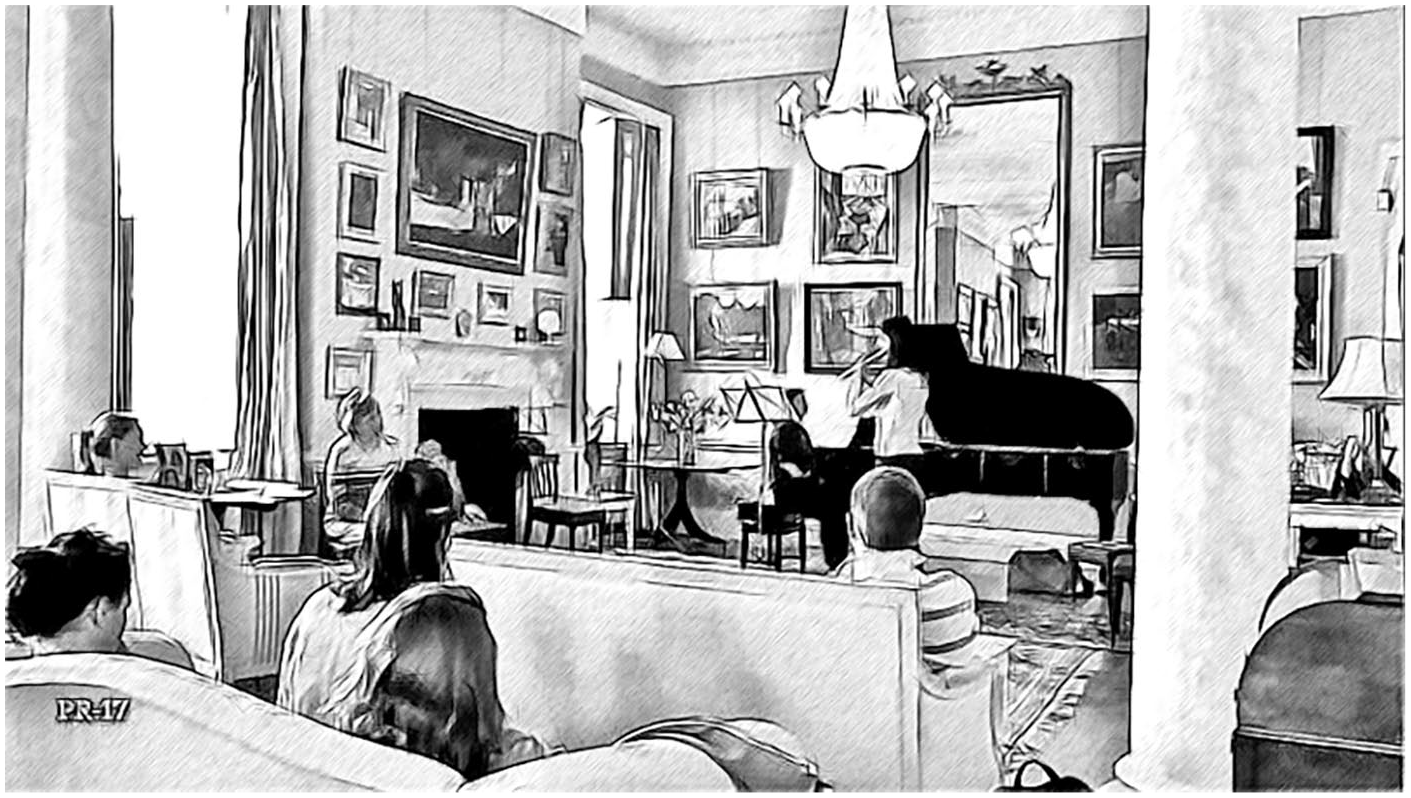
A typical spatial arrangement of a masterclass can be seen in Image 1, which shows an instrumentalist accompanied by a pianist watched by a seated master to the left of the performers. The audience members are other students, other masters, and other people (such as the researcher). In some instances, the masterclass occurs in a theatrical space and the audience is made up of members of the public.
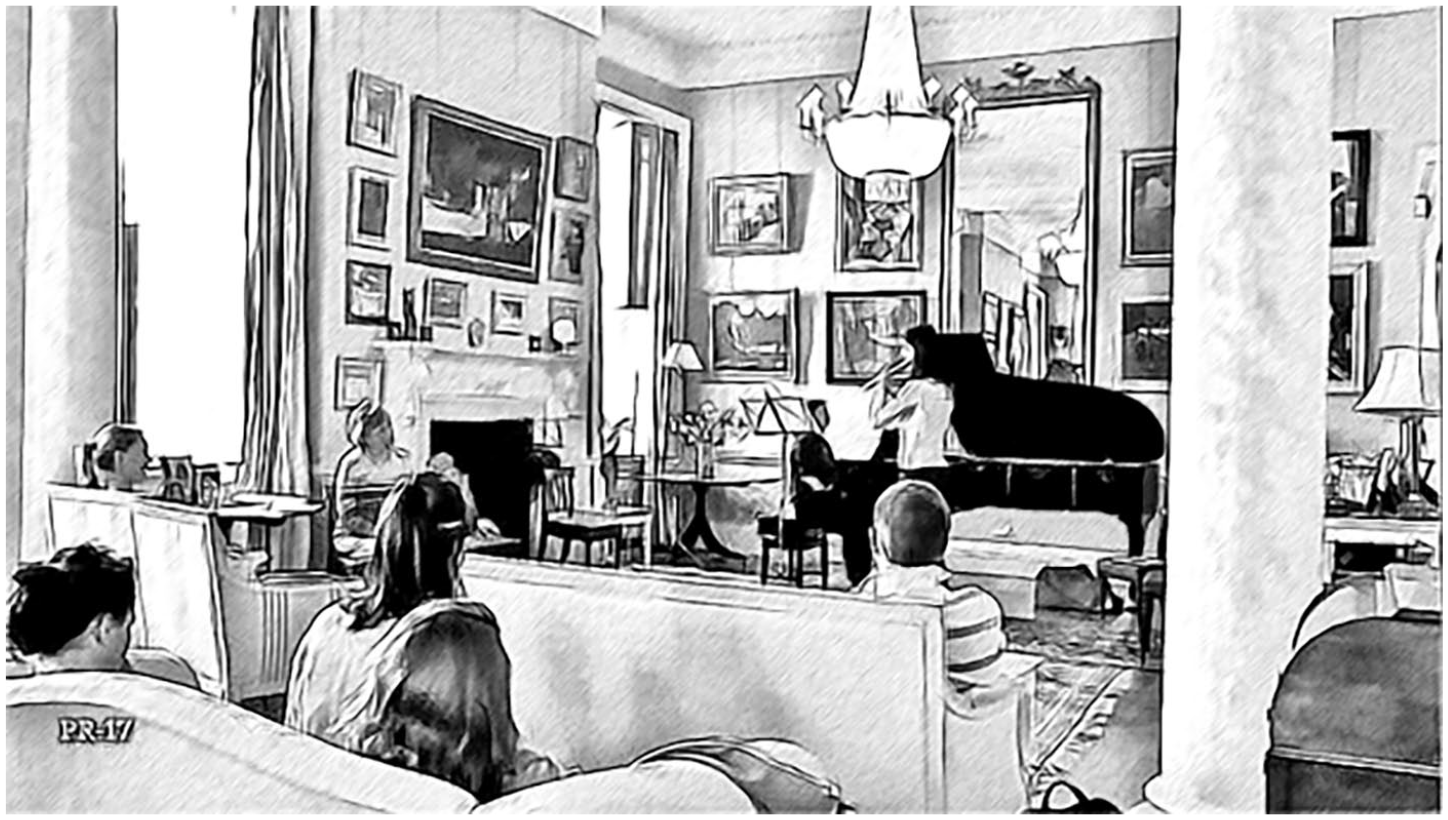
The music masterclass.
It is notable that throughout his discussion of performance as a social activity and invocation of Erving Goffman, the creator of the Performance Studies approach Richard Schechner does not contend with performance as an action-in-interaction (Schechner, 1988, 2006). That is, he does not ask how ‘a performance’ is formed in relation to ongoing activities in sequence with other activities. Instead, ‘performance’ is primarily understood as an aesthetic entity, one that is judged in terms of its ability to engage an audience. While audience applause is described as a ‘response’ to the performance (O’Connell and Kowal, 2008), it is framed in terms of ‘concert etiquette’ (Ross, 2010). There is an assumption that applause is simply a normatively established evaluation (Garber, 2013), rather than a sequentially achieved activity.
Similarly, silence is cast as an issue of disciplined emotional expression during a performance (Kania, 2010; O’Connell and Kowal, 2008), ‘All pianists want applause, but quiet attention is the true tribute’ (Rosen, 2002: 127), and as a mark of quality after the performance (Judkins, 1997). The latter is aided by the performers themselves, ‘deceleration of rhythm and decreasing loudness of sounds at the end of a performance may not merely fade into silence but be projected into a profounder silence by continued plucking motions for visual appearance after actual plucking has ceased. Western anxiety cannot restrain itself from breaking (rudely) into applause; but the longer the pause before applause, the greater the quiescent effect, the achievement of the artist, and the appreciation of the audience’ (Bahm, 1965, as quoted in Saville-Troike, 1985: 8).
Therefore, while there is undoubtedly a gap in the performance literature there are also hints of talk and embodied interaction that implicate interaction literature (Healey et al., 2022).
The classical musical piece includes cadences – ‘a melodic or harmonic configuration that creates a sense of resolution, finality or pause’ (Randel, 1999: 105) – to indicate (performance) turn final phrasing. This implies that the performance is a (pre-)organised activity, and that this organisation provides ‘cues’ for when the performance is about to end. In interactional terms, it could be said that applause occurs at the end of a self-contained performance-action sequence (see Szczepek Reed et al., 2013) – ‘the performance’. Yet, there are complicating factors. One complication is that applause does not always follow immediately upon musical cessation. There is often a ‘pause’ before applause.
According to Ross (2010), one way that the timing of the audience response is managed is through the conductor holding the baton in place after a piece has been played. Audience members perhaps learn to wait on the conductor before applauding. Another partial answer comes from instances of verbal cheering or verbal assessment (Heim, 2015) produced during the performance or immediately after it. These pre-empt collective activity.
The achievement of performance endings has been the topic of investigation in improvisational forms of music, such as jazz (Sawyer, 1996). This centres upon the ‘emergent’ nature of musical performance (as creative exercise) in relation to genre specific structuring elements such as the musical score. One notable aspect is the differences observed between music genres and traditions. For example, Haviland (2011) compares traditional ‘aural’ music, a classical quartet, and a jazz ensemble in relation to forms of improvisation. The endings of pieces are differently situated in relation to the structuring practices of each format. Haviland details the way comparative instances rely on varying spatial arrangements that enable different forms of coordination. Black (2008) formalises the achievement of performance endings in jazz performance as a cultural-specific understanding of ‘listening’ to the other (as both aural and visual monitoring). In combination with conventions such as the music ‘tag’ (a short repeated musical phase) this enables the performers to negotiate and achieve an ending to a performance.
Unlike improvisational musical styles, such as jazz, a classical music ‘performance’ could be seen to be defined by a written score that which prescribes a limited set of musical notes. 1 However, this paper takes ‘a performance’ to mean the combination of a set of vocal and embodied activities. This includes singing, gesturing, breathing, gazing, and the like. In short, a performance is defined here as a multimodal gestalt or action project (Robinson, 2013). It may be shaped and influenced by the score, but it is not encompassed by it.
Achieving applause
Other helpful literature comes from related interaction studies. Here, research into applause has centred upon the rhetorical structuring of political oratory and the manner in which a speaker invites audience members to respond (Atkinson, 1984; Bull, 2006; Bull and Wells, 2002). It has therefore been concerned with applause as response to talk (rather than a theatrical or musical performance).
There has been some research into the emergence of applause as interaction between audience members in an early paper on audience responses Clayman (1993). This is premised upon the difficulties and potential dangers of coordinating collective activity. Clayman (1993) situates responses such as applause and booing in relation to the classical conformity studies in psychology of Asch. Quoting Heritage and Greatbatch (1986), he notes that the ‘response initiation problem’ has ‘both benefits and costs’ (p. 111). The costs include ‘social isolation’ and embarrassment should it not come off, while the benefits are seen in the collective agreement about value or worth.
For Clayman, there is a distinction to be had between ‘independent decision making’ and ‘mutual monitoring’. Independent decision making aligns with the empirical evidence that ‘most applause episodes begin immediately after or just before the completion of a focal assertion by a speaker’ (p. 113). This results in an initial ‘burst’ of collective applause and is dependent on speaker-audience interaction. Mutual monitoring, on the other hand, indicates a progressive realisation of collective activity and is characterised by a ‘staggered’ onset of applause, wherein ‘the initial reactions of a few audience members prompts others to respond’ (Heritage and Greatbatch, 1986).
As with the point made by Heim (2015) earlier, mutual monitoring potentially pre-empts the individual decision making of others, ‘Individuals can monitor for behaviors that indicate a predisposition to respond in a given way (e.g. widespread nodding, murmurs of “yeah,” or appreciative laughter may be taken as evidence of a willingness to clap), behaviors that are leading up to a particular response (e.g. hands rising prior to clapping), or behaviors that constitute the actual beginning of a response (e.g. the first few claps)’ (p. 112).
While seating arrangements largely preclude direct visual monitoring, audible cues are available. In addition, the action of ‘gesture preparation’ in relation to an applause onset may provide visual access to audience member’s upcoming embodied actions.
Studies of applause in response to talk in the context of political oratory emphasises the ‘fit’ of applause-as-collective-action to individually produced speech. In relation to ‘a performance’ this becomes more problematic because the performance activity may be collectively produced by a group of performers. Therefore, the interaction between performers as they come to a performance ending is important. To capture this, the term ‘performance completion’ is utilised below.
Masterclass instruction
One area that has received sustained interactional attention is the music masterclass (Haddon et al., 2012; Haviland, 2007; Reed, 2015, 2020; Reed and Reed, 2014; Veronesi, 2014). In such instructional settings individual verbalised affiliative or positive responses sit alongside embodied collective activity of applause.
The music masterclass is a form of institutional interaction (Drew and Heritage, 1992) in which two different participation frameworks are operational: performance and instruction. Each framework implicates ‘differential participation rights’ (McHoul, 1978: 183), and there is an expected and anticipated ordering of phases of activities. Yet the behaviour is contingent and emergent (Deppermann et al., 2010).
A key element of performance-instruction transition is evaluation, accomplished through assessment actions. In the CA literature there is a history of interest in assessments in everyday conversation. However, there is little work in relation to musical performance assessment, either verbally or through (embodied) applause, and how this functions in relation to the interactional project of performance instruction.
Once a transition between the first full performance and instructional interaction has occurred, participants move between the two frameworks repeatedly, with re-performance of segments of the total piece sitting alongside instruction and evaluation in a sequential structure.
Assessments in everyday and institutional talk
Pomerantz (1984) lays the foundation for an appreciation of assessments as composed of actions such as compliments, complaints, self-deprecations and the like, and so-called second assessments as tied sequentially to the first assessment. A key dynamic of the second assessment is the common recipiency of a referent, and a preference for positive assessment (except when the initial action requires disagreement, such as with a self-deprecation). Pomerantz (1984) saw assessment as occurring in three different locations: (i) during participation in joint activities; (ii) in reports of joint activities, (iii) in the next turn to other assessments in the so-called ‘second assessment’ position. Her work focused primarily on this last location (Lindström and Mondada, 2009).
Assessments are key to instructional interactions, in the classroom and elsewhere. The IRE (Initiation, Response, Evaluation) (Mehan, 1979), or IRF (Initiation, Response, Feedback) (Sinclair and Coulthard, 1975) sequence structure is key to these forms of interaction in relation to correction and repair and student learning. The sequence contains an assessment-as-evaluation in the third position (see Szczepek Reed et al. (2013) for a discussion of different instances). Assessments may also be utilised to display closure in story telling episodes, and in the move from one participation framework to another (Goodwin and Goodwin, 1987). In Goodwin & Goodwin’s terms these assessments may range from ‘fully referential and predicational’ to ‘desemanticized’ (p. 24). An example of the latter is revealed by Mondada (2009) who notes how an assessment can function as a ‘receipt token’ in situations when they show a ‘shift of knowledge’ or epistemic access.
Antaki et al. (2000) identify ‘high-grade’ assessments (‘brilliant’ ‘jolly good’) in interview scenarios, and note their position within a schematic sequence: ‘[answer receipt]+[“ok” or “right” etc]+[high-grade assessment]+[(move to)next item]’ (p. 239), as well as their role in orienting to action progression rather than informational content. Antaki et al. (2000) note, ‘One set of discoveries is that when people use assessments at the start of their turns, they do so in an orderly way, displaying their understanding of what has come before, and strongly implying how the conversation will proceed. . . [H]igh-grade assessment sequences . . . claim a closure on the previous material as having been, in the circumstances, successfully completed as a section in a segmented whole’ (p. 4).
So while general performances have only recently been approached through an interactional frame (Healey et al., 2022), the performance literature hints at issues and ideas that have at times been addressed in other contexts. The key components of these analyses is the place of ‘assessments’, either produced through speech or gesture. This focus is helpful when detailing the analytic instances in the following analysis.
Data and methods
Pursuit of the analytic question entailed close examination, transcription, and description of 49 performance responses identified in around 40 hours of masterclass video material. These materials are a combination of: (1) recordings of masterclasses for semi-professional performers as part of the Live Music Now series of training events (www.livemusicnow.org.uk); (2) recordings of university-based teaching interactions in a music department; and (3) A single instances of professional level masterclass recordings uploaded to the video sharing site Youtube. The latter was used to supplement the researcher-collected material because it took place in theatrical spaces with a large audience. The ‘audience’ in the first two instances were fellow performers, alongside faculty staff and fellow masters.
All participants in the recorded materials, including the audience, gave consent to be recorded, and for the recordings to be used for academic research and publication. All names and places have been anonymised. The transcription used an adapted form of the Jeffersonian system (see Appendix).
Analysis
Performance completion
A musical performance may seem to have a definite ending – the performer(s) stops performing and the audience applauds. In practice, however, precise ‘performance completion’ relies upon a combination of factors, including the embodied posture of the performer and ancillary factors such as the resonant tone of the played instrument. In classical music, performers are taught to ‘pause’ and audience members wait for performance completion by enduring extended periods of silence.
Performance completion is a useful term because it denotes performance finality through action and interaction. A performance completion is achieved collectively, in sequence. Only once performance completion is achieved can any next action occur. Initially, this places control in the hands of the person, or persons, in the performance role. But completion may also entail performance interruption on the part of the instructor. This second form of performance completion only occurs when the performance is already part of the instructional project (see later); that is, it occurs as part of a second or subsequent performance and not the ‘first performance’ of a piece in a masterclass setting. There is then a basic distinction to be had between ‘first performance’ and ‘instructional performances’. Primary attention will be paid to first performances and their completion.
One way to answer the question of performance endings is to simply say that ‘a performance makes relevant a next action, that of applause’. Here the assumption is that performance and applause exist as a form of adjacency pair, wherein one action (performing) makes relevant a next action (applause). The analysis that follows shows this to be a naive and shallow assumption. Indeed, it could be said that performance endings are uncertain. Performance endings, and therefore performances per se, do not have a definite duration and ‘shape’ and as a consequence exactly when a performance ends is open to uncertainty and negotiation. This paper uses the terminology of performance completion to address this uncertainty and embraces the negotiated achievement of performance endings.
Performer allocation
One answer to the question of next-action coordination comes in the form of performer allocation of next action through embodied acknowledgement. In the following minimal example (Instance 1), the playing of the instrument ends, but is then followed by embodied action on the part of the performer.
Instance 1
During the performance the performer’s gaze is ‘unfocussed’ and her head is turned towards the instrument in front of her. She sways her head from side to side as she plays, at times closing her eyes (not transcribed) (see Image 2).
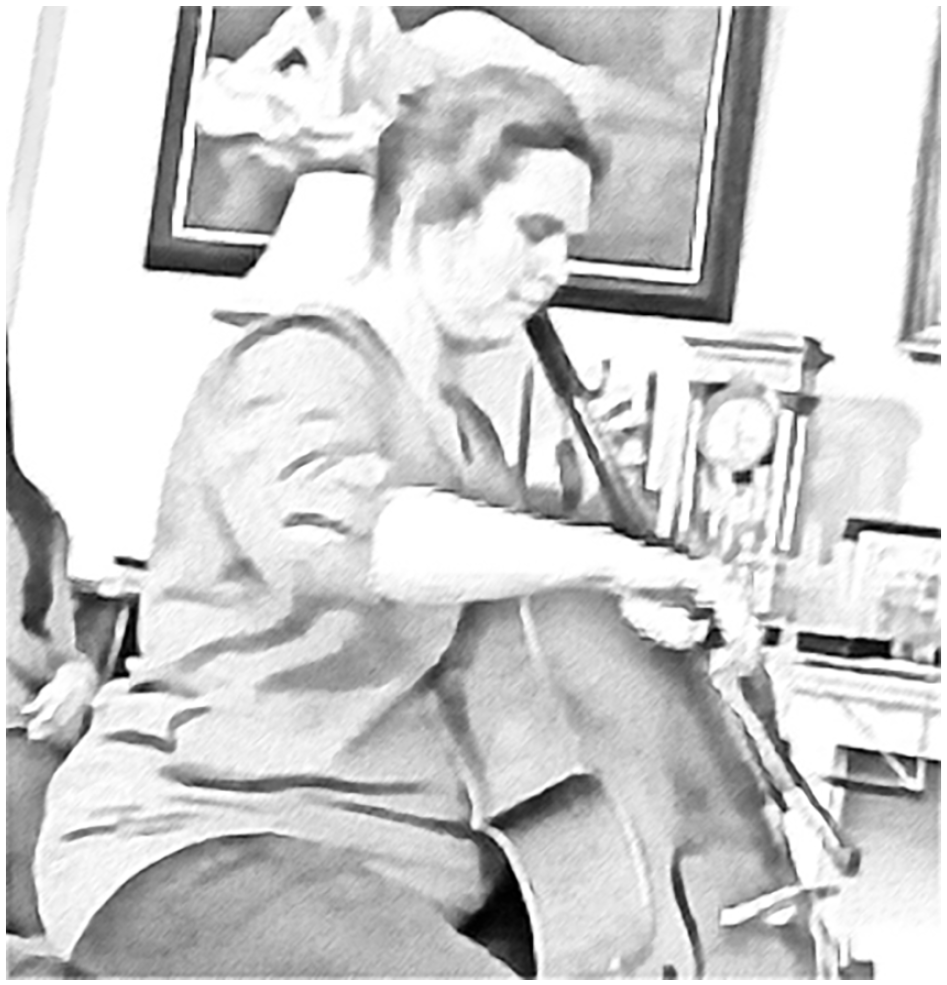
Cello player 1.
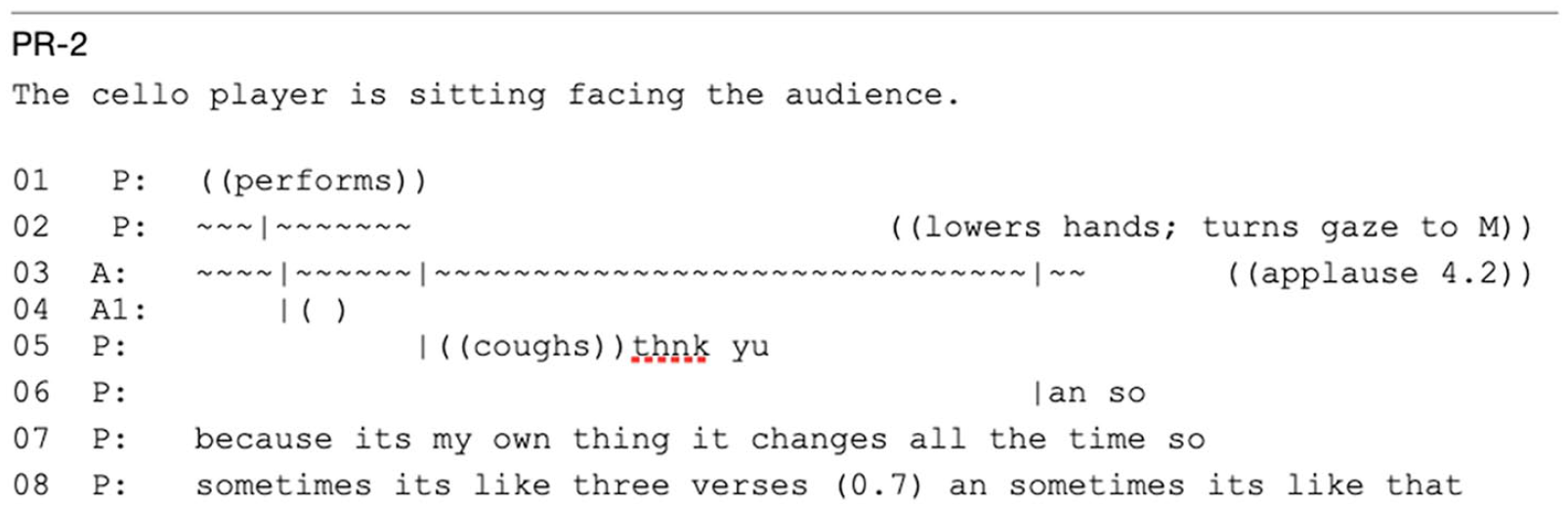
After playing the last note of the piece (line 01), the performer lowers both hands (one holding the bow, the other from the neck of the cello) for 0.3 of a second and then turns her head slowly upwards towards a person off-screen for 0.7 (possibly the master) (line 02).
Only once the performer has made eye-contact (or attained a definite eye-line with audience members) does the applause begin (line 03, Image 3).
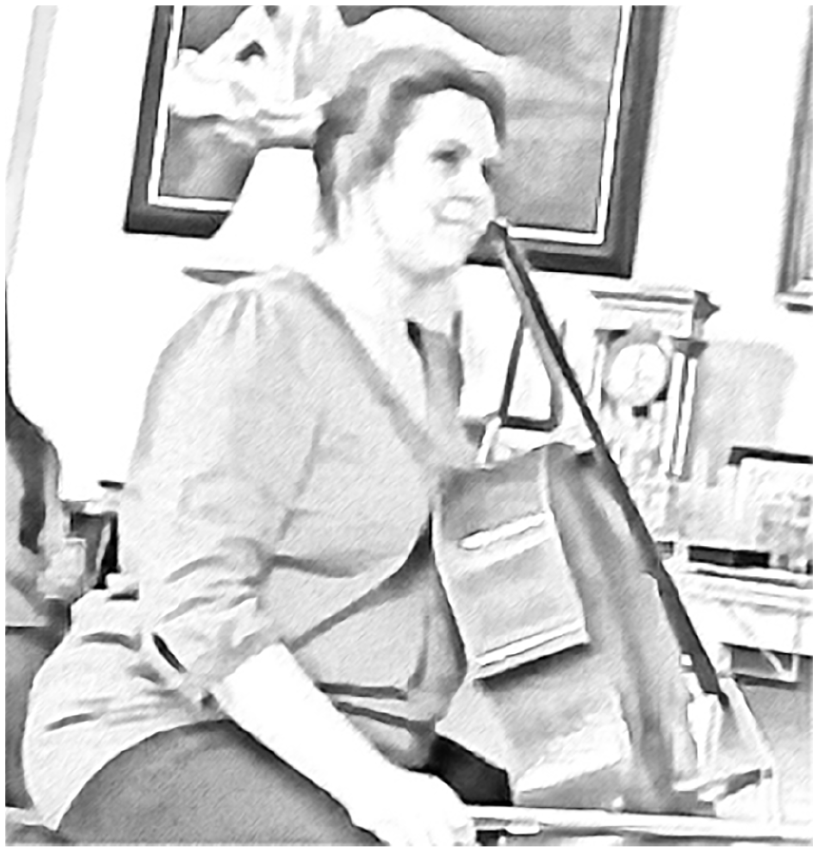
Cello player 2.
Performer allocation of next turn is also seen in Instance 2. Here, there is more than one performer. There is a ‘main performer’ – playing a clarinet (P1) – and an accompanist (PA). The main performer completes the playing of the piece and then turns his gaze towards the piano accompanist during a 2 second pause (lines 02–04). Only once he turns his gaze to the audience members (line 05) does the applause begin (line 06). One of two masters (M1) then turns towards a second master (M2) (line 07) to indicate that they should respond. 2
Instance 2
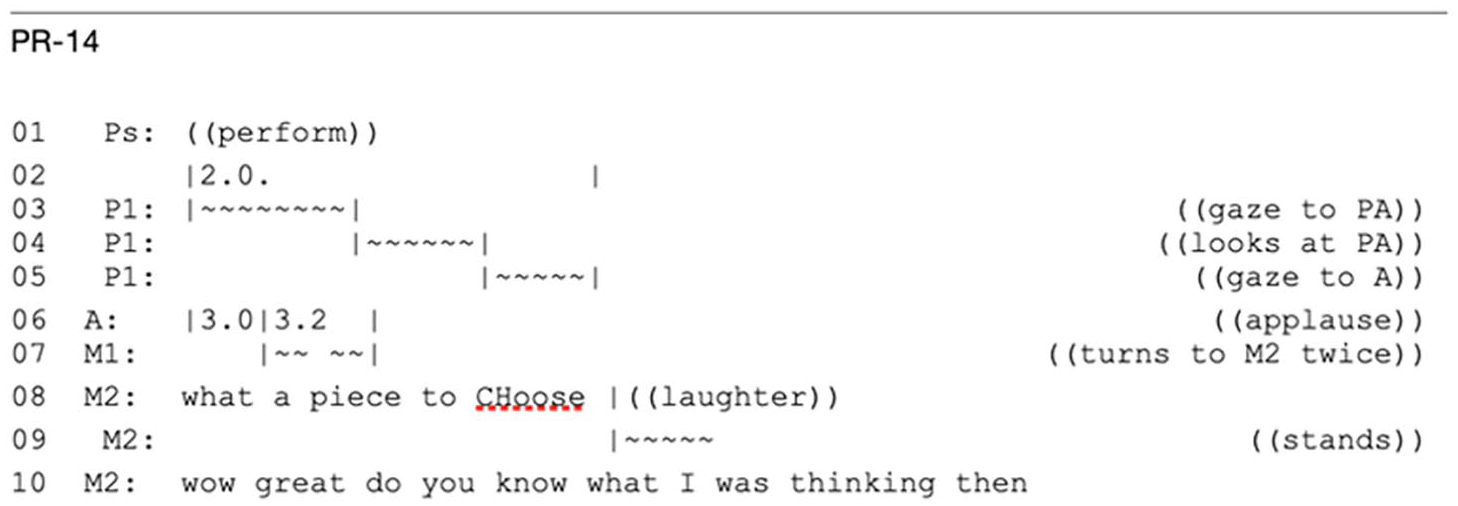
These two instances speak to the allocation of next action by the main performer to audience members. What these instances open up is a ‘space’ in which any next action – including collective audience response – is an achievement. It shows a willingness to wait, on the part of attendant actors, for an appropriate moment to respond.
Hearable termination of sound
A ‘performance’ is accomplished by single or group of performers. Even though one of those performers might be the main performer (a solo instrumentalist or singer, for example) the total performance is an amalgamation of every element. This includes the ‘accompanying’ music. Hence, while the main performer may have completed playing or singing, the performance itself may continue through an accompanying ‘playout’ or in the resonant sounds of the accompanying instruments.
Instance 3
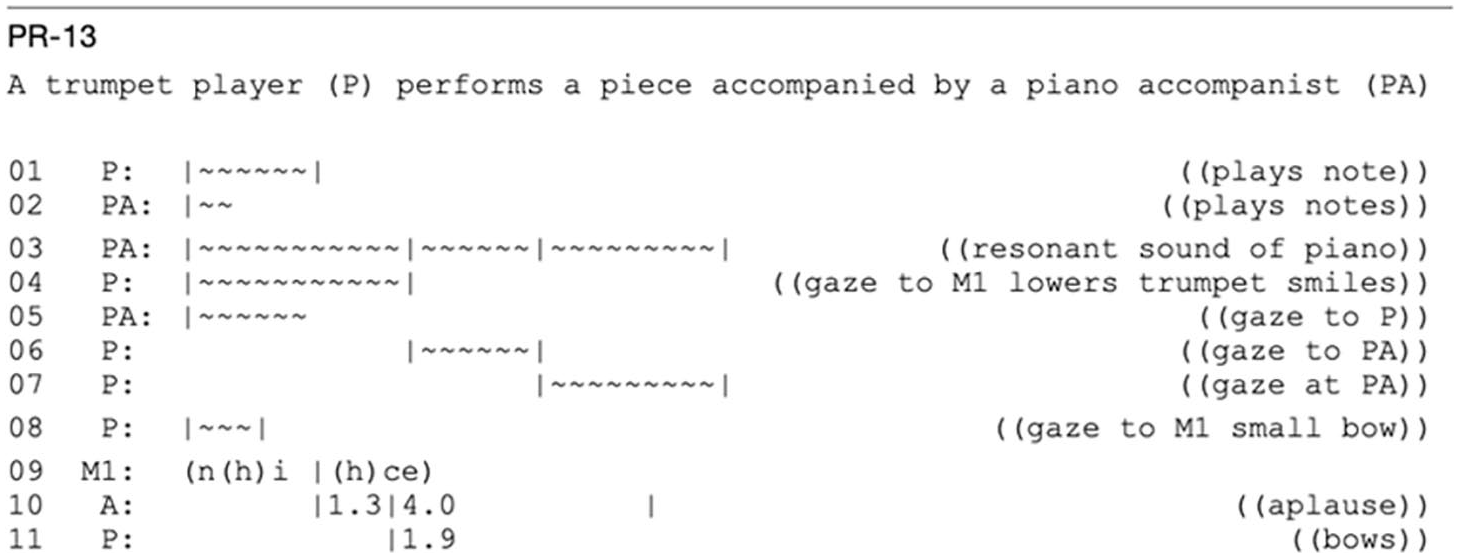
A trumpet player and piano accompanist play the last notes of a piece (lines 01 and 02). Then as the piano resonates (line 03), the trumpet player turns his gaze towards the master, lowers his trumpet, and smiles for 1.1 second. At the same time, the accompanist turns her gaze to the performer (line 05). The trumpet player then turns his gaze to the accompanist on line 06 and looks at her for 0.9 second (line 07). As the accompanist lifts her foot from the sustain pedal (not transcribed), the resonant sound ends and the trumpet player turns his gaze back to the master and makes a small nod-like bow (line 08). The master then begins the utterance ‘nice’ with inserted laughter and breaths (line 09). After the initial consonant and vowel of ‘nice’ the audience applauds. As an aside, the production of ‘ni’ by the master is accompanied by her lifting her hands to a clapping position and then clapping on ‘ce’ (not transcribed). She is sitting to the side of the performers, in full view of the attendant audience. 1.3 seconds into the applause, the trumpet player takes a full bow towards the audience.
What is notable is that the main performer orients precisely to the resonant sound of the piano, turning to the audience (as with the previous example) for a second time as this sound is terminated (line 08). Even though the main performer has made eye contact with the master (M1) as he completes his own playing (line 04) this is not received as a performance completion.
In this instance, it is not simply a matter of performer orientation. The initial gaze movement to the master does not result in performance completion and audience response. Instead, the resonant sound of the piano in combination with the performer’s gaze informs the audience orientation to performance completion. The subsequent verbal and embodied response by the master elicits further collective action on the part of audience members. The performers collectively negotiate the performance completion.
Performance Pause
It is in the period after performance that we find the ‘performance pause’. Here, all discernible activity has ended and the performer stands still staring out towards the audience, but without making direct eye contact. This held-gesture (Kendon, 1990) enables the performer(s) to maintain the ‘floor’ (Goffman, 1981). Only once the performer breaks this pause does the audience applaud.
In Instance 4, a viola player has played a piece of Bach.
Instance 4
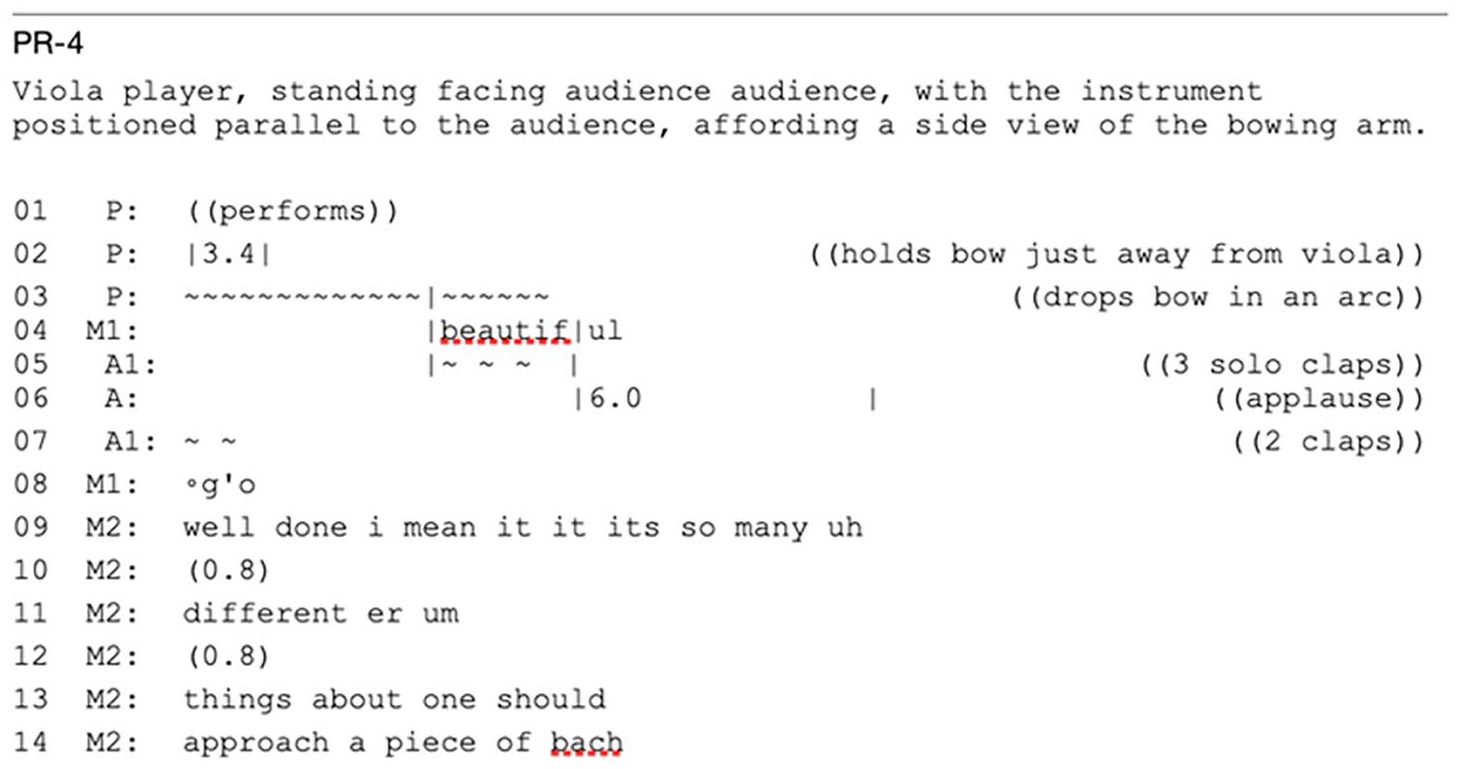
After playing the last note of the performance (line 01), the performer holds a position with the bow a few inches away from the strings of the viola for 3.4 seconds (line 02). He then lowers the bow in an arc away from the instrument in the direction of the audience (line 03). As the bow reaches a point parallel to the floor (and pointing directly towards the audience) 1.3 second into the movement a female master can be heard saying ‘beautiful’ (line 04). At the same time 3 solo claps (perhaps produced by the same master) can be heard. In overlap with ‘ul’ of beautiful the remaining audience members applaud.
Here, then, the response to the performance is delayed while the ‘performance pause’ occurs and continues as the instrumentalist lowers the bow for a further 1.3 second. The audience response is led by one of the attendant masters (there are 2 in the room) with a verbal assessment in line with individual clapping.
Accomplishing applause
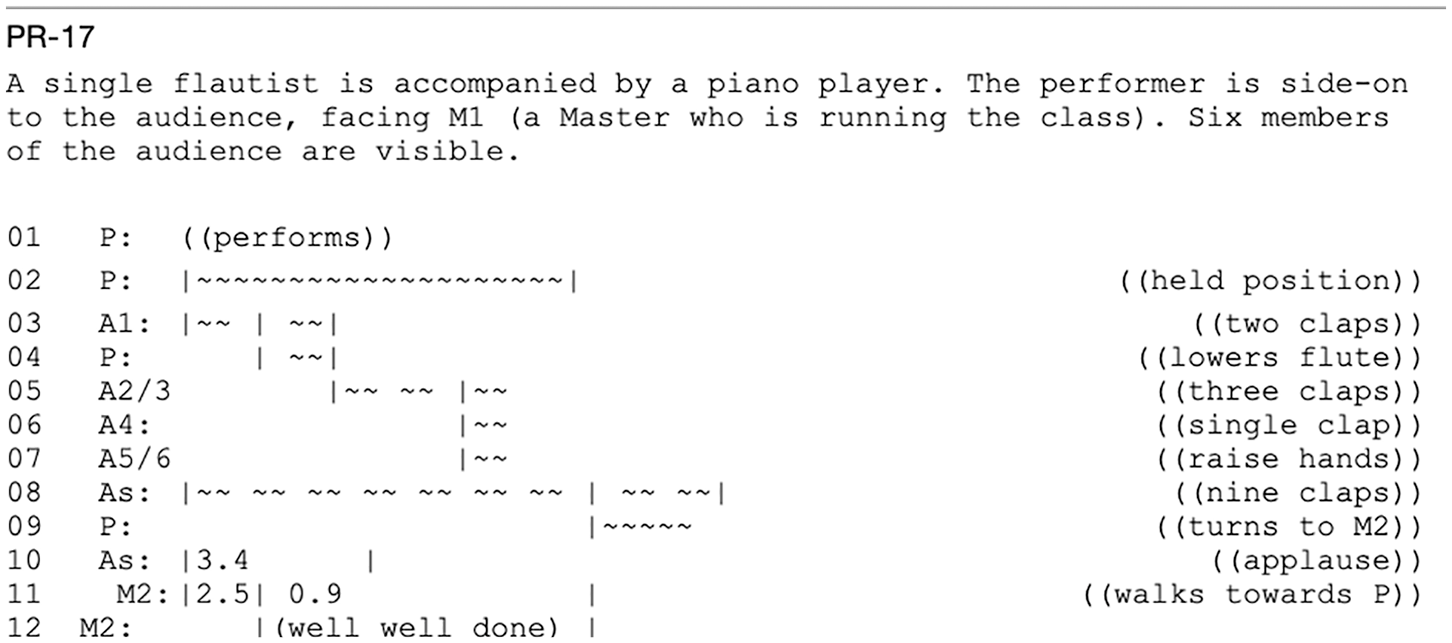
In addition to the uncertainty of when a performance has ended is a question about how applause occurs. While it is tempting to think of it as a single action, closer examination shows that it has a dynamic interactional shape. Applause is an ‘achieved’ collective activity. It is made up of component elements, commonly called ‘claps’. In the following instance, these component elements are oriented to the collective activity and achievement of ‘audience applause’. The analysis benefits from the visibility of a selection of the audience members due to the camera position (Image 4).
Instance 5
Flautist and piano accompanist.
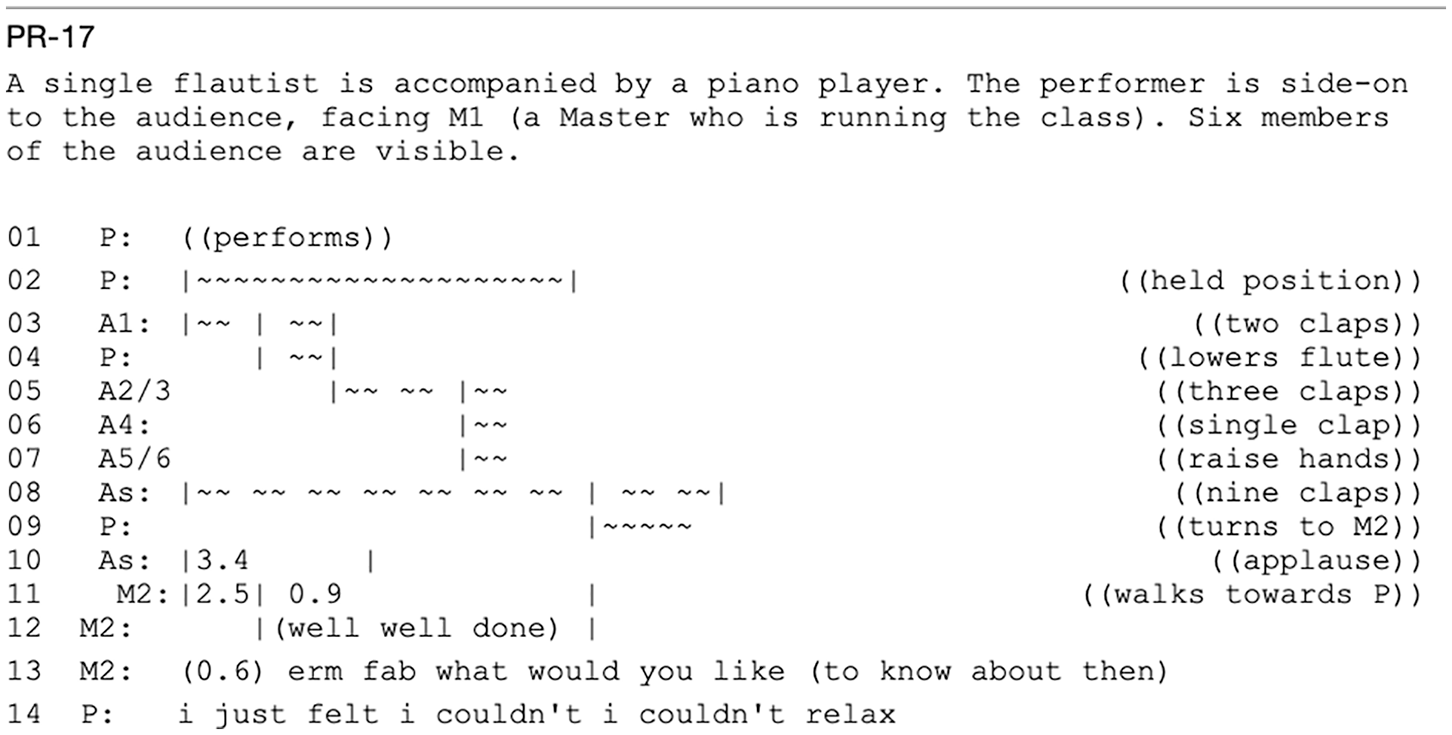
The flute player and the piano accompanist completes the piece and then the flute player maintains a held position – a performance pause – for 2 seconds. Two claps can be heard (from an unseen audience member – A1). On the second clap (line 03), the flute player lowers the flute (line04). The six visible audience members then begin to clap in time with the first two claps. First, audience members A2 and A3 clap three times (line 05), with audience member four joining on the third clap (line 06). Simultaneously with this third clap, two other audience members (A5 and A6) can be seen raising their hands to a clap position. There follows nine sets of claps in unison from a number of audience members. On the eighth clap sound the performer turns towards a master to her left (M2) (not shown in image). There follows 3.4 seconds of collective applause during which this master walk towards the performer and utters something indiscernible (line 12) but with the cadence and rhythm of ‘well well done’. After a 0.6 second pause (line 13) she asks the performer a question and the performer responds (line 14).
Notable here is that in this instance the performance pause is not terminated by the performer, but is instead instigated by the single clap of an audience member.
Coordination of the collective applause activity is instigated by an audible sound and over a period of claps different audience members ‘join in’. These collective claps are initially in unison; that is they are produced in time with one another. As the applause extends (and the master enters the performance space) this timing falters and the claps become less unified. As with the beginning of the applause, the end is characterised by staggered participation, with audience members stopping applauding till there is a single audible couple of claps (not transcribed).
It should be remembered that as an ‘audible and visual gesture’ a ‘clap’ is necessarily preceded by a ‘preparation’ phase in which a person moves both hands from home position to one in which the hands are a distance apart before they can then be brought together to produce a sound (as with Instance 3). This preparation phase may be short, but it is quite possible for it to be undertaken without producing the anticipated clap. This can be seen in the following instance, when two audience members produce the preparation phase of an applause gesture, with only one of them bringing the hands together (but without producing a sound).
Instance 6
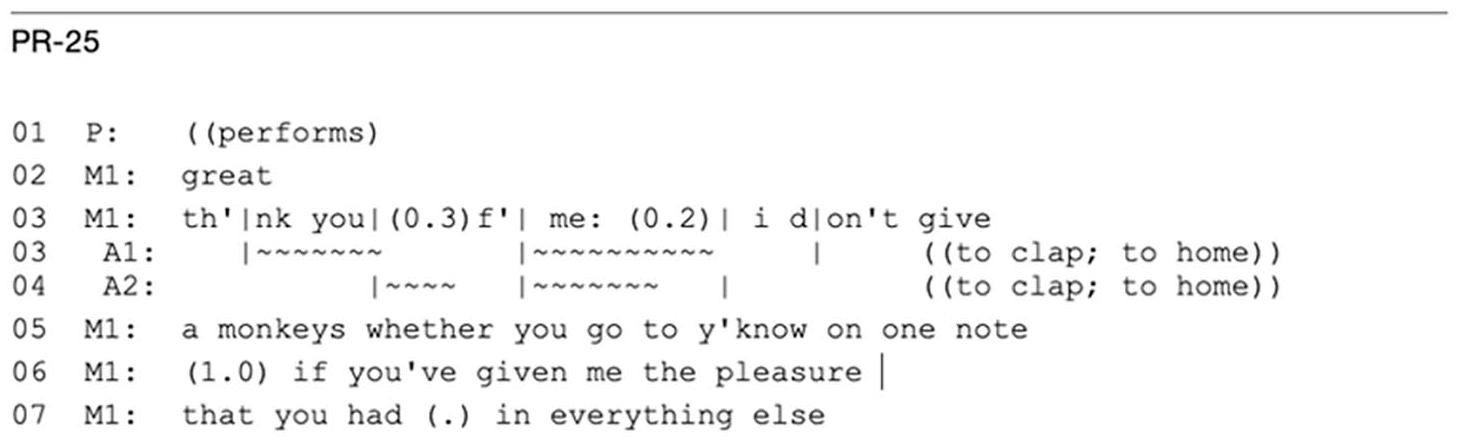
A trumpet player has just performed and before there is any applause the master utters ‘great thank you’. After a 0.3 second pause she continues ‘f’me (0.2) I don’t give a monkeys’.
In line with the word ‘thank you’, the pause, and the first consonant of ‘for’, one audience member (A1) brings her hands together from her side (Image 5, person furthest away from the camera). Simultaneously, but starting slightly later at the beginning of the 0.3 second pause, another audience member (in the foreground) moves her hands from a starting position of right hand to side of head and left hand in lap, to an open-clap position (Image 5). Immediately upon continuation of ‘f’me:’ both A1 and A2 return their hands to home position (with A2 returning her right hand to the side of her head).
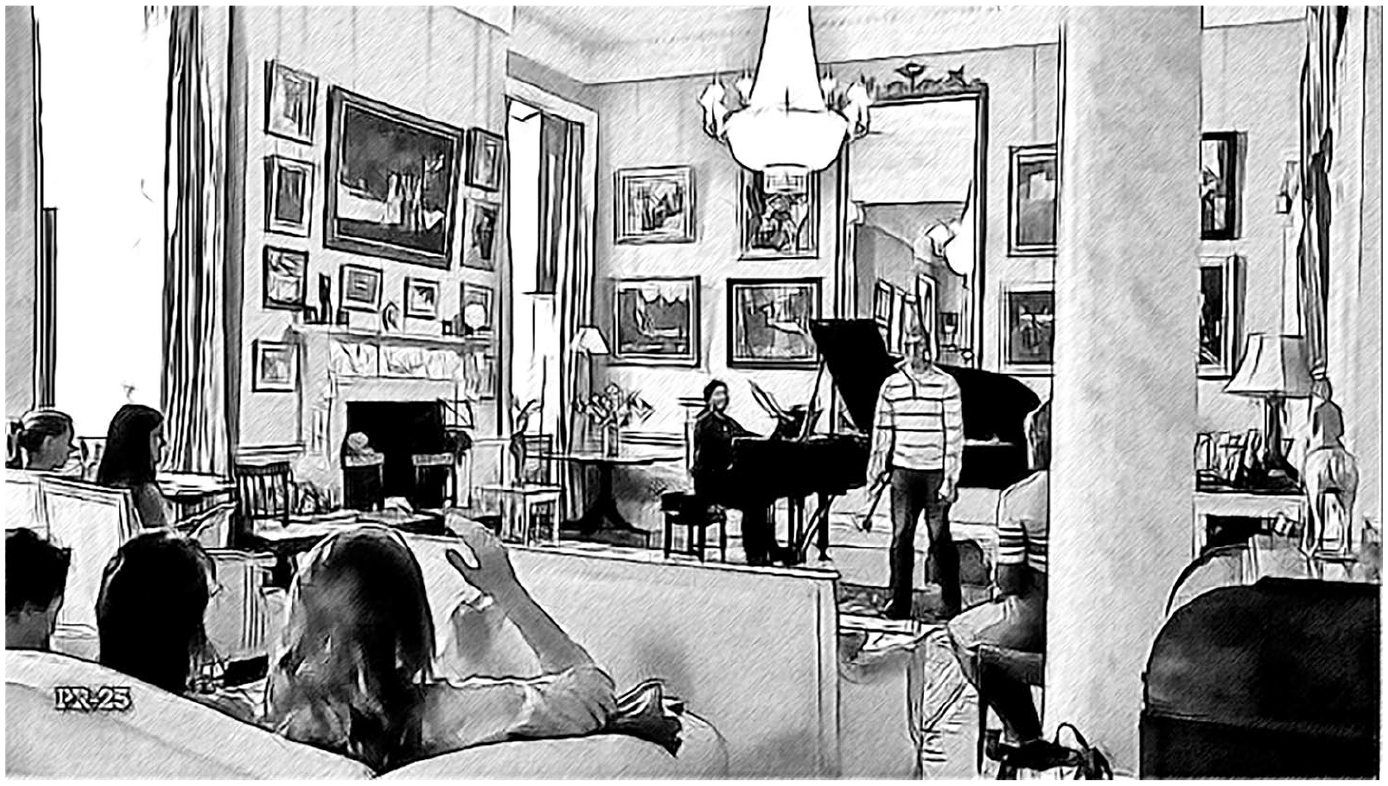
Trumpet player and piano accompanist.
Something in the formation of ‘great thank you’ indicates to these two audience members that applause was relevant, but upon the production of a further word (before the utterance is discernible) both jettison the applause action. ‘Great thank you’ is an example of an assessment receipt. In the next section, I will review this phenomenon and extend it in line with the developed understanding of performance completion occurring over a period of time.
With the accumulation of instances that show performer allocation, performance pauses, and audience applause onset, we are in a better position to situate the earlier published analysis of assessment receipts.
Performance assessments
The assessment receipt is a phenomenon that is operative in ‘transitions’ between performance and instruction in musical masterclasses (Reed, 2019). These have a component-like character, combining assessment and receipt tokens. An example is seen in Instance 7.
Instance 7

The student’s performance is followed by 5.9 seconds of applause (line 02), during which the master, who is seated alongside the audience, produces the utterance ‘oh well done’ in overlap (line 03), which combines a news token (Heritage, 2002) with an assessment. The assessment ‘well done’ is then repeated ‘in the clear’ (see later), and the words ‘good good’ are produced at an increased tempo. The repetition and tempo of ‘good good’ turns the evaluative ‘good’ into a ‘procedural acknowledgment token’ or receipt (Mondada, 2009). Hence the master’s utterance is an example of an ‘assessment receipt’.
The assessment receipt turns out to be one amongst a number of different kinds of verbal assessment positioning, in relation to instructional turn transition. Indeed, the above example of assessment receipt could be more simply described as a news token (‘oh’) followed by two ‘repeat-assessments’ – ‘well done well done’ then ‘good good’ (see later definition).
This section focuses on the production of verbal assessments. Later it will be possible to recombine them with receipt tokens to show an alternative kind of performance response (the ‘receipt assessment’).
There are four main locations for verbal assessments: (1) following the performance completion and applause (‘post-applause’); (2) following the performance completion and during the applause (‘during-applause’); (3) immediately following performance completion and before applause (‘pre-applause’); and (4) as the musician performs (‘during-performance’).
Post-applause
In the music masterclass interactions, there are instances when a simple (and anticipated) structure occurs. These are formed through three sequential actions: performance, applause (collective embodied assessment), master (verbal) assessment.
There is a distinction to be had between ‘minimal’ and ‘elaborate’ assessments.
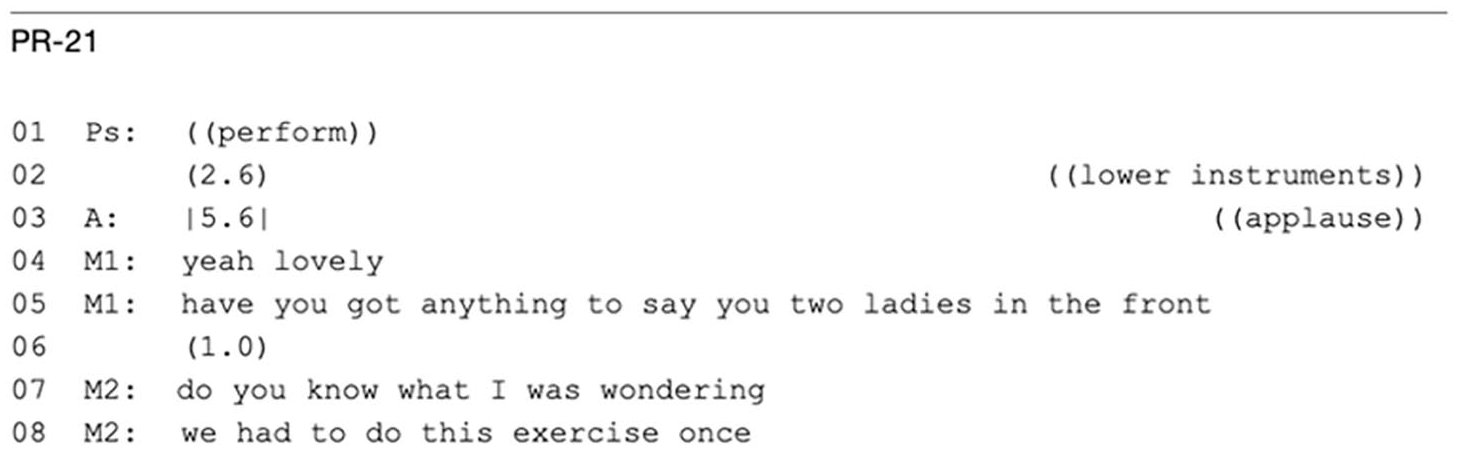
In the following instance, two clarinet players perform a piece. A master utters a minimal assessment of ‘yeah lovely’ once the applause has ended and then produces a next-turn allocation by saying to two others masters in the room, ‘have you got anything to say you two ladies in the front’ (line 5). One of these instructors, produces an utterance (lines 07–08) that has been described as ‘first business’ in earlier analysis (Szczepek Reed et al., 2013), a term used to describe the onset of instruction-related talk.
Instance 8
The more common format involves the production of an elaborate assessment. This can be seen in Instance 9. Once the applause has ended (line 05), a master produces an assessment ‘hey fantastic sound you’re making and its wonderful’. She then allocates the next turn to another master in the room (M2) by saying ‘I th’nk’ and pointing towards her.
Instance 9
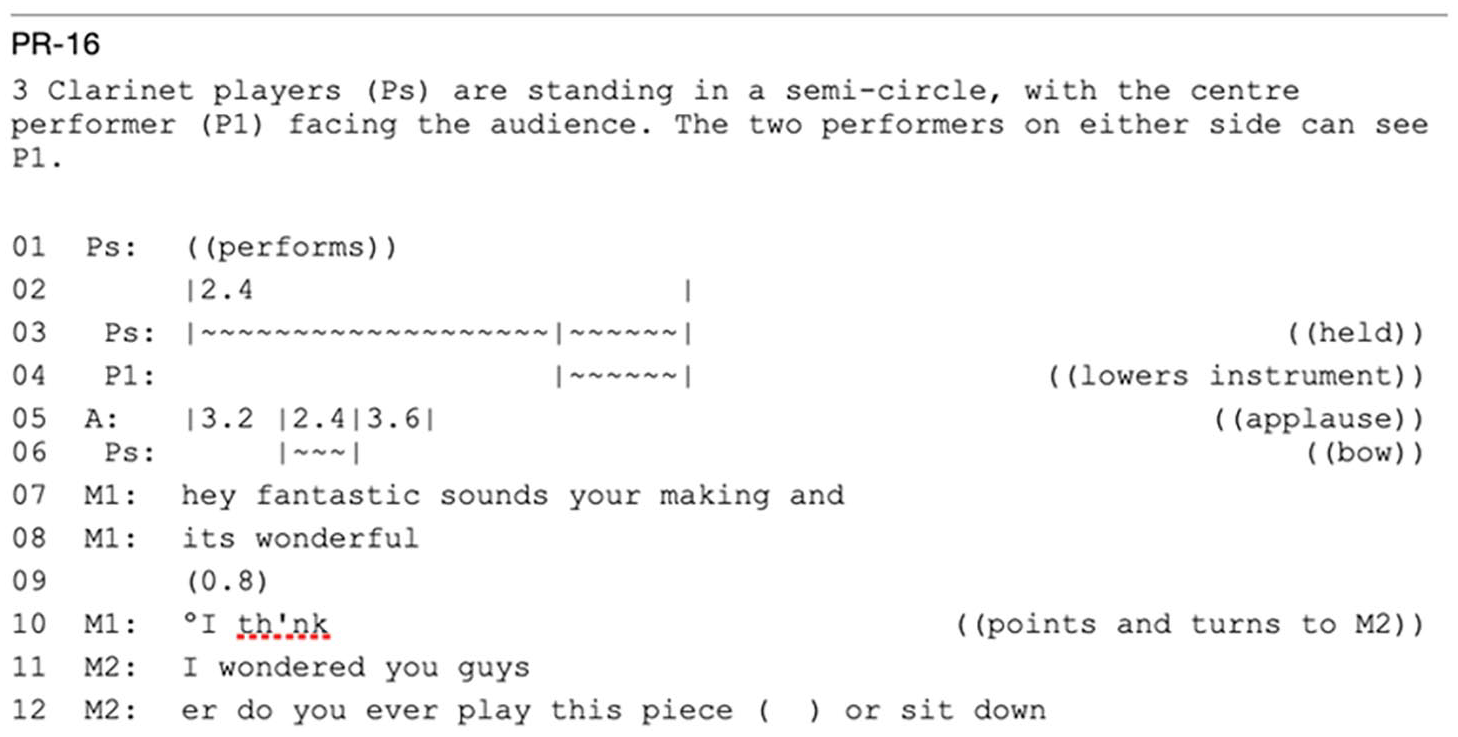
The post-applause verbal assessments are routinely positive. That is, they follow the valence of the positive collective embodied assessment of applause. It should be remembered that the master, as a member of the applauding audience, is implicated in this positive response. It would be odd if they suddenly moved from a positive (embodied) response, to a negative (verbal) one. There are, however, instances of negative verbal assessment in the data,
Instance 10

Negative verbal assessments occur when the performance being assessed is a ‘second’ or ‘subsequent’ performance. Masterclasses have a structure in which musicians first perform a piece all the way through, the audience applauds, and then the performers receive comments and feedback from one or more master. The master’s comments often include a directive to re-perform parts of the full piece. These performance elements are therefore ‘second’ or ‘subsequent’ and are akin to other forms of classroom interaction that form an ‘IRE’ sequence (Instruction-Response-Evaluation). In the data, negative assessments (and interruptions – see later) only occur in these instructional performance sequences.
During-applause assessment onset
In music masterclasses, as people applaud the performer, there are a number of instances when the master produces a verbal assessment of the performance. Verbal assessments (such as ‘good’, ‘well done’, ‘beautiful’ and ‘gorgeous’) are common in masterclass interaction.
One defining feature of this structure is the production of an assessment in overlap with the collective applause and some form of repetition produced once the applause has ended (‘in the clear’). This repetition may be a reproduction of the already issued assessment token (a ‘repeat assessment’) or the production of an alternative assessment token (a ‘double assessment’). There may also be combinations of repeat and double assessments, with the later produced as an extension of the former (effectively turning the second part of the repeat assessment pair into the first part of a double assessment).
Instance 7 (above) shows the basic shape of the repeat assessment. If we look more closely at Instance 7, we see two repeat assessments. The first is produced either side of the applause termination. Similarly, in Instance 11 (below) there is a repeat assessment ‘g’d good’ produced across the applause termination and then a repetition of ‘right’ as a receipting token.
Instance 11

One interesting element of this second instance is the elongation of ‘g’d’ to ‘good’. This is arguably an upgraded assessment (Antaki et al., 2000). A similar upgrade of the assessment ‘good’ can be found in Instance 12 (lines 04 and 06).
Instance 12
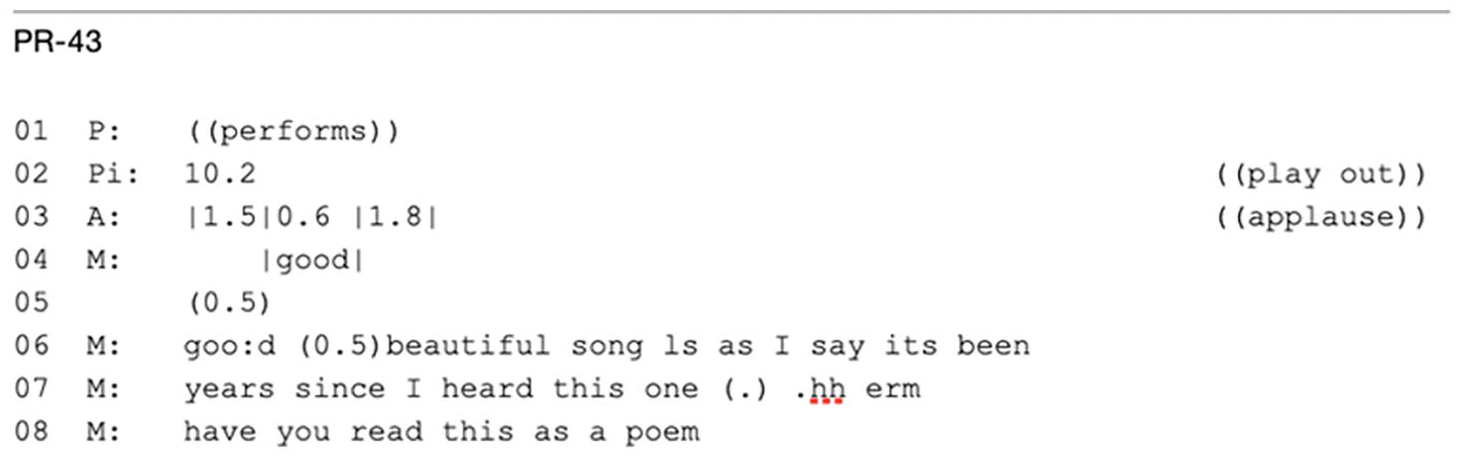
In this case the upgraded ‘goo:d’ (line 06) precipitates a further assessment of ‘beautiful song’. This could be described as a further upgrade. Notable here is the production of a ‘double assessment’ with ‘goo:d’ followed by ‘beautiful song’. This only functions as a double assessment if the second ‘good’ is taken to be the first part of an assessment pair. Its production – post-applause – lends it a separate character ‘in the clear’.
As an aside, this trajectory towards upgrade complements the earlier noticing of the production of ‘elaborate’ assessment utterances following applause.
A simple double assessment can be seen in Instance 13,
Instance 13
A restarted assessment of ‘well well done’ occurs in overlap with the applause (line 12) and then an alternative assessment of ‘erm fab’ occurs in the clear (line 13) creating a double assessment.
To emphasise the point about the relationship between a during-applause assessment, its repetition in the clear, and an upgrade trajectory, the following instance shows a double assessment (line 03) produced in overlap with the applause, followed by an upgraded elaborated assessment (lines 05–10) that starts in overlap with the applause.
Instance 14
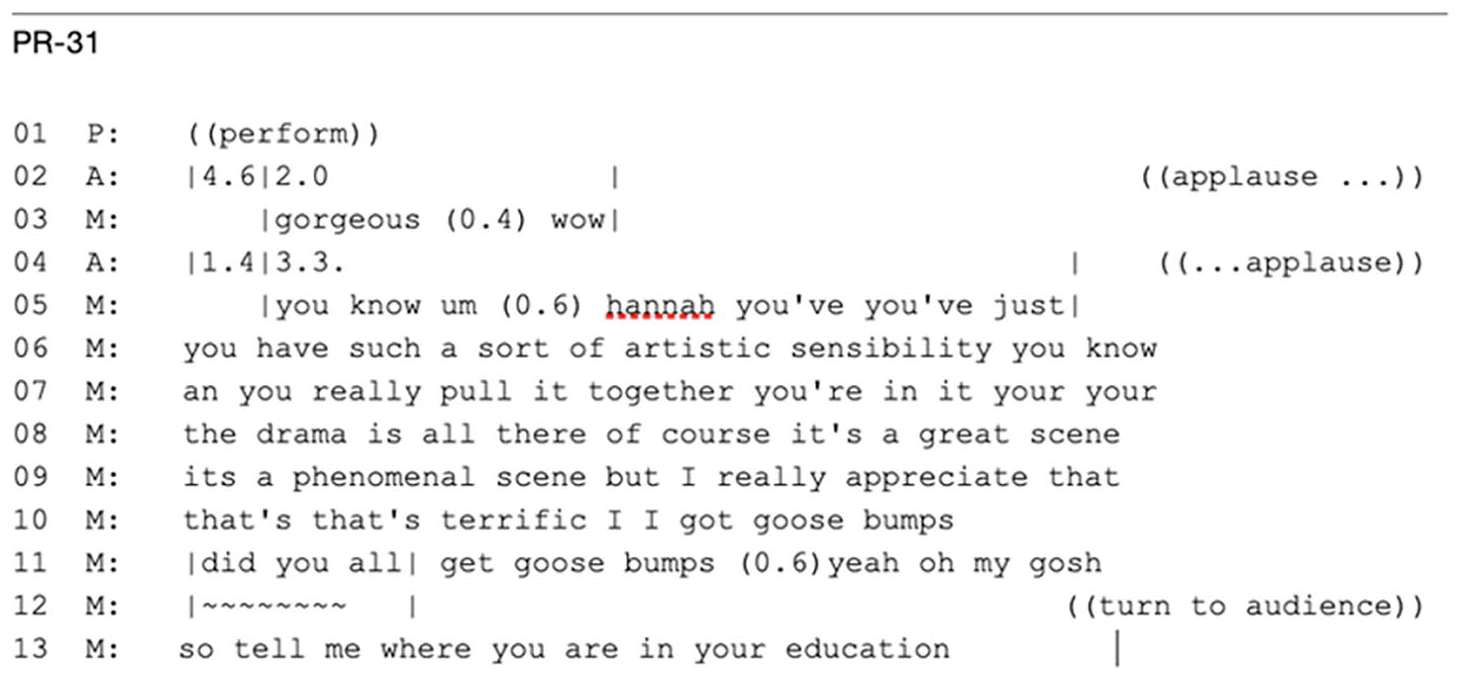
In the earlier analysis (Reed, 2019) it was claimed that assessment receipts enable next position turn taking. However, as can be see from the above instances, this is not the only manner in which this occurs. Verbal assessment tokens in isolation may also accomplishes this. Arguably, the assessment receipt rests on this broader use of assessment tokens.
Pre-applause assessment onset
Here, an assessment (or multiple assessments) is produced just before applause commences, either in its entirety, but more often in overlap with applause, such that it would better to speak of ‘pre-applause assessment onset’. An example was seen in Instance 3 earlier in the paper. On line 09 when the master utters ‘n(h)i(h)ce’ and lifts her hands to applaud just before the onset of the applause.
It could be argued that the verbal assessment onset instigates the collective embodied assessment of applause by the audience and therefore acts as an applause onset instigator, as a result of mutual monitoring.
At times the pre-applause verbal assessment coincides with minimal applause onset (with one person clapping), and there is the possibility that it is the person speaking is also producing the solo claps. This can be seen in Instance 13 above but also in the following instance,
Instance 15
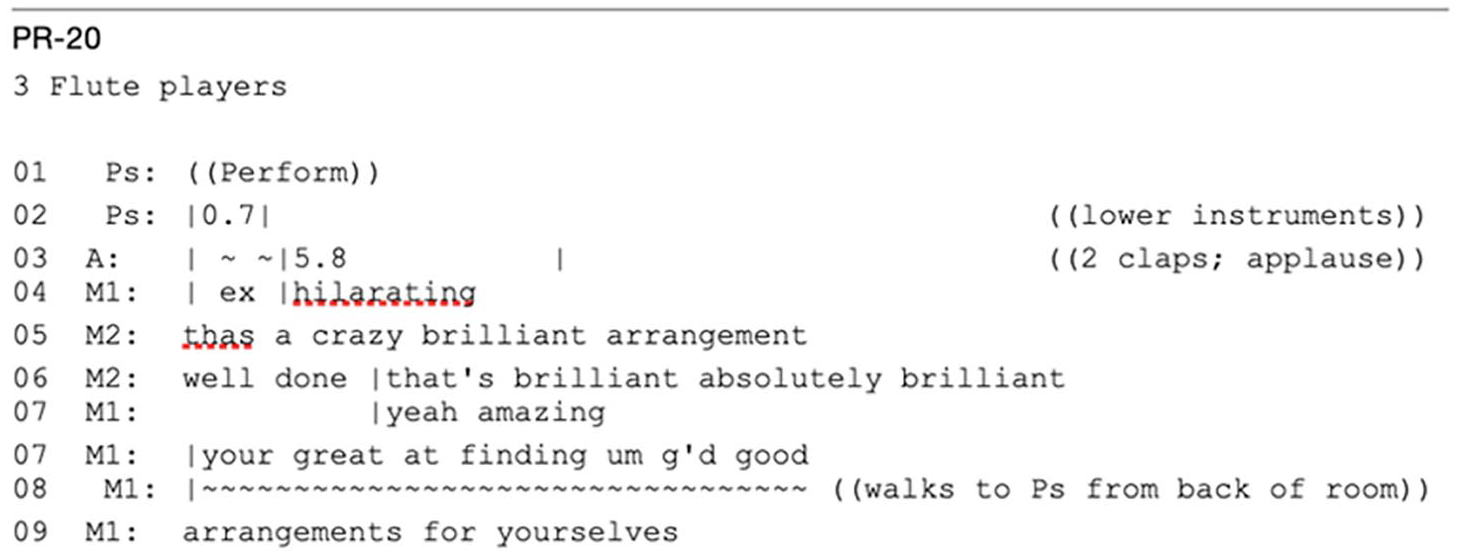
In line 03 two isolated claps are produced as one of the masters begins the utterance ‘exhilarating’. Collective audience applause follows immediately upon this.
Due to the visibility of the master, the claim that the minimal claps function as a collective applause onset is more compelling in the following instance,
Instance 16
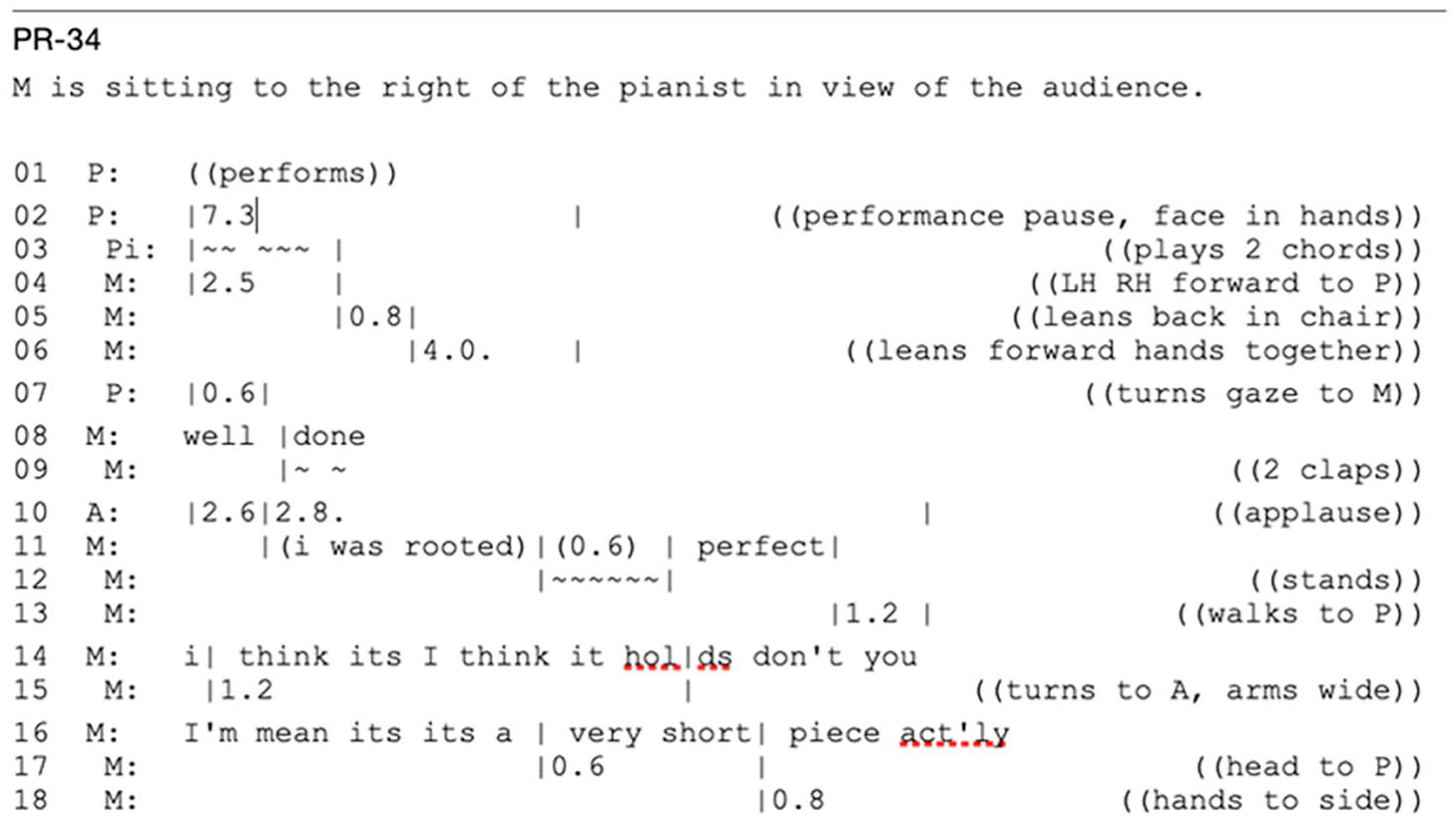
The performance is followed by a performance pause (line 02), during which the performer has her face in her hands (see Image 6, performer in in the bottom right corner). The master leans forward (line 04), back (line 05) and then forward again (line 06). Then on line 07 the performer turns her gaze towards the master for 0.6 of a second (as a performer next turn allocation). The master produces a verbal assessment of ‘well done’ and two claps during ‘done’. The remaining audience applauds.
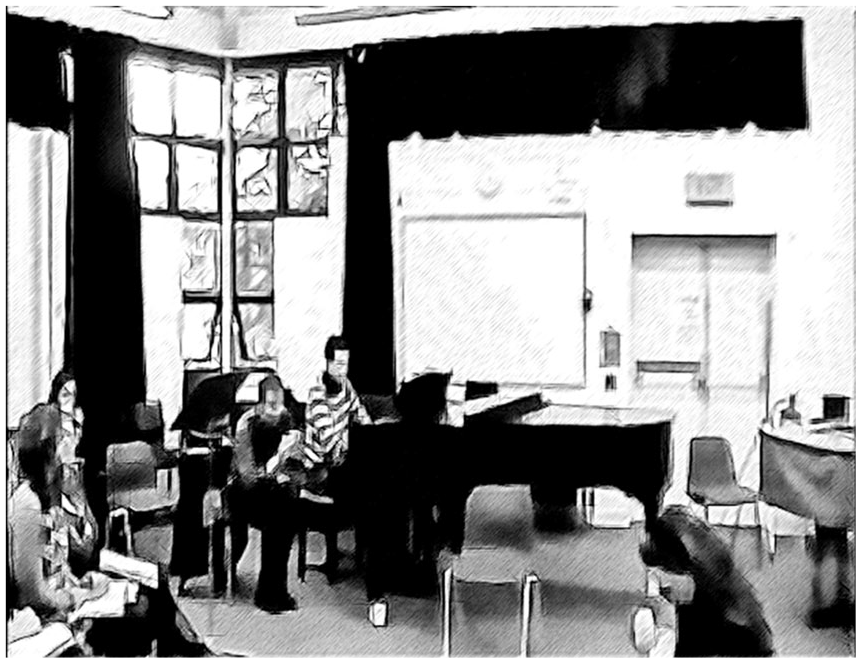
Singer and piano accompanist.
During the applause the master produces a double assessment ‘I was rooted’ and ‘perfect’, standing up between them (line 12) and then walking towards the performer (line 13). The master then produces an elaborate assessment on line 14.
Verbal assessments work as an applause onset instigator in combination with isolated or individual claps.
There are multi-party pre-applause assessment onsets. Here, more than one master issues a verbal assessment, with the first occurring before the applause commences, and the second in overlap with the applause. In Instance 17, M1 utters ‘mm lovely’ (line 03) and in overlap with ‘ely’ a single clap is audible (line 02). Then in overlap with collective applause a second master utters ‘yes well done’ (line 04)
Instance 17
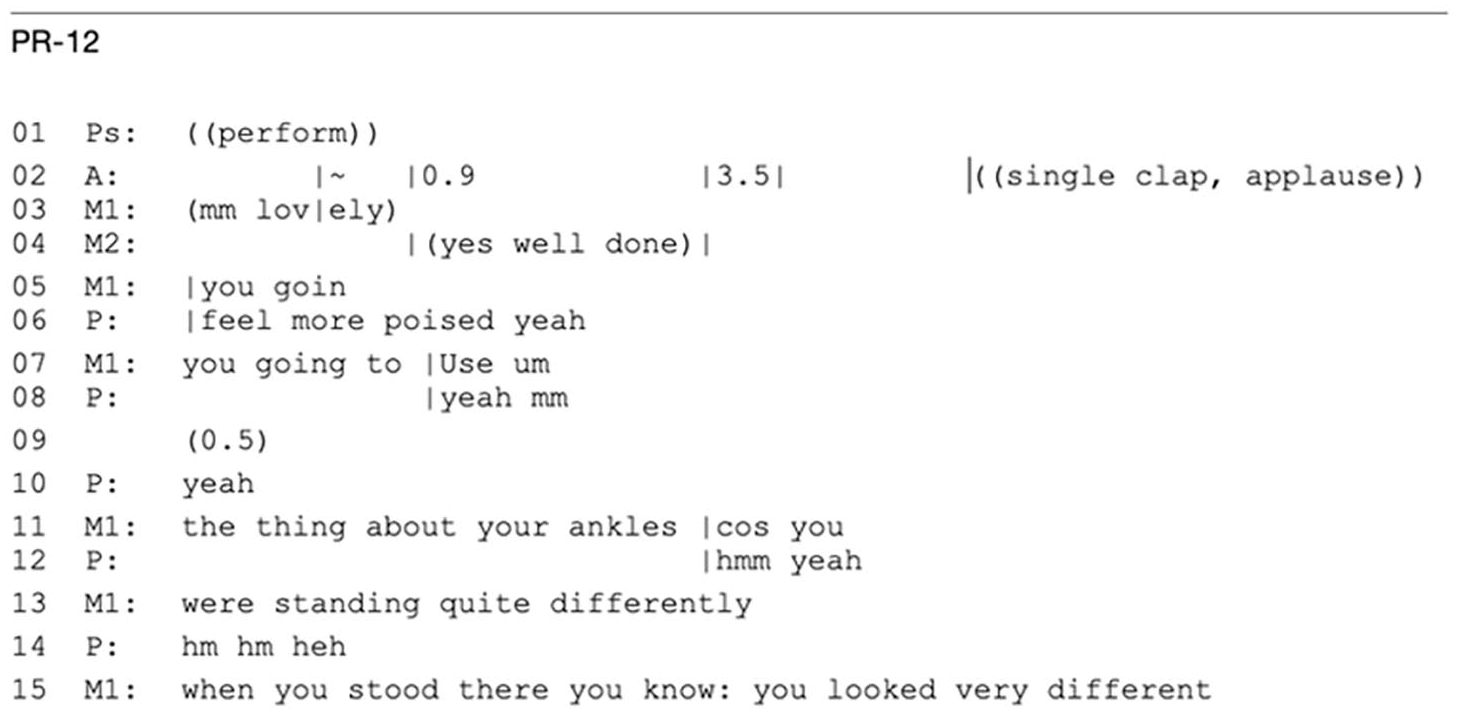
In another, more complicated, instance two masters issue an assessment before the applause (Instance 18).
Instance 18
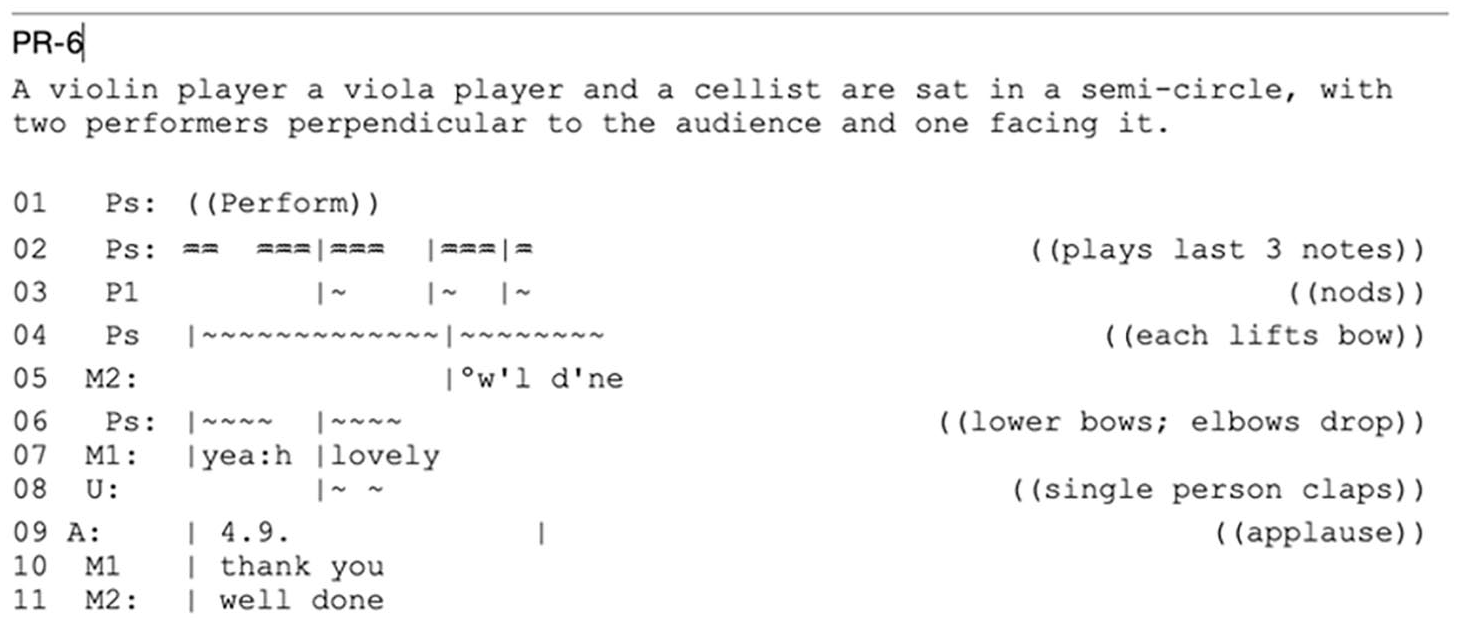
Here the first pre-applause assessment of ‘w’l d’ne’ by master 2 is closely related to the production of a performance pause (line 04). The performers produce three final notes (line 02) during which one performer produces a nod like head action (line 03). This helps coordinate the production and termination of the joint sound. All three performers then slightly lift the bow of the instrument in unison, producing the performance pause (line 04). 1.3 seconds into this movement M2 utters an assessment token (lines 05).
Upon completion of this token, all three instrumentalists break the performance pause and lower their arms (line 06), during which the second master (M1) issues an agreement token followed by an assessment (line 07). We hear 2 solo claps, and then the audience collectively applaud (line 09). In overlap, M1 produces the final part of an assessment receipt (‘yeah lovely thank you’) and the first master (M2) issues the second (upgraded) part of a repeat assessment pair (’w’l d’ne well done).
This complicated instance draws together performance completion and applause achievement. It also combines repeat and double assessment, the latter being an assessment receipt.
During-performance assessments
During-performance-assessments primarily occur during second or subsequent performances of the same piece in music masterclasses in which they are an appropriate response to the performer’s instruction-related actions. Typically the master’s intervention brings the performance to an immediate halt.
Instance 19
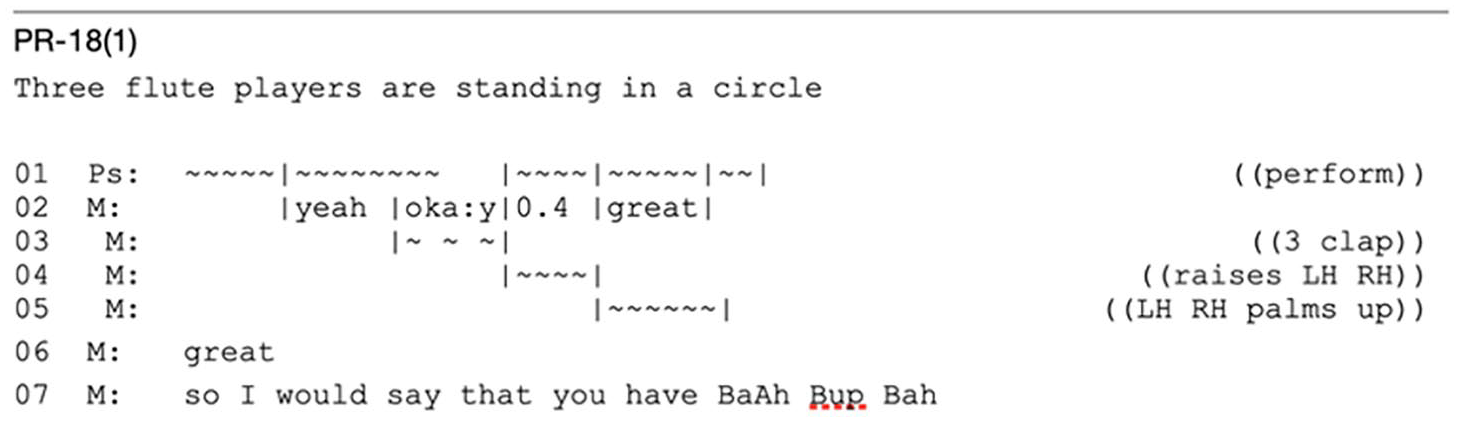
In Instance 19 and during the performance, M1 walks from the back of the room towards the performers (not transcribed). She utters ‘yeah’ and then ‘oka:y’ as she produces three claps. There is a 0.4 vocal pause during which M1 raises both arms in front of her body while walking forward. She then utters ‘great’ while raising her arms further (still moving forward) with her palms pointed towards the performers (line 05). Two tenths of a second later (line 01) the performers stop and the master utters ‘great’ once more (line 06) (a ‘repeat assessment’) in the clear. She then speaks to rhythmic phrasing (‘BaAH Bup Bah’) as a means to address the playing of the piece (line 07).
Of note, here, is that the 3 claps by the master do not precipitate collective applause. The camera angle allows a view of six of the audience members, and none produce a preparatory applause gesture (unlike Instance 6). Could it be, then, that the production of a receipt token first (as opposed to an assessment) does not implicate applause onset? Unfortunately, this is the only instance and hence it is not possible to pursue or support this idea.
Another interruption occurs in Instance 20.
Instance 20
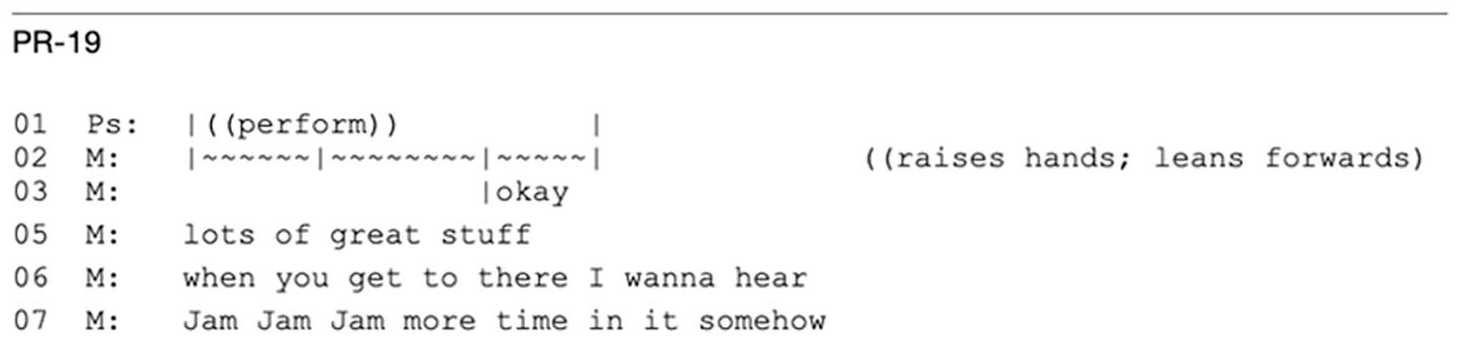
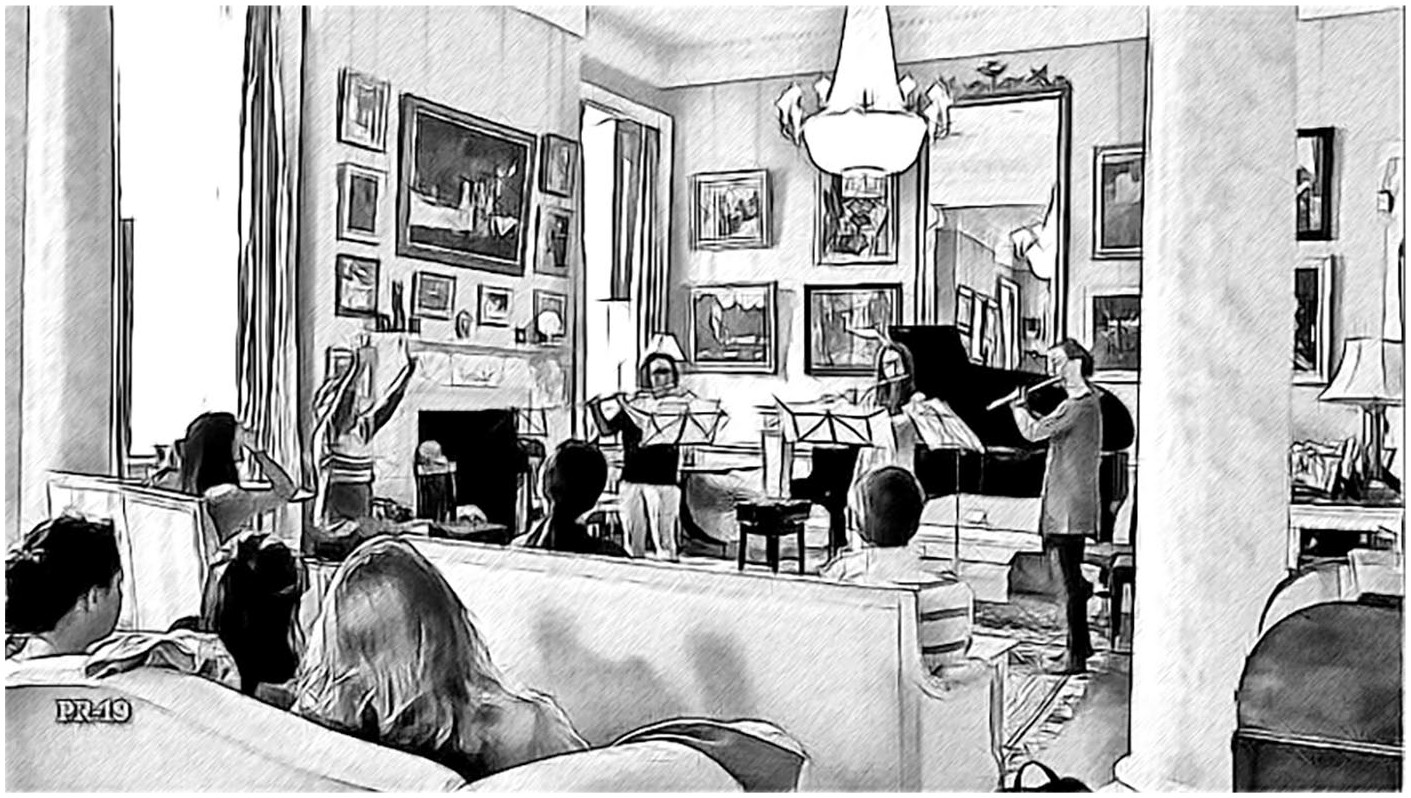
The master is to the side of the performers and while sitting she raises her hands above her head (line 02, Image 7) and then while ‘wiggling’ her fingers leans forwards (line 02). Continuing the movement, she utters ‘okay’ and the performers stop. The master complements the performance (line 05) and then continues with an instructional criticism about wanting a stronger rhythm (line 07), while producing an exaggerated sideways body movement with her arms in time with the repeated word ‘Jam’.
Woodwind trio and master.
Here is one further instance in which the receipt token is produced in overlap with the performance and the assessment token in the clear.
Instance 21
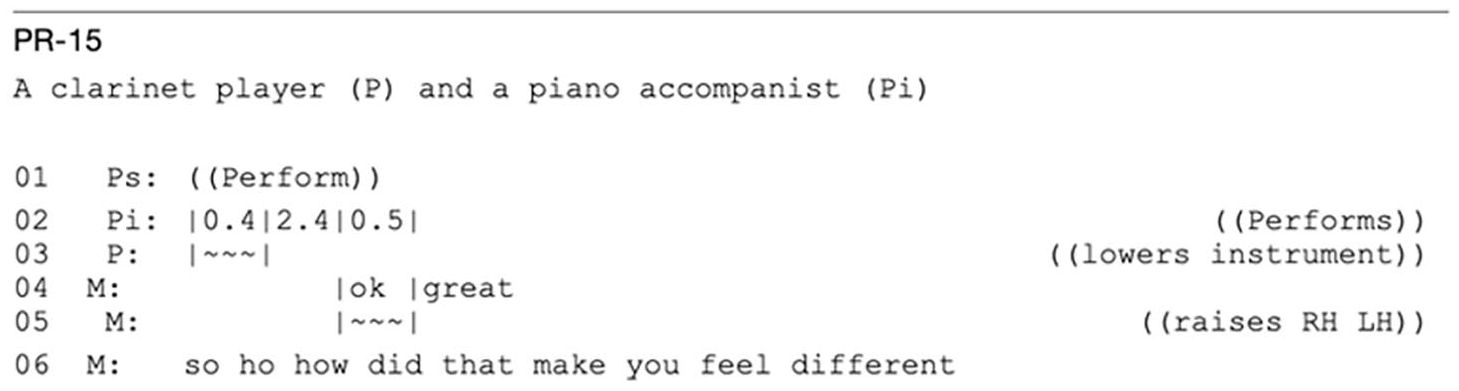
What is notable about these instances is the way that they are formed through the production of a receipt before an assessment: ‘yeah ok’ in Instance 19 and ‘okay’ in Instances 20 and 21. The token ‘okay’ acts as a pivot, in that it, ‘. . . simultaneously resolves the problem of attending to what was projected in prior turn (e.g. acknowledging/affirming), and paving-the-way for next-positioned matters (e.g. reassuring, assessing)’ (Beach, 1993: 338).
It is in this context of instruction-oriented performances, then, that we see an alternative formulation of the assessment receipt action. These reverse the ordering of ‘assessment’ and ‘receipt’ token. Receipt assessments only occur in relation to second or subsequent performances, that is, performances that follow an instructional turn. They act as interruptions and move to instructional matters.
Discussion
The accumulated instances of musical masterclass performance completions included a progression of analytic insights.
Performance endings are better understood as performance completions, wherein the precise moment that a performance ends is a matter of interactional achievement. Factors that contribute to this achievement include the embodied acknowledgement of audience members by performers (Instances 1 and 2), resulting in ‘performer allocation’ of next action, the performance pause (Instance 4), the hearable termination of instrument soundings (Instances 3), and the coordinated emergence of audience member’s embodied assessment response as applause (Instances 5 and 6).
An important noticing is that verbal assessments are a very common occurrence in and around performance completions in music masterclasses. These are primarily accomplished by the instructor or masters, but may at times be issued by the performers themselves as self-assessments. While verbalisations have been identified in performance responses before – in the form of cheers or boos, for example (McIlvenny, 1996) – their prevalence here would suggest they are a conventional aspect of the masterclass interaction.
These verbal assessments sit in relation to the collective embodied assessment, either occurring before, during, or after applause.
The most common are ‘post-applause assessments’. These could be seen to fit the conventional assumption of performance-applause adjacency, wherein a performance is followed by a collective appreciation. Follow-on verbal assessments sit naturally with this collective embodied response. They are routinely positive verbal assessments. However, they are negotiated and achieved in relation to the ongoing behaviours of the performers and attendant audience members.
The ‘during-applause assessment’ combines physical and verbal action. The master both claps and talks. In this way they are joining in with the collective assessment, but also claiming priority or primacy in relation to action recipiency. They position themselves as having the right to talk. Here, we see ‘repeat’ and ‘double’ assessment tokens and their combination, produced in overlap and in the clear. Repetition (of both sorts) enables the master to be talking and heard after the applause has ended. This affirms their position as next relevant speaker.
The ‘pre-applause assessment onset’ also situates the master as primary recipient of the performance but they also help coordinate the subsequent collective applause.
It transpires that the ‘assessment receipt’ is one format for performance response. The component elements are reversed as ‘receipt assessments’ in instances of ‘second performances’ in line with an instructional interaction, with the performance situated as a response to the instructional content. This analysis, therefore, re-situates assessment receipts within a broader category of assessments. By decoupling ‘assessment’ and ‘receipt’ tokens it identifies various configurations of ‘double’ and ‘repeat’ assessments, as well as the reversed ‘receipt assessment’.
Before concluding this paper it is worthwhile to recognise the potential relationships between the analysed performances and those in other genres or traditions. The masterclass is primarily a method of instruction in classical music training. This musical genre and practice is perhaps understandably perceived as highly structured. The coordination of multiple musicians rests on adherence to a musical score and adaptation of that score rests with the conductor, who decides in advance such elements as changes in tempo and emphasis. This plays out in the co-performance of conducting and instrument playing (Weeks, 1990). Arguably, this makes for more predictable performance endings as has been noted. In this regard the classical performance is different to a jazz performance. Here, the structure of the piece if far looser and the manner in which additions, adaptations, and improvisations occur are far more interactional.
Conclusion
This paper extends earlier analysis of the assessment receipt action. It does so by first detailing the various ways that performances are completed in musical masterclasses. It then considers the collaborative onset of collective embodied assessment, or applause. These analyses then provide a location for considering verbal assessments as variously located in performance completions, as well as during performances (as instruction-oriented interruptions). Finally, the receipt assessment is identified and compared to the original phenomenon to show a deviant case. The receipt assessment is deployed before performance completion by the performer(s) and inline with instruction-oriented performance segments.
Performance responses produced by masterclass instructors are tailored to the ongoing achievement of performance completion and applause onset. The analysis, while focused on the activity of masterclass training, nevertheless holds relevance for performance responses more generally. In that detailing the foundations for instructional interaction required analysis of ‘first performances’ that are more akin to a typical musical or theatrical performance, the analysis revealed aspects of ‘performance completion’ that potentially hold for non-instructional situations. Yet, it is in the music masterclass that we see greater variance in the positioning of verbal assessments. The master’s ‘right to speak’ – at times at length – is an important aspect of the music masterclasses as instructional setting. The total interaction is oriented to performance instruction. This paper details the different ways that assessment positioning enables the person in the master role to position themselves as ‘primary recipient’ of the performance and hence licence subsequent instruction-related talk.
Footnotes
Appendix
The transcription notation and system used is adapted from Jefferson and Heath. Descriptive gloss is provided right justified in double brackets. Embodied activity is indicated through single space indent of identifier and aligned and overlapping elements are grouped through text formatting.
(1.0) pause, indicated in tenths of a second
|1.0| timed period, demarcated by ‘timing points’ aligned with accompanying transcription elements
~~~ action, aligned with vocal utterance (tenths of a second, aside from single actions such as claps)
[ overlap
| timing point, relating to aligned point in action line
☐ played musical note onset (tenths of a second)
|~~~~|~~~~~ ((action 1; action 2))description of sequential actions
|~~~~~~~~~~ ((action 1, action 2))description of simultaneous actions
Declaration of conflicting interests
The author declared no potential conflicts of interest with respect to the research, authorship, and/or publication of this article.
Funding
The author received no financial support for the research, authorship, and/or publication of this article.