




Abstract
In dealing with the different ways in which argumentative styles manifest themselves in various communicative practices from several communicative domains, van Eemeren and Garssen start from a definition of argumentative style that is connected with the pragma-dialectical notion of strategic maneuvering. Depending on the argumentative moves that are made, the dialectical routes that are followed, and the strategic considerations that are brought to bear, they make a general distinction between detached and engaged argumentative styles. In this article, they report on recent research in which it is examined to what extent the argumentative styles that are prototypically used in different institutional macro-contexts from the political, the diplomatic, the juridical, the faciliatory, the academic and the medical domain belong to these two categories. In the analyses they discuss, the authors combine specialized and domain-specific background knowledge with pragma-dialectical insight into the properties of argumentative discourse that determine the argumentative style.
Keywords
A new perspective on argumentative style
The observations that are made by laymen as well as trained analysts concerning the style utilized in argumentative discourse vary from pointing out striking properties of the way in which the standpoint at issue is defended (‘overtly promotional’) to giving general characterizations of the defense (‘straightforward’) – or assessments of its appropriateness (‘too conversational’). They may concentrate on the style of a particular speech event (e.g. Charteris-Black’s keynote speech at the CADAAD conference in Bergamo on July 8, 2022) or a certain speaker (e.g. Kennedy) or writer (e.g. Nabokov), but also on distinctive features of the style put to good use in a certain type of communicative activity (e.g. chatting) or domain of communication (e.g. politics). Although the concept of style also applies to visual and other modes of communication, the observations that are made generally focus on spoken and written argumentative discourse.
The properties of style are in the literature generally described as linguistic characteristics. Wales (1991), for one, claims in her Dictionary of Stylistics that ‘stylistic features are basically features of language’ (p. 436); Fahnestock (2011) speaks in Rhetorical Style of ‘features of language that might enhance its power over the audience’ (p. 6). This linguistic view agrees with a general tendency. In ‘stylistics’, the modern version of the rhetorical doctrine of elocutio, style is predominantly seen as a quality of the linguistic presentation. For dealing adequately with argumentative style, however, it is not sufficient to concentrate predominantly on the presentational properties of style, as happens in the traditional stylistic approaches. In order to do justice to the notion of ‘argumentative style’, a new perspective is needed (Van Eemeren, 2019, 2021). This new perspective should be more specific, since it must focus on the argumentative function of the discourse, but it should also be broader, because in the argumentative function of the discourse more is involved than just the presentational aspect.
To capture the argumentative function of the discourse, we need a definition in which argumentative style is viewed as instrumental in trying to convince the intended audience of the acceptability of the standpoint at issue. This means that all three aspects of the strategic maneuvering involved in trying to resolve a difference reasonably and effectively are to be incorporated. 1 Using a certain argumentative style as a particular way of giving shape to one’s strategic maneuvering in argumentative discourse does not only involve choosing a particular way of exploiting the presentational devices of language (or another mode of communication), but also making a particular selection from the topical potential of available argumentative means, and adapting in a specific way to the audience demand of the intended addressees (Van Eemeren, 2010: 93–127). Viewing these three aspects of strategic maneuvering as the constitutive dimensions of argumentative style, enables us to properly identify the argumentative style that is utilized in giving a particular shape to the argumentative discourse.
It is helpful to realize that when we are speaking of the argumentative style utilized in a discourse, we always refer to a particular way of conducting the discourse in trying to resolve a difference of opinion at issue. In defining argumentative style, we therefore start from the view that the argumentative style utilized in argumentative discourse is supposed to be instrumental in trying to convince the intended audience of a certain standpoint. 2 In order to provide a definition that relates argumentative style to the relevant properties of the argumentative discourse in which it manifests itself, we will define argumentative style with the help of the theoretical instruments for analyzing argumentative discourse that have been developed in the pragma-dialectical theory of argumentation (Van Eemeren, 2010, 2018; Van Eemeren and Grootendorst, 1984, 2004). This means that in defining argumentative style in such a way that the argumentative style can be identified that is utilized in a discourse, three properties of the argumentative discourse will be taken into account that determine together the argumentative style.
The first property can be established by reconstructing, based on an ‘analytic overview’ of the discourse (Van Eemeren, 2018: 96–100), which communicative acts (i.e. generally ‘speech acts’) performed in the discourse involve argumentative moves that are pertinent to resolving the difference of opinion at issue. Since the pragma-dialectical model of a critical discussion (Van Eemeren and Grootendorst, 2004: 67–68) indicates which types of communicative acts are in the various stages of the argumentative process ‘analytically relevant’ in the sense of being instrumental in resolving a difference ‘on the merits’ (i.e. based on the argumentative moves that are made), this model can serve as a heuristic tool for identifying these argumentative moves.
The second property can be established by describing, based on the ‘argumentative pattern’ of the discourse (Van Eemeren, 2018: 150–154), the dialectical route(s) followed in making these argumentative moves in defending the standpoint at issue to resolve the difference of opinion. By providing the theoretical instruments for revealing the argumentative pattern of the discourse by characterizing the standpoint(s) and difference of opinion at issue, the argument schemes employed in the defense of the standpoint(s), and the argumentation structure that is realized (Van Eemeren, 2018: 154), the pragma-dialectical theory provides the possibility of tracing the dialectal routes that are followed in making the analytically relevant argumentative moves.
The third property can be established by determining, based on the ‘strategic design’ of the discourse (Van Eemeren, 2018: 111), the strategic considerations that constitute together the rationale of the argumentative conduct involved in making these argumentative moves in following these dialectical route(s). The strategic design of the argumentative discourse can be laid bare by analyzing carefully which ‘modes of strategic maneuvering’ are put to good use in the discourse and how they happen to be combined in coordinated ‘argumentative strategies’ (Van Eemeren, 2018: 116–120). 3 The argumentative moves constituting the dialectical route(s) chosen in the argumentative discourse can only determine the argumentative style of the discourse if the strategic maneuvers that are carried out are based on a certain rationale consisting of the strategic considerations concerning how the difference of opinion at issue can be resolved effectively through reasonableness.
Only by taking these three properties duly into account, will it be possible to identify the argumentative style utilized in a certain speech event to realize the arguer’s ‘strategic scenario’ for convincing the intended audience – or, by extension, the argumentative style prototypical of a certain speaker or writer, a certain type of communicative activity or communicative domain, a certain historical period or a certain cultural sphere. In pursuing these aims the following definition of argumentative style is our conceptual basis:
Argumentative style is the particular way in which (a substantial and representative part of) an argumentative discourse aimed at reasonably and effectively resolving a difference of opinion to the arguer’s content is systematically and consistently shaped by the topical choices, adaptations to audience demand and exploitations of presentational devices manifesting themselves systematically in the argumentative moves included in the analytic overview, the dialectical routes incorporated in the argumentative pattern, and the strategic considerations underlying the strategic design of the discourse.
Detached and engaged argumentative styles
A classification of argumentative styles that constitutes an adequate typology with a fitting nomenclature is not yet available. For systematic reasons we therefore start our research from two rather basic general categories of argumentative styles. These two general categories are fundamentally different from each other in each of their three dimensions and they occur regularly in all kinds of argumentative practices. The two contrasting categories we focus on in first instance can be captured by the following broad and comprehensive labels: detached argumentative styles and engaged argumentative styles. 4
When a detached argumentative style is utilized, the topical choice dimension is given shape by a selection from the available potential of argumentative moves that is characterized by radiating ‘objectivity’; the audience demand dimension, by an adaptation to the frame of reference and preferences of the listeners or readers that conveys ‘reliability’; and the presentational dimension, by a choice of presentational devices that expresses ‘openness to independent judgement’. Only if the amalgamation of radiating objectivity, conveying reliability and expressing openness to an independent judgement manifests itself systematically and consistently in a piece of argumentative discourse in all three constitutive dimensions of argumentative style, can it be concluded that this piece of argumentative discourse exhibits an argumentative style that belongs to the category of detached argumentative styles.
When an engaged argumentative style is utilized, the topical selection radiates ‘commitment’ to the cause at issue; the adaptation to audience demand conveys ‘communality’ with the audience; and the choice of presentational devices expresses ‘inclusiveness’. Like in the case of a detached argumentative style, it can only be concluded that a piece of argumentative discourse exhibits an argumentative style that belongs to the category of engaged argumentative styles if the amalgamation of radiating commitment, conveying communality and expressing inclusiveness manifests itself systematically and consistently in all three dimensions of engaged argumentative styles.
General argumentative styles are maintained throughout the argumentative process, but the use of a particular argumentative style may also be limited to one or more components of the discourse, covering only a specific stage or specific stages of the argumentative discourse: the confrontation stage, the opening stage, the argumentation stage or the concluding stage. In such a case, the argumentative style can be more precisely referred to as a confrontational argumentative style, an opening argumentative style, an argumentational argumentative style or a concluding argumentative style. A detached confrontational style, for instance, manifests itself in the empirical equivalent of the confrontation stage among other characteristics in the topical selection of a businesslike selection of what is to be discussed; an engaged opening style in the adaptation to audience demand in the empirical equivalent of the opening stage by starting points showing the arguer’s identification with what is important to the audience; a detached argumentational argumentative style in a choice of presentational devices expressing level-headedness and impartiality; an engaged concluding style in the empirical equivalent of the concluding stage in an adaptation to audience demand making the audience realize that the conclusion is based on the argumentative process the parties have gone through together; etc. Although the utilization of detached and engaged argumentative styles in argumentative discourse is omnipresent, in specific argumentative practices or cases the arguer’s strategic scenario may also be implemented by the utilization of other categories of argumentative styles, more specific sub-categories of argumentative styles, or certain mixtures of argumentative styles.
Detached and engaged argumentative styles in different institutional macro-contexts
Institutional constraints on strategic maneuvering
Since the possibilities of strategic maneuvering are always constrained by the ‘institutional preconditions’ of the institutional macro-context of the communicative activity type in which the argumentative discourse takes place (Van Eemeren, 2018: 137–140), it is likely that the institutional macro-context will also affect the argumentative style that is utilized. For this reason, recently a team of researchers, including – besides the two of us – Sara Greco, Ton van Haaften, Nanon Labrie, Fernando Leal and Wu Peng, set out to tackle this issue based on the theoretical starting points we explained in the previous sections. Their analytical empirical research concentrated on (1) political advertising and (2) parliamentary debates in the political domain, (3) press conferences in the diplomatic domain, (4) civil court’s judgements in the legal domain, (5) mediators’ opening speeches in the facilitatory domain, (6) peer-reviewed research papers in the academic domain and (7) doctor-patient consultations in the medical domain (Van Eemeren et al., 2022). From their earlier research, each of these researchers gained specific expertise concerning one of these seven argumentative practices, some of which take place orally, some in writing and in some the two are combined.
These researchers’ examination of the argumentative styles utilized in various communicative domains focused strongly on the functional shape given to the defence of the standpoint at issue in speech events realized in the particular institutional macro-context of the specific communicative activity types they concentrated on. In this endeavour they paid due attention to the specific nature of the communicative activity type concerned: next to giving an argumentative characterization of the way in which this communicative activity type is conventionalized, they discuss in every case the ‘primary’ institutional preconditions for strategic maneuvering applying to the communicative activity type concerned – which have usually a more or less official status, are often explicitly laid down, and are in many cases procedural – but they discuss also, because they can be of vital importance to the conduct of argumentative discourse, the relevant ‘secondary’ institutional preconditions – which are in principle unofficial, only implicitly accepted, and generally substantial.
In dealing with the seven argumentative practices, the researchers examined stage by stage which argumentative style has been put to good use – checking afterwards whether it can be concluded that a general argumentative style has been utilized. To make a simple and systematic start, they concentrated in the first instance entirely on determining whether the argumentative style that is utilized in a particular case belongs to either of the two basic categories of detached argumentative styles and engaged argumentative styles. They naturally allowed for the possibility of encountering a certain amount of variation in the argumentative styles belonging to a certain general category and all kinds of mixtures, graduality and overlap in the utilization of argumentative styles.
Argumentative style in political advertising
In this research the argumentative styles were identified that are utilized in two newspaper advertisements of political parties campaigning in the 2019 elections for the Provincial Council of North Holland, the Netherlands: the populist Party for Freedom (PVV) and the social-democratic Labour Party (PvdA). 5 In their strategic maneuvering in the hybrid communicative activity type of political advertising, both parties combine (in different ways) providing information about political issues with promoting their party argumentatively. In both cases, in the confrontation stage of the argumentative process an assumedly non-mixed difference of opinion about a prescriptive standpoint is at issue: Vote for our party! In the opening stage of the argumentative process, certain achievements and ideological positions of the advertising party are mentioned or suggested which are footholds for judging this party’s political intentions. In the argumentation stage, departing from these starting points, arguments are advanced that directly or indirectly support the standpoint at issue. In the concluding stage, a positive decision concerning this standpoint is proposed or suggested.
In defending their main standpoint, You should vote Party for Freedom, PVV takes an indirect dialectical route by defending explicitly the implicit claim You should not vote VVD – the Conservative Liberal party, which is their closest competitor. By resorting to a ‘disjunctive syllogism’ (A or B, not B; therefore A), the potential voters are expected to draw ‘retrogressively’ the conclusion that they should vote PVV. The Party for Freedom’s ‘negative campaigning’ by focusing entirely on criticizing their main competitor is supported by strategic considerations that imply PVV’s full compliance with the views and preferences of voters uncertain whether to vote for them or the Conservative Liberals. The first strategic consideration is that these voters can be convinced by providing a negative valuation of the policies and political attitude of the Conservative Liberals. The second that this negative valuation will have the desired result when the advertisement concentrates on issues these voters are familiar with and consider of immediate importance to their own interests. And the third strategic consideration that, because of their policies and political attitude, the Conservative Liberals can be held responsible for a future decline in these voters’ welfare and serious social injustices.
The analyses of the three dimensions of the argumentative style of the Party for Freedom’s advertisement make clear that their confrontational, opening, argumentational and concluding argumentative styles are engaged in all three dimensions: in all four stages of the argumentative process PVV’s argumentative style radiates commitment to the cause at issue in its topical dimension, conveys communality with the audience in its audience demand dimension and expresses inclusiveness in its presentational dimension. This means that it can be unreservedly concluded that the general argumentative style utilized in the Party for Freedom’s advertisement may be characterized as engaged – or even fully engaged.
In the other advertisement, the standpoint defended, You should vote for the Labour Party, is introduced immediately at the beginning. At the first level of the defence of this standpoint in a coordinative argumentation urgent concerns about jobs, housing and clean air are addressed and it is suggested that the Labour Party’s policies will deal with these concerns. At the second level of the defence, this position is further supported, and where this is considered necessary this support is in its turn supported, emphasizing in particular the importance of protecting the province of North Holland against climate change.
In the direct dialectical route that is chosen, the goal of convincing people to vote for the advertising party is pursued by ‘positive campaigning’. This positive campaigning relies on three strategic considerations. The two constituting the basis of the strategic maneuvering are that, by sharing the audience’s concerns, the Labour Party is in a special position to tackle the problems at issue and, due to their political determination, they may be regarded capable of tackling these problems. The third strategic consideration is that the climate, environmental and social problems that need to be solved must not only be tackled at the (inter)national level, but also locally by the Provincial Council – which is what the election is about.
The argumentative style employed in the Labour Party’s advertisement displays occasionally also characteristics of a detached argumentative style: radiating objectivity in the topical dimension, conveying reliability in the audience demand dimension or expressing openness to independent judgement in the presentational dimension. However, the analyses show that the confrontational, opening, argumentational and concluding argumentative styles utilized in this advertisement are in most of their dimensions primarily engaged: radiating commitment to the cause at issue, conveying communality with the audience and expressing inclusiveness. This means that the general argumentative style utilized in this advertisement may be characterized as engaged – at least predominantly.
Argumentative style in parliamentary debates
The research we are reporting about concentrates on plenary debates about legislation in the European Parliament. 6 In these debates Members of the European Parliament (MEPs) discuss legislative proposals put forward in a committee report prepared by the European Commission or by MEPs. If these proposals are (with or without amendments) approved, and the Council agrees, the legislative proposal is adopted. In his/her opening speech, which can be seen as an embedded communicative activity type, the ‘rapporteur’ of the report, that is, the committee member in charge of the proceedings, presents the problem that needs to be solved as the main reason why legislation is needed. In all stages of the argumentative process that are part of the decision procedure the rapporteur brings strategic considerations to bear aimed at getting the proposals accepted by the broadest possible consensus. The main arguments for adoption of the legislation he/she puts forward, which centre around the idea that implementing the new legislation will solve the problem, are proposed in (an amended version of) the report. In this way, the report shapes the parliamentary debate.
The case examined is a debate initiated by the report ‘A better functioning food supply chain in Europe’ of the Committee on Agriculture and Rural Development that took place in Strasbourg in 2010. A considerable amount of European farmers serving the food industry happens to be underpaid for the products they produce and European consumer prices are much too high. This is caused by the fact that a great many steps in the process from farm to shop are not visible. There is a multiple mixed difference of opinion between the rapporteur and the MEPs supporting the proposals and the MEPs who are against them. In the opening speech that is analyzed the rapporteur defends four separate standpoints relating to four policy proposals aimed at making the food chain process fairer.
Not the solution gets most attention, but the problem, also in the reactions of the MEPs. The rapporteur is out to secure adherence to the problem statement. The problem is therefore foregrounded in all stages of the argumentative process. In the main argumentation on the first level, where the four standpoints are defended, the rapporteur makes in all cases use of complex problem-solving argumentation. His argumentation is to some extent shaped as an explanation why the lack of transparency is such a big problem. The selection from the topical potential, the adaptation to audience demand and the exploitation of presentational devices are all realized in such a way that it hard to deny that there is a problem and that this problem is caused by a lack of transparency. Only after the problem has been dealt with by careful strategic maneuvering, the rapporteur comes to the solutions and presents them as the only possible solutions.
Based on the analysis provided it can be concluded that the general argumentative style utilized by the rapporteur in trying to realize his purposes can be characterized as predominantly detached, because it radiates businesslike objectivity, conveys reliability by pertinence, and expresses (in a somewhat paternalistic way) openness. This conclusion has been reached on the basis of an identification of the argumentative styles that are put to good use in the selection from the topical potential, the adaptation to audience demand and the exploitation of presentational devices in all four stages of the argumentative process.
Argumentative style at diplomatic press conferences
The research concerned focuses on Chinese spokespersons’ responses to questions asked by journalists at the regular press conferences of China’s Ministry of Foreign Affairs. 7 These responses are guided by institutional preconditions based on the Workbook for Governmental Press Conferences and Zhou Enlai’s Five Principles of Peaceful Co-existence. In their replies, the spokespersons address at the same time their intended primary audience, consisting of the international general public, and a secondary audience consisting of the people and countries whose criticisms of China’s policies are quoted or paraphrased in the journalists’ questions. The analysis of the spokespersons’ argumentative discourses concentrates in this project on identifying the confrontational argumentative style that illustrates China’s new diplomatic approach.
In dealing with the criticisms and opposition to China’s policies quoted in the journalists’ questions in the three representative cases of confrontational strategic maneuvering that are analyzed, the spokespersons try to convince their primary audience by combining being reasonable with being effective in all three dimensions of their argumentative style. The analysis shows how in these cases the confrontational argumentative style that is utilized is prototypically shaped by the argumentative moves that are made and the strategic considerations brought to bear in the strategic maneuvering. This confrontational argumentative style manifests itself in the spokespersons’ argumentative replies at China’s MoFA’s press conferences in a detached argumentative style that is compromising towards the general public that constitutes the primary audience, but uncompromising towards China’s critics that are the spokespersons’ secondary audience.
Argumentative style in civil court’s judgements
This research project is devoted to an argumentative practice that is part of the more encompassing communicative type of a civil lawsuit aimed at terminating a dispute by a court. 8 The difference of opinion at issue in a civil law case is a well-defined juridical dispute, with starting points consisting of largely codified legal rules, provisions of a case-related agreement and case-related concessions, argumentation and criticism based on a legal interpretation of the agreement provisions, the concessions and other relevant facts, and a motivated settlement by a court as the outcome. The procedural and material starting points are to a large extent predetermined by the institutional context and the characteristics of the specific case. The court’s verdict is prototypically legitimized by means of argumentation in which it is argued that dealing with the case in a particular way is justified because it is covered by a legal rule. For the court it is essential to make clear that it is seen as an independent and neutral reviewer of the case, that its verdict is based on an understanding of the relevant facts, and follows from the application of the legal or quasi-legal rules relevant in this specific context.
The case study that illustrates which argumentative style is commonly utilized in civil court’s judgements consists of the court’s decision in the Van Gelder Against the Dutch Olympic Committee case. Because of his behaviour at the 1996 Olympics in Rio de Janeiro, the Dutch Olympic Committee (NOC*NSF) suspended the athlete Yuri van Gelder for violating the team’s code of conduct and sent him home. Back in the Netherlands, Van Gelder took the NOC*NSF to court in a ‘civil summary judgement procedure’. He demanded to get reinstated in the Olympic team, denying that he had broken the team rules. The court decided to dismiss Van Gelder’s claim.
The dialectical route taken in the Van Gelder Against NOC*NSF case manifests the prototypical argumentative pattern generally displayed in civil court’s judgements: an evaluative standpoint about a plaintiff’s claim is justified by argumentation consisting of deductive reasoning that specifies what is, legally viewed, at stake. This argumentation is justified by argumentation which specifies the legal rule or rules that make the defendant’s actions (not) unlawful/(not) voidable. The use of these criteria is justified by symptomatic argumentation claiming that applying them is justified in the specific case concerned because of certain legal rules and relevant facts. The strategic considerations underlying the court’s proceedings are to a great deal determined by the institutional preconditions of the communicative activity type of a civil lawsuit regarding the position and role of a court. They underline that (a) the court is independent by maintaining a neutral attitude with respect to the case; (b) its assessment of the claim and the conclusion is shown to be unavoidable in a just and objective application of the relevant legal rules and procedures to the relevant facts; (c) the primary and secondary audiences are to be brought to accept the court’s standpoint by making them understand the reasons that support it.
The analyses of the topical dimension, audience demand dimension and presentational dimension of the argumentative style utilized in the court’s judgement make clear that the confrontational, opening, argumentational and concluding styles are overall detached in all three dimensions. This means that we can unreservedly conclude that the general argumentative style utilized in the court’s judgement may be characterized as fully detached. More specifically, the variant of a detached argumentative style that is prototypically utilized can be called demonstrably detached, because the standpoint is presented as the unavoidable outcome of compelling legal reasoning on the basis of undeniable facts, legal rules and procedures.
Argumentative style in mediators’ opening statements
The research in the facilitatory domain concentrates on how mediators utilize argumentative style in Alternative Dispute Resolution (ADR) mediation about labour relationships. 9 It focuses on the mediators’ opening statements, in which they try to set the stage for an appropriate argumentative discussion between the participants. The opening statement can be seen as a ‘sub-discussion’ in which the mediator anticipates upon problems that might otherwise arise. The mediators selected in the research have somewhat different approaches (‘mediation styles’), so that it can be examined to what extent this difference influences their argumentative style.
The first case examined is handled by a single mediator; in the second case there is co-mediation by two people. It transpires that in the two cases virtually the same argumentative pattern of dialectical routes is followed in defending the implicit standpoint ‘It is worthwhile for you to spend time in mediation’ – a prototypical opening statement in ADR mediation. The strategic considerations underlying the strategic design of the argumentative discourses relate to the advantages the participants can gain from taking part in the mediation process. According to these strategic considerations, engaging in the mediation process leaves the responsibility for solving the conflict entirely with the disputants, and the characteristics of the mediation process will help them reaching their goals.
The general argumentative style utilized by the mediators is in both cases engaged – or even fully engaged. In its topical dimension the mediator’s commitment to the parties’ cause is radiated throughout the various stages of the argumentative process. The arguments that are used, for instance, make it for the participants easier to see why the mediator’s take is acceptable, so that the argumentative style is engaged. In the audience demand dimension, by highlighting their shared interests and concerns, the mediator’s argumentative style strongly conveys communality with the participants addressed, thus confirming emphatically its engaged character. In the presentational dimension, the engaged character of the mediator’s argumentative style is equally clear. This is due not only to the consistent use of first names, but also to the inclusive use of the pronouns ‘we’ and ‘us’, and the mediator’s repeated use of mitigation. The conclusion is that in both cases the mediators involved, in spite of their different mediation styles, adopt a fully engaged argumentative style.
Argumentative style in a peer-reviewed research paper
The investigation deals with a peer-reviewed research paper, a communicative activity type that has become the vehicle par excellence for academic argumentation. 10 The structure of a modern research paper closely corresponds with the stages of the argumentative process portrayed in the model of a critical discussion. The Introduction section exhibits the elements characteristic of the confrontation stage, including the relevant differences of opinion, the questions arising from them and the hypotheses the paper’s authors adopt as provisional standpoints. The Method and the Results sections correspond to the opening stage: they contain all starting points on the basis of which the answer to the research questions will be argued for. The Method section presents in particular the procedural starting points; the Results section includes the raw data and their initial analysis – the substantive starting points. The Discussion section, finally, engages with the literature in the field and contains arguments and counterarguments about the strength of the data that have been analyzed. After weighing up the evidence presented and the evidence contained in the literature, a conclusion is reached: the concluding stage. This stage is usually situated at the end of the Discussion section; when the Conclusion is complex and interesting enough, it may get a special fifth section.
The research paper chosen for the analysis deals with an important question in experimental psychology. The paper belongs to a subtype of the communicative activity in which a target paper is followed by commissioned peer comments from other experts in the field and a reply of the original author(s). Because the argumentation advanced in the paper is long and complicated, the research concentrates on one subdiscussion concerning an aspect of the procedural starting points questioned by the commentators. The Method subsection is written in a purely descriptive manner, but the underlying argument becomes explicit in the peer comments and the reply. By resorting to a proxy of the dialectical route, it can be shown that the critics crucially misunderstand the procedural starting points, so that the argumentative reply consists in a restatement of the argument that is implicit in the relevant subsection.
The argumentative style of research papers is prototypically strongly detached: presenting facts, ideas and arguments in a thoroughly objective manner, as if coming ‘from Nature’s mouth’. This is markedly the case in the subsection that was analyzed, which is, as is usual, written descriptively. It is interesting to note that one of the critics takes advantage of her role as agent provocateur to indulge in an engaged argumentative style. This engaged argumentative style is manifested by a more popular presentation of some of the authors’ data (playing to the audience of students and non-specialized researchers) as well as the use of irony – a presentational device that would normally be ‘out of line’ in academic argumentation in experimental psychology. Both the other critics and the authors maintain their detached argumentative style throughout.
Argumentative style in medical consultations
This research is devoted to a sub-type of medical consultations in which clinicians discuss with the patient parents an infant’s health problems and treatment options during daily rounds. 11 In the speech event analyzed the doctor is the protagonist of three prescriptive standpoints, which are all presented retrogressively. In medical consultations open and explicit disagreements of patients with their clinicians’ views are rare, but the doctor sets standardly out to overcome doubts the patients or their representatives may have.
The institutional preconditions of family-centred medical consultations prototypically involve fixed and ordered protocols that affect the way in which the communication takes place. These preconditions include legal obligations, ethical principles and social norms that require clinicians to justify their medical recommendations to patients, such as the legal rule of ‘informed consent’, the legal principle of ‘autonomy’ and the contemporary principle of ‘shared decision-making’. The material starting points of the discussion are explicitly discussed at the beginning of the exchange, particularly, if it concerns such a case, the infant’s current medical status. The outcomes of the argumentative discussions pertaining to the doctor’s standpoints are always explicitly discussed at the end of the discussion round.
In the dialectical routes taken in the doctor’s argumentative defence of the standpoints at issue, the three standpoints are at the main level supported by arguments referring to medical knowledge and principles, while the arguments advanced at the second level offer a justificatory explanation of it. The doctor’s first strategic consideration involves the parents explicitly and emphatically in the discussion. His second strategic consideration concerns the necessity to systematically discuss the infant’s health issues and all medical treatment plans. The third strategic consideration, emphasizing the need to implement ‘evidence-based’ treatment plans with a solid foundation in medical protocol, is inherently connected with the aims of the medical profession.
On the basis of the reconstruction given of the discourse, the argumentative style utilized in the medical consultation examined has been identified. Although the ideal of patient-centred communication, with its focus on the needs and preferences of the patients and their families and its ideological predilection for joint decision-making, suggests that in contemporary medical consultations an engaged argumentative style will be prototypical, our analysis makes clear that the medical consultation that is analyzed offers a mixture of detached and engaged argumentative styles in which the former prevails. Characteristics of an engaged argumentative style manifest themselves merely at the presentational level of the strategic maneuvering. The detached characteristics are more pervasive and they are present in all three aspects of strategic maneuvering.
Functional differences in the use of detached and engaged argumentative styles
Argumentative discourse always takes place in the institutional macro-context of a communicative activity type, which can be strongly, moderately or just loosely conventionalized. In Section 3 it is shown that in seven well-established communicative practices from various communicative domains the argumentative styles are systematically embedded in the institutional context of the communicative activity types in which they are functionally utilized to realize the institutional point of these practices in a reasonable and effective way. In the one communicative practice or domain the institutional preconditions are stricter and more obligatory than in the other. In virtually all cases, however, the constraints upon the discourse ensuing from the institutional background of the discourse will have an impact on the utilization of argumentative styles. This means that in explaining the functionality of the ways in which the detached, engaged or other argumentative styles 12 are utilized in communicative practices the institutional preconditions of the communicative activity type concerned should always be taken into account.
Based on the analytical empirical research concerning the argumentative styles utilized in seven different communicative practices reported in Argumentative Style, and summarized in Sections 3.3–3.8, the inventory of the utilization of detached and engaged argumentative styles in these seven institutional macro-contexts can be made that is presented in Figure 1 (taken from Van Eemeren et al., 2022: 302). In cases where this seems enlightening, in order to characterize the argumentative styles that are utilized more precisely, a further specification is given of the kind of detached or engaged argumentative styles utilized in the diversity of institutional macro-contexts that that have been examined. Because in characterizing the various argumentative styles consistently the same method of analysis has been used, the inventory provided allows for a systematic comparison of the actual realisations of argumentative styles in the various kinds of communicative practices and the impact that the different kinds of institutional preconditions have on their utilization.
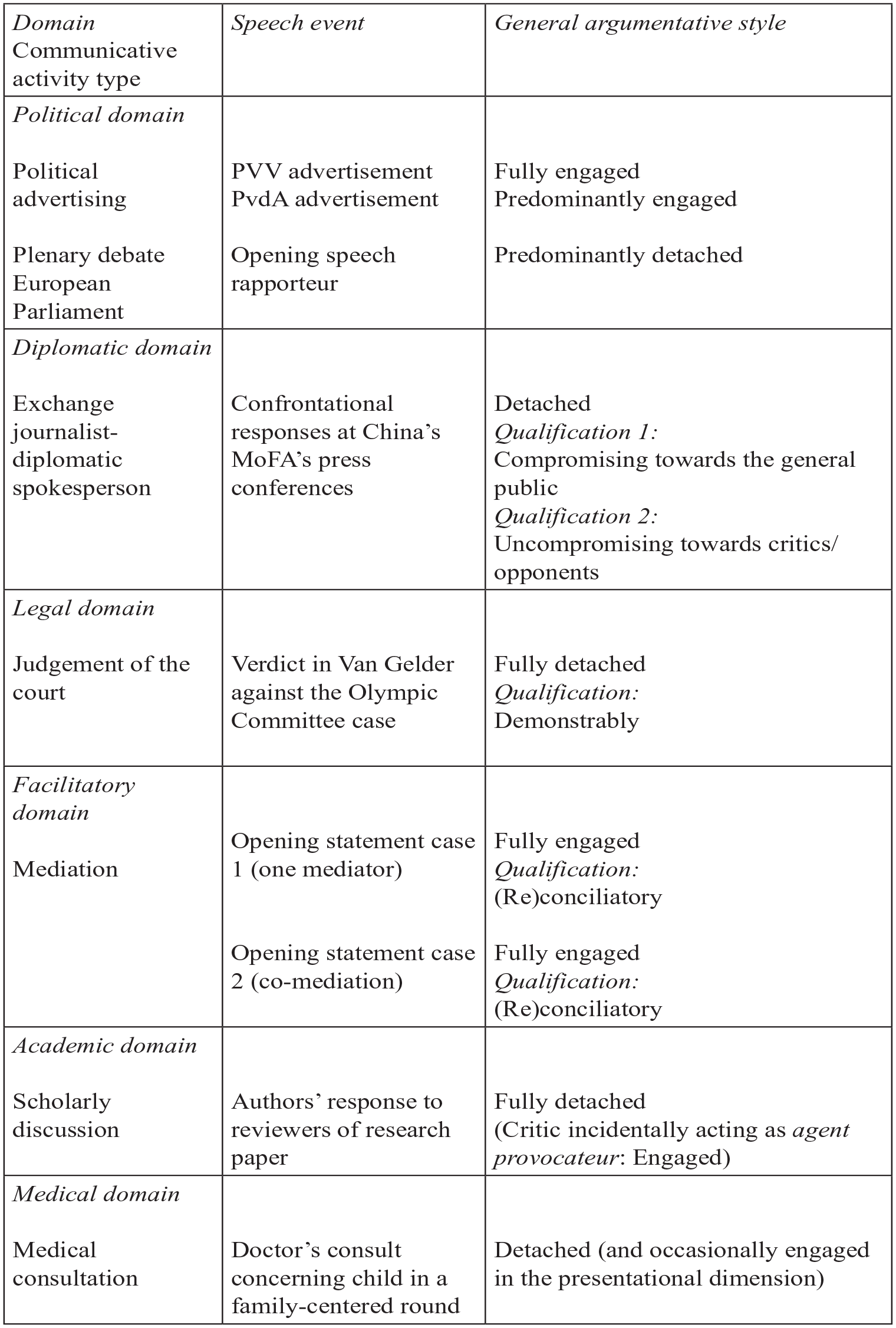
Argumentative styles utilized in different institutional macro-contexts.
The utilization of detached and engaged argumentative styles in a variety of different institutional macro-contexts shown in Figure 1 allows for some general observations. First of all, it is striking that the argumentative style utilized in the argumentative discourse conducted in a certain communicative activity type is in certain cases distinctly detached and in certain other cases distinctly engaged.
In communicative activity types in other communicative domains that were examined the argumentative style is as a rule not so uniformly and unequivocally of one particular category as in the communicative activity types from the legal, the facilitatory and the academic domain. In the political domain, both the utilization of an engaged argumentative style and the utilization of a detached argumentative style readily occur. The observation that the argumentative style may be detached or engaged to a certain extent or to a certain degree may in some cases also apply to (certain components of) communicative activity types from other domains – sometimes even to the argumentative style utilized in a court case in the legal domain or in a mediation case in the facilitatory domain.
It happens in particular cases also that the argumentative style is detached or engaged in a specific sense. The argumentative style is then characterized by having a special quality as a distinctive feature. In the verdict in the Van Gelder case, for instance, the court’s detached argumentative style has the special quality of being demonstrably detached – which is characteristic of such legal verdicts. In the three confrontational responses given by spokespersons at China’s MoFA’s press conferences discussed, the situation is more complicated, though by no means exceptional: the argumentative style utilized in the confrontation stage of the argumentative process gone through in this diplomatic communicative activity type is basically detached. However, in the imagined discussion with the primary audience consisting of the international general public it is detached in a compromising way, while in reacting to a secondary audience consisting of China’s critics or opponents it is detached in an uncompromising way. This means that the argumentative style utilized in this diplomatic communicative activity type is detached in the specific sense of having as a distinctive feature the special quality of being compromising in the one direction (from spokesperson to the international general public) and uncompromising in the other (from spokesperson to China’s critics) – which is in both cases a special trait of an engaged argumentative style.
There are also communicative activity types in which an organic mixture of detached and engaged argumentative styles is employed – in a specific combination or in alternation. Such a systematic mixture of argumentative styles from different categories will generally be found in hybrid communicative activity types, in which communicative genres that are prototypically used in different communicative activity types or domains are now employed jointly. It is the need to realize the complex institutional point of a hybrid communicative activity type by pursuing simultaneously various institutional aims, associated with different institutional backgrounds, that gives rise to the utilization of such a specific combination of argumentative styles. When the mixture is not random but conventional, it can even be prototypical of a particular communicative activity type.
Based on these observations, we draw some tentative conclusions about the prototypical utilization of detached and engaged argumentative styles in the various institutional macro-contexts of the communicative practices examined. From the reported results of the analytical empirical research it is clear that the argumentative style that is chosen, as a rule, does not solely depend on the arguers’ personal preferences for shaping the argumentative discourse in a particular way, but is to a greater or lesser extent determined by the institutional needs and requirements of the communicative activity type or communicative domain in which the argumentative discourse takes place – in particular by the primary and secondary institutional preconditions prevailing in the institutional macro-context concerned. This means that in cases where this macro-contextual determination is clear the argumentative style that is utilized is prototypical of the communicative practice concerned (which can be a specific communicative activity type but may also involve a whole cluster of activity types). We will illustrate this observation by mentioning some striking examples from the empirical research of the seven communicative activity types we have focused on.
In pronouncing a verdict in the legal domain, for example, a court is conventionally expected, based on the institutional preconditions of a court case, to utilize a detached argumentative style; it cannot just opt for utilizing an engaged argumentative style when it feels like it. This is because judges, in order to function properly in doing justice, in pronouncing their verdict, qualitate qua, need to convey objectivity in their approach, reliability in dealing with the intricacies of the parties’ case, and independence in their judgement about the case – the defining characteristics of a detached argumentative style. This applies in fact to all argumentative practices in which the values of objectivity, reliability and independent judging prevail. In the political domain, for instance, it goes for law making debates in the European Parliament that are primarily aimed at problem-solving. In our view, this predilection for objectivity, reliability and independent judging may also explain the observed dominance of a detached argumentative style in the family-centred doctor-patient consultation, in spite of different ideological preferences. In the facilitatory domain, on the other hand, an engaged argumentative style is generally favoured. This is, again, related to the institutional background of the communicative activity types that have developed in that domain: the institutional point they are designed to realize, and the institutional preconditions prevailing in these communicative practices.
Along these lines we can elucidate the prototypical utilization of detached or engaged argumentative styles in some of the communicative activity types examined. A certain argumentative style is prototypical if its utilization can be explained by referring to the institutional background of the argumentative discourse concerned and the institutional preconditions activated by the institutional macro-context in which the discourse takes place. Unlike ‘stereotypical’ utilizations of argumentative styles, dependent on their frequency of occurrence, prototypical utilizations of argumentative styles are a matter of analytic expectations based on knowledge of what kind of argumentative style is suitable in the institutional environment.
The detached argumentative style utilized by the court in its judgement in the Van Gelder case is both distinct and prototypical. That it is prototypical can be explained by referring to the institutional preconditions applying to this communicative activity type that the court should be objective, neutral and independent. It is due to these institutional preconditions that the argumentative style that is to be utilized should have the special quality of being distinctly detached in a specific sense, viz. demonstrably detached.
The engaged argumentative style of the mediators in their opening statements is also distinct and prototypical. Its prototypical character can, again, be explained by referring to the institutional preconditions pertaining to this communicative activity type. Although the institutional preconditions are in this case not official and less binding, all those familiar with the communicative activity type of mediation understand that mediators should always be fully committed to the cause at issue, connect strongly with the participants they address in their opening speech, and include these people with all reasonable means available in the mediation process.
In the PvdA’s political advertising, next to an engaged argumentative style, at times also a detached argumentative style is utilized. In this case, the utilization of neither of these two argumentative styles nor their combination is really distinct or prototypical. The utilization of both argumentative styles fits in well with the institutional background of the communicative activity type of political advertising but is in neither case determined by the institutional preconditions pertaining to this communicative activity type. The institutional background of a political advertisement leaves the advertisers a great deal of freedom to opt for the argumentative style of their choice. A complication involved is that this communicative activity type is a hybrid, so that a complex institutional point needs to be realized. In pursuing simultaneously the multiple goals of a political advertisement, both detached and engaged argumentative styles can be utilized. Each of them can have its own function, and no proportional or other division is prescribed.
Conclusion
In this article we have discussed some recent research results concerning the utilization of argumentative styles. This research starts from a new theoretical perspective in which the three aspects of strategic maneuvering are viewed as the constitutive dimensions of argumentative style. In the research argumentative styles are identified by tracking down the argumentative moves made in the dialectical routes taken in the discourse to comply with the arguer’s strategic considerations. Seven speech events exemplifying communicative activity types from a variety of communicative domains are examined for the impact of the institutional preconditions pertaining to these communicative activity types on the argumentative style that is utilized. Thus it becomes clear that there are functional differences between the utilization of argumentative styles in different argumentative practices. In some cases they manifest themselves in a specifically shaped detached or engaged argumentative styles. Future research should make the picture thus acquired more complete.
Next to the argumentative practices analyzed so far, other communicative activity types in the same and in other communicative domains need to be examined. Not only for the general argumentative style that is utilized throughout but also for the confrontational, opening, argumentational and concluding argumentative styles brought to bear in the various stages of the argumentative process. It also needs to be established which properties of the argumentative styles identified are individual idiosyncrasies and which properties are characteristics of an argumentative style prototypical of a certain (cluster of) communicative activity type(s) because they relate to the institutional preconditions pertaining to the institutional macro-context in which the argumentative discourse takes place. It may happen that some striking characteristics of an argumentative style prototypically connected with a certain kind of argumentative practice show up in another institutional macro-context so that their most familiar institutional flavour penetrates the other discourse. A policy defence in the political domain with a demonstrably detached argumentative style, for instance, may then have the unmistakably juridical flavour prototypical of a legal indictment. It would be worthwhile to investigate the occurrences of such transfers.
In addition to the qualitative empirical research discussed, complementary empirical research making use of quantitative methods needs to take place to determine whether a certain prototypical argumentative style occurs so frequently in a communicative activity type or domain that it may be considered stereotypical. Other useful quantitative research could consist of testing experimentally the occurrence of the intended immediate effects and consecutive interactional consequences (Van Eemeren, 2018: 85; Van Eemeren and Grootendorst, 1984: 24) of the utilization of a particular argumentative style in specific communicative activities in a specific institutional macro-context. In this way more insight can be gained into how effectiveness through reasonableness is achieved in argumentative discourse.
A theoretical research theme waiting for further exploration is the categorization of argumentative styles. This exploration concerns extending as well as subdividing and precizating the current simple taxonomy of the two categories of detached and engaged argumentative styles. Qualifying labels such as demonstrably, (re)conciliatory and (un)compromising could play a part in subdividing these general categories into sub-categories. It also needs to be considered whether Occam’s razor should not incite uniting compromising argumentative styles with (re)conciliatory argumentative styles and uncompromising argumentative styles with polarising argumentative styles in the nomenclature. Special attention must be paid in refining the categorization to the argumentative styles incidentally or conventionally utilized in hybrid communicative activity types.
When it comes to comparative research within and between communicative domains, it is recommendable to start from a systematic analysis of the argumentative styles that are prototypical of specific (clusters of) communicative activity types. Across the various domains, it would be interesting to delve into the ideologically motivated ‘cultures’ of argumentative style that have developed in geographically or historically delineated environments. An example in the medical domain is the newly-born tradition of participatory medical consultation that replaces the earlier paternalistic tradition. In the paternalistic culture it is ultimately the doctor who decides upon the best course of action, based on models and biomedical data; in the participatory approach, based on contemporary ideals of patient-centred care, clinicians focus explicitly on the needs and preferences of the patients. Ideally, treatment plans are then the result of joint decision-making by clinicians and patients together.
Last but not least, we must realize that the argumentative styles that are utilized may be representative of the argumentative conduct of a particular individual, group or organization (‘brand’) – and in that sense prototypical. Then their utilization is to some extent determined by the argumentative habits of an individual, a group or an institution. It would be enlightening to find out which characteristics exactly make the argumentative style in such cases prototypical of that person, group or organization – and to what extent the institutional macro-context plays a determining role.
Footnotes
Declaration of conflicting interests
The author(s) declared no potential conflicts of interest with respect to the research, authorship, and/or publication of this article.
Funding
The author(s) received no financial support for the research, authorship, and/or publication of this article.