




Abstract
‘Place’ is central to police work. Not only does the law prescribe proper uses of public spaces, but officers learn how to infer suspicion from people’s conduct and appearances at particular places. This article uses conversation analysis to examine how officers formulate place to render suspicious behavior accountably visible in their interactions with the public. Data come from recordings of police encounters in two American West Coast cities – the first dataset constitutes dashcam videos, and the second, videos recorded during ride-alongs. Findings suggest that officers use place formulations to (1) indicate violations in legally prescribed uses of space, (2) highlight incongruent elements in civilians’ conduct (e.g. proximity to incriminating objects), serving as a basis for inferring concealed wrongdoing, and (3) cast civilians’ presence in particular geographical areas as ‘out-of-place’. As place formulations do things in the interaction (i.e. accusing, questioning, accounting), the meaning officers ascribe to place is contingent upon ongoing courses of action.
Introduction
Like many forms of social interaction, police encounters involve individuals (in this case, officers and civilians) gathering in each other’s immediate presence (Goffman, 1963), occasionally in private places, but most often in public ones. Thus, previous sociological and criminological scholarship has explored how ‘place’ and related spatial terms influence officers’ conduct and decision-making in their encounters with the public. Most commonly, these terms refer to the sociodemographic composition of different neighborhoods, which previous studies found to correlate with higher risks of being subjected to police use of force (Terrill and Reisig, 2003), racial bias (Meehan and Ponder, 2002; Novak and Chamlin, 2012), and different policing styles (Smith, 1986). Within this body of work, spatial terms comprise ‘vernacular categories of social structures’ (Coulter, 1982: 36), that is, external, macro-level structures exerting causal influence over participants’ behaviors.
Discursive psychologists have drawn from the work of cultural geographers (Sibley, 1995) to conceptualize space and place differently. More than the backdrop of social interaction, this body of work proposes that ‘place’ is socially constructed as participants orient and refer to it while making sense of each other’s conduct, especially regarding rules about acceptable behavior, identity, and belonging (Dixon, 2001; Dixon and Durrheim, 2000; Dixon et al., 2006; Stokoe and Wallwork, 2003; Taylor and Wetherell, 1999). This notion resonates with a conversation analytic approach to context. Departing from a ‘bucket theory of context’ (Heritage, 1984), conversation analysis proposes that participants continuously establish their context in and through social interaction as their actions display understandings of each other’s conduct (Schegloff, 1987, 1997) and their current location (Schegloff, 1972).
Therefore, interactional studies demonstrate the value of examining talk-in-interaction to discuss how officers ascribe symbolic meanings to different places (Gieryn, 2000), producing immediate consequences to the ongoing interaction. This article develops this idea by analyzing how officers formulate place during their exchanges with the public to highlight incongruent aspects in their subjects’ conduct, which serves as a warrant for police intervention. In what follows, I elaborate on this approach by bringing together insights from classic police ethnographies and conversation analysis.
The incongruity procedure and place formulations
Methodic police work is intimately linked to knowledge about places. Initially, apprentice officers must become acquainted with their district geographies, including street names and the localization of prominent public places, such as the statehouse, the firehouse, hospitals in the district, and main intersections (Rubinstein, 1993). Over time, officers develop more nuanced, ethnographically grounded schemes of interpretation about types of people, places, and events on their beat – that is, area knowledge (Bittner, 1970) – allowing them to infer where, when, and by whom certain offenses are perpetrated. Instead of viewing the streets as random places where they encounter the public, officers learn how to treat their beat as a ‘territory of normal appearances’, sensitizing themselves to unusual variations they treat as warranting further investigation – this is what Sacks (1972) terms the incongruity procedure. Two considerations are necessary to grasp the theoretical significance of this method.
Firstly, ethnomethodological studies conceptualize ‘seeing’ (either as a lay or professional activity) as a relational, socially embedded phenomenon. Whatever people observe, they do so (a) from somewhere, that is, within physical arrangements and a geographical area (Crabtree, 2000; Smith, 2017, 2021); and (b) for practical, situated purposes (Carlin, 2003; Hester and Francis, 2003). As the former has action imports for the activity at hand, the visual order and its constituent elements intertwine with social action. That is, members of society can use their knowledge regarding how activities are tied to specific places to assemble commonplace scenes of people using these structures. The incongruity procedure then comprises a situated practice for decomposing commonplace scenes and assembling incongruent (or illegitimate) combinations that officers treat as warranting police intervention (see ‘On Exchanging Glances’ (Sacks, 1989)).
Secondly, as law enforcement agents conduct police work through talk, police talk bears a fingerprint of its institutional business (Drew and Heritage, 1992; Sharrock and Watson, 1988), including with respect to officers’ area knowledge (Meehan, 2019). Thus, officers’ incongruity procedure becomes ‘accountably visible’ (Garfinkel, 1967; Meehan, 2019) in and through conversational practices (for interrogating, requesting, accusing, etc.). In this respect, the notion of place formulation serves as an analytical resource to examine this aspect of police talk. Schegloff (1972) explains that for any location, people can choose from a set of terms, each of which correctly names it by a correspondence test. The selection of the ‘right’ term, Schegloff explains, depends on participants’ respective locations (‘where-we-know-we-are’); their culturally shared commonsense geography (‘who-we-know-we-are’); and the topic of or activity being done in the conversation (‘what-we-are-doing-at-this-point-in-the-conversation’).
Thus, as the moral and spatial order intertwine, ‘place’ serves as a resource for producing different actions, such as accusations (Drew, 1978) and complaints (Stokoe and Wallwork, 2003). Likewise, officers’ practices for formulating place upon implementing different actions (e.g. initiating encounters, interrogating, and accusing, among others) assemble incongruencies between people’s appearances, actions, and their current setting, rendering them ‘policeable subjects’. That is, officers treat such incongruencies as breaching the moral order, serving as a basis to identify or infer wrongdoing and select people for interrogation. In this way, by analyzing place formulations, we can discuss how officers establish their mandate to proceed against overt wrongdoing but also ‘penetrate the appearance of innocence to discover craftiness hiding under its cloak’ (Bittner, 1970: 9).
Data and method
This article draws from two datasets. The first comprises a collection of dashcam videos (over 400) from an American West Coast city police department produced as part of standard police practices and obtained for a project that aims to identify interactional mechanisms to improve the quality of officer-civilian communication. The data were initially collected via institutional agreements developed and administered via government funding agencies and provided to the project’s corpus of police encounters. These videos are considered public documents according to the state legislation of the department they were collected from.
The second data source comprises several hundred hours of police encounters recorded during ride-alongs with the police department of a different West Coast city – the author did not make these recordings. An officer from the participating department introduced the researchers, explained the project, and asked for volunteers to have their interactions with civilians recorded. Once a subject has indicated an interest in participating, they received a brochure describing the purpose of the research, what they agreed to by participating in it, how researchers would manage privacy concerns in published materials, the risks of participating, and rights as a research subject (including that they could withdraw consent at any time). Regarding the civilian subjects, researchers could not know whom the police would contact in advance and could not intervene to request consent once the police had contacted them. Thus, after the officers had finished the contact, researchers gave civilians a brochure describing why the interaction was recorded, the contact information for the researchers, and how to withdraw the consent if they wished to do so.
The length of the videos in both data sets varies considerably (between 10 and 60 minutes), as well as their possible outcomes, ranging from arrest decisions, releasing civilians, or connecting them with other services such as healthcare providers. The videos are stored on a password-protected, encrypted data website that complies with human protocols.
The initial analytic step was to assemble a collection of place formulations. Such formulations included geographical locations (e.g. streets’ and neighborhoods’ names), physical structures of the environment (e.g. ‘bus stop’, ‘bathroom’, ‘street’, etc.), and non-referential terms (e.g. ‘here’). Building collections, Schegloff (1996) explains, allows us to examine the phenomenon of inquiry in its many variations, highlighting its distinctive features. In this way, because ‘place’ may assume distinct meanings, examining the granularity of such formulations demonstrates how officers draw from different conceptions of places and people to ground their suspicion. Second, as a CA approach focuses on how participants systematically implement courses of action in social interaction, the analysis focuses on how officers’ selection of specific place terms implements different actions, such as questioning, accusing, and accounting for their decision to approach civilians.
The final collection comprises 20 videos, which were transcribed using Jefferson’s (2004) convention. Police officers are referred to as ‘PO1’ (where the number refers to their order of appearance in the video), and civilians are referred to as either CM1 or CF1 (respectively, ‘civilian male 1’ and ‘civilian female 1’). The transcripts included no personal information; in the case where figures were provided, their colors and contrast were altered to prevent the identification of the participants.
Analysis
The extracts below demonstrate how officers use place formulations to establish their grounds for suspecting civilians and initiating police encounters. Across these cases, the granularity of such descriptions varies as they draw from different conceptions of places to render their interlocutors ‘policeable subjects’. I first analyze instances where officers indicate that their interlocutors’ actions have breached legal norms concerning the use of space. Next, I turn to cases where officers infer other concerns from civilians’ legal violations or otherwise unusual public conduct, serving as a pretext for an investigatory stop. Lastly, I analyze cases where particular configurations of circumstances render a person’s very presence at certain places evidence of possible wrongdoing.
Place formulations and legal offenses
Foremost, police officers use place formulations to indicate that civilians’ public conduct violates legally prescribed uses of place. In most of these cases, the reason for the encounter exhausts its possible outcomes, that is, after administering the proper sanction for their legal violation, officers release their interlocutors (see Kidwell, 2018). Since most traffic violations involve civilians making improper use of the streets, examining such instances allows us to begin our analysis of how officers assemble incongruent appearances related to legal violations. See, for example, extracts 1 and 2, where officers stop people for speeding. Both videos begin with the officers approaching their interlocutors’ cars from the driver’s window:
In each instance, police officers highlight (a) an action their interlocutors have undertaken and (b) a place formulation that casts (a) as a legal violation given their relative position on the streets. Across the cases in this paper, the relationship between (a) and (b) builds upon more or less explicit assumptions regarding shared commonsense expectations regarding how civilians must conduct themselves in public.
In extract 1, the place formulation includes a rule regarding how civilians must use space (‘twenty miles an hour school zone’); the civilian’s misconduct becomes apparent when the officer indicates they were ‘doing thirty-eight’ (lines 4–6). In extract 2, the officer more explicitly elaborates on the rule his interlocutor has infringed (‘you’re doing forty-one miles an hour coming down the hill. You have to go thirty, okay?’ lines 7–9). Moreover, the use of precise numbers (respectively, ‘thirty-eight’ and ‘forty-one’) accounts for the officers’ precision in establishing that a violation occurred (see Sacks, 1988), which also relates to the legal nature of the offenses in question, that is, establishing one was driving above the speed limit requires officers to articulate how fast civilians were going and how fast they were allowed to go.
Importantly, as these formulations mark a breach of legally prescribed uses of place, they have an accusatory character. In the cases above, civilians accept the blame imputation. Brief pauses precede their responses (see lines 7–8 (extract 1) and 10–11 (extract 2)), which in legal contexts is a design feature of dispreferred responses, such as guilt admissions (Atkinson and Drew, 1979). Instances where civilians deny blame imputation further demonstrate how participants manage the accusatory character of such formulations. For example, in extract 3, an officer approaches a civilian for having his car parked in the middle of the street, but the latter claims he was stopped, which does not constitute an offense. The encounter happened around 8:30 pm near an intersection with moderate vehicle and foot traffic; the officer and the civilian are the only parties involved in the exchange:
Simply indicating that a person had their car parked on the street does not establish a legal violation; in this respect, ‘in the middle of’ (lines 5–6) specifies the civilians’ position on the streets to mark the incongruent character of his conduct (similar to ‘down the hill’ in extract 2 (line 8)). Interestingly, the officer appears to initiate the word ‘stopped’ before repairing and using the word ‘parked’ instead (line 5), upgrading his accusation. Whereas the former involves a momentary suspension of motion, the latter implies permanence and better fits the officers’ account for characterizing a behavior into a crime category (Edwards, 2008). In turn, the civilian explains that he was looking for a person who stole his computer (lines 10–14), accounting for having his car stopped for a more extended period without fitting the ‘parking’ category. Therefore, differentiating ‘parking’ from ‘stopping’ is central to determining whether the civilian committed an offense.
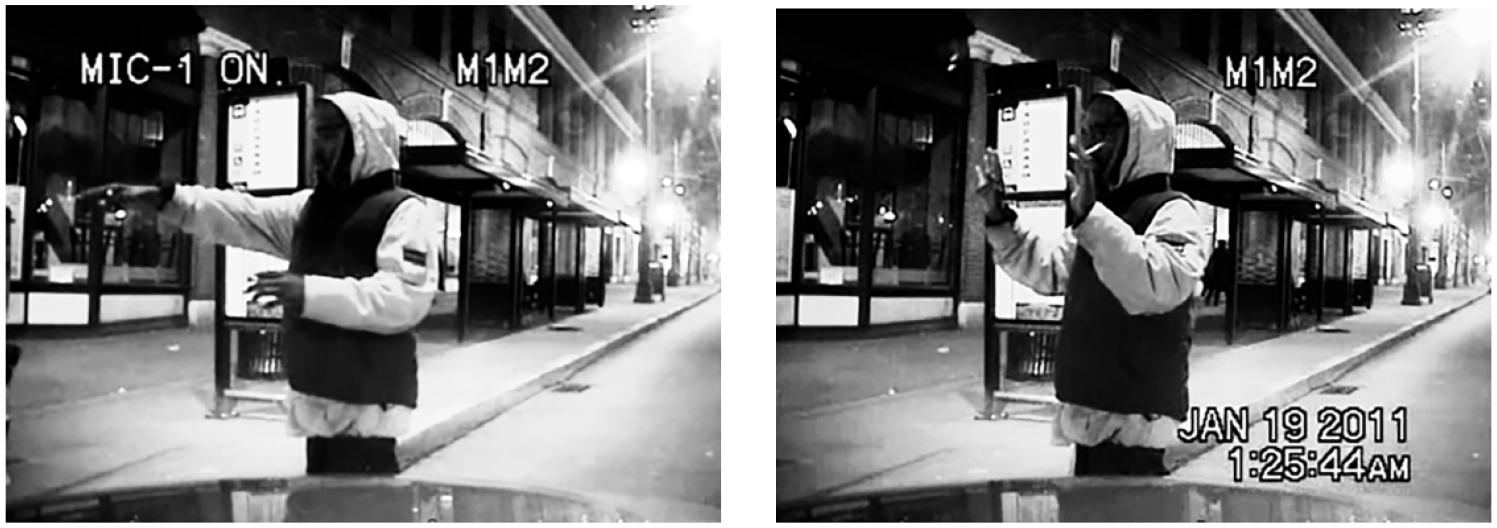
An alternative way that civilians respond to officers’ accusations is by reformulating the place they are occupying. For example, extract 4 begins with an officer driving to a bus stop. After stopping and leaving his car, a man moves to the front of the cruiser (presumably per the officer’s request; the audio begins shortly after), and the law enforcement agent asks about him smoking at a bus stop. However, the civilian refuses that he was at the bus stop.
The officer initiates the encounter by asking if the civilian knew it was illegal to smoke at a bus stop (line 1). According to Raymond et al. (2022), officers use ‘do you know’ to remind civilians of a particular rule and get them to adjust their conduct to what it requires, anticipating their recognition of the rules they have breached. On the other hand, ‘you know’ also seems to entertain the (unlikely) possibility that civilians were unaware of having committed an offense, which Raymond et al. (2022) suggest is characteristic of quality-of-life laws (e.g. disorderly conduct, vagrancy, and loitering). People’s commonsense knowledge about illegal conduct typically involves serious crimes or traffic violations – think, for instance, how strange it would sound to ‘remind’ civilians that they are not allowed to commit theft, burglary, or murder (Raymond et al, 2022).
The civilian claims that he was not at the bus stop but on the sidewalk and points to his last location (line 3, figure 1), but the officer tells him it was still bus prosperity (line 5). In this way, participants seek to establish the ecological border between the bus stop and the sidewalk to determine whether a legal violation occurred. In his post-expansion, the officer provides precise criteria concerning the distance the civilian must have been from the bus stop (lines 7–8). Notice that upon accepting the officer’s explanation, the civilian apologizes and raises his hands (line 6, figure 2), suggesting an orientation toward committing an offense and, consequently, the accusatory character of their previous exchange.
Extract 5.
In brief, officers use place formulations to assemble incongruent combinations between people’s visible conduct and their relative position on the streets. Since legally prescribed uses of place typically involve objective criteria that differentiate proper conduct from inadequate ones, in all but one case, officers use measurement systems to establish that an offense has occurred. On civilians’ part, they attempt to re-specify some aspect of their circumstances – either their prior behavior (extract 3) or their position on the streets (extract 4) – to avoid blame imputation.
Place formulations and inferences of moral character
Aside from initiating encounters by reference to overt legal violations, officers may infer hidden wrongdoing from civilians’ visible conduct. However, which aspect of their conduct serves as a basis for doing so varies. First, officers may treat civilians’ legal violations (such as the ones discussed so far) as a pretext for initiating an investigatory stop. In such cases, the original reason for the encounter does not exhaust its possible outcomes, meaning that officers infer other aspects of their interlocutors’ conduct while working out an accountable decision. For instance, in extract 5, the officer approaches a civilian for jaywalking; more than sanctioning the civilian for this violation, though, he focuses on gathering his interlocutor’s personal information:
Similar to the previous extracts, the officer uses a place formulation to indicate an incongruity in the civilian’s use of a public place (‘walking around in the middle of the street’, lines 2–3). However, instead of proceeding to sanction the civilian for his traffic violation, he infers other, possibly policeable, aspects of his subject’s conduct (being ‘mental’ or ‘high’, lines 2-3) and requests an ID (lines 5-6). The mismatch between the reason for the encounter and the apparent non-application of the sanction it presupposes suggests the officer treated the civilian’s offense as a pretext for investigating other matters, marking the open-ended nature of the encounter (Meehan, 2019). Upon facing resistance, the officer repeatedly recycles the place formulation (lines 5–6, 12–13) to establish his grounds for initiating the stop and, consequently, the civilian’s obligation identify himself. In lines 13-15, he more explicitly marks the “punishable” character of the civilian’s conduct to outline an alternative, more punitive trajectory (i.e., giving him a citation for walking in the middle of the street). In this way, through a place formulation, the officer invokes a legal framework within which he could resort to his authority to pursue compliance.
In turn, the civilian uses a different formulation to resist the officer’s authority. However, unlike extract 5, where both parties dispute the ecological borders of physical structures, the descriptions here are ontologically distinct. Walking ‘in the middle of the road’ refers to the civilians’ physical location to establish a misdemeanor, whereas ‘walking in my neighborhood’ (lines 17–18) claims membership to a geographical area to account for the ordinary character of one’s action.
A second aspect that officers use to infer concealed wrongdoing concerns people’s breaches of the moral order (i.e. taken-for-granted social norms governing everyday life (Garfinkel, 1967)), even if these do not constitute legal violations per se. In other words, officers entertain covert wrongdoing to explain overt ‘odd’, ‘out-of-place’, or ‘unusual’ public conduct. For instance, in extract 6, two officers approach two men they spotted simultaneously coming out of a public bathroom.
Sacks (1995) explains that people may use place terms for the activity being done at them (e.g., ‘I’m going to the bathroom’ or ‘I’m going to bed’), suggesting that certain places have activities categorically tied to them. In this way, the officer’s opening queries (‘what’s going on?’ line 1; and ‘what are you guys up to?’ line 3) orient to civilians engaging in some activity other than the routine use of the public bathroom. More than simply greeting the civilians, these questions implicitly establish an incongruent aspect of their conduct. One of the officers more explicitly formulates his basis for suspicion in line 6: ‘() you guys coming outta that bathroom man’. After the civilians do not respond, he specifies the out-of-place character of such an action and requests an account: ‘I saw the two of you guys come outta the bathroom. What’s going on?’ (line 8). Particularly, “the two of you” marks a violation in how people typically use the bathroom.
Because bathrooms serve as involvement shields – that is, they block ‘perception of either bodily signs of involvement or objects of involvement’ (Goffman, 1963: 39)–going to the bathroom in pairs violates its very purpose. Moreover, potential wrongdoers could benefit from this ‘involvement shield’ to commit illegal actions in public spaces. The incongruency procedure involves categorizing objects and places according to offenders’ favorite misuses. ‘For the police, objects and places having routine uses are conceived in terms of favorite misuses’ (Sacks, 1972: 292). In this case, the officer orients to ‘smoking’ as a potential misuse of public bathrooms (line 20) to explain the civilians’ seemingly breach of the involvement shield, assembling the appearance of smoking from the observation that two men came out of the bathroom at the same time.
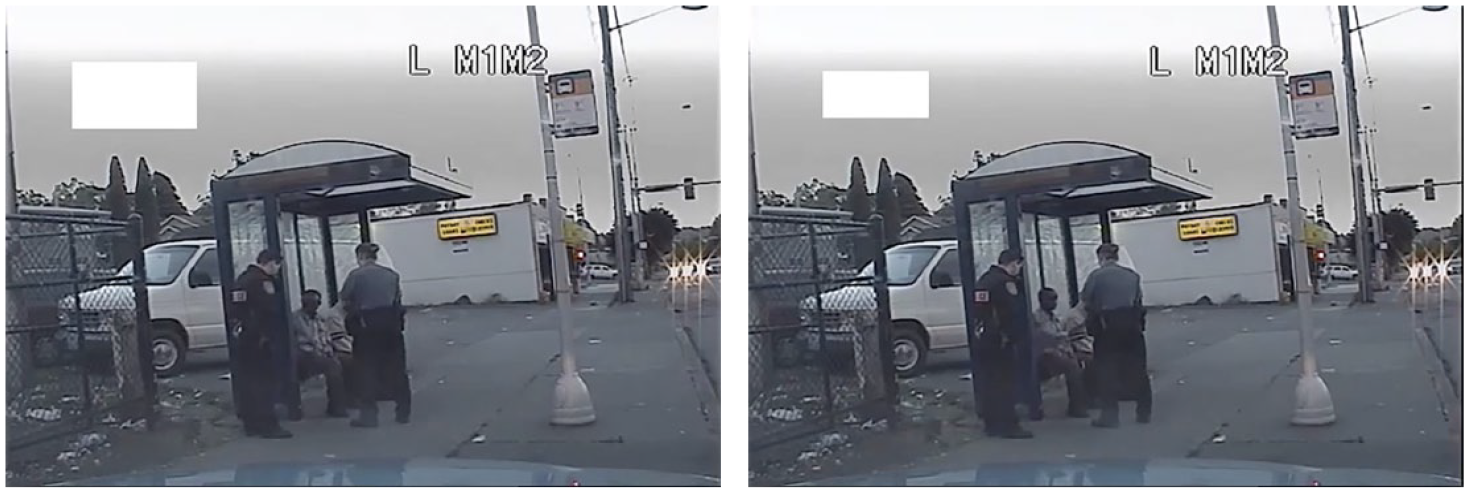
Other spatial features may also function as an involvement shield, albeit in different ways. In the following case, officers approach civilians sitting at a bus stop because there is an open container next to one of them, which they treat as evidence their subjects had been drinking in public. Importantly, this case falls into the third and last category of officers’ basis for inferring concealed wrongdoing from visible cues: proximity to incriminating objects. Concerning the involvement shields, the physical space the civilian occupies (i.e. the bus stop) affords him the claim to be engaged in a rather mundane activity: waiting for the bus. Although neither party explicitly uses place formulations, the action import of their utterances depends on the place they are in.
Like extract 6, the officer’s initial question in line 4 suggests an orientation to civilians engaging in an action other than what their public appearances display, since one would assume that people sitting at the bus stop are waiting for the bus. As the civilian expresses puzzlement with the question (line 5), the officer points to the bottle and asks if it belongs to him (line 6). Thus, the civilian’s physical proximity to an open container makes him vulnerable to the inference that he had been drinking in public. Although the civilian cannot control his physical distance from the object, he can, nonetheless, establish a social distance from it.
After the officer asks if the civilian could pick the bottle up for her, the civilian makes vertical palm (VP) open-hand prone gesture (figure 3) while claiming he is not going to touch it (line 15). This class of gestures, Bressem and Müller (2014: 1596) explain, is ‘semantically motivated by the effect of actions of removing or keeping away of things (. . .) annoying or otherwise unwanted objects’. In this way, the civilian’s basis for not cooperating is that doing so would have required him to get in touch with an object he has rejected thrice before, that is, one that he does not own and that, on this basis, he can reasonably not want to touch, in case it is dirty, for example. Finally, CM1 claims he was just waiting for the bus and points to the street (line 16, figure 4), accounting for the mundane character of his public conduct. Thus, by combining talk-in-interaction, gestures, and material elements of the interaction, the civilian cast an alternative contextual configuration (Goodwin, 2000) of his circumstances. In this respect, the physical space he occupies, that is, the bus stop, affords an account for the mundane character of his actions. In other places (e.g. a public bench), it would have been more difficult, albeit certainly not impossible, to explain why he was sitting next to an open container without owning it.
Extract 7.
In brief, police officers render appearances of concealed wrongdoing accountably “visible” from the juxtaposition of incongruent elements in people’s public conduct (see Carlin, 2003), even in cases where these do not constitute offenses per se. Likewise, civilians draw from different elements of the environment to assemble ordinary appearances, accounting for the moral character of their actions.
Person-place incongruencies: Inquiring about out-of-place presences
In the last case, I discussed how the civilians’ proximity to an incriminating object made them vulnerable to the inference that they were committing an offense. In what follows, I expand on this idea by discussing how particular configurations of circumstances may render civilians’ very presence in specific geographical areas a policeable matter. In these instances, although officers use the same non-referential place term, ‘here’, its meaning invokes different conceptions of places to cast people as out-of-place, thereby suspicious.
For example, officers may refer to their interlocutors’ current location to infer criminal activity. In extract 8, officers are called to address a domestic dispute. The parents say that their son had left home after an argument taking the family’s pickup truck with him; they also inform that their son had been drinking. The officers find the suspect in a different part of town, sitting against a metal roll-up overhead door. Of particular interest is how they use a place formulation to index that the civilian has committed a DUI:
The officer’s open query asks how his interlocutor got to his current location. ‘Here’ (line 1) has many possible meanings by a correspondence test (Schegloff, 1972). After the civilian says he walked there (line 2), the officer more directly elaborates on the non-referential term: ‘you walked all the way from seventeenth’ (lines 3–4). ‘Here’ then refers to the civilian’s distance from his previously known location. ‘All the way’, particularly, elaborates the officer’s skepticism regarding how the civilian claims to have closed such a distance, inferring other (possibly illegal) actions he must have undertaken to do so (i.e. driving or ‘running’, which he seems to entertain as a joke, line 10). In this respect, ‘how’ (line 1) refers to the mode of transportation, as opposed to, for example, the civilian’s experience upon arriving (to which ‘just fine’ could function as a response).
Although the officer moves to a different topic, establishing whether the civilian has been drinking (line 14), he later arrests his interlocutor for DUI (data not shown), thereby rejecting ‘walking’ as an explanation for the civilian’s presence in his current location. Notice that the officer knew the civilian had been driving before approaching him. Still, he does not rely on the information obtained from his parents, whose veracity, perhaps, the civilian could have questioned. Instead, the officer refers to the civilian’s presence in one location to infer an action he must have taken to arrive there.
Police officers may also have other, more local bases for inquiring about people’s presence in specific places. In extract 9, a security guard calls the police after spotting a suspicious person near the library where he works. The officers arrive at the scene (the timestamp indicates 11:15 pm) and approach a man sitting inside a car. The civilian claims he is a security guard there, but he did not call them, posing the officers a problem: could this man be the suspicious person hiding his identity?
The officer’s opening question cast a definition of the circumstances: they are responding to a call about a suspicious person in the library surroundings (which ‘here’ in lines 1, 6, and 11 refers to). The officer uses an optimistic question design as he orients to the civilian being the caller (Heritage and Raymond, 2021), but the civilian says he did not call them (line 4) and confirms that he works there (line 8), posing a problem. Upon arriving, officers knew about two people: the security guard who called them and a suspicious man wearing a mask. The civilian’s claim to be a security guard who did not call the police suggests whether there is a third person in the area of whom officers were unaware or he is a suspect trying to hide his identity. Notice that PO1 recycles both his questions (lines 11 and 14), marking a mismatch between the information from the dispatcher and the civilian’s responses, rendering him a suspect. Thus, the officer scrutinizes his basis for being there by requesting an ID and checking the civilian’s uniform (lines 23, 28, and 29).
Interestingly though, officers seem to orient to other, more tacit elements to ground their suspicion. After getting the civilian’s ID, one of the officers returns to the cruiser. At the same time, the second officer remains next to the civilian’s car when a woman with a leashed dog walks toward them. Despite her proximity to the scene, thereby also sufficing the criterion for being a suspect, the officer does not treat her such – see extract 10:
Notice that after asking where the woman lives (line 1), the officer does not request a form of identification to confirm the information she provided, suggesting that the query did not address her accountable basis for being there. Indeed, by proceeding to advise her to return home (lines 5, 7, 9, and 11), the officer seems to categorize her as a resident as opposed to a suspect. In this way, officers may have other, more implicit bases for inquiring about people’s warrants to be in different locations. For example, we may question whether he treated the dog as accounting for the woman’s presence on the streets, that is, ‘walking the dog’ is an activity categorically tied to dog owners, whereas ‘committing burglary’ is not.
Although it is impossible to determine officers’ ‘true motives’ for suspicion, it is worth noting that they seem to draw from more explicit or implicit elements in the scene to assemble appearances of criminal activity. To illustrate this point, I examine a more ambiguous case where an officer relies on tacit people and place categorizations to inquire about the civilian’s presence in a particular neighborhood.
In Extract 11, civilians called the police because they spotted what appeared to be a person holding a gun inside a car (it turns out that whoever called the police mistook a working tool for a weapon). The officers approached the vehicle, which was stopped in front of someone’s driveway, and proceeded to ask about the incident. Before releasing the civilians, the officer calls the driver aside and inquires about his presence in that area. The officer treats his interlocutor’s presence in that area as out-of-place, rejecting the civilian’s explanations for being there.
Throughout the interaction, the officer rejects the civilian’s claim that he was giving his friend a ride. Of particular interest here is how he relies on place and person categorizations to ground his skepticism. Take, for instance, his opening question: ‘so, what are you doing here?’ (line 1). As established in line 17, ‘here’ refers to the ‘South End’, suggesting that the interrogatory sequence addresses the civilian’s accountable basis for being in that specific part of town. Before the civilian can respond, PO1 indicates that they have run the civilian’s name down (lines 1–2). Alluding to the civilian’s personal information casts this specific person’s presence in the South End as requiring an account, possibly suggesting that some form of categorization was involved.
Although the officer refers to other elements while elaborating on his skepticism (e.g. suggesting the car has no spots left, line 23), his reluctance seems to build upon a person-place incongruency. When PO1 stops challenging his interlocutor’s explanation, he still does not treat that answer as sufficiently accounting for his presence in the South End, asking what else the civilians were doing “besides that” (line 25). In line 27, the officer confirms that his subject worked at McCormicks (fictional name) before challenging the civilian’s response that he was doing ‘nothing’ (lines 26–34). Personal information about one’s workplace links the civilian to a particular geographical area, 1 tacitly challenging his warrant for being in a different one. Although the officer’s suspicion remains unsettled (see line 35), he nonetheless releases the civilians, suggesting that his basis for suspecting them does not meet other legal requirements to pursue further investigation.
Thus, appearing to belong to a different area seems to suffice the officer’s threshold for suspicion regarding the possible reasons for his interlocutor’s presence there. According to Sacks (1972: 286), ‘[t]he police too treat ecological borders as of normative import. Persons whose appearance indicates that they are not normal members of an ecological area, e.g. whites in negro areas, the apparently poor in wealthy areas, etc., are subject to having a request made for “their papers” and an interrogatory made as to the reason of their presence’. Studies have discussed the race-and-place effect on police officers’ suspicion (see Meehan and Ponder, 2002) – the instance at hand involves a black police officer inquiring about the presence of white civilians in a predominantly black area. 2 As this case alone does not provide enough evidence to confirm such an inference, future research should build collections of cases involving racial categorizations during police encounters to examine whether an implicit form of categorization was at play, illuminating the often unpronounced ways that the race-and-place effect works (see Whitehead, 2020).
Across these cases, officers use different conceptions of place to cast their interlocutors’ presence across various locations as suspicious without necessarily observing suspicious actions firsthand. Such conceptions of place include inferences about actions civilians must have undertaken to arrive at their current location (extract 9), information from callers (extracts 9 and 10), and more tacit assumptions about people and places combinations (extracts 10 and 11).
Conclusion
In this paper, I have analyzed how officers use place formulations to mark incongruencies in civilians’ conduct, rendering ‘criminal’ or ‘suspicious’ conduct accountably visible. Whereas previous CA studies have discussed how participants use spatial categories to further complaints in disputes (Smith, 2017, 2021; Stokoe and Wallwork, 2003), in situ police work involves specific institutional contingencies. For example, law enforcement agents must not only proceed against overt criminal acts but look past appearances of innocence to find hidden craftiness (Bittner, 1970). As such, findings demonstrate how officers balance what they can directly observe or otherwise infer from their subjects’ public conduct.
First, officers may use place formulations to juxtapose their interlocutors’ visible behavior and the place they occupy to mark a breach in legally prescribed uses of space. In such cases, officers typically use a measurement system (Sacks, 1988) to typify civilians’ conduct as a violation according to established legal norms (see also Edwards, 2008). Second, officers also infer concealed wrongdoing from people’s public conduct without witnessing a legal violation per se. Likewise, particular classes of offenses become visible through the juxtaposition of incongruent elements in a given scene – officers may treat ‘unusual’ or ‘odd’ uses of public spaces and people’s proximity to incriminating objects to make inferences of moral character. Notice that such offenses do not constitute legal violations per se, yet, officers use them to select individuals for questioning, requiring an account for their public conduct. Third, officers may treat civilians’ presence in specific geographical areas as suspicious. Importantly, this class of offenses does not constitute offenses such as trespassing, which is a violation of legally prescribed uses of place. Instead, officers treat problematic civilians’ presence in areas where people are allowed to frequent otherwise. In this way, they rely on some personalized information about the civilian (including more tacit forms of categorization) to cast that-particular-person-at-that-particular-location as ‘suspicious’, regardless of their current conduct. The ‘race and place effect’ – that is, the disproportionate surveillance of individuals whose appearances indicate they belong to a different socioeconomic neighborhood (Meehan and Ponder, 2002) – exemplifies that (as seen in the last extract). Notably, the findings presented here only grasp the complex relationship between race categories and place formulations to analyze the ‘race and place effect’ in greater detail. Thus, future studies can dress this limitation by assembling collections (as Whitehead (2020) proposes) of cases where participants use racial and spatial forms of categorization.
Therefore, officers’ practices for formulating place constitute special inferential frameworks, that is, aspects of reasoning and inferences particular to the institutional context of policing (Drew and Heritage, 1992). Importantly, because these formulations bear an accusatory character, across the cases discussed, civilians’ responses assemble alternative mundane, congruent appearances to avoid blame imputation by reformulating their previous conduct (extract 3), location (extract 4), claiming membership to a geographical area (extract 5), and socially distancing themselves from incriminating objects (extract 7). Therefore, as place formulations do things in the interaction (such as, accusing, questioning, accounting, etc.), the symbolic meaning participants ascribe to place is contingent upon ongoing courses of action – this notion allow us to elaborate on CA’s contributions’ to criminological and sociological research about the police.
Whereas previous studies have foregrounded the importance of ‘place’ for methodic police work (Bittner, 1967; Rubinstein, 1993; Sacks, 1972), the analysis of talk-in-interaction better allows us to examine how participants themselves ascribe meaning to places. In contrast to other qualitative modes of sociological and criminological research, CA treats linguistic data as self-contained, that is, as methodic police work involves methodic ways of speaking, fine-grain analysis of police talk reveals crucial aspects of its institutional organization (Sharrock and Watson, 1988). In examining place formulations as a distinct phenomenon – including both mundane instances such as traffic stops and more complex cases where the basis for suspicion is more ambiguous – the findings demonstrate how officers draw from different conceptions of places and people to ground their suspicions and actions.
Footnotes
Acknowledgements
Thanks to Geoff Raymond, Kevin Whitehead, Jay Meehan, Ann Marie Dennis, and the anonymous reviewer for their suggestions.
Funding
The data collected in this research was funded by by the DARPA Strategic Social Interaction Module, Geoffrey Raymond, PI, Nikki Jones, Co-PI, and the William T Grant Foundation, ‘Talking Justice: Identifying interactional practices to improve the quality of police-civilian encounters’, Nikki Jones, PI, Geoffrey Raymond, Co-PI.