




Abstract
After navigating conceptual and empirical developments in frame analysis research, I reflect on cornerstones and weaknesses in its elaboration of a rigorous analytical prism. In the reflection, I discuss how combining the frame analysis conceptual toolkit with linguistics work on semantic grammars can perhaps help heal some of these weaknesses.
Introduction
In the early 2000s I found myself grappling with how to analyse social movement manifestos in the context of the so-called Global Justice Movement. I had collected data on the local chapters of the then new-born World Social Forum (WSF), 1 to understand if and how, as a supranational entity, this forum was facilitating the emergence of local, regional and cross-national alliances. I wanted to investigate the connections and the intertwining of local and transnational grievances, of concrete, grass-root demands and broader ideological positionings in the making of social contention. My work primarily focused on the material used in local social forums’ websites. Tracing structural connections (i.e. hyperlinks) among forum websites turned out to be a rather straightforward task: web crawlers 2 already existed, contemporary social media had not yet surfaced, and social network analysis offered all the means to discuss the resulting networks along national and language belonging (Vicari, 2014). But how could I study alliances built through meaning rather than hyperlinks? How could I research commonalities and differences in the way local manifestos shared on local social forums’ websites were articulated on the ground and with the WSF’s motto ‘Another world is possible’ on the background?
The 1980s ‘cultural turn’ in the social sciences drew new attention to the relationship between cultural meaning and social structures (Mohr, 1998), with social movement scholars starting to shift their focus from ideology – as a grand and relatively stable value system – to more fine-grained cognitive processes happening on the ground of social contention. Increasing academic work set out to analyse how beliefs, values, and goals were formulated, negotiated or dismissed through processes of signification, namely, through the attribution of meaning. But how? By the early 2000s, frame analysis had become a popular entry point into the study of the ‘meaning work’ (Benford and Snow, 2000: 613) or ‘symbolic dimension’ (Della Porta and Diani, 2006: 64–87) of social movement collective actors. So, I, like many others, found myself exploring the theoretical, methodological, and practical implications of using frame analysis to study meaning in the context of collective action.
In this article, I will first navigate conceptual and empirical developments in frame analysis research to highlight what may be seen as cornerstones and weaknesses, especially in its approach to discourse. Then, drawing on my own methodological work to research early 2000s social movement manifestos (Vicari, 2010), I will move on to discuss how linguistics can meet frame analysis and perhaps heal some of its weaknesses.
Frame analysis: The jigsaw puzzle
Unpacking frame analysis, as a theoretical and an analytical paradigm, is a complex process. A process that can entail extensive mapping exercises meant to trace (often hidden) connections and overlaps, in a literature that primarily spans across social movement research and media and communication studies. The next three sections will briefly engage with these mappings to offer at least a glimpse of the cosmology of concepts and operationalisations that have so far been used to pin down but also develop frame analysis as a theoretical and an empirical means to study meaning making.
Mapping frame concepts
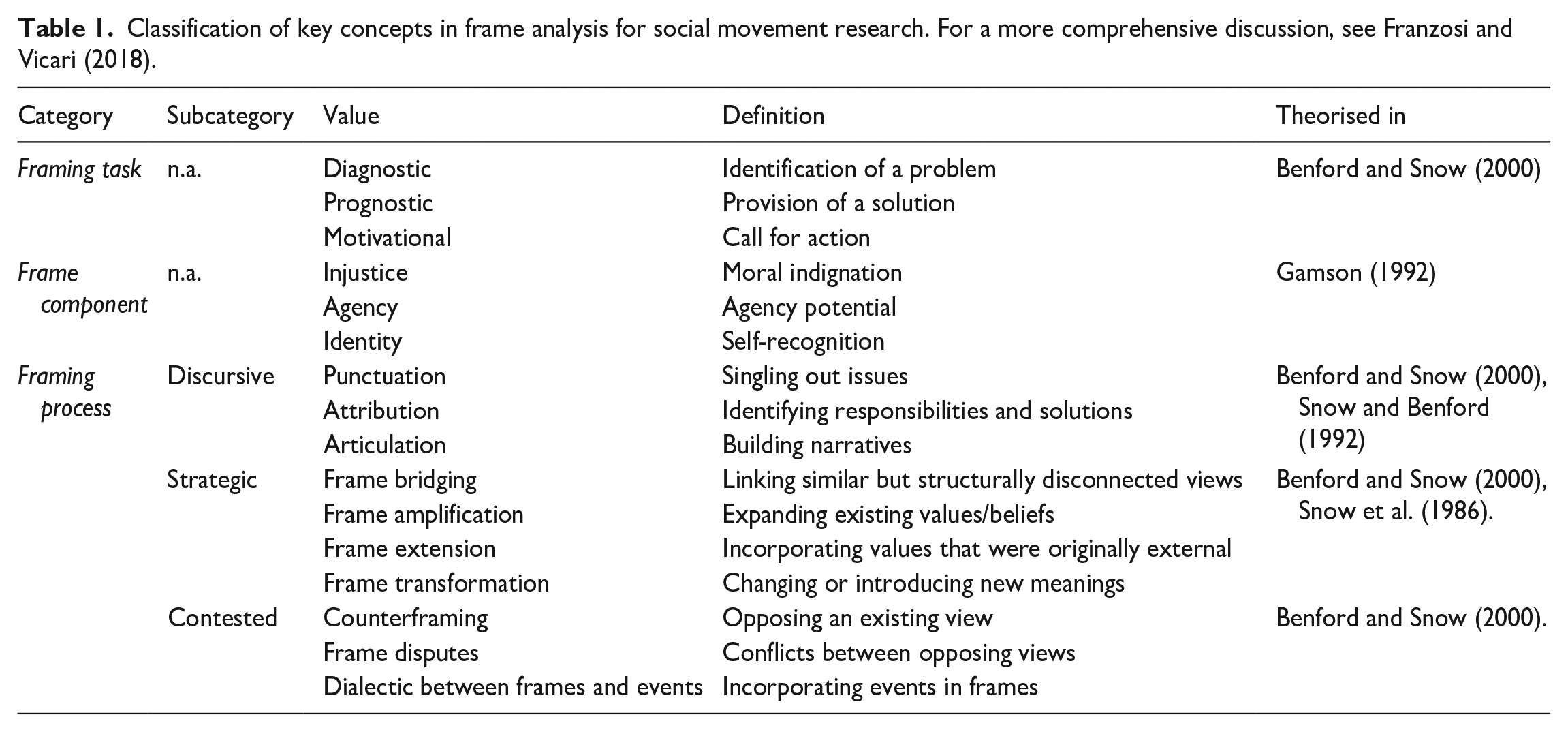
When in Frame Analysis Goffman (1974) defined a frame as a ‘schemata of interpretation’ (p. 21), he was heavily drawing from Bateson’s (1972) anthropological work on human cognitive behaviour: a frame is what allows us to understand what is out there, memorise this understanding and reuse it in the future. When social movement research started to devise its own frame analysis paradigm towards the end of the 1980s, it had two main goals: it aimed to address cognitive dynamics relevant to social movement actors and it meant to do it through an action-oriented prism. Across a number of sources, Snow and colleagues explain that frames related to social contention – so-called ‘collective action frames’ or, at a higher level, ‘master frames’ – are specifically meant to trigger a move from signification (i.e. meaning work) to mobilisation (i.e. action-oriented work) (see, for instance, Benford and Snow, 2000: 623–624; Snow and Benford, 1992: 136–138). They do so by performing three core tasks: they diagnose problems by punctuating, singling out or amplifying issues and by attributing blame. They make prognostic attributions by suggesting ameliorative action and identifying those responsible for it. Finally, they motivate people to engage in this action by articulating past events and experiences together. These three tasks (i.e. diagnosis, prognosis and motivational) are then clearly built through discursive processes (i.e. punctuation, attribution and articulation). But how do these tasks map into broader ideological domains? As a matter of fact, Benford and Snow (2000: 615) derive these tasks straight from Wilson’s (1973) breakdown of ideology into three elements. However, diagnosis, prognosis and motivation also seem to talk to Gamson’s (1992) seminal work on the relationship between collective action frames and broader cultural dynamics. According to Gamson, the injustice component of collective action frames functions as a moral driver, defining rights and wrongs. The agency component highlights the potential for human actors to be the agents of this change. The identity component draws the boundaries between ‘us’ and ‘them’, identifying the actors (them) responsible for the unjust condition that needs to change.
Discursive ones apart, Snow and colleagues discuss two additional processes as contributing to the emergence and/or development of collective action frames: strategic, and contested ones (Benford and Snow, 2000: 624–627; Snow et al., 1986: 467–476). Strategic processes are specifically functional to recruit new and mobilise existing members and resources. They can use four different strategies: frame bridging, frame amplification, frame extension and frame transformation. Bridging refers to the process by which ideologically similar but structurally disconnected frames are linked. Amplification draws on expanding or foregrounding existing values and beliefs. Extension entails incorporating wider interests that may be important to a target audience. Transformation leads to changes in existing meanings or in the introduction of new ones. Contested processes rather emerge with the development of contrasting views on specific issues. They consist of counterframing, frame disputes and the dialectic between frames and events. Counterframing develops with the proposition of alternative/opposing definitions of reality. Frame disputes see a conflict between frames and counterframes, for instance between a movement’s collective action frame and frames drawn by its opponents. The dialectic between frames and events is concerned with the complex overlapping of events and frames.
While Table 1 summarises the key concepts presented so far, I should highlight that frame analysis scholarship has theorised additional constructs, for instance, the so-called ‘variable features’ of collective action frames (Benford and Snow, 2000: 618–622; Snow and Benford, 1992: 138–141). Because of space limitations, in this reflection I will not engage with these further constructs, but a comprehensive discussion can be accessed in work by Franzosi and Vicari (2018). What I would like to signpost here is that (1) most empirical work applying a frame analysis paradigm has implemented a study of discourse, whether or not the ‘discursive processes’ shown in Table 1 were the central focus of the study; (2) in much theoretical work the relationships between the ‘values’ and/or cutting across the ‘categories’ of Table 1 is rather fuzzy, making it extremely hard to implement an analysis able to capture collective action frames as composite, multi-layered and transient elements of signification. The following section will expand on these two points.
Classification of key concepts in frame analysis for social movement research. For a more comprehensive discussion, see Franzosi and Vicari (2018).
Mapping the textual features studied in empirical frame analysis research
As mentioned above, at the root of frame analysis theorisations is anthropological work on human cognitive behaviour. Starting from the late 1980s, however, frames have mainly been analysed as devices through which conditions, situations, events, or policies are presented to a public. In other words, analytical outputs have not necessarily focused on the cognitive dynamics driving these interpretative processes but rather on the material and symbolic fabric used to enact them. They have studied the ‘packaging work’ (Gamson and Modigliani, 1989) that takes place when text is used to shape and deliver interpretations of reality (i.e. frames). It is then perhaps unsurprising that frame analysis has found a very fertile terrain in the study of media content, especially in relation to the coverage of protest events. To name one of the most influential works in this camp, Gitlin’s (2003) The whole world is watching explored mainstream news production and discussed ‘media frames’- news representations – as influential to the public understanding and response to the Students for a Democratic Society (SDS) movement of the 1960s.
A primary challenge to devising empirical studies of collective action frames derives exactly from the fact that frame analysis investigates the actual representation of the ‘system of meaning’ (Gerhards and Rucht, 1992: 573) it means to explore. This can be understood as a referential approach to discourse, where ‘the discourse used in framing is taken to be a generally straightforward bearer of meanings’ (Steinberg, 1998: 845). So, studying collective action frames has so far mostly meant studying texts (e.g. slogans, logos, written manifestos, spoken words of activists or bystanders) and their discursive features. Typically, the latter have been quantified or explored qualitatively through the identification of ‘symbolic devices’ (Gamson and Modigliani, 1989) - textual features used to activate interpretative processes. Perego and Vicari (2023) provide a detailed taxonomy of these textual features, which can be briefly summarised as:
‘framing devices’: items broadly identified as signposting specific meaning;
‘linguistic characteristics’: stylistic choices in a text;
‘linguistic elements’: micro-indicators of the social relationships between the producer of a text and their publics;
‘reasoning devices’: items that are functional to build logic in discourse;
‘syntactical structures’: arrangements of words and phrases into sentences;
‘script structures’: narrative elements of a text and their relationships within the text itself.
In sum, frame analysis has been primarily implemented for the study of signification – rather than cognition in itself – and this study has mostly developed through the analysis of discourse via qualitative and quantitative analytical approaches to a range of textual features. But how can these rather sparse and varied features be used to reconstruct collective action frames – understood as composite and unifying elements of signification in the context of collective action? Can linguistics, the discipline that seems to cut across most of the symbolic devices above, also help us tighten some of the theoretical looseness signposted at the end of the previous section?
A linguistic model
The last category of symbolic devices listed in the previous section, that of script structures, includes semantic (or story) grammars (see, for instance, Johnston, 2002). A semantic grammar can be understood as the skeleton of a text: it captures its key (semantic) elements, and it does so in a relational structure. The primary difference between semantic grammars and traditional content analysis codebooks is that the former depend on linguistic properties (e.g. grammatical forms and functions), while the latter are usually designed based on research-specific elements (e.g. theory in deductive coding and emerging themes in inductive coding). Semantic grammars may indeed differ, but they do so based on the type of text being analysed rather than on the research question. To provide an example, Franzosi’s work (e.g. Franzosi, 2010) has been primarily interested in the factual recount of events in newspaper articles. This recounting happens through the narrative proper typical of journalistic reporting – stories situated in time and space and marked by action verbs. Hence, the semantic grammar used in Franzosi’s work is action-based, building on the basic triplet of <subject> <action> <object>, which translates into a human actor engaging in an action that produces consequences for another human actor. As discussed above, collective action frames can be articulated via a range of both narrative (e.g. the recounting of past events) and non-narrative material (e.g. a policy evaluation, the description of an unjust condition). Hence, semantic grammars used to study collective action frames might need to capture structural elements used in both narrative and non-narrative discourse, with the latter primarily providing definitions and characterisations (see, for instance, Halliday and Matthiessen, 2004). A more suitable basic grammar would then possibly be <subject> <process> <object>, translating into an (human or non-human) actor in a (action, definition or characterisation) process that possibly produces consequences for another (human or non-human) actor.
But how can seemingly dry, rigid and certainly time-consuming coding exercises based on semantic grammars help us understand the fascinating processes of signification to which frame analysis theorisations seem to point? How can translating texts into semantic skeletons of subjects, processes and objects tell us something about collective action frames as ‘action-oriented sets of beliefs and meanings that inspire and legitimate the activities and campaigns of a social movement organization’ (Benford and Snow, 2000: 614)? I suggest that the answer lies exactly in the complex, while at times confusing, corpus of theoretical work that frame analysis scholarship has so far produced in the context of social movement research.
Using a semantic grammar to go from words to frames and on to broader understandings of society
Any act of coding, whether deductive or inductive, in a quantitative or a qualitative analytical approach, is meant to highlight, foreground or single out specific elements of a text that can be counted or interpreted to address a specific research question. Not only do semantic grammars offer ‘standardised procedures to measure’ (Johnston, 2002: 82) frames and a way to focus qualitatively on the frame elements identified through these procedures. They also provide a way to clearly trace the journey from the material of signification (e.g. word text), to micro-level signification (e.g. framing tasks) and on to macro-level signification (e.g. frame components). Figure 1, for instance, shows how this can translate into going from words (i.e. triplets in the inner circle) to problems, solutions and motivations (i.e. diagnosis, prognosis and motivations in the mid circle) and on to broader interpretations of society along the lines of what is just, what can be done and who is right or wrong (i.e. injustice, agency and identity in the outer circle).
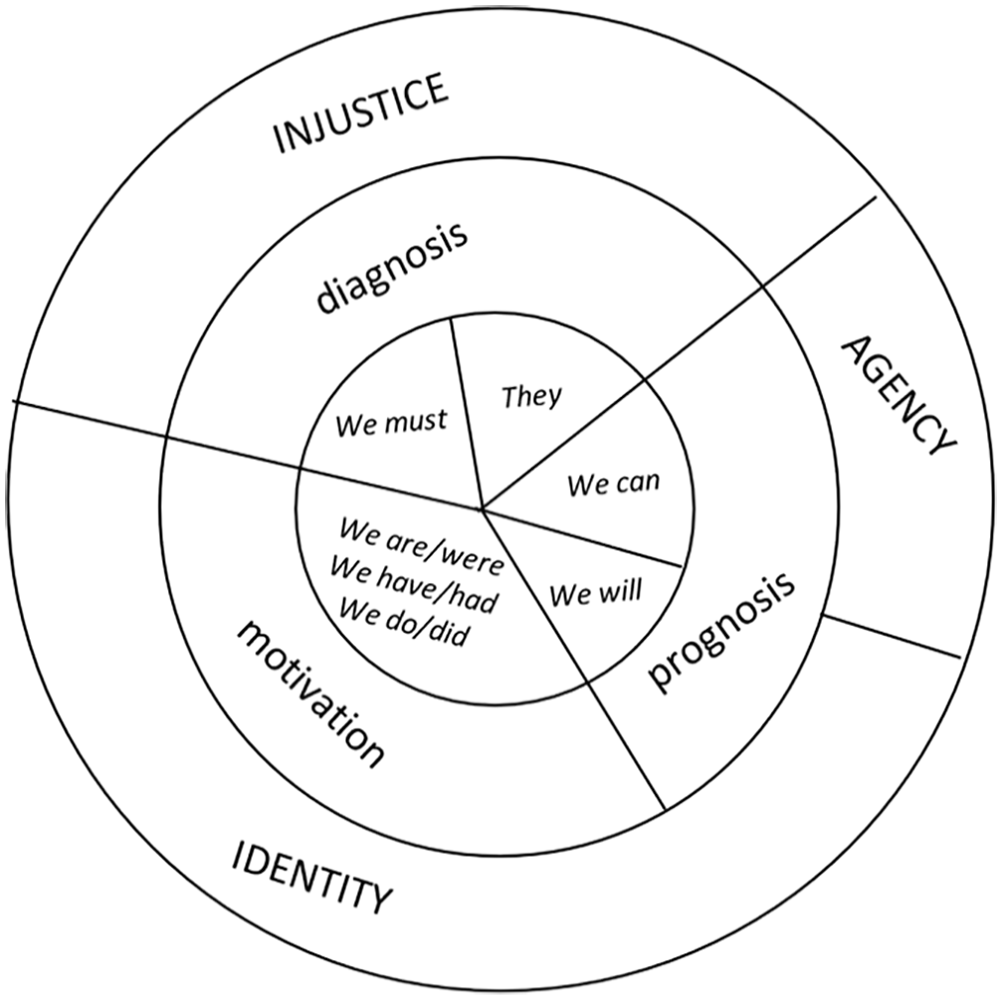
Visualisation of a frame semantic grammar: text in the inner circle, framing tasks in the mid circle and frame components in the outer circle (adapted from Vicari, 2010).
The structural relations of these three levels of analysis (i.e. text, framing tasks, frame components) build on linguistics and are informed by the conceptualisation of framing tasks and frame components discussed above (see Table 1). Each slice of the inner circle of Figure 1 identifies text with a specific set of <subject> <process> <object> triplets, based on their subject (i.e. we/they) and/or process (i.e. modal/non modal verb). ‘We’ is a <subject> referring to the collective actor producing the text itself (or one of their allies). ‘They’ is a <subject> that is adversarial to them. The categorisation of processes relies heavily on linguistic literature defining modality, or the way speakers’ attitudes and opinions are expressed through verbs (see, for instance, Bybee et al., 1994). According to this literature:
- ‘must’, ‘ought to’, ‘should’, ‘have to’, ‘need to’, ‘bound to’ express moral obligation;
- ‘can’, ‘could’, ‘may’, ‘might be able to’, ‘be capable to’ express ability/possibility;
- ‘will’, ‘shall’, ‘want to’, ‘mean to’, ‘be going to’ express intention.
The mid circle of Figure 1 shows how the semantic triplets identified in the inner circle build specific framing tasks. It shows how:
- ‘they’ semantic triplets along with ‘we’ semantic triplets expressing moral obligation (e.g. ‘we must’) articulate problems and attribute blame (diagnostic task);
- ‘we’ semantic triplets expressing ability/possibility (e.g. ‘we can’) and intention (e.g. ‘we will’) clearly identify ameliorative action that can and will happen in the future (prognostic task);
- ‘we’ semantic triplets expressing present and past actions (e.g. ‘we do’, ‘we did’), characterisations (e.g. ‘we have’, ‘we had’) or definitions (e.g. ‘we are’, ‘we were’) provide a motivational drive to engage in collective action (motivational task).
Finally, the other circle of Figure 1 shows how – and which semantic elements of – the framing tasks in the mid circle contribute to specific frame components, namely how they tap into broad understandings of what is just and unjust (injustice component), what can be done to address the unjust (agency component) and who is right of wrong (identity component).
The model just presented shows that frame semantic grammars offer a way to implement empirical frame analysis that relies on linguistics’ work on language and discourse and operationalises the core elements of collective action frames, bringing them together in a relational system. Not only does this allow the study of collective action frames both as built through discursive processes and as tapping into broader understandings of society. It also offers a starting point to develop research on frame processes (see Table 1), for instance to explore bridging dynamics across collective action frames advanced by different actors or to develop longitudinal studies of extension strategies.
Does frame analysis matter?
This reflection has offered a brief exploration into the conceptual and analytical developments of frame analysis research in social movement studies. Starting from the late 1980s, frame analysis has become a popular means to explore signification in the context of social contention. This has brought a shift from traditional work on ideology and grand systems to studies of the way elements of signification at the micro and meso level, like values, belief and goals, are articulated in action-oriented discourses.
Frame analysis scholarship has devised a varied, though sometimes sparse, conceptual toolkit, with the idea of ‘collective action frame’ introducing a relatively solid construct to study the way collective actors articulate their field of action, their identity and their views of society. As I have argued earlier, the key challenge in frame analysis research has been to define a clear empirical framework to study collective action frames. But was a new framework really needed? Or perhaps could frame analysis work best joining forces with long established work on discourse and language? In this reflection, I have argued for the latter option, offering a linguistics model to implement the analysis of collective action frames through frame semantic grammars.
As a matter of fact, linguistics and frame analysis can work well together but the model proposed in this reflection also suggests that there are limitations to be considered. First, while manual coding based on semantic grammars is extremely time consuming, automation is not straightforward either. For instance, the absence of one of the primary modal auxiliary verbs in a sentence does not preclude the presence of modality: sentences can express modal tendency without the use of modal verbs. This modal tendency, however, can only be extracted through human interpretation (Vicari, 2010: 513). Hence, even in an automated system, manual intervention is likely to be needed for the model to work. Moreover, the implementation of a frame semantic grammar in multinational datasets requires extensive work, for instance to identify different, but comparable, expressions of modality across languages. Finally, to what extent can frame semantic grammars work with signification that takes place in the contemporary social media ecology, where, for instance, microblogging and multimodal communication are key to collective action? I would argue that these limitations do not undermine the validity and reliability ensured by relying on linguistics to develop frame analysis. Rather, they suggest we need to keep developing analytical frameworks that consider modes of significations across cultures and that evolve within ever-changing media and communication ecosystems.
Footnotes
Declaration of conflicting interests
The authors declared no potential conflicts of interest with respect to the research, authorship, and/or publication of this article.
Funding
The author(s) received no financial support for the research, authorship, and/or publication of this article.