




Abstract
This study investigates the instruction of sustained embodied activities, that is, activities that require a continuous, sustained embodied effort. The context is horse-riding lessons. Riding instructors are shown to teach sustained embodied activities in orientation to four temporalities. Most fundamentally, they co-construct these activities as an ongoing and continuing timeline, for example, by giving action-continuing directives and by projecting continuation prosodically. In addition, instructors attend to the temporal organization of individual component actions of the activity. They situate actions in the past, present, or future along the timeline of the sustained activity; they co-construct the duration of individual actions as flexible; and they orient to individual actions as brief and transient. The analysis reveals practices that do not initiate or respond to specific actions but that accompany an activity as such, treating progression itself as a target for instruction and calling into question the often-assumed sequential adjacency of action pairs.
Introduction
The instruction of embodied skills involves ongoing negotiation between learner and instructor over the nature, quality, and timing of learner actions (Ehmer and Brône, 2021). This has been shown to be the case in a diverse range of contexts, such as cooking, 1 dancing, 2 driving, 3 medical settings, 4 music, 5 sports, 6 and various manual skills. 7 This substantial body of work has described the social, sequential, and temporal organization of instructing and instructed actions. Frequently, the focus has been on single action sequences rather than on the longer-term unfolding of instruction (but see Deppermann, 2018b, 2018c). However, many embodied skills are not accomplished in the form of single local actions but are instead organized over longer time periods and composed of sequences of actions, which together constitute the instructed activity. The present study focuses on the instruction of such activities, and specifically on the way their temporal organization is co-constructed. The instruction setting is horse-riding lessons.
Temporality and the instruction of embodied actions
A basic organization that participants must establish during co-present instruction is the temporal ordering of instructions and instructed actions. For example, the spatial, acoustic, and bodily configurations of driving instruction (Deppermann, 2018b, 2018c; De Stefani and Gazin, 2014), rock-climbing coaching (Simone and Galatolo, 2020, 2021), Pilates classes (Keevallik, 2020), and horse-riding lessons (Lundesjö Kvart and Melander Bowden, 2022; Lundgren, 2017) allow for teachers’ instruction-giving and learners’ complying actions to be performed in parallel. Lundesjö Kvart and Melander Bowden (2022) use the term ‘online instruction’ to describe horse-riding instructors’ talk that is delivered ‘continuously . . . while the student rides’ (p. 294). Previous work on the teaching and learning of embodied skills has shown that concurrently organized instruction can involve participants’ orientation to additional temporalities. Deppermann (2018b) shows how the verbal design of instructions is fitted to where in the instruction sequence they occur. In the context of driving lessons, repeat directives may take different language forms depending on whether they are given at the start, during, or at the end of a task-oriented sequence. Deppermann shows that instructions that are given for the first time are typically delivered in the declarative form. In contrast, the imperative form is used for correcting an ongoing action for which an instruction has already been given, and for insisting on a previously delivered directive. Deppermann (2018c) provides additional evidence that interactional histories may affect the turn design of instructions. When instructions are given for the first time, their linguistic format is comparatively complex, containing clauses, arguments, and much ‘descriptive and generalizable content’ (p. 301). As instructions are repeated, their format gradually becomes less complex. Deppermann ascribes the decreasing complexity and length of instructions to instructors’ treatment of learners as increasingly competent. In this context, the author describes ‘indexical-elliptical reminders’, that is, very short turns that ‘[build] on the should-have-known or known-in-principle character of the instructed action’ (p. 320) and that treat the recipient as not requiring a full explication of the task.
In addition to the temporal positioning of instructions in relation to the overall sequence, several studies have described their temporal fittedness to learners’ embodied performance (e.g. Lundesjö Kvart and Melander Bowden, 2022; Lundgren, 2017; Mondada, 2014c, 2017; Simone and Galatolo, 2020, 2021) and, related to temporal coordination, the indexing of immediacy (e.g. De Stefani and Gazin, 2014; Mondada, 2018a; Okada, 2018; Tekin, 2021). In their study of horse-riding lessons, Lundesjö Kvart and Melander Bowden (2022) show how riding instructors time their directives precisely to fit horse-rider actions as they are being performed. The authors argue that in doing so, instructors ‘mold’ the horse and rider unit by highlighting different aspects of the instructed action (p. 294). Lundesjö Kvart (2020) describes how in group riding lessons, instructors co-create ‘instructional spaces’ (p. 1) with individual riders through learner-specific recipient design. The temporal order and turn design of instructions is fitted to the order in which riders pass the instructor and the time window during which they are available for instruction. Lundgren (2017) details how riding instructors may co-construct the precise timing of horse-rider actions through prosodic means, for example, by placing positive assessments with each horse stride (p. 77), by vocally depicting the correct canter rhythm (p. 78), and by using vowel lengthening to stretch a directive to the moment when the horse-rider pair have reached the relevant place in the riding arena (p. 80). Other settings also show the temporal coordination of instructions with learner actions. For example, Simone and Galatolo (2020) show that in rock-climbing sessions for visually impaired climbers, coaches adjust their instructions precisely as climbers’ hands or feet approach the desired footholds on the climbing wall. Keevallik (2020) describes how a Pilates instructor synchronizes her instructions with the bodily movements of her students by, for example, lengthening individual segments as she waits for students to perform certain parts of their exercises.
Mondada (2017) shows how in a range of instruction settings including race driving and surgery, the short and syntactically simple language form of imperatives allows instructors to fit their directives to the fast-moving progression of embodied learner actions. By repeating imperatives instructors may place a heightened focus on urgency, exerting ‘temporal pressure’ (p. 87) on the learner until the directed action is accomplished (see also Mondada, 2018a; Okada, 2018). Multiple directives also allow instructors to ‘[accompany] the directed action as it unfolds in real time’, thereby ‘calibrating its length, intensity, changes, and completion’ (p. 91). Simone and Galatolo (2021) show that this applies not only to imperatives but to repeated instructions more generally. Mondada (2017) proposes that the temporal calibration of ongoing learner actions can affect the adjacent organization of the directive-response sequence. Embodied responses may be produced while the directive to perform them is still underway, since embodied responses can be started in overlap with ongoing talk. ‘This generates a sequential environment in which the second action most often begins before the first is completed and continues along with the first’. (p. 77; see also Okada, 2018). Over time such an organization may result in ‘sequentially ordered simultaneities’ (p. 91). Mondada describes the ‘flow of embodied actions’ within an ongoing activity 8 as ‘a continuous temporal and sequential unfolding, without any time out’ (p. 83). A related point is made by Keevallik (2020: 170), whose analysis of a Pilates class shows that teachers’ synchronization of their talk with learners’ embodied actions may involve phrases that are ‘both instructing and reacting, initiating and responding’, resulting in ‘verbal and embodied trajectories’ that are not ‘organized in . . . traditional conversational sequences’. The present study adds a layer of complexity to existing knowledge of instructional temporalities by showing that the progressivity of instructed actions itself can be treated as a target for instruction.
Methodological approach and data
The theoretical framework for this study is Conversation Analysis (Schegloff, 2007). This means that interactional events are not presented as pre-existing social categories. Instead, actions, identities, and other social ascriptions must be shown to be treated as relevant by participants themselves, and their co-construction must be evidenced from within the local interaction. The core analytical concern is participants’ joint accomplishment and organization of social interaction; here specifically, instruction.
The data corpus contains 22.5 hours of video-recorded riding instruction primarily in the discipline of dressage. Fifteen recordings are of private one-to-one riding lessons between 29 and 48 minutes in length (8 hours 40 minutes overall). For these, the author approached 21 riding coaches, 18 through the public data base of the British Horse Society and three by word of mouth. Six agreed to have their lessons recorded, and consent was sought from their clients. Ethical approval for the study was received from King’s College London. In addition, the corpus holds 13 hours 54 minutes of publicly available YouTube recordings of two private one-to-one lessons (44 minutes); 10 clinics open to the public and recorded by audience members (5 hours 32 minutes); five clinics open to the public and recorded for broadcasting (5 hours 38 minutes); two segments of private group lessons (23 minutes), and six group lessons recorded for broadcasting (1 hour 37 minutes). Extract (1) comes from the publicly available corpus. All transcripts, private and public, are fully anonymized.
The transcript notations for spoken interaction follow GAT2 (Selting et al., 2009/2011), see Appendix. Notations for embodied actions follow Mondada (2018b, 2019). The transcripts show only those prosodic and embodied events that are relevant to the analysis. The video-recorded data contain many embodied actions that are not represented in the transcript, as transcripts are always ‘unavoidably incomplete’ (Ten Have, 1997). The analysis of some data extracts requires specialist knowledge. Where this is the case, the relevant context has been provided. As equal contributors to horse-riding instruction, horses are represented in the transcripts as part of the horse-rider participant pair (H/R) and at times also as individual actors (H). Due to the extended nature of sustained embodied activities, the phenomenon results in transcripts of considerable length. Below, only Extract (4) shows the instruction of a sustained embodied activity from beginning to end. Extracts (1)−(3) show selected parts taken from longer instruction sequences, which allows for a more granular analysis of the temporal phenomena in question.
Teaching sustained embodied activities
This analysis is concerned with ‘sustained embodied activities’, that is, activities that participants co-construct as requiring a continuous embodied effort and during which ongoing and often simultaneous (sequences of) actions are performed to maintain the activity and its desired quality. The term ‘activity’ is chosen following Heritage and Sorjonen (1994) and Robinson (2013) to denote coherent ‘multiple, normatively ordered sequences of action’ (Robinson, 2013: 257). As the data below show, sustaining an activity is not necessarily co-constructed as a linear action trajectory, that is, one that progresses from one stage to another in a series of steps. Instead, instructors orient to ongoing holistic activities where several actions can be made relevant simultaneously, or where individual actions are not specified at all. Instructing sustained activities is typically organized as an activity itself, due to the variety of component actions involved, including directives, assessments, corrections, and explanations.
The following four examples illustrate ways in which participants orient to sustained embodied activities, and how their instruction is organized. The data show that sustained embodied activities are not only ‘done’ but are verbally and bodily co-constructed by participants. This appears to be achieved in orientation to – at least – four temporalities. Most importantly, instructors orient to an ongoing and continuing timeline, since sustaining an embodied activity requires its temporal continuation. As a result, its very progression becomes an issue for instruction. In addition, they attend to the temporal organization of individual component actions along the timeline of the larger activity. They do so by situating component actions in the past, present, or future; by co-constructing the duration of individual actions as flexible; and by treating individual actions as brief and transient.
In Extract (1), a rider is being instructed on how to lengthen the horse’s trot strides. This means that as the horse and rider are trotting around the rectangular riding arena, they are asked to lengthen the horse’s steps down each long side. The transcript indicates where horse and rider are trotting through corners and where they are on straight lines, as this affects how they are positioned to perform the exercise. In the transcript, rider actions are prefaced by R, instructor actions by I, joint horse and rider actions by H/R, and horse actions by H. The symbol ǁ represents lateral clicks (see Ogden, 2020).
(1) 20120314 10.40-11.06
The instructor initiates the next iteration of the exercise with and again up round and go (lines 2–5). While the directives up and round specify the horse’s neck position that the rider is asked to bring about, the directives and again and and go do not explicitly identify embodied actions. Instead, they co-construct the start of an activity as such. The following directives target four specific actions to be performed by the rider (lines 6–10, go on push; hold the front; half halt; up) while the subsequent directives once again orient to an ongoing activity. The lateral clicks that send the horse forward (lines 11 and 14) and the directives go on keep going (lines 12–13) and keep going (line 15) co-construct the horse-rider activity as one that requires sustained effort to maintain it without specifying individual actions to be performed. The combination keep + V(Gerund) explicitly denotes repeat behavior and persistence. The combination of specific and nonspecific action directives treats the horse and rider as engaged in a currently ongoing and continuing activity consisting of a variety of component actions but also requiring embodied effort to sustain the activity itself. The instructor closes the activity with the directive and back again (line 29), which frames the activity as an action unit within a specified temporal frame.
The instructor fits her talk to the sustained embodied activity as it emerges. Her directives are being produced while the horse’s and rider’s activity is in progress, with several directives being locally fitted to the moment at which the horse-rider actions make them relevant (Lundesjö Kvart and Melander Bowden, 2022; Lundgren, 2017; Mondada, 2017; Simone and Galatolo, 2020) and positioning horse-rider actions in the past, present, or future (De Stefani and Gazin, 2014; Keevallik, 2010; Mondada, 2018a; Szczepek Reed et al., 2013). The initiating turn at line 2 is delivered as the horse and rider are coming around the second corner of the short side of the arena, from where they are well positioned to commence the instructed exercise immediately. At this moment, the instructor does not respond to a spoken turn by the rider (unintelligible, line 1). Her initiating directive and again instead orients to the local opportunity to start the next exercise now. As horse and rider come out of the corner, the directive and go is fitted to the start of a new action immediately. Similarly, at line 23, the directive now push is locally fitted to the moment at which the horse and rider are coming out of the second corner of the next short side, entering the next long side of the arena. Here the local fittedness is verbalized through temporal deixis (now) (see Mondada, 2017: 75). The closing directive and back again (line 29) is delivered as horse and rider approach the next corner, again fitted closely to the place and moment where it can be complied with.
Like her directives, the instructor’s assessments are also locally fitted to where they become relevant, that is, at points at which assessable actions are occurring or have just occurred. The first assessment good (line 17) is produced as horse and rider reach the end of the long side of the arena and approach the corner where the instructor is seated. The assessment is delivered in overlap with the rider’s own praise for the horse (line 16), showing that she, too, is orienting to a point in the exercise where a desired outcome has been achieved. The second set of assessments (ye:::s lo::vely, lines 25–26) occur as the horse and rider are in the process of showing lengthened strides down the long side. The syllable lengthening on the assessment items allows the instructor to accompany the horse’s and rider’s ongoing activity vocally for an extended period, thus orienting to its duration in a form of ‘temporal iconicity’ (Mondada, 2017: 91). While the first assessment design positions the assessed action as having occurred in the immediate past, the second instance positions it as occurring in the current present, in parallel with the instructor’s speech.
Extract (1) shows the instructor’s orientation to a sustained embodied activity performed by the horse and rider. Directives such as and go, go on, push, keep going, and now push reveal an orientation to a concurrently emerging activity that is not ‘simply’ continuing, but that requires the recipients’ embodied effort to sustain it. The ongoing and sustained nature of the activity is treated as an instructionally relevant aspect of the activity, rather than as taken-for-granted natural progressivity. In her instruction of the sustained activity, the instructor makes relevant two distinct temporalities. Most fundamentally, she co-constructs the embodied activity as ongoing and continuing. Her two practices for doing so are using nonspecific action directives and opening and closing the activity. Nonspecific action directives such as go on keep going co-construct a concurrently emerging activity as one that is not merely continuing on its own, but that requires embodied and persistent effort to sustain it, making the sustained nature of the activity a focus and a learnable. Thus, progression is treated as instructionally relevant rather than taken for granted. Opening and closing an activity constructs it as to be performed for the length of a specified time window. Secondly, through locally fitted assessments and directives the instructor situates learner actions along the timeline of the ongoing activity. Assessments of immediately prior actions position those actions in the immediate past; the simultaneous delivery of assessments positions actions in the current present; local action directives to perform actions now (Okada, 2018; Szczepek Reed et al., 2013) position them in the immediate future.
Both temporalities are also made relevant by the instructor in the following extract, who additionally orients to a third temporality: the flexible duration of individual actions and the time it takes horse and rider to bring them about. The extract comes from a private riding lesson and shows a short section from an activity referred to by the participants as ‘warming him up’. Warming up a horse involves, amongst other things, riding frequent transitions from one gait to another and making frequent changes of direction.
(2) 20220331, Part 1, 3.27-4.14
The two directives at lines 2 and 4 mobilize actions that are to be performed for an unspecified number of times. The indefinite pronoun some (some more turns, some transitions) shows an orientation not to a specific number of iterations but to an ongoing timeframe during which actions are to be performed repeatedly and at the discretion of the rider. The rider’s discretion is made explicit in the instructor’s next directive (you’re when- you feel ready go forwards to walk, lines 5–6). Here, as well as at line 7 (and in your own time off to trot again), the rider is made responsible for choosing the appropriate timing to perform instructed actions. In designing instructions in this way, the instructor orients to the activity of warming up the horse as ongoing; more specifically, she orients to discretionary starting points and the flexible duration of individual actions, whose timing she does not specify. A similar orientation is shown in the directive to perform the next action – a change of direction – anywhere you like (lines 12–13). This refers to specified riding figures used for changing direction, which involve riding from one point in the arena, marked with a letter, to another. Depending on where the horse and rider start their figure, the execution may take varying amounts of time. The directive to start anywhere you like thus orients to the unspecified and flexible duration of the instructed action and the time it takes horse and rider to bring it about. This temporality is also relevant to the period of no speech lasting 11.5 seconds (line 13). The directive to change direction (lines 12–13) ends as the horse and rider are coming through and out of the first corner of a short side of the arena. At this point they are well positioned to change direction diagonally across the arena, starting at letter ‘H’, which is positioned just after the next corner (see Figure 1). As they do so, the instructor observes them silently. The instructor’s next directive at line 14 is produced at exactly the point at which the horse and rider have completed their ridden figure, as they reach letter ‘F’ at the other end of the arena. The instructor’s silent observation shows an orientation to the required duration of the learner action, that is, the time it takes to initiate, prepare, and accomplish it: when the directive is given, the horse and rider must first reach the next possible point from which they can start the ridden figure. The instructor remains silent while they bring about and complete the instructed action, orienting to the action’s completion with a precisely timed new directive.
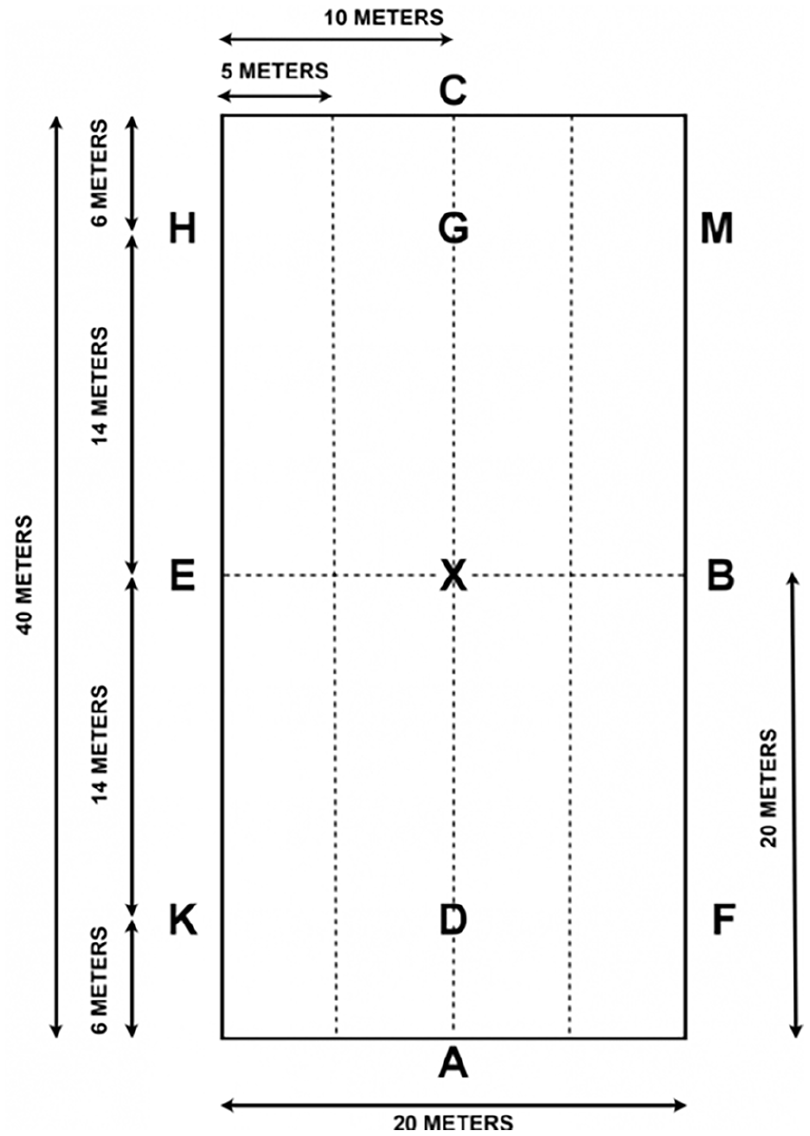
Standard 20 × 40 dressage arena. Copyright: howtodressage.com.
At lines 11–14, the instructor uses rising final pitch on individual chunks of talk. Rising pitch is typical of list intonation (Selting, 2007) and projects continuation of the instructor’s turn and action (Jefferson, 1990; Lerner, 1994). The prosodic design therefore co-constructs the horse-rider actions as ongoing and to-be-continued. The use of pitch to structure individual learner actions is reminiscent of the prosodic projection described in Keevallik (2020: 161–164), where a Pilates instructor’s level pitch projects the penultimate and then the final iteration of an exercise.
Extract (2) shows the instructor’s orientation to three temporalities. Firstly, she orients to the ongoing and to-be-sustained nature of the horse’s and rider’s embodied activity. Like the instructor in (1), she leaves certain aspects of her directives unspecified. In (1), nonspecific action directives such as keep going construct the activity as to be continued without naming individual actions. In (2), the instructor directs the rider and horse to perform actions repeatedly but without specifying when and how often. In doing so, she treats rider and horse as being engaged in an ongoing activity whose timeframe is yet undetermined. By designing instructions prosodically as lists, individual instructed actions are treated as components of a continuing and ongoing activity. Secondly, the instructor orients to the timing of component actions within the overall activity by fitting her talk precisely to the timing of the horse’s and rider’s actions. Thirdly, this instructor orients to the duration of embodied actions and the time it takes to bring them about. By giving underspecified directives to perform actions in the rider’s own time, the instructor co-constructs action slots as flexible and actions as requiring varying amounts of time. By silently observing instructed actions, the instructor grants horse and rider the necessary time to prepare and accomplish embodied actions and orients to their flexible duration.
The following extract from a private riding lesson shows an instructor’s orientation to a fourth temporality: the brief and transient nature of individual actions within the overall activity. The task is to canter first around the outside of the arena and then down the ‘quarter line’, that is, a straight line set 5 m in from the outside track (see Figure 1). Both horse and rider are inexperienced. Keeping a less experienced horse on a straight line, without the help of the established track along the fence, requires continuing communication with the horse through the rider’s seat, legs, and reins.
(3) 20220525, Part 2, 6.30-7.41
The directive off you go when you’re ready (line 3) initiates the activity and frames it as one that will be continuing for some time. By leaving the timing of the start of the activity to the rider and silently observing the horse and rider for 17.3 seconds, the instructor co-constructs a flexible and ongoing time frame during which the first action – the transition to canter - can be brought about in the horse’s and rider’s own time. At line 13, horse and rider turn down the quarter line. Lines 14–15 show the instructor delivering the same elliptical directive (Deppermann, 2018b) straight nine times. Each individual item is placed in rhythmical alignment with the horse’s canter strides, as is the final directive and turn (line 15). With each stride of the horse, the rider must give riding aids to keep the horse on a straight line. By placing repeated directives in alignment with the horse’s canter strides, the instructor fits them to each moment at which the rider’s actions become relevant. The instructor’s rhythmical alignment with the horse’s canter strides thus co-constructs the horse-rider activity as one that is to be actively and continuously sustained with each stride. 9
The short and elliptical directives co-construct a temporality of short, fleeting events, positioned along the timeline of the larger activity. As the instructed actions are being performed, each action is afforded the time window of one canter stride. The short directives are fitted to these time slots, which leave no time for elaboration, and which co-construct the horse’s and rider’s actions as passing quickly. The repeated directives appear similar to those described in Mondada (2017), through which instructors create ‘temporal pressure’ (p. 87) and ‘calibrate’ (p. 91) the speed of a learner’s action. However, instead of urging faster speed, the instructor in (3) adopts the existing rhythm provided by the horse to issue temporally aligned ‘indexical-elliptical reminders’ (Deppermann, 2018c: 320) of a previous directive (make sure that you’re completely straight, line 1).
The last extract from a private riding lesson shows the instruction of a sustained embodied activity in full. Here, all four temporalities are made relevant. Before the transcribed excerpt, the instructor has announced that the next exercise will be to ‘work [the horse] in canter’.
(4) 20220330, Part 2, 2.09-5.27
The directive pick up canter (line 2) opens the activity. In initiating a new activity, the instructor establishes a frame that projects the sustaining of the activity until its closing, which occurs after approximately 3.5 minutes (line 108). Opening and closing the activity also positions intermediate, activity-relevant horse-rider actions as component actions of the activity. The directive and circle (line 6) asks the horse and rider to canter in a prescribed circle shape along established markers in the riding arena. The directive does not specify the number of circles but simply asks the horse and rider to circle from now on. In asking the rider to perform an action not just once but for an unspecified number of times the instructor orients to an extended period during which the directive remains relevant, and thus projects a continuing temporality (the horse and rider circle four times before another directive to circle again (line 40) is given). The following directives sit up (line 7) and now remember half halt give and take (line 8) are specific action directives that are to be performed now, positioning instructed actions in the immediate future. The directive sequence concerning the size and shape of the ridden circle (lines 9–15) makes relevant both the present moment as well as a more distant future outside of the lesson when the rider may compete in a dressage test (line 14). Lines 16–17 and 18–20 show two correction sequences, which orient to the horse’s and rider’s correctable actions as positioned in the immediate past and present. The account for the first correction (line 17) addresses the horse’s ongoing canter and his loss of balance on the circle, thus orienting to the activity as continuing and to-be-sustained. Following the first correction there is a short period of silent observation (line 17), which also shows the instructor’s orientation to the continuing nature of the activity and to the time it takes to make the instructed correction.
At line 20, the horse falls into trot. This is addressed immediately by the rider’s apology (line 21) but initially receives no response from the instructor. As the rider and horse continue trotting, that is, as the rider does not take an immediate opportunity to correct herself, the instructor interrupts her current explanation regarding the shape of the circle and gives the directive keep going (line 23) followed by a click to send the horse forward (line 24; see Lundgren, 2017; Szczepek Reed, in press). In using the item keep going to mobilize a return to canter, the instructor orients to the canter as an activity that was previously in progress and that should continue now and into the immediate future. Unlike in Extract (1), here ‘keep going’ initiates a specific learner action, that is, the return to canter. The rider appears to attempt a transition back to canter as the horse speeds up his trot (line 24). However, the transition is not successful, as the horse only trots faster (line 26). Following this, the rider waits until she reaches the opposite side of the circle before she brings about a successful transition back to canter (line 31). During the horse’s and rider’s aborted attempt to return to canter and their subsequent trotting, the instructor and rider engage in continuing talk about the circle shape. The instructor gives no further directive to return to canter and no assessment or correction regarding the unsuccessful attempt; she only receipts the eventual transition with a positive assessment (line 32). This absence of talk following the initial directive to keep going shows an orientation to the time certain component actions may take to accomplish. In not attending to an unsuccessful attempt and the subsequent delay in the rider’s compliance with her directive the instructor allows the rider to accomplish the complying action in the time that it takes to bring the action about.
At line 41, the instructor gives the directive outside rein to steady him when the horse falls into trot once again (i.e. ‘trot once again.’). The instructor responds immediately with a nonlexical vocalization (ah::) and a correction but then the leg there so he doesn’t break (line 42), thereby orienting to the break of the canter as a trouble source. Outside rein contact can signal to the horse that he should slow down, as reflected in the instructor’s directive to steady him. However, depending on various factors, it may also communicate that he should transition to a lower gait, as he does here. The instructor’s directive but then the leg there refers to the leg aids that are required to show the horse that the increased rein contact is not asking him to transition down to trot but only to slow down in canter. The instructor thus orients to two simultaneous actions that are necessary to sustain the ongoing activity (the use of the reins and the legs), with each action being constructed as a component part of the overall activity (working in canter). The sequence also shows an orientation to the breaking of the canter as to-be-corrected, and thus to the canter as to-be-sustained.
At line 49, the instructor orients to a new component action, to give and take with the hands. Several of the Turn Constructional Units in this extended directive end in rising pitch (lines 50, 52–54) until the action is treated as having been achieved successfully (line 56). The prosodic design treats the horse’s and rider’s activity as continuing and to-be-continued.
At line 59, the instructor gives a positive assessment that’s it, which prefaces the directive keep working him. The prefacing assessment treats the rider’s current action as the one that she is being instructed to do, that is, the rider is currently ‘working’ the horse while also being instructed to continue to do so. The directive is non-specific in terms of the horse’s and rider’s embodied actions but reflects an orientation to the sustained embodied activity of working in canter. Following the directive, the instructor engages in another period of silent observation for 5.7 seconds. In following the directive keep working him with silent observation, the instructor orients to a timeframe during which the rider continues with the instructed activity and its component actions in her own time and under the scrutiny of the instructor (Stukenbrock, 2014: 91). The positive assessments good (line 60) and well done (line 61) respond to the horse’s and rider’s continuing work in canter as instructed but without specifying individual actions that are being assessed. The underspecified directive, the silent observation, and the underspecified assessments treat the horse-rider activity as a holistic, observable sequence of actions that is being scrutinized for its sustained progression and quality, rather than for the quality of individual component actions.
At line 64, the horse falls into trot again, and the instructor treats this as to be corrected (lines 65–67). Once the rider is cantering again, the instructor formulates the rider’s correctable action: so feel when he is going to switch off and put the leg on (lines 69–70). The formulation references the need for the rider to monitor the horse’s actions continuously and to sustain their joint embodied activity with her own embodied effort. The formulation makes relevant the nature of the activity as one that is not simply continuing by itself, but instead as one that needs to be actively sustained by horse and rider. The subsequent directive work your canter (line 71) once again makes explicit the ongoing effort of sustaining the canter actively.
At line 84, the previous instruction from line 70, and put the leg on, is reduced to the ‘indexical-elliptical reminder’ (Deppermann, 2018c: 320) leg on, and later to and leg (lines 96, 98) and then leg (line 104), as the repeated instructions become shorter and more elliptical over the course of the sequence. As a renewed use of riding aids becomes relevant with every stride of the horse, the short directive format is fitted to the short time window during which directives can be complied with. The directives and assessment at lines 96–99 are delivered in rhythmical alignment with every second canter stride of the horse. The short chunks of talk thus co-construct the horse’s and rider’s actions as brief and transient parts of an ongoing activity.
In addition to specific action directives, the instructor continues to give nonspecific action directives that do not identify single actions. They include work your canter (lines 71 and 87), keep working (line 76), keep him working (line 85), and now keep working him (line 101). These directives orient to the need to sustain an activity over an extended period and with continuing embodied effort. They are imprecise as to what specific embodied action(s) is or are being mobilized. Like shortened directives, nonspecific directives may orient to learner competence. They also show the instructor’s orientation to a holistic, extended embodied effort where individual sequential steps are made less relevant than the overall maintaining of the activity. Unlike the repeat directives described in Mondada (2017) and Simone and Galatolo (2021), which orient to individual embodied actions that are (instructed to be) performed ‘beat by beat’ (Mondada, 2017: 91) and which rely on sequentially unfolding instructions, the riding instructors’ nonspecific action directives orient to the sustaining of an embodied activity as such.
At line 108, the instructor gives the directive and now forwards to trot and silently observes the horse and rider until they have achieved the transition in full before giving a positive assessment (line 109).
Summary and discussion
The simultaneity of concurrent instruction allows instructors to attend to the temporal situatedness of learner actions as they occur. As the data show, the temporal organization of sustaining an embodied activity is highly relevant to its instruction. Instructors co-construct sustained embodied activities as ongoing and continuing, and individual actions as temporally situated within the larger activity. This is accomplished in orientation to four temporalities. Most fundamentally, instructors orient to sustained embodied activities as continuing along an emerging timeline, as the very progression of sustained activities requires persistent physical effort and is treated as an issue for instruction. Opening and closing the activities co-constructs them as to be performed for the duration of a specified period. The use of nonspecific directives to sustain an ongoing activity, such as keep going, co-constructs the horse and rider as involved in a holistic and continuing activity. Directives to perform individual actions not only once but for an unspecified number of times co-construct an extended period during which the directives remain relevant. And the prosodic delivery of instructions as lists designs clusters of instructor talk as projecting continuation, and thus the learner activities they attend to as to-be-continued.
In addition, instructors attend to the temporal organization of individual component actions within the larger activity. They do so in orientation to three additional temporalities. Through locally fitted assessments and directives instructors may situate individual learner actions along the timeline of the activity as it unfolds, in its immediate past, present, or future. Through periods of silent observation and by allowing learners to perform instructed activities in their own time, instructors make time for the flexible and discretionary duration of learner actions and the time it takes to bring them about. By fitting instructions to the short time windows of certain component actions they co-construct individual actions as brief and transient events along the timeline.
The concurrent instruction of sustained embodied activities reveals practices that, like those described by Mondada (2017) and Keevallik (2020), go beyond existing assumptions of sequential adjacency. Mondada (2017) shows how the coordination of instructor talk with embodied learner actions may result in overlaps between instructions and instructed actions, as ‘the second action most often begins before the first is completed and continues along with the first’ (p. 77), while nevertheless being ‘clearly initiated by one participant and responded to by the other’, resulting in ‘sequentially ordered simultaneities’ (Mondada, 2017: 91). Keevallik (2020) shows how instructions that are synchronized with instructed actions can be heard as initiating, correcting, and praising the learner all at the same time, as ‘bodily actions by the students’ are ‘simultaneously guided and corrected’ (p. 170). Both forms of non-adjacent sequential organization are concerned with specific learner actions that are being scrutinized according to their quality and timing. In contrast, the analysis of sustained embodied activities reveals practices that do not respond to or initiate specific actions but that accompany an activity as such, treating its progression as a target activity and learnable in its own right. Nonspecific action directives, such as keep going, can be found repeatedly across the corpus. These directives are imprecise as to what specific embodied action(s) is or are being mobilized, and they are delivered while the target activity is already being performed, reminding the learner not to stop what they are doing. Thus, their orientation is to the sustaining of a holistic activity as such, not to the prompting of an individual new action.
During the instruction of sustained embodied activities participants display an orientation to extended and multi-layered units of action, as sustaining an embodied activity involves successive, overlapping, and simultaneous actions and their coordination. In instructing learners to perform these activities, instructors manage a complex interplay of temporal factors, that is, the overall length and continuation of the activity as well as the timing, duration, and transience of individual component actions. The co-construction of others’ actions through orientation to their temporal situatedness offers much potential for future analysis.
Footnotes
Appendix
Speech transcription is adapted from Selting et al. (2009/2011)
Pauses and lengthening
(.) micro pause
(1.2) measured pause
::: lengthening
Accents
ACcent primary pitch accent
Accent secondary pitch accent
Phrase-final pitch movements
? rise-to-high
, rise-to-mid
- level
; fall-to-mid
. fall-to-low
Changes in pitch register, loudness and speech rate
<<l> > low pitch register
<<h> > high pitch register
<<f> > forte
<<p> > piano
<<all> > allegro
Breathing
.h, .hh, .hhh in-breath
h, hh, hhh out-breath
Other conventions
ǁ click
[talk
[talk overlap
Acknowledgements
I am grateful to Ben Rampton and two anonymous reviewers for their helpful comments on previous versions of this paper.
Declaration of conflicting interests
The author declared no potential conflicts of interest with respect to the research, authorship, and/or publication of this article.
Funding
The author(s) disclosed receipt of the following financial support for the research, authorship, and/or publication of this article: The research was supported by Seedcorn funding from King’s College London.