



Abstract
Sexual consent is advocated around the world to reduce sexual assault. The widespread affirmative consent model emphasizes a need for unambiguous consent. In this paper, we contribute to a deeper understanding of how ambiguities in the initiations of sexual activities are routinely solved to achieve consent. Drawing on conversation analytic research on joint decision-making, and a dataset of 80 cases of sexual initiation in contemporary TV-series and movies, we investigate the interactional practices by which sexual activities are presented as consensual and how consent is achieved across sequences of interaction. We found there to be social advantages of synchronous initiation, compared to sequential verbal initiations, which were associated with various social vulnerabilities. These vulnerabilities could however be circumvented by two practices, each of which made use of a distinct combination of verbal and embodied resources. While ambiguities exist, our results oppose the idea of sexual consent as a practically hopeless and awkward endeavor. Instead, consent consists of joint action that is achieved through recognizable and systematic ways.
Keywords
Introduction
The notion of sexual consent has, in the last couple of years, gained political, moral, and legal momentum worldwide, not least through the #metoo movement, which has made ethical consent practices into one crucial component in sexual violence prevention.
Different ideals and laws are forming the conceptions of sexual consent; however, the UN recommends a definition capturing ‘unequivocal and voluntary agreement’ (UN, 2010: 26). Young people report an understanding of consent as an interactional process that involves ‘both parties agree[ing] on what will happen next’ (Holmström et al., 2020: 352). However, some argue for a deconstructed view of consent where also the ‘ambivalent, uncertain, half-hearted’ complexities of the nature of sex should be taken into account (Gilbert, 2018: 274). Such complexities are manifold, involving various conceptions of which behaviors count as sex and whether or not sexual consent presupposes and necessitates mutual sexual desire (Beres, 2010; Muehlenhard and Peterson, 2005; Newstrom et al., 2021; Setty, 2021). Many point to a gap between ideals and messier situated realities of sexual consent (Gronert and Raclaw, 2019), which must be discussed and acknowledged to foster ethical consent practices (Setty, 2021).
One advocated model is the affirmative consent model. In this model, the initiator of sex is responsible for securing consent. The consenting party must do this knowingly and on a free basis (Coy et al., 2016), while the consent may be conveyed verbally or nonverbally (Muehlenhard et al., 2016). However, this model raises questions about which verbal or nonverbal behaviors are interpreted as consent. As pointed out in the literature on sexual consent, the focus on interpretation can leave room for contentious assumptions of cues, signals, and speculations (Muehlenhard et al., 2016).
Is establishing sexual consent then a hopelessly ambiguous endeavor? Inasmuch as ambiguities exist, all attempts to foster ethical consent practices would necessitate a deeper understanding of how exactly such ambiguities come about in social interaction and how participants routinely solve them in their everyday lives. It is toward this understanding that this study seeks to contribute.
Sexual consent as joint decision-making
In terms of social action, sexual consent may be conceptualized as joint decision-making. In this way, sexual consent become a focus of conversation-analytic research on joint decision-making practices. Conversation analysis is a qualitative, data-driven, micro-analytic method examining how participants in interaction dynamically and collaboratively construct meaning in interaction. It is essentially about analyzing repeated patterns in how utterances and embodied behaviors are used to construct actions and how these in turn are organized into sequences of initiating and responsive actions (Clift, 2016; Heritage, 1984; Schegloff, 2007).
Conversation-analytic research has highlighted the complex yet structured nature of decision-making processes. In many contexts, such as working life, joint decision-making is essentially about establishing ‘commitment to future action’ (Huisman, 2001: 70). A researcher may then ask how participants coordinately reach that commitment and how they position themselves to each other during the process. A joint decision-making sequence usually starts with a proposal for a future action, while a decision emerges from the recipients’ subsequent treatment of the proposal (Houtkoop-Steenstra, 1987; Maynard, 1984).
Proposals may basically lead to two different outcomes – acceptance and rejection – but these alternatives are not symmetrical. Rather, rejections are regularly avoided. In line with classic findings on preference structure (Pomerantz, 1984) rejections tend to be delayed, whereas acceptances are commonly done straightaway (Davidson, 1984; Houtkoop-Steenstra, 1987). In joint decision-making on distal future actions, the problematic nature of rejections becomes even more apparent. While an acceptance of a proposal typically leads to a decision, no explicit rejections are needed to avoid a decision Stevanovic (2012) has suggested that joint decisions emerge only when the recipients’ accepting responses to proposals contain three components: a claim of understanding of what the proposal is about (access), an indication that the proposed plan is feasible (agreement), and a display of willingness to treat the plan as binding (commitment). If the recipient abandons the sequence before providing all these components, the proposal is de facto rejected, even if the recipient might have commented on the proposal in positive terms. Furthermore, if the plan is realized with the recipient bypassing either access or agreement (or both), the outcome of the interaction may best be conceptualized as a unilateral decision.
While the above-described distal proposals call for explicit verbal commitment to future action, sexual consent is typically established in close temporal proximity to the joint action that the proposal targets. Consequently, the initiation of sexual activity is associated with proximal proposals, which – unlike their distal counterparts – rely much on embodied behaviors (Magnusson, 2021; Stevanovic and Monzoni, 2016). Proximal proposals may be directed to specific aspects of the physical environment (Broth and Lundström, 2013), to activities associated with specific spaces (Cekaite, 2010; Goodwin and Cekaite, 2013), and to culturally known objects whose manipulation conveys ideas about those activities that the participants should get involved with (Stevanovic and Monzoni, 2016). In those proximal decision-making contexts where the proposed activity involves physical engagement, a proposal, and its acceptance may be realized entirely without words, words becoming relevant only when things do not unfold as expected – for example, when the recipient seeks to reject the proposal (Magnusson, 2021; Stevanovic and Monzoni, 2016). In response to proximal proposals, explicit verbal commitment may seem superfluous and even distracting.
Hence, sexual consent appears as a dilemmatic matter. On the one hand, a certain future decision can be avoided without the recipient needing to explicate their rejection. What is enough to convey dissent is simply to refrain from fully engaging with the co-participant’s proposal. This notion is in line with Kitzinger and Frith (1999), who argued for the unnecessity of saying ‘no’ to convey sexual refusal. Instead, implicit ways of doing refusal (e.g. with silences, compliments, or even weak acceptances) should be acknowledged as enough. On the other hand, proximal proposals may blur into those very activities that they target. Indeed, the standard way of implementing a proximal proposal is to launch an activity, hoping that the other joins in. To be able to stop such action may thus necessitate explicit resistance. However, in the domain of sexual activities, such conduct is socially problematic, not only because a person needs to engage in the production of a ‘dispreferred’ action (Pomerantz, 1984), but also because the mere making of the proximal proposal may have already implied an insult to the proposal recipient’s physical integrity.
Dilemmas of timing in joint action
In addition to being a matter of joint decision-making, consensual sex is also a matter of interpersonal coordination in time. There are basically two different ways in which joint action may be coordinated (Deppermann and Streeck, 2018; Stevanovic and Peräkylä, 2015). First, joint action may be organized as stable trajectories of initiative action and responsive action (Schegloff, 2007). The sequential framework of interaction is characteristic of spoken conversation, which involves speakers imposing constraints on the next speakers by making specific response options ‘conditionally relevant’ (Schegloff and Sacks, 1973). As a result, spoken conversation is permeated by constant asymmetries, one speaker at the time controlling the course of action, these roles alternating between every turn change (Enfield, 2013; Enfield and Kockelman, 2017). The sequential framework of interaction also exceeds spoken interaction. Many joint actions that are realized primarily through bodily behavior involve turn-by-turn unfolding elements (e.g. Haddington et al., 2013; Mondada, 2016; Stevanovic and Monzoni, 2016). In the embodied domain, such as sex, it is fruitful to conceive sequentiality more broadly to include subtle ways of arranging and adjusting flows of action, as a person’s embodied behavior responds to another person’s previous behavior and unfolds simultaneously with it – a phenomenon that has been generally termed as ‘micro-sequentiality’ (Deppermann and Streeck, 2018; Mondada, 2021).
Second, interpersonal coordination of joint action may also occur within the concurrent framework of interaction (Deppermann and Streeck, 2018; Stevanovic and Peräkylä, 2015). This framework characterizes many affective interactional phenomena, such as simultaneous vocalizations in mother-infant interaction (Beebe et al., 1979), shared smiling and laughter (Hatfield et al., 1992), and the collective production of sound and movement through singing, playing, and dancing (McNeill, 1995; Nissi and Stevanovic, 2021; Phillips-Silver and Keller, 2012). In the concurrent framework of interaction, participants are equally and constantly contributing to the construction of the ongoing activity as a joint one – one toward which the participants are positioned symmetrically. It is thus easy to understand why perfectly consensual sexual activity has been commonly considered to contain elements of synchronicity (Holmström et al., 2020).
Synchronous activity means, by definition, that the ‘response’ to the ‘initiation’ happens simultaneously with that initiation. In this way, synchronicity confuses and makes irrelevant the statuses of the participants as initiators and respondents of action. Instead, two intertwined streams of behavior constitute a specific type of joint action precisely by virtue of the parallel temporal unfolding of these two behavioral streams. The realization of synchronous activity is essentially based on anticipation of partner behavior. The participants move forward believing that their moves will be reciprocated by their co-participants. To be able to assume such ‘common ground’ (Clark and Brennan, 1991; Enfield, 2006) is thus a precondition of synchronicity. Synchronicity is essentially about not waiting to see how the co-participant reacts to one’s moves. Instead, it is about surrendering oneself to the emerging flow of events, which proceeds according to its own logic.
From the perspective of joint decision-making, synchronous activity involves a dilemma. The initiation of synchronous activity confuses the act of proposing and the launching of those very activities that the proposal suggests. Starting to kiss another person accomplishes both. In a successful case, in which such ‘double action’ is reciprocated and the participants establish two synchronous intertwined streams of behavior, the outcome of the interaction is jointly determined. No one has been imposing their action plans on the other but these plans become public at the same time as the actions are jointly realized. In an unsuccessful case, however, the situation changes dramatically. Failing to establish synchronous behavioral streams transforms the outcome of the interaction as highly asymmetrical, one participant precisely having imposed on their co-participant both an action that is problematic and a unilateral decision on that action. Launching synchronous activity is thus a risky business.
Research question(s)
The study is guided by the following two research questions:
What are the interactional practices by which the initiation of sexual activity is presented as consensual?
How are verbal and embodied resources used to achieve consent across sequences of interaction?
Data and method
The data for this study comes from 80 scenes containing initiation of (or an attempt to initiate) sexual activity (independent of whether the situation leads to sexual intercourse or not) in a TV series or movie. Scenes in which the sex started before the scene began were excluded, just as scenes of kissing with clear-cut boundaries. However, refusals were included since they make the prior actions leading to the refusal sex-relevant. The scenes were chosen by identifying the 10 most-streamed TV series for each year during 2018–2020 on the subscription streaming services Netflix and HBO. From these most streamed shows, we then selected based on a parents’ guide informing on which series would contain sexual content. Series containing low or no sexual content were excluded from the dataset. The data were transcribed using Jefferson’s (2004) conventions for verbal actions and Mondada’s (2019) conventions for embodied actions.
Our study draws from conversation analysis (Heritage, 1984; Schegloff, 2007). Our focus lies in how participants convey an understanding of sexual consent, or a lack thereof, in and through the organization of their publicly observable behaviors. However, given the scripted nature of interaction in these scenes, our approach cannot be centered around the standard application of the so-called next-turn proof procedure, in which next turns are treated as evidence of the participants’ orientations to prior turns (Sacks et al., 1974). Instead, our approach is consistent with the literature on action ascription and action formation (Levinson, 2013), in which how people design their actions to be recognizable as specific types of action, such as requests, invitations, or proposals, constitute the center of attention. In this study, we ask how joint action has been designed (by the movie scriptwriter, director, actors, etc.) to be able to convey the emergence of sexual consent.
Conversation-analytic understanding of social interaction is important in understanding the multitude of resources that participants may use in the construction of their sexual activity action as consensual. In our view, this basic idea holds regardless of whether these activities are fully ‘authored’ by the participants in interaction or ‘animated’, the persons responsible for a large part of their design being external to the interaction then and there (Goffman, 1981: 124–157).
Analysis
Our analysis of sexual consent as an interactional achievement is divided into two main sections. First, we will discuss those main practices by which the initiation of sexual activity comes across as consensual. Second, we will focus more specifically on the participants’ intertwined deployment of verbal and embodied resources to achieve consent across sequences of interaction.
Establishing sexual consent
In this section, we will describe two main ways of presenting sexual initiation as consensual: synchronous establishing of nonverbal consent and sequential establishing of verbal consent. We will demonstrate the advantages of synchronous embodied behaviors in the interactional achievement of consent, pointing to some apparent disadvantages of doing the same within the sequential framework of verbal turn-by-turn exchanges.
Synchronous establishing of nonverbal consent
We will start by analyzing an example of a case in which two participants establish consent nonverbally by the synchronous initiation of sexual activity. The example is from the series Lucifer. The series is about Lucifer Morningstar, the ruler of Hell, who currently owns a nightclub in Los Angeles, and about Chloe Decker, a homicide detective and a member of L.A.P.D., whom Lucifer assists in her investigations. Previously in the series, Chloe has made it clear that she is not into having sex with Lucifer. One memorable dialog runs as follows:
‘Let me make myself perfectly clear. I will never, ever, ever sleep with you. Never. Okay? Got it?’
‘Playing hard to get. I like it’.
‘When Hell freezes over, Lucifer’.
‘I can arrange that, actually’.
Against this background, the two participants (and the spectator) share a common ground in which Lucifer’s willingness to have sex with Chloe may be assumed, while a radical change of mind would be needed for Chloe to consent to have sex with Lucifer. However, before the extract below, several signs in the air suggest that Chloe has fallen in love with Lucifer. As we enter the scene, Chloe is taking leave from Lucifer’s place, and the two exchange goodbyes (lines 1–7).




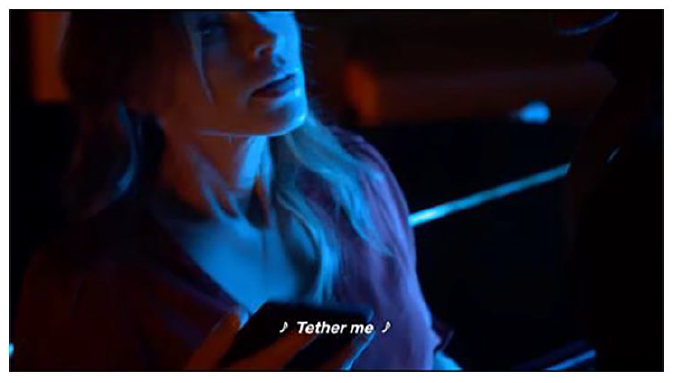
As the characters are saying goodbye to each other, Chloe walks toward the door while Lucifer faces the other direction (line 8). Standing back to back at a distance in the room, Lucifer produces a final closing of the encounter (line 9), at which point, both characters, at the very same moment, turn around and share a mutual gaze (fig. 3). Now facing each other, Chloe aligns verbally with the project of ending the encounter (line 11). However, they both remain in the position of sharing a mutual gaze in silence. Instead of moving further apart and actually ending the encounter, they move toward each other in a temporally synchronous manner (fig. 3–5). The initiation of the movement (line 12) is synchronously fine-tuned and when being in each other’s arms also the kissing is started simultaneously (line 12, fig. 6). The kissing continues along with heavy breathing (line 13) until they both stop simultaneously to share eye contact (fig. 7). Thereafter, they both return to kissing (line 15), and as the interaction continues, Chloe unbuttons Lucifer’s shirt.
Up until the unbuttoning of the shirt, all actions have been deployed in chorus. The synchronicity in changing the trajectory from ending the encounter to initiating the sexual activity casts the interaction as symmetrical. Since neither of the characters takes the first move in initiating sex, all possibilities of imposition and the associated face threats and vulnerabilities are eliminated. The normative structure of the adjacency pair is bridged by avoiding all unilateral initiatives. This joint transformation from saying goodbye to the emergence of sexual activity is conveyed as truly consensual through the characters’ synchronous actions.
Sequential establishing of verbal consent
We will next analyze a case in which sexual consent is established verbally within the sequential framework of spoken conversational interaction. The example is from the movie Unpregnant (2020). The movie is about a pregnant teenager Veronica who cannot get an abortion in her home state of Missouri without her parents’ permission. In an attempt to get an abortion elsewhere, she takes a road trip to Albuquerque with her friend Bailey. During their trip, Veronica and Bailey make a pit stop and meet Kira, a hot lesbian race car driver. Sparks begin to fly between Bailey and Kira; the extract below represents a critical moment in the unfolding romance, when Kira makes the first move on Bailey (line 1).

When verbally asking for consent to kiss Bailey, Kira is met with silence and no embodied response (line 2). Bailey starts accounting for her lack of action (line 3) but is interrupted by Kira apologizing (‘we don’t have to’, line 5). Bailey, however, makes apparent that the problem is not her unwillingness to kiss but her inexperience and nervousness of being bad at it (lines 7 and 8).
The verbal exchange between Kira and Bailey makes apparent two inherent vulnerabilities associated with the verbal asking for consent. First, the proposer becomes vulnerable to the possibility of a rejection taking place before the proposal recipient has been given ‘taste’ of what the proposal really entails pleasure-wise. A potential rejection thus targets something that currently exists only in the imaginary world. Compared to those situations in which the proposal recipient expresses the rejection only after the initiation of a kiss, the insult here may come across as more minor – it does not target a ‘real thing’ but just an idea of being kissed by the proposer. At the same time, the imaginary world and the range of sexual activities that could and could not take place in that world is a topic of much everyday conversation about sex, and this topic of talk is not immune to insults.
Second, a verbal request for consent makes the proposal recipient vulnerable to the possibility of failing to meet those expectations of pleasure that have motivated the proposal speaker to formulate their proposal. The temporal distance between the proposal and its realization and the physical distance between the proposer and proposal recipient play a key role in this respect. Due to the distance, it is not only the proposal recipient who lacks immediate access to the content of the proposal at the moment at which the proposal is verbally expressed, but it is also the proposal speaker who lacks immediate access to the extent to which their plan actually meets their expectations. The proposal recipient’s reflexive awareness of this lack of access may thus become consequential in complicating the emergence of consent, even if mutual sexual willingness exists.
Given these disadvantages of seeking to achieve consent through verbal turn exchanges, it is understandable that people might sometimes wish to refrain from having to express their sexual willingness verbally. Instead of the sequential framework of interaction, people have been shown to prefer the concurrent framework of interaction as a way of initiating sex (Gronert and Raclaw, 2019; Hickman and Muehlenhard, 1999), synchronous conduct enabling an even distribution of vulnerabilities between the participants.
Consent across sequences
In the section above, we demonstrated the advantages of achieving sexual consent in and through synchronous embodied behaviors and the disadvantages of achieving sexual consent in and through verbal turn exchanges. In this section, we seek to complement the big picture by focusing in more detail on the achievement of sexual consent in the sequential framework of interaction. In addition to verbal conduct, embodied conduct is often organized sequentially, resulting in the participants typically using various combinations of embodied and verbal turn exchanges to cast the emerging sexual activity as mutually desirable and consensual. Below, we will discuss two such practices: slow probing and trusting first.
Slow probing
We will next analyze a case in which sexual consent is achieved in and through a continuous chain of initiating and responsive actions. The sequential framework of interaction is foregrounded, although the participants alternate between the embodied and verbal forms of conduct. The case is from the post-apocalyptic dystopian thriller drama series Snowpiercer, following the passengers of a gigantic, perpetually moving train that carries the remnants of humanity after the world has become a frozen, unlivable wasteland. The characters in the case are Andre and Josie, who used to live in extreme poverty at the tail of the train. Andre was pulled out of the tail due to his prior experience as a homicide detective, while Josie was assumed to have frozen to death after an attempt to rebel against the train’s despotic leader, Melanie, but was nonetheless found alive. The two have kissed each other before, but they have – thus far – had no sex together.






The first sequence of initiating and responsive action occurs at the very beginning of the extract and consists of the participants’ embodied conduct: Josie takes one step toward Andre, who responds by initiating a slow trajectory toward Josie (line 1). What follows is talk about matters outside of the room (lines 2–4), which ends with a question about a concrete problem that the participants should deal with at some point (line 6). While Josie’s question could in principle be interpreted as a serious topic initiation, Andre responds to it with an explicit display of unwillingness to talk about the matter (line 8). However, his subsequent physical approaching toward Josie (line 9) renders sexual suggestivity to what might otherwise come across as a rude rejection of a topic for discussion.
Josie goes along with this playful ambiguity: after a display of compliance (line 10), she takes a step toward Andre (line 11) and says ‘you pick a topic then’ (line 12). Andre responds by wetting his lips with his tongue and leaning in toward Josie’s face (line 13). Josie responds to Andre’s move by also leaning in (line 13), which leads to a kiss (line 14). After that, they stand forehead to forehead (line 15) and start to kiss again (line 16), which is followed by Josie withdrawing (line 18) and gazing at Andre’s sweater (line 19, fig 7). Andre appears to orient to Josie’s gaze as a particular sexual proposal, as after a mutual gaze (line 20), he removes his sweater, which is followed by Josie removing her sweater (line 21) and pants (line 22). Thus, Josie’s gaze at the shirt along with a mutual gaze was enough to set off the actions of removing the clothes. A final sequence of initiating and responsive action before the launching of more synchronously organized sexual activity involves Josie approaching Andre and placing her hands on his upper body, to which Andre responds by placing his hands on Josies (lines 23–25).
The extract demonstrates a successful achievement of sexual consent in the sequential framework of interaction. What appears to play a key role in this respect is ambiguity: the extract is full of hints toward sexual activity, which nonetheless needed to be interpreted by the co-participant as such to forward the trajectory of the participants’ interaction toward sex. Essentially, such ambiguity could be observed in both verbal and embodied domains of conduct. Just like verbal utterances and embodied moves could serve as resources for creating ambiguity in initiating actions, both could also disambiguate the emerging line of action in the next turn.
Trusting first
Finally, we will discuss a second practice of achieving sexual consent in the sequential interaction framework. In the practice of slow probing discussed above, the participants could shift flexibly between the embodied and verbal forms of conduct. However, in the practice described here, such alteration becomes more systematized. The practice involves the participants first making an embodied move toward sexual activity ‘on trust’, followed by a verbal check for consent.
The scene comes from the series Sex Education and pictures the first sexual encounter of the two high school friends, Otis and Ola. In the episode before this, they declared their love interest in each other and kissed. When the scene begins, Otis and Ola are already in bed, making out with heavy breathing and grunting (line 1, fig. 1). Now, the activity progresses toward touching the breast (lines 2–5) and crotch (lines 6–8).





While kissing, Otis starts moving his hand from Ola’s hip upward toward her breast (line 2, fig. 2–3). Before his hand reaches the breast, Ola produces a groan-like sound (line 3) and puts her hand on his, slightly accompanying and confirming its upward movement toward the breast. Ola, however, lets go of Otis’s hand, after which he finishes the path himself, puts his hand on her breast, and squeezes it repeatedly (line 3). Only after Otis has already engaged in this more advanced sexual activity does he ask for Ola’s consent (is this okay, line 4).When positively affirmed, the squeezing increases (lines 6), and the kissing continues.
After that, Ola launches an analogous reciprocal action: she moves her hand from Otis’s back head to his crotch (fig. 6 and 7) and then squeezes it (fig. 8), to which Otis responds with a groan (line 7). Then Ola asks for consent with a heavily breathy voice (i(h)s tha(h)t o(h)ka(h)y, line 9) which is followed by Otis nodding and providing a verbal confirmation (lines 10 and 11).
Hence, both participants’ conduct roughly followed the pattern in which first an intimate action was launched, and only in retrospect was a request for consent made. While this pattern of achieving sexual consent is deeply embedded in the sequential framework of interaction, it involves more straightforward and forceful advances toward increased intimacy, compared to the instances of slow probing (Extract 3). The pattern thus involves a risk of imposition, which is however essentially lowered by the subtle embodied and vocal cues that confirm the anticipated trajectory of action (towing the hand toward the breast, line 3; groan-like sounds, lines 3 and 7).
Furthermore, compared to the instances of consent through verbal proposal-response sequences alone (Extract 2), here, the recipient of the ‘proposal’ is given temporally and physically immediate access to what it entails. The action of squeezing the breast or crotch is already on the move when the consent is asked for. In other words, the absolute certainty about an existing consent is thus established only at the point at which it would be technically too late to annul the first move. Trusting first, therefore, comes across as a risky endeavor, which calls into question the status of the verbal request as being really about the very action that it apparently refers to. Perhaps, receiving explicit consent for an action that has already been implemented may be best understood as receiving implicit permission to go further in the trajectory of ever-greater levels of sexual intimacy.
Conclusions
In this study, we used data from TV series and movies to analyze the interactional achievement of sexual consent, discussing those embodied and verbal resources available for the participants to convey this display. Our analysis of the initiation of sexual activity involved comparing synchronous establishing of nonverbal consent with sequential establishing of verbal consent, which led us to point to the advantages of synchronous embodied behaviors in the interactional achievement of consent and to the disadvantages of doing the same within the sequential framework of verbal turn-by-turn exchanges. In the second part of our analysis, we focused more on the achieving sexual consent in the sequential framework of interaction, describing two different ways for the participants to combine embodied and verbal turn-by-turn exchanges to construct the emerging sexual activity consensually: slow probing and trusting first. Although the interactions in our data are scripted, we maintain that the culturally-anchored interactional practices identified in the study also exist in real life – otherwise, these would not be recognizable to today’s spectators, at least in the Western world.
Our results cast new light on the affirmative consent model discussed at the beginning of the paper. While the model emphasizes the need for clear and unambiguous consent, it acknowledges that consent may be conveyed either verbally or nonverbally (Coy et al., 2016; Muehlenhard et al., 2016). However, as demonstrated in the first part of our analysis, the verbal establishing of consent is associated with various problems – albeit serving as an effective way to secure consent, the temporal distance between the proposal and its realization, as well as the physical distance between the proposer and proposal recipient, hinders the even distribution of vulnerabilities between the participants. Nevertheless, as the second part of our analysis has emphasized, the establishing of consent is far from a hopelessly ambiguous endeavor. In many joint actions in the embodied domain, no words are necessary to construct the activity as a joint one (Magnusson, 2021; Stevanovic and Monzoni, 2016), and this holds also for sexual activities (i.e. synchronous establishing of nonverbal consent, slow probing). Furthermore, words may be used flexibly in combination with embodied resources (i.e. trusting first), which allows the participants to avoid some of the social vulnerabilities associated with the use of spoken utterances to suggest sex (i.e. sequential establishing of verbal consent).
Given the inherent asymmetricities associated with making the first move, the synchronous initiation of sex appears as an optimal way of achieving consent, which is also frequently romanticized in media. In synchronous initiation of sexual activity, no one needs to take the risk of acting on trust and then facing a possible rejection. A synchronous initiation of sex also invokes an association of a high level of sexual arousal, passion, and intensity, which may not be similarly present in the instances of slow probing. This is most likely the reason why people tend to prefer the idea of initiating sex in a synchronous fashion (Holmström et al., 2020). However, passionate initiation of sex when the partner does not respond similarly will most likely be problematic from the perspective of sexual consent. Indeed, it is here that we may observe a potential key mechanism underlying many problems of sexual consent. People seek to experience the joys of synchronous initiation of sex but end up in situations where the timing is not quite right, and the initiation comes across as unilateral imposition. Interventions to advocate the concept of sexual consent may therefore be aided by a heightened awareness about people’s phantasies of the synchronous initiation of sex. What is needed, we suggest, is the embracing of the fact that the achievement of sexual consent may in practice involve getting rid of the romanticized ideal of synchronicity and resorting to more temperate means of achieving consent instead.
In this paper, the achievement of sexual consent was conceptualized as joint decision-making. Two main insights emerge from this conceptualization. The first has to do with the embodied nature of sexual proposals, which entails a specific challenge: How to provide a proposal recipient access to the precise content of a sexual proposal without already engaging in the very action that proposal is about? The participants in our data dealt with this challenge by treating the proposals and the proposed actions at times as unified and at other times as separate. For example, a verbal request for consent accompanied by a hand on the breast involved a moment where the two were unified. However, an affirming verbal answer to the proposal seemed to expand the scope of the proposal to encompass the next move in the chain of events toward increasingly intense sexual activity. The multimodal action packages associated with sexual proposals are thus of specifically complex nature, encompassing a wide range of verbal and embodied resources and intricate temporal projections.
The second insight that emerged from conceptualizing the achievement of sexual consent as joint decision-making has to do with ambiguity. Conversation analytic research has pointed to ambiguity as a central resource for achieving genuinely joint decisions (Stevanovic, 2012, 2013) and a high level of affiliation between the participants (Stivers et al., 2022). Ambiguity at each step of the decision-making process, starting from a proposal toward the joint decision, allows the participants to exert joint control, not only over the content of the decisions to be made but also over the content of the interactional agenda – that is, whether decisions about specific contents should be made in the first place (Stevanovic, 2013, 2015). As recently pointed out by Tavory and Fine (2020), ‘ambiguity is crucial to interaction precisely because it allows interactants to attend selectively to aspects of ongoing interaction, so that “dangerous” disruption is ignored or redefined’ (Tavory and Fine, 2020: 376). In our data, the advantages of verbal ambiguity could be particularly clearly seen in the sequences in which mundane talk involved sexual overtones, which the recipient could selectively orient to and thus pursue the unsaid.
Inasmuch as ambiguity plays a role in the participants’ movements into sexual activity, it is not only sexual consent that can be achieved as genuinely joint decisions. In addition, movement toward activities other than sex can also be reached jointly – simply by the proposer refraining from pursuing any further sexual activities that the recipient does not pick upon. While the affirmative consent model highlights the need to achieve sexual consent unambiguously, this should not be confused with how sexual consent realizes at the level of the turn-by-turn unfolding of interaction. Indeed, based on our study, we suggest that it is precisely by appreciating and ‘taking seriously’ the notion of ambiguity that sexual consent may be most likely achieved.
Footnotes
Declaration of conflicting interests
The author(s) declared no potential conflicts of interest with respect to the research, authorship, and/or publication of this article.
Funding
The author(s) disclosed receipt of the following financial support for the research, authorship, and/or publication of this article: The authors received financial support from Academy of Finland.