




Abstract
This article addresses a vital concern in current society by showing what participants themselves may treat as ways to transcend their differences. Actors’ shared understanding has been of longstanding interest across the social sciences. Conversation analysis (CA) treats the procedural infrastructure of interaction as the basis for participants to manage intersubjectivity. The field of dialogue studies has made occasions in which people transform their relationship by discussing their differences, central to their research project, and called them “dialogic moments.” This study draws on CA to investigate “dialogic moments,” but now through the eyes of participants themselves. Using single-case analysis, we argue that such moments require participants to go against normative orientations in talk promoting social solidarity and progressivity, by soliciting differences to understand and transcend them. This “going against the interactional tide” may explain both why dialogue is difficult to achieve and why it is appreciated by participants as dialogue.
Keywords
Introduction
Social scientists have long sought to understand how people with divergent perspectives, experiences, and social positions can achieve a shared understanding of their social circumstances and actions. Conversation analysis (CA) as a theory of social interaction (Sacks, 1992) and a method for its analysis (Sacks et al., 1974) transformed the terms of this debate by focusing on intersubjectivity as a contingent, practical achievement enabled by the procedural infrastructure of interaction (Schegloff, 1992). In approaching intersubjectivity in this way, CA has treated it as distinct from the type of occasion or its tenor, insofar as both cooperation and conflict require some shared level of understanding of events and actions. Thus, whether contributions to an encounter are designed to be hostile, harmonious, or indifferent; in every next action, participants display their understanding of the interaction thus far, including who they are to one another, the status of their relations, and the states of affairs being discussed (Heritage, 1984; Sacks et al., 1974). Where CA has examined how people seek to overcome and transcend their differences as a basis for managing their relations to one another, it has primarily focused on institutional settings with the avowed aim of resolving or addressing conflicts, such as mediation (e.g. Stokoe and Sikveland, 2016). The field of dialogue studies (Anderson et al., 2004a), by contrast, has placed occasions where people seek to transform how they relate to one another by exposing and discussing their differences at the center of their research project. Dialogue scholars have theorized about and examined the communicative ways (i.e. “dialogue”) that enable individuals to “improve their understanding of each other and the issues they face” (Black, 2008: 93).
One line of dialogue scholars has argued that such transformative engagements, where parties attempt to gain a better understanding of the other, should be regarded as existing in moments – ephemeral and yet profound in their effects (e.g. Cissna and Anderson, 1998). “Dialogic moments” have been defined as “fleeting, typically unplanned, instances where partners experience being both present and open to the other’s experience” (Black, 2008: 98). Such moments may involve “deep listening, perspective taking, respect, and a sense of genuineness or honesty” (Sprain and Black, 2018: 341) and bring about a new understanding of a person or issue (Heath and Isbell, 2021). Dialogue scholars have highlighted the importance of “dialogic moments” because the shared understanding achieved through them enables the possibility of peaceful coexistence as an alternative to relations characterized by conflict or dominance.
Despite their potential promise, the interactional trajectories through which “dialogic moments” are pursued and oriented-to as transformative engagements in actual interactions has largely remained unaddressed. Given the increasing prevalence and severity of conflict and discord however, understanding how participants can transcend their differences has emerged as a vital interdisciplinary concern. “Peaceful coexistence” glosses a wide range of possible outcomes, relations, and social arrangements (see Elias, 1978); however, occasions of interaction are crucial as a point of production for social relations. The current study poses that a conversation-analytic approach can shed light on “dialogic moments” and their achievement in occasions of interaction. This new focus, we argue, enables researchers and practitioners to recognize when such moments emerge and how they are accomplished in real-life interaction.
As discussed, CA transformed the terms of the debate on intersubjectivity by addressing shared understanding as a members’ problem, grounded in the sequential organization of conversation. We propose a similar transformation in the approach to “dialogic moments.” We present a single-case analysis (Schegloff, 1987) to demonstrate how CA can illuminate what participants treat as “dialogic moments.” This article therefore examines such moments from the perspective of the participants themselves, thus showing how dialogue studies and CA can mutually inform each other in seeking to better understand and facilitate dialogue practices.
In an earlier study (Van Burgsteden et al., 2022), we addressed many of the issues raised by dialogue scholars using an approach grounded in CA to examine occasions of transformative engagement. We demonstrated how analyses of sequences of action can lead us to expand the definition of transformation beyond what is assumed to be a “cognitive change” to include participants’ displayed transformation that emerges over interactional trajectories, through a series of steps or moves:
We examined occasions where one party asks about the source of a co-participant’s apparent preoccupation with a concern or emotional experience.
The analysis of such sequences showed that those persons tacitly indicating emotional preoccupation give voice to their concern or problem when asked about it.
We then considered how the person soliciting those concerns may display their understanding of them, using, for example, upshot formulations.
We showed how the demonstration of understanding revealed through these next turns can itself be consequential for recipients, who now reveal that these displayed understandings have resulted in some form of amelioration of the indicated trouble.
By mutually closing the issue, participants indicate they can move on to a next topic or sequence. Thus, our study has shown how one element of “peaceful coexistence” can be established locally, as a stable closure to the topic or sequence, such that previously unresolved matters no longer linger or cast a shadow over participants’ move to a next sequence (cf. Schegloff, 2007), or the more distal relations established through their talk.
In this way, we have sought to display how “dialogic moments” can involve sequences of actions through which participants pursue and display a shift in their “cognitive” and/or “emotional” orientations via talk and other conduct.
The current study builds on our prior work by placing our argument for a conversation-analytic approach to “dialogic moments” in a broader theoretical framework. In some ways, social differences and social bonds have been understood to be in tension with one another: People can either emphasize difference and risk conflict, or they can pursue social bonds by suppressing their differences. We contend that while many routine forms of conversational organization “prefer” social bonds over the articulation of difference – and thereby tacitly associate the articulation of such differences with the pursuit of conflict – in the case of “dialogic moments” participants find ways to maintain social bonds while nevertheless surfacing differences in pursuit of shared understandings that transcend them.
We begin by discussing dialogic communication theories as developed in communication studies, thereby highlighting studies approaching “dialogue” as existing in moments.
“Dialogic moments”: Insights from communication studies
Within the field of communication studies, the main interest in “dialogue” started to emerge in the 1970s and 1980s, inspired by the work of philosophers Mikhail Bakhtin, Martin Buber, Hans-Georg Gadamer, and Jürgen Habermas (Anderson et al., 2004b). Whereas these philosophies by their very nature are rather abstract, communication scholars have applied these theories to analyze the social practices of communication across settings, such as online forums, communication in organizations, and family communication. Furthermore, they have implemented these theories in practice, for instance in training sessions to community or workplace members dealing with conflict (Phillips, 2011).
Philosopher Martin Buber’s (1958) focus on the dialogic encounter with the other (“Thou”) emphasized dialogue’s transformative character. Buber posed that “dialogue” requires an active relationship between persons: “I become through my relation to the Thou, as I become I, I say Thou. All real living is meeting” (Buber, 1958: 17, emphasis in original). Within communication studies, Buber’s dialogue theory prompted a search for “dialogic moments” in instances of social interaction. Communication studies on “dialogic moments” have thereby examined how social actors experience and accomplish such transformative engagements in real life (e.g. Black, 2008; Cissna and Anderson, 2005, 2008; Davis, 2019; Heath and Isbell, 2021; Montague, 2012; Poulos, 2008).
One line of dialogue analysts has reported on participants’ retrospective accounts of such moments. Such studies illuminate the communicative practices and social circumstances which participants describe as enabling such moments. For instance, Montague (2012) provided individuals with a definition of “dialogic moments” and asked them about a time when they had experienced such a moment. Performing a thematic analysis on the interviews, he discovered that participants experienced the initiation of such moments through a series of reciprocated verbal and non-verbal displays of openness and prolonged engagement, such as eye contact and inquiries about one’s life and self-disclosure, that eventually shifted into “genuine dialogue.” According to the participants, this enabled them to gain a new understanding of the other. Montague (2012) concludes that “body language” and “considerate communicative acts” are important for the establishment of dialogic engagement.
In addition, Stewart and Koenig Kellas (2020) treated the “co-construction of people’s uniqueness” as central to “dialogic moments.” They provided an example of a “dialogic moment” between the first author and a student. The student had been hit by a car, resulting in the amputation of his leg. The author retrospectively described what happened in the exchange, for instance how he shared his anger at the driver and sensed his fear about the future, but also how he himself shared elements of his own life. According to the author, a “dialogic moment” occurred where he and the student mutually experienced “uniqueness” and “being open,” which they displayed “verbally and nonverbally.” Stewart and Koenig Kellas (2020: 11) concluded that the “co-construction of uniqueness” occurs when “conversation partners are mindfully-present to one another, open to emergent meanings, and able to put on the table between them relevant reflections, choices, and unmeasurable elements of one another, such as emotions and opinion.”
Studies on participants’ retrospective accounts, such as the ones outlined above, hint at some communicative practices and conditions that “dialogic moments” may comprise. However, they are based on participants’ reports of “dialogic moments” and not on analyses of actual conversation. Other scholars have sought to identify the communication characteristics of “dialogue” by analyzing real-life engagements. For instance, Cissna and Anderson (1994, 2002, 2008) examined a recording and transcript of a conversation between Martin Buber and psychologist Carl Rogers. The authors assumed it was a dialogue, given that Buber and the event’s moderator identified it as such (Cissna and Anderson, 1994), and Rogers thought it “went very well” (Pentony, 1987: 420). Cissna and Anderson aimed at establishing that, and why, these exchanges were in fact “dialogic,” and what we can learn from how these well-known dialogue theorists and practitioners built “dialogue.” The authors concluded that dialogue between Buber and Rogers evidently did develop, for instance through their displays of listening attentively to each other (e.g. “uh huh,” “m-hmmm”), how they disclosed their issues and viewpoints, and how they asked questions, thereby, according to the authors, revealing an “open orientation” to each other’s experiences.
Other work on the communicative characteristics of “dialogic moments” has emphasized the importance of storytelling. Black’s (2008) analysis of an online deliberative forum demonstrates how telling and listening to stories enables people to negotiate their identities and present their perspectives, while also allowing them to understand others’ perspectives. For instance, it shows that in response to a story about a person’s perspective and feelings concerning the 9/11 events, and her vision for the future of the World Trade Center site, the recipient shows to put herself in the shoes of the storyteller by saying “You haven’t expressed bitterness until now [. . .] Even if you don’t forgive what they did, you don’t let it close your heart to the best of what can come despite it” (Black, 2008: 106–107).
In sum, dialogue research has provided some insights into the communicative practices that “dialogic moments” may incorporate. However, two specific aspects of research on “dialogic moments” have impeded detailed analyses of the interactional trajectories over which these transformative engagements are pursued, and what participants themselves treat as transformative. First, dialogue analysts tend to assess how “real” “dialogic moments” are by including their own evaluations of the exchange, for instance by claiming that a response of one of the participants constituted “the weakest interchange of the evening” (Cissna and Anderson, 1994: 38). Second, dialogue scholars typically discuss and evaluate participants’ (changes in) cognitive states. For instance, they conclude that storytelling enables “dialogic moments” because it encourages people to “experience presence, openness, and a relational tension between self and other” (Black, 2008: 109), or that participants “fostered knowledge of what is important to the other in conversation as well as built empathy for their perspective” (Heath and Isbell, 2021: 12).
We argue that analysts’ inclusions of their own evaluations of the conversation or their claims on participants’ mental changes may lead to ignoring aspects of interaction that one would have observed when not incorporating understandings of behavior “from the outside” (cf. Te Molder, 2016). In fact, the inclusion of analyst evaluations may result in the substitution of participants’ perspectives for those of the analyst. In this respect, CA offers a well-developed apparatus for the analysis of the turn-by-turn unfolding of interaction. Rather than using qualitative value judgments about interaction which are believed to lead to some transformative understanding such as “deep listening, perspective taking, respect, and a sense of genuineness or honesty” (Sprain and Black, 2018: 341), our conversation-analytic perspective not only allows us to describe associated practices but also to specify and clarify these rather opaque terms. Moreover, conversation analysts put cognitive explanations between brackets. CA does not dispute that cognition exists but remains agnostic about its existence (cf. Te Molder and Potter, 2005). By addressing how participants show an understanding of each other’s interactional contributions, we can understand and interpret the course of the interaction, via what participants themselves make relevant and observable. In this study, we are therefore tracking what participants treat as transformative. We demonstrate that such oriented-to transformative engagements can be initiated with one party’s attempt to unearth what is treated as a co-participant’s potential problem; a problem which has been indicated, but not yet raised in explicit ways. In this regard, our analysis can be embedded in research on participants’ management of aspects of social relations which may pose choices about what is said, unsaid, made explicit, or left inferable.
Interactants’ management of what (not) to say
Across virtually every activity and form of social organization in interaction, speakers producing actions can be seen to make choices about what to say or not to say and are treated as having or making a choice in that respect (Heritage, 1984). Speakers’ choices along those lines reflect a range of sequential and relational concerns. Goffman (1967) posed that the organization of social interaction promotes social affiliation rather than social disaffiliation and conflict. CA’s notion of “preference organization” refers to how actions are designed either to undermine or promote social solidarity in interaction (Heritage and Raymond, 2005). One of the most ubiquitous outcomes of preference organization is the maintenance or advancement of social solidarity in interaction: Interlocutors typically seek to promote and produce socially solidary actions while limiting the effects of socially disruptive ones (e.g. Pomerantz and Heritage, 2013; Schegloff, 2007). Considering this, CA research suggests that people typically avoid producing potentially combative actions that may offend the recipient or undermine their relations. This phenomenon is understood to be rooted in a structural organization relating to participants’ normative orientations to the preservation or enhancement of social solidarity with interaction partners.
For instance, recipients of candidate answer questions typically shape their answers as partial confirmations to avoid blatant disconfirmations (Pomerantz and Heritage, 2013). Take the following case. A asks B, who lives in California, where she lives, and provides “Florida” as a candidate answer. B formulates her answer in such a way that she can still confirm the candidate answer.
Although B could have simply disconfirmed that she lives in Florida, B’s response is shaped in the direction of agreement (i.e. that she was born in Florida).
The organization of the various preferences that support or promote social solidarity do not make it impossible to introduce potentially problematic matters, but they pose challenges for speakers who would introduce them in the service of something other than conflict or disagreement. This is reflected in how speakers indicate these issues delicately, thereby conveying they are raising them while also attending to social bonds (see Lerner, 2013). Specifically, although speakers may present problems or disagreements in explicit ways, a large body of work within CA suggests that disclosing troubles or disagreement is socially constrained. Speakers typically present troubles or complaints in implicit ways (e.g. Heinemann and Traverso, 2009; Jefferson, 1980, 1988), or keep disagreements “‘beneath the surface’ of interaction, present but unsaid” (Toerien and Jackson, 2019: 38). Moreover, speakers can, but do not always, show a special concern for talking about delicate matters, for instance by obscuring sensitive or obscene expressions by laughing (e.g. Jefferson, 1984; Lerner, 2013), or by refraining from explicitly articulating sensitive words, such as “death” and “dying” (e.g. Lutfey and Maynard, 1998; Pino et al., 2016), thereby shifting part of the responsibility for what was said to the recipient’s ability to apprehend it. In sum, the various forms of social organization in interaction promote the burying of difference and not saying hurtful things. This suggests that the forms of social organization participants use to conduct courses of action in interaction can shape their contributions to those actions by suppressing the introduction of details that emphasize difference, disagreements, or delicate matters in the service of maintaining social bonds.
A further interdependent form of social organization, the preference for moving the conversation forward, or “progressivity,” also features in the suppression of details. The preference for progressivity becomes visible in cases where, for instance, interactants appear to have a problem, but leave the issue undecided in the service of continuing the conversation and activity-in-progress. For example, the preference for progressivity can be seen to override the preference for person reference recognition when speakers abandon the establishment of recognition in favor of continuing the conversation (Heritage, 2007). See Excerpt 2, where Emma fails to recognize Lottie’s reference to “Doctor Nelson” despite her extended efforts (see line 5–7).
Lottie finally abandons her pursuit of recognition by moving to the non-recognitional “This friend’v a:rs,” (line 9). Emma receipts this information (line 10), oriented to moving onward. As this example illustrates, participants encountering unresolved troubles must choose between sustaining their progressive realization of an in-progress activity and addressing and resolving those problems.
While we have so far discussed how the infrastructure of interaction may prefer the progressive realization of action and the suppression of differences, research on conflict in interaction reveals that insisting on details of difference can be a method for pursuing conflict (e.g. Coulter, 1990; Dersley and Wootton, 2001). For instance, speakers may invite co-participants to detail their perspectives and differences, but such invitations are typically produced in pursuing conflict rather than understanding (e.g. Hutchby, 1996; Reynolds, 2015). Consequently, the various preferences associated with social solidarity and cooperatively organized social action are abandoned when and as conflict emerges (cf. Whitehead et al., 2018). These insights suggest that the introduction of differing perspectives may be “risky” insofar as doing so can be treated as instantiating a form of engagement focused on conflict and disagreement.
This section has reviewed aspects of the normatively organized, interdependent organizations of practices for conducting talk-in-interaction that promote the suppression of differences and prefer progress over addressing troubles. We contend that these tacit features of interaction pose challenges for speakers seeking to solicit detail on differences while aiming at something other than conflict. Therefore, participants pursuing “dialogic moments” must find ways to work against these normative constraints. That is, participants pursuing moments of transformative engagement must find a way to pursue or maintain social bonds, while nevertheless soliciting detail on potential differences in the service of comprehending and transcending them. This can graphically be illustrated as follows (Figure 1):
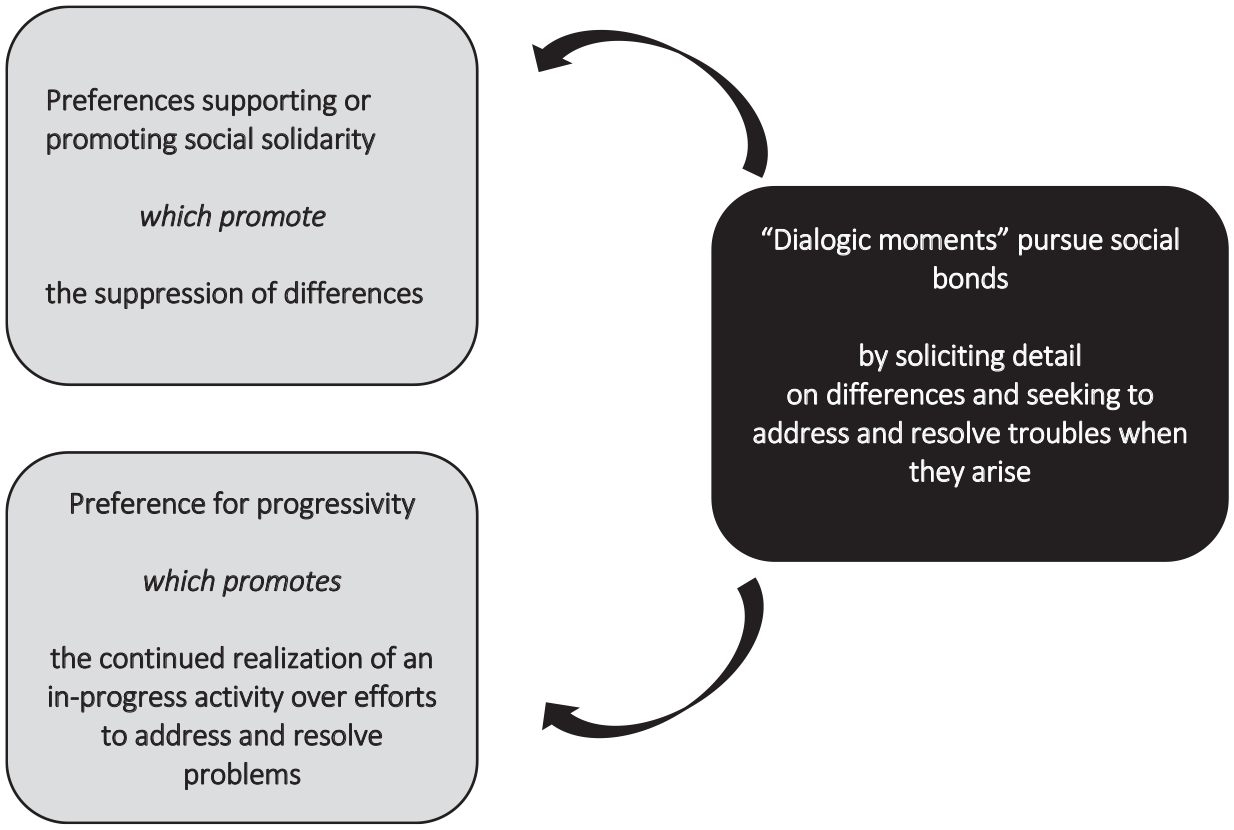
“Dialogic moments” require participants to go against normative orientations that promote suppression of difference.
Next, we illustrate this through our analysis of a segment of recorded interaction.
The case study
The case presented is from a larger corpus of data of recorded Dutch public meetings on livestock farming (Van Burgsteden and Te Molder, 2021, 2022; Van Burgsteden et al., 2022). The topic of livestock farming recurrently involves heated social debate in the Netherlands, and is characterized by a diversity of viewpoints, interests, and risk perceptions (Borlée, 2018).
The meeting we discuss concerns a video-recorded information meeting regarding a goat farm’s possible expansion. 1 Due to resistance in the farm’s surroundings, the municipal institution organized a meeting to provide an opportunity for residents to get informed on the health risks of living in the vicinity of livestock farms. People present in this meeting include (scientific) experts, residents, the goat farmer, and his advisor. In this meeting, experts presented knowledge on the risks of livestock farms and answered questions from residents. The meeting was led by a facilitator. The presence of a facilitator suggests that one or the other side needs help communicating, needs help understanding, or needs help deciding when (not) to continue. Consequently, the very presence of a facilitator reflects an orientation to a range of interactional problems associated with conflict.
Our focal case shows how participants are managing the tensions between privileging the progressivity of the interaction versus inviting the articulation of differences, either in the service of conflict (Excerpt 3A), or in the service of understanding (Excerpt 3B). We show that what participants identify as dialogue involves participants finding ways to invite the articulation of differences and respond to possible conflicts while nevertheless also promoting social solidarity and sustaining the progressive realization of the meeting.
Privileging progressivity and soliciting detail in the service of conflict
In the following fragment, two of the participants take different positions regarding the possible resolution of an effort to address a citizen’s concerns. The fragment begins with the facilitator asking a resident, Anton, whether a response to his prior question resolved his concerns. In a place where the resident could accept the answer, he instead poses a further question challenging the report’s inclusion of a research finding about the positive health effects of living close to livestock farms (lines 4–9). Both the posing of the question and aspects of its design reflect Anton’s continued skepticism about the report, which the scientist seeks to address via an extended answer (lines 13–25). After the scientist has provided the answer, the facilitator orients to moving on, posing a query that privileges the progressivity of the meeting over further consideration of the resident’s concerns (line 26). When the resident acquiesces however, the agricultural advisor, who assists the farmer in the meeting, adds further details in the service of conflict (lines 28–29).
The resident’s query about the report’s conclusions shows he does not accept these conclusions at face-value. Having read the conclusions aloud, he adds “I am ↑
After the scientist has provided an answer, the facilitator invites the resident’s acceptance of the response as adequate (line 26). Although the facilitator’s query formally provides a place for the resident to introduce more issues, its design is tilted toward acceptances and so movement to a next topic. Specifically, his turn consists of a polar (“yes/no”) question that is unavoidably tilted toward, or prefers, either a “yes” or “no” response (Clayman and Heritage, 2002; Raymond, 2003; Sacks, 1987). The question’s proposition that the “answer is clear,” tilts the question toward confirmation. This orientation becomes more explicit with each next component: After inviting uptake, the facilitator provides a candidate answer (“clear”) that, were Anton to accept it, would make relevant movement to a next topic. After yet another small pause, the facilitator adds a further component (“answer”) that pursues the same response.
Given the challenge posed by the resident’s query, accepting the scientist’s response as adequate would also make relevant backing down from his skeptical treatment of the report. This might be conveyed by a change of state token (e.g. “Oh okay”) or another sequence closing third (e.g. “Clear”). The resident, however, merely acquiesces, producing a neutral, unelaborated “yes” (line 27). In this way, he addresses the terms of the local question, but not the larger sequence it is part of. As such, his response poses a choice for the facilitator: He can take the resident’s acquiescence as a basis for moving to a next query or topic or invite Anton to elaborate the basis for his ongoing resistance.
As it happens, before he can pursue either of these alternatives, the agricultural advisor expands the sequence by pursuing an admission from the resident that would resolve it (see Schegloff, 2007). Specifically, the advisor’s emphatic assertion that the subject of the resident’s query was “properly stated” in the research report (lines 28–29) claims that the report, itself, should not be understood as the source of the resident’s skepticism. In this way, the advisor treats the resident as accountable for using knowledge that he treats as both widely shared and relevant to the exchange (cf. Raymond and Sidnell, 2019). Moreover, the Dutch word “keurig” (which can be translated as “properly”) is normatively and morally loaded. That is, something has been done in “keurig” ways when it has been done according to the appropriate and relevant rules or expectations. The contrastive stress on “keurig” draws attention “to that particular element in the utterance” (Raymond, 2017: 24) and designs the turn in a way that marks its content as being contrastive with content from the resident’s prior talk. The advisor’s turn thereby serves to counter the assumption invoked in the resident’s challenging question (lines 4–9) that there are issues with the research that need further explanation. In this way, his turn is challenging the resident’s suggestion that the research has not been conducted in “keurig” ways. Thus, whereas the resident’s unelaborated “Ja.” (line 27) deals with the local aspect of the sequence, the advisor’s turn is designed to prompt the resident’s acceptance of the report’s adequacy, and in this way abandon his claim that it needed elaboration.
The resident initiation of repair (“Huh?,” line 30), also treats the advisor’s turn as challenging (Drew, 1997). After the advisor has repeated his utterance as a response to the resident’s other-initiated repair (line 31), some acknowledgment (e.g. “oh”; “okay”) on the resident’s part would be relevant. However, instead, the resident remains silent and his body-behavioral displays, slowly nodding and looking down (line 32), convey that he is unilaterally moving out of the conversation (cf. Raymond and Zimmerman, 2016). In doing so, he is visibly avoiding providing details on their differences in an environment where those differences would be cast in terms of conflict.
Soliciting detail to pursue social bonds
So far, we have seen the facilitator’s orientation to moving forward, thereby privileging progressivity over inviting the resident’s elaboration of his skepticism, and the advisor’s orientations to soliciting disclosure in pursuit of conflict. After line 32 (Excerpt 3A), the participants have arrived at a point in the turn-taking system where they are about to move on to the next activity. However, rather than privileging the interaction’s progressivity, the scientist reopens the prior sequence and poses a question (line 34). The scientist treats the prior sequence as possibly closed, while casting the prior interaction as having insufficiently dealt with what the initial question was. Her query thus initiates a retro-sequence (Schegloff, 2007), and demonstrates an openness to hearing the basis for the resident’s remaining reservations about the matter and invites him to specify what these are. In privileging the articulation of difference, the scientist’s turn jeopardizes social solidarity, since her turn may elicit the production of actions that are disaffiliative and socially divisive (cf. Goffman, 1967: 37). That is, the introduction of differences can be a basis for the emergence of an alternative form of engagement, focused on conflict. In his response, however, the resident does not treat the scientist’s turn as invoking conflict (lines 35–39). Whereas his displays in the prior part of the conversation showed his orientation to avoiding disagreement (line 32), when being invited to surface his issue, he is willing to say what his views are.
The scientist’s question is designed to redo the prior sequence, treating what just happened as not getting at what the resident was really asking about. Specifically, her question recognizes that resident’s question reflected an as yet unstated agenda. The “actually” treats the agenda as having been submerged (see Clift, 2001), and the “but”-preface shows that the scientist is resuming an activity that was abandoned in the prior talk (Mazeland and Huiskes, 2001).
Moreover, the scientist orients to her question as sensitive. Specifically, the small pauses indicate some hesitation, the use of “exactly” marks the query as aimed at gaining a deeper level of understanding of the resident’s motives, and the “actually” is produced in a noticeably quieter manner, characterizing the matter as delicate (cf. Lerner, 2013). The question’s design manages the balance of posing a question about the speaker’s motives without surfacing them as a basis for challenging them and, thus, as pursuing conflict and or other socially disaffiliative actions. The scientist’s question shows an interest in the motives underlying the resident’s query and thereby solicits these details in the service of understanding and social bonds.
The resident takes up the scientist’s invitation, presenting himself as a reasonable person who is interested in hearing more of the positive elements of the report rather than have it primarily emphasize dangers (lines 35–39). He shows some transformation in his orientation and a shift in the interaction: In lines 27 and 32, the resident reluctantly acquiesces to the facilitator’s efforts to advance the meeting’s agenda and visibly avoids adding details in response to the advisor’s challenge; by contrast, in lines 35–39, he elaborates his concerns, providing the organizers with a further chance to address them. Thus, whereas the facilitator’s and advisor’s contributions pursued alternatives to the resident surfacing the issues that prompted his query, the scientist’s query aligns her as open to hearing an alternative perspective, and thereby re-opens the conversation.
The sequence initiated by the scientist’s query also leads her to claim a transformed understanding of the resident’s concerns. The scientist’s initial query (line 34) positioned her not knowing about or understanding the resident’s motives. Following his elaboration of those concerns, however the scientist claims to understand and agree with them (lines 40). Moreover, she shows that, having heard the motives behind the resident’s question, she aligns with him by addressing a basic assumption about science, which is that it locates problems rather than positive effects (lines 40–44). She thereby acknowledges his points and reveals to also find the issues noteworthy.
In next turn, the resident’s “that must also be said” (line 45) endorses the scientist’s response as both consistent with his claims and additive to them. This again shows a transformation in the resident’s orientation: While his challenging questions (lines 4–9) and embodied display following the agricultural advisor’s intervention (line 32) conveyed an enduring preoccupation with the issue, his now explicit agreement with the scientist reflects a transformation in his views. He now shows he is not necessarily pursuing negative results arising from this study, but also positive ones. Moreover, the resident’s assessment “that must also be said” is closing-implicative, which again shows some transformation in orientation as he indicates to have let go of the concerns prevalent in his initial contribution and subsequent turns.
We see how the resident and scientist exit from the sequence with increasingly general assessments (Raymond and Heritage, 2006) and their displayed alignment. Consequently, another aspect oriented to as transformative within this exchange pertains to the scientist and resident showing to be co-constructing a claim about the importance of demonstrating not just the negative but also the positive effects arising from scientific studies. That is, after the resident assesses the issue as something that “must also be said,” the scientist’s high-pitched agreement token (line 46) claims that she is able to relate to this, after which the resident again invites agreement and alignment (line 47). Such displays allow parties to achieve a more stable closure to the problematic sequence and in that way allow for moving to a next one without the unresolved matters that may otherwise cast a shadow over their move to a next sequence or topic (cf. Raymond and Zimmerman, 2016). The facilitator uses this sequential environment to close the issue (line 49) and to allocate the turn to another resident (line 50), displaying an understanding that this could be a point in the interaction where they could amicably depart.
Conclusion and discussion
This article hopes to prompt productive debate on how CA can contribute to work in the field of dialogue studies, and vice versa, and foster a “dialogue” between the two approaches. Understanding how individuals can seek to transcend their differences is a crucial multidisciplinary problem, particularly considering the polarized divisions evident in many contemporary democracies. This paper theoretically contributes to notions and understandings of “dialogic moments” more broadly (through the eyes of the participants themselves), by placing them within the broader structural framework of normative accountability in interaction, particularly those relating to preferences that support or promote social solidarity and the preference for progressivity, which together may complicate engaging in dialogue. We have proposed that whereas these forms of organization may co-operate in suppressing differences in promoting agreement and preferring progressivity over addressing troubles, pursuing “dialogic moments” may require participants to find ways of resisting such pressures. In these occasions, participants solicit or provide details on differences in the service of comprehending and transcending them, thereby preserving, rather than threatening, social bonds.
Our single-case analysis (Schegloff, 1987) illustrated this argument. The analysis demonstrated how participants oriented to a tension between managing the preferences for agreement and progressivity and efforts to solicit the articulation of differences, and deal with troubles these differences give rise to over multiple sequences. However, as we have demonstrated, where these tensions are managed in some demonstrably useful way, participants may find it possible to arrive at potentially transformative understandings of one another. For example, in sequential junctures where the facilitator sought to move on and the agricultural advisor pursued conflict, the scientist circled back to convey her openness to hearing the basis for the resident’s concerns.
Evidently, the scientist’s initiation of a retro-sequence (Schegloff, 2007) was the proximate impetus for the transformative moments that followed. Her query is “sailing against the interactional tide” (Van Burgsteden et al., 2022), as it reverses a projected move to a new topic by reopening the prior sequence. In doing so, the scientist also potentially risks upending the tenuous (if unstable) peace they have just achieved by inviting the resident to explicate the basis for his challenges, without knowing what these concerns are and whether they relate to research in general or this scientist in particular. Elaborating such a concern poses challenges for both the resident and scientist, as it puts either their reputation or their relationship at risk by potentially generating conflict. Soliciting and providing details thus asks for some interactional courage from both parties. As we showed, the scientist’s effort is further ratified and rewarded as participants moved from a state of possible or incipient conflict to one of agreement and alignment. Through such displays, the parties achieve a stable closure to the topic or sequence (Schegloff, 2007), allowing them to move to a next one without any unresolved matters haunting their move to a next topic or sequence (Raymond and Zimmerman, 2016). This gives us evidence that, from a participants’ perspective, something transformative has taken place in the meeting.
Despite the idiosyncratic character of this segment of interaction and the circumstances the participants find themselves in, the issues managed by the participants are not exclusive to them. Participants’ set of resources, through which they show an openness to what they treat as a co-participant’s potential issue, give every indication of being an elementary concern for the management of self-other relationships (cf. Black, 2008). Our study suggests that mutually ratified “dialogic moments” can also be found in less optimal conditions, that is, in public meetings on contested issues where one party makes the policy decisions, and the other party is forced to endure the consequences of it. As demonstrated, parties’ displays that they are at least operating in the same reality and showing their capability and willingness to hearing one another allows them to move to a next topic or sequence without their preoccupation with some issue lingering over their encounter. We therefore argue that “appreciation of another’s perspective” (cf. Black, 2008; Cissna and Anderson, 2008) can also be revealed through the display of a change of state, from: “I haven’t heard your experience before” to “Now I’ve heard it,” and demonstrating that it has been consequential for what you do or say next (as indicated in the scientist’s response). For the other participant, that displayed understanding and its consequentiality in the subsequent trajectory of the interaction can apparently resolve or ameliorate whatever trouble or concern has previously been conveyed (as indicated in the resident’s response).
This view on dialogue also has implications for theory and practice on democratic meetings. Processes of participatory democracy are built on ideals of enabling citizens to be directly involved in (local) governance. They include all sorts of attempts to initiate dialogue between stakeholders in the form of, among others, dialogue sessions, civic deliberation venues, and stakeholder meetings (e.g. Nabatchi and Leigninger, 2015; Pateman, 2012). This article does not make a plea to abolish these preconceived meetings but aims at expanding our views on the possibility for transformative engagement between governments and citizens. These organized meetings can be fruitful but must meet all sorts of conditions that require proper preparation: Organizers need to have a clear understanding of the problem and the relevant stakeholders, they need to be able to take the time and space to think of solutions, and so forth. Consequently, these meetings can only be held sparingly. Our approach has drawn attention to a more mundane appearance of dialogue, initiated by one party’s displayed attempt to go against several normative structures of interaction to surface what is treated as a co-participant’s trouble or concern. This reveals dialogue’s spontaneous appearance (i.e. “mundane”), rather than being (necessarily) anticipated. This view of dialogue suggests its applicability to many more situations or venues than those organized as (supposedly creating) dialogue, in cases where one overcomes the challenges that the interaction structurally poses to interactants. Importantly, this perspective on dialogue does not replace other ways in which dialogue is claimed to occur, such as through facilitated dialogue or civic deliberation groups. On the contrary, emphasizing its ordinary nature highlights its versatility. Our findings suggest the possibility for initiating “dialogic moments” in situations outside of the realms of public engagement sites or organized dialogues, that is, in daily life or “in the wild”; moments that cannot or are hard to be anticipated (see Prettner et al., 2021).
Overall, we hope this article provides ideas on how CA and dialogue studies can complement each other to better understand and facilitate dialogue practices in people’s everyday lives. Further research could shed more light on the empirical characteristics of these moments of transformative engagement, that are seemingly small, but potentially substantial in their effects. Building large, multi-modal datasets, collected across disparate settings to analyze what participants treat as “transformative,” enables us to broaden our conceptualizations of the possibility for “dialogic moments.” Refraining from incorporating our (analyst) definition of what counts as transformative, and instead tracking what participants treat as transformative, uncovers the subtlety of those very practices that participants invoke to manage their differences and distinctive understandings of the world or society more productively.
Footnotes
Declaration of conflicting interests
The author(s) declared no potential conflicts of interest with respect to the research, authorship, and/or publication of this article.
Funding
The author(s) disclosed receipt of the following financial support for the research, authorship, and/or publication of this article: This work was supported by the Netherlands Organization for Health Research and Development (ZonMw) under grant number 50-52200-98-325.