




Abstract
A recurrent theme that is addressed in psychotherapies is the client’s conflicting emotions. This article discusses discursive practices of working on conflicting emotions during psychodynamic psychotherapy. We focus on a phenomenon that we refer to as a ‘delayed response’ and analyze the client’s uses of interactional means, such as a display of negative experience, to invite affiliation or empathy from the therapist. The therapist, however, does not take a turn in the first possible place after the client’s turn. Recurrently, the therapist’s silence is followed by the client’s new turn that backs down from the emotional experience under discussion. After these retractions, the therapists respond with a turn that is responsive both to the retraction and to the initial display of negative experience that occurred prior to it. We argue that the timing of the therapist’s response in these sequences is in the service of psychotherapeutic work on conflicting emotions.
Introduction
The aim of psychodynamic psychotherapies is to increase clients’ wellbeing by understanding better the history of their experiences. While the empathetic understanding of a client’s experiences is an important ingredient in psychotherapy, the therapist’s actions also convey meanings that can create a dilemma in relation to empathy, such as confronting the client’s dysfunctional means of relating to emotions and self. In their analysis of nonverbal communication in psychoanalytic psychotherapy, Bänninger-Huber and Widmer (1999: 80) summarize the afore-mentioned dilemma in terms of a balance hypothesis: ‘[. . .] the therapist has to fulfill a double function. On the one hand, he or she has to provide a reliable working alliance to give the client a basic sense of security. This enables the client to explore his or her experiences and behaviors, and to accept and understand the therapist’s interventions. On the other hand, the therapist has to maintain a certain level of conflictive tension by not taking over the client’s role offers repeatedly. The maintenance of the tension is a prerequisite for recognizing and working on the client’s problems’.
Classical psychoanalytical literature formulates the therapist’s non-responsiveness to a client’s wishes more directly in terms of the therapist’s abstinence. According to Greenson (1967: 281), to safeguard the psychoanalytic process (the transference), the therapist has to maintain his or her ‘anonymity and deprivational attitude’ toward the patient’s wishes. But at the same time, to safeguard the working alliance with the patient, the therapist also needs to ‘behave in a humane way’. The balance hypothesis (in terms of balancing work between the client’s understanding and the therapist’s intervention) resembles a current paradigm in psychotherapy research, which is to apply Vygotsky’s (1978) concept of zone of proximal development to evaluate therapists’ interventions. To be effective, the therapist’s interventions need to be in the client’s zone of proximal development: the therapist challenges the client to work on something that the client has not yet articulated her/himself, but on the other hand, the therapist must not be too far from what the client can integrate to self (Leiman and Stiles, 2001; Ribeiro et al., 2013). Earlier conversation analysis of psychotherapy has demonstrated that empathetic actions and challenging actions were closely connected in the therapists’ responses to their clients (Muntigl and Horvath, 2015; Muntigl et al., 2013, 2020; Peräkylä, 2011; Voutilainen et al., 2010a, 2018; Weiste, 2015; Weiste and Peräkylä, 2014). Empirical research thus supports the balance hypothesis of empathy and challenge.
In psychodynamic therapy and psychoanalysis, one way that therapists can challenge or resist what Bänninger-Huber and Widmer (1999) called the client’s role offers is to remain silent in situations where a response would be interactionally relevant. In CA terms, the practices of turn-taking in psychoanalytic therapies differ from everyday conversation flow, at least from the therapist’s part. The focus of our analysis is on these types of situations that arise in psychodynamic psychotherapy.
During everyday interaction, participants tend to react to a lack of response in places where a response has been made relevant. Stivers and Rossano (2010) reported that after no immediate response in an initial action, speakers exploit various means to pursue responses, such as their gaze, interrogative morphology, morphosyntax, and prosody. Couper-Kuhlen and Thompson (2005) described ‘concessive repair’ as one means to retract the speaker’s overstatements and exaggerations after they were not taken up by the recipient. This practice is constructed in two parts: (1) a concession, which grants that what the speaker said may be overstated or exaggerated and (2) a revised formulation, which proposes a weaker version of the initial statement. The latter part is strongly projected, and it can either be left implicit, or it can be produced by a co-participant. This practice functions as a repair on vulnerable claims or its wording, after which the sequential implicativeness of the original action resumes (Couper-Kuhlen and Thompson, 2005: 260–278, see also Antaki and Wetherell, 1999; Couper-Kuhlen and Thompson, 2000). Furthermore, Koivisto (2011) described the use of the turn-final particles ja, mutta and että (‘and’, ‘but’, and ‘that/so’) when co-participants have not yet taken a turn when made relevant, and the speaker continues by specifying, conceding from, or legitimizing an earlier claim (cf. Raymond, 2004). A similar use of the turn-final particle että (that/so) in pursuit of a response was also found to occur during psychotherapy. However, the manner that therapists responded to a turn that ended in että differed from everyday talk because the therapists explicated the implicit content of the turn ending in että (Koivisto and Voutilainen, 2016).
In this article, we further analyze the interplay of everyday turn-taking practices and psychodynamic therapy by describing the interactional organization of the therapist’s ‘delayed response’ with the client’s experience. We argue that while the delay in response is a means to balance between abstinence and responsiveness, it also provides therapists an opportunity to modify their responses so that they do integrative work on the client’s experience.
Data and the focus sequence
The data of this study consist of two dyads from psychodynamic psychotherapies (six sessions from both dyads). The psychotherapists were trained psychoanalysts and the dyads met twice a week. In contrast to the coach approach in classical psychoanalysis, during these psychodynamic sessions, the therapist and the client sat so that they could see each other’s facial expressions and nonverbal communication. The sessions were video recorded. For the purposes of another study (Voutilainen et al., 2018), the psychophysiological activation of the participants (autonomic nervous system and facial muscle activation) was recorded during the sessions. Informed consent was obtained from the participants. The two dyads for this study were selected from a corpus of five dyads based on the occurrence of a ‘delayed response’.
Our analysis of ‘delayed response’ focuses on the sequences that featured the therapist not responding to the client’s affective expression in the first possible place, after which the client continued to talk by backing down from the affective stance she or he expressed. After the client backed down, the therapist responded with what we call a ‘delayed response’. The focus sequence thus consists of four parts:
The client’s expresses a negative experience.
The therapist does not respond.
The client backs down from his/her earlier stance.
The therapist provides a full account.
We found 18 of these instances in the data. In the following analysis, we describe this interactional context of ‘delayed response’ and how the therapist’s delayed turns are responsive to the client’s prior talk. We found that during these sequences, the therapist uses the client’s concessionary move as a resource for psychodynamic work on the client’s experience. We discovered that in all cases, the client’s affective expression is negative, typically a complaint (see Muntigl et al., 2014; Voutilainen et al., 2010b), which is followed by a lack of response or a minimal response by the therapist. We first discuss two cases that involve the therapist focusing back on the client’s first expressed negative emotion by making a contrastive remark toward the concessionary move (12/18 cases). In the latter two (6/18 cases), the response is formulated as a reformulation or a candidate understanding.
‘Delayed response’ as a contrastive remark
Extract 1 below features a case of the therapist’s delayed response in the form of a contrastive remark. The client is talking about his master’s thesis. At the beginning of the extract, the therapist asks about the thesis. It is not evident from the context whether ‘it’ refers to the organization of the thesis or to how the client has organized his work on it. From line 2, the client’s answer pertains to his thesis organization.
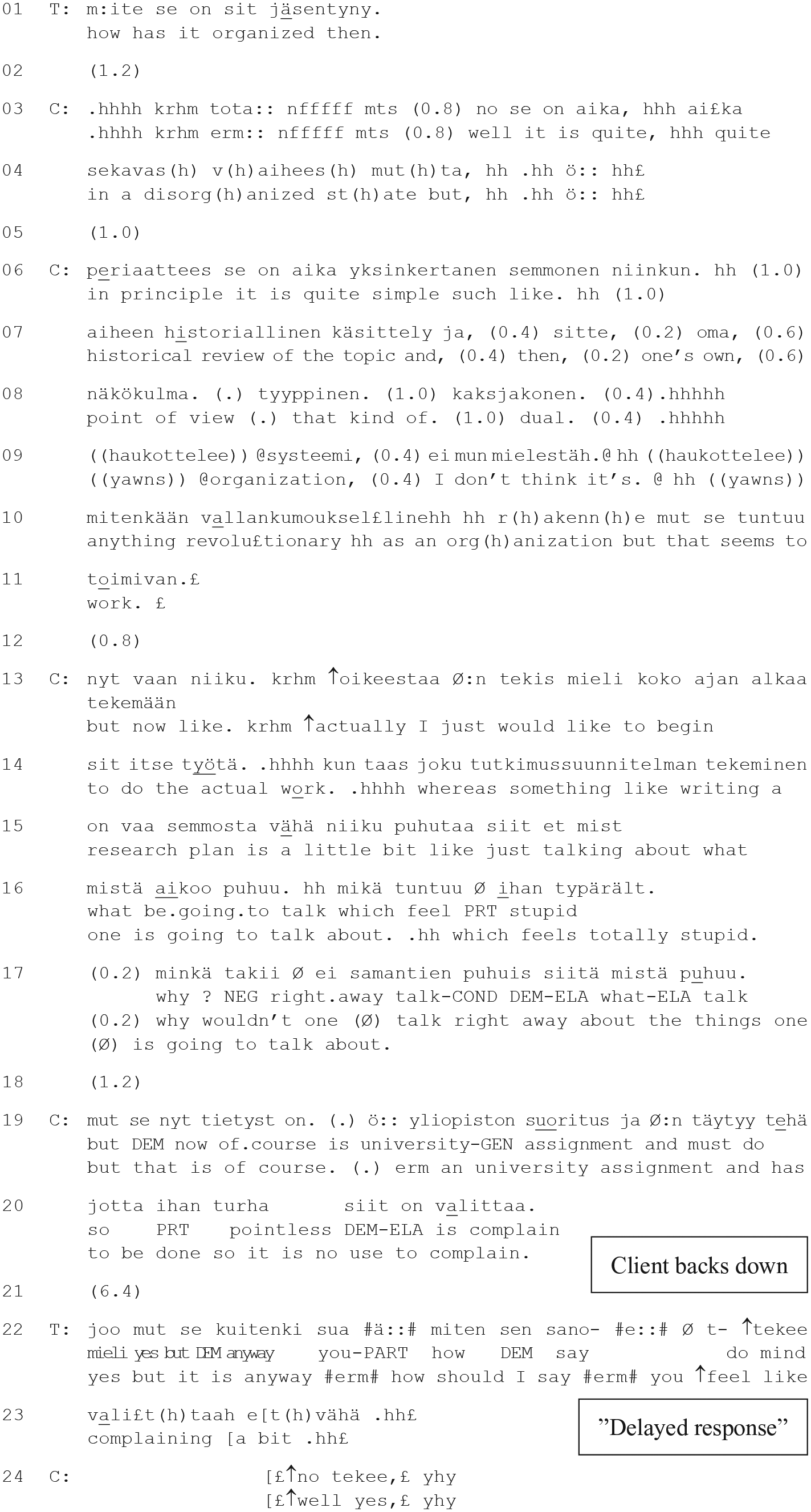
After the client describes the organization of his thesis (lines 3–4, 6–11, and receives no response from his therapist in line 12, the client moves on to talk about his experience of working on his thesis (lines 13–17). His description of his experience constitutes the first turn in the four-part sequence that we focus on. The client complains about having to write a research plan before he can begin working on the actual thesis. The client invites affiliation from his therapist through lexical means of an affective display (feels totally stupid) and the zero-person construction 1 that invites a sharing of experience (Laitinen, 1995) (lines 16–17).
When he receives no immediate response (line 18), the client backs down from his complaint (lines 19–20) (cf. Antaki and Wetherell, 1999). The turn starts with the contrastive mut ‘but’ and is formulated as a concession in favor of the opposite view: the research plan is a mandatory part of the university degree so one should not complain about it. The turn contains linguistic elements that are typical of concessions: the tietysti ‘of course’ marks the state of affairs as self-evident, and the particle nyt (‘now’) (originally a temporal adverb that is also used as a discourse particle) that typically occurs in reactive statements, similar to concessions (Hakulinen and Saari, 1995). Furthermore, this turn deploys the zero-person construction that leaves the subject unexpressed and thus presents the state of affairs as a general, relatable truth (applying to anyone in the client’s position).
After a gap of 6.4 seconds, the therapist responds to what his client expressed in lines 16–17. This is the turn that we refer to as the ‘delayed response’. The therapist prefaces his turn with joo mut (‘yeah but’). According to Niemi (2014), turn-initial joo mut is a means of disengaging from the previous turn by resisting the line of action projected by it. During this turn, the therapist responds to his client’s wish to complain about the research plan (displaying empathy in terms of understanding that the client wants to complain). Thus the therapist does not affiliate with the complaint per se. The therapist does not refer to the seminar rules that his client complained about, but addresses his client’s will to complain. By using ‘however’, the therapist links his turn to the just prior rationalization (the client wants to complain even when it is not rational). Thus, the initial withholding of an empathetic response makes it possible for the therapist to integrate his client’s two stances (the negative affective stance and the rationalization) when responding to him.
Extract 2 contains another case of the therapist’s contrastive remark after his client’s rationalizing move. At this point, the participants talk about the measurement devices that they are wearing in the session for a psychophysiological study. In the beginning of the extract, the client discloses how he was rather nervous about the measurements before coming to therapy (this was the first of the session where the measurements were made). This can be heard as an implicit complaint regarding the new situation he encounters in therapy.
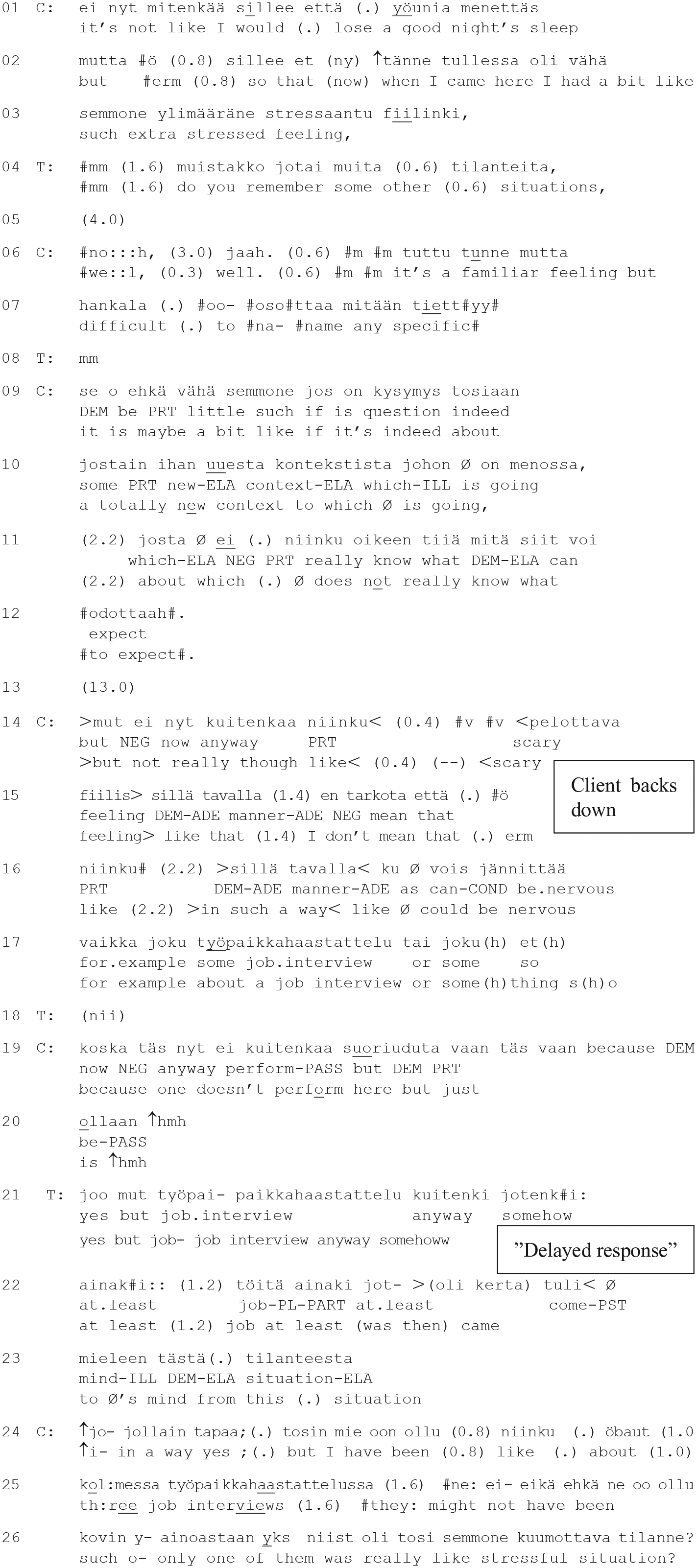
The therapist asks whether his client remembers other situations in which he experienced feeling similar nervousness (line 4). The client does not mention a specific situation, but describes his feeling as being in a completely new context that results in his not knowing what to expect (lines 6–7, 9–12). Through this description, given again in the zero-person format that leaves the subject unexpressed (i.e. the client does not refer overtly to himself but to anyone in a similar situation), the client calls for recognition of that type of an experience (being nervous). The therapist, however, does not respond during a gap of 13 seconds in line 13. After that silence, the client mitigates his feeling by pointing out that the current situation is not as frightening as a job interview would be, and thus evaluates the current situation rationally (lines 14–17, 19–20). The client marks his turn in contrast to what he said previously (mut ‘but’, kuitenkaan ‘however’). He also uses an explicit negating expression, ‘I don’t mean’, to negate the undesired, exaggerated implication of his prior turn. In other words, by making a comparison to a job interview, he creates a continuum of situations that might make one nervous, with a job interview is at the high end and the current situation something less daunting.
After this rationalization, the therapist responds to his client’s experience. In his response (lines 21–23), the therapist acknowledges the nervousness that his client expressed in his earlier turn (lines 9–12). The therapist prefaces his turn, as he did in the previous extract, with joo mut (‘yeah but’) that resists the line of action projected by the previous turn (Niemi, 2014). However, the therapist focuses on his client’s association with a job interview that he introduced during the mitigating turn where the client stated that his feeling is not like he feels in a job interview (lines 14–17). By contrasting this association with his client’s rationalization, the therapist focuses more on the negative experience than on the latter mitigation.
As in the previous extract, the therapist’s non-responsiveness after his client’s initial description of his negative emotion (being nervous) was followed by his rationalization. This enabled a ‘delayed’ turn by the therapist that integrated the client’s rationalization and the initial description of the negative experience, without specifically affiliating with a negative emotion – an implied complaint about the measurements. In Extract 2, this was achieved by focusing on the association (job interview) that the client mentioned to put his current experience of being nervous into perspective. The next extract is from another dyad. In these cases, the focus sequence has the same four-part structure, but the therapists’ delayed response is not marked as resisting the line of action projected by the just prior turn. Rather, the delayed response is a candidate understanding of the client’s talk.
‘Delayed response’ as a candidate understanding
In Extract 3, the participants have discussed the client’s work-related stress and allocation of work with colleagues. During this extract, the client complains about a colleague who participated in a staff training days, which meant that she was not able to help the client with her workload during those days.

The client complains about that the colleague attended four separate training courses, and one of them occurred during the days when the colleague was supposed to help the client with her workload. The highpoint of her complaint story is the young colleague’s bold response to their boss, who asked if she could skip one of the four training courses. After the delivery of this point (line 12), there is a place for the therapist’s response (affiliation with the client’s point of view). However, a gap of 0.6 seconds occurs with only a minimal response (lines 13–14), after which the client closes her telling, expressing her stance with laughter (cf. Muntigl et al., 2014). When she receives no full verbal response from the therapist, the client begins a word search (lines 16 and 18), and rephrases the end of the story (line 21) in a smiley voice, but does not explicate the emotional impact of the complaint story in words (Muntigl et al., 2014). In terms of everyday talk, there is a strong relevance for affiliation with the story. However, the therapist again responds only minimally (lines 22 and 24), and the client begins another word search (line 25). After another minimal response from the therapist (line 27), the client changes perspective and explains the colleague’s behavior as reflecting a young person’s lack of understanding. Although the client does not actually back down from her complaint about her colleague, she appears to distance herself from the moral indignation she conveys by attributing the colleague’s boldness to her age and lack of understanding. Linguistically, the contrastive relationship with the previous turn by the client is again marked with the turn-initial contrastive particle mut ‘but’ (line 28).
After this rationalizing move, the therapist responds (lines 42–43). The turn addresses the client’s implied experience of the unfair allocation of her workload by referring to her boss’s responsibility. This passage is similar to previous extracts in that the therapist’s non-responsiveness after the initial complaint is followed by a rationalization and a ‘delayed response’. The turn is marked as a candidate understanding of the client’s turn with nii että ‘so that’ (see Sorjonen, 2018). However, the empathetic stance in the therapist’s turn is not fully in concordance with what was made relevant in the client’s initial complaint. That is, instead of affiliating with the client’s moral stance toward the young co-worker, the therapist draws attention to the client’s boss’s position, thus empathizing with the client’s experience of unfairness but not with her moral stance toward her bold colleague. Again, the therapist’s ‘distanced’ perspective to the situation is enabled by the deferred display of empathy, produced only after she has partly backed down from the initial complaint by rationalizing. During earlier points of interaction, this type of response would have been more directly disaffiliative with the complaint (lines 13, 17, 19, 22, 24, 26).
Extract 4 is from the same dyad as Extract 3. Extract 4 presents another example of a candidate understanding that points to the agency of other people. During this extract, the client talks about her workload and colleagues. In the beginning of the extract, the therapist asks her whether the heavy workload was constant in her work.

As a response to the therapist’s turn that topicalized the continuation of the negative situation at the client’s workplace, the client first focuses on her difficulty in refusing to perform tasks at work (lines 4–6, 9–10). The therapist, however, responds only minimally to this, and the client shifts to complaining about her colleagues who are selfish in setting their boundaries (lines 17–20). She displays negative affect and a moral stance through her word choice (‘drive me mad’, ‘very selfish way’), which makes relevant the therapist’s display of affiliation. After a short gap, the therapist responds minimally (line 22). Facing only a minimal response, the client again downplays her stance, which is marked with an initial mut ‘but’ (line 24). The client sets up a contrast between her normal way of reacting to this type of situation (‘it probably would not have gotten to me so much’) and the current one that is justified by her stressed state of mind (‘but I was having hard time myself and was tired’). Again, as in the previous example, the client does not fully back down from her complaint about her colleagues, but instead distances herself from her complaint by providing reasons for her negative feelings toward her colleagues. By adding the expression ‘of course’ in the final utterance of her turn, she normalizes her way of reacting (‘of course it irritates Ø more’), and by using the zero-person construction (leaving the experiencer unexpressed), she generalizes her experience as something that anyone in a similar situation can relate to. The client ends her turn in line 28 with the particle et (that/so), which further invites a response from the therapist (Koivisto, 2011).
After this rationalization, the therapist responds (line 30), referring to the selfishness of the client’s colleagues that the client complained about. This turn is less empathetic than in the earlier examples, as the therapist’s turn is a candidate understanding of the presupposition in the client’s turn (that setting boundaries is selfish), and thus it does not affiliate with the complaint as such, but makes relevant a confirmation or a clarification. Through this candidate understanding, the therapist, however, is now responsive to the client’s turn that displayed an affective and moral stance. As in the previous extract, the therapist’s initial refraining from a display of empathy leads to a rationalizing turn by the client and this makes it possible for the therapist to respond to the client in a way that offers a distanced perspective to the client’s telling. In the earlier place for affiliation (line 21), as a direct response to the client’s complaint, this type of candidate understanding would have indicated disaffiliation (Drew and Walker, 2009), whereas after the rationalization, it can be understood as topicalizing the client’s perspective and the client also began to distance herself from it (lines 25–26, 28). Here, as in the previous extract, the client took reflective distance to her complaint in the rationalization. This offered the therapist a sequential position where it was possible to topicalize the client’s perspective without indicating disaffiliation.
Discussion
The sequences of delayed response can be considered as one context in which psychoanalytical theory informs the therapist’s responsiveness during psychodynamic psychotherapy (Stiles et al., 1998). The therapists maintained the ‘deprivational attitude’ described by Greenson (1967) in that they did not affiliate with the client’s affect in the first possible place (cf. Muntigl et al., 2014). On the other hand, the therapists eventually displayed empathy after the client began to back down from the initial display of negative emotion or a complaint. Thus, the sequences of delayed empathy contained both responsiveness and confrontation. This is in line with the balance hypothesis presented by Bänninger-Huber and Widmer (1999).
It is important to note that the psychotherapy clients behave similarly to participants in everyday interaction: they start pursuing a response even when they face a lack of response from the co-participant (cf. Pomerantz, 1984). The practices for achieving that described in this article display similarities with the concessive practices reported for everyday talk (Couper-Kuhlen and Thompson, 2005: 260–278; Antaki and Wetherell, 1999). The clients thus do not treat their therapist’s delay in responding as unproblematic, but they appear to orient to the norms and practices of everyday interaction. Furthermore, like participants in everyday interaction, psychotherapists also react to the pursuit by responding to their co-participant. This can be considered as ‘behaving in a humane way’ as described by Greenson (1967: 281). In the sequences of delayed empathy, thus, the therapist’s clinical understanding of the interaction (balance between responsiveness and confrontation) intersects with everyday practices of response pursuit. For the clients, the therapists’ delay in responding may be understood as their projecting disagreement, and by making a concession for a partly opposite view or mitigating their original claim, they orient to the everyday preference for agreement (Pomerantz and Heritage, 2012).
While in terms of everyday interaction, client retraction functions as a pursuit for a response, from a clinical perspective, it may be heard as defensive. In other words, when they encounter no response, the clients move away from their emotions to rational thinking (Freud, 1937). This means that the clients distance themselves from an emotion that their therapists did not recognize. In this sense, the delay in the therapist’s empathy provokes what can be heard as a defense. In terms of Bänninger-Huber and Widmer’s (1999) balance hypothesis, this involves maintaining the conflictive tension for psychoanalytical work. Thus, during the turns that follow the therapist’s non-response, the client and the therapist worked with the contradiction between the initially displayed affect and what can be heard as a defense. During their delayed responsive turn, the therapists appear to integrate these contradicting aspects so that the relation between the initial affect and the rationalization becomes more articulated (e.g. the client has an affective experience despite the rationalization; the client’s affective experience relates to agency of other people). It is important to note that in a data set containing sessions from five dyads in psychodynamic therapy, we detected ‘delayed responses’ in only two dyads. It is possible that this practice is present only in therapies in certain phases (possibly not at the beginning or end phases of therapies but during the phase when inner conflicts are explored), and with clients who are well enough to tolerate the therapists’ silences and are able to self-observe. This study is based on a very limited number of cases, and we cannot therefore make claims regarding how common this practice is in psychotherapies. Future studies are needed to explore situations in which clients display responses other than backing down to their therapist’s silence.
Our analysis suggests that the timing of the therapist’s response is one of the interactional means through which the therapists attune to the clients’ emotional conflicts. The clients, on the other hand, seem to orient to the norms of everyday interaction in their concessive responses. We would like to suggest that in the case of a ‘delayed response’, turn-taking phenomena and preference for agreement, which are familiar from the everyday interactions, these also serve the psychodynamic method in exploring and integrating conflicting emotions. In other words, what constitutes perhaps normal interactional work from the client’s perspective may appear as defensive to the therapists. Our study also suggests that the relations between turn-taking practices and clinical work is a possible topic for further study in conversation analysis of psychotherapy.
Footnotes
Acknowledgements
We thank Anssi Peräkylä and John Heritage for their helpful comments on the data of this study.
Declaration of conflicting interests
The author(s) declared no potential conflicts of interest with respect to the research, authorship, and/or publication of this article.
Funding
The author(s) disclosed receipt of the following financial support for the research, authorship, and/or publication of this article: This work was supported by the Academy of Finland under Grant 284595, and Kone Foundation under Grant 087184.