



Abstract
This paper contributes to empirical knowledge of citizen participation as a communicative event, by analyzing discursive tensions in interviews between civil servants and citizen-parents, that are part of a participatory process on how to mitigate violence in a suburban area in Sweden. Citizen participation events are increasingly initiated by public institutions in Western societies. Research, however, shows that goals of participatory processes often conflict with formal decision-making structures and institutional boundaries. Yet, how such tensions play out on the level of interaction is little researched. This study therefore analyzes discursive practices deployed by civil servants and how these construct characteristic tensions for the interviews. Three practices are identified: (1) pursuing the initial question, (2) cueing an institutional frame, and (3) epistemic positioning of the parents. These practices, being guided by an institutional agenda, create tensions both to the parents’ lifeworld and for the ideals of the participatory method itself.
Keywords
Introduction
This study analyzes interviews between civil servants and citizen-parents taking place in 2017 as part of a citizen participation process aimed at mitigating violence in a suburban area of Sweden. In detail, it analyzes how recurring practices deployed by the civil servants construct symptomatic discursive tensions for this communicative situation.
Interviewing is a common communicative practice within public institutions (Ehrlich and Freed, 2010; Pomerantz, 1988). Research of interviews and public encounters has established well that discursive tensions such as misunderstandings or breaches can occur when citizens speak from a lifeworld position (Mishler, 1984), and civil servants are informed by an institutional agenda (Drew and Heritage, 1992; Sarangi and Slembrouck, 2014; Tracy and Robles, 2009). As a characteristic feature of citizen participation, the interviews analyzed here aim to be loosely structured and inclusive conversations. However, despite participatory aims, similar interactional patterns of asymmetry can be expected, as knowledge about the process at hand is unevenly distributed between the civil servants and the citizen-parents (Farkas, 2013; Sprain and Reinig, 2018).
Moreover, research has shown that across different social practices, discursive tensions can occur as the communicative norms that guide professionals in institutional encounters often conflict (Peräkylä and Vehvilƒinen, 2003; Tracy and Robles, 2013). In the case of citizen participation, research on an overarching level has displayed clashes between the power-sharing ideals of participatory activities and the representative decision-making system in which they take place (Fung, 2015; Irvin and Stansbury, 2004). Studies have also pointed to the conflicting logics between formalized organizational structures and the open-ended agenda of participatory processes (Bächtiger et al., 2018; Skelcher and Torfing, 2010; Waisbord, 2008). How these tensions play out on the level of interaction in the various discourse formats of citizen participation is, however, less researched, which motivates this study (Farkas, 2013; Tracy, 2011). Correspondingly, these potential tensions are likely to be emphasized in the interviews, as they take place within institutional boundaries while relying on participatory ideals for their success.
The present study analyzes the discursive practices deployed by the civil servants and the symptomatic discursive tensions they operationalize in the interviews. Tensions are regarded both as a result and as a prerequisite. That is, the practices deployed by the civil servants are analyzed inductively while also expecting that there will be practices that manifest characteristic tensions; relating both to central challenges for citizen participation and to conditions of the interviewing situation. The practices identified are pursuing the initial question, cueing an institutional frame, and epistemic positioning of the parents. This study contributes with empirical accounts of citizen participation as a communicative event, in the intersection between its participatory ideals and institutional boundaries.
Theory and analytical framework
In any interaction, interlocutors will align to each other based on their definition of the communicative situation, relating it both to the local context and their wider worlds of experience. Tensions thus arise in encounters in various ways, as part of the continuous negotiation about what is going on in the interaction at hand (Drew and Heritage, 1992; Goffman, 1981). Consequently, studying civil servants’ recurring discursive practices – and how symptomatic tensions are manifested through these practices – will provide empirical knowledge about the communicative possibilities inherent to these conversations.
For the analysis, the concepts of frames and footings (Goffman, 1974; Tannen, 1993) as well as key notions on the function of questions (Heritage, 2010) are deployed as an overarching framework, as they make it possible to analyze how social situations are made sense of linguistically by the participants. Frames in this context are understood as the interactive schemes by which interactants organize their actions in a given social situation (Goffman, 1974, 1981; Tannen and Wallat, 1987). While based in prior expectations, frames are locally constructed and continuously negotiated. Within the same social situation, several frames can be embedded, as they are being introduced by linguistic cues or markers, such as a specific register or explicit addresses. When shifting frames, participants also change the footing and the alignments they take up with each other (Goffman, 1981). Still, while frames can shift within the same social situation, well-known activity types often include some pre-inscribed roles, which structure conversations in similar patterns (Levinson, 1992). In information-seeking activities in institutional contexts, the general pattern is that the institutional representatives ask questions and the lay citizens answer. The questions will induce certain answering possibilities, which contributes to discursively framing the social situation the participants are in. Thus, when identifying the recurring discursive practices deployed by the civil servants here, I depart from four overarching question-and-answer dimensions outlined by Heritage as a basis for my analysis (see e.g. Heritage, 2010). These dimensions are outlined below, whereas the analytical approach is further described in the Method section.
First, questions set topical and action agendas, which concern the topic that is presented as well as possible constraints on how the topic is to be addressed, for instance by specifying interrogative pronouns. Second, questions embody presuppositions and factual states both at the level of the sentence and the world surrounding. Third, they convey the questioner’s epistemic stance as well as attitude to the solicited information, for example, questions can be formulated as a confirmation of already known facts or take a more distanced stance to the information requested. Fourth, questions incorporate preferences for responses. That is, the questioner can signal that s/he prefers certain responses, such as general descriptions, justifications, or confirmations.
Hence, as a general idea, questions indicate frames and footings for the participants regarding the communicative situation. However, there is always a negotiation about the definition of the situation through which discursive tensions can arise. The above notions of frames and the following questioning dimensions are used as tools to analyze this negotiation and how discursive tensions are operationalized in the material in recurring practices.
Previous research on tensions in institutional discourse
Citizen participation processes share key aims and challenges while also showing situated empirical features depending on the design of the participatory activity (Farkas, 2013; Tracy and Hughes; 2014). When analyzing tensions within participatory interviews, an important context consists of research on how diverging frames and discursive tensions play out in public encounters with interviewing formats or one-to-one encounters between institutional representatives and lay citizens. Studies have emphasized similar patterns of tensions across institutions, albeit manifested in various discursive practices. Common tensions, presented in the following, are conflicting communicative ideals and epistemological divergences between the interlocutors.
Studies have found that as a practice is imbued with conflicting ideals, that lead the professionals to deploy contradictory discursive strategies, tensions within the communicative situation can occur (Tracy and Robles, 2013). Examples of this include journalists in news interviews being guided by norms of both adversarialness and neutrality, or doctors in medical interviews when guided by the principles of both optimization and in-depth problem attentiveness (Clayman, 1992; Heritage 2002, 2010). Similarly, in welfare administration encounters, studies have found that professionals need to balance principles of both efficiency and customer care (Ekström et al., 2019; Hultgren and Cameron, 2010). The communicative ideals and norms set out for a practice can thus be expected to create tensions in interactions when they adhere to conflicting rationales that require different practices and in turn different alignments for the interlocutors.
Furthermore, these norms tend to be more known by the institutional representatives than the lay citizens they meet. This epistemological divergence, which can transcend the knowledge of norms alone, is also a basis for interactional tensions (Peräkylä and Vehvilƒinen, 2003; Sarangi and Slembrouck, 2014; Tannen, 1993). Research on frames in encounters across different public institutions has found that personal footings are more often introduced by the laypersons, and that institutional representatives often use various discursive strategies to return to the institutional frame and agenda (Agne, 2007; Codó, 2011; Prego-Vázquez, 2007; Ribeiro, 1996; Solberg, 2018; Tracy, 1997). Not aligning with a personal footing also illustrates the power inherent in the institutional frame, and the way in which institutional representatives can deploy strategies to control the conversation (Codó, 2011; Prego-Vázquez, 2007). However, while power can be accomplished through the structural positions, it is also contextually negotiated among the interlocutors and depends on the communicative situation (see e.g. Thornborrow, 2002).
Put together, the studies show that similar tensions relating to the communicative situation are operationalized in various discursive practices. Thus, an analysis of how discursive tensions are manifested specifically in this communicative event is called for, to obtain empirical knowledge of the conditions of the interviews and the citizen participation process of which they are a part.
The case and data
The participatory process
The three interviews in focus for this study took place during 2017 as part of a participatory process on the topic of mitigating violence for small children, initiated by a city district in a suburban area in Sweden. The process used a method developed by a nationwide network for dialog in complex societal questions. The model has been developed since 2012 and consists of a set of activities that are broadly depicted in Table 1. I followed the process between 2016 and 2018 from the planning phase to the end of the participatory workshops.
Steps of the participatory process.
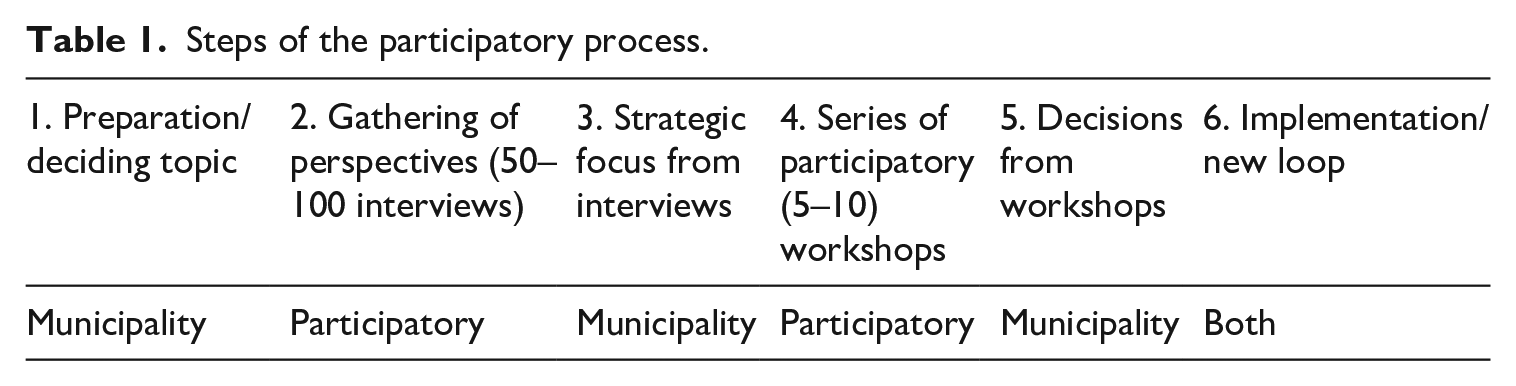
To summarize, the method aims to provide conditions to address complex issues through various participatory activities. Parts of the process take place within the municipal structure, but a number of activities are intended to promote broad participation. After the overarching topic has been decided by the municipality (1) between 50 and 100 participatory interviews (2) with different actors are conducted by a working group of civil servants, specifically trained in organizing participatory processes. Following the interviews, the civil servants synthesize the themes brought up by the interviewees (3). Thereafter follows a series of participatory workshops with several actors on these compiled themes, aimed at generating concrete ideas and suggestions on how to work with the topic in the area (4 and 5).
A large part of the participatory involvement takes place during the interviews, which are regarded as central to understand the important aspects of the topic of mitigating violence for small children. The method builds upon the participatory ideal that to address a complex topic, the engagement of multiple actors is required (Sprain and Reinig, 2018). The answers of the interviewees are therefore regarded as valuable perspectives that the municipality could not itself possess. In order to create conditions for participation in the interviews, they are loosely structured and the dialogic model advocates that the interviewing civil servants listen with curiosity and neutrality (Hellquist and Westin, 2019; Sande and Le Roux, 2016).
Thus, the interviews are imbued with participatory norms (Sprain and Reinig, 2018; Tracy and Hughes, 2014). Still, as the process is initiated by the municipal structure, the civil servants are more knowledgeable of both the method and the communicative norms for the interviews. The interviews therefore constitute a symptomatic case for citizen participation overall, and reflects the possible tensions that can manifest in these kinds of participatory practices.
Data
The three interviews analyzed come from the second step in the process, in which the civil servants during February and September 2017 conducted around 80 interviews. Following the entire process, I aimed to get a broad representation and observed 20 interviews, of which 5 were with parents living in the area. I was permitted to record three interviews and participated as an observer in the two others. These three are chosen as they highlight the structural positions of citizens and civil servants that are symptomatic of citizen participation processes (Farkas, 2013). Having observed several of the other interviews and participated in eight planning meetings during this period, I regard them to be representative.
The interviews took place at the local pre-school and lasted around 1 hour. The parents had been invited to participate a few weeks earlier by one of the civil servants who approached them at the pre-school and briefed them shortly about the process. Besides me, one or two civil servants were present. After having been granted permission to record, I remained quiet. The interviews took place in Swedish, apart from the second interview, which was conducted in English. I have transcribed the interviews in Swedish using CA conventions and then translated them to English. Interviews 1 and 3 do not include symbols for speech delivery, as these are not easily translated, nor are they part of the analytic focus. The translations are made as verbatim as possible, but as none of the interviewees spoke Swedish as a mother tongue, I have for readability purposes in some occurrences in interviews 1 and 3 corrected faulty syntax, as this is difficult to translate.
The interviews circulated around this question: What can be done in this area in order to mitigate violence for small children? Besides this question, a focus on what the interviewees themselves need to be able to contribute was highlighted as a central theme in planning meetings of the interviews. However, there were no preset follow-up questions; thus the conversations principally constituted blank slates in which the interviewees could address the topic in any way they found to be relevant.
Method
Spanning the overarching notions of how frames and questions set norms for interactions, three concrete, recurring practices, giving rise to discursive tensions, have been identified in the material. These are pursuing the initial question, cueing an institutional frame and epistemic positioning of the parents. The analytical categories have been delineated using an abductive method, which means that I have moved iteratively from specificities in the transcribed material to existing research on interaction in public institutions (Kennedy and Thornburg, 2018). First, I coded the interviews inductively based on what the interactants were doing and talking about. These categories were then analyzed in relation to the above outlined notions of question design, specifically with regard to the topical agendas, epistemic stances, and how preferred answers were being conveyed (Heritage, 2010). Thereafter, a closer analysis in interplay with patterns in the interviews and previous research was conducted, to identify the distinctive discursive practices. In this step, specifically recurring practices giving rise to characteristic tensions were chosen, as it is argued that tensions in conversations provide insights into the norms of the specific situation (Zimmerman, 1998). The practices are described in more detail as they are presented in the analysis.
Analysis
Pursuing the initial question
The first delineated practice illustrates a tension of the communicative ideals within the process, specifically between the inclusive ideal of the interview to approach the topic ‘in any way one wants’ and the forthcoming steps of the process aimed at addressing the issue through engagement and concrete actions. This tension is manifested in pursuits of the initial question posed by the civil servants. In the beginning of the interviews they set the topical agenda with the question, ‘What is needed in the area for small children to grow up without violence?’ As outlined in the case description, the interviewees are considered as active participants in the process, which includes defining and limiting the scope of this question. However, the way in which the question is pursued and returned to displays that there are some constraints on its openness.
Pursuits are defined as turns that: ‘(a) (. . .) halts forward trajectory of the sequence’ by ‘(b) renewing the initial question in some form; and (c) sustaining both the topical and action agenda of the initial question’ (Romaniuk, 2013: 149). In this way, pursuits differ from follow-up questions in that they show that the answer is somehow inadequate. Pursuits can be designed in many ways, but they are mostly linked to the first question by, for instance, making it more explicit or limiting the answering possibilities by adding constraints to it (Romaniuk, 2013). In these conversations pursuits are seen both in the immediate sequentiality of turns as well as in continuous returns to and repetitions of the initial question over the course of the interviews. The first extract is collected from the beginning of the third interview to illustrate how the main frame of the interview is formulated.
The question is preceded by some small talk, which is put to an end when CS3 asks this question. By specifically labeling it as ‘the question we have’ she provides a frame for the conversation. The formulation illustrates the ideals both of the participatory process and the communicative situation. CS3 expresses an awareness of the question’s broadness and complexity as well as an encouragement to ‘answer in any way one wants’, which highlights the communicative ideal that there are no right or wrong answers. However, over the course of the interaction, the interviewing civil servants pursue this question in ways that display certain preferred answers. The tension arising from these pursuits is illustrated in extract 2 below, gathered from around 20 minutes into the interview, when the parent expresses confusion about the goal of the conversation and what to answer to.
The civil servant has just asked who bears the responsibility for children to grow up without violence. The parent does not answer this question but instead expresses why she thinks she is there, stating that she does not have anything in particular to say apart from the things she has mentioned as important (lines 8–10). This return to the goal of the situation and the overarching frame expresses her confusion about her role as an interviewee – ‘keep ask I don’t understand’ (line 12) – and illustrates a tension in the communicative situation as a whole. The civil servant responds to this with a pursuit of the initial question containing explicit explanations about the preferred answers they are interested in: ‘practical things that one can do’ (lines 14–17). In other words, the extract displays that as the initial frame is pursued in an explicated way, there are constraints to the question, which are tensional to the communicative ideal ‘to answer in any way one wants’. A similar pursuit is illustrated in extract 3 below, gathered from interview 1.
The extract is collected around 30 minutes in and follows on a remark from the parent that many things such as education and health care are free in society. From these broad themes the civil servant brings the conversation back to the main question. Here, however, the question is connected specifically to the parent’s possibilities to contribute to the topic (lines 1–3). P1 answers with some modality: ‘maybe that the laws’ (line 4). CS1 shows that she is not satisfied with the broad content of this answer and pursues the question while trying to clarify it: ‘the laws are so difficult’, ‘but if one gets a little closer to what you need’ (lines 5–8). The explication of the question thus limits the preferred answer to be about what is needed for the participating parents to engage in the topic themselves. This illustrates the inherent tension of the different steps of the process: the openness of this interview, and the forthcoming participatory workshops aimed at generating concrete actions.
Cueing an institutional frame
The second characteristic practice is cueing an institutional frame, which illustrates a recurrent tension to the lifeworld of the parents (Mishler, 1984). The tension is particularly manifested in the way follow-up questions and reformulations are designed in line with an institutional agenda (see Table 1 for an overview of the steps of the process).
Cueing, or contextualization cues, as the concept is outlined by Gumperz (1982, 1992), refers to how aspects of speech, such as prosodic, paralinguistic, or lexical choices, invoke particular social and cultural understandings. Cueing is closely related to the concept of frames, as it guides or ‘keys’ interactants regarding what kind of speech situation they are in (Drew and Heritage, 1992; Goffman, 1974). It is used here as a notion to show how particularly reformulations and follow up-questions cue an institutional frame (Gumperz, 1992; Levinson, 2003). It is a common strategy for institutional representatives ‘to use “next questions” to selectively reformulate the layperson’s prior answers’ (Ehrlich and Freed, 2010: 7). Reformulations (Davis, 1986; Kurri and Wahlström, 2007) not only summarize what has been said but also tend to highlight or foreground aspects that align the statements with a trajectory of the institutional agenda. This includes bringing out the gist of the stories or upshots, implicating actions going forward (Antaki et al., 2005). Thus, when the civil servants design reformulations and follow-up questions in this way, they also diverge from the personal footing introduced by the parents. The first extract chosen to illustrate this comes from interview 3.
The extract is gathered from 10 minutes into the interview in which the parent talks about how her life with two children is a lot to cope with for one person (lines 1–3). Instead of asking more about the everyday life, CS1 then asks how dads in a general sense can be more present. This broadens the perspective to concern a more general problem, and illustrates an upshot formulation, as the preferred answer would be ideas on how to solve the dilemma of dads not being present. P3 misses the definite form of ‘the dad’ and responds, from a personal frame, that her husband works long days as a bus driver (lines 5–6). CS1 then reformulates what she meant – ‘I am thinking about all dads’ (line 7) – and highlights that she expects P3 to answer from a general perspective of knowledge. At this point P3 aligns with the institutional footing and responds about dads in general. The question posed by CS1, however, illustrates how an institutional frame is cued by interpreting the personal narrative of P3 as a general problem, and the upshot formulation indicates that the preferred answer should be about solutions to address this problem.
A similar cueing of an institutional frame is seen in extract 5, which is gathered from the same interview a few minutes later.
This extract starts with a question by CS3 (line 1), which is a new topic introduced at this point, as to whether P3 finds that it is easy for people in the area ‘generally’ to speak to each other. P3 requests clarification from a personal frame by asking: ‘If I say (. . .) you mean?’ (line 3). CS3 does not align to this footing and repeats her question, emphasizing the plural abstraction ‘if moms generally’, hence indicating that the preferred answer is in line with a general description. P3, however, refrains from answering the question from this perspective and states from a personal stance that she does not know (lines 6–7). This line of inquiry by CS3 could be understood along the note that an institutional goal of the interviewing process is to clarify central aspects of the overarching topic. In this extract, though, the abstract knowledge about the area asked for diverges from the personal footing of the parent. This tension between frames is further displayed in extract 6, gathered from interview 2.
The extract is gathered around five minutes in. It starts with P2 finishing a story by saying that they are new to Sweden, having lived there only for five years, and knowing little of various rules. CS2 interprets this statement – ‘and you say that’ – and reformulates it in a general frame – ‘many parents’ – while also providing an upshot formulation: ‘so the police should talk to them and tell them?’ (lines 4–5). From an institutional perspective this question could be interpreted both as a way of addressing the gist of what P2 said and at the same time as offering an upshot solution to the depicted problem. It is formulated as a declaration – ‘so you say that’ – and the preferred answer would be a confirmation of the proposal that ‘so the police should (. . .)’. However, P2 does not align to this suggested interpretation and instead says that although other people might know the rules she can only talk about her shop (lines 6–8), and pushes for her personal frame. The extract thus shows how questions that cue and foreground aspects in line with the institutional logic can give rise to discursive tensions between the frames of the lifeworld and the institutional world.
Epistemic positioning of the parents
The third recurring practice concerns the way the parents are positioned as knowledgeable sources. This practice illustrates a tension between the participatory ideal, regarding the epistemic status of the interviewees, and the actual epistemological stances they take up in the interviewing situation.
The way questions are designed signals both what information the questioner claims to have of the topic asked about and what knowledge is attributed to the answering part (Drew, 2018). Congruency between the epistemic status of the interactants and their epistemic stances is preserved when the less knowing interviewers ask questions and the more knowing interviewees answer. The epistemic status thus refers to a more static category about the access and rights to knowledge that a speaker has within a particular domain, whereas epistemic stance ‘concerns the moment-by-moment expression of these relationships’ (Heritage, 2013: 558). As outlined in the case and data section, a core idea of the participatory process is that the interviewed parents have knowledge and perspectives that the civil servants do not have themselves. In the interviews this epistemic status is attributed to the parents both in explicit addresses and implicitly in the formulated questions per se, which reveal what the parents are expected to be able to answer about. However, as the analytic extracts below show, these initial status positions are not always aligned to, which creates discursive tensions when the civil servants keep asking questions within that frame. The extracts also highlight that the epistemic positions are negotiated and contested, depending on what knowledge is asked for.
The first extract chosen to exemplify this comes from around 20 minutes into the second interview and shows how P2 refrains from aligning with the attributed epistemological status.
CS2 introduces her question, which is also a pursuit of the first question, with a preface (Heritage, 2002). That is, before asking the question (lines 5–6), she establishes a context for the question in lines 1–3 by stating that ‘we have been interviewing already many parents’ and ‘all of you say very similar things’. Through this she positions herself as an interviewer with experience from other interviews, being knowledgeable of the fact that P2 says ‘very similar things’ as many other parents in the area. At the same time she explicitly authorizes the position of P2 as a knowledgeable source in these interviews, being like many others. P2 agrees with this position – ‘okay same things’ (line 4) – but as the question is asked she defers the epistemic status and says that ‘I have no idea’, and continues to say that she would have vented ideas had she any, but she is ‘just thinking I need to move another place’ (lines 7–10). There is thus a negotiation here, of the epistemic status assigned to P2 and the unknowing stance she takes herself. This tension is illustrated in extract 6 above as well, in which P2 chooses to not answer and instead explains what she can answer to, by limiting her epistemological boundaries to concern her shop (see lines 6–8, extract 6).
Extract 8 below, gathered from interview 3, illustrates a similar tension between assigned and aligned epistemic status. This extract furthermore illustrates an inherent conflict to this status, as these initial positions also alter when the information solicited is within the institutional framework.
The extract is gathered from around 20 minutes into the conversation and starts with P3 ending a story by marking her epistemological boundaries with the remark ‘I don’t know anything more’ (lines 1–3). CS1 does not address that but instead focuses her follow-up question on what P3 said just before and asks, ‘Do you find that there are many activities here?’ (line 4). Responding to this, P3, again, explains why she cannot answer: ‘I don’t know, I have told you I am new’ (line 5). However, with hesitation, she then says that ‘maybe’ there is a need for a place for youths to meet (lines 7–9). She points out that she does not know the word in Swedish (line 9) and that she does not know whether a place like this exists already (line 14). The civil servants suggest names for the place she is talking about: ‘a meeting place’ (line 10) or a ‘youth center’ (line 13). Following P3’s remark that she does not think there are any of these here, CS1 says that there is one youth center at the local square and one in the southern part of the area (lines 15–16). The exchange thus shows how P3 expresses a reluctance regarding her position as a knowledgeable interviewee, and that the civil servants de facto know more about the referred activities in the area, as this is information within the institutional domain.
The last extract comes from the first interview. As with this extract, the epistemological status of the parent is challenged when the topics discussed lie within the institutional framework. Over the course of this exchange, however, the epistemological stance taken by the parent is also one of institutional knowledge.
The extract is gathered 6 minutes into the interview and starts with P1 telling a story about families being afraid that the social services might collect their children (lines 1–2). CS1 challenges this fact, and the epistemological position of P1, by asking if there are many thoughts about what the social services do while also stating, ‘the social services don’t just take children like that (lines 3–5)’. Through this statement CS1 assigns herself institutional knowledge that demarcates a distance to parents and their knowledge about the doings of the social services. P1 first aligns by saying ‘I know’ (line 6), and thus takes on the epistemic stance to be someone who is knowledgeable about these families while not being like them. However, over the following turns she reclaims the truthfulness of her statement in lines 1–2 by providing arguments for the declaration that the social services do take children. Here, she also claims institutional knowledge herself by referring to her experience as an interpreter ‘So I know they exist’ (lines 10–16). In this way she maintains her epistemological status in the interviewing situation, that is, being the one with the answers. The extract nevertheless highlights a tension between assigned and actual epistemic status of the interlocutors, and that it is difficult to take on the role as the one subjected to answer when the information solicited is not within the lifeworld.
Summary and conclusion
A core challenge for citizen participation regards how to allow for inclusive processes within asymmetrical organizational structures. This study has analyzed how these opposing ideals are expressed through discursive practices in interaction. In focus for the study has been interviews taking place between civil servants and citizen-parents as part of a participatory process on how to mitigate violence in a suburban area in Sweden. The study has identified three recurring practices deployed by the civil servants, which manifest symptomatic tensions that provide empirical knowledge about the norms and conditions of this communicative situation.
While the practices are related, they focus on different aspects of the communicative situation. The first practice, pursuing the initial question, illustrates a tension between the processual ideals of, on the one hand, inviting the interviewees to participate in an open and inclusive way, while on the other, pursuing the main question in ways that constrain it to aspects that are beneficial for the forthcoming steps of the process. The second practice illustrates how follow-up questions and reformulations recurrently cue an institutional frame, which diverges from the lifeworld of the parents. This emphasizes what previous studies have found, that personal footings are more often introduced by the lay citizens, whereas the institutional representatives deploy strategies that bring the conversation back to the institutional frame (Codó, 2011; Prego-Vázquez, 2007). Relatedly, the third delineated practice illustrates a tension of the interviewing situation between the epistemic positioning of the parents as knowledgeable interviewees and the less knowledgeable stance they take when the information asked for lies outside their personal domain and within the institutional sphere. This, again, highlights the core tension of how open these conversations can be in terms of what is being discussed, when the institutional boundaries of the process affect the epistemological positions of the interviewees.
In sum, the identified practices that construct tensions relate to an institutional agenda, in accordance with the steps of the method. As such, the practices are tensional both to the lifeworld of the parents, the knowledge they can possess as interviewees, and to the participatory ideal of the interviews themselves, as allowing for answers in an inclusive way. The practices also highlight the institutional character of these participatory interviews, which, similar to previous studies on institutional encounters, are imbued with conflicting ideals (Tracy and Robles, 2013). This study particularly shows how civil servants need to balance the ideals of opening up and allowing for manifold perspectives, while at the same time, through the identified practices, aiming to get specific information such as concrete solutions and general problem descriptions. While these kinds of interviews are not routinized institutional interactions per se, one could nevertheless assume that similar tensions in the intersection between participatory ideals and institutional boundaries will be manifested in other communicative events in participatory processes, as these are being increasingly initiated in local governments.
Footnotes
Declaration of conflicting interests
The author declared no potential conflicts of interest with respect to the research, authorship, and/or publication of this article.
Funding
The author received no financial support for the research, authorship, and/or publication of this article.