



Abstract
This article suggests that there are systematic ways in which the identity of the ‘self’, as created and performed through first-person markers, can be made relevant and consequential in particular episodes of interaction. More specifically, the study looks at generalizations that people present about themselves in local interactional contexts: displays of the types of people they are and the ways in which they always or never behave (‘I am this kind of person’, ‘I never do this’). It will be shown that such self-generalizations are typically used to account for one’s behavior, and that this tendency is tied to the epistemic and moral rights provided by the first-person perspective, having the primary rights to one’s own experience. The study suggests that speakers’ personal characteristics or habitual behavior can be offered as a locally produced micro-identity, which can come to have interactional significance.
Keywords
Introduction
There are systematic ways in which the identities of interactants, as created and performed through linguistic and interactional practices, can be made relevant and consequential in particular episodes of interaction (e.g. Antaki et al., 1996; Benvell and Stokoe, 2006; De Fina, 2003; Bucholtz and Hall, 2005; Raevaara, 2015b; Raymond and Heritage, 2006; Schegloff, 1991; Tracy and Robles, 2013; Wilkinson and Kitzinger, 2003). The ways in which the identity of the self is narrated in face-to-face interaction has received relatively little attention, though – despite the vast amount of literature on the social construction of self in various fields of science since the late 19th century 1 (see, however, Antaki et al., 1996; Antaki and Widdicombe, 1998; Benvell and Stokoe, 2006; Malone, 1997; Peräkylä, 2015; Raevaara, 2015a). In this article, I will focus on displays of the identity of the ‘self’, in this case one specific practice attested in my Finnish data, through which the participants-of-interaction craft a momentary, fleeting display of who they are for the purposes of the ongoing action. More specifically, I will analyze interactional practices in which the conversationalists present generalizing descriptions about themselves with a turn that includes a first-person pronoun (e.g. ‘I am this kind of person’; ‘I always do this’, ‘I never behave in this way’ etc.), illustrated briefly in examples 1 and 2.
(1) [Sg398,
2
face-to-face conversation] 01 Kati: 1SG be-1SG that-GEN much listen stingy I am so stingy you know that when I got 02 mumminh (.) ainoon oikeen samppanjan.=mä join sen the grandma’s only real champagne I drank it 03 ite(h)[e(h)myself 04 Taru: [no nimp(h) se(h) nin pit(h)ää well that’s the way it should be (2) [Sg437, face-to-face conversation] 01 Jaana: PRT 1SG neg-1SG
3
be never visit-PPC even well I have never even been 02 anywhere Spain-GEN direction-INE-NEG PRT that PRT anywhere near Spain but there’s that that 03 . hhhh viininlehtikääryleitä niit on vaik minkänäkösii j[a. there’s so many types of stuffed vine leaves 04 Tuula: [mm.
In example (1), Kati launches a telling about a champagne bottle she inherited from her grandmother. She starts the turn with a self-assessing generalization: I am so stingy you know. In (2), Jaana – who has earlier criticized people who do not explore local food culture when travelling – uses a generalizing self-description in a concessive preparation for an upcoming criticism (not shown here): although she has never been to Spain, she knows that the food is worth tasting. These short examples are here to illustrate the typical form and function of the utterance types that I will analyze as momentary displays of the identity of the ‘self’ 4 – at least that aspect of the interactionally conjured up ‘self’ that the speaker indexes when using a first-person marker. 5 The target turns analyzed (1) consist of a first-person pronoun, (2) include a verb that is in the present or perfect tense (see Seppänen, 1997), (3) in 39 % of the cases, are modified by an extreme case formulation such as always and never (Pomerantz, 1986), and (4) describe the characteristics or typical behavior of the person referred to with the first-person pronoun. As seen in 1 and 2, self-descriptions are typically produced to account for the speaker’s immediate or reported behavior.
Within the studies on person reference (e.g. Enfield, 2007; Siewierska, 2004), the first-person singular is generally treated as a somewhat unproblematic case: unlike the second and the third person, which easily receive generic and multiple interpretations, the first-person singular is seen to be highly presupposing rather than performative, typically referring to the person uttering the turn (cf. Helasvuo, 2008). Schegloff (2007: 123) describes self-reference in English in the following manner: Of all the practices for referring to persons in talk-in-interaction, the most common and the most straightforward – at least for English – appears to be self-reference. For English, with very few exceptions (Schegloff, 1996a: 443–445), a speaker refers to self with the dedicated term ‘I’ (and its grammatical variants – me, my, mine, etc.). This term is opaque with respect to all the usual key categorical dimensions – age, gender, status and the like, and is also insensitive to the history of prior reference – whether for the first or the nth occasion in some conversation or across multiple conversations, self is referred to as ‘I’.
In this article, I aim to describe the presupposing but also the performative, creative side of first-person reference. While the first person – which can, in Finnish, be marked with three grammatical indexes 6 (Helasvuo and Laitinen, 2006) – indeed refers to the current speaker, and thus presupposes it, I will focus on the indexically negotiated, performative aspects of the I’s meaning (see Jakobson 1971 [1957]; Silverstein, 1976). According to Silverstein (1976: 34), all shifters, personal pronouns among them, work in a similar vein: ‘Some aspect of the context – is fixed and presupposed, in order for the referential contribution to be made. And in this sense, reference itself is once more seen to be an act of creation, of changing the contextual basis for further speech events’. When talking about the referent of the first-person pronoun in this article, I will be referring both to the referent that is to be found in an actual speech event – for instance, a speaker named Kati – as well as the ‘I’ that functions as part of the utterance and whose indexical interpretation is negotiated in the ongoing interaction (see also Laitinen 1995: 44). I thus assume that it is the double existence of the indexically presupposed and indexically created referent of the first-person pronoun that allows for the ‘I’ – here, interpreted as an index of ‘self’ – to be continuously constructed and enacted, moment-to-moment, in everyday conversations.
I will limit my observations about the first-person pronoun to the aforementioned generalizations; that is, the collection is only comprised of explicit generalizing formulations that speakers present about their own typical or habitual behavior. Agha (2007: 233–239) makes a distinction between the self conception – the conception that one has about oneself – and the relational self, which only manifests in interaction with others, ‘the living – and ever moving – center of a person’s public identity’ (ibid. 239). As Agha points out, a researcher can have access to questions of identity only by examining the manifestations of the latter in interaction (Ibid.). My study, too, will focus on the ways in which the relational self is enacted, but as the generalizations that the interactants offer about themselves present descriptions of ‘who they are’, the relational self can in this case be approached as a meta-level description of a self-conception.
The article is structured as follows: After introducing the data and methodology, I move to the empirical heart of the paper, where I analyze six examples of self- and other-initiated self-descriptions to show the complex interactional work that they are used for. These findings are then discussed with regard to the epistemic and moral rights provided by the first-person perspective. I then revisit the indexical nature of pronouns and consider the possible implications of this study for the conversation analytical work on identities in interaction.
Data and methodology
As data, I use a collection of sequences compiled from the Conversational Data Archive at the University of Helsinki, recorded during 1980–2000. For this study, I analyzed six Finnish face-to-face conversations (total amount 5 hours and 15 minutes) that were all recorded while the participants were spending an evening together eating and/or drinking. In this data, I found 114 turns that included the previously described self-descriptions.
When I first became interested in the ways that interactants present generalizations about themselves, the interest arose not from a grammatically predefined phenomenon but rather from a participant’s category, based on the common-sense hunch that people produce mini-narratives about themselves for specific interactional purposes. When making the collection, I decided very early on to limit the focus to turns that have an explicit first-person reference, on the grounds that in such turns, the reference to self is explicitly objectified for observation for all interactants (cf. Antaki and Widdicombe, 1998: 3). Even so, the phenomenon seemed to evade more precise linguistic criteria. Therefore, I collected the data with just two criteria in mind: a first-person marking and a generalizing function.
After making the collection, I analyzed the grammatical and lexical properties shared by the target turns. Table 1 summarizes the numerical information of these analyses.
Grammatical and lexical properties of the target turns.
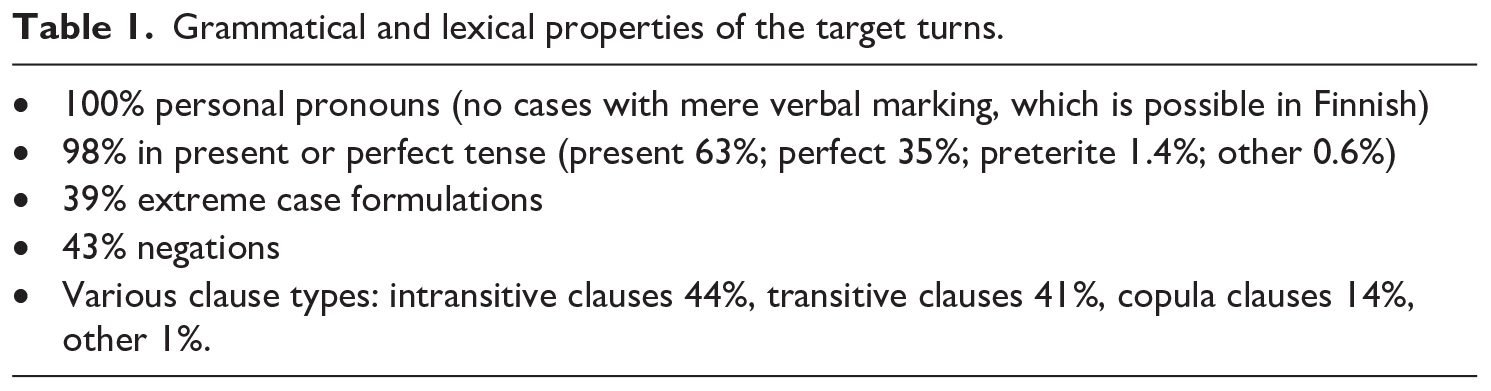
The data thus revealed further linguistic features that accompany the studied self-descriptions. Firstly, in all cases the first person was marked overtly with a pronoun. In Finnish, person is marked on finite verbs, and it is therefore possible to leave out an overt pronominal subject. In spoken language, however, the pronominal subject is most often present (Helasvuo and Laitinen, 2006), and in my data, it was always used. Secondly, almost all verbs were used in the present or perfect tense, which is probably due to the generalizing function that I was looking for: the turns tend to describe continuous states or habitually occurring activities. Of the turns, 39% were extreme case formulations, a feature analyzed later in this paper, and almost half of them negations. 7
I have analyzed the data using conversation analytic methods: In this paper, I will look at the generalizing self-descriptions in their sequential context, paying close attention to the ways in which the generalizations about the ‘I’ are made relevant and oriented to by the other participants. 8 By looking at the sequential settings in which the participants rely on these formulations, as well as the ways in which they are responded to, I hope to show how the speaker’s personal characteristics or habitual behavior can be offered as a locally relevant micro-identity, which can come to have interactional significance. To do this, I will also analyze the nature of the first-person generalization with regard to questions of epistemic rights (see e.g. Heritage and Raymond, 2005; Raymond and Heritage, 2006).
This approach implies a contextually changing, reflexively emerging understanding of the self, a self that is an interactional accomplishment, actively shaped and constructed together with other participants (Garfinkel, 1967; Goffman, 1959; see also e.g. Agha, 2007; Antaki et al., 1996; Benvell and Stokoe, 2006: 49; Tracy and Robles, 2013). By carefully analyzing naturally occurring conversational data, I hope to provide a micro-analytical perspective on the ways in which the displays of self can be made relevant in conversation, by focusing on one particular resource – the first-person generalizations that carve up a self-description for local interactional purposes.
Self-descriptions in Finnish conversations: Accounting for one’s behavior
The 114 cases of generalizing self-descriptions suggest that they are a resource for a range of social actions. For an analyst wanting to categorize them into discrete types they cause trouble: almost all of the cases have accounting functions, but in addition, they seem to be doing several other actions as well, most commonly assessing of various kinds (Goodwin and Goodwin, 1992; Pomerantz, 1984; Sacks, 1992: 68).
A self-generalizing turn is most commonly produced as an account – often a justification or explanation – for one’s reported or immediate behavior. Accounting for one’s behavior is an activity that offers insights into participants’ understanding of what they see as accountable and what sorts of accounts are seen as legitimate (e.g. Antaki, 1994; Bergmann, 1998; Drew, 1998; Heritage, 1988; Niemi, 2016), and it is the latter part – what makes accounts legitimate – that I will claim to be of special relevance here (I will elaborate on this in the section on first person and epistemic rights).
According to Bergmann (1998), an account sequence is initiated with the signaling of a breach of norms, after which an account is produced in order to mitigate or deny the moral charge associated with the breach. In my data, typically, there is no overt signaling of a breach of a norm from the other participant, but the speakers orient themselves to a possibly problematic issue by accounting for their behavior. In several self-initiated cases in my data, self-generalizations seem to orient to a potential complainable: they self-complain and/or self-deprecate before any actual complaint has been made (see also Drew, 1998: 296; Schegloff, 2005: 451; Whitehead, 2013).
In more than a third of my cases, the self-descriptions are produced in second position, as a reaction to something that another interlocutor has initiated or implicated (see also Antaki, 1994; Heritage, 1988). Typically, these are assessment sequences, and the self-generalizations are used as second assessments that simultaneously justify or defend something explicated or implicated by the previous speaker’s turn. The organization that I found in the data is the following:
(a) Self-initiated: Self-assessing accounts, often self-deprecation and self-complaint (75 cases, 66%).
(b) Other-initiated: Second assessments as self-justifying accounts (39 cases, 34%).
In the majority of the cases, type (a), the speakers initiate self-generalizations to account for their own behavior. In such contexts, self-descriptions typically orient to a potential complainable before any complaints have been (or ever will be) made; the participants orient to a potential breach of norms in a pre-emptive manner. In the latter cases, type (b), accountability is implicated by the co-participant – and then responded to with a justifying self-description. In the following, I will discuss three examples of type (a), then three cases of type (b).
Self-initiated self-descriptions: Self-assessing accounts, often self-deprecation, and self-complaint
Typical contexts that prompt self-initiated self-descriptions involve a potential complainable that the speaker pre-empts with a self-generalization. I first revisit example 1, where two middle-aged women are spending New Year’s Eve together, and Kati starts to comment on the (cheap) sparkling wine they are drinking (Kati is the host). Kati marks a new telling with a turn that starts with the self-generalizing assessment I am so stingy you know (line 04): (1’) [Sg398, face-to-face conversation] 01 Kati: se on tota (.) ihan toi m m sanos nyt e- (.) it is well like that tell me e 02 kuiva elysee. se on par- sellasta käyttöjuomaa. dry elysee it is be- like ordinary drink 03 Husb: (pantiin aamulla aikasin tonne ulos ku oli plussaa) (we put it early in the morning outside as there were plus degrees) 04 Kati: 1SG be-1SG that-GEN much listen stingy I am so stingy you know that when I got 05 mumminh (.) ainoon oikeen samppanjan.=mä join sen the grandma’s only real champagne so I drank it 06 ite(h)[e(h)by myself 07 Taru: [no nimp(h) se(h) nin pit(h)ää well that’s the way one should do
Here, the target turn (I am so stingy you know, l. 4), is a copula clause that has several functions: it prefaces the short story of the bottle of champagne that Kati inherited (and drank alone), but most importantly, it functions as a self-deprecating assessment. A few studies have pointed to the trouble management function of self-deprecations (e.g. Speer, 2019; Whitehead, 2013; Niemi, 2016); according to Speer (2019), they work to manage or pre-empt trouble in different sequential positions relative to the (potentially) problematic action sequence. Here, the turn-initial self-generalization can be seen to orient to at least two potential complainables that need to be accounted for: the fact that Kati has drunk a bottle of champagne alone, and, more crucially for the ongoing situation, the fact that she is serving Taru cheap wine.
According to Pomerantz (1984: 78–81), the preferred response to self-critical assessments is disagreement, but in this example – and in other similar cases in my data – the recipient does not disalign with the self-assessment (e.g. ‘No, you’re not stingy at all’). The self-assessment is produced turn-initially, and at the end of a possible point of completion Kati rushes to produce the next TCU, thus signaling that the turn is not designed for an agreeing/disagreeing response but is a preface to something else. I am so stingy you know functions as a pre-emptive way to head off possible critical interpretations, by providing an explanation for one’s behavior (drinking a bottle of champagne alone due to stinginess, not due to greediness, drinking problems etc., as well as not serving champagne now), and it is followed by a telling that illustrates and grounds the general self-deprecation.
By making a generalization about herself as a stingy person, I suggest that Kati also highlights the fact that serving cheap sparkling wine is not related to Taru per se, but Kati would have behaved the same way in other situations as well. Kati produces the champagne story smiling, and Taru is also smiling as she is receiving it; right after the story’s affective climax, Taru comes in with a response that seems to confirm the moral stance of the story – this is the way that one should behave (cf. Sacks, 1974: 340ff.; Selting, 2017). Taru’s turn is in the present tense and formulated with a zero-person construction (‘that’s the way one should do it’ l. 7), a common way of presenting generalizations in Finnish, which roughly equals the English one or you. Both features suggest that she orients to the generalizability of the moral of the story, of how one should behave. However, Taru’s turn can also be seen as taking a different stance than Kati: whereas Kati is problematizing her behavior, Taru is normalizing it, thus getting past the potential complainable.
Self-generalizations occur in various types of prefaces; what is similar across these contexts is that the speaker presents a self-assessment that accounts for their own behavior in the story that follows. In example (3), which comes from the same conversation as the example above, Kati produces a self-description (I have always hated Mother’s Days, l. 6–7) and then starts a story in which she told her newborn baby that she was not planning to be a good mother. When the excerpt starts, Kati is quoting a passage from a book that criticizes the mythical role given to mothers (lines 1–5): (3) [SG398, face-to-face conversation] 01 Kati: [((reading a passage from a book, five lines removed)) 02 et ole minulle velkaa mitään, =et ole minulle velkaa rahtusen you don’t owe me anything you don’t owe me the tiniest 03 verta[a. .hh sinun ei bit you don’t 04 Taru: [njoo, yea 05 Kati: tarvitse edes tervehtiä kadulla jos et have to even greet me on the street if you don’t 06 halua .hhh ((end of quote)) =>ku< (.) 1SG be-1SG always hate-PPC want to ((end of quote)) when< I have always hated 07 @ mothers.day-PL-PTV immensely
Mother’s Days immensely
08 =ni sillo ku Mari synty ni, hh .hh #mä# so when Mari was born so I 09 sanoin sille ett#ä# #e:# pienelle tytölle told her that a little girl 10 e# että t(u)ota(h) he hl- vauvalle joka ei that well to a baby that didn’t 11 ymmärtäny mitä>ä että< .hhhh £@k(h)uul(h)e understand anything that listen 12 minä aion olla niin huo(h)no äiti että I am planning to be such a bad mother that 13 si(h)nun ei ko(h)sk(h)aan tar(h)vit(h)se@ you don’t ever have to 14 [my(h)ö heh he heh 15 Taru:[£phhh£ 16 Kati: .h minuu palvoo äitienpäi(h)vä(h)nä heh he worship me on mother’s day 17 he he heh .hhhhhhhhh 18 (0.4)
After finishing the quote (l. 6), Kati is about to start the locally-occasioned story about what she told her baby when she was born (cf. ku, ‘when, because’ l. 6), when she parenthetically interrupts this to describe herself as a person who has always hated Mother’s Day. Here, the self-generalization is prefacing a story, which is told in the past tense; the generalization itself is formulated in the perfect tense. Seppänen (1997) has suggested that the Finnish perfect tense functions as a means by which speakers can mark their utterances as a justification for a previously presented view; it also allows the situation to be presented as open for discussion by other participants. I suggest that both functions are at use here: the self-generalization is presenting a justification for the story to come – everything that Kati will say should be interpreted knowing that she has always hated Mother’s Days – and simultaneously marks this characterization as open for discussion. Taru nods as Kati comes to the first possible completion point of a TCU (l. 7), and after this confirmation, Kati incrementally adds the adverb suunnattomasti (‘immensely’, l. 07) and then rushes to tell the story. On line 15, while Kati is describing what she told her newborn baby, Taru smiles and gives minimal affiliating feedback (l. 15); Kati then finishes the story, and after a pause they switch the topic to another book.
The example is similar to the one about the champagne in that the self-generalization is presenting something that might be contrary to the perceived norms of society, and this per se seems to be a motivating factor for producing them; they index the tellability of the story (see Berger, 2017) by anchoring it through a description of the ‘characteristics’ of the person launching it. Also, as in example 1, the self-generalization can be seen to be orienting to a possible complainable, in this case in particular the cultural norm that one ought to be a good mother; the self-generalization can thus be seen to be commenting on the ‘wrongness’ of the account to come (see Drew, 1998: 295, 302), displaying an orientation to the possibility that one may be considered to have acted improperly.
Self-initiated self-descriptions also frequently occur in the middle of the turn or in turn-final position. Example (4) comes from a conversation between two middle-aged sisters, Jaana and Tuula, who are sitting in Tuula’s kitchen, eating and drinking. The excerpt starts when Jaana says (l. 1–2) that their mother needs new kitchen curtains. Soon it turns out that Tuula does not know what their mother’s curtains look like; a self-description is provided as an account for not knowing, again pre-empting a possible complaint from the other interlocutor (as in the previous cases, such complaint never gets articulated): (4) [Sg437, face-to-face conversation] 01 Jaana: =ni se et ku äiti tarvii nytte ni noi like it’s that that mom needs now like those 02 (0.6) uudet keittiön °verhot° new kitchen curtains 03 (1.4) ((Tuula juo kupista)) Tuula drinks from a cup 04 Tuula: mt ↑minkälaiset siin on what kind are there 05 =>mu-l ei o-<, (.) > 1SG-ADE NEG be 1SG neg-1SG be quite I don’t h-I haven’t really 06 ever notice-PPC attention-PTV what.kind-PL ever really paid attention to what kind 07 Jaana: [.hh semmoset valk ]oset the kind of white ones 08 Tuula:niinpä onki joo, oh yeah that’s right 09 Jaana: semmoset puuvill[aset,] the cotton ones 10 Tuula: [sitä va]an ei noteeraa. one just doesn’t notice 11 (0.2) 12 Jaana: ↑ei ni↑, (.) ku ne, (0.2) .mh kuuluu asiaa one doesn’t (.) because they (0.2) are just there
Jaana’s turn (l. 1–2) gets no uptake from Tuula, who is taking a sip from her coffee (l. 3). After a pause, Tuula asks what kind of curtains their mother has, then interrupts herself and adds another TCU that starts a possessive construction (I don’t hav-, l. 5), including a first-person reference; she then interrupts this and produces a self-generalization (l. 5–6, I haven’t really ever paid attention to what kind). Jaana’s response (the kind of white ones, l. 7) orients back to Tuula’s question on line 4, thus sequentially ignoring the account on lines 5–6. Tuula receives this with the turn niinpä onki (oh yea that’s right, l. 8), suggesting that she now remembers the curtains, too. Jaana incrementally adds another description of the curtains (l. 9, the cotton ones), and Tuula produces a turn in which she makes a generalization about noticing such things; this time she does not make the generalization with a first-person pronoun but with a zero-person construction, which does not have any overt subject (translatable as one just doesn’t notice, l. 10). According to Laitinen (2006), the Finnish zero-person construction invites the other participants to recognize and affiliate with the description presented. Here, after a pause, Jaana indeed agrees with Tuula’s turn (one doesn’t, l. 12) and thus accepts the explanation. Jaana can be seen to orient to the justification that Tuula has presented; Jaana herself knows what their mother’s kitchen curtains look like, in very detailed manner, but she affiliates with the type of experience her sister is describing – it is easy not to notice such things as kitchen curtains (see also Heritage, 2011).
In this example, the self-generalization (I haven’t really every paid attention to what kind) takes the form of a transitive clause, which is in perfect tense; grammatically, it is thus similar to example (3). However, whereas in (3) Kati talked about how she has always hated Mother’s Days, offering this as a description of her habitual emotional behavior, here in (4), the generalization concerns the types of things that the speaker has or has not done with regard to a specific topic (the kitchen curtains; cf. also the similar example 2, never having visited Spain). Although the types of generalizations differ, the perfect tense indicates that Tuula presents her past actions as relevant for the ongoing action (Seppänen, 1997) and here, too, offers a generalization about her noticing the curtains, even if this is not directly about her character (or her habitual behavior concerning curtains in general). 9 On line 10, Tuula presents a further justification for her ‘transgression’ with a zero-person construction, offering another generalizing account about the kinds of things one pays (or does not pay) attention to. When Jaana then affiliates with a turn that also includes the zero person, the conversation about the kitchen curtains becomes a more general conversation about the kinds of things ‘one’ pays attention to.
In the three examples discussed above, the generalizing self-descriptions are used to account for the speaker’s behavior in a way that presents a pre-emptive self-complaint and/or self-deprecation or a justifying self-assessment. The ways in which the recipients react to these varies: in extracts 1 and 3, Taru receives the descriptions with minimal verbal responses, smiling and nodding, and, finally, in example 1, confirming the moral position of Kati’s story and simultaneously, ‘neutralizing’ the complainable. In example 4, Jaana does not react at first to Tuula’s generalization about not having noticed the curtains, but when Tuula later offers her experience-of-not-noticing as recognizable with a zero person construction, Jaana produces an affiliative turn that shows recognition of the type of experience described. In short, in the examples seen so far, the self-descriptions are met with affiliative responses, but these are not produced immediately after the self-description, due to the sequential positions in which the generalizations are produced (as well as the rush-throughs seen in examples 1 and 3).
Other-initiated self-descriptions: Second assessments as self-justifying accounts
In this section, the focus is on self-generalizations that are produced as reactions to something that another interlocutor initiates or implicates. (See Antaki, 1994; Heritage, 1988). A common context for these is assessing (e.g. Goodwin and Goodwin, 1992; Lindström and Mondada, 2009; Pomerantz, 1984; Thompson et al., 2015), particularly second assessments. 10 I will go through three examples, all of them exemplifying the use of self-generalizations as other-initiated assessments. In two of them, self-initiated self-generalizations are also used.
In example 5, Tuula and Jaana have been talking about where they would travel together. Tuula prefers city trips, whereas Jaana is not so eager to decide against a beach vacation. Tuula’s multi-unit turn on lines 1–4 ends with the assessment I can’t handle that lying lazy on the beach: (5) [Sg437, face-to-face conversation] 01 Tuula: .hhhh mä, (.) v- lähtisin ehkä mielummin tota, .mthh .hhh I (.) v- would go maybe rather like well, .mthh 02 jonnekin ihan, (0.4) ((narinaa)) Keski-Euroopan somewhere like, (0.4) ((creaks)) a Central European 03 kaupunkiin; (.) kun että jonneki biitsille ku city; (.) rather than on a beach because 04 1SG neg-1SG handle that-PTV beach-ADE lazing-PTV I can’t handle that lying lazy on the beach 05 Jaana: [ NEG-1SG 1SG-CLI me neither 06 NEG-1SG 1SG be never laze-PPC there I have never been lying lazy there 07 Tuula: [se on hirveen <tylsää>, it is really boring 08 (1.0)
Here, Tuula’s self-initiated self-description (l. 4) functions in many ways in a similar manner as the cases discussed before: she justifies her travel preference (city vacations) by presenting an assessment about the kind of person she is, a person who can’t handle lying on the beach. Unlike in the previous cases, here the self-description receives an immediate response. Jaana comes in with Me neither I have never been lying lazy there (l. 5–6), thus producing a second assessment that agrees with Tuula’s assessment: she does not like beach vacations either. Importantly, Jaana’s turn also responds to Tuula’s turn as a possible criticism and a complaint: as an implied (negative) assessment about the kinds of people who like to go on beach vacations – Jaana possibly being one of them (see Drew, 1998; Schegloff, 2005: 452).
When Jaana first agrees with Tuula, she casts herself out of the category of someone who likes lying on the beach (me neither, l. 5) and then defends herself (and presents evidence for her agreeing turn) with I have never been lying lazy there, using a perfect tense and an extreme case formulation. In this way, she makes the possible accusation/complaint explicit and denies that this should have ever fallen within her experience (cf. Maynard, 2013; Pomerantz, 1986: 228; Seppänen, 1997). According to Pomerantz (1986), interactants use extreme-case formulations ‘when they anticipate or expect their co-interactants to undermine their claims and when they are in adversial situations’. In the example seen above, Jaana’s turn gets no response; it is produced in overlap with Tuula’s assessment se on niin tylsää (‘it is so boring’, l. 7). There is a long pause, followed by Jaana’s mitigating turn, where she makes a milder formulation about her beach vacation habits (she only does the ‘necessary’ beach part).
Another type of other-initiated self-generalization that is produced as part of an assessment sequence can be seen in example (6), which comes from a dinner conversation between four friends. Kerttu is showing her friends pictures of her wedding party, and she has just presented them with some family portraits. In lines 1–2, Kerttu makes a negative first assessment about the portraits: (6) [Sg346, face-to-face conversation] 01 Kerttu: noi jotenki epäonnistu kyl vähän noi those somehow didn’t come out so well those 02 perhepotretithh? family portraits 03 (1.2) 04 Eeva: [niis ov vaikee saada kaik[ki it’s difficult to get everyone 05 Kerttu:[>(mut)< [#mm::.#
but mm
06 (1.0) 07 Kerttu: PRT neg-1SG 1SG PRT be so that.kind family.portait.person but I’m not (.) like so much like a family portrait person 08 PRT that 1SG-PTV much bother-COND that it would trouble me so much 09 Sanna: =mm::. mut on sit kumminki [(kai) ihan kivoj[a. mm but (they) they are however quite nice I guess
Kerttu’s turn those somehow didn’t come out so well those family portraits is followed by a long pause (l. 3). In a context where disagreeing with Kerttu’s critical assessment might be the preferred next action (Pomerantz, 1984: 63–64) – after all, it concerns her wedding pictures and can therefore be seen to be self-critical – Eeva aligns, after a long pause, with Kerttu’s assessment: she agrees that it is very hard to make family portraits work, and therefore displays agreement, indirectly, with the fact that the pictures have not come out so well. As the friends are withholding further second assessments (l. 6) (Pomerantz, 1984: 77–79), Kerttu produces a turn that starts with the contrastive particle mut and goes on to state that she is ‘not that much of a family portrait person’ (l. 7–8): she thus makes a new assessment in which she suggests that the unfortunate outcome of the pictures does not really matter to her, thus not accounting for the unsuccessfulness of the pictures but her being okay with them. She does this by locally invoking the category of a ‘non-family-portrait-person’ with which she identifies. The self-description provides a way out of the socially awkward situation: Kerttu can take the bad outcome of the photos due to the type of person that she categorizes herself to be. As Kerttu accounts for why the photos do not really matter to her by referring to the type of person she is, she also claims epistemic primacy: it is not only about her wedding, but also about the kind of person that she knows herself to be (Heritage and Raymond, 2005: 16; Sacks, 1984). Kerttu’s turn is followed by mild agreement from Sanna (l. 09), after which the topic moves on.
The last example (7) comes from the conversation between Jaana and Tuula; it includes seven self-generalizing turns (for another analysis of this ‘honey’ discussion, see Peräkylä, 2015: 449–452). The focus will be on the last one of these, the only one produced by Tuula, but I will present most of the conversation to show the build-up. The women are sitting in Tuula’s kitchen, eating a starter that consists of pickles, sour cream and honey. As Tuula is pouring honey from the bottle, Jaana presents the first self-generalization, saying that she always buys the same kind of honey (l. 1–3), after which they start negotiating its cheap price and handiness, as it can be poured directly from the bottle (omitted): (7) [Sg437, face-to-face conversation] 01 Jaana:.mth (.) PRT 1SG buy-1SG that-PTV always namely .mth (.) no but you see I always buy that 02 Tuula: [joo:. yea 03 Jaana:se_että, (.) .kr[mh .hhhh ] it’s just that 04 Tuula: [tää on p
this is the best
05 (0.4) 06 Jaana: ↑nii, (.) siis se on #y#↑, (.) se on ihan h yea (.) like it is (.) it is quite good (21 lines omitted)
After the talk about the price and usability of the liquid honey, Jaana makes another self-generalization on line 29 (I always use that when cooking), 11 as she does again on line 34 (I always put a little bit of honey there). I categorize all of these as self-initiated generalizations, because there is nothing in Tuula’s turns that would provoke them – if not the very fact that Jaana’s generalizations do not receive any uptake from Tuula. Tuula does, however, tell anecdotes that align with Jaana’s eagerness concerning honey; for example, on lines 39–47, Tuula tells about how she once accidentally put honey in a cabbage stew.
29 Jaana: PRT 1SG use-1SG cooking-INE always that-PTV PRT no but I always use that when cooking like 30 Tuula: [n handy 31 Jaana: .hhhh sillai justii et, (.) #e#t jos on jotain .hhh just like you know (.) that if you have something like 32 t a tomato-thing or something so 33 Tuula: [( pitäskö se vaihtaa) t should it be changed into that. 34 Jaana: (.) PRT PRT PRTH DEM PRT 1SG put-1SG always (.) so like, .hhmh it’s just that I always put 35 honey-PTV a.bit-GEN there a little bit of honey there 36 (0.6) ((Tuula dips her little finger in the dip)) 37 Jaana: .mhh 38 (1.4) 39 Tuula: kerran mä tein, (0.6) once I made, (0.6) (( licks her little finger)) 40 hmm, (1.0) ((licks her little finger again) 41 mt ↑k mt cabbage stew. and, ms it includes 42 siira- s syr- syrup right 43 Jaana:[niin tulee; it does 44 (.) 45 Tuula: ni tota, (0.2) minä sitten pokkana vahingos laitoinand well (0.2) I then straight-faced accidentally put 46 h honey in it I didn’t realize at all that it wasn’t 47 siirappii<, .mh (0.2) t syrup<, .mh (0.2) really good. 48 Jaana: PRT be-3SG DEM PRT 1SG put-1SG that-PTV it is, .hh it’s like that I put that #ö" (0.2) .hh 49 #a# (.) PRT really PRT all.kinds.of-ILL #a# (.) I mean actually like,(0.2) all types of 50 PRT what 1SG do-1SG PRT DEM so what I do so it depends just
After receiving Tuula’s story with the aligning niin o (l. 48), Jaana repeats that she puts honey in all kinds of food (l. 48–50). Tuula mildly agrees, and then tells another anecdote (omitted here), this time about a friend who works professionally in a kitchen and uses a little bit of sugar when cooking. Jaana then explains that it is not the sweetness she is talking about, but specifically the honey (omitted here). Throughout the conversation, Tuula aligns with Jaana’s ‘honey project’ in several ways, but Jaana keeps producing self-initiated generalizations to say that she uses honey in everything that she prepares; Tuula, on the other hand, never confirms that it is good to use honey in everything. Jaana finally suggests, in a self-mocking tone, that she thinks that honey is healthier than sugar, too (l. 78–79). Tuula does not reply but starts breathing in; after another 0.4 second pause, Jaana adds the adverb supposedly (l. 83), mitigating her own statement, possibly already anticipating the strongly disagreeing turn produced by Tuula on l. 84: 78 Jaana:£(h)ja sitte se_että kun mun mielest se on muka and then that that I think that it is supposedly 79 olevinaan terveellisemp°ää°£, more healthy 80 (0.4) 81 Tuula: .mthhhhhhhh 82 (0.4) 83 Jaana: mukam[as,supposedly 84 Tuula: [ 1SG NEG-1SG ever think any.kind health.matter-PL-PTV I never think about any kind of health issues 85 Jaana: [,nff ] 86 Tuula: CONJ 1SG make-1SG food-PTV or eat-1SG when I c- (.) cook or eat 87 (0.2) 88 Jaana: .mth[h no ( - ) .mth well 89 Tuula: [>se pitää [ollah< ] hyvää; it has to be good 90 Jaana: [no (kyl mä-),] well I 91 (0.2)
Tuula’s turn I never think about any kind of health issues when I cook or eat (l. 84–86) is produced in the form of a self-assessment. It does not disagree with the healthiness of honey, but presents Tuula as a person who never thinks about health matters, thus creating an opposition between Jaana and Tuula. It is also an account for Tuula’s earlier behavior: as she doesn’t think about health matters, she also hasn’t considered the use of honey in everything that she cooks. There is no immediate uptake from Jaana, and Tuula goes on to provide another assessment that supports her point: to her, food just needs to be good. The conversation soon changes to another topic: Jaana drops her ‘project’, which never gets confirmed.
In this conversation, Jaana has presented five assessments where she describes herself as a person who always uses honey when cooking, but these do not get a second assessment that would openly align or disalign with them. Tuula responds to Jaana’s generalizations with incidental, anecdotal stories that do not support the generalizing nature of Jaana’s project. When Tuula then openly disagrees with Jaana, she disagrees with the importance of thinking about the healthiness of food (which Jaana has just used as her last argument). An opposition is thus built between Jaana’s and Tuula’s habitual behavior, priorities, and the kinds of people they portray themselves to be, much like in the example about travel preference (example 5).
It is Tuula’s last turn that I have analyzed as being other-initiated, as it is in the sequential position of a second assessment. However, even if an opposition is created between the participants in openly disagreeing self-descriptions, it should be noted that the disagreement is done through a contrast, not by questioning, or assessing the description that the earlier speaker presented about themselves. That is, they follow the pattern A: I am this, B: I am not that/I am this rather than A: I am this, B: No, you’re not. In fact, none of the self-generalizations that we have seen so far, whether self- or other-initiated, are explicitly called into question by the other participants. I will consider this fact in more detail in the next section, where I relate the attested conversational patterns to questions of epistemic primacy.
To conclude, I have shown in this section that self-generalizations are used in self- and other-initiated positions. When self-initiated, they are used to account for one’s immediate or reported behavior, and they often occur in contexts where the speakers orient to pre-empting a possible (imagined) complaint due to a (failed) normative expectation. When other-initiated, the self-generalizations occur as second assessments, which also have accounting, justifying functions. The self-initiated self-descriptions were met with affiliative responses that were not produced immediately after the self-description, although in the section on other-initiated self-descriptions we saw other types of response possibilities to these as well. In the latter cases, when forming first-pair parts of assessment sequences, the self-initiated self-generalizations were responded to with self-generalizing second assessments; these, on their part, were responded to minimally, or not responded to at all. All of the self-initiated cases were used for evoking a description of the speaker, which might be contrary to some normative expectation from the perspective of the generalized other (e.g. presenting oneself as being stingy, a bad mother, a person who has never noticed their mother’s curtains), as a means of pre-empting a possible complainable. The other-initiated cases were also used in accounting, justifying, and defending functions. Unlike the self-initiated cases, they were produced as second parts of assessment sequences, where they were used to account for and justify something problematic raised by the previous speaker’s turn, in some cases an actual, direct complaint.
First-person reference and epistemic primacy
Participants of interaction display sensitivity to what they have rights to know and say relative to their co-participants (Drew, 1991; Goodwin and Goodwin, 1987; Heritage, 2011; Raymond and Heritage, 2006). Also, they show themselves to be accountable for what they know, the level of certainty of their statements, as well as their relative authority over the matter being talked about (Stivers et al., 2011: 9). Here I will refer to two central dimensions of knowledge that participants orient to in this regard: epistemic access and epistemic primacy. When participants manage epistemic access, they orient to the norms of not informing already knowing recipients about some state of affairs and avoid making claims about matters that they have insufficient access to. Epistemic primacy refers to the fact that the participants of interaction orient to asymmetries in their relative rights to know about some state of affairs as well as their rights to tell, inform, assert or assess something and the asymmetries that they have concerning the depth and specificity of their knowledge (Stivers et al., 2011: 13). One central norm that falls within epistemic primacy is that speakers that have more detailed knowledge about the matter have the primary rights to make claims and assessments about it (Heritage and Raymond, 2005; Stivers et al., 2011: 14).
As Sacks (1984) already noted, conversationalists have privileged access to their own experience and specific rights to narrate them; the speakers can thus also claim superior rights regarding themselves, their description and evaluation. Related to this, the sociologists Holstein and Gubrium (2000: 12) make an illuminating point: Subjectivity constitutes its own moral agency. By interactionally conjuring up a self, one implicitly provides reasons for why he or she may have acted in a particular fashion or interprets things in a distinctive way. The proffered self provides an account – ‘a vocabulary of motives’ (Mills, 1940) – for explaining and justifying conduct.
By combining epistemic access, epistemic primacy, and moral agency, we can see why generalizing self-descriptions are so well-suited for accounting: the participants-of-interaction account for their behavior, ongoing action, or views by referring to themselves, to the ‘kinds’ of people they are and what their habits are; by so doing, they present a moral and epistemic standpoint that is not easily questionable. More specifically, I believe that combining the concepts of epistemic primacy and moral agency helps us understand why the generalizing self-descriptions occur in accounting functions: as the participants justify their behavior by referring to the types of people they are, or present generalizations about the kinds of things they ‘always’ or ‘never’ do, they undisputedly have the primary access, knowledge, and authority over such a claim. Combining epistemic access and moral agency helps us describe why assessments made with such turns are not easily contested by other participants – at least in my everyday conversational data collected in Finland in the 1990s. In my data, it is rare for the co-participants to question a generalizing description that the speaker gives of himself or herself – as just seen with the example of honey. This does not mean that the co-participant could not have access to and knowledge about the matter being discussed. As Raymond and Heritage (2006: 681) have pointed out, the right to know something does not equal the right to make a claim about it. In my data, even though the co-participants might have a great amount of knowledge and experience about the speaker who makes a self-generalization, they do not, at least unproblematically, have the epistemic authority to override the speakers’ description about themselves.
There is one case, though, in my data, where a co-participant calls the self-description into question. The excerpt comes from a conversation between four young adults, who are sitting in a bar and talking about the beautiful winter weather and how nice it would be to go out to enjoy it, for example, by going skiing. Mika has claimed that he doesn’t know how to ski, and when the excerpt starts, he justifies this further by saying that he has almost never skied: (8) [Sg440, face-to-face conversation] 07 Mika: e-m mä tiiä NEG-1SG 1SG know NEG-1SG 1SG be ever ski-PPC almost I don’t know I haven’t ever skied almost 08 (.) 09 Kirsi: e[i siin oikeestaan tarviim mitään niinku, you don’t really need much like 10 Saila:[↑ikinä; ever 11 (0.8) 12 Saila: oot sä nyt jos[kus hiihtäny lapsena koulussa you must have skied at school when you were a child 13 Kirsi: [niin(ku), like 14 Saila: pakkoha se o [Suom-. it’s a must in Finl- 15 Mika: [nij joskus, (0.6) ehkä ekal luokal yea sometime maybe in first grade
Mika’s generalization on line 7, which interestingly includes both the adverbs ever and almost (the latter mitigating the categorical nature of his description already at the end of the turn), is responded to almost simultaneously by Kirsi and Saila: whereas Kirsi starts giving advice on how to ski, Saila repeats the extreme case device ever to start an other-initiated repair sequence, which is signaling pre-disagreement. As there is no uptake from Mika, or anyone else, Saila produces another turn where she explicitly challenges Mika’s generalization: you must have skied at school when you were a child (l. 12). In her following turn (l. 14), Saila provides the reason for the epistemic primacy that she adopts: on the basis of cultural knowledge, she suggests that every person in Finland must have skied at least once during their school years. On line 15, Mika admits that he has actually skied in first grade.
As said, this is the only case in my data where the epistemic primacy adopted in the self-description is challenged by another participant. But why here? Further study is needed to explore the organizations of the rights and conditions in which self-generalizations can be challenged – it might be that different types of self-generalizations prompt different kinds of responses, depending on contextual and cultural contingencies – but here, the reason might lie in the nature of the generalization itself as well as what has happened before. Right before the excerpt just seen, Mika has made a self-generalization in which he has claimed that he does not know how to ski (l. 1), which is responded to with a long silence: 01 Mika: be-COND PRT cool-PTV damn 1SG NEG-1SG know ski-INF PRT it would be cool just I don’t know how to ski so 02 (0.8) 03 Mika: pitäis opetellah. hh one should learn 04 Saila: etkö siis, (.) tämmöst perinte[istä et, you mean you don’t (.) this type of traditional 05 Mika: [e he e(h)m mä vaa. no I just can’t 06 (0.2)
On line 3, Mika adds that ‘one’ should learn, using the zero-person construction, which is followed by Saila’s turn where she asks whether Mika means that he doesn’t know how to ski even in the traditional style. The participants seem to orient to Mika as having the primary epistemic access to assess whether he can ski or not (we do not know if the others have ever witnessed him skiing); however, they also have shared cultural knowledge on the basis of which they know that children ski, or at least used to ski, in Finnish schools (in the traditional style). Saila’s open challenge (lines 10, 12) of Mika’s self-description is probably made possible by the factual side of Mika’s self-generalization, which is in conflict with what the participants know about their shared culture, whereas the more subjective generalization about not knowing how to ski is treated with more hesitation, showing similar reluctance in challenging the self-descriptions as seen in the rest of the cases in this study. Further study on different kinds of data will undoubtedly reveal more fine-tuned organizations concerning the rights and conditions in which self-generalizations can indeed be challenged.
Self, first person, and interactional identities
One key issue is left to be discussed with regard to the ways in which the participants rely on the generalizations that they produce about themselves, and that is the question of the identity of the self. What part of ‘self’ does the first person pronoun – more specifically, the generalizations made with it – refer to? Is this a mere deictic reference to the speaker, or should we approach the act of reference as a performance of the self, deployed for specific interactional purposes?
As mentioned at the beginning of this article, the first-person singular is generally treated as a somewhat ‘unproblematic’ case: unlike the second and third person, which easily get generic and multiple interpretations, the first person is more likely to be interpreted as simply referring to the person uttering the turn. The presupposing nature of the first-person pronoun does not mean, however, that the indexically created ‘I’ could not in itself serve as a locus for creating an interactionally conjured identity. But, the fact that we see the first-person marker as a mere marker of the speaker might cast a shadow on its interactional functions.
In this paper, I have aimed to show that the reference to self – as attested in the generalizations studied – can be analyzed as an identity mobilized in actual instances of interaction. Schegloff (1991: 50) proposes that for any particular identity category to be relevant to any stretch of interaction, the analyst should be able to show that such identities are linked to specific actions and that they are consequential for participants. In the analyses of the data excerpts, I have shown that the generalizations made with the first-person pronoun are used primarily as accounts of behavior; and as they grant the speakers epistemic primacy, they are typically not challenged or contested by the other participants, because these do not have the epistemic primacy or epistemic access to do this.
The conversation analytical studies on the ways in which specific identities can be oriented to and evoked in particular moments of ordinary interaction have focused on such socially graspable identities as ‘friends’, ‘grandparents’, ‘experts’, ‘patients’ etc. (see e.g. Antaki & Widdicombe, 1998; Bucholtz & Hall, 2005: 588; Raymond & Heritage, 2006: 678-680). On the basis of my observations, I suggest that the identity of the self, as performed through the markers of first person, can also be activated as an identity that participants-of-interaction orient to. By looking at the generalizations that the ‘I’ presents about itself, its own actions, and its nature through the first person markers, one can analyze the means through which we produce contextually changing displays of ‘who we are’, always with respect to the recipient(s), in particular moments of interaction.
In this study, I have narrowed down the analysis to a pattern where the participants-of-interaction present an observable generalization about themselves, focusing on the self as an identity that the participants orient to, and I have shown that in some parts of interaction, this identity of self is in fact very real for the participants. According to Raymond and Heritage (2006), ‘the management of rights to knowledge and, relatedly, rights to describe or evaluate states of affairs can be a resource for invoking identity in interaction’. In the data observed, the participants can be seen to be doing this: in order to provide justifications and assessments over which they claim primary epistemic access, knowledge, and authority over, they orient to the identity of the self, or the identity of the first-person, the ‘I’ of the interaction.
Through the analysis of this practice, I have shown that interactants can produce locally crafted fleeting identities – that of the family portrait person, the one who never thinks about health issues, the one who has always hated Mother’s Day – in order to do a specific action in a particular moment of interaction. As Antaki et al. (1996) have demonstrated, self-categorizations may be dynamic and fluid within the course of a single interaction, to meet the moment-by-moment exigencies of conversational interaction. The identities of the self, as enacted by the speakers through first-person markers in self-generalizations, are an example of such fluid and dynamic interactional constructs. They are produced in specific contexts, to meet the local interactional needs, but they participate in the myriad of ways through which we narrate stories about who we are; self-narratives that emerge in interaction with others, governed by social conventions.
Footnotes
Transcription and glossing symbols
Acknowledgements
I am indebted to Barbara A. Fox, Marja Etelämäki, Verónica Muñoz Ledo, and Tomi Visakko for their deep and insightful comments on the first drafts of this paper; the comments that I received during the editorial process were also extremely helpful. I would also like to thank Lea Laitinen, Marja-Leena Sorjonen, John Heritage, Salla Kurhila and Tapani Möttönen for inspiring discussions and comments.
Declaration of conflicting interests
The author(s) declared no potential conflicts of interest with respect to the research, authorship, and/or publication of this article.
Funding
The author(s) disclosed receipt of the following financial support for the research, authorship, and/or publication of this article: Early stages of this work were supported by the Foundations’ Post Doc Pool, as well as the Finnish Centre of Excellence in Research on Intersubjectivity in Interaction.
Notes
Author biography
Laura Visapää (PhD, Finnish language) holds a position as University Lecturer at the University of Helsinki. Her research focuses on grammar, interaction and semantics, and the ways in which these intersect in displays of empathy, affectivity, and personhood.