




Abstract
As a discourse genre, statements of purpose are characterized by their occluded status in the academy and by their hybrid nature. Statements of purpose are required in applications for a place in a postgraduate course (Master’s degree or doctorate), and they are requested to obtain information about the academic and professional background and skills of each applicant. A study of the genre’s linguistic and textual features is needed in Spanish to discover and understand writers’ and readers’ perception of this genre. A corpus of 50 motivation letters in Spanish is analyzed here. We study the distinguishing macro- and microtextual features of this particular genre and co-occurrences between both kinds of features. At the macrotextual level, statements of purpose display prototypical rhetorical moves, which can be classified as writers’ moves and readers’ moves. On the microtextual level, modalization resources and discourse markers are discussed. This multiple perspectives analysis of the corpus shows evidence of significant co-occurrences among modalization, discourse markers, and rhetorical moves. Writers’ ideal representations of this discourse genre, which spans the academic and professional fields, can also be deduced.
Keywords
Introduction
The object of study of this article is the motivation letter (‘carta de motivación’ in Spanish, known as ‘statement of purpose’ or ‘personal statement’ (PS) in United States). Letters as a discourse genre have been analyzed in different settings and for different purposes: for product and self-promotion in business settings (Bhatia, 1993), as job applications (Gillaerts, 2003), as personal argumentative texts in newspapers (Burguera, 2006; Ciapuscio, 2010; Garrido, 2005), and as presentation or submission letters (Montolío and López, 2010; Swales, 1996). However, motivation letters in Spanish have not been studied sufficiently. Their special status as an occluded genre in the academy makes them difficult to categorize and describe.
There are plenty of recommendations (‘how to’ literature; Newman, 2004) to be found online (in both English and Spanish) aimed at helping people to write a good motivation letter, along with samples. The advice given on these web sites is not pragmatic or discursive but primarily structural (parts of the letter, format) and informative (content) in nature; it is focused on the product and not on the process. 1 Apart from these brief general guidelines, there is no systematic or detailed linguistic or textual description of a standard Spanish motivation letter or of its rhetorical process. In the survey of print and electronic resources for writing the statements for graduate programs made by Samraj and Monk (2008), they conclude the information given doesn’t differentiate between PhD and Master’s programs, and across disciplines. This study also reveals the focus on a list of ‘Do’s and ‘Do not’s for writing a statement of purpose. Swales and Feak (2011) give examples of statements of purpose for English graduate school applications and offer a variety of tasks to show students how their texts may be perceived in order to feel more ‘genre ready’. In this line of preparing for the genre in Spanish, the questions we aim to answer in our study are the following:
What are the most characteristic macrotextual features in the discourse genre of motivation letters in Spanish?
What are the prototypical microlinguistic characteristics?
What correlations can we establish between the macro- and micro-features identified?
From the identified features, what kind of genre is the Spanish motivation letter: an academic or a professional genre?
To answer these questions, in the first section we define our object of study (motivation letters) and the discourse genre framework of our analysis. We then describe our corpus and the methodology and categories of analysis. Following this we present the results of the study and discuss them, as well as propose explanations: our data are both quantitative and qualitative at both the macrotextual and microlinguistic levels of analysis. Finally, in the conclusions section we highlight the more relevant applied linguistics contributions of our study and subsequent future lines of research.
Theoretical framework: Motivation letters as an occluded genre
Motivation letters, also called PS (Barton et al., 2004; Bekins et al., 2004; Ding, 2007) or statement of purpose (Brown, 2004; Samraj and Monk, 2008) in US discourse tradition, are written as a requirement imposed by an academic institution to which the writer is trying to gain admission. Their aim – as the noun motivation suggests – is to show the writer’s aspirations to become a good professional in a specific field or to improve his or her job prospects. The ultimate goal of a motivation letter is to persuade its reader of the writer’s suitability as a candidate for a place on the course, given the qualifications the candidate expounds in his or her text.
These types of letters can be defined as occluded or semi-occluded (Samraj and Monk, 2008) written genres in the academy. Swales (1996) defines occluded genres in the academy as follows:
On the one hand, they are typically formal documents which remain on file; on the other, they are rarely part of the public record. They are written for specific individual or small-group audiences, and yet may also be seriously invested with demonstrated scholarship and seriously concerned with representing their authors in a favourable professional light. More importantly, however, exemplars of these genres are typically hidden, ‘out of sight’ or ‘occluded’ from the public gaze by a veil of confidentiality. One consequence of these characteristics is that newcomers to a field, such as graduate students or junior staff, may have particular difficulties in matching the expectations of their targeted audiences. (p. 46)
Occluded discourse genres are written by people serving as references, by academic committees, or by students (as in our case); some examples of occluded genres listed in Swales (1996) are request letters (for information, copies of papers, advice, etc.), application letters (for jobs, grants, etc.), submission letters (accompanying articles, etc.), research proposals (for outside funding, etc.), article reviews (as part of a review process), or external evaluations (for academic institutions). We add motivation letters (for postgraduate studies) to this list of items drawn from Swales.
There are, of course, previous discourse studies on other types of letters. For Spanish letters, Ciapuscio (2010) has carried out an analysis of politeness and illocutionary structure in letters by science readers, highlighting the hybrid nature of this genre, which combines traits of journalistic texts (letters to the editor is one of the opinion pieces of a periodical) and literary texts (the epistolary is a genre with a long tradition).
Research on motivation letters developed in the United States points out the genre’s instability in different discourse communities. Bekins et al. (2004) analyze PS in medical school applications standing out their unusual status: it is a genre not practiced by central members of a discipline but rather by disciplinary apprentices. The ‘marketization’ character of this kind of genre is pointed out as it involves the promotion of oneself through discourse:
The PS in medical school applications is a common and important genre that plays a significant role in determining which students are selected for admittance into medical schools. The primary purpose of the PS is to highlight the personal qualities and achievements that grades, recommendation letters, and MCAT scores do not reveal. (Bekins et al., 2004: 57)
In a few previous research works, different features have been found in motivation letters written for different programs: medical schools (Bekins et al., 2004), medical residency programs (Barton et al., 2004), clinical psychology programs (Brown, 2004), linguistics, electrical engineering, and business administration Master’s programs (Samraj and Monk, 2008). The results in Samraj and Monk’s (2008) study of 35 statement of purpose (12 of linguistics, 9 of electrical engineering, and 14 of business administration programs) indicate the need for deeper research in this field:
Although there are broad similarities in the organization of this genre across these disciplines, there are intriguing differences, adding to our current knowledge of disciplinary variation in academic writing. Our findings also indicate that this genre can still be deemed occluded to a certain degree, for although some information exists on the general structure of graduate school statements of purpose, there is little specific information that is relevant for the writing of statements for specific master’s programs. (p. 195)
Multidimensional linguistic analysis (Van Dijk, 2000) has emphasized text structure and the rhetorical moves which characterize each discourse genre. A move is a particular textual segment meant to achieve a purpose, following Swales’ (1990) work on academic articles. In the case of product and self-promotion letters, a genre which shares the ‘persuasiveness’ aim with motivation letters, Bhatia (1993) has distinguished the following seven moves:
establishing credentials
introducing candidatures
offering incentives
enclosing documents
soliciting response
using pressure tactics
ending politely
Specific studies on PS or statement of purpose in the United States detailed different rhetorical moves. Bekins et al. (2004: 61) constructed a tentative set of five rhetorical moves to hold a two-day workshop to help students to prepare a PS for medical, dental, pharmacy, or veterinary school:
Hook: A narrative account designed to grab the reader’s attention by stating a unique characteristic or experience of an applicant.
Program: The reason applicant states for choosing a profession/specialization.
Background: Critical evaluation of skills and/or milestones in learning.
Self-promotion: Discussion of an individual’s distinctive qualities as a rationale for candidacy.
Projection: Evidence of critical judgment and/or understanding of the career choice.
As for Samraj and Monk (2008: 200–201), they identify in the 35 statements of purpose of their corpus the following five moves, with only moves 2 and 3, background and reasons for applying, appearing in all the texts, the others being optional:
Introduction, with three steps
Generalization Background Goals or decision to apply
Background, with five steps
General (family/travel, etc.) Work Education Research Personal attributes
Reasons for applying, with four steps
Gap in background Positive gains (incl. interests) Program/university attributes Disciplinary and research reasons
Extra-curricular activities
Conclusion, with two steps
Goals and/or prediction of future Self evaluation
These studies focus on the process and also on the contrast between the personal (individual introspection and reflection) features and the academic or the professional specialization of the statements of purpose. Different from them, we are interested in the discourse and linguistic features that connect the academic and the professional nature of the genre. For this reason, the macrotextual point of departure for our analysis is Bhatia’s seven-move model for application letters, which we have adapted to fit the features of the genre under study. We also consider the rhetorical structure and the use of metadiscursive elements for persuasiveness that Gillaerts (2003) has studied in job applications. Motivation letters are part of an application for Master’s-level education leading to a diploma, so persuasion is a defining pragmatic goal of this discourse genre. The microtextual features we analyze in our study, then, are due to the persuasive–argumentative component of motivation letters, in the framework of the rhetorical genre studies and systemic functional approaches to discourse genres (Halliday, 1994; Hasan et al., 2005; Martin and Rose, 2007 [2003], 2008), as well as research in academic discourse genres (Bhatia, 2004; Hyland, 2007).
Corpus
The corpus of our analysis consists of 50 motivation letters written by students selected – from a total of 140 candidates – to enter a single Master’s program (MA) in Teacher Training for Spanish as a Foreign Language over a period of two academic years: 2010–2011 and 2011–2012 at two Catalan universities. The total word count in the corpus is 20,618: the average word count for each letter is 412.
The criterion we followed to select the letters was that their authors were eventually selected for the MA program, which means that the writers are probably communicatively competent in Spanish. Although the selected candidates come from all over the world, they have Spanish as their first language (L1); they must demonstrate a Mastery or an Effective Operational Proficiency competence in any case. So, it should be fair to assume that most of the features of the analyzed motivation letters display genre-characteristic trends because their authors (the candidates for the MA) have demonstrated their competence as writers in Spanish. Apart from this language skill, the fact that the applicants of the corpus letters were selected for the MA program means that the reasons they argue in their text were credible and convincing statements for the admissions committee; the successful nature of the texts of the corpus has also been a requirement in previous research (cf. Samraj and Monk, 2008). To sum up, two criteria were applied in order to choose the corpus: a more substantive one, that is, the effective and persuasive statements of the letters, and a linguistic one, the Spanish competence of the writers.
The specific audience of these motivation letters are the two coordinators of the MA: one associate professor from each of the two Catalan universities involved. The only indication given in the MA’s pre-enrollment procedure instructions is that candidates must submit a ‘personal motivation letter’, with no further information regarding the letter’s addressee. Applicants didn’t receive any instructions about writing the motivation letter.
Methodology: Categories of analysis and tool
Following Bhatia (1993, 2004), we can establish 10 moves for motivation letters the general academic discourse community would accept as prototypical. This does not mean that they are all necessarily present in every letter, but that they are all the possible different moves in motivation letters:
establishing credentials (personal parameters: writer’s name)
entitling the letter
referring situational parameters (place and time)
greeting the reader
persuading the reader
introducing the applicant and the letter’s objectives
reasons for applying
expressing future expectations
ending politely
letter closing and signature
Decisions about the classification of the moves are made on the basis of linguistic evidence (lexical cues) and comprehension of the text, given that ‘moves are semantic and functional units of texts, which can be identified because of their communicative purposes and linguistic boundaries’ (Ding, 2007: 370).
In our analysis of motivation letters, we have not considered the first three moves – (a) establishing credentials, 2 (b) entitling the letter, 3 and (c) referring situational parameters 4 – because they are paratextual, not actually part of the discursive material but rather situational parameters that identify the text as belonging to the epistolary type. These three moves are inherent to all types of letters (e.g. all the letters in Figure 1), and therefore are not specific to the genre we are characterizing.
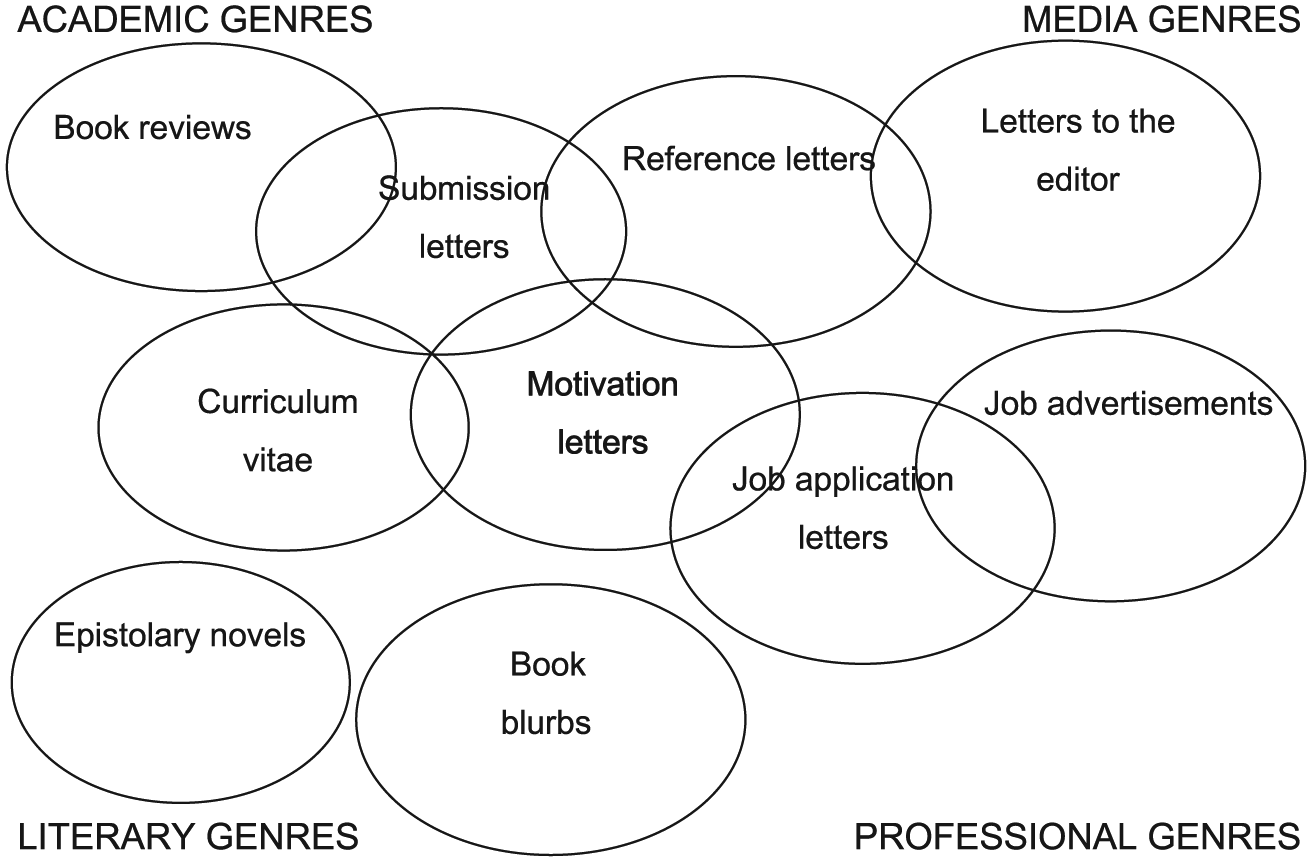
The discourse nature of the motivation letter, adapted from Bhatia (2004).
In Figure 2, we describe and exemplify the moves we are going to study in the corpus (seven in total), which are the macrotextual dimension categories in our analysis, focusing on the communication participant prominent in each of them, the writer (W) or the reader (R).
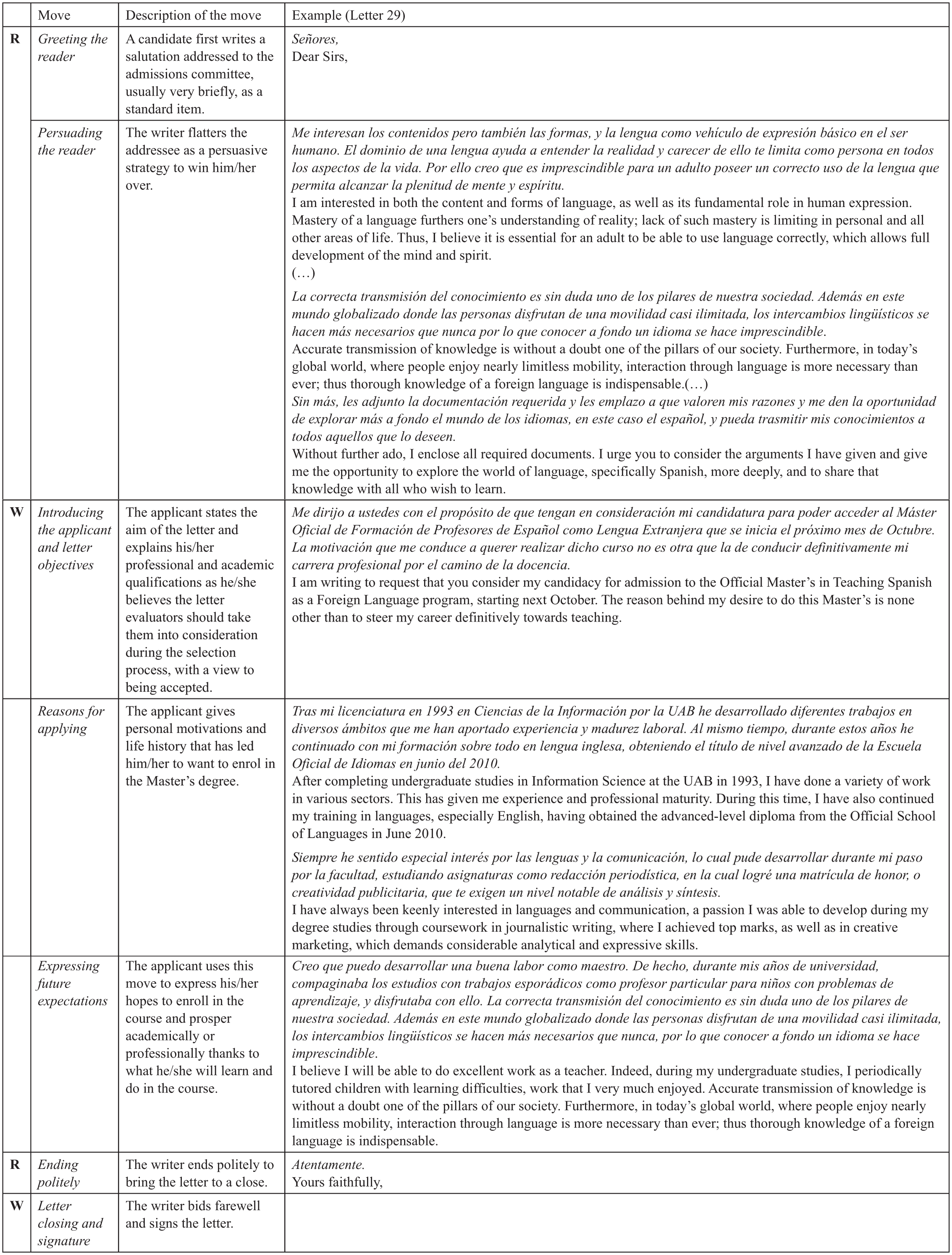
Motivation letter moves and their description, letter 29.
By grouping the moves at the macro-level analysis as W moves and R moves, we connect them with the microlinguistic resources; we emphasize two types of lexicogrammatical items given the persuasive–argumentative component of the genre: modalization resources and discourse markers (DMs).
For modalization features, we follow Hyland’s (2005) stance and engagement model of academic interaction. Stance and engagement are interactional macrofunctions related to the W and R, respectively. Stance includes attitudinal features which refer to ‘the ways writers present themselves and convey their judgements, opinions, and commitments’ (Hyland, 2005: 176). Engagement, in terms of Hyland (2005),
is an alignment dimension where writers acknowledge and connect to others, recognizing the presence of their readers, pulling them along with their argument, focusing attention, acknowledging their uncertainties, including them as discourse participants and guiding them to interpretations. (p. 176)
These two interactional functions, two sides of the same coin (the interpersonal dimension of discourse), are realized by the linguistic resources, as shown in Figure 3 (Hyland, 2005: 177).
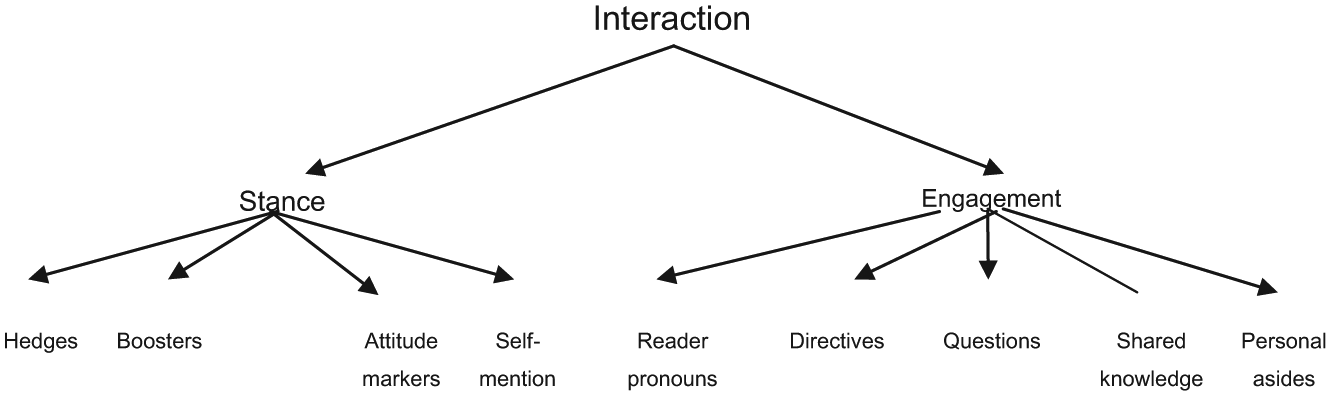
Linguistic resources of interactional macrofunctions.
From this model we select six modalization cues which have clear lexical and grammatical cues in our corpus: hedges, boosters, attitude markers, self-mention, reader pronouns, and questions. We have classified them according to the nature of their linguistic signals: predominantly evaluative and epistemic cues in hedges, boosters, and attitude markers; and predominantly grammatical (personal deixis) in self-mention and reader pronouns; as for questions, they are rhetorical features to engage the reader. Nevertheless, we only reflect in the article those linguistic features which have been more significant, as Atlas.ti co-occurrence tool shows (see Figure 6 later): attitude markers, personal deixis (self-mention and reader mention elements), and DMs of structure.
Modalization cues
Modalization is related to the presence of the author in his or her text, through stance and voice in discourse (Hyland, 2005). Sancho Guinda and Hyland (2012) define these concepts in applied linguistics as follows:
the terms essentially refer to the expression of point of view in speech and writing and to the ways we engage with others. They are central to ways of looking at written texts as social interactions, where readers and writers negotiate meanings, and to how students can be taught to convey their personal attitudes and assessments and appropriately connect with their readers. (p. 1)
Evaluative and epistemic modality cues
1. Attitude markers to express feelings such as surprise or disappointment, and judgments of importance, relevance, and so forth, that go with the writer’s arguments: these include nouns (interés ‘interest’), adjectives (imprescindible ‘essential’, interesante ‘interesting’, prestigiosa ‘prestigious’, especial ‘special’), verbs (deseo ‘wish’, siento ‘feel’, quiero ‘want’), and prepositional clauses (con eficacia ‘with efficacy’) conveying evaluative meaning or the writer’s wishes (desiderative sentence modality).
Personal deixis
2. Self-mention elements which signal how the writer makes self-references in the discourse, including subject and object first-person pronouns; possessive determiners and verb endings:
3. Reader mention elements used by the applicants to reach out to their reader (the coordinators of the Master’s), including personal pronouns and verb endings showing distance or proximity between the communication participants: me dirijo a
DMs
DMs are linguistic units specialized in linking discourse segments and in guiding interpretation of the text. We use the term DMs of discourse structure first used by Schiffrin (1987) and then by Redeker (1990). We distinguish two types of DMs in the corpus: distributional and argumentative ones, but the more relevant appeared to be the distributional ones (see Figure 6).
DMs in a distributional function
Discourse structure DMs organize the various parts of a letter. They are very important cohesive tools because they guide a reader going through a motivation letter by marking its different parts. At the same time, they are important in their argumentative strength to clearly present reasons in this type of letter (En primer lugar ‘In the first place’; Primero de todo ‘First of all’; por una parte ‘on the one hand’; por otro lado ‘on the other hand’, etc.).
Qualitative analysis tool
We used a qualitative analysis tool: Atlas.ti, version 6.2, a licensed software application (Friese, 2014). The letters were fed into the software after creating a hermeneutic unit, which is the file containing all the information related to the qualitative analysis of texts recorded: documents, codes used, analysis, and the relationship between the text segment quotations marked. Having created this analysis unit, the texts were input one by one in rich text format (.rtf). Once the letters had been digitized, the analytical categories were introduced in the software as codes. Since we have established two different types of codes, one corresponding to the macrotextual level of the letters and the other to the microlinguistic level, each one was given a different tag for easy recognition and to make marking and subsequent analysis operational:
Macrostructure tagging with letters (from a to j) was used for codes corresponding to the 10 moves identified in the letters.
Microstructure tags starting with a number were created for each formal lexicogrammatical category: 1 to 6 for evaluative and epistemic modality cues; 7 to 9 for DMs.
Figure 4 shows the tags used in the Atlas.ti software for each of the analytical categories established.
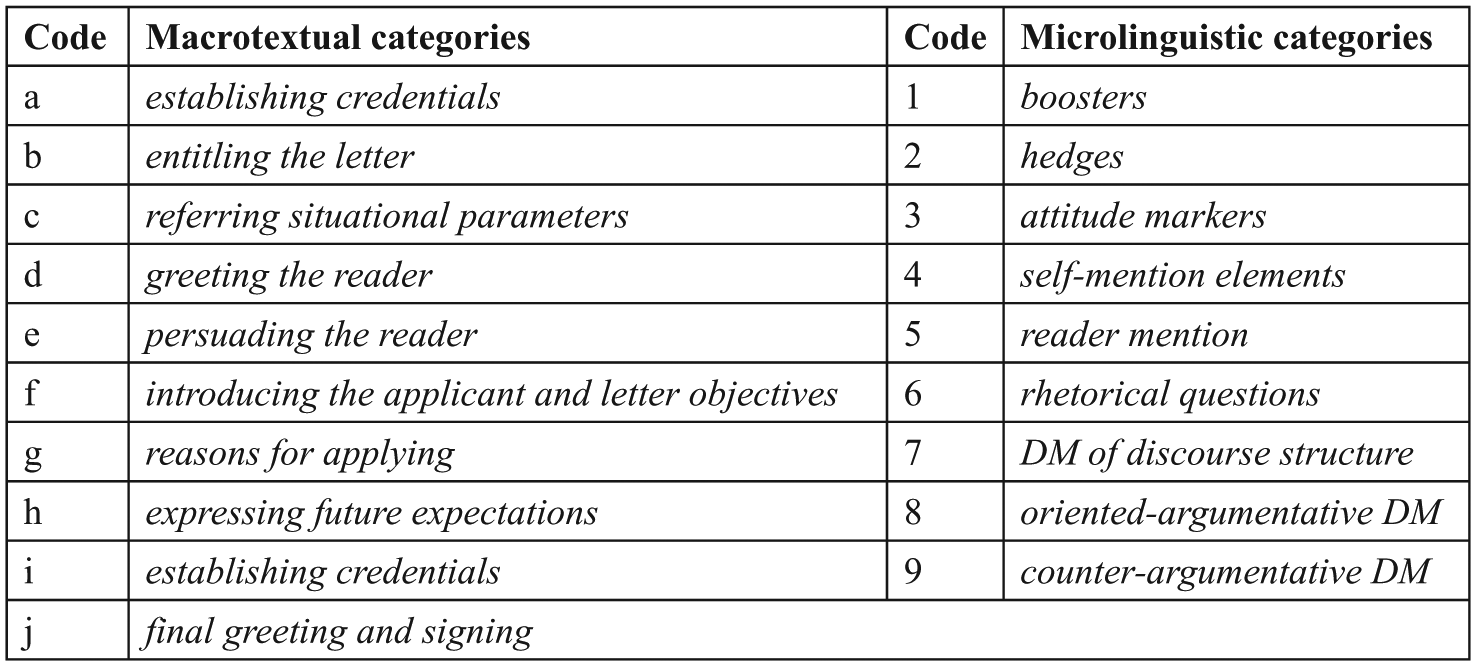
Tagging codes and categories used in Atlas.ti.
As we have detailed in Figure 2, up to four of the considered moves can be connected to rhetorical actions concerning the letter writer (W moves) and three with the addressee (R moves); we list in Figure 5 both groups according to the letter assigned to them for analysis in Atlas.ti.
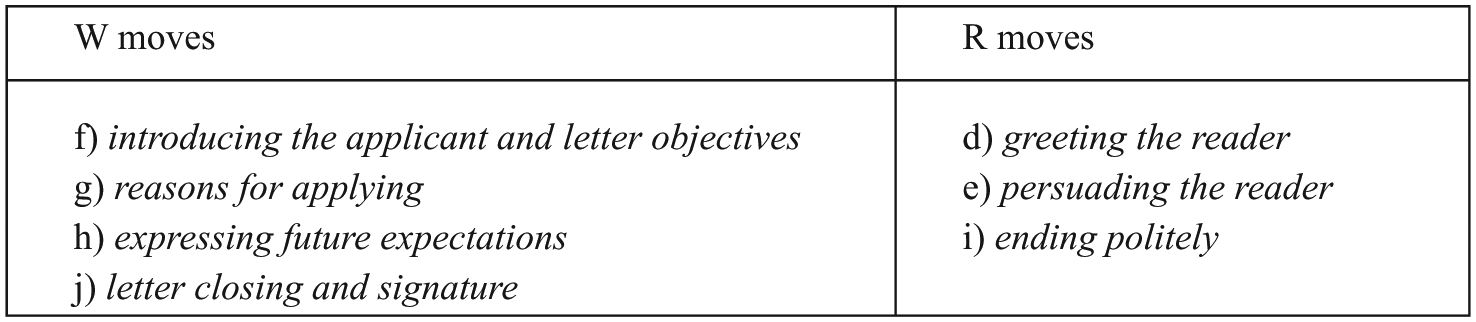
Atlas.ti move letters coding.
For identification purposes, each letter was assigned a code in the hermeneutical unit analysis: ct (carta) identified it as a motivation letter and a reference number (1, 2, 3, etc.) for each entry of a letter in the corpus. Thus, ct21 identifies letter 21 within the corpus. Texts were tagged manually, with one or more tags assigned to each text segment. The software enabled us to assign and overlap tags on the same segments: in other words, we could reflect the multifunctionality of the discourse elements. For example, here is a segment from ct3:
5
(1) Expongo a continuación los motivos por los que me gustaría matricularme al master […]. I expound below the reasons why I would like to enrol in the Master’s […] It was tagged as follows: Macrotextually, the whole segment belongs to the Introducing the applicant and letter objectives move. Microlinguistically, we find the following tags for the same segment, corresponding to two different lexicogrammatical features.
self-mention elements: hedge: me gustar
attitude marker:
To apply these tags, we have marked units that have a minimum complete textual sense, that is, the microlinguistic units are not tagged alone (only the pronoun me in example 2), but they are analyzed as part of the discourse segment in which they are used (me gustaría matricularme) in order to easily retrieve what the writer meant to communicate in the letter.
In order to observe the pragmatic function of the lexicogrammatical elements, it was necessary to take into account the context they appear in. The Atlas.ti tool was used to extract every discursive sequence marked with the analytical categories as well as to extract frequencies of use for each one.
Finally, we have crossed the macro- and microlinguistic to establish relationships between these two levels. Figure 6 shows the table of co-occurrences found through Atlas.ti: the lighter shades show the most outstanding data in relation to lexicogrammatical forms used more frequently in each of the moves as they were defined. In the following section, we explain the results of crossing the two levels of analysis.
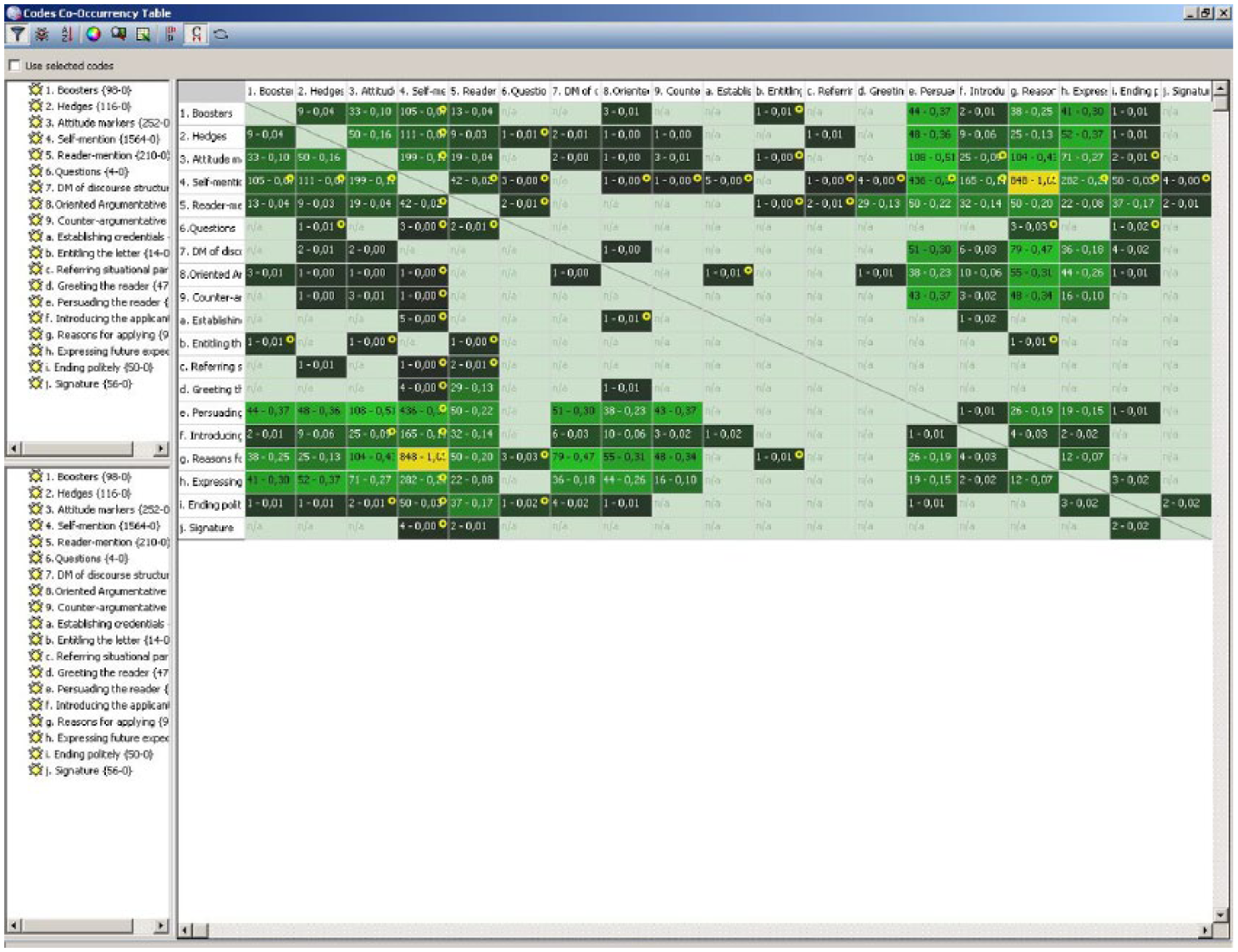
Co-occurrence in Atlas.ti for macrotextual and microlinguistic features.
Results and discussion
The analysis of the macrotextual features, then, is both qualitative and quantitative (following). In the study of microlinguistic features (see later), it is worth mentioning the co-occurrences found between lexicogrammatical elements and the macrotextual categories analyzed previously.
Macrotextual features
The macrotextual features of our corpus were analyzed according to whether they were oriented toward the writer’s (W) or the reader’s (R) letter. As for the W moves, only in three of the 50 letters (ct34, ct37, and ct45) is the author’s signature missing; of these, two include the farewell (ct34: aprovecho la ocasión para brindarles mis más cordiales saludos ‘I take this opportunity to greet you most cordially’; ct37: saludos cordiales ‘kind regards’). Letter ct45 has no signature and no closing salutation, which is characteristic of this type of letter. Here is how letter ct45 (unique in the corpus) opens and closes:
(2) CARTA DE MOTIVACIÓN
En mis primeros años de escuela, mis profesores solían elogiar mis facultades a la hora de escribir. A menudo, elaboraba redacciones fantásticas y creativas.
[…] Por todas estas razones solicito ser admitida en el MÁSTER. (ct45) MOTIVATION LETTER In my first years at school, my teachers used to praise my writing skills. I would often compose fanciful, creative essays. […] For all of these reasons I request to be admitted to the Master’s.
The absence of any mention of who the writer is or who the letter’s audience is shows that it is conceived more as an academic essay than an epistolary. However, it must comply with the requirement of signaling the writer’s identity with a signature at the bottom, following a standard practice of the letter writing genre, as well as some formulae for letter closing, like Atentamente ‘Yours sincerely’ (ct2), Saludos cordiales ‘Kind regards’ (ct1), or Reciban mis más cordiales saludos ‘Please receive my kind regards’ (ct46). They are routine linguistic formulae, fixed for this rhetorical function: they appear in 84% of the letters analyzed.
All of the moves that make up the body of the text are present: (f) introducing the applicant and letter objectives, (g) reasons for applying, and (h) expressing future expectations; the first, introducing the applicant and letter objectives, is the only one which is missing from 18% of the letters. This data can be explained by the hybrid nature of the genre, which overlaps academic and professional letter writing. Some applicants opt for a more academic approach when they do not include in the first paragraph the subject they are writing about (the so-called subject line in business and professional environments). Here are some examples of this move:
(3) Me dirijo a ustedes para exponer los motivos que me llevan a solicitar la matriculación a este Máster. (ct1) I am writing to you to tell you the reasons why I am applying to enrol in this Master’s. (4) Me llamo ***
6
y soy licenciada en *** por la Universidad Autónoma de Madrid. Me pongo en contacto con usted porque deseo cursar el Máster Oficial […] que ofrece su Universidad. (ct4) My name is *** and I hold a degree in *** from the Autonomous University of Madrid. I am contacting you because I wish to enroll in the Master’s […] that your university offers.
This first paragraph of the body of the letter is followed by an explanation of the reasons for applying. The reasons for applying move is the key one that distinguishes the motivation letter from other letters. The aim of this part is to show that the author is an adequate candidate to benefit from one of the places offered in the MA. Noteworthy in this move is the fact that the candidate’s adequacy sometimes depends on academic qualifications and sometimes is based on professional reasons. The following ((5) and (6)) are examples of the academic reasons that are given:
(5) Siempre he sentido un especial interés por el estudio de la lengua y la literatura española, que ha ido en aumento a lo largo de los últimos años de educación académica. (ct3) I have always felt a special interest for studying Spanish language and literature, which has grown over the last years of formal education. (6) Acabados mis estudios de Filología e Historia en la universidad Komotini (Grecia), me encuentro ahora buscando un mejor puesto de empleo. La lengua española está presente en mi vida desde hace 4 años y sigo utilizándola continuamente, día tras día. (ct14) Having finished my studies in Philology and History at the University of Komotini (Greece) I am now looking for a better job. Spanish has been a part of my life for the last 4 years, and I still use it all the time, on a daily basis.
The following is an example of professional reasons:
(7) Otro motivo es que la lengua española ha supuesto para mí una herramienta profesional a la que he tenido la suerte de estar vinculado de manera permanente durante trece años. En todo este tiempo, desarrollando mi labor como redactor publicitario, tuve la necesidad, así como el placer, de profundizar en su conocimiento, el cual me gustaría seguir ampliando cursando este máster. (ct1) Another reason is that Spanish, for me, has been a professional tool and I have had the luck to be in constant contact with it over the past thirteen years. In all this time, in carrying out my work as an advertising writer, I found the need, as well as the pleasure, to gain a deeper knowledge of the language, which I would like to continue to develop by doing this Master’s.
Other cases that stand out are the ones that state a desire for a professional career change as the main reason for wishing to enroll in the MA program. This can be seen in (8):
(8) Soy ingeniero industrial de profesión, la he ejercido por dos años y medio más casi un año de pasantías en una empresa de alimentos muy conocida en Venezuela. (ct20) I am an industrial engineer by profession. I have practiced for two and a half years plus almost a year’s internship in a well known food company in Venezuela.
This kind of motivation can be supported by academic and professional reasons:
(9) Desde que me he licenciado mi actividad formativa y profesional ha estado enfocada fundamentalmente en dos vertientes […]. Por un lado, en el ámbito de la investigación universitaria, centrada en la oralidad y la entonación; y por otro lado, en el ámbito de la enseñanza del gallego, en el que últimamente estoy más interesada. (ct30) Since finishing my degree, my training and work have been basically focused on two areas […]. One is in the field of university research, in spoken language and intonation; the other, in the area of teaching Galician, which I have lately found more interesting.
This move, then, the defining element of a motivation letter, is where the hybrid nature of the genre can be seen most clearly: it is halfway between an academic text and a professional one, as we postulated in the theoretical framework. The following (10) illustrates the same hybridization in the expressing future expectations W move:
(10) Resumiendo, considero de mucha importancia la realización de este master para mi currículo y futuro profesional porque el mismo me abriría las puertas en el sector de la enseñanza de español como lengua extranjera, sector que ha sufrido en los últimos años un incremento en la demanda de profesionales debido al creciente interés por el conocimiento de nuestra lengua, y que me permitiría encontrar un empleo acorde con mi vocación profesional tanto en España como en el extranjero. (ct16) In short, I consider that it is very important for me to do this Master’s, both for my CV and my career, because it would open doors for me as a teacher of Spanish as a foreign language, as demand for professionals has grown in this sector due to a growing interest in knowing our language, and this would help me to find employment in line with my professional vocation both in Spain and abroad.
Given the mixed nature of the genre analyzed in the corpus, very often these two W moves, reasons for applying and expressing future expectations, are blended and appear in the same paragraph, as in (11), the expression of expectations underlined:
(11) Como demuestra que mi primera elección de estudio universitario fuese el magisterio de educación primaria, la educación siempre ha sido una vocación que ha despertado mucho interés en mí. As demonstrated by the fact that my first choice for university studies was primary education training, education has always been a calling that has roused a keen interest in me.
Students show in these W moves that they are competent in using attitude markers and self-mention cues to express their stance in the different moves of the letter. This is an outstanding resource, as motivation letters are ‘a rich source of interactional features that allow us to see how individuals work to position themselves as potential members of a discourse community’ (Bekins et al., 2004: 57).
Just as the most systematic W move is the letter closing and signature, in the case of R moves the opening (greeting the reader) also happens to be the most recurrent element in the corpus: 42 letters include an opening salutation (84%). However, the writers do not seem so sure about who the addressee should be, ranging from a single individual to a whole group, as illustrated in (12):
(12) Att. a quien corresponda (ct22)/ Estimada Universidad (ct14) /Estimado destinatario (ct47)/ Señores, (ct29)/Estimado señor o señora: (ct2)/Estimados Sr. *** y Sra. ***: (ct 34)/Estimados Profesores de Comité de Selección: (ct23)/Estimado equipo de coordinación del master (ct18)/etc. To whom it may concern/Dear University/Dear addressee/Sirs,/Dear Madam or Sir,/Dear Mr *** and Mrs ***:/Dear Professors of the Selection Committee:/Dear management team for the Master’s/etc.
In contrast to stance, the engagement resources (Hyland, 2005) are not well controlled by the authors of the letters: there are doubts in relation to reader pronouns and shared knowledge. The variety in greeting the audience can be explained by the ‘occluded genre’ nature of motivation letters.
As for the persuading the reader move, it appears in most (76%) of the letters, but it does not always appear in the same place. In some of the letters, it appears after greeting the reader; in others, it is written immediately after introducing the letter’s aims or even after the reasons for applying move; this is due to the cycled nature of the moves. The following (13) shows the wording used (underlined) to persuade the MA coordinators of the suitability of a given candidate:
(13) Puedo enumerar varias razones más que me motivan a ingresar y cursar la maestría ofrecida por vosotros, por ejemplo I can list several more reasons that motivate me to enrol and take the Master’s course you offer,
The ending politely segment is found in most of the letters, as a mark of politeness aimed at ‘gaining the benevolence’ of the addressee before closing. It is used in 68% of the letters, with a variety of wordings which express gratitude for the reader’s attention and appeal to the addressee’s openness toward a final acceptance of their application. Prototypical forms are in (14):
(14) esperando que mi solicitud sea bien acogida. (ct5)/Gracias por la atención prestada (ct6)/Gracias por su tiempo y resto a la espera de recibir noticias suyas. (ct11)/Muchas gracias por tomarse la molestia de leer esta carta, esperando los resultados (ct21)/Espero que consideren mi petición de forma favorable y le agradezco su tiempo. (ct25) Hoping my application will be welcome./Thank you for paying attention./Thank you for your time and I look forward to hearing from you./Many thanks for taking the trouble to read this letter, I await the results./I hope you consider my application favorably and I thank you for your time.
Microlinguistic features
This section presents our analysis in the corpus of the modalization cues and DMs, as described earlier. Modalization cues are frequent in the parts that define the text as a motivation letter: W moves reasons for applying and expressing future expectations, and the R move persuading the reader. Noteworthy are the writer’s self-references (self-mention elements) when expounding personal motivations, also in the section for persuading the addressee; (15), (16) and (17) are representative examples of this:
Reasons for applying: (15) El primero de ellos [motivos] se remonta a Otro motivo es que la lengua española ha supuesto para Por último, The first one [of the motives] dates back to Another reason is that Spanish, for Lastly,
Persuading the reader:
(16) El año pasado perd Last year
Expressing future expectations:
(17)
The three moves shown in (15)–(17), and Figure 5((f), (g), (h)), stand out secondly because of the frequency of use of attitude markers, as noted in (18):
(18) […] el español sea parte Spanish is an
Mentions of the audience, of course, stand out in the R moves greeting the reader, persuading the reader, and ending politely as well as in reasons for applying, as can be seen in (19):
(19) Como As
(19) is a form of engagement (Hyland, 2005): the readers are mentioned to focus their attention and to include them as discourse participants, which allows writers to lead readers through the argument actively.
Turning to DMs, the data showing co-occurences, Figure 5, are the following: the one that predominates is DMs of discourse structure in the reason for applying move (20) and in the persuading the reader move (21):
(20) Aparte de los motivos ya descritos anteriormente, los principales motivos que me movieron a solicitar la preinscripción en este master […] son: Besides as the reasons already described above, the main reasons that moved me to apply for enrolment in this Master’s degree […] are: (21)
Conclusion and future lines of research
From our initial research questions, the following four conclusions can be established. First, the most prominent macrotextual features in motivation letters in the Spanish corpus analyzed are the following five moves, all of which are present in at least 70% of the 50 motivation letters studied: persuading the reader, introducing the applicant and letter objectives, reasons for applying, expressing future expectations, and final greeting and signing.
Second, about the prototypical microlinguistic characteristics, the ones that stand out among the modalizing elements are attitude markers and self-mention elements; their frequency of use is accounted for by the promotional nature of any motivation letter, whereby its writer needs to include some self-promotion. As for DMs, the most frequent ones are the DMs of discourse structure, given the organized exposition of motives as a requirement for this argumentative text.
Third, there are significant correlations between the macro- and micro-features identified. In the W moves, there is an understandable abundance of forms for referring to the first person of the writer; in the R moves, the same is the case in forms for referring to the reader. The DMs of discourse structure are predominant in the reason for applying move.
Finally, we conclude that the letters we have analyzed here are a hybrid genre (Bhatia, 2004) as they share academic and professional features at different levels: pragmatic (academic goals in conjunction with professional ones), informational (content), and linguistic (style). A motivation letter fits the criteria both of the academic type that has to be approved as matching the profile of the eligible student for a particular Master’s program and of the professional texts (the cover letter that is attached to a CV in a job application). In this sense, Bhatia (2004) argues that discourse genres have to be understood and described in terms of ‘genre families’ or ‘genre colonies’: motivation letters are hybrid forms because they share pragmatic, textual, and linguistic traits from different genre families. They have content intersections with other academic ‘promotional’ genres such as reference letters or curriculum vitae (Swales and Feak, 2011); at the same time, they share structural features with media genres such as letters to the editor and with literary genres as epistolary novels; finally, motivation letters also have many elements in common with job application letters.
All of these features show the image that graduate writers have of what constitutes an ideal type of motivation letter, as well as their mastery of written discourse. The fact that motivation letters are a hybrid genre, a combination between academic and professional texts, explains that among the writers of our corpus there is a certain amount of hesitation, especially when it comes to using some of the procedures for interacting with the audience, those that have to do with opening salutation (greeting the reader) and with finishing off the letter (ending politely) just before closing and signature. Hesitations in interaction reflect that the writer only has a vague idea of the person who is to read the motivation letter and the proper type of relationship that one is expected to establish. The ‘occluded genre’ nature of the text would explain this perplexity.
The inconsistencies pointed out are related to the interpersonal dimension of discourse and especially with engagement (Hyland, 2005). Regarding the analysis of the genre under study, we could claim that graduate students are competent in stance resources when writing motivation letters but need to improve their engagement skills. The analysis of the audience is central in a genre family theory (Bhatia, 2004; Ciapuscio, 2007) to distinguish the different nature of the addressee in each genre member of the family. The W moves are clearer than R moves in the genre competence of motivation letters. The results of our study point to the need to uncover and contrast the communicative and linguistic features in each of the members of a genre family and their status in academic and professional settings (Bach and López-Ferrero, 2011).
Thus, the future lines of research emerge, related to the data and to the method of analysis. In terms of data, additional texts could be investigated: motivation letters relevant to other MA programs and/or written in other languages and/or relevant to other cultures/countries; and neighboring genres could be analyzed: letters of applications, submission letters, and reference letters. Additional methods giving further insights into the genre of motivation letters could come from a corpus-driven identification of recurrent phraseologies or interviews with faculty selecting applicants, for example. All this research would shed light on the most effective procedures to achieve a positive assessment in Spanish motivation letters, and it would, therefore, contribute to the genre analysis pedagogy.
Footnotes
Acknowledgements
This article is related to the project IES 2.0: Digital literacy practices. Materials, classroom activity and online language resources (EDU2011-28381; 2012–2015) are from the Spanish government Plan Nacional de Investigación Científica, Desarrollo e Innovación Tecnológica 2011. The authors of this article also belong to the Gr@el research group (Grup de recerca sobre aprenentatge i ensenyament de llengües; Research group in language learning and teaching), a consolidated research group financed by AGAUR 2014–2016 (ref. 2014 SGR 1042-F).
Declaration of conflicting interests
The author(s) declared no potential conflicts of interest with respect to the research, authorship, and/or publication of this article.
Funding
The author(s) received no financial support for the research, authorship and/or publication of this article.
Notes
Author biographies
