




Abstract
This article examines the complex presence of smartphones during performances, focussing on how audiences, performers and managers navigate the tensions between digital connectivity and the need for immersive attention. Drawing on qualitative interviews with theatre professionals in Norway and ethnographic observations in Oslo, London and New York, the study demonstrates how social norms surrounding smartphone use are negotiated in different cultural contexts. The analysis highlights key tensions and dilemmas: audiences balance personal documentation with collective immersion, managers weigh promotional visibility against aesthetic disruption and performers experience interruptions that alter the sensory and affective dynamics of liveness. Extending Fischer-Lichte’s concept of the autopoietic feedback loop, the article proposes the concept of a ‘hybrid feedback loop’, in which audience responses circulate simultaneously through embodied co-presence and digitally mediated attention. This theoretical reframing captures how digital devices reconfigure the ecology of performance, reshaping how liveness is produced, perceived and policed in contemporary cultural institutions.
Introduction
‘Put it away, put it away’. The sharp whisper from an older man besides me at a London theatre jolted me out of a glance at my phone. I had just received a message from my pre-teen daughter and wanted to send a quick reassurance. Even that fleeting act, however, provoked a strong rebuke. Embarrassed, I put the phone away immediately, but my attention was fractured, and I felt conspicuously out of place, no longer fully part of the audience. A year later, at Norway’s open-air Peer Gynt Festival, the stage director addressed the crowd before the performance: ‘Please put away your phones. I do not want a wall between the audience and the actors’. Unlike the London incident, this appeal was framed collectively, but it carried the same imperative.
Both moments highlight how cultural spaces have become sites where social norms are actively negotiated, and where the tension between digital connectivity and embodied co-presence is made visible. Recent debates in digital media studies emphasise how online platforms transform communication through the interplay of human behaviour, technological mediation and algorithmic processes (Couldry and Hepp, 2017; van Dijck, 2013). In this context, traditional models of feedback and social interaction must be revisited.
Users interact within platforms that are deliberately designed to capture attention in coherence with the attention economy (Heitmayer, 2025). Algorithms amplify or attenuate signals, producing emergent feedback that continually reshapes attention, participation and meaning-making (Bucher, 2012). This approach situates the study at the intersection of autopoietic theory and contemporary debates on digital media, offering a lens to analyse how digital mediation fundamentally alters the dynamics of social interaction.
In recent decades, the ubiquity of smartphones has intensified the negotiation of norms for digital media use. These norms have been explored in the contexts of everyday life, work and extraordinary events (Baym, 2018; Fast, 2021; Karlsen and Ytre-Arne, 2022; Syvertsen, 2022). However, there is limited research on how smartphone use is enacted among theatre audiences, and on how such norms are negotiated between cultural institutions and their audiences. Accordingly, a key aim of this article is to analyse how smartphone norms are negotiated in performing arts.
Moreover, the negotiation of social norms in the theatre cannot be understood without acknowledging the role of the culture industry, as it encapsulates a broader dilemma: how to navigate the demands of a competitive media environment that encourages audiences to share content online, while preserving the tradition of collective immersion. At the same time, previous research has illuminated the benefits of social media arts marketing (Besana et al., 2018; Hausmann and Poellmann, 2013; Heitmayer, 2025; Taylor, 2018); however, less is known about how selfie culture shapes the relationship between performers and audiences. Addressing this gap constitutes the article’s second key research question.
Third, as demonstrated in performance theory (Bennett, 1997; Besana et al., 2018; Fischer-Lichte, 2008; Heim, 2015; Poell et al., 2021), the audience’s attention and embodied response are essential to the performing arts. Fischer-Lichte’s notion of the autopoietic feedback loop captures the circular dynamic through which performers and spectators co-create the aesthetic event. However, the ubiquity of smartphones raises new questions about how this feedback loop operates in hybrid environments, where the physical and the digital intersect. The key theoretical ambition of this article is therefore to extend and adapt the concept of the autopoietic feedback loop to the conditions of contemporary hybrid spectatorship.
Methodologically, the study employs a mixed-methods design, incorporating qualitative interviews with professionals in the Norwegian theatre sector, including actors, directors and managers, as well as ethnographic observations at performances in Oslo, London and New York. This approach offers insight into how key stakeholders perceive, experience and manage smartphone norms in performance settings, and enables observation of how social norms are shaped, enforced and contested in distinct cultural contexts.
Literature review
Theatre etiquette across cultural contexts
My experience as a tourist in the London theatre captures how social norms of theatre behaviour are both situationally enforced and culturally embedded. The disapproval of digital distractions reflects a longer genealogy of how public attention has been morally and institutionally regulated. Until the mid-nineteenth century, theatre audiences across Europe and North America were expressive and participatory, often shouting at performers, chatting or reacting vocally (Heim, 2015). The introduction of electric lighting in the 1880s, first in London and later in New York, transformed the sensory economy of the theatre. As the auditorium darkened, the audience was rendered collectively visible only through their silence. This shift marked the emergence of modern theatre etiquette, formalised through posted rules, ushers and even plainclothes police officers patrolling the aisles to enforce order (Heim, 2015). From this point onwards, attentiveness became not just an aesthetic expectation but a moral performance: being a ‘good’ audience member meant maintaining discipline, self-control and respect for others. In this historical light, the current tension over smartphone use in theatres appears less as a novel dilemma than as a continuation of a century-long negotiation over attention, technology and civility.
Across cultural contexts, expectations surrounding theatre behaviour are remarkably consistent, with silence, attentiveness and deference to the performance as norms; yet, the meanings attached to these norms differ. What is at stake is not only what audiences do, but also how acts of attention and distraction are morally interpreted. In Britain, theatre etiquette continues to resonate with ideals of politeness and civility, vestiges of Victorian moral order that historically linked public restraint to social respectability (Fox, 2014; Sedgman, 2018). Audiences might act as informal custodians of decorum, and subtle acts of correction, such as a sharp whisper, a disapproving glance, reinforce the sense that proper behaviour sustains the collective experience. Here, etiquette functions as a social contract between strangers.
The United States is characterised by equally strict expectations of silence and stillness. However, the moral framing differs. American theatres, especially in major cities, such as New York, combine commercial logics with civic ideals of shared respect. The emphasis is less on class-coded civility than on the mutual right to undisturbed enjoyment of one’s property. Audience members are repeatedly reminded to silence their phones and refrain from photography. However, the rationale tends to be pragmatic, protecting the show’s copyright or the comfort of others, rather than an appeal to etiquette per se (Baym, 2018; Sedgman, 2018). In this sense, compliance is grounded less in moral surveillance among audience members and more in an implicit contractual understanding between the theatre and the audiences.
In Norway, theatre etiquette reflects a distinctive blend of high digital connectivity and strong social moderation. Norwegians are among the world’s most intensive users of smartphones and digital media (Ling, 2012; Syvertsen et al., 2014), yet public conduct remains guided by ideals of modesty, equality and self-restraint. As Gullestad (1992) describes, egalitarian individualism structures social interaction through mutual awareness and understanding. Rich Ling’s studies of mobile culture demonstrate how phone use in Norway is regulated through ‘microcoordination’ and ‘bounded solidarity’, forms of discretion that preserve social harmony (Ling, 2008, 2012). Distraction is thus experienced not as moral failure or contractual breach, but as social dissonance, or an unwanted rupture in the shared rhythm of attention.
Taken together, these cultural inflexions suggest that while the rules of theatre etiquette are broadly shared, the moral vocabularies through which they are justified vary. The smartphone, like the electric light a century earlier, disrupts these moral grammars of attention. How audiences in London, New York or Oslo respond to such disruption tells us less about the device itself than about how late-modern societies negotiate the boundaries of civility, collectivity and digital presence.
Social media marketing: selfies as performance
The creative industries have long relied on publicity to attract audiences. In the pre-digital era, promotion was mediated mainly through advertisements, editorials and reviews (Caves, 2000; Hesmondhalgh, 2013; Pushkin, 2004). Today, social media has become central, shifting promotion from institutional channels to peer-to-peer networks. A growing body of research highlights the substantial influence of audience engagement and social media on the success of cultural performances. Studies have examined word-of-mouth (WOM) strategies in various contexts, including festivals (Luonila et al., 2015), Broadway shows (Pontelandolfo, 2022) and the performing arts more broadly (Hausmann and Poellmann, 2013).
Social media marketing cultivates what is framed as organic or authentic audience participation. Productions, such as Hamilton, encouraged fans to share content, turning practices like taking selfies into powerful promotional tools (Pontelandolfo, 2022). As Luonila et al. (2015: 464) note, ‘attendees’ sharing of information about their festival experience forms part of the event’s consumption and at the same time contributes to its marketing’. In this sense, selfies function as both personal souvenirs and public performances, positioning audiences simultaneously as consumers and promoters. Nevertheless, the same practices that extend visibility may compromise the aesthetic experience. Studies show that taking photos with the intention of sharing heightens self-presentational concerns and reduces immersion (Barasch et al., 2018; Baym, 2018). What enhances reach may therefore diminish satisfaction.
The convergence of consumption, tourism and performance in contemporary theatre intensifies this tension. The selfie epitomises this hybridity: an act of self-conscious performance (Heim, 2015) that recalls older rituals of ‘seeing and being seen’ while embedding cultural participation in digital economies of attention. Once derided as intrusive, photographing or filming performances can now be viewed as a form of participation, although it is often perceived as disruptive (Heim, 2015).
Audiences thus emerge not only as spectators but also as performers and promotional agents. This dual role creates both opportunities and dilemmas for institutions seeking to attract younger, digitally active demographics. A central question becomes: How do selfies as performance reshape the boundaries between spectatorship, promotion and participation in contemporary performing arts?
Performance theory: audience as co-creator
Unlike the visual arts, performing arts depend on the active engagement of both actors and audiences to create dynamic, co-present experiences (Fischer-Lichte, 2008). Performance theory thus rejects the notion of the spectator as a passive observer. Instead, meaning arises through the audience’s perceptual, emotional and bodily participation, which continuously shapes the unfolding of the event (Bennett, 1997; Herrmann, 1998). As Goffman (1959) and Dolan (2006) have argued, each performance becomes a social encounter in which both performers and spectators act upon each other, producing moments that are singular and unique.
Fischer-Lichte (2008) conceptualises this co-creative process through the notion of the autopoietic feedback loop, which involves the continuous exchange of energy, attention and affect between performers and spectators. The smallest gestures on stage, take, for example, changes in tone, rhythm or movement, elicit audience reactions that, in turn, feed back into the performer’s own expressive choices. The performance thus constitutes a self-generating system, sustained by mutual responsiveness within a shared physical and temporal space. Liveness, in this view, depends on immediacy: the reciprocal circulation of attention and emotion that anchors all participants in the here and now.
The introduction of smartphones into this ecology unsettles the delicate dynamics of the autopoietic loop. When spectators redirect their gaze to a screen, or when reactions are externalised through digital mediation rather than embodied presence, the feedback loop is fractured. Attention leaks outwards to dispersed, networked audiences – remote, invisible and temporally dislocated. The live performance no longer circulates solely within the room; it becomes entangled with the digital sphere. This transformation raises a key question: can the autopoietic feedback loop, once considered the essence of liveness, still function in its traditional form or has it already evolved into something else, hybrid, mediated and distributed?
These questions gain particular urgency in a cultural climate marked by what Albris et al. (2024) describe as digital backlash, a growing ambivalence towards the social and psychological costs of constant connectivity. Smartphones have been ubiquitous for decades, yet their deep integration into everyday life continues to reshape cultural norms, social expectations and embodied practices. Live performance venues have become emblematic sites where these tensions are played out, as norms of attention, presence and civility are continually negotiated and redefined.
Research points to the pervasive challenges of digital distraction, which not only fragment individual focus but also generate social tensions that resist resolution through either formal regulation or personal self-discipline (Syvertsen, 2020; Ytre-Arne et al., 2020). In this context, theatres occupy a distinctive position between regulation and freedom, relying on shared social norms to sustain attentiveness without resorting to overt policing. The management of smartphone use thus becomes a moral and aesthetic question as much as a practical one.
Contemporary theatre practices reveal diverse responses to the tension between embodied presence and digital mediation. Some productions integrate smartphone-based interaction into performances (Greenhalgh et al., 2022; Haldley, 2017; Kapsali, 2019), while others enforce strict phone-free policies, insisting that digital devices are disruptive. Most, however, operate in a contested middle ground, negotiating between audience expectations, institutional norms and broader cultural currents of digital ambivalence.
These dynamics suggest that the traditional autopoietic feedback loop, as theorised by Fischer-Lichte (2008), may no longer fully capture the circulation of attention, affect and responsiveness in contemporary performance contexts. Attention is increasingly fragmented, circulating not only between performers and physically present spectators, but also across digital networks and mediated spaces. The resulting tensions highlight how theatres serve as microcosms for broader societal negotiations over attention, presence and normative behaviour in an era of pervasive connectivity (Albris et al., 2024; Syvertsen, 2020; Ytre-Arne et al., 2020). Accordingly, this sets the stage for a closer examination of how liveness is being reconfigured in practice, and opens a theoretical space to explore configurations of attention and feedback that extend beyond the traditional autopoietic loop.
Methodology
This study employs a mixed-methods approach, combining qualitative interviews with ethnographic fieldwork. This design enables triangulation of findings, providing a nuanced understanding of how smartphones are used and regulated in theatre contexts, as well as how institutional strategies interact with audience behaviour.
Qualitative interviews
Semi-structured interviews were conducted to capture in-depth insights from both institutional stakeholders and actors (Lindlof and Taylor, 2014). Interviews explored experiences, reflections and strategies related to smartphone use during performances.
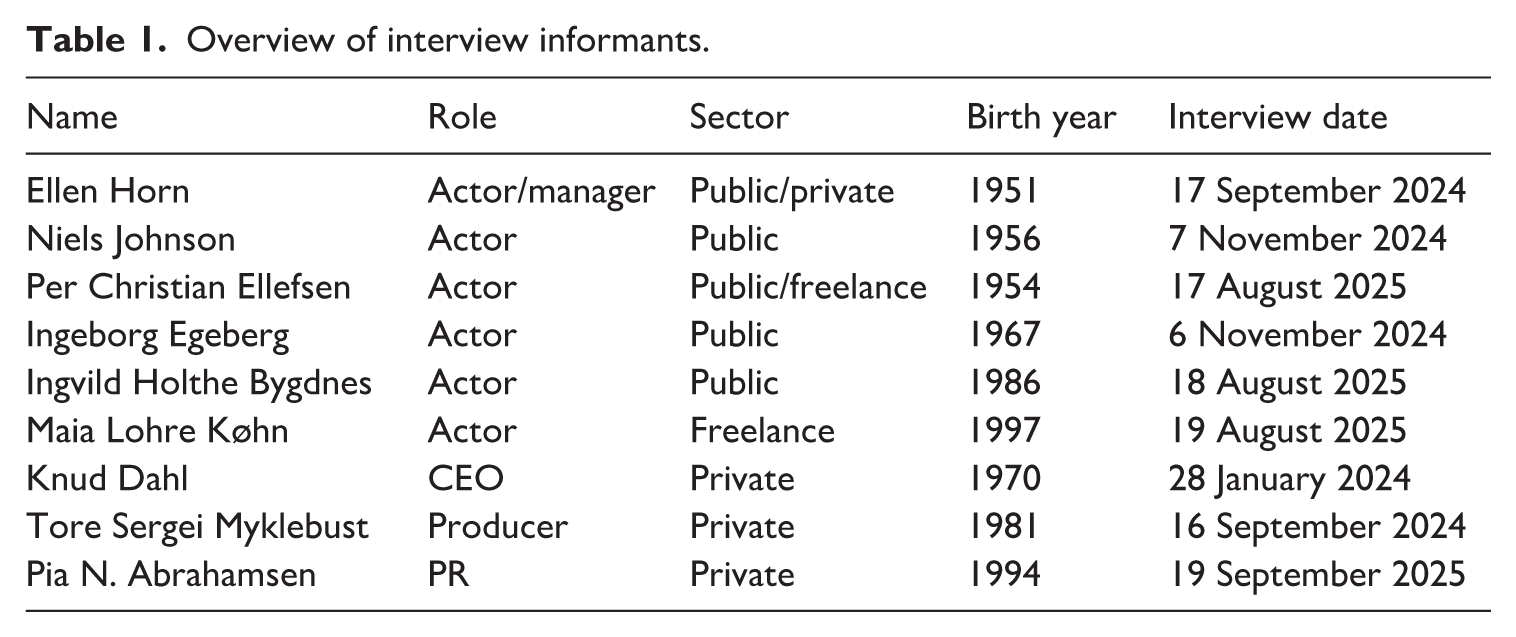
Nine informants participated, representing both stakeholder groups (see Table 1). Interviews lasted 30–60 minutes and were fully transcribed. Informants were selected to capture variation in career stage, institution type and professional role, ensuring a range of perspectives relevant to smartphone norms and theatre management.
Overview of interview informants.
Ethnographic fieldwork
Ethnographic observations complemented the interviews, providing insight into audience behaviour that could not be captured through interviews alone. The researcher attended performances as a ‘professional stranger’ (Agar, 1996), documenting smartphone use, signage and audience reactions.
Observed performances included a mix of public and private theatres, as well as international venues to contextualise Norwegian practices within a broader cultural context: Peer Gynt (Henrik Ibsen), Gålå, 10 August 2022; Waterloo (Abba-inspired), Christiania Teater, 20 September 2024; Dream of Autumn (Jon Fosse), Nationaltheatret, 11 April 2025; Hamilton (Miranda), Richard Rodgers Theatre, New York, 03 October 2024 and Austentatious (Jane Austen-inspired), Vaudeville Theatre, London 2 June 2025
Fieldnotes consisted of 16 pages of observations, supplemented by 23 photographs and two informal conversations with audience hosts. While audience interviews could have provided valuable self-reports, this approach was intentionally omitted to preserve naturalistic validity. Ethnographic observation allows for direct insight into embodied audience conduct, minimising recall and desirability biases common in post-event interviews. The decision reflects a theoretical commitment to performance as situated behaviour (Fischer-Lichte, 2008), privileging the observation of enacted norms over retrospective accounts of intention or justification.
Data analysis
Data were analysed through thematic coding (Braun and Clarke, 2006), combining inductive identification of recurring motifs with deductive interpretation informed by performance theory and research on social norms.
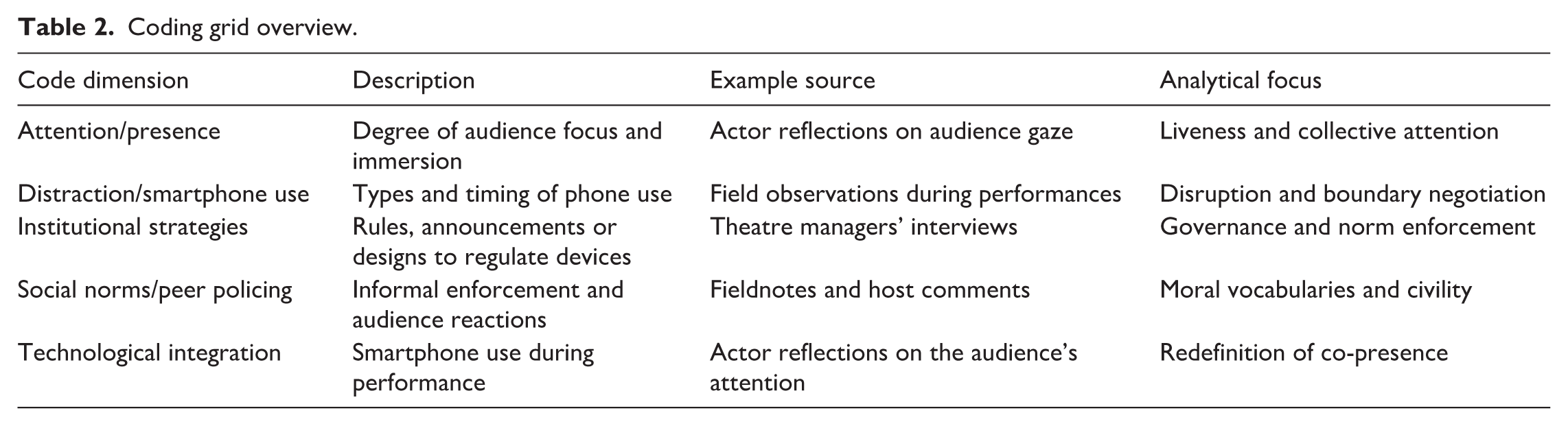
A structured coding grid was used to organise and compare data from interviews and fieldnotes. The grid was iteratively refined to enhance internal validity and coherence across data types (see Table 2).
Coding grid overview.
Codes were reviewed and merged iteratively during analysis. Validity was ensured through triangulation (comparing interviews and ethnographic notes), peer debriefing with research assistant and ongoing theoretical memo-writing. Together, these analytical layers establish the foundation for the concept of the hybrid feedback loop, proposed here as a way to conceptualise how digital connectivity reconfigures the autopoietic dynamics of live performance.
Analysis: the hybrid feedback loop
Theatre has long relied on a live feedback loop between stage and audience. With the rise of mobile media, this loop has become hybrid, blending physical co-presence with networked attention. Over four decades, mobile use in theatres has evolved from curiosity (1985–1995) to disruption (1995–2010) to negotiation (2010–2025), revealing how mediatisation reconfigures cultural norms around focus and participation.
Early episodes, such as a doctor’s ringing Mobira during a 1981 performance, exposed uncertainty about behavioural norms in mediated space (Johnson, 7 November 2024). By the late 1990s, interruptions had become both common and symbolically charged. When actors like Margareta Krook publicly disciplined audience members, the authority of the theatrical frame was being contested in real time; an analogue feedback loop intensified by digital intrusion (Horn, 7 September 2024).
Over the last decade, smartphones have increasingly become ubiquitous, serving as ‘extensions of the self’ (Park and Kaye, 2019). For theatre professionals, this has brought persistent distractions. In our current smartphone era, distraction has become ambient rather than exceptional. Informants describe nightly disturbances as part of a ‘new normal’. (Egeberg, 6 November 2024; Bygdenes, 18 August 2025). Theatre institutions respond through reminders and bans, yet these interventions often reproduce distraction by drawing attention to devices: If you give a message right before the lights go down, everyone starts fumbling with their phones, which creates noise and disrupts the atmosphere. It’s unfortunate that we have to give these instructions. (Johnson, 7 November 2024) We work hard with the opening to grasp the audience. Then you look up and see people fumbling with their phones, missing the start. It is their loss, but it’s also my loss. The opening is a vulnerable moment, and when the audience is told to turn off their phones, they are reminded of them instead. (Bygdnes, 18 August 2025)
The autopoietic feedback loop defined by Fischer-Lichte (2008) includes response, which could be defined as distractions, such as eating and drinking, coughing, whispering, rustling or moving around and even snoring (see also McParland, 2009). However, the current digital distractions might represent a new dynamics, which might be defined as a hybrid feedback loop; a framework for understanding how liveness is transformed when attention, affect and feedback circulate simultaneously within both physical and digital spheres. Unlike the classical autopoietic loop, the hybrid loop accommodates mediated, delayed and networked responses, highlighting how smartphones both fragment and extend the relational ecology of the performance.
Digital distractions differ fundamentally from analogue ones because they operate within the infrastructures of the attention economy. Through algorithmic circulation, even a momentary act of filming or posting can extend the performance into networked publics. This entanglement introduces conflicting interests between various stakeholder groups, revealing how norms of attention are now negotiated across hybrid, rather than bounded, cultural spaces.
Negotiating smartphone norms in performing arts
In the current phase of negotiated norms, it is beneficial to examine the most prominent stakeholders and the tensions between them during the negotiation process. Based on interviews and fieldwork, I identified the key stakeholder groups as the audiences, the management and the performers, and each of these has interests in how smartphone norms are negotiated in performing arts:
The audience
For audiences, smartphone use represents a breach of the aesthetic and communal contract underpinning live performance. Such disruptions are experienced as violations of shared cultural norms, provoking both immediate reactions and later complaints. According to the informants, management frequently receives feedback from spectators who feel that their experience has been diminished by others filming the show (Myklebust, 16 September 2024). These audience reactions can be interpreted in light of Fischer-Lichte’s (2008) notion of the audience as a community: ‘The creation of a community out of actors and spectators based on their bodily co-presence plays a key role in generating the feedback loop’. Accordingly, the very idea of community may be threatened when audience members focus on their screens rather than the shared presence of the performance, reducing both the authority of the performance and the value of co-presence itself. Several of the actors interviewed for this article emphasised the theatre’s community-building potential as socially valuable in an age of individualisation and an increase in reported loneliness: ‘Maybe that is why people still come to the theatre. They might enjoy being offline’ (Egeberg, 6. November 2024). ‘We meet in the theatre space for a shared experience, as a community’ (Johnson, 7 November 2024).
Despite the norms of co-presence and collectivity, audiences also see value in filming or taking photos to capture personal memories or share with networks beyond the physical space. As observed during fieldwork, spectators often reach for their phones during particularly spectacular or colourful scenes, or during moments of intense and photogenic performance. Capturing images that attract attention in today’s self-performative, selfie-driven culture makes it important for some audience members to film during the show.
According to the actors, and contrary to the common assumption that younger audiences are the main culprits, they experience older spectators as the most disruptive: ‘The elderly are the worst; they light up the entire space around them with the smartphone in the air’ (16 September 2024). ‘They have huge iPads, spend a long time taking pictures, and forget to turn off the flash’ (28 October 2024). ‘When a phone rings, it is rarely the young. It is grandma or grandpa, struggling to find flight mode’ (6 November 2024). However, during fieldwork, I observed both young and middle-aged audience members filming, to the point where the ushers even had to warn them. This episode occurred during a musical show rather than a traditional stage play, and the audience seemed digitally immersed, engaging with the show through filming, as if the potential for sharing images with their networks enhanced, rather than distracted from, the performance experience.
Moreover, during the Jane Austen improvisation performance, the young adult audience refrained from using their phones. Instead, the event fostered an interactive immersion through analogue participation, for instance, by inviting the audience to contribute suggestions. In this case, the ‘feedback loop’ was maintained through analogue engagement rather than digital capture.
These findings highlight how smartphone use during live performances challenges multiple normative frameworks and underscore the importance of genre. It can undermine the sense of community by diverting attention to external networks, and it challenges traditional artistic authority by fragmenting the audience’s attention between online and offline presences. However, there are also signs of added value, as audience filming and sharing can generate publicity and attract new spectators to the performing arts.
Management
Given that the managers interviewed for this study represent the private, commercial and tourist-oriented segment of the Norwegian performing arts sector, they occupy a structurally ambivalent position within the field. On one hand, they recognise the advantages of smartphone use in the auditorium as a mechanism for visibility and social media promotion. In a highly competitive creative arts and live entertainment market, these managers embrace audience engagement as an extension of marketing logics: ‘If you look at the marketing and PR side of it, I believe the advantages of allowing phones outweigh the disadvantages’ (Dahl, 28 October 2024). As another explained, ‘We fight for the audience, and compete not just with theatres but also with the movies and Netflix. Thus, we need to be top of mind when people are making decisions. We need a word-of-mouth effect to sell tickets’ (Myklebust, 16 September 2024).
On the other hand, even within commercially oriented theatres, directors acknowledge the inherent trade-offs associated with smartphone use during performances: ‘We want to get rid of the phones, but nice photos attract more audience. It is a marketing tool, but at the same time, many actors are distracted by it’ (Horn, 17 September 2024). As one director succinctly put it, ‘It is a two-way exchange. Otherwise, you might as well stay home and watch Netflix’ (Myklebust, 16 September 2024).
Thus, while digital documentation and online sharing enhance visibility and extend the theatre’s promotional reach, they also introduce tensions between artistic, social and commercial rationalities. Managers express ambivalence, recognising that the mediatisation of the live event may compromise its aesthetic integrity and the audience’s immersive engagement. In this sense, the very affordances that amplify promotional potential can simultaneously erode the aesthetic and symbolic value that underpins the performing arts’ distinct cultural capital.
A key dilemma lies in navigating between the commercial appeal of publicity generated through selfies and algorithmic visibility, and the preservation of performance’s authority as a unique, communal experience. In practice, theatres attempt to reconcile these competing logics by allowing photography only at designated moments, typically during applause. This negotiated compromise seeks to accommodate both those who wish to capture and share content and those who value uninterrupted attention. However, as observed across public and private theatres alike, such measures rarely satisfy the most digitally oriented audiences, who continue to record throughout the performance. Applause represents predictable, low-risk content that functions more as institutional marketing than as personal documentation of experience, thus reaffirming the commodification of spectatorship itself.
A key finding is that theatres are reluctant to impose outright bans on smartphone use, as such measures are perceived as both overly interventionist and practically unfeasible. Instead, they seek to establish social norms by encouraging audiences to refrain from distracting the performance, primarily through communicative and informational strategies. The most common approaches include posters, digital messages and voice-over announcements, while performer-delivered reminders are used more sparingly and tend to depend on genre conventions. As one manager explained, ‘It works best if the comedians speak up, rather than staff interfering with the show’ (Abrahamsen, 19 September 2024).
Nevertheless, these attempts to discipline audiences have not eliminated the problem of digital distractions. One theatre manager reported purchasing mag lights to illuminate offenders – an intrusive method acknowledged as a last resort, to be applied rarely and with caution (Myklebust, 16 September 2024). The use of mag lights recalls early twentieth-century theatre etiquette, when audience conduct was formalised and strictly enforced by police officers using flashlights to correct disruptive behaviour (Heim, 2015: 66). This historical parallel illustrates how successive technological innovations, first electricity, later mobile communication, have repeatedly transformed the performer–audience relationship to the extent that renewed forms of behavioural enforcement are once again deemed necessary.
Performers
The actors interviewed for this study primarily emphasised the importance of the autopoietic feedback loop, as defined by Fischer-Lichte (2008). Nevertheless, they also point towards a new, more hybrid relationship between performers and audiences. The overarching finding is that the informants consistently framed digital media, referring to smartphones, tablets and smartwatches, as inherently distracting and disruptive within the theatre space, as they interrupt the delicate connection between stage and audience. As Johnsen (7 November 2024) observed, ‘It takes about 5–8 minutes to reconnect with the audience after a disruption. The energy in the room can disappear instantly’. Similarly, Horn (17 September 2024) emphasised the fragility of this link: ‘There is a fragile, invisible arc between the stage and the audience that must be protected. Theatre is a sacred space that demands respect’. Even minor gestures, such as the glow of a phone or a glance at a watch, signal the audience’s waning attention, as Ellefsen (17 August 2025) noted: ‘The glow of a phone, a glance at the watch, small gestures that reveal attention is slipping’. Together, these accounts highlight that digital distractions not only disrupt attention but can also fundamentally unsettle the performative energy on which theatre relies. Across different generations (born in 1954, 1967 and 1997), the actors express the essential role of audience feedback and their practical function as guidance in their artistic performances: ‘I need reactions like breathing, glances, or laughter. I need all those little reactions so that you can guide me further’ (Køhn, 19 August 2025), ‘Our tool as actors is sensitivity. We are always tuned in, with every antenna on high alert. Our nervous systems are exposed’ (Egeberg, 6 November 2024), ‘When a monologue holds the audience in silence and full attention, I know I have succeeded’ (Ellefsen, 17 August 2025).
When disrupted by smartphone use during live performances, actors report that their primary strategy is to ignore the disturbance to preserve the continuity and integrity of the scene. However, as several interviewees emphasise, even the attempt to ignore a ringtone or the glow of a screen subtly recalibrates their sensory, emotional and rhythmic orientation. Such disturbances do not remain external to the performance; instead, they become folded into the performative situation itself, altering the attentional texture of the moment and the relational field between actors and audience. As one actor explained: In classical drama, it is hard when you are in a big moment and suddenly a phone rings. You are pulled out of it, the audience is pulled out of it, and the play loses its foundation. Sometimes you ignore it, sometimes you acknowledge it, to recognise that this is happening in the room. (Bygdnes, 18 August 2025).
These empirical insights invite a reconsideration of Fischer-Lichte’s (2008) concept of the autopoietic feedback loop. While the original formulation centres on the reciprocal exchange of perception and affect between co-present performers and spectators, the interviews suggest that contemporary performance environments are shaped by an additional layer of digitally mediated cues. Actors increasingly interpret smartphone screens, notification sounds and even the act of filming as part of the feedback environment that informs their real-time decisions. As Abrahamsen (19 September 2024) notes, comedians may integrate distracted spectators into their ‘crowd work’, directly incorporating the phone use into the dramaturgy. Likewise, an experienced stage actor described smartphone activity as a proxy for audience disengagement: ‘For us actors, these (digital) cues are crucial: they show us when something is not working’ (Ellefsen, 17 August 2025).
Taken together, the actors’ accounts point towards what can be conceptualised as a hybrid feedback loop: a dynamic circuit in which audience responses are generated simultaneously through embodied co-presence and through digital media. Traditional markers of engagement – applause, silence and laughter – now coexist with digitally mediated signals, such as illuminated screens, notification sounds and intermittent filming. Performers and institutions, therefore, navigate feedback that is immediate and co-located, yet also dispersed, asynchronous and networked. The material thus points towards an expanded conceptualisation that highlights how contemporary performance is conditioned not only by real-time interpersonal exchange but also by digitally extended circuits of attention, participation and affective shift.
The conceptual model demonstrates this transformation. In Fischer-Lichte’s (2008) classical loop, meaning is generated through mutual perception in the shared physical space of performance. In contemporary settings, this loop becomes hybrid as corporeal interaction is interwoven with digital and algorithmic processes. Digital devices introduce parallel channels of perception and response, reshaping the ecology of attention in ways that reverberate across the temporal, affective and spatial dimensions of live performance.
Smartphone norms across cultural contexts
This final part of the analysis will turn to examine how the hybrid feedback loop operates across cultural contexts and how norms of smartphone use in live performance reflect broader moral and social orders. The opening anecdote, in which I, as a foreigner attending a local theatre in London, was publicly corrected for using my smartphone, crystallises the social force of attentiveness in live performance spaces, as well as how cultural differences in how social norms are negotiated. The strict message to ‘put it away’, referring to my phone, resonates with the British norms for theatre etiquette rooted in traditions of civility and restraint; such moments of corrections illustrate how audience members act as informal custodians of decorum. The expectation to remain silent and still does not merely serve the performance; it also reproduces a moral order in which composure signifies respectability. Drawing on Sedgman’s (2018) and Fox’s (2014) analyses of moral surveillance, these micro-regulations reflect a lingering Victorian ethos, where public restraint functions as a marker of social virtue. The smartphone, when it intrudes, becomes more than a distraction; it threatens the fragile social contract of civility that defines the collective experience of the theatre.
In the United States, the same behavioural norms apply but are grounded in a different moral framework. During a Broadway performance of Hamilton, ushers’ announcements politely reminded spectators to silence their phones and avoid filming, framed as a matter of policy (it is prohibited), not etiquette. When a spectator discreetly filmed a scene despite these reminders, others looked away rather than expressing disapproval (Fieldnotes, 03 October 2024). Here, compliance depends on a sense of contractual reciprocity between the institution and the audience, rather than moral surveillance among peers. As such, smartphone disruptions are not moral failings but breaches of a social contract between consumers and institutions.
In Norway, digital norms intersect with egalitarian ideals that prioritise moderation, equality and social awareness. Norwegians are among the world’s most intensive smartphone users (Ling, 2012; Syvertsen et al., 2014), yet public interaction is marked by modesty and mutual attentiveness (Gullestad, 1992). At the National Theatre’s Fosse production, a spectator briefly took a photo of the stage before quietly putting the phone away. No one reacted; the disruption was absorbed into the social rhythm rather than sanctioned. Similarly, an audience host explained that enforcement works best ‘if the performers themselves speak up, rather than staff interfering in the show’ (Abrahamsen, 19 September 2024), emphasising discretion over confrontation. These practices align with Ling’s (2008, 2012) notion of ‘bounded solidarity’, where digital behaviour is regulated through tacit awareness rather than authority. Theatre audiences thus negotiate a balance between digital presence and social discretion, reflecting a cultural commitment to equilibrium rather than enforcement.
Taken together, these cases reveal that while the behavioural expectations surrounding smartphone use in theatre are globally recognisable, the moral vocabularies through which they are justified differ. The British moralism of civility, the American contractualism of mutual respect and the Norwegian social moderation exemplify distinct modes of digital negotiation. The smartphone becomes a diagnostic tool, revealing how late-modern societies rearticulate social norms, community and attention in the face of technological mediation.
In this sense, smartphone etiquette in the performing arts is not simply about managing distractions; it is a cultural mirror, reflecting how societies conceptualise the boundaries between self and other, between private impulses and public restraint. These underlying cultural grammars also influence the hybrid feedback loop between audiences, performers and institutions.
Together, these strategies illustrate a broader cultural negotiation: smartphones have transformed expectations of presence, attention and participation in live events. Audiences increasingly blend consumption, documentation and sharing; managers balance enforcement with promotion; and performers adjust to preserve immersion while engaging with a digitally mediated reality. The ongoing interplay among these stakeholders underscores how new media is reshaping the norms, authority and experience of live performance in contemporary society.
Conclusion
This study examines how smartphone norms are negotiated within the performing arts and how digital practices shape the roles and relations between audiences, performers and institutions. This concluding section will discuss key empirical findings and consider their theoretical implications for performance theory, research on digital media norms and studies of social media and selfie culture in the arts marketing context. Subsequently, it reflects on the limitations and weaknesses of this work, before outlining directions for future research on social norms surrounding smartphone use and negotiation of norms in public spaces.
First, the introduction of new technology into the theatre generates tensions and conflicts of interest between stakeholder groups. While mobile technology has been impacting theatre for some time, it was only once it became ubiquitous that negotiating these norms became urgent, and particularly in light of the recent ‘digital backlash’ (Albris et al., 2024), referring to a growing ambivalence towards the social and psychological costs of constant connectivity, including lack of co-presence, focussed attention and community. Given that these are essential elements for the shared experience of performing arts, the theatre is a particularly fruitful space to analyse the ongoing contestation of social norms in the public sphere. The empirical analysis reveals key tensions and dilemmas arising from digital connections and the attention economy: audiences balance personal documentation with collective immersion; managers weigh promotional visibility against aesthetic disruption and performers experience interruptions that alter the sensory and affective dynamics of live performance.
Second, the negotiation of smartphone norms is not merely a matter of individual behaviour but is deeply embedded within cultural contexts. Such norms are established through subtle cues, gentle nudges, discreet reprimands, voice messages or written signs, rather than through rigid enforcement. Audiences are thus required to ‘read the room’ and adapt their behaviour in response to others. In this way, norms surrounding digital media are collectively negotiated among managers, performers and audiences, while simultaneously reflecting the specific societal, cultural and historical frameworks in which they emerge.
Theoretically, the analysis extends performance theory for the networked era by reconfiguring Fischer-Lichte’s (2008) autopoietic feedback loop into a hybrid feedback loop, one in which audience response is not only corporeal and collective, but also digital, diffuse and algorithmically amplified. Where Fischer-Lichte’s autopoietic feedback loop emphasises the self-contained immediacy of co-presence, the hybrid feedback loop highlights the porous, digitally extended circuits of interaction that now shape performance. This framework helps explain how smartphones can simultaneously weaken the immediacy of co-presence while functioning as a new mode of audience feedback, signalling disengagement, demands for interaction or desires for connection beyond the stage.
Moreover, the study contributes to scholarship on digital media norms by demonstrating how negotiations over smartphone use unfold at a meso-level, where institutions translate shifting individual behaviours into shared, yet contested, cultural norms. The theatre is not merely a backdrop for these struggles; it is a crucible for the production of new sociotechnical boundaries. Because the performing arts uniquely foreground liveness, co-presence and co-creation, they amplify wider societal conflicts over legitimacy, authority and the future of public attention.
These findings also intervene in digital marketing debates by exposing the hidden costs of transforming audiences into marketing agents. Social media may expand reach and enhance commercial success, but it also threatens the concentration and immersion that make live performance distinctive. These trade-offs matter: they not only shape how cultural participation is valued but also reveal how promotional logics increasingly structure artistic experience.
The study’s limitations must, however, be acknowledged. The sample of informants does not include direct audience interviews, which makes it difficult to analyse their motivations and reflections on smartphone use in the theatre. Moreover, the sample of institutional informants is weighted towards commercial genres, which limits generalisability to publicly funded institutions or high-culture repertoires. In addition, the fieldwork is temporally and geographically limited; observations from only three cities cannot support broad generalisations about international differences. Nevertheless, the material offers a rich account of how different actors understand and manage digital distraction, and how smartphones now shape both conflicts and reorientations within the performing arts sector.
However, these limitations also highlight opportunities for future research. Comparative studies could reveal how smartphone norms vary across genres, institutions and national contexts, pinpointing when digital engagement enhances or undermines live performance. Ethnographic and interview-based approaches can further capture how audiences experience immersion, enjoyment and a sense of belonging, as well as how digital practices reshape these affective and social dynamics. More broadly, exploring negotiations over smartphone use in diverse live events promises critical insight into how digital technologies are redefining authority, legitimacy and collective presence in public life. This research thus opens a timely and necessary path for understanding the interplay between technology and the live, shared experience.
Footnotes
Funding
The author disclosed receipt of the following financial support for the research, authorship, and/or publication of this article: The author acknowledges funding from the Norwegian Research Council (grant no. 287563) for the project “Intrusive media, ambivalent users and digital detox (DIGITOX)” (2019–2024).
