



Abstract
Generative Artificial Intelligence (GenAI) is widely regarded as a transformative force, reshaping our understanding of both life and death. One experimental frontier is its ability to recreate deceased human beings. Our article explores this nascent GenAI application situated at the threshold of existence. We analyze 50 cases from the United States, Europe, the Near East, and East Asia and distill three principal modes of AI resurrections: (1) Spectacularization, the public re-staging of iconic deceased cultural figures via immersive recreations for entertainment spectacle; (2) Sociopoliticization, the re-invoking of victims of violence in political or commemorative contexts, often as posthumous testimonies; and (3) Mundanization, the everyday revival of loved ones, allowing users to interact with the deceased through chatbots or synthetic media. To engage with the underlying industry that capitalizes on digital remains, we introduce the notion of spectral labor, in which the dead become involuntary sources of data, likeness, and affect that are extracted, circulated, and monetized without their consent. We argue that the use of GenAI to animate the deceased raises urgent legal and ethical questions around posthumous appropriation, ownership, work, and control.
Since the popularization of Generative Artificial Intelligence (GenAI), these technologies have become sites of intense experimentation aimed at conjuring the dead. Through what are often called AI resurrections, the effigies and voices of the deceased are forced to become virtually alive again. These resurrections encompass a wide range of performances, testimonies, and digital clones, generated through AI systems trained on vast archives of digital-born or digitized traces of the dead. For instance, fans of Whitney Houston are now able to witness “new” vocal performances by the late pop icon in live stage events and on YouTube, where she is made to cover songs like Bohemian Rhapsody, while Queen’s Freddie Mercury, in turn, is made to perform I Will Always Love You. GenAI is also instrumental in more troubling instances, such as the TikTok account of Royalty Marie Floyd—a child victim of domestic violence—where she is made to posthumously describe her ordeal. At the commercial frontier, the tech start-up ELIXIR AI markets digital immortality by promising to create an eternal doppelganger from a customer’s lifetime data: “We can now live better, live forever” (ELIXIR AI, 2024).
The cultural interest in these rebirths ranges from excitement to irritation (Morris and Brubaker, 2024; Savin-Baden, 2021). A few pilot efforts have received initial scholarly attention, in particular, thanabots or griefbots, that is, chatbots trained on a dead person’s data (Elder, 2020; Henrickson, 2023; Jiménez-Alonso and De Luna, 2022); holographic legacy avatars (Altaratz and Morse, 2023); virtual reality (VR) clones (Altaratz and Morse, 2023; Hurtado Hurtado, 2023); AI-animated images (Kopelman and Frosh, 2023); and afterlife service providers (Bassett, 2022; Öhman, 2024; Savin-Baden, 2021). These studies all attempt to capture the novel sorts of AI-powered transcendence technology and its implications while stressing the close connection to long-standing cultural aspirations for posthumous mediated representation and interaction (Huberman, 2018; Sherlock, 2013).
In our article, we aim to provide a broader and more inclusive overview of this protean area of GenAI application. We ask: What are the modes of employing GenAI to integrate the deceased into society? For what purposes do these opportunities manifest in re-presencing the departed? And what ethical implications do they entail? Our aim in collecting cases from the United States, Europe, the Near East, and East Asia is to conceptualize AI resurrection modes and their common traits, emphasizing a critical and empirically grounded perspective. We discern three principal modes that encapsulate the functions for which AI resurrections are employed: spectacularization, sociopoliticization, and mundanization.
Taken together, these modes predicate on what we identify as a form of spectral labor—the exploitation of digital remains for aesthetically pleasing, politically charged, and communicative representations. Spectral labor, we argue, evokes the condition in which the dead are compelled to haunt the present to serve its desires (Gordon, 2008), as their likeness and voices are reanimated through GenAI-mediated appropriations. It raises questions about the legitimacy of such reanimations and the agendas of the “puppeteers” who call the dead to life. Thinking through what AI does to the relations between the living and the dead is therefore crucial to understanding the ethical, social, and cultural implications of repurposing personal legacies for contemporary expressive and political ends.
We approach AI resurrections through the concept of existential media that, following Lagerkvist (2022), are deeply enmeshed in the human condition. Existential media’s significance becomes most evident in limit situations at the end of life. In GenAI-enabled representations, persons occupy a perpetual in-between state—hovering between life and death, presence and absence. This aligns with a modern desire to overcome mortality by increasingly relying on technological advancements. The common hope to expand our natural limits in what Jacobsen (2017) dubbed a “postmortal society” has fueled a number of thanatechnologies (Sofka, 2020) or necro-technologies (Nansen et al., 2023). The ultimate goal is “immortalization” (Sumiala, 2021)—if not to halt physical death, then to retain the deceased as members of society and maintain para-social bonds (Becker, 1997).
Conceptual background: speaking with the dead
Communication between the absent is fundamental to media theory. Media are prime devices in the human quest to conserve as much of the presence of others as possible as a “phantasm of the living” (Peters, 2001: 141). This urge seems to have grown within secularized societies (Bauman, 1992), and the media’s role at life’s boundaries remains strong despite digital advancements. On the web, there are numerous initiatives to keep the dead present. Usually, these efforts gravitate around digital data left by those who have died, like personal profiles (e.g., Morse and Birnhack, 2022; Navon and Noy, 2023). Beyond talking about the dead, addressing them as if they are listening is also widespread in online mourning (Akinyemi and Hassett, 2023).
Via AI resurrections, the deceased shift from being mere subjects of communication to actively engaging with us while speaking in their own recreated voices. They thus promise to fulfill, in some sense, the spiritualist longing to bridge both existential spheres by receiving messages from the dead—not through a human medium but via technological mediation. Fueled by such desires, a “transcendence industry” (Lagerkvist, 2022) has emerged with and around GenAI that exploits digital remains to reanimate some sort of visual, audio, audiovisual, or holographic presence and performance. Businesses like Eternal Me, Forever Identity, StoryFile, and Digital Immortality Now offer disembodied afterlife recreations and forms of posthumous personhood, though their long-term economic viability remains uncertain. As with the necro-technologies discussed by Nansen et al. (2023), many of the projects we examined struggle to establish sustainable business models. Initiatives focused on spectacular one-off appearances typically operate within a defined time frame and deliver a product with clear limits. In contrast, enterprises that promise ongoing services raise a more complex question: how can AI resurrections be sustained over time, both technically and financially?
Postmortal society and thanatechnologies
Immortalization is an illusion, yet a powerful one that bespeaks modern societies’ fascination with remaking the boundaries that separate life and death and, ultimately, overcoming life’s finality. It is on this note that Jacobsen (2017) writes of a “postmortal society” whose relation to the limit situation of dying and being dead is complex and contradictory. Media have consistently been drawn to death and dying and, as such, have been key to witnessing war and disaster, covering the passing of prominent people, and memorializing fatal events (Hanusch, 2010). The Internet has again transformed the mediation of death in different inflections: From personal grief and collective mourning via hashtag tributes and commemorative appeals to contestations of witnessing and victimhood as well as the livestreaming of death (Moreman and Lewis, 2014; Savin-Baden and Mason-Robbie, 2020).
Consequently, in postmortal societies, death is omnipresent yet remains problematic. It is not so much denied but rather the focus is on defying death with the help of technology (Kellehear, 1984; Tradii and Robert, 2019). Arguably, it is the human desire to transcend death and reject the finality of nonexistence (Becker, 1997; Lifton and Olson, 1974; Sherlock, 2013) that drives AI-based resurrections as the latest evolution in thanatechnologies, albeit through a different path than transhumanist experiments with biotechnology and brain science (Sofka, 2020). Broadly speaking, thanatechnologies, including the deployment of GenAI tools, sit at the intersection of transhumanist thought, scientific innovation, technology, and mortuary practice. They encompass a diverse range of methods aimed at reshaping how we engage with death, loss, and the management of human remains, while also addressing the practical, ethical, and emotional complexities of the postmortem realm. Alongside biomedical and forensic innovations, thanatechnologies encompass a spectrum of tools designed to curate digital legacies, preserving memories and fostering connections with loved ones across existential boundaries (Kneese, 2023). Lately, GenAI is increasingly employed to enhance mortuary practice and end-of-life care, preserving not just memories but the very essence of personhood beyond the confines of mortal flesh (Öhman, 2024).
AI resurrections as existential media
AI resurrections are the latest variation of “existential media” (Lagerkvist, 2022). Rather than singling out a particular technology of mediation, the term underscores media’s fundamental and life-defining importance, which becomes pronounced in limit situations. Media are existential by virtue of being present in “extraordinary, transformative, or traumatic events and crises that transcend the everyday, remind us of mortality, and importantly traverse both individual and global scales,” Lagerkvist notes (p. 2). The limits are not defined by individual abilities alone, but more generally refer to the human condition as such—that is, to face bereavement and death.
AI resurrections aim to transcend the existential juncture by retaining the dead in an approachable and communicative re-presence. More than being addressees of messages, AI-generated personas are kept as active counterparts within social relations and interactions. The ultimate goal is immortalization. Immortality as a state of existence, however, seems out of reach due to finite mortal beings’ temporary, impermanent, and effervescent nature despite transhumanist ambitions (Rothblatt and Kurzweil, 2014). Symbolic immortality, in turn, means that the dead are made present through media, although they are no longer alive (Lifton and Olson, 1974). So, while immortality is unavailable, immortalization seeks technological means to keep the dead in society to maintain relationships and continue bonds by keeping open ways of communication and interaction (Bassett, 2022; Segerstad et al., 2022).
Immortalization has shifted the focus from ritual and commemoration to communication about the dead, as we find in many online settings (e.g., Navon and Noy, 2023) and, thanks to GenAI, with the dead (Kasket, 2019). Still, these immortalization endeavors have a bifurcated temporal orientation: they are geared toward enabling future interactions but they are bound to exploit past data. “The deceased perpetuates his or her presence,” as Huberman (2018: 56) notes, yet AI resurrections deliver the re-presenting via innovative and often startling interfaces with the aim of giving a plausible and valid impression of aliveness without being alive (Henrickson, 2023).
Following this paradox, AI resurrections are both immediate and mediated. They are made to act vividly and prompt non-linear interaction in an unfolding situation, yet this hinges on users’ suspension of disbelief and willingness to accept the entirely artificial re-presencing (Sherlock, 2013). Following Kopelman and Frosh (2023), the “algorithmic as if” designates the contradiction inherent to the engagement with AI resurrections as a “socially and technically orchestrated desire to overcome death, and our consciousness of its utter impossibility” (p. 17). Hence, confronted with the limit situation of death, AI resurrections exhibit their limitations. They may strive for transcendence and excel in simulating presence and enlivening the deceased, but they do not overcome the existential threshold that separates life and death. On the contrary, being around this threshold might, in fact, help reinstate its very existence.
Methods and materials
AI resurrections represent a rapidly mushrooming area, with new projects emerging weekly. While this surge in activity drives our interest, it also poses challenges when attempting to chart the field. Considering the inchoate and evolving landscape, the aim of our investigation was not an exhaustive mapping but an overview and conceptualization of the burgeoning spectrum of applications. To ensure the selection included conceptually representative cases, we monitored media coverage and social media discussions, and conducted extensive searches across platforms such as TikTok, Instagram, and YouTube, as well as search engines like Google, Bing, and DuckDuckGo to identify GenAI outputs. We used a list of keywords and search strings (in English, German, and Hebrew) with combinations of “AI” or “Artificial Intelligence” and “death,” “dead,” “deceased,” “died,” “departed,” “no longer living,” “pass*away,” “victim,” “murder*,” “killed,” “lost,” “loss,” “back to life,” “resurrect*,” “back from the grave,” “preserve,” “eternity,” “forever,” and “clone.”
All searches were conducted using Safari’s private browsing mode to minimize tracking and reduce the influence of personalization. We assessed the results not only for thematic relevance but also by evaluating the reasons for each item’s existence, considering explicit and implicit communicative intentions such as memorialization, protest, marketing, or emotional provocation. We then traced the origins of cases by examining markers such as watermarks, usernames, and metadata, allowing us to determine the specific GenAI platforms where the content was initially created. Our evaluation of each case was also based on its visibility (i.e., how widely it had been circulated or discussed), its resonance within cultural or political discourse, and its relevance to our overarching conceptual categories. In identifying an item’s audience, we considered both intended viewers, when discernible from the content or context, and inferred audiences based on the platform’s typical user base, language, style, and features.
By tracing the cultural discourse surrounding the cases we encountered via social media circulation, journalistic coverage, and the projects’ own self-promotion, we intentionally adopted a convenience sampling approach (Patton, 2015). We assumed this reflects how AI resurrections gain social relevance and become topics of concern. As Flyvbjerg (2001) notes, such sampling yields paradigmatic cases that attract public attention and may generate further engagement from various stakeholders. These cases serve as focal points for related initiatives and, methodologically, allow us to identify broader patterns and defining characteristics of the field.
We ultimately identified 51 unique cases of GenAI replications of the deceased, collected between January 2023 and 1 June 2024, while remaining attentive to new projects that emerged during the writing and revision process; no duplicates were included in the final dataset. They were documented through screenshots in addition to available online presentations and marketing materials. Most of the cases come from the United States, Israel, and the United Kingdom, with others launched in other countries across the globe (full list of cases: https://osf.io/vj2y9/?view_only=bd18dcaee1f74cea87d62a7da656c12b).
Our primary goal was to characterize AI resurrections by outlining their key aspects and classifying them based on both their similarities and differences. We used thematic analysis to identify and characterize key traits that informed our conceptualization of the chief modes of AI resurrection (Braun and Clarke, 2021). Some studies have centered individual cases, such as Kopelman and Frosh’s (2023) analysis of Deep Nostalgia. However, there has been no comprehensive—yet inevitably fragmented—overview of the phenomenon.
Closest to our own endeavor, Morris and Brubaker’s (2024) framework explores “generative ghosts” (p. 2) across multiple design dimensions: The provenance of the agent, whether created by the individual, authorized parties, or unauthorized third parties; the timing of deployment, either premortem or postmortem; the nature of reincarnation, whether agents are presented as the deceased or as representations; the singularity or multiplicity of agents; the flexibility of the cut-off date, with agents being static or adaptive; the physical or virtual state of embodiment; and whether the agents are based on human or non-human subjects. While such attributes help delineate the design space of AI afterlives, they have not been used to conceptualize the manifold cases. At this stage of experimentation, with new projects launched continuously, we argue that formulating broad conceptual categories enables us to better assess the core characteristics without getting lost in detail or buying into the marketing bravado that celebrates each release as a revolutionary leap.
In effect, our focus was not on creating isolated portraits of specific cases but rather on sketching an overarching landscape with the aim of conceptual representativeness. This approach allows us to better understand the cultural significance of AI resurrections. To this end, we first individually read all the available documentation for each case and formulated tentative themes and core aspects. For each case, we sought to state its purpose, the actors and personas involved, the materials and remix techniques employed, and their target audiences. In a second step, the two authors discussed all cases. The process helped draw lines between similar themes, clear up open questions, and harmonize divergent interpretations. Based on this, connate themes were compared and linked, ultimately yielding three conceptual categories: spectacularization, sociopoliticization, and mundanization.
Findings
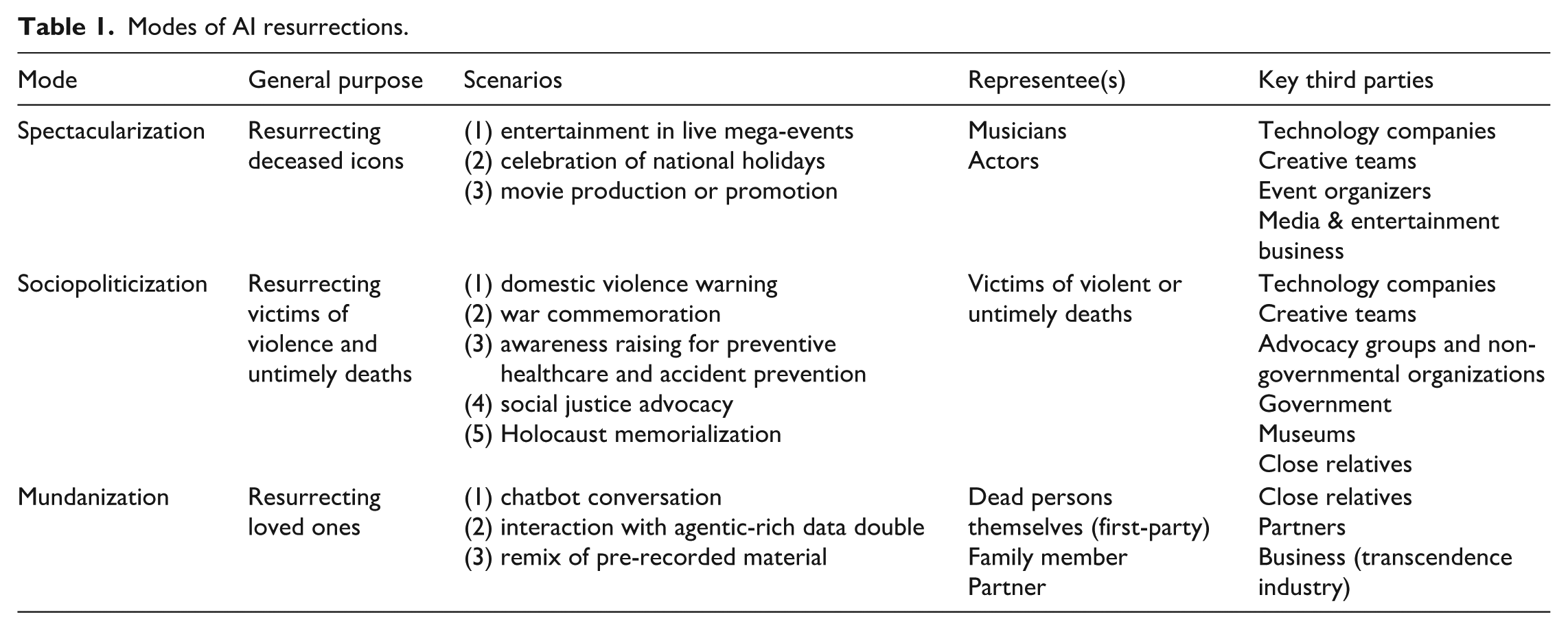
AI resurrections occur via three modes: re-staging icons, re-invoking victims, or re-viving loved ones, referred to in turn as spectacularization, sociopoliticization, and mundanization (Table 1). These modes are illustrated with examples from varied cases. The material bases of all three modes rested on combinations of the following: (1) videos, photos, and audio recordings of the deceased; (2) audio processing to recreate the distinctive voice of the deceased, using AI-driven speech synthesis based on machine learning and natural language processing; (3) text processing and AI-driven synthesis to create chatbots; (4) holography and VR technologies that project AI-generated personas on stage, making them appear lifelike and three-dimensional; and (5) animation and motion capture: techniques that ensure digital avatars or clones move and behave in a realistic and captivating manner, often by translating live performances onto an GenAI model with the help of, for instance, facial recognition software.
Modes of AI resurrections.
Spectacularization
The first mode involves the digital resurrection of deceased iconic performers. Consider the case of Ofra Haza, the legendary Israeli-Yemenite singer who passed away in 2000, yet was summoned back for a celebrity production on Yom Ha’atzmaut (Israel’s Independence Day) in 2023. In this televised spectacle, Haza’s holographic image and voice were reconstructed and forced into a duet with contemporary pop star Noa Kirel. The performance fused eras and aesthetics—Haza’s haunting presence reanimated through algorithmic synthesis, “performing” Kirel’s modern hit song. The result was a carefully engineered encounter between the living and the dead, where the technological revival of Haza served as both a nostalgic homage and a profitable spectacle of digital enchantment, transforming her posthumous image into a pliable cultural asset.
Within this mode, we identified three dominant scenarios emerging from our data corpus. First is the innovative integration of resurrected artists into live events, where iconic figures of the past are digitally revived to deliver new and classic hits in contemporary performances, blending nostalgia with modern entertainment. Second is the creation of themed video clips for special occasions, such as national holidays, in which actors embody national significance through digital enhancements, adding a contemporary twist to cultural narratives. Third is the use of movie teasers featuring resurrected, iconic actors who play roles tied to the film’s storyline, drawing on their legacy while adding depth to the promotion of new cinematic experiences.
In the first scenario of live event integration, we observed multiple instances in which advanced holographic technology and digital enhancements were used to seamlessly revive artists, bridging their enduring legacies with the contemporary music industry. This phenomenon is not unprecedented. It dates back to 2012, when holograms like Tupac’s resurrected performance at Coachella emerged, which were still original animations, not fed by live footage. This approach resulted in realistic yet static displays devoid of real-time interaction or adaptability (Drecolias, 2014). Similarly, the holographic representation of Michael Jackson at the Billboard Music Awards in 2014 showcased his iconic moves through pre-scripted performances (Knopper, 2016). Despite their powerful nostalgic appeal, these holograms were limited by their inability to offer real-time interaction or dynamic engagement.
With the advent of advanced AI-based resurrections, our dataset includes technologically more sophisticated performances that transform the deceased into both a spectacular presence and a marketable product. This includes, among others, the Maria Callas Tour 2023 combining 3D hologram technology with digitally remastered recordings presented by the Melbourne Symphony Orchestra (Byrne, 2023); the Frank Sinatra, the Whitney Houston, and the Amy Winehouse resurrections featuring interactive holographic performances that employed GenAI for new vocal performances and stage interactions (Brunt, 2023).
The second scenario of special-occasion clip productions included, for instance, national holidays, showcasing actors embodying characters of historical or national significance. These clips were designed to celebrate and commemorate important cultural and historical events, using digitally resurrected figures to enhance the impact and resonance of the occasion. For example, the AI resurrection of Ofra Haza introduced above illustrates this dynamic, as does another posthumous duet with fellow late Israeli singer Zohar Argov, produced for Israel’s Independence Day in 2023, where their voices were recombined in the commemorative performance Kan Le Olam (“Here Forever”).
While these resurrections were anchored in nationally significant moments, our cases reveal that commercially motivated actors played a decisive role in shaping the productions and their public reception. Broadcasters, event producers, and media corporations strategically harnessed the emotional charge of patriotic celebrations to serve branding and promotional goals. By embedding AI-generated performances into televised spectacles and cross-platform campaigns, they amplified the affective power of nostalgia and national pride to generate viral engagement. In doing so, they transformed acts of digital commemoration into marketable entertainment, fusing collective sentiment with commercial visibility and the politics of national identity.
The third scenario, movie teasers featuring iconic actors, had them playing roles tied to the storylines of upcoming films. These teasers use the actors’ familiar personas to foment anticipation for the movies, while also paying homage to their legacy in the film industry. Cases in point are Paul Walker, who passed away during the filming of Fast & Furious 7 and who was digitally recreated to complete his role; Peter Cushing’s character, Grand Moff Tarkin, that continued to appear in the Star Wars saga through digital recreations after his death, allowing his character to remain part of the narrative; James Dean, despite passing away in 1955, was announced to re-appear for a role in Finding Jack, a plan that did eventually not come to fruition yet sparked debates on legacy and ethics in using technology to revive actors (Velasquez, 2023). In all three cases, AI and computer-generated imagery (CGI) were used to bring actors back to life. For Walker, AI helped to blend real footage with CGI, using motion capture from his brothers. Dean’s case would have taken it a step further, and AI-generated imagery and synthesized voice were promised to create an entirely digital actor for a new film role.
Sociopoliticization
The second mode centers on the use of GenAI for social and political advocacy. This could be illustrated by “The Shotline” campaign in the United States, which used AI to recreate the presence of gun violence victims—most notably Joaquin Oliver, a student killed in the 2018 Parkland school shooting. Through AI-generated audio, Joaquin’s voice was synthesized to urge lawmakers to pass stricter gun control laws. Led by his father, Manuel Oliver, the project made the victim “speak” directly to Congress thus transforming the personal loss into political testimony and the ongoing grief into civic action (Democracy Now! 2024).
Extending this logic of digital reanimation to broader sociopolitical contexts, GenAI technologies are increasingly used to weave the faces and voices of victims into persuasive audiovisual narratives. Across diverse cases, these representations bring the dead into motion once more—animating their gestures, expressions, and speech to recount the events leading to their deaths in their own regenerated voices. The following section discusses five key scenarios where this sociopoliticization of the dead becomes most pronounced.
Scenarios of sociopoliticization include, for example, domestic violence, where female victims narrate their tragic deaths at the hands of their abusers, offering ways to recognize toxic relationships and guidance for those seeking to escape similar circumstances. The Michal Sela Forum from Israel is a case in point. After Sela was murdered by her husband, feminist activists and supporters used GenAI techniques to manipulate her face, as well as those of other female victims, creating mouth movements synced with voice samples to deliver cautionary messages. This resulted in an afterlife portrayal that seemed as though the victim herself was speaking out, warning others about the dangers of toxic relationships and urging them to seek help.
Moreover, AI-driven commemoration of war has emerged as a deeply charged practice. During the recent Israel–Hamas war, GenAI applications were used to resurrect the faces and voices of fallen Israeli soldiers and police officers, often using recordings from WhatsApp voice notes or other personal archives. Families produced videos in which the deceased appear to speak directly to their loved ones—expressing love, sharing final wishes, reaffirming patriotic faith in the justness of their cause, and praising the sacrifice they have made. While profoundly emotional, these reanimations raise ethical questions around agency, consent, and posthumous representation, as family members speak on behalf of those who can no longer voice their own beliefs (@rememberingidfheroes, 2024).
In stark contrast, in Gaza, activists used GenAI tools to recreate the nine children of Dr Hamdi al-Najjar, all killed in Israeli airstrikes in Rafah (BBC News, 2025). In these videos, the children are digitally brought back to life to plead for an end to the killing of other children—transforming their AI resurrection into an act of testimony and moral resistance (@everydaypalestinee2, 2025). While Israeli memorial reanimations project patriotic continuity, these videos speak from the rubble, calling for an end to the violence, death, and destruction inflicted on Palestinians in Gaza. Across these contexts, AI resurrections expose how grief is aestheticized and politicized, as the dead are made to speak in service of divergent national narratives and moral imaginaries.
Furthermore, awareness or advocacy efforts in which GenAI technologies have been used to recreate the appearance of individuals who have passed away due to avoidable health issues or accidents, delivering messages that promote preemptive measures, be they prophylactic or precautionary. For example, in breast cancer awareness campaigns, AI-generated videos depict the deceased urging viewers to pursue early detection and treatment, with messages crafted to feel personal and urgent. Advocacy groups use these AI reconstructions to promote regular screenings and support medical advancements (The Economic Times, 2024). Similarly, for road safety and anti-drunk driving campaigns, victims of driving accidents are resurrected to share their stories, providing compelling and emotionally toned calls to responsible behavior. These messages often include visual and auditory deepfake elements to simulate the deceased speaking directly to the audience, enhancing the sense of urgency (Lu and Chu, 2023).
In addition, in the case of societal injustices, GenAI has been found to play a role in resurrecting individuals to bear testimony to their deaths caused by social wrongs, such as racism. An example is provided by “The Shotline” project sketched above. Holocaust memorialization is extending such contemporary interventions to include historical injustices, where museums and foundations have utilized GenAI technology to create interactive survivor testimonies for educational initiatives for preserving historical memory and fostering empathy among younger generations. While projects like “Dimensions in Testimony” by the USC Shoah Foundation, first launched in 2017, had pioneered interactive holographic conversations with Holocaust survivors, subsequent advancements in AI have significantly improved this technology. Enhancements in natural language processing (NLP) have enabled seemingly more natural dialogues with survivors (USC Shoah Foundation, 2022). Such technologies are at the core of projects such as “Take a Stand Center” at the Illinois Holocaust Museum and Education Center, launched in 2017. The project has utilized AI-enhanced holograms to create real-time interactions with digital avatars of survivors. They recall personal stories and respond to visitor questions to offer an emotionally resonant and immersive educational experience (Illinois Holocaust Museum, 2022).
Mundanization
The final mode encompasses the use of GenAI in intimate, everyday practices that enable people to reconnect with deceased loved ones. A telling example is the case of Michael Bommer, a German IT manager who, after being diagnosed with terminal cancer, collaborated with the California-based afterlife company Eternos to create a digital version of himself. He trained a language-based AI using voice memos, chat histories, and detailed information about his personal and professional life—his habits, preferences, and speech tone. His goal was not spectacle but continuity: to leave behind a responsive likeness that could offer his wife and family enduring companionship and conversation, extending his presence beyond death. Bommer’s case is distinct from the exploitative uses of AI resurrections discussed earlier, it highlights how GenAI can also serve as an act of agency and choice, enabling individuals to shape their posthumous digital selves.
In this mode, GenAI is employed to simulate familiar conversations and emotional exchanges, allowing users to sustain bonds with those they have lost. Unlike the modes of spectacularization or sociopoliticization, which are outward-facing and public, this practice turns toward the private and affective domain. Here, AI functions as an emotional interface, helping users preserve shared routines, recreate moments of intimacy, and maintain a sense of ongoing dialogue. Advances in audiovisual synthesis have intensified these experiences, making it possible to reanimate voices, gestures, and micro-expressions with startling fidelity. Through these technologies, memory becomes interactive, and mourning increasingly mediated by algorithmic companionship.
Mundanization encompasses a number of scenarios, of which we discuss four. First, hyper-realistic interactions are made possible by applications like Project December, which uses GenAI to create chatbots that replicate the speech and conversational style of a deceased person, allowing users to have text-based dialogues by drawing on past messages, emails, and social media conversations (Project December, n.d.). Popular examples are chatbots trained with personal data to mimic a deceased person’s language style, personality, and conversational flow. For example, Joshua Barbeau, a user of Project December, had the platform create a chatbot version of his late fiancée, Jessica. By entering all her past messages into the platform, he was able to engage in highly realistic conversations that closely mimicked Jessica’s personality. This allowed him to “chat” with her as if she were alive, providing a sense of comfort and emotional re-connection (Fagone, 2021).
Second, platforms like YOV (You, Only Virtual) enable the creation of Versonas, that is, a double of the deceased, enabling users to interact as if their loved ones were still alive based on voice recordings, photos, and videos. These endeavors aim to recreate a multi-modal, lifelike resurrection beyond just text, simulating face-to-face interactions that include vocal tones, facial expressions, and other sensory responses. For example, users can send a message to the AI as if they were texting their lost loved one and receive a response that reflects their conversational style, providing a sense of presence and the continuation of a relationship in their everyday interactions (MyYOV, 2024).
Third, platforms like StoryFile Life make use of GenAI to transform pre-recorded videos into dynamic, interactive memories that span both the past and the speculative future. Users can engage in conversations with the digital avatar of a deceased person by asking questions, to which the ghost agent responds by selecting and connecting tailored video clips. Unlike Project December, which primarily uses text-based chat to replicate conversations, or YOV, which integrates various forms of material to capture the emotional essence of the individual, StoryFile Life builds on purpose-made audiovisual sequences. With the help of GenAI technology, users can also explore hypothetical scenarios based on the exploitation of stored data. For instance, a user might ask, “What do you think we should name our kids?” or “Should I take this new job?” and the AI avatar responds based on an amalgam of relevant pre-recorded video, creating a sense of spontaneity and personalization (StoryFile, 2024).
Finally, in ventures like Eternal Me and Forever Identity (Adido Digital, 2023), we see GenAI being applied to preserve digital legacies by offering comprehensive solutions for capturing and archiving an individual’s memories, stories, and physical attributes. These platforms allow users to gather biographical information, photographs, videos, and even the nuances of their body behavior to create a digital persona. They promise secure storage, ensuring that a person’s life experiences and stories are preserved and endure long after they are gone.
Discussion: spectral labor
Our inquiry into the modes of afterlife re-staging icons, re-invoking victims, and re-viving loved ones through AI resurrections reveals a diverse array of purposes, spanning from entertainment to advocacy and commemoration. With generative ghosts that aim at faithfully re-presenting an agentic and interacting persona, GenAI applications are used to create aesthetically pleasing, politically charged, and communicative representations. The characters come alive through animation, artificial voices, and expressions, prompting inquiries into the interplay between ventriloquism and data mining, particularly the data that shape their appearances and the choices of the “puppeteers” that influence their performances. These dynamics expose a deeper unease about what kind of “work” the digital revenants perform and for whom; a calling for a framework attentive to both the ethical and material dimensions of such posthumous production.
We approach these concerns through the lens of spectral labor, which foregrounds the ethical and economic dimensions of the posthumous use of a dead person’s digital remains, often in the absence of consent and of legal frameworks governing their reuse. Drawing on Avery Gordon’s (2008) conception of haunting as the moment when “ghosts appear as the trouble they represent is no longer contained or repressed or blocked from view” (p. xvi), spectral labor captures how the dead are made to “work” again across a spectrum of purposes through generative technologies that reanimate their likeness, voice, or persona. Whereas deepfakes are driven by an intent to deceive, spectral labor shifts attention to the posthumous labor of GenAI—the reanimated traces of the dead that circulate as productive, aesthetic, and affective agents within media economies. These resurrections are, by design “synthetic” and represent a form of posthumous personhood; yet seeing them as a kind of spectral labor underscores the fact that they are brought forward and put to use by different parties involved, who expect some sort of benefit from their engagement.
Spectral labor acknowledges but extends Morris and Brubaker’s (2024) notion of “generative ghosts”—AI resurrections that can create new content, engage in social interaction, and evolve beyond their initial commemorative purposes. While generative ghosts foreground the interactive and emotional possibilities of digital afterlife design, spectral labor draws attention to the broader infrastructures that enable such reanimations. It highlights how these posthumous figures become part of a system of production in which data, likeness, and affect are extracted, circulated, and monetized without consent.
For some, this may appear as a comforting or creative gesture: a way to leave a digital legacy or to sustain emotional bonds with the bereaved (Morris and Brubaker, 2024). Yet, when third-party actors appropriate generative ghosts, they reconfigure this intimate labor into forms of exploitation and spectacle. We identified four pertinent uses that align with our analytical modes yet often overlap in practice: (1) nostalgia and tribute—honoring deceased icons by reintroducing their presence and allowing fans to relive their performances; (2) entertainment—enhancing events via unique, immersive, and marketable experiences; (3) innovation showcase—demonstrating the technical capacities of GenAI in producing lifelike representations; and (4) economic gain—driving profit via ticket sales, streaming engagement, and merchandise tied to AI-resurrected performances.
The mourning-focused mundanization of AI resurrections, which looms large in the third mode, has been the topic of a number of publications already, with a particular focus on conversational agents and photography (Kopelman and Frosh, 2023; Savin-Baden, 2021). Therefore, we shift our attention here to AI resurrections’ use to capitalize on spectacle and advance sociopolitical goals, which raises concerns about appropriation and exploitation, encapsulated in the concept of spectral labor. They stem from the generative ghosts’ agentic capacities, which are put to use following the agenda and interests of third parties whose goals may or may not align with the intentions and legacy of the persons evoked. In both modes, generative ghosts are re-presenced without their consent, trapping them in an endless loop of use, be it commercial or political (Roberts, 2023).
Capitalizing on the spectacle
With regard to spectacularization, we see the re-staged icons involved in economic activities with effects on the living. This applies across all three scenarios, as entrepreneurs and AI companies increasingly take the lead in introducing generative ghosts into national celebrations. Their continued presence and performance may constitute unfair competition, as established icons perpetuate their market dominance even posthumously. In fact, a number of musicians on Forbes’s List of Top Earning Dead Celebrities have been called back to life—posthumous representation can indeed be extremely lucrative.
What is more, notwithstanding the careful staging of the dead singers’ performances, the mere fact of seeing them seemingly come back to life provides a media spectacle in its own right. In fact, the resurrection of deceased icons is a technological spectacle where cultural content is transformed to stage and screen in sensational and captivating encounters. In this context, the body and presence of the deceased become the “site of the spectacular” (Ibrahim, 2018) as cutting-edge technology is used to instigate a sense of awe among viewers (Debord, 2000). Because of that, Altaratz and Morse (2023) have argued that the audience for the spectacularization is not only commemorating or celebrating the idol put back on stage but also, nolens volens, witnessing the power of advanced GenAI technology. Thus, there is a tension here between economic gain and commercialization, in which the resurrected performers are marketed as cutting-edge technological marvels, drawing audiences not only to the performances but also to the novelty, fidelity, and sophistication of lifelike avatars.
Yet, GenAI use raises ethical concerns as it instrumentalizes authenticity and exploits the legacy of the generative ghosts in recreated performances. The dual appeal generates significant revenue through four key assets of spectacularization: (1) Brand extension, where the transformation of resurrected performers into avatars enables them to continue “performing” even in their absence. This taps into strategies of legacy branding (Rodd, 1998), extending the brand’s lifespan indefinitely, ensuring that the performers remain profitable within the modern entertainment landscape. (2) Interactive fan engagement, where AI tech makes fans interact directly with the resurrected, fostering a novel way of intimacy (Baym, 2018). This includes live chats with AI performers, such as Whitney Houston, or virtual meet-and-greets with Amy Winehouse. These immersive interactions can be monetized via pay-per-interaction models or premium access, enhancing user experience. (3) Merchandising and licensing, where resurrected performers are utilized across a range of opportunities, from concert tickets to exclusive performances during national holidays, and even serving as brand ambassadors for movie premieres. This omnichannel marketing (Cui et al., 2021) turns the performers into a multifaceted product, allowing for diverse monetization avenues. (4) Multi-platform circulation, where the resurrected share content in snippets across platforms, both disassembled and disseminated by users and producers. This takes advantage of participatory cultures, in which media fragments spread virally through remixing, sharing, and adaptation (Jenkins, 2006). By leveraging platform-specific features and engagement dynamics, these performances become more visible and shape trends, amplifying the reach and connection around resurrected performers.
Overall, the commercial schemes driving spectacularization make clear that much of the experimentation is following third-party interests. For artists and public figures and their legacies, the control of their legal estate has been instrumental before GenAI opened up new opportunities for value creation. Hence, this aspect of spectral labor stretches the boundaries of intellectual-property governance, even as existing legal frameworks lag behind. Defining the rights and conditions attached to this form of posthumous work demands reckoning with a series of thorny legal and ethical challenges, in a field already tightly regulated and long marked by routine posthumous exploitation (Shields, 2025).
Mobilizing for sociopolitical quests
Here, GenAI technologies are mobilized to create posthumous testimony. Developed by third parties, these systems aim to preserve and amplify the voices of the deceased, ensuring their messages endure as lasting reminders of the human cost of injustice and conflict. This mode operates by transforming the testimonies of victims of violence or premature death into calls to action for the living. As with spectacularization, it raises ethical concerns about autonomy and the potential exploitation of these figures. That is not to say that this usage of AI resurrections must necessarily be at odds with the intentions of the departed. Still, the cases we found are based on a kind of repurposing. Hence, spectral labor operated in an ethically and legally murkier area. In the gray zone of sociopoliticization, the common reasoning seems to be that the end justifies the means. Thus, generative ghosts are created without the consent of the people upon whom they are modeled. Different from deepfake doppelgangers, which are often framed in terms of unsolicited impersonation, the motifs behind AI resurrections seem less shady. Still, there is a moment of appropriation and alienation when the dead are enlisted into a cause presumed to be righteous.
Take, for instance, the scenario of late Holocaust survivors, some of whom were active in sharing their memories during their lifetimes. Now being re-invoked as agentic ghosts, they are animated to carry a voice of warning against the rise of fascism and underscore the importance of resistance, offering personal narratives on safeguarding human rights. This sociopoliticization of AI resurrections of victims expands upon what Nejad et al. (2023) have described as AI’s sociopolitical artistry, presenting cautionary, explanatory, and pedagogical narratives derived from the experiences of the deceased, thereby providing vital insights and warnings for contemporary audiences. These narratives harness the technology’s emotional and immersive potential to prompt awareness, empathy, and behavioral transformation (Suh and Prophet, 2018). Sociopoliticization in this respect corresponds with Peters’ (2001) concept of the media as a “phantasm of the living,” in which the deceased are re-presented in a way that transcends their natural limits, thereby extending their influence and existence beyond death. By using GenAI to bring deceased victims back to life and harness their ghosts for current purposes, sociopoliticization taps into this desire to witness and interact with the phantasmal presence of the departed.
Furthermore, some forms of sociopoliticization that involve people whose violent or premature deaths have not been confirmed even extend beyond the concept of existential media (Lagerkvist, 2022), which describes the role of media in capturing extraordinary, transformative, or traumatic events that remind us of our mortality. A poignant example here is the hostages who were abducted to Gaza by Hamas on October 7, 2023. With the fate of their loved ones unknown, some families have turned to GenAI to create videos portraying the hostages’ return home. In these videos, the abducted individuals are envisioned being reunited with their families. All involved are subject to AI motion manipulation, simulating a reunion hug that has not happened. For instance, families have simulated the story of a four-year-old boy, Ariel Bibas, who was kidnapped, urging viewers to do everything they can to help save him. Using artificial voice, imagery, and motion, Ariel is portrayed as taking viewers through the tunnels, showing where he might have been held.
We argue that these examples fall into the realm of liminal media, where GenAI creates a space for individuals to exist between life and death, presence and absence. The AI videos do not simply commemorate or memorialize. They open up a new reality where the hostages or kidnapped individuals exist in a liminal state—neither confirmed as dead nor truly alive but animated to express their emotions, wishes, or experiences. The visual and affect-laden portrayal of reunions, simulated journeys, and rescue appeals blurs the boundary between what is real and what is imagined, forcing the audience to confront this ambiguous in-between state. It creates a form of engagement that transcends mere remembrance or existential reflection, placing viewers within a constructed narrative that simulates the presence and struggle of those in captivity.
Conclusion and outlook
Even in death, it seems, voices are being made to speak again. Our interrogation of AI resurrections—across mourning and commemoration, celebration and spectacle, advocacy and premonition—helps illuminate how these technologies participate in sustaining life itself. As a field of experimentation, AI resurrections are part of a larger “transcendence industry” (Lagerkvist, 2022: 169) that responds to the human desire to bridge the existential gap between life and death, offering experiences that seem to transcend the limitations of mortality. Unlike deepfakes of living persons, the point of AI resurrections is not to trick people into believing someone is still among the living. On the contrary, the artificial nature of the afterlife personas is not concealed but advertised. The growth of GenAI models has elevated the realism of these re-presences and the interactions with them, resulting in more resonant experiences. Still, they can evoke feelings of the uncanny with close-to-lifelike yet nevertheless artificial personas (Kopelman and Frosh, 2023).
In our analysis, we have laid the groundwork for charting and characterizing this nascent area. This provides a snapshot of an evolving landscape, as new projects emerge weekly with similar infrastructures and presentations of technology, life, and death that we identify in our analysis. Given our sampling, existing projects may have escaped our view, too. Still, we believe that the conceptualization of three modes of AI spectacularization, sociopoliticization, and mundanization is of a more general value and can help to contextualize further investigation that would build on the explorative approach offered here.
AI resurrections and the spectral labor which these generative agents form part of and help to sustain are full of challenges, both practical and philosophical. Questions pertaining to the continuity of self, authenticity of experience, and the ethical ramifications of digital immortality loom large. How do we reconcile the notion of personal identity when confronted with the prospect of multiple copies of oneself existing simultaneously in various digital realms? What safeguards must be implemented to prevent the exploitation or manipulation of digital entities by third parties? Also, the accessibility of such technologies and their inequitable distribution need to be considered to avoid exacerbating existing disparities.
In fact, AI resurrections extend Hurtado Hurtado’s (2024) overview of resource-intense and costly forms of “technological immortalism” that tend to make them an elite enterprise. This dynamic suggests that the same biases and representational gaps affecting the living may also be reproduced in the realm of the dead. The consequence could be that “the dead risk dying a second time, with their data—and the memories they evoke—decomposing with their bodies” (Henrickson, 2023: 4). In addition, the popularity of AI resurrection projects requires approaches to ensure the integrity of digital archives spanning generations (Kneese, 2023).
Furthermore, the legal and ethical frameworks governing issues such as consent, privacy, and end-of-life decision-making demand reevaluation to accommodate the challenges posed by afterlife personhood. In particular, to date, there is no clear line for governing the intricate intertwining of an individual’s data traces and GenAI applications (Öhman, 2024). The generative ghosts, Henrickson (2023) maintains, are “trained on deeply personal datasets comprising one’s digital remains that are maintained and altered through integration with a massive and often proprietary language model” (p. 8). One potential path forward is outlined by Harbinja (2022), who argues that the digital assets underpinning AI resurrections can be approached either as property or as matters of postmortem privacy. These two fundamentally distinct frameworks carry specific ethical and commercial implications, as the chosen lens determines how easily such assets can be transferred, accessed, or monetized.
It seems possible that engaging with these questions would mean suspending further technological tinkering. On that note, Lagerkvist (2020) concludes that “taking responsibility for AI also means, importantly, pausing in the present in order to collaboratively shape the future” (p. 21). Yet such a pause is difficult to imagine in a cultural moment captivated by the promise of transcending mortality. At the same time, as Witzenberger et al. (2025: 3) remind us, what AI can do is inseparable from those who use it—user expertise “is not a nice addition to technical knowledge; it becomes constitutive of AI capabilities.” This entanglement between human intention and machine simulation underscores why ethical and legal safeguards must accompany the rise of generative ghosts. We must navigate this path without relinquishing the forms of accountability needed to mitigate harm. Embracing these computational afterlives means confronting how they unsettle deeply held beliefs about life and death. The afterlife is no longer elsewhere; it is distributed across platforms and shaped by the interplay of data, desire, and algorithmic reconstruction. What we resurrect may not be what we remember, but rather, what technology renders back to us.
Footnotes

Funding
The authors disclosed receipt of the following financial support for the research, authorship, and/or publication of this article: