



Abstract
Understanding power requires focusing not just on structures but also on people, especially as resistance becomes more complex. Extending De Certeau’s spatial framework of place, space, and subject positions to digital platforms, this article explores how ordinary Instagram users negotiate platform power by approaching resistance as spatial negotiation embedded in everyday use. Based on 15 in-depth interviews, the analysis identifies everyday tactics that transform Instagram from a structured place into a lived space: users abandon places, make the platform habitable, play with its materiality, and repurpose it for unexpected uses. The study demonstrates how users resist by how they position and move within platform structures. It categorizes users as voyeurs and walkers, based on De Certeau’s subject positions, and introduces a new category, transients, each reflecting distinct spatial relations to the platform. This article argues that spatial relations shape user agency and the conditions under which resistance becomes possible.
Keywords
Introduction
Interwoven with power structures, affordances and algorithms, everyday acts of online engagement can become forms of resistance—subtle, routine, and sometimes unintentional—often without platforms noticing or those resisting recognizing them as such. As Van Dijck et al. (2018: 11) argue, users “are not ‘puppets’ of the techno-commercial dynamics inscribed in a platform.” However, agency becomes increasingly complex and blurred in the datafied society (Milan, 2024), and bringing ordinary tactics to light becomes essential if we want to understand the real power dynamics in digital environments.
Instagram remains one of the most influential platforms globally (Statista, 2025), shaping everyday life, aesthetics, and identity (Leaver et al., 2020). Simultaneously, its commercial nature raises concerns regarding the subjectivities it constructs and the impact on users’ behavior. While many studies explore the platform’s power through governance mechanisms, scholars also examine how various groups, such as feminists, artists, vulnerable communities, and activists, resist (Gangneux, 2021; Maddox, 2021; Olszanowski, 2014; Talvitie-Lamberg et al., 2024; Van Der Nagel, 2018; Witzenberger, 2018). Yet, the few studies focusing on ordinary 1 users also call for greater attentiveness to understanding invisible forms of resistance, power dynamics, and ways to support individuals (Caldeira et al., 2021). The need to focus on users’ perspectives is even more urgent nowadays, as platforms are changing and people can rely less and less on them for protection (see Knibbs, 2025). Users need to develop their own practices to navigate digital spaces. Thus, understanding how power operates requires focusing not only on structures but also on people, especially since resistance becomes harder to detect (Milan, 2024).
Responding to this need, this study explores how ordinary Instagram users enact everyday resistance by transforming the platform from a structured place into a lived space, following De Certeau’s conceptualization of agency. More specifically, a place refers to an ordered arrangement shaped by strategies, while a space emerges through everyday practices (De Certeau, 1984). The spatial metaphor is used as an analytical lens to highlight how this transformation of places into spaces exists as a constant negotiation between platforms and users, rather than appearing as a distinctive event or moment of rupture. It also shows how people’s existence within and their relation to these environments can shape their agency. This influence is not always intentional or conscious but arises as part of inhabiting and reappropriating the place, often before users even begin to reflect on resistance. In the existing literature, resistance is often approached as visible, intentional, and collective, such as efforts to understand and subvert algorithmic systems, manage visibility, and engage in tactical media interventions, focusing on what users do (see Bishop, 2019; Dieter, 2011; Lin, 2025; Raley, 2009). Studies also draw on De Certeau’s tactics and strategies and engage with spatial concerns implicitly (see De Ridder, 2015; Gangneux, 2021; Maddox, 2021; Talvitie-Lamberg et al., 2024; Witzenberger, 2018). However, this article expands the scope by explicitly engaging with his distinction between place and space, and more specifically, the role of subject positions in user agency, a dimension that has received limited attention in existing research. It approaches resistance not only through what users do to resist platform power but also where they stand within the platform’s architecture and how they move in relation to that structure, exploring the conditions of resistance. More specifically, this article asks: How do ordinary Instagram users navigate platform logics through everyday practices, and how are these practices shaped by their spatial position within the platform? Based on 15 in-depth interviews, the article stresses how spatial positioning shapes what kinds of resistance become possible, and for whom. It argues that users can be understood not only as voyeurs or walkers, as in De Certeau’s original metaphor, but also as transients: users who oscillate between distance and participation, embodying a spatialized form of negotiated resistance.
This framing approaches resistance not as a stable or intentional act, but as something shaped by users’ affective proximity to the platform and their movement within it. Rather than treating De Certeau’s categories as fixed, the article uses them as a starting point to conceptualize new forms of engagement with platform infrastructures that reveal resistance as a dynamic and spatialized process. By offering this conceptual framework, the article contributes to research on digital resistance by underscoring how subject positions and spatial practices shape agency on commercial platforms, and by introducing the figure of the transient to rethink how resistance may emerge from ambivalent or detached forms of use. In the next section, the study is situated within the broader field of platform governance, and the ideas of power and resistance are discussed through spatial dynamics.
Agency through spatial dynamics
Situating resistance: from platform structures to spatial positioning
Much of the existing literature in platform studies approaches power by analyzing how platforms shape user behavior. Platform governance emerges as a key framework for understanding how platforms operate as political and infrastructural actors, paying attention to structural elements, such as design, affordances and algorithms, and the global policy environments in which platforms function (Gorwa, 2019). This study builds on this approach, by discussing how Instagram structures user behavior through design, algorithmic curation, and commercial logics. Accordingly, the platform operates as a governed and governing space, what De Certeau would call place, constructed through strategies that shape behavior. Central to this approach is the concept of affordances, referring to how objects “enable and constrain” actions (Davis, 2020: 11). Affordances exist to demarcate the possibilities of action, making certain behaviors more likely than others, without causing a specific action (Bucher and Helmond, 2018). This relationality means that while affordances guide user behavior, they also leave room for negotiation and even resistance, as they vary across people and contexts (Davis, 2020). However, these approaches tend to emphasize how platforms exert control, paying less attention to how users experience and relate to these structures.
Framing Instagram as a place that is lived and potentially transformed into space adds a user-centered dimension to platform governance, showing how control is not only imposed from above but also negotiated from below through invisible everyday use. Several studies have explored user agency, particularly how people resist or reinterpret platform power by pushing back against algorithms, managing visibility, subverting ranking systems, or resisting surveillance (Bishop, 2019; Lin, 2025; Raley, 2009; Mniestri and Randerath, 2022; Randerath and Friedrich, 2025; Van Der Nagel, 2018). For instance, studies discuss how “gossiping” and collective efforts to understand algorithms allow users to challenge platform logics and use them to their own advantage (see Bishop, 2019; Cotter, 2019). Furthermore, by exploring how gig workers resist against and through app-based tracking, Randerath and Friedrichs (2025) show how users negotiate forms of informal and organized resistance to navigate platform logics in response to glitches, which act as triggers for resistance. These studies focus on what users do and think about platforms, whether intentionally or unintentionally, collectively or individually, through everyday negotiations. This study also suggests exploring what users do and think within platforms, assuming an immanent position inside the latter that is always already dealt with. While glitches may serve as visible triggers for resistance, everyday negotiations with platforms occur even without disruption, as users also adapt to their rhythms and constraints in more silent and affective ways. A spatial metaphor complements existing perspectives by highlighting how resistance can also arise through the platforms’ everyday inhabitation, as individuals are always already implicated in their architecture, developing tactics to survive within it. Phrased differently, users position themselves in relation to platforms long before they begin to consciously think or act in oppositional ways. In this sense, glitches, for instance, can trigger resistance, whether unintentional or organized, but the conditions of agency are already shaped by the relationships individuals develop with their environment. Understanding these positions is equally important as they create the very conditions through which agency and tactics can emerge. Dieter (2011) argues that contemporary networked power complicates approaches that provides a dichotomy between power and agency, such as strategies and tactics, as digital platforms function through intensive and transversal networks that do not fit into top-down or bottom-up approaches. Although power remains unevenly distributed, it operates through dynamic, non-hierarchical positions, requiring scholars to rethink how tactics emerge in such environments (Dieter, 2011). Despite the growing interest in platform resistance, little attention has been paid to how such practices are shaped by users’ spatial positioning and affective relation to platforms. Bringing spatiality into the conversation allows us to move beyond what users do to consider how they inhabit platform structures and how this inhabitation itself can produce resistant possibilities. Thus, drawing on De Certeau’s spatial theory, this study approaches resistance as relational, spatial, and often unintentional, focusing on how users adopt subject positions and relate to the platform as a place.
Instagram as a place
While Instagram’s stated goal is to connect people (Instagram, n.d.), it is also a profitable business. As a commercial platform, its primary aim is to increase profits and attract more businesses. To accomplish that, users should follow a behavior conducive to the market, becoming the platform’s ideal user. So, Instagram is designed so that it allows specific actions and discourages others, as platforms are “neither neutral nor value-free constructs,” but “come with specific norms and values inscribed in their architectures” (Van Dijck et al., 2018: 3). The way platforms are constructed through their design, affordances, and algorithms resembles what De Certeau (1984) defines as place.
A place is a stable arrangement governed by strategies, akin to disciplinary mechanisms that impose order and control. In digital contexts, this concept helps describe how platforms are structured to guide user behavior. De Certeau (1984) used cities as an example of such places; places demarcated by buildings and streets that provide an “instantaneous configuration of positions” (p. 117). Similarly, Instagram can be seen as a digital city; a stable place constructed through design choices and structural elements that promote a specific, ideal use. Like architects, designers construct platforms invoking users to move inside their confines in specific ways. De Certeau presents urban planning as a strategy to establish concrete forms, dominating and controlling a place. Accordingly, structural elements, such as low-level affordances like filters and hashtags (Bucher and Helmond, 2018), can organize the “proper” and, by extent, subtly shape users’ actions, opening up possibilities while also setting restrictions. In this way, platforms construct a kind of ‘digital city. Therefore, it is crucial to understand how Instagram is designed and what strategies it uses to structure its place. The following section draws from literature on Instagram power, discussing key strategies that shape the Instagram place.
The place’s strategies
Instagram place is constructed through its strategies in a way conducive to its economy, urging users to embrace specific subjectivities and behaviors. First, the platform seems to prioritize “users as consumers of content” (O’Meara, 2019: 1). Its affordances provide people with endless opportunities to consume new content tailored to their interests (Carah and Shaul, 2016; Kollyri and Milioni, 2022). According to Kollyri and Milioni (2022), people are constantly exposed to refreshed content through features like the algorithmically curated “Explore” and “Home” pages, and through elements such as links and hashtags in posts. In addition, the design of certain elements encourages quick glances rather than deeper engagement. For example, stories automatically move to the next, and the small size of images, along with restricted zoom options, prompt users to move on quickly rather than linger over images. The Instagram place is designed to make people instinctively use it as content consumers (Kollyri and Milioni, 2022).
Although users can also produce content, filters, brands, algorithms, and the potential for self-spectacularization offered by the place urge them to design their posts following specific aesthetic conventions that generate economic value, sustaining the place’s viability (Briziarelli and Armano, 2017; Kollyri and Milioni, 2022). Furthermore, they are encouraged to produce mainstream content, driven by algorithms that promote it and commercial accounts that spread it to boost brand engagement (Abidin, 2016; Kollyri, 2021; Mazzarolo et al., 2021). The quantification of fame through Instagram metrics also prompts them to produce standardized content to secure interactions and validation (see Grosser, 2014). Even female users seeking empowerment often rely on stereotypically gendered representations to gain and sustain popularity (Savolainen et al., 2022). As Savolainen et al. (2022: 565) argue, Instagram’s self-presentation pressures encourage users to treat their profiles as “social or aesthetic capital,” avoiding content that might seem unpopular. Offline commercial spaces, such as restaurants, also enable users to grow their individual metrics. By adhering to Instagram’s aesthetics and becoming visually appealing, these spaces encourage users to share photographs, offering free advertising (Leaver et al., 2020). As Chayka (2024) argues the cycle of aesthetic optimization and homogenization continues outside and inside the platform. Users are thus urged to participate in the place’s construction by producing standardized content.
Although Instagram is conceptualized around the idea of community (Instagram, n.d.), it is structured around statistics quantifing human performance. This focus on metrics drives users to engage in sociable behavior aimed at maintaining their numbers, leading to a depersonalization of human relationships on the platform (Kollyri and Milioni, 2022). Instagram urges users to promote their private life by embracing the idea of self-branding, not necessarily to connect with others but to increase their visibility (Abidin, 2017). Furthermore, affordances steer users toward phatic communication, providing predetermined responses and promoting short repetitive answers (Kollyri and Milioni, 2022). The place’s structure and its quantified elements invoke users to care about their online performance, raising questions regarding the actual human connection through the platform.
Apart from interacting with other user profiles, people are constantly engaging with brands, whether consciously or through algorithmic exposure. The platform is designed to seamlessly integrate commercial content into users’ experiences, offering companies a pre-engaged audience, while prioritizing promotional material in feeds. Instagram’s algorithms do not merely reflect users’ interests but actively shapes them by amplifying commercial content (Kollyri, 2021). Even non-commercial societal issues, such as the #MeToo movement, tend to be commercialized, as the place’s structure and affordances (e.g. hashtags, influencer-partnerships) facilitate commodification (Afnan et al., 2019; Cwynar-Horta, 2016). This creates an environment saturated with branded messaging, where personal content and advertising blur. Hence, users are subtly steered toward active consumption, reinforcing the platform’s embedded culture of consumerism and contributing to the depoliticization of content (Kollyri and Milioni, 2022).
Instagram as a space
A place can be transformed into a space through the tactics of its inhabitants, which are clever tricks, the “art of the weak” (De Certeau, 1984:37) practiced by those who navigate places created by others. Returning to the illustration of a city, De Certeau (1984) argues that while a street is defined by urban planning, it takes on new meaning when walked upon by individuals who subvert its intended purpose. Through tactics that distort strategies, people can reappropriate place without rejecting or leaving it. However, since tactics lack a “proper locus,” individuals rely on time to resist the place’s stability, like the secretary who writes love letters on company time (De Certeau, 1984). In this way, individuals must constantly repurpose dominant forces to turn constraints into opportunities.
Several studies draw on De Certeau’s notion of tactics to explore user resistance to platform power (see Gangneux, 2021; Maddox, 2021; Talvitie-Lamberg et al., 2024; Van Der Nagel, 2018; Witzenberger, 2018). The idea that users make platforms habitable by creating spaces through hidden everyday practices is present in the literature, but without explicitly referring to spatiality (see De Ridder, 2015; Gangneux, 2021; Maddox, 2021; Talvitie-Lamberg et al., 2024; Witzenberger, 2018). For instance, Talvitie-Lamberg et al. (2024) show how vulnerable users make platforms livable through subtle tactics of invisibility. Similarly, Maddox (2021) demonstrates how joy can become a tactical response to platform toxicity. These studies point to silent, everyday negotiations that shape how users experience a place. Building on this, this study approaches everyday resistance not as an always intentional act of subversion, but as an often-invisible practice whose challenge to the system may be unintentional. Across this spectrum, spatial metaphors help reveal how users navigate power, not always through direct confrontation, but by inhabiting platforms differently. These unnoticed, everyday engagements can function as active micropolitical acts of resistance. They reflect ongoing negotiations with the systems that govern interactions and highlight the need to explore how people reappropriate digital structures. This study draws on these insights to explore the everyday tactics users develop to transform the Instagram place into a space, while also examines how subject positions within digital environments shape the conditions for resistance.
Subject positions: voyeurs and walkers
Focusing on the place’s spatiality, De Certeau (1984) stressed that people can experience a city from two different positions: seeing it from above, as voyeurs, and walking through it, as walkers. These different subject positions can affect how they experience and navigate places, providing a framework to better understand power dynamics.
More specifically, voyeurs observe the city from a distance, not being affected by the bustling streets and the nervous traffic. This distance allows them to read the city as a whole, to feel that they have control, as they look down like gods (De Certeau, 1984). The city’s complexity becomes readable as people do not immerse themselves in the place. However, the world that voyeurs spectate can be a representation of the actual city, “the panorama-city is a ‘theoretical’ simulacrum, in short a picture, whose condition of possibility is an oblivion and a misunderstanding of practices” (De Certeau, 1984:93). One cannot understand or experience the everyday and the city’s real practices without being there. Thus, De Certeau (1984) claimed that “the ordinary practitioners of the city live ‘down below,’ below the thresholds at which visibility begins,” they are walkers. The walkers are blind, as they write the urban text without being able to read it, immersing themselves in the city. They invisibly change the urban text through everyday practices, using spaces that voyeurs cannot discern. Thus, they experience a different city from what voyeurs spectate.
De Certeau’s subject positions are used as a conceptual starting point to explore how users relate to platform spaces and how different positions shape the possibilities for agency and resistance. Although de Certeau introduced these positions in relation to physical space, they have not been applied in the context of digital platforms. By extending them into the platform environment and introducing the figure of the transient, this study reworks these subject positions to show how spatial relations shape everyday negotiations with platform power.
Methodology
This qualitative study explores how ordinary users navigate Instagram’s place and whether they develop forms of hidden resistance, focusing on their subject positions and how these shape agency. To investigate these aims, 15 in-depth semi-structured interviews were conducted with Instagram users. Participants were selected through purposive sampling (Maxwell, 2012). Recruitment began through my personal network, asking for recommendations of users who met specific diversity criteria, including new users, active users, those who had deleted their accounts, and individuals varying in age, gender, profession, and socioeconomic background. Then, following the snowball sampling method (Parker et al., 2019), initials participants were asked to recommend others who fit the criteria. The final sample included users with diverse interests and Instagram habits (Figure 1). As recruitment began with participants from Greece and Cyprus, the sample naturally reflected this context, consisting of individuals aged 20 to 38. In addition, pseudonyms were assigned to participants to safeguard anonymity. Although the study did not focus on cultural differences, the geographic context is acknowledged to reflect the sample’s composition and potential influences. Specifically, Instagram is widely used in both countries, especially among people aged 25 to 34, making it deeply embedded in everyday cultural life (NapoleonCat, 2025a, 2025b).
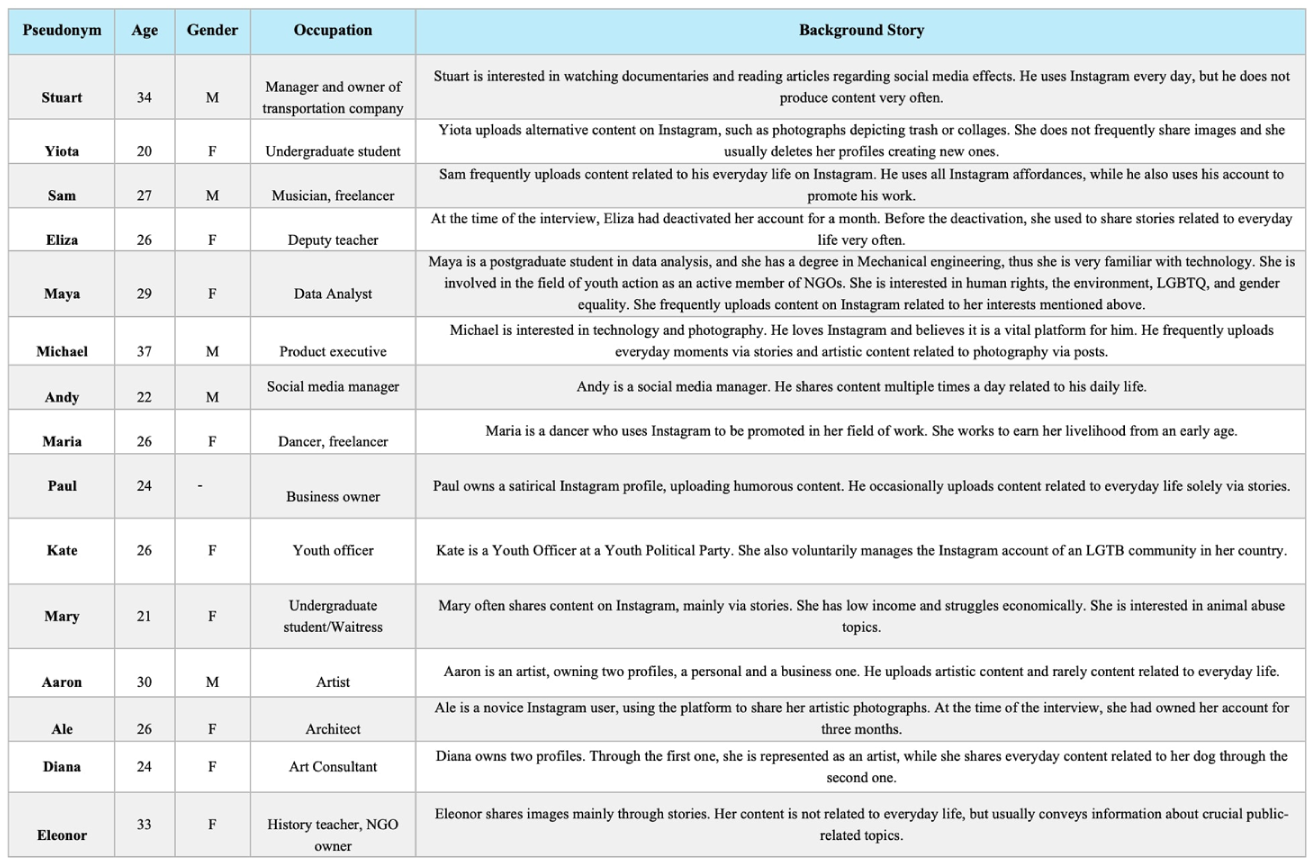
List of interviewees.
Each interview lasted approximately 2 hours, was conducted in Greek, and translated into English for this article. The literature review on Instagram’s place informed the interview questions. Specifically, the Instagram place drives users toward the endless content consumption, standardized production, superficial relations, and consumerism through its design. These aspects were turned into different sets of interview questions (see Figure 2). The aim was to explore how users engage with Instagram, while follow-up questions on users’ feelings were asked. Prior to the interviews, I analyzed participants’ profiles to identify posts that could serve as stimuli for discussion. This pre-analysis enabled conversations about visible behaviors tied to the platform’s ideal use.
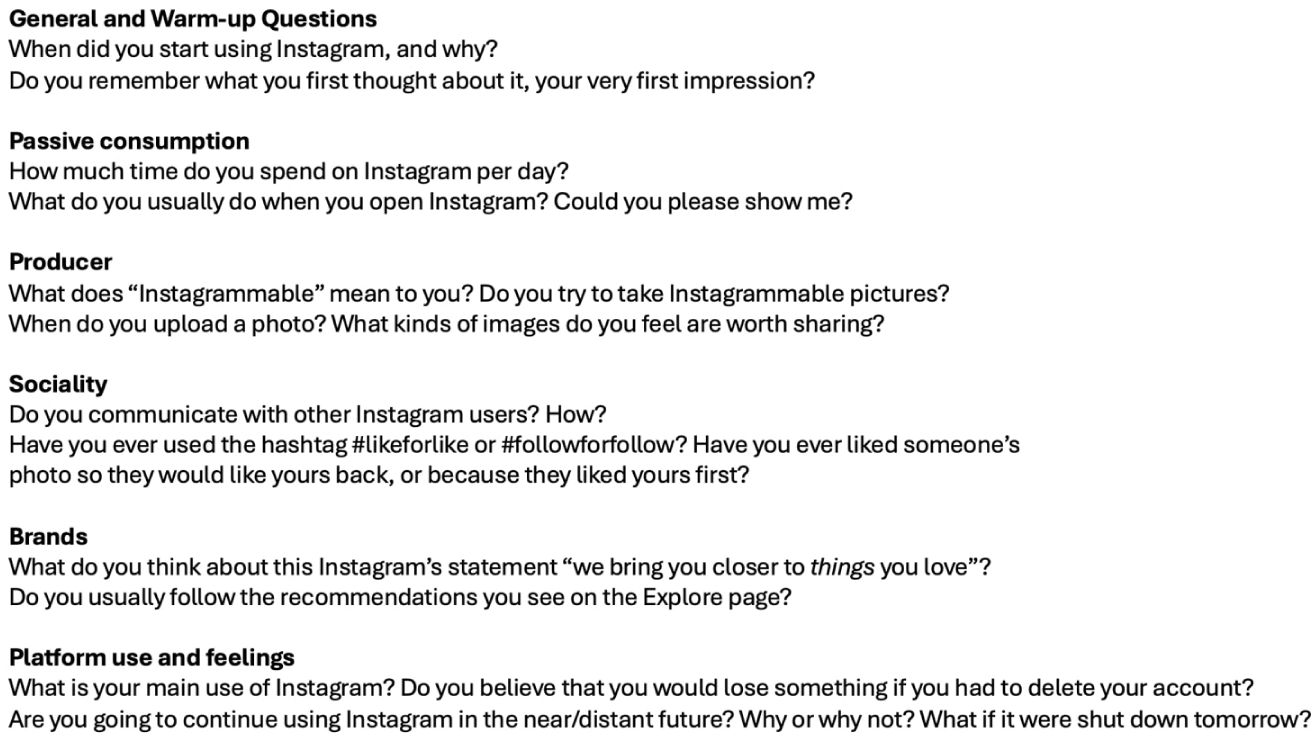
Sample interview questions.
Interviews were recorded and transcribed. Afterward, participants’ accounts were monitored to better understand their statements and behavior. The data were manually analyzed using Braun and Clarke’s (2006) six-phase thematic analysis. I first familiarized myself with the data, noting initial codes, then identified broad categories to organize them. Next, codes were refined and grouped into themes through repeated review. Revisiting the interviews multiple times, I evaluated and refined each theme, assigning clear names. I initially focused on users’ relationships to Instagram. Early themes included reasons for use, conforming practices, tactics of resistance, feelings, and tensions. The final themes, which structure the Findings section, focus on the tactics users employ to navigate Instagram. Through this process, the three subject positions discussed above emerged from the data. Finally, I selected representative quotes to capture diverse perspectives. The process was both inductive, open to emerging patterns, and deductive, with theory guiding the reinterpretation of these patterns as spatialized practices.
Findings
The analysis shows that participants develop invisible practices to navigate Instagram and make it livable. The findings are organized around these tactics, followed by a discussion of the participants’ subject positions and their role in power dynamics.
Avoiding places
The study’s participants leverage their time on Instagram differently from what the designers foresaw. Many invisibly negotiate the platform’s use, imposing self-limitations and intentionally avoiding certain actions to resist its effects, abandoning certain places. Specifically, they consciously avoid the Explore page to resist the temptation of “wasting their time” (Eliza) or falling into consumption traps. They are aware of the platform’s lures, taking action to bypass them. Here, intentional passivity indicates resistance, as they ignore these affordances to reclaim control over the data they consume.
I avoid it [explore page] like the plague because I know I’m prone to it. It influences how consumers feel, and I’m pretty sure it affects me too, probably even my self-confidence. (Maria)
Furthermore, they intentionally fast-scroll through posts on soft topics to avoid engagement. When encountering such posts, they quickly scroll past deliberately limiting the time spent on them. Although these practices may seem simple, requiring no technical knowledge and offering no immediate effect on users’ accounts, participants still put effort into following them. Maria captures this tension, acknowledging how challenging it is to avoid certain content: I would need some support, I want to search if there are accounts that pop up a post saying “don’t look at them, close the dumb thing.”
The place drives users toward continuous effortless consumption of commercial content (Kollyri and Milioni, 2022). However, some of the place’s elements become inactive, subtly “altering its spatiality.” Since the early web, users and platforms have had an implicit “deal”; users do not pay fees to access most social media platforms, but they “pay” with their time, providing data and becoming impressionable subjects who engage with advertisements and services (Introna, 2016). As with Prodigy users who avoided advertisements by covering them with paper and quietly breaking that deal (Introna, 2016), these participants attempt to skip commercial content and spend their time differently. Active users often struggle to adopt this tactic, even when they see it as necessary for a “healthy” interaction with Instagram, while more detached users avoid tempting spaces more easily.
Affective negotiations: making Instagram habitable
Participants try to make Instagram habitable through subtle everyday tactics that help them navigate and emotionally manage the platform. I will now explore these tactics and how participants draw on their feelings to adapt its structure to their own rhythms and needs, sometimes following and sometimes defying its “unspoken” rules.
Following the “unspoken” rules
Most participants noted that there are many constrains when explicitly going against the platform’s aesthetics, as these are shaped by “unspoken” rules. Several recognized that Instagram users should upload “luxury” (Michael, Andy) and “trending” (Eliza) content or even avoid political themes altogether (Stuart, Paul, Aaron) to fit in. Sharing alternative content can be stressful, as it rarely generates likes or interaction, while Instagrammable posts are often rewarded with a sense of belonging and being seen (Sam).
Everyone wants to belong on Instagram. So, we notice what is more acceptable and popular and reproduce it. (Stuart)
Several participants express a range of emotions stemming from their Instagram use, from anxiety to satisfaction and belonging. Instagram capitalizes on affect by commodifying users’ moments, promoting content homogenization, and rewarding it with metrics, making it difficult for users to deviate from standardized production. Yet, for many participants, even standardized content offers emotional value: it allows them to “reminisce” (Stuart), build a “legacy,” “alleviate loneliness and feel happy” (Michael). Caldeira et al. (2021) describe Instagram as a personal archive, a view Michael shares, as the platform holds special meaning for him.
Posts keep me company. Honestly, I work from home all day long and the only way to interact with people outside work meetings is Instagram [. . .] I have flirted, traveled, met people, bonded with them, and found others with whom we hadn’t met for ages. It has ended up meaning so many things for me.
Michael also uses hashtags, location stamps, music, and filters to creatively curate his content, making use of the place’s possibilities. As Maddox (2021) explains, users can resist platform power through joy. Several participants understand that the presented reality is curated, but by using Instagram they express themselves, declare their important moments, and tell their stories, filling the place with emotions. Trivial moments gain value when given a space to be shared. Despite hidden restrictions on content that reflect platform power, participants make Instagram habitable by sharing meaningful moments, contributing to their positive feelings. However, users may experience negative emotions acting as triggers for producing standardized content, indicating the battle with the place’s strategies. The participants bond with Instagram, making it difficult to avoid its norms, yet sharing content still brings joy and contributes to their memories.
Defying the “unspoken” rules
A few participants make the place habitable by ignoring the platform’s unspoken rules. Yiota strongly argues that Instagram’s inauthentic representation restricts people from sharing their true everyday lives: Although photographs may depict friends laughing and having a good time, they should laugh in specific ways to capture an appropriate Instagram picture. It isn’t genuine.
Having recognized the platform’s restrictions, she does not share personal everyday content altogether. She has never shared content related to her life, nor used hashtags and filters; she keeps her profile anonymous by using a pseudonym. She shares her artwork, expresses herself, and makes statements whenever she wants, completely disregarding metrics and what other people upload. Although other users did not understand her content, such as photographs depicting trash, she did not care about it: I really liked sharing pictures of trash. Of course, everyone kept saying, “Why do you do this?” I said it isn’t just trash. Every photograph tells a story.
Yiota entirely ignores the core of Instagram production, namely sharing everyday moments, and uploads thought-provoking content that does not follow any norms, while abstaining from using its tools. She finds joy in expressing herself without worrying about the platform’s expectations. Diana also resisted Instagram’s imperatives for positive content, using the platform to share her feelings: I had just finished my work, and I was in my car crying, and I uploaded a story [. . .] Nowadays, it is the only way to communicate with people you love and tell them that you are not OK and you need their support.
Some participants share important moments and form genuine connections, moving beyond superficiality and metrics. Yiota’s content, for example, can be seen as “anti-Instagrammable.” Unlike others, four participants reject the idea that a profile central to one’s identity and should be carefully curated. They delete their profiles and content quite easily, and create new ones. Yiota states, “it isn’t something important, let’s create something new.” She often spends weeks without having an account until she creates a new one, while she firmly avoids filters, location stamps and hashtags; core affordances she finds meaningless. Similarly, Eleonor uses Instagram intensively for a few days to share content she values, then becomes inactive until she wants to use it again. These interviewees make the platform habitable by ignoring its “unspoken rules,” using it on their own ends, keeping a distance from it.
However, resisting the platform’s imperatives is challenging. Yiota gets frustrated when tempted to scroll, and intentionally leaves Instagram for a while. Although several participants try to exploit Instagram, they also express negative feelings that make them wonder whether to stay or deactivate their accounts. Indeed, most interviewees described life without Instagram as ideal: “It would be the best” (Mary), “I wish it would close” (Aaron). Yet none have fully quit, and the majority find the idea of deleting their accounts very difficult. Having invested time in building their online identity, they feel they “have to be part of it” (Stuart). Ale, a novice user, initially joined Instagram to share artistic photographs and dismissed everyday content as “silly,” insisting she would never post such material. However, a few months later, she began sharing daily stories and tagging friends. Her shift illustrates how even skeptical users can gradually align with the platform’s content norms. This example shows how Instagram subtly draws users in by offering emotional and social rewards like connectivity and presence, making resistance to its “unspoken rules” challenging.
Playing with the platform’s materiality
The previous practices are rooted in users’ feelings. Other participants, however, “play” with Instagram’s materiality to control the information they receive and resist the endless consumption of soft topics. First, some try to influence their feed by muting accounts that share mainstream content. Michael avoids supporting influencers by sometimes unfollowing accounts that advertise products. Maya actively tries to shape the algorithm by liking posts she values and avoiding branded posts. Still, she admits to occasionally “falling into the trap” of clicking on stories from accounts unrelated to her interests. Nevertheless, she tries to change that.
I must try harder to influence the algorithm, control myself and say: “I don’t want you to show me my neighbor, I want you to show me the prime minister of New Zealand.”
The tension between users’ intentional efforts and the place’s power is evident.
Aware that content about her friends tempts her to “waste” time on Instagram, Diana maintains two accounts: a personal one for social interaction and a professional one where she engages only with work-related posts, guiding algorithms to suggest content she can use to her advantage.
I created my account to find art. We know that algorithms know with what we interact more and, thus, I couldn’t find anything new to be inspired. Therefore, I created two accounts. Before, algorithms were suggesting cute puppies all the time, and I wanted to say: “No, I don’t want to see puppies. I should find new artists for my work.”
It is important to note that when users create second profiles or mute content, they act within Instagram’s confines, changing default settings. Muting may still generate data for algorithms and reinforce personalization, making it unclear whether soft content is truly eliminated. Still, users retain some control over what they see, and some deliberately develop practices to manage their feeds. Although they admit to lacking expertise, they draw on their personal experiences to subtly intervene in the platform’s structure.
Some participants come to understand the place’s restrictions through active use, which in turn enables subtle forms of resistance. Although they operate within its confines, they negotiate the platform’s power, making it a more livable space. They do not alter the platform itself, but still try to retain control over how they spend their time. They seek opportunities to manage their use, weaken disciplinary mechanisms, or repurpose the platform for their own goals. While Instagram promotes a constant pace of consumption focused on soft content and advertising, users quietly create their own pace, managing time differently.
Altering the spatiality: producing content for sociopolitical causes
Some participants resist by exploiting the system, acting against its raison d’être and turning it into an “opportunity.” Aiming to positively influence others, they make their actions visible to disrupt the place and challenge its intended function. They share content that challenges expectations, including political and activist messages on anti-capitalism and LGBTQ+ rights. These actions matter even more now that Instagram had announced it will no longer promote “political content” (Instagram, 2024). These participants understand how the system works and try to exploit its tools for the common good. Through their tactics, they resist depoliticization, treating Instagram as a space for political expression.
Maya acknowledges that positive content attracts users and is favored by algorithms. Thus, she posts such content to capture attention before delivering her actual message.
I posted a photo of my dog first, then one of a shelter dog. I chose this order because the first, positive image, my cute dog, would catch people’s attention and lead them to the second. Otherwise, they wouldn’t engage, nor would Instagram promote it.
One user noticed that after posting about the Israel–Palestine conflict, Instagram ranked his story last in his friends’ recommendations. To counter this, he first shared sexy pose stories to make algorithms prioritize his content, then followed it with political posts. Although Instagram renders such posts nearly invisible, even deleting them in some cases (Osman, 2021), users find ways to bypass Instagram’s rules by using its tools and leveraging popular topics to influence algorithms and voice their concerns about Palestine.
Certain interviewees exploit marketing techniques and platform affordances: Kate pays attention to influencer strategies to endorse her alternative content effectively, using the right hashtags and captions; Maria presents critical topics through a playful approach. Meanwhile, Eleonor aims to raise young people’s awareness about issues like capitalism, gender stereotypes, and even criticisms of Instagram itself. She uses stories, knowing younger users engage with them more than posts. Aware that algorithms prioritize popular content, Mary likes images on important issues to increase their visibility. Thus, participants use a system designed to serve capitalist interests to counter them or raise awareness of social concerns. As a result, they make their actions and the new possibilities discernible to others embedding them to the place.
Discussion
The study’s findings reveal how ordinary Instagram users develop subtle, often unintentional tactics to navigate and resist platform logics. These practices are shaped by the users’ spatial positioning, conditioning their affective relationship with the platform and the forms of agency they can enact. Taking a closer look at these tactics, participants resemble voyeurs and walkers, two subject positions proposed by De Certeau (1984), while this study introduces a new category: the transient. This section discusses these three subject positions by drawing from and extending De Certeau’s spatial theory. These categories serve as conceptual tools for understanding how spatial positioning within the platform shapes tactics, agency, and possibilities for resistance.
First, some participants resemble voyeurs, namely users who enter a platform having a distant clear gaze and participate only passively. While few resemble this subject position, they question the place’s affordances. Structural elements like stories and hashtags only gain meaning through interaction, by “walking” through the platform rather than merely “passing by.” One novice user exemplifies this position. Upon joining Instagram, she kept the voyeur’s distance, questioning and ignoring its main possibilities, using it only to post photographs. Voyeurs can control their use and debunk dominant platform discourses. Their distant gaze and detached use are crucial for capitalizing on a place without being affected by its strategies, and this may be a critical point for resistance. Nonetheless, they do not benefit from the place’s possibilities, alter it, or invent new opportunities, as they remain spectators. Maintaining such distance can also be difficult. As Ale became more involved in the platform, she gradually transformed into a walker. Instagram’s tools began to make sense and became part of her routine. She did not manage to keep the voyeur’s distance, as her interfering with the platform made her bond with it.
Most participants resemble walkers, the actual practitioners of a place. The pedestrians make use of spaces that cannot be seen by those who constructed the city (De Certeau, 1984). Each road leads to specific destinations. Yet, it is its inhabitants who reshape it, bringing their own experiences, triggering new possibilities, and giving it meaning to make the place habitable. This can involve affective relays, invisible practices, such as fast-scroll, and actions to visibly intervene in the place’s spatiality, sometimes even opposing its intended purpose.
More specifically, walkers’ emotional investment in the place allows them to experience positive feelings, even when following the platform’s imperatives. These affective outcomes emerge through continuous engagement with the platform. As Duff (2010) suggests, affective engagement can turn places into spaces of personal enrichment. Some walkers also develop subtle, often unintentional tactics to negotiate the platform’s logics without aiming to subvert them, but to adapt the space to their own needs. These include fast-scrolling, muting content, or selectively engaging with affordances. While users might not recognize these practices as resistance, the latter reflects a quiet negotiation of power and reappropriation of the platform. In this way, users make Instagram more livable, a crucial dynamic in a system where platforms and users co-exist. Others engage more consciously, repurposing the platform’s materiality for personal or political ends, also challenging its raison d’ être. These practices sometimes resemble culture jamming (Carducci, 2006), exposing the logic of visibility, algorithmic control, or aesthetic norms by using the platform’s own tools. While they do not reject the platform, their tactics disrupt its dominant narratives.
Walkers may be “blind,” but by embedding themselves in the place, they can invent new opportunities and exploit the system in ways that a voyeur cannot. They develop positive sentiments, benefit from the platform by becoming familiar with affordances and investing in its possibilities. However, this often induces an attachment that makes it difficult for participants to leave Instagram, as they have invested time in building an online presence that has become important to them. Walkers are more susceptible to the platform’s strategies, as their immersion in the place prevents them from maintaining a clear view of it.
The interview data showed that some participants resemble transients, those who observe the platform from a distance, like voyeurs, but also step into it. They visit briefly, then return to their distant position without becoming deeply involved. As temporary visitors, transients remain unaffected by emotions or bonds, knowing they will likely walk away. This detachment gives them a clear gaze and a sense of control, enabling them to exit the platform, like deleting their profiles or staying away for weeks, without concern for content or online identity. Free from the platform’s unspoken rules, they often defy them, for instance, by producing anti-Instagrammable content. Therefore, transients are sometimes active on the platform, capitalizing on some of its advantages. They find joy in sharing content and expressing themselves without worrying about the place’s conventions. They take advantage of it, perceiving the place on their own terms and using it according to their needs.
However, transients’ use of the place remains mainly at the surface, engaging with its basic features, like posting and scrolling, much like a passenger who visits a place’s main attractions and then leaves, keeping their distance. Their brief stay prevents them from finding meaning in features that walkers embrace, such as hashtags, tags and filters, tools that remain irrelevant to them. Nonetheless, transients walk the line between maintaining the voyeur’s clear gaze and being tempted by the place’s strategies which can lead them away from their intended Instagram use. Some of them, understanding that they are sometimes lured by it to, for example, scroll through everyday content, feel frustrated, which makes them leave and regain their distant perspective.
In Murumaa-Mengeland and Siibak’s (2019) study, participants were asked to detox from social media for 5 days. The study showed that the enforced distance made participants more conscious of how the repetitive nature of everyday practices reproduces social norms. Distance seems to play a vital role in understanding a place and the self in relation to it. For transients, however, distance is a choice rather than an imposed break. By intentionally stepping away from Instagram without worrying about it, they avoid the struggles users undergoing detox often face, like the fear of missing out or the urge to return. Simultaneously, transients enjoy some of the place’s benefits through being there temporarily. Still, distance is not the ultimate solution to resistance, as it limits users’ ability to fully explore the place’s possibilities; also, not everyone is able to take distance, whether due to affective attachment or professional reliance on the platform.
Conclusion
This article explores how ordinary Instagram users navigate platform power, examining how their subject position shapes agency. It argues that people transform a place into a space by (a) abandoning places, (b) using the place based on their feelings to make it habitable, (c) playing with its materiality, and (d) repurposing it for uses other than originally intended. These tactics are not always visible or intentional, but they offer important insights into how control is negotiated from below. By extending De Certeau’s framework of place, space, and subject positions into digital platforms, this article argues that spatial relations shape how users negotiate power and the conditions under which resistance becomes possible. It also introduces a new subject position, the transient, highlighting how selective engagement and emotional detachment can function as forms of negotiated resistance.
By focusing on the experiences of ordinary users, this study highlights how everyday tactics emerge not to directly oppose or reject platforms, but to make them more livable. They reflect how users navigate platform constraints in ways that preserve a sense of control. These practices can be easily overlooked, but they reveal how power is negotiated quietly, sometimes unintentionally, through ongoing adaptations by ordinary people. Shifting attention to these minor, invisible, and seemingly trivial tactics contributes to debates on user agency, calling for closer attention to the practices that take shape in the margins of everyday use.
This study builds and adapts De Certeau’s spatial framework and subject positions to the context of digital platforms, showing how concepts originally developed for physical environments can illuminate user agency online. The spatial metaphor shifts attention from resistance as a deliberate act to resistance as something that emerges through how users inhabit and relate to platform architectures. Agency, in this view, is shaped by users’ emotional proximity and spatial positioning within the platform. In this context, the study introduces the transient as a third subject position: one that captures how users move in and out of engagement, negotiating control through selective use and minimal attachment, enabling them to maintain an autonomous platform use. The transient shows how agency can be exercised without fully exiting the platform or confronting it directly. By tracing these spatial positions, the study offers a spatial and relational perspective on how agency is shaped in platform society.
Social media users can be voyeurs, walkers, or transients of digital places. Each position gives rise to different tactics and involves different opportunities and limitations. Resistance is not located within one specific mode of use, while these types are not mutually exclusive. Users can shift between them, gaining different advantages or facing unique barriers. This framework highlights users’ spatial relationship to platform infrastructures, offering a new lens to approach power relations. Talvitie-Lamberg et al. (2024: 5450) note that “it remains unclear who has the opportunity to adopt a resistant position toward digital platforms.” This study addresses this question by examining users’ shifting subject positions and exploring the conditions that either prompt resistance or draw them deeper into complying with the platform’s logic.
This framework can inform future research on how individuals negotiate their position within digital environments, contributing to debates on user resistance in media ecosystems. However, the interviews with Greek and Cypriot participants limit the cultural scope of the findings; expanding the sample to include more diverse perspectives could offer additional insights. Ultimately, this article offers a nuanced perspective on digital resistance by shifting attention to the subtle, affective, and spatial practices through which users navigate power. It also highlights the importance of supporting those who, often invisibly, strive to make digital environments more livable. Resistance in the platform society is not always a refusal, but often a quiet reconfiguration of the rules from within.
Footnotes
Funding
The author received no financial support for the research, authorship, and/or publication of this article.
