



Abstract
As the year draws to a close, the marketing campaign ‘Spotify Wrapped’ invites users to share their personalised data story on social media. We draw on empirical insights from five creative workshops to examine how university students perceive and respond to the logics of this ‘algorithmic event’ and assertion of identity through ‘wrappification’. Our analysis identifies four themes: the resonance of Wrapped, limits of the Wrapped self, ambience of music and contestations of Spotify’s governance. These themes reflect the multifaceted emotions evoked in users, ranging from celebration of personalisation to critique of data capture. They also demonstrate contradictory views of classification systems. While our participants are deeply attuned to the algorithmic and commercial forces of streaming, their engagement with music often transcends the platform’s affordances. By examining these negotiated practices during an algorithmic event, our study extends debates on the platformisation of culture, especially regarding music’s aesthetic and functional values.
Introduction
In late November or early December, Spotify invites users to relive their year in music through personalised data stories. In a series of audiovisual slides, the ‘Wrapped’ feature breaks down listening statistics from the past year, including the user’s most-streamed artists, songs and podcasts. Every year offers a slight spin on the same core components. Examples include a personalised ‘Audio Aura’ (2021), ‘Listening Personality’ (2022), ‘Sound Town’ (2023) and ‘Music Evolution’ (2024). Beyond offering a glimpse into the behavioural data generated through music streaming, these data stories signal how Spotify constructs and categorises users’ identities, tastes and lifestyles. This article examines how university students navigate such data stories individually and collectively, casting light on the role Wrapped plays in shaping self-perception and listening behaviour.
Initially launched in 2013 as a webpage called ‘Year in Review’, Wrapped has become a powerful marketing tool that leverages data storytelling to drive engagement, subscriptions and brand visibility (Alagiah, 2022). According to Spotify’s earnings call in February 2025, the 2024 iteration of Wrapped saw 245 million users engaging with it within the first 7 days across 184 markets and 53 languages, marking a 10% increase from the previous year (Spotify, 2025). These self-reported metrics do not specify what form this ‘engagement’ took and how the marketing template is experienced and recognised by users. Even so, they speak of the scale at which Wrapped operates and the ‘eventness’ surrounding it. Spotify reinforces the annual Wrapped tradition by promoting it through the app and associated marketing campaigns. In 2023, for instance, the campaign ‘Wrapped or it didn’t happen’ connected listening trends to random data points, like how the streaming of the song ‘Kill Bill’ coincided with the decreasing popularity of the name Bill (Figure 1).
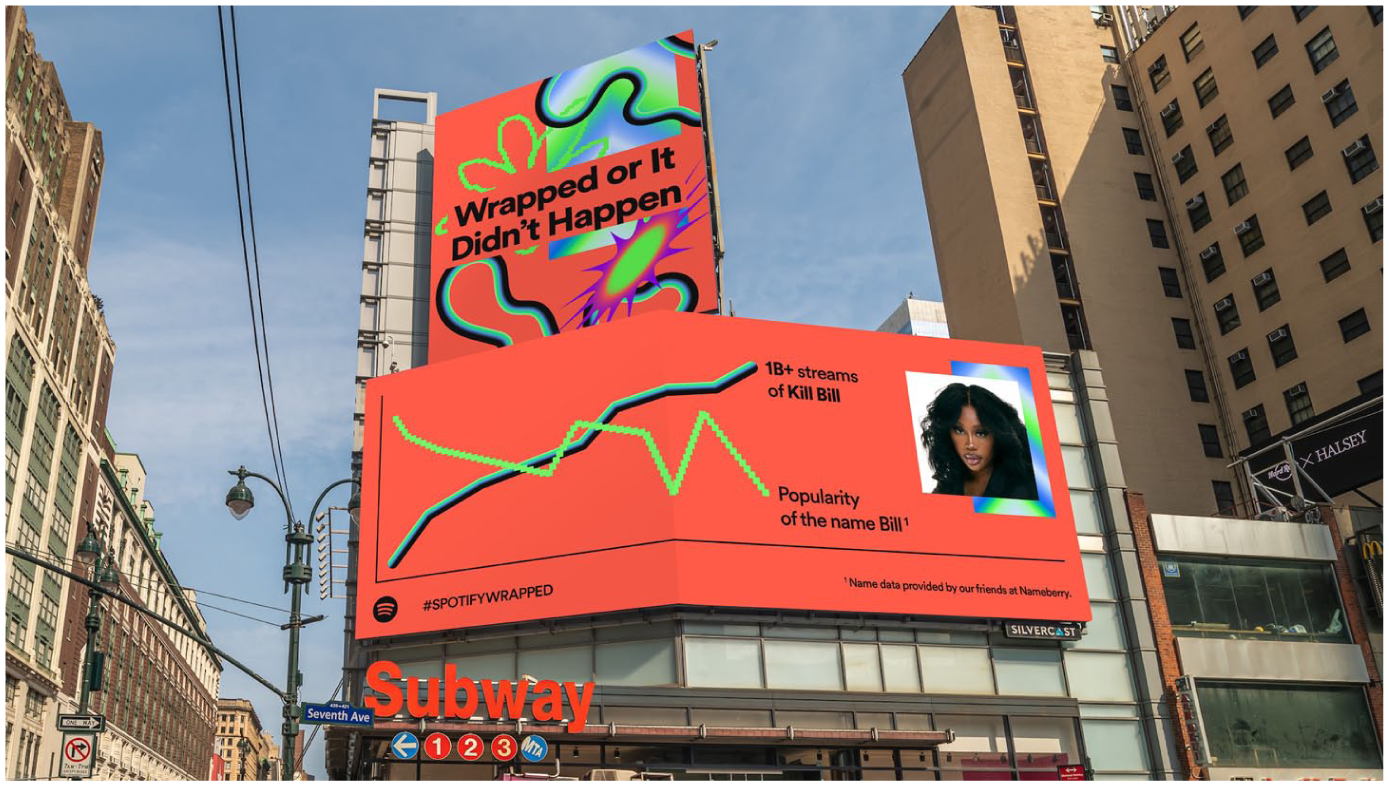
A Wrapped campaign billboard in New York City (Spotify, 2023).
Wrapped has only recently attracted scholarly attention, with early contributions from Burgess et al. (2022) and Valiati et al. (2024) setting the stage for further research. We approach Wrapped as an ‘algorithmic event’, defined as a moment in time when there is a collective orientation towards a particular algorithmic system and its associated data. As Ahmed (2006) theorises, ‘orientation’ captures how bodies are situated in time and space, directing them towards and away from objects and others. In this instance, Spotify users are prompted to reflect on Spotify’s data collection and algorithmic system through the re-presentation of their data. In this sense, it provides an opportunity to ‘re-encounter objects as strange things’ (Ahmed, 2006: 164). We see Wrapped as an outcome of ‘platform capitalism’ (Srnicek, 2016) and ‘datafication’ (Mayer-Schönberger and Cukier, 2013), which provides the infrastructure to make claims about user identity and listening. Wrapped also reflects these broader systems. As such, this algorithmic event is inseparable from the data and algorithmic workings it exposes.
Our findings draw on qualitative data from five creative workshops where 106 university students co-analysed their experiences of Wrapped as an algorithmic event. This collaborative approach seeks to resist the patterns of data extraction that the algorithmic event in question depends on. We do not wish to conflate the operations of platform capitalism and the research community, nor imply their respective approaches to data analysis are analogous. Even so, we intentionally involve users in the interpretation of their data to demonstrate how it can be understood in ways that contrast with the methods of platform companies. Our analysis identifies four themes: the resonance of Wrapped, the limits of the Wrapped self, the ambience of music and contestations of Spotify’s governance. By examining these practices during a prominent algorithmic event, our study adds to ongoing discussions about how music is valued, experienced and understood through classification systems and other platform dynamics.
The logics of algorithmic events
Our theorisation of ‘algorithmic events’ builds on existing interest in media events, predating the arrival of algorithmic culture. For Dayan and Katz (1992), televised historic events offer a ‘sense of occasion’ (p. viii). As they argue, such ceremonial events invite – perhaps even command – large audiences to interrupt their daily routines and collectively engage in the festive viewing of television. Extending this work, Hepp and Couldry (2010) reframe media events within the context of globalised media cultures. Their conceptualisation accentuates the performative nature of media events, which they define as ‘certain situated, thickened, centering performances of mediated communication that are focused on a specific thematic core, cross different media products and reach a wide and diverse multiplicity of audiences and participants’ (p. 12). This approach calls attention to how the media (and other social actors) position themselves as ‘the centre’ to construct reality in ways that serve particular interests and reinforce existing power structures. Crucially, Hepp and Couldry emphasise that the centring performances of media events must be in critical dialogue with people’s everyday appropriation of such events.
In the case of Wrapped, the ‘thickening of media communication’ is driven by the interests of the platform and carefully orchestrated by a group of platform workers drawn from multiple Spotify teams (see The Webby Awards, 2023). Yet, Wrapped as a media event is not restricted to the company’s planning, organisation and communication. Wrapped generates discussion across social media, as indicated by the hashtag #spotifywrapped used in 580 K Instagram posts and 12.7M TikTok posts (as of September 2025), many of which share screenshots of individual data stories. These post counts displayed in the search results of social media platforms offer an indicative snapshot of the shareability of Wrapped. The recirculation of data stories can be understood through ‘templatability’ (Leaver et al., 2020), which describes how aesthetic and vernacular norms developed by influencers and algorithmic recommender systems result in widely replicated content templates. The Wrapped phenomenon follows a similar pattern by providing users with content designed to be posted on social media at the height of the event (see Figure 2). However, Spotify itself, rather than elite users, facilitates and promotes this templatability.
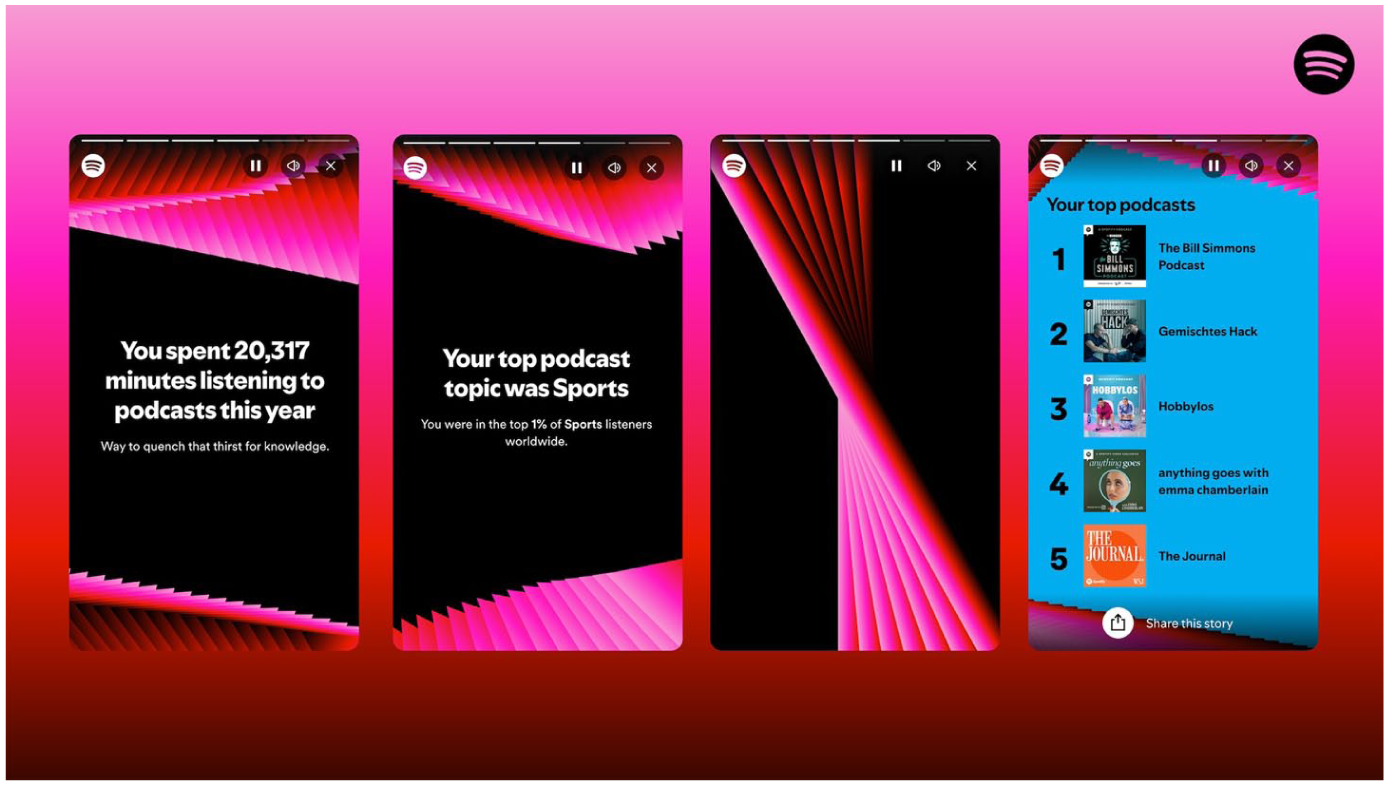
Screenshots of the Spotify Wrapped in-app experience in 2024 (Spotify, 2024).
The viral appeal of Spotify Wrapped has inspired other music platforms to launch annual listening breakdowns. These include ‘Apple Music Replay’ in the United States, ‘Wynk Rewind’ from India-based Wynk Music (now discontinued) and ‘QQ音乐 Wrapped’ from China’s Tencent Music. People, companies and organisations have also adapted the recognisable format and aesthetics. Users have broken down other aspects of their lives by sharing their ‘Dating Wrapped’ (Greene, 2022) or ‘High school Wrapped’ (Press-Reynolds, 2023). Meanwhile, companies like the online bank Monzo and British grocery retailer Tesco have capitalised on the hype by offering customers bespoke data insights through their respective annual ‘Year in Monzo’ or ‘Clubcard Unpacked’ reports.
These instances all speak of how the performances of Wrapped as a media event span audiences and the media ecology. They also exemplify a process we call ‘wrappification’, which involves repackaging behavioural data capturing a specific activity throughout the year, as well as the responses to the belief that we can ‘know’ ourselves in this way. The measurement of user behaviour and classification of identity is determined and articulated within the temporal rhythms of the platform, which renders the datafied self legible. As such, this sociotechnical process rebrands the extraction of data as a mediator of identity and sense-making. It is then through the algorithmic event of Wrapped that the process of wrappification becomes visible to the individual it seeks to interpellate. Ultimately, it is the private governance of Spotify – the ability of platform companies to set the rules and terms that users must abide by (see Klonick, 2018) – that enables wrappification and the staging of the algorithmic event centred on ‘knowing you’.
Wrappification connects with the configuration of the self through ‘personal data assemblages’ (Lupton, 2016), ‘algorithmic identities’ (Cheney-Lippold, 2011) and ‘algorithmic individuation’ (Prey, 2018) as a specific entanglement of algorithms in subject formation. Temporality plays a crucial role in wrappification, since the process is premised on annual patterns of remembrance. As Humphreys (2020: 1673) outlines in her concept of on-this-day media, the ‘temporal structure of the year acts as a social marker of anniversary and remembrance’, exemplifying the mutual shaping of memory and media (see also Van Dijck, 2007). Similar to how the platformisation of memory and annual recaps on social media entrench anniversary mechanisms, wrappification assumes that reflecting on data collected throughout the year holds meaning. As we show in this article, such reflection is sometimes unbound from the top–down structure of platforms. This resonates with research on how users go beyond the articulation of memories by platforms in their performance of digital memory work, justifying everyday practices of content sharing as mnemonically driven (Annabell, 2022).
Using Wrapped as a case study, we argue that algorithmic events represent a distinct form of media event because they emerge from within the platform ecosystem. Unlike traditional media events, algorithmic events have no distinction between occurrence and representation. The event is inseparable from its mediation. For users, the opportunity to actively reflect on data capture and algorithmic systems depends on the performance of the event through these very processes. Wrapped, thus, brings to light the collection and aggregation of user data under platform capitalism through the promotion, circulation and discussion of data stories. This process relies on Spotify extracting and repackaging user data through wrappification, algorithmically operationalising interconnected yet invisible classification systems (for an examination of classification more broadly, see Bowker and Star, 2000).
We argue that algorithmic events expose the dynamics of ‘algorithmic culture’, understood as ‘the use of computational processes to sort, classify, and prioritise people, places, objects, and ideas’ and ‘the repertoires of thought, conduct, expression, and feeling that flow from and back into those processes’ (Striphas, 2023: 5). Our perspective is informed by scholarship on the social power of algorithms and metrics (Beer, 2017), particularly in how people make sense of their affective encounters with algorithms and data (Bucher, 2017; Kennedy and Hill, 2018; Siles et al., 2020). As Bishop (2019) demonstrates, shared narratives and informal speculation about how the algorithms function, also known as ‘algorithmic gossip’, not only affect how people interact with algorithms. They also provide us with what Bucher (2017) refers to as alternative ways of knowing algorithms. We propose that algorithmic events offer a productive entry point to explore how people imagine and approach algorithmic systems. As our study shows, users engage in algorithmic gossip about how Spotify’s recommender system operates in general and how Wrapped might be algorithmically generated.
Music streaming in everyday life
As an algorithmic event, Spotify Wrapped must also be understood in the context of music streaming. Since 2008, the music industry has undergone a process of platformisation, a term that refers to ‘the penetration of infrastructures, economic processes and governmental frameworks of digital platforms in different economic sectors and spheres of life, as well as the reorganisation of cultural practices and imaginations around these platforms’ (Poell et al., 2019: 1). This shift is characterised by the emergence, growth and domination of music streaming platforms that manage an abundance of music content for users through personalisation (Hesmondhalgh et al., 2024). Furthermore, this process is closely linked to datafication, where a phenomenon (in this case, listening behaviour) is quantified and aggregated for predictive analysis (Mayer-Schönberger and Cukier, 2013). As Prey (2018) attests, ‘ways of seeing the individual listener on streaming platforms are heavily influenced by categories that are defined and demanded by advertisers and brands’ (p. 1094). The combination of data-driven user segmentation, recommendation and marketing drives Spotify Wrapped as an algorithmic event: It is a promotional tool for Spotify and ‘personalised’ repackaged user data shaped by classification systems on the platform. As an algorithmic event, Wrapped represents a heightened moment when these mechanisms bubble to the surface, signalling how user listening behaviour is tracked, analysed and monetised.
As Walsh (2024) suggests, ‘music streaming’s affordances and its convergence with social media come to impact the experience of using these technologies’ (p. 749). How music streaming platforms, then, steer users towards particular forms of music consumption has been a concern animating research. For instance, scholars have examined how these services create ‘branded musical experiences’ (Morris and Powers, 2015), promote specific ways of ‘collecting’ music through playlists (Hagen, 2015), introduce new forms of consumer surveillance (Drott, 2018), enhance the gendering of popular music genres (Werner, 2020) and prompt users to negotiate music streaming as both an individual and social experience (Hagen and Lüders, 2017). For Pedersen (2020), data-driven recommendations invite continuous and inattentive engagement with music, or what he joins music scholar Anahid Kassabian in calling ‘ubiquitous listening’. While this mode of listening predates streaming, Pedersen argues that recommender systems actively reduce music to a sonic backdrop accompanying users as they perform other activities. Streaming platforms primarily position music as a functional resource, he suggests, thereby diminishing its potential aesthetic value and the emotional depth evoked through careful contemplation and attentive listening. Similarly, critics have emphasised how streaming platforms curate music for ‘affect management and mood enhancement’ (Anderson, 2015), as exemplified by Spotify’s ‘thematically selected playlists and messages for mornings, afternoons, evenings, and weekends’ (Eriksson et al., 2019: 121).
Rather than treating the functional uses of music in everyday life as separate from aesthetic engagement, Hesmondhalgh et al. (2024) contend that these two dimensions are interconnected. In an ‘aesthetically oriented musical experience’, qualities of beauty and excitement take centre stage: ‘For example, listening to a favorite track or artist and enjoying (and even reflecting on) the way it encapsulates an identity, a sensibility, a set of emotions, a way of being’ (p. 3264). Through a comparative analysis of interfaces, they show how platforms ‘bring aesthetic and functional uses of music together in unprecedentedly explicit ways’ (p. 3272). In a separate study, Hesmondhalgh and Campos Valverde (2024) utilise a diary method and follow-up interviews to examine how users alternate between casual or distracted ‘background’ listening and more intensely attentive ‘foreground’ experiences. Such user studies invite us to move past oversimplified views of platform use that assume uniform listening habits and risk promoting elitist discourse about the ‘right’ ways to listen to music (see also Hesmondhalgh, 2022). As Flynn (2016) theorises, the control users exercise in their music consumption produces listening positions that are distinct and varied. As such, we argue that the algorithmic event also creates space to engage with the complexity of musical experiences in a platform society.
We build on existing insights into the sense-making practices of Spotify users, as examined by Siles et al. (2020), in the context of algorithmic recommendations. They find that some users engage in the personification of Spotify, drawing on ideas about friendship and public behaviour while naturalising surveillance to explain how recommendations work. Other users adopt a more computational vision, positioning Spotify as trainable through feedback loops. These two folk theories are significant in conceptualising the distribution of power between Spotify and users, as well as what actions can be taken. More broadly, they demonstrate a critical, reflexive position in which Spotify is understood as an active mediator. Among what Raffa (2024) terms ‘musically competent users’, the platform infrastructure is also experienced as inherently limiting, but due to a lack of alternatives, users resign to ‘make-do-with’ listening. Building on these insights, we position Spotify Wrapped in our workshops as an opportunity for participants to engage in such platform criticism and remain analytically sensitive to the complexity of music streaming.
In addition, we turn to work on music experience outside of the streaming context to avoid perpetuating a technological determinist perspective. This includes Frith’s (1996) work on music and identity, in which he argues that ‘identity is mobile, a process not a thing, a becoming not a being’ and that ‘our experience of music – of music making and music listening – is best understood as an experience of this self-in-process’ (p. 109). People use music to regulate themselves as aesthetic agents. Based on in-depth interviews, DeNora (1999) examines how people turn to music as a cultural resource to mobilise their ongoing self-construction, as well as the emotional, memory and biographical work such a project entails. This is theorised by Nowak (2016) as ‘role-normative mode of listening’, in which music consumption is understood as a way to regulate individuals’ lives, associating music with moments, activities and affective states in everyday life. As argued by Hesmondhalgh (2008), music also provides people with the opportunity to ‘make connections with each other, to enrich their inner lives, and even in some cases, to enhance a sense of community’. However, he stresses this is ‘constrained, limited and damaged’ due to socio-historical factors and psychological reasons (pp. 341–342). Put differently, it is important to consider the context of people’s lived experiences. This is especially true as we study how music functions in everyday life within a changing landscape, where commercial intervention increasingly relies on algorithmic systems. Because of its focus on listening habits and music consumption through data stories, Wrapped serves as a particularly useful case for understanding how people experience music and exert agency over their listening within the limits of platform capitalism.
Method
Creative workshops provide a dynamic, collaborative space to examine algorithmic events like Wrapped. In an earlier article (Annabell and Rasmussen, 2024), we detail how such workshops can facilitate a range of empirical insights into how people make sense of algorithmic events within the context of the everyday. In particular, we suggest that arts-based methods can promote a more embodied form of knowledge production and meaning-making. Such a ‘data feminist’ approach (D’Ignazio and Klein, 2020) allows participants to critically examine with us the power dynamics, biases and inequalities embedded in data practices. The Spotify (Un)wrapped workshop unfolds in five stages:
Introduction to Wrapped and our conceptual toolkit, including terms like ‘algorithmic gossip’ (Bishop, 2019) and ‘algorithmic imaginaries’ (Bucher, 2017);
Analysis of the latest iteration of Wrapped listening characters;
Production of a visual diagram based on a modified ‘walkthrough’ (Light et al., 2018) of Wrapped or the Spotify interface;
Creation of a collage that responds to Wrapped;
Reflection on the analytical journey of the workshop.
For the second exercise, we provide physical printouts of the listening character cards for participants to analyse. In addition, we invite them to bring along any screenshots or recordings they have of their own Wrapped to help them remember their personalised in-app experience. In line with the feminist emphasis on reciprocity, we also offer our own Wrapped screen recordings as reference materials.
Apart from the final reflection, every element is followed by a short plenary, which we audio-record for subsequent analysis. All exercises centre our participants as co-analysts (see also Markham, 2021; Robards and Lincoln, 2017). This involves recognising the analytical value of participants’ reflective, embodied and creative contributions throughout the workshop. We capture these insights through audio recordings, walkthrough diagrams, creative artefacts (or photographs of artefacts), sticky notes and a small number of video testimonials in which participants explain their analytical and creative processes.
This article presents the results from five 2-hour Spotify (Un)wrapped workshops held at the London School of Economics and Political Science (LSE) in February 2024.The project underwent departmental ethics review at the LSE [Ref: 262076]. We recruited participants through physical flyers distributed across one campus and enlisted other universities in the city to share our registration form through email and social media. Participants gave their informed consent in writing before the workshop.
The 106 participants were undergraduate or postgraduate students at London universities who ranged in age from 18 to 45 years, with a median age of 22. This sample is composed of highly educated individuals, which may inform how they engaged with the workshops. Critically, while they held an interest in Wrapped, their knowledge of algorithmic systems differed, and our interest lay in how platforms like Spotify were located in their everyday lives. Of the participants, 65% identified as women, 27% as men, 2% as non-binary and 6% preferred not to answer this question. With regard to ethnicity, 56% identified as Asian (with the majority selecting Chinese/Chinese British or Indian/Indian British), 21% as white, 7% as Black, 6% as mixed or multiple ethnic groups, 2% as Arab and 1% as Latin American; 7% preferred not to say. During the workshops, these diverse backgrounds helped to foreground discrepancies in user experiences, as participants discussed how factors such as gender and ethnicity influenced their interaction with and interpretation of Wrapped.
Our analytical approach emphasises individual meaning-making situated within group settings. While the group interactions shaped what participants expressed and produced in the workshops, these interactional dynamics are not the primary unit of analysis. The creative artefact exercise served as a culmination of the participants’ analytical journey. Therefore, we used the artefacts as the starting point for our inductive development of themes. We followed the analytical procedures of ‘taking apart participants’ creative work’ developed by Bishop and Kant (2023), examining form and content with a focus on the interplay of iconography, colour and language. In our case, this iterative process involved organising the artefacts into thematic clusters following a reflexive thematic analysis approach (Braun and Clarke, 2019). As part of this process, we identified patterns in the selection of specific artist printouts, colour palettes, symbolic imagery and text (both handwritten annotations and magazine clippings). We then gave each cluster a preliminary name such as ‘datafication of identity’, ‘emotional places’ or ‘fan identity’ (Figure 3). Our positionality as researchers inevitably influenced how we read meaning into participants’ visual choices. For that reason, we triangulated our visual analysis with the other data sources generated during the workshops, including some of the participants’ own explanations of their work, the walkthrough diagrams, sticky notes and audio recordings of plenary discussions. Integrating these various sources into our analysis allowed us to refine, expand and rename the thematic clusters.
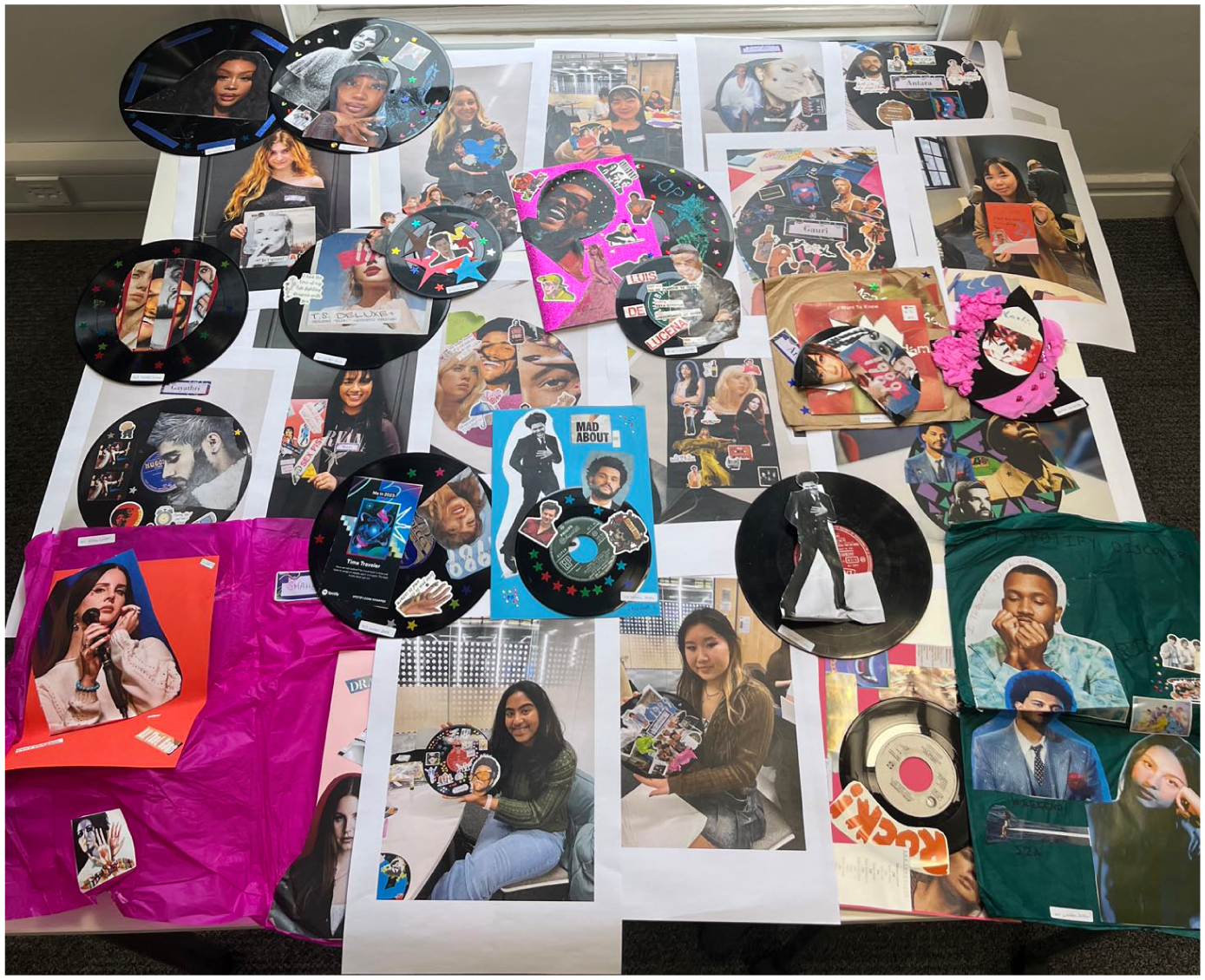
Artefacts grouped, in this case under the topic ‘fan identity’.
In the following section, we present the four overarching themes, which convey how participants engaged with Wrapped as an algorithmic event. Examples from our wide tapestry of empirical data have been selected to illustrate how language, imagery and symbols were employed in meaning-making processes. Wherever possible, we bring in how the participants themselves describe their walkthrough diagrams and creative artefacts, for example, and do not seek to use a dominant reading of their work.
Findings
Our four themes – the resonance of Wrapped, limits of the Wrapped self, ambience of music and contestations of Spotify’s governance – can be situated on two axes (Figure 4). The first axis distinguishes between how participants responded to the algorithmic event through either an affective and embodied or a critical orientation. The second axis separates responses that focus primarily on the Wrapped experience from those that extend to broader topics, especially the aesthetic significance of music in everyday life (what we call ‘ambience’) and how Spotify as a data-driven company intervenes in the music industry and listening experience. Together, these axes reflect how our participants interact with Wrapped, streaming services like Spotify and music listening more broadly. Importantly, these themes are not mutually exclusive. Participants’ contributions often span multiple themes, reflecting the multifaceted nature of their lived experience.
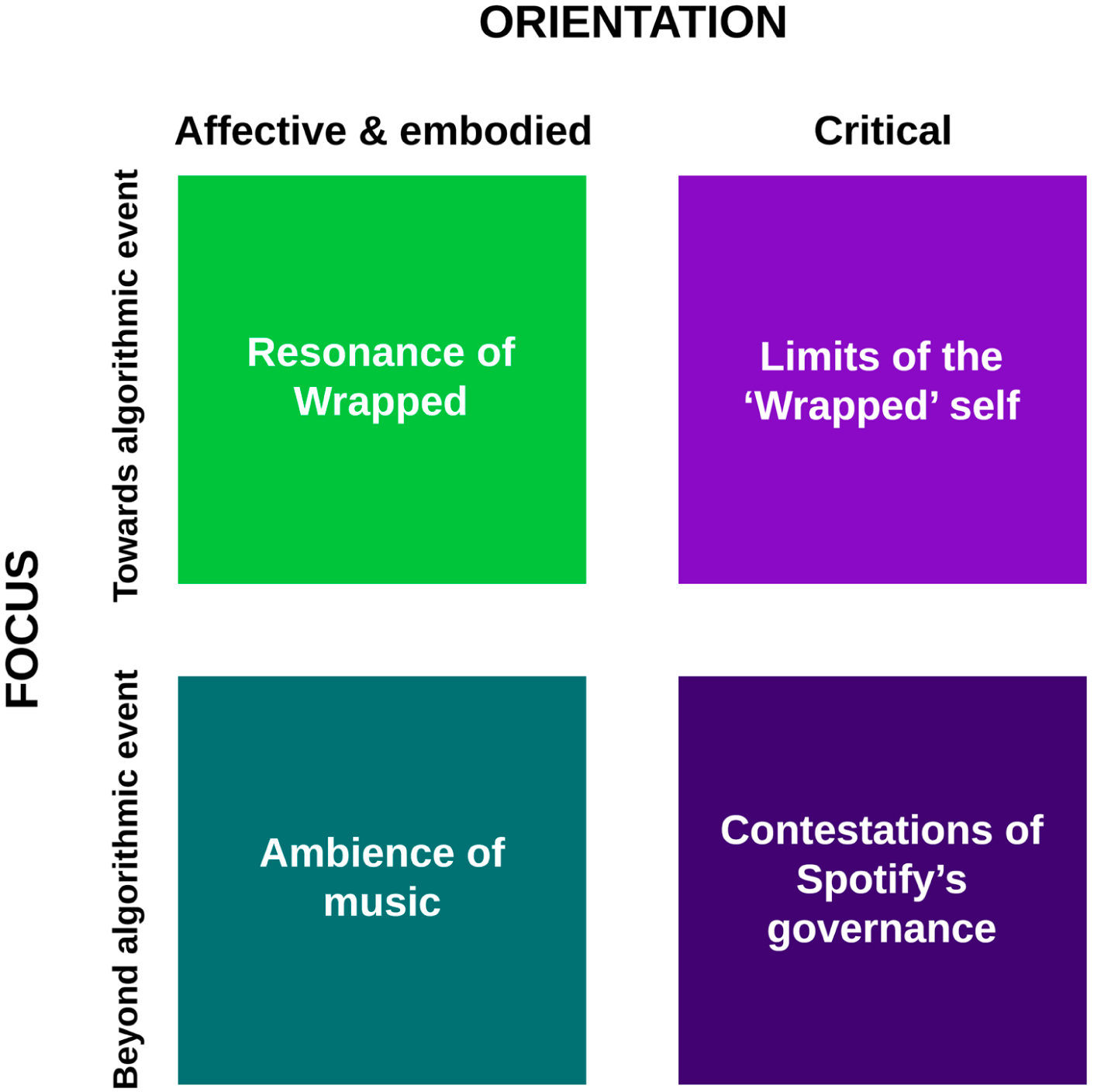
Overview of thematic analysis of participant contributions.
Resonance of Wrapped
Many participants positively responded to Wrapped as an algorithmic event, highlighting that its articulation of the self resonated with their identities, tastes and listening patterns. In such instances, we note how these users reproduce the claim that Spotify ‘knows you’. This is especially evident in how participants used collaging material to produce creative artefacts that echo Spotify’s use of top artists or songs to best represent their listening (e.g. Figure 3), while capitalising on parasocial relationships (see Baym, 2012, for a critical discussion of ‘parasociality’ between musicians and audiences). Such feelings towards categorisation align with the underlying premise of Wrapped: that the self can meaningfully be distilled into data points and located within broader social networks. The design and affordances of Wrapped actively promote this idea by including a ‘share this story’ button on each slide, prompting the user to not only confront their algorithmic identity (Cheney-Lippold, 2011) but also to perform it outside of the platform. It exemplifies the shared experience central to ‘media events’ (Dayan and Katz, 1992).
Some creative responses imitate the ‘templatability’ (Leaver et al., 2020) of Wrapped aesthetics and replicate its phrases and metrics. In these instances, datafication is experienced as enjoyable and affirming. This relates to Kennedy and Hill’s (2018) work on the role of emotions in interpreting data and its visualisation, or what they call ‘the feeling of numbers’. For these participants, the Wrapped metrics resonate as a meaningful form of self-reflection. In this way, we position sharing Spotify data cards on social media alongside creative artefacts produced in workshops that endorse Wrapped and its aesthetics. These responses indicate active and visible expressions of alignment with Spotify’s datafication of the self and the phenomenon of wrappification.
The resonance of Wrapped relies upon practices and literacies that our participants have developed over time. At one level, we view the annotations, use of arrows and drawings in walkthrough diagrams (e.g. Figure 5) as examples of ‘successful’ decoding of Wrapped logics which users have been socialised into recognising. This hints at how the longevity of the algorithmic event feeds into users’ ability to make sense of Wrapped. More critically, we argue that it manifests in how some participants act in the lead-up to the algorithmic event to ensure Wrapped will resonate. The anticipation of Wrapped can sometimes act as a catalyst for individuals to adapt their use of Spotify in an effort to regain autonomy and control over the behavioural data presumed to underpin the data stories. One participant, Tamara (mixed/multiple ethnic group woman), calls it an attempt to ‘resist and manipulate Wrapped to some extent’, noting how she would engineer a ‘cooler’ result due to the social emphasis on Wrapped. In fact, several participants deliberately listen more to their favourite artists to secure a top spot for them. As May (24-year-old woman) explains: ‘You’re handpicking what you listen to, so when you get your data back, everyone can see that your identity is clear. There [are] no accidental listens or anything like that’.
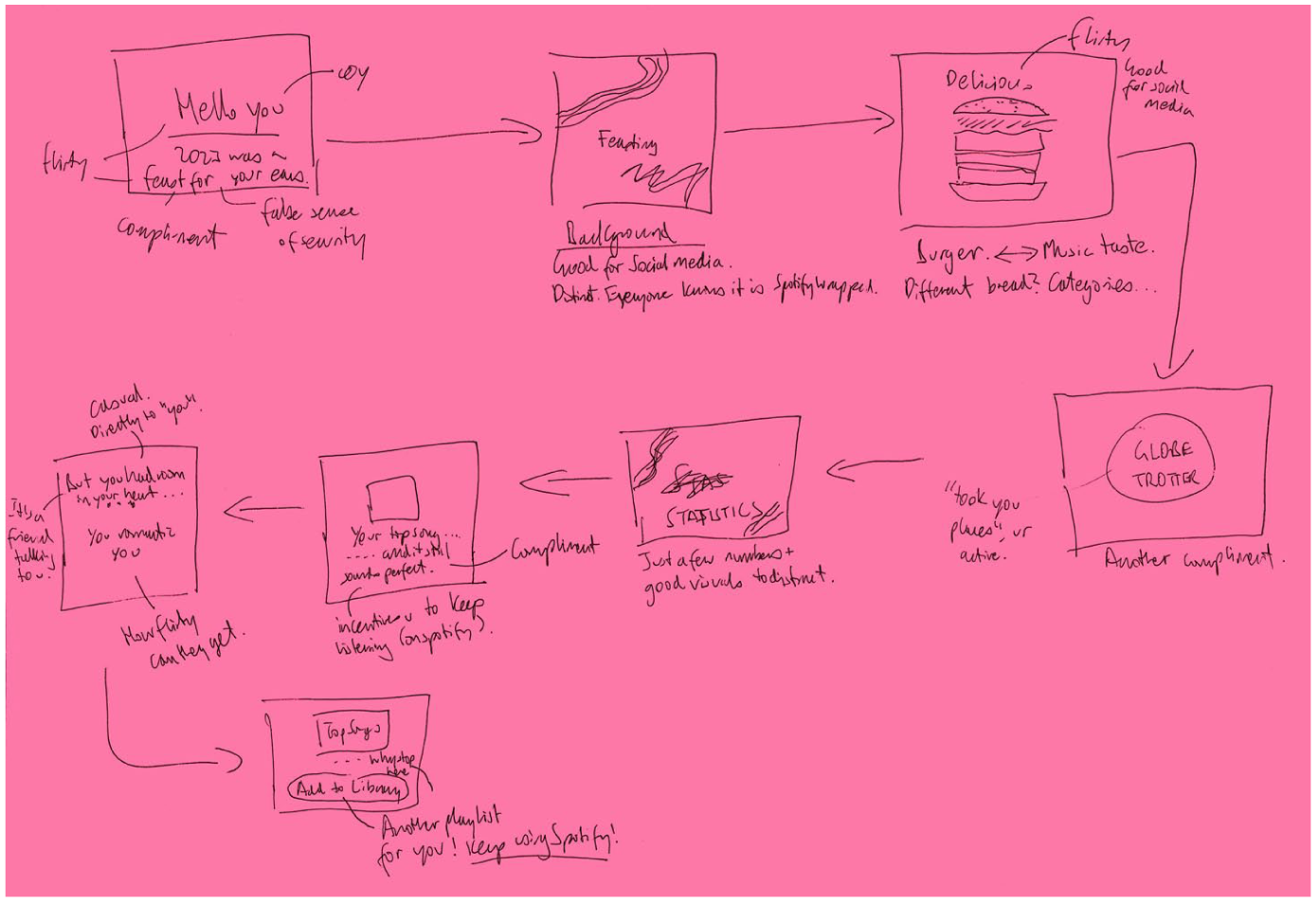
Walkthrough diagram produced during a workshop.
Because Wrapped is perceived as meaningful and revealing, these users purposefully shift their listening habits to align with their desired self-image. However, the pursuit of agency and control over Wrapped exists within how the platform organises and curates these data stories. To influence the expected outcomes of the algorithmic event, users must optimise their listening habits based on how they imagine the platform operates (see also Bucher, 2017). As such, the expectation that results should resonate and feel meaningful can trigger apprehension about what listening habits might be exposed. For some participants, such misalignment between Wrapped and personal self may be perceived as their own shortcoming, thereby privileging the platform as the authority on accurately capturing music listening. Others direct this point of friction back towards the platform and its inherent limitations.
Limits of the Wrapped self
Our second theme explores how participants refute the claim that Spotify ‘knows us’ and that the self can be understood through data. The (in)visible processes of classification (Bowker and Star, 2000) and the tension between user agency and algorithmic authority emerge in the way our participants describe the shortcomings of wrappification. Some participants dispute the accuracy of specific metrics (like top songs), contesting the output but not the underlying logics. Others identify limits due to the platform’s inability to monitor users’ musical engagement beyond its own ecosystem. Our participants also offer normative critiques, highlighting blind spots in how these data stories portray their listening experiences. This includes how music tastes evolve and what songs signify for individuals. Within this theme, we furthermore incorporate responses that address the relationship between individuality and collectivity, which is sometimes seen as an unresolved tension. Here, participants see the personalisation of Wrapped as overstated and reject the notion of the ‘self’ as entirely distinctive from others. Some participants furthermore question the transparency of Spotify’s datafication processes, while others challenge the assumed objectivity of data and the ‘self-evident relationship between data and people’ (Van Dijck, 2014: 199).
Several creative artefacts interrogate Wrapped’s capacity to represent the intricacies of identity and music taste. As Tamara points out, Wrapped omits what she listens to outside of the platform on CDs, which she rectifies by including these artists in her artefact. In another piece, a magazine cutout of the word ‘myself’ is surrounded by handwritten question marks, explicitly questioning the platform’s interpretation (Figure 6). On the back of the artefact, Louise (22-year-old white woman) explains: I decided to merge both my top genres/artists as well as my actual favourite . . . It is not necessarily what I think I listen to the most, as I enjoy Coldplay or more calm music (green material) as well as movie tunes.
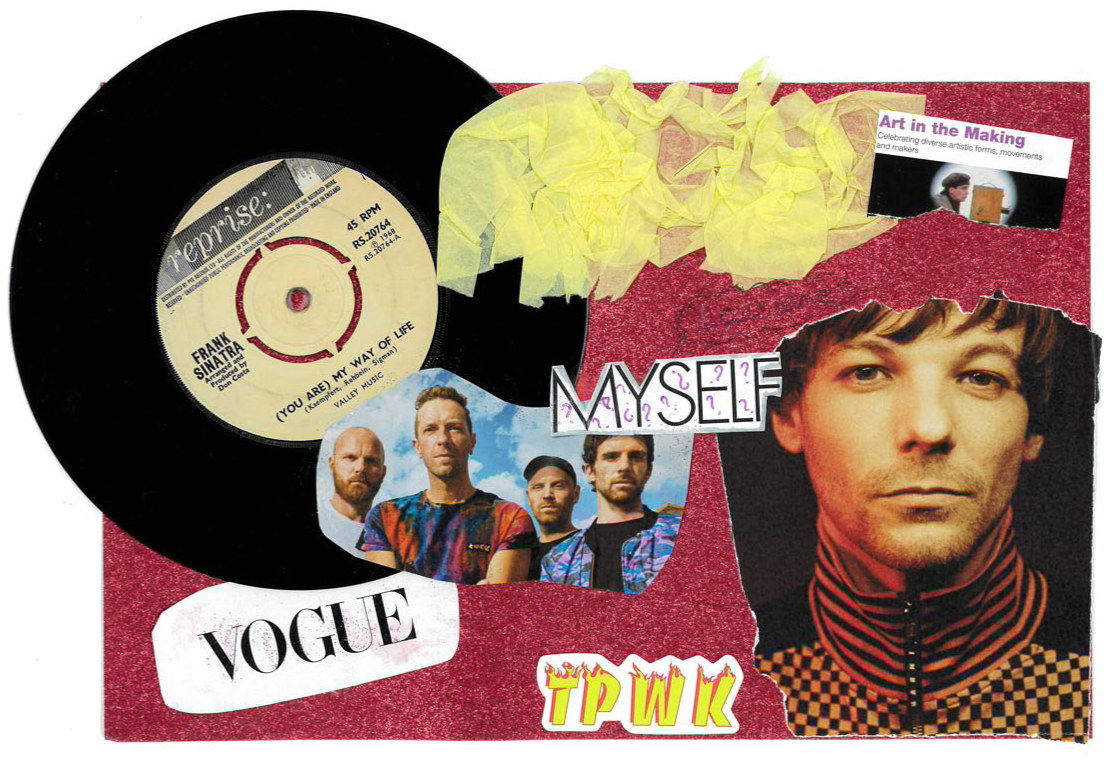
Creative artefact produced by Louise.
Taking back control, thus, entails surfacing other ways of knowing outside of the platform’s data collection.
Some participants argue that Wrapped offers superficial assessments of taste and identity, which are sometimes perceived as humorous. This finding aligns with how many #spotifywrapped tweets reveal glitches between practices and algorithmic logics (Burgess et al., 2022). In our workshops, this critique has particularly targeted Spotify’s classification regime as reductive.
Kael’s (26-year-old Black non-binary person) artefact features torn edges of magazine clippings and printouts of artists, along with the smashed record and layering of materials (Figure 7). It visualises the fragmentation of identity in Wrapped, with the listening character name ‘Mastermind’ literally sliced in half: I was assigned ‘The Mastermind’ card for my music taste . . . I am a master of my mind. I’m essentially rejecting Spotify’s decision to categorise me. I listen to what I want when I want. If that makes me a ‘Mastermind’, so be it, but music shouldn’t be about categorising people. It should be about how it makes you feel.
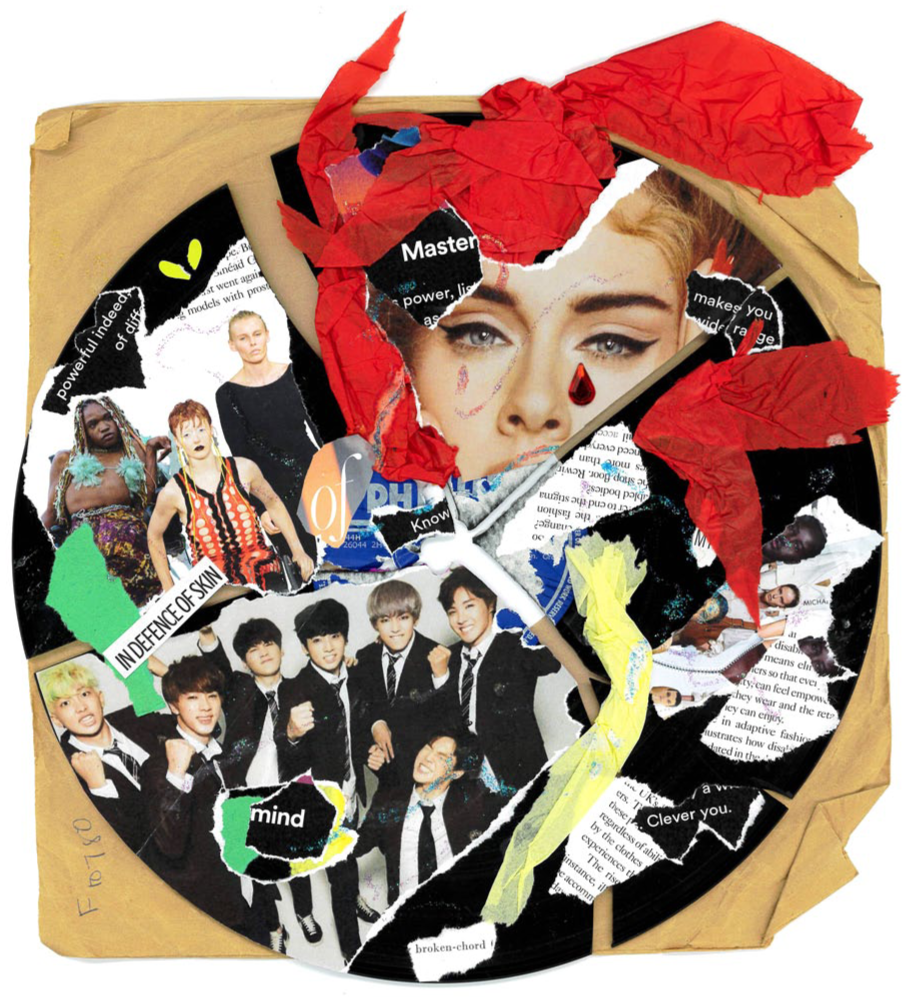
Creative artefact produced by Kael.
Kael asserts autonomy over their listening, emphasising music’s emotional and aesthetic depth, something they believe algorithmic categorisation cannot account for. These limitations were widely discussed during the listening characters exercise where participants analysed the 12 character cards produced for Wrapped 2023, which assigned names and descriptions to music habits. For instance, one group questioned the ‘deciding factors’ between two characters with similar definitions, speculating that the gendered connotation of ‘fanatic’ compared with ‘cyclops’ could indicate that gender contributes to allocation. Across different workshops, participants have framed these characters as reductive and shallow due to their genericity. At times, this has been contrasted with the imagined potential of Spotify to develop sophisticated listening interpretations based on its access to data. Many participants have also drawn connections to other types of classification they are critical of (e.g. MBTI, star signs, tarot cards and Buzzfeed quizzes), noting the use of similar aesthetics and phrases.
Thinking about classification systems led several participants to problematise Wrapped as personalised. In a sticky note reflection, Serena (25-year-old white woman) asks: ‘How, in Spotify’s quest for personalisation, has Wrapped been so uniform or putting people in boxes?’ The promise of ‘personalised understandings of individual users’ within the ‘branded musical experience’ (Morris and Powers, 2015) collapses under the weight of Wrapped’s generic templates, which ultimately render individual musical journeys indistinct. For Anthony (20-year-old white man), claims of uniqueness fall flat once you scrutinise the actual numbers: ‘Often they had the percentages, which I think is quite misleading. You get something that says ‘you’re in 1% of Taylor Swift [listeners]’, but that means nothing, because there are people who have 0.001’. Put differently, such rankings can feel empty and even ‘misleading’ when stripped of essential context.
Ambience of music
Some participants grapple with their relationship to music beyond articulating data and the self within the Wrapped format, which relies on a quantification of listening. Here, analytical and creative engagement with the algorithmic event becomes an opportunity to contemplate the value of music. In many ways, such responses substantiate Hesmondhalgh et al.’s (2024) argument about aesthetic engagement with music on streaming platforms, as users actively reflect on the way music ‘encapsulates an identity, a sensibility, a set of emotions, a way of being’ (p. 3264). In particular, these responses affirm how music is personally experienced and mobilised in self-construction, emotional labour and memory work (DeNora, 1999; Frith, 1996; Pickering and Keightley, 2015). This is presented as inherently positive and beneficial, largely following patterns of academic inquiry in which arguments about music consumption in everyday life downplay negative social processes (Hesmondhalgh, 2008). Nevertheless, such engagements with music are seen as outside the capacity of the Wrapped self, revealing how data points fail to grasp aspects that people consider valuable in their engagement with music on Spotify and in their lives more generally.
To begin with, Erma’s (33-year-old mixed or multiple ethnic groups woman) creative artefact uses her top Wrapped artist as a starting point while incorporating imagery to represent memories and affective connections that nuance the data story. As she explains: ‘What I did here was trying to remember those moments I would hear the songs that are part of my Wrapped. It was basically related to . . . when I was reading, even for university or in my travels’. She considers music as a resource for remembering, which, as Pickering and Keightley (2015) discuss, helps people retain or revitalise their connection to the past in their everyday lives. This is often related to specific events, people and places. For Erma, Wrapped songs serve as a catalyst for recalling where she was listening to music and what she was doing. The word ‘beautiful’ is inserted at the top of her artefact, ‘because I feel it’s the way music always makes me feel. . . . Whenever something is happening or not, it’s something beautiful in my life’. This point also addresses the embodied, affective experience of listening to music.
The ambience of music is similarly depicted in another creative artefact (Figure 8). The absence of images or text that refer to music, songs or artists outside of a grand piano is distinctive. Instead, the layered nature scenes with pastel colours and soft torn edges seem to construct emotional landscapes. As such, the piece taps into ‘qualities of abstractness’ and the experiential nature of music that Frith (1996) argues also resonates with the process of identity-making. Natural imagery is evident in other artefacts within this theme, suggesting a shared visual language that makes affective attachments to music visible. This aesthetic and symbolic expression differs from representation through data or in data stories. As such, it gestures towards a potential particularity of the music experience that resists the logic of quantification and datafication. It also reinforces how the subjective can be situated in the collective, exemplified by a shared understanding of the aesthetic value of music in everyday life.
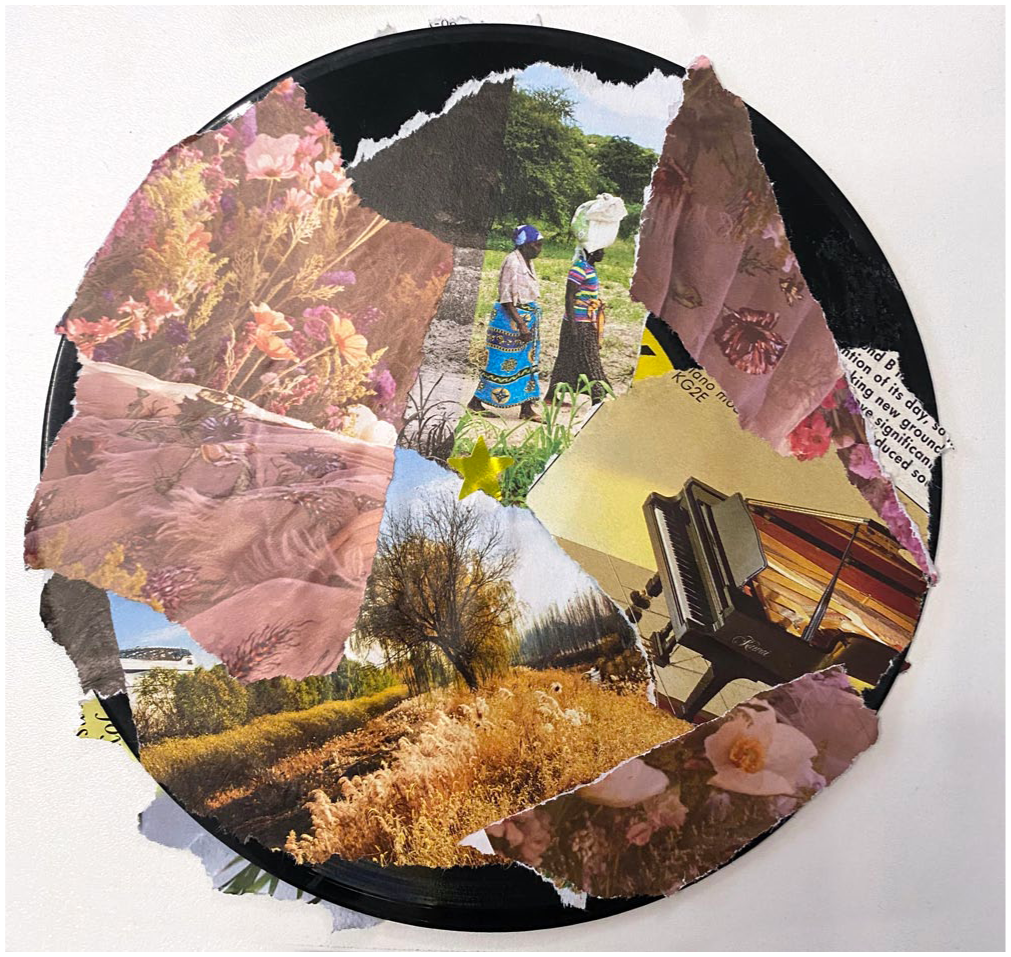
Creative artefact produced by Tamie (Japanese woman).
Contestations of Spotify’s governance
Our fourth theme considers how participants use Wrapped to critique Spotify as a platform company and the processes of datafication and commodification associated with music streaming on both a user and industry level. Specifically, participants contend that Spotify uses Wrapped to direct them towards specific types of engagement. This interpretive work is frequently supported by a type of ‘algorithmic gossip’ (Bishop, 2019) about specific recommendation algorithms. Across the activities in the workshop, one participant explored how the platform as a mediator contributes to the ‘death of the album’, as Wrapped persistently emphasises top songs, artists and genres without revealing listeners’ top albums. His analysis reflects a common interest among our participants in understanding how algorithmic logics shape user experience and incentivise certain behaviours. Another participant recounted how a friend received early access to concert tickets, apparently because Spotify had classified them as a ‘top fan’ based on their listening. By placing users within a hierarchy of fandom, Spotify cultivates a sense of exclusivity and belonging, strengthening their ties not only to the artist but also to the platform. The participant further observed that integrating a ticket purchasing feature within Wrapped underscores its commercial imperative, as the platform transforms fandom into consumer opportunity.
Across the workshops, the exercises prompted participants to consider how Wrapped links to the platformisation of music and culture (Poell et al., 2019). In particular, participants have been critical of the surveillance enacted by Spotify, which is positively repackaged through Wrapped. The artefact produced by Hamdi (20-year-old Arab man) includes the handwritten text ‘Spotify is watchin you’ and images of three individuals’ eyes or faces, each gazing upwards, potentially alluding to the power asymmetry between the platform and its users (Figure 9). The ‘you’, however, is decorated with glitter and star stickers, which signals a playful inflection of Spotify’s interpellation through platform capitalist mechanisms.
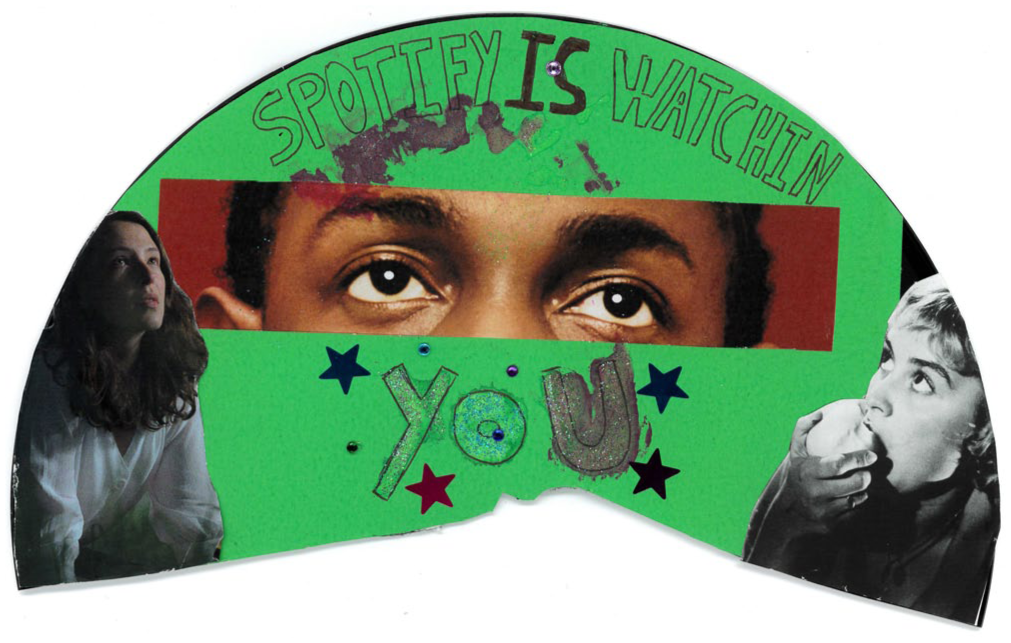
Creative artefact produced by Hamdi.
The rebranding of data extraction is a lingering reflection contributed by sticky notes from two participants: Wrappification: the move towards using data to provide annual summaries of everything is awful – I feel I cannot live without some company telling me my habits/activities. I miss when I could just act without this acute awareness of my own/general trends. Re ‘wrappification’ – is this a strategy to put a positive spin on data colonialism and datafication as consumers become more aware of their danger?
Going beyond the specificity of Wrapped, these participants reflect on their feelings towards algorithmic events, wrappification and their perceived impact. Some are annoyed by the ubiquity of wrappification and how it affects their self-perception, which they consider to be inevitable. In their view, Wrapped contributes to normalising datafication by using language designed to nurture a sense of safety and care. Gabriela (23-year-old Black woman) discusses this point following the walkthrough exercise: ‘The fact that they have all that data on you, they want to give you that comfortable language so you feel more safe’.
The inverse is also raised by another sticky note reflection, which begins with an Edward Snowden quote, followed by ‘Spotify probably knows way more about us than this Wrapped suggests, and somehow it is not problematic to us . . .’ Similarly, Minnie (24-year-old Black woman) expresses a sense of helplessness: ‘I feel like as a user, if I want to “take part” in modern music culture, I am unable to resist Spotify “knowing me”. It’s their user agreement. I let them track me or I don’t use the app’. This underscores how users lack power over the terms of interaction with the company despite a desire for greater control – a condition Draper and Turow (2019) describe as ‘digital resignation’.
Finally, some participants critically examine Spotify as a platform for artists, echoing industry debates about the payment rates and the role of record labels (see Hesmondhalgh, 2021). The identity of Spotify as a business is also part of Austin’s (27-year-old white man) artefact, which addresses three aspects of his understanding of ‘Spotify as a whole’: his relationship with music as ‘a fan of rock and metal music’, the negative impact of Spotify on smaller artists, and metrics as hollow representations for assigning value. It underscores the diverse reactions from our participants: Wrapped can be celebrated and critiqued, resonate and feel shallow, reveal too much and not enough – each of which can be understood as beneficial or concerning.
Conclusion
In a platform society, we are immersed and implicated in datafication practices and algorithmic systems that structure how we consume music, among many other social and personal experiences. This infrastructural layer, we argue, becomes visible each year during the Spotify Wrapped campaign, which presents users with interpretations of their listening data. We contribute the theorisations of ‘wrappification’ and ‘algorithmic events’ to describe the sociotechnical process of identity classification through data extraction within the temporal rhythms of the platform. In particular, we show how this process is made visible through the collective orientation towards the very algorithmic system and associated data collection it relies upon. Algorithmic events function as key sites for examining how datafication shapes the rhythms and ruptures of everyday media routines by directing users towards data objects, to use the language of Ahmed’s (2006) understanding of ‘orientation’. While our focus has been on Wrapped, we consider it an example of a new development within algorithmic culture that warrants further critical investigation into its configuration through and beyond the marketing apparatus of platforms.
In this article, we have explored how 106 participants experience Spotify Wrapped as an algorithmic event. The exercises have sparked nuanced and sometimes contradictory responses from users: They celebrate the Wrapped data stories for positively resonating with people and call out Spotify for oversimplifying and misrepresenting listening experiences. We argue that Wrapped acts as a mirror and a modifier when users tweak their listening behaviour to influence future results. Such strategic engagement demonstrates that Wrapped data stories shape music consumption within and beyond platform affordances. The orientation towards Wrapped also opens up reflections that transcend the algorithmic event. Our participants explore the affective, mnemonic meaning of music consumption, even as they remain aware of how Spotify profits from this data as a platform.
A central thread across the four themes is the negotiation of classification systems. Being assigned to categories through opaque mechanisms can elicit a mix of pleasure, anticipation and powerlessness. Our findings challenge the narrative offered by Spotify, which is that users can ‘know’ themselves through repackaged behavioural data. Yet, this study also unsettles critiques of platforms that overlook the value derived from users’ engagement with platform capitalist systems as well as their agency and literacy. We argue that algorithmic events, such as Wrapped, provide productive entry points for people to reflect on these multiplicities, as they reveal the classification systems that saturate our environment (Bowker and Star, 2000). Our participants recognise the value of belonging to groups, but they also criticise how Spotify employs classifications beyond user control with limited transparency, raising questions about how else their Wrapped identities might be leveraged in the commercial interests of the platform.
The analysis offers insight into perceptions of end-of-year music recaps, which may be experienced differently than those issued by banks, dating apps, supermarkets and other entities. Nevertheless, our results show that the celebratory nature of Wrapped as an algorithmic event contributes to naturalising the data-driven mechanisms of platform capitalism (Srnicek, 2016). We have seen how discussions of Wrapped often progress to questioning recommender systems, data privacy and wider corporate surveillance. As such, the workshops offer space for participants to recognise patterns of datafication in their daily lives by making these processes tangible and personally relevant.
Although the participants belong to different ethnic groups and gender identities, our sample is restricted to university students living in an urban environment. Our participants are largely Spotify users or at least familiar with Wrapped. Future research could explore how wrappification plays out for individuals in different life stages and geographical contexts, as well as across music streaming platforms. In addition, in-depth interviews with users, diary studies and textual analysis of Wrapped social media content could provide alternative methodological approaches for grappling with perceptions and experiences of this algorithmic event.
Further critical research is also needed to understand how users negotiate assertions of identity and personalisation by platforms as they expand their services. Spotify is introducing new variations of repackaged behavioural data as part of everyday music listening. ‘Daylists’, for example, are personalised playlists algorithmically generated for users multiple times a day to match their evolving moods. This extends and capitalises on the success of Wrapped. Both features signal the platform’s process of collecting, processing and repackaging behavioural data. For our participants, however, awareness of such data-driven operations exists alongside – and often in tension with – the embodied, affective experiences facilitated by the platform. Users will likely continue to negotiate these datafied experiences in creative ways, finding meanings and practices that eclipse the algorithmic confines of the platform.
Footnotes
Acknowledgements
We would like to thank our participants from all the Spotify (Un)wrapped workshops for their engagement and insightful contributions, which have greatly enriched our project. We are also grateful to the anonymous reviewers for their constructive suggestions, which have helped us refine our arguments and analysis. Finally, we want to thank the LSE100 team for all their support throughout this project.
Author contributions
Both authors have equally contributed to this article; authorship is in alphabetical order.
Data availability statement
The participants of this study did not give written consent for their personal data and workshop contributions to be disclosed in full or without appropriate contextual framing. Due to the ethical and confidential restrictions of the research, supporting data is therefore not available.
Declaration of conflicting interests
The authors declared no potential conflicts of interest with respect to the research, authorship and/or publication of this article.
Funding
The authors disclosed receipt of the following financial support for the research, authorship and/or publication of this article: This work was supported by LSE100.
Ethical approval and informed consent statements
Departmental ethics approver: Dr Jillian Terry, London School of Economics and Political Science, Ref: 262076.
Consent to participate
All participants in this study were provided with a detailed information sheet explaining the study’s objectives and participant involvement. Following this, participants were given the opportunity to ask questions and seek further clarification. Informed consent was obtained from each participant through the signing of a consent form, confirming their voluntary participation in the study.
Consent for publication
Informed consent for publication was obtained from all participants in writing. The consent confirmed that participants understood their contributions could be used in academic publications, conference presentations and other research outputs. The consent also stated that while participants would be anonymised using pseudonyms in written outputs, they could still be identifiable through images, audio or video. Participants were given the option to opt out of having their contributions photographed or filmed without any negative impact on their participation.
